
Last Updated May 7, 2026
Tipping points, feedback loops, and cascading ecological change sit at the conceptual heart of the planetary boundaries framework because they explain why gradual human pressure can produce abrupt, self-reinforcing, and potentially irreversible Earth-system change. The framework was never intended as a simple inventory of environmental problems. It was designed to identify the biophysical processes whose destabilization could weaken Earth-system resilience and increase the likelihood of major state shifts. That logic depends directly on how tipping dynamics work. A boundary matters not only because pressure is rising, but because the system may respond nonlinearly once thresholds are approached or crossed.
This is what makes tipping dynamics so consequential. Climate systems, forests, coral reefs, hydrological networks, cryosphere components, ocean circulation systems, soil systems, and ecological communities do not always respond proportionally to disturbance. In many cases, systems can absorb stress for extended periods and then reorganize rapidly when critical conditions are reached. Positive feedbacks can intensify that change, while interactions among systems can generate cascading effects across scales. Research on climate tipping elements, ecological thresholds, and interacting regime shifts has made this increasingly clear. Tipping points are not speculative embellishments added to environmental analysis. They are one of the main reasons planetary pressures become civilizationally significant.
Main Library
Publications
Article Map
Planetary Boundaries
Related Article
Safe Operating Space
Related Article
Earth-System Resilience
Related Topic
Systems Thinking

Tipping-point thinking changes the meaning of risk. In a linear system, delay is costly but often manageable because the system responds gradually. In a nonlinear system, delay can be much more dangerous because the system may cross a threshold beyond which return becomes difficult, costly, or impossible on human timescales. That is why tipping points, feedback loops, and cascading ecological change are inseparable from precaution. The problem is not only that damage accumulates. It is that damage can reorganize the system that absorbs damage.
This article examines tipping points, feedback loops, and cascading ecological change by explaining what each concept means, how they relate to resilience thinking and planetary boundaries, why nonlinear change is so important in Earth-system science, how ecological regime shifts unfold, how cascading interactions can amplify risk across domains, why slow variables and fast shocks interact, how early-warning signals can help, and why these dynamics transform the way societies must think about governance, engineering, monitoring, justice, precaution, and long-term stability.
What a Tipping Point Is
A tipping point is a critical threshold at which a small additional disturbance can trigger a large, qualitative change in the state or behavior of a system. The key idea is not simply that the system changes, but that it changes in a way that becomes self-propelling, difficult to reverse, or structurally different from the state that preceded it. In ecological and climate literature, tipping points are often associated with abrupt shifts, but the underlying concept is broader. What matters most is the reorganization of system feedbacks.
This distinction is important because systems do not need to collapse instantaneously to have tipped. A threshold can be crossed quickly while the visible consequences unfold more slowly. In ecological systems, a change in system feedbacks may occur first, while the resulting transformation in vegetation, hydrology, species composition, soil dynamics, fire regimes, or productivity emerges over longer timescales. This is one reason tipping points are often misunderstood. They are not merely dramatic moments of visible collapse. They are points at which the internal logic of the system changes.
In Earth-system science, the term “tipping element” is often used for large-scale components of the Earth system that may pass a tipping point under sufficient forcing. These can include ice sheets, ocean circulation systems, permafrost, coral reef systems, monsoon systems, and major forest biomes. The concept does not mean that every system has the same kind of threshold, the same timing, or the same reversibility. It means that some systems have internal dynamics that can shift from gradual response into self-reinforcing transformation.
The planetary boundaries framework depends on this insight because it treats Earth-system resilience as a condition that can be weakened before collapse is visible. A boundary is not simply a line marking known catastrophe. It is a precautionary guardrail designed to reduce the likelihood that human pressure moves key processes toward destabilizing thresholds.
A tipping point therefore has three parts: a pressure that moves the system toward a threshold, feedbacks that reorganize the system once the threshold is approached or crossed, and a new state that may become difficult to reverse. This triad is what makes tipping points so important. The danger is not only that systems degrade. The danger is that they become organized around a different set of feedbacks.
For planetary governance, the implication is direct: waiting for visible collapse can mean waiting too long. The most important intervention often occurs before the tipping point, when stabilizing feedbacks still have enough strength to preserve recovery capacity.
Feedback Loops and Self-Reinforcing Change
Feedback loops are the mechanisms through which system change either dampens itself or reinforces itself. Negative feedbacks stabilize systems by counteracting disturbance. Positive feedbacks amplify disturbance and can push systems toward accelerated change. Tipping behavior becomes especially dangerous when positive feedbacks begin to dominate over the stabilizing feedbacks that previously maintained resilience.
In Earth-system and ecological contexts, feedbacks are everywhere. Warming can melt reflective ice, exposing darker surfaces that absorb more heat and intensify warming. Permafrost thaw can release carbon dioxide and methane, increasing greenhouse forcing and accelerating further warming. Forest degradation can reduce evapotranspiration, weaken rainfall recycling, intensify drying, and increase the likelihood of further forest loss. Nutrient overload can simplify aquatic ecosystems, reduce oxygen, and reinforce conditions favoring continued ecological degradation. What makes tipping points so consequential is that they often signal a shift from feedbacks that buffer disturbance to feedbacks that amplify it.
Feedback loops also operate across social-ecological systems. Agricultural expansion can fragment forests, reduce rainfall recycling, increase fire risk, and then make additional conversion more likely. Infrastructure development can lock in energy demand, land transformation, and emissions pathways. Financial systems can reinforce extraction if capital continues to flow toward activities that intensify boundary pressure. Feedbacks are therefore not only physical or ecological. They can be institutional, economic, cultural, and technological as well.
This is why feedback loops matter so much for the planetary boundaries framework. Boundaries are not just about cumulative pressure in a linear sense. They are about the possibility that pressure will alter feedback structures in ways that make further change harder to stop. Once that happens, systems can move into self-reinforcing trajectories that no longer respond proportionally to ordinary management.
The distinction between stabilizing and amplifying feedbacks also helps explain why resilience is not merely a matter of strength. A system can appear strong because it resists small disturbances, yet become vulnerable if the feedbacks holding it together are eroding. A forest may remain intact until repeated droughts, fragmentation, fire, and species loss weaken the processes that generate rainfall, protect soils, and enable recovery. At that point, the same system may become fire-prone and self-degrading.
Feedback analysis therefore turns environmental governance into feedback governance. Societies must ask which feedbacks they are strengthening. Are they strengthening forest recovery or fire amplification? Soil regeneration or erosion? Clean energy adoption or fossil lock-in? Biodiversity recovery or ecological simplification? The answer determines whether change becomes stabilizing or self-reinforcing in the wrong direction.
Why Nonlinear Change Matters
Nonlinear change matters because it breaks the assumption that environmental deterioration will unfold gradually, predictably, and reversibly. In a linear world, each increment of pressure would produce a roughly proportional increment of response. In a nonlinear world, systems may appear relatively stable until they approach a critical threshold, after which change accelerates, cascades, or reorganizes the system entirely.
This matters strategically because late intervention is much more dangerous in nonlinear systems than in systems governed by smooth proportional change. If a threshold exists, then waiting for unmistakable signs of breakdown may mean acting only after the system has already shifted into a less resilient state. That is why tipping-point logic strengthens the case for precaution. It is not based on alarmism. It is based on the recognition that systems with thresholds punish delay more harshly than systems without them.
Nonlinearity also complicates measurement. A system may look stable if analysts track only near-term averages, even while underlying resilience is eroding. A lake may remain clear for years while nutrient loads accumulate. A forest may appear intact while drying, fragmentation, and species loss reduce its capacity to recover after fire. An ice sheet may lose mass gradually before dynamic feedbacks accelerate retreat. This means that monitoring must look not only at current state, but at resilience indicators, feedback strength, variability, recovery rates, and exposure to triggering shocks.
For engineers, modelers, and analysts, nonlinear change requires a different design mindset. It is not enough to extrapolate from recent trends. Systems with thresholds require scenario analysis, sensitivity testing, network thinking, early-warning signals, uncertainty ranges, and robust decision-making. A model that assumes smooth proportional change may be precisely the wrong model for tipping-risk analysis.
Nonlinear change also affects communication. Public debate often struggles with systems that appear stable until they are not. A risk may seem remote because visible change is modest, even while the system is losing the capacities that make visible stability possible. Tipping-point thinking therefore requires a public language of latent instability: the idea that the most important damage may be the weakening of recovery before collapse becomes obvious.
This is why planetary boundaries are structured around risk zones rather than exact collapse dates. The goal is not to claim perfect knowledge of every threshold. The goal is to avoid pushing systems into ranges where nonlinear response becomes more likely and less governable.
Ecological Regime Shifts and State Transitions
In ecology, tipping points are often discussed in relation to regime shifts. A regime shift occurs when an ecosystem reorganizes into a different state with different structures, functions, and feedbacks. Lakes can shift from clear-water states to turbid, algae-dominated states. Coral reefs can move toward degraded algal systems. Forests can transition toward more open, fire-prone landscapes. Grasslands and drylands can experience long-lasting reorganizations in vegetation and soil dynamics.
These regime shifts matter because they demonstrate that ecological degradation is not always additive. A system may not simply become somewhat worse in a smooth progression. It may cross into a different regime altogether, one that is less productive, less biodiverse, less resilient, or less capable of recovery. This is one of the central insights linking ecology to planetary boundaries. The problem is not only cumulative loss. It is transformation into qualitatively different states.
Regime shifts are especially difficult to manage because the drivers of change can accumulate slowly while the visible transition occurs abruptly. This is why slow variables are so important. Nutrient accumulation, soil degradation, groundwater depletion, habitat fragmentation, warming, invasive species, and biodiversity erosion may weaken resilience long before the system visibly tips. Once a transition occurs, reversing the original driver may not be enough. The new regime may have its own stabilizing feedbacks.
This dynamic is often described as hysteresis: the path into a degraded state may not be the same as the path out. A lake that becomes turbid may require much larger nutrient reductions to return to clear water than would have been required to prevent the shift. A forest that becomes savanna-like may not automatically recover if rainfall returns. A coral reef that becomes algae-dominated may remain trapped if herbivore populations, water quality, and physical structure are degraded. Tipping points therefore matter because prevention can be far easier than restoration.
Ecological regime shifts also show why biodiversity is a resilience issue rather than only a conservation issue. Diversity, redundancy, and response diversity help ecosystems absorb shocks and recover from disturbance. When species, functions, and habitats are simplified, the system may become more vulnerable to a tipping event. The loss of ecological complexity can therefore be a hidden precondition for abrupt change.
This matters for planetary boundaries because local and regional regime shifts can accumulate into larger Earth-system consequences. A single lake shift may be local; widespread aquatic eutrophication, forest dieback, coral loss, soil degradation, and dryland shifts can collectively weaken climate regulation, food systems, freshwater security, carbon storage, and biosphere integrity. Regime shifts are local in form but planetary in cumulative significance.
Tipping Points in the Earth System
Earth-system tipping points extend this logic to large-scale planetary processes. Climate research has identified major tipping elements such as the Greenland Ice Sheet, the West Antarctic Ice Sheet, Atlantic Meridional Overturning Circulation, Amazon rainforest, boreal forests, permafrost, warm-water coral reefs, and monsoon systems as especially important because they may undergo self-perpetuating change beyond certain thresholds. This does not mean every tipping element has a precisely known trigger, nor that all such changes would unfold on the same timescale. It means there are parts of the Earth system where the risk of abrupt, self-reinforcing change is serious enough to reshape long-term planetary conditions.
The risk is not limited to climate alone. Ecological tipping dynamics can emerge in forests, grasslands, fisheries, coral reefs, freshwater systems, agricultural landscapes, and soil systems. Hydrological shifts can alter vegetation, which alters evapotranspiration, which alters rainfall and fire risk. Biodiversity loss can weaken ecological redundancy, reducing the ability of ecosystems to absorb shocks. Chemical and nutrient pressures can simplify ecosystems and create reinforcing degradation pathways. These are precisely the kinds of interactions that make planetary boundaries more than isolated environmental indicators.
The 2025 Global Tipping Points Report emphasizes that Earth-system tipping points pose distinct governance needs because they can create profound and hard-to-reverse risks for societies, economies, and ecosystems. That framing is important because tipping points are not only scientific curiosities. They define planning problems for adaptation, disaster risk, food systems, infrastructure, finance, insurance, public health, and international cooperation.
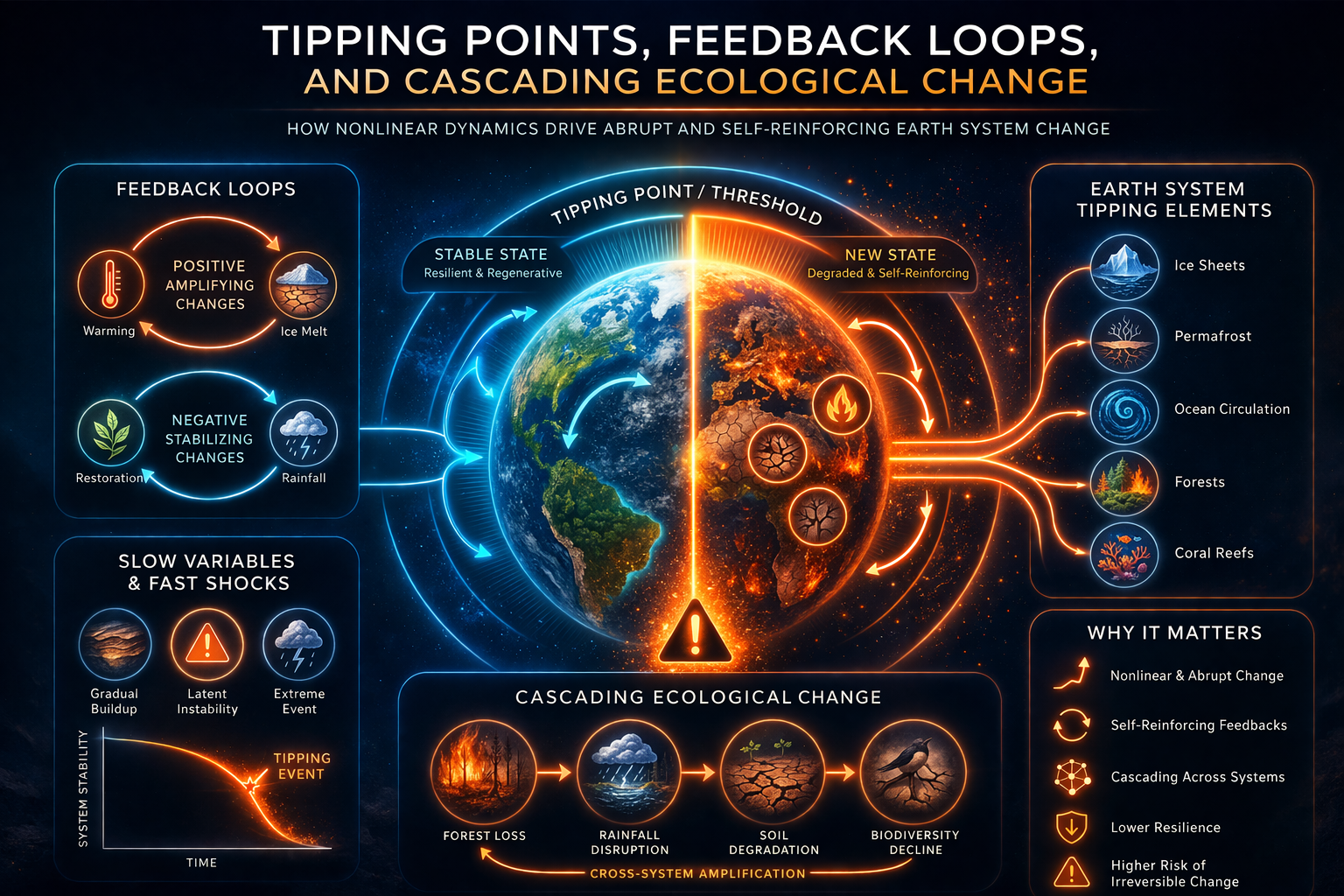
This is where tipping points become especially important to the planetary boundaries framework. Boundaries matter because they are meant to reduce the probability of entering the conditions under which such Earth-system tipping becomes more likely. The framework is therefore not simply about keeping pressures below arbitrary ceilings. It is about preserving resilience before threshold-driven reorganization becomes more probable.
Earth-system tipping points also have unequal consequences. Ice-sheet instability would reshape coastlines, insurance markets, infrastructure planning, displacement risk, and fiscal burdens. Rainforest dieback would affect biodiversity, rainfall recycling, carbon storage, Indigenous territories, agriculture, and regional climate stability. Coral reef collapse would affect marine biodiversity, fisheries, tourism, food security, and coastal protection. These are not distant scientific scenarios. They are material conditions for human security and ecological continuity.
The governance challenge is that many tipping elements respond to cumulative pressure over long periods, but the political systems responsible for reducing pressure often operate on short time horizons. This mismatch between Earth-system timescales and institutional timescales is one of the deepest reasons tipping points are so difficult to govern.
Cascading Change Across Systems
Cascading change occurs when disruption in one system increases the likelihood of disruption in another. This is one of the most important developments in recent resilience and Earth-system research. Tipping elements and regime shifts do not necessarily remain isolated. One destabilized system can alter the background conditions of another, producing chains of amplification or interconnected transitions.
Research on cascading regime shifts has shown that these cascades can take several forms. One regime shift may create a one-way dependency that makes another shift more likely. Alternatively, hidden feedbacks can link systems more reciprocally, creating two-way reinforcing interactions. In Earth-system terms, this means climate change, land transformation, freshwater disruption, biosphere decline, nutrient overload, aerosol loading, and other boundary processes can interact not only additively but dynamically.
This matters because the planetary boundaries framework is explicitly concerned with interactions among boundaries. A transgression in one domain may shrink the safe operating space in another. Climate change can weaken biosphere integrity. Land-system change can intensify hydrological disruption. Freshwater change can reduce ecosystem resilience. Biogeochemical flows can degrade aquatic systems and coastal zones. Novel entities can weaken ecological and physiological systems in ways that are difficult to predict. Cross-boundary interaction is therefore not a secondary complication. It is one of the main reasons system-wide destabilization can accelerate more quickly than single-issue analysis would suggest.
Cascading risk is also a governance challenge. Most institutions are organized by sector: climate, water, land, biodiversity, agriculture, infrastructure, finance, health, or disaster response. Cascades do not respect those boundaries. A drought may become a food-price shock, which becomes a political-stability problem, which becomes a migration issue, which becomes a fiscal and security issue. Ecological cascades can therefore propagate into social and economic cascades. That is why planetary-boundary thinking requires systems governance rather than isolated environmental management.
Cascades also change the meaning of preparedness. A society may be prepared for a flood but not for a flood that coincides with crop failure, disease risk, infrastructure failure, debt stress, and political instability. A coastal city may prepare for sea-level rise but not for simultaneous heat stress, insurance withdrawal, food-price volatility, and migration pressure. A forest-management system may prepare for fire but not for the combined effects of heat, drought, pest outbreaks, invasive species, and weakened governance capacity.
For companion essays, see Climate Change as a Planetary Boundary, Biosphere Integrity and the Stability of Life Systems, Freshwater Change and Earth System Risk, Land-System Change and Ecological Transformation, Biogeochemical Flows: Nitrogen, Phosphorus, and Planetary Destabilization, and Novel Entities and the Problem of Synthetic Overload.
Slow Variables, Fast Shocks, and Latent Instability
One of the deeper insights from resilience thinking is that systems are often shaped by slow variables as much as by fast shocks. Slow variables are gradually changing background conditions such as soil degradation, warming trends, biodiversity erosion, groundwater depletion, nutrient accumulation, forest fragmentation, permafrost warming, declining ecological redundancy, or the slow weakening of governance capacity. Fast shocks are events such as droughts, fires, floods, storms, pest outbreaks, heat waves, or pollution pulses. Tipping behavior often emerges when slow variables have already weakened resilience and fast shocks then trigger visible transition.
This is important because tipping points do not arise from nowhere. They are often prepared by long periods of latent instability. A forest does not necessarily tip because of a single fire alone. It may tip because years of warming, drying, fragmentation, and ecological simplification have already undermined resilience, and the fire acts as the triggering event. A lake may not shift because of one runoff event alone, but because nutrient accumulation has made it vulnerable. A coral reef may not collapse because of one heat wave alone, but because repeated bleaching, pollution, overfishing, and acidification have reduced recovery capacity.
The slow-fast interaction helps explain why tipping points can appear sudden even when their underlying causes have been accumulating for decades. It also explains why policy systems often respond too late. Political attention is drawn to the shock, but the deeper problem may be the slow erosion of resilience that made the shock transformative. A governance system focused only on crisis response will repeatedly miss the background variables that create tipping risk.
For monitoring systems, this means dashboards should track both pressure and resilience. Temperature, nutrient loads, forest cover, soil moisture, groundwater levels, species richness, functional diversity, fire frequency, hydrological variability, and recovery time after disturbance may all matter. A serious tipping-risk system must ask not only what event occurred, but whether the system’s capacity to absorb events is weakening.
Slow variables are often politically inconvenient because they do not always generate immediate crisis. Soil degradation, aquifer depletion, biodiversity loss, permafrost warming, and institutional decay can be invisible to short-term accounting. But slow variables shape the possibility space within which shocks operate. They determine whether a shock is absorbed, amplified, or transformed into a regime shift.
The lesson is practical: resilience governance must monitor the background conditions that make shocks dangerous. Without that, societies will repeatedly treat tipping events as surprises even when the conditions that made them possible were accumulating in plain sight.
Early-Warning Signals and Critical Slowing Down
Because tipping points are difficult to predict exactly, researchers have developed methods for detecting early-warning signals. One important concept is critical slowing down: as a system approaches a threshold, it may recover more slowly from perturbations. This can appear statistically as rising autocorrelation, increasing variance, changing spatial patterns, or longer recovery times after disturbance. These signals are not perfect, but they can help identify systems whose resilience is weakening before a visible transition occurs.
Early warning is especially valuable because tipping points are often easier to prevent than reverse. If a system has already shifted into a new regime, restoration may require stronger intervention than prevention would have required. Detecting declining resilience therefore has enormous value for governance, conservation, climate adaptation, infrastructure planning, and risk management.
At the same time, early-warning signals must be interpreted carefully. Not all systems produce clear signals. Some signals may be masked by noise, changing external drivers, insufficient data, or multiple interacting variables. False positives and false negatives are possible. A responsible monitoring framework should therefore combine statistical early-warning indicators with process understanding, field observation, local knowledge, scenario modeling, and precautionary judgment.
This is where engineering and data infrastructure become essential. Detecting tipping risk requires long-term observations, sensor networks, satellite data, ecological monitoring, climate records, hydrological data, model outputs, and transparent analytics pipelines. The point is not to promise perfect prediction. It is to improve the ability to see resilience loss before it becomes irreversible.
Early-warning systems also require institutional response. A warning signal is not useful if no one has authority to act, if funding is unavailable, if political incentives reward delay, or if affected communities lack power in decision-making. Monitoring is only one part of tipping-risk governance. The larger challenge is connecting knowledge to action before thresholds are crossed.
This is why early warning should be understood as a governance system, not only a technical system. It includes data, models, thresholds, uncertainty, communication, institutions, responsibility, and trust. A society that detects tipping risk but cannot respond to it has not solved the problem. It has only documented the approach of danger.
Planetary Boundaries and Escalating Risk
The planetary boundaries framework is best understood as a way of governing escalating risk in systems where tipping points and cascades are possible. Boundaries are not deterministic claims that crossing one number automatically produces collapse. They are precautionary guardrails meant to reduce the likelihood that key Earth-system processes enter zones where self-reinforcing change becomes more probable.
This is why the framework emphasizes safe operating space rather than certainty about exact collapse points. The scientific challenge is not to predict every tipping event with mechanical precision. It is to identify the ranges within which resilience is more likely to be preserved and beyond which the risk of threshold-driven reorganization becomes harder to ignore. Tipping points, feedback loops, and cascades therefore provide the conceptual logic for why the framework is structured as it is.
Escalating risk also means that boundary transgressions should not be interpreted independently. A boundary process under pressure may be more dangerous when another boundary is also under pressure. Climate change can intensify fire and drought, which can weaken forests, which can reduce carbon uptake, which can further intensify climate change. Nutrient overload can degrade freshwater and marine systems, weakening ecological resilience. Land conversion can disrupt hydrology and biodiversity simultaneously. In a coupled Earth system, the risk is often in the interaction.
Planetary boundaries therefore act less like isolated speed limits and more like a system of resilience constraints. Crossing one may reduce the room for maneuver in others. This is why safe operating space is not simply a set of nine independent ceilings. It is an integrated risk concept for a complex Earth system.
The escalating-risk interpretation also clarifies why boundary transgression is not only a measurement problem. It is a time problem. The longer a pressure remains beyond a boundary, the more it can weaken resilience, trigger feedbacks, and interact with other pressures. A temporary excursion near a boundary is different from persistent overshoot. Duration, magnitude, interaction, and recovery capacity all matter.
| Risk dynamic | What it means | Planetary-boundary implication |
|---|---|---|
| Threshold proximity | A system approaches a zone where small additional pressure can produce large change. | Boundaries should preserve distance from uncertain thresholds. |
| Positive feedback | Change reinforces itself and accelerates further change. | Risk may grow faster than direct pressure alone suggests. |
| Hysteresis | The pathway back from a degraded state differs from the pathway into it. | Prevention may be far easier than restoration. |
| Cascade pressure | Change in one system raises risk in another system. | Boundary interactions must be monitored and governed together. |
| Critical slowing down | Recovery after disturbance becomes slower as resilience weakens. | Early-warning systems should track recovery capacity, not only state variables. |
The planetary boundaries framework therefore turns tipping dynamics into governance logic: reduce pressure early, preserve buffers, monitor resilience, and act before nonlinear change reduces the freedom to choose.
Justice, Vulnerability, and Unequal Cascades
Tipping points and cascading ecological change are justice issues because their consequences are not distributed equally. The communities most exposed to drought, flood, heat, food insecurity, wildfire smoke, coastal erosion, water stress, disease risk, and ecological degradation are often not the communities most responsible for creating planetary pressure. A tipping event may be described at Earth-system scale, but it is experienced through highly unequal geographies of vulnerability.
Sea-level rise from ice-sheet instability would not affect all coastlines equally. Wealthier regions may build defenses, insure assets, relocate infrastructure, or access recovery funding. Poorer communities may face displacement, land loss, cultural loss, debt burdens, and weakened political bargaining power. Rainforest dieback would affect Indigenous peoples, local communities, biodiversity, regional rainfall, and global carbon dynamics, but the benefits of forest conversion often flow to distant markets. Coral reef collapse would harm marine life and coastal protection, but also fishing communities, tourism-dependent economies, and cultures tied to reef ecosystems.
Cascading risk intensifies inequality because one shock can trigger many burdens at once. A heat wave may coincide with crop failure, electricity demand, health-system strain, water scarcity, labor loss, and food-price inflation. A drought may cascade through agriculture, hydropower, debt, migration, and political instability. A flood may contaminate drinking water, damage housing, disrupt schooling, spread disease, and destroy livelihoods. Vulnerability is rarely single-dimensional.
Justice therefore changes the meaning of tipping-risk governance. It is not enough to identify thresholds. Societies must ask who is exposed, who has adaptive capacity, who receives warning, who can move, who has insurance, who is ignored by monitoring systems, and who participates in decisions. Without those questions, tipping-point governance can become technocratic while leaving the most vulnerable unprotected.
Intergenerational justice is also central. Tipping points can impose long-lived or effectively irreversible burdens on future generations. Ice-sheet loss, biodiversity collapse, permafrost carbon feedbacks, coral reef degradation, and rainforest dieback can narrow the options available to people who did not create the pressure. This makes delay a moral issue as well as a scientific issue.
A just approach to tipping dynamics must therefore combine pressure reduction, adaptation support, Indigenous and local knowledge, community participation, loss-and-damage recognition, transparent monitoring, and protection for those most exposed to cascading harm. Resilience without justice can become a demand that vulnerable people endure more. Justice without resilience can become a promise with no ecological foundation. The planetary challenge requires both.
Positive Tipping Points and Transformative Change
Tipping-point thinking is not only about danger. It can also describe beneficial transformation. Positive tipping points occur when social, technological, economic, or institutional changes become self-reinforcing in ways that accelerate transition toward safer and more just systems. Renewable energy adoption, electric mobility, energy storage, clean cooking, regenerative land practices, ecosystem restoration, circular material systems, and shifts in public norms can all display tipping-like dynamics under the right conditions.
This distinction matters because planetary-boundary governance cannot be only defensive. Societies need to prevent destructive Earth-system tipping while deliberately enabling positive social and technological tipping. The question is not whether systems will transform. They will. The question is whether transformation will be driven by ecological breakdown or by intentional changes that reduce pressure and restore resilience.
Positive tipping points often depend on feedbacks similar in structure to harmful tipping points, but directed toward better outcomes. Falling costs can increase adoption, adoption can drive learning, learning can reduce costs further, and policy support can accelerate the cycle. Social norms can change when visible adoption makes new behavior seem normal. Infrastructure can make low-carbon choices easier, which increases use, which strengthens political support for further investment. These are feedback loops of transformation.
However, positive tipping should not be treated as automatic optimism. Beneficial tipping requires policy design, finance, institutional support, justice, public legitimacy, and attention to unintended consequences. A transition can accelerate while reproducing inequality if benefits and burdens are distributed unfairly. It can also create new material pressures if clean technologies depend on extractive supply chains without strong governance. Positive tipping must therefore be embedded in planetary-boundary and justice analysis.
The strategic lesson is that societies should reduce negative tipping risk and accelerate positive tipping capacity at the same time. That means phasing down fossil fuels, protecting ecosystems, restoring degraded lands, redesigning food systems, strengthening monitoring, investing in public goods, and making clean, resilient systems easier to adopt than destructive ones.
In this sense, tipping-point thinking does not only warn against collapse. It also identifies leverage. If feedbacks can accelerate harm, they can also accelerate repair. The task is to shift the direction of self-reinforcing change.
Governance, Engineering, and Monitoring Implications
If ecological and Earth-system change can be nonlinear, self-reinforcing, and cascading, then governance cannot be organized solely around reactive management after damage becomes obvious. It must become more anticipatory, more precautionary, and more attentive to slow variables, interaction effects, and resilience erosion. This requires different institutional habits than those associated with narrow sectoral optimization or short-term crisis response.
The governance challenge is especially difficult because tipping dynamics are often uncertain in timing even when the risk is credible in structure. That uncertainty does not eliminate responsibility. It heightens it. In systems where delay can lock in self-reinforcing change, prudence requires preserving buffers and avoiding unnecessary pressure even before every threshold is perfectly known. This is one of the clearest ways in which planetary-boundary thinking reshapes policy logic.
Engineering systems also need to adapt to tipping-risk logic. Infrastructure, monitoring platforms, early-warning systems, environmental sensors, scenario models, data pipelines, and decision-support tools should be designed for nonlinear risk rather than smooth extrapolation alone. That means building systems that can track leading indicators, detect anomaly patterns, simulate cascade scenarios, preserve data provenance, update thresholds, and communicate uncertainty clearly.
For governance, the practical implications are direct: reduce pressure before thresholds are approached, protect ecological buffers, monitor slow variables, strengthen adaptive capacity, avoid lock-in, and design institutions capable of responding to weak signals. For engineering, the implication is equally clear: build observability into planetary-risk systems so that resilience loss becomes visible before crisis becomes irreversible.
Monitoring systems should also be open and accountable. If tipping-risk analytics are opaque, they can create false certainty or become inaccessible to the communities most affected by risk. Transparent assumptions, uncertainty ranges, public data, reproducible workflows, and community-accessible warning systems matter because tipping risk is not only a technical problem. It is a public decision problem.
For adjacent essays, see Earth System Governance in an Age of Limits, Environmental Monitoring Systems, Business Strategy Within Planetary Boundaries, and Finance, Disclosure, and Systemic Environmental Risk.
Why This Matters for Planetary Boundaries
Tipping points, feedback loops, and cascading ecological change matter because they explain why planetary risk is not a simple matter of incremental deterioration. Complex systems can absorb stress for long periods and then reorganize rapidly when critical conditions are reached. Positive feedbacks can amplify change, and interactions across systems can propagate disruption beyond its original domain. This is one of the central reasons the planetary boundaries framework exists: to reduce the likelihood that human pressures push Earth-system processes into zones where destabilization becomes self-reinforcing.
To understand planetary boundaries seriously is therefore to understand tipping dynamics seriously. The deepest danger is not only that environments are being degraded. It is that resilience may be eroding in ways that make abrupt, cascading, and difficult-to-reverse change more likely. That is what gives tipping points and feedback loops their enduring significance in Earth-system science and planetary governance.
The practical implication is clear: societies need to reduce pressure before thresholds are approached, monitor slow variables, protect resilience, detect early-warning signals, and build institutions that can act under uncertainty. In a nonlinear Earth system, waiting for perfect certainty can mean waiting until the most important choices have already disappeared.
This matters because planetary boundaries are not only a scientific map. They are a warning about timing. The most important decisions are often made before catastrophe becomes visible, before feedbacks dominate, before cascades spread, and before restoration becomes vastly more difficult than prevention. Tipping-point thinking therefore gives the framework its urgency.
It also gives the framework its hope. If harmful feedbacks can accelerate decline, beneficial feedbacks can accelerate transformation. The task is to prevent destructive tipping while creating the conditions for positive tipping toward resilience, justice, ecological restoration, and durable human development.
Mathematical Lens: Thresholds, Feedbacks, and Cascading Risk
Tipping dynamics can be represented with simple threshold and feedback models. Let \(x_t\) represent the state of an ecological or Earth-system component at time \(t\), and let \(p_t\) represent external pressure, such as warming, nutrient loading, land conversion, or freshwater stress. A simplified state update can be written as:
x_{t+1} = x_t + f(x_t, p_t) – r(x_t)
\]
Interpretation: The future system state depends on the current state, destabilizing pressure and feedbacks, and stabilizing recovery processes.
A tipping point occurs when destabilizing feedbacks begin to exceed stabilizing recovery capacity near a critical threshold \(T\):
f(x_t, p_t) > r(x_t) \quad \text{as} \quad x_t \rightarrow T
\]
Interpretation: The system becomes vulnerable when reinforcing change becomes stronger than recovery capacity near the threshold.
A pressure ratio can be defined as:
R_t = \frac{p_t}{T}
\]
Interpretation: If \(R_t < 1\), pressure remains below the estimated threshold. If \(R_t \geq 1\), the system has reached or exceeded the estimated tipping threshold.
Because thresholds are uncertain, a precautionary version can include uncertainty \(\sigma_T\):
T_p = T – k\sigma_T
\]
Interpretation: \(T_p\) is a precautionary threshold. A larger safety-margin parameter \(k\) creates a more conservative guardrail before the estimated tipping threshold.
Cascading risk can be represented as a network. Let \(A_{ij}\) represent the influence of tipping element \(i\) on tipping element \(j\). If \(s_i\) is the state of element \(i\), where \(s_i = 0\) indicates not tipped and \(s_i = 1\) indicates tipped, then the cascade pressure on element \(j\) can be written as:
C_j = \sum_{i=1}^{n} A_{ij}s_i
\]
Interpretation: Cascade pressure rises when connected systems have already tipped or moved into destabilizing states.
The probability that element \(j\) tips can be modeled with a logistic function:
P(s_j = 1) = \frac{1}{1 + e^{-(\alpha p_j + \beta C_j – \theta_j)}}
\]
Interpretation: Tipping probability rises with direct pressure and cascade pressure, while \(\theta_j\) represents the threshold and \(\alpha\), \(\beta\) weight direct and cascading effects.
| Term | Meaning | Interpretive role |
|---|---|---|
| \(x_t\) | System state at time \(t\) | Represents ecological, climate, hydrological, or social-ecological condition. |
| \(p_t\) | External pressure | Represents warming, pollution, land conversion, freshwater stress, or another forcing. |
| \(T\) | Estimated tipping threshold | Marks a critical transition zone. |
| \(T_p\) | Precautionary threshold | Builds uncertainty and safety margin into governance. |
| \(A_{ij}\) | Interaction weight | Represents how one tipping element affects another. |
| \(C_j\) | Cascade pressure | Represents network pressure from already destabilized systems. |
| \(\theta_j\) | Tipping threshold parameter | Represents the resistance of element \(j\) to tipping. |
This formulation is simplified, but it captures a crucial idea: Earth-system risk can rise not only because direct pressure increases, but because other connected systems have already destabilized.
Advanced Python Workflow: Tipping-Risk and Cascade Simulation
The following Python workflow models tipping risk as a network of interacting Earth-system components. It calculates direct pressure, threshold proximity, precautionary thresholds, feedback amplification, cascade pressure, tipping probability, and scenario sensitivity. The values are illustrative, but the structure can be adapted for teaching, prototyping, early-warning analytics, resilience dashboards, or decision-support systems.
"""
Tipping-risk and cascading ecological change workflow.

This workflow models:
- direct pressure on Earth-system components
- precautionary thresholds under uncertainty
- feedback amplification
- resilience and monitoring gaps
- cascade pressure through a weighted interaction network
- tipping probability
- pressure-reduction and monitoring-improvement scenarios

The values are illustrative. Replace them with documented Earth-system
data, expert elicitation, model outputs, monitoring systems, and
transparent assumptions before applied use.
"""

from __future__ import annotations

from dataclasses import dataclass
from pathlib import Path
from typing import Literal

import numpy as np
import pandas as pd


RiskClass = Literal["lower_risk", "moderate_risk", "high_risk", "severe_risk"]


@dataclass(frozen=True)
class TippingElement:
    """Representation of an Earth-system tipping element."""

    element: str
    pressure: float
    threshold: float
    threshold_uncertainty: float
    precaution_factor: float
    feedback_strength: float
    resilience_capacity: float
    monitoring_capacity: float
    governance_capacity: float
    justice_burden: float


def build_tipping_elements() -> pd.DataFrame:
    """Create illustrative tipping-element data."""
    elements = [
        TippingElement(
            element="greenland_ice_sheet",
            pressure=1.18,
            threshold=1.00,
            threshold_uncertainty=0.12,
            precaution_factor=1.0,
            feedback_strength=0.70,
            resilience_capacity=0.42,
            monitoring_capacity=0.74,
            governance_capacity=0.48,
            justice_burden=0.62,
        ),
        TippingElement(
            element="west_antarctic_ice_sheet",
            pressure=1.12,
            threshold=1.00,
            threshold_uncertainty=0.14,
            precaution_factor=1.0,
            feedback_strength=0.68,
            resilience_capacity=0.38,
            monitoring_capacity=0.66,
            governance_capacity=0.44,
            justice_burden=0.70,
        ),
        TippingElement(
            element="amoc",
            pressure=0.92,
            threshold=1.00,
            threshold_uncertainty=0.20,
            precaution_factor=1.1,
            feedback_strength=0.52,
            resilience_capacity=0.48,
            monitoring_capacity=0.58,
            governance_capacity=0.42,
            justice_burden=0.68,
        ),
        TippingElement(
            element="amazon_rainforest",
            pressure=1.24,
            threshold=1.00,
            threshold_uncertainty=0.18,
            precaution_factor=1.1,
            feedback_strength=0.76,
            resilience_capacity=0.36,
            monitoring_capacity=0.56,
            governance_capacity=0.38,
            justice_burden=0.82,
        ),
        TippingElement(
            element="boreal_forest",
            pressure=1.05,
            threshold=1.00,
            threshold_uncertainty=0.16,
            precaution_factor=1.0,
            feedback_strength=0.62,
            resilience_capacity=0.44,
            monitoring_capacity=0.52,
            governance_capacity=0.40,
            justice_burden=0.58,
        ),
        TippingElement(
            element="permafrost_carbon",
            pressure=1.15,
            threshold=1.00,
            threshold_uncertainty=0.15,
            precaution_factor=1.0,
            feedback_strength=0.82,
            resilience_capacity=0.34,
            monitoring_capacity=0.50,
            governance_capacity=0.36,
            justice_burden=0.64,
        ),
        TippingElement(
            element="warm_water_coral_reefs",
            pressure=1.40,
            threshold=1.00,
            threshold_uncertainty=0.10,
            precaution_factor=1.0,
            feedback_strength=0.74,
            resilience_capacity=0.28,
            monitoring_capacity=0.62,
            governance_capacity=0.34,
            justice_burden=0.78,
        ),
    ]

    return pd.DataFrame([element.__dict__ for element in elements])


def build_interaction_matrix(elements: list[str]) -> pd.DataFrame:
    """
    Create an illustrative directed interaction matrix.

    A_ij represents the influence of source element i on target element j.
    Values are illustrative and should not be interpreted as empirical estimates.
    """
    matrix = pd.DataFrame(0.0, index=elements, columns=elements)

    matrix.loc["greenland_ice_sheet", "amoc"] = 0.30
    matrix.loc["west_antarctic_ice_sheet", "amoc"] = 0.18
    matrix.loc["amoc", "amazon_rainforest"] = 0.22
    matrix.loc["amazon_rainforest", "boreal_forest"] = 0.16
    matrix.loc["amazon_rainforest", "amoc"] = 0.10
    matrix.loc["boreal_forest", "permafrost_carbon"] = 0.20
    matrix.loc["permafrost_carbon", "greenland_ice_sheet"] = 0.24
    matrix.loc["permafrost_carbon", "west_antarctic_ice_sheet"] = 0.20
    matrix.loc["permafrost_carbon", "boreal_forest"] = 0.12
    matrix.loc["warm_water_coral_reefs", "amazon_rainforest"] = 0.08

    return matrix


def logistic(value: float) -> float:
    """Numerically stable logistic transform."""
    return float(1 / (1 + np.exp(-value)))


def classify_risk(score: float) -> RiskClass:
    """Classify cascade-adjusted tipping risk."""
    if score < 0.35:
        return "lower_risk"
    if score < 0.75:
        return "moderate_risk"
    if score < 1.25:
        return "high_risk"
    return "severe_risk"


def score_tipping_risk(data: pd.DataFrame, interactions: pd.DataFrame) -> pd.DataFrame:
    """Score tipping probability and cascade-adjusted risk."""
    scored = data.copy()

    scored["precautionary_threshold"] = (
        scored["threshold"]
        - scored["precaution_factor"] * scored["threshold_uncertainty"]
    )

    if (scored["precautionary_threshold"] <= 0).any():
        raise ValueError("Precautionary thresholds must remain positive.")

    scored["pressure_ratio"] = scored["pressure"] / scored["precautionary_threshold"]
    scored["resilience_gap"] = 1 - scored["resilience_capacity"]
    scored["monitoring_gap"] = 1 - scored["monitoring_capacity"]
    scored["governance_gap"] = 1 - scored["governance_capacity"]

    scored["direct_risk_signal"] = (
        scored["pressure_ratio"]
        + scored["feedback_strength"]
        + scored["resilience_gap"]
        + 0.50 * scored["monitoring_gap"]
        + 0.50 * scored["governance_gap"]
    )

    # Initial tipped-state approximation for cascade calculation.
    scored["initial_tipped_state"] = (scored["pressure_ratio"] >= 1.0).astype(float)

    tipped_state = scored.set_index("element")["initial_tipped_state"]
    cascade_pressure = interactions.T.dot(tipped_state)

    scored["cascade_pressure"] = scored["element"].map(cascade_pressure)

    scored["tipping_probability"] = scored.apply(
        lambda row: logistic(
            1.8 * (row["pressure_ratio"] - 1.0)
            + 1.2 * row["cascade_pressure"]
            + 0.8 * row["feedback_strength"]
            - 0.7 * row["resilience_capacity"]
            - 0.4 * row["governance_capacity"]
        ),
        axis=1,
    )

    scored["cascade_adjusted_risk"] = (
        scored["tipping_probability"]
        * (1 + scored["cascade_pressure"])
        * (1 + scored["monitoring_gap"])
        * (1 + 0.25 * scored["justice_burden"])
    )

    scored["risk_class"] = scored["cascade_adjusted_risk"].apply(classify_risk)

    scored["priority"] = np.select(
        [
            scored["pressure_ratio"] >= 1.0,
            scored["cascade_pressure"] >= 0.25,
            scored["resilience_capacity"] < 0.35,
            scored["monitoring_capacity"] < 0.55,
            scored["governance_capacity"] < 0.40,
        ],
        [
            "pressure_reduction_priority",
            "cascade_monitoring_priority",
            "resilience_restoration_priority",
            "early_warning_infrastructure_priority",
            "governance_capacity_priority",
        ],
        default="maintain_monitoring_and_resilience",
    )

    return scored.sort_values("cascade_adjusted_risk", ascending=False)


def run_pressure_scenarios(data: pd.DataFrame, interactions: pd.DataFrame) -> pd.DataFrame:
    """Run scenario multipliers for increased Earth-system pressure."""
    scenarios = {
        "baseline": 1.00,
        "moderate_pressure_increase": 1.10,
        "high_pressure_increase": 1.25,
        "extreme_pressure_increase": 1.40,
    }

    frames = []

    for scenario_name, pressure_multiplier in scenarios.items():
        scenario_data = data.copy()
        scenario_data["pressure"] = scenario_data["pressure"] * pressure_multiplier

        scenario = score_tipping_risk(scenario_data, interactions)
        scenario["scenario"] = scenario_name
        scenario["pressure_multiplier"] = pressure_multiplier
        scenario["rank"] = scenario["cascade_adjusted_risk"].rank(
            ascending=False,
            method="dense",
        )
        frames.append(scenario)

    return pd.concat(frames, ignore_index=True)


def run_governance_scenarios(data: pd.DataFrame, interactions: pd.DataFrame) -> pd.DataFrame:
    """Compare pressure reduction, monitoring, and governance scenarios."""
    scenarios = {
        "baseline": {
            "pressure_multiplier": 1.00,
            "monitoring_gain": 0.00,
            "resilience_gain": 0.00,
            "governance_gain": 0.00,
        },
        "early_warning_investment": {
            "pressure_multiplier": 1.00,
            "monitoring_gain": 0.18,
            "resilience_gain": 0.04,
            "governance_gain": 0.08,
        },
        "pressure_reduction": {
            "pressure_multiplier": 0.78,
            "monitoring_gain": 0.04,
            "resilience_gain": 0.06,
            "governance_gain": 0.08,
        },
        "integrated_tipping_risk_governance": {
            "pressure_multiplier": 0.70,
            "monitoring_gain": 0.18,
            "resilience_gain": 0.14,
            "governance_gain": 0.16,
        },
    }

    frames = []

    for scenario_name, params in scenarios.items():
        scenario_data = data.copy()

        scenario_data["pressure"] = (
            scenario_data["pressure"] * params["pressure_multiplier"]
        )

        scenario_data["monitoring_capacity"] = np.minimum(
            1.0,
            scenario_data["monitoring_capacity"] + params["monitoring_gain"],
        )

        scenario_data["resilience_capacity"] = np.minimum(
            1.0,
            scenario_data["resilience_capacity"] + params["resilience_gain"],
        )

        scenario_data["governance_capacity"] = np.minimum(
            1.0,
            scenario_data["governance_capacity"] + params["governance_gain"],
        )

        scored = score_tipping_risk(scenario_data, interactions)
        scored["scenario"] = scenario_name
        scored["rank"] = scored["cascade_adjusted_risk"].rank(
            ascending=False,
            method="dense",
        )
        frames.append(scored)

    return pd.concat(frames, ignore_index=True)


def main() -> None:
    """Run tipping-risk and cascade simulation workflow."""
    output_dir = Path(
        "articles/tipping-points-feedback-loops-and-cascading-ecological-change/outputs"
    )
    output_dir.mkdir(parents=True, exist_ok=True)

    elements = build_tipping_elements()
    interactions = build_interaction_matrix(elements["element"].tolist())

    scored = score_tipping_risk(elements, interactions)
    pressure_scenarios = run_pressure_scenarios(elements, interactions)
    governance_scenarios = run_governance_scenarios(elements, interactions)

    scored.to_csv(output_dir / "tipping_risk_scores.csv", index=False)
    interactions.to_csv(output_dir / "interaction_matrix.csv")
    pressure_scenarios.to_csv(output_dir / "pressure_scenarios.csv", index=False)
    governance_scenarios.to_csv(output_dir / "governance_scenarios.csv", index=False)

    display_columns = [
        "element",
        "pressure_ratio",
        "feedback_strength",
        "resilience_gap",
        "monitoring_gap",
        "governance_gap",
        "cascade_pressure",
        "tipping_probability",
        "cascade_adjusted_risk",
        "risk_class",
        "priority",
    ]

    print("\nTipping-risk scores:")
    print(scored[display_columns].round(3).to_string(index=False))

    print("\nPressure scenario summary:")
    print(
        pressure_scenarios[
            [
                "scenario",
                "element",
                "pressure_ratio",
                "cascade_pressure",
                "tipping_probability",
                "cascade_adjusted_risk",
                "risk_class",
                "rank",
            ]
        ].round(3).to_string(index=False)
    )

    print("\nGovernance scenario summary:")
    print(
        governance_scenarios[
            [
                "scenario",
                "element",
                "pressure_ratio",
                "cascade_pressure",
                "tipping_probability",
                "cascade_adjusted_risk",
                "risk_class",
                "rank",
            ]
        ].round(3).to_string(index=False)
    )


if __name__ == "__main__":
    main()
This workflow is useful because it separates direct pressure from feedback strength, resilience capacity, monitoring capacity, governance capacity, justice burden, and cascade pressure. A system may appear less exposed under direct pressure alone but become more fragile once interactions with other systems are included. The workflow also makes scenario assumptions explicit, allowing analysts to test how tipping risk changes as pressure increases, monitoring improves, governance capacity strengthens, or direct pressure is reduced.
The governance scenarios make the central lesson visible. Early-warning investment improves detection but does not solve the pressure problem by itself. Pressure reduction lowers direct risk. Integrated tipping-risk governance performs best because it combines pressure reduction, monitoring, resilience restoration, and institutional capacity.
Advanced R Workflow: Feedback and Cascade Dashboarding
The following R workflow prepares dashboard-ready outputs for tipping-point and cascade analysis. It is designed for researchers, sustainability analysts, systems modelers, engineers, governance teams, and risk analysts who need to compare Earth-system components across threshold proximity, feedback strength, resilience gaps, governance capacity, monitoring capacity, justice burden, and network cascade pressure.
# Tipping points, feedback loops, and cascading ecological change dashboard
#
# This workflow scores Earth-system components across:
# - pressure
# - precautionary thresholds
# - feedback strength
# - resilience capacity
# - monitoring capacity
# - governance capacity
# - justice burden
# - cascade pressure
# - tipping probability
#
# Values are illustrative and should be replaced with documented data,
# monitoring systems, model outputs, or transparent expert elicitation.

library(readr)
library(dplyr)
library(tidyr)
library(tibble)

logistic <- function(x) {
  1 / (1 + exp(-x))
}

elements <- tibble::tibble(
  element = c(
    "greenland_ice_sheet",
    "west_antarctic_ice_sheet",
    "amoc",
    "amazon_rainforest",
    "boreal_forest",
    "permafrost_carbon",
    "warm_water_coral_reefs"
  ),
  pressure = c(1.18, 1.12, 0.92, 1.24, 1.05, 1.15, 1.40),
  threshold = c(1, 1, 1, 1, 1, 1, 1),
  threshold_uncertainty = c(0.12, 0.14, 0.20, 0.18, 0.16, 0.15, 0.10),
  precaution_factor = c(1.0, 1.0, 1.1, 1.1, 1.0, 1.0, 1.0),
  feedback_strength = c(0.70, 0.68, 0.52, 0.76, 0.62, 0.82, 0.74),
  resilience_capacity = c(0.42, 0.38, 0.48, 0.36, 0.44, 0.34, 0.28),
  monitoring_capacity = c(0.74, 0.66, 0.58, 0.56, 0.52, 0.50, 0.62),
  governance_capacity = c(0.48, 0.44, 0.42, 0.38, 0.40, 0.36, 0.34),
  justice_burden = c(0.62, 0.70, 0.68, 0.82, 0.58, 0.64, 0.78)
)

interaction_edges <- tibble::tibble(
  source = c(
    "greenland_ice_sheet",
    "west_antarctic_ice_sheet",
    "amoc",
    "amazon_rainforest",
    "amazon_rainforest",
    "boreal_forest",
    "permafrost_carbon",
    "permafrost_carbon",
    "permafrost_carbon",
    "warm_water_coral_reefs"
  ),
  target = c(
    "amoc",
    "amoc",
    "amazon_rainforest",
    "boreal_forest",
    "amoc",
    "permafrost_carbon",
    "greenland_ice_sheet",
    "west_antarctic_ice_sheet",
    "boreal_forest",
    "amazon_rainforest"
  ),
  interaction_weight = c(
    0.30, 0.18, 0.22, 0.16, 0.10,
    0.20, 0.24, 0.20, 0.12, 0.08
  )
)

score_tipping_dashboard <- function(input_elements, input_edges) {
  base_scores <- input_elements %>%
    mutate(
      precautionary_threshold = threshold -
        precaution_factor * threshold_uncertainty,
      pressure_ratio = pressure / precautionary_threshold,
      resilience_gap = 1 - resilience_capacity,
      monitoring_gap = 1 - monitoring_capacity,
      governance_gap = 1 - governance_capacity,
      initial_tipped_state = if_else(pressure_ratio >= 1, 1, 0)
    )

  cascade_pressure <- input_edges %>%
    left_join(
      base_scores %>%
        select(source = element, initial_tipped_state),
      by = "source"
    ) %>%
    mutate(cascade_contribution = interaction_weight * initial_tipped_state) %>%
    group_by(target) %>%
    summarise(
      cascade_pressure = sum(cascade_contribution),
      .groups = "drop"
    )

  base_scores %>%
    left_join(
      cascade_pressure,
      by = c("element" = "target")
    ) %>%
    mutate(
      cascade_pressure = replace_na(cascade_pressure, 0),
      tipping_probability = logistic(
        1.8 * (pressure_ratio - 1) +
          1.2 * cascade_pressure +
          0.8 * feedback_strength -
          0.7 * resilience_capacity -
          0.4 * governance_capacity
      ),
      cascade_adjusted_risk = tipping_probability *
        (1 + cascade_pressure) *
        (1 + monitoring_gap) *
        (1 + 0.25 * justice_burden),
      risk_class = case_when(
        cascade_adjusted_risk < 0.35 ~ "lower_risk",
        cascade_adjusted_risk < 0.75 ~ "moderate_risk",
        cascade_adjusted_risk < 1.25 ~ "high_risk",
        TRUE ~ "severe_risk"
      ),
      priority = case_when(
        pressure_ratio >= 1.0 ~ "pressure_reduction_priority",
        cascade_pressure >= 0.25 ~ "cascade_monitoring_priority",
        resilience_capacity < 0.35 ~ "resilience_restoration_priority",
        monitoring_capacity < 0.55 ~ "early_warning_infrastructure_priority",
        governance_capacity < 0.40 ~ "governance_capacity_priority",
        TRUE ~ "maintain_monitoring_and_resilience"
      )
    ) %>%
    arrange(desc(cascade_adjusted_risk))
}

scored <- score_tipping_dashboard(elements, interaction_edges)

dashboard_long <- scored %>%
  select(
    element,
    pressure_ratio,
    feedback_strength,
    resilience_gap,
    monitoring_gap,
    governance_gap,
    cascade_pressure,
    tipping_probability,
    cascade_adjusted_risk
  ) %>%
  pivot_longer(
    cols = -element,
    names_to = "metric",
    values_to = "value"
  )

scenario_grid <- tibble::tibble(
  scenario = c(
    "baseline",
    "moderate_pressure_increase",
    "high_pressure_increase",
    "extreme_pressure_increase"
  ),
  pressure_multiplier = c(1.00, 1.10, 1.25, 1.40)
)

scenario_output <- scenario_grid %>%
  group_split(scenario) %>%
  lapply(function(scenario_row) {
    scenario_name <- scenario_row$scenario[[1]]
    pressure_multiplier <- scenario_row$pressure_multiplier[[1]]

    scenario_elements <- elements %>%
      mutate(pressure = pressure * pressure_multiplier)

    score_tipping_dashboard(scenario_elements, interaction_edges) %>%
      mutate(
        scenario = scenario_name,
        pressure_multiplier = pressure_multiplier
      )
  }) %>%
  bind_rows() %>%
  group_by(scenario) %>%
  mutate(rank = dense_rank(desc(cascade_adjusted_risk))) %>%
  ungroup()

governance_grid <- tibble::tibble(
  scenario = c(
    "baseline",
    "early_warning_investment",
    "pressure_reduction",
    "integrated_tipping_risk_governance"
  ),
  pressure_multiplier = c(1.00, 1.00, 0.78, 0.70),
  monitoring_gain = c(0.00, 0.18, 0.04, 0.18),
  resilience_gain = c(0.00, 0.04, 0.06, 0.14),
  governance_gain = c(0.00, 0.08, 0.08, 0.16)
)

governance_output <- governance_grid %>%
  group_split(scenario) %>%
  lapply(function(scenario_row) {
    scenario_name <- scenario_row$scenario[[1]]

    scenario_elements <- elements %>%
      mutate(
        pressure = pressure * scenario_row$pressure_multiplier[[1]],
        monitoring_capacity = pmin(
          1,
          monitoring_capacity + scenario_row$monitoring_gain[[1]]
        ),
        resilience_capacity = pmin(
          1,
          resilience_capacity + scenario_row$resilience_gain[[1]]
        ),
        governance_capacity = pmin(
          1,
          governance_capacity + scenario_row$governance_gain[[1]]
        )
      )

    score_tipping_dashboard(scenario_elements, interaction_edges) %>%
      mutate(scenario = scenario_name)
  }) %>%
  bind_rows() %>%
  group_by(scenario) %>%
  mutate(rank = dense_rank(desc(cascade_adjusted_risk))) %>%
  ungroup()

output_dir <- "articles/tipping-points-feedback-loops-and-cascading-ecological-change/outputs"

dir.create(
  output_dir,
  recursive = TRUE,
  showWarnings = FALSE
)

write_csv(
  scored,
  file.path(output_dir, "r_tipping_scores.csv")
)

write_csv(
  interaction_edges,
  file.path(output_dir, "r_interaction_edges.csv")
)

write_csv(
  dashboard_long,
  file.path(output_dir, "r_dashboard_long.csv")
)

write_csv(
  scenario_output,
  file.path(output_dir, "r_pressure_scenario_scores.csv")
)

write_csv(
  governance_output,
  file.path(output_dir, "r_governance_scenario_scores.csv")
)

print(scored)
This R workflow is designed for transparent interpretation rather than false precision. It separates pressure, threshold uncertainty, feedback strength, resilience capacity, monitoring capacity, governance capacity, justice burden, and cascade pressure. That separation matters because different tipping-risk profiles require different responses. A system with high direct pressure requires pressure reduction; a system with weak monitoring requires better observation; a system with high cascade pressure requires network-aware governance rather than single-system management.
The scenario outputs are useful because they show how tipping risk can intensify under rising pressure and how it may decline under integrated governance. Early-warning investment improves observability, but pressure reduction and resilience restoration remain essential. The workflow is therefore not a prediction machine. It is a structured way to make assumptions visible and compare plausible risk pathways.
Advanced Go Workflow: Lightweight Tipping-Risk Scoring Service
The following Go workflow translates tipping-risk diagnostics into a lightweight scoring service. Go is useful for command-line tools, APIs, monitoring systems, and operational scoring engines. This example reads tipping-element profiles from a CSV file and reports precautionary threshold, pressure ratio, resilience gap, monitoring gap, governance gap, tipping probability, cascade-adjusted risk, and risk class.
package main

import (
	"encoding/csv"
	"errors"
	"fmt"
	"math"
	"os"
	"strconv"
)

type TippingElement struct {
	Element              string
	Pressure             float64
	Threshold            float64
	ThresholdUncertainty float64
	PrecautionFactor     float64
	FeedbackStrength     float64
	ResilienceCapacity   float64
	MonitoringCapacity   float64
	GovernanceCapacity   float64
	JusticeBurden        float64
}

func parseFloat(value string) (float64, error) {
	parsed, err := strconv.ParseFloat(value, 64)
	if err != nil {
		return 0, fmt.Errorf("invalid numeric value %q: %w", value, err)
	}
	return parsed, nil
}

func parseElement(row []string) (TippingElement, error) {
	if len(row) < 10 {
		return TippingElement{}, errors.New("expected at least 10 columns")
	}

	values := make([]float64, 9)
	for i := 1; i < 10; i++ {
		parsed, err := parseFloat(row[i])
		if err != nil {
			return TippingElement{}, err
		}
		values[i-1] = parsed
	}

	return TippingElement{
		Element:              row[0],
		Pressure:             values[0],
		Threshold:            values[1],
		ThresholdUncertainty: values[2],
		PrecautionFactor:     values[3],
		FeedbackStrength:     values[4],
		ResilienceCapacity:   values[5],
		MonitoringCapacity:   values[6],
		GovernanceCapacity:   values[7],
		JusticeBurden:        values[8],
	}, nil
}

func precautionaryThreshold(element TippingElement) float64 {
	return element.Threshold -
		element.PrecautionFactor*element.ThresholdUncertainty
}

func pressureRatio(element TippingElement) float64 {
	threshold := precautionaryThreshold(element)
	if threshold <= 0 {
		return 0
	}

	return element.Pressure / threshold
}

func resilienceGap(element TippingElement) float64 {
	return 1 - element.ResilienceCapacity
}

func monitoringGap(element TippingElement) float64 {
	return 1 - element.MonitoringCapacity
}

func governanceGap(element TippingElement) float64 {
	return 1 - element.GovernanceCapacity
}

func logistic(value float64) float64 {
	return 1 / (1 + math.Exp(-value))
}

func tippingProbability(element TippingElement, cascadePressure float64) float64 {
	return logistic(
		1.8*(pressureRatio(element)-1.0) +
			1.2*cascadePressure +
			0.8*element.FeedbackStrength -
			0.7*element.ResilienceCapacity -
			0.4*element.GovernanceCapacity,
	)
}

func cascadeAdjustedRisk(element TippingElement, cascadePressure float64) float64 {
	return tippingProbability(element, cascadePressure) *
		(1 + cascadePressure) *
		(1 + monitoringGap(element)) *
		(1 + 0.25*element.JusticeBurden)
}

func riskClass(score float64) string {
	switch {
	case score < 0.35:
		return "lower_risk"
	case score < 0.75:
		return "moderate_risk"
	case score < 1.25:
		return "high_risk"
	default:
		return "severe_risk"
	}
}

func priority(element TippingElement, cascadePressure float64) string {
	switch {
	case pressureRatio(element) >= 1.0:
		return "pressure_reduction_priority"
	case cascadePressure >= 0.25:
		return "cascade_monitoring_priority"
	case element.ResilienceCapacity < 0.35:
		return "resilience_restoration_priority"
	case element.MonitoringCapacity < 0.55:
		return "early_warning_infrastructure_priority"
	case element.GovernanceCapacity < 0.40:
		return "governance_capacity_priority"
	default:
		return "maintain_monitoring_and_resilience"
	}
}

func main() {
	if len(os.Args) < 2 {
		fmt.Println("usage: tipping-risk-score tipping_elements.csv")
		os.Exit(1)
	}

	file, err := os.Open(os.Args[1])
	if err != nil {
		fmt.Println("error opening file:", err)
		os.Exit(1)
	}
	defer file.Close()

	reader := csv.NewReader(file)
	rows, err := reader.ReadAll()
	if err != nil {
		fmt.Println("error reading CSV:", err)
		os.Exit(1)
	}

	// This lightweight example uses a placeholder cascade pressure.
	// A production service should compute cascade pressure from an
	// explicit interaction-edge table or adjacency matrix.
	const cascadePressure = 0.25

	for i, row := range rows {
		if i == 0 {
			continue
		}

		element, err := parseElement(row)
		if err != nil {
			fmt.Println("parse error:", err)
			continue
		}

		score := cascadeAdjustedRisk(element, cascadePressure)

		fmt.Printf(
			"element=%s precautionary_threshold=%.3f pressure_ratio=%.3f resilience_gap=%.3f monitoring_gap=%.3f governance_gap=%.3f cascade_pressure=%.3f tipping_probability=%.3f cascade_risk=%.3f class=%s priority=%s\n",
			element.Element,
			precautionaryThreshold(element),
			pressureRatio(element),
			resilienceGap(element),
			monitoringGap(element),
			governanceGap(element),
			cascadePressure,
			tippingProbability(element, cascadePressure),
			score,
			riskClass(score),
			priority(element, cascadePressure),
		)
	}
}
The Go workflow shows how tipping-risk diagnostics can move from article-level explanation into operational systems. A lightweight scoring service could support early-warning dashboards, environmental-monitoring systems, resilience-risk registers, scenario APIs, infrastructure-screening tools, finance disclosure systems, or cross-boundary governance analytics.
A production implementation should include schema validation, unit checking, explicit interaction matrices, versioned thresholds, uncertainty metadata, source provenance, structured logging, test coverage, scenario configuration, early-warning indicators, governance-capacity fields, justice fields, and audit trails. Tipping-risk scoring should not hide uncertainty behind a single number. It should make threshold assumptions, feedback strength, resilience capacity, monitoring capacity, cascade pressure, and governance readiness visible enough to support better decisions.
Engineering Extensions in the GitHub Repository
The accompanying GitHub repository extends the article workflow beyond Python, R, and Go into a broader engineering scaffold. The article body keeps Python and R visible because they are accessible tools for systems modeling, cascade analysis, dashboard preparation, scenario testing, and reproducible reporting. Go provides a compact service layer. The repository, however, is structured for readers who want to translate tipping-point analysis into more technical systems: auditable databases, scoring engines, APIs, embedded monitoring, scenario simulation, edge anomaly detection, and accelerator-aware environmental data pipelines.
The SQL scaffold is intended for tipping elements, thresholds, uncertainty values, feedback strengths, resilience indicators, monitoring capacity, governance capacity, justice burden, interaction edges, scenario runs, source provenance, and audit trails. Rust can support reliable scoring engines or command-line tools where type safety and reproducibility matter. Go can support lightweight diagnostic APIs. C and C++ can support embedded threshold monitoring, local signal processing, or scenario simulation. TinyML can support low-power anomaly detection at the edge, while PYNQ-oriented scaffolding can support accelerated preprocessing of environmental monitoring streams.
This engineering layer matters because tipping-risk analysis is not just a conceptual exercise. It requires observability, versioned thresholds, documented assumptions, network models, scenario comparison, anomaly detection, early-warning indicators, and reproducible outputs. If feedback assumptions are hidden, if interactions are not documented, or if early-warning signals are not traceable, tipping-risk dashboards can create false certainty. Serious technical architecture should make nonlinear risk inspectable.
A mature implementation should also include documentation for indicator selection, threshold definitions, uncertainty treatment, interaction-weight assumptions, cascade-model limitations, monitoring requirements, early-warning signals, governance-response triggers, environmental-justice fields, community-warning protocols, and review workflows. Without that layer, tipping-risk analytics can become decorative. With it, the technical system becomes accountable nonlinear-risk knowledge infrastructure.
GitHub Repository
Complete Code Repository
The full code distribution for this article, including Python, R, and Go workflows plus extended engineering scaffolding for SQL, Rust, C, C++, TinyML, and PYNQ-oriented tipping-risk and cascade diagnostics, is available on GitHub.
Common Misunderstandings
A common misunderstanding is that tipping points always mean instant catastrophe. In reality, the threshold may be crossed rapidly while the full visible change unfolds over years, decades, centuries, or longer. A system can pass a point of self-reinforcing change before the full consequences become visible.
Another misunderstanding is that feedback loops are only dramatic runaway processes. In fact, all complex systems are structured by feedbacks. The key question is whether stabilizing or amplifying feedbacks dominate. Tipping risk rises when amplifying feedbacks overpower the mechanisms that previously maintained resilience.
A third misunderstanding is that cascading ecological change is too speculative to matter. The growing literature on interacting tipping elements and regime shifts suggests the opposite: interdependence is one of the most important features of Earth-system risk. Cascades do not have to be perfectly predictable to be relevant. Their plausibility is enough to justify monitoring, precaution, and systems-aware governance.
A fourth misunderstanding is that uncertainty about exact thresholds justifies waiting. In resilience and planetary-boundary thinking, uncertainty often strengthens the case for precaution because systems with tipping potential can impose large penalties for late action. The absence of perfect foresight is not a reason to ignore nonlinear risk.
A fifth misunderstanding is that tipping points are only ecological or physical. Social, technological, institutional, and economic systems can also tip. That means tipping-point thinking can identify both dangers and opportunities. Negative tipping points can destabilize Earth systems, while positive tipping points can accelerate transitions in energy, transport, land stewardship, governance, finance, and social norms.
A final misunderstanding is that early-warning systems can replace emissions cuts, ecosystem protection, and pressure reduction. They cannot. Monitoring helps societies see risk, but it does not by itself reduce the pressures driving the risk. Early warning is valuable only when connected to action.
Related Articles
- What Are Planetary Boundaries?
- The Origins of the Planetary Boundaries Framework
- Safe Operating Space and the Logic of Thresholds
- How Planetary Boundaries Are Measured
- Uncertainty, Precaution, and Scientific Debate in Boundary Setting
- Planetary Boundaries and Earth System Resilience
- Climate Change as a Planetary Boundary
- Biosphere Integrity and the Stability of Life Systems
- Freshwater Change and Earth System Risk
- Land-System Change and Ecological Transformation
- Biogeochemical Flows: Nitrogen, Phosphorus, and Planetary Destabilization
- Ocean Acidification and the Chemistry of Planetary Change
- Atmospheric Aerosol Loading and Regional Planetary Risk
- Novel Entities and the Problem of Synthetic Overload
- Sustainable Development Goals Within Planetary Boundaries
- Planetary Boundaries, Justice, and Global Inequality
- Earth System Governance in an Age of Limits
- Business Strategy Within Planetary Boundaries
- Finance, Disclosure, and Systemic Environmental Risk
- Critiques of the Planetary Boundaries Framework
- The Future of Planetary Stewardship
Further Reading
- Armstrong McKay, D.I. et al. (2022) ‘Exceeding 1.5°C global warming could trigger multiple climate tipping points’, Science, 377(6611), eabn7950. Available at: https://www.science.org/doi/10.1126/science.abn7950.
- Boers, N. (2021) ‘Observation-based early-warning signals for a collapse of the Atlantic Meridional Overturning Circulation’, Nature Climate Change, 11, pp. 680–688. Available at: https://www.nature.com/articles/s41558-021-01097-4.
- Dakos, V. et al. (2008) ‘Slowing down as an early warning signal for abrupt climate change’, Proceedings of the National Academy of Sciences, 105(38), pp. 14308–14312. Available at: https://www.pnas.org/doi/10.1073/pnas.0802430105.
- Flores, B.M. et al. (2024) ‘Critical transitions in the Amazon forest system’, Nature, 626, pp. 555–564. Available at: https://www.nature.com/articles/s41586-023-06970-0.
- Lenton, T.M. et al. (2008) ‘Tipping elements in the Earth’s climate system’, Proceedings of the National Academy of Sciences, 105(6), pp. 1786–1793. Available at: https://www.pnas.org/doi/10.1073/pnas.0705414105.
- Lenton, T.M. et al. (2025) Global Tipping Points Report 2025. Exeter: University of Exeter. Available at: https://global-tipping-points.org/lana-download/global-tipping-points-report-2025-full-report/.
- Rocha, J.C., Peterson, G.D., Bodin, Ö. and Levin, S. (2018) ‘Cascading regime shifts within and across scales’, Science, 362(6421), pp. 1379–1383. Available at: https://www.science.org/doi/10.1126/science.aat7850.
- Scheffer, M. et al. (2001) ‘Catastrophic shifts in ecosystems’, Nature, 413, pp. 591–596. Available at: https://www.nature.com/articles/35098000.
- Scheffer, M. et al. (2009) ‘Early-warning signals for critical transitions’, Nature, 461, pp. 53–59. Available at: https://www.nature.com/articles/nature08227.
- Wunderling, N., Donges, J.F., Kurths, J. and Winkelmann, R. (2021) ‘Interacting tipping elements increase risk of climate domino effects under global warming’, Earth System Dynamics, 12, pp. 601–619. Available at: https://esd.copernicus.org/articles/12/601/2021/.
References
- Armstrong McKay, D.I., Staal, A., Abrams, J.F., Winkelmann, R., Sakschewski, B., Loriani, S., Fetzer, I., Cornell, S.E., Rockström, J. and Lenton, T.M. (2022) ‘Exceeding 1.5°C global warming could trigger multiple climate tipping points’, Science, 377(6611), eabn7950. Available at: https://www.science.org/doi/10.1126/science.abn7950.
- Boers, N. (2021) ‘Observation-based early-warning signals for a collapse of the Atlantic Meridional Overturning Circulation’, Nature Climate Change, 11, pp. 680–688. Available at: https://www.nature.com/articles/s41558-021-01097-4.
- Dakos, V., Scheffer, M., van Nes, E.H., Brovkin, V., Petoukhov, V. and Held, H. (2008) ‘Slowing down as an early warning signal for abrupt climate change’, Proceedings of the National Academy of Sciences, 105(38), pp. 14308–14312. Available at: https://www.pnas.org/doi/10.1073/pnas.0802430105.
- Flores, B.M. et al. (2024) ‘Critical transitions in the Amazon forest system’, Nature, 626, pp. 555–564. Available at: https://www.nature.com/articles/s41586-023-06970-0.
- Folke, C., Carpenter, S.R., Walker, B., Scheffer, M., Chapin, T. and Rockström, J. (2010) ‘Resilience thinking: Integrating resilience, adaptability and transformability’, Ecology and Society, 15(4), 20. Available at: https://www.ecologyandsociety.org/vol15/iss4/art20/.
- Lade, S.J., Steffen, W., de Vries, W., Carpenter, S.R., Donges, J.F., Gerten, D., Hoff, H., Newbold, T. et al. (2020) ‘Human impacts on planetary boundaries amplified by Earth system interactions’, Nature Sustainability, 3, pp. 119–128. Available at: https://www.nature.com/articles/s41893-019-0454-4.
- Lenton, T.M., Held, H., Kriegler, E., Hall, J.W., Lucht, W., Rahmstorf, S. and Schellnhuber, H.J. (2008) ‘Tipping elements in the Earth’s climate system’, Proceedings of the National Academy of Sciences, 105(6), pp. 1786–1793. Available at: https://www.pnas.org/doi/10.1073/pnas.0705414105.
- Lenton, T.M., Rockström, J., Gaffney, O., Rahmstorf, S., Richardson, K., Steffen, W. and Schellnhuber, H.J. (2019) ‘Climate tipping points — too risky to bet against’, Nature, 575, pp. 592–595. Available at: https://www.nature.com/articles/d41586-019-03595-0.
- Lenton, T.M. et al. (2025) Global Tipping Points Report 2025. Exeter: University of Exeter. Available at: https://global-tipping-points.org/lana-download/global-tipping-points-report-2025-full-report/.
- Rocha, J.C., Peterson, G.D., Bodin, Ö. and Levin, S.A. (2018) ‘Cascading regime shifts within and across scales’, Science, 362(6421), pp. 1379–1383. Available at: https://www.science.org/doi/10.1126/science.aat7850.
- Scheffer, M., Carpenter, S., Foley, J.A., Folke, C. and Walker, B. (2001) ‘Catastrophic shifts in ecosystems’, Nature, 413, pp. 591–596. Available at: https://www.nature.com/articles/35098000.
- Scheffer, M. et al. (2009) ‘Early-warning signals for critical transitions’, Nature, 461, pp. 53–59. Available at: https://www.nature.com/articles/nature08227.
- Steffen, W., Richardson, K., Rockström, J., Cornell, S.E., Fetzer, I., Bennett, E.M., Biggs, R., Carpenter, S.R., de Vries, W., de Wit, C.A., Folke, C., Gerten, D., Heinke, J., Mace, G.M., Persson, L.M., Ramanathan, V., Reyers, B. and Sörlin, S. (2015) ‘Planetary boundaries: Guiding human development on a changing planet’, Science, 347(6223), 1259855. Available at: https://www.science.org/doi/10.1126/science.1259855.
- Walker, B. and Meyers, J.A. (2004) ‘Thresholds in ecological and social–ecological systems: A developing database’, Ecology and Society, 9(2), 3. Available at: https://www.ecologyandsociety.org/vol9/iss2/art3/.
- Wunderling, N., Donges, J.F., Kurths, J. and Winkelmann, R. (2021) ‘Interacting tipping elements increase risk of climate domino effects under global warming’, Earth System Dynamics, 12, pp. 601–619. Available at: https://esd.copernicus.org/articles/12/601/2021/.