
Last Updated May 8, 2026
The Sustainable Development Goals and the planetary boundaries framework belong together because they address the same civilizational challenge from different directions. The SDGs articulate a global project of poverty reduction, human dignity, inclusion, health, education, decent work, resilient infrastructure, peace, and environmental stewardship. The planetary boundaries framework identifies the biophysical conditions within which that project can remain viable over time. One framework speaks primarily in the language of human development; the other speaks in the language of Earth-system stability. Taken together, they define one of the central questions of the twenty-first century: can humanity achieve the SDGs without destabilizing the planetary systems on which all development depends?
This question matters because the SDGs were never intended to be pursued as isolated policy objectives. The 2030 Agenda describes the goals as integrated and indivisible, balancing the economic, social, and environmental dimensions of sustainable development. A planetary-boundaries perspective sharpens that claim. If climate change, biosphere integrity, freshwater change, land-system change, nutrient overload, ocean acidification, novel entities, atmospheric aerosol loading, and other Earth-system pressures move beyond safer ranges, then the material basis for durable development begins to erode. Food systems, health systems, water security, infrastructure, livelihoods, public finance, and political stability all become harder to protect. In that sense, the SDGs cannot be understood credibly apart from planetary conditions.
Main Library
Publications
Article Map
Planetary Boundaries
Related Article
Justice & Inequality
Related Article
Earth-System Resilience
Related Topic
Sustainable Development
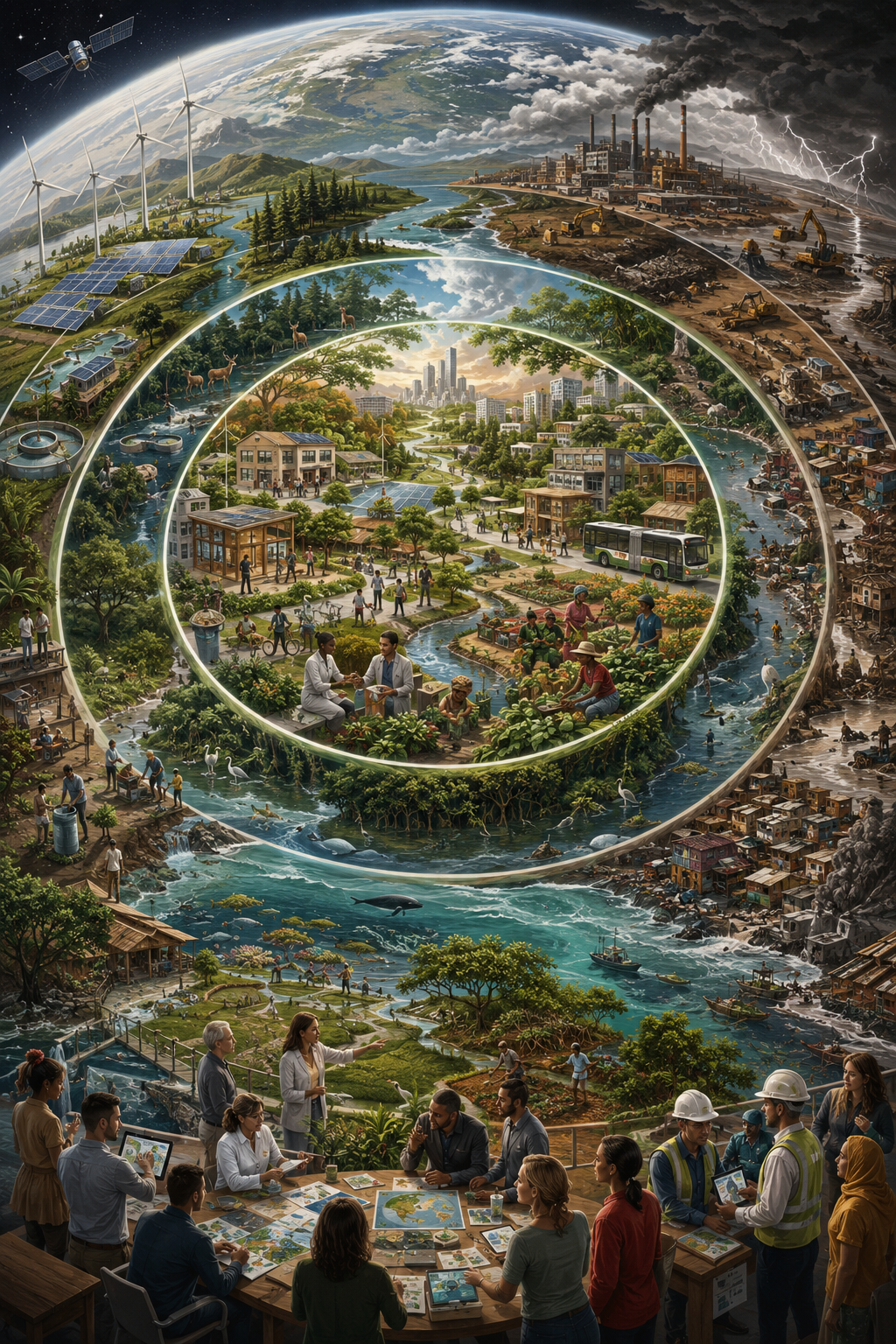
The relationship is not one of simple balance between people and nature, as if development and Earth-system stability were separate interests to be traded against one another. Human development depends on biophysical stability, while planetary stewardship must be pursued in ways that expand dignity, reduce deprivation, and confront inequality. A development agenda that ignores ecological limits can become materially self-undermining. A boundary agenda that ignores poverty and exclusion can become politically illegitimate and ethically incomplete. Sustainable development within planetary boundaries therefore requires a dual commitment: meeting human needs while preserving the ecological foundations that make those needs meetable over time.
This article examines what it means to pursue the Sustainable Development Goals within planetary boundaries. It explains why the SDGs require a biophysical foundation, how boundary transgression complicates development strategy, why trade-offs and synergies matter, how justice and inequality shape the use of safe operating space, how SDG progress should be measured under ecological constraint, and why sustainable development is best understood not as growth without end but as human advancement within a stable and resilient Earth system.
Why the SDGs Need a Planetary Foundation
The SDGs need a planetary foundation because development does not occur on a passive background. It depends on climate stability, functioning ecosystems, freshwater availability, fertile soils, predictable seasons, resilient oceans, and atmospheric conditions compatible with health and food production. These are not optional environmental amenities added after prosperity has been achieved. They are enabling conditions for prosperity itself. If those conditions are destabilized, then gains in income, health, education, food security, housing, public infrastructure, or institutional stability become harder to secure and harder to maintain.
This is the deeper meaning of bringing the SDGs into conversation with planetary boundaries. The question is not whether social progress matters more than the environment, or vice versa. The question is whether social progress can endure when the Earth-system conditions that support it are progressively weakened. A development agenda without a planetary foundation risks promising advances that become materially fragile, regionally unequal, and historically short-lived.
The planetary foundation also changes how development risk is understood. A country may make progress on poverty reduction, education, or infrastructure while becoming more exposed to climate volatility, water stress, biodiversity loss, pollution, land degradation, or agricultural disruption. In the short term, that may look like progress. Over the longer term, it may create vulnerability if development depends on destabilizing the very systems that support food, water, energy, health, and livelihoods.
This is why sustainable development cannot be evaluated only through social indicators or economic output. It must also ask whether the ecological conditions of continued development are being preserved. Without that question, development analysis risks becoming too short-sighted for the Earth-system conditions now shaping human possibility.
A planetary foundation also clarifies why the SDGs are not merely moral aspirations. They are material commitments. Ending hunger depends on soils, water, climate, biodiversity, fisheries, pollination, seed systems, distribution systems, and public capacity. Expanding health depends on clean air, safe water, nutrition, sanitation, disease ecology, heat protection, chemical safety, and functioning institutions. Building resilient infrastructure depends on climate, land, water, energy, finance, material systems, and governance. Development is not floating above the Earth system. It is embedded within it.
That embeddedness is the reason planetary boundaries belong at the center of SDG interpretation. They provide a way to ask whether development pathways are strengthening the foundations of future wellbeing or borrowing against them.
The SDGs as an Integrated Agenda
The Sustainable Development Goals are best understood as an integrated agenda rather than a checklist of separate ambitions. Ending poverty, improving health, expanding education, reducing inequality, building infrastructure, promoting decent work, protecting ecosystems, and strengthening institutions are all connected. That is not simply a rhetorical feature of the SDGs. It reflects the structure of development itself. Water affects health. Energy affects poverty. Food systems affect land, biodiversity, and nutrition. Infrastructure affects emissions, resilience, and inclusion. Institutional capacity shapes every other domain.
This systems logic is one of the strongest links between the SDGs and planetary boundaries. The boundaries framework also treats its domains as interacting rather than isolated. Climate change affects freshwater and biosphere integrity. Land-system change affects hydrology, biodiversity, and carbon storage. Nutrient overload affects lakes, rivers, coasts, and marine systems. Novel entities and chemical pollution affect health, ecosystems, production systems, and governance capacity. Once both frameworks are read structurally rather than sectorally, their compatibility becomes much clearer. They are both trying to govern interdependence.
The practical implication is that SDG strategy cannot be organized as a set of isolated programs that maximize one goal at a time. Progress on one goal can either support or undermine progress on others depending on how it is pursued. Expanding energy access through fossil-intensive systems may support near-term development while worsening climate risk. Expanding food production through fertilizer-intensive and land-converting systems may reduce hunger in the short term while worsening nutrient overload, biodiversity loss, and freshwater stress. The SDGs require integration because development itself is integrated.
Planetary boundaries strengthen this interpretation by providing an external test of whether integration is real. If a development strategy increases income or infrastructure while driving boundary transgression, then its sustainability remains incomplete. The SDGs are not only a list of aspirations. They are a demand for coherent transformation across social, economic, institutional, and environmental systems.
Integration also means that the SDGs cannot be pursued through narrow optimization. A policy that improves one target while degrading several others may be a statistical success and a systems failure at the same time. The more interconnected the goals are, the more important it becomes to evaluate policy portfolios rather than isolated interventions. A planetary-boundaries lens pushes SDG implementation toward systemic coherence, not just target-by-target accounting.
This is why the 2030 Agenda’s language of indivisibility matters. It recognizes that social progress, economic transformation, environmental stewardship, peace, and institutions form one development system. The planetary boundaries framework adds that this system must operate within Earth-system conditions that cannot be negotiated away.
Planetary Boundaries as Development Conditions
Planetary boundaries can be understood as development conditions because they define the broader Earth-system ranges within which social and economic goals are more likely to remain achievable over time. Climate stability matters for food production, settlement, labor productivity, disaster exposure, migration risk, insurance systems, and fiscal resilience. Biosphere integrity matters for pollination, soils, carbon storage, ecological productivity, disease regulation, and wider system resilience. Freshwater change matters for agriculture, health, sanitation, power generation, industry, and urban viability. Land-system change shapes food systems, habitat continuity, carbon regulation, and watershed stability.
Seen this way, boundaries are not external limits imposed on development from outside. They are the ecological and Earth-system conditions that development uses, depends on, and often takes for granted until they begin to break down. This is one reason the planetary-boundaries framework is not anti-development. It is an attempt to specify the conditions under which development remains physically plausible.
This point is especially important because development has often been imagined as a process of increasing command over nature. In a planetary-boundaries context, durable development requires something different: increasing human capability while reducing destabilizing pressure on the Earth system. That does not mean rejecting technology, infrastructure, industry, or economic advancement. It means redesigning them so that human progress no longer depends on eroding the systems that sustain it.
The SDGs therefore become more credible when interpreted within planetary boundaries. They become less a promise of unlimited expansion and more a framework for securing human dignity within biophysical conditions that must be preserved. This is a more demanding vision of development, but it is also more realistic.
| Planetary boundary process | Development condition it protects | SDG relevance |
|---|---|---|
| Climate change | Temperature stability, predictable seasons, reduced disaster risk, habitable settlements, labor productivity. | Health, food, water, cities, energy, poverty reduction, infrastructure, peace, and climate action. |
| Biosphere integrity | Ecological redundancy, pollination, pest regulation, carbon storage, food-web stability, disease regulation. | Zero hunger, health, life on land, life below water, livelihoods, resilience, and poverty reduction. |
| Freshwater change | Water availability, sanitation, irrigation, ecosystems, hydropower, industrial use, urban viability. | Water and sanitation, food, health, energy, cities, ecosystems, and inequality. |
| Land-system change | Soils, habitats, carbon storage, rainfall recycling, watershed stability, food-system resilience. | Food, poverty, climate, biodiversity, cities, sustainable production, and rural livelihoods. |
| Biogeochemical flows | Nitrogen and phosphorus balance, water quality, soil health, aquatic ecosystem stability. | Food, water, health, oceans, land ecosystems, and sustainable agriculture. |
| Novel entities | Chemical safety, material stewardship, pollution control, toxic-exposure reduction, monitoring capacity. | Health, water, responsible consumption, industry, ecosystems, work, and justice. |
Planetary boundaries therefore do not sit beside development. They define the physical conditions under which development can endure.
Why Overshoot Makes Development Harder
Once key boundaries are transgressed, development becomes harder in both practical and strategic terms. Climate destabilization raises the costs of adaptation, disaster response, food production, health protection, insurance, migration management, and infrastructure resilience. Freshwater disruption increases uncertainty for agriculture, cities, ecosystems, sanitation, and power generation. Biosphere decline undermines ecological functions that support production and recovery. Nutrient overload and novel entities create chronic burdens for water quality, health, and environmental management. Land degradation and system transformation reduce the room for low-conflict, low-cost development pathways.
This does not mean all development stops under overshoot. It means development becomes more stressed, more unequal, more reactive, and more expensive to sustain. Societies end up spending more effort compensating for destabilization that earlier development pathways helped create. In that sense, boundary transgression converts ecological overshoot into development fragility.
Overshoot also changes the distribution of development risk. Wealthier communities and countries often have more capacity to adapt, insure, relocate, regulate, rebuild, and absorb shocks. Poorer and more marginalized communities often face greater exposure with fewer buffers. As boundaries are transgressed, development gains can become more reversible for those already vulnerable. A flood, heat wave, crop failure, water crisis, wildfire, disease outbreak, or pollution event can undo years of progress in health, income, schooling, infrastructure, and social stability.
This is why the SDGs cannot be pursued credibly through short-term sectoral success alone. A development strategy that increases output while increasing systemic vulnerability may achieve indicators temporarily while weakening the conditions for long-term achievement. Development within planetary boundaries asks whether progress can endure.
Overshoot also creates policy traps. When climate damage, water stress, and ecological decline intensify, governments may shift resources from long-term development to emergency response. Public budgets become more reactive. Infrastructure spending becomes repair-oriented rather than transformative. Social protection systems become strained. Insurance markets become less reliable. Food-price volatility can increase pressure on households and public institutions. In this way, ecological overshoot can crowd out the very investments required for SDG progress.
Boundary transgression therefore does not merely create environmental costs. It changes the development landscape. It turns the pursuit of the SDGs into a more difficult, more expensive, and less predictable project.
SDG Synergies and SDG Trade-Offs
Pursuing the SDGs within planetary boundaries requires taking synergies and trade-offs seriously. Some actions can support both social goals and boundary stability at the same time. Expanding clean energy can advance health, energy access, and climate mitigation together. Restoring degraded ecosystems can strengthen livelihoods, biodiversity, water resilience, and carbon storage. Improving public transit can support inclusion, reduce air pollution, and lower emissions. Circular material systems can reduce waste, resource throughput, and exposure to novel entities while supporting innovation and employment.
But there are also real trade-offs. Expanding food production through fertilizer-intensive systems may help with hunger in the short term while worsening nitrogen and phosphorus overload. Rapid industrialization can support jobs and infrastructure while increasing climate, aerosol, and material pressures if pursued through conventional fossil-intensive pathways. Large-scale irrigation can support agricultural output while intensifying freshwater stress. Mining for transition minerals can support renewable-energy systems while creating land, water, biodiversity, labor, and justice concerns if governance is weak.
Trade-offs do not invalidate the SDGs. They show why pursuing them within planetary boundaries requires systemic design rather than piecemeal expansion. The question is not whether development goals interact. They do. The question is whether institutions have the analytical and political capacity to manage those interactions honestly. Development strategy must therefore move beyond single-goal optimization and toward policy portfolios that reduce conflict among goals while strengthening mutually reinforcing transitions.
Synergies and trade-offs also depend on context. The same intervention may have different effects depending on geography, infrastructure, institutions, inequality, and ecological conditions. Solar energy expansion, for example, may reduce emissions while creating new land-use or material-supply questions. Agricultural intensification may spare land in one setting and accelerate chemical or water stress in another. A planetary-boundaries perspective does not eliminate complexity. It helps organize it.
A serious SDG strategy therefore needs an explicit trade-off architecture. That means identifying where policies produce co-benefits, where they transfer burdens, where they create delayed harm, and where they shift pressure from one boundary to another. It also means distinguishing short-term indicator gains from durable transformation. A policy that increases food production while damaging soils and water may not be a development success. It may be a delayed-development failure.
| Development intervention | Possible SDG synergy | Possible boundary or justice trade-off |
|---|---|---|
| Clean energy access | Supports poverty reduction, health, education, jobs, and climate mitigation. | Requires careful governance of minerals, land use, supply chains, and affordability. |
| Agroecological food-system transition | Supports food security, soil health, biodiversity, water quality, and rural livelihoods. | Requires transition support, knowledge systems, market access, and protection for farmers. |
| Public transit and compact cities | Reduces emissions, air pollution, transport costs, and exclusion. | Can intensify displacement or gentrification without housing and land protections. |
| Industrial development | Creates jobs, infrastructure, and productive capacity. | Can increase emissions, pollution, material throughput, and local exposure if poorly governed. |
| Ecosystem restoration | Improves biodiversity, water resilience, carbon storage, livelihoods, and disaster protection. | Can create land-rights conflicts if imposed without community participation. |
Synergy is not automatic. It has to be designed. Trade-offs are not excuses for inaction. They are signals that governance must become more honest, participatory, and systems-aware.
Which SDGs Are Most Closely Tied to Boundary Pressure
Some SDGs are especially entangled with boundary pressure. Goal 2 on hunger and sustainable agriculture intersects directly with land-system change, biogeochemical flows, freshwater change, climate change, and biosphere integrity. Goal 6 on water and sanitation connects strongly with freshwater change, pollution, ecosystem quality, watershed resilience, and public health. Goal 7 on energy and Goal 13 on climate are tightly linked through decarbonization, air pollution, energy security, infrastructure, and broader Earth-system stability. Goals 14 and 15 on oceans and terrestrial ecosystems align closely with ocean acidification, biosphere integrity, land change, pollution pressures, and ecosystem resilience.
Yet even goals not usually classified as “environmental” depend on boundary conditions. Goal 3 on health is affected by heat, air pollution, nutrition, disease ecology, water quality, chemical exposure, and ecological disruption. Goal 8 on work and economic life depends on climate stability, labor productivity, infrastructure reliability, supply-chain resilience, and manageable risk. Goal 9 on industry and infrastructure depends on energy systems, materials, resilience, and transition pathways. Goal 11 on cities depends on water, energy, land, climate resilience, air quality, affordability, and disaster preparedness. The result is that nearly all the SDGs become harder to achieve as boundary pressures intensify.
This interdependence also means that environmental SDGs cannot be treated as separate conservation goals sitting beside the social and economic goals. They are part of the enabling architecture of the whole agenda. If oceans, terrestrial ecosystems, climate systems, freshwater systems, and material cycles deteriorate, the social goals become more difficult, not less. The SDGs are therefore most credible when interpreted as a socio-ecological system rather than a policy checklist.
The planetary-boundaries framework gives this interpretation scientific structure. It helps identify where development pathways are likely to intensify systemic risk and where they may create stabilizing feedbacks. It also shows why some goals must be pursued together rather than sequenced as “development first, environment later.” On a destabilizing planet, environment later may be too late.
This also matters for investment. SDG financing cannot be evaluated only by the social sector it supports. Infrastructure, food, energy, housing, transport, water, health, and education investments all create material footprints and resilience consequences. Finance that supports SDG progress while expanding boundary pressure may be solving one part of the agenda while undermining another. SDG-aligned investment should therefore be boundary-aware, justice-aware, and long-horizon.
The strongest interpretation is that every SDG has a boundary condition. Some are direct, some are indirect, but none are wholly independent of Earth-system stability.
From Output Growth to Development Within Limits
Framing the SDGs within planetary boundaries changes the meaning of development strategy. It shifts the central question away from how much output can be expanded through conventional means and toward what kinds of development remain viable within biophysical limits. That does not require rejecting innovation, infrastructure, or rising living standards. It requires rejecting the assumption that human advancement can continue indefinitely through materially destabilizing pathways without eventually undermining itself.
This is why “development within limits” is a stronger phrase than it first appears. It does not mean choosing austerity over progress. It means reorganizing progress so that gains in wellbeing are not purchased through the erosion of the Earth-system conditions that future wellbeing requires. In practice, that points toward low-carbon systems, lower material waste, resilient food and water systems, restored ecosystems, circular production, safer chemistry, more equitable access, and more distributive rather than purely extractive forms of prosperity.
Development within limits also requires a distinction between sufficiency and excess. Many people still need more access to energy, nutrition, sanitation, housing, health care, education, mobility, and infrastructure. At the same time, high-consuming groups and systems generate disproportionate ecological pressure far beyond what is needed for dignity. A planetary-boundaries approach therefore does not simply ask societies to reduce everything. It asks them to reduce unsustainable excess while expanding the minimum conditions of human flourishing.
This changes the meaning of progress. Progress is not only more output, more consumption, or faster growth. It is the expansion of real capabilities within ecological conditions that can endure. That is a deeper and more rigorous standard than conventional development metrics alone can provide.
Development within limits also shifts attention from gross expansion to qualitative transformation. A society can improve wellbeing through public health, education, low-carbon infrastructure, clean energy, housing quality, public transit, social protection, ecosystem restoration, and institutional trust without relying on endless growth in throughput. This does not erase the need for economic development in poorer regions. It clarifies that the form of development matters as much as the amount.
In this sense, the SDGs within planetary boundaries are not a call for stagnation. They are a call for a more intelligent development model: one that expands dignity where needs remain unmet and contracts destructive excess where throughput has become socially wasteful and ecologically dangerous.
Safe and Just Space: Human Floors and Ecological Ceilings
One of the most useful ways to connect the SDGs and planetary boundaries is through the idea of a safe and just space. The SDGs define many elements of the social foundation: food, water, health, education, energy, decent work, equality, peace, institutions, and participation. Planetary boundaries define ecological ceilings: the outer limits beyond which Earth-system stability becomes increasingly difficult to preserve. Sustainable development must operate between these two conditions. It must raise people above deprivation while keeping societies below destabilizing ecological pressure.
This framing is powerful because it rejects two false choices. It rejects the idea that poverty reduction can be postponed until ecological stability is secured. It also rejects the idea that ecological stability can be postponed until conventional development is complete. Both delays are dangerous. Poverty, exclusion, and institutional weakness reduce the legitimacy and capacity needed for ecological transition. Boundary transgression makes poverty reduction, public health, and infrastructure resilience harder. The two agendas must be pursued together.
A safe and just space is therefore not a compromise between human beings and the planet. It is the operating zone in which human dignity and Earth-system resilience can support one another. The challenge is that most countries and institutions have not yet demonstrated how to combine high social achievement with low ecological pressure at the necessary scale. This is why the SDG-boundary conversation is not merely theoretical. It names one of the central empirical failures of present development models.
Human floors and ecological ceilings also reveal why averages are insufficient. A country may have strong average social indicators while leaving marginalized communities below the social foundation. Another may remain within some ecological pressures because many people still lack basic services. Neither condition is adequate. Sustainable development must ask both whether everyone has enough and whether total pressure remains within safe operating space.
This dual test is ethically sharper than either development or environmental metrics alone. It asks societies to expand capability without expanding harm, to reduce deprivation without reproducing destructive pathways, and to preserve planetary resilience without sacrificing those still excluded from basic dignity.
Equity, Safe Operating Space, and Differentiated Responsibility
Once development is placed within a finite safe operating space, questions of justice become unavoidable. The remaining ecological room is not equally distributed, and historical responsibility for overshoot is not equal either. Some societies have built wealth through pathways that consumed disproportionate shares of atmospheric capacity, material throughput, land transformation, and ecological disturbance, while others still face unmet needs in energy, sanitation, health, food security, housing, education, and infrastructure.
This means that achieving the SDGs within planetary boundaries cannot be reduced to universal restraint in the abstract. It requires differentiated responsibility, fairer allocation of remaining ecological room, and development pathways that expand capabilities for the poor without replicating the most destabilizing features of earlier high-throughput models. Equity is not an optional ethical supplement here. It is part of the political realism of any credible strategy for sustainable development within boundaries.
Differentiated responsibility also matters within countries. High-income households, high-emitting sectors, large asset owners, and institutions that benefit from ecologically intensive systems often have greater capacity and responsibility to reduce pressure. Low-income communities may need greater access to services, infrastructure, and resilience. A justice-aware SDG strategy must therefore distinguish between luxury consumption, productive investment, and basic provision.
Equity also shapes feasibility. Transitions that are experienced as unfair often face political resistance, while transitions that connect ecological stabilization to real improvements in dignity, access, security, and participation are more likely to endure. In this sense, justice is not only morally necessary. It is strategically necessary for achieving the SDGs within planetary boundaries.
International equity is especially important. Many lower-income countries are asked to pursue cleaner development pathways under tighter ecological constraints than those faced by early industrializers. That is not impossible, but it requires finance, technology transfer, debt relief, fair trade rules, capacity building, and policy space. Without those supports, calls for global sustainability can become a demand that poorer societies bear the cost of limits created disproportionately by wealthier ones.
The planetary-boundaries framework therefore deepens the justice content of the SDGs. It does not only ask whether development is inclusive now. It asks whether the remaining safe operating space is being used in ways that respect historical responsibility, present vulnerability, and future generations.
What an SDG Strategy Within Boundaries Would Look Like
An SDG strategy within planetary boundaries would begin by treating social progress and Earth-system stability as co-conditions rather than competing agendas. It would prioritize poverty eradication, health, education, and infrastructure in forms that reduce rather than intensify system pressure. It would invest heavily in clean energy, resilient public systems, ecosystem restoration, circular material use, water stewardship, safer chemical systems, and agricultural transitions that reduce nutrient, land, biodiversity, and climate stress. It would also treat institutions, data, and policy coherence as central rather than secondary, because fragmented governance tends to produce fragmented trade-offs.
Just as important, it would stop treating growth in throughput as the default measure of success. The operative question would become whether wellbeing, security, and capability are increasing while climate, biodiversity, water, nutrient cycles, land systems, and material pressures are being stabilized. That is a more demanding development standard, but it is also more honest about what sustainability actually requires.
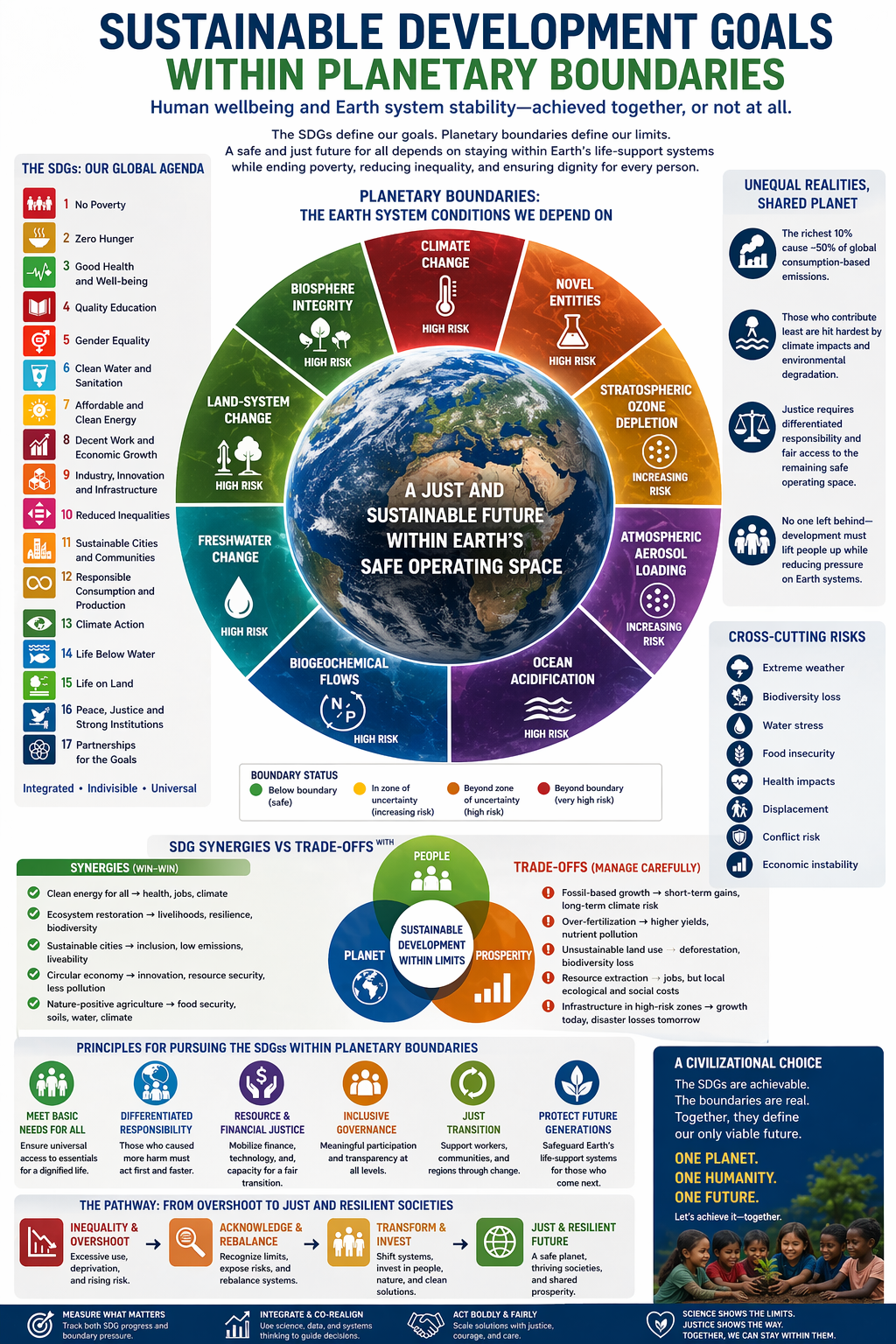
Such a strategy would also be place-based. Different regions face different boundary pressures, institutional capacities, vulnerabilities, and development needs. A water-stressed region needs different priorities than a flood-exposed delta, a deforestation frontier, an industrial pollution corridor, a small island state, a rapidly urbanizing metropolitan region, or a post-conflict rural economy. Planetary boundaries define global conditions, but implementation requires spatial intelligence, local governance, and attention to lived realities.
Finally, an SDG strategy within boundaries would require long-term governance. The SDGs are time-bound to 2030, but planetary stability and human flourishing extend beyond any single policy horizon. Development strategy must therefore preserve future options, not merely hit near-term indicators. That means investing in resilience, institutional capacity, monitoring systems, public goods, and forms of prosperity that remain viable under ecological constraint.
An SDG-within-boundaries strategy would also distinguish between transition sectors. Energy systems require rapid decarbonization and access expansion. Food systems require nutrition, livelihoods, biodiversity, soil, water, and nutrient governance together. Cities require affordable housing, public transit, cooling, water resilience, and low-carbon infrastructure. Industry requires clean energy, circular material systems, safer chemistry, and labor protections. Finance requires capital allocation aligned with both social floors and ecological ceilings.
The result is a development agenda that is not smaller than the SDGs. It is more coherent. It does not abandon ambition. It disciplines ambition so that development becomes durable rather than self-undermining.
Measurement, Monitoring, and Policy Coherence
Pursuing the SDGs within planetary boundaries requires measurement systems that can track social achievement and ecological pressure together. A country, city, company, or institution may report progress on selected SDG indicators while failing to show whether that progress increases pressure on climate, land, water, biodiversity, nutrient flows, aerosol loading, or chemical systems. Conversely, environmental metrics may show reduced pressure without revealing whether poverty, exclusion, or vulnerability remain unresolved. A credible monitoring system needs both dimensions.
This is not only a statistical challenge. It is a governance challenge. Indicators shape priorities, funding, accountability, and public understanding. If metrics are separated into social and environmental silos, policy often follows the same pattern. A planetary-boundaries interpretation of the SDGs therefore requires integrated dashboards, transparent assumptions, spatial data, distributional indicators, and explicit treatment of trade-offs.
Policy coherence is equally important. Governments may support clean energy while subsidizing fossil fuels, protect biodiversity while expanding land-converting infrastructure, promote food security while encouraging nutrient overuse, or invest in resilience while allowing settlement in high-risk zones. The SDGs within planetary boundaries require institutions capable of identifying these contradictions and correcting them. Coherence is not a bureaucratic ideal. It is a condition of avoiding development pathways that solve one problem by worsening another.
For engineers and data teams, this means building systems that can connect development indicators, environmental thresholds, spatial exposure, infrastructure dependencies, and scenario assumptions. The problem is not only how to report progress. It is how to design decision-support systems that reveal whether progress is durable, just, and compatible with Earth-system stability.
Measurement must also avoid false precision. Downscaling planetary boundaries to countries, cities, sectors, firms, or households involves ethical and methodological choices. Allocation can be based on population, historical responsibility, capacity, development need, territorial emissions, consumption footprints, or other criteria. Different allocation rules produce different interpretations. A responsible dashboard should make those assumptions visible rather than hide them behind a single score.
Finally, monitoring must be distributional. It should identify who benefits from SDG progress, who remains below social thresholds, who bears ecological burdens, who is exposed to risk, and who has capacity to adapt. Aggregates are useful, but they can hide inequality. The SDGs within planetary boundaries require data that can see both planetary pressure and unequal human experience.
Governance, Finance, and Institutional Capacity
Achieving the SDGs within planetary boundaries is not primarily a matter of better slogans. It requires governance capacity. Institutions must be able to coordinate across energy, food, water, land, health, industry, finance, cities, ecosystems, and social protection. They must be capable of long-term planning, conflict resolution, public participation, scientific learning, policy correction, and accountability. Without institutional capacity, integrated agendas remain aspirational.
Finance is central because development pathways are built through investment. Public budgets, development banks, private finance, infrastructure funds, insurance systems, and trade finance shape whether societies expand clean energy or fossil lock-in, regenerative agriculture or extractive land use, resilient housing or hazard exposure, circular material systems or waste expansion. SDG finance that ignores planetary boundaries can fund short-term gains that generate long-term vulnerability.
Debt and fiscal space also matter. Many countries face high development needs while having limited capacity to invest in resilient infrastructure, social protection, ecosystem restoration, clean energy, and adaptation. If the global financial system does not expand fiscal space for sustainable development, then calls for SDG acceleration can become unrealistic. A planetary-boundaries approach should therefore be linked to reform of development finance, debt burdens, technology access, and global public goods.
Institutional trust is equally important. Transformations are more likely to endure when people experience them as fair, transparent, participatory, and materially beneficial. A transition that reduces emissions while increasing inequality or insecurity can lose legitimacy. A transition that improves health, access, affordability, jobs, and resilience can build support for deeper change. In this sense, governance is not only implementation machinery. It is part of the social foundation for transformation.
For adjacent essays, see Earth System Governance in an Age of Limits, Finance, Disclosure, and Systemic Environmental Risk, Business Strategy Within Planetary Boundaries, and Environmental Monitoring Systems.
SDG-boundary governance therefore requires more than target tracking. It requires public capacity to redirect systems. The issue is not only whether governments know the goals. It is whether they can align incentives, budgets, institutions, infrastructure, and public legitimacy around development pathways that remain within Earth-system limits.
Why This Matters for Planetary Boundaries
The SDGs matter for planetary boundaries because ecological stability has no durable political future if it is separated from human dignity. A boundary framework that does not address poverty, health, exclusion, inequality, energy access, infrastructure, and institutional legitimacy risks becoming morally incomplete and politically fragile. People living with deprivation cannot be asked to protect planetary systems without also receiving a credible path toward security, dignity, and participation.
Planetary boundaries matter for the SDGs because human development has no durable material future if it is separated from Earth-system stability. A development framework that does not address climate, biodiversity, water, land, nutrients, oceans, aerosols, and synthetic overload risks becoming ecologically unrealistic. It may produce short-term progress while destabilizing the conditions required to sustain it.
The strongest interpretation is therefore not SDGs versus boundaries, nor people versus planet. It is the recognition that the future of human development depends on a safe operating space, and that the legitimacy of planetary stewardship depends on justice. Sustainable development worthy of the name must hold both together.
This matters especially now because global SDG progress remains insufficient while planetary-boundary pressure continues to intensify. The world does not have the luxury of pursuing one agenda now and the other later. The development agenda must become boundary-aware, and the boundary agenda must become justice-aware. Anything less is either ecologically unstable or socially incomplete.
The SDGs provide the human agenda. Planetary boundaries provide the Earth-system conditions. The task is not simply to achieve more targets faster. It is to pursue development in forms that reduce vulnerability, preserve ecological stability, expand dignity, and remain coherent across time.
Mathematical Lens: SDG Progress Under Boundary Constraint
The relationship between the SDGs and planetary boundaries can be modeled as a dual-performance problem. Let \(S_{g,j}\) represent achievement on SDG-related social or economic target \(j\) for group, country, or region \(g\), scaled from 0 to 1. Let \(M_j\) represent the minimum acceptable achievement level for that target. A development shortfall can be written as:
Q_{g,j} = \max\left(0, \frac{M_j – S_{g,j}}{M_j}\right)
\]
Interpretation: If \(Q_{g,j}=0\), the minimum target is met. If \(Q_{g,j} > 0\), there is a development shortfall.
Planetary-boundary pressure can be represented separately. Let \(E_{g,i}\) represent ecological pressure on boundary process \(i\), and let \(B_i\) represent a boundary-compatible allocation or threshold. Boundary overshoot can be written as:
O_{g,i} = \max\left(0, \frac{E_{g,i} – B_i}{B_i}\right)
\]
Interpretation: If \(O_{g,i}=0\), pressure remains within the chosen boundary-compatible threshold. If \(O_{g,i} > 0\), ecological pressure exceeds that threshold.
An SDG-within-boundaries diagnostic must consider both dimensions simultaneously. A simplified alignment score can be expressed as:
A_g = 1 – \left(\alpha \overline{Q_g} + \beta \overline{O_g}\right)
\]
Interpretation: \(\overline{Q_g}\) is average development shortfall, \(\overline{O_g}\) is average ecological overshoot, and \(\alpha\), \(\beta\) are explicit weights.
A more justice-aware version can add vulnerability and responsibility:
J_g = \alpha \overline{Q_g} + \beta \overline{O_g} + \gamma V_g + \delta R_g
\]
Interpretation: \(V_g\) represents vulnerability to ecological disruption, and \(R_g\) represents responsibility or capacity to act.
Policy coherence can be modeled as a trade-off penalty. Let \(T_{ab}\) represent the trade-off imposed by progress in goal \(a\) on goal or boundary \(b\), and let \(Y_a\) represent the intensity of intervention \(a\). A simplified coherence penalty is:
C = \sum_{a=1}^{m}\sum_{b=1}^{n} T_{ab}Y_a
\]
Interpretation: Coherence declines when interventions create large negative spillovers across SDGs or boundary processes.
A full diagnostic can therefore combine shortfall, overshoot, vulnerability, responsibility, and coherence:
D_g = \left(\alpha \overline{Q_g} + \beta \overline{O_g} + \gamma V_g + \delta R_g\right)(1 + C_g)
\]
Interpretation: Development risk rises when social shortfalls, ecological overshoot, vulnerability, responsibility, and policy incoherence reinforce one another.
| Term | Meaning | Interpretive role |
|---|---|---|
| \(S_{g,j}\) | Observed SDG achievement | Represents social or economic progress for group, country, or region \(g\). |
| \(M_j\) | Minimum acceptable target | Represents a social foundation or development floor. |
| \(Q_{g,j}\) | Development shortfall | Measures distance below the social floor. |
| \(E_{g,i}\) | Ecological pressure | Represents emissions, land use, water use, nutrient load, material pressure, or other boundary pressure. |
| \(B_i\) | Boundary-compatible threshold | Represents an ecological ceiling or allocation. |
| \(O_{g,i}\) | Boundary overshoot | Measures distance above the ecological ceiling. |
| \(V_g\) | Vulnerability | Represents exposure and sensitivity to ecological disruption. |
| \(C_g\) | Coherence penalty | Represents trade-offs and negative spillovers across goals and boundaries. |
This score should not be treated as a final measure of sustainable development. Its value is diagnostic: it makes visible whether a development pathway is failing because social needs remain unmet, ecological ceilings are exceeded, policy is incoherent, vulnerability is high, or several of these conditions occur together.
Advanced Python Workflow: SDG-Boundary Alignment Scoring
The following Python workflow models SDG achievement and planetary-boundary pressure together. It separates social-development shortfall from ecological overshoot, then adds vulnerability, responsibility, and capacity variables to support a more justice-aware diagnostic. The data are illustrative, but the structure can be adapted for national, regional, city-level, or institutional analysis.
"""
SDG-boundary alignment scoring workflow.

This workflow models sustainable development as a relationship between:
- SDG achievement
- minimum development thresholds
- ecological pressure
- planetary-boundary-compatible thresholds
- vulnerability
- responsibility
- capacity to act
- policy coherence

The data are illustrative. Replace placeholder values with documented
SDG indicators, environmental accounts, vulnerability metrics, and
transparent boundary-allocation assumptions before applied use.
"""

from __future__ import annotations

from dataclasses import dataclass
from pathlib import Path
from typing import Literal

import numpy as np
import pandas as pd


IndicatorDomain = Literal["social", "ecological"]


@dataclass(frozen=True)
class IndicatorSpec:
    """Metadata for an SDG-boundary indicator."""

    name: str
    domain: IndicatorDomain
    threshold: float
    direction: Literal["floor", "ceiling"]
    weight: float
    unit: str


def build_indicator_specs() -> list[IndicatorSpec]:
    """Create illustrative indicator specifications."""
    return [
        IndicatorSpec("poverty_reduction", "social", 0.90, "floor", 1.30, "0-1 index"),
        IndicatorSpec("health_access", "social", 0.90, "floor", 1.20, "0-1 index"),
        IndicatorSpec("education_access", "social", 0.90, "floor", 1.10, "0-1 index"),
        IndicatorSpec("clean_energy_access", "social", 0.90, "floor", 1.10, "0-1 index"),
        IndicatorSpec("climate_pressure", "ecological", 1.00, "ceiling", 1.40, "pressure ratio"),
        IndicatorSpec("freshwater_pressure", "ecological", 1.00, "ceiling", 1.10, "pressure ratio"),
        IndicatorSpec("land_pressure", "ecological", 1.00, "ceiling", 1.00, "pressure ratio"),
        IndicatorSpec("nutrient_pressure", "ecological", 1.00, "ceiling", 1.00, "pressure ratio"),
        IndicatorSpec("biosphere_pressure", "ecological", 1.00, "ceiling", 1.20, "pressure ratio"),
        IndicatorSpec("material_pressure", "ecological", 1.00, "ceiling", 1.00, "pressure ratio"),
    ]


def build_sample_data() -> pd.DataFrame:
    """
    Create illustrative region-level SDG and boundary data.

    Social indicators are scaled 0-1.
    Ecological indicators are pressure ratios where values above 1 indicate overshoot.
    Vulnerability, responsibility, and capacity are scaled 0-1.
    """
    return pd.DataFrame(
        {
            "region": [
                "Region A",
                "Region B",
                "Region C",
                "Region D",
                "Region E",
            ],
            "poverty_reduction": [0.82, 0.95, 0.54, 0.76, 0.88],
            "health_access": [0.78, 0.96, 0.58, 0.72, 0.84],
            "education_access": [0.80, 0.94, 0.52, 0.75, 0.86],
            "clean_energy_access": [0.70, 0.98, 0.46, 0.62, 0.82],
            "climate_pressure": [1.10, 1.85, 0.52, 0.78, 1.20],
            "freshwater_pressure": [0.95, 1.30, 0.72, 1.18, 0.88],
            "land_pressure": [1.05, 1.22, 0.64, 1.35, 0.92],
            "nutrient_pressure": [1.28, 1.55, 0.70, 1.48, 1.05],
            "biosphere_pressure": [1.12, 1.42, 0.66, 1.30, 0.98],
            "material_pressure": [1.04, 1.76, 0.58, 0.92, 1.18],
            "vulnerability": [0.54, 0.28, 0.84, 0.72, 0.46],
            "responsibility": [0.42, 0.86, 0.18, 0.34, 0.58],
            "capacity_to_act": [0.52, 0.82, 0.24, 0.38, 0.60],
            "policy_coherence": [0.56, 0.62, 0.36, 0.42, 0.58],
        }
    )


def score_indicators(
    data: pd.DataFrame,
    specs: list[IndicatorSpec],
) -> pd.DataFrame:
    """Score SDG shortfalls and ecological overshoot in long format."""
    records: list[dict[str, object]] = []

    for _, row in data.iterrows():
        for spec in specs:
            observed = float(row[spec.name])

            if spec.direction == "floor":
                penalty = max(0.0, (spec.threshold - observed) / spec.threshold)
            else:
                penalty = max(0.0, (observed - spec.threshold) / spec.threshold)

            records.append(
                {
                    "region": row["region"],
                    "indicator": spec.name,
                    "domain": spec.domain,
                    "observed": observed,
                    "threshold": spec.threshold,
                    "direction": spec.direction,
                    "weight": spec.weight,
                    "unit": spec.unit,
                    "penalty": penalty,
                }
            )

    return pd.DataFrame.from_records(records)


def weighted_mean(values: pd.Series, weights: pd.Series) -> float:
    """Calculate weighted mean with validation."""
    total_weight = weights.sum()

    if total_weight <= 0:
        raise ValueError("Total weight must be positive.")

    return float((values * weights).sum() / total_weight)


def aggregate_alignment(
    scored: pd.DataFrame,
    region_data: pd.DataFrame,
    alpha: float = 0.5,
    beta: float = 0.5,
) -> pd.DataFrame:
    """Aggregate social shortfall, ecological overshoot, and alignment."""
    social = (
        scored.query("domain == 'social'")
        .groupby("region")
        .apply(lambda g: weighted_mean(g["penalty"], g["weight"]))
        .rename("weighted_sdg_shortfall")
        .reset_index()
    )

    ecological = (
        scored.query("domain == 'ecological'")
        .groupby("region")
        .apply(lambda g: weighted_mean(g["penalty"], g["weight"]))
        .rename("weighted_boundary_overshoot")
        .reset_index()
    )

    result = social.merge(ecological, on="region").merge(
        region_data[
            [
                "region",
                "vulnerability",
                "responsibility",
                "capacity_to_act",
                "policy_coherence",
            ]
        ],
        on="region",
    )

    result["sdg_boundary_alignment_score"] = 1 - (
        alpha * result["weighted_sdg_shortfall"]
        + beta * result["weighted_boundary_overshoot"]
    )

    result["policy_incoherence"] = 1 - result["policy_coherence"]

    result["justice_adjusted_risk"] = (
        result["weighted_sdg_shortfall"]
        + result["weighted_boundary_overshoot"]
        + 0.65 * result["vulnerability"]
        + 0.45 * result["responsibility"]
    ) * (
        1
        + (1 - result["capacity_to_act"])
        + 0.40 * result["policy_incoherence"]
    )

    result["diagnostic_class"] = np.select(
        [
            (result["weighted_sdg_shortfall"] == 0)
            & (result["weighted_boundary_overshoot"] == 0),
            (result["weighted_sdg_shortfall"] > 0)
            & (result["weighted_boundary_overshoot"] == 0),
            (result["weighted_sdg_shortfall"] == 0)
            & (result["weighted_boundary_overshoot"] > 0),
        ],
        [
            "within_social_and_ecological_targets",
            "social_shortfall_without_boundary_overshoot",
            "boundary_overshoot_without_social_shortfall",
        ],
        default="combined_social_shortfall_and_boundary_overshoot",
    )

    result["priority"] = np.select(
        [
            (result["weighted_sdg_shortfall"] >= 0.25)
            & (result["weighted_boundary_overshoot"] >= 0.25),
            result["weighted_sdg_shortfall"] >= 0.25,
            result["weighted_boundary_overshoot"] >= 0.25,
            result["vulnerability"] >= 0.70,
            result["policy_incoherence"] >= 0.50,
        ],
        [
            "integrated_development_and_boundary_strategy",
            "capability_expansion_priority",
            "pressure_reduction_priority",
            "resilience_and_adaptation_priority",
            "policy_coherence_priority",
        ],
        default="maintain_balanced_progress",
    )

    return result.sort_values(
        "justice_adjusted_risk",
        ascending=False,
    ).reset_index(drop=True)


def run_sensitivity(scored: pd.DataFrame, region_data: pd.DataFrame) -> pd.DataFrame:
    """Run weighting scenarios for social and ecological priorities."""
    scenarios = {
        "balanced": {"alpha": 0.5, "beta": 0.5},
        "sdg_priority": {"alpha": 0.65, "beta": 0.35},
        "boundary_priority": {"alpha": 0.35, "beta": 0.65},
        "strong_boundary_precaution": {"alpha": 0.25, "beta": 0.75},
    }

    frames = []

    for scenario_name, params in scenarios.items():
        scenario = aggregate_alignment(
            scored,
            region_data,
            alpha=params["alpha"],
            beta=params["beta"],
        )
        scenario["scenario"] = scenario_name
        scenario["rank"] = scenario["justice_adjusted_risk"].rank(
            ascending=False,
            method="dense",
        )
        frames.append(scenario)

    return pd.concat(frames, ignore_index=True)


def main() -> None:
    """Run the SDG-boundary alignment workflow."""
    output_dir = Path(
        "articles/sustainable-development-goals-within-planetary-boundaries/outputs"
    )
    output_dir.mkdir(parents=True, exist_ok=True)

    specs = build_indicator_specs()
    data = build_sample_data()
    scored = score_indicators(data, specs)
    alignment = aggregate_alignment(scored, data)
    sensitivity = run_sensitivity(scored, data)

    scored.to_csv(output_dir / "indicator_level_scores.csv", index=False)
    alignment.to_csv(output_dir / "sdg_boundary_alignment_scores.csv", index=False)
    sensitivity.to_csv(output_dir / "sdg_boundary_sensitivity.csv", index=False)

    display_columns = [
        "region",
        "weighted_sdg_shortfall",
        "weighted_boundary_overshoot",
        "sdg_boundary_alignment_score",
        "vulnerability",
        "responsibility",
        "capacity_to_act",
        "policy_incoherence",
        "justice_adjusted_risk",
        "diagnostic_class",
        "priority",
    ]

    print("\nSDG-boundary alignment scores:")
    print(alignment[display_columns].round(3).to_string(index=False))

    print("\nSensitivity analysis:")
    print(
        sensitivity[
            [
                "scenario",
                "region",
                "sdg_boundary_alignment_score",
                "justice_adjusted_risk",
                "diagnostic_class",
                "priority",
                "rank",
            ]
        ].round(3).to_string(index=False)
    )


if __name__ == "__main__":
    main()
This workflow is useful because it refuses to collapse development and ecological pressure into a single optimistic narrative. It shows whether a region is facing social shortfall, boundary overshoot, or both. It also adds vulnerability, responsibility, capacity to act, and policy coherence, which makes the analysis more justice-aware. A region with low ecological pressure but severe social shortfall requires a different policy response than a high-consuming region with strong social outcomes and high ecological overshoot.
The sensitivity analysis is important because SDG-boundary scoring always involves normative judgment. Weighting social shortfall more heavily, weighting boundary overshoot more heavily, or applying stronger precaution will change rankings. A responsible workflow should expose those assumptions rather than hide them.
Advanced R Workflow: SDG-Boundary Dashboarding
The following R workflow prepares dashboard-ready outputs for comparing SDG achievement and planetary-boundary pressure. It is designed for policy teams, sustainability analysts, researchers, engineers, and governance practitioners who need to identify social shortfalls, ecological overshoot, vulnerability, responsibility, policy coherence, and capacity in an integrated reporting format.
# SDG-boundary alignment dashboard
#
# This workflow scores regions across:
# - SDG achievement
# - planetary-boundary pressure
# - vulnerability
# - responsibility
# - capacity to act
# - policy coherence
#
# Values are illustrative and should be replaced with documented data,
# transparent allocation assumptions, and verified indicator sources.

library(readr)
library(dplyr)
library(tidyr)

region_data <- tibble::tibble(
  region = c("Region A", "Region B", "Region C", "Region D", "Region E"),
  poverty_reduction = c(0.82, 0.95, 0.54, 0.76, 0.88),
  health_access = c(0.78, 0.96, 0.58, 0.72, 0.84),
  education_access = c(0.80, 0.94, 0.52, 0.75, 0.86),
  clean_energy_access = c(0.70, 0.98, 0.46, 0.62, 0.82),
  climate_pressure = c(1.10, 1.85, 0.52, 0.78, 1.20),
  freshwater_pressure = c(0.95, 1.30, 0.72, 1.18, 0.88),
  land_pressure = c(1.05, 1.22, 0.64, 1.35, 0.92),
  nutrient_pressure = c(1.28, 1.55, 0.70, 1.48, 1.05),
  biosphere_pressure = c(1.12, 1.42, 0.66, 1.30, 0.98),
  material_pressure = c(1.04, 1.76, 0.58, 0.92, 1.18),
  vulnerability = c(0.54, 0.28, 0.84, 0.72, 0.46),
  responsibility = c(0.42, 0.86, 0.18, 0.34, 0.58),
  capacity_to_act = c(0.52, 0.82, 0.24, 0.38, 0.60),
  policy_coherence = c(0.56, 0.62, 0.36, 0.42, 0.58)
)

indicator_specs <- tibble::tibble(
  indicator = c(
    "poverty_reduction",
    "health_access",
    "education_access",
    "clean_energy_access",
    "climate_pressure",
    "freshwater_pressure",
    "land_pressure",
    "nutrient_pressure",
    "biosphere_pressure",
    "material_pressure"
  ),
  domain = c(
    "social",
    "social",
    "social",
    "social",
    "ecological",
    "ecological",
    "ecological",
    "ecological",
    "ecological",
    "ecological"
  ),
  threshold = c(0.90, 0.90, 0.90, 0.90, 1.00, 1.00, 1.00, 1.00, 1.00, 1.00),
  direction = c(
    "floor",
    "floor",
    "floor",
    "floor",
    "ceiling",
    "ceiling",
    "ceiling",
    "ceiling",
    "ceiling",
    "ceiling"
  ),
  weight = c(1.3, 1.2, 1.1, 1.1, 1.4, 1.1, 1.0, 1.0, 1.2, 1.0)
)

indicator_scores <- region_data %>%
  pivot_longer(
    cols = -c(
      region,
      vulnerability,
      responsibility,
      capacity_to_act,
      policy_coherence
    ),
    names_to = "indicator",
    values_to = "observed"
  ) %>%
  left_join(indicator_specs, by = "indicator") %>%
  mutate(
    penalty = case_when(
      direction == "floor" ~ pmax(0, (threshold - observed) / threshold),
      direction == "ceiling" ~ pmax(0, (observed - threshold) / threshold),
      TRUE ~ NA_real_
    ),
    weighted_penalty = penalty * weight
  )

domain_scores <- indicator_scores %>%
  group_by(region, domain) %>%
  summarise(
    weighted_penalty = sum(weighted_penalty) / sum(weight),
    max_penalty = max(penalty),
    .groups = "drop"
  ) %>%
  pivot_wider(
    names_from = domain,
    values_from = c(weighted_penalty, max_penalty)
  )

alignment_scores <- domain_scores %>%
  left_join(
    region_data %>%
      select(
        region,
        vulnerability,
        responsibility,
        capacity_to_act,
        policy_coherence
      ),
    by = "region"
  ) %>%
  mutate(
    policy_incoherence = 1 - policy_coherence,
    sdg_boundary_alignment_score = 1 - (
      0.5 * weighted_penalty_social +
        0.5 * weighted_penalty_ecological
    ),
    justice_adjusted_risk = (
      weighted_penalty_social +
        weighted_penalty_ecological +
        0.65 * vulnerability +
        0.45 * responsibility
    ) *
      (
        1 +
          (1 - capacity_to_act) +
          0.40 * policy_incoherence
      ),
    diagnostic_class = case_when(
      weighted_penalty_social == 0 &
        weighted_penalty_ecological == 0 ~
        "within_social_and_ecological_targets",
      weighted_penalty_social > 0 &
        weighted_penalty_ecological == 0 ~
        "social_shortfall_without_boundary_overshoot",
      weighted_penalty_social == 0 &
        weighted_penalty_ecological > 0 ~
        "boundary_overshoot_without_social_shortfall",
      TRUE ~
        "combined_social_shortfall_and_boundary_overshoot"
    ),
    priority = case_when(
      weighted_penalty_social >= 0.25 &
        weighted_penalty_ecological >= 0.25 ~
        "integrated_development_and_boundary_strategy",
      weighted_penalty_social >= 0.25 ~
        "capability_expansion_priority",
      weighted_penalty_ecological >= 0.25 ~
        "pressure_reduction_priority",
      vulnerability >= 0.70 ~
        "resilience_and_adaptation_priority",
      policy_incoherence >= 0.50 ~
        "policy_coherence_priority",
      TRUE ~
        "maintain_balanced_progress"
    )
  ) %>%
  arrange(desc(justice_adjusted_risk))

dashboard_long <- alignment_scores %>%
  select(
    region,
    weighted_penalty_social,
    weighted_penalty_ecological,
    sdg_boundary_alignment_score,
    vulnerability,
    responsibility,
    capacity_to_act,
    policy_incoherence,
    justice_adjusted_risk
  ) %>%
  pivot_longer(
    cols = -region,
    names_to = "metric",
    values_to = "value"
  )

domain_summary <- indicator_scores %>%
  group_by(domain, indicator) %>%
  summarise(
    mean_penalty = mean(penalty),
    max_penalty = max(penalty),
    .groups = "drop"
  ) %>%
  arrange(domain, desc(mean_penalty))

scenario_grid <- tibble::tibble(
  scenario = c(
    "balanced",
    "sdg_priority",
    "boundary_priority",
    "strong_boundary_precaution"
  ),
  alpha = c(0.50, 0.65, 0.35, 0.25),
  beta = c(0.50, 0.35, 0.65, 0.75)
)

sensitivity_scores <- alignment_scores %>%
  select(
    region,
    weighted_penalty_social,
    weighted_penalty_ecological,
    vulnerability,
    responsibility,
    capacity_to_act,
    policy_incoherence,
    diagnostic_class,
    priority
  ) %>%
  crossing(scenario_grid) %>%
  mutate(
    sdg_boundary_alignment_score = 1 - (
      alpha * weighted_penalty_social +
        beta * weighted_penalty_ecological
    ),
    justice_adjusted_risk = (
      weighted_penalty_social +
        weighted_penalty_ecological +
        0.65 * vulnerability +
        0.45 * responsibility
    ) *
      (
        1 +
          (1 - capacity_to_act) +
          0.40 * policy_incoherence
      )
  ) %>%
  group_by(scenario) %>%
  mutate(rank = dense_rank(desc(justice_adjusted_risk))) %>%
  ungroup()

output_dir <- "articles/sustainable-development-goals-within-planetary-boundaries/outputs"

dir.create(
  output_dir,
  recursive = TRUE,
  showWarnings = FALSE
)

write_csv(
  indicator_scores,
  file.path(output_dir, "r_indicator_scores.csv")
)

write_csv(
  alignment_scores,
  file.path(output_dir, "r_alignment_scores.csv")
)

write_csv(
  dashboard_long,
  file.path(output_dir, "r_dashboard_long.csv")
)

write_csv(
  domain_summary,
  file.path(output_dir, "r_domain_summary.csv")
)

write_csv(
  sensitivity_scores,
  file.path(output_dir, "r_sensitivity_scores.csv")
)

print(alignment_scores)
This R workflow is designed for transparent interpretation rather than decorative scoring. It separates social shortfall, ecological overshoot, vulnerability, responsibility, capacity, and policy coherence. That separation matters because different patterns require different interventions. A region with severe social shortfall may need capability expansion; a region with high ecological overshoot may need rapid pressure reduction; a region with high vulnerability may need adaptation, finance, and resilience investment even if its own ecological use is relatively low.
The workflow also makes a deeper point: SDG progress and planetary-boundary pressure should not be reported in separate institutional worlds. Integrated monitoring makes it harder to hide the fact that some development pathways solve one problem by worsening another.
Advanced Go Workflow: Lightweight SDG-Boundary Scoring Service
The following Go workflow translates SDG-boundary diagnostics into a lightweight scoring service. Go is useful for command-line tools, APIs, monitoring systems, and operational scoring engines. This example reads region-level SDG and boundary profiles from a CSV file and reports social shortfall, ecological overshoot, alignment score, justice-adjusted risk, diagnostic class, and priority.
package main

import (
	"encoding/csv"
	"errors"
	"fmt"
	"os"
	"strconv"
)

type RegionProfile struct {
	Region            string
	PovertyReduction  float64
	HealthAccess      float64
	EducationAccess   float64
	CleanEnergyAccess float64
	ClimatePressure   float64
	FreshwaterPressure float64
	LandPressure      float64
	NutrientPressure  float64
	BiospherePressure float64
	MaterialPressure  float64
	Vulnerability     float64
	Responsibility    float64
	CapacityToAct     float64
	PolicyCoherence   float64
}

func parseFloat(value string) (float64, error) {
	parsed, err := strconv.ParseFloat(value, 64)
	if err != nil {
		return 0, fmt.Errorf("invalid numeric value %q: %w", value, err)
	}
	return parsed, nil
}

func parseProfile(row []string) (RegionProfile, error) {
	if len(row) < 15 {
		return RegionProfile{}, errors.New("expected at least 15 columns")
	}

	values := make([]float64, 14)
	for i := 1; i < 15; i++ {
		parsed, err := parseFloat(row[i])
		if err != nil {
			return RegionProfile{}, err
		}
		values[i-1] = parsed
	}

	return RegionProfile{
		Region:             row[0],
		PovertyReduction:   values[0],
		HealthAccess:       values[1],
		EducationAccess:    values[2],
		CleanEnergyAccess:  values[3],
		ClimatePressure:    values[4],
		FreshwaterPressure: values[5],
		LandPressure:       values[6],
		NutrientPressure:   values[7],
		BiospherePressure:  values[8],
		MaterialPressure:   values[9],
		Vulnerability:      values[10],
		Responsibility:     values[11],
		CapacityToAct:      values[12],
		PolicyCoherence:    values[13],
	}, nil
}

func floorShortfall(observed float64, threshold float64) float64 {
	if threshold <= 0 {
		return 0
	}

	shortfall := (threshold - observed) / threshold
	if shortfall < 0 {
		return 0
	}

	return shortfall
}

func ceilingOvershoot(observed float64, threshold float64) float64 {
	if threshold <= 0 {
		return 0
	}

	overshoot := (observed - threshold) / threshold
	if overshoot < 0 {
		return 0
	}

	return overshoot
}

func weightedMean(values []float64, weights []float64) float64 {
	if len(values) != len(weights) {
		return 0
	}

	totalWeight := 0.0
	total := 0.0

	for i := range values {
		total += values[i] * weights[i]
		totalWeight += weights[i]
	}

	if totalWeight <= 0 {
		return 0
	}

	return total / totalWeight
}

func socialShortfall(profile RegionProfile) float64 {
	values := []float64{
		floorShortfall(profile.PovertyReduction, 0.90),
		floorShortfall(profile.HealthAccess, 0.90),
		floorShortfall(profile.EducationAccess, 0.90),
		floorShortfall(profile.CleanEnergyAccess, 0.90),
	}

	weights := []float64{1.30, 1.20, 1.10, 1.10}

	return weightedMean(values, weights)
}

func boundaryOvershoot(profile RegionProfile) float64 {
	values := []float64{
		ceilingOvershoot(profile.ClimatePressure, 1.00),
		ceilingOvershoot(profile.FreshwaterPressure, 1.00),
		ceilingOvershoot(profile.LandPressure, 1.00),
		ceilingOvershoot(profile.NutrientPressure, 1.00),
		ceilingOvershoot(profile.BiospherePressure, 1.00),
		ceilingOvershoot(profile.MaterialPressure, 1.00),
	}

	weights := []float64{1.40, 1.10, 1.00, 1.00, 1.20, 1.00}

	return weightedMean(values, weights)
}

func alignmentScore(profile RegionProfile) float64 {
	return 1 - (0.5*socialShortfall(profile) + 0.5*boundaryOvershoot(profile))
}

func policyIncoherence(profile RegionProfile) float64 {
	return 1 - profile.PolicyCoherence
}

func justiceAdjustedRisk(profile RegionProfile) float64 {
	return (
		socialShortfall(profile) +
			boundaryOvershoot(profile) +
			0.65*profile.Vulnerability +
			0.45*profile.Responsibility
	) * (
		1 +
			(1 - profile.CapacityToAct) +
			0.40*policyIncoherence(profile)
	)
}

func diagnosticClass(profile RegionProfile) string {
	social := socialShortfall(profile)
	ecological := boundaryOvershoot(profile)

	switch {
	case social == 0 && ecological == 0:
		return "within_social_and_ecological_targets"
	case social > 0 && ecological == 0:
		return "social_shortfall_without_boundary_overshoot"
	case social == 0 && ecological > 0:
		return "boundary_overshoot_without_social_shortfall"
	default:
		return "combined_social_shortfall_and_boundary_overshoot"
	}
}

func priority(profile RegionProfile) string {
	social := socialShortfall(profile)
	ecological := boundaryOvershoot(profile)

	switch {
	case social >= 0.25 && ecological >= 0.25:
		return "integrated_development_and_boundary_strategy"
	case social >= 0.25:
		return "capability_expansion_priority"
	case ecological >= 0.25:
		return "pressure_reduction_priority"
	case profile.Vulnerability >= 0.70:
		return "resilience_and_adaptation_priority"
	case policyIncoherence(profile) >= 0.50:
		return "policy_coherence_priority"
	default:
		return "maintain_balanced_progress"
	}
}

func main() {
	if len(os.Args) < 2 {
		fmt.Println("usage: sdg-boundary-score region_profiles.csv")
		os.Exit(1)
	}

	file, err := os.Open(os.Args[1])
	if err != nil {
		fmt.Println("error opening file:", err)
		os.Exit(1)
	}
	defer file.Close()

	reader := csv.NewReader(file)
	rows, err := reader.ReadAll()
	if err != nil {
		fmt.Println("error reading CSV:", err)
		os.Exit(1)
	}

	for i, row := range rows {
		if i == 0 {
			continue
		}

		profile, err := parseProfile(row)
		if err != nil {
			fmt.Println("parse error:", err)
			continue
		}

		fmt.Printf(
			"region=%s social_shortfall=%.3f boundary_overshoot=%.3f alignment=%.3f justice_risk=%.3f diagnostic=%s priority=%s\n",
			profile.Region,
			socialShortfall(profile),
			boundaryOvershoot(profile),
			alignmentScore(profile),
			justiceAdjustedRisk(profile),
			diagnosticClass(profile),
			priority(profile),
		)
	}
}
The Go workflow shows how SDG-boundary diagnostics can move from article-level explanation into operational systems. A lightweight scoring service could support dashboard APIs, city or regional planning tools, sustainability reporting platforms, development-finance screening, public-sector budget review, or infrastructure risk assessment.
A production implementation should include schema validation, indicator metadata, unit checking, missing-data handling, uncertainty intervals, allocation assumptions, source provenance, audit trails, geographic identifiers, distributional fields, and versioned thresholds. SDG-boundary scoring should not hide social shortfall, ecological overshoot, vulnerability, responsibility, or policy incoherence behind a single number. It should make the structure of development risk visible.
Engineering Extensions in the GitHub Repository
The accompanying GitHub repository extends the article workflow beyond Python, R, and Go into a broader engineering scaffold. The article body keeps Python and R visible because they are accessible tools for development analytics, boundary-pressure scoring, dashboard preparation, scenario testing, and reproducible reporting. Go provides a compact service layer. The repository, however, is structured for readers who want to translate SDG-within-boundaries analysis into more technical systems: auditable databases, scoring engines, APIs, embedded monitoring, scenario simulation, edge anomaly detection, and accelerator-aware environmental data pipelines.
The SQL scaffold is intended for regions, SDG indicators, ecological-pressure indicators, thresholds, boundary allocations, vulnerability metrics, responsibility metrics, capacity variables, policy-coherence fields, scoring runs, source provenance, and audit trails. Rust can support reliable scoring engines or command-line tools where type safety and reproducibility matter. Go can support lightweight services and diagnostic APIs. C and C++ can support embedded threshold monitoring, local signal processing, or scenario simulation. TinyML can support low-power anomaly detection at the edge, while PYNQ-oriented scaffolding can support accelerated preprocessing of environmental or development indicator streams.
This engineering layer matters because SDG strategy within planetary boundaries depends on integrated data infrastructure. If development indicators, ecological thresholds, vulnerability measures, responsibility assumptions, and allocation rules remain in disconnected systems, decision-makers will struggle to distinguish durable progress from short-term improvement that worsens long-term risk. Integrated analytics cannot replace politics, but they can make trade-offs, assumptions, and risks more visible.
A mature implementation should also include documentation for indicator selection, allocation rules, uncertainty handling, missing-data treatment, spatial disaggregation, justice fields, governance-capacity metrics, policy-coherence logic, scenario parameters, review workflows, and public communication. Without that layer, SDG-boundary dashboards can become decorative. With it, the technical system becomes accountable development-within-limits knowledge infrastructure.
GitHub Repository
Complete Code Repository
The full code distribution for this article, including Python, R, and Go workflows plus extended engineering scaffolding for SQL, Rust, C, C++, TinyML, and PYNQ-oriented SDG-boundary alignment diagnostics, is available on GitHub.
Common Misunderstandings
A common misunderstanding is that planetary boundaries are anti-development. They are better understood as specifying the biophysical conditions under which development can endure. The framework does not reject human advancement; it asks whether advancement can continue without destabilizing the Earth-system foundations that make it possible.
Another misunderstanding is that the SDGs can be implemented through social policy alone, with planetary stability treated as a parallel issue. In reality, the SDGs themselves are integrated, and many of their targets depend directly on stable Earth-system conditions. Water, health, food, cities, work, infrastructure, and poverty reduction are all affected by climate, ecosystems, land, water, pollution, and material systems.
A third misunderstanding is that development within planetary boundaries means simple restriction. The stronger interpretation is redesign. The challenge is not to halt human advancement, but to change the forms of energy, food, infrastructure, material use, chemistry, finance, and governance through which advancement is pursued.
A fourth misunderstanding is that global boundaries leave no room for justice. In fact, once safe operating space is recognized as finite, questions of distribution become even more central, not less. Equity, historical responsibility, capacity, vulnerability, and basic needs must all shape how remaining ecological room is understood.
A fifth misunderstanding is that SDG progress can be measured adequately through aggregate national indicators alone. Aggregates can hide regional vulnerability, local ecological stress, unequal access, and the distribution of benefits and burdens. A planetary-boundaries interpretation of the SDGs requires more granular analysis: who benefits, who is exposed, what pressures increase, and whether progress is durable under Earth-system constraint.
Finally, it is a mistake to assume that synergies among SDGs happen automatically. Some interventions create synergies; others create trade-offs. Pursuing the SDGs within planetary boundaries requires active design, monitoring, and institutional learning. Good intentions are not enough when systems interact.
Related Articles
- What Are Planetary Boundaries?
- The Origins of the Planetary Boundaries Framework
- Safe Operating Space and the Logic of Thresholds
- How Planetary Boundaries Are Measured
- Uncertainty, Precaution, and Scientific Debate in Boundary Setting
- Climate Change as a Planetary Boundary
- Biosphere Integrity and the Stability of Life Systems
- Freshwater Change and Earth System Risk
- Land-System Change and Ecological Transformation
- Biogeochemical Flows: Nitrogen, Phosphorus, and Planetary Destabilization
- Ocean Acidification and the Chemistry of Planetary Change
- Atmospheric Aerosol Loading and Regional Planetary Risk
- Novel Entities and the Problem of Synthetic Overload
- Planetary Boundaries and Earth System Resilience
- Tipping Points, Feedback Loops, and Cascading Ecological Change
- Planetary Boundaries, Justice, and Global Inequality
- Earth System Governance in an Age of Limits
- Business Strategy Within Planetary Boundaries
- Finance, Disclosure, and Systemic Environmental Risk
- Planetary Boundaries and Doughnut Economics
- The Future of Planetary Stewardship
Further Reading
- Fanning, A.L., O’Neill, D.W., Hickel, J. and Roux, N. (2022) ‘The social shortfall and ecological overshoot of nations’, Nature Sustainability, 5, pp. 26–36. Available at: https://www.nature.com/articles/s41893-021-00799-z.
- Gupta, J. et al. (2024) ‘A just world on a safe planet: a Lancet Planetary Health–Earth Commission report on Earth-system boundaries, translations and transformations’, The Lancet Planetary Health, 8(10), pp. e813–e873. Available at: https://www.thelancet.com/journals/lanplh/article/PIIS2542-5196(24)00042-1/fulltext.
- International Science Council (2017) A Guide to SDG Interactions: From Science to Implementation. Paris: International Science Council. Available at: https://council.science/publications/a-guide-to-sdg-interactions-from-science-to-implementation/.
- O’Neill, D.W., Fanning, A.L., Lamb, W.F. and Steinberger, J.K. (2018) ‘A good life for all within planetary boundaries’, Nature Sustainability, 1, pp. 88–95. Available at: https://www.nature.com/articles/s41893-018-0021-4.
- Randers, J., Rockström, J., Stoknes, P.E., Goluke, U., Collste, D. and Cornell, S. (2019) ‘Achieving the 17 Sustainable Development Goals within 9 planetary boundaries’, Global Sustainability, 2, e24. Available at: https://www.cambridge.org/core/journals/global-sustainability/article/achieving-the-17-sustainable-development-goals-within-9-planetary-boundaries/5934F82F471B751168A0B2AE59AD0319.
- Richardson, K. et al. (2023) ‘Earth beyond six of nine planetary boundaries’, Science Advances, 9(37), eadh2458. Available at: https://www.science.org/doi/10.1126/sciadv.adh2458.
- Rockström, J., Sachs, J.D., Öhman, M.C. and Schmidt-Traub, G. (2013) Sustainable Development and Planetary Boundaries. New York: Sustainable Development Solutions Network. Available at: https://files.unsdsn.org/Sustainable-Development-and-Planetary-Boundaries.pdf.
- Sachs, J.D., Lafortune, G. and Fuller, G. (2025) Sustainable Development Report 2025: Financing the SDGs by 2030 and Mid-Century. Paris: SDSN; Dublin: Dublin University Press. Available at: https://dashboards.sdgindex.org/.
- United Nations (2015) Transforming our world: the 2030 Agenda for Sustainable Development. New York: United Nations. Available at: https://sdgs.un.org/2030agenda.
- United Nations (2023) Global Sustainable Development Report 2023: Times of Crisis, Times of Change. New York: United Nations. Available at: https://sdgs.un.org/gsdr/gsdr2023.
- United Nations (2025) The Sustainable Development Goals Report 2025. New York: United Nations. Available at: https://unstats.un.org/sdgs/report/2025/.
References
- Fanning, A.L., O’Neill, D.W., Hickel, J. and Roux, N. (2022) ‘The social shortfall and ecological overshoot of nations’, Nature Sustainability, 5, pp. 26–36. Available at: https://www.nature.com/articles/s41893-021-00799-z.
- Gupta, J. et al. (2024) ‘A just world on a safe planet: a Lancet Planetary Health–Earth Commission report on Earth-system boundaries, translations and transformations’, The Lancet Planetary Health, 8(10), pp. e813–e873. Available at: https://www.thelancet.com/journals/lanplh/article/PIIS2542-5196(24)00042-1/fulltext.
- International Science Council (2017) A Guide to SDG Interactions: From Science to Implementation. Paris: International Science Council. Available at: https://council.science/publications/a-guide-to-sdg-interactions-from-science-to-implementation/.
- O’Neill, D.W., Fanning, A.L., Lamb, W.F. and Steinberger, J.K. (2018) ‘A good life for all within planetary boundaries’, Nature Sustainability, 1, pp. 88–95. Available at: https://www.nature.com/articles/s41893-018-0021-4.
- Randers, J., Rockström, J., Stoknes, P.E., Goluke, U., Collste, D. and Cornell, S. (2019) ‘Achieving the 17 Sustainable Development Goals within 9 planetary boundaries’, Global Sustainability, 2, e24. Available at: https://www.cambridge.org/core/journals/global-sustainability/article/achieving-the-17-sustainable-development-goals-within-9-planetary-boundaries/5934F82F471B751168A0B2AE59AD0319.
- Richardson, K., Steffen, W., Lucht, W., Bendtsen, J., Cornell, S.E., Donges, J.F., Drüke, M., Fetzer, I., Bala, G., von Bloh, W., Feulner, G., Fiedler, S., Gerten, D., Gleeson, T., Hofmann, M., Huiskamp, W., Jakobsson, C., Jürgensen, J.H., Kummu, M., Mohan, C., Nogués-Bravo, D., Petri, S., Porkka, M., Rahmstorf, S., Schaphoff, S., Schulte-Uebbing, L., Staal, A., Sun, Z., Sakschewski, B. and Wang-Erlandsson, L. (2023) ‘Earth beyond six of nine planetary boundaries’, Science Advances, 9(37), eadh2458. Available at: https://www.science.org/doi/10.1126/sciadv.adh2458.
- Rockström, J., Steffen, W., Noone, K., Persson, Å., Chapin, F.S. III, Lambin, E.F., Lenton, T.M., Scheffer, M., Folke, C., Schellnhuber, H.J., Nykvist, B., de Wit, C.A., Hughes, T., van der Leeuw, S., Rodhe, H., Sörlin, S., Snyder, P.K., Costanza, R., Svedin, U., Falkenmark, M., Karlberg, L., Corell, R.W., Fabry, V.J., Hansen, J., Walker, B., Liverman, D., Richardson, K., Crutzen, P. and Foley, J.A. (2009a) ‘A safe operating space for humanity’, Nature, 461, pp. 472–475. Available at: https://www.nature.com/articles/461472a.
- Rockström, J., Steffen, W., Noone, K., Persson, Å., Chapin, F.S. III, Lambin, E.F., Lenton, T.M., Scheffer, M., Folke, C., Schellnhuber, H.J., Nykvist, B., de Wit, C.A., Hughes, T., van der Leeuw, S., Rodhe, H., Sörlin, S., Snyder, P.K., Costanza, R., Svedin, U., Falkenmark, M., Karlberg, L., Corell, R.W., Fabry, V.J., Hansen, J., Walker, B., Liverman, D., Richardson, K., Crutzen, P. and Foley, J.A. (2009b) ‘Planetary boundaries: Exploring the safe operating space for humanity’, Ecology and Society, 14(2), 32. Available at: https://www.ecologyandsociety.org/vol14/iss2/art32/.
- Rockström, J., Sachs, J.D., Öhman, M.C. and Schmidt-Traub, G. (2013) Sustainable Development and Planetary Boundaries. New York: Sustainable Development Solutions Network. Available at: https://files.unsdsn.org/Sustainable-Development-and-Planetary-Boundaries.pdf.
- Sachs, J.D., Lafortune, G. and Fuller, G. (2025) Sustainable Development Report 2025: Financing the SDGs by 2030 and Mid-Century. Paris: SDSN; Dublin: Dublin University Press. Available at: https://dashboards.sdgindex.org/.
- Steffen, W., Richardson, K., Rockström, J., Cornell, S.E., Fetzer, I., Bennett, E.M., Biggs, R., Carpenter, S.R., de Vries, W., de Wit, C.A., Folke, C., Gerten, D., Heinke, J., Mace, G.M., Persson, L.M., Ramanathan, V., Reyers, B. and Sörlin, S. (2015) ‘Planetary boundaries: Guiding human development on a changing planet’, Science, 347(6223), 1259855. Available at: https://www.science.org/doi/10.1126/science.1259855.
- United Nations (2015) Transforming our world: the 2030 Agenda for Sustainable Development. New York: United Nations. Available at: https://sdgs.un.org/2030agenda.
- United Nations (2023) Global Sustainable Development Report 2023: Times of Crisis, Times of Change. New York: United Nations. Available at: https://sdgs.un.org/gsdr/gsdr2023.
- United Nations (2025) The Sustainable Development Goals Report 2025. New York: United Nations. Available at: https://unstats.un.org/sdgs/report/2025/.