
Last Updated May 8, 2026
The planetary boundaries framework has always raised questions of justice, even when its earliest formulations were presented mainly in biophysical terms. A safe operating space for humanity is never only a scientific idea. It is also a political and ethical question about who has used ecological space, who still needs access to it, who is most exposed to overshoot, and who has the power to avoid, absorb, or shift its costs. More recent work on safe-and-just Earth-system boundaries has made this explicit by arguing that Earth-system limits must not only protect planetary stability in the aggregate, but also protect people from significant harm. That move does not abandon the original framework. It clarifies one of its deepest implications: planetary stability and human justice cannot be treated as separate problems.
This matters because global inequality is not external to planetary instability. The same world system that has generated unprecedented material abundance for some has also generated ecological overshoot, unequal exposure, and uneven adaptive capacity. Climate disruption, freshwater stress, pollution burdens, land degradation, biosphere loss, and weak resilience are distributed through existing structures of wealth, power, geography, colonial history, institutional strength, and infrastructure. Poorer populations often contribute least to boundary transgression while facing greater exposure to its consequences and fewer resources to absorb them. Once this is recognized, justice is no longer an optional moral supplement to the planetary boundaries framework. It becomes part of how the framework must be interpreted if it is to speak meaningfully to the real world.
Main Library
Publications
Article Map
Planetary Boundaries
Related Article
SDGs Within Boundaries
Related Article
Earth-System Governance
Related Topic
Institutions & Governance
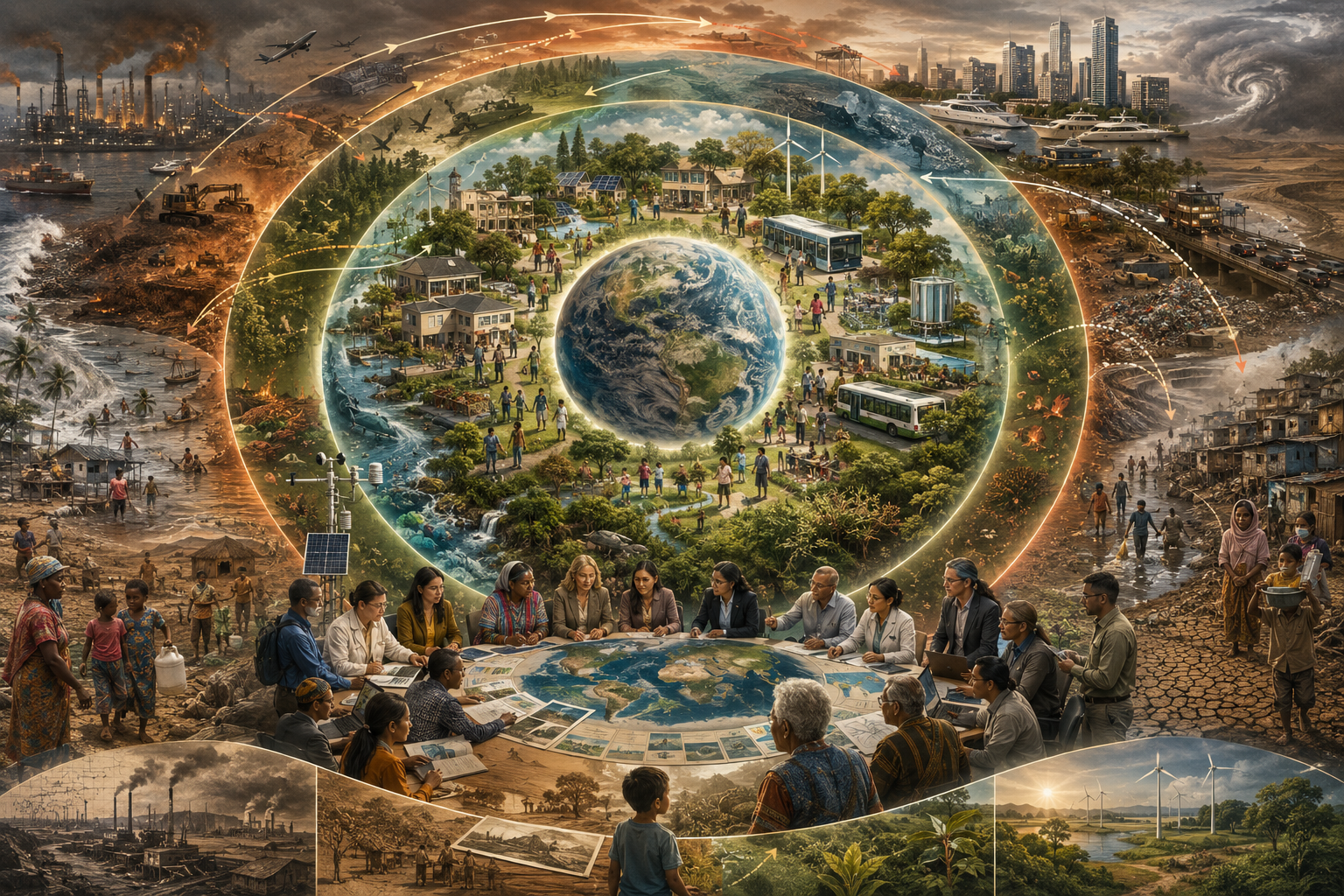
The question is therefore not simply whether humanity can remain within planetary boundaries. It is whether humanity can do so in a way that reduces deprivation, respects differentiated responsibility, protects vulnerable communities, and preserves a livable Earth system for future generations. A biophysically safe planet that leaves large populations without food, water, energy, housing, health, voice, or protection from harm is not a just planet. A socially ambitious development model that destroys the ecological foundations of future wellbeing is not just either. Planetary justice sits precisely at this difficult intersection.
This article examines the relationship between planetary boundaries, justice, and global inequality by explaining why justice is built into boundary questions, how global inequality shapes both boundary transgression and vulnerability to it, why safe operating space must be interpreted alongside fair access and differentiated responsibility, why justice is not only about distribution but also about recognition and voice, and what this means for governance, development, finance, engineering systems, and the future of a livable planet.
Why Justice Is Inseparable from Boundary Thinking
Justice is inseparable from boundary thinking because a planetary boundary is never just a measurement of Earth-system strain. It also implies questions of entitlement, exposure, responsibility, and harm. If the Earth system has a finite safe operating space, then the use of that space cannot be treated as socially neutral. Who consumes energy, land, materials, atmospheric capacity, freshwater, and waste-absorbing capacity matters. Who bears the costs of overshoot matters. Who has the institutional ability to avoid, absorb, insure against, or shift those costs matters as well.
This is one reason the safe-and-just boundaries literature has been so important. It argues that boundaries should not be set only to preserve Earth-system stability in the aggregate, but also to avoid significant harm to people. That shift is conceptually powerful because it reveals that even a scientifically “safe” aggregate condition may still be unjust if large populations are already exposed to intolerable harm. A framework concerned only with system averages risks overlooking the lived reality of unequal vulnerability. Justice therefore does not dilute boundary science. It sharpens its human significance.
Once boundaries are understood this way, justice is no longer external commentary on Earth-system science. It is part of the framework’s interpretive structure. A safe operating space for humanity cannot be understood meaningfully unless we ask which humanity is being protected, under what conditions, and at whose expense. If a boundary protects aggregate stability while allowing severe harm to particular communities, regions, species, or generations, then its adequacy has to be questioned.
Justice also matters because boundaries are never translated into policy without social choices. Decisions about carbon budgets, land-use limits, water allocation, conservation, pollution controls, finance, technology transfer, adaptation funding, industrial transition, and liability all distribute burdens and benefits. A boundary may be biophysical in origin, but its governance is unavoidably political.
Justice also alters the meaning of “humanity” in the phrase safe operating space for humanity. Humanity is not a single actor with a single ecological footprint, a single vulnerability profile, or a single development need. It is divided by wealth, class, race, colonial history, gender, geography, state capacity, infrastructure, citizenship, and political voice. A framework that speaks of humanity must therefore avoid flattening humanity into an abstraction.
The stronger interpretation is that planetary boundaries require a double test: does a proposed pathway preserve Earth-system resilience, and does it protect people from severe and unequal harm while expanding dignified access for those still deprived? If it fails either test, it is incomplete.
Global Inequality and Uneven Ecological Use
Global inequality shapes planetary boundaries because ecological pressure has never been produced evenly. Wealthier countries and affluent populations have historically consumed disproportionate shares of fossil energy, industrial materials, land transformation, atmospheric space, and waste-absorbing capacity. Poorer countries, meanwhile, often remain underprovided in basic services such as sanitation, health care, resilient infrastructure, secure housing, clean cooking, reliable electricity, food security, and climate adaptation. This creates a structural imbalance: some have built prosperity through throughput-intensive pathways that helped drive overshoot, while others still seek the minimum material basis for dignified life in a world where ecological room is already constrained.
That imbalance means planetary instability cannot be discussed honestly as a universal human problem in which all actors are similarly responsible. Humanity as a whole may be transgressing boundaries, but the production of that condition is unequal. Historical emissions, industrial expansion, material extraction, ecological transformation, and pollution burdens have been concentrated in particular regions, sectors, corporations, states, and classes. Justice enters here not as rhetoric but as analytic necessity. Without differentiating historical contribution, present capability, and remaining need, boundary discourse risks becoming biophysically correct but socially blunt.
This is also why aggregate language can mislead. Averages can suggest shared responsibility where asymmetry is decisive. The planetary boundaries framework gains explanatory depth when it is read alongside the history of global development, colonial extraction, industrial advantage, unequal exchange, class inequality, and uneven incorporation into the modern world economy. The question is not simply whether humanity has overshot. It is how different parts of humanity arrived there and how differently they live inside the consequences.
Carbon inequality is one of the clearest examples. High-emitting groups consume far more atmospheric space than low-emitting groups, while the poorest communities often face the highest vulnerability to climate disruption. This does not mean climate responsibility is only individual; emissions are embedded in infrastructure, energy systems, production networks, investment patterns, and political economy. But it does mean that justice cannot be reduced to national averages alone. Inequality within countries and across countries must both be visible.
| Justice dimension | What it asks | Why it matters for planetary boundaries |
|---|---|---|
| Historical responsibility | Who contributed most to cumulative ecological pressure? | Past emissions, extraction, land transformation, and pollution shape present obligations. |
| Present capacity | Who has the financial, technical, and institutional ability to transition? | Equal obligations can be unjust when capacity is unequal. |
| Minimum access | Who still lacks food, water, energy, housing, sanitation, health, education, and resilience? | Planetary limits must not freeze deprivation in place. |
| Exposure and vulnerability | Who is harmed first and hardest by overshoot? | Boundary transgression becomes injustice through unequal exposure and weak protection. |
| Procedural power | Who gets to define acceptable risk, priorities, and pathways? | Justice requires voice and recognition, not only redistribution. |
Uneven ecological use therefore changes the meaning of planetary stewardship. It cannot be a call for identical restraint imposed on unequal worlds. It must be a call for differentiated transformation: deeper and faster pressure reduction by those with greater responsibility and capacity, alongside expanded dignified access for those still denied the material conditions of a secure life.
Overshoot and Unequal Vulnerability
Boundary transgression produces unequal vulnerability because Earth-system destabilization is filtered through poverty, geography, infrastructure, institutional weakness, and political marginalization. Climate instability, freshwater change, biosphere decline, air pollution, soil degradation, chemical exposure, and ecosystem loss do not affect all societies equally, even when their drivers are global. People with weaker infrastructure, insecure livelihoods, limited mobility, fragile public systems, insecure land rights, and fewer legal protections are more exposed to drought, heat, floods, crop failure, pollution burdens, displacement, and ecological loss.
This is why global inequality and planetary instability reinforce one another. Overshoot magnifies developmental fragility, and fragility in turn limits the capacity to respond to overshoot. The result is not simply environmental harm layered on top of inequality. It is a mutually reinforcing pattern in which ecological disruption deepens social vulnerability and unequal institutions make ecological risk harder to manage. The poor are not only disadvantaged within the existing order. They are also more likely to be pushed first and hardest by the destabilization that order has produced.
This unequal vulnerability also has temporal consequences. Development gains that appear secure under stable ecological conditions can become highly reversible under ecological strain. A failed rainy season, marine collapse, severe heat wave, water contamination event, repeated flood, or prolonged drought can rapidly undo years of progress in health, education, livelihood security, public investment, and food security. Overshoot therefore turns inequality into a multiplier of risk.
Vulnerability is not only exposure to hazard. It is also the absence of protection, voice, insurance, public capacity, mobility, savings, legal recourse, secure tenure, and adaptive infrastructure. A justice-aware planetary-boundaries analysis must therefore look beyond the physical hazard itself. It must ask how social systems convert Earth-system disruption into unequal harm.
Unequal vulnerability also means that the same environmental pressure can have very different meanings across societies. A heat wave in a city with universal cooling access, green space, strong public health systems, worker protections, and reliable power is not the same as a heat wave in an informal settlement with poor housing, insecure electricity, limited health care, and outdoor labor dependence. A drought in a region with irrigation, insurance, social protection, and fiscal capacity is not the same as a drought where subsistence livelihoods and public systems are fragile.
Boundary justice therefore requires disaggregated analysis. It is not enough to ask whether a boundary is transgressed globally. We must also ask where the harm appears, who is least protected, and which institutions have the power to reduce exposure before disruption becomes disaster.
From Safe Boundaries to Safe and Just Boundaries
The move from safe boundaries to safe-and-just boundaries is one of the most important developments in this field because it changes the evaluative standard. The original planetary boundaries framework asked what ranges of Earth-system change remain compatible with long-term planetary stability and resilience. The safe-and-just literature asks a sharper question: what levels of Earth-system pressure are both safe for the planet and just for people, especially those exposed to harm first and most intensely?
This often results in more demanding thresholds because significant human harm can appear before aggregate Earth-system destabilization becomes fully apparent. In other words, justice may require more protective boundaries than safety alone. That is a major conceptual advance. It suggests that governance of planetary boundaries cannot stop at biophysical resilience in the abstract. It must also consider whether large populations are already being pushed into unacceptable exposure under supposedly tolerable global conditions.
The importance of this move is not only normative but methodological. It forces researchers, engineers, policymakers, and institutions to ask what kind of evidence counts when defining tolerable conditions. System-level stability is indispensable, but it is not sufficient. If the same environmental state means catastrophe for some and adaptability for others, distribution has to enter the boundary conversation directly. Safe-and-just thinking therefore expands rather than replaces the original framework, making it more responsive to the unequal social realities through which Earth-system change is experienced.
The safe-and-just turn also changes how data systems should be built. A planetary dashboard that tracks only aggregate pressure may be scientifically useful but ethically incomplete. A more responsible dashboard should also track exposure, access, vulnerability, adaptive capacity, minimum needs, procedural inclusion, and differentiated responsibility. Justice has implications for information architecture.
It also changes how risk is communicated. A boundary can no longer be described only as a global control variable or a system threshold. It must also be understood as a condition under which people may or may not remain protected from severe harm. This does not make boundary science less rigorous. It makes the interpretation of boundary science more honest about the social world in which Earth-system change unfolds.
Safe-and-just boundaries therefore introduce a deeper standard: the goal is not merely to keep the Earth system from crossing dangerous thresholds in the aggregate, but to organize human societies so that planetary stability and human dignity reinforce one another.
Leave No One Behind on a Changing Planet
The promise to leave no one behind, central to the 2030 Agenda, becomes much more demanding once read through planetary boundaries. It is one thing to affirm inclusion in principle. It is another to pursue inclusion on a planet where climate change, freshwater stress, biodiversity loss, nutrient overload, land degradation, synthetic chemical exposure, and air pollution are already constraining development prospects. The commitment to end poverty, reduce inequality, and protect the planet cannot be separated into parallel tracks. It has to be understood as one intertwined challenge.
That has two implications. First, no one can be left behind socially if ecological destabilization is allowed to intensify. Second, no one can be left behind politically if the remaining safe operating space is allocated in ways that reproduce historical advantage. A credible interpretation of “leave no one behind” in the Anthropocene therefore has to include both protection from ecological harm and fairer access to the conditions of sustainable wellbeing.
This changes the meaning of inclusion. Inclusion cannot simply mean access to the remnants of an already destabilized model. It must mean participation in a transition toward forms of energy, food, water, infrastructure, mobility, housing, health, and governance that can endure within a finite Earth system. Otherwise “leave no one behind” becomes an ethical slogan attached to an ecologically deteriorating reality.
The challenge is especially acute because some forms of poverty reduction require additional material and energy access. The justice question is not whether the poor should be denied development in the name of limits. It is whether the rich, powerful, and high-consuming can reduce excess fast enough to preserve ecological room for universal dignity.
Leaving no one behind also requires attention to people who are often missing from aggregate development dashboards: informal workers, Indigenous peoples, small island communities, migrants, refugees, people with disabilities, rural women, smallholder farmers, children, the elderly, displaced communities, and those living in informal settlements, floodplains, heat islands, pollution corridors, or fragile drylands. Boundary transgression is not experienced by an average citizen. It is experienced through specific bodies, places, livelihoods, and institutions.
A justice-centered planetary-boundaries framework therefore turns “leave no one behind” into a biophysical and political test: do development pathways protect those most exposed to Earth-system disruption while reducing the excessive pressures produced by those with the greatest responsibility and capacity?
Why Boundary Justice Is Not Only About Distribution
Justice in the context of planetary boundaries is not only about distributing remaining ecological room. It is also about voice, recognition, institutional power, and whose knowledge counts in setting pathways forward. Populations facing severe exposure often have the least influence over the rules that structure production, extraction, finance, infrastructure, and environmental burden. This means that injustice can persist even when aggregate redistribution is discussed, if decision-making remains concentrated and the lived experience of harm remains peripheral.
This broader view matters because global inequality is reproduced not only through resource asymmetries but through governance asymmetries. Boundary politics therefore cannot be reduced to technocratic global budgeting alone. It also has to ask who sets priorities, who defines acceptable risk, whose security is treated as negotiable, and whose expertise is dismissed or ignored. Justice requires participation and recognition, not only arithmetic allocation.
This point is especially important in global environmental governance, where the language of science can sometimes obscure the politics of interpretation. The same dataset can be incorporated into very different policy architectures depending on whose institutions dominate the process. Boundary justice therefore includes procedural justice: the fairness of decision-making itself, not only the fairness of the outcomes it distributes.
Recognition also matters for Indigenous peoples, frontline communities, small island states, rural communities, informal workers, smallholder farmers, and others whose knowledge of ecological harm is often practical, place-based, and historically grounded. A justice-aware boundary framework should not treat these communities only as vulnerable populations. It should recognize them as knowledge holders, rights holders, and governance actors.
Distribution remains essential, but it is not enough. A community may receive compensation while still being excluded from decisions. A population may be counted as vulnerable while its knowledge is ignored. A region may be described as a conservation priority while its inhabitants are displaced or criminalized. These are not technical details. They are failures of justice.
Boundary justice must therefore include distributive justice, procedural justice, recognitional justice, corrective justice, and intergenerational justice. Without that fuller understanding, planetary governance risks repeating the unequal patterns it claims to correct.
Development, Poverty, and Ecological Room
One of the hardest questions in this area is how to reconcile urgent development needs with a finite safe operating space. Poorer societies still require expanded access to food, health, water, energy, housing, education, transport, sanitation, digital infrastructure, and climate resilience. But if traditional high-throughput development pathways are no longer ecologically viable at planetary scale, then the challenge is not whether development should continue. It is how development can proceed without reproducing the most destabilizing features of past industrialization.
This is why justice cannot mean freezing existing inequalities in the name of planetary protection. A just boundary politics must preserve room for the eradication of deprivation while requiring more rapid transformation from those who have already consumed disproportionate ecological space. Development under constraint is difficult, but development without fairness is politically unstable and ethically indefensible.
What follows is not a rejection of development, but a demand to reorganize its material basis. The issue is not whether poorer societies should remain poor so that richer societies can preserve ecological comfort. The issue is whether development can be redesigned so that basic wellbeing expands while the most destructive forms of throughput, waste, extraction, pollution, and overshoot are reduced. Justice here requires both upward convergence in human dignity and downward convergence in unsustainable excess.
Research on minimum access and planetary boundaries sharpens this point. Meeting basic human needs does have material implications, but those needs are not equivalent to the high-consumption patterns of affluent societies. A just transition must therefore distinguish between sufficiency, dignity, and luxury overuse. Without that distinction, planetary limits can be weaponized against the poor while leaving excess insufficiently challenged.
Ecological room is therefore not only a technical allocation problem. It is a moral test of development strategy. If remaining safe operating space is used to preserve luxury emissions, speculative extraction, wasteful material systems, and high-consumption lifestyles while basic needs remain unmet elsewhere, then boundary governance becomes unjust even if it uses scientific language.
The challenge is to create development pathways that expand minimum access without copying the most destructive patterns of affluent consumption. That means clean energy, public health, resilient water systems, affordable housing, low-carbon mobility, regenerative food systems, strong public institutions, safer materials, and infrastructure designed for durability rather than waste.
Differentiated Responsibility and Planetary Stewardship
Differentiated responsibility is a necessary principle because equal percentages of effort do not imply equal justice. Countries and groups differ in historical contribution to overshoot, present capacity to transition, current vulnerability, and remaining need for basic development. A boundary-centered politics that ignores these differences risks turning planetary stewardship into a language of equal restraint imposed on unequal worlds. That would not only be unjust. It would likely be unworkable.
Planetary stewardship therefore has to be differentiated without becoming fragmented. The safe operating space is shared, but pathways into it cannot be identical. Some actors must decarbonize faster, reduce throughput more deeply, phase out destructive production sooner, and finance adaptation and transformation more substantially. Others must still expand key capabilities, but through less destructive pathways than those historically followed by richer societies. That is what justice means under conditions of shared but unequal planetary pressure.
Differentiated responsibility also helps protect the political legitimacy of transition itself. If boundary governance is experienced as another form of imposed scarcity by populations that have contributed least to overshoot, resistance will deepen. But if transition is coupled with fair finance, technology sharing, institutional inclusion, debt relief, adaptation support, and recognition of uneven responsibility, planetary stewardship becomes more plausible as a cooperative project rather than a coercive one.
This principle applies within countries as well as between them. High-income households, high-emitting sectors, large asset owners, and institutions that benefit from ecologically intensive systems often have greater responsibility and capacity than low-income households whose emissions and material use are tied to basic needs. Justice requires more granular responsibility than national averages alone can provide.
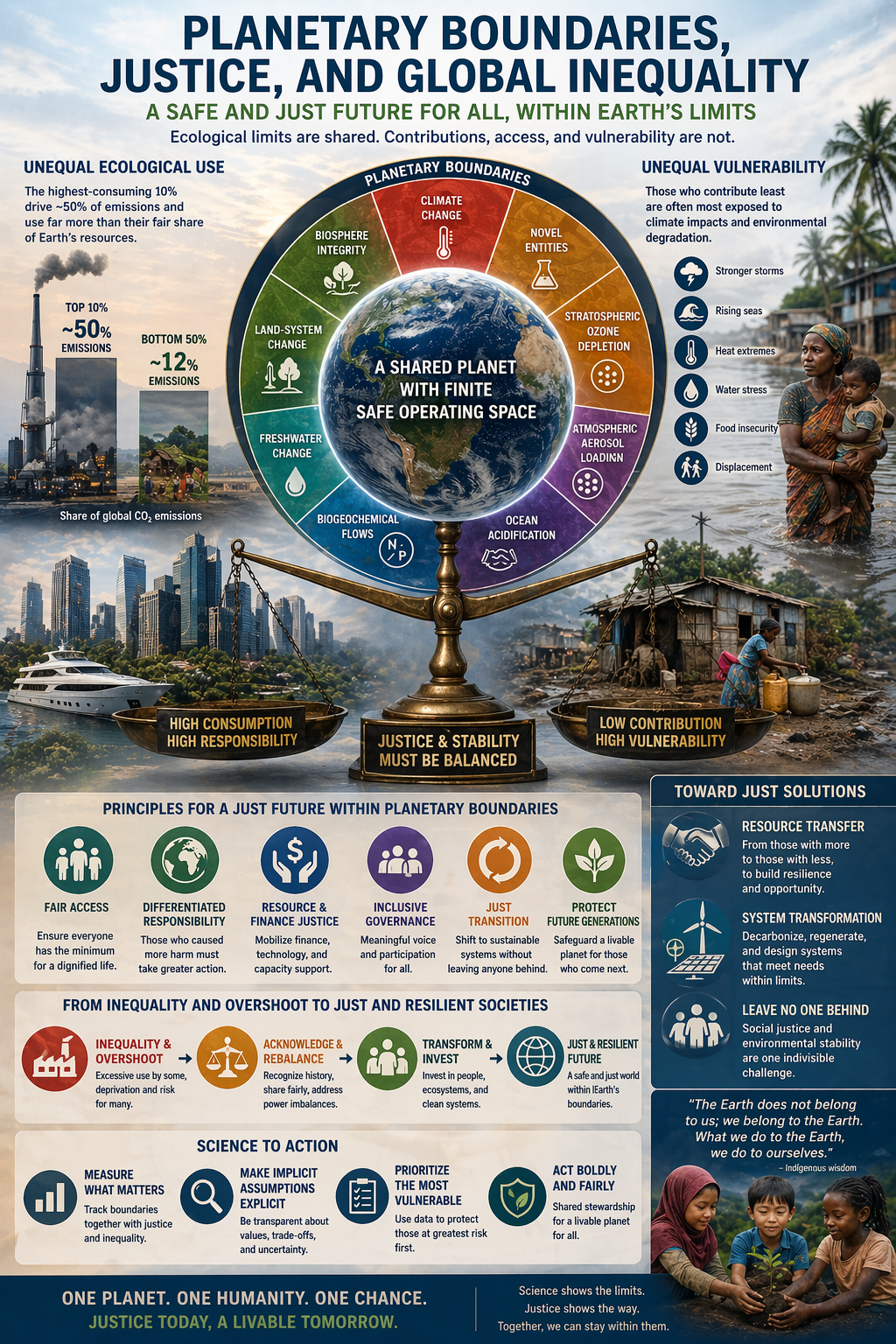
Differentiated responsibility is also a design principle for policy. It means that carbon pricing, energy transition, land conservation, pollution regulation, biodiversity protection, infrastructure investment, and adaptation finance should not be socially blind. Policies that ignore distribution can punish the vulnerable while leaving high-consuming actors relatively protected. Policies that integrate justice can reduce pressure while expanding legitimacy.
Planetary stewardship must therefore be both universal and differentiated: universal in recognizing shared dependence on Earth-system stability, differentiated in assigning responsibility according to contribution, capacity, need, and vulnerability.
Justice Across Time, Generations, and Risk
Justice in boundary politics is not only spatial. It is also temporal. Boundary transgression affects future generations by narrowing the ecological room, resilience, and strategic options available to them. A world that uses up buffering capacity, destabilizes climate, degrades the biosphere, contaminates water, and proliferates synthetic overload is not merely transferring environmental damage forward. It is transferring reduced freedom, higher adaptation costs, and weaker foundations for collective flourishing.
This intergenerational dimension deepens the justice argument considerably. It shows that present overshoot is not only about unequal burdens among existing populations. It is also about what kind of planet is being handed to those who did not consent to the risks being imposed. Future generations cannot vote in present institutions, but they are among the clearest stakeholders in boundary governance.
Thinking across time also clarifies why precaution matters. A just response to uncertainty is not to postpone action until damage becomes undeniable. It is to preserve room for future agency. Intergenerational justice therefore aligns closely with resilience thinking: both are concerned with protecting conditions of continued possibility rather than exhausting them for short-term gain.
Temporal justice also complicates discounting. Economic models that heavily discount future harm can make present overshoot appear more acceptable than it should be. A justice-centered planetary framework has to ask whether current generations are using analytical techniques that undervalue future lives, future rights, and future ecological stability.
Intergenerational justice is especially important for slow-moving and irreversible boundary processes. Ice-sheet loss, biodiversity extinction, groundwater depletion, soil degradation, persistent chemical contamination, and climate feedbacks can impose burdens over decades, centuries, or longer. These are not ordinary policy costs. They are inheritances of reduced possibility.
That is why planetary justice requires a long time horizon. It asks present societies not only what they can extract, consume, emit, or defer, but what kind of Earth-system inheritance they are creating. A safe operating space is therefore also a promise to the future: that present power will not consume the resilience that future people need.
Finance, Debt, and Transition Capacity
Planetary justice cannot be separated from finance because transition capacity is shaped by fiscal space, debt burdens, investment flows, insurance systems, trade rules, technology access, and the cost of capital. Many countries facing high climate vulnerability and development needs also face constrained budgets, expensive borrowing, limited infrastructure finance, and debt pressures. If these conditions are ignored, calls for sustainability can become unrealistic or punitive. A society cannot transform systems it lacks the financial capacity to rebuild.
Debt is especially important because it can force short-term extraction. Countries under fiscal pressure may expand resource exports, fossil fuel extraction, deforestation, mining, or austerity not because these pathways are desirable, but because public finance is constrained. Boundary governance that does not address debt and development finance risks telling vulnerable societies to transform while leaving the financial architecture of vulnerability intact.
Adaptation finance also matters. Boundary transgression is already producing loss, damage, and adaptation costs. If those costs fall mainly on communities and countries least responsible for overshoot, planetary governance becomes unjust. Climate-resilient infrastructure, early-warning systems, health protection, water systems, coastal defense, ecosystem restoration, and social protection require public investment. Justice demands that the burden of financing these responses reflect responsibility and capacity, not only exposure.
Private finance must also be part of the analysis. Capital allocation can reinforce boundary transgression when it funds fossil infrastructure, land conversion, pollution-intensive industry, and speculative extraction. It can support transition when aligned with clean energy, resilient infrastructure, ecosystem restoration, affordable housing, circular systems, safer materials, and public goods. Finance is not neutral. It is one of the main ways planetary futures are built.
For companion essays, see Finance, Disclosure, and Systemic Environmental Risk, Business Strategy Within Planetary Boundaries, Sustainable Development Goals Within Planetary Boundaries, and Earth System Governance in an Age of Limits.
Planetary justice therefore requires financial architecture consistent with differentiated responsibility. Without fair finance, technology access, debt relief, and adaptation support, the language of safe operating space can become a demand placed on those least able to bear it.
Governance Implications
If planetary boundaries are read through justice and inequality, governance cannot remain focused only on aggregate environmental targets. It must also address who bears transition costs, who receives protection, who gains access to cleaner systems, who receives adaptation support, and who is compensated for historical and ongoing damage. This points toward stronger international cooperation, fairer finance, technology sharing, differentiated obligations, debt justice, just transition policy, and institutions better able to connect biophysical stability with social inclusion.
It also changes how success is measured. A world that reduces one aggregate planetary metric while intensifying exclusion, deprivation, displacement, or sacrifice for already vulnerable populations cannot be counted as fully successful. Boundary governance has to protect resilience for the planet and dignity for people together. Otherwise it risks becoming ecologically literate but politically brittle.
This means governance has to move beyond the false choice between technocratic management and distributive politics. Planetary governance is already distributive politics. The question is whether that distribution remains hidden and unequal, or whether it becomes explicit, fairer, and more democratically accountable. Justice is therefore not an added burden on boundary governance. It is part of what makes it governable at all.
For technical systems, the governance implication is equally clear. Data pipelines, dashboards, scoring engines, and decision-support tools should not represent planetary risk as if social structure were irrelevant. A justice-aware system must connect environmental pressure to exposure, access, vulnerability, capacity, responsibility, and procedural inclusion. Without those links, analytics can reproduce the same blindness that justice critiques seek to correct.
Governance must also be capable of handling conflict honestly. Boundary transitions create real conflicts over land, energy, minerals, water, conservation, compensation, jobs, infrastructure, and sovereignty. Justice does not eliminate conflict, but it changes how conflict should be handled. It demands participation, transparency, rights protection, accountability, and protection for those with the least bargaining power.
A justice-aware planetary-boundaries framework therefore points toward institutions that are scientifically informed, publicly accountable, globally cooperative, locally responsive, and distributionally explicit. That is a much higher standard than environmental management alone. It is also the standard required by the scale of the crisis.
Why This Matters for Planetary Boundaries
Justice matters for planetary boundaries because a safe operating space that ignores inequality is not truly a safe operating space for humanity. It may protect an abstract planetary condition while failing to protect the people most exposed to harm. It may preserve aggregate stability while allowing severe deprivation, displacement, or sacrifice zones. It may reduce one pressure while reproducing the power relations that created overshoot in the first place.
Planetary boundaries matter for justice because human dignity cannot be secured on a destabilizing Earth system. Poverty reduction, health, food security, water access, housing, education, work, peace, and institutional legitimacy all depend on ecological foundations. A justice agenda that ignores Earth-system limits may promise liberation through a development pathway that becomes materially self-undermining.
The strongest interpretation is therefore not justice versus planetary limits. It is planetary justice: the attempt to preserve Earth-system resilience while reducing deprivation, exposure, and unequal responsibility. This is the framework needed for a century in which ecological limits and social inequality can no longer be treated as separate fields.
This matters because the legitimacy of planetary-boundary governance will depend on whether people experience it as protection or punishment. If transition means austerity for the vulnerable and continuity for the powerful, it will fail morally and politically. If transition expands dignity, reduces vulnerability, confronts excess, and distributes responsibility fairly, it becomes a plausible basis for shared planetary stewardship.
Planetary justice therefore deepens the framework. It does not weaken the science. It asks the science to confront the world as it is: unequal, historically structured, politically contested, and morally urgent.
Mathematical Lens: Ecological Use, Minimum Access, and Justice Gaps
Planetary justice can be represented as a relationship among ecological use, fair allocation, minimum access, and vulnerability. Let \(E_{g,i}\) represent ecological use by group or region \(g\) for boundary process \(i\), such as climate pressure, material use, freshwater use, land conversion, nutrient loading, or pollution burden. Let \(A_{g,i}\) represent a fair or policy-relevant allocation for that group, defined through a transparent allocation method. A simple ecological overuse ratio is:
O_{g,i} = \max\left(0, \frac{E_{g,i} – A_{g,i}}{A_{g,i}}\right)
\]
Interpretation: If \(O_{g,i}=0\), the group is within its allocated ecological space for that process. If \(O_{g,i} > 0\), it exceeds that allocation.
But justice also requires attention to minimum access. Let \(S_{g,j}\) represent social access for group \(g\) on foundation \(j\), such as clean water, energy, food, housing, health, education, mobility, or adaptation infrastructure. Let \(M_{g,j}\) represent the minimum access threshold required for dignity. A social access shortfall can be written as:
Q_{g,j} = \max\left(0, \frac{M_{g,j} – S_{g,j}}{M_{g,j}}\right)
\]
Interpretation: If \(Q_{g,j}=0\), minimum access is met. If \(Q_{g,j} > 0\), the group faces a social foundation shortfall.
Justice analysis must also include vulnerability. Let \(V_g\) represent exposure and vulnerability to boundary transgression, scaled from 0 to 1. A combined planetary justice gap can be expressed as:
J_g = \alpha \overline{O_g} + \beta \overline{Q_g} + \gamma V_g
\]
Interpretation: A justice gap can arise from excessive ecological use, unmet minimum access, high vulnerability, or some combination of all three.
A responsibility-weighted version can add historical contribution and capacity:
R_g = J_g \times (1 + H_g) \times (1 + C_g)
\]
Interpretation: \(H_g\) represents historical contribution to overshoot, while \(C_g\) represents present capacity to act.
Procedural justice can also be included. Let \(P_g\) represent procedural inclusion, such as participation, legal protection, data access, and decision-making voice. A procedural penalty can be written as:
L_g = 1 – P_g
\]
Interpretation: A group with low procedural inclusion faces a higher governance justice gap, even if redistribution is discussed.
A fuller justice diagnostic can then combine material and procedural dimensions:
D_g = \left(\alpha \overline{O_g} + \beta \overline{Q_g} + \gamma V_g + \delta L_g\right)(1 + H_g)(1 + C_g)
\]
Interpretation: Planetary justice risk rises when ecological overuse, unmet access, vulnerability, procedural exclusion, historical contribution, and capacity interact.
| Term | Meaning | Interpretive role |
|---|---|---|
| \(E_{g,i}\) | Ecological use | Represents a group’s pressure on a boundary process. |
| \(A_{g,i}\) | Fair allocation | Represents a transparent allocation of ecological space. |
| \(O_{g,i}\) | Ecological overuse | Measures distance above allocated ecological space. |
| \(S_{g,j}\) | Social access | Represents access to food, water, energy, housing, health, education, mobility, or resilience. |
| \(M_{g,j}\) | Minimum access threshold | Defines the social foundation required for dignity. |
| \(Q_{g,j}\) | Minimum-access shortfall | Measures distance below the social foundation. |
| \(V_g\) | Vulnerability | Represents exposure and sensitivity to ecological disruption. |
| \(H_g\) | Historical contribution | Represents accumulated contribution to overshoot. |
| \(C_g\) | Capacity to act | Represents ability to finance, govern, and implement transition. |
| \(P_g\) | Procedural inclusion | Represents voice, participation, rights, and decision-making access. |
This model is not a final measure of justice. Its purpose is diagnostic. It forces the assumptions to be visible: what allocation rule is used, which minimum access thresholds matter, how vulnerability is weighted, how historical contribution enters, and whether procedural exclusion is treated as part of the justice gap.
Advanced Python Workflow: Planetary Justice and Inequality Scoring
The following Python workflow models planetary justice as a relationship among ecological overuse, minimum-access shortfall, vulnerability, procedural inclusion, historical contribution, and capacity. It is illustrative rather than definitive, but it provides an auditable structure for comparing groups, regions, or countries without hiding the ethical assumptions behind a single opaque score.
"""
Planetary justice and inequality scoring workflow.

This workflow models justice gaps across:
- ecological overuse
- minimum-access shortfall
- vulnerability
- procedural exclusion
- historical contribution
- present capacity to act

The data are illustrative. Replace sample values with documented
environmental accounts, social indicators, vulnerability metrics,
historical responsibility data, governance indicators, and transparent
allocation methods before applied use.
"""

from __future__ import annotations

from dataclasses import dataclass
from pathlib import Path
from typing import Literal

import numpy as np
import pandas as pd


JusticePriority = Literal[
    "lower_priority",
    "moderate_priority",
    "high_priority",
    "urgent_priority",
]


@dataclass(frozen=True)
class JusticeWeight:
    """Weight assigned to a planetary justice dimension."""

    dimension: str
    weight: float


def normalize_weights(weights: list[JusticeWeight]) -> dict[str, float]:
    """Normalize weights so they sum to one."""
    total = sum(item.weight for item in weights)

    if total <= 0:
        raise ValueError("Total weight must be positive.")

    return {item.dimension: item.weight / total for item in weights}


def build_sample_data() -> pd.DataFrame:
    """
    Create illustrative group-level justice data.

    Ecological-use values and allocations are indexed.
    Social access and minimum access are indexed from 0 to 1.
    Vulnerability, historical contribution, capacity, and procedural inclusion
    are scaled from 0 to 1.
    """
    return pd.DataFrame(
        {
            "group": [
                "High-income high-consuming",
                "Middle-income industrializing",
                "Low-income climate-vulnerable",
                "Small island vulnerable",
                "Resource-export dependent",
                "Urban low-income communities",
            ],
            "ecological_use": [2.40, 1.45, 0.55, 0.38, 1.20, 0.62],
            "fair_allocation": [1.00, 1.00, 1.00, 1.00, 1.00, 1.00],
            "social_access": [0.96, 0.78, 0.48, 0.68, 0.58, 0.52],
            "minimum_access": [0.85, 0.85, 0.85, 0.85, 0.85, 0.85],
            "vulnerability": [0.22, 0.45, 0.82, 0.90, 0.66, 0.74],
            "procedural_inclusion": [0.78, 0.54, 0.32, 0.38, 0.42, 0.28],
            "historical_contribution": [0.88, 0.48, 0.12, 0.08, 0.35, 0.18],
            "capacity_to_act": [0.86, 0.58, 0.24, 0.30, 0.42, 0.32],
        }
    )


def classify_priority(score: float) -> JusticePriority:
    """Classify responsibility-adjusted justice priority."""
    if score < 0.40:
        return "lower_priority"
    if score < 0.90:
        return "moderate_priority"
    if score < 1.50:
        return "high_priority"
    return "urgent_priority"


def score_justice_gaps(
    data: pd.DataFrame,
    weights: dict[str, float],
) -> pd.DataFrame:
    """Calculate planetary justice gap and responsibility-adjusted score."""
    scored = data.copy()

    if (scored["fair_allocation"] <= 0).any():
        raise ValueError("Fair allocation values must be positive.")

    if (scored["minimum_access"] <= 0).any():
        raise ValueError("Minimum access values must be positive.")

    scored["ecological_overuse"] = np.maximum(
        0,
        (scored["ecological_use"] - scored["fair_allocation"])
        / scored["fair_allocation"],
    )

    scored["minimum_access_shortfall"] = np.maximum(
        0,
        (scored["minimum_access"] - scored["social_access"])
        / scored["minimum_access"],
    )

    scored["procedural_exclusion"] = 1 - scored["procedural_inclusion"]

    scored["planetary_justice_gap"] = (
        scored["ecological_overuse"] * weights["ecological_overuse"]
        + scored["minimum_access_shortfall"] * weights["minimum_access_shortfall"]
        + scored["vulnerability"] * weights["vulnerability"]
        + scored["procedural_exclusion"] * weights["procedural_exclusion"]
    )

    scored["responsibility_adjusted_gap"] = (
        scored["planetary_justice_gap"]
        * (1 + scored["historical_contribution"])
        * (1 + scored["capacity_to_act"])
    )

    scored["dominant_dimension"] = scored[
        [
            "ecological_overuse",
            "minimum_access_shortfall",
            "vulnerability",
            "procedural_exclusion",
        ]
    ].idxmax(axis=1)

    scored["justice_priority_class"] = scored[
        "responsibility_adjusted_gap"
    ].apply(classify_priority)

    scored["policy_priority"] = np.select(
        [
            scored["ecological_overuse"] >= 0.50,
            scored["minimum_access_shortfall"] >= 0.30,
            scored["vulnerability"] >= 0.70,
            scored["procedural_exclusion"] >= 0.60,
            scored["capacity_to_act"] < 0.35,
        ],
        [
            "reduce_excess_ecological_use",
            "expand_minimum_access",
            "adaptation_and_resilience_support",
            "procedural_justice_and_voice",
            "finance_and_capacity_support",
        ],
        default="maintain_justice_monitoring",
    )

    return scored.sort_values(
        "responsibility_adjusted_gap",
        ascending=False,
    ).reset_index(drop=True)


def run_sensitivity(data: pd.DataFrame) -> pd.DataFrame:
    """Run alternative ethical weighting scenarios."""
    scenarios = {
        "balanced": [
            JusticeWeight("ecological_overuse", 1),
            JusticeWeight("minimum_access_shortfall", 1),
            JusticeWeight("vulnerability", 1),
            JusticeWeight("procedural_exclusion", 1),
        ],
        "vulnerability_priority": [
            JusticeWeight("ecological_overuse", 1),
            JusticeWeight("minimum_access_shortfall", 1),
            JusticeWeight("vulnerability", 2),
            JusticeWeight("procedural_exclusion", 1),
        ],
        "access_priority": [
            JusticeWeight("ecological_overuse", 1),
            JusticeWeight("minimum_access_shortfall", 2),
            JusticeWeight("vulnerability", 1),
            JusticeWeight("procedural_exclusion", 1),
        ],
        "responsibility_priority": [
            JusticeWeight("ecological_overuse", 2),
            JusticeWeight("minimum_access_shortfall", 1),
            JusticeWeight("vulnerability", 1),
            JusticeWeight("procedural_exclusion", 1),
        ],
        "procedural_priority": [
            JusticeWeight("ecological_overuse", 1),
            JusticeWeight("minimum_access_shortfall", 1),
            JusticeWeight("vulnerability", 1),
            JusticeWeight("procedural_exclusion", 2),
        ],
    }

    frames = []

    for scenario_name, scenario_weights in scenarios.items():
        normalized = normalize_weights(scenario_weights)
        scored = score_justice_gaps(data, normalized)
        scored["scenario"] = scenario_name
        scored["rank"] = scored["responsibility_adjusted_gap"].rank(
            ascending=False,
            method="dense",
        )
        frames.append(scored)

    return pd.concat(frames, ignore_index=True)


def main() -> None:
    """Run the planetary justice scoring workflow."""
    output_dir = Path(
        "articles/planetary-boundaries-justice-and-global-inequality/outputs"
    )
    output_dir.mkdir(parents=True, exist_ok=True)

    data = build_sample_data()

    balanced_weights = normalize_weights(
        [
            JusticeWeight("ecological_overuse", 1),
            JusticeWeight("minimum_access_shortfall", 1),
            JusticeWeight("vulnerability", 1),
            JusticeWeight("procedural_exclusion", 1),
        ]
    )

    scored = score_justice_gaps(data, balanced_weights)
    sensitivity = run_sensitivity(data)

    scored.to_csv(output_dir / "planetary_justice_scores.csv", index=False)
    sensitivity.to_csv(output_dir / "planetary_justice_sensitivity.csv", index=False)

    display_columns = [
        "group",
        "ecological_overuse",
        "minimum_access_shortfall",
        "vulnerability",
        "procedural_exclusion",
        "historical_contribution",
        "capacity_to_act",
        "planetary_justice_gap",
        "responsibility_adjusted_gap",
        "dominant_dimension",
        "justice_priority_class",
        "policy_priority",
    ]

    print("\nPlanetary justice scores:")
    print(scored[display_columns].round(3).to_string(index=False))

    print("\nSensitivity analysis:")
    print(
        sensitivity[
            [
                "scenario",
                "group",
                "responsibility_adjusted_gap",
                "dominant_dimension",
                "justice_priority_class",
                "policy_priority",
                "rank",
            ]
        ].round(3).to_string(index=False)
    )


if __name__ == "__main__":
    main()
This workflow is useful because it separates different kinds of justice problems. A high-consuming group may score high because of ecological overuse and historical contribution. A vulnerable group may score high because of minimum-access shortfall and exposure, even with low ecological use. A procedurally excluded group may face justice risks because it lacks voice in decisions that shape its exposure. Treating those cases as identical would be analytically and ethically misleading.
The workflow also makes ethical weighting explicit, allowing analysts to test whether conclusions change when vulnerability, access, ecological overuse, or procedural inclusion receives greater emphasis. That transparency matters because planetary justice is not value-free. The goal is not to remove ethics from analysis, but to make ethical assumptions visible enough to be debated.
Advanced R Workflow: Justice, Access, and Boundary-Pressure Dashboarding
The following R workflow prepares dashboard-ready outputs for planetary justice analysis. It is designed for policy teams, sustainability analysts, researchers, engineers, and governance practitioners who need to compare ecological use, access shortfalls, vulnerability, procedural inclusion, historical contribution, and capacity across groups or regions.
# Planetary justice and inequality dashboard
#
# This workflow scores groups across:
# - ecological overuse
# - minimum-access shortfall
# - vulnerability
# - procedural exclusion
# - historical contribution
# - present capacity to act
#
# Values are illustrative and should be replaced with documented data,
# transparent allocation rules, and verified indicator sources.

library(readr)
library(dplyr)
library(tidyr)

justice_data <- tibble::tibble(
  group = c(
    "High-income high-consuming",
    "Middle-income industrializing",
    "Low-income climate-vulnerable",
    "Small island vulnerable",
    "Resource-export dependent",
    "Urban low-income communities"
  ),
  ecological_use = c(2.40, 1.45, 0.55, 0.38, 1.20, 0.62),
  fair_allocation = c(1, 1, 1, 1, 1, 1),
  social_access = c(0.96, 0.78, 0.48, 0.68, 0.58, 0.52),
  minimum_access = c(0.85, 0.85, 0.85, 0.85, 0.85, 0.85),
  vulnerability = c(0.22, 0.45, 0.82, 0.90, 0.66, 0.74),
  procedural_inclusion = c(0.78, 0.54, 0.32, 0.38, 0.42, 0.28),
  historical_contribution = c(0.88, 0.48, 0.12, 0.08, 0.35, 0.18),
  capacity_to_act = c(0.86, 0.58, 0.24, 0.30, 0.42, 0.32)
)

weights <- tibble::tibble(
  dimension = c(
    "ecological_overuse",
    "minimum_access_shortfall",
    "vulnerability",
    "procedural_exclusion"
  ),
  weight = c(1, 1, 1, 1)
) %>%
  mutate(weight = weight / sum(weight))

scored <- justice_data %>%
  mutate(
    ecological_overuse = pmax(
      0,
      (ecological_use - fair_allocation) / fair_allocation
    ),
    minimum_access_shortfall = pmax(
      0,
      (minimum_access - social_access) / minimum_access
    ),
    procedural_exclusion = 1 - procedural_inclusion
  )

justice_long <- scored %>%
  select(
    group,
    ecological_overuse,
    minimum_access_shortfall,
    vulnerability,
    procedural_exclusion
  ) %>%
  pivot_longer(
    cols = -group,
    names_to = "dimension",
    values_to = "dimension_score"
  ) %>%
  left_join(weights, by = "dimension") %>%
  mutate(weighted_score = dimension_score * weight)

justice_scores <- justice_long %>%
  group_by(group) %>%
  summarise(
    planetary_justice_gap = sum(weighted_score),
    dominant_dimension = dimension[which.max(dimension_score)],
    dominant_dimension_value = max(dimension_score),
    .groups = "drop"
  ) %>%
  left_join(
    scored %>%
      select(group, historical_contribution, capacity_to_act),
    by = "group"
  ) %>%
  mutate(
    responsibility_adjusted_gap = planetary_justice_gap *
      (1 + historical_contribution) *
      (1 + capacity_to_act),
    justice_priority_class = case_when(
      responsibility_adjusted_gap < 0.40 ~ "lower_priority",
      responsibility_adjusted_gap < 0.90 ~ "moderate_priority",
      responsibility_adjusted_gap < 1.50 ~ "high_priority",
      TRUE ~ "urgent_priority"
    ),
    policy_priority = case_when(
      dominant_dimension == "ecological_overuse" ~
        "reduce_excess_ecological_use",
      dominant_dimension == "minimum_access_shortfall" ~
        "expand_minimum_access",
      dominant_dimension == "vulnerability" ~
        "adaptation_and_resilience_support",
      dominant_dimension == "procedural_exclusion" ~
        "procedural_justice_and_voice",
      TRUE ~ "maintain_justice_monitoring"
    )
  ) %>%
  arrange(desc(responsibility_adjusted_gap))

scenario_weights <- tibble::tibble(
  scenario = c(
    "balanced",
    "vulnerability_priority",
    "access_priority",
    "responsibility_priority",
    "procedural_priority"
  ),
  ecological_overuse = c(1, 1, 1, 2, 1),
  minimum_access_shortfall = c(1, 1, 2, 1, 1),
  vulnerability = c(1, 2, 1, 1, 1),
  procedural_exclusion = c(1, 1, 1, 1, 2)
) %>%
  pivot_longer(
    cols = -scenario,
    names_to = "dimension",
    values_to = "raw_weight"
  ) %>%
  group_by(scenario) %>%
  mutate(weight = raw_weight / sum(raw_weight)) %>%
  ungroup()

sensitivity <- scored %>%
  select(
    group,
    ecological_overuse,
    minimum_access_shortfall,
    vulnerability,
    procedural_exclusion,
    historical_contribution,
    capacity_to_act
  ) %>%
  pivot_longer(
    cols = c(
      ecological_overuse,
      minimum_access_shortfall,
      vulnerability,
      procedural_exclusion
    ),
    names_to = "dimension",
    values_to = "dimension_score"
  ) %>%
  left_join(scenario_weights, by = "dimension") %>%
  mutate(weighted_score = dimension_score * weight) %>%
  group_by(scenario, group) %>%
  summarise(
    planetary_justice_gap = sum(weighted_score),
    historical_contribution = first(historical_contribution),
    capacity_to_act = first(capacity_to_act),
    dominant_dimension = dimension[which.max(dimension_score)],
    .groups = "drop"
  ) %>%
  mutate(
    responsibility_adjusted_gap = planetary_justice_gap *
      (1 + historical_contribution) *
      (1 + capacity_to_act)
  ) %>%
  group_by(scenario) %>%
  mutate(rank = dense_rank(desc(responsibility_adjusted_gap))) %>%
  ungroup()

dashboard_long <- justice_scores %>%
  select(
    group,
    planetary_justice_gap,
    responsibility_adjusted_gap,
    historical_contribution,
    capacity_to_act
  ) %>%
  pivot_longer(
    cols = -group,
    names_to = "metric",
    values_to = "value"
  )

output_dir <- "articles/planetary-boundaries-justice-and-global-inequality/outputs"

dir.create(
  output_dir,
  recursive = TRUE,
  showWarnings = FALSE
)

write_csv(
  scored,
  file.path(output_dir, "r_base_scores.csv")
)

write_csv(
  justice_long,
  file.path(output_dir, "r_justice_long.csv")
)

write_csv(
  justice_scores,
  file.path(output_dir, "r_justice_scores.csv")
)

write_csv(
  sensitivity,
  file.path(output_dir, "r_sensitivity.csv")
)

write_csv(
  dashboard_long,
  file.path(output_dir, "r_dashboard_long.csv")
)

print(justice_scores)
This R workflow is designed for transparent interpretation. It allows analysts to identify whether a justice gap is driven mainly by ecological overuse, minimum-access shortfall, vulnerability, or procedural exclusion. It also makes explicit how historical contribution and capacity to act alter responsibility-adjusted priority. That distinction is essential because planetary justice is not one-dimensional.
The sensitivity table is especially important. If a ranking changes dramatically when vulnerability receives more weight or procedural exclusion receives more weight, that is not a flaw. It is useful information. It shows where ethical assumptions matter most and where decision-makers need open public reasoning rather than hidden technocratic judgment.
Advanced Go Workflow: Lightweight Planetary Justice Scoring Service
The following Go workflow translates planetary-justice diagnostics into a lightweight scoring service. Go is useful for command-line tools, APIs, monitoring systems, and operational scoring engines. This example reads group-level justice profiles from a CSV file and reports ecological overuse, minimum-access shortfall, vulnerability, procedural exclusion, justice gap, responsibility-adjusted gap, and priority class.
package main

import (
	"encoding/csv"
	"errors"
	"fmt"
	"os"
	"strconv"
)

type JusticeProfile struct {
	Group                  string
	EcologicalUse          float64
	FairAllocation         float64
	SocialAccess           float64
	MinimumAccess          float64
	Vulnerability          float64
	ProceduralInclusion    float64
	HistoricalContribution float64
	CapacityToAct          float64
}

func parseFloat(value string) (float64, error) {
	parsed, err := strconv.ParseFloat(value, 64)
	if err != nil {
		return 0, fmt.Errorf("invalid numeric value %q: %w", value, err)
	}
	return parsed, nil
}

func parseProfile(row []string) (JusticeProfile, error) {
	if len(row) < 9 {
		return JusticeProfile{}, errors.New("expected at least 9 columns")
	}

	values := make([]float64, 8)
	for i := 1; i < 9; i++ {
		parsed, err := parseFloat(row[i])
		if err != nil {
			return JusticeProfile{}, err
		}
		values[i-1] = parsed
	}

	return JusticeProfile{
		Group:                  row[0],
		EcologicalUse:          values[0],
		FairAllocation:         values[1],
		SocialAccess:           values[2],
		MinimumAccess:          values[3],
		Vulnerability:          values[4],
		ProceduralInclusion:    values[5],
		HistoricalContribution: values[6],
		CapacityToAct:          values[7],
	}, nil
}

func maxZero(value float64) float64 {
	if value < 0 {
		return 0
	}
	return value
}

func ecologicalOveruse(profile JusticeProfile) float64 {
	if profile.FairAllocation <= 0 {
		return 0
	}
	return maxZero((profile.EcologicalUse - profile.FairAllocation) / profile.FairAllocation)
}

func minimumAccessShortfall(profile JusticeProfile) float64 {
	if profile.MinimumAccess <= 0 {
		return 0
	}
	return maxZero((profile.MinimumAccess - profile.SocialAccess) / profile.MinimumAccess)
}

func proceduralExclusion(profile JusticeProfile) float64 {
	return 1 - profile.ProceduralInclusion
}

func planetaryJusticeGap(profile JusticeProfile) float64 {
	// Balanced weights across four dimensions.
	const weight = 0.25

	return weight*ecologicalOveruse(profile) +
		weight*minimumAccessShortfall(profile) +
		weight*profile.Vulnerability +
		weight*proceduralExclusion(profile)
}

func responsibilityAdjustedGap(profile JusticeProfile) float64 {
	return planetaryJusticeGap(profile) *
		(1 + profile.HistoricalContribution) *
		(1 + profile.CapacityToAct)
}

func dominantDimension(profile JusticeProfile) string {
	values := map[string]float64{
		"ecological_overuse":          ecologicalOveruse(profile),
		"minimum_access_shortfall":    minimumAccessShortfall(profile),
		"vulnerability":              profile.Vulnerability,
		"procedural_exclusion":        proceduralExclusion(profile),
	}

	maxKey := "ecological_overuse"
	maxValue := values[maxKey]

	for key, value := range values {
		if value > maxValue {
			maxKey = key
			maxValue = value
		}
	}

	return maxKey
}

func priorityClass(score float64) string {
	switch {
	case score < 0.40:
		return "lower_priority"
	case score < 0.90:
		return "moderate_priority"
	case score < 1.50:
		return "high_priority"
	default:
		return "urgent_priority"
	}
}

func policyPriority(profile JusticeProfile) string {
	switch dominantDimension(profile) {
	case "ecological_overuse":
		return "reduce_excess_ecological_use"
	case "minimum_access_shortfall":
		return "expand_minimum_access"
	case "vulnerability":
		return "adaptation_and_resilience_support"
	case "procedural_exclusion":
		return "procedural_justice_and_voice"
	default:
		return "maintain_justice_monitoring"
	}
}

func main() {
	if len(os.Args) < 2 {
		fmt.Println("usage: planetary-justice-score justice_profiles.csv")
		os.Exit(1)
	}

	file, err := os.Open(os.Args[1])
	if err != nil {
		fmt.Println("error opening file:", err)
		os.Exit(1)
	}
	defer file.Close()

	reader := csv.NewReader(file)
	rows, err := reader.ReadAll()
	if err != nil {
		fmt.Println("error reading CSV:", err)
		os.Exit(1)
	}

	for i, row := range rows {
		if i == 0 {
			continue
		}

		profile, err := parseProfile(row)
		if err != nil {
			fmt.Println("parse error:", err)
			continue
		}

		score := responsibilityAdjustedGap(profile)

		fmt.Printf(
			"group=%s ecological_overuse=%.3f access_shortfall=%.3f vulnerability=%.3f procedural_exclusion=%.3f justice_gap=%.3f responsibility_adjusted_gap=%.3f dominant=%s class=%s priority=%s\n",
			profile.Group,
			ecologicalOveruse(profile),
			minimumAccessShortfall(profile),
			profile.Vulnerability,
			proceduralExclusion(profile),
			planetaryJusticeGap(profile),
			score,
			dominantDimension(profile),
			priorityClass(score),
			policyPriority(profile),
		)
	}
}
The Go workflow shows how planetary-justice diagnostics can move from article-level explanation into operational systems. A lightweight scoring service could support public dashboards, policy screening tools, development-finance review, climate-justice monitoring, infrastructure planning, adaptation prioritization, or environmental-risk APIs.
A production implementation should include schema validation, unit checking, source metadata, uncertainty intervals, transparent allocation rules, geographic identifiers, disaggregated population groups, rights indicators, missing-data handling, audit trails, and versioned ethical assumptions. Planetary-justice scoring should never hide moral and political choices behind a single number. It should make those choices visible enough for review, contestation, and public accountability.
Engineering Extensions in the GitHub Repository
The accompanying GitHub repository extends the article workflow beyond Python, R, and Go into a broader engineering scaffold. The article body keeps Python and R visible because they are accessible tools for justice analytics, inequality scoring, dashboard preparation, scenario testing, and reproducible reporting. Go provides a compact service layer. The repository, however, is structured for readers who want to translate planetary justice analysis into more technical systems: auditable databases, scoring engines, APIs, embedded monitoring, scenario simulation, edge anomaly detection, and accelerator-aware environmental data pipelines.
The SQL scaffold is intended for groups, regions, ecological-use indicators, minimum-access indicators, vulnerability metrics, historical responsibility variables, procedural inclusion variables, capacity indicators, source provenance, scoring runs, and audit trails. Rust can support reliable scoring engines or command-line tools where type safety and reproducibility matter. Go can support lightweight services and diagnostic APIs. C and C++ can support embedded threshold monitoring, local signal processing, or scenario simulation. TinyML can support low-power anomaly detection at the edge, while PYNQ-oriented scaffolding can support accelerated preprocessing of environmental or social-risk signals.
This engineering layer matters because planetary justice is not only a philosophical or legal concern. It is also a data-infrastructure problem. If systems cannot connect ecological pressure to vulnerability, minimum access, historical responsibility, procedural inclusion, and capacity, they will reproduce aggregate blindness. Justice-aware analytics require careful data modeling, explicit assumptions, provenance, uncertainty tracking, and transparent interpretation.
A mature implementation should also include documentation for allocation methods, minimum-access thresholds, vulnerability scoring, historical responsibility indicators, procedural-justice variables, uncertainty handling, review workflows, community data rights, privacy protections, and public communication. Without that layer, justice dashboards can become decorative. With it, the technical system becomes accountable planetary-justice knowledge infrastructure.
GitHub Repository
Complete Code Repository
The full code distribution for this article, including Python, R, and Go workflows plus extended engineering scaffolding for SQL, Rust, C, C++, TinyML, and PYNQ-oriented planetary justice and inequality diagnostics, is available on GitHub.
Common Misunderstandings
A common misunderstanding is that justice is an optional moral supplement added after the science is done. In reality, once a finite safe operating space is identified, questions of use, exposure, responsibility, and access enter immediately. The boundary may be biophysical, but its interpretation is social and political.
A second misunderstanding is that global inequality is only a development issue and not a boundary issue. The opposite is true: inequality shapes both who drives overshoot and who suffers it. Ecological pressure, exposure, adaptive capacity, and political voice are all distributed unequally.
A third misunderstanding is that justice means abandoning biophysical rigor. The safe-and-just literature argues instead that justice often sharpens the interpretation of what protection requires. If significant human harm occurs before an aggregate Earth-system threshold is crossed, then a justice-aware boundary may need to be more protective than a boundary defined by planetary stability alone.
A further misunderstanding is that a universal planetary problem automatically calls for identical obligations from all actors. Shared planetary risk does not erase unequal history, capacity, vulnerability, or need. Justice in boundary politics depends not on pretending all positions are equal, but on responding to unequal conditions with appropriately differentiated responsibility.
Another mistake is to assume that once aggregate stability is secured, justice will follow automatically. It may not. A transition can be ecologically successful in a narrow sense while remaining politically exclusionary, socially punitive, or historically blind. Justice has to be designed into boundary governance rather than expected to emerge as a by-product.
A final misunderstanding is that justice can be reduced to redistribution alone. Distribution is essential, but justice also includes recognition, participation, procedural fairness, rights protection, repair, and intergenerational responsibility. Boundary governance that ignores voice and power can remain unjust even if it discusses allocation.
Related Articles
- What Are Planetary Boundaries?
- The Origins of the Planetary Boundaries Framework
- Safe Operating Space and the Logic of Thresholds
- How Planetary Boundaries Are Measured
- Uncertainty, Precaution, and Scientific Debate in Boundary Setting
- Planetary Boundaries and Earth System Resilience
- Tipping Points, Feedback Loops, and Cascading Ecological Change
- Sustainable Development Goals Within Planetary Boundaries
- Climate Change as a Planetary Boundary
- Biosphere Integrity and the Stability of Life Systems
- Freshwater Change and Earth System Risk
- Land-System Change and Ecological Transformation
- Biogeochemical Flows: Nitrogen, Phosphorus, and Planetary Destabilization
- Novel Entities and the Problem of Synthetic Overload
- Earth System Governance in an Age of Limits
- Business Strategy Within Planetary Boundaries
- Finance, Disclosure, and Systemic Environmental Risk
- Planetary Boundaries and Doughnut Economics
- The Future of Planetary Stewardship
Further Reading
- Biermann, F. (2020) ‘Planetary justice: A research framework’, Earth System Governance, 6, 100070. Available at: https://www.sciencedirect.com/science/article/pii/S2589811620300082.
- Fanning, A.L., O’Neill, D.W., Hickel, J. and Roux, N. (2022) ‘The social shortfall and ecological overshoot of nations’, Nature Sustainability, 5, pp. 26–36. Available at: https://www.nature.com/articles/s41893-021-00799-z.
- Gupta, J. et al. (2023) ‘Earth system justice needed to identify and live within Earth system boundaries’, Nature Sustainability, 6, pp. 630–638. Available at: https://www.nature.com/articles/s41893-023-01064-1.
- Gupta, J. et al. (2024) ‘A just world on a safe planet: a Lancet Planetary Health–Earth Commission report on Earth-system boundaries, translations and transformations’, The Lancet Planetary Health, 8(10), pp. e813–e873. Available at: https://www.thelancet.com/journals/lanplh/article/PIIS2542-5196(24)00042-1/fulltext.
- O’Neill, D.W., Fanning, A.L., Lamb, W.F. and Steinberger, J.K. (2018) ‘A good life for all within planetary boundaries’, Nature Sustainability, 1, pp. 88–95. Available at: https://www.nature.com/articles/s41893-018-0021-4.
- Rammelt, C.F. et al. (2023) ‘Impacts of meeting minimum access on critical Earth systems’, Nature Sustainability. Available at: https://www.nature.com/articles/s41893-022-00995-5.
- Raworth, K. (2017) Doughnut Economics: Seven Ways to Think Like a 21st-Century Economist. London: Random House. Available at: https://www.kateraworth.com/doughnut/.
- Rockström, J. et al. (2023) ‘Safe and just Earth system boundaries’, Nature, 619, pp. 102–111. Available at: https://www.nature.com/articles/s41586-023-06083-8.
- United Nations (2015) Transforming our world: the 2030 Agenda for Sustainable Development. New York: United Nations. Available at: https://sdgs.un.org/2030agenda.
- United Nations Sustainable Development Group (n.d.) Leave No One Behind. New York: United Nations. Available at: https://unsdg.un.org/2030-agenda/universal-values/leave-no-one-behind.
- World Inequality Lab (2022) World Inequality Report 2022. Paris: World Inequality Lab. Available at: https://wir2022.wid.world/.
References
- Biermann, F. (2020) ‘Planetary justice: A research framework’, Earth System Governance, 6, 100070. Available at: https://www.sciencedirect.com/science/article/pii/S2589811620300082.
- Earth Commission (n.d.) Safe and Just Earth System Boundaries. Available at: https://earthcommission.org/safe-and-just-earth-system-boundaries/.
- Earth Commission (2024) Earth System Justice Explainer Brief: Towards a Just World on a Safe Planet. Available at: https://earthcommission.org/wp-content/uploads/2024/09/Earth-System-Justice-Explainer-Brief.pdf.
- Fanning, A.L., O’Neill, D.W., Hickel, J. and Roux, N. (2022) ‘The social shortfall and ecological overshoot of nations’, Nature Sustainability, 5, pp. 26–36. Available at: https://www.nature.com/articles/s41893-021-00799-z.
- Gupta, J. et al. (2023) ‘Earth system justice needed to identify and live within Earth system boundaries’, Nature Sustainability, 6, pp. 630–638. Available at: https://www.nature.com/articles/s41893-023-01064-1.
- Gupta, J. et al. (2024) ‘Earth system boundaries and Earth system justice: sharing the ecospace’, Environmental Politics. Available at: https://www.tandfonline.com/doi/full/10.1080/09644016.2023.2234794.
- Gupta, J. et al. (2024) ‘A just world on a safe planet: a Lancet Planetary Health–Earth Commission report on Earth-system boundaries, translations and transformations’, The Lancet Planetary Health, 8(10), pp. e813–e873. Available at: https://www.thelancet.com/journals/lanplh/article/PIIS2542-5196(24)00042-1/fulltext.
- O’Neill, D.W., Fanning, A.L., Lamb, W.F. and Steinberger, J.K. (2018) ‘A good life for all within planetary boundaries’, Nature Sustainability, 1, pp. 88–95. Available at: https://www.nature.com/articles/s41893-018-0021-4.
- Rammelt, C.F. et al. (2023) ‘Impacts of meeting minimum access on critical Earth systems’, Nature Sustainability. Available at: https://www.nature.com/articles/s41893-022-00995-5.
- Richardson, K., Steffen, W., Lucht, W., Bendtsen, J., Cornell, S.E., Donges, J.F., Drüke, M., Fetzer, I., Bala, G., von Bloh, W., Feulner, G., Fiedler, S., Gerten, D., Gleeson, T., Hofmann, M., Huiskamp, W., Jakobsson, C., Jürgensen, J.H., Kummu, M., Mohan, C., Nogués-Bravo, D., Petri, S., Porkka, M., Rahmstorf, S., Schaphoff, S., Schulte-Uebbing, L., Staal, A., Sun, Z., Sakschewski, B. and Wang-Erlandsson, L. (2023) ‘Earth beyond six of nine planetary boundaries’, Science Advances, 9(37), eadh2458. Available at: https://www.science.org/doi/10.1126/sciadv.adh2458.
- Rockström, J., Steffen, W., Noone, K., Persson, Å., Chapin, F.S. III, Lambin, E.F., Lenton, T.M., Scheffer, M., Folke, C., Schellnhuber, H.J., Nykvist, B., de Wit, C.A., Hughes, T., van der Leeuw, S., Rodhe, H., Sörlin, S., Snyder, P.K., Costanza, R., Svedin, U., Falkenmark, M., Karlberg, L., Corell, R.W., Fabry, V.J., Hansen, J., Walker, B., Liverman, D., Richardson, K., Crutzen, P. and Foley, J.A. (2009) ‘A safe operating space for humanity’, Nature, 461, pp. 472–475. Available at: https://www.nature.com/articles/461472a.
- Rockström, J. et al. (2023) ‘Safe and just Earth system boundaries’, Nature, 619, pp. 102–111. Available at: https://www.nature.com/articles/s41586-023-06083-8.
- Steffen, W., Richardson, K., Rockström, J., Cornell, S.E., Fetzer, I., Bennett, E.M., Biggs, R., Carpenter, S.R., de Vries, W., de Wit, C.A., Folke, C., Gerten, D., Heinke, J., Mace, G.M., Persson, L.M., Ramanathan, V., Reyers, B. and Sörlin, S. (2015) ‘Planetary boundaries: Guiding human development on a changing planet’, Science, 347(6223), 1259855. Available at: https://www.science.org/doi/10.1126/science.1259855.
- United Nations (2015) Transforming our world: the 2030 Agenda for Sustainable Development. New York: United Nations. Available at: https://sdgs.un.org/2030agenda.
- United Nations Sustainable Development Group (n.d.) Leave No One Behind. Available at: https://unsdg.un.org/2030-agenda/universal-values/leave-no-one-behind.
- World Inequality Lab (2022) World Inequality Report 2022. Paris: World Inequality Lab. Available at: https://wir2022.wid.world/.