
Last Updated May 8, 2026
The future of planetary stewardship will be defined by whether human societies can learn to govern themselves as participants in, rather than masters of, a finite and interdependent Earth system. Ecological crisis is no longer well described as a collection of separate environmental problems. Climate disruption, biosphere decline, freshwater destabilization, land transformation, pollution, resource extraction, and systemic overshoot now shape the operating conditions of economies, institutions, cities, infrastructures, cultures, and everyday life. In this context, stewardship means more than conservation in a narrow sense. It means taking responsibility for the conditions that make long-run collective flourishing possible on a living planet.
Planetary stewardship is the ethical, institutional, scientific, and practical counterpart to the planetary boundaries framework. The boundaries identify the ecological conditions within which humanity can reduce the risk of destabilizing the Earth system. Stewardship asks what kinds of governance, responsibility, repair, restraint, legitimacy, solidarity, and social transformation are required to live within those conditions. It shifts the discussion from diagnosis to obligation, from measurement to responsibility, and from abstract limits to the lived work of care.
Main Library
Publications
Article Map
Planetary Boundaries
Related Article
Earth System Governance
Related Topic
Sustainable Development
Related Topic
Stewardship & Ethics
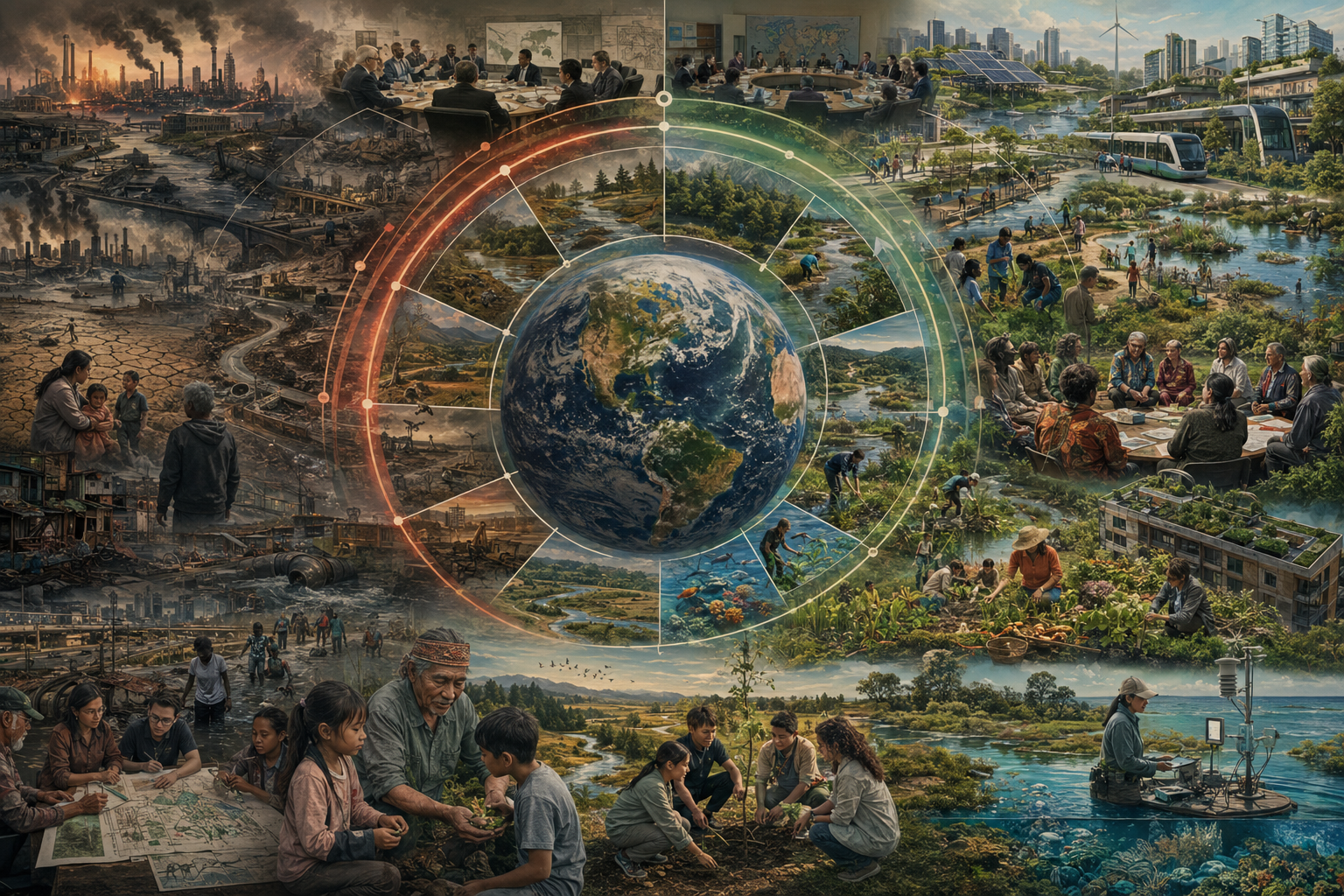
The distinctive contribution of stewardship to the planetary boundaries conversation is that it refuses to let Earth-system science remain merely descriptive. If climate change, biosphere integrity, land-system change, freshwater disruption, biogeochemical flows, novel entities, ocean acidification, atmospheric aerosols, and ozone depletion define the physical and ecological pressures of the Anthropocene, then stewardship names the human response those pressures require. It asks whether institutions, markets, cities, communities, cultures, and legal systems can be redesigned so that human activity supports rather than degrades the long-run stability of the Earth system.
This article examines why planetary stewardship is becoming a defining concept in an age of ecological limits, how it differs from narrower environmental management, why it must be multilevel rather than centralized, how justice and legitimacy shape its credibility, why repair and regeneration matter, what risks can hollow out stewardship language, and how stewardship capacity can be modeled through governance, justice, restoration, response capacity, and boundary pressure. It also includes Python, R, and Go workflows for translating stewardship concepts into reproducible diagnostics, dashboards, and service-oriented scoring tools.
Why Planetary Stewardship Matters Now
Planetary stewardship matters now because humanity no longer inhabits a world in which environmental degradation can be treated as local, reversible, or secondary to development. The ecological conditions that support food systems, water security, public health, economic stability, cultural continuity, and social resilience are being altered at scales large enough to reshape the future of civilization itself. Once planetary boundaries are transgressed, the problem is no longer simply whether particular ecosystems are under pressure. It is whether the broader Earth system remains stable enough to support durable human societies.
The concept of stewardship becomes especially important when the language of management reaches its limits. Management suggests bounded systems, controllable problems, and relatively discrete interventions. Stewardship suggests something more demanding: long-horizon responsibility under uncertainty, interdependence, and imperfect control. It emphasizes that humanity is not simply regulating an external environment, but inhabiting and transforming a shared Earth system whose resilience cannot be taken for granted.
This distinction matters because the planetary crisis is not only a technical problem. It is also a crisis of relationship. Modern institutions have often treated land, water, atmosphere, minerals, forests, oceans, species, and labor as resources to be mobilized for growth. Planetary stewardship begins from a different premise: the Earth system is not merely a stock of inputs. It is the living condition of possibility for collective life.
For this reason, the future of stewardship is bound up with the future of political maturity. The challenge is not only whether societies know enough science to recognize planetary risk. It is whether they can translate that knowledge into forms of restraint, redesign, repair, solidarity, and institutional commitment strong enough to alter their trajectory. A society can measure ecological danger and still fail to govern it. Stewardship is the discipline of closing that gap.
The urgency of stewardship also comes from the cumulative nature of boundary pressure. Climate change cannot be stabilized while ecosystems are being destroyed. Biodiversity cannot be protected while land systems, freshwater systems, and chemical pollution continue to intensify. Food systems cannot remain secure if soil, pollination, water, and climate regulation are degraded. Stewardship therefore asks societies to move beyond fragmented environmental response and toward integrated responsibility for the systems that sustain life.
Planetary stewardship matters, finally, because it names a positive project. It is not merely a warning against collapse. It is a vision of responsibility: societies capable of reducing harm, repairing damage, protecting vulnerable communities, restoring ecosystems, governing technology, transforming infrastructure, and building forms of prosperity that do not require planetary destabilization.
What Stewardship Means in an Earth-System Context
In an Earth-system context, stewardship means the deliberate shaping of human activity so that it supports rather than degrades the ecological foundations of collective life. It implies an active relationship of responsibility, not passive appreciation. A steward does not merely observe limits. A steward works to preserve, restore, renew, and govern the conditions that make continuity possible.
This makes stewardship broader than conservation in the classical sense. Conservation often evokes the protection of specific landscapes, species, or resources. Planetary stewardship includes those concerns, but extends further to global biophysical processes, system interactions, and the social institutions that influence them. Climate governance, land-use planning, freshwater management, industrial transformation, food systems, financial allocation, technological design, urban development, and rights-based ecological governance all become part of stewardship when they are understood through their effects on planetary life-support systems.
Stewardship also carries an ethical implication. It presumes that the Earth is not merely a stock of inputs for present extraction, but a shared inheritance and enabling condition that generates responsibilities across communities, generations, and species. In that sense, stewardship is not only strategic. It is civilizational.
The Earth-system meaning of stewardship also changes how agency is understood. Humans are not outside the systems they govern. Cities, farms, ports, mines, supply chains, data centers, energy grids, forests, rivers, oceans, and households are all coupled social-ecological systems. Their consequences travel through atmosphere, water, trade, finance, migration, ecological change, and institutional trust. Stewardship therefore requires humility: not the claim that humanity can master planetary complexity, but the recognition that human systems must be redesigned because they already affect planetary complexity.
A serious stewardship framework should include at least five dimensions. First, it requires scientific literacy about Earth-system processes. Second, it requires governance capacity to translate knowledge into durable rules, investments, protections, and practices. Third, it requires justice, because ecological limits become politically explosive when responsibility and vulnerability are distributed unequally. Fourth, it requires repair, because many systems are already degraded. Fifth, it requires cultural formation, because societies organized around short-term extraction will struggle to act as stewards even when they have excellent data.
| Concept | Narrow interpretation | Planetary-stewardship interpretation |
|---|---|---|
| Environmental management | Managing discrete environmental problems, sites, resources, or compliance obligations. | Useful but insufficient unless connected to Earth-system stability, cumulative pressure, and justice. |
| Conservation | Protecting species, habitats, landscapes, or ecological resources. | Essential, but part of a broader responsibility for the living systems that sustain planetary resilience. |
| Sustainability | Often reduced to efficiency, reporting, or lower-impact practices. | A transformation of human systems so that wellbeing can persist within ecological limits. |
| Planetary stewardship | Sometimes mistaken for moral aspiration or environmental care alone. | The practical, institutional, ethical, scientific, and political work of preserving and repairing Earth-system resilience. |
| Governance | Rules and institutions for managing behavior. | The multilevel capacity to align law, markets, infrastructure, communities, and knowledge with planetary stability. |
Stewardship is strongest when it joins these dimensions without reducing one to another. It should not collapse into technocracy, because ecological limits are inseparable from justice and legitimacy. It should not collapse into rhetoric, because good intentions do not stabilize climate, restore wetlands, protect communities, or transform infrastructure. It should not collapse into moral individualism, because planetary pressures are built into institutions, supply chains, and political economies. Stewardship is the work of changing those systems.
From Environmental Management to Planetary Responsibility
The move from environmental management to planetary responsibility marks one of the most important conceptual shifts of the Anthropocene. Environmental management emerged largely in a world where ecological harms could still be imagined as separate problems: local pollution, species decline, poor waste control, deforestation, industrial contamination, or overfishing. Planetary responsibility begins from the recognition that these problems are entangled and cumulative, and that their aggregate effects can destabilize the wider Earth system.
This shift changes the scope of obligation. A firm does not only manage emissions at a facility. It participates in a wider carbon regime. A city does not only manage waste or zoning. It shapes land, water, mobility, consumption, and social expectations. A financial institution does not only manage portfolio risk. It allocates capital within systems that may intensify or ease ecological overshoot. A national government does not only regulate domestic industries. It participates in international systems of trade, finance, extraction, energy, food, migration, security, and diplomacy.
Stewardship therefore broadens responsibility by embedding actors within larger patterns of consequence. It also makes responsibility harder to evade. Once activities are seen as systemically connected, it becomes less plausible for actors to treat their contribution as too small or too indirect to matter. Stewardship is not based on the fantasy that any one actor controls the whole. It is based on the recognition that many actors together shape the whole, and that responsibility follows from participation in cumulative systems.
This does not mean responsibility is distributed evenly. Wealthy states, high-consuming populations, major emitters, extractive industries, financial institutions, and firms embedded in high-throughput supply chains generally carry greater responsibility than communities with minimal ecological footprints and high vulnerability. Planetary responsibility must therefore be differentiated. Without that differentiation, stewardship can become a language that asks those least responsible for overshoot to bear its heaviest burdens.
The movement from management to responsibility also changes the time horizon. Management often works on budget cycles, compliance periods, election schedules, project timelines, or quarterly reporting. Planetary responsibility requires intergenerational thinking. It asks whether today’s energy systems, settlement patterns, food systems, industrial practices, and financial decisions are creating conditions under which future societies can thrive. Stewardship is therefore a form of long-term accountability.
The deepest change is moral and institutional. Environmental management can remain compatible with an extractive worldview if it merely reduces damage at the margins. Planetary responsibility challenges that worldview. It asks whether human systems can be reorganized around limits, reciprocity, repair, and enoughness rather than endless expansion, externalization, and delayed consequence.
Stewardship and the Politics of Limits
The future of planetary stewardship will depend on whether societies can develop political forms adequate to ecological limits. Limits are difficult because they unsettle modern assumptions of endless expansion, frictionless growth, and externalized consequence. Once ecological space is understood as finite, questions of priority, fairness, sufficiency, and self-restraint become unavoidable.
This means stewardship cannot be reduced to technocratic efficiency. It is political because limits are political. Who gives up what, who gains room to develop, who is protected, who pays for repair, who controls land and water, whose knowledge counts, and whose risks are recognized are not questions that science alone can answer. Stewardship therefore requires institutions capable of negotiating limits without collapsing into denial, authoritarianism, or unequal sacrifice.
At its best, stewardship is not the politics of austerity but the politics of reorientation. It asks how societies can secure wellbeing, dignity, and resilience while letting go of models of prosperity that depend on continual destabilization of the systems that sustain life. That is an exacting demand, but it is increasingly the real context in which politics takes place.
Limits also expose the difference between scarcity produced by ecology and scarcity produced by political economy. Some constraints are biophysical: atmospheric carbon budgets, freshwater availability, ecological thresholds, land-system capacity, nutrient loading, and chemical toxicity. Other constraints are socially organized: poverty amid abundance, exclusion from land, unequal energy access, debt structures, underinvestment in public goods, and concentrated ownership of resources. Stewardship must distinguish these forms of scarcity. Otherwise, ecological limits can be misused to justify inequality rather than to transform it.
The politics of limits also raises the problem of legitimacy. People are unlikely to accept transition if they experience it as imposed, hypocritical, or one-sided. A stewardship politics that protects elite consumption while disciplining ordinary households will fail morally and politically. A credible stewardship politics must align ecological restraint with social protection, public investment, participatory decision-making, and visible fairness.
This is where planetary stewardship becomes inseparable from democratic capacity. The task is not merely to govern limits, but to govern them in ways people can contest, understand, trust, and help shape. Scientific knowledge defines danger zones; political legitimacy determines whether societies can respond without reproducing domination. Stewardship requires both.
Why the Future of Stewardship Is Multilevel
The future of stewardship is multilevel because no single institution, jurisdiction, or social scale is large enough to govern planetary conditions on its own. Stewardship has to operate simultaneously through international coordination, national law, regional planning, municipal experimentation, corporate transformation, civil-society mobilization, Indigenous and local stewardship, scientific monitoring, and household practice. Earth-system pressures are global in effect but uneven in expression, which means governance must be both coordinated and context-sensitive.
This multilevel structure is not a weakness to be eliminated. It is the condition of any realistic stewardship politics. The challenge is not to replace plural authority with one planetary sovereign. It is to align many forms of authority toward shared ecological objectives while respecting democratic legitimacy, place-based knowledge, and social difference.
That alignment remains difficult because institutions are often fragmented while Earth-system processes are integrated. Climate ministries, agricultural agencies, finance regulators, water authorities, planning departments, trade bodies, health systems, biodiversity offices, Indigenous governance systems, and local governments may all influence the same ecological outcomes while operating under different mandates. Stewardship requires connection across these domains, not merely activity within them.
Multilevel governance also matters because ecological risks travel across scales. A local wetland may regulate flood risk for nearby communities, store carbon, support migratory species, filter pollutants, and connect to regional hydrology. A city’s transport system may affect local air quality, national energy demand, global emissions, land-use patterns, and public health. A corporate procurement policy may influence forests, labor conditions, water use, biodiversity, and political power across continents. Stewardship must be able to see and govern these connections.
International law and diplomacy remain indispensable, especially for climate, biodiversity, oceans, hazardous wastes, trade, finance, and shared ecological systems. But international agreement without local implementation can become symbolic. Local action without national and international support can become isolated. Corporate commitments without enforcement can become reputational cover. Community stewardship without rights can become vulnerable to dispossession. The multilevel task is to make these scales mutually reinforcing.
A mature stewardship system would connect global goals, national law, regional planning, local knowledge, rights-based governance, financial accountability, scientific monitoring, and public participation. It would recognize that planetary stability is not governed from one place. It is produced, weakened, or repaired through many places at once.
Cities, Markets, and Transformative Agency
One of the major questions for the future is which actors will actually drive stewardship transitions. States remain indispensable, but they are not the only relevant actors. Cities increasingly shape energy use, infrastructure, land patterns, mobility, consumption, housing, public health, waste, and social innovation. Markets allocate capital, shape supply chains, and influence technological direction. Civil society helps articulate legitimacy, pressure institutions, and hold power accountable. Indigenous peoples and local communities often sustain place-based stewardship practices with deep ecological knowledge and long-term relationships to land and water.
This means transformative agency is distributed. No single actor will solve planetary crisis, but many actors can either reinforce overshoot or help redirect it. The future of stewardship therefore depends less on finding one master institution than on cultivating aligned transformation across strategically important sites of decision-making.
Cities are especially significant because they concentrate population, infrastructure, capital, and political experimentation. Their ecological influence extends well beyond their administrative boundaries through supply chains, land demand, material throughput, emissions, food systems, construction, water use, and institutional innovation. If cities become more regenerative, distributive, and ecologically literate, they can play a major stewardship role. If they deepen extractive and high-throughput patterns, they can intensify planetary strain. In that sense, the urban future is deeply entangled with the future of stewardship.
Markets matter because they encode incentives. If financial systems reward deforestation, fossil expansion, pollution, disposable design, planned obsolescence, land speculation, and high-throughput consumption, stewardship will remain structurally weak. If capital allocation begins to recognize ecological risk, rights violations, transition exposure, biodiversity loss, and long-term resilience, markets can become less destructive. But markets do not become stewards on their own. They require law, disclosure, liability, public investment, democratic pressure, and institutional redesign.
Businesses matter because they organize material flows. Energy, food, construction, transport, chemicals, mining, textiles, electronics, and finance all shape boundary pressure. Serious stewardship therefore requires more than corporate sustainability language. It requires changes in procurement, production, design, labor conditions, land use, emissions, waste, circularity, restoration, biodiversity protection, and community accountability.
Civil society matters because stewardship without public power becomes fragile. Social movements, professional associations, universities, religious communities, youth movements, Indigenous organizations, local associations, scientists, journalists, and cultural institutions help define what societies can see, value, contest, and demand. Stewardship is not only enacted through policy. It is cultivated through public imagination and organized pressure.
Knowledge, Ethics, and the Cultivation of Stewardship
Stewardship is not only a matter of institutions. It is also a matter of worldview, knowledge, and ethical formation. A society organized around extraction, short time horizons, and externalization of harm will struggle to act as a steward even if it possesses excellent data. Stewardship requires not just information, but interpretation and moral orientation. It depends on whether societies see the biosphere as disposable background or as a living condition of shared survival.
This is why knowledge systems matter. Scientific monitoring is essential for understanding planetary change, but scientific knowledge alone is not enough. The future of stewardship also depends on whether institutions can learn from local ecological knowledge, Indigenous stewardship traditions, civic deliberation, religious and philosophical ethics, historical memory, and lived experience. A scientifically informed but socially detached stewardship model will remain brittle. A morally committed but scientifically weak model will remain ineffective. The challenge is to hold these domains together.
Earth-system science contributes the diagnostic architecture. It helps identify feedbacks, thresholds, risks, uncertainty, cross-boundary interactions, and the cumulative effects of human pressure. Social science contributes insight into institutions, incentives, inequality, legitimacy, behavior, conflict, power, and governance. Humanities and religious studies contribute moral vocabulary, memory, meaning, humility, and reflection on what kinds of life are worth building. Indigenous and local knowledge systems contribute long-term relational understanding of place, seasonality, reciprocity, and ecological responsibility. Stewardship needs this plurality.
There is therefore a cultural dimension to stewardship that should not be underestimated. Stewardship has to be cultivated through education, narrative, public institutions, rituals of accountability, ecological literacy, professional norms, and shared expectations. It is not just a policy setting. It is a civilizational disposition toward care under conditions of interdependence.
This cultural dimension does not replace material transformation. A society can speak beautifully about care while continuing to destroy forests, pollute rivers, exploit labor, and finance fossil expansion. But without cultural formation, technical reforms remain shallow. Stewardship requires both the infrastructure of responsibility and the imagination to sustain it.
Justice and the Future of Planetary Care
The future of planetary stewardship cannot be separated from justice because ecological destabilization is produced and experienced unevenly. A stewardship model that preserves aggregate planetary indicators while reproducing deprivation, unequal sacrifice, or colonial patterns of control will not be politically legitimate or ethically defensible. Stewardship, if it is to endure, has to include fairer allocation of responsibility, protection, and ecological room.
This means planetary care cannot be imagined as neutral guardianship from above. It has to confront who has contributed most to overshoot, who remains most vulnerable to harm, who has benefited from extraction, who still lacks the material basis for a dignified life, and who is asked to change first. Stewardship that ignores these asymmetries risks becoming a moral language for preserving stability without transforming inequality.
Justice also matters because stewardship depends on trust. Populations asked to change how they live, produce, consume, travel, build, or develop will not do so easily if transition appears one-sided or hypocritical. Fairness is therefore not simply an ethical addition to stewardship. It is one of the preconditions of its social viability.
The justice dimension is especially important for Indigenous peoples and local communities. Many high-integrity ecosystems overlap with territories shaped by long-term stewardship, customary governance, and place-based ecological knowledge. Protecting planetary systems cannot be reduced to fortress conservation that removes people from land and seascapes. In many contexts, Indigenous sovereignty, land rights, cultural continuity, and local governance are part of ecological resilience rather than obstacles to it.
Justice also applies internationally. The nations and communities most vulnerable to climate disruption, biodiversity loss, water stress, food insecurity, and disaster risk are often those least responsible for historic ecological pressure. A serious stewardship framework must therefore include climate finance, adaptation support, loss and damage mechanisms, biodiversity finance, debt justice, technology access, and reform of trade and investment systems that externalize ecological harm.
Finally, justice requires attention to the future. Future generations cannot vote in present institutions, yet they will inherit the consequences of present decisions. Stewardship is partly the discipline of representing those absent interests: children, future communities, nonhuman life, and ecosystems whose damage may not become fully visible until later. Without intergenerational justice, stewardship becomes short-term management under a kinder name.
Repair, Restoration, and Regeneration
The future of stewardship will also be shaped by whether societies move beyond a defensive model of sustainability toward a more active model of repair and regeneration. Avoiding additional damage remains essential, but in many domains it is no longer enough. Degraded ecosystems, disrupted hydrological cycles, polluted environments, exhausted soils, fragmented habitats, heat-stressed cities, contaminated waterways, and weakened public systems often require active restoration if resilience is to recover.
This makes stewardship future-oriented in a richer sense. It is not merely about staying within limits through less harm. It is about rebuilding capacities that have already been weakened. Restoration, regeneration, and repair are therefore likely to become increasingly central to stewardship discourse, especially in agriculture, forestry, watershed governance, biodiversity policy, urban design, coastal systems, public health, and climate adaptation.
Regeneration must be interpreted carefully. In ecological terms, it means rebuilding living capacity: soil structure, biodiversity, water retention, pollination, habitat connectivity, carbon storage, nutrient cycling, ecological relationships, and resilience after disturbance. In social terms, it means strengthening communities, public institutions, rights, livelihoods, and trust. A regenerative project that repairs ecosystems while exploiting people is not stewardship. A social program that improves wellbeing while destroying its ecological foundations is not stewardship either.
At the same time, regenerative language can be used superficially. The credibility of repair depends on whether it reduces absolute pressure, restores ecological function, protects communities, and supports just transition rather than serving as rhetorical cover for continued overshoot elsewhere. Tree planting cannot substitute for old-growth protection. Offsets cannot erase ongoing destruction. Restoration cannot justify avoidable harm. Stewardship requires regeneration, but it also requires honesty about the scale and limits of regeneration.
Repair also needs governance. Restoration projects require monitoring, long-term funding, land tenure clarity, community consent, ecological baselines, species selection, hydrological understanding, local knowledge, and accountability for outcomes. Without these, restoration can become symbolic. With them, it can become part of planetary recovery.
The deeper purpose of repair is not nostalgia for an untouched past. Human societies have long shaped landscapes and ecosystems. The purpose is to rebuild the conditions of resilience: living systems that can function, communities that can adapt, institutions that can learn, and economies that no longer depend on degrading their own foundations.
What Makes Stewardship Credible
Stewardship becomes credible when it is embedded in institutions, incentives, infrastructures, and forms of accountability that make ecological responsibility durable rather than symbolic. Declarations of care are insufficient if investment, infrastructure, law, and governance continue to reward destabilizing activity. Credibility therefore depends on whether stewardship claims are matched by measurable shifts in energy systems, land use, capital allocation, industrial practice, social protection, public procurement, restoration, and institutional design.
It also depends on whether stewardship is treated as transformational rather than decorative. The stronger the evidence for overshoot becomes, the less plausible it is to imagine that marginal improvement and reputational signaling will be enough. Stewardship worthy of the future has to alter what gets built, financed, subsidized, normalized, measured, protected, and defended.
Credible stewardship has several features. It is science-informed, because Earth-system risk cannot be governed without evidence. It is justice-centered, because unequal transition will not endure. It is measurable, because accountability requires indicators, baselines, and monitoring. It is participatory, because legitimacy cannot be manufactured from above. It is precautionary, because uncertainty does not justify delay when irreversible harm is plausible. It is adaptive, because institutions must learn as systems change. It is structural, because voluntary goodwill cannot overcome incentives that reward degradation.
Credibility also depends on transparency. Stewardship claims should be traceable: what boundary pressures are being reduced, what communities are affected, what ecosystems are protected or restored, what financing changed, what trade-offs remain, and what evidence supports the claim? Without provenance and auditability, stewardship becomes public relations.
In this sense, stewardship is a test of seriousness. It asks whether societies can move from admiring the concept of planetary care to organizing political and economic life around it. The difference between rhetorical stewardship and credible stewardship will likely define much of the coming period.
| Stewardship claim | Weak form | Credible form |
|---|---|---|
| Commitment to sustainability | General aspiration, branding, or isolated reporting. | Clear targets linked to boundary pressure, public accountability, and material changes in practice. |
| Restoration | Symbolic planting, offsetting, or short-term project language. | Ecologically credible repair with monitoring, permanence, community consent, and reduced pressure elsewhere. |
| Justice | Consultation after decisions are already made. | Rights, participation, benefit sharing, protection, and fair distribution of transition costs and gains. |
| Governance | Fragmented programs without enforcement or coordination. | Integrated law, finance, planning, monitoring, and adaptive institutions across scales. |
| Measurement | Selective metrics that support a preferred story. | Transparent indicators, uncertainty ranges, provenance, baselines, and independent scrutiny. |
The Largest Risks to Planetary Stewardship
The largest risks to planetary stewardship are not only ecological. They are also institutional and political. Denial, delay, short-termism, fragmented governance, unequal power, disinformation, authoritarian responses, weak enforcement, elite capture, and social fatigue can all weaken stewardship even when the scientific diagnosis is clear. A society may know that the planet is under pressure and still fail to respond coherently if its political systems cannot sustain long-term coordination or fair transition.
Another risk is narrowing stewardship to elite management detached from public participation. If stewardship becomes a language used only by experts, executives, or global forums, it may lose the democratic depth needed for durable legitimacy. Conversely, if it becomes purely symbolic and detached from Earth-system science, it may lose practical force. The future of stewardship depends on holding together knowledge, justice, legitimacy, and institutional capacity at once.
A further risk is the misuse of stewardship language to justify control. Ecological limits are real, but they can be governed badly. A politics of limits can become coercive if it is detached from rights, participation, and fairness. Stewardship should not become a mask for authoritarian environmentalism, exclusionary conservation, technocratic rule, or unequal sacrifice. The cure for ecological destabilization cannot be social domination.
Stewardship can also be weakened by metric substitution. Because planetary systems are complex, institutions may choose what is easiest to measure rather than what matters most. Carbon accounting may crowd out biodiversity, water, land, justice, and toxicity. Biodiversity offsets may obscure irreversible loss. Aggregate indicators may hide distributional harm. Dashboards may create the appearance of control while underlying systems remain unstable. Measurement is essential, but it must remain accountable to ecological reality.
A final risk is that stewardship may be embraced rhetorically while material systems remain largely unchanged. This is perhaps the most familiar danger: a widening gap between ecological language and ecological reality. The future of stewardship will be decided partly by whether that gap continues to widen or begins, at last, to close.
Why This Matters for Planetary Boundaries
Planetary stewardship matters for planetary boundaries because boundaries alone do not govern. They diagnose risk, identify safer operating conditions, and clarify the consequences of overshoot. But the movement from knowledge to action requires institutions, norms, laws, investments, cultures, and forms of accountability capable of changing human systems. Stewardship is the practical and ethical bridge between Earth-system diagnosis and social transformation.
The planetary boundaries framework becomes more powerful when paired with stewardship because it prevents two mistakes. The first mistake is treating boundaries as a purely scientific dashboard, as if measurement itself were response. The second is treating stewardship as a vague ethic of care, as if goodwill were enough. Together, the two concepts are stronger: boundaries define the ecological stakes, while stewardship defines the responsibilities of living within them.
This also clarifies why the future of stewardship cannot be separated from the wider planetary-boundaries sequence. Climate change requires energy transition, land protection, adaptation, and justice. Biosphere integrity requires habitat protection, restoration, rights-based stewardship, and changes to food, finance, and infrastructure. Freshwater change requires watershed governance, pollution control, agricultural reform, and public investment. Novel entities require precautionary chemical governance, material redesign, and monitoring. No boundary can be governed as an isolated silo.
Stewardship therefore gives the planetary boundaries framework its institutional horizon. It asks what must be built: monitoring systems, legal frameworks, public finance, democratic planning, ecological restoration, responsible markets, transparent supply chains, civic education, and long-term accountability. It also asks what must be restrained: destructive extraction, excessive consumption, pollution, speculative land conversion, fossil dependence, and forms of growth that erode the conditions of life.
To understand planetary stewardship is to understand that the safe operating space is not merely a zone on a diagram. It is a political, ethical, scientific, and institutional achievement. Humanity does not simply remain within limits by knowing them. It remains within limits by learning how to live differently.
Mathematical Lens: Stewardship Capacity, Boundary Pressure, and Response Gaps
One way to formalize planetary stewardship is to treat it as a relationship among boundary pressure, governance coherence, justice and legitimacy, restoration capacity, monitoring capacity, and adaptive response. Let \(S_r\) represent stewardship capacity in region, territory, institution, or system \(r\). A conceptual stewardship-capacity score can be written as:
S_r = \alpha G_r + \beta J_r + \gamma R_r + \eta M_r + \theta A_r
\]
Interpretation: Stewardship capacity rises when governance coherence, justice and legitimacy, restoration effort, monitoring capacity, and adaptive learning are stronger.
Here, \(G_r\) represents governance coherence, \(J_r\) represents justice and legitimacy, \(R_r\) represents restoration and regeneration capacity, \(M_r\) represents monitoring and transparency, and \(A_r\) represents adaptive learning. A boundary-pressure index can be represented as:
P_r = w_c C_r + w_b B_r + w_l L_r + w_f F_r + w_n N_r
\]
Interpretation: Boundary pressure can be modeled as a weighted combination of climate pressure, biosphere pressure, land-system pressure, freshwater pressure, and novel-entity pressure.
The stewardship response gap can then be written as:
\Delta_r = P_r – S_r
\]
Interpretation: A positive response gap means boundary pressure exceeds stewardship capacity. The larger the gap, the more serious the institutional and ecological risk.
For multilevel stewardship, leverage can be represented as a combination of urban capacity, national and international coordination, community stewardship, and financial alignment:
L_s = \mu U_s + \nu N_s + \rho C_s + \phi F_s
\]
Interpretation: Stewardship leverage becomes stronger when cities, national and international institutions, communities, and financial systems align toward ecological stability.
A justice-adjusted risk score can include vulnerability and legitimacy:
Q_r = \Delta_r \times V_r \times (1 – J_r)
\]
Interpretation: Risk increases when response gaps and vulnerability are high, especially where justice and legitimacy are weak.
| Term | Meaning | Interpretive role |
|---|---|---|
| \(S_r\) | Stewardship capacity | Represents the ability of a region, institution, or system to govern ecological responsibility. |
| \(G_r\) | Governance coherence | Represents alignment across law, policy, planning, finance, and implementation. |
| \(J_r\) | Justice and legitimacy | Represents fairness, rights, participation, trust, and distributional credibility. |
| \(R_r\) | Restoration and regeneration capacity | Represents credible ecological and social repair capacity. |
| \(M_r\) | Monitoring and transparency | Represents data quality, provenance, auditability, and public visibility. |
| \(A_r\) | Adaptive learning | Represents institutional ability to revise strategies as conditions change. |
| \(P_r\) | Boundary pressure | Represents cumulative pressure against planetary boundaries. |
| \(\Delta_r\) | Stewardship response gap | Shows whether ecological pressure exceeds response capacity. |
| \(V_r\) | Vulnerability | Represents exposure and sensitivity to ecological harm. |
| \(Q_r\) | Justice-adjusted stewardship risk | Highlights where ecological risk is amplified by vulnerability and weak legitimacy. |
This simplified model is not a substitute for Earth-system science, political theory, or ecological governance. It is a transparent way to connect planetary-boundary pressure with institutional response. Its purpose is to make the stewardship problem inspectable: where are pressures rising, where are governance systems weak, where are communities vulnerable, and where is repair capacity credible?
Advanced Python Workflow: Stewardship Capacity and Boundary Pressure Modeling
The following Python workflow models planetary stewardship as a systems relationship among governance coherence, justice and legitimacy, restoration effort, monitoring capacity, adaptive learning, and boundary pressure. The values are illustrative, but the structure can be adapted for city dashboards, national transition planning, institutional sustainability assessments, portfolio-risk analysis, environmental justice mapping, and reproducible stewardship reporting.
"""
Planetary stewardship capacity and boundary-pressure diagnostics.

This workflow models stewardship as a relationship among:
- governance coherence
- justice and legitimacy
- restoration and regeneration capacity
- monitoring and transparency
- adaptive learning
- boundary pressure
- vulnerability
- multilevel leverage

The data are illustrative. Replace with documented indicators,
transparent assumptions, and source metadata before applied use.
"""

from __future__ import annotations

from dataclasses import dataclass
from typing import Literal

import numpy as np
import pandas as pd


RiskBand = Literal[
    "lower_gap",
    "moderate_gap",
    "high_gap",
    "severe_gap",
]


@dataclass(frozen=True)
class StewardshipProfile:
    """Profile for a territory, city, institution, watershed, or region."""

    unit_name: str
    unit_type: str
    governance_coherence: float
    justice_legitimacy: float
    restoration_regeneration: float
    monitoring_transparency: float
    adaptive_learning: float
    climate_pressure: float
    biosphere_pressure: float
    land_system_pressure: float
    freshwater_pressure: float
    novel_entity_pressure: float
    urban_transformation: float
    national_international_coordination: float
    community_stewardship: float
    financial_alignment: float
    vulnerability: float


def build_profiles() -> pd.DataFrame:
    """Create illustrative stewardship profiles."""
    profiles = [
        StewardshipProfile(
            unit_name="coastal_delta_city",
            unit_type="city_region",
            governance_coherence=0.58,
            justice_legitimacy=0.46,
            restoration_regeneration=0.52,
            monitoring_transparency=0.64,
            adaptive_learning=0.55,
            climate_pressure=0.82,
            biosphere_pressure=0.66,
            land_system_pressure=0.58,
            freshwater_pressure=0.76,
            novel_entity_pressure=0.60,
            urban_transformation=0.62,
            national_international_coordination=0.48,
            community_stewardship=0.54,
            financial_alignment=0.40,
            vulnerability=0.84,
        ),
        StewardshipProfile(
            unit_name="industrial_agricultural_basin",
            unit_type="watershed",
            governance_coherence=0.50,
            justice_legitimacy=0.42,
            restoration_regeneration=0.44,
            monitoring_transparency=0.56,
            adaptive_learning=0.48,
            climate_pressure=0.64,
            biosphere_pressure=0.78,
            land_system_pressure=0.82,
            freshwater_pressure=0.80,
            novel_entity_pressure=0.74,
            urban_transformation=0.38,
            national_international_coordination=0.44,
            community_stewardship=0.50,
            financial_alignment=0.36,
            vulnerability=0.70,
        ),
        StewardshipProfile(
            unit_name="rights_based_forest_region",
            unit_type="landscape",
            governance_coherence=0.72,
            justice_legitimacy=0.78,
            restoration_regeneration=0.70,
            monitoring_transparency=0.66,
            adaptive_learning=0.74,
            climate_pressure=0.52,
            biosphere_pressure=0.46,
            land_system_pressure=0.42,
            freshwater_pressure=0.38,
            novel_entity_pressure=0.34,
            urban_transformation=0.34,
            national_international_coordination=0.62,
            community_stewardship=0.86,
            financial_alignment=0.58,
            vulnerability=0.48,
        ),
        StewardshipProfile(
            unit_name="high_consumption_metro_region",
            unit_type="metropolitan_region",
            governance_coherence=0.68,
            justice_legitimacy=0.52,
            restoration_regeneration=0.58,
            monitoring_transparency=0.78,
            adaptive_learning=0.66,
            climate_pressure=0.88,
            biosphere_pressure=0.58,
            land_system_pressure=0.62,
            freshwater_pressure=0.54,
            novel_entity_pressure=0.72,
            urban_transformation=0.74,
            national_international_coordination=0.60,
            community_stewardship=0.52,
            financial_alignment=0.50,
            vulnerability=0.44,
        ),
        StewardshipProfile(
            unit_name="restoration_oriented_rural_region",
            unit_type="rural_region",
            governance_coherence=0.64,
            justice_legitimacy=0.70,
            restoration_regeneration=0.82,
            monitoring_transparency=0.62,
            adaptive_learning=0.68,
            climate_pressure=0.50,
            biosphere_pressure=0.48,
            land_system_pressure=0.44,
            freshwater_pressure=0.46,
            novel_entity_pressure=0.38,
            urban_transformation=0.28,
            national_international_coordination=0.54,
            community_stewardship=0.80,
            financial_alignment=0.56,
            vulnerability=0.52,
        ),
    ]

    return pd.DataFrame([profile.__dict__ for profile in profiles])


def validate_unit_interval(df: pd.DataFrame) -> pd.DataFrame:
    """Validate all numeric stewardship indicators are in [0, 1]."""
    numeric_columns = df.select_dtypes(include=[np.number]).columns

    for column in numeric_columns:
        invalid = df[column].lt(0) | df[column].gt(1)
        if invalid.any():
            bad_units = df.loc[invalid, "unit_name"].tolist()
            raise ValueError(
                f"Column '{column}' has values outside [0, 1] for: {bad_units}"
            )

    return df


def compute_stewardship_capacity(df: pd.DataFrame) -> pd.DataFrame:
    """Compute stewardship capacity from institutional and social indicators."""
    df = df.copy()

    df["stewardship_capacity"] = (
        0.25 * df["governance_coherence"]
        + 0.23 * df["justice_legitimacy"]
        + 0.20 * df["restoration_regeneration"]
        + 0.17 * df["monitoring_transparency"]
        + 0.15 * df["adaptive_learning"]
    ).clip(0, 1)

    return df


def compute_boundary_pressure(df: pd.DataFrame) -> pd.DataFrame:
    """Compute composite boundary pressure."""
    df = df.copy()

    df["boundary_pressure"] = (
        0.26 * df["climate_pressure"]
        + 0.24 * df["biosphere_pressure"]
        + 0.18 * df["land_system_pressure"]
        + 0.18 * df["freshwater_pressure"]
        + 0.14 * df["novel_entity_pressure"]
    ).clip(0, 1)

    return df


def compute_multilevel_leverage(df: pd.DataFrame) -> pd.DataFrame:
    """Compute multilevel leverage across cities, states, communities, and finance."""
    df = df.copy()

    df["multilevel_leverage"] = (
        0.25 * df["urban_transformation"]
        + 0.28 * df["national_international_coordination"]
        + 0.27 * df["community_stewardship"]
        + 0.20 * df["financial_alignment"]
    ).clip(0, 1)

    return df


def classify_gap(gap: float) -> RiskBand:
    """Classify stewardship response gap."""
    if gap >= 0.30:
        return "severe_gap"
    if gap >= 0.18:
        return "high_gap"
    if gap >= 0.06:
        return "moderate_gap"
    return "lower_gap"


def compute_response_metrics(df: pd.DataFrame) -> pd.DataFrame:
    """Compute response gap and justice-adjusted risk."""
    df = df.copy()

    df["stewardship_response_gap"] = (
        df["boundary_pressure"] - df["stewardship_capacity"]
    )

    df["justice_adjusted_risk"] = (
        df["stewardship_response_gap"].clip(lower=0)
        * df["vulnerability"]
        * (1 - df["justice_legitimacy"])
    ).clip(0, 1)

    df["risk_band"] = df["stewardship_response_gap"].apply(classify_gap)

    df["priority_score"] = (
        0.45 * df["stewardship_response_gap"].clip(lower=0)
        + 0.35 * df["justice_adjusted_risk"]
        + 0.20 * (1 - df["multilevel_leverage"])
    ).clip(0, 1)

    return df.sort_values(
        by=["priority_score", "justice_adjusted_risk"],
        ascending=False,
    )


def run_pipeline() -> pd.DataFrame:
    """Run full stewardship diagnostic pipeline."""
    df = build_profiles()
    df = validate_unit_interval(df)
    df = compute_stewardship_capacity(df)
    df = compute_boundary_pressure(df)
    df = compute_multilevel_leverage(df)
    df = compute_response_metrics(df)
    return df


if __name__ == "__main__":
    results = run_pipeline()

    display_columns = [
        "unit_name",
        "unit_type",
        "stewardship_capacity",
        "boundary_pressure",
        "stewardship_response_gap",
        "multilevel_leverage",
        "justice_adjusted_risk",
        "priority_score",
        "risk_band",
    ]

    print(results[display_columns].round(3).to_string(index=False))
    results.to_csv("planetary_stewardship_diagnostics.csv", index=False)
This workflow highlights a practical stewardship question: where is boundary pressure rising faster than response capacity? A mature implementation would replace illustrative values with documented datasets, source metadata, uncertainty estimates, community review processes, vulnerability indicators, legal and institutional data, and independent audit trails.
Advanced R Workflow: Multilevel Stewardship Readiness Dashboarding
The following R workflow prepares dashboard-ready outputs for multilevel stewardship analysis. It is designed for sustainability analysts, researchers, policy teams, urban planners, environmental justice practitioners, ecological economists, and governance teams who need to compare stewardship readiness, boundary pressure, vulnerability, and response gaps across places.
# Planetary stewardship readiness dashboard
#
# This workflow scores stewardship readiness across:
# - governance coherence
# - justice and legitimacy
# - restoration and regeneration
# - monitoring and transparency
# - adaptive learning
# - boundary pressure
# - vulnerability
# - multilevel leverage
#
# Values are illustrative and should be replaced with documented
# indicators, source metadata, and transparent assumptions.

library(readr)
library(dplyr)
library(tidyr)

stewardship_profiles <- tibble::tibble(
  unit_name = c(
    "coastal_delta_city",
    "industrial_agricultural_basin",
    "rights_based_forest_region",
    "high_consumption_metro_region",
    "restoration_oriented_rural_region"
  ),
  unit_type = c(
    "city_region",
    "watershed",
    "landscape",
    "metropolitan_region",
    "rural_region"
  ),
  governance_coherence = c(0.58, 0.50, 0.72, 0.68, 0.64),
  justice_legitimacy = c(0.46, 0.42, 0.78, 0.52, 0.70),
  restoration_regeneration = c(0.52, 0.44, 0.70, 0.58, 0.82),
  monitoring_transparency = c(0.64, 0.56, 0.66, 0.78, 0.62),
  adaptive_learning = c(0.55, 0.48, 0.74, 0.66, 0.68),
  climate_pressure = c(0.82, 0.64, 0.52, 0.88, 0.50),
  biosphere_pressure = c(0.66, 0.78, 0.46, 0.58, 0.48),
  land_system_pressure = c(0.58, 0.82, 0.42, 0.62, 0.44),
  freshwater_pressure = c(0.76, 0.80, 0.38, 0.54, 0.46),
  novel_entity_pressure = c(0.60, 0.74, 0.34, 0.72, 0.38),
  urban_transformation = c(0.62, 0.38, 0.34, 0.74, 0.28),
  national_international_coordination = c(0.48, 0.44, 0.62, 0.60, 0.54),
  community_stewardship = c(0.54, 0.50, 0.86, 0.52, 0.80),
  financial_alignment = c(0.40, 0.36, 0.58, 0.50, 0.56),
  vulnerability = c(0.84, 0.70, 0.48, 0.44, 0.52)
)

validate_unit_interval <- function(df) {
  numeric_cols <- names(df)[vapply(df, is.numeric, logical(1))]

  for (col in numeric_cols) {
    invalid_count <- sum(df[[col]] < 0 | df[[col]] > 1, na.rm = TRUE)
    if (invalid_count > 0) {
      stop(paste("Column outside [0, 1]:", col))
    }
  }

  df
}

stewardship_scores <- stewardship_profiles %>%
  validate_unit_interval() %>%
  mutate(
    stewardship_capacity = pmin(
      pmax(
        0.25 * governance_coherence +
          0.23 * justice_legitimacy +
          0.20 * restoration_regeneration +
          0.17 * monitoring_transparency +
          0.15 * adaptive_learning,
        0
      ),
      1
    ),
    boundary_pressure = pmin(
      pmax(
        0.26 * climate_pressure +
          0.24 * biosphere_pressure +
          0.18 * land_system_pressure +
          0.18 * freshwater_pressure +
          0.14 * novel_entity_pressure,
        0
      ),
      1
    ),
    multilevel_leverage = pmin(
      pmax(
        0.25 * urban_transformation +
          0.28 * national_international_coordination +
          0.27 * community_stewardship +
          0.20 * financial_alignment,
        0
      ),
      1
    ),
    stewardship_response_gap = boundary_pressure - stewardship_capacity,
    justice_adjusted_risk = pmin(
      pmax(
        pmax(stewardship_response_gap, 0) *
          vulnerability *
          (1 - justice_legitimacy),
        0
      ),
      1
    ),
    risk_band = case_when(
      stewardship_response_gap >= 0.30 ~ "severe_gap",
      stewardship_response_gap >= 0.18 ~ "high_gap",
      stewardship_response_gap >= 0.06 ~ "moderate_gap",
      TRUE ~ "lower_gap"
    ),
    priority_score = pmin(
      pmax(
        0.45 * pmax(stewardship_response_gap, 0) +
          0.35 * justice_adjusted_risk +
          0.20 * (1 - multilevel_leverage),
        0
      ),
      1
    )
  ) %>%
  arrange(desc(priority_score), desc(justice_adjusted_risk))

dashboard_summary <- stewardship_scores %>%
  group_by(unit_type) %>%
  summarise(
    avg_stewardship_capacity = mean(stewardship_capacity),
    avg_boundary_pressure = mean(boundary_pressure),
    avg_response_gap = mean(stewardship_response_gap),
    avg_multilevel_leverage = mean(multilevel_leverage),
    avg_justice_adjusted_risk = mean(justice_adjusted_risk),
    observations = n(),
    .groups = "drop"
  ) %>%
  arrange(desc(avg_response_gap))

write_csv(stewardship_scores, "planetary_stewardship_scores.csv")
write_csv(dashboard_summary, "planetary_stewardship_dashboard_summary.csv")

print(stewardship_scores)
print(dashboard_summary)
The R workflow is useful for dashboard preparation because it creates both unit-level scores and grouped summaries. A production version could connect to geospatial data, public finance data, climate-risk datasets, biodiversity indicators, urban infrastructure inventories, community vulnerability indexes, and governance-performance records.
Advanced Go Workflow: Lightweight Stewardship Scoring Service
The following Go workflow shows how stewardship scoring can move from article-level analysis into a lightweight service layer. This kind of structure can support internal dashboards, municipal planning tools, transition-risk applications, research prototypes, or API-based reporting systems.
package main

import (
	"encoding/json"
	"fmt"
	"log"
	"math"
	"net/http"
)

type StewardshipProfile struct {
	UnitName                         string  `json:"unit_name"`
	UnitType                         string  `json:"unit_type"`
	GovernanceCoherence              float64 `json:"governance_coherence"`
	JusticeLegitimacy                float64 `json:"justice_legitimacy"`
	RestorationRegeneration          float64 `json:"restoration_regeneration"`
	MonitoringTransparency           float64 `json:"monitoring_transparency"`
	AdaptiveLearning                 float64 `json:"adaptive_learning"`
	ClimatePressure                  float64 `json:"climate_pressure"`
	BiospherePressure                float64 `json:"biosphere_pressure"`
	LandSystemPressure               float64 `json:"land_system_pressure"`
	FreshwaterPressure               float64 `json:"freshwater_pressure"`
	NovelEntityPressure              float64 `json:"novel_entity_pressure"`
	UrbanTransformation              float64 `json:"urban_transformation"`
	NationalInternationalCoordination float64 `json:"national_international_coordination"`
	CommunityStewardship             float64 `json:"community_stewardship"`
	FinancialAlignment               float64 `json:"financial_alignment"`
	Vulnerability                    float64 `json:"vulnerability"`
}

type StewardshipResult struct {
	UnitName               string  `json:"unit_name"`
	UnitType               string  `json:"unit_type"`
	StewardshipCapacity    float64 `json:"stewardship_capacity"`
	BoundaryPressure       float64 `json:"boundary_pressure"`
	MultilevelLeverage     float64 `json:"multilevel_leverage"`
	ResponseGap            float64 `json:"stewardship_response_gap"`
	JusticeAdjustedRisk    float64 `json:"justice_adjusted_risk"`
	PriorityScore          float64 `json:"priority_score"`
	RiskBand               string  `json:"risk_band"`
}

func clamp01(value float64) float64 {
	return math.Max(0, math.Min(1, value))
}

func stewardshipCapacity(p StewardshipProfile) float64 {
	return clamp01(
		0.25*p.GovernanceCoherence +
			0.23*p.JusticeLegitimacy +
			0.20*p.RestorationRegeneration +
			0.17*p.MonitoringTransparency +
			0.15*p.AdaptiveLearning,
	)
}

func boundaryPressure(p StewardshipProfile) float64 {
	return clamp01(
		0.26*p.ClimatePressure +
			0.24*p.BiospherePressure +
			0.18*p.LandSystemPressure +
			0.18*p.FreshwaterPressure +
			0.14*p.NovelEntityPressure,
	)
}

func multilevelLeverage(p StewardshipProfile) float64 {
	return clamp01(
		0.25*p.UrbanTransformation +
			0.28*p.NationalInternationalCoordination +
			0.27*p.CommunityStewardship +
			0.20*p.FinancialAlignment,
	)
}

func riskBand(responseGap float64) string {
	switch {
	case responseGap >= 0.30:
		return "severe_gap"
	case responseGap >= 0.18:
		return "high_gap"
	case responseGap >= 0.06:
		return "moderate_gap"
	default:
		return "lower_gap"
	}
}

func scoreProfile(p StewardshipProfile) StewardshipResult {
	capacity := stewardshipCapacity(p)
	pressure := boundaryPressure(p)
	leverage := multilevelLeverage(p)
	responseGap := pressure - capacity

	positiveGap := math.Max(responseGap, 0)
	justiceAdjustedRisk := clamp01(
		positiveGap * p.Vulnerability * (1 - p.JusticeLegitimacy),
	)

	priorityScore := clamp01(
		0.45*positiveGap +
			0.35*justiceAdjustedRisk +
			0.20*(1-leverage),
	)

	return StewardshipResult{
		UnitName:            p.UnitName,
		UnitType:            p.UnitType,
		StewardshipCapacity: capacity,
		BoundaryPressure:    pressure,
		MultilevelLeverage:  leverage,
		ResponseGap:         responseGap,
		JusticeAdjustedRisk: justiceAdjustedRisk,
		PriorityScore:       priorityScore,
		RiskBand:            riskBand(responseGap),
	}
}

func scoreHandler(w http.ResponseWriter, r *http.Request) {
	if r.Method != http.MethodPost {
		http.Error(w, "Use POST with a stewardship profile JSON body.", http.StatusMethodNotAllowed)
		return
	}

	var profile StewardshipProfile
	if err := json.NewDecoder(r.Body).Decode(&profile); err != nil {
		http.Error(w, "Invalid JSON payload.", http.StatusBadRequest)
		return
	}

	result := scoreProfile(profile)

	w.Header().Set("Content-Type", "application/json")
	if err := json.NewEncoder(w).Encode(result); err != nil {
		http.Error(w, "Could not encode result.", http.StatusInternalServerError)
	}
}

func main() {
	http.HandleFunc("/score", scoreHandler)

	fmt.Println("Planetary stewardship scoring service running on :8080")
	log.Fatal(http.ListenAndServe(":8080", nil))
}
The Go workflow shows how stewardship diagnostics can become operational infrastructure. A production implementation should include schema validation, structured logging, authentication, rate limiting, uncertainty intervals, provenance fields, source metadata, unit conventions, versioned weighting assumptions, and tests. Stewardship scoring should not hide political and ecological complexity behind a single number. It should make assumptions visible enough to be challenged, improved, and governed.
Engineering Extensions in the GitHub Repository
The accompanying GitHub repository can extend the article workflow beyond Python, R, and Go into a broader engineering scaffold. The article body keeps Python and R visible because they are accessible tools for analytics, dashboard preparation, scenario testing, and reproducible reporting. Go provides a compact service layer. The repository, however, can support additional systems for readers who want to translate planetary stewardship into more technical infrastructure: auditable databases, scoring engines, APIs, scenario models, monitoring dashboards, and governance-review workflows.
The SQL scaffold can support tables for territories, indicators, boundary pressures, governance capacity, justice and legitimacy metrics, restoration projects, monitoring sources, vulnerability indicators, scenario runs, source provenance, and audit logs. Rust can support reliable command-line scoring tools where type safety and reproducibility matter. TypeScript can support interactive dashboards. Julia can support optimization and scenario modeling. C and C++ can support embedded environmental monitoring or high-performance simulation components. Not every article needs every language in the body, but the repository structure can make room for more advanced implementation.
This engineering layer matters because stewardship is fundamentally a coordination and measurement problem as well as an ethical and political problem. Boundary pressure, institutional response, justice, vulnerability, restoration, and adaptive capacity all need to be made visible. A serious technical architecture should help users inspect the chain from source data to indicator selection, from weighting assumptions to risk classifications, and from dashboard outputs to governance decisions.
A mature implementation should also include documentation for indicator selection, uncertainty handling, spatial resolution, temporal resolution, data provenance, consent and rights considerations, community-review workflows, and limitations. Without that layer, stewardship analytics can become decorative. With it, the technical system becomes accountable knowledge infrastructure for ecological responsibility.
GitHub Repository
Complete Code Repository
The full code distribution for this article, including stewardship-capacity scoring, multilevel readiness analysis, boundary-pressure diagnostics, dashboard preparation, service scaffolding, and implementation materials, is available on GitHub.
Common Misunderstandings
A common misunderstanding is that planetary stewardship is simply another word for environmental management. It is more demanding than that. Environmental management can address discrete problems, but planetary stewardship concerns the long-run responsibility of human systems within an interdependent Earth system.
Another misunderstanding is that stewardship means humans should control the planet. The concept is better understood as responsibility under limits, uncertainty, and interdependence. It does not imply mastery. It implies humility, restraint, repair, and accountable participation in systems larger than human design.
A third misunderstanding is that stewardship is mainly a moral attitude. Ethics matter, but stewardship also requires institutions, monitoring, law, finance, infrastructure, restoration, and public accountability. Good intentions cannot substitute for durable systems of responsibility.
A further misunderstanding is that stewardship can be handled by experts alone. Scientific knowledge is essential, but the governance of limits also requires legitimacy, justice, participation, local knowledge, Indigenous rights, and democratic accountability. A purely technocratic stewardship model will be socially brittle and politically vulnerable.
Another misunderstanding is that stewardship is anti-development. The opposite is true. Durable development depends on the ecological foundations of life: stable climate, functioning ecosystems, freshwater, food systems, soil fertility, public health, and resilience. Stewardship asks how human development can continue without destroying its own conditions of possibility.
A final misunderstanding is that planetary stewardship can wait until after prosperity is secured. That view misunderstands the crisis. Ecological degradation already shapes poverty, displacement, conflict, health, food security, disaster risk, and economic instability. Stewardship is not a luxury after development. It is part of what development now requires.
Related Articles
- What Are Planetary Boundaries?
- The Origins of the Planetary Boundaries Framework
- Safe Operating Space and the Logic of Thresholds
- Biosphere Integrity and the Stability of Life Systems
- Planetary Boundaries and Earth System Resilience
- Tipping Points, Feedback Loops, and Cascading Ecological Change
- Planetary Boundaries, Justice, and Global Inequality
- Earth System Governance in an Age of Limits
- Business Strategy Within Planetary Boundaries
- Finance, Disclosure, and Systemic Environmental Risk
- Critiques of the Planetary Boundaries Framework
- Planetary Boundaries and Doughnut Economics
Further Reading
- Chapin, F.S., Carpenter, S.R., Kofinas, G.P., Folke, C., Abel, N., Clark, W.C., Olsson, P., Smith, D.M.S., Walker, B., Young, O.R., Berkes, F., Biggs, R., Grove, J.M., Naylor, R.L., Pinkerton, E., Steffen, W. and Swanson, F.J. (2010) ‘Ecosystem stewardship: sustainability strategies for a rapidly changing planet’, Trends in Ecology & Evolution, 25(4), pp. 241–249. Available at: https://doi.org/10.1016/j.tree.2009.10.008.
- Folke, C., Polasky, S., Rockström, J., Galaz, V., Westley, F., Lamont, M., Scheffer, M., Österblom, H., Carpenter, S.R., Chapin, F.S., Seto, K.C., Weber, E.U., Crona, B.I., Daily, G.C., Dasgupta, P., Gaffney, O., Gordon, L.J., Hoff, H., Levin, S.A., Lubchenco, J., Steffen, W. and Walker, B.H. (2021) ‘Our future in the Anthropocene biosphere’, Ambio, 50, pp. 834–869. Available at: https://doi.org/10.1007/s13280-021-01544-8.
- Biermann, F. (2014) Earth System Governance: World Politics in the Anthropocene. Cambridge, MA: MIT Press. Available at: https://mitpress.mit.edu/9780262028226/earth-system-governance/.
- Rockström, J., Gupta, J., Qin, D., Lade, S.J., Abrams, J.F., Andersen, L.S., Armstrong McKay, D.I., Bai, X., Bala, G., Bunn, S.E., Ciobanu, D., DeClerck, F., Ebi, K., Gifford, L., Gordon, C., Hasan, S., Kanie, N., Lenton, T.M., Loriani, S., Liverman, D.M., Mohamed, A., Nakicenovic, N., Obura, D., Ospina, D., Prodani, K., Rammelt, C., Sakschewski, B., Scholtens, J., Stewart-Koster, B., Tharammal, T., van Vuuren, D., Verburg, P.H., Winkelmann, R. and Zimm, C. (2023) ‘Safe and just Earth system boundaries’, Nature, 619, pp. 102–111. Available at: https://doi.org/10.1038/s41586-023-06083-8.
- Richardson, K., Steffen, W., Lucht, W., Bendtsen, J., Cornell, S.E., Donges, J.F., Drüke, M., Fetzer, I., Bala, G., von Bloh, W., Feulner, G., Fiedler, S., Gerten, D., Gleeson, T., Hofmann, M., Huiskamp, W., Kummu, M., Mohan, C., Nogués-Bravo, D., Petri, S., Porkka, M., Rahmstorf, S., Schaphoff, S., Thonicke, K., Tobian, A., Virkki, V., Wang-Erlandsson, L., Weber, L. and Rockström, J. (2023) ‘Earth beyond six of nine planetary boundaries’, Science Advances, 9(37), eadh2458. Available at: https://doi.org/10.1126/sciadv.adh2458.
- IPBES (2019) Global Assessment Report on Biodiversity and Ecosystem Services. Bonn: Intergovernmental Science-Policy Platform on Biodiversity and Ecosystem Services. Available at: https://ipbes.net/global-assessment.
- Convention on Biological Diversity (2022) Kunming-Montreal Global Biodiversity Framework. Montreal: Secretariat of the Convention on Biological Diversity. Available at: https://www.cbd.int/gbf.
- IPCC (2023) Climate Change 2023: Synthesis Report. Geneva: Intergovernmental Panel on Climate Change. Available at: https://www.ipcc.ch/report/ar6/syr/.
References
- Biermann, F. (2014) Earth System Governance: World Politics in the Anthropocene. Cambridge, MA: MIT Press. Available at: https://mitpress.mit.edu/9780262028226/earth-system-governance/.
- Chapin, F.S., Carpenter, S.R., Kofinas, G.P., Folke, C., Abel, N., Clark, W.C., Olsson, P., Smith, D.M.S., Walker, B., Young, O.R., Berkes, F., Biggs, R., Grove, J.M., Naylor, R.L., Pinkerton, E., Steffen, W. and Swanson, F.J. (2010) ‘Ecosystem stewardship: sustainability strategies for a rapidly changing planet’, Trends in Ecology & Evolution, 25(4), pp. 241–249. Available at: https://doi.org/10.1016/j.tree.2009.10.008.
- Convention on Biological Diversity (2022) Kunming-Montreal Global Biodiversity Framework. Montreal: Secretariat of the Convention on Biological Diversity. Available at: https://www.cbd.int/gbf.
- Folke, C., Polasky, S., Rockström, J., Galaz, V., Westley, F., Lamont, M., Scheffer, M., Österblom, H., Carpenter, S.R., Chapin, F.S., Seto, K.C., Weber, E.U., Crona, B.I., Daily, G.C., Dasgupta, P., Gaffney, O., Gordon, L.J., Hoff, H., Levin, S.A., Lubchenco, J., Steffen, W. and Walker, B.H. (2021) ‘Our future in the Anthropocene biosphere’, Ambio, 50, pp. 834–869. Available at: https://doi.org/10.1007/s13280-021-01544-8.
- IPBES (2019) Global Assessment Report on Biodiversity and Ecosystem Services. Bonn: Intergovernmental Science-Policy Platform on Biodiversity and Ecosystem Services. Available at: https://ipbes.net/global-assessment.
- IPCC (2023) Climate Change 2023: Synthesis Report. Geneva: Intergovernmental Panel on Climate Change. Available at: https://www.ipcc.ch/report/ar6/syr/.
- Richardson, K., Steffen, W., Lucht, W., Bendtsen, J., Cornell, S.E., Donges, J.F., Drüke, M., Fetzer, I., Bala, G., von Bloh, W., Feulner, G., Fiedler, S., Gerten, D., Gleeson, T., Hofmann, M., Huiskamp, W., Kummu, M., Mohan, C., Nogués-Bravo, D., Petri, S., Porkka, M., Rahmstorf, S., Schaphoff, S., Thonicke, K., Tobian, A., Virkki, V., Wang-Erlandsson, L., Weber, L. and Rockström, J. (2023) ‘Earth beyond six of nine planetary boundaries’, Science Advances, 9(37), eadh2458. Available at: https://doi.org/10.1126/sciadv.adh2458.
- Rockström, J., Gupta, J., Qin, D., Lade, S.J., Abrams, J.F., Andersen, L.S., Armstrong McKay, D.I., Bai, X., Bala, G., Bunn, S.E., Ciobanu, D., DeClerck, F., Ebi, K., Gifford, L., Gordon, C., Hasan, S., Kanie, N., Lenton, T.M., Loriani, S., Liverman, D.M., Mohamed, A., Nakicenovic, N., Obura, D., Ospina, D., Prodani, K., Rammelt, C., Sakschewski, B., Scholtens, J., Stewart-Koster, B., Tharammal, T., van Vuuren, D., Verburg, P.H., Winkelmann, R. and Zimm, C. (2023) ‘Safe and just Earth system boundaries’, Nature, 619, pp. 102–111. Available at: https://doi.org/10.1038/s41586-023-06083-8.
- Rockström, J., Steffen, W., Noone, K., Persson, Å., Chapin, F.S., Lambin, E.F., Lenton, T.M., Scheffer, M., Folke, C., Schellnhuber, H.J., Nykvist, B., de Wit, C.A., Hughes, T., van der Leeuw, S., Rodhe, H., Sörlin, S., Snyder, P.K., Costanza, R., Svedin, U., Falkenmark, M., Karlberg, L., Corell, R.W., Fabry, V.J., Hansen, J., Walker, B., Liverman, D., Richardson, K., Crutzen, P. and Foley, J.A. (2009) ‘A safe operating space for humanity’, Nature, 461, pp. 472–475. Available at: https://doi.org/10.1038/461472a.
- Steffen, W., Richardson, K., Rockström, J., Cornell, S.E., Fetzer, I., Bennett, E.M., Biggs, R., Carpenter, S.R., de Vries, W., de Wit, C.A., Folke, C., Gerten, D., Heinke, J., Mace, G.M., Persson, L.M., Ramanathan, V., Reyers, B. and Sörlin, S. (2015) ‘Planetary boundaries: guiding human development on a changing planet’, Science, 347(6223), 1259855. Available at: https://doi.org/10.1126/science.1259855.
- Stockholm Resilience Centre (n.d.) Planetary Boundaries. Stockholm University. Available at: https://www.stockholmresilience.org/research/planetary-boundaries.html.
- United Nations (2007) United Nations Declaration on the Rights of Indigenous Peoples. New York: United Nations. Available at: https://www.un.org/development/desa/indigenouspeoples/declaration-on-the-rights-of-indigenous-peoples.html.
- United Nations Environment Programme (2022) Kunming-Montreal Global Biodiversity Framework. Nairobi: UNEP. Available at: https://www.unep.org/resources/kunming-montreal-global-biodiversity-framework.