
Last Updated May 8, 2026
Earth system governance has become one of the defining challenges of the twenty-first century because human societies now operate at a scale capable of altering the stability and resilience of the Earth system itself. Governance can no longer be understood only as the management of separate environmental issues such as climate, water, biodiversity, pollution, or land use in isolation. These problems interact across scales, across borders, and across institutions. They increasingly have to be understood as parts of a single planetary condition: humanity is governing within, and often against, a finite Earth system whose buffering capacities are under strain.
This is why the language of limits has become so important. The planetary boundaries framework gave this condition scientific form by defining a safe operating space for humanity based on the biophysical processes that regulate Earth-system stability and resilience. But once limits are recognized, a deeper question emerges. If the planet cannot absorb unlimited disruption, how should political, legal, economic, technological, and institutional systems be organized in response? Earth system governance is the name for that larger problem. It concerns how societies coordinate power, knowledge, responsibility, restraint, legitimacy, and collective action under conditions where ecological overshoot is no longer hypothetical but structurally real.
Main Library
Publications
Article Map
Planetary Boundaries
Related Article
Justice & Inequality
Related Article
SDGs Within Boundaries
Related Topic
Institutions & Governance

The challenge is not only scientific. It is constitutional, institutional, legal, economic, political, and technical. A world beyond multiple planetary boundaries cannot be governed adequately through fragmented issue silos, short-term electoral cycles, voluntary commitments, narrow regulatory categories, or market correction alone. It requires governance systems capable of recognizing interdependence, coordinating across scales, integrating justice, managing uncertainty, preserving resilience, and building information infrastructures that make planetary risk visible before crisis becomes irreversible.
This article examines Earth system governance in an age of limits by explaining why governance must change when planetary boundaries are taken seriously, how Earth system governance differs from traditional environmental governance, why polycentric and cross-scalar coordination matter, how questions of justice, legitimacy, and power intensify under ecological constraint, how law and institutions must confront the problem of planetary fit, and what forms of institutional imagination are required for governing a crowded and destabilizing planet.
Why Governance Must Change in an Age of Limits
Governance must change in an age of limits because many of the institutions that shaped industrial modernity were built on implicit assumptions of ecological expansiveness. Economic systems often treated the atmosphere as an open sink, land as indefinitely convertible, freshwater as locally manageable, and ecosystems as resilient enough to absorb rising throughput. Those assumptions no longer hold. Once societies recognize that climate, biosphere integrity, freshwater change, nutrient cycling, ocean chemistry, land-system change, atmospheric aerosols, and synthetic overload are linked to the resilience of the Earth system itself, governance can no longer remain organized as though ecological destabilization were a marginal side effect of growth.
This is the deeper implication of planetary boundaries for politics and institutions. The problem is not only that environmental damage has become severe. It is that the operating context of governance has changed. Governments, firms, cities, courts, legal systems, multilateral institutions, financial systems, technical standard-setters, and data infrastructures are now making decisions inside a narrowing safe operating space. In that setting, governance must do more than allocate resources or correct isolated externalities. It must preserve the planetary conditions that make continued social and economic coordination possible.
That requirement changes the meaning of public capacity. Governance in an age of limits must be able to detect cumulative risk, coordinate across fragmented authorities, manage contested trade-offs, and act before nonlinear damage becomes irreversible. The challenge is not simply to strengthen environmental agencies. It is to redesign governance so that ecological stability becomes part of the operating logic of law, finance, infrastructure, planning, trade, science, public administration, and democratic accountability.
The planetary boundaries framework intensifies this challenge because it makes clear that many environmental problems are not isolated. Climate change affects freshwater systems, land use, ecosystems, food security, health, migration, finance, and security. Biodiversity loss weakens resilience across multiple Earth-system processes. Nutrient loading, land conversion, and chemical pollution interact through agriculture, industry, water, and public health. Governance must therefore become more systemic because the problems themselves are systemic.
The age of limits also changes the political meaning of delay. In a world of smooth, reversible environmental change, late response might be costly but manageable. In a world of thresholds, feedbacks, tipping risks, and path dependence, late response can narrow future options. Governance must therefore learn to act under uncertainty while preserving legitimacy. That is a far more difficult task than ordinary environmental management.
For companion essays, see Safe Operating Space and the Logic of Thresholds, Tipping Points, Feedback Loops, and Cascading Ecological Change, and Planetary Boundaries and Earth System Resilience.
What Earth System Governance Means
Earth system governance refers to the ensemble of institutions, norms, rules, actors, knowledge systems, technologies, legal arrangements, financial mechanisms, and power relations through which humanity seeks to govern its relationship with the Earth system as a whole. The phrase matters because it marks a conceptual shift. Traditional environmental governance often focuses on particular sectors or problems: forests, fisheries, emissions, treaties, pollution controls, protected areas, or resource management. Earth system governance asks a broader question: how should governance operate when human activity is itself a force shaping planetary conditions?
This broader framing recognizes that governance is no longer occurring against a stable natural background. Human systems and Earth systems are entangled. Decisions about trade, agriculture, infrastructure, energy, urbanization, finance, technology, and law feed back into climate, water, biodiversity, nutrient cycles, chemical flows, and resilience. Governance therefore has to become more reflexive, more integrated, and more aware of the planetary consequences of what were once treated as domestic, sectoral, or private decisions.
Earth system governance also differs from older environmental management because it treats uncertainty, interdependence, and feedback as central rather than secondary. The issue is not only how to regulate a pollutant or manage a resource. It is how to govern systems whose behavior emerges from interactions among states, markets, ecosystems, infrastructures, cultures, technologies, legal regimes, and knowledge systems. That makes governance a problem of coordination and learning as much as command and control.
The field also forces a difficult political recognition: there is no single actor called “humanity” capable of governing the Earth system in a unified way. Authority is fragmented. Responsibilities are unequal. Capacities differ. Power is uneven. Earth system governance must therefore address planetary risk without pretending that the world has a single planetary government, a unified public, or equal participation in the causes and consequences of overshoot.
This is why Earth system governance is not simply a technical extension of environmental policy. It is a field of political order under planetary pressure. It asks how authority, legitimacy, responsibility, knowledge, law, and collective action can be reorganized in a world where human systems have become Earth-system forces.
A useful way to summarize the distinction is this: environmental governance manages environmental problems; Earth system governance asks how societies should govern when environmental stability has become one of the conditions of political, economic, and social order itself.
From Environmental Management to Planetary Coordination
One of the clearest shifts implied by Earth system governance is the move from environmental management to planetary coordination. Environmental management often assumes that damage can be mitigated within bounded jurisdictions and technical sectors. Planetary coordination begins from the recognition that many major pressures are transboundary, cumulative, and interactive. Climate change does not respect borders. Nutrient pollution can propagate through watersheds and coasts. Biosphere decline alters resilience far beyond the location of immediate habitat loss. Novel entities travel through air, water, food systems, supply chains, waste streams, and bodies.
This does not mean all governance should be centralized at a single global level. It means governance must become capable of linking scales. Local action, national regulation, regional institutions, transnational networks, scientific assessment bodies, city coalitions, courts, financial regulators, Indigenous governance, civil society, and multilateral rule-making all matter, but they matter differently depending on the process being governed. Earth system governance is not simply global governance by another name. It is governance adequate to the scale, interdependence, and systemic consequences of the processes at stake.
Planetary coordination also requires better informational systems. Governments and institutions cannot coordinate around risks they cannot see, compare, or verify. Monitoring infrastructure, open data, remote sensing, environmental accounting, treaty reporting, corporate disclosure, scenario analysis, and scientific assessment all become part of governance capacity. In an age of limits, information architecture is not merely technical support. It is part of institutional power.
The shift from management to coordination also changes how success is measured. A policy may succeed within one jurisdiction while shifting damage elsewhere. A supply-chain rule may reduce direct domestic pressure while outsourcing land conversion or pollution. A climate policy may reduce emissions but increase mineral, land, or water pressure if transition systems are poorly designed. Planetary coordination requires governance systems that can detect these cross-boundary effects rather than declaring victory within narrow administrative units.
This is especially important for cities and firms. Local sustainability claims can be misleading if they omit consumption-based footprints, imported materials, outsourced emissions, waste exports, or supply-chain labor conditions. National sustainability claims can be misleading if they rely on extraction elsewhere. Planetary coordination requires that governance follow flows: carbon, nitrogen, phosphorus, water, materials, chemicals, biodiversity impacts, finance, and risk.
Coordination is therefore not only a diplomatic problem. It is a systems problem. The task is to connect authority to the pathways through which ecological pressure is actually produced and distributed.
Why Limits Create a Governance Problem
Limits create a governance problem because once ecological room is understood as finite, questions of allocation, priority, legitimacy, and restraint intensify. A world imagined as open-ended can defer these questions through expansion. A world understood as operating within a finite safe space cannot do so as easily. If carbon budgets are constrained, land conversion has system-wide implications, freshwater disruption accumulates, and material throughput drives synthetic overload, then governance has to decide not only how to promote prosperity, but how to do so under conditions of bounded ecological possibility.
This makes governance more conflictual, not less. Limits expose political asymmetries that were often hidden by growth. Who gets to emit, extract, develop, consume, or transition faster becomes more contested when the cumulative effects matter for planetary resilience. Governance in an age of limits is therefore not merely technical coordination. It is also the politics of finite planetary space.
The politics of limits are especially difficult because ecological boundaries enter a world already structured by unequal histories. High-income states and affluent groups have used far more ecological space through industrialization, fossil energy, land conversion, material consumption, and global supply chains. Many lower-income societies still face unmet needs for energy, housing, food security, health care, education, infrastructure, and adaptation capacity. A governance framework that treats all actors as equally responsible for restraint risks reproducing injustice.
Limits also create a problem of timing. Delayed action can make future governance more coercive, costly, and conflictual because the remaining ecological space narrows. Earlier action can preserve more options, but it requires political legitimacy and institutional courage before all costs are immediately visible. Earth system governance must therefore manage not only physical thresholds, but the social consequences of acting too late or too narrowly.
The challenge is that governance systems often prefer visible crises to latent risk. Electoral cycles reward near-term gains. Financial systems discount long-term harm. Bureaucracies separate issues into manageable categories. Firms externalize costs. International institutions depend on state consent. Yet planetary boundaries describe cumulative, interactive, and long-lag processes that do not wait for institutional convenience.
| Governance problem | Why limits intensify it | Institutional implication |
|---|---|---|
| Allocation | Finite ecological space makes distribution unavoidable. | Policies must distinguish basic need, productive transition, and excessive pressure. |
| Legitimacy | Restraint affects livelihoods, development paths, and perceived fairness. | Governance must be transparent, participatory, and justice-aware. |
| Coordination | Boundary pressures move across sectors, scales, and jurisdictions. | Institutions need cross-sector and cross-scale alignment. |
| Timing | Delay can narrow future options and increase irreversible harm. | Precaution, monitoring, and early action become central. |
| Accountability | Many actors contribute to cumulative risk, often indirectly. | Roles, duties, disclosures, and liability pathways must become clearer. |
Limits therefore do not end politics. They make politics more explicit. The question is whether institutions can govern those conflicts fairly before ecological instability makes them harder to resolve.
The Challenge of Scale, Interdependence, and Fragmentation
One of the central dilemmas of Earth system governance is that Earth-system processes are deeply interconnected while institutions remain highly fragmented. Ministries separate water from agriculture, trade from climate, health from biodiversity, and finance from ecological resilience. International law is similarly segmented into issue-specific regimes, conventions, and sectoral obligations. Yet the Earth system does not operate through those institutional divisions. Climate affects freshwater. Land change affects biosphere integrity. Nutrient flows affect aquatic systems. Chemical and material overload interacts with air, water, soil, food systems, labor systems, and health.
This mismatch creates a persistent problem of fit. Institutions built for discrete sectors struggle to govern coupled systems. The result is often policy incoherence, burden shifting, or narrow success in one domain that intensifies pressure in another. Earth system governance therefore requires not only more ambition, but more institutional integration and a stronger capacity to recognize cross-system effects before they harden into crisis.
Fragmentation also appears across levels of authority. Cities control land use, transport, buildings, waste systems, and local adaptation, but often lack authority over energy systems, trade, agriculture, or finance. National governments can regulate major economic systems but remain constrained by global markets, treaty obligations, geopolitical competition, and domestic political cycles. International institutions can coordinate norms and agreements but often lack enforcement capacity. Earth system governance has to work through this multi-level architecture rather than assuming it away.
The challenge is therefore not simply more governance. It is better fit between institutional authority and Earth-system dynamics. Where risks are local, local capacity matters. Where risks are global, multilateral cooperation matters. Where risks are driven by supply chains, corporate and financial governance matter. Where risks cross all scales, coordination mechanisms become essential.
Fragmentation becomes especially dangerous when institutions optimize their own domain without seeing system-wide consequences. Agricultural policy may maximize yield while worsening nitrogen flows, freshwater stress, biodiversity loss, and greenhouse emissions. Energy policy may decarbonize electricity while increasing mineral pressure and land conflict. Trade policy may lower consumer costs while externalizing environmental burdens. Finance may price near-term risk while ignoring systemic ecological instability. Each narrow success can become a system failure.
A governance system fit for planetary boundaries must therefore ask how decisions interact. It must build institutional habits that look across boundaries, sectors, jurisdictions, and time horizons. Without that, planetary governance will remain trapped in a world where every institution can claim success while the Earth system continues to destabilize.
Polycentric Governance and the Problem of Coherence
Because no single authority governs the planet, Earth system governance is necessarily polycentric. Cities, states, courts, firms, international organizations, civil society networks, scientific bodies, Indigenous governments, local communities, financial institutions, and technical standard-setters all play roles. This polycentric condition can be a strength because it allows experimentation, redundancy, learning, and multiple pathways of response. But it also creates a major problem of coherence. A crowded governance landscape can generate fragmented initiatives without sufficient alignment to keep cumulative pressures within safer ranges.
The challenge, then, is not to eliminate polycentricity, but to make it work under conditions of planetary constraint. That requires better coordination across scales, stronger information flows, more credible long-term signals, and institutions capable of learning from one another without dissolving into paralysis or competitive incoherence. In an age of limits, plural governance is unavoidable, but disordered pluralism is not enough.
Polycentric governance also raises the question of accountability. When many actors share responsibility, it can become easy for each to claim that another level of governance should act first. Cities may blame national policy, national governments may blame global competition, corporations may blame consumer demand, and investors may blame fiduciary constraints. A coherent Earth system governance architecture must reduce this accountability gap by clarifying roles, duties, and feedback mechanisms.
Effective polycentric governance therefore requires both autonomy and alignment. Local experimentation matters, but it should be connected to planetary goals. National policy matters, but it should be informed by local realities and global obligations. Corporate action matters, but it should not substitute for democratic regulation. Scientific assessment matters, but it should be linked to public deliberation and legal accountability.
This balance is difficult because polycentric systems can drift into symbolic action. Cities may declare climate goals without financing implementation. Firms may disclose sustainability risks without changing business models. States may sign agreements while expanding fossil infrastructure. International institutions may issue reports without enforcement. Polycentric governance becomes meaningful only when multiple centers of authority are linked by credible obligations, measurable progress, public accountability, and material change.
Coherence does not require uniformity. It requires that diverse institutions move in directions compatible with Earth-system stability and justice. That is the hard work of Earth system governance: coordinating plural authority without pretending that pluralism alone is enough.
Earth System Governance and Political Legitimacy
Governance in an age of limits raises sharp questions of legitimacy. Decisions about planetary risk, ecological restraint, transition speed, and shared responsibility are not politically neutral. They affect livelihoods, development strategies, industrial structures, property relations, territorial rights, public budgets, and future opportunities. That means governance cannot rely only on scientific authority, however essential science remains. It also needs legitimacy: the sense that decisions are fair, accountable, transparent, and responsive to those affected by them.
This is where Earth system governance becomes more difficult than many technical policy frameworks suggest. A governance system can be scientifically sophisticated and still politically brittle if those subjected to its rules experience it as opaque, unequal, or imposed. Conversely, legitimacy without biophysical adequacy is insufficient as well. The challenge is to join scientific seriousness with democratic and institutional credibility under conditions where both are strained.
Legitimacy also requires meaningful participation. Communities most exposed to climate disruption, land dispossession, pollution, biodiversity loss, water stress, and infrastructure risk cannot be treated only as data points in planetary assessment. Indigenous peoples, frontline communities, workers, small farmers, youth, and lower-income societies must have voice in how transition burdens and benefits are defined. Governance that protects planetary systems while silencing affected communities is not adequate to the justice demands of an age of limits.
At the same time, legitimacy cannot become an excuse for indefinite delay. The difficulty is that ecological thresholds and political consent operate on different timelines. Earth system governance must therefore build institutions that can act with urgency while maintaining accountability. That is a demanding balance, but it is precisely the balance required by planetary risk.
Legitimacy also depends on visible fairness. If transition policies raise energy costs for vulnerable households while protecting fossil wealth, public trust will erode. If conservation policies remove local communities from land while allowing distant consumption to continue, legitimacy will collapse. If climate finance is promised but not delivered, international cooperation weakens. Earth system governance cannot ask for sacrifice from the vulnerable while leaving structural excess untouched.
Legitimacy is therefore not an ornamental political value. It is a condition of implementation. Policies that lack legitimacy may fail even when scientifically justified. Policies that ignore science may remain popular temporarily but become materially self-defeating. The task is to build institutions that can hold science, justice, urgency, and accountability together.
Power, Justice, and Differentiated Responsibility
Once limits are recognized, power and justice move to the center of governance. The remaining safe operating space is not entering a blank world. It enters a world shaped by historical emissions, colonial extraction, unequal industrialization, uneven technological capacity, concentrated wealth, and persistent poverty. Some actors have contributed far more to overshoot than others. Some have far greater capacity to transition. Some still face unmet needs in energy, water, housing, health, food security, and infrastructure.
Earth system governance therefore cannot be credible if it treats all actors as similarly situated. Differentiated responsibility is not merely a diplomatic convenience. It reflects the structure of the problem itself. A just governance system in an age of limits must account for historical contribution, present capability, and remaining developmental need. Otherwise planetary stewardship risks becoming a language of equal restraint imposed on unequal worlds.
This issue is not limited to international climate negotiations. It applies across planetary boundaries. Land conservation can restrict livelihoods if imposed without justice. Biodiversity protection can reproduce colonial conservation patterns if local and Indigenous rights are ignored. Chemical regulation can shift burdens across jurisdictions if production is outsourced. Water governance can privilege powerful agricultural, industrial, or urban users over vulnerable communities. Planetary governance must therefore ask not only how to stay within limits, but who benefits, who pays, who decides, and who is protected.
Justice also changes the meaning of resilience. A system can appear resilient at aggregate scale while sacrificing particular communities, places, species, or future generations. Earth system governance must resist that kind of false resilience. Stability purchased through unequal harm is not a just form of planetary stewardship.
Differentiated responsibility also applies within countries. High-income households, politically protected industries, large asset owners, and high-consuming systems often have greater capacity and responsibility to reduce pressure. Low-income households may need greater access to energy, mobility, housing, cooling, water, and public services. A just transition must distinguish between luxury pressure and basic provision.
For companion essays, see Planetary Boundaries, Justice, and Global Inequality, Sustainable Development Goals Within Planetary Boundaries, and Planetary Boundaries and Doughnut Economics.
Law, Institutions, and the Problem of Planetary Fit
Law has an especially important but difficult role in Earth system governance. Legal systems are among the main ways societies stabilize expectations, assign responsibility, structure authority, protect rights, and constrain harmful behavior. But much existing law remains built around territorial sovereignty, sectoral specialization, and slower patterns of environmental change. Earth-system instability challenges each of those assumptions. Harms cross borders, cumulative effects matter, and delays in legal response can lock in much larger risks.
This creates a problem of planetary fit: are existing legal and institutional forms adequate to governing a planet in which major Earth-system processes are already under pressure? Some are partially adaptable, but many remain reactive, fragmented, and poorly matched to long-horizon risk. Earth system governance therefore demands not only better policy, but institutional redesign capable of matching the scale, speed, and interdependence of the conditions now being governed.
Earth system law has emerged as one response to this problem. It asks whether legal systems can move beyond traditional environmental law toward frameworks that recognize planetary interdependence, ecological limits, systemic risk, and the Anthropocene condition. This does not mean abandoning existing legal principles. It means asking whether sovereignty, jurisdiction, liability, rights, duties, and institutional mandates can evolve under conditions where ecological instability is no longer exceptional.
The problem of planetary fit also extends to administrative systems. Budgeting, procurement, permitting, infrastructure approval, financial supervision, land-use planning, and development policy often operate through procedures that were not designed to evaluate cumulative Earth-system risk. If those procedures do not change, planetary boundaries may remain scientifically visible but institutionally weak.
Legal fit also requires attention to remedies. If harms are cumulative, delayed, transboundary, or uncertain, ordinary liability frameworks may struggle to assign responsibility. If damages are irreversible, compensation after the fact may be inadequate. If future generations are affected, standing and representation become difficult. If harms are distributed through supply chains, jurisdiction becomes complex. Earth system law must therefore address not only rules, but the institutional pathways through which harm becomes visible, contestable, and remediable.
For adjacent work, see International Law and Institutions & Governance.
Governing Risk, Uncertainty, and Irreversibility
Earth system governance in an age of limits cannot wait for perfect certainty, because many of the relevant risks are nonlinear, interacting, and partly irreversible. Planetary boundaries themselves are structured around this problem. They are set conservatively because systems with thresholds and long lags can punish delay more severely than ordinary policy problems. This means governance must operate under uncertainty without collapsing into either paralysis or arbitrary overreach.
That requirement changes the logic of public decision-making. It elevates precaution, long-term monitoring, adaptive governance, scenario planning, resilience preservation, and early-warning systems. It also raises hard questions about how much risk societies are willing to impose on one another and on future generations. In an age of limits, governance is not only about optimizing present outcomes. It is about protecting the conditions under which future options remain open.
Uncertainty also has political dimensions. Powerful actors may use uncertainty to delay action, while vulnerable communities may experience uncertainty as immediate insecurity. Scientific uncertainty does not distribute evenly across society. It can protect incumbent interests if governance demands impossible certainty before intervention. Earth system governance must therefore distinguish between uncertainty that requires humility and uncertainty that is being weaponized to preserve overshoot.
Adaptive governance is essential because no institution can know everything in advance. But adaptive governance should not mean weak governance. It means learning systems: monitoring, feedback, revision, accountability, and the willingness to change course as evidence develops. In planetary terms, adaptation must be precautionary enough to avoid irreversible damage and flexible enough to respond to new knowledge.
Irreversibility gives this issue moral force. Extinction, ice-sheet destabilization, persistent chemical contamination, groundwater depletion, soil loss, and ecosystem collapse cannot always be repaired through later policy. Some harms exceed the logic of compensation. Earth system governance must therefore preserve options rather than merely price damages.
The practical implication is that governance systems should be designed around warning, learning, and correction. They should detect emerging risk, evaluate uncertainty transparently, trigger precautionary responses, and revise policy as evidence changes. A system that waits for certainty before acting is not cautious. In the context of planetary boundaries, it may be reckless.
Finance, Disclosure, and Accountability
Finance is a central domain of Earth system governance because capital allocation helps determine which infrastructures, technologies, land uses, extraction pathways, and business models expand. A financial system that treats planetary boundaries as external to valuation will continue to fund activities that increase systemic environmental risk. A financial system that recognizes Earth-system constraints must ask whether investments are compatible with climate stability, biosphere integrity, freshwater resilience, safer materials, and just transition pathways.
Disclosure is one mechanism for making planetary risk visible, but disclosure alone is not enough. Firms and financial institutions can disclose risk while continuing to expand exposure. Meaningful accountability requires connecting disclosure to governance: prudential regulation, fiduciary interpretation, transition planning, scenario analysis, supply-chain due diligence, procurement rules, public investment, and legal responsibility. Planetary risk must move from sustainability reporting into core decision architecture.
Finance also shapes justice. Countries and communities with limited fiscal capacity often face the greatest adaptation needs. Debt burdens can force short-term extraction. High costs of capital can delay clean infrastructure. Insurance retreat can create new geographies of abandonment. If finance is not aligned with planetary stewardship and social protection, the costs of overshoot will fall hardest on those least responsible for creating it.
Earth system governance therefore requires financial governance. Public budgets, development banks, central banks, private lenders, insurers, institutional investors, and corporate boards all shape the material direction of the economy. Their decisions determine whether the safe operating space is treated as an abstract scientific concept or as a real constraint on investment.
For companion essays, see Finance, Disclosure, and Systemic Environmental Risk and Business Strategy Within Planetary Boundaries.
The deeper point is that accountability must follow power. If financial systems help drive boundary pressure, then financial governance must become part of Earth system governance. Otherwise planetary stewardship will remain underpowered relative to the systems shaping planetary risk.
Information Infrastructure and Planetary Observability
Earth system governance depends on planetary observability: the ability to see, measure, compare, audit, and interpret the pressures that human systems place on the Earth system. Without observability, governance becomes reactive and fragmented. Institutions may know that risks exist in general while lacking the data pipelines needed to identify where pressure is rising, which actors are responsible, which communities are exposed, and whether interventions are working.
Planetary observability includes satellites, sensors, environmental monitoring networks, ecological surveys, climate models, hydrological data, chemical inventories, emissions accounts, land-use datasets, supply-chain records, public health data, corporate disclosures, legal reporting, and community knowledge. These sources are not merely technical inputs. They shape what institutions can see and therefore what they can govern.
But observability is not neutral. Data systems can exclude marginalized communities, hide uncertainty, privilege well-resourced actors, or frame problems in ways that narrow political imagination. Environmental data can be proprietary, uneven, inaccessible, or difficult to verify. Corporate disclosure can be selective. Remote sensing can miss local rights and lived experience. A justice-aware Earth system governance framework must therefore treat data infrastructure as a site of power.
Good information architecture should make assumptions visible. It should track provenance, uncertainty, methods, thresholds, allocation choices, and revision history. It should support public scrutiny, not only internal dashboards. It should connect environmental pressure to social exposure, legal duties, financial flows, and institutional capacity. It should be reproducible enough for independent review.
This is where engineering becomes part of governance. Databases, APIs, model cards, audit trails, open schemas, monitoring systems, scenario tools, and early-warning dashboards are not substitutes for politics, but they can make governance more accountable. A society that cannot observe boundary pressure reliably cannot govern it responsibly.
For adjacent technical themes, see Environmental Monitoring Systems, Data Systems & Analytics, and Intelligent Infrastructure Systems.
What Governance in an Age of Limits Requires
Governance in an age of limits requires more than stronger environmental regulation in the narrow sense. It requires institutions capable of recognizing interdependence, governing cumulative effects, integrating justice into planetary stewardship, and coordinating action across fragmented systems. It requires better alignment between science and decision-making, but also between transition policies and legitimacy. It requires investment in monitoring, law, finance, public capacity, data infrastructure, and social protection so that transformation does not remain politically fragile.
It also requires a deeper shift in political imagination. Governance can no longer be built around the assumption that ecological destabilization is a manageable externality of development. It has to begin from the recognition that Earth-system stability is one of the enabling conditions of development itself. In that sense, the age of limits is not only a scientific diagnosis. It is a constitutional challenge for modern governance.
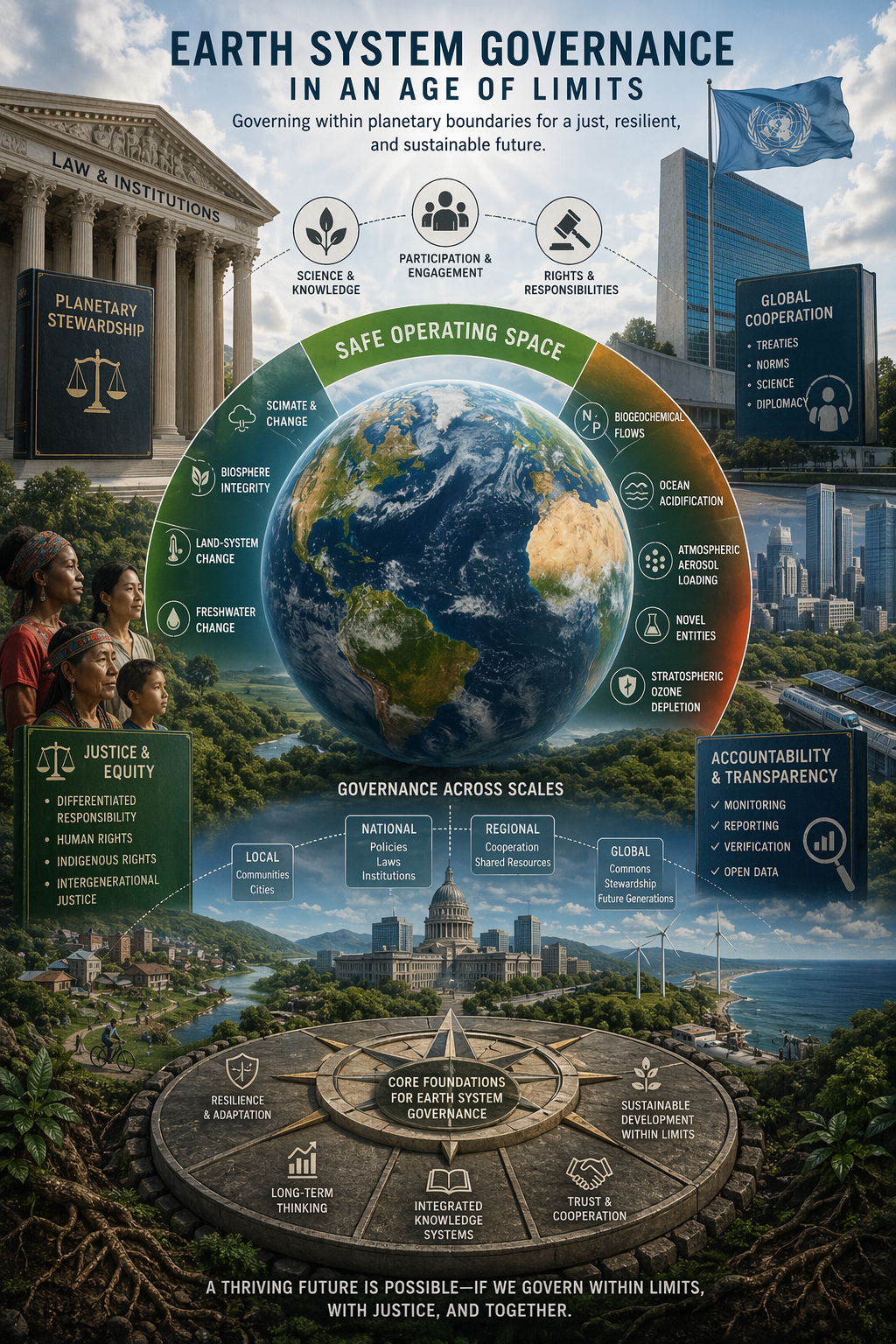
Practical governance reform would need to work on multiple fronts at once: stronger global coordination, more coherent national planning, empowered local adaptation, justice-centered transition policy, more rigorous corporate and financial accountability, and better integration of scientific monitoring into public decision-making. None of these levels is sufficient alone. The problem is systemic, and the response must be layered.
Governance in an age of limits also requires institutional memory. Ecological risk unfolds across decades, while political attention often moves in short bursts. Long-lived institutions, transparent data systems, legal duties, public oversight, and independent scientific assessment can help preserve continuity. Without them, planetary stewardship becomes vulnerable to electoral cycles, market volatility, and crisis-driven improvisation.
It also requires a new kind of public ethics. The age of limits asks societies to distinguish between needs and excess, resilience and extraction, development and destabilization, prosperity and throughput, public capacity and private accumulation, legitimate transition and imposed sacrifice. These are not merely technical distinctions. They are political and moral distinctions that determine whether governance can preserve both planetary stability and human dignity.
Earth system governance therefore requires science, but not science alone; markets, but not market correction alone; law, but not reactive law alone; democracy, but not short-term majoritarianism alone; and technology, but not technological optimism alone. It requires institutions mature enough to govern interdependence.
Why This Matters for Planetary Boundaries
Earth system governance matters for planetary boundaries because boundaries without governance remain warnings without sufficient institutional force. Scientific assessment can identify ecological limits, threshold risks, and transgressions, but societies still need political, legal, economic, and technical systems capable of responding. The framework tells us where danger lies; governance determines whether that knowledge changes behavior.
Planetary boundaries matter for governance because they transform the meaning of institutional responsibility. If Earth-system stability is a condition of human flourishing, then climate policy, biodiversity protection, freshwater management, land use, food systems, finance, trade, and infrastructure cannot be treated as isolated policy sectors. They become parts of a shared governance problem: how to preserve the life-support conditions of a complex planet while reducing deprivation and injustice.
The strongest interpretation is therefore not “science first, governance later.” It is science and governance together. The planetary boundaries framework provides the biophysical diagnosis; Earth system governance asks what kind of institutional order can respond to that diagnosis with legitimacy, justice, precaution, and material effectiveness.
This matters because the age of limits will test whether institutions can learn. A society that knows it is crossing boundaries but cannot coordinate response is not simply uninformed. It is institutionally misaligned with reality. A society that responds to boundaries without justice risks political failure. A society that pursues justice without planetary limits risks material failure. Earth system governance is the attempt to avoid both failures at once.
The future of planetary boundaries will therefore depend not only on better Earth-system science, but on governance systems capable of translating that science into durable, fair, and adaptive institutions.
Mathematical Lens: Governance Fit Under Planetary Constraint
Earth system governance can be represented as a problem of fit between boundary pressure and institutional capacity. Let \(P_i\) represent pressure on planetary-boundary process \(i\), and let \(B_i\) represent the corresponding safe or policy-relevant boundary level. Boundary pressure can be expressed as:
R_i = \max\left(0, \frac{P_i – B_i}{B_i}\right)
\]
Interpretation: If \(R_i = 0\), the process remains within the selected boundary. If \(R_i > 0\), pressure exceeds the boundary.
But governance risk is not determined by pressure alone. It also depends on whether institutions are capable of responding. Let \(C_i\) represent governance capacity for boundary process \(i\), scaled from 0 to 1, where 1 indicates strong monitoring, coordination, enforcement, legitimacy, and adaptive capacity. A governance-adjusted risk score can be written as:
G_i = R_i \times (1 – C_i)
\]
Interpretation: Boundary transgression is more dangerous when governance capacity is weak.
Governance capacity can itself be decomposed:
C_i = \alpha M_i + \beta L_i + \gamma J_i + \delta A_i + \epsilon K_i
\]
Interpretation: \(M_i\) represents monitoring capacity, \(L_i\) legal and institutional fit, \(J_i\) justice and legitimacy, \(A_i\) adaptive capacity, and \(K_i\) cross-scale coordination.
A total governance-fragility score can then be written as:
F = \sum_{i=1}^{n} w_i G_i
\]
Interpretation: \(w_i\) represents the severity, uncertainty, irreversibility, or systemic importance of boundary process \(i\).
Because institutions are often fragmented, a coordination penalty can be added. Let \(S_i\) represent sectoral fragmentation for boundary process \(i\), and let \(H_i\) represent horizontal and vertical policy coherence:
X_i = G_i(1 + S_i)(1 – H_i)
\]
Interpretation: Governance risk rises when boundary transgression is combined with weak capacity, fragmentation, and low policy coherence.
A justice-adjusted governance score can also include distributional vulnerability. Let \(V_i\) represent vulnerability and unequal exposure associated with boundary process \(i\):
Y_i = X_i(1 + V_i)
\]
Interpretation: Governance failure becomes more severe when ecological risk is likely to harm vulnerable populations first and hardest.
| Term | Meaning | Interpretive role |
|---|---|---|
| \(P_i\) | Boundary pressure | Observed pressure on planetary-boundary process \(i\). |
| \(B_i\) | Boundary level | Safe or policy-relevant threshold. |
| \(R_i\) | Boundary transgression | Proportional pressure beyond the boundary. |
| \(C_i\) | Governance capacity | Institutional ability to monitor, coordinate, enforce, adapt, and act legitimately. |
| \(G_i\) | Governance-adjusted risk | Risk after accounting for institutional capacity. |
| \(S_i\) | Fragmentation penalty | Degree to which authority is divided or incoherent. |
| \(H_i\) | Policy coherence | Degree of alignment across sectors and scales. |
| \(V_i\) | Vulnerability | Unequal exposure and adaptive capacity associated with the risk. |
The purpose of this model is not to reduce governance to a single number. It is to clarify what responsible governance assessment should include: boundary pressure, institutional capacity, legitimacy, justice, adaptive capacity, fragmentation, policy coherence, and cross-scale coordination.
Advanced Python Workflow: Governance-Fit and Boundary-Risk Scoring
The following Python workflow models Earth system governance as a fit problem between boundary pressure and institutional capacity. It scores governance systems across monitoring capacity, legal fit, justice and legitimacy, adaptive capacity, cross-scale coordination, policy coherence, fragmentation, and vulnerability. The data are illustrative, but the structure can be adapted for governance diagnostics, policy analysis, institutional risk assessment, legal review, or comparative case studies.
"""
Earth system governance-fit scoring workflow.

This workflow models governance risk as a relationship between:
- boundary pressure
- monitoring capacity
- legal and institutional fit
- justice and legitimacy
- adaptive capacity
- cross-scale coordination
- policy coherence
- institutional fragmentation
- vulnerability

The data are illustrative. Replace them with documented indicators,
expert elicitation, stakeholder assessment, institutional data, treaty
tracking, legal analysis, or governance-performance metrics before applied use.
"""

from __future__ import annotations

from dataclasses import dataclass
from pathlib import Path
from typing import Literal

import numpy as np
import pandas as pd


BoundaryDomain = Literal[
    "climate",
    "biosphere",
    "freshwater",
    "land",
    "nutrients",
    "novel_entities",
]


@dataclass(frozen=True)
class GovernanceWeight:
    """Weight assigned to a governance-capacity dimension."""

    dimension: str
    weight: float


def normalize_weights(weights: list[GovernanceWeight]) -> dict[str, float]:
    """Normalize governance-capacity weights so they sum to one."""
    total = sum(item.weight for item in weights)

    if total <= 0:
        raise ValueError("Total weight must be positive.")

    return {item.dimension: item.weight / total for item in weights}


def build_governance_cases() -> pd.DataFrame:
    """
    Create illustrative governance case data.

    boundary_pressure and boundary_level are scaled indexes.
    Capacity dimensions are scored from 0 to 1.
    Higher fragmentation and vulnerability values indicate greater risk.
    """
    return pd.DataFrame(
        {
            "case": [
                "Global climate coordination",
                "Transboundary freshwater basin",
                "National land-use transition",
                "Chemical pollution governance",
                "Urban adaptation network",
                "Regional biodiversity compact",
                "Food-system nutrient governance",
            ],
            "domain": [
                "climate",
                "freshwater",
                "land",
                "novel_entities",
                "climate",
                "biosphere",
                "nutrients",
            ],
            "boundary_pressure": [1.45, 1.30, 1.25, 1.70, 1.10, 1.20, 1.55],
            "boundary_level": [1.00, 1.00, 1.00, 1.00, 1.00, 1.00, 1.00],
            "monitoring_capacity": [0.78, 0.62, 0.55, 0.38, 0.70, 0.58, 0.50],
            "legal_institutional_fit": [0.60, 0.54, 0.48, 0.35, 0.50, 0.52, 0.42],
            "justice_legitimacy": [0.52, 0.46, 0.40, 0.42, 0.62, 0.50, 0.44],
            "adaptive_capacity": [0.66, 0.50, 0.45, 0.32, 0.72, 0.56, 0.46],
            "cross_scale_coordination": [0.58, 0.52, 0.44, 0.30, 0.60, 0.48, 0.40],
            "policy_coherence": [0.48, 0.50, 0.42, 0.34, 0.56, 0.46, 0.38],
            "institutional_fragmentation": [0.70, 0.62, 0.66, 0.80, 0.52, 0.64, 0.72],
            "vulnerability_exposure": [0.72, 0.68, 0.60, 0.74, 0.66, 0.58, 0.70],
            "domain_weight": [1.40, 1.10, 1.00, 1.20, 1.00, 1.30, 1.15],
        }
    )


def score_governance_fit(
    data: pd.DataFrame,
    weights: dict[str, float],
) -> pd.DataFrame:
    """Score governance fit and adjusted fragility."""
    scored = data.copy()

    if (scored["boundary_level"] <= 0).any():
        raise ValueError("Boundary levels must be positive.")

    scored["boundary_transgression"] = np.maximum(
        0,
        (scored["boundary_pressure"] - scored["boundary_level"])
        / scored["boundary_level"],
    )

    scored["governance_capacity"] = (
        scored["monitoring_capacity"] * weights["monitoring_capacity"]
        + scored["legal_institutional_fit"] * weights["legal_institutional_fit"]
        + scored["justice_legitimacy"] * weights["justice_legitimacy"]
        + scored["adaptive_capacity"] * weights["adaptive_capacity"]
        + scored["cross_scale_coordination"] * weights["cross_scale_coordination"]
    )

    scored["governance_gap"] = 1 - scored["governance_capacity"]

    scored["basic_governance_fragility"] = (
        scored["boundary_transgression"]
        * scored["governance_gap"]
        * scored["domain_weight"]
    )

    scored["fragmentation_multiplier"] = 1 + scored["institutional_fragmentation"]
    scored["coherence_multiplier"] = 1 + (1 - scored["policy_coherence"])
    scored["vulnerability_multiplier"] = 1 + scored["vulnerability_exposure"]

    scored["justice_adjusted_fragility"] = (
        scored["basic_governance_fragility"]
        * scored["fragmentation_multiplier"]
        * scored["coherence_multiplier"]
        * scored["vulnerability_multiplier"]
    )

    scored["weakest_capacity_dimension"] = scored[
        [
            "monitoring_capacity",
            "legal_institutional_fit",
            "justice_legitimacy",
            "adaptive_capacity",
            "cross_scale_coordination",
        ]
    ].idxmin(axis=1)

    scored["fragility_class"] = pd.cut(
        scored["justice_adjusted_fragility"],
        bins=[-np.inf, 0.20, 0.60, 1.20, np.inf],
        labels=[
            "lower_fragility",
            "moderate_fragility",
            "high_fragility",
            "severe_fragility",
        ],
    )

    scored["priority"] = np.select(
        [
            scored["monitoring_capacity"] < 0.45,
            scored["legal_institutional_fit"] < 0.45,
            scored["justice_legitimacy"] < 0.45,
            scored["adaptive_capacity"] < 0.45,
            scored["cross_scale_coordination"] < 0.45,
            scored["policy_coherence"] < 0.45,
            scored["institutional_fragmentation"] > 0.70,
        ],
        [
            "monitoring_infrastructure_priority",
            "legal_and_institutional_fit_priority",
            "justice_and_legitimacy_priority",
            "adaptive_governance_priority",
            "cross_scale_coordination_priority",
            "policy_coherence_priority",
            "fragmentation_reduction_priority",
        ],
        default="maintain_and_strengthen_governance_capacity",
    )

    return scored.sort_values(
        "justice_adjusted_fragility",
        ascending=False,
    ).reset_index(drop=True)


def run_sensitivity(data: pd.DataFrame) -> pd.DataFrame:
    """Run governance-weight sensitivity scenarios."""
    scenarios = {
        "balanced": [
            GovernanceWeight("monitoring_capacity", 1),
            GovernanceWeight("legal_institutional_fit", 1),
            GovernanceWeight("justice_legitimacy", 1),
            GovernanceWeight("adaptive_capacity", 1),
            GovernanceWeight("cross_scale_coordination", 1),
        ],
        "justice_priority": [
            GovernanceWeight("monitoring_capacity", 1),
            GovernanceWeight("legal_institutional_fit", 1),
            GovernanceWeight("justice_legitimacy", 2),
            GovernanceWeight("adaptive_capacity", 1),
            GovernanceWeight("cross_scale_coordination", 1.5),
        ],
        "institutional_fit_priority": [
            GovernanceWeight("monitoring_capacity", 1),
            GovernanceWeight("legal_institutional_fit", 2),
            GovernanceWeight("justice_legitimacy", 1),
            GovernanceWeight("adaptive_capacity", 1),
            GovernanceWeight("cross_scale_coordination", 1.5),
        ],
        "adaptive_governance_priority": [
            GovernanceWeight("monitoring_capacity", 1),
            GovernanceWeight("legal_institutional_fit", 1),
            GovernanceWeight("justice_legitimacy", 1),
            GovernanceWeight("adaptive_capacity", 2),
            GovernanceWeight("cross_scale_coordination", 1.5),
        ],
        "coordination_priority": [
            GovernanceWeight("monitoring_capacity", 1),
            GovernanceWeight("legal_institutional_fit", 1),
            GovernanceWeight("justice_legitimacy", 1),
            GovernanceWeight("adaptive_capacity", 1),
            GovernanceWeight("cross_scale_coordination", 2),
        ],
    }

    frames = []

    for scenario_name, scenario_weights in scenarios.items():
        normalized = normalize_weights(scenario_weights)
        scored = score_governance_fit(data, normalized)
        scored["scenario"] = scenario_name
        scored["rank"] = scored["justice_adjusted_fragility"].rank(
            ascending=False,
            method="dense",
        )
        frames.append(scored)

    return pd.concat(frames, ignore_index=True)


def main() -> None:
    """Run the Earth system governance-fit workflow."""
    output_dir = Path(
        "articles/earth-system-governance-in-an-age-of-limits/outputs"
    )
    output_dir.mkdir(parents=True, exist_ok=True)

    data = build_governance_cases()

    balanced_weights = normalize_weights(
        [
            GovernanceWeight("monitoring_capacity", 1),
            GovernanceWeight("legal_institutional_fit", 1),
            GovernanceWeight("justice_legitimacy", 1),
            GovernanceWeight("adaptive_capacity", 1),
            GovernanceWeight("cross_scale_coordination", 1),
        ]
    )

    scored = score_governance_fit(data, balanced_weights)
    sensitivity = run_sensitivity(data)

    scored.to_csv(output_dir / "governance_fit_scores.csv", index=False)
    sensitivity.to_csv(output_dir / "governance_fit_sensitivity.csv", index=False)

    display_columns = [
        "case",
        "domain",
        "boundary_transgression",
        "governance_capacity",
        "governance_gap",
        "institutional_fragmentation",
        "policy_coherence",
        "vulnerability_exposure",
        "justice_adjusted_fragility",
        "weakest_capacity_dimension",
        "fragility_class",
        "priority",
    ]

    print("\nGovernance-fit scores:")
    print(scored[display_columns].round(3).to_string(index=False))

    print("\nSensitivity analysis:")
    print(
        sensitivity[
            [
                "scenario",
                "case",
                "justice_adjusted_fragility",
                "weakest_capacity_dimension",
                "fragility_class",
                "priority",
                "rank",
            ]
        ].round(3).to_string(index=False)
    )


if __name__ == "__main__":
    main()
This workflow is useful because it separates boundary pressure from institutional capacity. A governance case may face high ecological pressure but also possess strong monitoring, legal authority, legitimacy, adaptive capacity, and cross-scale coordination. Another case may face similar pressure with weaker institutions. Treating them as equivalent would be misleading. The workflow also allows analysts to test whether conclusions change when justice, legal fit, adaptive governance, or coordination is weighted more strongly.
The added fragmentation, coherence, and vulnerability fields make the model more realistic. Earth system governance risk does not arise only from ecological pressure. It arises when ecological pressure intersects with institutional fragmentation, weak legitimacy, low adaptive capacity, and unequal exposure.
Advanced R Workflow: Cross-Scale Governance Dashboarding
The following R workflow prepares dashboard-ready outputs for Earth system governance analysis. It is designed for policy teams, researchers, legal analysts, institutional designers, or sustainability engineers who need to compare governance cases across ecological pressure and governance capacity dimensions.
# Earth system governance-fit dashboard
#
# This workflow scores governance cases across:
# - boundary pressure
# - monitoring capacity
# - legal and institutional fit
# - justice and legitimacy
# - adaptive capacity
# - cross-scale coordination
# - policy coherence
# - institutional fragmentation
# - vulnerability exposure

library(readr)
library(dplyr)
library(tidyr)

governance_cases <- tibble::tibble(
  case = c(
    "Global climate coordination",
    "Transboundary freshwater basin",
    "National land-use transition",
    "Chemical pollution governance",
    "Urban adaptation network",
    "Regional biodiversity compact",
    "Food-system nutrient governance"
  ),
  domain = c(
    "climate",
    "freshwater",
    "land",
    "novel_entities",
    "climate",
    "biosphere",
    "nutrients"
  ),
  boundary_pressure = c(1.45, 1.30, 1.25, 1.70, 1.10, 1.20, 1.55),
  boundary_level = c(1, 1, 1, 1, 1, 1, 1),
  monitoring_capacity = c(0.78, 0.62, 0.55, 0.38, 0.70, 0.58, 0.50),
  legal_institutional_fit = c(0.60, 0.54, 0.48, 0.35, 0.50, 0.52, 0.42),
  justice_legitimacy = c(0.52, 0.46, 0.40, 0.42, 0.62, 0.50, 0.44),
  adaptive_capacity = c(0.66, 0.50, 0.45, 0.32, 0.72, 0.56, 0.46),
  cross_scale_coordination = c(0.58, 0.52, 0.44, 0.30, 0.60, 0.48, 0.40),
  policy_coherence = c(0.48, 0.50, 0.42, 0.34, 0.56, 0.46, 0.38),
  institutional_fragmentation = c(0.70, 0.62, 0.66, 0.80, 0.52, 0.64, 0.72),
  vulnerability_exposure = c(0.72, 0.68, 0.60, 0.74, 0.66, 0.58, 0.70),
  domain_weight = c(1.4, 1.1, 1.0, 1.2, 1.0, 1.3, 1.15)
)

capacity_weights <- tibble::tibble(
  dimension = c(
    "monitoring_capacity",
    "legal_institutional_fit",
    "justice_legitimacy",
    "adaptive_capacity",
    "cross_scale_coordination"
  ),
  weight = c(1, 1, 1, 1, 1)
) %>%
  mutate(weight = weight / sum(weight))

capacity_long <- governance_cases %>%
  select(
    case,
    monitoring_capacity,
    legal_institutional_fit,
    justice_legitimacy,
    adaptive_capacity,
    cross_scale_coordination
  ) %>%
  pivot_longer(
    cols = -case,
    names_to = "dimension",
    values_to = "capacity_score"
  ) %>%
  left_join(capacity_weights, by = "dimension") %>%
  mutate(weighted_capacity = capacity_score * weight)

capacity_scores <- capacity_long %>%
  group_by(case) %>%
  summarise(
    governance_capacity = sum(weighted_capacity),
    weakest_capacity_dimension = dimension[which.min(capacity_score)],
    weakest_capacity_value = min(capacity_score),
    .groups = "drop"
  )

governance_scores <- governance_cases %>%
  left_join(capacity_scores, by = "case") %>%
  mutate(
    boundary_transgression = pmax(
      0,
      (boundary_pressure - boundary_level) / boundary_level
    ),
    governance_gap = 1 - governance_capacity,
    basic_governance_fragility = boundary_transgression *
      governance_gap *
      domain_weight,
    justice_adjusted_fragility = basic_governance_fragility *
      (1 + institutional_fragmentation) *
      (1 + (1 - policy_coherence)) *
      (1 + vulnerability_exposure),
    fragility_class = case_when(
      justice_adjusted_fragility < 0.20 ~ "lower_fragility",
      justice_adjusted_fragility < 0.60 ~ "moderate_fragility",
      justice_adjusted_fragility < 1.20 ~ "high_fragility",
      TRUE ~ "severe_fragility"
    ),
    priority = case_when(
      monitoring_capacity < 0.45 ~
        "monitoring_infrastructure_priority",
      legal_institutional_fit < 0.45 ~
        "legal_and_institutional_fit_priority",
      justice_legitimacy < 0.45 ~
        "justice_and_legitimacy_priority",
      adaptive_capacity < 0.45 ~
        "adaptive_governance_priority",
      cross_scale_coordination < 0.45 ~
        "cross_scale_coordination_priority",
      policy_coherence < 0.45 ~
        "policy_coherence_priority",
      institutional_fragmentation > 0.70 ~
        "fragmentation_reduction_priority",
      TRUE ~
        "maintain_and_strengthen_governance_capacity"
    )
  ) %>%
  arrange(desc(justice_adjusted_fragility))

dashboard_long <- governance_scores %>%
  select(
    case,
    domain,
    boundary_transgression,
    governance_capacity,
    governance_gap,
    basic_governance_fragility,
    justice_adjusted_fragility,
    monitoring_capacity,
    legal_institutional_fit,
    justice_legitimacy,
    adaptive_capacity,
    cross_scale_coordination,
    policy_coherence,
    institutional_fragmentation,
    vulnerability_exposure
  ) %>%
  pivot_longer(
    cols = -c(case, domain),
    names_to = "metric",
    values_to = "value"
  )

domain_summary <- governance_scores %>%
  group_by(domain) %>%
  summarise(
    mean_boundary_transgression = mean(boundary_transgression),
    mean_governance_capacity = mean(governance_capacity),
    mean_policy_coherence = mean(policy_coherence),
    mean_fragmentation = mean(institutional_fragmentation),
    total_governance_fragility = sum(justice_adjusted_fragility),
    .groups = "drop"
  ) %>%
  arrange(desc(total_governance_fragility))

scenario_weights <- tibble::tibble(
  scenario = c(
    "balanced",
    "justice_priority",
    "institutional_fit_priority",
    "adaptive_governance_priority",
    "coordination_priority"
  ),
  monitoring_capacity = c(1, 1, 1, 1, 1),
  legal_institutional_fit = c(1, 1, 2, 1, 1),
  justice_legitimacy = c(1, 2, 1, 1, 1),
  adaptive_capacity = c(1, 1, 1, 2, 1),
  cross_scale_coordination = c(1, 1.5, 1.5, 1.5, 2)
) %>%
  pivot_longer(
    cols = -scenario,
    names_to = "dimension",
    values_to = "raw_weight"
  ) %>%
  group_by(scenario) %>%
  mutate(weight = raw_weight / sum(raw_weight)) %>%
  ungroup()

sensitivity_scores <- governance_cases %>%
  select(
    case,
    domain,
    boundary_pressure,
    boundary_level,
    monitoring_capacity,
    legal_institutional_fit,
    justice_legitimacy,
    adaptive_capacity,
    cross_scale_coordination,
    policy_coherence,
    institutional_fragmentation,
    vulnerability_exposure,
    domain_weight
  ) %>%
  pivot_longer(
    cols = c(
      monitoring_capacity,
      legal_institutional_fit,
      justice_legitimacy,
      adaptive_capacity,
      cross_scale_coordination
    ),
    names_to = "dimension",
    values_to = "capacity_score"
  ) %>%
  left_join(scenario_weights, by = "dimension") %>%
  mutate(weighted_capacity = capacity_score * weight) %>%
  group_by(scenario, case, domain) %>%
  summarise(
    boundary_pressure = first(boundary_pressure),
    boundary_level = first(boundary_level),
    policy_coherence = first(policy_coherence),
    institutional_fragmentation = first(institutional_fragmentation),
    vulnerability_exposure = first(vulnerability_exposure),
    domain_weight = first(domain_weight),
    governance_capacity = sum(weighted_capacity),
    weakest_capacity_dimension = dimension[which.min(capacity_score)],
    .groups = "drop"
  ) %>%
  mutate(
    boundary_transgression = pmax(
      0,
      (boundary_pressure - boundary_level) / boundary_level
    ),
    governance_gap = 1 - governance_capacity,
    justice_adjusted_fragility = boundary_transgression *
      governance_gap *
      domain_weight *
      (1 + institutional_fragmentation) *
      (1 + (1 - policy_coherence)) *
      (1 + vulnerability_exposure)
  ) %>%
  group_by(scenario) %>%
  mutate(rank = dense_rank(desc(justice_adjusted_fragility))) %>%
  ungroup()

output_dir <- "articles/earth-system-governance-in-an-age-of-limits/outputs"

dir.create(
  output_dir,
  recursive = TRUE,
  showWarnings = FALSE
)

write_csv(
  governance_scores,
  file.path(output_dir, "r_governance_scores.csv")
)

write_csv(
  capacity_long,
  file.path(output_dir, "r_capacity_long.csv")
)

write_csv(
  dashboard_long,
  file.path(output_dir, "r_dashboard_long.csv")
)

write_csv(
  domain_summary,
  file.path(output_dir, "r_domain_summary.csv")
)

write_csv(
  sensitivity_scores,
  file.path(output_dir, "r_sensitivity_scores.csv")
)

print(governance_scores)
This R workflow is designed for institutional interpretation rather than false precision. It helps identify where governance fragility is driven by high boundary pressure, weak legal fit, limited monitoring, low legitimacy, poor adaptive capacity, inadequate cross-scale coordination, policy incoherence, institutional fragmentation, or vulnerability exposure. Those distinctions matter because each weakness requires a different institutional response.
The sensitivity output is also important. If a governance case changes rank when justice, legal fit, adaptive capacity, or coordination receives greater weight, that is not a flaw. It shows where institutional judgment matters most and where public reasoning should be explicit.
Advanced Go Workflow: Lightweight Governance-Fit Scoring Service
The following Go workflow translates governance-fit diagnostics into a lightweight scoring service. Go is useful for command-line tools, APIs, monitoring systems, and operational scoring engines. This example reads governance cases from a CSV file and reports boundary transgression, governance capacity, governance gap, justice-adjusted fragility, weakest capacity dimension, fragility class, and priority.
package main

import (
	"encoding/csv"
	"errors"
	"fmt"
	"os"
	"strconv"
)

type GovernanceCase struct {
	CaseName                   string
	Domain                     string
	BoundaryPressure           float64
	BoundaryLevel              float64
	MonitoringCapacity         float64
	LegalInstitutionalFit      float64
	JusticeLegitimacy          float64
	AdaptiveCapacity           float64
	CrossScaleCoordination     float64
	PolicyCoherence            float64
	InstitutionalFragmentation float64
	VulnerabilityExposure      float64
	DomainWeight               float64
}

func parseFloat(value string) (float64, error) {
	parsed, err := strconv.ParseFloat(value, 64)
	if err != nil {
		return 0, fmt.Errorf("invalid numeric value %q: %w", value, err)
	}
	return parsed, nil
}

func parseCase(row []string) (GovernanceCase, error) {
	if len(row) < 13 {
		return GovernanceCase{}, errors.New("expected at least 13 columns")
	}

	values := make([]float64, 11)

	for i := 2; i < 13; i++ {
		parsed, err := parseFloat(row[i])
		if err != nil {
			return GovernanceCase{}, err
		}
		values[i-2] = parsed
	}

	return GovernanceCase{
		CaseName:                   row[0],
		Domain:                     row[1],
		BoundaryPressure:           values[0],
		BoundaryLevel:              values[1],
		MonitoringCapacity:         values[2],
		LegalInstitutionalFit:      values[3],
		JusticeLegitimacy:          values[4],
		AdaptiveCapacity:           values[5],
		CrossScaleCoordination:     values[6],
		PolicyCoherence:            values[7],
		InstitutionalFragmentation: values[8],
		VulnerabilityExposure:      values[9],
		DomainWeight:               values[10],
	}, nil
}

func maxZero(value float64) float64 {
	if value < 0 {
		return 0
	}
	return value
}

func boundaryTransgression(item GovernanceCase) float64 {
	if item.BoundaryLevel <= 0 {
		return 0
	}

	return maxZero((item.BoundaryPressure - item.BoundaryLevel) / item.BoundaryLevel)
}

func governanceCapacity(item GovernanceCase) float64 {
	// Balanced weights across five capacity dimensions.
	const weight = 0.20

	return weight*item.MonitoringCapacity +
		weight*item.LegalInstitutionalFit +
		weight*item.JusticeLegitimacy +
		weight*item.AdaptiveCapacity +
		weight*item.CrossScaleCoordination
}

func governanceGap(item GovernanceCase) float64 {
	return 1 - governanceCapacity(item)
}

func basicGovernanceFragility(item GovernanceCase) float64 {
	return boundaryTransgression(item) *
		governanceGap(item) *
		item.DomainWeight
}

func justiceAdjustedFragility(item GovernanceCase) float64 {
	return basicGovernanceFragility(item) *
		(1 + item.InstitutionalFragmentation) *
		(1 + (1 - item.PolicyCoherence)) *
		(1 + item.VulnerabilityExposure)
}

func weakestCapacityDimension(item GovernanceCase) string {
	values := map[string]float64{
		"monitoring_capacity":      item.MonitoringCapacity,
		"legal_institutional_fit":  item.LegalInstitutionalFit,
		"justice_legitimacy":       item.JusticeLegitimacy,
		"adaptive_capacity":        item.AdaptiveCapacity,
		"cross_scale_coordination": item.CrossScaleCoordination,
	}

	weakestKey := "monitoring_capacity"
	weakestValue := values[weakestKey]

	for key, value := range values {
		if value < weakestValue {
			weakestKey = key
			weakestValue = value
		}
	}

	return weakestKey
}

func fragilityClass(score float64) string {
	switch {
	case score < 0.20:
		return "lower_fragility"
	case score < 0.60:
		return "moderate_fragility"
	case score < 1.20:
		return "high_fragility"
	default:
		return "severe_fragility"
	}
}

func priority(item GovernanceCase) string {
	switch {
	case item.MonitoringCapacity < 0.45:
		return "monitoring_infrastructure_priority"
	case item.LegalInstitutionalFit < 0.45:
		return "legal_and_institutional_fit_priority"
	case item.JusticeLegitimacy < 0.45:
		return "justice_and_legitimacy_priority"
	case item.AdaptiveCapacity < 0.45:
		return "adaptive_governance_priority"
	case item.CrossScaleCoordination < 0.45:
		return "cross_scale_coordination_priority"
	case item.PolicyCoherence < 0.45:
		return "policy_coherence_priority"
	case item.InstitutionalFragmentation > 0.70:
		return "fragmentation_reduction_priority"
	default:
		return "maintain_and_strengthen_governance_capacity"
	}
}

func main() {
	if len(os.Args) < 2 {
		fmt.Println("usage: governance-fit-score governance_cases.csv")
		os.Exit(1)
	}

	file, err := os.Open(os.Args[1])
	if err != nil {
		fmt.Println("error opening file:", err)
		os.Exit(1)
	}
	defer file.Close()

	reader := csv.NewReader(file)
	rows, err := reader.ReadAll()
	if err != nil {
		fmt.Println("error reading CSV:", err)
		os.Exit(1)
	}

	for i, row := range rows {
		if i == 0 {
			continue
		}

		item, err := parseCase(row)
		if err != nil {
			fmt.Println("parse error:", err)
			continue
		}

		score := justiceAdjustedFragility(item)

		fmt.Printf(
			"case=%s domain=%s boundary_transgression=%.3f governance_capacity=%.3f governance_gap=%.3f justice_adjusted_fragility=%.3f weakest=%s class=%s priority=%s\n",
			item.CaseName,
			item.Domain,
			boundaryTransgression(item),
			governanceCapacity(item),
			governanceGap(item),
			score,
			weakestCapacityDimension(item),
			fragilityClass(score),
			priority(item),
		)
	}
}
The Go workflow shows how governance-fit diagnostics can move from article-level explanation into operational systems. A lightweight scoring service could support public dashboards, institutional risk registers, legal-review tools, environmental-governance APIs, treaty tracking, city-network monitoring, financial-risk screening, or cross-scale decision-support systems.
A production implementation should include schema validation, source metadata, uncertainty intervals, indicator documentation, governance-case definitions, legal notes, stakeholder-review fields, versioned assumptions, audit trails, and safeguards against false precision. Governance scoring should never replace institutional judgment. It should make pressure, capacity, fragmentation, legitimacy, and vulnerability visible enough for accountable decision-making.
Engineering Extensions in the GitHub Repository
The accompanying GitHub repository extends the article workflow beyond Python, R, and Go into a broader engineering scaffold. The article body keeps Python and R visible because they are accessible tools for governance analytics, policy scoring, dashboard preparation, and reproducible reporting. Go provides a compact service layer. The repository, however, is structured for readers who want to translate Earth system governance into more technical systems: auditable databases, scoring engines, APIs, embedded monitoring, scenario simulation, edge anomaly detection, legal traceability, and accelerator-aware environmental data pipelines.
The SQL scaffold is intended for governance cases, boundary domains, institutional capacity dimensions, legal-fit scores, justice and legitimacy indicators, adaptive-capacity variables, cross-scale coordination metrics, policy-coherence fields, vulnerability exposure, scoring runs, source provenance, and audit trails. Rust can support reliable scoring engines or command-line tools where type safety and reproducibility matter. Go can support lightweight services and diagnostic APIs. C and C++ can support embedded threshold monitoring, local signal processing, or scenario simulation. TinyML can support low-power anomaly detection at the edge, while PYNQ-oriented scaffolding can support accelerated preprocessing of environmental or governance-monitoring signals.
This engineering layer matters because Earth system governance is not only about principles and institutions. It is also about data infrastructure, monitoring systems, early warning, legal traceability, model transparency, and decision support. If governance systems cannot observe cumulative risk, track institutional capacity, document assumptions, or reproduce outputs, they will remain poorly fitted to the scale of planetary instability.
A mature implementation should also include documentation for governance indicators, legal interpretation, boundary definitions, uncertainty handling, institutional assumptions, stakeholder review, community participation, privacy protections, and public communication. Without that layer, governance dashboards can become decorative. With it, the technical system becomes accountable planetary-governance knowledge infrastructure.
GitHub Repository
Complete Code Repository
The full code distribution for this article, including Python, R, and Go workflows plus extended engineering scaffolding for SQL, Rust, C, C++, TinyML, and PYNQ-oriented Earth system governance and boundary-risk diagnostics, is available on GitHub.
Common Misunderstandings
A common misunderstanding is that Earth system governance means global government. It does not. The problem is not simply the absence of one planetary sovereign, but the need to coordinate multiple levels and forms of authority around shared Earth-system risks. Earth system governance is better understood as an architecture of polycentric coordination than as a proposal for centralized rule by a single global authority.
Another misunderstanding is that limits mean only prohibition or austerity. In governance terms, limits also mean prioritization, redesign, fairer allocation, resilience preservation, and more credible long-term coordination. Limits do not eliminate politics. They make politics more honest by revealing the biophysical constraints within which development, justice, and prosperity must be pursued.
A third misunderstanding is that Earth system governance is just traditional environmental governance with a new label. The difference is deeper. Earth system governance begins from the premise that human activity now shapes the planetary conditions of its own existence, which requires a more integrated, reflexive, justice-aware, and systems-oriented form of governance than sectoral environmental management alone.
A fourth misunderstanding is that science can determine governance automatically. Science can identify risks, thresholds, uncertainty, and systemic pressures. It cannot by itself decide who bears costs, how rights are protected, how democratic legitimacy is secured, or how historical responsibility should be allocated. Earth system governance requires science, but it also requires law, politics, justice, institutional design, and public legitimacy.
A fifth misunderstanding is that polycentric governance solves the problem by itself. Multiple actors and institutions can produce experimentation and learning, but they can also produce fragmentation, accountability gaps, duplication, and symbolic action. Polycentric governance matters only when it is connected to coherence, accountability, and material pressure reduction.
A final misunderstanding is that data infrastructure is merely technical support. In an age of limits, monitoring, disclosure, provenance, early warning, and auditability are part of governance itself. What institutions can see shapes what they can govern.
Related Articles
- What Are Planetary Boundaries?
- The Origins of the Planetary Boundaries Framework
- Safe Operating Space and the Logic of Thresholds
- How Planetary Boundaries Are Measured
- Uncertainty, Precaution, and Scientific Debate in Boundary Setting
- Planetary Boundaries and Earth System Resilience
- Tipping Points, Feedback Loops, and Cascading Ecological Change
- Sustainable Development Goals Within Planetary Boundaries
- Planetary Boundaries, Justice, and Global Inequality
- Planetary Boundaries and Doughnut Economics
- Climate Change as a Planetary Boundary
- Biosphere Integrity and the Stability of Life Systems
- Freshwater Change and Earth System Risk
- Land-System Change and Ecological Transformation
- Biogeochemical Flows: Nitrogen, Phosphorus, and Planetary Destabilization
- Business Strategy Within Planetary Boundaries
- Finance, Disclosure, and Systemic Environmental Risk
- Critiques of the Planetary Boundaries Framework
- The Future of Planetary Stewardship
Further Reading
- Biermann, F. (2012) ‘Planetary boundaries and earth system governance: Exploring the links’, Ecological Economics, 81, pp. 4–9. Available at: https://www.sciencedirect.com/science/article/abs/pii/S0921800912000808.
- Biermann, F. (2014) Earth System Governance: World Politics in the Anthropocene. Cambridge, MA: MIT Press. Available at: https://direct.mit.edu/books/monograph/3049/Earth-System-GovernanceWorld-Politics-in-the.
- Climate Governance Commission (2023) Governing Our Planetary Emergency. Available at: https://ggin.stimson.org/lib/report/2023-report-of-the-climate-governance-commission-governing-our-planetary-emergency/.
- Earth System Governance Project (2018) Earth System Governance: Science and Implementation Plan of the Earth System Governance Project. Utrecht: Earth System Governance Project. Available at: https://www.earthsystemgovernance.org/research-framework/.
- Galaz, V. (2014) Global Environmental Governance, Technology and Politics: The Anthropocene Gap. Cheltenham: Edward Elgar. Available at: https://www.e-elgar.com/shop/usd/global-environmental-governance-technology-and-politics-9781781955543.html.
- Kotzé, L.J. and Kim, R.E. (2019) ‘Earth system law: The juridical dimensions of Earth system governance’, Earth System Governance, 1, 100003. Available at: https://www.sciencedirect.com/science/article/pii/S2589811619300023.
- Richardson, K. et al. (2023) ‘Earth beyond six of nine planetary boundaries’, Science Advances, 9(37), eadh2458. Available at: https://www.science.org/doi/10.1126/sciadv.adh2458.
- Rockström, J. et al. (2009) ‘A safe operating space for humanity’, Nature, 461, pp. 472–475. Available at: https://www.nature.com/articles/461472a.
- Steffen, W. et al. (2015) ‘Planetary boundaries: Guiding human development on a changing planet’, Science, 347(6223), 1259855. Available at: https://www.science.org/doi/10.1126/science.1259855.
- Young, O.R. (2017) ‘Governing complex systems: Social capital for the Anthropocene’, MIT Press. Available at: https://mitpress.mit.edu/9780262533843/governing-complex-systems/.
References
- Biermann, F. (2012) ‘Planetary boundaries and earth system governance: Exploring the links’, Ecological Economics, 81, pp. 4–9. Available at: https://www.sciencedirect.com/science/article/abs/pii/S0921800912000808.
- Biermann, F. (2014) Earth System Governance: World Politics in the Anthropocene. Cambridge, MA: MIT Press. Available at: https://direct.mit.edu/books/monograph/3049/Earth-System-GovernanceWorld-Politics-in-the.
- Climate Governance Commission (2023) Governing Our Planetary Emergency. Available at: https://ggin.stimson.org/lib/report/2023-report-of-the-climate-governance-commission-governing-our-planetary-emergency/.
- Earth System Governance Project (2018) Earth System Governance: Science and Implementation Plan of the Earth System Governance Project. Utrecht: Earth System Governance Project. Available at: https://www.earthsystemgovernance.org/research-framework/.
- Galaz, V. (2014) Global Environmental Governance, Technology and Politics: The Anthropocene Gap. Cheltenham: Edward Elgar. Available at: https://www.e-elgar.com/shop/usd/global-environmental-governance-technology-and-politics-9781781955543.html.
- Gupta, J. et al. (2023) ‘Earth system justice needed to identify and live within Earth system boundaries’, Nature Sustainability, 6, pp. 630–638. Available at: https://www.nature.com/articles/s41893-023-01064-1.
- Kotzé, L.J. and Kim, R.E. (2019) ‘Earth system law: The juridical dimensions of Earth system governance’, Earth System Governance, 1, 100003. Available at: https://www.sciencedirect.com/science/article/pii/S2589811619300023.
- Richardson, K., Steffen, W., Lucht, W., Bendtsen, J., Cornell, S.E., Donges, J.F., Drüke, M., Fetzer, I., Bala, G., von Bloh, W., Feulner, G., Fiedler, S., Gerten, D., Gleeson, T., Hofmann, M., Huiskamp, W., Jakobsson, C., Jürgensen, J.H., Kummu, M., Mohan, C., Nogués-Bravo, D., Petri, S., Porkka, M., Rahmstorf, S., Schaphoff, S., Schulte-Uebbing, L., Staal, A., Sun, Z., Sakschewski, B. and Wang-Erlandsson, L. (2023) ‘Earth beyond six of nine planetary boundaries’, Science Advances, 9(37), eadh2458. Available at: https://www.science.org/doi/10.1126/sciadv.adh2458.
- Rockström, J., Steffen, W., Noone, K., Persson, Å., Chapin, F.S. III, Lambin, E.F., Lenton, T.M., Scheffer, M., Folke, C., Schellnhuber, H.J., Nykvist, B., de Wit, C.A., Hughes, T., van der Leeuw, S., Rodhe, H., Sörlin, S., Snyder, P.K., Costanza, R., Svedin, U., Falkenmark, M., Karlberg, L., Corell, R.W., Fabry, V.J., Hansen, J., Walker, B., Liverman, D., Richardson, K., Crutzen, P. and Foley, J.A. (2009a) ‘A safe operating space for humanity’, Nature, 461, pp. 472–475. Available at: https://www.nature.com/articles/461472a.
- Rockström, J., Steffen, W., Noone, K., Persson, Å., Chapin, F.S. III, Lambin, E.F., Lenton, T.M., Scheffer, M., Folke, C., Schellnhuber, H.J., Nykvist, B., de Wit, C.A., Hughes, T., van der Leeuw, S., Rodhe, H., Sörlin, S., Snyder, P.K., Costanza, R., Svedin, U., Falkenmark, M., Karlberg, L., Corell, R.W., Fabry, V.J., Hansen, J., Walker, B., Liverman, D., Richardson, K., Crutzen, P. and Foley, J.A. (2009b) ‘Planetary boundaries: Exploring the safe operating space for humanity’, Ecology and Society, 14(2), 32. Available at: https://www.ecologyandsociety.org/vol14/iss2/art32/.
- Steffen, W., Richardson, K., Rockström, J., Cornell, S.E., Fetzer, I., Bennett, E.M., Biggs, R., Carpenter, S.R., de Vries, W., de Wit, C.A., Folke, C., Gerten, D., Heinke, J., Mace, G.M., Persson, L.M., Ramanathan, V., Reyers, B. and Sörlin, S. (2015) ‘Planetary boundaries: Guiding human development on a changing planet’, Science, 347(6223), 1259855. Available at: https://www.science.org/doi/10.1126/science.1259855.
- Young, O.R. (2017) Governing Complex Systems: Social Capital for the Anthropocene. Cambridge, MA: MIT Press. Available at: https://mitpress.mit.edu/9780262533843/governing-complex-systems/.