
Last Updated May 8, 2026
Business strategy within planetary boundaries begins from a different premise than conventional strategy. It does not assume that the natural world is a passive backdrop to competition, scale, market share, operational efficiency, and shareholder return. It begins from the recognition that firms operate inside a finite Earth system whose stability and resilience depend on biophysical processes already under severe pressure. The planetary boundaries framework defines a safe operating space for humanity based on those processes, and its later development has made clear that climate change, biosphere integrity, freshwater change, land-system change, nutrient loading, novel entities, and other pressures are not peripheral environmental issues. They are conditions of economic possibility.
That shift matters because strategy is ultimately about how firms position themselves under real constraints. If ecological destabilization is reshaping regulation, supply chains, infrastructure, capital markets, insurance, public trust, labor conditions, resource access, and social license, then strategy cannot remain confined to market share, growth targets, cost advantage, and short-term materiality assessments alone. It has to confront a harder question: what kinds of firms, value propositions, supply chains, and business models remain viable in an economy that must function within finite ecological limits?
Main Library
Publications
Article Map
Planetary Boundaries
Related Article
Finance & Disclosure
Related Article
Earth-System Governance
Related Topic
Economic Systems

The question is not whether companies should “care” about sustainability as a reputational preference. The question is whether business models designed under assumptions of ecological abundance can survive under conditions of ecological constraint. Planetary-boundary thinking therefore changes strategy at the level of risk, innovation, capital allocation, governance, supply-chain design, product architecture, competitive advantage, and business-model legitimacy. It moves the conversation from incremental sustainability improvement toward absolute alignment with Earth-system conditions.
This article examines what business strategy looks like within planetary boundaries. It explains why planetary boundaries change the meaning of strategic risk, why firms need to move from narrow ESG materiality toward Earth-system materiality, why relative improvement is not enough, how absolute sustainability reshapes competitive positioning, why supply chains become strategic terrain, and what this means for corporate governance, innovation, capital allocation, transition capability, and long-term value creation.
Why Planetary Boundaries Change Business Strategy
Planetary boundaries change business strategy because they change the operating environment in which firms create value. Firms are no longer competing inside a biophysically stable background. They are operating inside a stressed Earth system in which climate instability, water disruption, land change, pollution, ecosystem decline, and chemical overload increasingly affect production systems, regulation, infrastructure, labor conditions, insurance costs, capital markets, and demand patterns.
In strategic terms, this means environmental issues can no longer be treated as peripheral compliance matters, public-relations concerns, or stand-alone sustainability reports. They shape core questions of continuity, resilience, input security, regulatory exposure, transition cost, social license, insurance access, investor confidence, and long-run value creation. Once cumulative ecological pressure is recognized as part of the business environment itself, planetary boundaries cease to be an external framework and become part of strategic analysis.
This is a deeper shift than adding environmental goals to existing plans. It changes the assumptions on which strategy rests. If firms depend on ecosystems, stable climates, functioning water systems, viable agriculture, resilient infrastructure, and socially legitimate access to finite resources, then the real question is not whether planetary boundaries matter to business. It is how long business strategy can remain credible without taking them seriously.
Planetary-boundary strategy therefore begins with a change in strategic imagination. The firm is not merely an economic actor adapting to environmental regulation. It is an institutional participant in systems of production, extraction, consumption, finance, and infrastructure that either intensify or reduce pressure on Earth-system stability. That makes business strategy both a risk-management problem and a design problem.
The strategic issue is not only whether the firm can protect itself from ecological disruption. It is also whether the firm contributes to the disruption that later appears as market, supply, regulatory, reputational, and financial risk. A company may appear resilient in the narrow sense while depending on value chains that degrade the systems on which future resilience depends. Planetary-boundary strategy asks firms to evaluate both sides of the relationship: risk to the company and risk generated by the company.
For companion essays, see Earth System Governance in an Age of Limits, Finance, Disclosure, and Systemic Environmental Risk, and Sustainable Development Goals Within Planetary Boundaries.
From ESG Materiality to Earth-System Materiality
A major implication of planetary-boundary thinking is that firms need to move beyond narrow ESG materiality toward Earth-system materiality. Standard corporate materiality often asks which environmental issues are financially significant to the firm in the short to medium term. That lens can miss a critical problem: cumulative environmental impacts may appear individually immaterial to one company’s accounts while still contributing to system-wide destabilization that ultimately reshapes markets and operating conditions.
Earth-system materiality asks a harder question. It asks whether a firm’s activities are compatible with the stability of the systems on which economies themselves depend. That does not replace financial analysis, but it changes its hierarchy. The relevant issue is no longer only whether the environment is material to business. It is whether business models remain viable inside the limits of the environment.
This matters because conventional materiality can reward delay. A company may conclude that a particular boundary process is not yet financially significant enough to alter core strategy, even while its cumulative contribution helps intensify long-run system instability. Earth-system materiality corrects for that short horizon by forcing strategy to engage with the conditions that make future markets, infrastructure, labor, logistics, and legitimacy possible in the first place.
Earth-system materiality also expands the meaning of impact. The question is not only whether a firm is exposed to environmental risk, but whether the firm contributes to the systemic conditions that generate that risk. A company may be resilient in the short term while participating in value chains that undermine climate stability, biodiversity, water security, soil health, or chemical safety. Planetary-boundary strategy requires holding both sides of materiality together: risk to the firm and risk generated by the firm.
This shift also changes what counts as strategic information. Emissions totals, water withdrawals, waste ratios, and supplier scores matter, but they are not sufficient. Firms need to understand location-specific water stress, land-use change, biodiversity pressure, chemical persistence, lifecycle impacts, supply-chain concentration, ecosystem dependency, regulatory trajectories, social contestation, and whether their core business model depends on ecological underpricing. A boundary-aligned strategy must see beyond the disclosure spreadsheet into the systems that make the firm possible.
| Strategic lens | Core question | Limitation if used alone |
|---|---|---|
| Traditional financial materiality | Which environmental issues affect enterprise value? | May miss cumulative impacts that are systemically significant before they become firm-level financial risks. |
| ESG disclosure | What does the firm report about environmental, social, and governance performance? | Can remain descriptive if not connected to capital allocation, product strategy, and business-model redesign. |
| Double materiality | How does the environment affect the firm, and how does the firm affect people and planet? | Stronger, but still needs ecological thresholds and absolute alignment logic. |
| Earth-system materiality | Is the business model compatible with the stability of the systems on which economies depend? | Requires difficult allocation choices, supply-chain visibility, and long-horizon strategic judgment. |
Earth-system materiality therefore moves sustainability from a reporting category into the deeper architecture of strategy. It asks whether the company is financially optimizing inside assumptions that planetary science is already calling into question.
Relative Improvement Is Not Enough
Conventional sustainability strategy often emphasizes relative improvement: lower emissions per unit, lower water intensity, reduced waste ratios, better energy efficiency, improved supplier scores, or stronger performance than peers. These improvements matter, but the planetary boundaries framework shows why they are not enough on their own. A firm can improve relative efficiency while still increasing absolute pressure if total output, market expansion, product turnover, or supply-chain throughput grows fast enough.
This is strategically important because it changes what counts as progress. A company that becomes less damaging per unit while helping drive total system pressure upward is not strategically aligned with planetary stability. Relative performance can still be valuable operationally, but it does not answer the bigger strategic question of whether absolute impact is moving toward ecological compatibility.
Within planetary boundaries, strategy must therefore distinguish between optimization and alignment. Optimization makes existing models more efficient. Alignment asks whether those models fit inside a finite safe operating space at all. That is a much more demanding standard, and it challenges many familiar corporate narratives of improvement.
The distinction is particularly important in fast-growing sectors. A technology company may reduce energy intensity per transaction while total computation, device production, data-center demand, and material extraction expand. A food company may improve water efficiency per unit while sourcing from stressed basins. A manufacturer may reduce waste intensity while scaling disposable product cycles. In each case, relative improvement can coexist with absolute overshoot.
Relative metrics can also obscure rebound effects. Efficiency can lower costs and increase demand. Cleaner production can support higher volume. Lightweight products can still drive more frequent replacement. Digital services can appear immaterial while increasing energy, cooling, mineral, and infrastructure requirements. Boundary-aligned strategy requires asking whether efficiency gains reduce total pressure or merely make expansion cheaper.
The strategic standard must therefore become absolute: are emissions, land pressure, water stress, nutrient loading, chemical risks, biodiversity impacts, and material throughput falling to levels compatible with safe operating space? If not, relative improvement may be useful, but it is incomplete.
Absolute Sustainability and Strategic Positioning
Absolute sustainability asks whether a firm’s activities fit within ecologically safe limits rather than simply outperforming peers on relative metrics. This is one of the most important strategic implications of applying planetary boundaries to business. The firm is no longer assessed only against competitors. It is assessed against a shrinking ecological budget.
That shifts the basis of strategic positioning. The key questions become more structural: which products, services, and business lines remain viable under tighter carbon, water, land, chemical, or biodiversity constraints? Which offerings reduce system pressure rather than merely optimize it? Which revenue models depend on continued overshoot, and which can thrive under lower absolute throughput?
Seen this way, absolute sustainability is not only a measurement concept. It is a strategic filter. It helps firms distinguish between activities that look profitable under historically loose ecological assumptions and activities that remain viable under conditions of tightening planetary constraint. That distinction is likely to become more important as regulation, investor expectations, supply shocks, insurance constraints, litigation risk, and social pressure converge around ecological limits.
Absolute sustainability also forces companies to evaluate whether growth itself is compatible with boundary alignment. Growth in socially useful, low-impact, restorative, or service-based activities may support transition. Growth in extraction-heavy, disposable, chemically intensive, land-converting, or fossil-dependent activities may deepen systemic risk. Strategy within planetary boundaries does not simply ask how to grow. It asks what should grow, what should shrink, what should be redesigned, and what should be phased out.
This is uncomfortable because it moves beyond the easy language of “green growth” and into portfolio judgment. Some business lines may require transition investment. Some may require redesign. Some may require divestment, retirement, or managed decline. Some may need to be replaced by service models, circular systems, repair-based revenue, shared infrastructure, regenerative sourcing, or lower-throughput alternatives. A boundary-aligned strategy cannot assume that every existing profit center deserves a sustainable version of itself.
Absolute sustainability therefore reframes competitive positioning around ecological fit. The strongest position is not merely better reporting or lower intensity. It is the ability to create durable value while reducing absolute pressure on Earth-system processes.
Why Supply Chains Become Strategic Terrain
Supply chains become strategic terrain within planetary-boundary thinking because many of the largest environmental impacts occur upstream and downstream rather than at a firm’s owned facilities. Climate emissions, water use, land conversion, nutrient loading, biodiversity loss, mining impacts, chemical pollution, and exposure to novel entities are often embedded in sourcing systems, logistics networks, subcontracted production, and product life cycles rather than in direct operations alone.
This matters because a company may present a relatively clean operational footprint while depending on stressed basins, degraded ecosystems, intensive agricultural systems, extraction-heavy material streams, or highly polluting supplier networks. Strategy within planetary boundaries therefore requires visibility beyond direct operations. It turns procurement, sourcing, traceability, supplier relationships, value-chain redesign, and lifecycle analysis into strategic issues rather than compliance add-ons.
Once supply chains are seen as ecological as well as commercial systems, business strategy changes in emphasis. Cost minimization alone becomes inadequate if it depends on fragile ecosystems, politically unstable extraction zones, or hidden environmental liabilities. A cheaper supply chain may be strategically weaker if it is more exposed to ecological overshoot, regulation, reputational loss, litigation, or social contestation.
Supply-chain strategy also becomes more spatial. Boundary pressures are not evenly distributed. Water risk depends on basin conditions. Biodiversity risk depends on ecosystem context. Land-use impacts depend on region, biome, governance, and competing claims. Chemical exposure depends on production processes, persistence, toxicity, and regulatory systems. Planetary-boundary strategy therefore requires data architectures that can connect supplier activity to place-based ecological conditions rather than relying only on generic global averages.
Supply chains also connect firms to justice. Land conversion, mineral extraction, pollution exposure, labor conditions, and water competition often affect communities far from the end consumer. A company that reduces direct operational emissions while shifting pressure onto vulnerable suppliers, workers, ecosystems, or territories is not operating within a serious boundary-aligned strategy. The planetary frame demands that responsibility follow value chains.
Strategic supply-chain redesign therefore requires more than supplier questionnaires. It requires traceability, procurement reform, long-term supplier partnerships, regional ecological intelligence, product redesign, circular logistics, chemical substitution, demand management, and credible governance of externalized impacts. The supply chain is no longer back-office infrastructure. It is where planetary strategy becomes material.
Allocation Methods and the Problem of Corporate Share
One of the hardest problems in applying planetary boundaries to business is allocation. Planetary boundaries are defined at Earth-system scale, while firms operate through sectors, facilities, products, suppliers, customers, and markets. A company therefore has to ask: what share of a global, regional, or sectoral ecological limit can reasonably be associated with its activities?
There is no single neutral answer. Allocation can be based on sectoral transition pathways, value added, production volume, market share, population need, consumption responsibility, historical contribution, technological feasibility, or negotiated policy targets. Each method produces different results and carries different ethical assumptions. A high-revenue company may look different under value-added allocation than under physical production allocation. A retailer may look different under territorial accounting than under consumption-based footprinting. A technology firm may look different if embodied supply-chain impacts are included.
This makes allocation a strategic and governance issue, not merely a technical calculation. Firms should not hide allocation assumptions inside proprietary models. They should disclose which allocation method is used, why it is appropriate, what boundaries are included, what uncertainties remain, and how results change under alternative methods. Strategy within planetary boundaries requires methodological honesty.
Allocation is especially challenging for global supply chains. A product may involve minerals from one region, manufacturing in another, logistics across several jurisdictions, use-phase impacts in multiple markets, and disposal elsewhere. Assigning responsibility across this chain requires clear rules, data quality, and governance. Without that, firms can overstate alignment by counting the easy parts and omitting the difficult ones.
| Allocation approach | What it emphasizes | Strategic risk |
|---|---|---|
| Sectoral pathway allocation | Compatibility with sector-specific transition trajectories. | Can understate firm responsibility if the sector pathway itself is too weak. |
| Market-share allocation | Firm share of output, revenue, or market activity. | May reward firms in high-impact sectors if total sector pressure remains excessive. |
| Value-added allocation | Economic contribution or value creation. | Can obscure physical throughput and ecological pressure. |
| Consumption-based allocation | Full lifecycle and demand-side responsibility. | Requires difficult data collection across suppliers, use, and disposal. |
| Historical responsibility allocation | Past contribution to cumulative pressure. | Politically and legally sensitive, but important for justice and credibility. |
| Needs-based allocation | Socially necessary activity and basic provision. | Requires distinguishing essential provision from luxury or wasteful demand. |
The point is not that allocation uncertainty makes boundary-aligned strategy impossible. The point is that credible strategy must show its allocation logic. A firm cannot claim alignment with planetary boundaries if it refuses to explain how its share of the safe operating space is defined.
Innovation Within Limits
Planetary-boundary strategy does not eliminate innovation. It changes its direction. Instead of treating innovation as the expansion of throughput, market capture, or extraction without ecological regard, it reorients innovation toward compatibility with finite Earth-system conditions. Innovation under limits is not the same as innovation under assumed abundance.
In practice, this means innovation may need to focus more on circularity, lower-material business models, regenerative production, renewable systems, longevity, repairability, modularity, service-based models, efficient infrastructure, low-impact computation, ecosystem restoration, safer chemistry, and redesigned demand patterns. The strategic issue is no longer how to scale any profitable solution, but how to scale solutions that reduce total system pressure while preserving or improving social usefulness.
This is not merely a technological challenge. It is also a strategic imagination challenge. Firms have to learn to treat ecological constraint not only as a restriction, but as a design condition. Some business models will prove harder to justify or defend under that condition. Others may gain strength precisely because they solve problems of resilience, waste, dependency, and finite resource exposure more effectively than conventional alternatives.
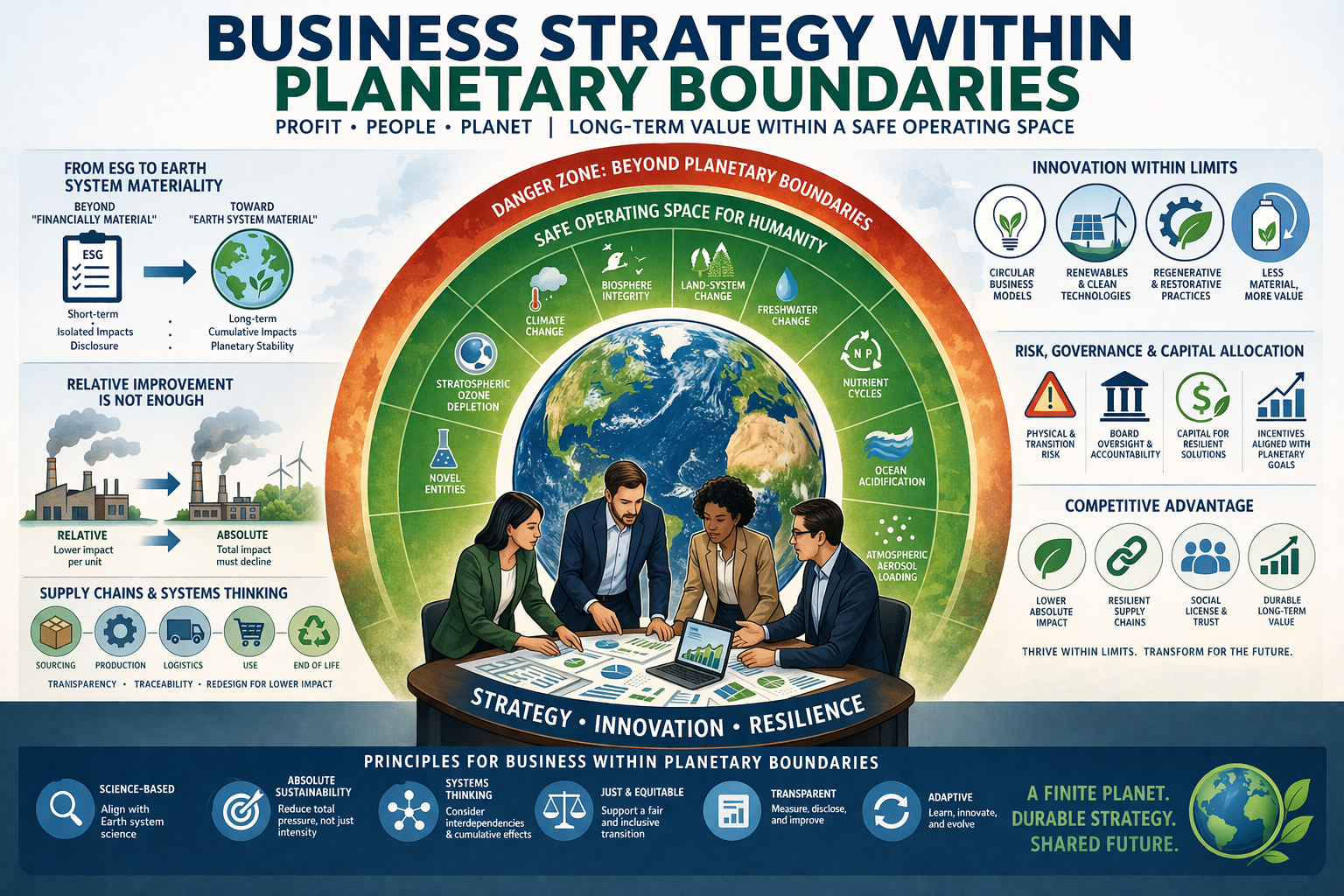
Innovation within limits also requires different success metrics. A product is not strategically superior merely because it is more efficient, cheaper, or easier to scale. It must be evaluated against lifecycle impacts, rebound effects, infrastructure dependence, end-of-life pathways, supplier geography, ecosystem effects, and compatibility with absolute reduction targets. The innovation question becomes: does this new offering reduce pressure on the system, or does it simply make overshoot more efficient?
This also changes the role of design. Product design, packaging, software architecture, material selection, repairability, data-center architecture, distribution channels, end-of-life recovery, and customer-use patterns all become boundary-relevant. Innovation is not confined to research and development departments. It appears in procurement, logistics, pricing, contract design, customer relationships, warranty policy, and the decision to sell less material while delivering more service.
The most credible innovation strategies within planetary boundaries will therefore connect new offerings to absolute pressure reduction, not merely to market novelty. Innovation becomes strategically mature when it helps the firm escape dependency on ecological underpricing.
Strategy, Risk, and the Cost of Boundary Transgression
Business strategy within planetary boundaries also changes how risk is understood. Boundary transgression is not just an environmental statistic. It creates transition risk, physical risk, legal risk, supply risk, legitimacy risk, stranded-asset risk, and stranded-model risk. Climate instability affects insurance, infrastructure, labor productivity, food systems, and energy systems. Freshwater disruption affects agriculture, manufacturing, mining, and urban operations. Biodiversity and land degradation affect food systems, raw materials, ecosystem services, and social conflict. Novel entities and pollution pressures increase regulatory and liability exposure.
The strategic point is that overshoot can reprice entire sectors. What once appeared efficient under loose ecological assumptions may become fragile under ecological stress and tightening governance. Firms that fail to internalize this may mistake short-term advantage for durable competitiveness. The planetary-boundaries perspective therefore broadens strategic risk from firm-specific exposure to system-specific fragility.
This is one reason planetary-boundary thinking belongs in mainstream strategy rather than in peripheral reporting. It changes the risk map of the firm. It suggests that the most consequential threats may come not from isolated environmental incidents, but from business models that remain structurally dependent on destabilizing systems.
The cost of boundary transgression may appear first through supply shocks, regulatory tightening, litigation, insurance withdrawal, reputational loss, or input scarcity. But over time it may become more fundamental: shrinking strategic space for business models that require ecological underpricing. The firm that waits until these costs are fully visible may find that adaptation has become more expensive, more contested, and less voluntary.
Boundary transgression can also create correlated risk. A firm may face drought, heat stress, logistics disruption, supplier failure, regulatory change, and financing constraints at the same time because these are not separate risks. They are interacting expressions of ecological overshoot and institutional response. Conventional risk registers often underestimate this problem because they separate risks into categories that the Earth system does not respect.
Strategy within planetary boundaries therefore requires scenario thinking. Firms must ask not only what happens if one regulation changes or one supplier fails, but what happens if multiple ecological and institutional pressures intensify together. The relevant risk is not only the next shock. It is the loss of strategic freedom as ecological constraints tighten around business models designed for abundance.
Governance, Capital Allocation, and Corporate Decision-Making
If firms are to operate within planetary boundaries, the issue cannot remain in sustainability teams alone. It has to affect governance and capital allocation. Decisions about product portfolios, mergers, sourcing, asset life, infrastructure, innovation budgets, executive incentives, performance metrics, and investor communication all shape whether a firm is adapting to a finite planetary context or simply reporting around it.
This is why board oversight, incentive design, investment criteria, internal planning cycles, risk committees, and disclosure systems become central. A company cannot credibly claim strategic adaptation to planetary limits if the core capital-allocation logic still rewards only scale, extraction, and short-run throughput. Strategy within planetary boundaries therefore requires governance architectures that can recognize long-run system risk and act on it before it becomes existential.
Capital allocation is especially important because it reveals what the firm actually believes about the future. Public commitments may point in one direction, while investment decisions continue to fund models dependent on ecological overshoot. A planetary-boundaries perspective forces these contradictions into view. It asks not what the company says about sustainability, but what kinds of futures it is materially underwriting.
Governance must therefore connect planetary-boundary analysis to decision rights. If boundary-alignment metrics sit outside the processes that approve capital expenditure, product launches, supplier contracts, executive bonuses, and acquisitions, they will remain informational rather than strategic. The real test is whether ecological limits change decisions that would otherwise have been made differently.
This also changes the meaning of fiduciary responsibility. If ecological instability can affect long-run enterprise value, market stability, asset durability, supply security, and social license, then ignoring planetary risk is not prudence. It is a form of strategic blindness. Governance within planetary boundaries should therefore connect board oversight, scenario planning, risk committees, audit functions, sustainability teams, finance, procurement, and product strategy into one decision architecture.
For adjacent essays, see Finance, Disclosure, and Systemic Environmental Risk and Earth System Governance in an Age of Limits.
Competitive Advantage in a Finite Planetary Context
Competitive advantage in a finite planetary context will likely come less from exploiting ecological underpricing and more from operating effectively under ecological constraint. Firms that can deliver value with lower absolute impact, lower dependency on stressed systems, greater transparency, stronger supply-chain resilience, and better alignment with tightening public expectations may be better positioned as the operating context shifts.
This does not mean every environmentally ambitious company will succeed or that ecological alignment guarantees commercial advantage. It means the basis of durable advantage is changing. Dependence on overshoot may itself become a strategic weakness. Conversely, firms that learn to operate with lower ecological exposure, stronger adaptive capacity, and higher legitimacy may be more resilient as markets, regulation, and public expectations evolve.
In that sense, planetary boundaries reshape competition itself. The issue is no longer only which firm can grow fastest under existing assumptions. It is also which firm can remain credible, investable, insurable, and operationally stable as those assumptions break down. Advantage under finite conditions is less about unconstrained scale and more about resilient fit.
Competitive advantage may therefore emerge from capabilities that conventional strategy underweights: environmental data quality, supplier transparency, product repairability, circular logistics, location-specific ecological intelligence, transition credibility, governance discipline, and systems-level collaboration. These capabilities are harder to imitate than generic sustainability messaging because they require real changes in operations, incentives, data, and information architecture.
Collaboration may also become a source of advantage. Many boundary pressures cannot be solved by one firm alone. Sector standards, supplier partnerships, shared infrastructure, circular material platforms, chemical disclosure systems, restoration finance, traceability protocols, and pre-competitive collaboration may become necessary to reduce system pressure. In a finite planetary context, the ability to cooperate can become a strategic capability.
The firms most likely to build durable advantage are those that understand ecological limits early enough to redesign before constraint becomes crisis. They will not treat planetary boundaries as a compliance horizon. They will treat them as a strategic design brief.
From Operational Efficiency to Business-Model Redesign
One of the deepest implications of this framework is that some firms will need more than operational efficiency improvements. They will need business-model redesign. If a revenue model depends structurally on increasing material throughput, disposable product cycles, hidden supply-chain damage, or ecological underpricing, then better reporting and incremental efficiencies may not be enough to bring it into alignment with planetary boundaries.
Business-model redesign may involve shifting from volume dependence to service provision, from disposability to durability, from extraction-heavy growth to circular value retention, or from narrowly transactional relationships to ecosystem-aware value creation. These shifts are demanding because they affect pricing, incentives, product design, customer relationships, operations, investor expectations, and internal culture. But they may also be where the most meaningful strategic adaptation occurs.
This is why planetary-boundary strategy is not just about risk defense. It is also about business-model discovery. Firms that redesign earlier may find new forms of trust, resilience, and long-term relevance. Firms that rely only on efficiency gains may discover that they have postponed adaptation rather than achieved it.
The redesign challenge is especially important in sectors whose profitability depends on accelerating consumption. Circularity, repair, reuse, product longevity, leasing, sharing, remanufacturing, and service models can reduce throughput, but they may also threaten revenue assumptions built around replacement cycles. The strategic question is whether firms can create value without depending on ecological acceleration.
Business-model redesign also requires honesty about demand. Some demand can be met in lower-impact ways. Some demand can be shifted from products to services. Some demand is socially useful and should be supported through cleaner systems. Some demand is wasteful, status-driven, harmful, or dependent on manufactured obsolescence. Strategy within planetary boundaries cannot treat all demand as equally legitimate simply because it is monetizable.
A serious strategy therefore asks: which parts of the business help meet real human needs within ecological limits, and which parts monetize patterns of consumption that make those limits harder to respect? That question is not anti-business. It is strategy adapted to the real operating conditions of the twenty-first century.
Data Systems, Disclosure, and Decision-Grade Intelligence
Business strategy within planetary boundaries depends on decision-grade information. Firms cannot align with limits they cannot measure, allocate, trace, or govern. Disclosure is part of this, but disclosure alone is not enough. Boundary-aligned strategy requires data systems that connect absolute impacts, allocation assumptions, product portfolios, supplier geography, lifecycle pressure, ecological thresholds, capital expenditure, and transition scenarios.
This is where many firms face a gap. They may have sustainability reports, emissions inventories, supplier questionnaires, and risk narratives, but not an integrated information architecture that changes strategic decisions. Data may be scattered across procurement, finance, operations, compliance, product teams, and external consultants. Boundary-aligned strategy requires those data streams to become part of decision infrastructure.
Good information systems should make assumptions visible. They should document boundary domains, allocation rules, data sources, uncertainty ranges, supplier coverage, missing-data treatments, and scenario parameters. They should distinguish relative improvement from absolute alignment. They should connect environmental pressure to revenue exposure, margin dependence, investment decisions, and transition capability. They should allow leaders to see not only where impacts are high, but where business models are strategically dependent on impacts remaining underpriced.
Data systems also shape accountability. If capital expenditure approvals, supplier contracts, product development, and executive incentives do not use boundary-alignment data, then disclosure remains external communication rather than internal governance. Decision-grade intelligence means that ecological limits enter the systems where business choices are actually made.
For adjacent technical themes, see Data Systems & Analytics, Environmental Monitoring Systems, and Intelligent Infrastructure Systems.
The deeper point is that planetary-boundary strategy is not only a moral or reputational claim. It is an information problem, a governance problem, and a decision-system problem. Without the right infrastructure, firms cannot know whether they are transforming or merely narrating transformation.
Why This Matters for Planetary Boundaries
Business strategy matters for planetary boundaries because firms are not passive observers of ecological overshoot. They organize production, design products, structure supply chains, allocate capital, shape demand, influence policy, and build the infrastructures through which ecological pressure is created or reduced. If planetary boundaries are to become more than scientific warnings, they must enter the strategic logic of firms.
Planetary boundaries matter for business because they expose the limits of strategy built on ecological underpricing. A firm can appear successful while depending on unstable climate conditions, declining ecosystems, stressed water systems, fragile supply chains, cheap waste disposal, weak chemical governance, or underregulated extraction. The planetary frame reveals that such success may be less durable than it appears.
The strongest interpretation is therefore not sustainability as reputation management, nor environmental reporting as a side function. It is business strategy under Earth-system constraint. That means absolute impact, ecological budgets, allocation assumptions, transition capability, governance discipline, supply-chain visibility, and business-model resilience must become part of core strategic analysis.
This matters because the economy will not move within planetary boundaries through consumer preference or disclosure alone. It will require decisions about what firms build, finance, sell, source, measure, reward, scale, redesign, and retire. Strategy is one of the places where those decisions become real.
Business within planetary boundaries is not simply about doing less harm. It is about learning to create value in ways that fit the physical conditions of a finite planet and the social conditions of a just transition.
Mathematical Lens: Strategic Alignment Under Ecological Constraint
Business strategy within planetary boundaries can be represented as an alignment problem between firm activity and ecological constraint. Let \(I_{f,i}\) represent firm \(f\)’s absolute impact on boundary-relevant process \(i\), such as climate, land, freshwater, nutrient flows, biosphere integrity, or novel entities. Let \(A_{f,i}\) represent the firm’s allocated ecological budget for that process under a chosen allocation method. A simple alignment ratio can be written as:
R_{f,i} = \frac{I_{f,i}}{A_{f,i}}
\]
Interpretation: If \(R_{f,i} \leq 1\), the firm is within its allocated boundary-compatible budget for that process. If \(R_{f,i} > 1\), the firm exceeds that allocation.
A firm’s strategic boundary pressure can be summarized as:
P_f = \sum_{i=1}^{n} w_i \max(0, R_{f,i} – 1)
\]
Interpretation: \(w_i\) reflects the relative importance, severity, uncertainty, or irreversibility of boundary process \(i\).
Business-model resilience can then be represented as a relationship between boundary pressure, transition capability, and dependency on overshoot. Let \(T_f\) represent transition capability and \(D_f\) represent dependency on activities that exceed ecological limits. A simplified strategic fragility score can be written as:
S_f = P_f \times (1 – T_f) \times (1 + D_f)
\]
Interpretation: A firm is most fragile when it has high boundary pressure, low transition capability, and high dependency on overshoot.
Supply-chain visibility can be added because hidden upstream and downstream impacts increase strategic uncertainty. Let \(V_f\) represent supply-chain visibility, scaled from 0 to 1. A visibility-adjusted fragility score can be written as:
S_f^{*} = S_f \times (1 + (1 – V_f))
\]
Interpretation: Lower supply-chain visibility increases strategic fragility because the firm cannot govern impacts it cannot see.
Capital allocation can also be modeled. Let \(K_{f,b}\) represent capital allocated to business activity \(b\), and let \(Q_{f,b}\) represent the boundary-alignment quality of that activity, scaled from 0 to 1. A portfolio-alignment score can be written as:
A_f = \frac{\sum_{b=1}^{m} K_{f,b} Q_{f,b}}{\sum_{b=1}^{m} K_{f,b}}
\]
Interpretation: A firm’s stated strategy is more credible when capital allocation flows toward boundary-compatible business activities.
A fuller strategic diagnostic can therefore combine pressure, dependency, transition capability, visibility, and capital allocation:
Z_f = \left(P_f \times (1 – T_f) \times (1 + D_f) \times (1 + (1 – V_f))\right)(1 – A_f)
\]
Interpretation: Strategic risk rises when boundary pressure, overshoot dependency, weak transition capability, low visibility, and misaligned capital allocation reinforce one another.
| Term | Meaning | Strategic role |
|---|---|---|
| \(I_{f,i}\) | Firm impact on boundary process \(i\) | Captures absolute pressure from firm activity. |
| \(A_{f,i}\) | Allocated ecological budget | Represents the firm’s boundary-compatible allocation under a chosen method. |
| \(R_{f,i}\) | Alignment ratio | Shows whether impact exceeds allocation. |
| \(P_f\) | Strategic boundary pressure | Aggregates overshoot across boundary domains. |
| \(T_f\) | Transition capability | Represents ability to redesign operations, products, supply chains, and capital allocation. |
| \(D_f\) | Overshoot dependency | Represents dependence on activities that remain profitable because ecological pressure is underpriced. |
| \(V_f\) | Supply-chain visibility | Represents traceability and decision-grade impact data. |
| \(A_f\) | Capital-alignment score | Represents whether investment flows toward boundary-compatible activities. |
This mathematical lens should not be mistaken for a complete corporate sustainability model. Its purpose is diagnostic. It makes visible whether strategy is fragile because impacts exceed ecological allocations, transition capability is weak, business models depend on overshoot, supply-chain visibility is poor, or capital allocation contradicts stated sustainability commitments.
Advanced Python Workflow: Boundary-Aligned Business Strategy Scoring
The following Python workflow models business strategy within planetary boundaries by scoring business units across boundary pressure, transition capability, overshoot dependency, supply-chain transparency, capital-allocation alignment, and strategic resilience. It is illustrative rather than definitive, but it shows how firms could begin turning planetary-boundary logic into auditable strategic analysis.
"""
Boundary-aligned business strategy scoring.

This workflow models business units across:
- absolute boundary pressure
- allocated ecological budget
- transition capability
- overshoot dependency
- supply-chain transparency
- capital-allocation alignment
- strategic fragility

The data are illustrative. Replace them with firm-specific environmental
accounts, lifecycle data, supplier data, scenario analysis, and documented
allocation methods before applied use.
"""

from __future__ import annotations

from dataclasses import dataclass
from pathlib import Path
from typing import Literal

import numpy as np
import pandas as pd


BoundaryDomain = Literal[
    "climate",
    "water",
    "land",
    "biosphere",
    "nitrogen",
    "novel_entities",
]


@dataclass(frozen=True)
class BoundaryWeight:
    """Weight assigned to a boundary-relevant domain."""

    domain: BoundaryDomain
    weight: float


def build_business_unit_data() -> pd.DataFrame:
    """
    Create illustrative business-unit data.

    impact and allocation are scaled indexes.
    transition_capability, overshoot_dependency, transparency, and
    capital_alignment are 0-1 scores.
    """
    return pd.DataFrame(
        {
            "business_unit": [
                "Durable Products",
                "Disposable Goods",
                "Industrial Chemicals",
                "Circular Services",
                "Agricultural Inputs",
                "Digital Infrastructure",
                "Regenerative Materials",
            ],
            "domain": [
                "climate",
                "land",
                "novel_entities",
                "water",
                "nitrogen",
                "climate",
                "biosphere",
            ],
            "absolute_impact": [1.20, 1.45, 1.80, 0.75, 1.65, 1.10, 0.85],
            "allocated_budget": [1.00, 1.00, 1.00, 1.00, 1.00, 1.00, 1.00],
            "transition_capability": [0.62, 0.38, 0.30, 0.78, 0.42, 0.66, 0.74],
            "overshoot_dependency": [0.45, 0.82, 0.90, 0.22, 0.76, 0.40, 0.28],
            "supply_chain_transparency": [0.70, 0.46, 0.35, 0.72, 0.40, 0.68, 0.76],
            "capital_alignment": [0.58, 0.32, 0.28, 0.76, 0.38, 0.62, 0.80],
            "revenue_share": [0.16, 0.20, 0.15, 0.13, 0.18, 0.10, 0.08],
        }
    )


def build_boundary_weights() -> dict[str, float]:
    """Create illustrative boundary-domain weights."""
    weights = [
        BoundaryWeight("climate", 1.4),
        BoundaryWeight("water", 1.1),
        BoundaryWeight("land", 1.0),
        BoundaryWeight("biosphere", 1.3),
        BoundaryWeight("nitrogen", 1.0),
        BoundaryWeight("novel_entities", 1.2),
    ]

    return {item.domain: item.weight for item in weights}


def score_business_units(
    data: pd.DataFrame,
    weights: dict[str, float],
) -> pd.DataFrame:
    """Score business units for boundary alignment and strategic fragility."""
    scored = data.copy()

    if (scored["allocated_budget"] <= 0).any():
        raise ValueError("Allocated ecological budgets must be positive.")

    scored["domain_weight"] = scored["domain"].map(weights)

    if scored["domain_weight"].isna().any():
        missing = scored.loc[scored["domain_weight"].isna(), "domain"].unique()
        raise ValueError(f"Missing boundary weights for domains: {missing}")

    scored["alignment_ratio"] = (
        scored["absolute_impact"] / scored["allocated_budget"]
    )

    scored["boundary_pressure"] = np.maximum(
        0,
        scored["alignment_ratio"] - 1,
    ) * scored["domain_weight"]

    scored["transparency_gap"] = 1 - scored["supply_chain_transparency"]
    scored["capital_misalignment"] = 1 - scored["capital_alignment"]

    scored["strategic_fragility"] = (
        scored["boundary_pressure"]
        * (1 - scored["transition_capability"])
        * (1 + scored["overshoot_dependency"])
        * (1 + scored["transparency_gap"])
        * (1 + scored["capital_misalignment"])
    )

    scored["portfolio_weighted_fragility"] = (
        scored["revenue_share"] * scored["strategic_fragility"]
    )

    scored["strategic_class"] = pd.cut(
        scored["strategic_fragility"],
        bins=[-np.inf, 0.15, 0.50, 1.00, np.inf],
        labels=[
            "lower_fragility",
            "moderate_fragility",
            "high_fragility",
            "severe_fragility",
        ],
    )

    scored["strategic_priority"] = np.select(
        [
            scored["boundary_pressure"] >= 0.50,
            scored["transition_capability"] < 0.40,
            scored["overshoot_dependency"] >= 0.75,
            scored["supply_chain_transparency"] < 0.45,
            scored["capital_alignment"] < 0.40,
        ],
        [
            "reduce_absolute_boundary_pressure",
            "build_transition_capability",
            "redesign_overshoot_dependent_model",
            "improve_supply_chain_transparency",
            "redirect_capital_allocation",
        ],
        default="maintain_and_strengthen_alignment",
    )

    return scored.sort_values(
        "portfolio_weighted_fragility",
        ascending=False,
    ).reset_index(drop=True)


def summarize_strategy(scored: pd.DataFrame) -> tuple[pd.DataFrame, pd.DataFrame]:
    """Create portfolio and domain summaries."""
    portfolio_summary = pd.DataFrame(
        {
            "revenue_weighted_fragility": [
                scored["portfolio_weighted_fragility"].sum()
            ],
            "mean_transition_capability": [
                np.average(
                    scored["transition_capability"],
                    weights=scored["revenue_share"],
                )
            ],
            "mean_supply_chain_transparency": [
                np.average(
                    scored["supply_chain_transparency"],
                    weights=scored["revenue_share"],
                )
            ],
            "mean_overshoot_dependency": [
                np.average(
                    scored["overshoot_dependency"],
                    weights=scored["revenue_share"],
                )
            ],
            "mean_capital_alignment": [
                np.average(
                    scored["capital_alignment"],
                    weights=scored["revenue_share"],
                )
            ],
        }
    )

    domain_summary = (
        scored.groupby("domain")
        .agg(
            revenue_share=("revenue_share", "sum"),
            boundary_pressure=("boundary_pressure", "sum"),
            weighted_fragility=("portfolio_weighted_fragility", "sum"),
            mean_transition_capability=("transition_capability", "mean"),
            mean_transparency=("supply_chain_transparency", "mean"),
            mean_capital_alignment=("capital_alignment", "mean"),
        )
        .reset_index()
        .sort_values("weighted_fragility", ascending=False)
    )

    return portfolio_summary, domain_summary


def run_transition_scenarios(scored: pd.DataFrame) -> pd.DataFrame:
    """Evaluate how strategic fragility changes under transition scenarios."""
    scenarios = {
        "baseline": {
            "transition_gain": 0.00,
            "dependency_reduction": 0.00,
            "transparency_gain": 0.00,
            "capital_alignment_gain": 0.00,
            "impact_reduction": 0.00,
        },
        "governance_upgrade": {
            "transition_gain": 0.10,
            "dependency_reduction": 0.05,
            "transparency_gain": 0.15,
            "capital_alignment_gain": 0.10,
            "impact_reduction": 0.05,
        },
        "business_model_redesign": {
            "transition_gain": 0.20,
            "dependency_reduction": 0.25,
            "transparency_gain": 0.20,
            "capital_alignment_gain": 0.25,
            "impact_reduction": 0.18,
        },
        "deep_alignment": {
            "transition_gain": 0.30,
            "dependency_reduction": 0.40,
            "transparency_gain": 0.30,
            "capital_alignment_gain": 0.35,
            "impact_reduction": 0.35,
        },
    }

    frames = []

    for scenario_name, params in scenarios.items():
        scenario = scored.copy()
        scenario["scenario"] = scenario_name

        scenario["scenario_absolute_impact"] = (
            scenario["absolute_impact"] * (1 - params["impact_reduction"])
        )

        scenario["scenario_alignment_ratio"] = (
            scenario["scenario_absolute_impact"] / scenario["allocated_budget"]
        )

        scenario["scenario_boundary_pressure"] = np.maximum(
            0,
            scenario["scenario_alignment_ratio"] - 1,
        ) * scenario["domain_weight"]

        scenario["scenario_transition_capability"] = (
            scenario["transition_capability"] + params["transition_gain"]
        ).clip(0, 1)

        scenario["scenario_overshoot_dependency"] = (
            scenario["overshoot_dependency"] - params["dependency_reduction"]
        ).clip(0, 1)

        scenario["scenario_transparency"] = (
            scenario["supply_chain_transparency"] + params["transparency_gain"]
        ).clip(0, 1)

        scenario["scenario_capital_alignment"] = (
            scenario["capital_alignment"] + params["capital_alignment_gain"]
        ).clip(0, 1)

        scenario["scenario_transparency_gap"] = 1 - scenario["scenario_transparency"]
        scenario["scenario_capital_misalignment"] = (
            1 - scenario["scenario_capital_alignment"]
        )

        scenario["scenario_fragility"] = (
            scenario["scenario_boundary_pressure"]
            * (1 - scenario["scenario_transition_capability"])
            * (1 + scenario["scenario_overshoot_dependency"])
            * (1 + scenario["scenario_transparency_gap"])
            * (1 + scenario["scenario_capital_misalignment"])
        )

        scenario["scenario_weighted_fragility"] = (
            scenario["revenue_share"] * scenario["scenario_fragility"]
        )

        frames.append(scenario)

    return pd.concat(frames, ignore_index=True)


def main() -> None:
    """Run the boundary-aligned strategy workflow."""
    output_dir = Path(
        "articles/business-strategy-within-planetary-boundaries/outputs"
    )
    output_dir.mkdir(parents=True, exist_ok=True)

    data = build_business_unit_data()
    weights = build_boundary_weights()

    scored = score_business_units(data, weights)
    portfolio_summary, domain_summary = summarize_strategy(scored)
    scenarios = run_transition_scenarios(scored)

    scored.to_csv(output_dir / "business_unit_strategy_scores.csv", index=False)
    portfolio_summary.to_csv(output_dir / "portfolio_strategy_summary.csv", index=False)
    domain_summary.to_csv(output_dir / "domain_strategy_summary.csv", index=False)
    scenarios.to_csv(output_dir / "transition_scenarios.csv", index=False)

    display_columns = [
        "business_unit",
        "domain",
        "alignment_ratio",
        "boundary_pressure",
        "transition_capability",
        "overshoot_dependency",
        "supply_chain_transparency",
        "capital_alignment",
        "strategic_fragility",
        "portfolio_weighted_fragility",
        "strategic_class",
        "strategic_priority",
    ]

    print("\nBusiness-unit strategy scores:")
    print(scored[display_columns].round(3).to_string(index=False))

    print("\nPortfolio summary:")
    print(portfolio_summary.round(3).to_string(index=False))

    print("\nDomain summary:")
    print(domain_summary.round(3).to_string(index=False))


if __name__ == "__main__":
    main()
This workflow separates boundary pressure from transition capability, overshoot dependency, supply-chain transparency, capital alignment, and revenue exposure. That separation matters because strategic fragility is not determined by impact alone. A high-impact business unit with strong transition capability and transparent supply chains may be more strategically adaptable than a similarly exposed unit with weak visibility and deep dependency on overshoot.
The workflow also allows scenario testing so managers can compare incremental governance upgrades against deeper business-model redesign. This distinction is crucial. A firm may improve oversight and reporting while leaving its revenue model largely unchanged. A deeper transition changes capital allocation, reduces absolute impact, lowers overshoot dependency, and improves the firm’s ability to create value inside ecological limits.
Advanced R Workflow: Strategic Alignment Dashboarding
The following R workflow prepares dashboard-ready outputs for business-unit strategy within planetary boundaries. It is designed for strategy, sustainability, finance, procurement, or risk teams that need to compare business units, boundary domains, and transition scenarios.
# Boundary-aligned business strategy dashboard
#
# This workflow models business units across:
# - boundary pressure
# - transition capability
# - overshoot dependency
# - supply-chain transparency
# - capital alignment
# - revenue-weighted strategic fragility

library(readr)
library(dplyr)
library(tidyr)

business_units <- tibble::tibble(
  business_unit = c(
    "Durable Products",
    "Disposable Goods",
    "Industrial Chemicals",
    "Circular Services",
    "Agricultural Inputs",
    "Digital Infrastructure",
    "Regenerative Materials"
  ),
  domain = c(
    "climate",
    "land",
    "novel_entities",
    "water",
    "nitrogen",
    "climate",
    "biosphere"
  ),
  absolute_impact = c(1.20, 1.45, 1.80, 0.75, 1.65, 1.10, 0.85),
  allocated_budget = c(1, 1, 1, 1, 1, 1, 1),
  transition_capability = c(0.62, 0.38, 0.30, 0.78, 0.42, 0.66, 0.74),
  overshoot_dependency = c(0.45, 0.82, 0.90, 0.22, 0.76, 0.40, 0.28),
  supply_chain_transparency = c(0.70, 0.46, 0.35, 0.72, 0.40, 0.68, 0.76),
  capital_alignment = c(0.58, 0.32, 0.28, 0.76, 0.38, 0.62, 0.80),
  revenue_share = c(0.16, 0.20, 0.15, 0.13, 0.18, 0.10, 0.08)
)

boundary_weights <- tibble::tibble(
  domain = c(
    "climate",
    "water",
    "land",
    "biosphere",
    "nitrogen",
    "novel_entities"
  ),
  domain_weight = c(1.4, 1.1, 1.0, 1.3, 1.0, 1.2)
)

scored <- business_units %>%
  left_join(boundary_weights, by = "domain") %>%
  mutate(
    alignment_ratio = absolute_impact / allocated_budget,
    boundary_pressure = pmax(0, alignment_ratio - 1) * domain_weight,
    transparency_gap = 1 - supply_chain_transparency,
    capital_misalignment = 1 - capital_alignment,
    strategic_fragility = boundary_pressure *
      (1 - transition_capability) *
      (1 + overshoot_dependency) *
      (1 + transparency_gap) *
      (1 + capital_misalignment),
    revenue_weighted_fragility = revenue_share * strategic_fragility,
    strategic_class = case_when(
      strategic_fragility < 0.15 ~ "lower_fragility",
      strategic_fragility < 0.50 ~ "moderate_fragility",
      strategic_fragility < 1.00 ~ "high_fragility",
      TRUE ~ "severe_fragility"
    ),
    strategic_priority = case_when(
      boundary_pressure >= 0.50 ~
        "reduce_absolute_boundary_pressure",
      transition_capability < 0.40 ~
        "build_transition_capability",
      overshoot_dependency >= 0.75 ~
        "redesign_overshoot_dependent_model",
      supply_chain_transparency < 0.45 ~
        "improve_supply_chain_transparency",
      capital_alignment < 0.40 ~
        "redirect_capital_allocation",
      TRUE ~
        "maintain_and_strengthen_alignment"
    )
  ) %>%
  arrange(desc(revenue_weighted_fragility))

domain_summary <- scored %>%
  group_by(domain) %>%
  summarise(
    revenue_share = sum(revenue_share),
    boundary_pressure = sum(boundary_pressure),
    weighted_fragility = sum(revenue_weighted_fragility),
    mean_transition_capability = mean(transition_capability),
    mean_supply_chain_transparency = mean(supply_chain_transparency),
    mean_capital_alignment = mean(capital_alignment),
    .groups = "drop"
  ) %>%
  arrange(desc(weighted_fragility))

portfolio_summary <- scored %>%
  summarise(
    revenue_weighted_fragility = sum(revenue_weighted_fragility),
    mean_transition_capability = weighted.mean(
      transition_capability,
      revenue_share
    ),
    mean_supply_chain_transparency = weighted.mean(
      supply_chain_transparency,
      revenue_share
    ),
    mean_overshoot_dependency = weighted.mean(
      overshoot_dependency,
      revenue_share
    ),
    mean_capital_alignment = weighted.mean(
      capital_alignment,
      revenue_share
    )
  )

scenario_parameters <- tibble::tibble(
  scenario = c(
    "baseline",
    "governance_upgrade",
    "business_model_redesign",
    "deep_alignment"
  ),
  transition_gain = c(0.00, 0.10, 0.20, 0.30),
  dependency_reduction = c(0.00, 0.05, 0.25, 0.40),
  transparency_gain = c(0.00, 0.15, 0.20, 0.30),
  capital_alignment_gain = c(0.00, 0.10, 0.25, 0.35),
  impact_reduction = c(0.00, 0.05, 0.18, 0.35)
)

scenario_scores <- scored %>%
  tidyr::crossing(scenario_parameters) %>%
  mutate(
    scenario_absolute_impact = absolute_impact * (1 - impact_reduction),
    scenario_alignment_ratio = scenario_absolute_impact / allocated_budget,
    scenario_boundary_pressure = pmax(0, scenario_alignment_ratio - 1) *
      domain_weight,
    scenario_transition_capability = pmin(1, transition_capability + transition_gain),
    scenario_overshoot_dependency = pmax(
      0,
      overshoot_dependency - dependency_reduction
    ),
    scenario_transparency = pmin(1, supply_chain_transparency + transparency_gain),
    scenario_capital_alignment = pmin(1, capital_alignment + capital_alignment_gain),
    scenario_transparency_gap = 1 - scenario_transparency,
    scenario_capital_misalignment = 1 - scenario_capital_alignment,
    scenario_fragility = scenario_boundary_pressure *
      (1 - scenario_transition_capability) *
      (1 + scenario_overshoot_dependency) *
      (1 + scenario_transparency_gap) *
      (1 + scenario_capital_misalignment),
    scenario_weighted_fragility = revenue_share * scenario_fragility
  )

scenario_summary <- scenario_scores %>%
  group_by(scenario) %>%
  summarise(
    total_weighted_fragility = sum(scenario_weighted_fragility),
    mean_transition_capability = weighted.mean(
      scenario_transition_capability,
      revenue_share
    ),
    mean_overshoot_dependency = weighted.mean(
      scenario_overshoot_dependency,
      revenue_share
    ),
    mean_transparency = weighted.mean(
      scenario_transparency,
      revenue_share
    ),
    mean_capital_alignment = weighted.mean(
      scenario_capital_alignment,
      revenue_share
    ),
    .groups = "drop"
  ) %>%
  arrange(total_weighted_fragility)

dashboard_long <- scored %>%
  select(
    business_unit,
    domain,
    revenue_share,
    alignment_ratio,
    boundary_pressure,
    transition_capability,
    overshoot_dependency,
    supply_chain_transparency,
    capital_alignment,
    revenue_weighted_fragility
  ) %>%
  pivot_longer(
    cols = c(
      alignment_ratio,
      boundary_pressure,
      transition_capability,
      overshoot_dependency,
      supply_chain_transparency,
      capital_alignment,
      revenue_weighted_fragility
    ),
    names_to = "metric",
    values_to = "value"
  )

output_dir <- "articles/business-strategy-within-planetary-boundaries/outputs"

dir.create(
  output_dir,
  recursive = TRUE,
  showWarnings = FALSE
)

write_csv(
  scored,
  file.path(output_dir, "r_business_unit_scores.csv")
)

write_csv(
  portfolio_summary,
  file.path(output_dir, "r_portfolio_summary.csv")
)

write_csv(
  domain_summary,
  file.path(output_dir, "r_domain_summary.csv")
)

write_csv(
  scenario_scores,
  file.path(output_dir, "r_transition_scenarios.csv")
)

write_csv(
  scenario_summary,
  file.path(output_dir, "r_scenario_summary.csv")
)

write_csv(
  dashboard_long,
  file.path(output_dir, "r_dashboard_long.csv")
)

print(domain_summary)
print(scenario_summary)
This R workflow is designed for strategic interpretation rather than superficial scoring. It identifies which business units are most fragile, which boundary domains create the greatest strategic exposure, and how transition scenarios alter business-unit resilience. It also creates long-format dashboard data that can be used in reporting, internal strategy reviews, or decision-support tools.
The workflow is especially useful because it links strategic fragility to revenue exposure. A business unit with high ecological pressure but small revenue share may require technical remediation; a high-pressure unit with large revenue share may represent a deeper business-model problem. Boundary-aligned strategy requires seeing that difference.
Advanced Go Workflow: Lightweight Strategy-Alignment Scoring Service
The following Go workflow translates boundary-aligned business strategy diagnostics into a lightweight scoring service. Go is useful for command-line tools, APIs, internal scoring engines, procurement screening, and operational dashboards. This example reads business-unit records from a CSV file and reports boundary pressure, strategic fragility, portfolio-weighted fragility, strategic class, and recommended priority.
package main

import (
	"encoding/csv"
	"errors"
	"fmt"
	"os"
	"strconv"
)

type BusinessUnit struct {
	Name                    string
	Domain                  string
	AbsoluteImpact          float64
	AllocatedBudget         float64
	TransitionCapability    float64
	OvershootDependency     float64
	SupplyChainTransparency float64
	CapitalAlignment        float64
	RevenueShare            float64
}

func parseFloat(value string) (float64, error) {
	parsed, err := strconv.ParseFloat(value, 64)
	if err != nil {
		return 0, fmt.Errorf("invalid numeric value %q: %w", value, err)
	}
	return parsed, nil
}

func parseBusinessUnit(row []string) (BusinessUnit, error) {
	if len(row) < 9 {
		return BusinessUnit{}, errors.New("expected at least 9 columns")
	}

	values := make([]float64, 7)

	for i := 2; i < 9; i++ {
		parsed, err := parseFloat(row[i])
		if err != nil {
			return BusinessUnit{}, err
		}
		values[i-2] = parsed
	}

	return BusinessUnit{
		Name:                    row[0],
		Domain:                  row[1],
		AbsoluteImpact:          values[0],
		AllocatedBudget:         values[1],
		TransitionCapability:    values[2],
		OvershootDependency:     values[3],
		SupplyChainTransparency: values[4],
		CapitalAlignment:        values[5],
		RevenueShare:            values[6],
	}, nil
}

func domainWeight(domain string) float64 {
	switch domain {
	case "climate":
		return 1.4
	case "water":
		return 1.1
	case "land":
		return 1.0
	case "biosphere":
		return 1.3
	case "nitrogen":
		return 1.0
	case "novel_entities":
		return 1.2
	default:
		return 1.0
	}
}

func maxZero(value float64) float64 {
	if value < 0 {
		return 0
	}
	return value
}

func alignmentRatio(unit BusinessUnit) float64 {
	if unit.AllocatedBudget <= 0 {
		return 0
	}

	return unit.AbsoluteImpact / unit.AllocatedBudget
}

func boundaryPressure(unit BusinessUnit) float64 {
	return maxZero(alignmentRatio(unit)-1) * domainWeight(unit.Domain)
}

func strategicFragility(unit BusinessUnit) float64 {
	transparencyGap := 1 - unit.SupplyChainTransparency
	capitalMisalignment := 1 - unit.CapitalAlignment

	return boundaryPressure(unit) *
		(1 - unit.TransitionCapability) *
		(1 + unit.OvershootDependency) *
		(1 + transparencyGap) *
		(1 + capitalMisalignment)
}

func portfolioWeightedFragility(unit BusinessUnit) float64 {
	return unit.RevenueShare * strategicFragility(unit)
}

func strategicClass(score float64) string {
	switch {
	case score < 0.15:
		return "lower_fragility"
	case score < 0.50:
		return "moderate_fragility"
	case score < 1.00:
		return "high_fragility"
	default:
		return "severe_fragility"
	}
}

func strategicPriority(unit BusinessUnit) string {
	switch {
	case boundaryPressure(unit) >= 0.50:
		return "reduce_absolute_boundary_pressure"
	case unit.TransitionCapability < 0.40:
		return "build_transition_capability"
	case unit.OvershootDependency >= 0.75:
		return "redesign_overshoot_dependent_model"
	case unit.SupplyChainTransparency < 0.45:
		return "improve_supply_chain_transparency"
	case unit.CapitalAlignment < 0.40:
		return "redirect_capital_allocation"
	default:
		return "maintain_and_strengthen_alignment"
	}
}

func main() {
	if len(os.Args) < 2 {
		fmt.Println("usage: business-boundary-score business_units.csv")
		os.Exit(1)
	}

	file, err := os.Open(os.Args[1])
	if err != nil {
		fmt.Println("error opening file:", err)
		os.Exit(1)
	}
	defer file.Close()

	reader := csv.NewReader(file)
	rows, err := reader.ReadAll()
	if err != nil {
		fmt.Println("error reading CSV:", err)
		os.Exit(1)
	}

	totalPortfolioFragility := 0.0

	for i, row := range rows {
		if i == 0 {
			continue
		}

		unit, err := parseBusinessUnit(row)
		if err != nil {
			fmt.Println("parse error:", err)
			continue
		}

		score := strategicFragility(unit)
		weighted := portfolioWeightedFragility(unit)
		totalPortfolioFragility += weighted

		fmt.Printf(
			"business_unit=%s domain=%s alignment_ratio=%.3f boundary_pressure=%.3f strategic_fragility=%.3f weighted_fragility=%.3f class=%s priority=%s\n",
			unit.Name,
			unit.Domain,
			alignmentRatio(unit),
			boundaryPressure(unit),
			score,
			weighted,
			strategicClass(score),
			strategicPriority(unit),
		)
	}

	fmt.Printf("portfolio_weighted_fragility=%.3f\n", totalPortfolioFragility)
}
The Go workflow shows how boundary-aligned strategy diagnostics can move from article-level explanation into operational systems. A lightweight scoring service could support internal dashboards, procurement screening, portfolio reviews, capital-allocation tools, product strategy reviews, supplier-risk APIs, or investor-facing transition analysis.
A production implementation should include schema validation, unit checking, source provenance, allocation-method documentation, uncertainty intervals, supplier identifiers, lifecycle boundaries, audit trails, and scenario versioning. The goal is not to create a black-box sustainability score. It is to make strategic assumptions visible enough for review, challenge, and decision-making.
Engineering Extensions in the GitHub Repository
The accompanying GitHub repository extends the article workflow beyond Python, R, and Go into a broader engineering scaffold. The article body keeps Python and R visible because they are accessible tools for strategy analytics, sustainability modeling, dashboard preparation, and reproducible reporting. Go provides a compact service layer. The repository, however, is structured for readers who want to translate business strategy within planetary boundaries into more technical systems: auditable databases, scoring engines, APIs, embedded monitoring, scenario simulation, edge anomaly detection, and accelerator-aware environmental data pipelines.
The SQL scaffold is intended for business-unit records, boundary-domain metadata, impact accounts, allocation assumptions, transition-capability scores, overshoot-dependency fields, supply-chain transparency scores, capital-allocation fields, scoring runs, source provenance, and audit trails. Rust can support reliable scoring engines or command-line tools where type safety and reproducibility matter. Go can support lightweight services and diagnostic APIs. C and C++ can support embedded threshold monitoring, local signal processing, or scenario simulation. TinyML can support low-power anomaly detection at the edge, while PYNQ-oriented scaffolding can support accelerated preprocessing of environmental or supply-chain signals.
This engineering layer matters because planetary-boundary strategy is not just a boardroom concept. It depends on data systems that can track absolute impacts, allocation methods, supplier geography, lifecycle pressure, scenario assumptions, capital flows, and strategic decisions. If those systems are weak, firms may produce sustainability narratives without decision-grade strategic intelligence.
A mature implementation should also include documentation for allocation methods, lifecycle boundaries, supply-chain coverage, missing-data treatment, uncertainty ranges, review workflows, governance responsibilities, and disclosure controls. Without that layer, strategy dashboards can become decorative. With it, the technical system becomes accountable business-within-boundaries infrastructure.
GitHub Repository
Complete Code Repository
The full code distribution for this article, including Python, R, and Go workflows plus extended engineering scaffolding for SQL, Rust, C, C++, TinyML, and PYNQ-oriented business-strategy and boundary-alignment diagnostics, is available on GitHub.
Common Misunderstandings
A common misunderstanding is that business strategy within planetary boundaries is just ESG with stronger branding. It is not. ESG often remains focused on disclosure, reputational concerns, and financially material topics, while planetary-boundary strategy asks whether the business model itself fits within finite Earth-system conditions.
Another misunderstanding is that relative efficiency gains are enough. They are often necessary, but they are not sufficient. A company can reduce emissions intensity, water intensity, waste intensity, or supplier-risk scores while increasing total ecological pressure. Planetary-boundary strategy requires attention to absolute impact.
A third misunderstanding is that this framework is anti-business. In fact, much of the business-facing literature argues that firms can play a major role in transformation, but only if strategy is anchored in scientifically grounded system limits. The issue is not whether business should exist. It is what kind of business remains viable under real planetary conditions.
A further misunderstanding is that boundary thinking is relevant only for heavy industry. In reality, planetary pressures travel through finance, data systems, procurement, logistics, built environments, digital infrastructure, food systems, product design, and technology supply chains. The exact relevance differs by sector, but the strategic question of operating inside finite ecological conditions is far broader than a few high-emitting industries.
Another mistake is to confuse supply-chain disclosure with supply-chain strategy. Disclosure may reveal impacts, but strategy must change sourcing, design, contracts, supplier relationships, lifecycle systems, and capital allocation. Visibility is only useful if it changes decisions.
Finally, planetary-boundary strategy should not be confused with generic resilience language. A firm can be resilient in the narrow sense of protecting itself while still contributing to ecological overshoot. Strategic resilience within planetary boundaries means reducing dependency on destabilizing systems, not merely insulating the firm from the consequences of those systems.
Related Articles
- What Are Planetary Boundaries?
- The Origins of the Planetary Boundaries Framework
- Safe Operating Space and the Logic of Thresholds
- How Planetary Boundaries Are Measured
- Planetary Boundaries and Earth System Resilience
- Uncertainty, Precaution, and Scientific Debate in Boundary Setting
- Sustainable Development Goals Within Planetary Boundaries
- Planetary Boundaries, Justice, and Global Inequality
- Planetary Boundaries and Doughnut Economics
- Earth System Governance in an Age of Limits
- Finance, Disclosure, and Systemic Environmental Risk
- Climate Change as a Planetary Boundary
- Biosphere Integrity and the Stability of Life Systems
- Freshwater Change and Earth System Risk
- Land-System Change and Ecological Transformation
- Novel Entities and the Problem of Synthetic Overload
- Critiques of the Planetary Boundaries Framework
- The Future of Planetary Stewardship
Further Reading
- Bjørn, A., Owsianiak, M., Molin, C. and Hauschild, M.Z. (2018) ‘LCA history: Linking past practice to future trends’, in Hauschild, M.Z., Rosenbaum, R.K. and Olsen, S.I. (eds.) Life Cycle Assessment: Theory and Practice. Cham: Springer. Available at: https://link.springer.com/book/10.1007/978-3-319-56475-3.
- Clift, R. et al. (2017) ‘The challenges of applying planetary boundaries as a basis for strategic decision-making in companies with global supply chains’, Sustainability, 9(2), 279. Available at: https://www.mdpi.com/2071-1050/9/2/279.
- Crona, B., Wassénius, E., Parlato, G. and Kashyap, S. (2024) Doing Business Within Planetary Boundaries. Stockholm: Stockholm Resilience Centre and Beijer Institute of Ecological Economics. Available at: https://www.stockholmresilience.org/research/synthesis-reports/doing-business-within-planetary-boundaries.html.
- Erlandsson, J. et al. (2023) ‘Establishing the planetary boundaries framework in ICT corporate sustainability reporting’, Journal of Environmental Management. Available at: https://www.sciencedirect.com/science/article/pii/S0301479722026056.
- Li, M. et al. (2021) ‘The role of planetary boundaries in assessing absolute environmental sustainability under growing consumption and production pressures’, Environment International. Available at: https://www.sciencedirect.com/science/article/pii/S0160412021001008.
- Ryberg, M.W., Owsianiak, M., Richardson, K. and Hauschild, M.Z. (2018) ‘How to bring absolute sustainability into decision-making: An industry case study using a planetary boundary-based methodology’, Science of the Total Environment, 634, pp. 1406–1416. Available at: https://www.sciencedirect.com/science/article/abs/pii/S0048969718312397.
- Science Based Targets Network (2020) Science-Based Targets for Nature: Initial Guidance for Business. Available at: https://sciencebasedtargetsnetwork.org/resources/.
- Stockholm Resilience Centre (2024) ‘New report guides companies and investors to do business within planetary boundaries’. Available at: https://www.stockholmresilience.org/research/research-stories/2024-11-06-new-report-guides-companies-and-investors-to-do-business-within-planetary-boundaries.html.
- van Vuuren, D.P. et al. (2025) ‘Exploring pathways for world development within planetary boundaries’, Nature, 641, pp. 347–355. Available at: https://www.nature.com/articles/s41586-025-08928-w.
- World Business Council for Sustainable Development (2020) Unlocking Systems Transformation in Support of Inclusive and Sustainable Growth for Business. Available at: https://docs.wbcsd.org/2020/06/WBCSD-Unlocking-systems-transformation.pdf.
References
- Clift, R., Sim, S., King, H., Chenoweth, J.L., Christie, I., Clavreul, J., Mueller, C., Posthuma, L., Boulay, A.-M., Chaplin-Kramer, R. et al. (2017) ‘The challenges of applying planetary boundaries as a basis for strategic decision-making in companies with global supply chains’, Sustainability, 9(2), 279. Available at: https://www.mdpi.com/2071-1050/9/2/279.
- Crona, B., Wassénius, E., Parlato, G. and Kashyap, S. (2024) Doing Business Within Planetary Boundaries. Stockholm: Stockholm Resilience Centre and Beijer Institute of Ecological Economics. Available at: https://www.stockholmresilience.org/research/synthesis-reports/doing-business-within-planetary-boundaries.html.
- Erlandsson, J. et al. (2023) ‘Establishing the planetary boundaries framework in ICT corporate sustainability reporting’, Journal of Environmental Management. Available at: https://www.sciencedirect.com/science/article/pii/S0301479722026056.
- Li, M. et al. (2021) ‘The role of planetary boundaries in assessing absolute environmental sustainability under growing consumption and production pressures’, Environment International. Available at: https://www.sciencedirect.com/science/article/pii/S0160412021001008.
- Richardson, K., Steffen, W., Lucht, W., Bendtsen, J., Cornell, S.E., Donges, J.F., Drüke, M., Fetzer, I., Bala, G., von Bloh, W., Feulner, G., Fiedler, S., Gerten, D., Gleeson, T., Hofmann, M., Huiskamp, W., Jakobsson, C., Jürgensen, J.H., Kummu, M., Mohan, C., Nogués-Bravo, D., Petri, S., Porkka, M., Rahmstorf, S., Schaphoff, S., Schulte-Uebbing, L., Staal, A., Sun, Z., Sakschewski, B. and Wang-Erlandsson, L. (2023) ‘Earth beyond six of nine planetary boundaries’, Science Advances, 9(37), eadh2458. Available at: https://www.science.org/doi/10.1126/sciadv.adh2458.
- Rockström, J., Steffen, W., Noone, K., Persson, Å., Chapin, F.S. III, Lambin, E.F., Lenton, T.M., Scheffer, M., Folke, C., Schellnhuber, H.J., Nykvist, B., de Wit, C.A., Hughes, T., van der Leeuw, S., Rodhe, H., Sörlin, S., Snyder, P.K., Costanza, R., Svedin, U., Falkenmark, M., Karlberg, L., Corell, R.W., Fabry, V.J., Hansen, J., Walker, B., Liverman, D., Richardson, K., Crutzen, P. and Foley, J.A. (2009a) ‘A safe operating space for humanity’, Nature, 461, pp. 472–475. Available at: https://www.nature.com/articles/461472a.
- Rockström, J., Steffen, W., Noone, K., Persson, Å., Chapin, F.S. III, Lambin, E.F., Lenton, T.M., Scheffer, M., Folke, C., Schellnhuber, H.J., Nykvist, B., de Wit, C.A., Hughes, T., van der Leeuw, S., Rodhe, H., Sörlin, S., Snyder, P.K., Costanza, R., Svedin, U., Falkenmark, M., Karlberg, L., Corell, R.W., Fabry, V.J., Hansen, J., Walker, B., Liverman, D., Richardson, K., Crutzen, P. and Foley, J.A. (2009b) ‘Planetary boundaries: Exploring the safe operating space for humanity’, Ecology and Society, 14(2), 32. Available at: https://www.ecologyandsociety.org/vol14/iss2/art32/.
- Ryberg, M.W., Owsianiak, M., Richardson, K. and Hauschild, M.Z. (2018) ‘How to bring absolute sustainability into decision-making: An industry case study using a planetary boundary-based methodology’, Science of the Total Environment, 634, pp. 1406–1416. Available at: https://www.sciencedirect.com/science/article/abs/pii/S0048969718312397.
- Science Based Targets Network (2020) Science-Based Targets for Nature: Initial Guidance for Business. Available at: https://sciencebasedtargetsnetwork.org/resources/.
- Steffen, W., Richardson, K., Rockström, J., Cornell, S.E., Fetzer, I., Bennett, E.M., Biggs, R., Carpenter, S.R., de Vries, W., de Wit, C.A., Folke, C., Gerten, D., Heinke, J., Mace, G.M., Persson, L.M., Ramanathan, V., Reyers, B. and Sörlin, S. (2015) ‘Planetary boundaries: Guiding human development on a changing planet’, Science, 347(6223), 1259855. Available at: https://www.science.org/doi/10.1126/science.1259855.
- Stockholm Resilience Centre (n.d.) ‘Planetary boundaries’. Available at: https://www.stockholmresilience.org/research/planetary-boundaries.html.
- Stockholm Resilience Centre (2024) ‘New report guides companies and investors to do business within planetary boundaries’. Available at: https://www.stockholmresilience.org/research/research-stories/2024-11-06-new-report-guides-companies-and-investors-to-do-business-within-planetary-boundaries.html.
- van Vuuren, D.P., Doelman, J., Schmidt Tagomori, I., Beusen, A., Cornell, S., Rockström, J., Schipper, A., Stehfest, E., Ambrosio, G., van den Berg, M., Bouwman, L., Daioglou, V., Harmsen, M., Lucas, P. and van der Wijst, K. (2025) ‘Exploring pathways for world development within planetary boundaries’, Nature, 641, pp. 347–355. Available at: https://www.nature.com/articles/s41586-025-08928-w.
- World Business Council for Sustainable Development (2020) Unlocking Systems Transformation in Support of Inclusive and Sustainable Growth for Business. Available at: https://docs.wbcsd.org/2020/06/WBCSD-Unlocking-systems-transformation.pdf.