Sustainable Systems

Sustainable systems examine how social, economic, and environmental processes can be organized to support long-term stability and human well-being. Rather than treating environmental protection, economic development, and social equity as separate challenges, sustainable systems research emphasizes their deep interdependence.

The field integrates insights from sustainability science, systems theory, ecological economics, and public policy. Researchers analyze how resource use, technological development, governance structures, and social behavior interact within complex systems.

Designing sustainable systems requires understanding feedback loops, institutional incentives, and long-term environmental constraints. Effective systems must balance efficiency with resilience, innovation with stewardship, and economic opportunity with ecological limits.

By integrating interdisciplinary knowledge, sustainable systems approaches aim to create development pathways that maintain ecological integrity while supporting inclusive and resilient societies.

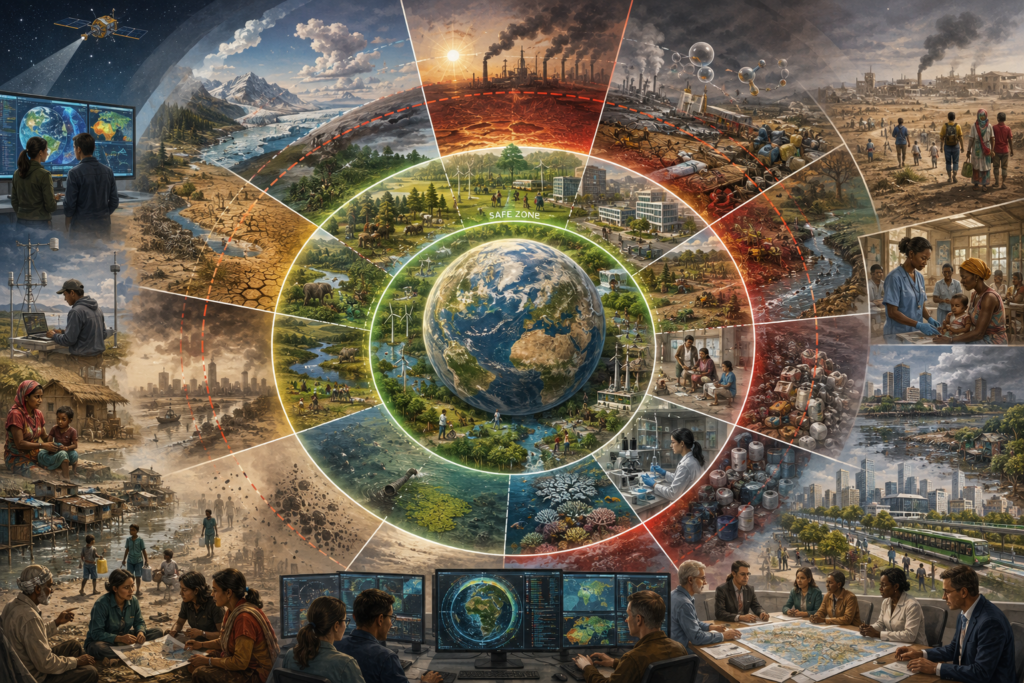
Editorial featured image showing Earth inside a circular safe operating zone, with stable forests, rivers, land systems, clouds, and atmospheric balance on one side, and rising threshold risk with heat, drought, damaged ecosystems, ocean stress, and feedback-loop patterns on the other.

Safe Operating Space and the Logic of Thresholds

Safe Operating Space and the Logic of Thresholds explains the conceptual foundation of the planetary boundaries framework: the idea that human societies should remain within biophysical conditions that reduce the risk of destabilizing the Earth system. The article shows why safe operating space is not a promise of perfect safety, but a precautionary risk zone shaped by thresholds, uncertainty, nonlinear dynamics, feedbacks, lag effects, and cascading change. It examines why boundaries are better understood as zones of rising risk rather than hard walls, how uncertainty strengthens rather than weakens the case for precaution, and why threshold logic matters for governance, engineering, finance, infrastructure, and long-term strategy. The article also includes mathematical, Python, and R workflows for modeling boundary pressure, uncertainty margins, risk zones, cross-boundary amplification, and governance capacity.

Infographic showing Earth at the center of a circular planetary boundaries framework, surrounded by nodes for Earth system science, Anthropocene awareness, resilience thinking, climate, biosphere integrity, freshwater, land-system change, ocean chemistry, biogeochemical flows, governance institutions, and safe operating space.

The Origins of the Planetary Boundaries Framework

The Origins of the Planetary Boundaries Framework explains how one of the most influential sustainability concepts of the twenty-first century emerged from Earth system science, resilience thinking, global change research, and Anthropocene debate. The article shows how the 2009 planetary boundaries papers synthesized evidence that human societies were altering climate, biodiversity, land systems, nutrient cycles, freshwater, ocean chemistry, and atmospheric processes at planetary scale. It examines the framework’s intellectual background, the idea of a safe operating space for humanity, the original nine boundaries, the 2015 refinement that identified climate change and biosphere integrity as core boundaries, and the framework’s later evolution into a research and governance architecture. It also includes mathematical, Python, and R workflows for analyzing framework evolution, influence, uncertainty, governance uptake, and justice integration.

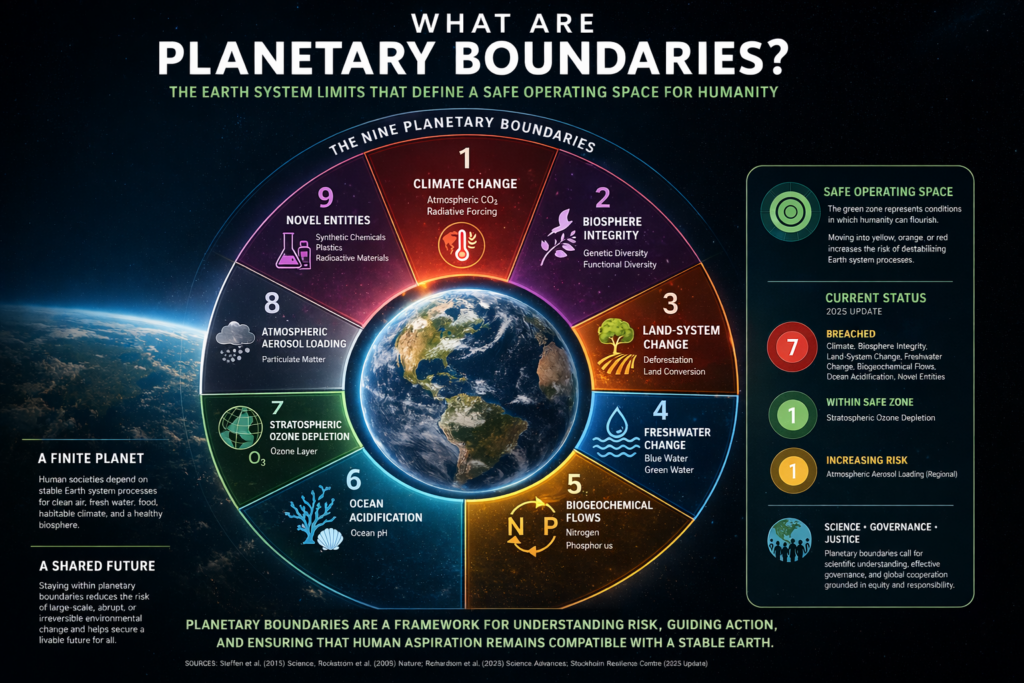
Infographic explaining planetary boundaries with Earth at the center and surrounding segments for climate change, biosphere integrity, land-system change, freshwater change, biogeochemical flows, ocean acidification, stratospheric ozone depletion, atmospheric aerosol loading, and novel entities.

What Are Planetary Boundaries? Earth System Limits Explained

What Are Planetary Boundaries? Earth System Limits Explained introduces the planetary boundaries framework as a way of understanding the biophysical conditions that help define a safe operating space for humanity. The article explains how the framework identifies nine critical Earth system processes—climate change, biosphere integrity, land-system change, freshwater change, biogeochemical flows, ocean acidification, stratospheric ozone depletion, atmospheric aerosol loading, and novel entities—and why these should be understood as interacting risk zones rather than isolated environmental issues. It covers the framework’s origins, current status, safe operating space, threshold logic, major debates, justice implications, and governance significance. It also includes mathematical, Python, and R workflows for modeling boundary pressure, uncertainty margins, risk zones, cross-boundary amplification, social exposure, and governance capacity.

Editorial Earth-system illustration showing planetary boundaries, safe operating space, climate pressure, biosphere integrity, freshwater systems, land change, nutrient flows, ocean health, atmospheric change, novel entities, monitoring, governance, and stewardship.

Planetary Boundaries: Earth System Limits, Risk, and Governance

The Planetary Boundaries knowledge series examines the Earth system processes that define a safe operating space for humanity. It connects Holocene climate stability, the Great Acceleration, Anthropocene planetary risk, resilience thinking, and sustainable development with the nine planetary boundaries: climate change, biosphere integrity, land-system change, freshwater change, biogeochemical flows, ocean acidification, stratospheric ozone depletion, atmospheric aerosol loading, and novel entities. The series explains how these boundaries are measured, why thresholds and feedback loops matter, how boundary transgression affects development and governance, and why justice must be central to any serious account of planetary limits. It frames planetary boundaries not as isolated environmental indicators, but as a scientific and ethical architecture for understanding prosperity, resilience, and civilization on a finite planet.

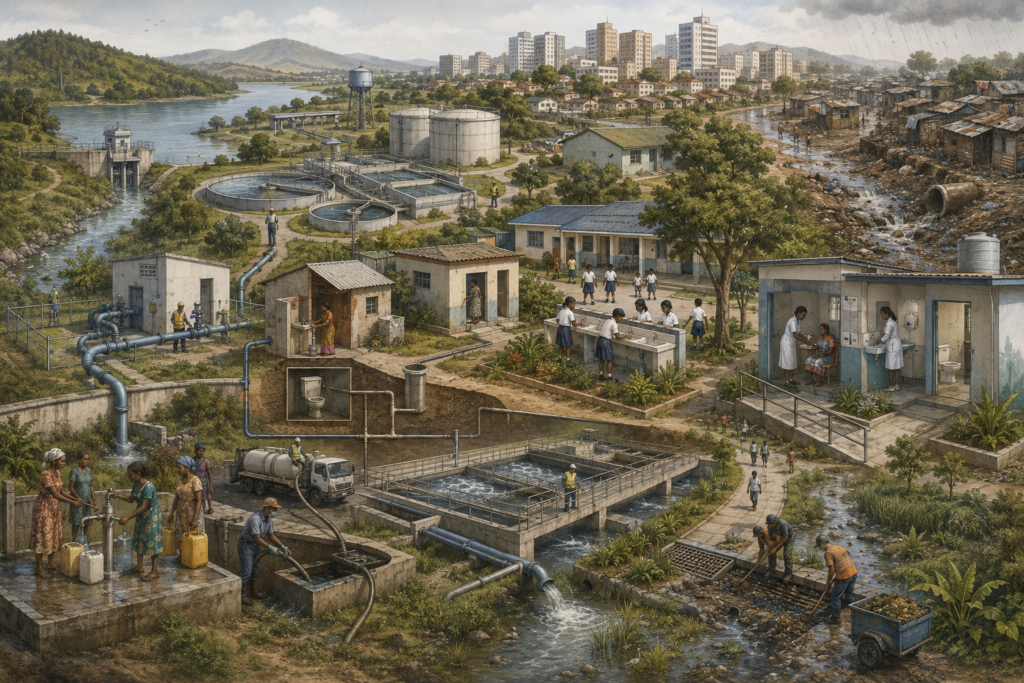
Editorial sustainability illustration showing water treatment, sanitation, hygiene facilities, drainage, wastewater systems, and unequal service conditions across neighborhoods, schools, clinics, and public spaces.

Water, Sanitation, and Public Infrastructure Systems

Water, sanitation, and public infrastructure systems are foundational to sustainable development because they determine whether health, dignity, education, care, and public life can function safely and reliably. This article argues that water and sanitation should be understood not as isolated services, but as governable public systems linking treatment, delivery, wastewater, drainage, finance, maintenance, and institutional capacity. It examines the historical evolution of water infrastructure, the shift from access metrics to systems thinking, and the ways inequality, gender, territorial exclusion, and climate stress shape infrastructural outcomes. It also shows why sustainable development depends on more than construction alone: durable progress requires maintenance, resilience, safe end-to-end management, and institutions capable of reconciling rights, affordability, operational realism, and long-horizon stewardship.

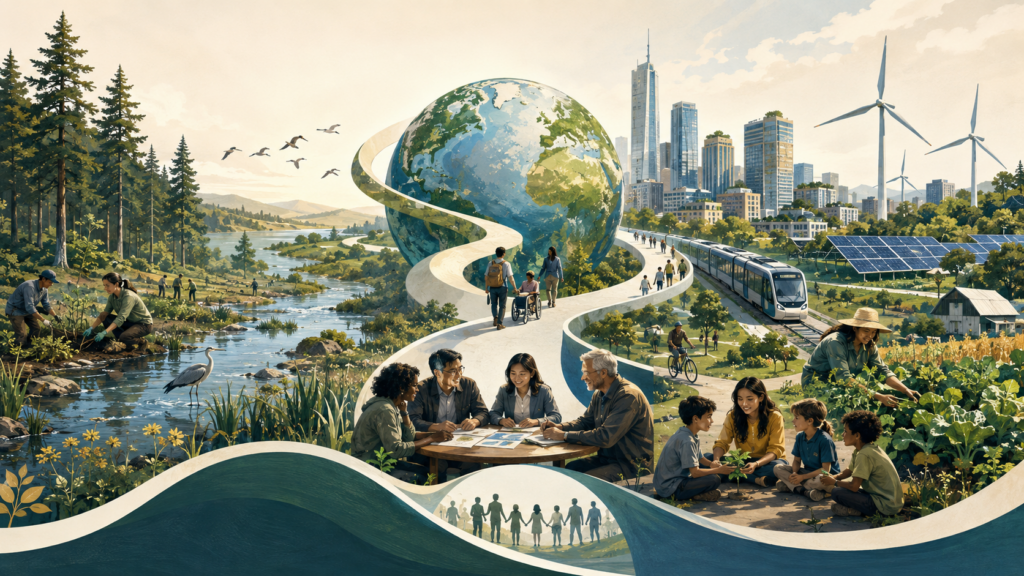
Editorial sustainability illustration showing a globe, ecological restoration, renewable energy, inclusive communities, public transit, agriculture, and a pathway toward a more resilient sustainable future.

Future Directions in Sustainable Development Thought

Future directions in sustainable development thought are being shaped by a deeper redefinition of development itself. This article argues that the field is moving beyond growth-centered frameworks toward a more demanding conception of viability: one that integrates planetary boundaries, resilience, governance capacity, technological power, justice, and long-horizon uncertainty. It examines the biophysical turn in development theory, the rise of fragility and systems thinking, the growing importance of anticipatory governance, and the digital recasting of development through AI and data systems. It also explores how future development thought is becoming more political in its treatment of inequality, more plural in its treatment of knowledge, and more ambitious in its effort to measure flourishing beyond output alone. The result is a field increasingly organized around the problem of sustaining just and governable futures under conditions of systemic stress.

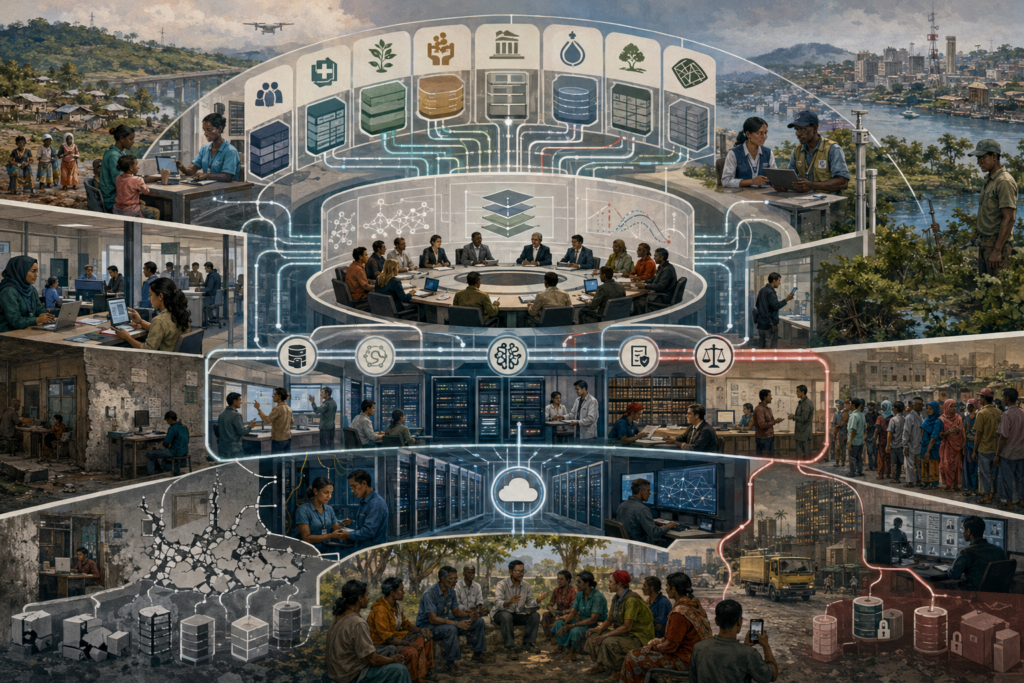
Editorial sustainability and governance illustration showing AI, public data systems, digital infrastructure, institutional oversight, community participation, and unequal access to accountable digital governance.

AI, Data Systems, and the Future of Development Governance

AI, data systems, and development governance increasingly belong to the same analytical frame because public authority is becoming more data-mediated, more automated, and more dependent on digital infrastructure. This article argues that AI is not developmentally meaningful in isolation. Its value depends on data quality, interoperability, compute access, institutional capacity, legal safeguards, and public trust. It examines how AI is reshaping administrative power, service delivery, state legibility, and governance infrastructure, while also intensifying questions of inequality, surveillance, platform dependence, and algorithmic lock-in. The core claim is that sustainable development now depends not only on technical adoption, but on whether societies can build trustworthy data systems and publicly governable AI arrangements. What matters most is not AI sophistication alone, but whether digital governance remains accountable, inclusive, contestable, and institutionally durable.

Planetary boundaries define the Earth-system conditions within which sustainable development remains habitable, just, resilient, and durable over time.

Development Under Deep Uncertainty

Development under deep uncertainty examines how sustainable development decisions should be made when futures are multiple, probabilities are disputed, and system behavior cannot be confidently forecast in advance. This article argues that long-horizon development planning cannot rely on prediction-centered methods alone. It must instead use strategies built around robustness, adaptability, institutional learning, and pathway flexibility. The piece distinguishes deep uncertainty from ordinary risk, explains why forecast-based planning often becomes brittle under changing conditions, and shows how scenario analysis, adaptive pathways, and Decision-Making Under Deep Uncertainty provide a more durable framework for planning. It also foregrounds the justice dimension of uncertainty, emphasizing that the burdens of error, delay, and adjustment are distributed unequally. The result is a more realistic account of how development remains strategic when certainty is no longer available.

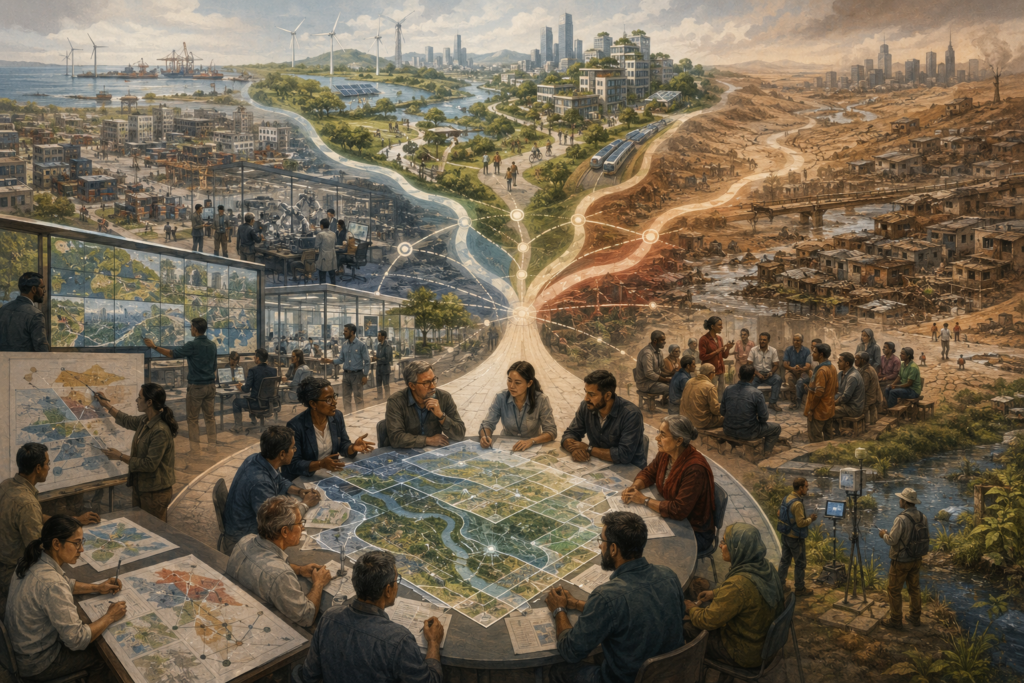
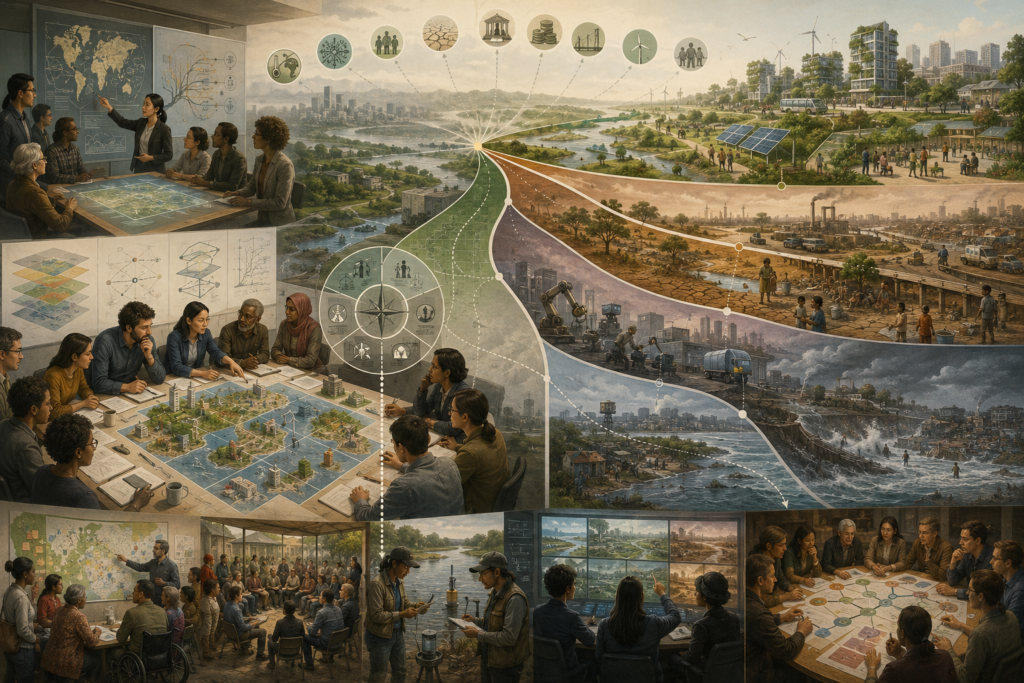
Editorial sustainability illustration showing multiple branching future pathways, planning tables, community workshops, foresight rooms, field monitoring, and contrasting sustainable development scenarios.

Scenario Planning for Sustainable Futures

Scenario planning matters for sustainable development because long-horizon development decisions must be made without knowing which future will arrive. This article argues that scenario planning is valuable not because it predicts one correct outcome, but because it helps institutions think rigorously across multiple plausible futures and improve present strategy under uncertainty. It explains how scenario planning differs from forecasting, why it matters for climate-resilient and path-dependent development, and how it supports robustness, institutional learning, and adaptive decision-making. The article also emphasizes that scenario work is never politically neutral: the futures institutions imagine reflect assumptions about power, vulnerability, and legitimacy. Used well, scenario planning widens strategic awareness, surfaces hidden assumptions, and strengthens present judgment. Used poorly, it becomes decorative futurism detached from real decisions, justice, and institutional change.

Scroll to Top