
Last Updated May 7, 2026
Development under deep uncertainty matters because sustainable development is often pursued in situations where decision-makers cannot confidently know which future is most likely, how key systems will interact, or even how competing outcomes should be weighed against one another. In these contexts, uncertainty is not merely a lack of precise information around an otherwise stable model. It is deeper than that. The structure of the problem itself may be contested, evolving, politically disputed, or only partly understood.
Sustainable development therefore cannot rely only on prediction, optimization, or single-path planning. It requires strategies that remain usable when futures are multiple, probabilities are unclear, values conflict, and system behavior may shift in nonlinear ways.
Main Library
Publications
Article Map
Sustainable Development
Related Article
Scenario Planning
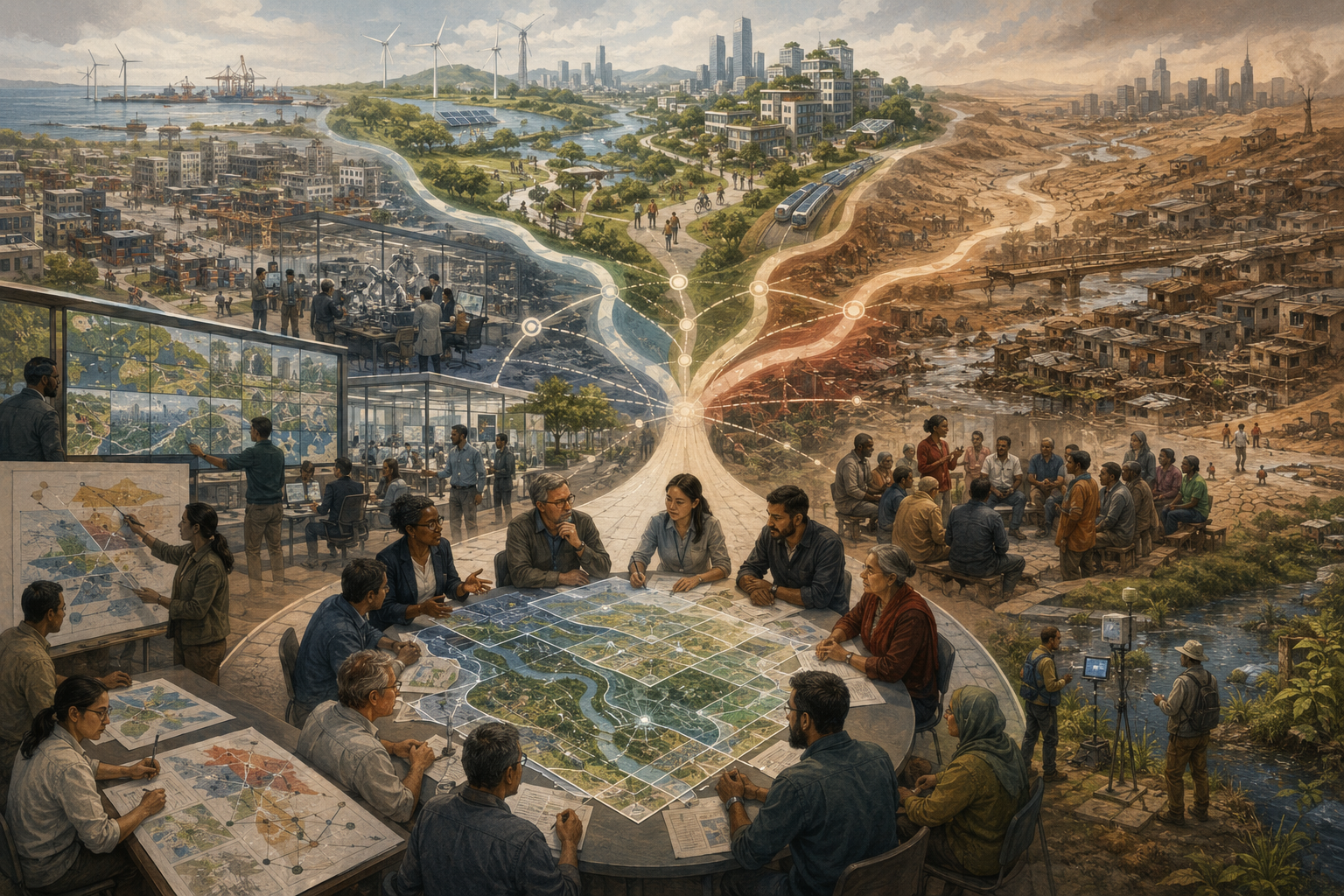
The deeper reason deep uncertainty matters is that long-horizon development decisions must be made before uncertainty is resolved. Governments and institutions must still choose how to invest in infrastructure, energy systems, cities, social protection, water management, industrial upgrading, digital systems, and climate adaptation even when they cannot know which shocks, transitions, or interactions will define the operating environment decades from now.
This article argues that robust and adaptive strategy is no longer a specialized planning technique at the margins. It is increasingly part of what serious development governance requires. The task is not to eliminate uncertainty, but to build institutions, pathways, and decision rules that can act intelligently while uncertainty remains.
What Deep Uncertainty Means
Deep uncertainty refers to situations in which decision-makers do not know, or do not agree on, the models that describe how a system works, the probabilities that should be assigned to future events, or the way alternative outcomes ought to be valued. That is what distinguishes it from a more ordinary planning problem. Under deep uncertainty, analysts cannot simply refine the forecast enough to recover a stable answer.
The uncertainty is not only about numerical error around known parameters. It may extend to causal structure, institutional response, social behavior, technological change, ecological feedback, political reaction, and normative disagreement. A planning team may not only disagree about the probability of a future. It may disagree about which model of the system is relevant, which outcomes matter most, and what forms of risk are acceptable.
This matters because deep uncertainty changes what counts as a rational decision. If the future cannot be reduced to a single credible probability distribution, then tools built around expected-value optimization, single baselines, and “best estimate” planning become less reliable guides to action. The problem is no longer to pick the best option for the most likely world. It is to identify strategies that remain defensible across multiple plausible worlds.
Deep uncertainty is especially important for sustainable development because the systems involved are coupled and evolving. Climate, water, food, infrastructure, migration, public finance, technology, institutions, and social legitimacy interact. A change in one domain can alter the meaning of choices in another. Uncertainty therefore becomes structural rather than merely statistical.
To ask what deep uncertainty means is therefore to ask how development should proceed when even the frame through which the future is interpreted remains partly unsettled. That is why the issue belongs naturally beside How Sustainable Development Is Measured and SDG Indicators: Strengths, Gaps, and Political Uses, since uncertainty often arises not only from missing facts but from contested ways of defining what progress, risk, and success mean.
Why Deep Uncertainty Matters for Development
Deep uncertainty matters for development because many of the most consequential development decisions involve long time horizons, path dependence, and complex system interaction. Energy transitions, water systems, urban expansion, public-health preparedness, digital infrastructure, agricultural adaptation, industrial upgrading, fiscal strategy, and climate-resilient infrastructure all depend on futures that cannot be known with confidence decades in advance.
The farther development planning reaches into the future, the more it confronts interacting uncertainties rather than stable forecastable trajectories. A city designed for one climate regime may confront another. An economy positioned for one trade order may face a more fragmented world. A welfare architecture built for modest shocks may face cascading crises. A technology strategy built around one adoption pathway may meet a different pattern of diffusion, concentration, or geopolitical restriction.
This matters because the costs of error can be large and difficult to reverse. Infrastructure can lock in settlement patterns. Energy systems can lock in emissions and dependence. Industrial policies can lock in capabilities or vulnerabilities. Digital systems can lock in platform power. Water systems can lock in assumptions about climate, demand, and governance capacity. Under deep uncertainty, wrong assumptions may become expensive physical, fiscal, and institutional constraints.
Sustainable development depends partly on whether institutions can make decisions that remain usable across several plausible futures rather than only under one expected trajectory. This requires a different standard of quality. A strategy should not be judged only by how well it performs under the central forecast. It should also be judged by whether it avoids unacceptable failure under plausible alternatives.
In that respect, this article extends the logic already present in Scenario Planning for Sustainable Futures, where the question is not which single future will arrive, but how present strategy can remain defensible across multiple futures.
From Risk to Deep Uncertainty
A useful distinction must be made between risk and deep uncertainty. Under risk, probabilities can at least be estimated with some confidence, even if imperfectly. A planner may not know exactly what will happen, but the range of outcomes and their probability distribution are treated as reasonably knowable. Under deep uncertainty, probability distributions themselves may be unknown, disputed, unstable, or insufficient for the most important dimensions of the decision.
This matters because planning tools suited to ordinary risk may perform poorly when deep uncertainty prevails. Expected-value reasoning, single-point optimization, and best-estimate forecasts depend on assumptions that often break down when futures are structurally open and system interactions are nonlinear. A tool that works well for known risks may become misleading when the system itself changes or when values and objectives are contested.
The difference can be seen in climate adaptation, water governance, public health, and infrastructure planning. A flood-risk model may estimate probabilities from historical data, but climate change can shift the underlying distribution. A public-health model may estimate disease spread, but social behavior, trust, misinformation, institutional capacity, and global mobility can alter the system while the policy is being implemented. The uncertainty is not simply a margin of error. It concerns the structure of the problem.
Development under deep uncertainty therefore requires a broader decision logic: one less dependent on precise prediction and more attentive to robustness, learning, flexibility, and adaptive revision. This does not mean abandoning evidence. It means using evidence differently, as part of a stress-testing and learning process rather than as a claim that uncertainty has been fully resolved.
This also explains why deep uncertainty belongs in close dialogue with Risk, Shock, and Fragility in Development Systems. Fragility often appears when institutions plan as though risk were knowable and bounded, only to discover that the future does not behave in ways their models assumed.
Why Prediction-Centered Planning Breaks Down
Prediction-centered planning breaks down when uncertainty is not just large but irreducibly structural. In such conditions, improving the forecast does not necessarily solve the decision problem because the future may be shaped by shifting institutions, emergent feedbacks, technological discontinuities, political contestation, ecological thresholds, and social responses that cannot be reliably compressed into a single expected path.
The baseline itself can move. The meaning of variables can shift. The relevant interactions may change while policy is being implemented. A plan built around one expected future can become brittle not because analysts failed to work hard enough, but because the future was never reducible to one stable planning assumption in the first place.
This matters because many bureaucratic systems remain built around forecast discipline: one baseline, one preferred case, one central estimate, one cost-benefit projection. These tools can be useful, but they can also create false confidence. Long-horizon development often takes place in environments where the baseline is unstable and the confidence attached to it is misplaced. When institutions rely too heavily on deterministic planning, they can become brittle precisely where flexibility is most needed.
Prediction-centered planning can also create a political problem. A single forecast can make contested assumptions look technical and settled. It can narrow debate by making one future appear official. Under deep uncertainty, that can hide value judgments, silence alternative futures, and encourage institutions to treat dissenting perspectives as noise rather than as information about uncertainty.
Sustainable development becomes more robust when institutions stop treating prediction failure as an anomaly and start recognizing that some of the most important futures cannot be forecast with high confidence in the first place. That is why this article pairs naturally with Resilience Thinking and Sustainable Development, which similarly shifts attention from stable equilibrium toward adaptation, disturbance, and changing baselines.
Development Decisions Without Settled Probabilities
A distinctive feature of deep uncertainty is that decisions must still be made even when probabilities are not settled. Governments cannot wait for certainty before deciding on infrastructure standards, climate adaptation, industrial strategy, insurance arrangements, water systems, energy transition, public-health preparedness, or social protection. Development planning must function in the absence of probability confidence.
This matters because inaction is also a choice. Refusing to decide until uncertainty resolves can lock systems into fragile trajectories or increase later costs of adjustment. Waiting can allow ecological overshoot, infrastructure exposure, debt burdens, housing vulnerability, technological dependence, or institutional weakness to deepen. Under deep uncertainty, delay may appear prudent while actually narrowing future options.
The question therefore shifts from “What is the optimal decision for the most likely future?” to “What decisions remain reasonable across several plausible futures?” That is a more demanding and more honest question because it accepts the future’s openness rather than pretending it has already been domesticated analytically.
Some decisions should be staged. Some should preserve options. Some should reduce irreversible lock-in. Some should build monitoring capacity. Some should protect the most vulnerable from bearing the cost of uncertainty. Some should move quickly because delay increases danger. Under deep uncertainty, good planning is not simply cautious planning. It is decision-making that understands reversibility, timing, thresholds, and distributional consequences.
Sustainable development therefore requires decision frameworks that can justify action without pretending that uncertainty has been tamed. This becomes especially clear in areas like Infrastructure as the Material Basis of Development, Water, Sanitation, and Public Infrastructure Systems, and Climate Change as a Development Constraint, where waiting for certainty can itself create long-run vulnerability.
Decision-Making Under Deep Uncertainty
Decision-Making Under Deep Uncertainty, often shortened to DMDU, refers to a family of methods designed for conditions where models, probabilities, and values are uncertain or contested. Related approaches include robust decision-making, adaptive pathways, scenario planning, dynamic adaptation, exploratory modeling, and decision scaling. Their common feature is that they reorient analysis away from finding the best answer under one forecast and toward identifying strategies that perform adequately across many conditions.
This matters because DMDU is not just a technical toolkit. It is also a different philosophy of public reasoning under uncertainty: robust, iterative, learning-based, and stress-tested rather than forecast-dependent. Instead of optimizing for one imagined future, it asks what kinds of strategies fail least badly, remain revisable, preserve room for maneuver, and avoid unacceptable downside risk.
DMDU approaches often begin by exploring a wide range of plausible futures. They then test policies across those futures, identify conditions under which policies fail, compare robustness, and design adaptive pathways that can be revised as signals emerge. This is different from asking which future is most likely and then optimizing around it. It treats uncertainty as part of the decision problem rather than as a defect to be eliminated before decisions can be made.
For sustainable development, that shift is crucial. Planning for energy, mobility, public finance, climate adaptation, water systems, food security, and social resilience must often be judged by robustness and flexibility rather than by narrow efficiency against a single expected world. A strategy that is slightly less efficient in one forecast but far more robust across several plausible futures may be more developmentally responsible.
In that sense, DMDU offers an explicit methodological companion to the strategic questions raised in Policy Coordination Across Complex Systems and Sustainable Finance and Development Investment, where uncertainty changes what counts as a sound decision in the present.
Scenarios, Pathways, and Robustness
Scenarios and pathways are essential under deep uncertainty because they help institutions move beyond single-path thinking. Scenario planning explores multiple plausible futures. Pathway approaches examine how present choices open or close future options. Robustness asks which strategies continue to function across several such worlds. These are not simply storytelling devices. They are ways of organizing public judgment when the future cannot be responsibly reduced to one baseline.
This matters because sustainable development is path dependent. Choices about land use, energy, infrastructure, welfare systems, industrial structure, housing, water, digital governance, and fiscal architecture create trajectories that may later become difficult to reverse. Under deep uncertainty, the goal is often not optimization for one future but robustness across several and adaptability when futures change.
A robust strategy may not be perfect in any one world, but it avoids catastrophic failure across many. It may preserve flexibility, reduce downside exposure, protect vulnerable groups, and keep future options open. A fragile strategy may perform well in a narrow expected future but fail badly when climate, finance, technology, governance, or social conditions shift.
Pathway thinking adds a temporal dimension. It asks what should be done now, what can wait, what decisions should be staged, what signals should trigger revision, and what thresholds indicate that a strategy is failing. This makes uncertainty governable without pretending it has disappeared.
Development strategy becomes stronger when it asks not only “What is the best plan?” but also “What plan fails least badly across divergent futures, and what plan can be revised as new information emerges?” That is the deeper logic of Scenario Planning for Sustainable Futures, which becomes even more powerful when read through the lens of deep uncertainty.
Deep Uncertainty and Climate-Resilient Development
Climate change provides one of the clearest examples of development under deep uncertainty. Emissions pathways, physical feedbacks, adaptation choices, institutional responses, technological transitions, land-use decisions, and social vulnerabilities cannot be reduced to one deterministically knowable future. Water systems, cities, infrastructure, agricultural strategy, disaster risk reduction, and public health all require decisions now under conditions of incomplete and partly contested knowledge.
This matters because climate-resilient development must be designed before future warming patterns, hazard intensities, adaptation capacities, and political responses are fully known. Deep uncertainty is therefore not a peripheral issue in climate-development planning. It is part of the core condition under which such planning takes place.
Development strategies that assume a narrow range of climate futures may become obsolete or dangerous precisely when resilience is most needed. A drainage system sized for one rainfall regime may fail under another. A coastal investment built around one sea-level scenario may face more severe conditions. A food system designed around historical rainfall may become unstable. A public-health system that underestimates heat, disease, and displacement may become overwhelmed.
Climate uncertainty also has a justice dimension. The costs of wrong assumptions are not evenly distributed. Low-income settlements, climate-exposed regions, small farmers, indigenous communities, informal workers, children, older adults, disabled people, and fiscally constrained states often have less capacity to absorb planning error. Robust climate development must therefore ask not only what performs across futures, but who is protected in those futures.
Sustainable development under climate change requires governance approaches that remain functional across multiple climate-development futures rather than depending on a single forecast being correct. This makes the connection to Climate Change as a Development Constraint especially direct, since climate becomes a development constraint precisely because it multiplies uncertain futures rather than merely adding one more predictable variable to the planning environment.
Institutions, Learning, and Adaptive Capacity
Development under deep uncertainty places unusual importance on institutional learning. If the future cannot be known confidently in advance, then institutions must be able to revise assumptions, track signals, recognize failures early, and adapt strategy over time. This matters because rigid institutions tend to fail twice under deep uncertainty: first by assuming more certainty than exists, and then by adapting too slowly when their assumptions are overtaken by events.
Learning capacity, monitoring, and revision are therefore not optional add-ons to planning. They are part of what good planning means under uncertain conditions. Institutions need to be able not only to act, but to update. They need mechanisms for horizon scanning, feedback, public deliberation, scenario review, evidence integration, and adaptive triggers. They also need the political legitimacy to revise course without treating revision as failure.
This is especially important because many institutions are designed for stability rather than learning. Budget cycles, procurement rules, performance measures, legal mandates, and administrative hierarchies often reward compliance with existing plans more than intelligent adjustment. Under deep uncertainty, that rigidity can become a source of fragility.
Adaptive capacity also depends on institutional memory. If agencies do not learn from past shocks, they repeat vulnerability. If local knowledge does not enter planning, institutions miss early signals. If communities are excluded from feedback, planning remains abstract. If data systems are weak, learning becomes delayed. Adaptive governance therefore depends on both technical systems and public legitimacy.
Sustainable development depends not only on strategic foresight at the start of a process, but on sustained institutional ability to learn and reorient as futures unfold. This brings the discussion into close contact with Why Institutions Matter for Sustainable Development and State Capacity, Public Administration, and Delivery Systems, since adaptive capacity is one of the clearest tests of whether institutions are actually capable under stress rather than merely formal on paper.
Plural Values, Conflicting Objectives, and Political Judgment
Deep uncertainty is not only about facts. It is also about values. Development decisions often involve trade-offs among growth, resilience, equity, speed, environmental protection, affordability, public legitimacy, cultural continuity, and political feasibility. Even perfect technical analysis cannot eliminate conflict over what should be prioritized. Deep uncertainty makes this more visible because the future cannot be settled empirically in advance in ways that make political disagreement disappear.
This matters because deep uncertainty makes political judgment more visible, not less. When future conditions are contested, disagreement over desirable outcomes, acceptable risks, and institutional priorities becomes even more central. A resilient infrastructure strategy may be costlier in the short term. A social-protection expansion may increase fiscal strain. A technology pathway may improve efficiency while worsening concentration of power. A climate strategy may reduce long-run exposure while imposing near-term transition costs.
Under deep uncertainty, no technical method can legitimately erase those conflicts. Methods can clarify trade-offs, reveal vulnerabilities, stress-test policies, and identify robust options. They cannot decide whose losses matter, whose voice counts, how much risk is acceptable, or which future is worth pursuing. Those remain questions of political judgment and moral reasoning.
This does not weaken the value of analytical tools. It clarifies their proper role. Good analysis under deep uncertainty should make disagreement more honest, not pretend to dissolve it. It should reveal where strategies fail, where burdens fall, and where values conflict. That can improve public reasoning precisely because it does not hide politics behind false certainty.
Sustainable development therefore requires decision frameworks that can clarify trade-offs without pretending to dissolve them into technical certainty. This article belongs in conversation with Law, Rights, and Sustainable Development and Participation, Voice, and Community-Led Development, where disagreement is not a flaw in governance but part of what democratic and legitimate development must work through.
Deep Uncertainty and Development Justice
Deep uncertainty also has a justice dimension. Uncertainty is often experienced unequally. Wealthier actors and stronger institutions usually have more buffers, more flexibility, and more capacity to revise strategy than poor households, fiscally constrained states, informal workers, displaced people, or marginalized communities. What appears as manageable uncertainty from one vantage point may be existential exposure from another.
The ability to absorb error, delay, experimentation, and policy revision is itself unequally distributed. A ministry may revise a plan. An investor may diversify. A wealthy household may relocate or insure. A poor household may lose income, take on debt, withdraw children from school, sell assets, or move into dangerous work. Deep uncertainty is therefore not only an epistemic condition. It is a social condition filtered through unequal capacity.
This matters because development planning under deep uncertainty can reproduce inequality if it assumes that all actors can absorb pathway revision equally. Uncertainty is not experienced on a level field. It is filtered through income, geography, political marginality, race, gender, disability, land tenure, institutional strength, and unequal access to protection. A “robust” strategy for a ministry or investor may still externalize risk downward onto communities with far less capacity to cope.
Justice also affects who participates in defining uncertainty. Expert-driven models may identify some risks while missing others. Communities may experience uncertainty through eviction risk, informal water access, care burdens, local violence, insecure land rights, or cultural loss. If these forms of uncertainty are excluded from planning, then robust strategy may become robust only for those already represented in formal systems.
Sustainable development under deep uncertainty is therefore not only about smarter technical planning. It is also about making uncertainty governable in ways that do not shift disproportionate burdens onto those with the least capacity to absorb them. This makes the article a natural companion to Inequality and Inclusive Development and Gender, Exclusion, and Development Justice, where vulnerability is shown to be structured socially rather than merely distributed by chance.
Why Robustness Does Not Mean Caution Alone
A common misunderstanding is that deep uncertainty implies caution above all else. But robustness does not always mean choosing the least ambitious path. In some cases, delaying action can increase exposure, raise future costs, and narrow future options. Under deep uncertainty, bold action may be more robust than caution if it reduces lock-in, builds adaptive capacity, or preserves flexibility.
The real question is not whether a strategy is aggressive or cautious in the abstract, but whether it performs tolerably across a wide range of futures and avoids catastrophic downside risk. A cautious strategy that delays climate adaptation may be fragile if delay increases infrastructure exposure. A cautious strategy that postpones energy transition may be fragile if it locks in stranded assets. A cautious strategy that avoids public-health investment may be fragile if system shocks become more frequent.
Robustness is therefore not passivity. It is strategic intelligence about reversibility, flexibility, thresholds, and the distribution of harm over time. It asks which actions keep more pathways open, which reduce severe downside risk, which protect the most vulnerable, and which can be revised as conditions evolve. Some robust actions are incremental. Others are transformative. The distinction depends on the structure of the uncertainty and the consequences of delay.
This is especially important for sustainability because ecological systems may have thresholds, lags, and irreversibilities. Waiting for perfect certainty can be dangerous when delayed action increases boundary transgression, climate risk, biodiversity loss, water stress, or infrastructure vulnerability. Prudence under deep uncertainty sometimes means acting earlier than conventional cost-benefit logic would suggest.
Sustainable development requires that more subtle understanding of prudence. In some contexts, the most robust choice is not to wait, but to act in ways that reduce future brittleness. This point connects strongly to Boundary Transgression and Development Fragility, because ecological overshoot often makes delayed action less prudent, not more.
Why This Matters for Sustainable Development
Development under deep uncertainty requires a different style of reasoning from development under ordinary risk. When probabilities are unclear, models are contested, values conflict, and system behavior may shift, sustainable development cannot rely on prediction-centered planning alone. It requires robustness, adaptability, learning, and plural-futures thinking.
This is why deep uncertainty matters so much. It reveals a central truth that linear planning often obscures: some of the most important development choices must be made precisely when the future is least knowable. The task of governance is therefore not to eliminate uncertainty, but to act intelligently within it.
The issue is also one of justice. Deep uncertainty is not experienced equally. Some actors can absorb delay, error, experimentation, and revision; others cannot. Sustainable development cannot be credible if uncertainty is managed by shifting risk onto communities with the least ability to bear it.
To take deep uncertainty seriously is therefore to take the limits of prediction seriously. Long-run progress depends not only on ambition and targets, but on whether institutions can make decisions that remain usable across multiple futures and revise those decisions as the world changes.
Development becomes credible when uncertainty is made explicit, when strategies are tested across plausible futures, when institutions learn before crisis forces revision, and when robust planning protects those most likely to bear the costs of failed assumptions.
Mathematical Lens
Deep uncertainty can be clarified by comparing optimization under risk with robustness under multiple futures. Under ordinary risk, a planner may seek to maximize expected value:
\max_{x \in X} \; \mathbb{E}[U(x,\omega)]
\]
Interpretation: Expected-value optimization works best when future states have a known or credibly estimable probability distribution.
Here, \(x\) is the chosen strategy, \(X\) is the feasible strategy set, \(U\) is utility or performance, and \(\omega\) is a future state with an associated probability distribution. Deep uncertainty begins when that distribution is itself contested, unstable, or insufficient for the decision at hand.
Under deep uncertainty, a more suitable question is often whether a strategy remains acceptable across many plausible futures:
\text{Choose } x \text{ such that } U(x,\omega) \geq \tau \text{ for as many } \omega \in \Omega \text{ as possible}
\]
Interpretation: Under deep uncertainty, decision quality often depends on adequate performance across a wide scenario space rather than optimal performance under one assumed distribution.
Here, \(\tau\) is a satisficing threshold and \(\Omega\) is a wide space of plausible futures rather than a single probability-weighted forecast.
A simple robustness score can be written as:
R(x) = \frac{1}{|\Omega|}\sum_{\omega \in \Omega} \mathbf{1}\{U(x,\omega) \geq \tau\}
\]
Interpretation: Robustness measures the proportion of plausible futures in which strategy \(x\) meets the minimum acceptable threshold.
A high-robustness strategy may not be optimal anywhere, but it is less likely to fail badly across divergent conditions. That is often the more relevant criterion for long-horizon development planning.
Pathway thinking can also be expressed dynamically. Suppose strategy \(x_t\) can be revised over time in response to signals \(s_t\):
x_{t+1} = g(x_t, s_t)
\]
Interpretation: Adaptive planning depends not only on choosing a good strategy now, but on preserving the capacity to update as signals arrive.
A regret-based view can help compare strategies across futures:
\text{Regret}(x,\omega) = \max_{y \in X} U(y,\omega) – U(x,\omega)
\]
Interpretation: Regret measures the performance loss of choosing strategy \(x\) instead of the best available strategy under future \(\omega\).
| Term | Meaning | Interpretive role |
|---|---|---|
| \(x\) | Strategy or policy | Represents a development choice being evaluated under uncertainty. |
| \(X\) | Feasible strategy set | Represents available policy or investment options. |
| \(\omega\) | Future state | Represents one possible future condition. |
| \(\Omega\) | Plausible future space | Represents the wider set of futures used for stress-testing. |
| \(U(x,\omega)\) | Utility or performance | Represents how well strategy \(x\) performs under future \(\omega\). |
| \(\tau\) | Satisficing threshold | Represents a minimum acceptable performance standard. |
| \(R(x)\) | Robustness score | Represents the share of plausible futures where the strategy remains acceptable. |
| \(s_t\) | Signal or observation | Represents new information that can trigger adaptive revision. |
The equations are conceptual rather than predictive. Their value is to make visible the structure of the problem: deep uncertainty changes the decision criterion from optimizing under one assumed future to preserving adequate performance, learning capacity, and adaptive options across many plausible futures.
Advanced Python Workflow: Scenario Stress-Testing for Development Pathways
This Python workflow demonstrates how a planning team can stress-test development strategies across multiple futures rather than ranking them against a single expected forecast. It calculates minimum performance, average performance, regret, and robustness relative to a satisficing threshold. This is useful when the analytical problem is not “Which option is optimal under one baseline?” but “Which option remains usable across a broad set of plausible futures?”
from __future__ import annotations

import pandas as pd

INPUT_FILE = "development_pathway_scenarios.csv"
OUTPUT_FILE = "development_pathway_robustness_scores.csv"
SATISFICING_THRESHOLD = 0.60


def load_data(path: str) -> pd.DataFrame:
    """Load strategy-scenario performance data from CSV."""
    df = pd.read_csv(path)

    required_columns = [
        "strategy_name",
        "scenario_name",
        "performance_score",
    ]

    missing = [col for col in required_columns if col not in df.columns]

    if missing:
        raise ValueError(f"Missing required columns: {missing}")

    return df


def validate_scores(df: pd.DataFrame) -> pd.DataFrame:
    """Validate normalized performance scores."""
    if df["performance_score"].isna().any():
        raise ValueError("performance_score contains missing values.")

    if ((df["performance_score"] < 0) | (df["performance_score"] > 1)).any():
        raise ValueError("performance_score contains values outside [0, 1].")

    return df


def compute_regret(df: pd.DataFrame) -> pd.DataFrame:
    """Compute regret relative to the best strategy in each scenario."""
    df = df.copy()

    best_by_scenario = (
        df.groupby("scenario_name", dropna=False)["performance_score"]
        .max()
        .rename("best_score")
        .reset_index()
    )

    df = df.merge(best_by_scenario, on="scenario_name", how="left")
    df["regret"] = df["best_score"] - df["performance_score"]

    return df


def summarise_strategies(df: pd.DataFrame) -> pd.DataFrame:
    """Summarize robustness properties for each strategy."""
    df = df.copy()
    df["meets_threshold"] = df["performance_score"] >= SATISFICING_THRESHOLD

    summary = (
        df.groupby("strategy_name", dropna=False)
        .agg(
            avg_performance=("performance_score", "mean"),
            min_performance=("performance_score", "min"),
            max_performance=("performance_score", "max"),
            avg_regret=("regret", "mean"),
            max_regret=("regret", "max"),
            robustness_share=("meets_threshold", "mean"),
            scenarios_tested=("scenario_name", "count"),
        )
        .reset_index()
    )

    summary["composite_robustness_score"] = (
        0.40 * summary["robustness_share"] +
        0.25 * summary["min_performance"] +
        0.20 * (1 - summary["avg_regret"]) +
        0.15 * (1 - summary["max_regret"])
    ).clip(lower=0, upper=1)

    summary["decision_band"] = summary["composite_robustness_score"].apply(
        lambda x: "Highly robust"
        if x >= 0.75
        else "Moderately robust"
        if x >= 0.50
        else "Fragile"
    )

    return summary.sort_values(
        by=[
            "composite_robustness_score",
            "robustness_share",
            "min_performance",
            "avg_regret",
        ],
        ascending=[False, False, False, True],
    )


def main() -> None:
    df = load_data(INPUT_FILE)
    df = validate_scores(df)
    df = compute_regret(df)

    summary = summarise_strategies(df)
    summary.to_csv(OUTPUT_FILE, index=False)

    print("Development pathway stress-test complete.")
    print(summary.to_string(index=False))


if __name__ == "__main__":
    main()
This workflow is intentionally transparent. It does not claim to forecast which future will occur. It creates a reproducible way to compare strategies across plausible futures, identify strategies that fail under particular conditions, and prioritize strategies that remain acceptable across a wider uncertainty space. In practice, this kind of stress test can support infrastructure appraisal, climate adaptation, public investment planning, and institutional risk review.
Advanced R Workflow: Robustness and Adaptive Capacity Indicator Analysis
This R workflow is useful when analysts want to compare countries or regions on adaptive capacity, institutional learning, uncertainty-sensitive resilience, and policy flexibility across time. It combines several dimensions into a robustness-oriented panel summary and tracks whether adaptive capacity is improving or declining.
library(readr)
library(dplyr)

input_file <- "adaptive_capacity_panel.csv"
output_file <- "adaptive_capacity_summary.csv"
trend_output_file <- "adaptive_capacity_trends.csv"

cap_df <- read_csv(input_file, show_col_types = FALSE)

required_cols <- c(
  "country",
  "year",
  "institutional_learning_index",
  "adaptive_capacity_index",
  "resilience_index",
  "policy_flexibility_index"
)

missing_cols <- setdiff(required_cols, names(cap_df))

if (length(missing_cols) > 0) {
  stop(paste("Missing required columns:", paste(missing_cols, collapse = ", ")))
}

index_cols <- c(
  "institutional_learning_index",
  "adaptive_capacity_index",
  "resilience_index",
  "policy_flexibility_index"
)

invalid_index_cols <- index_cols[
  vapply(
    cap_df[index_cols],
    function(x) any(is.na(x) | x < 0 | x > 1),
    logical(1)
  )
]

if (length(invalid_index_cols) > 0) {
  stop(
    paste(
      "Index columns must be complete and normalized to [0, 1]:",
      paste(invalid_index_cols, collapse = ", ")
    )
  )
}

cap_df <- cap_df %>%
  arrange(country, year) %>%
  mutate(
    robustness_proxy = (
      institutional_learning_index +
        adaptive_capacity_index +
        resilience_index +
        policy_flexibility_index
    ) / 4,
    brittleness_proxy = (
      (1 - adaptive_capacity_index) +
        (1 - resilience_index) +
        (1 - policy_flexibility_index)
    ) / 3
  )

summary_df <- cap_df %>%
  group_by(country) %>%
  summarise(
    avg_robustness_proxy = mean(robustness_proxy, na.rm = TRUE),
    min_robustness_proxy = min(robustness_proxy, na.rm = TRUE),
    max_robustness_proxy = max(robustness_proxy, na.rm = TRUE),
    avg_brittleness_proxy = mean(brittleness_proxy, na.rm = TRUE),
    observations = n(),
    .groups = "drop"
  ) %>%
  mutate(
    robustness_band = case_when(
      avg_robustness_proxy >= 0.70 ~ "High robustness",
      avg_robustness_proxy >= 0.50 ~ "Moderate robustness",
      avg_robustness_proxy >= 0.35 ~ "Stressed robustness",
      TRUE ~ "Low robustness"
    )
  ) %>%
  arrange(desc(avg_robustness_proxy))

trend_df <- cap_df %>%
  group_by(country) %>%
  summarise(
    start_year = first(year),
    end_year = last(year),
    start_robustness = first(robustness_proxy),
    end_robustness = last(robustness_proxy),
    start_adaptive_capacity = first(adaptive_capacity_index),
    end_adaptive_capacity = last(adaptive_capacity_index),
    start_learning = first(institutional_learning_index),
    end_learning = last(institutional_learning_index),
    observations = n(),
    .groups = "drop"
  ) %>%
  mutate(
    robustness_change = end_robustness - start_robustness,
    adaptive_capacity_change = end_adaptive_capacity - start_adaptive_capacity,
    learning_change = end_learning - start_learning,
    trend_band = case_when(
      robustness_change >= 0.15 ~ "Improving robustness",
      robustness_change >= 0.00 ~ "Stable robustness",
      robustness_change >= -0.15 ~ "Declining robustness",
      TRUE ~ "Severely declining robustness"
    )
  ) %>%
  arrange(desc(robustness_change))

write_csv(summary_df, output_file)
write_csv(trend_df, trend_output_file)

cat("Adaptive capacity summary exported to:", output_file, "\n")
print(summary_df)

cat("\nAdaptive capacity trends exported to:", trend_output_file, "\n")
print(trend_df)
R works well here because deep uncertainty is often studied through comparative panels: countries, regions, sectors, institutions, or infrastructure systems observed over time. The workflow calculates robustness and brittleness proxies, identifies performance bands, and tracks whether institutions are becoming more adaptive or less adaptive as conditions evolve. That makes the analysis useful for longitudinal reporting rather than one-time scenario workshops alone.
Advanced Go Workflow: Lightweight Robustness Scoring Service
This Go workflow is useful when deep-uncertainty analysis needs to move from research into a lightweight operational service. Python and R are strong for analysis, but Go is a good fit for a compact utility that can ingest strategy-scenario records and return robustness, regret, and decision bands quickly. In practical terms, this kind of service could sit behind a dashboard, policy-screening tool, investment review system, or internal planning workflow.
package main

import (
	"encoding/csv"
	"fmt"
	"os"
	"strconv"
)

const satisficingThreshold = 0.60

type StrategyScenarioRecord struct {
	StrategyName      string
	ScenarioName      string
	PerformanceScore  float64
	BestScenarioScore float64
	AdaptabilityScore float64
	EquityScore       float64
}

func parseIndex(value string) (float64, error) {
	parsed, err := strconv.ParseFloat(value, 64)
	if err != nil {
		return 0, err
	}

	if parsed < 0 || parsed > 1 {
		return 0, fmt.Errorf("index value outside [0, 1]: %f", parsed)
	}

	return parsed, nil
}

func parseRecord(row []string) (StrategyScenarioRecord, error) {
	if len(row) != 6 {
		return StrategyScenarioRecord{}, fmt.Errorf("invalid record length: expected 6 columns")
	}

	performance, err := parseIndex(row[2])
	if err != nil {
		return StrategyScenarioRecord{}, err
	}

	bestScore, err := parseIndex(row[3])
	if err != nil {
		return StrategyScenarioRecord{}, err
	}

	adaptability, err := parseIndex(row[4])
	if err != nil {
		return StrategyScenarioRecord{}, err
	}

	equity, err := parseIndex(row[5])
	if err != nil {
		return StrategyScenarioRecord{}, err
	}

	return StrategyScenarioRecord{
		StrategyName:      row[0],
		ScenarioName:      row[1],
		PerformanceScore:  performance,
		BestScenarioScore: bestScore,
		AdaptabilityScore: adaptability,
		EquityScore:       equity,
	}, nil
}

func clamp01(x float64) float64 {
	if x < 0 {
		return 0
	}

	if x > 1 {
		return 1
	}

	return x
}

func regret(record StrategyScenarioRecord) float64 {
	return clamp01(record.BestScenarioScore - record.PerformanceScore)
}

func robustnessScore(record StrategyScenarioRecord) float64 {
	meetsThreshold := 0.0

	if record.PerformanceScore >= satisficingThreshold {
		meetsThreshold = 1.0
	}

	score := 0.35*meetsThreshold +
		0.25*record.PerformanceScore +
		0.20*record.AdaptabilityScore +
		0.15*record.EquityScore +
		0.05*(1-regret(record))

	return clamp01(score)
}

func decisionBand(score float64) string {
	switch {
	case score >= 0.75:
		return "Highly robust"
	case score >= 0.50:
		return "Moderately robust"
	default:
		return "Fragile"
	}
}

func main() {
	file, err := os.Open("deep_uncertainty_strategy_scores_service.csv")
	if err != nil {
		fmt.Println("Error opening CSV:", err)
		return
	}
	defer file.Close()

	reader := csv.NewReader(file)

	rows, err := reader.ReadAll()
	if err != nil {
		fmt.Println("Error reading CSV:", err)
		return
	}

	for i, row := range rows {
		if i == 0 {
			continue
		}

		record, err := parseRecord(row)
		if err != nil {
			fmt.Println("Parse error:", err)
			continue
		}

		score := robustnessScore(record)

		fmt.Printf(
			"strategy=%s scenario=%s performance=%.3f regret=%.3f robustness=%.3f band=%s\n",
			record.StrategyName,
			record.ScenarioName,
			record.PerformanceScore,
			regret(record),
			score,
			decisionBand(score),
		)
	}
}
The point is not to build a full deep-uncertainty platform inside the article. The point is to show how the logic of strategy performance, regret, adaptability, equity, and robustness can be operationalized cleanly: validate normalized inputs, calculate regret, score robustness, and return a readable decision band. That gives the article’s systems argument a practical service layer while keeping the code compact and auditable.
Advanced Embedded C Workflow: Edge Threshold Monitoring for Uncertain Infrastructure Conditions
Embedded C becomes relevant when development under deep uncertainty is tied to physical infrastructure that must continue functioning under unstable environmental conditions. Low-power devices used in water systems, drainage control, environmental sensing, localized resilience monitoring, or field infrastructure often need simple, dependable threshold logic that can operate even when centralized systems are unavailable or communications are degraded.
In this context, embedded C is not decorative. It represents the infrastructural edge of uncertainty governance. The code below illustrates a compact threshold monitor for water level, temperature, and battery state. In a real system, the readings would come from calibrated sensors rather than hard-coded sample values.
#include <stdio.h>
#include <stdbool.h>

#define WATER_LEVEL_WARNING_CM 75.0f
#define WATER_LEVEL_CRITICAL_CM 100.0f
#define TEMPERATURE_WARNING_C 40.0f
#define BATTERY_LOW_V 3.30f

typedef struct {
    float water_level_cm;
    float temperature_c;
    float battery_voltage;
} SensorReading;

typedef enum {
    STATUS_NORMAL,
    STATUS_WARNING,
    STATUS_CRITICAL
} MonitorStatus;

MonitorStatus evaluate_reading(SensorReading reading) {
    if (reading.water_level_cm >= WATER_LEVEL_CRITICAL_CM) {
        return STATUS_CRITICAL;
    }

    if (
        reading.water_level_cm >= WATER_LEVEL_WARNING_CM ||
        reading.temperature_c >= TEMPERATURE_WARNING_C ||
        reading.battery_voltage <= BATTERY_LOW_V
    ) {
        return STATUS_WARNING;
    }

    return STATUS_NORMAL;
}

const char* status_to_string(MonitorStatus status) {
    switch (status) {
        case STATUS_CRITICAL:
            return "CRITICAL";
        case STATUS_WARNING:
            return "WARNING";
        case STATUS_NORMAL:
            return "NORMAL";
        default:
            return "UNKNOWN";
    }
}

int main(void) {
    SensorReading reading = {
        .water_level_cm = 82.5f,
        .temperature_c = 37.2f,
        .battery_voltage = 3.7f
    };

    MonitorStatus status = evaluate_reading(reading);

    printf("water_level_cm=%.2f temperature_c=%.2f battery_voltage=%.2f status=%s\n",
        reading.water_level_cm,
        reading.temperature_c,
        reading.battery_voltage,
        status_to_string(status)
    );

    return 0;
}
The development logic is simple: some uncertainty-sensitive systems require monitoring close to the physical environment. Edge threshold logic does not replace institutional planning, but it can improve resilience by detecting local stress before centralized systems respond. In water, drainage, heat, and infrastructure monitoring, that local detection capacity can become part of adaptive governance.
Advanced C++ Workflow: Adaptive Edge Resilience Scoring for Infrastructure Systems
C++ is useful when local infrastructure devices or edge systems need richer logic than simple threshold triggering. In development terms, that can mean local resilience scoring for water, transport, or energy systems operating under uncertain conditions, where multiple signals must be combined into a usable classification. The point is not to simulate national planning at the device layer, but to show how uncertainty-sensitive logic can exist close to the infrastructure itself.
#include <algorithm>
#include <iostream>
#include <string>

struct InfrastructureSignals {
    double sensor_reliability;
    double power_reliability;
    double communications_reliability;
    double local_repair_capacity;
    double hazard_exposure;
};

double clamp01(double value) {
    return std::max(0.0, std::min(1.0, value));
}

double resilience_score(const InfrastructureSignals& signals) {
    double capacity =
        0.25 * signals.sensor_reliability +
        0.20 * signals.power_reliability +
        0.20 * signals.communications_reliability +
        0.20 * signals.local_repair_capacity +
        0.15 * (1.0 - signals.hazard_exposure);

    return clamp01(capacity);
}

std::string resilience_band(double score) {
    if (score >= 0.75) {
        return "High edge resilience";
    }

    if (score >= 0.55) {
        return "Moderate edge resilience";
    }

    if (score >= 0.35) {
        return "Stressed edge resilience";
    }

    return "Low edge resilience";
}

int main() {
    InfrastructureSignals signals{
        .sensor_reliability = 0.82,
        .power_reliability = 0.68,
        .communications_reliability = 0.54,
        .local_repair_capacity = 0.61,
        .hazard_exposure = 0.72
    };

    double score = resilience_score(signals);

    std::cout << "edge_resilience_score=" << score
              << " band=" << resilience_band(score)
              << std::endl;

    return 0;
}
This workflow shows how adaptive strategy can be translated into infrastructure-adjacent logic. A local system cannot resolve deep uncertainty at the societal level, but it can classify stress, preserve operational awareness, and support earlier intervention. That matters when environmental instability, communications failure, or institutional delay makes centralized response less reliable.
GitHub Repository
Complete Code Repository
The full code distribution for this article, including scenario stress-testing workflows, robustness scoring, adaptive-capacity analysis, SQL materials, optional Go scoring-service tooling, infrastructure-oriented embedded C and C++ examples, supporting documentation, and repository structure, is available on GitHub.
Related Articles
- Sustainable Development
- Scenario Planning for Sustainable Futures
- Resilience Thinking and Sustainable Development
- Risk, Shock, and Fragility in Development Systems
- Policy Coordination Across Complex Systems
- Climate Change as a Development Constraint
- Why Institutions Matter for Sustainable Development
- State Capacity, Public Administration, and Delivery Systems
- Inequality and Inclusive Development
- Boundary Transgression and Development Fragility
Further Reading
- Marchau, V.A.W.J., Walker, W.E., Bloemen, P.J.T.M. and Popper, S.W. (eds.) (2019) Decision Making under Deep Uncertainty: From Theory to Practice. Cham: Springer Open. Available at: https://link.springer.com/book/10.1007/978-3-030-05252-2
- Organisation for Economic Co-operation and Development (2025) Foresight Toolkit for Resilient Public Policy: A Comprehensive Foresight Methodology to Support Sustainable and Future-Ready Public Policy. Paris: OECD. Available at: https://www.oecd.org/content/dam/oecd/en/publications/reports/2025/01/foresight-toolkit-for-resilient-public-policy_9ad1cd60/bcdd9304-en.pdf
- United Nations Development Programme (2023) Choosing Your Tomorrows: Using Foresight and Anticipatory Governance to Explore Multiple Futures and Support Risk-Informed Development. New York: UNDP. Available at: https://www.undp.org/sites/g/files/zskgke326/files/2023-02/UNDP-DFS-Choosing-Your-Tomorrows-Using-Foresight-and-Anticipatory-Governance-Risk-Informed-Development.pdf
- United Nations Development Programme (2025) Democratizing Futures. New York: UNDP. Available at: https://www.undp.org/sites/g/files/zskgke326/files/2025-06/democratizing_futures.pdf
- Walker, W.E., Marchau, V.A.W.J. and Kwakkel, J.H. (2024) ‘The use of decision making under deep uncertainty in the IPCC’, Frontiers in Climate, 6, 1380054. Available at: https://research-portal.uu.nl/ws/portalfiles/portal/231479933/fclim-06-1380054.pdf
References
- Intergovernmental Panel on Climate Change (2021) The Concept of Risk in the IPCC Sixth Assessment Report. Available at: https://www.ipcc.ch/site/assets/uploads/2021/02/Risk-guidance-FINAL_15Feb2021.pdf
- Intergovernmental Panel on Climate Change (2021) AR6 WGI Chapter 1: Framing, Context and Methods. Available at: https://www.ipcc.ch/report/ar6/wg1/downloads/report/IPCC_AR6_WGI_Chapter01.pdf
- Intergovernmental Panel on Climate Change (2022) AR6 WGII Chapter 17: Decision-Making Options for Managing Risk. Available at: https://www.ipcc.ch/report/ar6/wg2/downloads/report/IPCC_AR6_WGII_Chapter17.pdf
- Marchau, V.A.W.J., Walker, W.E., Bloemen, P.J.T.M. and Popper, S.W. (eds.) (2019) Decision Making under Deep Uncertainty: From Theory to Practice. Cham: Springer Open. Available at: https://link.springer.com/book/10.1007/978-3-030-05252-2
- National Oceanic and Atmospheric Administration (n.d.) Decision-Making Under Deep Uncertainty. Available at: https://toolkit.climate.gov/course-lesson/decision-making-under-deep-uncertainty
- Organisation for Economic Co-operation and Development (n.d.) Strategic Foresight. Available at: https://www.oecd.org/en/about/programmes/strategic-foresight.html
- Organisation for Economic Co-operation and Development (2025) Building Anticipatory Capacity with Strategic Foresight in Government. Paris: OECD. Available at: https://www.oecd.org/en/publications/building-anticipatory-capacity-with-strategic-foresight-in-government_d7eb0bb6-en.html
- Organisation for Economic Co-operation and Development (2025) Foresight Toolkit for Resilient Public Policy: A Comprehensive Foresight Methodology to Support Sustainable and Future-Ready Public Policy. Paris: OECD. Available at: https://www.oecd.org/content/dam/oecd/en/publications/reports/2025/01/foresight-toolkit-for-resilient-public-policy_9ad1cd60/bcdd9304-en.pdf
- RAND (n.d.) Decision Making Under Deep Uncertainty. Available at: https://www.rand.org/global-and-emerging-risks/centers/pardee/dmdu-decision-making-under-deep-uncertainty.html
- RAND (2025) Decision Making under Deep Uncertainty and the Great Transition. Available at: https://www.rand.org/pubs/perspectives/PEA3789-1.html
- United Nations Development Programme (2018) Foresight Manual. New York: UNDP. Available at: https://www.undp.org/sites/g/files/zskgke326/files/publications/UNDP_ForesightManual_2018.pdf
- United Nations Development Programme (2023) Choosing Your Tomorrows: Using Foresight and Anticipatory Governance to Explore Multiple Futures and Support Risk-Informed Development. New York: UNDP. Available at: https://www.undp.org/sites/g/files/zskgke326/files/2023-02/UNDP-DFS-Choosing-Your-Tomorrows-Using-Foresight-and-Anticipatory-Governance-Risk-Informed-Development.pdf
- Walker, W.E., Marchau, V.A.W.J. and Kwakkel, J.H. (2024) ‘The use of decision making under deep uncertainty in the IPCC’, Frontiers in Climate, 6, 1380054. Available at: https://research-portal.uu.nl/ws/portalfiles/portal/231479933/fclim-06-1380054.pdf