
Last Updated May 7, 2026
Water, sanitation, and public infrastructure systems matter for sustainable development because they create the material conditions under which health, dignity, education, care, public order, environmental protection, and economic life become possible. Safe drinking water, sanitation networks, wastewater treatment, stormwater drainage, hygiene access, and the institutions that maintain them are not secondary amenities delivered after development has already occurred. They are part of development’s foundation.
Where these systems are absent, intermittent, unsafe, unaffordable, or socially unequal, development is weakened at the level of bodies, households, schools, clinics, neighborhoods, watersheds, cities, and states. Sustainable development therefore depends not only on whether a household has a tap or toilet in a narrow descriptive sense, but on whether societies can build, finance, regulate, maintain, and adapt public systems that deliver safe, affordable, reliable, and dignified service over time.
Main Library
Publications
Article Map
Sustainable Development
Related Article
Infrastructure
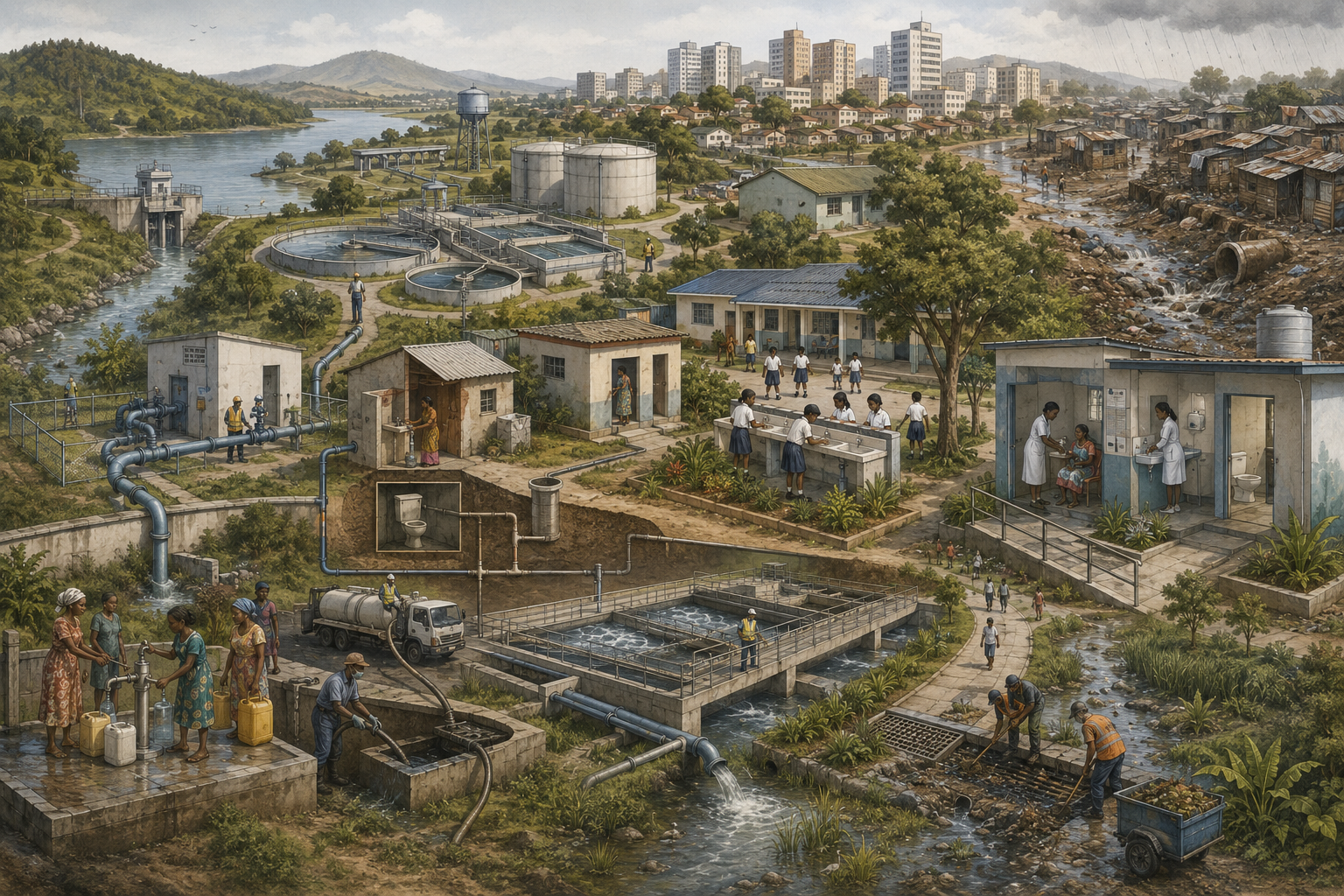
The deeper question is institutional as much as technical. Water and sanitation systems reveal whether public authority can organize the physical systems through which everyday life becomes less precarious and more capable of flourishing. A settlement without reliable water or drainage carries higher disease risk, heavier time burdens, more fragile schooling, more exposed care work, greater environmental contamination, and weaker institutional legitimacy.
Within sustainable development, this topic also reveals the inadequacy of development models that focus too narrowly on growth, aggregate investment, or policy aspiration while neglecting material systems of delivery. The global water and sanitation challenge is not simply one of scarcity or engineering. It is also one of inequality, governance, territorial neglect, climate stress, environmental contamination, and the unequal distribution of exposure to preventable harm.
Water and sanitation therefore belong at the center of development because they join the biological, infrastructural, ecological, and institutional foundations of human life. They are where public health, environmental stewardship, state capacity, gender justice, territorial inclusion, and climate resilience meet in concrete systems that either work for people or fail them.
Why Water and Sanitation Belong at the Center of Development
Water and sanitation belong at the center of development because they sit close to the biological and institutional foundations of social life. Safe drinking water reduces exposure to disease. Sanitation interrupts fecal-oral transmission, lowers environmental contamination, and protects households from chronic exposure to preventable pathogens. Hygiene access supports safer childbirth, infection prevention, school attendance, menstrual dignity, food safety, and everyday public health. These are not marginal improvements. They shape whether families remain healthy enough to learn, work, care, and participate in public life.
Yet the developmental importance of water and sanitation extends well beyond health. A settlement without reliable water or drainage carries higher time burdens, more fragile schooling, more exposed care work, more urban disorder, and weaker institutional legitimacy. A city with poor wastewater management can accumulate environmental contamination, recurrent flooding, and disease risk even while posting impressive growth rates. A rural district without reliable service delivery may remain structurally disadvantaged despite formal inclusion in national development plans.
In this sense, water and sanitation expose the difference between nominal development and materially grounded development. A society can report progress in income, infrastructure spending, or urban expansion while still leaving people exposed to unsafe water, unmanaged waste, unreliable service, and preventable illness. Those failures reveal that development is not only about aggregate indicators. It is about whether public systems reach bodies, households, schools, clinics, and neighborhoods in reliable and dignified ways.
This is one reason Goal 6 of the Sustainable Development Goals is so important. It does not treat water as a narrow utility matter. It links drinking water, sanitation, hygiene, wastewater, water quality, efficiency, integrated management, ecosystems, cooperation, and participation. That wider architecture reflects a crucial truth: water and sanitation are not isolated services but infrastructural conditions of public health, environmental protection, human capability, and institutional order.
Water and sanitation also matter because they reveal whether societies can prevent harm before it reaches crisis. A public health system that waits for disease to appear has already accepted a large part of the failure. A development system that prevents contamination, reduces exposure, and protects daily dignity builds capability upstream. Water and sanitation are therefore preventive infrastructures as much as delivery infrastructures.
What Water, Sanitation, and Public Infrastructure Systems Actually Include
In development analysis, water and sanitation must be understood as systems rather than isolated facilities. They include source protection, watershed management, treatment plants, storage, pumps, pipelines, pressure management, metering, household connections, standpipes, toilets, sewers, septic systems, fecal-sludge management, wastewater treatment, stormwater drainage, handwashing infrastructure, monitoring systems, utility operations, tariff regimes, maintenance budgets, regulatory agencies, local authorities, public-health coordination, and emergency response procedures.
This systems view matters because a tap without safe treatment and continuity is not the same as safe water. A toilet without safe containment, transport, and treatment is not the same as sanitation. A drainage channel that is never maintained is not resilience but deferred failure. Public infrastructure exists not when assets are merely installed, but when interdependent technical, financial, administrative, social, and ecological processes are organized well enough to deliver reliable outcomes over time.
Development discourse too often treats access points as if they were equivalent to functioning public systems. A household connection may exist on paper while water flows only intermittently, is microbiologically unsafe, or is too expensive for the poorest users. A latrine may count as improved while sludge disposal contaminates groundwater or nearby waterways. A wastewater plant may exist but operate below capacity because electricity, staffing, chemicals, maintenance, or financing are unreliable.
Water and sanitation also connect multiple scales. A household tap depends on watershed condition, energy systems, treatment infrastructure, local maintenance, pricing rules, public finance, and regulatory oversight. A neighborhood drain depends on urban land use, solid-waste management, maintenance crews, rainfall intensity, road design, and local accountability. A school toilet depends on water supply, cleaning budgets, menstrual hygiene provision, accessibility design, privacy, and institutional management.
That broader systems logic connects this topic to Systems Modeling, Environmental Monitoring Systems, and Economic Systems. Water and sanitation are classic multi-layer systems problems: they involve stocks and flows, feedbacks, maintenance cycles, geographic inequities, environmental thresholds, financing constraints, and institutional path dependence.
To ask what water and sanitation systems include is therefore to ask what must be governed for safe service to become ordinary. The answer is not a single facility. It is a whole chain of public provision, environmental stewardship, finance, maintenance, monitoring, and accountability.
Historical Development: From Public Health Engineering to Sustainable Development
The modern developmental importance of water and sanitation emerged historically through public health, urban engineering, and state formation. Nineteenth-century struggles with cholera, typhoid, urban crowding, and contaminated water helped establish the idea that collective health depends on shared infrastructure rather than private coping alone. Sewer systems, piped water, filtration, drainage, and municipal health governance were not simply technical upgrades. They were political reorganizations of urban life, and they changed what populations could reasonably expect from public authority.
This history matters because it shows that water and sanitation were never merely technical sectors. They were part of the development of the modern public sphere. The ability to provide clean water, remove waste, regulate contamination, and reduce epidemic risk helped define the modern city, the administrative state, and the idea that public health is a collective responsibility. Infrastructure became a way of making public obligation material.
Twentieth-century development debates broadened this view. Water infrastructure came to be associated with modernization, agricultural transformation, urban growth, and industrial development, while sanitation often lagged behind in prestige, financing, and institutional coherence. That imbalance still shapes policy today. Water supply frequently receives more visibility than sanitation, even though public health requires both. The result is a recurring pattern in which politically legible infrastructure expands while back-end systems such as sludge treatment, drainage, and wastewater management remain neglected.
Sanitation’s relative invisibility has deep consequences. Toilets, sewers, drains, sludge systems, and treatment plants are often treated as less glamorous than dams, reservoirs, pipelines, and visible water supply projects. But when sanitation is neglected, waste does not disappear. It moves into soil, water, streets, homes, ecosystems, and bodies. Development that supplies water while neglecting sanitation can therefore reproduce contamination through another channel.
Under the sustainable development framework, the older public-health and engineering story is joined to concerns about ecological integrity, rights, inequality, gender, climate resilience, and long-run stewardship. Water systems are now understood not only as delivery networks but as institutions embedded in watersheds, cities, ecosystems, budgets, and global development agendas. This shift is intellectually important. It means that water and sanitation can no longer be treated as narrow service sectors; they have become central to debates about justice, resilience, governance, and the ecological limits of development itself.
From Access Metrics to Governable Systems
One of the major conceptual advances in recent water and sanitation governance is the shift from counting access to evaluating systems. Access metrics remain indispensable. They reveal deprivation, benchmark progress, structure accountability, and make inequality visible. But access alone can mislead when it is detached from questions of continuity, safety, affordability, maintenance, service quality, and safe end-to-end waste management. A project may install infrastructure, improve a coverage statistic, and still leave the underlying system fragile.
This distinction helps explain why so many infrastructure gains remain unstable. A water point may fail after a few seasons because maintenance financing was never secured. A sanitation campaign may expand toilet construction while ignoring sludge treatment, environmental contamination, or urban drainage. Utilities may extend service to politically visible areas while low-income settlements remain dependent on unsafe private vendors. In each case, the issue is not simply insufficient infrastructure but insufficient governability.
Governability requires institutions capable of sustaining service. It requires asset management, budgets, tariffs or subsidies, maintenance schedules, trained staff, spare-parts supply chains, regulatory oversight, water-quality monitoring, accountability channels, and the capacity to respond to breakdowns. It also requires legitimacy: people need to trust that payments, rules, and service obligations are organized around public purpose rather than neglect or extraction.
To ask whether water and sanitation systems are governable is to ask whether there are credible institutions, financing arrangements, data systems, and maintenance practices capable of sustaining service under ordinary conditions and under shock. It is also to ask whether public agencies can identify excluded settlements, respond to contamination, protect watersheds, coordinate with health systems, and adapt infrastructure to climate stress.
This is why water and sanitation belong in conversations about Global Governance, International Law, and Decision Science. Development requires not just building assets, but choosing governance forms that can keep those assets socially effective over time.
Governable systems also require humility about measurement. A high access statistic may conceal intermittency. A safe water label may conceal household storage contamination. A sanitation facility may conceal unsafe disposal. A wastewater treatment rate may conceal plant underperformance. Sustainable development requires measurement systems capable of seeing the whole chain, not only the visible asset.
Health, Capability, and the Infrastructure of Prevention
Water and sanitation are among the most basic infrastructures of prevention. They reduce harmful exposure before illness reaches clinics and hospitals. This is a deeper achievement than treatment alone. It shifts public health upstream, from reaction to prevention. When safe water is available at home, when sanitation prevents environmental contamination, and when hygiene facilities support routine handwashing, disease risk declines not only statistically but structurally. The built environment itself becomes less hostile to human life.
The capability implications are equally important. Time spent collecting water, coping with illness, finding safe sanitation, or managing insecure hygiene is time not spent learning, working, resting, caring, or participating in civic life. Households can be formally included in development while still losing enormous amounts of time and bodily security to infrastructural deprivation. The issue, then, is not only morbidity but the narrowing of practical freedom.
Water and sanitation systems influence whether development expands what people are actually able to do. A child who misses school because of illness, unsafe sanitation, or menstrual exclusion experiences infrastructure failure as educational loss. A caregiver who spends hours securing water experiences infrastructure failure as time poverty. A worker exposed to contaminated environments experiences infrastructure failure as health insecurity. These burdens accumulate across households and generations.
The infrastructure of prevention also changes the meaning of healthcare. Health systems are not only hospitals and clinics; they include the environmental and infrastructural conditions that determine whether people are repeatedly exposed to preventable disease. A clinic treating diarrheal disease in a community without safe water and sanitation is responding downstream to an upstream public failure. Sustainable development requires moving that burden upstream into systems of prevention.
This is why water and sanitation connect directly to broader themes of Risk and Resilience and human capability. They reduce exposure to recurrent shocks, lower daily friction, and help convert public investment into lived developmental gains. Where they fail, families absorb the burden privately, often through unpaid labor, unsafe coping mechanisms, and intergenerational losses in health and education.
Sanitation, Dignity, Gender, and the Politics of Everyday Life
Sanitation is developmental not only because it reduces disease, but because it structures privacy, dignity, safety, and social membership. To lack safe sanitation is to experience infrastructural failure in embodied form. It can mean exposure to shame, insecurity, open defecation, unsafe shared facilities, sexual harassment risk, menstrual exclusion, or routine dependence on poorly maintained spaces. These harms are not incidental. They reveal how deeply public systems shape the moral texture of everyday life.
The gendered dimensions are especially important. Women and girls frequently absorb disproportionate burdens when water is distant, sanitation is unsafe, or hygiene facilities are inadequate. Time spent collecting water, managing menstruation without safe facilities, or coping with insecure sanitation can affect education, mobility, labor participation, bodily autonomy, and personal safety. These are not merely social side effects of infrastructure. They are central developmental outcomes.
Sanitation also affects schools. Where toilets are absent, unsafe, inaccessible, or poorly maintained, attendance and dignity suffer. Where menstrual hygiene is ignored, girls may be pushed out of full participation in education. Where school toilets lack privacy or water, the formal presence of schooling may coexist with daily indignity. Development cannot be reduced to school buildings and enrollment if the material conditions of attendance are not dignified.
The allocation of water and sanitation risk is also an allocation of dignity and life chances. Shared toilets that are unsafe at night, distant water sources, inaccessible facilities for disabled people, and poorly maintained public sanitation all distribute vulnerability through built systems. These failures are often normalized because they affect people with less political voice.
A serious sustainable development framework must therefore reject the idea that sanitation is a secondary or culturally awkward technical matter. It is a question of justice, care, and public obligation. Systems that fail to provide safe sanitation are not just inefficient; they institutionalize unequal exposure to indignity and harm.
Schools, Clinics, and State Capacity
Water and sanitation systems reveal state capacity in concrete form because schools, clinics, and other public institutions cannot function well without them. A school without handwashing infrastructure, safe toilets, reliable water, or menstrual hygiene support is not simply under-equipped. It is developmentally compromised. A health facility without safe water, sanitation, and hygiene services faces infection risks that undercut the quality and legitimacy of care.
This matters for a deeper reason. State legitimacy is not produced only through constitutions, policy documents, elections, or national plans. It is produced when institutions work in the ordinary places where people encounter public authority. Water at a clinic, hygiene at a school, drainage in a neighborhood, and functioning sanitation in a public facility are all part of the lived experience of the state. Where those systems fail, the state may remain legally sovereign while appearing socially absent.
Water and sanitation also shape institutional effectiveness. Teachers cannot compensate fully for unsafe school sanitation. Health workers cannot provide safe care without clean water and infection-control infrastructure. Local governments cannot maintain public order if drainage fails and wastewater contaminates streets. Public administration becomes materially thin when the basic systems of health, sanitation, and hygiene are unreliable.
Infrastructure is therefore part of administrative reach. A state that cannot provide or coordinate safe water and sanitation across territory struggles to make rights, services, and public health protections real. This insight aligns with the broader argument developed in pieces on institutions, public administration, and territorial development: service delivery is not just a downstream implementation problem. It is part of what makes development politically credible in the first place.
Schools and clinics are especially important because they are places where development promises become visible. If children encounter public institutions through unsafe toilets, if patients encounter care through facilities lacking water, and if communities encounter the state through neglected drainage, then development loses credibility at the point of contact. Water and sanitation therefore belong inside state-capacity analysis, not merely infrastructure accounting.
Wastewater, Drainage, and Urban Resilience
Water and sanitation debates often focus on supply and household access, but wastewater and drainage are equally central. Wastewater treatment, sewer maintenance, fecal-sludge management, stormwater systems, and flood pathways determine whether cities can remain healthy and orderly under pressure. Urban development without adequate drainage converts rainfall into inundation, contamination, and infrastructural disorder. Sanitation without treatment simply relocates waste rather than managing it safely.
These back-end systems are politically easy to neglect because they are less visible than new connections or flagship projects. Yet they are often where development succeeds or fails. A city can expand piped networks while discharging untreated wastewater into rivers. Informal settlements can receive sanitation facilities while remaining exposed to flood-mixed sewage. Stormwater systems can be underdesigned for a changing climate, turning heavy rainfall into recurrent crisis.
Drainage also connects water and sanitation to urban land use. Paved surfaces, blocked drains, waste disposal, housing location, river encroachment, wetland loss, and inadequate maintenance all shape whether storms become manageable events or public-health disasters. Wastewater and stormwater governance therefore cannot be separated from housing, roads, land planning, waste systems, and local government capacity.
In each case, the problem is not only technical underinvestment but the political invisibility of maintenance, waste, and urban metabolism. Cities metabolize water, waste, energy, food, materials, and human activity. When wastewater and drainage systems are neglected, the hidden metabolism of the city returns as visible crisis: flooding, contamination, disease, odor, blocked streets, damaged homes, and polluted ecosystems.
This is why wastewater and drainage belong within the same developmental frame as drinking water and sanitation. They connect households to ecosystems, public health to land use, and urbanization to environmental governance. They also belong in conversation with Planetary Boundaries, because contamination and hydrological disruption do not stop at municipal boundaries.
Inequality, Territorial Exclusion, and Infrastructural Injustice
Water and sanitation burdens are distributed unequally across class, region, settlement type, race, caste, gender, disability, indigeneity, migration status, and political marginality. This inequality is not a statistical footnote. It is one of the central reasons the topic belongs in sustainable development rather than narrow sectoral management. Infrastructure distributes safety and exposure unevenly.
Some households enjoy continuous piped water, safely managed sanitation, reliable drainage, and institutional response when systems fail. Others depend on contaminated sources, distant collection, costly private vendors, unsafe shared toilets, intermittent supply, informal tanker markets, failing drains, or unregulated waste disposal. These differences are not merely differences in service quality. They structure health risk, time burdens, dignity, and life chances.
These inequalities are often territorial. Informal settlements, peri-urban districts, rural regions, Indigenous territories, and politically marginalized communities are more likely to be under-served, less likely to receive timely maintenance, and more likely to be exposed to environmental externalities. The effect is cumulative. Poorer communities do not merely lack services; they often pay more per unit, absorb more unpaid labor, experience more illness, and receive weaker institutional response when systems fail.
Infrastructure becomes a mechanism through which inequality is reproduced materially. A household without safe water may spend time and money compensating for public failure. A settlement without drainage may experience repeated flooding and contamination. A school without sanitation may reproduce gender exclusion. A neighborhood without wastewater treatment may live with environmental burdens shifted away from better-protected areas.
To call this infrastructural injustice is not rhetorical excess. It names a real pattern in which the burdens of contamination, time loss, disease exposure, and climate vulnerability are shifted onto those with the least political protection. Sustainable development cannot be taken seriously if it ignores how water and sanitation systems stratify vulnerability across territory and social hierarchy.
This section connects directly to Inequality and Inclusive Development, Gender, Exclusion, and Development Justice, and Local Governance, Cities, and Territorial Development.
Finance, Governance, and the Problem of Maintenance
Water and sanitation systems are financial and governance systems as much as engineering systems. Pipes, pumps, sewers, drains, and treatment plants do not maintain themselves. Utilities require operating revenue, subsidy design, procurement competence, asset management, workforce capacity, data systems, regulatory credibility, and long-term planning. Many infrastructure failures are not failures of technical knowledge but failures of institutional continuity.
Maintenance is especially important because development politics often privileges construction over care. New assets are visible, ribbon-cuttable, and politically rewarding. Maintenance is recurrent, less visible, and easier to defer. Yet deferred maintenance accumulates into service unreliability, leakage, contamination, non-revenue water, overburdened treatment systems, and eventual fiscal crisis. A development model that funds expansion but starves maintenance is effectively borrowing against the future condition of public systems.
Water and sanitation finance also involves difficult trade-offs. Cost recovery matters, but so does affordability. Subsidies are necessary in many contexts, but poorly designed subsidies can reward already-served users more than excluded communities. Centralization can produce efficiency, while local governance can produce responsiveness. Public-private arrangements can mobilize capital or expertise, yet they can also create fragmentation, inequity, or weak accountability if governance is poor.
Maintenance also has a justice dimension. Wealthier areas may receive quicker repairs, better pressure, more reliable supply, and stronger political attention, while poorer settlements live with intermittent service and chronic breakdown. If maintenance systems follow political power rather than need, inequality is reproduced through operational routines. The geography of repair becomes part of the geography of development.
The right developmental question is not whether one model is ideologically pure, but whether institutions can organize finance, accountability, maintenance, and public obligation in ways that sustain equitable service over time. Water and sanitation require fiscal seriousness because universal access cannot be maintained through capital projects alone. It requires the less glamorous work of keeping systems functioning every day.
Climate Change, Water Security, and System Stress
Climate change intensifies the developmental importance of water and sanitation because it disrupts the environmental assumptions on which many systems were built. Drought alters source reliability. Floods overwhelm drainage and sanitation infrastructure. Heat changes demand patterns and can degrade water quality. Glacier loss and snowpack shifts affect downstream supply. Coastal intrusion threatens groundwater in vulnerable regions. These are not separate environmental issues layered onto existing systems; they are transformations of the hydrological context in which those systems must now operate.
The result is that water and sanitation planning can no longer rely on historical stability. A system designed for yesterday’s rainfall intensity, source profile, groundwater availability, or temperature regime may be structurally misaligned with tomorrow’s conditions. A drainage network sized for past storms may fail under new rainfall extremes. A water source assumed to be reliable may become seasonal or contaminated. A sanitation system assumed to remain above flood levels may become exposed to recurrent inundation.
Poorer communities are often hit first and hardest because they have weaker buffers, lower-quality infrastructure, less secure tenure, fewer savings, and less political capacity to secure adaptation investment. Climate change therefore magnifies pre-existing infrastructural inequality. The same storm, drought, or heat event can produce very different consequences depending on whether households have safe water, drainage, sanitation, savings, institutional support, and political voice.
Water security also requires ecological thinking. Watersheds, aquifers, rivers, wetlands, forests, glaciers, and land-use systems shape the quantity and quality of water available to human systems. Treating water as a utility output while neglecting ecological source conditions creates long-run fragility. Sustainable development therefore requires linking WASH infrastructure to watershed protection, ecosystem stewardship, land planning, and climate adaptation.
This is why WASH must be treated as a core adaptation domain. Resilient design, watershed protection, redundancy, diversified supply, better monitoring, risk-informed asset planning, leakage reduction, contamination surveillance, and stronger coordination across climate, health, and local governance are no longer optional add-ons. They are part of what it means to govern water and sanitation responsibly under conditions of long-run environmental instability.
Competing Frameworks: Rights, Utilities, and Developmental Statecraft
There are at least three major ways of framing water and sanitation in development, and each captures something important while risking distortion if taken alone. The first is the human-rights framework, which emphasizes universal entitlement, dignity, non-discrimination, participation, and state obligation. This framework is indispensable for identifying exclusion and insisting that access cannot depend entirely on market power. But rights language alone does not solve financing, operations, maintenance, institutional capacity, or ecological constraint.
The second is the utility or service-delivery framework, which focuses on tariffs, cost recovery, efficiency, asset management, service quality, regulatory performance, and institutional reliability. This framework is essential because systems must function materially, not just normatively. Yet it can become too narrow if it treats people mainly as customers, de-emphasizes justice, or overlooks the political conditions under which some communities remain permanently under-served.
The third is a broader developmental statecraft framework, which treats water and sanitation as strategic public infrastructures linked to health, education, territorial integration, environmental stewardship, resilience, and public legitimacy. This approach is often the most analytically complete because it can integrate rights, economics, ecology, and institution-building. Its weakness is that it demands more from public systems: more coordination, more fiscal seriousness, more administrative capability, more accountability, and more long-term planning than many systems currently possess.
Sustainable development requires holding these frameworks together rather than choosing one at the expense of the others. Rights without governability become declarative. Utility logic without justice becomes exclusionary. State ambition without accountability becomes brittle. Durable progress depends on institutional designs capable of reconciling universality, operational realism, ecological stewardship, and long-horizon public obligation.
This integrated view also helps avoid false debates. The question is not whether water is a right or a service. It is both. The question is not whether systems need finance or justice. They need both. The question is not whether infrastructure requires engineering or governance. It requires both. Sustainable development begins when these frames are treated as mutually necessary rather than competing slogans.
Why Building Systems Is Not Enough
It is not enough simply to build water and sanitation infrastructure. A system can expand physically while remaining unsafe, unaffordable, intermittent, poorly maintained, socially unequal, or ecologically fragile. Pipes, pumps, toilets, drains, and treatment plants become developmentally meaningful only when they support reliable, safe, dignified, and equitable service over time.
This matters because infrastructure expansion can conceal fragility. A connection can be counted while water quality remains unsafe. A toilet can be built while sludge is not safely treated. A drain can be installed while maintenance is absent. A treatment plant can be commissioned while operating costs are underfunded. A utility can expand coverage while poor households remain disconnected by fees, documentation requirements, tenure insecurity, or political neglect.
Building systems is also not enough if systems lock in unsustainable ecological relationships. Over-extraction, untreated discharge, wetland destruction, groundwater depletion, and poorly planned urban expansion can make short-run service expansion compatible with long-run water insecurity. Sustainable development requires water and sanitation systems that are aligned with watershed health, climate realities, and intergenerational stewardship.
Nor is technical success enough if accountability is weak. Communities need channels to report contamination, service failure, flooding, unsafe facilities, unaffordable tariffs, and exclusion. Workers need resources to maintain systems. Regulators need independence. Local governments need capacity. Public agencies need data. Without institutional accountability, infrastructure can exist while people remain exposed to preventable failure.
The deeper goal is therefore not infrastructure as installation, but infrastructure as durable public capability. Water and sanitation systems become sustainable when they are safe enough to protect health, reliable enough to support daily life, equitable enough to reduce exclusion, resilient enough to withstand stress, and accountable enough to remain oriented toward public purpose.
Why This Matters for Sustainable Development
Water, sanitation, and public infrastructure systems matter for sustainable development because they determine whether health, dignity, institutional reach, and ecological stewardship can be materially sustained. They are not secondary services layered on top of development after growth has occurred. They are among the infrastructures through which development becomes real.
This is why water and sanitation matter so much. They reveal a central truth that narrow development thinking often misses: societies are not developed simply because they grow, urbanize, or install visible assets. They become more developmentally capable when public systems reduce preventable harm, protect everyday dignity, sustain ecological foundations, and reach marginalized territories with reliable service.
The issue is also one of justice. Water and sanitation determine whose body is exposed to contamination, whose time is spent collecting water, whose school lacks safe toilets, whose clinic lacks hygiene infrastructure, whose neighborhood floods with wastewater, whose household pays more for worse service, and whose community receives maintenance only after crisis. Sustainable development cannot be credible if these burdens remain concentrated among the least protected.
To take water and sanitation seriously is therefore to take sustainable development seriously. It is to recognize that long-run human progress depends not only on policy ambition, rights language, or infrastructure spending, but on whether societies can build and maintain public systems that endure. Water and sanitation make this standard unusually clear because they sit at the intersection of bodies, budgets, ecosystems, territories, and institutions.
Development becomes credible when safe water, sanitation, hygiene, wastewater treatment, drainage, maintenance, affordability, and climate resilience are governed as connected public systems rather than fragmented service outputs. The broader lesson is demanding but necessary: sustainable development should be judged by whether societies can make the basic conditions of healthy, dignified, and ecologically responsible life ordinary for everyone.
Mathematical Lens
Water and sanitation systems can be clarified through a service-capacity framework that links population, access, quantity, safety, and reliability. Let \(P_t\) represent population at time \(t\), \(a_t\) the proportion of the population with access to a given service, \(q_t\) the average quantity of safely delivered service per person, and \(r_t\) service reliability:
S_t = P_t \cdot a_t \cdot q_t \cdot r_t
\]
Interpretation: Effective service provision rises when population coverage, safe quantity, and reliability improve together; nominal access alone is not enough.
This is useful because it distinguishes several analytically different problems. A system may fail because population grows faster than infrastructure expands. It may fail because access remains socially unequal even when aggregate capacity rises. It may fail because nominal access exists but the quality and continuity of service are weak, reducing \(q_t\) or \(r_t\) in practice. Developmental success therefore cannot be inferred from population coverage alone.
For sanitation and wastewater, an end-to-end safe management ratio is often more revealing than facility counts:
M_t = c_t \cdot e_t \cdot tr_t
\]
Interpretation: Safely managed sanitation depends on safe containment, safe emptying or conveyance, and safe treatment or reuse; if any link is weak, the whole chain degrades.
Here, \(c_t\) is the share of waste safely contained, \(e_t\) the share safely emptied or conveyed, and \(tr_t\) the share safely treated or reused. This is why sanitation cannot be reduced to toilet installation. Safe management is multiplicative rather than symbolic.
Climate and resilience analysis can also be framed in threshold terms. Suppose a system has maximum operational capacity \(K\), while hydrological or urban stress \(H_t\) rises with flood intensity, drought, heat, or contamination. System failure risk rises sharply when \(H_t\) approaches or exceeds \(K\):
R_t = \Pr(H_t \geq K)
\]
Interpretation: Failure risk depends not only on average system performance, but on whether stress exceeds the infrastructure’s operational buffer.
In practical terms, resilience is not only about normal-year performance. A network that appears adequate under ordinary demand can still be developmentally fragile if it regularly crosses failure thresholds during storms, droughts, heat, or contamination events.
Finally, the equity dimension can be represented by comparing service quality across groups. If \(s_i\) denotes safely managed service access in group \(i\), \(w_i\) is the population weight of each group, and \(\bar{s}\) is the average service level, a simple inequality measure can be written as:
I_s = \sum_i w_i (s_i – \bar{s})^2
\]
Interpretation: A falling inequality score suggests convergence toward more equal service provision, while a rising score suggests that aggregate progress may be leaving some groups behind.
| Term | Meaning | Interpretive role |
|---|---|---|
| \(S_t\) | Effective service provision | Represents the usable level of water or sanitation service after accounting for access, safe quantity, and reliability. |
| \(P_t\) | Population at time \(t\) | Represents the scale of service demand. |
| \(a_t\) | Access share | Represents the proportion of the population with access to the service. |
| \(q_t\) | Safe service quantity or quality | Represents whether service is safe, adequate, and usable. |
| \(r_t\) | Reliability | Represents continuity and dependable functioning over time. |
| \(M_t\) | Safely managed sanitation chain | Represents the combined strength of containment, conveyance, and treatment. |
| \(R_t\) | Failure risk | Represents the probability that hydrological or urban stress exceeds system capacity. |
| \(I_s\) | Service inequality | Represents dispersion in safely managed service access across social or territorial groups. |
The broader lesson is that water and sanitation require multidimensional measurement. Quantity, safety, continuity, treatment, resilience, affordability, maintenance, and equity must be assessed together. A single access statistic is useful, but sustainable development requires seeing the system behind the statistic.
Advanced Python Workflow: District WASH Risk, Service Gap, and Infrastructure Stress Analysis
This Python workflow demonstrates how a planning team or public agency could evaluate district-level water, sanitation, and hygiene performance using a structured indicator pipeline. The script estimates service deprivation, computes a combined access-gap score, and builds an infrastructure stress indicator that captures leakage, flood exposure, maintenance deficits, wastewater treatment weakness, and service reliability. In practice, this kind of workflow is useful for prioritizing districts where developmental shortfalls are not only large in aggregate, but structurally serious in operational terms.
from __future__ import annotations

import pandas as pd
import numpy as np

INPUT_FILE = "district_wash_data.csv"
OUTPUT_FILE = "district_wash_summary.csv"


def load_data(path: str) -> pd.DataFrame:
    """
    Load district-level WASH data from CSV.

    All rate and index fields should be normalized to [0, 1].
    Higher access and treatment values are better.
    Higher stress values, such as flood_risk_index and non_revenue_water_rate,
    indicate greater system vulnerability.
    """
    df = pd.read_csv(path)

    required_columns = [
        "district",
        "region",
        "population",
        "safe_water_access_rate",
        "safe_sanitation_access_rate",
        "basic_hygiene_access_rate",
        "wastewater_treatment_rate",
        "service_reliability_index",
        "non_revenue_water_rate",
        "flood_risk_index",
        "annual_maintenance_gap_usd",
    ]

    missing = [col for col in required_columns if col not in df.columns]

    if missing:
        raise ValueError(f"Missing required columns: {missing}")

    if (df["population"] <= 0).any():
        raise ValueError("Population must be positive for every district.")

    return df


def validate_rates(df: pd.DataFrame) -> pd.DataFrame:
    """Ensure all rate and index columns are bounded between 0 and 1."""
    rate_columns = [
        "safe_water_access_rate",
        "safe_sanitation_access_rate",
        "basic_hygiene_access_rate",
        "wastewater_treatment_rate",
        "service_reliability_index",
        "non_revenue_water_rate",
        "flood_risk_index",
    ]

    for col in rate_columns:
        if df[col].isna().any():
            raise ValueError(f"Column '{col}' contains missing values.")

        if ((df[col] < 0) | (df[col] > 1)).any():
            raise ValueError(f"Column '{col}' contains values outside [0, 1].")

    return df


def minmax_scale(series: pd.Series) -> pd.Series:
    """Scale a numeric series to [0, 1], returning 0 when there is no variation."""
    min_value = series.min()
    max_value = series.max()

    if max_value == min_value:
        return pd.Series(0.0, index=series.index)

    return (series - min_value) / (max_value - min_value)


def compute_indicators(df: pd.DataFrame) -> pd.DataFrame:
    """
    Compute access gaps, safely managed service proxies,
    infrastructure stress, and planning priority flags.
    """
    df = df.copy()

    df["people_without_safe_water"] = (
        df["population"] * (1 - df["safe_water_access_rate"])
    ).round().astype(int)

    df["people_without_safe_sanitation"] = (
        df["population"] * (1 - df["safe_sanitation_access_rate"])
    ).round().astype(int)

    df["people_without_basic_hygiene"] = (
        df["population"] * (1 - df["basic_hygiene_access_rate"])
    ).round().astype(int)

    df["combined_access_gap_score"] = (
        (
            (1 - df["safe_water_access_rate"]) +
            (1 - df["safe_sanitation_access_rate"]) +
            (1 - df["basic_hygiene_access_rate"])
        ) / 3
    ).clip(lower=0, upper=1)

    per_capita_maintenance_gap = (
        df["annual_maintenance_gap_usd"] / df["population"]
    )

    df["maintenance_gap_index"] = minmax_scale(per_capita_maintenance_gap)

    df["infrastructure_stress_score"] = (
        0.28 * df["non_revenue_water_rate"] +
        0.25 * df["flood_risk_index"] +
        0.22 * df["maintenance_gap_index"] +
        0.15 * (1 - df["service_reliability_index"]) +
        0.10 * (1 - df["wastewater_treatment_rate"])
    ).clip(lower=0, upper=1)

    df["safe_management_proxy"] = (
        df["safe_sanitation_access_rate"] *
        df["wastewater_treatment_rate"] *
        df["service_reliability_index"]
    ).clip(lower=0, upper=1)

    df["resilience_adjusted_wash_score"] = (
        0.32 * (1 - df["combined_access_gap_score"]) +
        0.24 * df["safe_management_proxy"] +
        0.20 * df["service_reliability_index"] +
        0.14 * (1 - df["infrastructure_stress_score"]) +
        0.10 * df["wastewater_treatment_rate"]
    ).clip(lower=0, upper=1)

    df["priority_flag"] = np.select(
        [
            df["combined_access_gap_score"] >= 0.40,
            df["infrastructure_stress_score"] >= 0.65,
            df["safe_management_proxy"] <= 0.35,
            df["resilience_adjusted_wash_score"] <= 0.45,
        ],
        [
            "High priority: access deprivation",
            "High priority: infrastructure stress",
            "High priority: unsafe sanitation chain",
            "High priority: weak resilience-adjusted service",
        ],
        default="Standard monitoring",
    )

    return df


def build_summary(df: pd.DataFrame) -> pd.DataFrame:
    """Return a concise planning summary sorted by urgency."""
    summary_columns = [
        "district",
        "region",
        "population",
        "people_without_safe_water",
        "people_without_safe_sanitation",
        "people_without_basic_hygiene",
        "wastewater_treatment_rate",
        "service_reliability_index",
        "combined_access_gap_score",
        "infrastructure_stress_score",
        "safe_management_proxy",
        "resilience_adjusted_wash_score",
        "priority_flag",
    ]

    summary = df[summary_columns].copy()

    priority_order = {
        "High priority: access deprivation": 1,
        "High priority: infrastructure stress": 2,
        "High priority: unsafe sanitation chain": 3,
        "High priority: weak resilience-adjusted service": 4,
        "Standard monitoring": 5,
    }

    summary["priority_rank"] = summary["priority_flag"].map(priority_order)

    summary = summary.sort_values(
        by=[
            "priority_rank",
            "combined_access_gap_score",
            "infrastructure_stress_score",
            "safe_management_proxy",
        ],
        ascending=[True, False, False, True],
    ).drop(columns=["priority_rank"])

    return summary


def main() -> None:
    df = load_data(INPUT_FILE)
    df = validate_rates(df)
    scored = compute_indicators(df)
    summary = build_summary(scored)

    summary.to_csv(OUTPUT_FILE, index=False)

    print("WASH performance summary created successfully.")
    print(summary.head(10).to_string(index=False))


if __name__ == "__main__":
    main()
This workflow is intentionally transparent. It does not claim that water and sanitation performance can be reduced to one objective score. Instead, it makes assumptions visible: access, sanitation, hygiene, wastewater treatment, reliability, leakage, flood exposure, and maintenance deficits are treated as distinct components. The value of the model is diagnostic. It helps identify where districts need access expansion, where they need maintenance and resilience investment, and where sanitation chains are unsafe even if toilets exist.
Advanced R Workflow: Regional Inequality and Population-Weighted WASH Service Analysis
This R workflow is designed for analytical settings where the goal is not only to report district-level deprivation, but also to compare districts against broader regional baselines. It calculates the number of people without safe water, safe sanitation, and basic hygiene, then constructs population-weighted regional averages so that each district can be evaluated relative to the service conditions of the wider territory in which it sits.
library(readr)
library(dplyr)

input_file <- "district_wash_data.csv"
output_file <- "district_wash_inequality_summary.csv"

wash_df <- read_csv(input_file, show_col_types = FALSE)

required_cols <- c(
  "district",
  "region",
  "population",
  "safe_water_access_rate",
  "safe_sanitation_access_rate",
  "basic_hygiene_access_rate",
  "wastewater_treatment_rate",
  "service_reliability_index"
)

missing_cols <- setdiff(required_cols, names(wash_df))

if (length(missing_cols) > 0) {
  stop(paste("Missing required columns:", paste(missing_cols, collapse = ", ")))
}

rate_cols <- c(
  "safe_water_access_rate",
  "safe_sanitation_access_rate",
  "basic_hygiene_access_rate",
  "wastewater_treatment_rate",
  "service_reliability_index"
)

invalid_rate_cols <- rate_cols[
  vapply(
    wash_df[rate_cols],
    function(x) any(is.na(x) | x < 0 | x > 1),
    logical(1)
  )
]

if (length(invalid_rate_cols) > 0) {
  stop(
    paste(
      "Rate columns must be complete and normalized to [0, 1]:",
      paste(invalid_rate_cols, collapse = ", ")
    )
  )
}

wash_df <- wash_df %>%
  mutate(
    people_without_safe_water = round(population * (1 - safe_water_access_rate)),
    people_without_safe_sanitation = round(population * (1 - safe_sanitation_access_rate)),
    people_without_basic_hygiene = round(population * (1 - basic_hygiene_access_rate)),
    safely_managed_sanitation_proxy = (
      safe_sanitation_access_rate *
      wastewater_treatment_rate *
      service_reliability_index
    ),
    average_service_rate = (
      safe_water_access_rate +
      safe_sanitation_access_rate +
      basic_hygiene_access_rate +
      safely_managed_sanitation_proxy
    ) / 4
  )

regional_summary <- wash_df %>%
  group_by(region) %>%
  summarise(
    total_population = sum(population, na.rm = TRUE),
    weighted_safe_water = weighted.mean(safe_water_access_rate, population, na.rm = TRUE),
    weighted_safe_sanitation = weighted.mean(safe_sanitation_access_rate, population, na.rm = TRUE),
    weighted_basic_hygiene = weighted.mean(basic_hygiene_access_rate, population, na.rm = TRUE),
    weighted_safely_managed_sanitation = weighted.mean(
      safely_managed_sanitation_proxy,
      population,
      na.rm = TRUE
    ),
    .groups = "drop"
  ) %>%
  mutate(
    regional_average_service = (
      weighted_safe_water +
      weighted_safe_sanitation +
      weighted_basic_hygiene +
      weighted_safely_managed_sanitation
    ) / 4
  )

district_summary <- wash_df %>%
  left_join(regional_summary, by = "region") %>%
  mutate(
    district_vs_region_gap = average_service_rate - regional_average_service,
    deprivation_flag = case_when(
      average_service_rate < 0.50 ~ "Severe deprivation",
      average_service_rate < 0.70 ~ "Moderate deprivation",
      TRUE ~ "Lower deprivation"
    ),
    equity_warning = case_when(
      district_vs_region_gap <= -0.20 ~ "Severe regional underperformance",
      district_vs_region_gap <= -0.10 ~ "Moderate regional underperformance",
      TRUE ~ "Closer to regional average"
    )
  ) %>%
  arrange(
    deprivation_flag,
    district_vs_region_gap,
    desc(people_without_safe_water),
    desc(people_without_safe_sanitation)
  )

write_csv(district_summary, output_file)

cat("District inequality summary exported to:", output_file, "\n")
print(head(district_summary, 10))
This workflow helps distinguish aggregate progress from equitable progress. A country or region may show improving water and sanitation averages while some districts remain far behind. Population-weighted summaries are especially important because small, severe pockets of deprivation can disappear in broad averages, while large underserved districts can define the lived reality of regional development. The workflow therefore treats inequality as a core analytical feature, not an afterthought.
Advanced SQL Workflow: WASH Infrastructure Monitoring Schema and Priority Query
This SQL workflow provides a simple relational backbone for monitoring district-level WASH infrastructure, service indicators, and maintenance gaps. SQL is useful here because water and sanitation governance depends on durable records: where infrastructure exists, which systems are functioning, which communities are underserved, how maintenance is funded, and where risks are accumulating. A database structure like this can support dashboards, audits, public reporting, and planning workflows.
-- WASH infrastructure monitoring schema.
-- This schema is intentionally compact, but it separates districts,
-- annual service indicators, and infrastructure assets so that service
-- quality can be analyzed alongside physical systems.

CREATE TABLE IF NOT EXISTS districts (
    district_id INTEGER PRIMARY KEY,
    district_name TEXT NOT NULL,
    region_name TEXT NOT NULL,
    population INTEGER NOT NULL CHECK (population > 0),
    territory_type TEXT CHECK (
        territory_type IN ('urban', 'peri-urban', 'rural', 'remote')
    )
);

CREATE TABLE IF NOT EXISTS wash_service_indicators (
    indicator_id INTEGER PRIMARY KEY,
    district_id INTEGER NOT NULL,
    reporting_year INTEGER NOT NULL,
    safe_water_access_rate REAL NOT NULL CHECK (
        safe_water_access_rate BETWEEN 0 AND 1
    ),
    safe_sanitation_access_rate REAL NOT NULL CHECK (
        safe_sanitation_access_rate BETWEEN 0 AND 1
    ),
    basic_hygiene_access_rate REAL NOT NULL CHECK (
        basic_hygiene_access_rate BETWEEN 0 AND 1
    ),
    wastewater_treatment_rate REAL NOT NULL CHECK (
        wastewater_treatment_rate BETWEEN 0 AND 1
    ),
    service_reliability_index REAL NOT NULL CHECK (
        service_reliability_index BETWEEN 0 AND 1
    ),
    non_revenue_water_rate REAL NOT NULL CHECK (
        non_revenue_water_rate BETWEEN 0 AND 1
    ),
    flood_risk_index REAL NOT NULL CHECK (
        flood_risk_index BETWEEN 0 AND 1
    ),
    annual_maintenance_gap_usd REAL NOT NULL CHECK (
        annual_maintenance_gap_usd >= 0
    ),
    FOREIGN KEY (district_id) REFERENCES districts(district_id)
);

CREATE TABLE IF NOT EXISTS wash_assets (
    asset_id INTEGER PRIMARY KEY,
    district_id INTEGER NOT NULL,
    asset_type TEXT NOT NULL CHECK (
        asset_type IN (
            'water_treatment',
            'water_distribution',
            'sewer_network',
            'fecal_sludge_management',
            'wastewater_treatment',
            'stormwater_drainage',
            'public_hygiene_facility'
        )
    ),
    asset_condition TEXT NOT NULL CHECK (
        asset_condition IN ('good', 'fair', 'poor', 'critical')
    ),
    last_maintenance_date DATE,
    climate_exposure_level TEXT CHECK (
        climate_exposure_level IN ('low', 'moderate', 'high', 'severe')
    ),
    FOREIGN KEY (district_id) REFERENCES districts(district_id)
);

-- Priority query:
-- Identify districts where access deprivation, unsafe sanitation chains,
-- maintenance gaps, and climate/flood stress combine into high public risk.

WITH latest AS (
    SELECT
        w.*
    FROM wash_service_indicators w
    INNER JOIN (
        SELECT
            district_id,
            MAX(reporting_year) AS latest_year
        FROM wash_service_indicators
        GROUP BY district_id
    ) recent
        ON w.district_id = recent.district_id
       AND w.reporting_year = recent.latest_year
),
district_scores AS (
    SELECT
        d.district_name,
        d.region_name,
        d.territory_type,
        d.population,
        l.reporting_year,
        ROUND(d.population * (1 - l.safe_water_access_rate), 0)
            AS people_without_safe_water,
        ROUND(d.population * (1 - l.safe_sanitation_access_rate), 0)
            AS people_without_safe_sanitation,
        ROUND(d.population * (1 - l.basic_hygiene_access_rate), 0)
            AS people_without_basic_hygiene,
        ROUND(
            (
                (1 - l.safe_water_access_rate) +
                (1 - l.safe_sanitation_access_rate) +
                (1 - l.basic_hygiene_access_rate)
            ) / 3.0,
            3
        ) AS combined_access_gap_score,
        ROUND(
            l.safe_sanitation_access_rate *
            l.wastewater_treatment_rate *
            l.service_reliability_index,
            3
        ) AS safe_management_proxy,
        ROUND(
            0.35 * l.non_revenue_water_rate +
            0.35 * l.flood_risk_index +
            0.30 * (l.annual_maintenance_gap_usd / d.population),
            3
        ) AS raw_infrastructure_stress_signal
    FROM latest l
    JOIN districts d
      ON l.district_id = d.district_id
)
SELECT
    district_name,
    region_name,
    territory_type,
    population,
    reporting_year,
    people_without_safe_water,
    people_without_safe_sanitation,
    people_without_basic_hygiene,
    combined_access_gap_score,
    safe_management_proxy,
    raw_infrastructure_stress_signal,
    CASE
        WHEN combined_access_gap_score >= 0.40 THEN 'High priority: access deprivation'
        WHEN safe_management_proxy <= 0.35 THEN 'High priority: unsafe sanitation chain'
        WHEN raw_infrastructure_stress_signal >= 0.60 THEN 'High priority: infrastructure stress'
        ELSE 'Standard monitoring'
    END AS priority_flag
FROM district_scores
ORDER BY
    combined_access_gap_score DESC,
    raw_infrastructure_stress_signal DESC,
    safe_management_proxy ASC;
This workflow gives the article’s argument a database form. It separates access, infrastructure condition, climate exposure, service reliability, and maintenance gaps so that governance can move beyond one-time coverage reporting. The point is not that SQL solves WASH governance, but that durable public systems require durable public records. Without records, inspection, maintenance, and accountability become much harder to sustain.
GitHub Repository
Complete Code Repository
The full code distribution for this article, including district WASH scoring workflows, regional inequality analysis, SQL monitoring schema, infrastructure stress diagnostics, supporting documentation, and repository structure, is available on GitHub.
Related Articles
- Infrastructure as the Material Basis of Development
- Urbanization, Housing, and Basic Services
- Local Governance, Cities, and Territorial Development
- Climate Change as a Development Constraint
- Infrastructure as the Material Basis of Development
- Health, Education, and Human Capability Expansion
- Inequality and Inclusive Development
- Gender, Exclusion, and Development Justice
- Environmental Governance and Sustainable Regulation
- Environmental Monitoring Systems
Further Reading
- Bartram, J. and Cairncross, S. (2010) ‘Hygiene, sanitation, and water: forgotten foundations of health’, PLoS Medicine, 7(11), e1000367. Available at: https://journals.plos.org/plosmedicine/article?id=10.1371/journal.pmed.1000367
- Hutton, G. and Varughese, M. (2016) The Costs of Meeting the 2030 Sustainable Development Goal Targets on Drinking Water, Sanitation, and Hygiene. Washington, DC: World Bank. Available at: https://openknowledge.worldbank.org/entities/publication/69c34f7b-bef7-505c-b922-1f35f3fdb2f2
- Mara, D., Lane, J., Scott, B. and Trouba, D. (2010) ‘Sanitation and health’, PLoS Medicine, 7(11), e1000363. Available at: https://journals.plos.org/plosmedicine/article?id=10.1371/journal.pmed.1000363
- UN-Water (2023) Blueprint for Acceleration: Sustainable Development Goal 6 Synthesis Report on Water and Sanitation 2023. Geneva: UN-Water. Available at: https://www.unwater.org/publications/sdg-6-synthesis-report-2023
- World Health Organization and United Nations Children’s Fund (2024) Progress on Drinking Water, Sanitation and Hygiene in Schools 2015–2023: Special Focus on Menstrual Health. Geneva: WHO and UNICEF. Available at: https://www.who.int/publications/i/item/9789240100206
- World Health Organization and United Nations Children’s Fund (2025) Progress on Household Drinking Water, Sanitation and Hygiene 2000–2024: Special Focus on Inequalities. Geneva: WHO and UNICEF Joint Monitoring Programme. Available at: https://data.unicef.org/resources/jmp-report-2025/
- World Health Organization (2023) Burden of Disease Attributable to Unsafe Drinking-Water, Sanitation and Hygiene: 2019 Update. Geneva: WHO. Available at: https://www.who.int/publications/i/item/9789240075610
- World Bank (2024) Funding a Water-Secure Future: An Assessment of Public Spending. Washington, DC: World Bank. Available at: https://documents.worldbank.org/en/publication/documents-reports/documentdetail/099050624154572979
References
- United Nations (2010) Resolution 64/292: The Human Right to Water and Sanitation. New York: United Nations General Assembly. Available at: https://documents.un.org/doc/undoc/gen/n09/479/35/pdf/n0947935.pdf
- United Nations Department of Economic and Social Affairs (n.d.) Goal 6: Ensure availability and sustainable management of water and sanitation for all. New York: United Nations. Available at: https://sdgs.un.org/goals/goal6
- United Nations Statistics Division (2025) The Sustainable Development Goals Report 2025. New York: United Nations. Available at: https://unstats.un.org/sdgs/report/2025/The-Sustainable-Development-Goals-Report-2025.pdf
- United Nations Statistics Division (2025) Goal 6 Reporting Page. New York: United Nations Statistics Division. Available at: https://unstats.un.org/sdgs/report/2025/goal-06/
- UN-Water (n.d.) WASH – Water, Sanitation and Hygiene. Geneva: UN-Water. Available at: https://www.unwater.org/water-facts/wash-water-sanitation-and-hygiene
- World Health Organization and United Nations Children’s Fund (2025) Progress on Household Drinking Water, Sanitation and Hygiene 2000–2024: Special Focus on Inequalities. Geneva: WHO and UNICEF Joint Monitoring Programme. Available at: https://data.unicef.org/resources/jmp-report-2025/
- World Health Organization (2023) Burden of Disease Attributable to Unsafe Drinking-Water, Sanitation and Hygiene: 2019 Update. Geneva: WHO. Available at: https://www.who.int/publications/i/item/9789240075610
- World Health Organization and United Nations Children’s Fund (2025) WASH in Health Care Facilities 2023 Data Update: Special Focus on Primary Health Care. Geneva: WHO and UNICEF. Available at: https://data.unicef.org/resources/wash-in-health-care-facilities-2023-data-update/
- UNESCO and UN-Water (2025) The United Nations World Water Development Report 2025: Mountains and Glaciers – Water Towers. Paris: UNESCO. Available at: https://unesdoc.unesco.org/ark:/48223/pf0000397159
- World Bank (2024) Funding a Water-Secure Future: An Assessment of Public Spending. Washington, DC: World Bank. Available at: https://documents.worldbank.org/en/publication/documents-reports/documentdetail/099050624154572979
- World Bank (n.d.) Water. Washington, DC: World Bank. Available at: https://www.worldbank.org/en/topic/water
- United Nations Human Settlements Programme (2023) World Cities Report 2022: Envisaging the Future of Cities. Nairobi: UN-Habitat. Available at: https://unhabitat.org/wcr/
- World Health Organization (2017) Guidelines for Drinking-Water Quality: Fourth Edition Incorporating the First Addendum. Geneva: WHO. Available at: https://www.who.int/publications/i/item/9789241549950
- World Health Organization (2019) Drinking-Water. Geneva: WHO. Available at: https://www.who.int/news-room/fact-sheets/detail/drinking-water
- World Health Organization and United Nations Children’s Fund (2019) WASH in Health Care Facilities: Global Baseline Report 2019. Geneva: WHO and UNICEF. Available at: https://washdata.org/reports/wash-in-health-care-facilities-global-baseline-report-2019