Sustainable Systems

Sustainable systems examine how social, economic, and environmental processes can be organized to support long-term stability and human well-being. Rather than treating environmental protection, economic development, and social equity as separate challenges, sustainable systems research emphasizes their deep interdependence.

The field integrates insights from sustainability science, systems theory, ecological economics, and public policy. Researchers analyze how resource use, technological development, governance structures, and social behavior interact within complex systems.

Designing sustainable systems requires understanding feedback loops, institutional incentives, and long-term environmental constraints. Effective systems must balance efficiency with resilience, innovation with stewardship, and economic opportunity with ecological limits.

By integrating interdisciplinary knowledge, sustainable systems approaches aim to create development pathways that maintain ecological integrity while supporting inclusive and resilient societies.

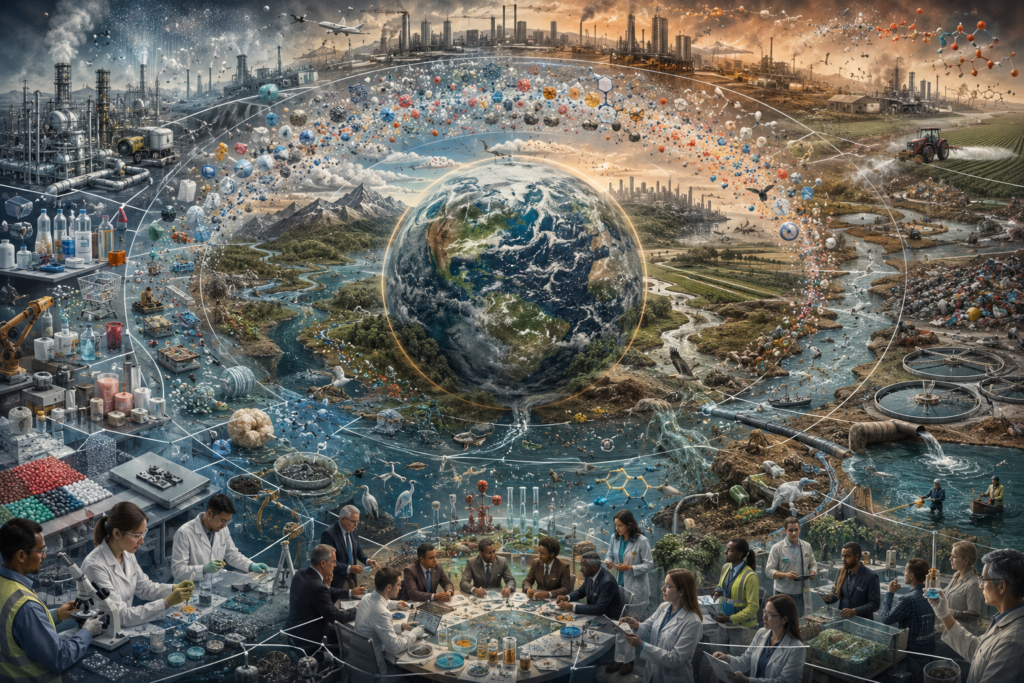
Editorial illustration showing Earth surrounded by synthetic chemicals, plastics, industrial materials, laboratories, polluted waterways, and governance efforts to manage novel-entities risk.

Novel Entities and the Problem of Synthetic Overload

Novel entities occupy one of the most conceptually revealing positions in the planetary boundaries framework because they expose a defining feature of industrial modernity: human societies are creating substances and materials faster than they can adequately assess, monitor, or govern their long-term effects. More than a conventional pollution issue, this boundary concerns the widening gap between technological production and the capacities of science, regulation, and ecosystems to absorb what is being introduced. This article examines synthetic overload as an Earth system problem, explains why novel entities are now treated as a transgressed planetary boundary, and explores what this reveals about the relationship between innovation, governance, and planetary stability.
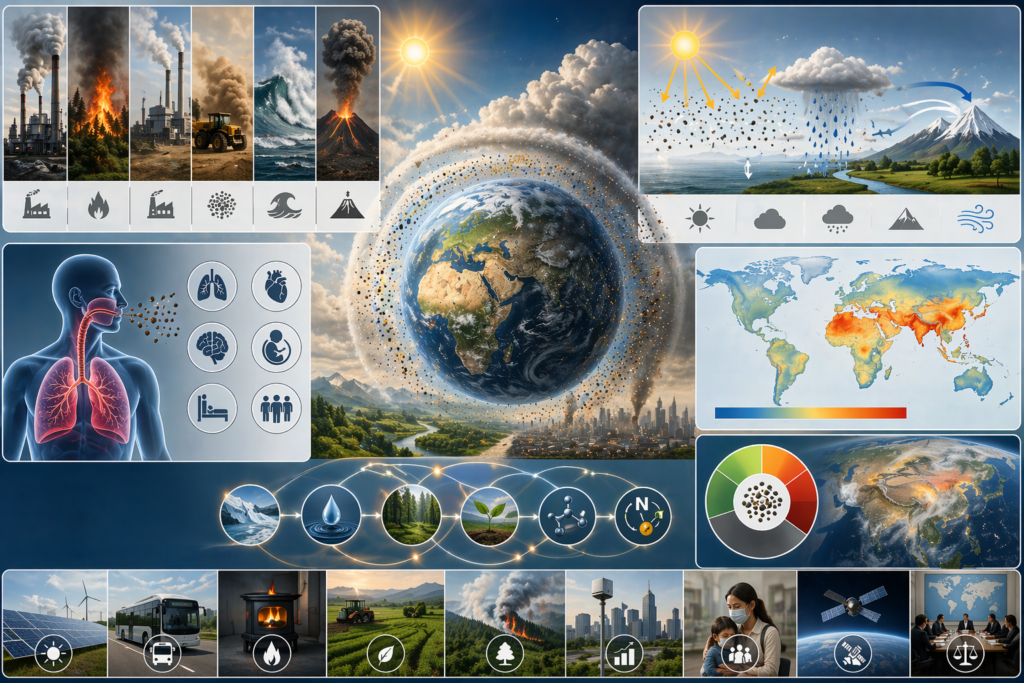
Editorial image showing Earth surrounded by atmospheric particle pollution, with visual references to industrial emissions, wildfire smoke, dust, clouds, rainfall disruption, human health, satellite monitoring, clean energy, transport, and regional climate risk.

Atmospheric Aerosol Loading and Regional Planetary Risk

Atmospheric Aerosol Loading and Regional Planetary Risk explains why aerosols are one of the most complex boundary processes in the planetary boundaries framework. Unlike globally mixed greenhouse gases, aerosols are spatially uneven, compositionally diverse, short-lived, and strongly regional in their effects. The article examines aerosol optical depth, PM2.5 exposure, black carbon, sulfates, dust, cloud interactions, monsoon disruption, hydrological sensitivity, public-health burdens, and the difficulty of defining a single global threshold. It argues that aerosol loading remains planetary in significance because regional atmospheric disturbances can affect rainfall, food systems, cryosphere change, human health, and Earth-system resilience. The article also includes mathematical, Python, and R workflows for regional aerosol-risk diagnostics.

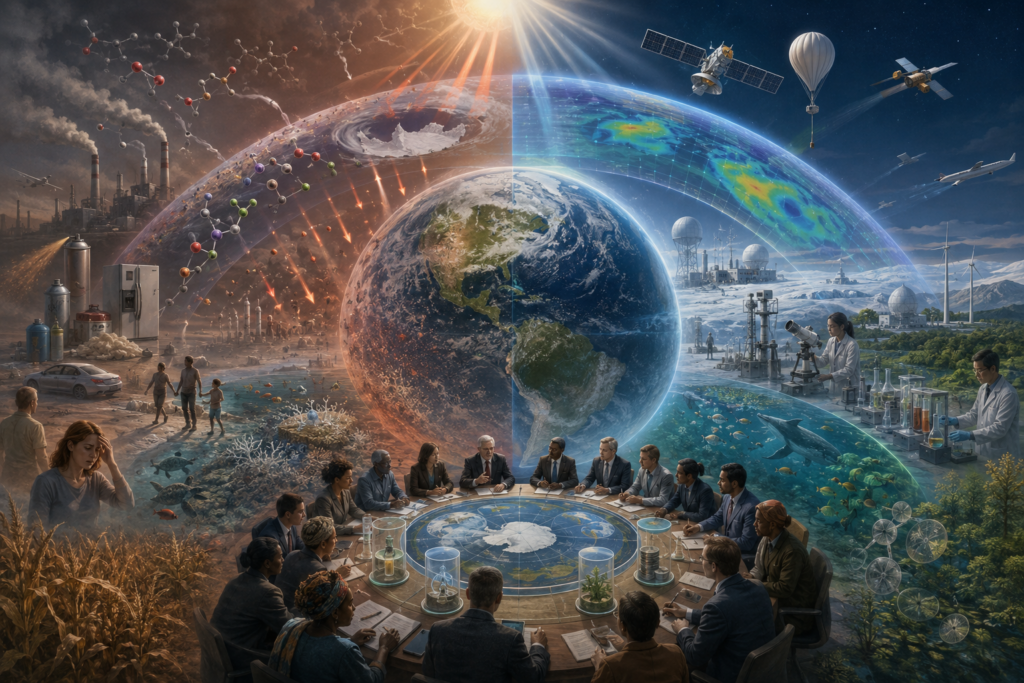
Editorial illustration showing Earth’s ozone layer under stress and recovery, with atmospheric chemistry, ultraviolet radiation, scientific monitoring, and international governance.

Stratospheric Ozone Depletion and Global Environmental Governance

Stratospheric Ozone Depletion and Global Environmental Governance explains why the ozone layer is one of the most important recovery cases in the planetary boundaries framework. The article examines how ozone-depleting substances damaged a vital atmospheric shield, how the Antarctic ozone hole transformed environmental politics, and how the Montreal Protocol created a durable governance regime based on science, treaty commitments, industrial substitution, monitoring, finance, and compliance. It also explores why the ozone boundary is now within the safe operating space, why recovery remains incomplete, how the Kigali Amendment links ozone governance to climate mitigation, and what the ozone case teaches about planetary governance.

Infographic explaining ocean acidification as a planetary-boundary process, showing Earth and the ocean, seawater chemistry changes, lower pH, reduced carbonate availability, coral stress, shell formation pressure, food web effects, monitoring systems, governance responses, and interactions with climate change, deoxygenation, nutrient pollution, and ecosystem vulnerability.

Ocean Acidification and the Chemistry of Planetary Change

Ocean Acidification and the Chemistry of Planetary Change explains why ocean acidification is one of the clearest chemical expressions of planetary change. The article shows how rising atmospheric carbon dioxide dissolves into seawater, lowers pH, reduces carbonate ion availability, and weakens aragonite saturation states needed by many marine organisms. It examines carbonate chemistry, calcification, coral reefs, planktonic organisms, shellfish coasts, polar waters, upwelling systems, ecosystem vulnerability, and the boundary’s updated status as a transgressed planetary boundary in the 2025 Planetary Health Check. It also connects acidification to climate change, biosphere integrity, nutrient pollution, freshwater change, and coastal governance, with mathematical, Python, and R workflows for carbonate-risk diagnostics.

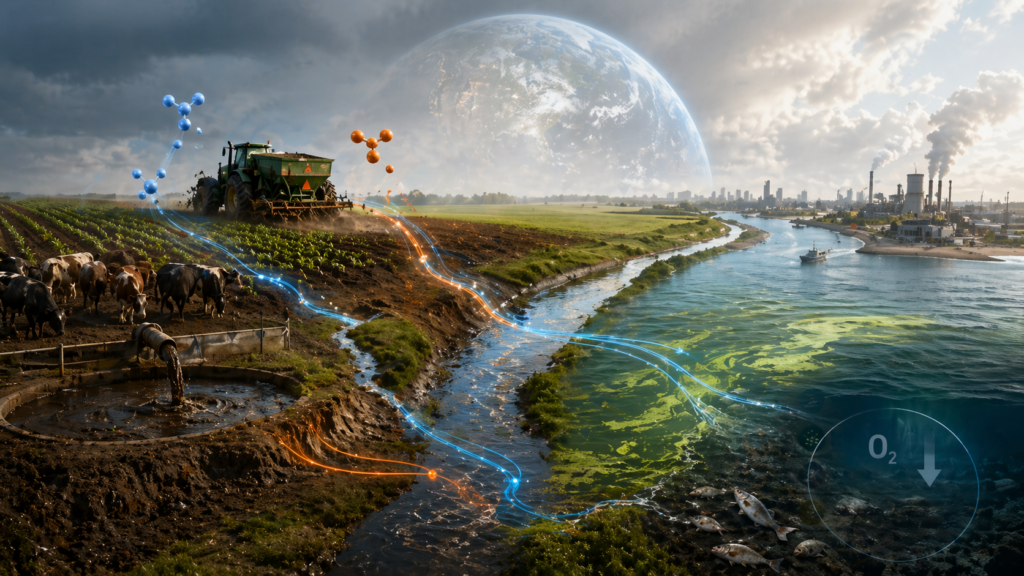
Editorial featured image showing farmland, livestock waste, nutrient runoff flowing into a river and polluted waterway, algal growth, fish mortality, and a planetary-scale environmental backdrop representing nitrogen and phosphorus destabilization.

Biogeochemical Flows: Nitrogen, Phosphorus, and Planetary Destabilization

Biogeochemical Flows: Nitrogen, Phosphorus, and Planetary Destabilization explains why altered nitrogen and phosphorus cycles are among the most severely transgressed planetary boundaries. The article shows how industrial nitrogen fixation, phosphate mining, fertilizer use, livestock concentration, wastewater systems, runoff, erosion, and legacy nutrients have transformed life-supporting nutrient cycles into drivers of eutrophication, dead zones, biodiversity loss, soil imbalance, air pollution, nitrous oxide emissions, and Earth-system risk. It connects nutrient overload to freshwater change, biosphere integrity, land-system change, climate, ocean acidification, and food-system governance. The article also includes mathematical, Python, and R workflows for modeling nutrient surplus, nutrient-use efficiency, boundary pressure, eutrophication risk, watershed connectivity, legacy nutrient pressure, and governance capacity.

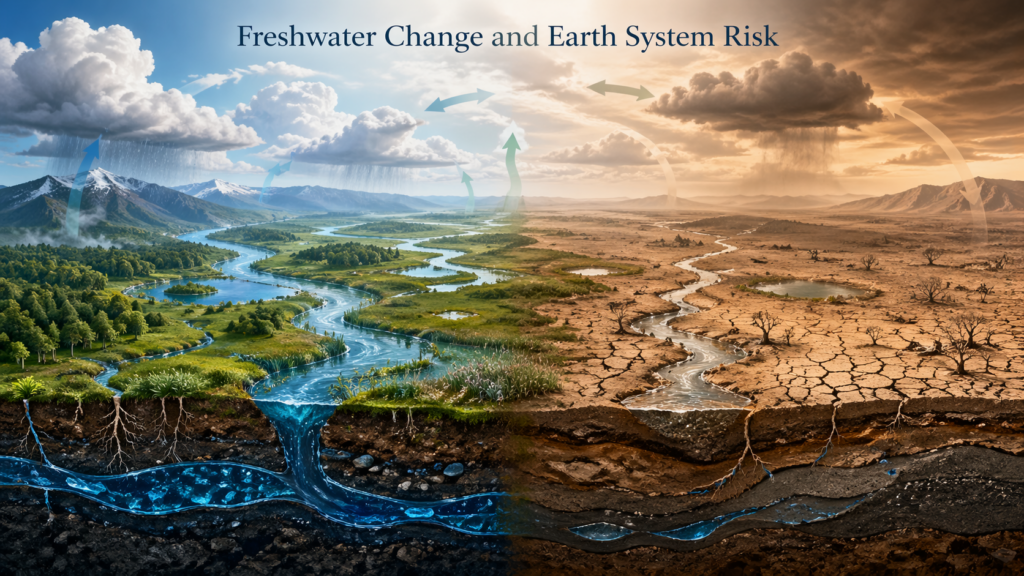
Editorial image showing a planetary freshwater landscape divided between a resilient water-rich ecosystem with rivers, wetlands, groundwater, vegetation, rain clouds, and a stressed dry landscape with drought, cracked soils, fragmented rivers, depleted groundwater, and sparse vegetation.

Freshwater Change and Earth System Risk

Freshwater Change and Earth System Risk explains why the planetary boundaries framework moved beyond a narrow focus on freshwater use toward a broader understanding of hydrological disruption. The article shows how blue water in rivers, lakes, wetlands, reservoirs, and aquifers interacts with green water in soils and vegetation to regulate ecosystems, agriculture, climate feedbacks, nutrient transport, and planetary resilience. It examines streamflow deviation, root-zone soil-moisture change, groundwater depletion, wetland loss, hydrological extremes, shifting baselines, and the boundary’s current transgressed status. It also connects freshwater change to climate change, land-system change, biosphere integrity, biogeochemical flows, atmospheric aerosols, food systems, and governance. Mathematical, Python, and R workflows model hydrological boundary pressure, exposure, sensitivity, buffers, monitoring capacity, and governance risk.

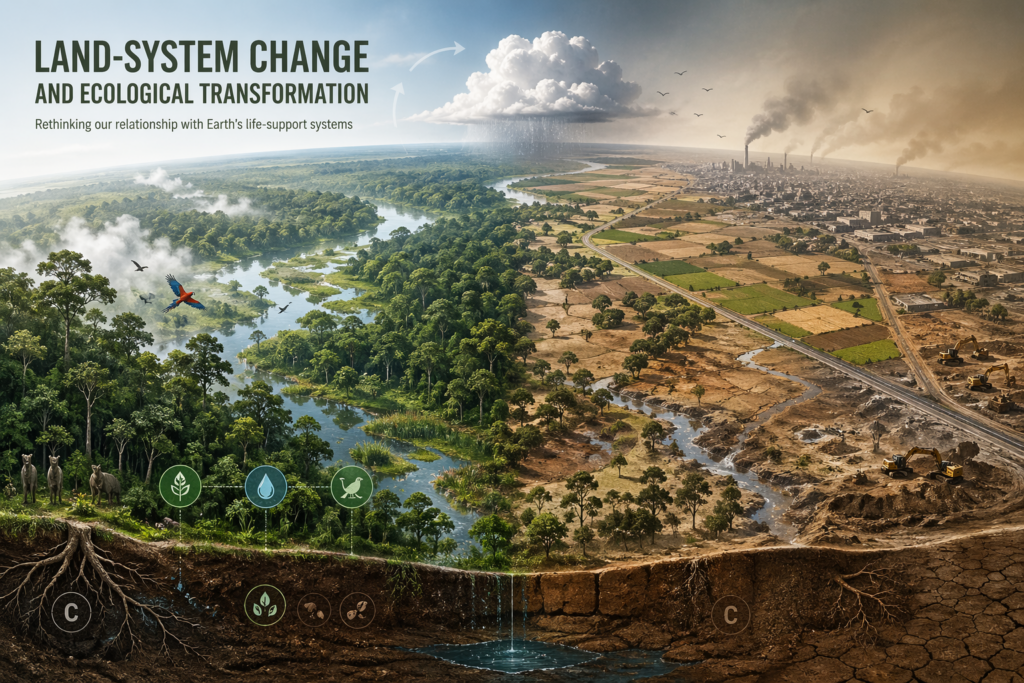
Editorial featured image showing a planetary landscape divided between an intact forest biome with wetlands, rivers, wildlife, soil roots, and moisture cycling, and a transformed human-dominated landscape with agriculture, roads, exposed soil, mining, urbanization, smoke, and ecological degradation.

Land-System Change and Ecological Transformation

Land-System Change and Ecological Transformation explains why large-scale transformation of forests, grasslands, wetlands, savannas, peatlands, and agricultural frontiers is a central planetary-boundary risk. The article shows how land conversion, deforestation, fragmentation, ecological simplification, soil degradation, and biome transformation weaken carbon storage, moisture recycling, biodiversity, hydrological regulation, climate stability, and Earth-system resilience. It examines the shift from land use as an economic category to land-system change as an Earth-system process, with attention to forests, biomes, justice, Indigenous stewardship, restoration, and governance. The article also includes mathematical, Python, and R workflows for modeling forest-cover thresholds, biome integrity, fragmentation, regulatory importance, land-system pressure, restoration potential, and governance capacity.

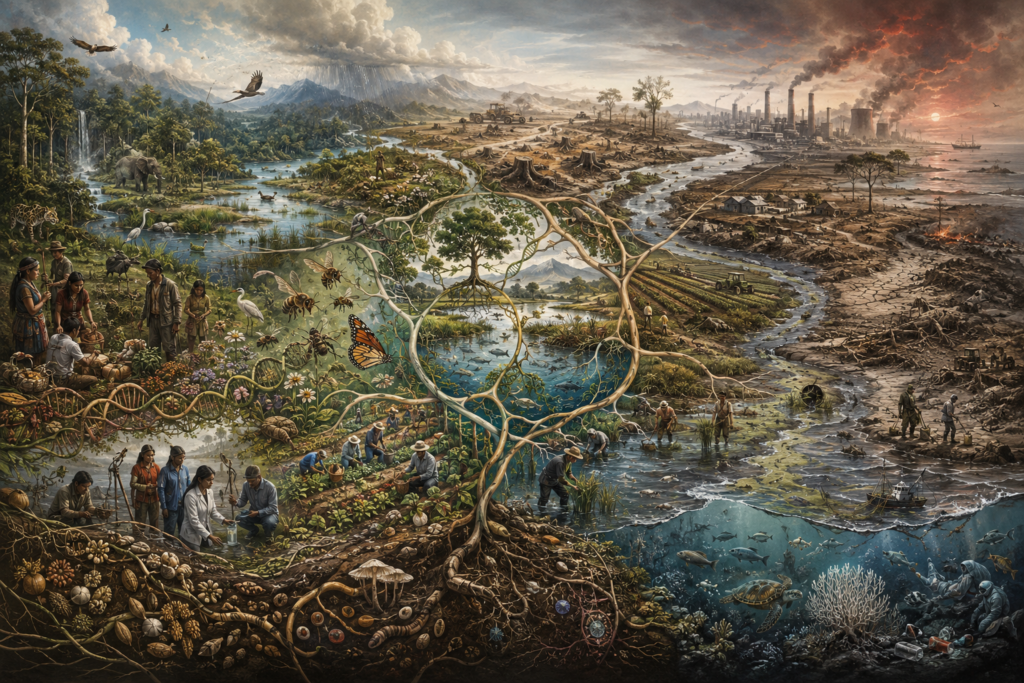
Editorial illustration showing biosphere integrity as a planetary boundary through interconnected ecosystems, genetic diversity, ecological function, stewardship, and contrasting zones of degradation.

Biosphere Integrity and the Stability of Life Systems

Biosphere Integrity and the Stability of Life Systems explains why the planetary boundaries framework treats the biosphere as one of the two core Earth-system boundaries alongside climate change. The article shows how genetic diversity, functional integrity, habitat intactness, ecological networks, soil systems, forests, wetlands, marine ecosystems, and food webs help regulate climate, water, carbon, nutrients, resilience, and long-term habitability. It examines the shift from biodiversity loss to biosphere integrity, the boundary’s current transgressed status, the drivers of ecological degradation, and the connections between biosphere decline, land-system change, freshwater change, biogeochemical flows, ocean acidification, and novel entities. It also includes mathematical, Python, and R workflows for modeling extinction pressure, functional-integrity deficits, habitat loss, fragmentation, appropriation pressure, cross-boundary stress, restoration potential, and governance capacity.

Editorial featured image showing Earth divided between a stable climate system with blue oceans, clouds, green land, and polar ice, and a destabilized climate system with warming atmosphere, wildfire smoke, storms, drought, melting ice, sea-level rise, and stressed landscapes.

Climate Change as a Planetary Boundary

Climate Change as a Planetary Boundary explains why climate change is one of the two core boundaries in the planetary boundaries framework alongside biosphere integrity. The article shows how atmospheric carbon dioxide, radiative forcing, cumulative emissions, carbon-sink resilience, feedbacks, tipping elements, hydrological change, sea-level rise, heat extremes, and cross-boundary interactions can destabilize Earth-system resilience. It examines the original climate boundary defined through carbon dioxide concentration and radiative forcing, the boundary’s current transgressed status, the difference between warming and systemic instability, and the justice implications of unequal exposure and responsibility. The article also includes mathematical, Python, and R workflows for modeling carbon dioxide boundary pressure, radiative forcing, emissions-transition gaps, cross-boundary stress, exposure, adaptation, monitoring, and governance capacity.

Scroll to Top