
Last Updated May 7, 2026
Scenario planning matters for sustainable development because the future cannot be governed well through prediction alone. Development unfolds amid uncertainty, interacting risks, long time horizons, ecological stress, technological disruption, demographic change, institutional fragility, geopolitical fragmentation, and social transformation. Policymakers, institutions, and communities must therefore make choices before knowing which future will arrive.
Scenario planning offers a disciplined way to think through multiple plausible futures, explore their implications, and strengthen present action without pretending that one definitive outcome can be forecast in advance. It does not eliminate uncertainty. It makes uncertainty usable for strategy.
Main Library
Publications
Article Map
Sustainable Development
Related Topic
Risk & Resilience
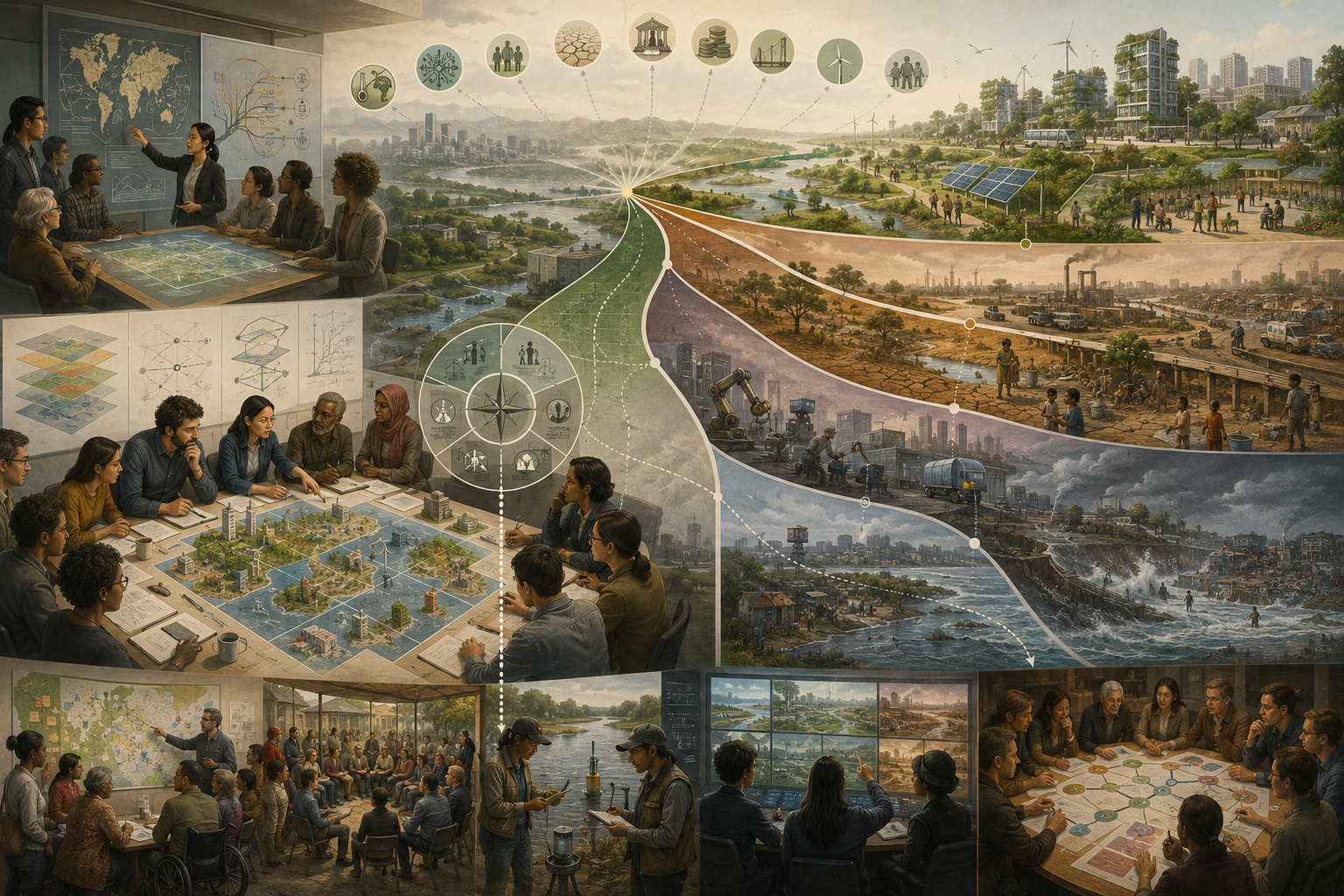
The significance of scenario planning becomes clearer once sustainable development is understood as a field shaped by nonlinear and cross-sectoral forces. Climate change, biodiversity loss, energy transition, technological concentration, fiscal stress, demographic change, public trust, migration, conflict, and institutional capacity do not operate separately. They interact, reinforce one another, and sometimes collide. A change in one domain can alter the conditions of all the others.
This article argues that scenario planning belongs near the center of sustainable development because long-horizon development increasingly depends on the capacity to reason across uncertainty rather than around it. The challenge is no longer simply to define ambitious goals, but to think more intelligently about the range of futures through which those goals may have to be pursued.
What Scenario Planning Means
Scenario planning is a structured method for exploring multiple plausible futures and using those futures to inform present choices. Instead of trying to predict a single outcome, it develops contrasting scenarios built around key drivers, critical uncertainties, interactions, and decision points that could shape how the future unfolds. Its purpose is not to produce certainty, but to widen the frame of strategic thought.
This makes scenario planning especially useful in development, where policy decisions must be made before uncertainty has been resolved. Governments and institutions still have to decide how to invest, regulate, govern, plan, finance, build, and protect vulnerable populations even when future shocks, transitions, and interactions cannot be known with precision. Scenario planning helps turn that condition from an obstacle into an object of disciplined reasoning.
Scenario planning is not the same thing as forecasting. Forecasting usually asks what is most likely to happen based on available evidence, trends, models, or probability assumptions. Scenario planning asks what could plausibly happen if major drivers interact in different ways. It is therefore less about guessing one future correctly and more about making present strategy less brittle.
In development terms, scenario planning asks how institutions can think rigorously about futures they cannot forecast exactly. Its value lies less in predictive confidence than in disciplined imagination. It helps institutions surface assumptions, compare pathways, test strategies, identify vulnerabilities, and preserve room for maneuver when conditions change.
That is why scenario planning sits naturally alongside Development Under Deep Uncertainty, where the real problem is not how to eliminate uncertainty, but how to act intelligently within it.
Why Scenario Planning Matters for Sustainable Development
Scenario planning is particularly useful in sustainable development because the systems involved are deeply interconnected, path dependent, and exposed to long-horizon uncertainty. Climate, biodiversity, energy, demographics, technology, governance, inequality, debt, infrastructure, and geopolitical change do not evolve in isolation. They interact across time, sometimes gradually, sometimes abruptly, and often in ways that alter the viability of development pathways decades later.
That is precisely where single-path planning becomes fragile. A strategy that appears sound under one future may become brittle under another. Energy systems, water systems, fiscal structures, settlement patterns, food systems, industrial policy, education systems, and welfare institutions all perform differently depending on how broader conditions evolve. Scenario planning helps institutions move beyond the assumption that one baseline is enough.
The value of scenario planning is not that it tells institutions what will happen. Its value is that it helps them ask better questions about what could happen and what kinds of present choices would remain defensible if circumstances shift. It turns uncertainty into a structured field of comparison rather than a vague background anxiety.
This matters because sustainable development decisions are often long-lived and difficult to reverse. Infrastructure, energy systems, public institutions, housing patterns, water infrastructure, industrial policy, education systems, and land-use arrangements can lock societies into pathways for decades. Bad assumptions about the future can therefore produce long-lasting costs.
Scenario planning belongs beside Risk, Shock, and Fragility in Development Systems and Resilience Thinking and Sustainable Development, both of which show how easily planning can fail when continuity is assumed too quickly.
From Prediction to Plausibility
One of the most important contributions of scenario planning is that it shifts attention from prediction to plausibility. Prediction asks what is most likely to happen. Scenario planning asks what could plausibly happen under different combinations of drivers and uncertainties. That distinction becomes crucial in contexts where feedbacks, discontinuities, and cross-system interactions make deterministic forecasting weak or misleading.
In sustainable development, many futures are not easily inferred from present trends alone. A world shaped by delayed climate action, fragmented trade, concentrated technologies, debt stress, rising displacement, and weak institutions will look very different from one shaped by deeper coordination, faster technological diffusion, stronger public capacity, and climate-resilient investment. Both may be plausible enough to matter for present strategy.
Plausibility does not mean fantasy. A strong scenario is not simply an imagined future. It is a structured story about how drivers could interact under credible conditions. Its plausibility depends on whether it is internally coherent, relevant to present decisions, grounded in known drivers of change, and different enough from other scenarios to test assumptions meaningfully.
This shift protects strategy from becoming intellectually overcommitted to one future path. If institutions plan only around a central forecast, they may become blind to futures that are less likely but highly consequential. Scenario planning makes room for uncertainty without surrendering rigor.
The question becomes less “What will happen?” and more “What kinds of futures must present strategy be able to withstand?” That is a better question for development systems facing climate change, technological disruption, ecological stress, and institutional uncertainty at the same time.
Uncertainty, Complexity, and Long-Horizon Decision-Making
Sustainable development requires long-horizon decisions about infrastructure, education, industrial structure, ecological transition, energy systems, water management, urban form, fiscal policy, public administration, and institutional reform. Yet these are also the areas in which uncertainty is high and reversibility is low. Choices made now often remain embedded in physical systems, budgets, laws, settlement patterns, and expectations for decades.
The problem is not simply that the future is unknown. It is that long-lived decisions are being made in systems where multiple drivers interact and where the consequences of error may be politically, financially, socially, and ecologically expensive to reverse. A city designed for one climate regime may face another. An energy strategy built for one cost curve may confront a different technological landscape. A labor policy built around one automation pathway may look inadequate under another.
Complexity also means that the consequences of one decision can depend on changes elsewhere. A water strategy may fail if climate conditions, agricultural demand, urban growth, or governance capacity evolve differently than expected. A national industrial strategy may depend on global trade rules, technology access, energy prices, finance, and local skill systems. A social-protection system may be tested by shocks that were not central to its original design.
Scenario planning helps institutions think more carefully under these conditions by widening the range of futures against which present decisions are tested. It does not produce perfect knowledge, but it reduces strategic narrowness. It forces planners to ask what decisions remain sensible across different futures and which decisions require flexibility, staged investment, or monitoring triggers.
This makes scenario planning especially relevant to articles such as Infrastructure as the Material Basis of Development and Local Governance, Cities, and Territorial Development, where design decisions made today often become tomorrow’s hard constraints.
Drivers, Uncertainties, and the Construction of Scenarios
Scenarios are constructed by identifying major drivers of change, distinguishing relatively stable trends from high-impact uncertainties, and combining them into contrasting future worlds. In sustainable development, these drivers often include demographic change, climate impacts, governance quality, technological diffusion, debt conditions, geopolitical fragmentation, ecological stress, energy transition speed, social trust, public finance, and institutional capacity.
The quality of a scenario exercise depends heavily on what it treats as important, uncertain, and interacting. Weak scenarios often collapse into stylized optimism and pessimism. Strong scenarios identify uncertainties that are structurally significant, then explore how they combine to reshape the context for action. They force institutions to clarify which assumptions they are carrying quietly and whether those assumptions are robust enough to support present commitments.
For example, a scenario exercise on sustainable infrastructure might focus on climate severity, fiscal space, governance capacity, technology access, and public trust. A scenario exercise on food systems might focus on rainfall volatility, trade fragmentation, input costs, biodiversity loss, land rights, and social protection. A scenario exercise on digital development might focus on platform concentration, public digital infrastructure, cybersecurity, skills, and data governance.
Scenario planning is strongest when it makes uncertainty structured rather than vague. It gives institutions a way to talk about drivers, interactions, thresholds, weak signals, and pathway choices before crisis forces the conversation. It also helps distinguish what can be controlled, what can only be monitored, and what requires adaptive strategy.
This is why scenario planning aligns with Policy Coordination Across Complex Systems, where the difficulty lies not in following one variable but in understanding how several moving parts reshape one another over time.
Scenario Planning and Strategic Foresight
Scenario planning usually works best as one element within a broader strategic foresight practice. Foresight also includes horizon scanning, megatrends analysis, signal detection, backcasting, anticipatory governance, visioning, and early-warning interpretation. Scenario planning contributes by showing how different futures might emerge from the interaction of these signals and forces, and how current decisions might look different under each.
This wider framing matters because scenarios are at their strongest when they are tied to continuing institutional learning rather than treated as isolated workshops or one-off reports. Horizon scanning helps identify emerging signals. Scenarios help organize those signals into alternative future configurations. Backcasting helps connect long-term futures to present choices. Monitoring helps institutions notice when one pathway is becoming more plausible or when a strategy needs revision.
Strategic foresight is therefore not simply a creative exercise. It is a governance capability. It helps institutions become more anticipatory, more adaptive, and less dependent on crisis-driven decision-making. The goal is not to produce a perfect picture of the future. The goal is to strengthen the institutional capacity to think, revise, and act before uncertainty becomes emergency.
This matters for sustainable development because many of its most important questions are anticipatory. How should infrastructure be built for future climates? How should welfare systems prepare for automation, migration, aging, and climate displacement? How should energy policy account for uncertain technology costs and geopolitical risk? How should cities prepare for futures that may differ sharply from past trends?
Scenario planning becomes most valuable when it is embedded in real decision cycles: budgeting, planning, regulation, infrastructure appraisal, climate adaptation, public investment, and institutional reform. Without that connection, scenario planning may remain intellectually interesting but strategically weak.
Scenario Planning and Climate-Resilient Development
Scenario planning is especially important in climate-related development because climate futures cannot be reduced to one deterministic path. Emissions trajectories, adaptation choices, land-use change, governance quality, technology costs, vulnerability patterns, and global cooperation all shape which future becomes more likely. Long-horizon climate reasoning must therefore work with structured plural futures rather than one forecast.
This gives scenario planning a practical role in climate-resilient infrastructure, agriculture, health systems, water planning, energy transition, disaster-risk reduction, and settlement strategy. These systems must be designed before future warming patterns, hazard intensities, ecological feedbacks, and institutional capacities are fully known. Scenario planning allows institutions to connect climate uncertainty to real strategic choices without pretending that the future has already been analytically settled.
Climate scenarios are also useful because they expose the danger of path dependence. Decisions about roads, housing, ports, electricity grids, irrigation systems, public health, and land use can lock societies into risks that become harder to manage later. Scenario planning can help identify which investments are robust across climate futures and which require flexibility, staged implementation, retreat options, or stronger safeguards.
Scenario planning also helps bring climate justice into strategic discussion. Different climate futures distribute risk unevenly. Low-income communities, indigenous peoples, rural livelihoods, informal settlements, climate-exposed regions, and countries with limited fiscal space may face sharper burdens under severe warming or weak adaptation. Scenarios should therefore ask not only which future is plausible, but who is exposed in each future and who has the power to shape response.
In this sense, scenario planning becomes a bridge between climate uncertainty and development strategy. This is why the article connects directly to Climate Change as a Development Constraint, where climate becomes constraining not simply because it introduces risk, but because it multiplies the futures through which development must now pass.
Development Pathways, Transition Risk, and Adaptive Strategy
Scenario planning helps institutions think in terms of pathways rather than isolated events. Development is shaped not only by shocks, but by how choices accumulate across time. Energy systems, industrial policy, education, trade, finance, urbanization, land use, housing, public administration, and social protection all combine to produce trajectories that later become easier or harder to revise.
This is especially important where transition risk is underestimated. A strategy built around cheap fossil energy, narrow export dependence, fragile infrastructure, concentrated technologies, weak public finance, or vulnerable supply chains may appear viable until the wider system changes. Scenario planning makes those dependencies more visible by revealing how different futures change the meaning of present commitments.
Adaptive strategy becomes stronger when it is informed by multiple pathways rather than fixed to a single expected trajectory. A pathway approach asks what decisions should be made now, what decisions should be delayed, what signals should be monitored, and what thresholds should trigger revision. It allows institutions to avoid both paralysis and premature lock-in.
Transition risk is not only technical or financial. It is also social and political. Workers, communities, regions, firms, and public institutions may bear different costs depending on how transitions unfold. A rapid energy transition without justice can produce backlash and exclusion. A delayed transition can deepen climate risk and asset stranding. Scenario planning helps institutions examine these competing risks before they harden into crisis.
This section is a natural companion to Industrial Policy and Sustainable Structural Transformation, Sustainable Finance and Development Investment, and Debt, Fiscal Space, and Development Constraints, where future viability depends heavily on decisions whose consequences compound.
Participatory Scenarios and Futures Literacy
Scenario planning is not only a technocratic method. It can also be participatory. Communities, local governments, civil-society groups, indigenous peoples, workers, youth, public servants, small businesses, and affected populations can all contribute to the construction of futures by bringing different experiences of risk, vulnerability, aspiration, memory, and possibility into the process.
This matters because development futures are lived unequally. Scenario exercises that ignore distribution, marginalization, or local knowledge can reproduce narrow assumptions about what futures matter. A national infrastructure scenario may miss informal settlements. A climate scenario may miss indigenous ecological knowledge. A technology scenario may miss the experience of workers, disabled people, rural communities, or public-service users. Participatory scenario work widens the range of plausible futures considered.
Futures literacy is the broader capability to imagine, interpret, and use futures more consciously. This is important because the future is often treated as something experts define and others receive. Sustainable development benefits when more people can participate in shaping how futures are imagined, contested, and governed. Participatory scenarios can therefore become tools of democratic learning rather than elite planning alone.
Participatory scenarios also make hidden assumptions visible. Communities may identify risks that formal models miss: informal water access, care burdens, local violence, distrust, land conflict, cultural loss, inaccessible services, or everyday infrastructure failure. These insights can make scenarios more grounded and more just.
Sustainable development gains when scenario planning is treated as a social learning process rather than as an elite planning instrument. That is why participatory scenarios extend naturally from Participation, Voice, and Community-Led Development.
Scenario Planning and Institutional Learning
One of the deepest strengths of scenario planning is that it helps institutions learn. Not because scenarios tell them what will happen, but because they force organizations to surface assumptions, examine blind spots, and test strategies under different conditions. Many planning failures begin as failures of imagination. Institutions often assume continuity until discontinuity becomes impossible to deny.
Scenario planning helps make discontinuity discussable before it arrives as crisis. It gives institutions language for uncertainty, alternatives, early signals, and strategic revision. This matters because public institutions often become locked into routines, budget cycles, mandates, and performance measures that discourage long-range thinking. Scenario planning can interrupt that narrowness.
The real gain is not simply a better scenario document, but a stronger institutional habit of revision. Planning improves when institutions become more capable of noticing when assumptions are failing and more willing to revise strategy before those failures harden into systemic weakness. Scenario planning therefore belongs inside governance routines, not only special reports.
Institutional learning also requires memory. Scenarios should not disappear after a workshop. They should inform monitoring, budgeting, policy review, risk registers, public investment appraisal, and adaptive triggers. A scenario exercise becomes more useful when institutions return to it as conditions change and ask which assumptions still hold.
For that reason, scenario planning fits especially well with Why Institutions Matter for Sustainable Development and State Capacity, Public Administration, and Delivery Systems, where the deeper issue is not only whether institutions are strong, but whether they can revise themselves in time.
Scenarios, Robustness, and Decision Quality
A central contribution of scenario planning is that it improves decision quality by testing robustness. The question is not only whether a policy works under one preferred future, but whether it remains useful across several plausible futures. Some strategies are highly efficient under narrow conditions yet brittle when those conditions change. Others may be less optimized for any single future but more robust across many.
That distinction matters for sustainable development because long-lived choices must often be judged not by their elegance under one scenario, but by their ability to remain viable under several. Infrastructure, social protection, institutional reform, public health, water planning, climate adaptation, and transition planning all benefit when policies are evaluated not only for immediate effectiveness but for their ability to withstand divergent conditions.
A robust strategy may share several features. It may preserve flexibility, reduce exposure, avoid irreversible lock-in, protect vulnerable populations, maintain fiscal room, support learning, and create options for adjustment. It may not be the cheapest strategy under one narrow forecast, but it may be more defensible when uncertainty is deep.
Scenario planning also helps identify strategies that are contingent. A policy may work well only if technology costs fall, global cooperation improves, rainfall patterns remain within a certain range, finance stays affordable, or public trust remains high. Knowing those dependencies is valuable. It tells institutions what signals to monitor and what fallback plans may be needed.
Scenario planning therefore improves not only the content of planning but the quality of judgment behind it. It helps institutions distinguish efficient strategies, fragile strategies, robust strategies, and adaptive strategies before conditions change enough to expose the difference.
The Limits and Misuses of Scenarios
Scenario planning has limits. Scenarios can be too generic, too detached from real decision contexts, too narrow in their assumptions, or overly shaped by current institutional biases. They can create an illusion of preparedness if institutions generate scenarios without linking them to strategy, governance reform, budgeting, investment, regulation, or monitoring. A scenario exercise that never changes decisions may widen imagination briefly while leaving underlying fragility untouched.
Not all scenario work is equally valuable. Poorly constructed scenarios can reinforce conventional thinking while claiming to explore alternatives. Some scenario exercises reduce the future to simple optimism and pessimism. Others focus on dramatic narratives while neglecting practical decisions. Still others use scenarios to justify decisions already made rather than to test assumptions honestly.
Scenarios can also obscure politics if they treat futures as neutral technical outcomes. Development futures are shaped by power, law, inequality, investment, conflict, exclusion, and institutional choice. A scenario may be plausible, but that does not make it desirable. A scenario may be orderly, but that does not make it just. Scenario planning must therefore remain connected to normative judgment.
Even strong scenarios cannot eliminate uncertainty or dissolve conflicts over priorities and values. They are tools for thinking better, not substitutes for judgment. Their value depends on whether they are linked to decisions, revisited over time, open to contestation, and honest about what they can and cannot do.
Sustainable development requires scenario planning that stays tied to real decisions, institutional constraints, and questions of justice rather than floating off into abstract futurism. Scenario work can be misused in much the same way indicators can: not by existing, but by being treated as more definitive than it really is.
Why Scenarios Do Not Replace Politics or Judgment
Scenario planning can improve strategic reasoning, but it does not replace politics, ethics, or judgment. Development choices still involve conflict over distribution, power, risk tolerance, historical responsibility, ecological limits, and desirable futures. Scenarios can clarify these tensions, but they cannot make them disappear. A plausible future is not automatically a just one. A robust strategy is not automatically an equitable one.
This is important because sustainable development is not only a technical coordination problem. It is also a question of which futures societies value and how costs, opportunities, and risks are distributed. Scenario planning can improve deliberation by making alternatives more visible, but it cannot determine which future ought to be chosen. That remains a matter of political struggle, institutional legitimacy, public reason, and normative judgment.
Scenarios can help institutions ask better questions. Who benefits under each future? Who is exposed? Which communities are forced to adapt? Which systems become locked in? Which investments preserve choice? Which futures deepen inequality? Which futures protect ecological foundations? These are not merely technical questions. They are questions of justice and collective direction.
The deepest contribution of scenario planning is therefore not replacing politics, but improving the quality of political and strategic choice under uncertainty. It gives societies a better way to deliberate about futures before those futures arrive as constraints.
That is why scenario planning sits comfortably alongside Law, Rights, and Sustainable Development and International Organizations and Global Development Governance, where future pathways are shaped not only by evidence and strategy but by conflict, legitimacy, and collective choice.
Why This Matters for Sustainable Development
Scenario planning and sustainable development belong together because the future cannot be governed through certainty. Long-horizon development decisions must be made under uncertainty, and scenario planning offers a disciplined way to think through multiple plausible futures and their implications for present action. Its contribution lies not in prediction, but in helping institutions reason better when certainty is unavailable.
That is what makes scenario planning so valuable. It reveals a truth that linear planning often obscures: robust development strategy depends less on guessing one future correctly than on preparing for several plausible futures well enough to preserve room for maneuver, reduce fragility, and improve present judgment.
The issue is also one of justice. Scenario planning asks whose futures are imagined, whose risks are recognized, whose knowledge is included, and whose wellbeing is protected when uncertainty becomes a planning condition. Scenarios become stronger when they widen democratic imagination rather than narrowing future-making to technical elites.
To take scenario planning seriously is therefore to take uncertainty seriously. Sustainable development depends not only on targets and ambitions, but on whether institutions can think in plural futures, learn across uncertainty, and act in ways that remain adaptive as the world changes.
Development becomes credible when strategy is tested against multiple futures, when planning preserves flexibility instead of locking in fragility, when futures thinking includes those most exposed to risk, and when institutions use scenarios not as prediction theater but as disciplined preparation for uncertain change.
Mathematical Lens
Scenario planning can be clarified mathematically by contrasting single-forecast optimization with multi-future robustness. Under a forecast-centered approach, an institution may try to optimize policy \(x\) for one expected future state \(\omega^*\):
\max_{x \in X} U(x,\omega^*)
\]
Interpretation: Forecast-centered optimization chooses the policy that performs best under one assumed future, which can become fragile if that future is wrong.
Here, \(U(x,\omega^*)\) represents the value of policy \(x\) under the assumed future. This is analytically tidy, but it can be brittle when the assumed future does not arrive.
Scenario planning works differently. Let \(\Omega = \{\omega_1, \omega_2, \dots, \omega_n\}\) be a set of plausible futures. The question becomes how policies perform across many worlds rather than one:
R(x) = \frac{1}{|\Omega|}\sum_{\omega \in \Omega} \mathbf{1}\{U(x,\omega) \geq \tau\}
\]
Interpretation: Robustness measures the share of plausible futures in which a strategy meets a minimum acceptable performance threshold.
A highly robust strategy may not be optimal in any single future, but it is less likely to fail badly across several. This is often more useful for sustainable development than narrow optimization under one expected pathway.
Scenario planning also supports pathway reasoning. If decisions occur over time and can be revised, then present strategy depends partly on future update rules:
x_{t+1} = g(x_t, s_t)
\]
Interpretation: Adaptive strategy depends on updating decisions as new signals or observations become available.
A regret-based view can also help compare strategies across futures:
\text{Regret}(x,\omega) = \max_{y \in X} U(y,\omega) – U(x,\omega)
\]
Interpretation: Regret measures how much worse a chosen strategy performs compared with the best available strategy in a given future.
| Term | Meaning | Interpretive role |
|---|---|---|
| \(x\) | Policy or strategy | Represents a decision being tested across plausible futures. |
| \(X\) | Choice set | Represents the set of available strategies or policy options. |
| \(\omega\) | Future state or scenario | Represents one plausible future in the scenario set. |
| \(\Omega\) | Scenario set | Represents the full set of plausible futures used for testing strategy. |
| \(U(x,\omega)\) | Performance value | Represents how well strategy \(x\) performs under future \(\omega\). |
| \(\tau\) | Minimum acceptable threshold | Represents the performance level a strategy must meet to be considered adequate. |
| \(R(x)\) | Robustness score | Represents the share of plausible futures where a strategy performs adequately. |
| \(s_t\) | New signal or observation | Represents information that becomes available over time and supports adaptive revision. |
The equations are conceptual rather than predictive. Their value is to make visible the structure of the problem: scenario planning improves sustainable development strategy by testing choices across multiple plausible futures, identifying fragile assumptions, and preserving adaptive capacity over time.
Advanced Python Workflow: Scenario Matrix Generation and Robustness Scoring
This Python workflow shows how scenario planning can move from conceptual discussion into structured analysis. The first step is to generate a scenario matrix from a small set of key drivers. The second is to score candidate strategies across those futures using robustness-oriented logic rather than a single expected forecast. The result is not a prediction engine. It is a way of organizing scenario comparison so that present choices can be assessed against multiple plausible worlds.
from __future__ import annotations

import itertools
from dataclasses import dataclass

import pandas as pd

SCENARIO_OUTPUT_FILE = "scenario_matrix.csv"
ROBUSTNESS_OUTPUT_FILE = "development_pathway_robustness_scores.csv"
SATISFICING_THRESHOLD = 0.60

DRIVERS = {
    "climate_path": ["moderate", "severe"],
    "trade_order": ["cooperative", "fragmented"],
    "technology_diffusion": ["broad", "concentrated"],
    "governance_capacity": ["strong", "stressed"],
}


@dataclass(frozen=True)
class StrategyScore:
    """A score for one strategy under one scenario."""
    strategy_name: str
    scenario_name: str
    performance_score: float
    cost_score: float
    adaptability_score: float
    equity_score: float


def build_scenario_matrix(drivers: dict[str, list[str]]) -> pd.DataFrame:
    """Generate all combinations of key scenario drivers."""
    keys = list(drivers.keys())
    values = [drivers[key] for key in keys]
    rows: list[dict[str, str]] = []

    for combination in itertools.product(*values):
        row = dict(zip(keys, combination))
        row["scenario_name"] = " / ".join(combination)
        rows.append(row)

    return pd.DataFrame(rows)


def validate_scores(df: pd.DataFrame) -> pd.DataFrame:
    """Validate strategy scores and required columns."""
    required_columns = [
        "strategy_name",
        "scenario_name",
        "performance_score",
        "cost_score",
        "adaptability_score",
        "equity_score",
    ]

    missing = [col for col in required_columns if col not in df.columns]

    if missing:
        raise ValueError(f"Missing required columns: {missing}")

    score_columns = [
        "performance_score",
        "cost_score",
        "adaptability_score",
        "equity_score",
    ]

    for col in score_columns:
        if df[col].isna().any():
            raise ValueError(f"Column '{col}' contains missing values.")

        if ((df[col] < 0) | (df[col] > 1)).any():
            raise ValueError(f"Column '{col}' must be normalized to [0, 1].")

    return df


def compute_regret(df: pd.DataFrame) -> pd.DataFrame:
    """Compute regret relative to the best strategy in each scenario."""
    df = df.copy()

    best_by_scenario = (
        df.groupby("scenario_name", dropna=False)["performance_score"]
        .max()
        .rename("best_score")
        .reset_index()
    )

    df = df.merge(best_by_scenario, on="scenario_name", how="left")
    df["regret"] = df["best_score"] - df["performance_score"]

    return df


def summarise_strategies(df: pd.DataFrame) -> pd.DataFrame:
    """Summarize robustness characteristics for each strategy."""
    df = df.copy()

    df["meets_threshold"] = df["performance_score"] >= SATISFICING_THRESHOLD

    summary = (
        df.groupby("strategy_name", dropna=False)
        .agg(
            avg_performance=("performance_score", "mean"),
            min_performance=("performance_score", "min"),
            max_performance=("performance_score", "max"),
            avg_cost=("cost_score", "mean"),
            avg_adaptability=("adaptability_score", "mean"),
            avg_equity=("equity_score", "mean"),
            avg_regret=("regret", "mean"),
            max_regret=("regret", "max"),
            robustness_share=("meets_threshold", "mean"),
            scenarios_tested=("scenario_name", "count"),
        )
        .reset_index()
    )

    summary["composite_robustness_score"] = (
        0.35 * summary["robustness_share"] +
        0.20 * summary["min_performance"] +
        0.20 * summary["avg_adaptability"] +
        0.15 * summary["avg_equity"] +
        0.10 * (1 - summary["avg_regret"])
    ).clip(lower=0, upper=1)

    summary["decision_band"] = summary["composite_robustness_score"].apply(
        lambda x: "Highly robust"
        if x >= 0.75
        else "Moderately robust"
        if x >= 0.50
        else "Fragile"
    )

    return summary.sort_values(
        by=[
            "composite_robustness_score",
            "min_performance",
            "avg_regret",
        ],
        ascending=[False, False, True],
    )


def build_example_strategy_scores() -> pd.DataFrame:
    """Create a small example scoring table."""
    example_scores = [
        StrategyScore(
            "Adaptive Infrastructure",
            "moderate / cooperative / broad / strong",
            0.81,
            0.48,
            0.82,
            0.67,
        ),
        StrategyScore(
            "Adaptive Infrastructure",
            "severe / fragmented / concentrated / stressed",
            0.63,
            0.48,
            0.82,
            0.67,
        ),
        StrategyScore(
            "Industrial Export Push",
            "moderate / cooperative / broad / strong",
            0.78,
            0.61,
            0.33,
            0.39,
        ),
        StrategyScore(
            "Industrial Export Push",
            "severe / fragmented / concentrated / stressed",
            0.42,
            0.61,
            0.33,
            0.39,
        ),
    ]

    return pd.DataFrame([score.__dict__ for score in example_scores])


def main() -> None:
    scenario_matrix = build_scenario_matrix(DRIVERS)
    scenario_matrix.to_csv(SCENARIO_OUTPUT_FILE, index=False)

    print("Scenario matrix created successfully.")
    print(scenario_matrix.to_string(index=False))

    strategy_scores = build_example_strategy_scores()
    strategy_scores = validate_scores(strategy_scores)

    scored_df = compute_regret(strategy_scores)
    summary_df = summarise_strategies(scored_df)

    summary_df.to_csv(ROBUSTNESS_OUTPUT_FILE, index=False)

    print("\nRobustness scoring complete.")
    print(summary_df.to_string(index=False))


if __name__ == "__main__":
    main()
This workflow is intentionally transparent. It does not claim to predict which future will occur. It creates a reproducible way to compare strategies across plausible futures, estimate robustness, and identify strategies that perform acceptably under a wider range of conditions. In practice, this kind of workflow can support infrastructure appraisal, climate adaptation planning, industrial policy, public investment strategy, and institutional risk review.
Advanced R Workflow: Scenario Panel and Adaptive Capacity Analysis
This R workflow is useful when scenario planning needs to be connected to panel-style development analysis rather than treated as a one-off exercise. It summarizes how countries or institutions perform across scenario families and tracks adaptive capacity over time. That makes it easier to connect scenario thinking to comparative governance, institutional learning, and long-horizon resilience analysis.
library(readr)
library(dplyr)

input_file <- "scenario_panel.csv"
output_file <- "scenario_panel_summary.csv"
adaptive_output_file <- "adaptive_capacity_trends.csv"

scenario_df <- read_csv(input_file, show_col_types = FALSE)

required_cols <- c(
  "country",
  "year",
  "scenario_family",
  "robustness_index",
  "adaptive_capacity_index",
  "institutional_learning_index",
  "equity_protection_index"
)

missing_cols <- setdiff(required_cols, names(scenario_df))

if (length(missing_cols) > 0) {
  stop(paste("Missing required columns:", paste(missing_cols, collapse = ", ")))
}

index_cols <- c(
  "robustness_index",
  "adaptive_capacity_index",
  "institutional_learning_index",
  "equity_protection_index"
)

invalid_index_cols <- index_cols[
  vapply(
    scenario_df[index_cols],
    function(x) any(is.na(x) | x < 0 | x > 1),
    logical(1)
  )
]

if (length(invalid_index_cols) > 0) {
  stop(
    paste(
      "Index columns must be complete and normalized to [0, 1]:",
      paste(invalid_index_cols, collapse = ", ")
    )
  )
}

scenario_df <- scenario_df %>%
  arrange(country, year) %>%
  mutate(
    composite_resilience_proxy = (
      robustness_index +
        adaptive_capacity_index +
        institutional_learning_index +
        equity_protection_index
    ) / 4,
    fragility_warning_proxy = (
      (1 - robustness_index) +
        (1 - adaptive_capacity_index) +
        (1 - equity_protection_index)
    ) / 3
  )

scenario_summary <- scenario_df %>%
  group_by(country, scenario_family) %>%
  summarise(
    avg_resilience_proxy = mean(composite_resilience_proxy, na.rm = TRUE),
    min_resilience_proxy = min(composite_resilience_proxy, na.rm = TRUE),
    max_resilience_proxy = max(composite_resilience_proxy, na.rm = TRUE),
    avg_fragility_warning = mean(fragility_warning_proxy, na.rm = TRUE),
    observations = n(),
    .groups = "drop"
  ) %>%
  mutate(
    scenario_band = case_when(
      avg_resilience_proxy >= 0.75 ~ "High scenario resilience",
      avg_resilience_proxy >= 0.55 ~ "Moderate scenario resilience",
      avg_resilience_proxy >= 0.35 ~ "Stressed scenario resilience",
      TRUE ~ "Low scenario resilience"
    )
  ) %>%
  arrange(country, desc(avg_resilience_proxy))

adaptive_summary <- scenario_df %>%
  group_by(country) %>%
  summarise(
    start_year = first(year),
    end_year = last(year),
    start_adaptive_capacity = first(adaptive_capacity_index),
    end_adaptive_capacity = last(adaptive_capacity_index),
    start_learning = first(institutional_learning_index),
    end_learning = last(institutional_learning_index),
    start_equity = first(equity_protection_index),
    end_equity = last(equity_protection_index),
    observations = n(),
    .groups = "drop"
  ) %>%
  mutate(
    adaptive_capacity_change = end_adaptive_capacity - start_adaptive_capacity,
    learning_change = end_learning - start_learning,
    equity_change = end_equity - start_equity,
    adaptive_band = case_when(
      adaptive_capacity_change >= 0.15 ~ "Improving adaptive capacity",
      adaptive_capacity_change >= 0.00 ~ "Stable adaptive capacity",
      adaptive_capacity_change >= -0.15 ~ "Declining adaptive capacity",
      TRUE ~ "Severely declining adaptive capacity"
    )
  ) %>%
  arrange(desc(adaptive_capacity_change))

write_csv(scenario_summary, output_file)
write_csv(adaptive_summary, adaptive_output_file)

cat("Scenario panel summary exported to:", output_file, "\n")
print(scenario_summary)

cat("\nAdaptive capacity trends exported to:", adaptive_output_file, "\n")
print(adaptive_summary)
R is particularly useful here because scenario planning often needs to connect qualitative futures with longitudinal institutional evidence. The workflow calculates a composite resilience proxy, estimates fragility warnings across scenario families, and tracks whether adaptive capacity, institutional learning, and equity protection are improving or declining over time. This makes scenario planning more than a one-time workshop: it becomes part of ongoing institutional learning.
Advanced Go Workflow: Lightweight Scenario Robustness Service
This Go workflow is useful when scenario planning needs to move from analysis into a lightweight operational service. Python and R are strong for exploratory analysis and comparative summaries, but Go is a good fit for a compact utility that can ingest strategy-scenario records and return robustness, regret, and decision bands quickly. In practical terms, this kind of service could sit behind a dashboard, policy-screening tool, or internal foresight workflow.
package main

import (
	"encoding/csv"
	"fmt"
	"os"
	"strconv"
)

const satisficingThreshold = 0.60

type ScenarioRecord struct {
	StrategyName     string
	ScenarioName     string
	PerformanceScore float64
	CostScore        float64
	Adaptability     float64
	Equity           float64
	BestScenarioScore float64
}

func parseIndex(value string) (float64, error) {
	parsed, err := strconv.ParseFloat(value, 64)
	if err != nil {
		return 0, err
	}

	if parsed < 0 || parsed > 1 {
		return 0, fmt.Errorf("index value outside [0, 1]: %f", parsed)
	}

	return parsed, nil
}

func parseRecord(row []string) (ScenarioRecord, error) {
	if len(row) != 7 {
		return ScenarioRecord{}, fmt.Errorf("invalid record length: expected 7 columns")
	}

	performance, err := parseIndex(row[2])
	if err != nil {
		return ScenarioRecord{}, err
	}

	cost, err := parseIndex(row[3])
	if err != nil {
		return ScenarioRecord{}, err
	}

	adaptability, err := parseIndex(row[4])
	if err != nil {
		return ScenarioRecord{}, err
	}

	equity, err := parseIndex(row[5])
	if err != nil {
		return ScenarioRecord{}, err
	}

	bestScore, err := parseIndex(row[6])
	if err != nil {
		return ScenarioRecord{}, err
	}

	return ScenarioRecord{
		StrategyName:      row[0],
		ScenarioName:      row[1],
		PerformanceScore:  performance,
		CostScore:         cost,
		Adaptability:      adaptability,
		Equity:            equity,
		BestScenarioScore: bestScore,
	}, nil
}

func clamp01(x float64) float64 {
	if x < 0 {
		return 0
	}

	if x > 1 {
		return 1
	}

	return x
}

func regret(record ScenarioRecord) float64 {
	return clamp01(record.BestScenarioScore - record.PerformanceScore)
}

func scenarioRobustnessScore(record ScenarioRecord) float64 {
	meetsThreshold := 0.0

	if record.PerformanceScore >= satisficingThreshold {
		meetsThreshold = 1.0
	}

	score := 0.35*meetsThreshold +
		0.25*record.PerformanceScore +
		0.20*record.Adaptability +
		0.15*record.Equity +
		0.05*(1-regret(record))

	return clamp01(score)
}

func decisionBand(score float64) string {
	switch {
	case score >= 0.75:
		return "Highly robust"
	case score >= 0.50:
		return "Moderately robust"
	default:
		return "Fragile"
	}
}

func main() {
	file, err := os.Open("strategy_scenario_scores_service.csv")
	if err != nil {
		fmt.Println("Error opening CSV:", err)
		return
	}
	defer file.Close()

	reader := csv.NewReader(file)

	rows, err := reader.ReadAll()
	if err != nil {
		fmt.Println("Error reading CSV:", err)
		return
	}

	for i, row := range rows {
		if i == 0 {
			continue
		}

		record, err := parseRecord(row)
		if err != nil {
			fmt.Println("Parse error:", err)
			continue
		}

		score := scenarioRobustnessScore(record)

		fmt.Printf(
			"strategy=%s scenario=%s performance=%.3f regret=%.3f robustness=%.3f band=%s\n",
			record.StrategyName,
			record.ScenarioName,
			record.PerformanceScore,
			regret(record),
			score,
			decisionBand(score),
		)
	}
}
The point is not to build a full foresight platform inside the article. The point is to show how the logic of strategy performance, regret, adaptability, equity, and robustness can be operationalized cleanly: validate normalized inputs, calculate regret, score robustness, and return a readable decision band. That gives scenario planning a practical service layer while keeping the code compact and auditable.
GitHub Repository
Complete Code Repository
The full code distribution for this article, including scenario matrix generation, robustness scoring, adaptive-capacity analysis, optional scoring-service tooling, SQL materials, supporting documentation, and repository structure, is available on GitHub.
Related Articles
- Sustainable Development
- Development Under Deep Uncertainty
- Resilience Thinking and Sustainable Development
- Risk, Shock, and Fragility in Development Systems
- Future Directions in Sustainable Development Thought
- Climate Change as a Development Constraint
- Policy Coordination Across Complex Systems
- Participation, Voice, and Community-Led Development
- Why Institutions Matter for Sustainable Development
- State Capacity, Public Administration, and Delivery Systems
Further Reading
- Amer, M., Daim, T.U. and Jetter, A. (2013) ‘A review of scenario planning’, Futures, 46, pp. 23–40.
- Organisation for Economic Co-operation and Development (2025) Strategic Foresight Toolkit for Resilient Public Policy. Paris: OECD. Available at: https://www.oecd.org/en/publications/foresight-toolkit-for-resilient-public-policy_bcdd9304-en.html
- United Nations Development Programme (2018) Foresight Manual: Empowered Futures. New York: UNDP. Available at: https://www.undp.org/publications/foresight-manual-empowered-futures
- UNESCO (n.d.) Futures Literacy & Foresight. Available at: https://www.unesco.org/en/futures-literacy
- Wright, G., Cairns, G. and Bradfield, R. (2013) ‘Scenario methodology: New developments in theory and practice’, Technological Forecasting and Social Change, 80(4), pp. 561–565.
References
- Amer, M., Daim, T.U. and Jetter, A. (2013) ‘A review of scenario planning’, Futures, 46, pp. 23–40.
- Intergovernmental Panel on Climate Change (2021) Chapter 4: Future Global Climate: Scenario-based Projections and Near-term Information. In: Climate Change 2021: The Physical Science Basis. Available at: https://www.ipcc.ch/report/ar6/wg1/chapter/chapter-4/
- Organisation for Economic Co-operation and Development (n.d.) Strategic Foresight. Available at: https://www.oecd.org/en/about/programmes/strategic-foresight.html
- Organisation for Economic Co-operation and Development (2025) Strategic Foresight Toolkit for Resilient Public Policy. Paris: OECD. Available at: https://www.oecd.org/en/publications/foresight-toolkit-for-resilient-public-policy_bcdd9304-en.html
- United Nations Development Programme (2018) Foresight Manual: Empowered Futures. New York: UNDP. Available at: https://www.undp.org/publications/foresight-manual-empowered-futures
- United Nations Development Programme (2022) Foresight Playbook. Available at: https://www.undp.org/sites/g/files/zskgke326/files/2022-08/UNDP-RBAP-Foresight-Playbook-2022.pdf
- UNESCO (n.d.) Futures Literacy & Foresight. Available at: https://www.unesco.org/en/futures-literacy
- UNESCO (n.d.) About Futures Literacy. Available at: https://www.unesco.org/en/futures-literacy/about
- van der Heijden, K. (2005) Scenarios: The Art of Strategic Conversation, 2nd edn. Chichester: Wiley.
- Wright, G., Cairns, G. and Bradfield, R. (2013) ‘Scenario methodology: New developments in theory and practice’, Technological Forecasting and Social Change, 80(4), pp. 561–565.