
Last Updated May 9, 2026
Ecological economics and the idea of the embedded economy belong together because they begin from a proposition too often neglected in conventional economic thought: the economy is not an autonomous machine floating above society and nature. It is embedded within ecological systems, dependent on material and energy throughput, shaped by institutions and culture, and constrained by the biophysical conditions that make life possible. Ecological economics studies the economy as a subsystem of the biosphere rather than as a self-contained realm of prices, production, and exchange. The embedded economy perspective adds that economic activity is also socially and politically situated, structured by law, norms, power, care, territory, infrastructure, and collective institutions rather than reducible to abstract market transactions.
These themes matter because modern economies often measure success in ways that obscure the conditions that sustain them. Output can rise while soils degrade, ecosystems fragment, atmospheric stability weakens, unpaid care work is strained, and essential commons are privatized or exhausted. Conventional accounts may treat environmental damage as an externality and social reproduction as background, but ecological economics argues that these are not peripheral concerns. They are constitutive conditions of economic life. The economy extracts from nature, transforms through labor and technology, circulates through institutions, and ultimately returns wastes to ecological systems that have finite regenerative and absorptive capacities.
The embedded economy is especially important because it challenges the image of the economy as governed only by efficiency and exchange. It emphasizes that markets are nested within legal systems, infrastructures, households, states, communities, and ecosystems. Food systems depend on soils, water, climate, labor, logistics, public health, and regulation. Energy systems depend on land, minerals, institutions, technology, and public investment. Care systems depend on households, communities, gendered labor, welfare institutions, and social norms. The real question is not only how resources are allocated through markets, but how economies are organized within ecological limits and social structures that they neither create nor can safely ignore.
Main Library
Publications
Article Map
Economic Systems
Related Topic
Sustainable Development
Related Topic
Environmental Systems
Related Topic
Risk & Resilience
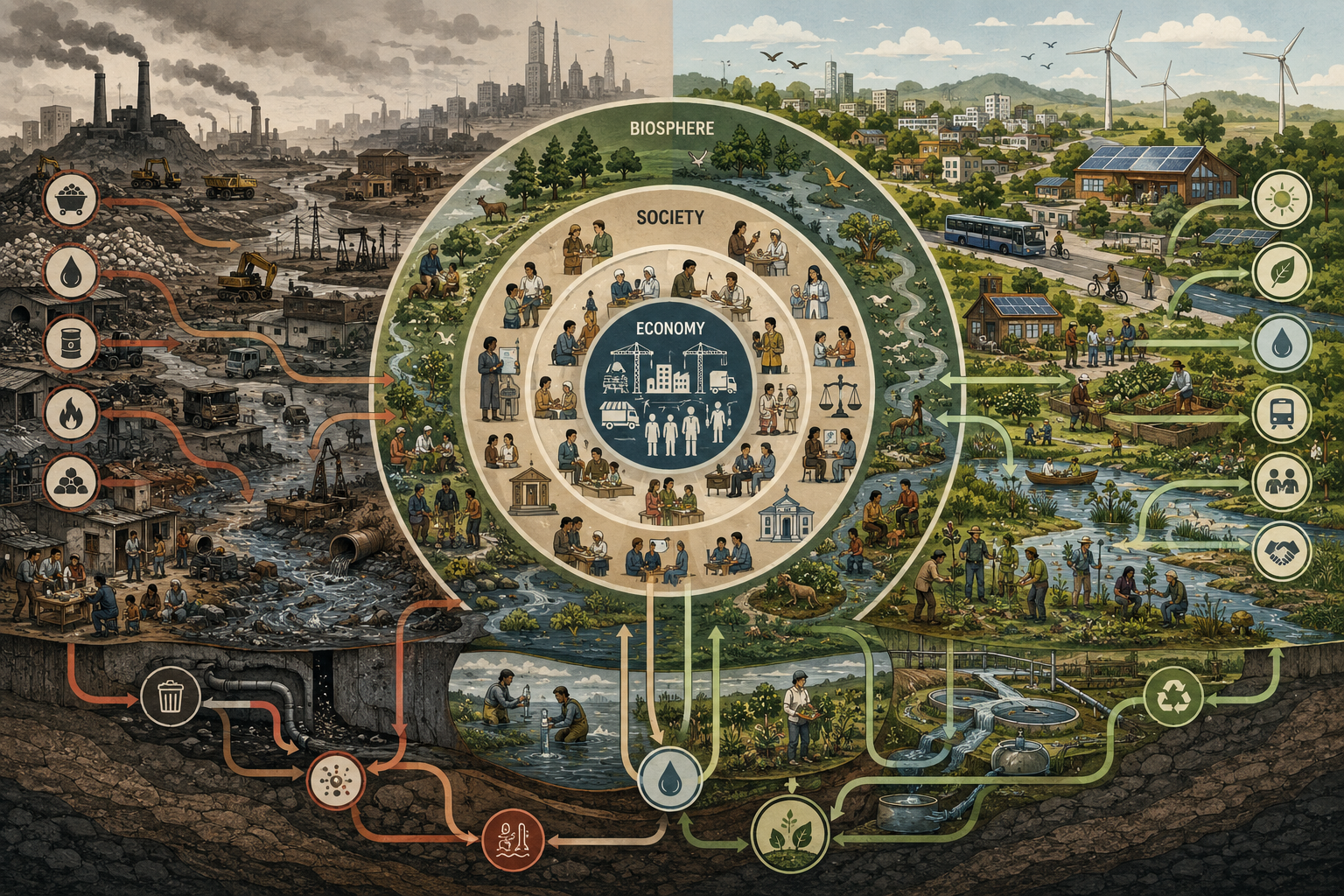
Within a sustainable systems framework, ecological economics and the embedded economy should be examined not only in relation to environmental protection, but in relation to scale, justice, resilience, social reproduction, governance, and long-run viability. A society may expand GDP while undermining the ecological and social foundations on which all future production depends. The deeper question is whether economies can be governed in ways that recognize dependence on living systems, respect material limits, preserve care and commons, and sustain the conditions of collective life rather than treating them as expendable inputs to short-horizon accumulation.
Why This Topic Matters
Modern economic systems depend continuously on ecological stability and social organization, yet both are often treated as background rather than as conditions of possibility. Food depends on soil fertility, pollination, water cycles, climate patterns, labor, transport, and public regulation. Industry depends on minerals, energy, infrastructure, institutions, and waste sinks. Everyday life depends on care, households, public systems, and ecological regularities that no market actor can reproduce independently.
Ecological economics matters because it brings those dependencies to the foreground. It asks how large the economy can grow relative to ecological systems, how material and energy flows should be governed, and how economic value should be understood when many essential conditions of life are not fully captured by price. The point is not simply to add the environment into economics. It is to rethink the economy itself as materially situated and biophysically constrained.
The embedded economy perspective matters because it widens the frame further. Economies are not only embedded in nature; they are embedded in households, social norms, legal orders, care systems, and political institutions. Production depends on unpaid and underpaid reproductive labor as well as waged work. Markets depend on states, infrastructure, public trust, and cultural norms. No economy is disembedded in reality, even when theory imagines it as such.
For that reason, ecological economics and the embedded economy belong near the center of any serious account of sustainability. They help explain why environmental breakdown, social strain, and economic instability so often travel together.
They also show that the relevant question is not how to protect nature from the economy as though the two were separable, but how to govern an economy that is already inside living systems it can damage but never transcend.
This framing changes the meaning of economic responsibility. It asks whether institutions are capable of maintaining the ecological and social foundations of life rather than merely increasing monetized output within a deteriorating world.
The central issue is therefore not growth versus nature in the abstract. It is whether economic systems can be redesigned so that provisioning, care, production, infrastructure, and exchange remain compatible with the regenerative capacities of the Earth and the dignity of human communities.
What Ecological Economics Is
Ecological economics is an interdisciplinary field that studies the relationship between economic systems and the ecosystems within which they operate. It differs from conventional environmental economics in part by refusing to treat ecological issues as marginal side constraints or externalities appended to an otherwise self-regulating market order. Instead, it starts from the premise that the economy is a subsystem of the biosphere and must be understood in relation to material limits, thermodynamics, ecological regeneration, and long-run system viability.
This matters because many standard economic models abstract away from the physical basis of production. They focus on exchange, prices, and equilibrium while leaving energy throughput, matter transformation, land use, water stress, waste, and ecological degradation underdescribed. Ecological economics insists that production is always a transformation of energy and materials and that no amount of financial abstraction changes that biophysical fact.
The field also broadens evaluation beyond efficiency alone. It places greater emphasis on scale, distribution, resilience, justice, and the maintenance of ecological life-support systems. In that sense, it is not simply a greener version of conventional economics. It is a different framework for understanding what economies are and what sustainability demands of them.
A serious account therefore treats ecological economics as a foundational critique of disembedded economic reasoning.
Its core claim is that economies must be judged in relation to the systems that sustain life, not only in relation to prices and output.
Ecological economics also rejects the idea that monetary valuation can fully substitute for ecological judgment. Prices can help coordinate some decisions, but they cannot adequately represent irreversible loss, species extinction, climate thresholds, cultural meaning, intergenerational justice, or the intrinsic integrity of living systems.
For economic systems analysis, ecological economics is essential because it makes visible the physical metabolism of the economy: the energy, materials, land, water, waste, labor, and institutions through which abstract value becomes real-world transformation.
What the Embedded Economy Means
The embedded economy means that economic life is nested within social institutions and ecological systems rather than operating as a purely autonomous market sphere. Exchange depends on law, trust, customs, infrastructure, care labor, territorial order, public authority, and cultural meaning. Production depends on energy, land, water, climate, and social reproduction. Consumption depends on distribution systems, public goods, household time, and social norms.
This matters because it challenges the fiction that markets can be analyzed as though they stand apart from the conditions that enable them. A labor market depends on households that reproduce workers, schools that educate them, transport systems that move them, legal systems that regulate them, and ecological systems that supply the food, water, and energy on which they depend. None of that is external in any meaningful sense.
The embedded economy perspective also helps make visible what is systematically undervalued. Unpaid care work, ecosystem maintenance, informal reciprocity, public infrastructure, cultural trust, and communal institutions often sit beneath market pricing while carrying enormous functional weight for the whole system.
A serious framework therefore treats embeddedness as descriptive, not metaphorical.
Economies are always socially and ecologically embedded; the main question is whether institutions acknowledge that reality or organize activity as though it did not matter.
Disembedding is therefore not a natural state. It is an institutional project that attempts to treat land, labor, care, and nature as if they were ordinary commodities. That project can generate short-term growth, but it often does so by shifting costs into households, ecosystems, future generations, and politically weaker communities.
The embedded economy perspective asks how economic systems can be governed as part of the wider web of life rather than as systems that merely draw from that web until it frays.
The Economy as a Subsystem of the Biosphere
Ecological economics begins with a spatial and material reversal of standard thinking: the economy is not the encompassing whole within which nature appears as a sector or stock of resources. Rather, the economy is a subsystem nested within the biosphere. It draws matter and energy from ecosystems, transforms them through production and consumption, and returns wastes to ecological sinks with limited absorptive capacities.
This matters because it changes what counts as economic possibility. Growth cannot be imagined as indefinitely expandable abstraction if it requires physical throughput from finite or stressed systems. Ecological cycles place conditions on extraction, emissions, regeneration, and waste disposal that no market signal can repeal.
This framing also changes the meaning of sustainability. Sustainability is not merely about making growth cleaner at the margin. It is about whether the scale and structure of the economy remain compatible with the regenerative and absorptive capacities of the biosphere.
A serious account therefore places ecological containment before economic ambition.
The economy can innovate within the biosphere, but it cannot outgrow dependence on the systems that sustain it.
This does not mean that all economic activity is destructive. It means that economic design must be evaluated by its relationship to ecological capacity: whether it restores, maintains, depletes, or destabilizes the living systems on which it depends.
Once the economy is understood as a subsystem, the question of scale becomes unavoidable. The issue is not simply whether resources are efficiently allocated within markets, but whether the total material burden of the economy can be carried by the systems into which it is embedded.
Throughput, Energy, and Material Dependence
All economies require throughput: the flow of energy and materials into production and the flow of wastes out of it. Goods and services may appear increasingly digital or immaterial, yet the infrastructures behind them remain deeply material: server farms, electrical grids, mining, logistics, buildings, food systems, supply chains, roads, ports, water systems, and laboring bodies all depend on throughput.
This matters because efficiency gains do not automatically eliminate total material pressure. A system can produce more output per unit of resource while still increasing total throughput if scale continues to expand. Ecological economics therefore pays close attention not only to intensity, but to absolute levels of extraction and waste.
Energy matters especially because it underlies all transformations. Fossil fuels enabled historic growth by providing dense and transportable energy, but they also linked development to climate destabilization and deep ecological disruption. Transitioning energy systems is therefore not just a technological challenge, but a civilizational coordination problem involving land, minerals, labor, finance, infrastructure, governance, and justice.
A serious framework therefore treats throughput as central to economic analysis rather than as an engineering afterthought.
No economy can be understood adequately if its material and energetic metabolism remains invisible.
Throughput also exposes the limits of purely monetary analysis. Money can circulate indefinitely in accounting systems, but matter and energy move through physical systems subject to depletion, dissipation, waste, and ecological thresholds.
For sustainable systems, the goal is not simply to make throughput more efficient. It is to determine which throughput is necessary for human wellbeing, which is wasteful or destructive, and how total material pressure can remain within ecological limits while meeting human needs fairly.
Externalities and the Problem of Misrecognized Costs
Conventional economics often describes ecological degradation as an externality: a cost not fully reflected in market prices. Ecological economics accepts that this describes a real phenomenon, but it also argues that the language of externality can be misleading. If ecological damage affects the conditions that make production and life possible, then it is not truly external to the economy in any substantive sense.
This matters because treating ecological harm as marginal can understate its structural significance. Soil depletion, biodiversity loss, water contamination, heat stress, air pollution, and climate disruption are not side effects in a world where economies depend fundamentally on ecological stability.
The same logic applies socially. Care burdens, unpaid labor, community erosion, public-health stress, and household exhaustion may be priced poorly or not at all, yet they shape the reproduction of labor and the resilience of households. Costs can be invisible in markets while remaining central in reality.
A serious account therefore treats externalities as signs of deeper misrecognition.
What markets fail to price adequately is often not peripheral, but foundational to the system’s own long-run viability.
This does not mean that pricing tools are useless. Carbon prices, pollution charges, and resource fees can sometimes help change incentives. But they are insufficient when ecological losses are irreversible, when burdens are unjustly distributed, or when basic life-support systems require rights, regulation, public planning, and hard limits.
The deeper question is what kinds of costs should be priced, what kinds should be prohibited, what kinds should be governed democratically, and what kinds should never be treated as acceptable tradeoffs in the first place.
Social Embeddedness, Care, and Reproduction
The embedded economy is not only ecological. It is also social. Labor markets, firms, and public institutions all depend on households and care systems that reproduce people across time. Childrearing, elder care, emotional support, domestic labor, education, health maintenance, disability support, and community care are all part of the wider foundation on which formal economic activity depends.
This matters because economic theory has often privileged market production while understating the social labor that makes market participation possible. Care work is frequently unpaid, underpaid, feminized, racialized, or institutionally marginalized, yet economies would fail quickly without it.
Social embeddedness also means that communities, norms, and public institutions shape economic coordination. Trust, reciprocity, health, safety, and social rights affect whether market exchange occurs under conditions of resilience or chronic strain.
A serious framework therefore treats reproduction and care as constitutive parts of economic life.
The economy is sustained not only in firms and markets, but in the spaces where life is maintained from one day and one generation to the next.
Care also changes how sustainability should be understood. An economy can reduce emissions while intensifying unpaid labor, weakening public health, or exhausting communities. Such a transition would remain socially unsustainable even if some ecological indicators improved.
The embedded economy therefore asks whether systems of provisioning support both ecological regeneration and human reproduction, including the work of care, maintenance, education, healing, and community continuity.
Scale, Allocation, and Distribution
Ecological economics often distinguishes three core problems: scale, allocation, and distribution. Allocation concerns how resources are assigned among competing uses. Distribution concerns how income, wealth, risks, and access are shared across groups. Scale concerns the physical size of the economy relative to ecological systems.
This distinction matters because conventional economics tends to focus heavily on allocation while treating scale as secondary and distribution as politically external. Ecological economics argues that this is backward. An efficiently allocated economy that exceeds ecological limits remains unsustainable. A growing economy with deeply unequal access remains socially unstable. Scale and distribution must therefore be treated as co-equal questions.
The framework also helps clarify policy disputes. Carbon pricing may improve allocation, but it does not by itself determine just distribution or safe ecological scale. Public investment may support transition, but it must still be judged relative to biophysical limits and social equity.
A serious account therefore treats scale, allocation, and distribution as interconnected rather than separable domains.
An economy cannot be called well-governed if it optimizes exchange inside a structure that is ecologically oversized or socially exclusionary.
This is especially important because distribution and scale affect one another. High inequality can increase luxury consumption, political resistance to restraint, and unequal exposure to ecological harms. Ecological overshoot can, in turn, intensify inequality by exposing vulnerable communities to greater risk.
Sustainable economic governance therefore requires asking three questions together: how much material throughput is safe, how resources should be allocated, and how the benefits and burdens of economic life should be shared.
Strong Sustainability and Non-Substitutable Natural Capital
A major distinction in sustainability debates concerns whether natural systems can be substituted by other forms of capital. Weak sustainability approaches often assume that natural capital can be offset by human-made capital so long as total aggregate capital does not decline. Strong sustainability argues that some ecological systems and functions are not substitutable in any meaningful sense.
This matters because climate stability, biodiversity, fertile soils, freshwater systems, and ecosystem integrity are not simple interchangeable inputs. A society cannot compensate for collapsing pollinator systems, destabilized climate regimes, or irreversibly degraded aquifers merely by adding roads, machines, data centers, or financial wealth.
Strong sustainability therefore places sharper emphasis on thresholds, irreversibility, and precaution. It asks not only whether losses can be priced, but whether they can be lived with or repaired at all.
A serious framework therefore treats some forms of natural capital as foundational rather than substitutable.
The relevant question is not how much ecological loss can be monetized, but which losses would undermine the conditions of collective life itself.
Strong sustainability also challenges a common policy habit: assuming that future technological substitution will solve present ecological depletion. Innovation matters, but it cannot justify the reckless liquidation of life-support systems whose functions are poorly understood, slow to regenerate, or impossible to replace.
For sustainable systems, the precautionary question is central: which ecological functions must be protected before economic optimization begins?
Entropy, Waste, and Biophysical Limits
Ecological economics draws on thermodynamic insights, especially the idea that production transforms low-entropy matter and energy into higher-entropy wastes. Economies do not create material value from nothing. They rearrange and degrade energy and matter in ways that inevitably generate waste.
This matters because it places limits on fantasies of perfectly circular or purely weightless growth. Recycling, efficiency, repair, reuse, and cleaner design matter greatly, but they do not eliminate physical constraints altogether. Material use can be reduced and cycles improved, yet no system escapes throughput and dissipation entirely.
Entropy also matters because waste sinks are finite. Carbon accumulates in the atmosphere, nitrates in water systems, plastics in ecosystems, toxic residues in bodies and soils, and heat in planetary systems. Disposal is not disappearance.
A serious account therefore treats waste as intrinsic to economic metabolism rather than as a residual technical inconvenience.
Biophysical limits are not ideological preferences. They are conditions of operating within a finite world.
This does not imply fatalism. It implies discipline. Economies can change their energy base, reduce material intensity, extend product lifetimes, repair ecosystems, and redesign infrastructure. But these strategies must be evaluated by absolute ecological outcomes, not only relative efficiency improvements.
The central question is whether economic systems can reduce destructive throughput fast enough and fairly enough while maintaining the social foundations of wellbeing.
Ecosystem Services, Commons, and Living Systems
One way of making ecological dependence more visible is through the language of ecosystem services: pollination, flood buffering, carbon sequestration, soil formation, nutrient cycling, habitat support, and water purification are all functions on which economic activity depends. Yet ecological economics is often cautious about reducing living systems entirely to services for humans.
This matters because ecosystems are not only service providers. They are complex living systems with their own dynamics, thresholds, and intrinsic value. A forest is not simply a carbon machine. A wetland is not simply a flood-control asset. Purely instrumental framings can obscure the complexity and dignity of living systems while still undervaluing them economically.
The concept of the commons also matters here. Fisheries, forests, watersheds, atmosphere, grazing lands, seeds, and local ecosystems often involve shared access, overlapping claims, and collective management problems that neither pure privatization nor unmanaged open access handles well.
A serious framework therefore treats ecosystems as both materially indispensable and institutionally complex.
They require governance forms capable of respecting interdependence rather than treating nature as a warehouse of isolated inputs.
Commons governance also reveals that ecological coordination is not reducible to state versus market. Communities, Indigenous stewardship practices, local institutions, public law, scientific monitoring, and polycentric governance can all play roles in sustaining shared resources.
The deeper issue is whether governance recognizes ecological relationships, distributes responsibilities fairly, and gives affected communities meaningful authority over the systems that sustain them.
Growth, Degrowth, and Post-Growth Debates
Ecological economics has become one of the main intellectual homes for debates over growth, degrowth, and post-growth futures. These debates ask whether continued expansion of GDP can remain compatible with ecological stability and social wellbeing, especially in already wealthy societies with high material footprints.
This matters because growth has historically been tied to employment, fiscal stability, profits, debt repayment, and political legitimacy. Challenging growth therefore raises difficult institutional questions. Yet if further growth continues to intensify ecological overshoot while delivering diminishing welfare gains to many populations, then defending growth as an unquestioned objective becomes harder.
Degrowth arguments emphasize planned downscaling of ecologically destructive throughput in wealthy economies while expanding care, public goods, equality, and democratic control. Post-growth approaches often focus more broadly on building economies in which wellbeing no longer depends on perpetual expansion.
A serious account therefore treats these debates as questions of institutional reorganization rather than mere cultural preference.
The issue is whether economies can maintain security and legitimacy without relying on endless material expansion as the primary solution to every social problem.
This distinction is crucial. Unplanned contraction can produce unemployment, austerity, poverty, and political instability. Planned post-growth transition would require public services, shorter working time, redistribution, care investment, ecological repair, debt reform, and institutions that protect wellbeing while reducing material pressure.
The question is not whether less is automatically better. The question is whether societies can distinguish between destructive throughput and genuine human flourishing.
Valuation Beyond Price
Ecological economics places strong emphasis on the limits of price as a measure of value. Many of the most important goods in life—ecological stability, public trust, care, health, cultural meaning, species survival, community continuity, sacred places, and future habitability—are not adequately represented by market price, and some may be distorted when forced into purely monetary terms.
This matters because policy systems often rely on price as though it were a comprehensive social language. Yet willingness to pay depends on income, information, and power. A poor community may value clean water deeply without being able to express that value through market demand. Future generations cannot bid in present markets. Nonhuman life is not represented there at all.
Broader valuation frameworks therefore matter. Deliberative institutions, rights-based protections, precautionary rules, public planning, ecological thresholds, Indigenous and local knowledge, and multi-criteria evaluation can capture dimensions of worth that prices miss.
A serious framework therefore treats price as one signal among others rather than the final arbiter of value.
What matters most for social and ecological survival is often precisely what markets are least reliable at valuing well.
This does not require rejecting all quantification. It requires humility about what quantification can do. Measurement can support better governance, but it should not collapse plural forms of value into a single monetary scale when the underlying stakes are ethical, ecological, cultural, and intergenerational.
Valuation beyond price is therefore not anti-analytical. It is a demand for more complete analysis.
Institutions, Governance, and Ecological Coordination
If the economy is ecologically and socially embedded, then institutions matter enormously. Land-use rules, environmental law, energy policy, water governance, transport planning, welfare institutions, industrial standards, public procurement, scientific monitoring, and public investment all shape whether economies can remain compatible with ecological systems.
This matters because no spontaneous market process is likely to coordinate decarbonization, biodiversity protection, resource conservation, territorial justice, and social stability at the necessary scale without strong institutional guidance. Ecological transition requires governance, not merely cleaner consumer choice.
Institutions also mediate conflict. Transition creates winners and losers, at least in the short term. Public systems must therefore coordinate investment, compensation, regulation, labor transition, ecological restoration, and participation in ways that preserve legitimacy while changing the material structure of the economy.
A serious account therefore treats ecological coordination as a governance problem rather than a matter of isolated green preferences.
The embedded economy can only be governed well if institutions are strong enough to see and organize the relations on which it depends.
Governance must also be adaptive. Ecological systems change, knowledge evolves, and policies have unintended consequences. Institutions need monitoring, feedback, correction, and meaningful participation from those closest to ecological and social impacts.
Ecological economics therefore points toward public capacity, democratic accountability, scientific literacy, local knowledge, and long-term planning as core economic institutions, not peripheral administrative concerns.
Justice, Inequality, and the Distribution of Ecological Burdens
Ecological breakdown does not affect all groups equally. Low-income households, marginalized communities, peripheral regions, Indigenous peoples, workers in transition-exposed sectors, and future generations often bear greater exposure to pollution, climate risk, ecological degradation, and weak infrastructure while contributing less to cumulative damage than wealthier groups.
This matters because ecological economics is not only about limits. It is also about distribution. Who consumes how much, who owns resource-intensive assets, who benefits from extraction, who is displaced by transition, and who pays for adaptation are all questions of justice as well as ecology.
Inequality also shapes response capacity. Wealthier households can relocate, insure, buffer shocks, or buy cleaner alternatives more easily. Poorer households are often more dependent on degraded public systems and more exposed to environmental hazards.
A serious framework therefore treats ecological policy as inseparable from questions of class, race, geography, colonial history, gender, and power.
An ecologically stable order that remains socially unjust will be politically brittle, while a just order that ignores biophysical limits will not remain just for long.
Ecological justice also requires attention to historical responsibility. Those who benefited most from high-throughput growth are not necessarily those who suffer first or most from its consequences.
A sustainable economic system must therefore combine ecological restraint with fair burden-sharing, public investment, social protection, and democratic voice for communities historically treated as sacrifice zones.
Resilience, Vulnerability, and Socio-Ecological Systems
Ecological economics often overlaps with socio-ecological systems thinking, which examines how human and natural systems interact dynamically across time. Economies are not separate from watersheds, landscapes, energy infrastructures, food systems, and climate processes. They co-evolve with them.
This matters because resilience depends on the condition of the combined system. A financially prosperous region can remain highly vulnerable if it depends on fragile supply chains, degraded aquifers, unstable coastlines, heat-stressed labor, brittle infrastructure, or collapsing ecosystems. Vulnerability is often hidden until shocks expose the underlying fragility.
Resilience therefore requires more than efficiency. It requires diversity, redundancy, maintenance, adaptive governance, and attention to thresholds that cannot safely be crossed.
A serious account therefore treats resilience as a socio-ecological property rather than a narrow engineering metric.
The embedded economy is resilient only when the ecological and social systems that sustain it remain robust enough to absorb stress without systemic breakdown.
This also means that resilience cannot be reduced to individual adaptation. Households may be told to prepare for shocks, but their actual resilience depends on public infrastructure, social protection, ecosystem condition, emergency systems, housing quality, and collective institutions.
A sustainable economy is therefore one that reduces vulnerability at the system level rather than shifting adaptation burdens onto those least able to carry them.
Historical Lessons from Embedded and Disembedded Economic Orders
Historical experience suggests that economies become especially destructive when they are treated as disembedded from the ecological and social systems that sustain them. Periods of rapid extraction, enclosure, fossil-fuel expansion, financial speculation, colonial resource transfer, and deregulated land or labor exploitation often produced impressive short-term gains alongside longer-term ecological and social damage.
This matters because disembedding is not only theoretical. It is an institutional project: the attempt to organize markets as though land, labor, care, and nature can be treated primarily as commodities. Such projects often generate backlash because they erode the communities and ecosystems on which actual economic life depends.
Historical experience also shows that more embedded orders—those with stronger social protection, stewardship practices, public goods, and ecological restraint—can produce greater stability even if they generate less short-run extraction.
A serious historical perspective therefore treats embeddedness as a practical institutional achievement rather than a romantic abstraction.
Economies are always embedded; the question is whether institutions govern them as though that fact matters.
History also shows that the costs of disembedding are often distributed unequally. Enclosure, extraction, pollution, and ecological depletion have frequently fallen hardest on communities with the least political power, including colonized peoples, rural communities, workers, and racialized or marginalized populations.
The historical lesson is therefore not simply that economies should be “closer to nature.” It is that economic institutions must be judged by how they organize land, labor, care, property, ecology, and power across time.
Ecological Economics and Sustainable Systems
Within sustainable systems, ecological economics provides one of the clearest frameworks for asking whether an economy can remain materially, socially, and politically viable across time. It insists that sustainability cannot be defined only by cleaner output or better pricing. It must be defined by whether the scale and structure of economic life remain compatible with ecological regeneration, social reproduction, and public legitimacy.
This changes the policy frame. The task is not simply to internalize a few costs while preserving an otherwise disembedded growth model. The task is to redesign systems of energy, food, transport, care, housing, production, finance, land use, and public infrastructure so that they operate within living limits and support broad-based capability rather than ecological overshoot.
Sustainable systems therefore require more than environmental add-ons. They require recognizing that the economy is embedded in nature and society at every level and must be governed accordingly.
In this sense, ecological economics becomes a systems question. It asks whether material life can be organized in ways that preserve the integrity of the systems on which all future economic activity depends.
This also means that sustainability should not be framed as a niche environmental concern. It is about the long-run governability of an economy that remains inseparable from the biosphere and the social institutions that reproduce life.
An embedded sustainable economy would therefore measure success differently. It would ask whether basic needs are met with lower throughput, whether ecological systems are regenerating, whether care is supported, whether commons are protected, whether burdens are fairly distributed, and whether communities have meaningful voice in decisions that shape their futures.
The central challenge is to move from an economy that treats life-support systems as inputs to an economy that treats their preservation as a defining purpose.
How Ecological-Economic Systems Should Be Judged
Ecological-economic systems should not be judged only by GDP, productivity, or market efficiency. A broader economic systems framework asks whether the economy remains within ecological capacity, supports social reproduction, distributes burdens fairly, protects critical natural capital, and builds resilience without sacrificing justice.
| Dimension | Narrow Question | Systems Question |
|---|---|---|
| Throughput | How much energy and material enters the economy? | Is throughput necessary, efficient, justly distributed, and compatible with ecological limits? |
| Scale | Is the economy growing? | Is the physical scale of economic activity within regenerative and absorptive ecological capacity? |
| Waste | How much is recycled? | How much residual waste remains, where does it go, and who bears its consequences? |
| Natural Capital | Can losses be offset? | Which ecological functions are non-substitutable, threshold-sensitive, or irreversible? |
| Care | Is care counted? | Does the economy support the reproductive labor that sustains people and communities across time? |
| Commons | Are shared resources managed? | Do governance systems protect regeneration, access, participation, and long-term stewardship? |
| Distribution | Who consumes and who pays? | How are ecological benefits, harms, adaptation costs, and transition burdens distributed across groups? |
| Resilience | Can the system recover? | Does the socio-ecological system have diversity, redundancy, maintenance, learning, and adaptive governance? |
| Valuation | What is priced? | Which values exceed price, require rights, demand precaution, or need democratic deliberation? |
| Sustainability | Can growth continue? | Can wellbeing be secured within ecological limits while supporting justice, care, and public legitimacy? |
This framework prevents a common mistake: treating environmental policy as a corrective layer added after economic growth is defined elsewhere. Ecological economics asks whether the economy itself is structured in ways that protect or undermine the systems that make life possible.
The central issue is therefore not whether the economy can become slightly greener while remaining otherwise unchanged. The deeper question is whether economic systems can be governed as embedded systems: materially constrained, socially reproduced, politically contested, and ecologically dependent.
Mathematical Lens
Mathematics can clarify ecological economics and the embedded economy by making throughput, scale, waste, material footprints, ecological burden, resilience, and embeddedness explicit. These equations do not determine what level of throughput is just, but they help show what must be examined.
1. Throughput Relation
T = E + M
\]
Interpretation: Total throughput \(T\) equals energy input \(E\) plus material input \(M\). This highlights that economic activity always involves physical flows, not only monetary transactions.
2. Ecological Scale Relation
S = \frac{Economic\ Scale}{Ecological\ Capacity}
\]
Interpretation: The scale ratio \(S\) compares economic activity with ecological capacity. When this ratio rises too far above one, ecological overshoot becomes more likely.
3. Waste Residual
W = T – R
\]
Interpretation: Waste residual \(W\) equals total throughput \(T\) minus recovered, recycled, reused, or regenerated throughput \(R\). Circularity can reduce residual waste, but it rarely eliminates physical dissipation altogether.
4. Material Footprint
MF = Domestic\ Extraction + Imports – Exports
\]
Interpretation: Material footprint \(MF\) estimates the material basis of consumption and production by accounting for domestic extraction and trade-related material flows.
5. Ecological Burden
EB = f(Exposure, Income, Infrastructure, Adaptive\ Capacity)
\]
Interpretation: Ecological burden \(EB\) is socially mediated. Exposure matters, but so do income, infrastructure, public services, political voice, and adaptive capacity.
6. Socio-Ecological Resilience
SR = f(Diversity, Redundancy, Regeneration, Governance)
\]
Interpretation: Socio-ecological resilience \(SR\) depends on system qualities beyond narrow efficiency. Diversity, redundancy, regeneration, maintenance, learning, and governance all matter.
7. Embedded Economy
EE = f(Ecology, Care, Institutions, Infrastructure, Culture)
\]
Interpretation: Embedded economy \(EE\) clarifies that economic life depends on multiple non-market supports operating together: ecological systems, care systems, public institutions, infrastructure, and culture.
8. Strong Sustainability
SS = f(Non\text{-}Substitutability, Threshold\ Risk, Irreversibility, Life\ Support)
\]
Interpretation: Strong sustainability \(SS\) emphasizes that some ecological functions cannot be safely replaced by manufactured or financial capital.
9. Practical Interpretation
The mathematical lens clarifies several structural points. Economic activity always depends on material and energy throughput. Scale matters in relation to ecological capacity, not only output growth. Waste is intrinsic to production, even when recovery improves. Ecological burden is distributed unequally across social groups. Resilience depends on diversity, regeneration, and governance rather than efficiency alone. Embeddedness shows that economies depend on care, institutions, infrastructure, culture, and ecology together.
Formalization helps clarify mechanism, but it does not determine what level of throughput is just, what forms of ecological loss are unacceptable, or how societies should balance wellbeing, equality, restraint, and repair. Those remain institutional, ethical, ecological, and political questions.
Python Workflow: Ecological Economics and the Embedded Economy
Python is useful for turning ecological-economy concepts into reproducible calculations. The following compact workflow models throughput, ecological scale, waste residual, material footprint, burden, resilience, and embeddedness.
# Ecological Economics and the Embedded Economy
# Simple Python workflow

import pandas as pd

# Throughput
energy_input = 420
material_input = 310
throughput = energy_input + material_input

print("Throughput:", throughput)

# Ecological scale relation
economic_scale = 0.84
ecological_capacity = 0.72
scale_ratio = economic_scale / ecological_capacity

print("Scale ratio:", round(scale_ratio, 3))

# Waste balance
recovered_throughput = 180
waste_residual = throughput - recovered_throughput
recovery_rate = recovered_throughput / throughput

print("Waste residual:", waste_residual)
print("Recovery rate:", round(recovery_rate, 3))

# Material footprint
domestic_extraction = 260
imports = 140
exports = 65

material_footprint = domestic_extraction + imports - exports

print("Material footprint:", material_footprint)

# Ecological burden
exposure = 0.78
income_buffer = 0.24
infrastructure = 0.38
adaptive_capacity = 0.32
political_voice = 0.30

ecological_burden = (
    0.26 * exposure
    + 0.20 * (1 - income_buffer)
    + 0.20 * (1 - infrastructure)
    + 0.20 * (1 - adaptive_capacity)
    + 0.14 * (1 - political_voice)
)

print("Ecological burden score:", round(ecological_burden, 3))

# Socio-ecological resilience
diversity = 0.66
redundancy = 0.59
regeneration = 0.61
governance = 0.64
maintenance = 0.58
learning = 0.62

resilience_score = (
    0.18 * diversity
    + 0.16 * redundancy
    + 0.18 * regeneration
    + 0.18 * governance
    + 0.14 * maintenance
    + 0.16 * learning
)

print("Resilience score:", round(resilience_score, 3))

# Embedded economy score
ecology = 0.68
care = 0.72
institutions = 0.70
infrastructure = 0.66
culture = 0.64

embedded_economy_score = (
    0.22 * ecology
    + 0.20 * care
    + 0.20 * institutions
    + 0.18 * infrastructure
    + 0.20 * culture
)

print("Embedded economy score:", round(embedded_economy_score, 3))

df = pd.DataFrame({
    "Metric": [
        "Throughput",
        "Scale Ratio",
        "Waste Residual",
        "Recovery Rate",
        "Material Footprint",
        "Ecological Burden Score",
        "Resilience Score",
        "Embedded Economy Score"
    ],
    "Value": [
        throughput,
        scale_ratio,
        waste_residual,
        recovery_rate,
        material_footprint,
        ecological_burden,
        resilience_score,
        embedded_economy_score
    ]
})

print(df)
This workflow is useful because it links biophysical throughput, ecological scale, material footprint, unequal burden, resilience, and embeddedness within one simplified analytical frame. It helps show why ecological economics is not only about environmental damage, but about how economic systems depend on energy, matter, care, governance, infrastructure, and living systems.
The full GitHub repository expands this example into throughput scenarios, sector material footprints, ecological scale ratios, waste and recovery analysis, strong sustainability scoring, ecological burden distribution, embedded-economy indicators, commons governance comparisons, resilience metrics, post-growth scenarios, SQL queries, R and Stata replication workflows, Julia simulations, and article-ready figures.
R Workflow: Ecological Economics and the Embedded Economy
R is useful for ecological-economy summaries, throughput tables, material-footprint comparisons, burden analysis, resilience scoring, and publication-ready graphics. The following compact workflow performs the same throughput, scale, waste, material-footprint, burden, resilience, and embeddedness calculations in R.
# Ecological Economics and the Embedded Economy
# Simple R workflow

# Throughput
energy_input <- 420
material_input <- 310
throughput <- energy_input + material_input

cat("Throughput:", throughput, "\n")

# Ecological scale relation
economic_scale <- 0.84
ecological_capacity <- 0.72
scale_ratio <- economic_scale / ecological_capacity

cat("Scale ratio:", round(scale_ratio, 3), "\n")

# Waste balance
recovered_throughput <- 180
waste_residual <- throughput - recovered_throughput
recovery_rate <- recovered_throughput / throughput

cat("Waste residual:", waste_residual, "\n")
cat("Recovery rate:", round(recovery_rate, 3), "\n")

# Material footprint
domestic_extraction <- 260
imports <- 140
exports <- 65

material_footprint <- domestic_extraction + imports - exports

cat("Material footprint:", material_footprint, "\n")

# Ecological burden
exposure <- 0.78
income_buffer <- 0.24
infrastructure <- 0.38
adaptive_capacity <- 0.32
political_voice <- 0.30

ecological_burden <- (
  0.26 * exposure +
  0.20 * (1 - income_buffer) +
  0.20 * (1 - infrastructure) +
  0.20 * (1 - adaptive_capacity) +
  0.14 * (1 - political_voice)
)

cat("Ecological burden score:", round(ecological_burden, 3), "\n")

# Socio-ecological resilience
diversity <- 0.66
redundancy <- 0.59
regeneration <- 0.61
governance <- 0.64
maintenance <- 0.58
learning <- 0.62

resilience_score <- (
  0.18 * diversity +
  0.16 * redundancy +
  0.18 * regeneration +
  0.18 * governance +
  0.14 * maintenance +
  0.16 * learning
)

cat("Resilience score:", round(resilience_score, 3), "\n")

# Embedded economy score
ecology <- 0.68
care <- 0.72
institutions <- 0.70
infrastructure_score <- 0.66
culture <- 0.64

embedded_economy_score <- (
  0.22 * ecology +
  0.20 * care +
  0.20 * institutions +
  0.18 * infrastructure_score +
  0.20 * culture
)

cat("Embedded economy score:", round(embedded_economy_score, 3), "\n")

summary_df <- data.frame(
  Metric = c(
    "Throughput",
    "Scale Ratio",
    "Waste Residual",
    "Recovery Rate",
    "Material Footprint",
    "Ecological Burden Score",
    "Resilience Score",
    "Embedded Economy Score"
  ),
  Value = c(
    throughput,
    scale_ratio,
    waste_residual,
    recovery_rate,
    material_footprint,
    ecological_burden,
    resilience_score,
    embedded_economy_score
  )
)

print(summary_df)
This R workflow is deliberately compact for article readability. In the full repository, R reads structured throughput, sector-footprint, ecological-burden, embeddedness, resilience, commons-governance, post-growth, and strong-sustainability scenarios; calculates throughput, waste residuals, scale ratios, recovery rates, material footprints, ecological pressure scores, burden scores, embeddedness scores, resilience scores, and article-ready graphics.
Future Economic Systems articles can extend this foundation with material-flow accounts, energy balances, environmental input-output tables, emissions inventories, water stress data, land-use data, ecological indicators, household exposure data, social vulnerability indicators, care-work surveys, infrastructure data, and commons-governance datasets.
GitHub Repository
The article body includes selected computational examples so the conceptual, ecological, institutional, and mathematical argument remains readable. The full repository contains the expanded research infrastructure: Python ecological-economics analysis, R throughput summaries, Stata applied ecological-economy replication workflows, SQL ecological scenario tables, Julia throughput and resilience simulations, material footprints, scale ratios, waste residuals, recovery rates, ecological burden distribution, strong sustainability, commons governance, embeddedness, care and social reproduction, post-growth scenarios, documentation, reproducible sample data, and article-ready figures and tables.
Complete Code Repository
The full code distribution for this article, including selected article examples and advanced research-style computational scaffolding for throughput accounting, energy and material flows, ecological scale, waste and recovery, material footprints, strong sustainability, ecological burden distribution, care and social reproduction, embeddedness, commons governance, resilience, post-growth scenarios, reproducibility documentation, and cross-language economic analysis, is available on GitHub.
Conclusion
Ecological economics and the embedded economy are central to economic analysis because they show that the economy is never separate from the ecological and social systems that sustain it. Production, exchange, and consumption always depend on material throughput, living systems, institutions, infrastructure, and reproductive labor that standard economic abstractions often push into the background.
To understand an economic system seriously, one must therefore ask not only how much it grows, but how large it has become relative to ecological capacity, how it distributes burdens across social groups, how it values care and commons, and whether its institutions can preserve the foundations of life on which future prosperity depends. These questions reveal whether an economy is being governed as an embedded subsystem of a living world or as though the conditions of its own existence could be treated as expendable inputs without consequence.
The serious study of sustainability also requires moving beyond the idea that environmental policy is a narrow correction to ordinary economics. Ecological limits, care systems, public institutions, and commons are not secondary to the economy. They are part of what the economy is.
In a sustainable economic system, success cannot be measured only by output, consumption, or market value. It must be measured by whether human wellbeing is secured within ecological limits, whether burdens are shared justly, whether care is supported, whether ecosystems regenerate, and whether future generations inherit a world still capable of sustaining life.
Related Reading
- Economic Systems
- Public Finance, State Capacity, and Collective Goods
- Externalities, Public Goods, and Collective Provision
- Socialism, Planning, and the Mixed Economy
- Political Economy, Power, and Distributional Conflict
- Planetary Boundaries
- Risk & Resilience
- Sustainable Development
- Environmental Systems
- Institutions & Governance
Further Reading
- Costanza, R. et al. (1997). The value of the world’s ecosystem services and natural capital. Nature, 387, pp. 253–260. Available at: https://www.nature.com/articles/387253a0
- Daly, H.E. (1996). Beyond Growth: The Economics of Sustainable Development. Boston: Beacon Press. Available at: https://www.beacon.org/Beyond-Growth-P1241.aspx
- Georgescu-Roegen, N. (1971). The Entropy Law and the Economic Process. Cambridge, MA: Harvard University Press. Available at: https://www.hup.harvard.edu/books/9780674257801
- International Resource Panel (IRP) (2024). Global Resources Outlook 2024. Available at: https://www.resourcepanel.org/reports/global-resources-outlook-2024
- IPBES (2019). Global Assessment Report on Biodiversity and Ecosystem Services. Available at: https://ipbes.net/global-assessment
- Ostrom, E. (1990). Governing the Commons: The Evolution of Institutions for Collective Action. Cambridge: Cambridge University Press. Available at: https://www.cambridge.org/core/books/governing-the-commons/7AB7AE11BADA84409C34815CC288CD79
- Polanyi, K. (1944). The Great Transformation: The Political and Economic Origins of Our Time. Boston: Beacon Press. Available at: https://www.beacon.org/The-Great-Transformation-P156.aspx
- Raworth, K. (2017). Doughnut Economics: Seven Ways to Think Like a 21st-Century Economist. London: Penguin Random House. Available at: https://www.kateraworth.com/doughnut/
- Rockström, J. et al. (2009). A safe operating space for humanity. Nature, 461, pp. 472–475. Available at: https://www.nature.com/articles/461472a
- United Nations Environment Programme (UNEP) (n.d.). Resource efficiency and sustainable consumption and production. Available at: https://www.unep.org/explore-topics/resource-efficiency
References
- Costanza, R. et al. (1997). The value of the world’s ecosystem services and natural capital. Nature, 387, pp. 253–260. Available at: https://www.nature.com/articles/387253a0
- Daly, H.E. (1996). Beyond Growth: The Economics of Sustainable Development. Boston: Beacon Press. Available at: https://www.beacon.org/Beyond-Growth-P1241.aspx
- Georgescu-Roegen, N. (1971). The Entropy Law and the Economic Process. Cambridge, MA: Harvard University Press. Available at: https://www.hup.harvard.edu/books/9780674257801
- International Resource Panel (IRP) (2024). Global Resources Outlook 2024. Available at: https://www.resourcepanel.org/reports/global-resources-outlook-2024
- IPBES (2019). Global Assessment Report on Biodiversity and Ecosystem Services. Available at: https://ipbes.net/global-assessment
- Ostrom, E. (1990). Governing the Commons: The Evolution of Institutions for Collective Action. Cambridge: Cambridge University Press. Available at: https://www.cambridge.org/core/books/governing-the-commons/7AB7AE11BADA84409C34815CC288CD79
- Polanyi, K. (1944). The Great Transformation: The Political and Economic Origins of Our Time. Boston: Beacon Press. Available at: https://www.beacon.org/The-Great-Transformation-P156.aspx
- Raworth, K. (2017). Doughnut Economics: Seven Ways to Think Like a 21st-Century Economist. London: Penguin Random House. Available at: https://www.kateraworth.com/doughnut/
- Rockström, J. et al. (2009). A safe operating space for humanity. Nature, 461, pp. 472–475. Available at: https://www.nature.com/articles/461472a
- United Nations Environment Programme (UNEP) (n.d.). Resource efficiency and sustainable consumption and production. Available at: https://www.unep.org/explore-topics/resource-efficiency