Chemistry

Chemistry examines the composition, structure, properties, and transformation of matter at the atomic and molecular levels. It seeks to explain how substances are constituted, how they interact, and how chemical processes generate both stability and change across natural and synthetic systems.

This field brings together the study of elements, compounds, bonding, reactions, equilibrium, energetics, and molecular behavior. It provides the crucial bridge between the laws of physics and the complex material organization of organisms, environments, technologies, and the substances that make up the physical world.

Chemistry plays a central role in the natural sciences because it explains the material basis of interaction, transformation, and form. By clarifying how matter combines, reorganizes, and behaves under different conditions, it supports inquiry into biology, Earth systems, materials science, medicine, industry, and the physical processes that underlie life and environment.

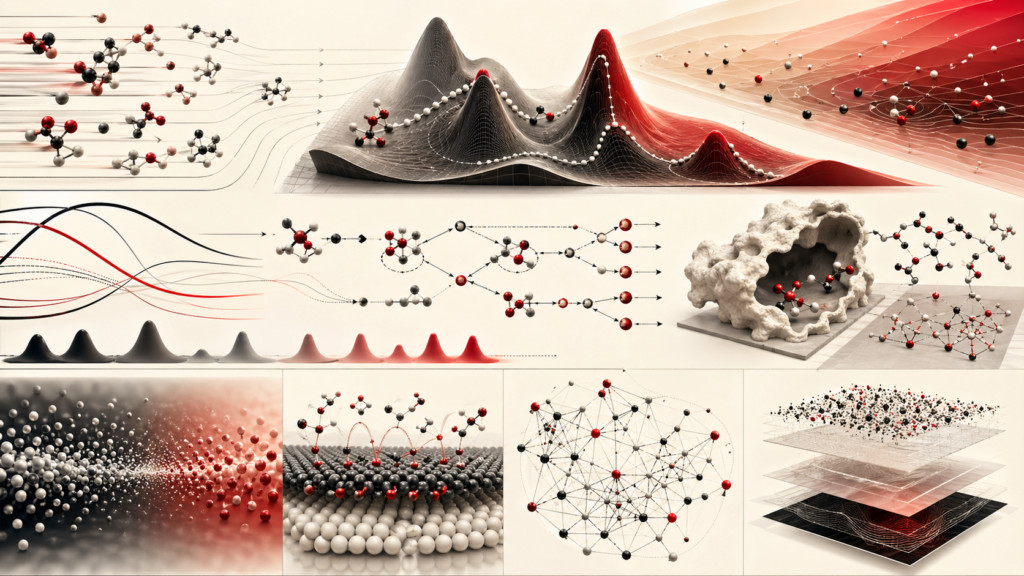
Abstract editorial scientific illustration of chemical kinetics, reaction pathways, activation barriers, molecular mechanisms, rate laws, intermediates, catalysts, and kinetic workflows in cream, gray, black, and deep red.

Chemical Kinetics and Reaction Mechanisms

Chemical kinetics explains how fast reactions occur, how pathways unfold, and why thermodynamic possibility is not the same as chemical speed. Thermodynamics tells whether a transformation is energetically favored, but kinetics explains whether that transformation happens in seconds, years, geological time, or not observably at all. This article introduces reaction rate, rate laws, reaction order, integrated rate laws, half-life, temperature dependence, Arrhenius behavior, activation energy, elementary reactions, molecularity, reaction mechanisms, intermediates, transition states, rate-determining and rate-controlling steps, steady-state and pre-equilibrium approximations, catalysis, chain reactions, diffusion control, surface reactions, enzyme kinetics, and computational kinetic modeling. It shows why kinetics gives chemistry its time dimension, connecting concentration, temperature, catalysts, mechanisms, molecular pathways, experimental evidence, and reproducible reaction modeling.
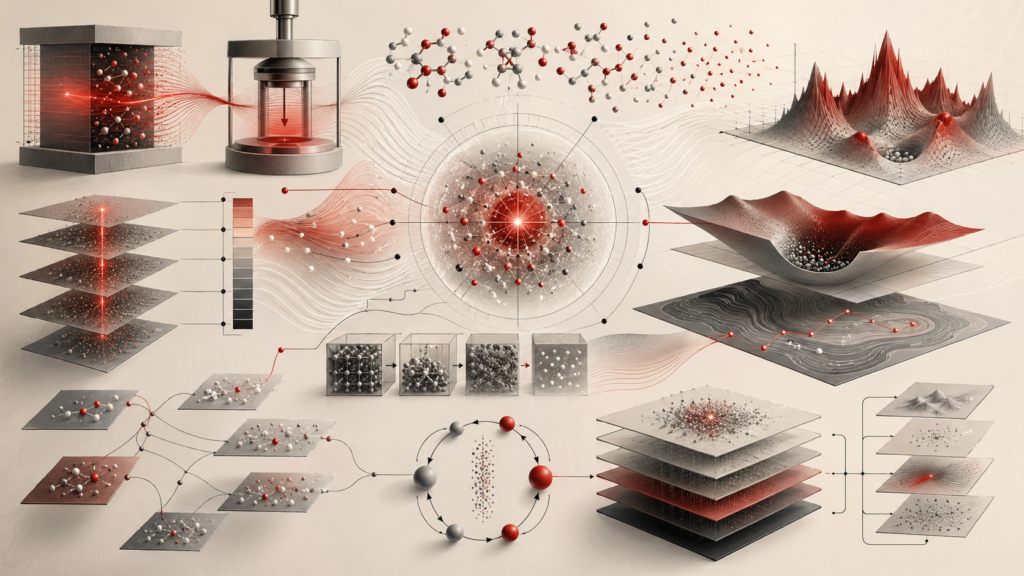
Abstract editorial scientific illustration of chemical thermodynamics, molecular energy flow, heat exchange, entropy dispersal, free-energy landscapes, phase transitions, and thermodynamic workflows in cream, gray, black, and deep red.

Chemical Thermodynamics and Energetics

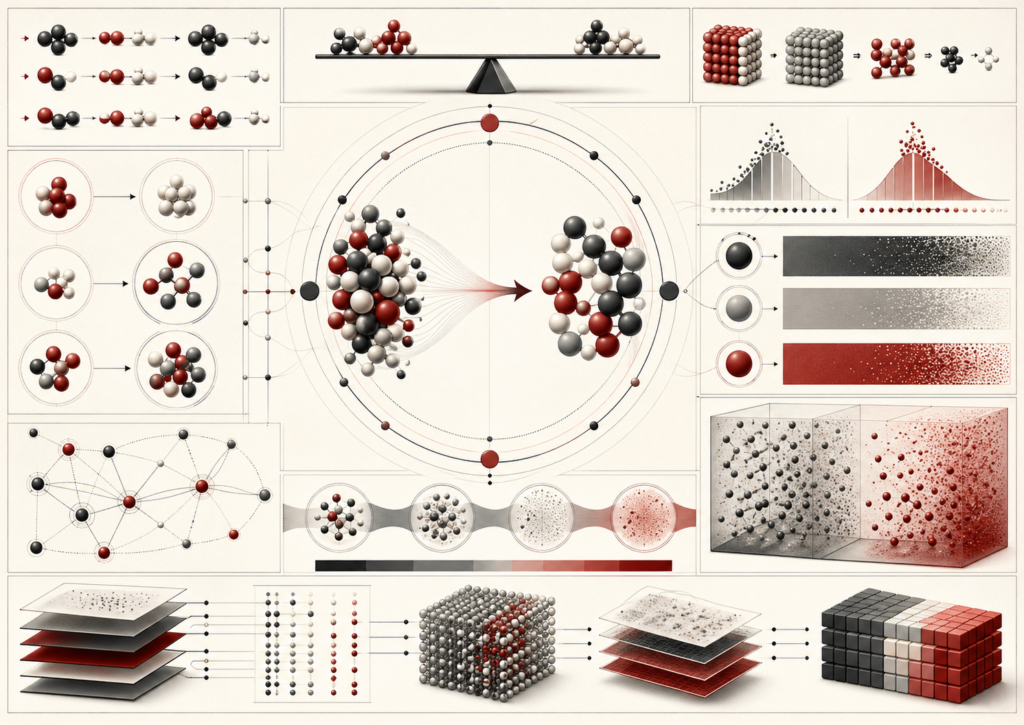
Chemical thermodynamics explains the energetic constraints that govern chemical change. Stoichiometry tells how much matter can react, but thermodynamics asks what energy is involved, what direction is favored, what equilibrium is possible, and why some transformations require heat, work, coupling, pressure, light, electricity, or different conditions. This article introduces systems, surroundings, state functions, internal energy, heat, work, enthalpy, entropy, Gibbs free energy, Hess’s law, calorimetry, heat capacity, phase transitions, bond enthalpy, standard states, reaction quotient, equilibrium constants, temperature dependence, chemical potential, and coupled reactions. It shows why thermodynamics does not determine reaction speed or mechanism, but defines the energetic boundary conditions within which reactions, equilibria, phases, materials, biochemical systems, environmental processes, and industrial chemistry must operate. Understanding thermodynamics connects laboratory measurements to feasibility, energy efficiency, process design, climate chemistry, metabolism, electrochemical systems, and sustainable materials innovation.

Abstract editorial scientific illustration of stoichiometry, balanced reaction relationships, reactant-product ratios, molecular quantities, process balances, and quantitative chemical workflows in cream, gray, black, and deep red.

Stoichiometry and the Quantitative Language of Reactions

Stoichiometry is the quantitative grammar of chemical reaction. A balanced chemical equation is not merely symbolic; it is a conservation statement about matter, charge, amount, mass, and measurable transformation. This article introduces stoichiometry through balanced equations, the mole, molar mass, stoichiometric coefficients, reaction ratios, limiting reagents, excess reagents, theoretical yield, actual yield, percent yield, concentration, dilution, titration, gas stoichiometry, empirical formulas, combustion analysis, reaction extent, process balances, and uncertainty. It shows why stoichiometry is not only an introductory chemistry exercise, but the foundation of laboratory planning, analytical chemistry, environmental monitoring, pharmaceutical preparation, industrial scale-up, materials synthesis, combustion analysis, and chemical accountability. The article also includes computational workflows for limiting reagents, yields, titration equivalence, gas reactions, empirical formula inference, and reproducible reaction data practice.

Abstract editorial scientific illustration of intermolecular forces, molecular clustering, liquid interfaces, crystal lattices, amorphous packing, radial distribution patterns, and condensed phases in cream, gray, black, and deep red.

Intermolecular Forces and the Chemistry of Condensed Matter

Intermolecular forces explain how molecules become matter in bulk. Chemical bonding describes how atoms are joined into molecules, ions, networks, and crystals, but intermolecular forces explain how those units attract, repel, organize, condense, evaporate, dissolve, crystallize, melt, flow, pack, and form surfaces. This article introduces dispersion forces, dipole-dipole interactions, ion-dipole interactions, hydrogen bonding, van der Waals forces, repulsion, potential energy curves, liquids, solids, vapor pressure, boiling point, melting point, viscosity, surface tension, solubility, molecular crystals, amorphous matter, ionic lattices, and radial distribution functions. It shows why condensed matter is not simply “many molecules,” but collective molecular organization shaped by energy, entropy, geometry, charge distribution, polarizability, thermal motion, pressure, interfaces, and statistical structure. Understanding these forces helps explain materials, environmental chemistry, biological recognition, formulation science, and everyday properties such as wetting, volatility, softness, hardness, flow, and industrial design workflows broadly.

Abstract editorial scientific illustration of molecular geometry, symmetry planes, orbital surfaces, bond angles, conformer variations, crystal lattices, and structural data patterns in cream, gray, black, and deep red.

Molecular Geometry, Symmetry, and Structure

Molecular geometry is the spatial form of chemical bonding. A formula tells which atoms are present, but molecular structure explains how those atoms are arranged in three-dimensional space. This article introduces molecular geometry, symmetry, and structure through bond lengths, bond angles, torsion angles, conformations, VSEPR theory, electron-domain geometry, point groups, chirality, stereochemistry, molecular surfaces, electron density, crystal structure, and experimental structure determination. It shows why molecular structure is not merely a drawing, but an evidence-based, model-dependent claim about matter supported by spectroscopy, diffraction, crystallography, computation, and mathematical representation. The article also includes computational workflows for molecular coordinates, distance matrices, bond-angle calculations, rotation matrices, center-of-mass estimates, RMSD comparisons, VSEPR metadata, symmetry operations, and reproducible molecular-geometry data practice.

Abstract editorial scientific illustration of periodic-table classification, unlabeled element blocks, atomic structures, periodic trends, element families, and chemical data patterns in cream, gray, black, and deep red.

The Periodic Table and the Logic of Chemical Classification

The periodic table is chemistry’s most powerful system of classification because it organizes elements by atomic structure, recurring behavior, and predictive relationships. This article explains why the table is more than a chart of element names: it is a scientific model that connects atomic number, electron configuration, groups, periods, blocks, isotopes, standard atomic weights, chemical families, metals, nonmetals, metalloids, transition metals, lanthanides, actinides, and periodic trends. It shows how chemical classification helps chemists reason from position to behavior, compare elements across families, identify exceptions, and translate atomic structure into chemical expectation. The article also connects periodic classification to modern computational chemistry, where element descriptors such as group, period, block, electronegativity, atomic radius, ionization energy, and oxidation state become structured data for modeling, prediction, and reproducible chemical workflows.

Abstract editorial scientific illustration of chemical bonding, molecular geometry, orbital overlap, electron sharing, bond polarity, and structured molecular forms in cream, gray, black, and deep red.

Chemical Bonding and Molecular Structure

Chemical bonding and molecular structure explain how atoms become molecules, ions, crystals, metals, polymers, biomolecules, and materials. Bonding is the organizing principle that connects electronic structure to molecular geometry, molecular geometry to physical properties, and physical properties to chemical behavior. This article introduces covalent, ionic, metallic, coordinate, polar, and delocalized bonding; Lewis structures; formal charge; resonance; valence-shell electron-pair repulsion; molecular geometry; hybridization; sigma and pi bonds; molecular orbital theory; bond order; bond length; bond energy; electronegativity; polarity; intermolecular forces; crystal and network structures; and computational approaches to molecular structure. It frames bonding not as a memorized set of diagrams, but as a structural language for understanding why matter has shape, stability, reactivity, directionality, charge distribution, and measurable chemical properties across molecular and extended systems.

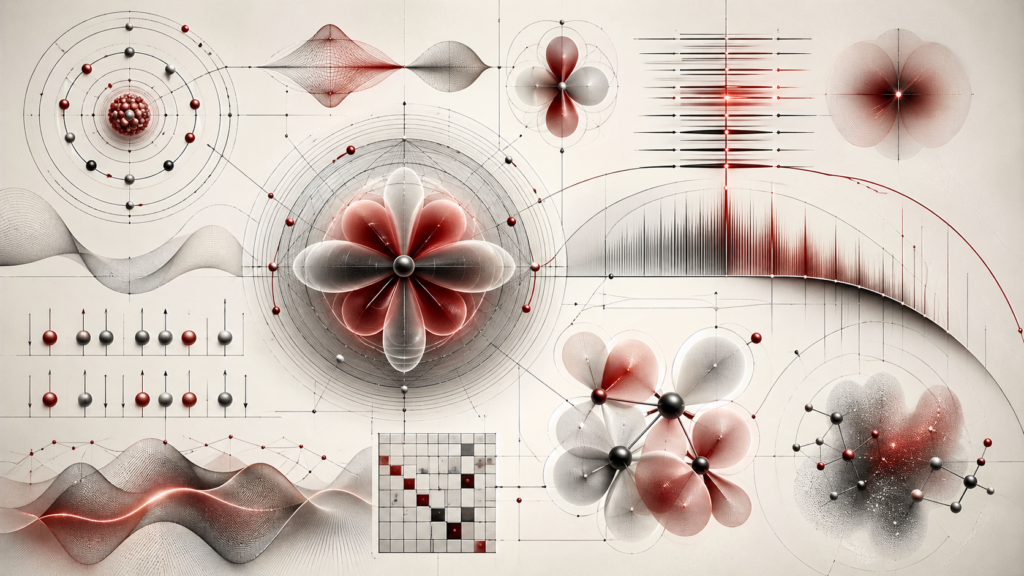
Abstract editorial scientific illustration of quantum orbitals, electron-density fields, energy-level bands, molecular orbital overlap, and electronic structure in cream, gray, black, and deep red.

Electronic Structure and the Quantum Foundations of Chemistry

Electronic structure is the quantum foundation of chemistry, explaining how electrons occupy orbitals, shape atoms, form bonds, absorb light, transfer charge, and determine chemical behavior. While chemistry often begins with substances and reactions, its deepest explanations depend on quantum principles: energy levels, wavefunctions, electron configuration, spin, probability, and molecular orbitals. These ideas connect the periodic table to bonding patterns, spectroscopy, magnetism, reactivity, catalysis, materials design, electrochemistry, and computational chemistry. Electronic structure shows why carbon forms diverse frameworks, why metals conduct electricity, why molecules have color, and why small changes in electron distribution can transform properties. It also links experimental evidence to mathematical models and simulation. Understanding electronic structure therefore turns chemistry into a science of invisible order, where molecular behavior emerges from the quantum architecture of matter. It makes chemical prediction more rigorous, visual, and computationally powerful today.

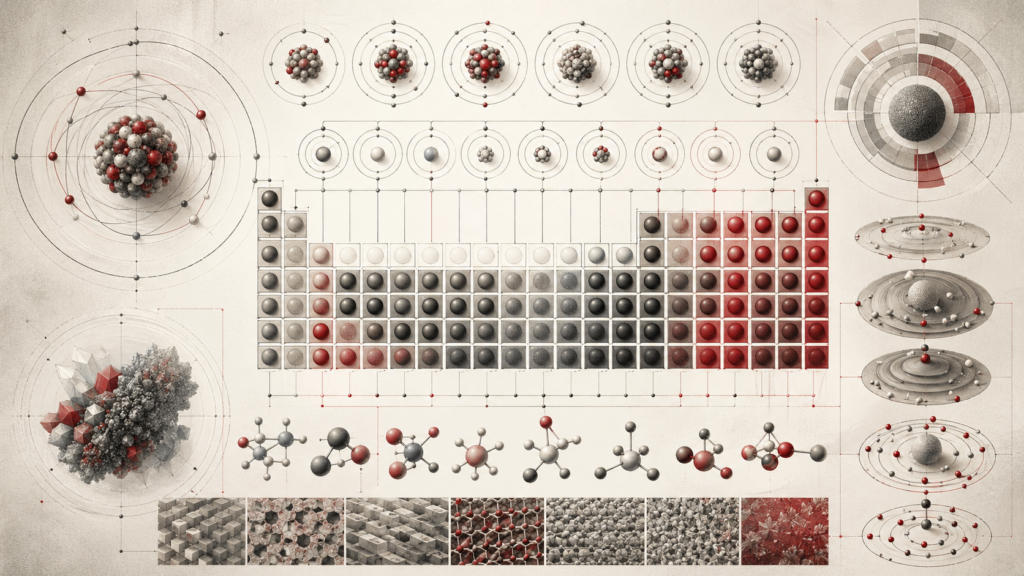
Editorial scientific illustration showing abstract atomic structures, isotope-like variations, molecular forms, and a stylized periodic-table arrangement in cream, gray, black, and deep red.

Atoms, Elements, and the Periodic Organization of Matter

Atoms, elements, and the periodic organization of matter form the structural foundation of chemistry. Every substance is built from atoms, whose protons, neutrons, and electrons determine identity, stability, bonding, and reactivity. Elements organize this diversity into a coherent system, while the periodic table reveals recurring patterns in atomic size, ionization energy, electronegativity, valence, metallic character, and chemical behavior. This organization makes chemistry predictive rather than merely descriptive, allowing scientists to connect atomic structure with molecular formation, material properties, biological function, environmental processes, and technological design. From hydrogen and carbon to transition metals and rare earth elements, the periodic table shows how matter is both varied and ordered. Understanding atoms and elements therefore provides the language for explaining substances, reactions, materials, and the molecular architecture of the natural and engineered world. It remains chemistry’s most powerful map of material possibility.

Scroll to Top