
Last Updated May 28, 2026
Intermolecular forces explain how molecules become matter in bulk. Chemical bonding explains how atoms are joined into molecules, ions, networks, and crystals; intermolecular forces explain how those chemical units attract, repel, organize, condense, evaporate, dissolve, crystallize, melt, flow, pack, phase-separate, form surfaces, and acquire macroscopic properties.
The central thesis of this article is that condensed matter is collective molecular organization. Liquids, solids, surfaces, solutions, crystals, glasses, gels, films, aerosols, membranes, and soft materials are not merely “many molecules.” They are structured systems shaped by attraction, repulsion, thermal motion, entropy, geometry, charge distribution, polarizability, pressure, confinement, surfaces, and statistical order.
A molecule is not isolated in ordinary material life. Water molecules hydrogen-bond. Carbon dioxide molecules attract through dispersion and quadrupolar interactions. Ionic solids organize through long-range electrostatic forces. Molecular crystals pack through shape complementarity, hydrogen bonding, halogen bonding, pi interactions, and van der Waals contact. Liquids flow because attractive forces keep molecules close while thermal motion allows rearrangement. Solids persist because interactions stabilize ordered or disordered structures. Surfaces form because molecules at boundaries experience different interactions than molecules in the interior.
Main Library
Publications
Article Map
Chemistry
Related Topic
Physics
Related Topic
Mathematical Modeling
Related Topic
Environmental Monitoring Systems
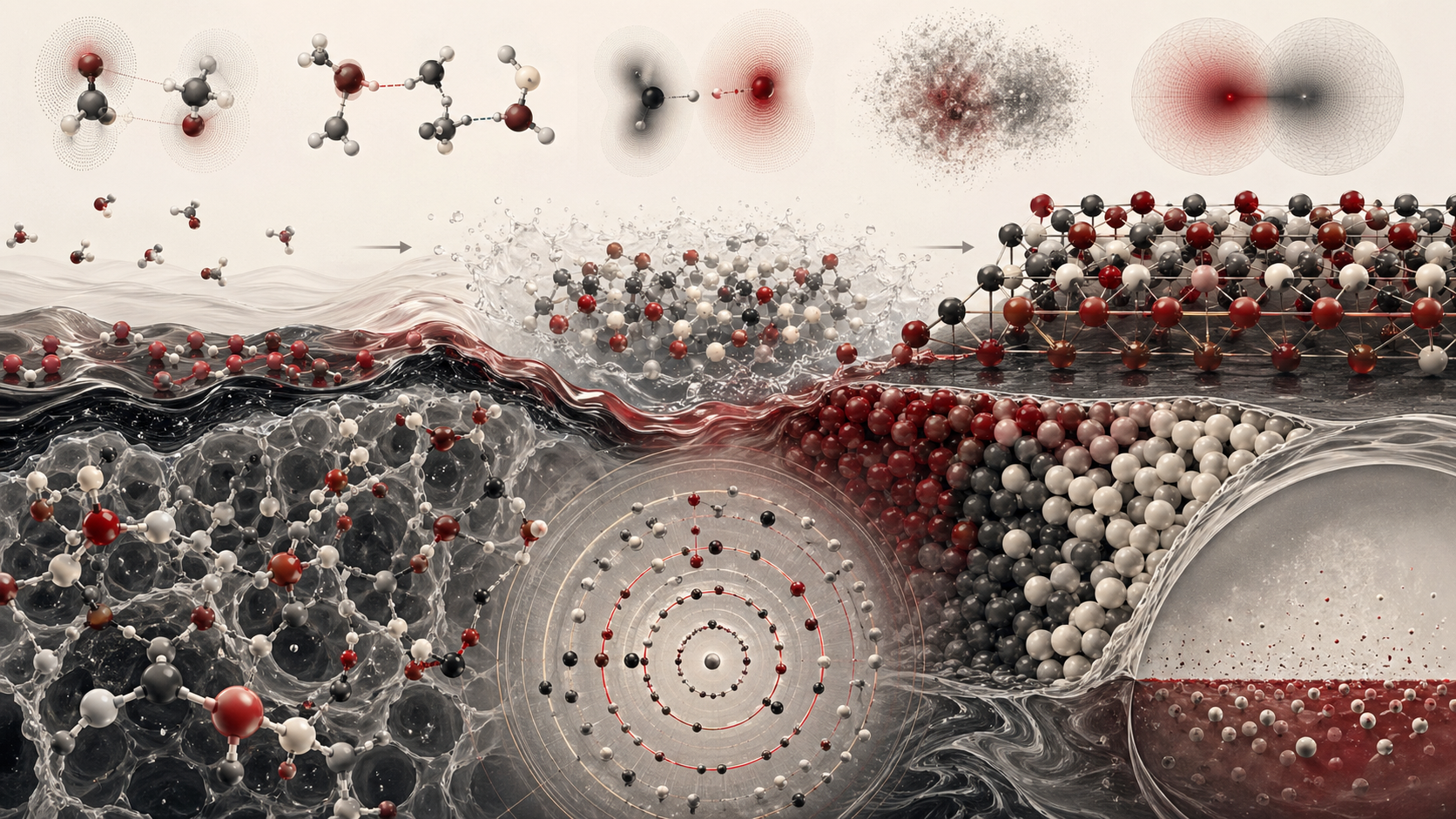
Why Intermolecular Forces Matter
Intermolecular forces matter because they connect molecular identity to material behavior. They help explain why water is liquid at ordinary conditions, why methane is a gas, why iodine sublimes, why ethanol mixes with water, why oils separate from water, why polymers soften, why proteins fold, why DNA strands associate, why crystals pack, why liquids have surface tension, and why some solids are brittle while others are soft, flexible, layered, or glassy.
These forces also explain why molecular structure alone is not enough. A molecule’s formula and bonding tell us what the molecule is, but condensed-phase behavior depends on how many molecules interact. Boiling point depends not only on molecular mass but also on polarity, hydrogen bonding, dispersion forces, molecular shape, and packing. Solubility depends on interactions between solute and solvent, not only on the solute itself. Crystal form depends on how molecules arrange in repeating structures, not merely on their chemical formula.
Intermolecular forces translate microscopic chemistry into macroscopic properties. They connect electron distribution to phase behavior, molecular shape to packing, polarity to solvation, hydrogen bonding to biological recognition, ion-dipole interactions to electrolyte behavior, and dispersion to the cohesion of nonpolar matter.
This makes condensed-matter chemistry essential to research practice. Drug formulation, battery electrolytes, aerosol particles, water activity, polymer films, protein assemblies, adhesives, membranes, porous solids, gels, paints, coatings, and crystallization processes all depend on interactions among chemical units.
Condensed matter is chemistry at the collective scale. To understand how matter behaves in the real world, chemists must understand not only molecules but molecular neighborhoods.
From Molecular Structure to Condensed Matter
Condensed matter includes liquids and solids. In gases, molecules are relatively far apart and interact intermittently. In condensed phases, molecules, ions, atoms, or structural units remain close enough that interactions are continuous and collective. This proximity produces properties that isolated molecules do not have.
A liquid is not merely a disordered solid or a dense gas. It has local structure, mobility, cohesion, diffusion, and dynamic rearrangement. A solid is not merely molecules at rest. Solids can be crystalline, amorphous, ionic, metallic, molecular, covalent-network, polymeric, glassy, porous, layered, defect-rich, or composite. A surface is not merely the edge of matter. It is a region where forces, structure, reactivity, and energy differ from the bulk.
Intermolecular forces govern much of this behavior. They are usually weaker than covalent bonds, but their collective effect can be enormous. A single hydrogen bond may be modest in strength, but a network of hydrogen bonds can shape water, ice, cellulose, proteins, nucleic acids, and supramolecular assemblies. Dispersion forces are individually weak, but they become significant in large molecules, polymers, layered materials, molecular crystals, and biomolecular interfaces.
Thermal motion also matters. At finite temperature, molecules vibrate, rotate, translate, diffuse, and rearrange. Condensed matter reflects the balance between interaction energy and thermal energy. Strong interactions can stabilize structure; thermal energy can disrupt order and enable flow.
Condensed matter chemistry therefore requires both molecular and statistical thinking. It asks how individual interactions accumulate into bulk behavior and how bulk conditions reshape individual molecular behavior.
Dispersion Forces and Polarizability
London dispersion forces arise from fluctuations in electron distribution. Even nonpolar molecules can experience temporary dipoles that induce dipoles in neighboring molecules. Correlated fluctuations produce attraction.
Dispersion forces increase with polarizability. Large atoms and molecules with diffuse electron clouds are often more polarizable than small, compact ones. This helps explain why boiling points tend to increase down a group among noble gases and halogens, and why large nonpolar molecules can condense into liquids or solids despite lacking permanent dipoles.
Dispersion is sometimes underappreciated because introductory chemistry often emphasizes polarity and hydrogen bonding. But dispersion is universal. It operates between all atoms and molecules. It contributes to the stability of molecular crystals, hydrocarbons, polymers, membranes, proteins, layered materials, aerosols, organic liquids, pharmaceutical solids, and many solid-state assemblies.
Molecular shape matters too. Long, flat, or extended molecules may have greater surface contact than compact molecules of similar mass. Increased contact can strengthen dispersion interactions and influence boiling point, melting point, viscosity, volatility, adsorption, and crystal packing.
Dispersion forces also help explain why nonpolar materials can be cohesive. Hydrocarbon chains aggregate. Wax is solid. Graphitic layers adhere. Organic molecules crystallize. Protein interiors contain hydrophobic packing. Nonpolar does not mean noninteracting.
For researchers, dispersion is not a residual weak effect. It is a central component of condensed-phase structure, especially when many contact surfaces accumulate across a material.
Dipole-Dipole and Ion-Dipole Interactions
Polar molecules have permanent dipole moments. A dipole-dipole interaction occurs when the positive end of one molecular dipole interacts with the negative end of another. These interactions are directional and depend on molecular orientation, distance, temperature, and surrounding environment.
Dipole-dipole interactions help explain why polar molecules often have higher boiling points than nonpolar molecules of similar size. They also influence solubility, molecular alignment, dielectric behavior, crystal packing, liquid structure, and intermolecular recognition.
Ion-dipole interactions occur when ions interact with polar molecules. These interactions are especially important in solutions. When sodium chloride dissolves in water, water molecules orient around \(Na^+\) and \(Cl^-\), stabilizing separated ions through hydration. Ion-dipole interactions are central to electrolyte solutions, biological ion transport, batteries, atmospheric aerosols, geochemistry, water treatment, and environmental chemistry.
The strength of ion-dipole interactions depends on ion charge, ion size, dipole moment, solvent structure, dielectric environment, coordination geometry, and competing interactions. A small highly charged ion can strongly organize surrounding solvent molecules. This local ordering is one reason solution chemistry cannot be reduced to isolated molecules floating in empty space.
Ion pairing, hydration shells, solvation free energy, conductivity, activity coefficients, and transport behavior all depend on the balance between electrostatic attraction, solvent organization, entropy, and thermal motion.
For researchers, dipole and ion-dipole interactions provide the bridge between molecular polarity and condensed-phase behavior in solvents, electrolytes, interfaces, and biological fluids.
Hydrogen Bonding
Hydrogen bonding is a particularly important and directional intermolecular interaction. It commonly occurs when hydrogen bonded to an electronegative atom interacts with an electron-rich site such as a lone pair, pi system, or electronegative atom in another molecule or another part of the same molecule.
Water is the most familiar hydrogen-bonding liquid. Its unusually high boiling point relative to similar small molecules, high heat capacity, surface tension, ice structure, solvent behavior, and biological importance all depend in part on hydrogen bonding. But hydrogen bonding is not limited to water. It is central to alcohols, carboxylic acids, amides, proteins, nucleic acids, carbohydrates, cellulose, supramolecular chemistry, pharmaceuticals, and many crystal structures.
Hydrogen bonds vary in strength, geometry, and context. They may be intermolecular or intramolecular. They may be strong, moderate, or weak. They may help organize structure, stabilize transition states, guide molecular recognition, alter acidity, control solubility, influence viscosity, or determine crystal packing.
Hydrogen bonding also shows why molecular geometry matters. Directionality affects how molecules pack, how biological macromolecules fold, and how solids form networks. A hydrogen bond is not merely an attraction; it is a structural force.
Hydrogen-bond networks can also be dynamic. In liquid water, hydrogen bonds form and break continually. In proteins and nucleic acids, hydrogen bonds operate within a crowded environment shaped by solvent, ions, conformational strain, entropy, and neighboring interactions. In crystals, hydrogen bonds can stabilize particular polymorphs or supramolecular motifs.
For researchers, hydrogen bonding is both an energetic and architectural principle. It organizes matter across scales from small-molecule liquids to biomolecular assemblies and solid-state forms.
van der Waals Forces and Repulsion
The phrase van der Waals forces is often used for intermolecular attractions that include dispersion, dipole-induced dipole, and dipole-dipole contributions. In molecular modeling contexts, van der Waals interactions may also include short-range repulsion arising when electron clouds overlap too closely.
At long enough distances, attractions may draw molecules together. At very short distances, repulsion becomes dominant. This balance creates an equilibrium separation where attraction and repulsion produce a potential-energy minimum.
Repulsion matters because molecules cannot collapse into one another. The apparent “size” of atoms and molecules in condensed matter is partly a consequence of repulsive interactions and electron-density overlap. Molecular packing, steric effects, liquid structure, crystal structure, protein-ligand binding, and surface adsorption all depend on the balance between attraction and repulsion.
Van der Waals interactions are therefore not vague weak forces. They are part of the energetic architecture of matter. They help determine contact distances, packing density, lattice energy, adsorption strength, conformational preference, and condensed-phase stability.
In research settings, van der Waals modeling requires caution. A generic force-field term may approximate interactions well for one class of molecules but poorly for another. Parameter choice, combining rules, polarizability, anisotropy, and many-body effects can all affect results.
For researchers, van der Waals interactions are both conceptually simple and computationally delicate: they express universal attraction and repulsion, but their accurate modeling depends on context.
Potential Energy Curves and Molecular Separation
Intermolecular interactions are often represented using potential energy as a function of distance. One common model is the Lennard-Jones potential:
U(r) = 4\varepsilon\left[\left(\frac{\sigma}{r}\right)^{12}-\left(\frac{\sigma}{r}\right)^6\right]
\]
Interpretation: \(U(r)\) is potential energy, \(r\) is separation distance, \(\varepsilon\) describes well depth, and \(\sigma\) is a distance parameter related to repulsive contact.
The \(r^{-12}\) term represents steep short-range repulsion, while the \(r^{-6}\) term represents attractive dispersion-like behavior. The model is simplified, but it is useful in molecular simulation and conceptual explanation.
The equilibrium distance occurs near the potential minimum. At separations larger than this minimum, attraction dominates. At shorter separations, repulsion rises sharply. This curve helps explain why condensed matter has structure: molecules tend to occupy separations that balance attraction, repulsion, thermal motion, and packing constraints.
Electrostatic interactions may be represented using Coulombic terms. Hydrogen bonding may require directional terms or emerge from electrostatics and geometry depending on the model. Polarizable systems may require induced-dipole or many-body treatment. Molecular simulations combine such terms into force fields or more detailed electronic-structure calculations.
Potential energy functions are not reality itself. They are models. Their usefulness depends on parameter quality, molecular context, phase, temperature, pressure, and whether the relevant interaction types are adequately represented.
For researchers, potential-energy curves provide a disciplined way to connect molecular separation to stability, but they must be treated as models with domains of validity.
Liquids and the Chemistry of Flow
Liquids occupy a middle ground between gases and solids. Molecules in liquids are close together, but they can move, rotate, diffuse, and rearrange. This gives liquids cohesion without rigid long-range order.
Intermolecular forces shape liquid properties such as viscosity, surface tension, vapor pressure, boiling point, heat capacity, diffusion, miscibility, density, compressibility, dielectric behavior, and solvation. Stronger attractions often increase boiling point and viscosity, though molecular shape and dynamics matter. Hydrogen-bonded liquids can show distinctive behavior because directional networks form and break continuously.
Water is a special case because its hydrogen-bond network gives it unusual properties. But other liquids also show complex organization. Ionic liquids have strong electrostatic interactions and low volatility. Organic solvents vary widely in polarity, hydrogen-bonding ability, polarizability, and viscosity. Liquid crystals combine fluidity with orientational order. Polymer melts show entanglement and slow dynamics.
Liquids are also chemically active environments. Solvent molecules stabilize transition states, screen charges, organize ions, shift equilibria, alter reaction rates, and influence selectivity. A reaction may proceed differently in water, ethanol, acetonitrile, dimethyl sulfoxide, ionic liquid, oil phase, molten salt, or biological cytoplasm because the condensed phase participates in the chemistry.
Liquid chemistry is therefore not random molecular motion. It is structured motion. Molecules move, but their movement is constrained by interaction networks, local order, and energy landscapes.
For researchers, liquids should be treated as organized chemical media, not passive containers.
Solids, Crystals, and Amorphous Matter
Solids can be classified by the nature of their structural units and interactions. Ionic solids are stabilized by electrostatic attraction among ions. Molecular solids are stabilized by intermolecular forces among molecules. Metallic solids involve delocalized electrons across atomic arrays. Covalent network solids contain extended covalent structures. Polymers may be semicrystalline or amorphous. Glasses have disordered structures that lack long-range crystalline periodicity.
Crystals have long-range order. Their atoms, ions, or molecules repeat in patterns described by unit cells, lattices, and symmetry. Amorphous solids have local structure but lack long-range periodic order. Both can be chemically important. A pharmaceutical compound may have multiple crystalline polymorphs and amorphous forms, each with different solubility and stability. A polymer may have crystalline regions embedded in amorphous regions. A silicate glass may be structurally disordered but technologically indispensable.
Intermolecular forces influence crystal packing, melting point, sublimation, polymorphism, mechanical properties, solid-state reactivity, hydration, desolvation, and stability. The same molecule may crystallize differently under different conditions, producing different condensed-matter behavior.
Defects also matter. Real solids contain vacancies, dislocations, grain boundaries, surfaces, impurities, disorder, and interfaces. These features can control diffusion, strength, optical behavior, electrical behavior, catalytic activity, degradation, and reactivity.
Solid-state chemistry is therefore a chemistry of order, disorder, interaction, and structure. It connects molecular interactions to material properties through packing, symmetry, defects, and phase stability.
For researchers, a solid is not defined only by composition. It is defined by composition, phase, structure, defects, history, and environment.
Phase Transitions, Vapor Pressure, and Boiling
Phase transitions occur when matter changes between solid, liquid, gas, or other phases. Melting, freezing, vaporization, condensation, sublimation, deposition, glass transition, crystallization, and polymorphic transformation all involve changes in molecular organization and energy.
Vapor pressure reflects the tendency of molecules to escape from a condensed phase into the gas phase. Substances with stronger intermolecular attractions often have lower vapor pressures and higher boiling points, although molecular mass, entropy, shape, and structure also matter.
Boiling occurs when vapor pressure equals external pressure. This is why boiling point depends on pressure. At lower atmospheric pressure, water boils at a lower temperature. In a pressure cooker, water can remain liquid at higher temperatures because pressure is increased.
The Clausius-Clapeyron relationship provides a useful approximation for vapor pressure behavior:
\ln P = -\frac{\Delta H_{\mathrm{vap}}}{RT} + C
\]
Interpretation: Vapor pressure \(P\) varies with temperature \(T\), enthalpy of vaporization \(\Delta H_{\mathrm{vap}}\), gas constant \(R\), and fitted constant \(C\) over a limited range.
This relationship connects intermolecular forces, energy, and temperature to measurable phase behavior. Stronger cohesive interactions often require more energy for vaporization, increasing \(\Delta H_{\mathrm{vap}}\) and lowering vapor pressure at a given temperature.
Phase transitions can also be path-dependent in real materials. Supercooling, glass formation, nucleation barriers, polymorphic transformation, hysteresis, and metastability can cause observed behavior to deviate from simple equilibrium expectations.
For researchers, phase behavior requires both thermodynamic and kinetic interpretation. The stable phase may be predicted thermodynamically, but the observed phase may depend on history, nucleation, confinement, impurities, and rate of change.
Surface Tension, Capillarity, and Interfaces
A molecule in the interior of a liquid experiences interactions from surrounding molecules in many directions. A molecule at the surface experiences an asymmetric environment. This difference gives rise to surface tension: the energetic cost of increasing surface area.
\gamma = \left(\frac{\partial G}{\partial A}\right)_{T,p,n}
\]
Interpretation: Surface tension \(\gamma\) can be interpreted as the change in Gibbs free energy \(G\) with surface area \(A\) under specified conditions.
Surface tension affects droplets, bubbles, capillary rise, wetting, emulsions, foams, aerosols, membranes, coatings, microfluidics, and biological interfaces. Water has high surface tension because of its strong cohesive hydrogen-bonding network. Surfactants reduce surface tension by accumulating at interfaces and changing intermolecular interactions.
Interfaces are chemically important because they are regions where phases meet: liquid-gas, solid-liquid, solid-gas, liquid-liquid, biological membrane-water, mineral-water, electrode-electrolyte, air-aerosol, or polymer-composite boundaries. Interfacial chemistry is central to catalysis, electrochemistry, colloids, corrosion, environmental transport, atmospheric aerosols, and materials engineering.
Surface chemistry also differs from bulk chemistry. Molecules at interfaces may orient differently, react differently, concentrate selectively, experience different dielectric environments, or participate in interfacial electric fields. A pollutant at an air-water interface, a protein at a membrane surface, or an ion at an electrode interface may behave differently from the same species in bulk solution.
Condensed matter chemistry therefore cannot study only bulk phases. Surfaces and interfaces often control behavior.
Solubility, Mixing, and Molecular Compatibility
Solubility depends on the balance among solute-solute, solvent-solvent, and solute-solvent interactions. A substance dissolves when the resulting mixture is thermodynamically favorable under given conditions. This depends on enthalpy, entropy, polarity, hydrogen bonding, ion-dipole interactions, molecular size, structure, temperature, pressure, and phase form.
The phrase “like dissolves like” is useful but incomplete. Polar solvents often dissolve polar solutes and ions because favorable interactions compensate for disrupting existing interactions. Nonpolar solvents often dissolve nonpolar solutes through dispersion and compatible cohesive energy. But real solubility can be shaped by specific interactions, acid-base chemistry, ionization, complexation, temperature, pressure, crystallinity, particle size, impurities, and solvent mixtures.
Solubility is central to pharmaceuticals, environmental fate, extraction, purification, geochemistry, food chemistry, polymer science, and biological transport. It determines whether a compound remains in a solid, partitions into water, accumulates in lipids, evaporates into air, binds to soil, crystallizes, precipitates, or becomes bioavailable.
Mixing also has entropic and enthalpic dimensions. Two liquids may mix completely, partially, or not at all depending on molecular compatibility. Polymer blends may phase-separate. Proteins may form condensates. Surfactants may assemble into micelles. Salts may alter solubility through ionic strength and specific ion effects.
Solubility is thus a condensed-matter property with molecular consequences. It is not a fixed attribute of an isolated molecule but a relation among molecule, phase, solvent, temperature, and environment.
Radial Distribution and Local Structure
Liquids and amorphous solids lack the long-range order of perfect crystals, but they are not structureless. Radial distribution functions describe how particle density varies as a function of distance from a reference particle. Peaks in a radial distribution function indicate preferred neighbor distances.
A simplified radial distribution function is written:
g(r) = \frac{\rho(r)}{\rho_{\mathrm{bulk}}}
\]
Interpretation: \(g(r)\) compares local density at distance \(r\) with average bulk density.
In a gas with little structure, \(g(r)\) approaches 1 over broad distances. In liquids, \(g(r)\) often shows peaks corresponding to local coordination shells. In crystals, long-range order produces regular structure over larger distances.
Radial distribution functions are used in molecular simulation, scattering analysis, liquid-state theory, materials chemistry, and condensed-matter physics. They help translate molecular positions into measurable structural information.
Local structure matters because many condensed phases are neither perfectly ordered nor random. Liquids, glasses, gels, polymers, electrolytes, aerosols, and biological environments often show intermediate organization. The local arrangement of neighbors can control diffusion, viscosity, reaction rate, conductivity, solvation, and mechanical response.
For researchers, radial distribution is a reminder that “disordered” does not mean “unstructured.” Condensed phases can have rich local organization even without crystalline periodicity.
Condensed Matter in Materials, Life, and Environment
Intermolecular forces shape materials, living systems, and environmental processes. In materials research, they influence polymers, molecular crystals, organic semiconductors, adhesives, coatings, gels, porous materials, nanomaterials, membranes, composite interfaces, and soft matter. In biology, they shape protein folding, membrane structure, DNA base pairing, enzyme-substrate recognition, hydration shells, phase separation, and biomolecular condensates. In environmental chemistry, they influence sorption to soils, partitioning into organic matter, aerosol formation, ice nucleation, pollutant mobility, and contaminant persistence.
Condensed matter also matters for technology. Batteries depend on electrolyte structure, ion solvation, interfacial films, and transport. Pharmaceuticals depend on crystal form, solubility, stability, dissolution, and formulation. Food chemistry depends on emulsions, gels, crystallization, water activity, and texture. Atmospheric chemistry depends on aerosol particles, cloud droplets, ice surfaces, organic films, and heterogeneous reactions. Polymer engineering depends on glass transition, crystallinity, chain interactions, and phase behavior.
Biology is condensed-phase chemistry under extraordinary constraint. Cells are crowded molecular environments. Proteins fold in solvent. Membranes self-assemble. Nucleic acids pair. Biomolecular condensates form through many weak interactions acting together. Hydration, ion atmosphere, excluded volume, and local dielectric environment can alter molecular behavior.
Environmental justice also has a condensed-matter dimension. Solubility, volatility, sorption, partitioning, persistence, and bioavailability influence chemical exposure. Contaminants may bind to sediments, accumulate in organic matter, volatilize into air, dissolve into groundwater, or persist in microplastics. These behaviors are governed by intermolecular interactions and phase partitioning.
The chemistry of condensed matter is therefore not a secondary topic after molecular structure. It is how molecular structure becomes usable, measurable, functional, and consequential in the real world.
Condensed-Phase Data, Computation, and Reproducibility
Condensed-phase chemistry increasingly depends on data and computation. Molecular simulations, crystallographic databases, scattering experiments, thermodynamic tables, surface-tension measurements, vapor-pressure records, solubility datasets, phase diagrams, spectroscopy, microscopy, and property models all contribute to understanding condensed matter.
Reproducible condensed-phase workflows should preserve:
- molecular identities, formulas, and structures;
- phase, temperature, pressure, and composition;
- force-field or electronic-structure method;
- interaction parameters and units;
- simulation box size, boundary conditions, timestep, and equilibration method;
- experimental method and calibration records;
- surface or interface definitions;
- crystal form, polymorph, hydration state, or amorphous status;
- solvent, salt, pH, ionic strength, and additives;
- uncertainty, replicates, and validation evidence;
- data sources and versioning.
Computation can make condensed-phase reasoning more transparent, but it can also produce false confidence. A simulation may depend strongly on force-field parameters. A vapor-pressure fit may apply only over a limited temperature range. A solubility prediction may fail for ionizable compounds or different crystal forms. A radial distribution function may depend on sampling, density, boundary conditions, and equilibration.
For researchers, condensed-matter computation should make assumptions visible. The output should not only show a curve, property, or structure; it should preserve the conditions under which the result has meaning.
Mathematical Lens: Intermolecular Forces and Condensed Matter
Intermolecular forces and condensed phases can be represented through energy functions, thermodynamic relationships, structural distributions, and statistical measures. The Lennard-Jones potential is:
U(r) = 4\varepsilon\left[\left(\frac{\sigma}{r}\right)^{12}-\left(\frac{\sigma}{r}\right)^6\right]
\]
Interpretation: This simplified model combines short-range repulsion and longer-range attraction.
A Coulombic interaction is:
U(r) = \frac{1}{4\pi\varepsilon_0}\frac{q_1q_2}{r}
\]
Interpretation: This idealized expression describes electrostatic interaction between point charges in vacuum.
A Boltzmann weight is:
w_i = e^{-E_i/(k_BT)}
\]
Interpretation: Lower-energy states have higher statistical weight at temperature \(T\), though degeneracy and ensemble context also matter.
The Clausius-Clapeyron approximation is:
\ln P = -\frac{\Delta H_{\mathrm{vap}}}{RT} + C
\]
Interpretation: Vapor pressure can be related to temperature over a fitted range under simplifying assumptions.
The radial distribution function is:
g(r) = \frac{\rho(r)}{\rho_{\mathrm{bulk}}}
\]
Interpretation: Local density at distance \(r\) is compared with average bulk density.
Surface tension is:
\gamma = \left(\frac{\partial G}{\partial A}\right)_{T,p,n}
\]
Interpretation: Surface tension measures free-energy cost per unit increase in surface area under specified conditions.
Mean-square displacement for simple three-dimensional diffusion is:
\langle r^2(t) \rangle = 6Dt
\]
Interpretation: The diffusion coefficient \(D\) relates average squared displacement to time for simple isotropic diffusion.
The Stokes-Einstein relation is often written:
D = \frac{k_BT}{6\pi\eta R}
\]
Interpretation: This approximate relation connects diffusion coefficient, temperature, viscosity \(\eta\), and particle radius \(R\) under idealized conditions.
A partition coefficient can be represented as:
K = \frac{C_{\mathrm{phase\ 1}}}{C_{\mathrm{phase\ 2}}}
\]
Interpretation: Partitioning expresses how a species distributes between two phases under specified conditions.
These equations show that condensed matter chemistry is both molecular and statistical. It requires energies, distances, temperatures, probabilities, densities, interfaces, motion, and collective structure.
Computational Workflows for Intermolecular Forces
Computational workflows can make intermolecular-force reasoning more transparent. A workflow can track molecular structures, interaction parameters, potential-energy functions, radial distribution scaffolds, vapor-pressure fits, surface-tension records, diffusion estimates, solubility tables, phase-property datasets, force-field metadata, simulation assumptions, and provenance.
Useful workflows include Lennard-Jones potential curves, Coulombic interaction examples, Boltzmann weighting, vapor-pressure fitting, surface-tension summaries, radial distribution histograms, diffusion mean-square-displacement scaffolds, solubility comparison tables, molecular crystal property registers, and SQL evidence systems.
For researchers, condensed-phase workflows should preserve four distinctions:
- Molecule versus phase: an isolated molecule does not determine bulk behavior by itself.
- Interaction type versus measured property: boiling point, viscosity, and solubility emerge from many interactions, not a single label.
- Model potential versus real matter: force-field equations approximate interactions and require validation.
- Equilibrium property versus kinetic pathway: stable phases, observed phases, nucleation, and glass formation may differ.
The examples below use synthetic educational data. They do not validate real force fields, certify material properties, approve pharmaceutical formulation, establish environmental fate, or replace professional condensed-phase analysis. They demonstrate how intermolecular-force reasoning can be organized, audited, and communicated responsibly.
Python Example: Lennard-Jones Potentials, RDF Scaffolds, Vapor Pressure, and Provenance
The following Python example uses synthetic educational data. It calculates a Lennard-Jones potential curve, estimates a simple radial distribution-like histogram from coordinates, fits a Clausius-Clapeyron-style vapor pressure relationship, summarizes surface-tension records, and writes provenance outputs. In real condensed-phase work, these workflows should preserve validated parameters, units, sampling conditions, calibration records, and uncertainty.
from pathlib import Path
from typing import Dict, List
import json
import math
import platform
import sys

import numpy as np
import pandas as pd


# Synthetic condensed-matter chemistry workflow.
# Educational example only; not for force-field validation,
# pharmaceutical formulation, environmental compliance,
# materials certification, or safety-critical decisions.


def require_columns(data: pd.DataFrame, required: List[str], table_name: str) -> None:
    """Raise an error if required columns are missing."""
    missing = [column for column in required if column not in data.columns]
    if missing:
        raise ValueError(f"{table_name} is missing required columns: {missing}")


epsilon_kj_mol = 0.997
sigma_angstrom = 3.40

r_angstrom = np.linspace(3.0, 10.0, 160)

u_kj_mol = 4.0 * epsilon_kj_mol * (
    (sigma_angstrom / r_angstrom) ** 12
    - (sigma_angstrom / r_angstrom) ** 6
)

potential = pd.DataFrame({
    "r_angstrom": r_angstrom,
    "u_kj_mol": u_kj_mol,
})

minimum = potential.loc[potential["u_kj_mol"].idxmin()]

coordinates = pd.DataFrame({
    "particle": range(1, 13),
    "x": [0.0, 1.0, 0.9, -1.1, -0.8, 2.0, -2.1, 0.1, 1.8, -1.7, 0.4, -0.3],
    "y": [0.0, 0.2, 1.1, 0.1, -1.0, 0.4, -0.2, 2.2, -1.1, 1.5, -2.0, 1.8],
    "z": [0.0, 0.1, -0.2, 1.0, -0.3, 0.5, 0.6, -0.7, 1.2, -1.4, 0.8, -1.1],
})

require_columns(coordinates, ["x", "y", "z"], "coordinates")

coords = coordinates[["x", "y", "z"]].to_numpy()

distances = []

for i in range(len(coords)):
    for j in range(i + 1, len(coords)):
        distances.append(np.linalg.norm(coords[i] - coords[j]))

hist, edges = np.histogram(distances, bins=np.linspace(0, 5, 11))

rdf_scaffold = pd.DataFrame({
    "r_lower": edges[:-1],
    "r_upper": edges[1:],
    "pair_count": hist,
})

vapor = pd.DataFrame({
    "temperature_K": [290, 300, 310, 320, 330, 340],
    "pressure_kPa": [1.9, 3.0, 4.6, 6.9, 10.1, 14.5],
})

vapor["inverse_temperature_K_inv"] = 1.0 / vapor["temperature_K"]
vapor["ln_pressure"] = np.log(vapor["pressure_kPa"])

slope, intercept = np.polyfit(
    vapor["inverse_temperature_K_inv"],
    vapor["ln_pressure"],
    deg=1,
)

R_J_mol_K = 8.314462618

estimated_delta_h_vap_kj_mol = -slope * R_J_mol_K / 1000.0

vapor_fit_summary = pd.DataFrame([{
    "slope": slope,
    "intercept": intercept,
    "estimated_delta_h_vap_kj_mol": estimated_delta_h_vap_kj_mol,
}])

liquids = pd.DataFrame({
    "liquid": ["water", "ethanol", "hexane", "glycerol"],
    "surface_tension_mN_m": [72.0, 22.0, 18.4, 63.0],
    "dominant_interaction": [
        "hydrogen bonding network",
        "hydrogen bonding and dispersion",
        "dispersion",
        "extensive hydrogen bonding",
    ],
})

surface_summary = pd.DataFrame([{
    "average_surface_tension_mN_m": liquids["surface_tension_mN_m"].mean(),
    "maximum_surface_tension_liquid": liquids.loc[
        liquids["surface_tension_mN_m"].idxmax(),
        "liquid",
    ],
    "minimum_surface_tension_liquid": liquids.loc[
        liquids["surface_tension_mN_m"].idxmin(),
        "liquid",
    ],
}])

diffusion = pd.DataFrame({
    "time_ps": np.linspace(0, 100, 11),
})

D_angstrom2_ps = 0.025
diffusion["mean_square_displacement_angstrom2"] = 6.0 * D_angstrom2_ps * diffusion["time_ps"]

output_dir = Path("outputs")
output_dir.mkdir(exist_ok=True)

potential.to_csv(output_dir / "synthetic_lennard_jones_potential.csv", index=False)
rdf_scaffold.to_csv(output_dir / "synthetic_radial_distribution_scaffold.csv", index=False)
vapor.to_csv(output_dir / "synthetic_vapor_pressure_data.csv", index=False)
vapor_fit_summary.to_csv(output_dir / "synthetic_vapor_pressure_fit_summary.csv", index=False)
liquids.to_csv(output_dir / "synthetic_surface_tension_liquids.csv", index=False)
surface_summary.to_csv(output_dir / "synthetic_surface_tension_summary.csv", index=False)
diffusion.to_csv(output_dir / "synthetic_diffusion_msd.csv", index=False)

manifest: Dict[str, object] = {
    "workflow": "synthetic_intermolecular_forces_condensed_matter_workflow",
    "data_type": "synthetic educational condensed-phase chemistry records",
    "lennard_jones_parameters": {
        "epsilon_kj_mol": epsilon_kj_mol,
        "sigma_angstrom": sigma_angstrom,
    },
    "potential_minimum": {
        "r_angstrom": float(minimum["r_angstrom"]),
        "u_kj_mol": float(minimum["u_kj_mol"]),
    },
    "equations": [
        "U(r) = 4*epsilon*((sigma/r)^12 - (sigma/r)^6)",
        "ln(P) = -DeltaHvap/(R*T) + C",
        "g(r) scaffold from pair-distance histogram",
        "MSD = 6*D*t for simple 3D diffusion",
    ],
    "python_version": sys.version,
    "platform": platform.platform(),
    "numpy_version": np.__version__,
    "pandas_version": pd.__version__,
    "output_files": [
        "outputs/synthetic_lennard_jones_potential.csv",
        "outputs/synthetic_radial_distribution_scaffold.csv",
        "outputs/synthetic_vapor_pressure_data.csv",
        "outputs/synthetic_vapor_pressure_fit_summary.csv",
        "outputs/synthetic_surface_tension_liquids.csv",
        "outputs/synthetic_surface_tension_summary.csv",
        "outputs/synthetic_diffusion_msd.csv",
        "outputs/intermolecular_forces_manifest.json",
    ],
    "responsible_use": [
        "Synthetic educational data only.",
        "Real condensed-phase workflows require validated parameters, calibrated measurements, sufficient sampling, uncertainty estimates, and expert review.",
    ],
}

with (output_dir / "intermolecular_forces_manifest.json").open(
    "w",
    encoding="utf-8"
) as file:
    json.dump(manifest, file, indent=2)

print("Lennard-Jones potential, first rows")
print("-----------------------------------")
print(potential.head(8).round(6).to_string(index=False))
print("\nApproximate potential minimum")
print("-----------------------------")
print(minimum.round(6).to_string())

print("\nRadial distribution scaffold")
print("----------------------------")
print(rdf_scaffold.to_string(index=False))

print("\nVapor pressure fit summary")
print("--------------------------")
print(vapor_fit_summary.round(6).to_string(index=False))

print("\nSurface tension summary")
print("-----------------------")
print(surface_summary.round(6).to_string(index=False))

print("\nDiffusion mean-square displacement scaffold")
print("-------------------------------------------")
print(diffusion.round(6).to_string(index=False))
This workflow demonstrates condensed-phase evidence discipline rather than real materials validation. It separates potential modeling, local-structure scaffolding, vapor-pressure fitting, surface-property summaries, diffusion estimates, and provenance. A real workflow would add validated force fields, uncertainty intervals, replicate measurements, equilibration checks, finite-size review, and independent comparison.
R Example: Clausius-Clapeyron Fitting, Surface Tension, and Phase Properties
The following R example uses synthetic educational data to fit a Clausius-Clapeyron-style vapor-pressure relationship, summarize surface tension across liquids, and organize phase-property records. In real condensed-phase analysis, these calculations should be tied to validated measurements, temperature range, purity, uncertainty, and phase identity.
# Synthetic condensed-matter chemistry scaffold.
# Educational example only; not for force-field validation,
# pharmaceutical formulation, materials certification,
# environmental compliance, or safety-critical decisions.

vapor <- data.frame(
  temperature_K = c(290, 300, 310, 320, 330, 340),
  pressure_kPa = c(1.9, 3.0, 4.6, 6.9, 10.1, 14.5)
)

vapor$inverse_temperature <- 1 / vapor$temperature_K
vapor$ln_pressure <- log(vapor$pressure_kPa)

model <- lm(ln_pressure ~ inverse_temperature, data = vapor)

slope <- coef(model)[["inverse_temperature"]]
intercept <- coef(model)[["(Intercept)"]]

R_gas_constant <- 8.314462618

estimated_delta_h_vap_J_mol <- -slope * R_gas_constant

vapor_summary <- data.frame(
  slope = slope,
  intercept = intercept,
  estimated_delta_h_vap_kJ_mol = estimated_delta_h_vap_J_mol / 1000,
  r_squared = summary(model)$r.squared
)

liquids <- data.frame(
  liquid = c("water", "ethanol", "hexane", "glycerol"),
  surface_tension_mN_m = c(72.0, 22.0, 18.4, 63.0),
  dominant_interaction = c(
    "hydrogen bonding network",
    "hydrogen bonding and dispersion",
    "dispersion",
    "extensive hydrogen bonding"
  )
)

surface_summary <- data.frame(
  average_surface_tension_mN_m = mean(liquids$surface_tension_mN_m),
  maximum_liquid = liquids$liquid[which.max(liquids$surface_tension_mN_m)],
  minimum_liquid = liquids$liquid[which.min(liquids$surface_tension_mN_m)]
)

phase_properties <- data.frame(
  substance = c("water_like", "nonpolar_solvent_like", "hydrogen_bonded_polyol_like"),
  dominant_interaction = c(
    "hydrogen bonding",
    "dispersion",
    "extensive hydrogen bonding"
  ),
  relative_vapor_pressure = c("low", "moderate", "very low"),
  expected_viscosity = c("moderate", "low", "high"),
  condensed_phase_note = c(
    "networked liquid",
    "dispersion-dominated liquid",
    "strongly associated liquid"
  )
)

dir.create("outputs", showWarnings = FALSE)

write.csv(
  vapor,
  file = "outputs/r_vapor_pressure_data.csv",
  row.names = FALSE
)

write.csv(
  vapor_summary,
  file = "outputs/r_vapor_pressure_fit_summary.csv",
  row.names = FALSE
)

write.csv(
  liquids,
  file = "outputs/r_surface_tension_liquids.csv",
  row.names = FALSE
)

write.csv(
  surface_summary,
  file = "outputs/r_surface_tension_summary.csv",
  row.names = FALSE
)

write.csv(
  phase_properties,
  file = "outputs/r_phase_property_scaffold.csv",
  row.names = FALSE
)

sink("outputs/r_intermolecular_forces_report.txt")
cat("Synthetic Intermolecular Forces and Condensed Matter Report\n")
cat("==========================================================\n\n")
cat("Vapor pressure data:\n")
print(vapor)
cat("\nClausius-Clapeyron-style fit summary:\n")
print(vapor_summary)
cat("\nSurface tension records:\n")
print(liquids)
cat("\nSurface tension summary:\n")
print(surface_summary)
cat("\nPhase property scaffold:\n")
print(phase_properties)
cat("\nResponsible-use note:\n")
cat("Synthetic educational data only. Real condensed-phase workflows require validated parameters, calibrated measurements, sufficient sampling, uncertainty estimates, and expert review.\n")
sink()

print(vapor)
print(vapor_summary)
print(liquids)
print(surface_summary)
print(phase_properties)
This scaffold shows how R can support vapor-pressure fitting, surface-property summaries, and phase-property records. The central issue is not the language but the evidence chain. Condensed-phase properties should remain connected to phase identity, purity, temperature, pressure, method, uncertainty, and validation.
SQL Example: Condensed-Matter Chemistry Evidence Register
Condensed-matter chemistry becomes more reliable when molecules, phases, interactions, property measurements, simulation parameters, crystal forms, interfaces, solubility records, vapor-pressure records, radial-distribution analyses, and interpretation claims are traceable. A simple evidence register can preserve the context needed to audit condensed-phase results.
CREATE TABLE condensed_system (
    system_id TEXT PRIMARY KEY,
    system_name TEXT NOT NULL,
    system_domain TEXT,
    phase_description TEXT,
    temperature_K REAL,
    pressure_bar REAL,
    composition_description TEXT,
    solvent_or_matrix TEXT,
    system_review_status TEXT,
    notes TEXT
);

CREATE TABLE condensed_species (
    species_id TEXT PRIMARY KEY,
    system_id TEXT NOT NULL,
    species_name TEXT NOT NULL,
    formula TEXT,
    structure_uri TEXT,
    charge INTEGER,
    polarity_description TEXT,
    polarizability_description TEXT,
    species_review_status TEXT,
    FOREIGN KEY (system_id) REFERENCES condensed_system(system_id)
);

CREATE TABLE intermolecular_interaction_record (
    interaction_id TEXT PRIMARY KEY,
    system_id TEXT NOT NULL,
    species_id TEXT,
    interaction_type TEXT,
    interaction_partner_description TEXT,
    distance_angstrom REAL,
    energy_kj_mol REAL,
    directionality_description TEXT,
    method_description TEXT,
    interaction_review_status TEXT,
    FOREIGN KEY (system_id) REFERENCES condensed_system(system_id),
    FOREIGN KEY (species_id) REFERENCES condensed_species(species_id)
);

CREATE TABLE phase_property_record (
    property_id TEXT PRIMARY KEY,
    system_id TEXT NOT NULL,
    property_name TEXT,
    property_value REAL,
    property_unit TEXT,
    temperature_K REAL,
    pressure_bar REAL,
    measurement_method TEXT,
    source_uri TEXT,
    uncertainty_value REAL,
    uncertainty_unit TEXT,
    property_review_status TEXT,
    FOREIGN KEY (system_id) REFERENCES condensed_system(system_id)
);

CREATE TABLE crystal_or_amorphous_record (
    structure_record_id TEXT PRIMARY KEY,
    system_id TEXT NOT NULL,
    structure_type TEXT,
    crystal_system TEXT,
    polymorph_label TEXT,
    amorphous_description TEXT,
    unit_cell_description TEXT,
    structure_data_uri TEXT,
    structure_review_status TEXT,
    FOREIGN KEY (system_id) REFERENCES condensed_system(system_id)
);

CREATE TABLE interface_record (
    interface_id TEXT PRIMARY KEY,
    system_id TEXT NOT NULL,
    interface_type TEXT,
    phase_1_description TEXT,
    phase_2_description TEXT,
    surface_tension_mN_m REAL,
    wetting_description TEXT,
    interface_measurement_uri TEXT,
    interface_review_status TEXT,
    FOREIGN KEY (system_id) REFERENCES condensed_system(system_id)
);

CREATE TABLE solubility_partition_record (
    solubility_id TEXT PRIMARY KEY,
    system_id TEXT NOT NULL,
    solute_species_id TEXT,
    solvent_or_phase_1 TEXT,
    phase_2_description TEXT,
    solubility_value REAL,
    solubility_unit TEXT,
    partition_coefficient REAL,
    pH REAL,
    ionic_strength_description TEXT,
    solubility_review_status TEXT,
    FOREIGN KEY (system_id) REFERENCES condensed_system(system_id),
    FOREIGN KEY (solute_species_id) REFERENCES condensed_species(species_id)
);

CREATE TABLE vapor_pressure_record (
    vapor_record_id TEXT PRIMARY KEY,
    system_id TEXT NOT NULL,
    temperature_K REAL,
    vapor_pressure_value REAL,
    vapor_pressure_unit TEXT,
    fitted_delta_h_vap_kj_mol REAL,
    fit_model_description TEXT,
    source_uri TEXT,
    vapor_pressure_review_status TEXT,
    FOREIGN KEY (system_id) REFERENCES condensed_system(system_id)
);

CREATE TABLE radial_distribution_record (
    rdf_id TEXT PRIMARY KEY,
    system_id TEXT NOT NULL,
    pair_description TEXT,
    r_value_angstrom REAL,
    g_r_value REAL,
    analysis_method TEXT,
    simulation_or_experiment_uri TEXT,
    rdf_review_status TEXT,
    FOREIGN KEY (system_id) REFERENCES condensed_system(system_id)
);

CREATE TABLE simulation_record (
    simulation_id TEXT PRIMARY KEY,
    system_id TEXT NOT NULL,
    simulation_type TEXT,
    software_name TEXT,
    software_version TEXT,
    force_field_name TEXT,
    force_field_version TEXT,
    timestep_fs REAL,
    simulation_time_ns REAL,
    ensemble_description TEXT,
    boundary_condition_description TEXT,
    input_uri TEXT,
    output_uri TEXT,
    equilibration_status TEXT,
    validation_status TEXT,
    simulation_review_status TEXT,
    FOREIGN KEY (system_id) REFERENCES condensed_system(system_id)
);

CREATE TABLE condensed_matter_interpretation_claim (
    claim_id TEXT PRIMARY KEY,
    system_id TEXT NOT NULL,
    simulation_id TEXT,
    claim_text TEXT,
    claim_type TEXT,
    confidence_level TEXT,
    limitation_notes TEXT,
    review_status TEXT,
    FOREIGN KEY (system_id) REFERENCES condensed_system(system_id),
    FOREIGN KEY (simulation_id) REFERENCES simulation_record(simulation_id)
);

SELECT
    sys.system_id,
    sys.system_name,
    sys.system_domain,
    sys.phase_description,
    sys.temperature_K,
    sys.pressure_bar,
    sp.species_name,
    sp.formula,
    sp.polarity_description,
    inter.interaction_type,
    inter.energy_kj_mol,
    prop.property_name,
    prop.property_value,
    prop.property_unit,
    structure.structure_type,
    structure.polymorph_label,
    iface.interface_type,
    iface.surface_tension_mN_m,
    sol.solubility_value,
    sol.partition_coefficient,
    vapor.vapor_pressure_value,
    rdf.pair_description,
    rdf.g_r_value,
    sim.simulation_type,
    sim.force_field_name,
    sim.equilibration_status,
    sim.validation_status,
    claim.claim_type,
    claim.confidence_level,
    CASE
        WHEN sys.temperature_K IS NULL
            THEN 'temperature review required'
        WHEN sys.phase_description IS NULL
            THEN 'phase review required'
        WHEN sp.species_review_status IS NOT NULL
             AND sp.species_review_status != 'pass'
            THEN 'species review required'
        WHEN inter.interaction_review_status IS NOT NULL
             AND inter.interaction_review_status != 'pass'
            THEN 'interaction review required'
        WHEN prop.property_review_status IS NOT NULL
             AND prop.property_review_status != 'pass'
            THEN 'property review required'
        WHEN structure.structure_review_status IS NOT NULL
             AND structure.structure_review_status != 'pass'
            THEN 'structure review required'
        WHEN iface.interface_review_status IS NOT NULL
             AND iface.interface_review_status != 'pass'
            THEN 'interface review required'
        WHEN sol.solubility_review_status IS NOT NULL
             AND sol.solubility_review_status != 'pass'
            THEN 'solubility or partition review required'
        WHEN vapor.vapor_pressure_review_status IS NOT NULL
             AND vapor.vapor_pressure_review_status != 'pass'
            THEN 'vapor pressure review required'
        WHEN rdf.rdf_review_status IS NOT NULL
             AND rdf.rdf_review_status != 'pass'
            THEN 'radial distribution review required'
        WHEN sim.equilibration_status IS NOT NULL
             AND sim.equilibration_status != 'pass'
            THEN 'simulation equilibration review required'
        WHEN sim.validation_status IS NOT NULL
             AND sim.validation_status != 'pass'
            THEN 'simulation validation review required'
        WHEN sim.simulation_review_status IS NOT NULL
             AND sim.simulation_review_status != 'pass'
            THEN 'simulation review required'
        WHEN claim.review_status IS NOT NULL
             AND claim.review_status != 'reviewed'
            THEN 'interpretation review required'
        ELSE 'standard review'
    END AS condensed_matter_review_status
FROM condensed_system sys
LEFT JOIN condensed_species sp
    ON sys.system_id = sp.system_id
LEFT JOIN intermolecular_interaction_record inter
    ON sys.system_id = inter.system_id
LEFT JOIN phase_property_record prop
    ON sys.system_id = prop.system_id
LEFT JOIN crystal_or_amorphous_record structure
    ON sys.system_id = structure.system_id
LEFT JOIN interface_record iface
    ON sys.system_id = iface.system_id
LEFT JOIN solubility_partition_record sol
    ON sys.system_id = sol.system_id
LEFT JOIN vapor_pressure_record vapor
    ON sys.system_id = vapor.system_id
LEFT JOIN radial_distribution_record rdf
    ON sys.system_id = rdf.system_id
LEFT JOIN simulation_record sim
    ON sys.system_id = sim.system_id
LEFT JOIN condensed_matter_interpretation_claim claim
    ON sys.system_id = claim.system_id
ORDER BY condensed_matter_review_status, sys.system_id, sp.species_name;
The purpose of this register is to keep condensed-phase interpretation attached to evidence. A condensed-matter result should preserve molecular identity, phase, temperature, pressure, interaction type, property measurements, structure records, interface records, solubility and partition evidence, vapor-pressure data, radial-distribution analysis, simulation assumptions, validation status, and interpretation review. Intermolecular-force chemistry becomes stronger when its evidence trail is structured.
GitHub Repository
The companion repository for this article can support reproducible workflows for Lennard-Jones potential curves, Coulombic interaction examples, radial distribution scaffolds, vapor-pressure fitting, surface-tension summaries, diffusion estimates, solubility and partition records, phase-property tables, SQL evidence registers, and responsible condensed-phase interpretation.
Complete Code Repository
The full code distribution for this article, including selected intermolecular-force examples, expanded computational workflows, reproducible data structures, provenance documentation, potential-energy curves, vapor-pressure fitting, surface-property summaries, radial-distribution scaffolds, SQL evidence registers, and scientific-computing infrastructure, is available on GitHub.
Limits, Uncertainty, and Responsible Interpretation
Intermolecular-force reasoning is powerful, but it is not self-interpreting. A molecule labeled “polar” does not automatically dissolve in every polar solvent. A hydrogen bond donor does not guarantee a particular crystal form. A Lennard-Jones potential does not capture every condensed-phase interaction. A vapor-pressure fit may not extrapolate safely beyond its temperature range. A radial distribution function does not by itself explain mechanism or causality.
Uncertainty enters condensed-phase interpretation at many levels: sample purity, phase identity, polymorphism, temperature, pressure, humidity, particle size, solvent composition, pH, ionic strength, measurement calibration, surface contamination, finite-size effects, equilibration, force-field parameters, sampling time, statistical convergence, and model choice.
Condensed-phase properties are also conditional. Solubility depends on crystal form, temperature, solvent, pH, and additives. Surface tension depends on purity and interface composition. Viscosity depends on temperature and shear conditions. Vapor pressure depends on phase and temperature. Diffusion depends on medium and molecular environment. A property value without conditions can mislead.
Computational condensed-matter workflows add additional risks. Simulations can look precise while relying on inappropriate parameters. Sampling may be too short. A system may not be equilibrated. A small simulation box may distort structure. A model may omit polarizability, specific hydrogen bonding, proton transfer, surface heterogeneity, or chemical reaction.
The computational examples associated with this article are synthetic and educational. They do not validate real force fields, certify material properties, approve pharmaceutical formulation, establish environmental fate, or replace professional condensed-phase analysis. They are designed to show how intermolecular-force reasoning can be structured and audited.
Responsible condensed-phase interpretation should match claim strength to evidence. A strong claim should specify molecular identities, phase, temperature, pressure, composition, purity, method, uncertainty, model assumptions, and validation status whenever possible.
Conclusion
Intermolecular forces explain how molecules organize into liquids, solids, surfaces, solutions, crystals, glasses, films, gels, aerosols, membranes, and materials. They are weaker than many covalent bonds, but their collective consequences are decisive. Dispersion, dipole interactions, ion-dipole interactions, hydrogen bonding, repulsion, packing, entropy, thermal motion, and interfaces together determine condensed-matter behavior.
The chemistry of condensed matter shows that molecular identity is only the beginning. A molecule’s behavior depends on neighbors, phase, temperature, pressure, surface, solvent, crystal form, confinement, local structure, and measurement conditions. Matter is not only built from molecules; it is built from molecular interactions repeated across space and time.
Modern chemical challenges are increasingly condensed-matter challenges. Drug formulation depends on polymorphs, solubility, dissolution, crystal habit, and excipient interactions. Battery performance depends on electrolyte structure, ion solvation, interfacial films, and transport. Climate chemistry depends on aerosols, cloud droplets, ice, organic films, and heterogeneous reactions. Biology depends on crowded molecular environments, membranes, proteins, hydration, and phase-separated assemblies.
To understand intermolecular forces is to understand the hidden architecture of everyday matter: why liquids flow, why solids hold shape, why surfaces form, why substances dissolve, why crystals pack, why droplets bead, why polymers soften, why biomolecules associate, and why chemistry becomes tangible.
Related articles
- What Is Chemistry?
- The Chemical Revolution and the Rise of Modern Chemistry
- Measurement, Quantification, and the Experimental Basis of Chemistry
- Chemical Metrology, Standards, and Reference Materials
- Mathematics for Chemistry and Molecular Systems
- Atoms, Elements, and the Periodic Organization of Matter
- Electronic Structure and the Quantum Foundations of Chemistry
- Chemical Bonding and Molecular Structure
- The Periodic Table and the Logic of Chemical Classification
- Molecular Geometry, Symmetry, and Structure
- Stoichiometry and the Quantitative Language of Reactions
- Chemical Thermodynamics and Energetics
- Equilibrium and the Dynamics of Reversible Systems
- Computational Chemistry and Molecular Modeling
Further reading
- Atkins, P., de Paula, J. and Keeler, J. (2018) Atkins’ Physical Chemistry. 11th edn. Oxford: Oxford University Press. Available at: https://global.oup.com/academic/product/atkins-physical-chemistry-9780198769866
- Israelachvili, J.N. (2011) Intermolecular and Surface Forces. 3rd edn. Amsterdam: Academic Press. Available at: https://www.sciencedirect.com/book/9780123919274/intermolecular-and-surface-forces
- McQuarrie, D.A. and Simon, J.D. (1997) Physical Chemistry: A Molecular Approach. Sausalito: University Science Books. Available at: https://uscibooks.aip.org/books/physical-chemistry-a-molecular-approach/
- Hansen, C.M. (2007) Hansen Solubility Parameters: A User’s Handbook. 2nd edn. Boca Raton: CRC Press. Available at: https://www.routledge.com/Hansen-Solubility-Parameters-A-Users-Handbook/Hansen/p/book/9780849372483
- Allen, M.P. and Tildesley, D.J. (2017) Computer Simulation of Liquids. 2nd edn. Oxford: Oxford University Press. Available at: https://global.oup.com/academic/product/computer-simulation-of-liquids-9780198803201
- MIT OpenCourseWare (2008) Thermodynamics & Kinetics. Available at: https://ocw.mit.edu/courses/5-60-thermodynamics-kinetics-spring-2008/
- Royal Society of Chemistry (n.d.) Intermolecular Forces. Available at: https://edu.rsc.org/resources/intermolecular-forces
- Cambridge Crystallographic Data Centre (n.d.) The Cambridge Structural Database. Available at: https://www.ccdc.cam.ac.uk/solutions/software/csd/
- National Institute of Standards and Technology (n.d.) NIST Chemistry WebBook. Available at: https://webbook.nist.gov/chemistry/
References
- Allen, M.P. and Tildesley, D.J. (2017) Computer Simulation of Liquids. 2nd edn. Oxford: Oxford University Press. Available at: https://global.oup.com/academic/product/computer-simulation-of-liquids-9780198803201
- Atkins, P., de Paula, J. and Keeler, J. (2018) Atkins’ Physical Chemistry. 11th edn. Oxford: Oxford University Press. Available at: https://global.oup.com/academic/product/atkins-physical-chemistry-9780198769866
- Cambridge Crystallographic Data Centre (n.d.) The Cambridge Structural Database. Available at: https://www.ccdc.cam.ac.uk/solutions/software/csd/
- Hansen, C.M. (2007) Hansen Solubility Parameters: A User’s Handbook. 2nd edn. Boca Raton: CRC Press. Available at: https://www.routledge.com/Hansen-Solubility-Parameters-A-Users-Handbook/Hansen/p/book/9780849372483
- International Union of Pure and Applied Chemistry (n.d.) Compendium of Chemical Terminology. Available at: https://goldbook.iupac.org/
- Israelachvili, J.N. (2011) Intermolecular and Surface Forces. 3rd edn. Amsterdam: Academic Press. Available at: https://www.sciencedirect.com/book/9780123919274/intermolecular-and-surface-forces
- McQuarrie, D.A. and Simon, J.D. (1997) Physical Chemistry: A Molecular Approach. Sausalito: University Science Books. Available at: https://uscibooks.aip.org/books/physical-chemistry-a-molecular-approach/
- National Center for Biotechnology Information (n.d.) PubChem. Available at: https://pubchem.ncbi.nlm.nih.gov/
- National Institute of Standards and Technology (n.d.) NIST Chemistry WebBook. Available at: https://webbook.nist.gov/chemistry/
- National Institute of Standards and Technology (2024) CODATA Recommended Values of the Fundamental Physical Constants: 2022. Available at: https://physics.nist.gov/cuu/Constants/
- Royal Society of Chemistry (n.d.) Intermolecular Forces. Available at: https://edu.rsc.org/resources/intermolecular-forces
- Royal Society of Chemistry (n.d.) States of Matter. Available at: https://edu.rsc.org/resources/states-of-matter