
Last Updated May 28, 2026
Atoms give chemistry its smallest ordinary units of identity, while elements give chemistry its system of classification. Every substance studied in chemistry—water, oxygen, sodium chloride, glucose, copper, carbon dioxide, polymers, minerals, atmospheric gases, biological molecules, semiconductors, pollutants, medicines, and catalysts—depends on atoms arranged into elements, compounds, ions, molecules, networks, phases, and materials.
The central thesis of this article is that the periodic table is not a decorative chart. It is a compressed scientific model of matter. It organizes chemical identity, atomic structure, recurring properties, reactivity patterns, measurement conventions, isotopic variation, and the historical development of chemical knowledge into one of the most successful classification systems in modern science.
An element is not merely a familiar name such as hydrogen, carbon, oxygen, sodium, iron, chlorine, copper, silver, gold, or uranium. In modern chemistry, an element is tied to atomic number: the number of protons in the nucleus. This proton number gives each element its nuclear identity. Yet chemical behavior depends primarily on electrons: their number, arrangement, energy, shielding, and participation in bonding. The periodic table becomes intelligible because nuclear charge and electronic structure interact in patterned ways.
Main Library
Publications
Article Map
Chemistry
Related Topic
Physics
Related Topic
Mathematical Modeling
Related Topic
Data Systems & Analytics
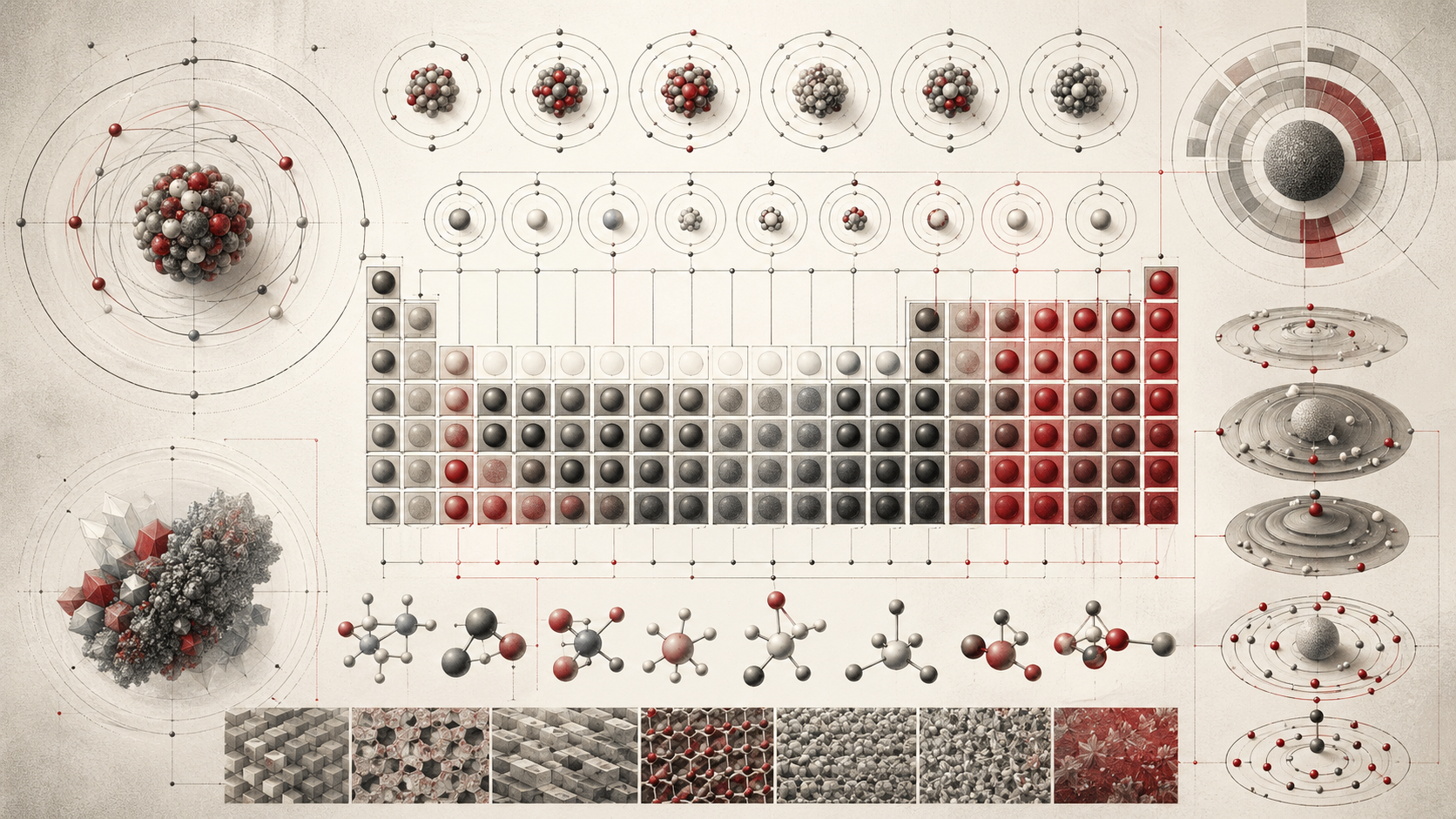
Why Atoms and Elements Matter
Atoms and elements matter because they provide chemistry with its basic units of identity, classification, measurement, and explanation. A chemical reaction can be understood as a rearrangement of atoms. A compound can be described by the elements it contains and the ratios in which those elements occur. A material can be interpreted through atomic composition, bonding, structure, defects, and phase behavior. A biological molecule can be understood through the carbon, hydrogen, oxygen, nitrogen, sulfur, phosphorus, metals, and trace elements that shape its function.
Without atoms and elements, chemistry would be a catalog of substances without an organizing grammar. With atoms and elements, chemistry can explain why sodium and potassium show related behavior, why chlorine and bromine form similar ions, why carbon has exceptional structural diversity, why noble gases are comparatively unreactive, why transition metals support catalysis, and why trace elements can matter profoundly in biological and environmental systems.
The periodic table gives chemistry a way to connect identity and behavior. It tells the chemist that elements are not isolated facts. They belong to a structured order. This order reflects atomic number, electron configuration, valence behavior, shielding, atomic size, ionization energy, electronegativity, metallic character, bonding possibilities, oxidation states, and recurring chemical families.
Atoms and elements also support measurement. A chemist can weigh a sample, calculate amount of substance, infer numbers of particles, balance equations, track conservation of mass, estimate molecular composition, and compare materials across laboratories because atomic identity and molar quantities are standardized. The mole makes atoms countable at the scale of laboratory practice.
Atoms are also not isolated from public life. Elemental chemistry shapes energy storage, semiconductor manufacturing, fertilizer systems, medicine, drinking-water treatment, mining, environmental contamination, climate chemistry, nuclear safety, electronics, infrastructure, and biological health. To understand atoms and elements is to understand the vocabulary through which modern material life is organized.
Chemistry therefore begins with atoms, but it does not stop at atoms. It uses atoms to understand substances, transformations, measurement, matter, life, materials, technology, and the chemical conditions of habitability.
The Atom as a Chemical Unit
An atom is the smallest ordinary unit of a chemical element that retains the element’s identity in chemical processes. Atoms contain a nucleus and surrounding electrons. The nucleus contains protons and neutrons. Protons carry positive charge. Neutrons are electrically neutral. Electrons carry negative charge and occupy quantum states around the nucleus.
In ordinary chemical reactions, nuclei usually remain unchanged while electrons are redistributed. Bonds form, break, polarize, and reorganize. Ions form when atoms or groups of atoms gain or lose electrons. Molecules form when atoms are joined through chemical bonding. Materials form when atoms, ions, or molecules are arranged into extended structures.
This distinction between nuclear identity and electronic behavior is essential. The nucleus determines which element an atom belongs to. The electrons largely determine how the atom behaves chemically. Carbon is carbon because its atoms have six protons. Yet the chemical difference between graphite, diamond, carbon dioxide, methane, glucose, and proteins depends on bonding, structure, electron distribution, and molecular context.
The atom is therefore both a physical object and a chemical abstraction. It is physical because atoms have mass, charge distribution, quantum structure, and measurable interactions. It is abstract because chemistry often reasons about atoms through symbols, formulas, equations, structures, models, and data tables.
The chemical atom is also contextual. In a molecule, atoms are not independent billiard balls. Their electron densities overlap, polarize, delocalize, and respond to neighbors. In a crystal, atoms or ions exist within lattices and coordination environments. In a metal, atomic centers interact through delocalized electronic states. In a protein, atoms contribute to a folded, solvated, dynamic molecular system.
The power of chemistry comes from moving between these levels: the atom as a quantum system, the element as a class of atoms, the compound as an arrangement of atoms, the material as an extended structure, and the reaction as a transformation of atomic relationships.
Atomic Number and Elemental Identity
Atomic number is the number of protons in the nucleus of an atom. It is usually represented by \(Z\). Every atom of hydrogen has \(Z = 1\). Every atom of helium has \(Z = 2\). Every atom of carbon has \(Z = 6\). Every atom of oxygen has \(Z = 8\). Every atom of iron has \(Z = 26\). The atomic number defines elemental identity.
Z = p
\]
Interpretation: \(Z\) is atomic number and \(p\) is proton number. Proton number defines which element an atom belongs to.
This is one of the most important classification rules in chemistry. If the proton number changes, the element changes. An atom with six protons is carbon regardless of how many neutrons it has. An atom with seven protons is nitrogen. An atom with eight protons is oxygen.
For a neutral atom, the number of electrons equals the number of protons:
e = Z
\]
Interpretation: In a neutral atom, electron count \(e\) equals atomic number \(Z\).
For an ion, the electron count differs from the proton count. A sodium atom has 11 protons and, when neutral, 11 electrons. A sodium ion, \(Na^+\), still has 11 protons, but it has lost one electron and has 10 electrons. It remains sodium because elemental identity is nuclear. Its charge and reactivity change because electron count and electronic structure have changed.
Atomic number also determines the order of the modern periodic table. The elements are arranged primarily by increasing atomic number, not by alphabetical order, discovery date, abundance, or simple mass. This ordering reveals recurring chemical properties because electron configurations repeat in structured ways as atomic number increases.
Elemental identity is therefore nuclear, while chemical behavior is largely electronic. This dual structure is one of chemistry’s core insights: the nucleus defines the element, but electrons explain much of what the element does.
Mass Number, Isotopes, and Nuclides
Atoms of the same element can have different numbers of neutrons. These variants are isotopes. Isotopes have the same atomic number but different mass numbers. The mass number, usually represented by \(A\), is the total number of protons and neutrons in the nucleus:
A = Z + N
\]
Interpretation: \(A\) is mass number, \(Z\) is proton number, and \(N\) is neutron number.
Neutron number can therefore be written:
N = A – Z
\]
Interpretation: Isotopes of the same element have the same \(Z\) but different \(N\).
Carbon provides a familiar example. Carbon-12, carbon-13, and carbon-14 all have six protons. They are all carbon. But they have different numbers of neutrons:
- carbon-12 has 6 protons and 6 neutrons;
- carbon-13 has 6 protons and 7 neutrons;
- carbon-14 has 6 protons and 8 neutrons.
Because isotopes of the same element have the same proton number, they usually have very similar chemical behavior when charge state and electronic state are the same. However, isotope mass can affect physical behavior and reaction rates, especially for light elements such as hydrogen. Isotopic composition also matters in geochemistry, climate science, ecology, archaeology, forensic science, nuclear chemistry, pharmacology, and environmental tracing.
It is useful to distinguish element, isotope, and nuclide. An element is defined by proton number. An isotope is one of several nuclides of the same element with different mass numbers. A nuclide refers to a nuclear species defined by proton number, neutron number, and sometimes nuclear energy state. Chemistry often uses isotope language because many chemical questions concern elements and their mass variants.
Isotopes also show why chemical identity is not the same as nuclear stability. Carbon-12 and carbon-13 are stable isotopes. Carbon-14 is radioactive. Uranium isotopes differ in nuclear behavior. Hydrogen, deuterium, and tritium show how isotope mass can matter strongly when the nucleus is very light. Nuclear identity and chemical identity overlap, but they are not identical categories.
For researchers, isotope data must be handled with source awareness. Isotopic abundance, isotopic mass, natural variation, enrichment, depletion, and radioactive decay can all affect interpretation depending on the field.
Relative Atomic Mass and Standard Atomic Weight
Atomic masses are not all whole numbers, and the values printed on periodic tables are not simply mass numbers. The mass number counts protons and neutrons in a particular nuclide. Relative atomic mass and standard atomic weight involve measured atomic masses and natural isotopic composition.
For an element with several naturally occurring isotopes, the atomic-weight-style value depends on the weighted contribution of those isotopes. A simplified expression is:
A_r(E) = \sum_i x_i m_i
\]
Interpretation: \(A_r(E)\) is a relative atomic-mass or atomic-weight-style value for element \(E\), \(x_i\) is fractional abundance of isotope \(i\), and \(m_i\) is relative isotopic mass.
Chlorine illustrates the idea. Natural chlorine contains mostly chlorine-35 and chlorine-37. Because these isotopes occur in different proportions, the standard atomic weight of chlorine is close to 35.45 rather than exactly 35 or 37. This does not mean that an individual chlorine atom has a fractional number of nucleons. It means that the value reflects an abundance-weighted average for normal terrestrial materials.
This distinction matters in chemical calculation. Molar masses used in laboratory stoichiometry are based on atomic-weight values, not merely mass numbers. When calculating how many moles are present in a given mass of sodium chloride, calcium carbonate, glucose, or copper sulfate, the periodic table values used are connected to measured atomic weights.
Atomic weights also have uncertainty and context. Some elements show natural isotopic variation across terrestrial materials. Some elements have no stable isotopes and are represented differently. Some periodic tables use bracketed mass numbers for radioactive elements. Standard atomic weights are therefore not merely textbook constants; they are evaluated scientific quantities tied to measurement, isotopic abundance, and metrology.
For researchers, this means atomic mass data must be treated as scientific data rather than decorative table values. The relevant value may depend on whether the question concerns a specific isotope, a natural terrestrial sample, an enriched material, a radioactive nuclide, a mass spectrometry measurement, or a conventional molar-mass calculation.
The Mole and the Counting of Atoms
Atoms are far too small to count one by one in ordinary laboratory work. Chemistry therefore uses the mole to connect microscopic particles to macroscopic amounts. The mole is the SI unit for amount of substance. It links particle number to measurable quantities such as mass, volume, concentration, and stoichiometric ratio.
The Avogadro constant, \(N_A\), gives the number of specified elementary entities per mole:
N_A = 6.02214076 \times 10^{23}\ \mathrm{mol}^{-1}
\]
Interpretation: One mole contains exactly \(6.02214076 \times 10^{23}\) specified elementary entities.
The amount of substance can be expressed as:
n = \frac{N}{N_A}
\]
Interpretation: \(n\) is amount of substance in moles and \(N\) is the number of specified elementary entities.
Mass, molar mass, and amount of substance are related by:
n = \frac{m}{M}
\]
Interpretation: \(n\) is amount of substance, \(m\) is sample mass, and \(M\) is molar mass.
The mole is one of the bridges between atomic theory and laboratory practice. A chemist does not need to see individual atoms to use them quantitatively. By weighing a sample and using molar mass, the chemist can infer amount of substance. By using a balanced equation, the chemist can infer how much product could form or how much reactant is required.
The mole also matters for data systems. Concentration, reaction yield, dose, emissions, atmospheric abundance, nutrient cycling, industrial production, and pharmaceutical formulation all depend on connecting particle-scale identity to measurable quantities. Chemical data become comparable because amount of substance is standardized.
The mole turns atomic identity into practical chemical arithmetic.
Ions, Atoms, and Electron Count
An atom becomes an ion when it gains or loses electrons. Because the number of protons does not change in ordinary ion formation, the element remains the same, but the charge and electronic structure change. This is one of chemistry’s most important distinctions: elemental identity is defined by proton number, while ionic charge depends on electron count.
A simplified ionic charge in elementary-charge units can be written:
q = Z – e
\]
Interpretation: \(q\) is charge in elementary-charge units, \(Z\) is proton number, and \(e\) is electron count. Positive ions have fewer electrons than protons.
A neutral sodium atom has 11 protons and 11 electrons. A sodium ion, \(Na^+\), has 11 protons and 10 electrons. A neutral chlorine atom has 17 protons and 17 electrons. A chloride ion, \(Cl^-\), has 17 protons and 18 electrons.
Ions are central to salts, acids, bases, electrochemistry, batteries, physiology, environmental chemistry, water chemistry, atmospheric particles, minerals, and analytical chemistry. Sodium, potassium, calcium, magnesium, chloride, nitrate, sulfate, carbonate, ammonium, phosphate, iron, copper, zinc, and many other ions shape biological and environmental systems.
Ion formation also connects atomic structure to bonding. Ionic compounds are often stabilized by electrostatic attraction among ions in extended lattices or solution. Covalent molecules can contain formal charges. Transition metals can form ions with multiple oxidation states. Polyatomic ions distribute charge across several atoms through bonding and resonance.
For researchers, ion identity should be paired with chemical context. An ion’s behavior depends on charge, size, hydration, coordination, oxidation state, pH, ionic strength, counterions, complexation, and phase. “Sodium,” “iron,” or “chlorine” is often not specific enough; the chemical form matters.
Periodic Organization of Matter
The periodic table organizes elements by atomic number and recurring chemical behavior. Its rows are periods. Its columns are groups. Elements in the same group often share valence patterns and chemical similarities because they have related outer-electron configurations.
This organization emerged historically from empirical patterns in atomic weights and chemical properties, but modern chemistry explains periodicity through electronic structure. As atomic number increases, electrons fill shells and subshells in structured ways. Similar valence-electron arrangements produce recurring chemical behavior. Alkali metals, halogens, noble gases, alkaline earth metals, transition metals, lanthanides, and actinides are not arbitrary groupings. They express patterns in atomic structure and chemical behavior.
The periodic table is therefore both historical and theoretical. It is historical because it developed from the classification of known substances and recurring properties. It is theoretical because it is now interpreted through nuclear charge, quantum mechanics, electron configuration, orbital structure, and periodic trends.
Periodic organization allows chemists to predict. If an element lies in the halogen group, one expects certain kinds of reactivity, common oxidation states, and bonding behavior. If an element lies among the noble gases, one expects low reactivity under ordinary conditions. If an element lies among transition metals, one expects variable oxidation states, coordination chemistry, colored compounds, magnetic behavior, and catalytic possibilities.
The periodic table does not answer every chemical question. It does not specify every compound, isotope, oxidation state, biological role, environmental form, or material property. But it tells chemists where to begin. It provides the first structured map of elemental behavior.
Periodic organization is therefore not merely a memory aid. It is the organizing architecture through which chemistry connects atomic identity, electronic structure, and material behavior.
Groups, Periods, Blocks, and Chemical Families
Groups are vertical columns of the periodic table. Elements in a group often share chemical similarities because they have related valence electron configurations. Periods are horizontal rows. Moving across a period, atomic number increases, nuclear charge increases, and electron configurations change in ways that produce systematic trends.
Blocks describe broad regions of the table associated with the filling of \(s\), \(p\), \(d\), and \(f\) subshells. This block structure links the visual shape of the table to quantum electron structure. The \(s\)-block is two columns wide, the \(p\)-block is six columns wide, the \(d\)-block is ten columns wide, and the \(f\)-block is fourteen columns wide because subshell capacities differ.
Several chemical families are especially important:
- Alkali metals are highly reactive metals that commonly form \(+1\) ions.
- Alkaline earth metals commonly form \(+2\) ions and occur in minerals, shells, bones, and geological materials.
- Transition metals often show variable oxidation states, coordination complexes, catalytic activity, and distinctive electronic behavior.
- Pnictogens include nitrogen and phosphorus, elements central to atmosphere, fertilizers, biomolecules, and chemical industry.
- Chalcogens include oxygen and sulfur, elements central to oxides, sulfides, proteins, atmospheric chemistry, and redox systems.
- Halogens are reactive nonmetals that commonly form \(-1\) ions and many molecular compounds.
- Noble gases have filled valence shells and are comparatively unreactive under ordinary conditions.
- Lanthanides and actinides involve f-block electronic structure and are important in materials, magnets, nuclear chemistry, lighting, medicine, and energy technologies.
These family names are useful because they connect location to behavior. A student who knows only element names has memorized fragments. A chemist who understands groups, periods, and blocks can reason from position to probable properties.
Chemical families also help link chemistry to the Earth system and technology. Alkali and alkaline earth metals shape water chemistry, mineral systems, and biological electrolytes. Transition metals support enzymes, pigments, catalysts, batteries, alloys, and electronic materials. Halogens matter in disinfection, atmospheric chemistry, pharmaceuticals, and polymers. Lanthanides are central to magnets, optics, and low-carbon technologies.
Periodic organization is therefore not only a classroom structure. It is a map of matter in practical, environmental, industrial, and biological contexts.
Periodic Trends and Chemical Prediction
Periodic trends are recurring patterns in elemental properties. They help chemists reason about atoms without treating every element as an isolated fact. Important periodic trends include atomic radius, ionic radius, ionization energy, electron affinity, electronegativity, metallic character, common oxidation states, bonding preferences, and acid-base behavior of oxides.
Atomic radius generally decreases across a period from left to right because increasing nuclear charge pulls electrons closer, although shielding and subshell structure complicate the pattern. Atomic radius generally increases down a group because electrons occupy higher shells farther from the nucleus.
Ionization energy is the energy required to remove an electron from an atom or ion. It generally increases across a period and decreases down a group. Elements with low ionization energies tend to lose electrons more readily. Elements with high ionization energies hold electrons more strongly.
Electronegativity describes an atom’s tendency to attract electron density in a chemical bond. It generally increases across a period and decreases down a group, with fluorine among the most electronegative elements. Electronegativity helps chemists reason about bond polarity, acid-base behavior, reaction mechanisms, molecular structure, and material properties.
These trends are connected to effective nuclear charge, shielding, orbital penetration, electron-electron repulsion, and shell structure. A simplified effective nuclear charge relationship is:
Z_{\mathrm{eff}} \approx Z – S
\]
Interpretation: \(Z_{\mathrm{eff}}\) is an approximate effective nuclear charge, \(Z\) is atomic number, and \(S\) represents shielding by other electrons.
These trends are not mechanical rules that replace chemical judgment. They are patterns with exceptions. Transition metals, f-block elements, relativistic effects, electron pairing, orbital penetration, shielding, oxidation state, coordination environment, and molecular context can all complicate simple trends. But periodic trends remain powerful because they provide first-order expectations.
A periodic table is therefore a predictive instrument. It does not merely show where elements sit. It suggests how they may behave and why evidence may deviate from the simplest prediction.
Metals, Nonmetals, and Metalloids
The periodic table is often divided into metals, nonmetals, and metalloids. This division is approximate but useful. Metals tend to be conductive, malleable, ductile, and capable of forming cations. Nonmetals tend to form covalent compounds, molecular substances, or anions. Metalloids have intermediate properties and are especially important in semiconductors and materials chemistry.
Metallic character generally increases down a group and toward the left side of the periodic table. Nonmetallic character is more pronounced toward the upper right. This broad pattern helps explain why sodium and potassium are reactive metals, why oxygen and chlorine are reactive nonmetals, why silicon and germanium are important semiconducting metalloids, and why transition metals support diverse oxidation states and coordination geometries.
The metal/nonmetal distinction also matters for sustainability and technology. Metals are central to infrastructure, electronics, batteries, catalysts, turbines, vehicles, buildings, and renewable energy systems. Nonmetals are central to biological molecules, atmospheric chemistry, water chemistry, polymers, fertilizers, medicines, and fuels. Metalloids are central to electronics, photovoltaics, sensing, and advanced materials.
Yet these categories should not be treated as rigid boxes. Elements can behave differently depending on oxidation state, bonding environment, pressure, temperature, allotrope, and compound form. Carbon as diamond, graphite, graphene, carbon dioxide, methane, carbonate, and organic polymer illustrates how one element can participate in radically different structures and properties.
This is especially important in environmental and public-health contexts. “Metal” is not a sufficient risk description. Elemental mercury, methylmercury, inorganic mercury salts, mercury vapor, and mercury bound in mineral forms differ in behavior. Chromium(III) and chromium(VI) have different chemistry and risk profiles. Arsenic speciation matters. Lead mobility depends on mineral form, water chemistry, pH, and corrosion control.
Chemistry uses categories, but it also studies the conditions under which categories bend. Classification is useful when it supports more precise chemical reasoning.
Atoms, Elements, Compounds, and Substances
An element is a class of atoms defined by proton number. A compound is a substance composed of atoms of two or more elements in chemically defined relationships. Sodium chloride contains sodium and chlorine. Water contains hydrogen and oxygen. Carbon dioxide contains carbon and oxygen. Glucose contains carbon, hydrogen, and oxygen. Proteins contain carbon, hydrogen, oxygen, nitrogen, sulfur, and sometimes metals or other elements in functional contexts.
Chemical formulas express composition. For water:
H_2O
\]
Interpretation: A water molecule contains two hydrogen atoms for every oxygen atom.
For carbon dioxide:
CO_2
\]
Interpretation: A carbon dioxide molecule contains one carbon atom for every two oxygen atoms.
Chemical formulas are not merely labels. They express atom ratios, molecular composition, charge balance, and stoichiometric relationships. They allow chemists to calculate molar mass, percent composition, limiting reagents, theoretical yield, and concentration. They also connect atomic identity to molecular structure.
Elements can also exist as elemental substances. Oxygen gas, \(O_2\), contains only oxygen atoms. Nitrogen gas, \(N_2\), contains only nitrogen atoms. Diamond and graphite contain carbon atoms arranged differently. Metals such as copper, iron, and aluminum can exist as extended metallic solids. The same element can have multiple allotropes, phases, or structural forms.
The relationship between atom, element, compound, and substance is therefore subtle. Atoms are units. Elements are classes of atoms. Compounds are chemically defined combinations. Substances are material forms with composition, structure, properties, and context.
This distinction matters in communication. “Oxygen” can refer to oxygen atoms, oxygen gas, oxygen in water, oxygen in carbon dioxide, oxygen in minerals, or oxygen in biological molecules. “Carbon” can refer to an element, an atom in a molecule, graphite, diamond, organic matter, fossil carbon, atmospheric carbon dioxide, carbonate minerals, or carbon-based materials. Chemical precision depends on specifying form.
Abundance, Origin, and Earth-System Chemistry
Elements are not equally abundant. Hydrogen and helium dominate much of the visible universe. Oxygen, silicon, aluminum, iron, calcium, sodium, potassium, and magnesium are major constituents of Earth’s crust. Carbon, hydrogen, oxygen, nitrogen, phosphorus, and sulfur are central to life. Trace metals such as iron, copper, zinc, manganese, molybdenum, cobalt, and nickel can be biologically essential even at small concentrations.
Elemental abundance shapes planetary chemistry. The chemistry of rocks depends on silicates, oxides, carbonates, sulfides, and metals. The chemistry of oceans depends on water, dissolved ions, carbonate equilibria, nutrients, trace metals, and gases. Atmospheric chemistry depends on nitrogen, oxygen, argon, carbon dioxide, water vapor, ozone, aerosols, and reactive trace species. Biological chemistry depends on carbon-based molecules operating in water under constraints of energy, structure, catalysis, and information.
The periodic table therefore connects to Earth-system science. It helps explain nutrient cycles, mineral resources, pollution, atmospheric reactions, climate processes, ocean chemistry, soil fertility, toxic exposure, and materials extraction. It also helps clarify why some elements are abundant but hard to use, why some are rare but technologically critical, and why chemical form matters as much as elemental identity.
For example, elemental mercury, methylmercury, inorganic mercury salts, and mercury bound in minerals have different behavior and risks. Elemental nitrogen in the atmosphere, nitrate in water, ammonium in soil, and nitrogen in amino acids are chemically and biologically different. Elemental identity is necessary, but speciation, bonding, oxidation state, and environmental context determine meaning.
Elemental abundance also has ethical and institutional dimensions. Technologies depend on mined materials. Fertilizer systems depend on nitrogen and phosphorus cycles. Batteries depend on lithium, nickel, cobalt, manganese, iron, phosphorus, graphite, and electrolytes. Semiconductors depend on silicon, dopants, rare gases, and specialty chemicals. Environmental justice often turns on where extraction, processing, waste, and contamination occur.
Atoms and elements are therefore not only scientific abstractions. They are part of the material organization of societies, ecosystems, technologies, and public responsibilities.
The Periodic Table as a Scientific Model
The periodic table is a scientific model because it simplifies reality while preserving essential relationships. It does not show every isotope, oxidation state, compound, phase, or reaction pathway. It does not display all quantum details, environmental forms, biological roles, or industrial uses. Yet it organizes chemical knowledge with extraordinary efficiency.
The table’s power comes from compression. Each element square condenses atomic number, symbol, name, mass information, and sometimes category or state. Each position condenses relationships to neighboring elements. Each group and period suggests patterns in valence, size, energy, bonding, and reactivity. The table allows a chemist to see both individual identity and systematic order.
This is why periodic organization remains central even in computational chemistry and data science. Machine-readable element tables, atomic descriptors, periodic features, electronegativity values, covalent radii, oxidation states, ionization energies, and group/period encodings are used in materials informatics, molecular modeling, reaction prediction, environmental databases, and chemical machine learning.
The periodic table is therefore not obsolete because modern chemistry has become computational. It has become more important. Computational workflows require structured descriptors, standardized identifiers, reproducible data, and chemically meaningful features. The periodic table remains one of the deepest feature systems in science.
At the same time, a model must be used with awareness. The periodic table organizes elements, but compounds, materials, biological systems, and environmental exposures require more detail. Atomic number does not tell the whole story. Isotope, electron configuration, oxidation state, bonding environment, crystal structure, phase, dose, exposure pathway, and system context may all matter.
The periodic table is strongest when treated neither as a memorization chart nor as an all-purpose answer. It is a disciplined way to begin chemical reasoning.
Atomic Data, Standards, and Reproducibility
Atomic and periodic knowledge increasingly depends on reliable data systems. Element names, symbols, atomic numbers, standard atomic weights, isotope records, isotopic abundances, ionization energies, electron configurations, electronegativity scales, radii, oxidation states, and category labels are all data. They require sources, definitions, units, uncertainty, and versioning.
Reproducible atomic-data workflows should preserve:
- element name and symbol;
- atomic number and proton count;
- isotope label, mass number, neutron number, and isotopic mass;
- standard atomic weight, interval, or conventional value;
- source of isotopic abundance data;
- charge state and electron count where relevant;
- group, period, block, and family classification;
- electronegativity scale and radius definition where used;
- molar mass calculation method;
- formula parsing assumptions;
- percent composition method;
- data source, retrieval date, and version;
- uncertainty or review status;
- responsible-use notes for toxicity, exposure, or environmental interpretation.
This matters because atomic data can appear deceptively simple. A radius value may represent covalent radius, van der Waals radius, metallic radius, or ionic radius. An electronegativity value depends on scale. Atomic weight may be a standard value, interval, isotope-specific mass, or conventional value. Element category labels may differ across sources. Toxicity claims depend on chemical form and exposure, not only element name.
Computational chemistry, materials informatics, environmental modeling, and laboratory automation all require element data to be machine-readable. But machine-readable is not the same as scientifically sufficient. Data should be auditable, sourced, and documented.
For researchers, periodic and atomic data should be treated as evidence infrastructure. The goal is not only to calculate a number; it is to preserve enough context for another person or system to understand what the number means.
Mathematical Lens: Atoms, Elements, and Periodic Organization
The mathematical structure of atoms and elements begins with counting, ratios, weighted averages, and scaling relationships. Atomic number is:
Z = p
\]
Interpretation: Atomic number equals proton number and defines elemental identity.
Mass number is:
A = Z + N
\]
Interpretation: Mass number is the total number of protons and neutrons in a nuclide.
Neutron number is:
N = A – Z
\]
Interpretation: This relationship distinguishes isotopes of the same element.
Ion charge is:
q = Z – e
\]
Interpretation: Charge in elementary-charge units depends on proton number and electron count.
Amount of substance is:
n = \frac{N_{\mathrm{entities}}}{N_A}
\]
Interpretation: Amount of substance relates the number of specified entities to the Avogadro constant.
Mass and molar mass are related by:
n = \frac{m}{M}
\]
Interpretation: A sample’s amount of substance equals mass divided by molar mass.
Isotope-weighted atomic mass is:
\bar{m} = \sum_i f_i m_i
\]
Interpretation: Average atomic mass can be represented as isotopic masses weighted by fractional abundances.
Percent composition by mass is:
\%E = \frac{n_E A_r(E)}{M_{\mathrm{compound}}}\times 100
\]
Interpretation: Percent composition gives the mass contribution of element \(E\) in a compound.
A simplified element descriptor vector can be written:
\mathbf{x}_E = [Z, g, p, b, A_r, \chi, r]
\]
Interpretation: An element can be encoded computationally using atomic number, group, period, block, atomic-weight value, electronegativity, and radius descriptor.
These relationships show how chemistry moves from subatomic identity to laboratory quantities. Proton number defines the element. Neutron number distinguishes isotopes. Electron number affects charge. Isotopic abundance affects atomic-weight values. The mole connects particles to measurable matter. Periodic descriptors turn atomic identity into structured data.
Computational Workflows for Atomic and Periodic Data
Computational workflows can make atomic and periodic reasoning more transparent. A workflow can track element identity, isotope records, neutron counts, electron counts, molar masses, mole conversions, percent composition, periodic classifications, trend summaries, descriptor tables, source metadata, and provenance.
Useful workflows include isotope-weighted mass calculations, mole-to-particle conversions, formula molar-mass calculators, percent-composition tables, periodic-feature tables, group and period summaries, simple trend models, element similarity scaffolds, material composition registers, and SQL evidence systems.
For researchers, atomic-data workflows should preserve four distinctions:
- Element versus isotope: proton number defines the element; neutron number distinguishes isotopes.
- Atomic weight versus mass number: standard atomic-weight values are evaluated quantities, not counts of nucleons in individual atoms.
- Element identity versus chemical form: behavior depends on ionization, oxidation state, bonding, phase, and speciation.
- Reference data versus sample data: periodic-table values may not represent a specific enriched, depleted, radioactive, or unusual sample.
The examples below use synthetic educational data. They do not replace official reference data, certify standard atomic weights, validate environmental risk assessments, approve materials specifications, or substitute for professional chemical review. They demonstrate how atomic and periodic concepts can be organized, audited, and communicated responsibly.
Python Example: Elements, Isotopes, Moles, Percent Composition, and Provenance
The following Python example uses a small educational dataset to classify elements, calculate neutron number, estimate isotope-weighted atomic mass, convert mass to moles and entities, calculate percent composition, summarize periodic features, and write provenance outputs. In real chemical-data workflows, reference values should come from evaluated sources and uncertainty should be preserved.
from pathlib import Path
import json
import platform
import sys

import numpy as np
import pandas as pd


# Synthetic atoms, elements, and periodic organization workflow.
# Educational example only; not a replacement for official reference data,
# laboratory quality assurance, environmental compliance,
# materials certification, or professional chemical review.


AVOGADRO_CONSTANT = 6.02214076e23


def require_columns(data: pd.DataFrame, required: list[str], table_name: str) -> None:
    """Raise an error if required columns are missing."""
    missing = [column for column in required if column not in data.columns]
    if missing:
        raise ValueError(f"{table_name} is missing required columns: {missing}")


elements = pd.DataFrame(
    {
        "symbol": ["H", "C", "N", "O", "Na", "Mg", "Cl", "Fe", "Si", "P", "S"],
        "name": [
            "hydrogen",
            "carbon",
            "nitrogen",
            "oxygen",
            "sodium",
            "magnesium",
            "chlorine",
            "iron",
            "silicon",
            "phosphorus",
            "sulfur",
        ],
        "atomic_number": [1, 6, 7, 8, 11, 12, 17, 26, 14, 15, 16],
        "period": [1, 2, 2, 2, 3, 3, 3, 4, 3, 3, 3],
        "group": [1, 14, 15, 16, 1, 2, 17, 8, 14, 15, 16],
        "block": ["s", "p", "p", "p", "s", "s", "p", "d", "p", "p", "p"],
        "category": [
            "nonmetal",
            "nonmetal",
            "nonmetal",
            "nonmetal",
            "alkali metal",
            "alkaline earth metal",
            "halogen",
            "transition metal",
            "metalloid",
            "nonmetal",
            "nonmetal",
        ],
        "atomic_weight_u_simplified": [
            1.008,
            12.011,
            14.007,
            15.999,
            22.990,
            24.305,
            35.45,
            55.845,
            28.085,
            30.974,
            32.06,
        ],
    }
)

require_columns(
    elements,
    [
        "symbol",
        "atomic_number",
        "period",
        "group",
        "block",
        "category",
        "atomic_weight_u_simplified",
    ],
    "elements",
)

classification_summary = (
    elements.groupby(["period", "block", "category"])
    .size()
    .reset_index(name="count")
    .sort_values(["period", "block", "category"])
)

isotopes = pd.DataFrame(
    {
        "isotope": [
            "carbon-12",
            "carbon-13",
            "carbon-14",
            "oxygen-16",
            "oxygen-18",
            "chlorine-35",
            "chlorine-37",
        ],
        "symbol": ["C", "C", "C", "O", "O", "Cl", "Cl"],
        "atomic_number": [6, 6, 6, 8, 8, 17, 17],
        "mass_number": [12, 13, 14, 16, 18, 35, 37],
    }
)

isotopes["neutron_number"] = isotopes["mass_number"] - isotopes["atomic_number"]

chlorine_isotopes = pd.DataFrame(
    {
        "isotope": ["Cl-35", "Cl-37"],
        "isotopic_mass_u": [34.96885268, 36.96590260],
        "fractional_abundance": [0.7576, 0.2424],
    }
)

chlorine_isotopes["weighted_contribution_u"] = (
    chlorine_isotopes["isotopic_mass_u"]
    * chlorine_isotopes["fractional_abundance"]
)

chlorine_weighted_mass = chlorine_isotopes["weighted_contribution_u"].sum()

isotope_weight_summary = pd.DataFrame(
    [
        {
            "element": "chlorine",
            "estimated_weighted_atomic_mass_u": chlorine_weighted_mass,
            "note": "educational isotope-weighted calculation",
        }
    ]
)

mole_examples = pd.DataFrame(
    {
        "substance": ["water", "carbon_dioxide", "sodium_chloride"],
        "sample_mass_g": [18.015, 44.009, 58.44],
        "molar_mass_g_mol": [18.015, 44.009, 58.44],
    }
)

mole_examples["amount_mol"] = (
    mole_examples["sample_mass_g"] / mole_examples["molar_mass_g_mol"]
)

mole_examples["entities"] = mole_examples["amount_mol"] * AVOGADRO_CONSTANT

water_composition = pd.DataFrame(
    {
        "element": ["H", "O"],
        "atom_count": [2, 1],
        "atomic_weight_u_simplified": [1.008, 15.999],
    }
)

water_composition["mass_contribution"] = (
    water_composition["atom_count"]
    * water_composition["atomic_weight_u_simplified"]
)

water_molar_mass = water_composition["mass_contribution"].sum()

water_composition["percent_by_mass"] = (
    water_composition["mass_contribution"]
    / water_molar_mass
    * 100.0
)

period_three = elements[elements["period"] == 3].copy()

period_three_summary = (
    period_three[["symbol", "atomic_number", "group", "category", "atomic_weight_u_simplified"]]
    .sort_values("atomic_number")
    .reset_index(drop=True)
)

review_notes = pd.DataFrame(
    [
        {
            "review_item": "atomic_number",
            "status": "identity_defining",
            "note": "proton number defines elemental identity",
        },
        {
            "review_item": "isotope_records",
            "status": "educational",
            "note": "mass number and neutron number shown for selected isotopes",
        },
        {
            "review_item": "atomic_weight",
            "status": "simplified",
            "note": "use evaluated reference sources for official values",
        },
        {
            "review_item": "mole_conversion",
            "status": "SI_constant",
            "note": "uses exact Avogadro constant",
        },
        {
            "review_item": "percent_composition",
            "status": "formula_based",
            "note": "depends on formula and atomic-weight values used",
        },
    ]
)

output_dir = Path("outputs")
output_dir.mkdir(exist_ok=True)

elements.to_csv(output_dir / "synthetic_element_table.csv", index=False)
classification_summary.to_csv(output_dir / "synthetic_periodic_classification_summary.csv", index=False)
isotopes.to_csv(output_dir / "synthetic_isotope_neutron_numbers.csv", index=False)
chlorine_isotopes.to_csv(output_dir / "synthetic_chlorine_isotope_weights.csv", index=False)
isotope_weight_summary.to_csv(output_dir / "synthetic_isotope_weight_summary.csv", index=False)
mole_examples.to_csv(output_dir / "synthetic_mole_conversion_examples.csv", index=False)
water_composition.to_csv(output_dir / "synthetic_water_percent_composition.csv", index=False)
period_three_summary.to_csv(output_dir / "synthetic_period_three_summary.csv", index=False)
review_notes.to_csv(output_dir / "synthetic_atomic_data_review_notes.csv", index=False)

manifest = {
    "workflow": "synthetic_atoms_elements_periodic_organization_workflow",
    "data_type": "synthetic educational atomic and periodic records",
    "constants": {
        "avogadro_constant_per_mol": AVOGADRO_CONSTANT,
    },
    "equations": [
        "Z = proton number",
        "A = Z + N",
        "N = A - Z",
        "q = Z - electron_count",
        "n = N_entities / N_A",
        "n = mass / molar_mass",
        "weighted_atomic_mass = sum(f_i * m_i)",
        "percent_element = element_mass_contribution / compound_molar_mass * 100",
    ],
    "cautions": [
        "Synthetic educational data only.",
        "Official atomic weights require evaluated reference data.",
        "Element identity does not determine toxicity, environmental fate, or biological role by itself.",
        "Chemical form, dose, oxidation state, bonding, and exposure pathway matter.",
    ],
    "python_version": sys.version,
    "platform": platform.platform(),
    "numpy_version": np.__version__,
    "pandas_version": pd.__version__,
    "output_files": [
        "outputs/synthetic_element_table.csv",
        "outputs/synthetic_periodic_classification_summary.csv",
        "outputs/synthetic_isotope_neutron_numbers.csv",
        "outputs/synthetic_chlorine_isotope_weights.csv",
        "outputs/synthetic_isotope_weight_summary.csv",
        "outputs/synthetic_mole_conversion_examples.csv",
        "outputs/synthetic_water_percent_composition.csv",
        "outputs/synthetic_period_three_summary.csv",
        "outputs/synthetic_atomic_data_review_notes.csv",
        "outputs/atoms_elements_periodic_manifest.json",
    ],
}

with (output_dir / "atoms_elements_periodic_manifest.json").open(
    "w",
    encoding="utf-8"
) as file:
    json.dump(manifest, file, indent=2)

print("Element table")
print("-------------")
print(elements.to_string(index=False))

print("\nClassification summary")
print("----------------------")
print(classification_summary.to_string(index=False))

print("\nIsotope neutron-number table")
print("----------------------------")
print(isotopes.to_string(index=False))

print("\nIsotope-weighted atomic mass summary")
print("------------------------------------")
print(isotope_weight_summary.round(6).to_string(index=False))

print("\nMole conversion examples")
print("------------------------")
print(mole_examples.to_string(index=False))

print("\nWater percent composition")
print("-------------------------")
print(water_composition.round(4).to_string(index=False))

print("\nReview notes")
print("------------")
print(review_notes.to_string(index=False))
This workflow demonstrates atomic-data evidence discipline rather than official reference-data validation. It separates element identity, classification, isotope records, neutron-number calculations, isotope-weighted mass, mole conversions, percent composition, periodic summaries, review notes, and provenance. A real workflow would add evaluated reference values, uncertainty, source versions, laboratory context, and domain-specific review.
R Example: Periodic Trends, Isotopes, and Atomic Data Summaries
The following R example uses simplified educational data to summarize period-two trends, calculate neutron numbers, estimate isotope-weighted mass, and create atomic-data review outputs. In real workflows, values should be tied to official reference sources, uncertainty, and explicit definitions.
# Synthetic atoms, elements, and periodic organization scaffold.
# Educational example only; not a replacement for official reference data,
# laboratory quality assurance, environmental compliance,
# materials certification, or professional chemical review.

avogadro_constant <- 6.02214076e23

elements <- data.frame(
  symbol = c("Li", "Be", "B", "C", "N", "O", "F", "Ne"),
  atomic_number = c(3, 4, 5, 6, 7, 8, 9, 10),
  period = c(2, 2, 2, 2, 2, 2, 2, 2),
  group = c(1, 2, 13, 14, 15, 16, 17, 18),
  category = c(
    "alkali metal",
    "alkaline earth metal",
    "metalloid",
    "nonmetal",
    "nonmetal",
    "nonmetal",
    "halogen",
    "noble gas"
  ),
  atomic_radius_pm = c(128, 96, 84, 76, 71, 66, 57, 58),
  first_ionization_kj_mol = c(520, 900, 801, 1086, 1402, 1314, 1681, 2081)
)

radius_model <- lm(atomic_radius_pm ~ atomic_number, data = elements)
ionization_model <- lm(first_ionization_kj_mol ~ atomic_number, data = elements)

trend_summary <- data.frame(
  trend = c(
    "period_2_atomic_radius_vs_atomic_number",
    "period_2_first_ionization_vs_atomic_number"
  ),
  slope = c(
    coef(radius_model)[["atomic_number"]],
    coef(ionization_model)[["atomic_number"]]
  ),
  r_squared = c(
    summary(radius_model)$r.squared,
    summary(ionization_model)$r.squared
  )
)

isotopes <- data.frame(
  isotope = c("carbon-12", "carbon-13", "carbon-14", "oxygen-16", "oxygen-18"),
  atomic_number = c(6, 6, 6, 8, 8),
  mass_number = c(12, 13, 14, 16, 18)
)

isotopes$neutron_number <- isotopes$mass_number - isotopes$atomic_number

chlorine <- data.frame(
  isotope = c("Cl-35", "Cl-37"),
  isotopic_mass_u = c(34.96885268, 36.96590260),
  fractional_abundance = c(0.7576, 0.2424)
)

chlorine$weighted_contribution_u <-
  chlorine$isotopic_mass_u * chlorine$fractional_abundance

chlorine_summary <- data.frame(
  element = "chlorine",
  estimated_weighted_atomic_mass_u = sum(chlorine$weighted_contribution_u),
  note = "educational isotope-weighted calculation"
)

mole_examples <- data.frame(
  substance = c("water", "carbon_dioxide", "sodium_chloride"),
  sample_mass_g = c(18.015, 44.009, 58.44),
  molar_mass_g_mol = c(18.015, 44.009, 58.44)
)

mole_examples$amount_mol <-
  mole_examples$sample_mass_g / mole_examples$molar_mass_g_mol

mole_examples$entities <-
  mole_examples$amount_mol * avogadro_constant

water_composition <- data.frame(
  element = c("H", "O"),
  atom_count = c(2, 1),
  atomic_weight_u_simplified = c(1.008, 15.999)
)

water_composition$mass_contribution <-
  water_composition$atom_count *
  water_composition$atomic_weight_u_simplified

water_molar_mass <- sum(water_composition$mass_contribution)

water_composition$percent_by_mass <-
  water_composition$mass_contribution / water_molar_mass * 100

review_notes <- data.frame(
  review_item = c(
    "periodic trends",
    "isotope neutron numbers",
    "isotope-weighted mass",
    "mole conversions",
    "percent composition"
  ),
  status = c(
    "educational",
    "formula-based",
    "simplified",
    "SI constant-based",
    "formula-based"
  ),
  note = c(
    "trend values use a small simplified dataset",
    "neutron number equals mass number minus atomic number",
    "official values require evaluated isotopic data",
    "uses exact Avogadro constant",
    "depends on formula and atomic weights used"
  )
)

dir.create("outputs", showWarnings = FALSE)

write.csv(
  elements,
  file = "outputs/r_period_two_element_table.csv",
  row.names = FALSE
)

write.csv(
  trend_summary,
  file = "outputs/r_period_two_trend_summary.csv",
  row.names = FALSE
)

write.csv(
  isotopes,
  file = "outputs/r_isotope_neutron_numbers.csv",
  row.names = FALSE
)

write.csv(
  chlorine,
  file = "outputs/r_chlorine_isotope_weights.csv",
  row.names = FALSE
)

write.csv(
  chlorine_summary,
  file = "outputs/r_chlorine_weighted_mass_summary.csv",
  row.names = FALSE
)

write.csv(
  mole_examples,
  file = "outputs/r_mole_conversion_examples.csv",
  row.names = FALSE
)

write.csv(
  water_composition,
  file = "outputs/r_water_percent_composition.csv",
  row.names = FALSE
)

write.csv(
  review_notes,
  file = "outputs/r_atomic_data_review_notes.csv",
  row.names = FALSE
)

sink("outputs/r_atoms_elements_periodic_report.txt")
cat("Synthetic Atoms, Elements, and Periodic Organization Report\n")
cat("==========================================================\n\n")
cat("Period-two element table:\n")
print(elements)
cat("\nTrend summary:\n")
print(trend_summary)
cat("\nIsotope neutron-number table:\n")
print(isotopes)
cat("\nChlorine isotope-weighted mass summary:\n")
print(chlorine_summary)
cat("\nMole conversion examples:\n")
print(mole_examples)
cat("\nWater percent composition:\n")
print(water_composition)
cat("\nReview notes:\n")
print(review_notes)
cat("\nResponsible-use note:\n")
cat("Synthetic educational data only. Official atomic and periodic data require evaluated sources, units, definitions, uncertainty, and versioning.\n")
sink()

print(elements)
print(trend_summary)
print(isotopes)
print(chlorine_summary)
print(mole_examples)
print(water_composition)
print(review_notes)
This scaffold shows how R can support periodic trend summaries, isotope calculations, mole conversions, and percent-composition records. The central issue is not the language but the evidence chain. Atomic outputs should remain connected to source data, definitions, units, uncertainty, and validation.
SQL Example: Atomic and Periodic Evidence Register
Atomic and periodic reasoning becomes more reliable when element identity, isotope records, atomic weights, periodic positions, formula calculations, mole conversions, property values, source records, and interpretation claims are traceable. A simple evidence register can preserve the context needed to audit atomic-data workflows.
CREATE TABLE element_identity (
    element_id TEXT PRIMARY KEY,
    atomic_number INTEGER NOT NULL UNIQUE,
    symbol TEXT NOT NULL UNIQUE,
    element_name TEXT NOT NULL,
    proton_count INTEGER NOT NULL,
    identity_source_uri TEXT,
    identity_review_status TEXT,
    notes TEXT
);

CREATE TABLE isotope_record (
    isotope_id TEXT PRIMARY KEY,
    element_id TEXT NOT NULL,
    isotope_label TEXT NOT NULL,
    mass_number INTEGER,
    neutron_number INTEGER,
    isotopic_mass_u REAL,
    fractional_abundance REAL,
    abundance_context TEXT,
    isotope_source_uri TEXT,
    isotope_review_status TEXT,
    FOREIGN KEY (element_id) REFERENCES element_identity(element_id)
);

CREATE TABLE atomic_weight_record (
    atomic_weight_id TEXT PRIMARY KEY,
    element_id TEXT NOT NULL,
    atomic_weight_value REAL,
    atomic_weight_interval_low REAL,
    atomic_weight_interval_high REAL,
    atomic_weight_unit TEXT,
    weight_type TEXT,
    source_uri TEXT,
    uncertainty_description TEXT,
    atomic_weight_review_status TEXT,
    FOREIGN KEY (element_id) REFERENCES element_identity(element_id)
);

CREATE TABLE ion_record (
    ion_id TEXT PRIMARY KEY,
    element_id TEXT NOT NULL,
    ion_symbol TEXT,
    proton_count INTEGER,
    electron_count INTEGER,
    charge INTEGER,
    oxidation_state INTEGER,
    chemical_context TEXT,
    ion_review_status TEXT,
    FOREIGN KEY (element_id) REFERENCES element_identity(element_id)
);

CREATE TABLE periodic_position (
    position_id TEXT PRIMARY KEY,
    element_id TEXT NOT NULL,
    group_number INTEGER,
    period_number INTEGER,
    block_label TEXT,
    family_name TEXT,
    category_name TEXT,
    table_convention TEXT,
    position_source_uri TEXT,
    position_review_status TEXT,
    FOREIGN KEY (element_id) REFERENCES element_identity(element_id)
);

CREATE TABLE periodic_property_record (
    property_id TEXT PRIMARY KEY,
    element_id TEXT NOT NULL,
    property_name TEXT NOT NULL,
    property_value REAL,
    property_unit TEXT,
    property_definition TEXT,
    measurement_or_source_context TEXT,
    source_uri TEXT,
    uncertainty_description TEXT,
    property_review_status TEXT,
    FOREIGN KEY (element_id) REFERENCES element_identity(element_id)
);

CREATE TABLE compound_formula_record (
    formula_id TEXT PRIMARY KEY,
    formula_text TEXT NOT NULL,
    compound_name TEXT,
    formula_unit_description TEXT,
    formula_source_uri TEXT,
    formula_review_status TEXT,
    notes TEXT
);

CREATE TABLE compound_element_component (
    component_id TEXT PRIMARY KEY,
    formula_id TEXT NOT NULL,
    element_id TEXT NOT NULL,
    atom_count REAL,
    atomic_weight_used REAL,
    mass_contribution REAL,
    percent_by_mass REAL,
    component_review_status TEXT,
    FOREIGN KEY (formula_id) REFERENCES compound_formula_record(formula_id),
    FOREIGN KEY (element_id) REFERENCES element_identity(element_id)
);

CREATE TABLE mole_calculation_record (
    mole_calc_id TEXT PRIMARY KEY,
    formula_id TEXT,
    sample_mass_value REAL,
    sample_mass_unit TEXT,
    molar_mass_value REAL,
    molar_mass_unit TEXT,
    amount_mol REAL,
    entity_count REAL,
    avogadro_constant_used REAL,
    calculation_context TEXT,
    mole_calc_review_status TEXT,
    FOREIGN KEY (formula_id) REFERENCES compound_formula_record(formula_id)
);

CREATE TABLE abundance_context_record (
    abundance_id TEXT PRIMARY KEY,
    element_id TEXT NOT NULL,
    context_domain TEXT,
    abundance_description TEXT,
    chemical_form_description TEXT,
    relevance_note TEXT,
    source_uri TEXT,
    abundance_review_status TEXT,
    FOREIGN KEY (element_id) REFERENCES element_identity(element_id)
);

CREATE TABLE atomic_dataset (
    dataset_id TEXT PRIMARY KEY,
    dataset_name TEXT NOT NULL,
    dataset_version TEXT,
    source_uri TEXT,
    retrieval_date TEXT,
    unit_convention_description TEXT,
    missing_value_policy TEXT,
    uncertainty_policy TEXT,
    dataset_review_status TEXT
);

CREATE TABLE atomic_periodic_interpretation_claim (
    claim_id TEXT PRIMARY KEY,
    element_id TEXT,
    formula_id TEXT,
    dataset_id TEXT,
    claim_text TEXT,
    claim_type TEXT,
    confidence_level TEXT,
    limitation_notes TEXT,
    review_status TEXT,
    FOREIGN KEY (element_id) REFERENCES element_identity(element_id),
    FOREIGN KEY (formula_id) REFERENCES compound_formula_record(formula_id),
    FOREIGN KEY (dataset_id) REFERENCES atomic_dataset(dataset_id)
);

SELECT
    e.atomic_number,
    e.symbol,
    e.element_name,
    iso.isotope_label,
    iso.mass_number,
    iso.neutron_number,
    iso.fractional_abundance,
    aw.atomic_weight_value,
    aw.atomic_weight_interval_low,
    aw.atomic_weight_interval_high,
    ion.ion_symbol,
    ion.electron_count,
    ion.charge,
    ion.oxidation_state,
    pos.group_number,
    pos.period_number,
    pos.block_label,
    pos.family_name,
    pos.category_name,
    prop.property_name,
    prop.property_value,
    prop.property_unit,
    formula.formula_text,
    formula.compound_name,
    component.atom_count,
    component.percent_by_mass,
    mole.amount_mol,
    mole.entity_count,
    abundance.context_domain,
    abundance.chemical_form_description,
    dataset.dataset_name,
    dataset.dataset_version,
    claim.claim_type,
    claim.confidence_level,
    CASE
        WHEN e.identity_review_status IS NOT NULL
             AND e.identity_review_status != 'pass'
            THEN 'element identity review required'
        WHEN iso.isotope_review_status IS NOT NULL
             AND iso.isotope_review_status != 'pass'
            THEN 'isotope review required'
        WHEN aw.atomic_weight_review_status IS NOT NULL
             AND aw.atomic_weight_review_status != 'pass'
            THEN 'atomic weight review required'
        WHEN ion.ion_review_status IS NOT NULL
             AND ion.ion_review_status != 'pass'
            THEN 'ion record review required'
        WHEN pos.position_review_status IS NOT NULL
             AND pos.position_review_status != 'pass'
            THEN 'periodic position review required'
        WHEN prop.property_review_status IS NOT NULL
             AND prop.property_review_status != 'pass'
            THEN 'periodic property review required'
        WHEN formula.formula_review_status IS NOT NULL
             AND formula.formula_review_status != 'pass'
            THEN 'formula review required'
        WHEN component.component_review_status IS NOT NULL
             AND component.component_review_status != 'pass'
            THEN 'formula component review required'
        WHEN mole.mole_calc_review_status IS NOT NULL
             AND mole.mole_calc_review_status != 'pass'
            THEN 'mole calculation review required'
        WHEN abundance.abundance_review_status IS NOT NULL
             AND abundance.abundance_review_status != 'pass'
            THEN 'abundance context review required'
        WHEN dataset.dataset_review_status IS NOT NULL
             AND dataset.dataset_review_status != 'pass'
            THEN 'dataset review required'
        WHEN claim.review_status IS NOT NULL
             AND claim.review_status != 'reviewed'
            THEN 'interpretation review required'
        ELSE 'standard review'
    END AS atomic_periodic_review_status
FROM element_identity e
LEFT JOIN isotope_record iso
    ON e.element_id = iso.element_id
LEFT JOIN atomic_weight_record aw
    ON e.element_id = aw.element_id
LEFT JOIN ion_record ion
    ON e.element_id = ion.element_id
LEFT JOIN periodic_position pos
    ON e.element_id = pos.element_id
LEFT JOIN periodic_property_record prop
    ON e.element_id = prop.element_id
LEFT JOIN compound_element_component component
    ON e.element_id = component.element_id
LEFT JOIN compound_formula_record formula
    ON component.formula_id = formula.formula_id
LEFT JOIN mole_calculation_record mole
    ON formula.formula_id = mole.formula_id
LEFT JOIN abundance_context_record abundance
    ON e.element_id = abundance.element_id
LEFT JOIN atomic_periodic_interpretation_claim claim
    ON e.element_id = claim.element_id
LEFT JOIN atomic_dataset dataset
    ON claim.dataset_id = dataset.dataset_id
ORDER BY atomic_periodic_review_status, e.atomic_number, iso.mass_number, formula.formula_text;
The purpose of this register is to keep atomic and periodic interpretation attached to evidence. An atomic-data result should preserve element identity, isotope records, atomic weights, ion records, periodic positions, property definitions, formula components, mole calculations, abundance context, dataset sources, validation status, and interpretation review. Atomic and periodic chemistry becomes stronger when its evidence trail is structured.
GitHub Repository
The companion repository for this article can support reproducible workflows for element classification, isotope records, neutron-number calculations, isotope-weighted mass, mole conversions, percent composition, periodic trend summaries, atomic-data provenance, SQL evidence registers, and responsible periodic interpretation.
Complete Code Repository
The full code distribution for this article, including selected atomic and periodic examples, expanded computational workflows, reproducible data structures, provenance documentation, isotope and mole calculations, percent-composition scaffolds, periodic feature tables, SQL evidence registers, and scientific-computing infrastructure, is available on GitHub.
Limits, Uncertainty, and Responsible Interpretation
Atomic and periodic reasoning is powerful, but it is not self-interpreting. Atomic number defines element identity, but it does not specify isotope, charge state, oxidation state, bonding environment, chemical form, material phase, dose, exposure pathway, or environmental fate. A periodic-table position gives a useful first expectation, not a complete description of behavior.
Uncertainty enters atomic and periodic interpretation at many levels: isotopic abundance, standard atomic weight intervals, measurement uncertainty, natural variation, element category boundaries, radius definitions, electronegativity scales, oxidation-state conventions, and reference-data versions.
Atomic-weight values should also be interpreted carefully. A standard atomic weight may not match an enriched isotope sample, a depleted material, a radioactive nuclide, or a chemically processed sample with nonstandard isotopic composition. Mass number and atomic weight are different concepts. An individual atom does not have the average mass printed on a periodic table.
Element categories are also conditional. “Metal,” “nonmetal,” “metalloid,” “transition metal,” “rare earth,” and “heavy metal” are useful labels, but their meanings can vary by context. Chemical form matters especially in public health and environmental chemistry. Toxicity, mobility, persistence, bioavailability, and risk depend on speciation, solubility, particle form, oxidation state, dose, and exposure route.
Computational atomic-data workflows add additional risks. Datasets can mix units, definitions, and sources. Formula parsers can mishandle hydrates, charges, isotopes, polymers, or nonstoichiometric materials. Periodic descriptors can be used as machine-learning features without chemical interpretation. Missing values can be imputed without documentation. Element identity can be mistaken for chemical behavior.
The computational examples associated with this article are synthetic and educational. They do not replace official reference data, certify standard atomic weights, validate environmental risk assessments, approve materials specifications, or substitute for professional chemical review. They are designed to show how atomic and periodic concepts can be structured and audited.
Responsible atomic and periodic interpretation should match claim strength to evidence. A strong claim should specify element identity, isotope or atomic-weight context, charge state, chemical form, phase, source data, units, uncertainty, and domain of applicability whenever possible.
Conclusion
Atoms and elements provide chemistry with its foundational structure. Atomic number defines elemental identity. Neutron number distinguishes isotopes. Electron configuration shapes chemical behavior. Atomic weights connect isotopic abundance to laboratory calculation. The mole connects microscopic particles to measurable samples. The periodic table organizes these relationships into a compact and predictive scientific model.
The periodic organization of matter is one of chemistry’s great intellectual achievements because it links classification and explanation. It allows chemists to move from element names to chemical families, from atomic number to recurring behavior, from electron structure to bonding patterns, and from periodic trends to practical prediction.
Atoms and elements also matter now because modern challenges are material challenges. Energy storage, semiconductor production, climate chemistry, water quality, fertilizer systems, toxic exposure, drug development, metallurgy, catalysis, nuclear safety, and environmental monitoring all depend on understanding which elements are present, in what form, in what amount, and under what conditions.
To understand atoms, elements, and the periodic table is therefore to understand how chemistry turns matter into ordered knowledge. The periodic table is not merely a chart of what exists. It is a disciplined way of seeing relationships among the substances, reactions, materials, environments, and living systems that make up the chemical world.
Related articles
- What Is Chemistry?
- The Chemical Revolution and the Rise of Modern Chemistry
- Measurement, Quantification, and the Experimental Basis of Chemistry
- Chemical Metrology, Standards, and Reference Materials
- Mathematics for Chemistry and Molecular Systems
- Electronic Structure and the Quantum Foundations of Chemistry
- Chemical Bonding and Molecular Structure
- The Periodic Table and the Logic of Chemical Classification
- Molecular Geometry, Symmetry, and Structure
- Intermolecular Forces and the Chemistry of Condensed Matter
- Stoichiometry and the Quantitative Language of Reactions
- Chemical Thermodynamics and Energetics
- Computational Chemistry and Molecular Modeling
- Analytical Chemistry and the Identification of Matter
Further reading
- Atkins, P., de Paula, J. and Keeler, J. (2018) Atkins’ Physical Chemistry. 11th edn. Oxford: Oxford University Press. Available at: https://global.oup.com/academic/product/atkins-physical-chemistry-9780198769866
- Housecroft, C.E. and Sharpe, A.G. (2018) Inorganic Chemistry. 5th edn. Harlow: Pearson. Available at: https://www.pearson.com/en-gb/subject-catalog/p/inorganic-chemistry/P200000003413
- Scerri, E.R. (2020) The Periodic Table: Its Story and Its Significance. 2nd edn. Oxford: Oxford University Press. Available at: https://global.oup.com/academic/product/the-periodic-table-9780190914363
- Scerri, E.R. (2019) The Periodic Table: A Very Short Introduction. Oxford: Oxford University Press. Available at: https://global.oup.com/academic/product/the-periodic-table-a-very-short-introduction-9780198842323
- MIT OpenCourseWare (2014) Principles of Chemical Science. Available at: https://ocw.mit.edu/courses/5-111sc-principles-of-chemical-science-fall-2014/
- Royal Society of Chemistry (n.d.) Periodic Table. Available at: https://periodic-table.rsc.org/
- International Union of Pure and Applied Chemistry (n.d.) Periodic Table of Elements. Available at: https://iupac.org/what-we-do/periodic-table-of-elements/
- Commission on Isotopic Abundances and Atomic Weights (n.d.) Standard Atomic Weights. Available at: https://www.ciaaw.org/atomic-weights.htm
- National Institute of Standards and Technology (n.d.) NIST Chemistry WebBook. Available at: https://webbook.nist.gov/chemistry/
References
- BIPM (2019) The International System of Units (SI Brochure). 9th edn. Available at: https://www.bipm.org/en/publications/si-brochure
- Commission on Isotopic Abundances and Atomic Weights (n.d.) Standard Atomic Weights. Available at: https://www.ciaaw.org/atomic-weights.htm
- International Union of Pure and Applied Chemistry (n.d.) Compendium of Chemical Terminology: Atomic Number. Available at: https://goldbook.iupac.org/terms/view/A00499
- International Union of Pure and Applied Chemistry (n.d.) Compendium of Chemical Terminology: Chemical Element. Available at: https://goldbook.iupac.org/terms/view/C01022
- International Union of Pure and Applied Chemistry (n.d.) Compendium of Chemical Terminology: Isotope. Available at: https://goldbook.iupac.org/terms/view/I03331
- International Union of Pure and Applied Chemistry (n.d.) Periodic Table of Elements. Available at: https://iupac.org/what-we-do/periodic-table-of-elements/
- National Center for Biotechnology Information (n.d.) PubChem. Available at: https://pubchem.ncbi.nlm.nih.gov/
- National Institute of Standards and Technology (n.d.) NIST Chemistry WebBook. Available at: https://webbook.nist.gov/chemistry/
- National Institute of Standards and Technology (2024) CODATA Recommended Values of the Fundamental Physical Constants: 2022. Available at: https://physics.nist.gov/cuu/Constants/
- Royal Society of Chemistry (n.d.) Periodic Table. Available at: https://periodic-table.rsc.org/
- Scerri, E.R. (2020) The Periodic Table: Its Story and Its Significance. 2nd edn. Oxford: Oxford University Press. Available at: https://global.oup.com/academic/product/the-periodic-table-9780190914363