
Last Updated May 28, 2026
Stoichiometry is the quantitative grammar of chemical reaction. A chemical equation is not merely a symbolic sentence. It is a constrained statement about matter: which substances react, which products form, how atoms are conserved, how charge is balanced, how much material is required, how much product can form, which reactant limits the process, and how laboratory measurements connect to molecular change.
The central thesis of this article is that stoichiometry turns chemical transformation into auditable quantity. It is not a detached classroom exercise; it is the quantitative foundation of synthesis, analytical chemistry, environmental monitoring, pharmaceutical preparation, industrial scale-up, materials fabrication, combustion analysis, electrochemistry, biochemistry, and chemical engineering.
A reaction may be dramatic, invisible, rapid, slow, exothermic, reversible, biological, industrial, environmental, or synthetic. Yet every reaction must obey quantitative constraints. Atoms are rearranged rather than created from nothing. Charge must be conserved. Amounts of substance relate through coefficients. Masses, volumes, concentrations, and yields must be interpreted through units. A reaction claim that violates stoichiometry is not merely imprecise; it is chemically impossible.
Main Library
Publications
Article Map
Chemistry
Related Topic
Mathematical Modeling
Related Topic
Data Systems & Analytics
Related Topic
Environmental Monitoring Systems
Why Stoichiometry Matters
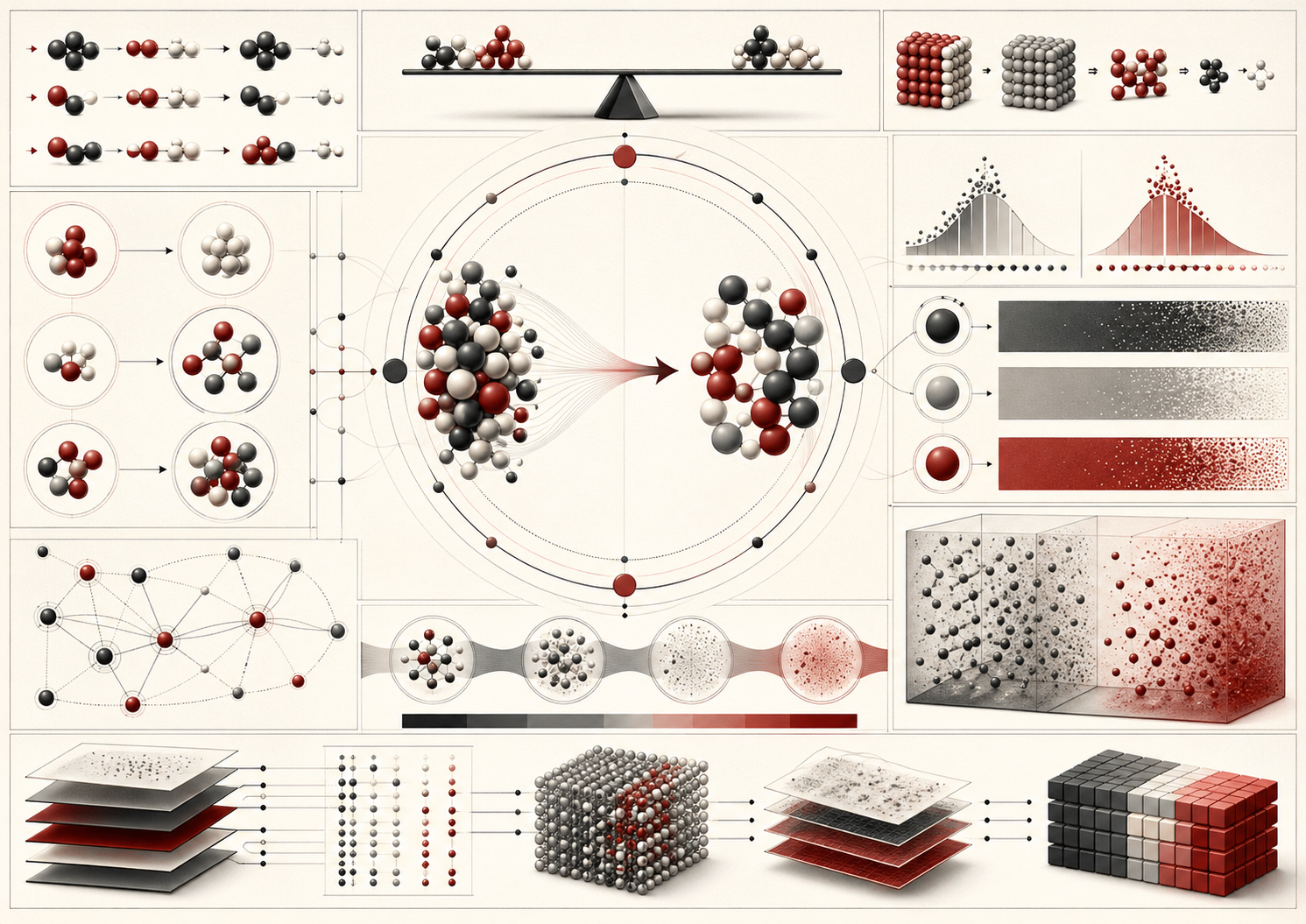
Stoichiometry matters because chemistry is not only about what reacts. It is about how much reacts. A balanced equation can tell a chemist how many moles of oxygen are required to burn a fuel, how much precipitate should form from a solution reaction, how much acid is neutralized by a base, how much product a synthesis can theoretically produce, how much reagent remains in excess, and whether a proposed process violates conservation.
The importance of stoichiometry becomes clear whenever chemistry must be planned, measured, or scaled. A laboratory synthesis cannot be designed responsibly without knowing reagent amounts. An analytical titration cannot report concentration without quantitative reaction relationships. An environmental sample cannot be interpreted without converting measured mass to amount and amount to concentration. An industrial reactor cannot be evaluated without feed ratios, conversion, yield, selectivity, recycle, purge, waste, and material balance.
Stoichiometry also protects chemistry from false precision. A product claim is meaningless if the yield is not calculated correctly. A concentration without units is ambiguous. A reaction equation that is not balanced cannot support reliable quantitative inference. A limiting reagent error can overstate product, understate waste, misrepresent process efficiency, or obscure safety hazards.
Stoichiometry is also the basis of chemical reproducibility. If a reaction cannot be expressed quantitatively, it cannot be repeated reliably, audited, scaled, regulated, automated, or compared. This is why stoichiometric thinking appears in notebooks, batch records, environmental reports, laboratory information systems, process simulators, quality-control documents, and regulatory filings.
At its core, stoichiometry is the discipline of respecting matter. It requires chemists to treat symbols, units, coefficients, masses, volumes, concentrations, and measurements as connected evidence.
Chemical Equations as Conservation Statements
A balanced chemical equation expresses conservation. For a general reaction:
aA + bB \rightarrow cC + dD
\]
Interpretation: The coefficients \(a\), \(b\), \(c\), and \(d\) define proportional relationships among reactants and products.
These coefficients do not necessarily mean that isolated molecules collide exactly in that ratio in a single molecular event. Rather, they describe the net quantitative relationship required by conservation of atoms and charge.
For example, the reaction between hydrogen and oxygen to form water is written:
2H_2 + O_2 \rightarrow 2H_2O
\]
Interpretation: Two moles of hydrogen gas react with one mole of oxygen gas to form two moles of water under the balanced stoichiometric relationship.
This equation says that hydrogen atoms are conserved, oxygen atoms are conserved, and the ratio applies at the particle level, mole level, and laboratory planning level when the reaction is interpreted appropriately.
Balancing a reaction is therefore more than rearranging numbers. It is a conservation test. Hydrogen atoms must be conserved. Oxygen atoms must be conserved. Metals, nonmetals, ions, electrons, and charge must be conserved where relevant. In ionic and redox equations, charge balance is as important as atom balance.
A reaction can be chemically plausible only if its quantitative statement is conserved. If a proposed equation creates oxygen atoms from nothing, loses nitrogen atoms, changes net charge without electron accounting, or violates mass balance, it cannot be used for stoichiometric calculation.
For researchers, chemical equations become quantitative evidence when coefficients are treated as conservation-based ratios among amounts of substance.
Amount of Substance, the Mole, and Molar Mass
Atoms and molecules are too small to count individually in ordinary laboratory practice. Chemistry therefore uses the amount of substance, represented by \(n\), and the mole, represented by \(mol\), to connect microscopic entities to measurable quantities.
The mole connects amount of substance to a fixed number of specified elementary entities. Those entities may be atoms, molecules, ions, electrons, formula units, or other specified groups. The entity must be named because one mole of oxygen atoms is not the same as one mole of oxygen molecules.
The basic relationship between number of entities and amount of substance is:
N = nN_A
\]
Interpretation: \(N\) is number of elementary entities, \(n\) is amount of substance, and \(N_A\) is the Avogadro constant.
Laboratory stoichiometry often uses molar mass:
n = \frac{m}{M}
\]
Interpretation: Amount of substance is calculated from mass \(m\) divided by molar mass \(M\).
This relationship is central because balances measure mass, while reactions operate through amount relationships. A chemist weighs grams, converts to moles, applies coefficients, and converts back to grams if needed.
For example, if a balanced reaction requires two moles of one reactant for every one mole of another, the mass ratio is not necessarily two-to-one. The mass ratio depends on molar masses. Stoichiometry therefore requires careful movement among mass, amount, coefficients, and target quantities.
For researchers, the mole is not just a convenience. It is the bridge between molecular counting and laboratory measurement.
Stoichiometric Coefficients and Reaction Ratios
Stoichiometric coefficients define reaction ratios. For the general reaction:
aA + bB \rightarrow cC + dD
\]
Interpretation: The balanced equation specifies the proportional amount relationships among substances.
the reaction relationship can be written:
\frac{n_A}{a} = \frac{n_B}{b} = \frac{n_C}{c} = \frac{n_D}{d}
\]
Interpretation: When amounts correspond exactly to the balanced reaction relationship, each amount divided by its coefficient gives the same reaction extent.
These ratios allow chemists to calculate one amount from another. If \(a\) moles of \(A\) correspond to \(c\) moles of \(C\), then:
n_C = n_A\frac{c}{a}
\]
Interpretation: The amount of product \(C\) can be calculated from the amount of reactant \(A\) using the coefficient ratio.
The coefficients are dimensionless, but the amounts carry units. Losing track of units is one of the most common ways stoichiometric reasoning fails. A coefficient ratio can convert moles of one substance to moles of another, but it cannot directly convert grams of one substance to grams of another without molar masses.
A reliable stoichiometric calculation therefore has a chain:
\mathrm{mass\ known}
\rightarrow
\mathrm{moles\ known}
\rightarrow
\mathrm{moles\ target}
\rightarrow
\mathrm{mass\ target}
\]
Interpretation: Laboratory mass must be converted to amount before stoichiometric coefficients can be applied.
This chain is one reason stoichiometry trains disciplined scientific reasoning. Each step must be chemically meaningful and dimensionally coherent.
For researchers, coefficient ratios are not arithmetic decoration. They are conservation-based relationships that connect measured quantities to reaction claims.
Limiting Reagents and Excess Reagents
A limiting reagent is the reactant that determines the maximum amount of product that can form. Once the limiting reagent is consumed, the reaction cannot continue to produce more product according to the same stoichiometric pathway, even if other reactants remain.
For a reaction:
aA + bB \rightarrow cC
\]
Interpretation: The amount of product \(C\) depends on which reactant runs out first relative to the required coefficients.
one way to identify the limiting reagent is to compare available reaction extents:
\xi_A = \frac{n_A}{a}
\]
Interpretation: \(\xi_A\) is the possible reaction extent based on available \(A\).
\xi_B = \frac{n_B}{b}
\]
Interpretation: \(\xi_B\) is the possible reaction extent based on available \(B\).
The smaller value determines the limiting reagent. The maximum product amount is then:
n_C = c \cdot \min(\xi_A,\xi_B)
\]
Interpretation: Product formation is constrained by the smallest available stoichiometric extent.
Limiting reagent reasoning is essential because reactants are often not mixed in exactly stoichiometric proportions. One reagent may be intentionally used in excess to drive reaction completion, improve yield, suppress side reactions, compensate for volatility, manage cost, or simplify purification.
In industrial chemistry, excess reactants may be recovered and recycled. In laboratory chemistry, excess reagent may complicate workup, contaminate product, create waste, or alter selectivity. In environmental chemistry, an “excess” reagent may create secondary impacts downstream.
Understanding limiting reagents also prevents an important error: calculating product from the wrong reactant. If a reagent is in excess, it cannot determine the theoretical yield. The limiting reagent does.
For researchers, limiting reagent analysis is not merely an introductory calculation. It is the basis of batch planning, yield accountability, process economics, waste minimization, and reaction safety.
Theoretical Yield, Actual Yield, and Percent Yield
Theoretical yield is the maximum amount of product predicted by stoichiometry from the limiting reagent, assuming the specified reaction proceeds completely to the target product with no losses, side reactions, incomplete conversion, decomposition, evaporation, transfer loss, isolation loss, or purification loss.
Actual yield is the amount of product obtained experimentally. Percent yield compares actual yield to theoretical yield:
\%Y = \frac{Y_{\mathrm{actual}}}{Y_{\mathrm{theoretical}}}\times 100
\]
Interpretation: Percent yield compares observed product amount with the maximum stoichiometrically predicted amount.
Percent yield is not merely a performance score. It is a diagnostic signal. A low yield may reflect incomplete reaction, side products, equilibrium limitations, poor selectivity, product loss during workup, measurement error, reagent impurity, moisture sensitivity, competing reactions, incorrect stoichiometry, or experimental technique.
Yield must also be interpreted carefully. A yield above 100 percent usually indicates impurity, residual solvent, water, unremoved reagent, weighing error, incorrect molar mass, incorrect limiting reagent assignment, or another measurement problem. A high isolated yield is meaningful only if product identity and purity are established.
Yield also differs from conversion and selectivity. Conversion describes how much reactant is consumed. Selectivity describes how much of the consumed reactant goes to the desired product rather than side products. Yield can be high, low, or misleading depending on how these quantities are defined.
For researchers, stoichiometry supports experimental accountability. It links what should have formed to what actually formed and asks why they differ.
Concentration, Solutions, and Dilution
Many reactions occur in solution, so stoichiometry often requires concentration. Amount concentration, often represented as \(C\), is:
C = \frac{n}{V}
\]
Interpretation: Concentration is amount of solute divided by solution volume.
This relationship allows the amount of solute to be calculated from concentration and volume:
n = CV
\]
Interpretation: A measured solution volume and known concentration determine solute amount.
Dilution calculations often use conservation of solute amount:
C_1V_1 = C_2V_2
\]
Interpretation: Dilution conserves the amount of solute when no reaction, loss, or additional solute is involved.
This formula should not be used blindly when reactions, volume contraction, density effects, activity corrections, solution nonideality, evaporation, adsorption, or incomplete transfer matter.
Solution stoichiometry is central to acid-base reactions, precipitation reactions, complexometric titrations, redox titrations, buffer preparation, analytical standards, environmental monitoring, clinical chemistry, pharmaceutical formulation, and industrial process control. It also requires careful technique: volumetric flasks, pipettes, burettes, balances, calibration, temperature control, and uncertainty all matter.
Concentration is therefore both a mathematical ratio and a laboratory practice. A reported concentration is not only a number; it is a claim about preparation, measurement, units, and traceability.
For researchers, solution stoichiometry connects molecular amount to experimental handling. The calculation and the technique must support each other.
Titration and Equivalence
Titration is a quantitative method in which a reagent of known concentration reacts with an analyte to determine analyte amount or concentration. The equivalence point occurs when stoichiometrically equivalent amounts of titrant and analyte have reacted according to the balanced equation.
For a general titration relationship:
aA + bB \rightarrow \mathrm{products}
\]
Interpretation: The titration stoichiometry depends on the balanced reaction between analyte and titrant.
the equivalence relationship is:
\frac{C_A V_A}{a} = \frac{C_B V_B}{b}
\]
Interpretation: Concentration and volume are converted into amount, then compared through stoichiometric coefficients.
The familiar one-to-one acid-base case reduces to:
C_A V_A = C_B V_B
\]
Interpretation: This simplified equation applies only when the reaction stoichiometry is one-to-one.
Many titrations require coefficient-aware calculation. Sulfuric acid, carbonate, permanganate, thiosulfate, EDTA complexes, iodometry, dissolved oxygen analysis, and redox systems often require more careful stoichiometric relationships.
Titration demonstrates the power of stoichiometry because an unknown quantity becomes knowable through reaction, measurement, and equivalence. But it also demonstrates the importance of assumptions: endpoint detection, indicator behavior, reaction completeness, side reactions, standardization, sample matrix, pH, redox potential, complex stability, and volumetric uncertainty all affect results.
For researchers, titration is not simply “volume times concentration.” It is a stoichiometric inference supported by experimental design.
Gas Stoichiometry and Reaction Volumes
Gas reactions connect stoichiometry to pressure, volume, temperature, and amount. Under idealized conditions, the ideal gas equation is:
PV = nRT
\]
Interpretation: Gas pressure, volume, amount, and temperature are related through the gas constant under ideal-gas assumptions.
This equation allows measured gas volume to be related to moles, provided pressure and temperature are known. Gas stoichiometry is important in combustion, respiration, atmospheric chemistry, gas evolution reactions, industrial gas production, electrolysis, fermentation, environmental emissions, and materials processing.
At equal temperature and pressure, gas volumes can reflect mole ratios for ideal gases. This is why a reaction such as:
2H_2 + O_2 \rightarrow 2H_2O
\]
Interpretation: Under comparable ideal-gas conditions, hydrogen and oxygen react in a 2:1 volume ratio before water formation and possible condensation.
can be discussed in terms of gas volume ratios for reactant gases under comparable conditions.
But real gases can deviate from ideal behavior, especially at high pressure, low temperature, or strong intermolecular interaction. Water vapor may condense. Gas collection over water requires vapor pressure correction. Mixtures require partial pressure reasoning. Temperature and pressure must be measured, not assumed.
For researchers, gas stoichiometry connects chemical reaction ratios to physical conditions. The balanced equation provides the ratio; gas laws provide the measurement bridge.
Empirical Formulas and Combustion Analysis
Stoichiometry also works backward from composition to formula. An empirical formula gives the simplest whole-number ratio of atoms in a compound. It can be inferred from percent composition or from combustion analysis.
For elemental percent composition, a typical workflow is:
- assume a convenient sample mass, often 100 g;
- convert each element’s mass to moles;
- divide by the smallest mole amount;
- multiply if needed to obtain whole-number ratios;
- write the empirical formula.
Combustion analysis uses product amounts to infer elements in the original compound. Carbon in \(CO_2\) reflects carbon in the sample. Hydrogen in \(H_2O\) reflects hydrogen in the sample. Oxygen in the original compound may be inferred by mass difference if only carbon, hydrogen, and oxygen are present.
n_C = n_{CO_2}
\]
Interpretation: Each mole of carbon dioxide contains one mole of carbon atoms from the original sample.
n_H = 2n_{H_2O}
\]
Interpretation: Each mole of water contains two moles of hydrogen atoms from the original sample.
Combustion analysis shows that stoichiometry is not only predictive but inferential. It can identify composition from measured products, provided assumptions are clear. Those assumptions include complete combustion, accurate product capture, no contamination, correct element list, and reliable mass measurement.
For researchers, empirical formula work is a reminder that chemical identity often begins with quantitative evidence before structural detail is known.
Reaction Extent and Process Balances
In more advanced chemical contexts, reaction progress can be described using extent of reaction, often represented by \(\xi\). For species \(i\):
n_i = n_{i,0} + \nu_i \xi
\]
Interpretation: \(n_i\) is final amount, \(n_{i,0}\) is initial amount, \(\nu_i\) is stoichiometric number, and \(\xi\) is extent of reaction.
Reactants usually have negative stoichiometric numbers, while products have positive stoichiometric numbers. This representation is powerful because it treats reaction change systematically. It can support reaction engineering, equilibrium calculations, reaction networks, combustion models, bioreaction stoichiometry, process balances, and computational chemistry.
Industrial chemistry often uses related concepts:
- conversion: fraction of a reactant consumed;
- selectivity: preference for one product over competing products;
- yield: product formed relative to theoretical or feed basis;
- recycle: return of unused material to a process;
- purge: removal of accumulating inert or unwanted substances;
- material balance: accounting of all inputs, outputs, accumulation, and reaction.
A general material balance can be written conceptually as:
\mathrm{Input} – \mathrm{Output} + \mathrm{Generation} – \mathrm{Consumption} = \mathrm{Accumulation}
\]
Interpretation: Material accounting tracks matter through a process boundary, including reaction and accumulation.
Stoichiometry is therefore not limited to isolated equations on paper. It becomes the accounting structure of chemical systems.
For researchers, reaction extent and material balance connect molecular stoichiometry to reactors, ecosystems, industrial processes, and computational reaction networks.
Stoichiometry in Analytical, Environmental, and Industrial Chemistry
Stoichiometry appears across nearly every applied chemical domain. In analytical chemistry, stoichiometry supports titrations, gravimetric analysis, calibration standards, reagent preparation, precipitate formation, complexation, redox analysis, purity determination, and quality control.
In environmental chemistry, stoichiometry supports nutrient loading, oxygen demand, carbonate chemistry, acid neutralization, pollutant degradation, atmospheric reaction budgets, water-treatment dosing, greenhouse gas accounting, mine drainage chemistry, and mass loading estimates. A concentration measurement becomes meaningful only when amount, volume, mass, and reaction relationships are handled correctly.
In industrial chemistry, stoichiometry supports reactor feeds, process yields, combustion efficiency, fertilizer production, metallurgy, polymerization, energy systems, chemical separations, neutralization, emissions control, process safety, and waste minimization. Scale makes stoichiometric errors costly. A small calculation error in laboratory work can become a large material, economic, safety, or environmental problem at industrial scale.
Stoichiometry also appears in biochemistry and medicine. Metabolic pathways conserve atoms. Enzyme assays depend on substrate and product amounts. Pharmaceutical preparation depends on dose, concentration, purity, and stoichiometric formulation. Clinical chemistry often converts measured signals into concentrations that affect care.
For researchers, stoichiometry is the shared quantitative language connecting laboratory chemistry, environmental systems, industrial process control, biological pathways, and public accountability.
Atom Economy, Waste, and Responsible Chemical Accounting
Stoichiometry also supports responsible chemistry. Green chemistry often asks how efficiently atoms from reactants are incorporated into products, how much waste is generated, and whether reaction design can improve material efficiency.
A simplified atom economy expression is:
\%AE = \frac{M_{\mathrm{desired\ product}}}{\sum M_{\mathrm{reactants}}}\times 100
\]
Interpretation: Atom economy compares molar mass incorporated into the desired product with the total molar mass of reactants, with coefficients applied according to the balanced reaction.
Atom economy does not replace yield, toxicity, solvent impact, energy use, catalyst durability, purification burden, life-cycle assessment, or exposure risk. A reaction may have excellent atom economy but use hazardous reagents. Another may have poor atom economy but safer conditions. Stoichiometry supplies one important lens within a broader responsible-chemistry framework.
Waste can also be evaluated through mass intensity, E-factor, solvent burden, excess reagent use, and separation losses. These metrics require stoichiometric clarity because “waste” depends on what is counted, where the process boundary is drawn, and whether solvent, water, salts, catalysts, and auxiliaries are included.
Responsible stoichiometric accounting is especially important when chemistry affects communities: water treatment, emissions, fertilizer runoff, industrial discharge, hazardous waste, mining chemistry, and chemical manufacturing all depend on material flows that can be quantified.
For researchers, stoichiometry links chemical design to material consequence. It asks not only whether a product can form, but what else is produced, consumed, wasted, or released.
Uncertainty, Significant Figures, and Accountability
Stoichiometric calculations often look exact because balanced equations use whole-number coefficients. But laboratory inputs are measured quantities with uncertainty. Masses, volumes, concentrations, purities, temperatures, pressures, and yields all carry measurement limitations.
A responsible stoichiometric result should consider:
- balance precision;
- volumetric glassware tolerance;
- reagent purity;
- standardization uncertainty;
- endpoint uncertainty;
- temperature and pressure effects;
- instrument calibration;
- rounding and significant figures;
- sample heterogeneity;
- side reactions and incomplete reaction;
- evaporation, adsorption, transfer loss, and contamination;
- matrix effects in environmental or biological samples.
Significant figures are a simplified teaching tool for expressing reasonable precision, but serious measurement requires uncertainty analysis. A stoichiometric calculation is only as reliable as its inputs and assumptions.
This is especially important when chemistry supports public decisions: drinking-water treatment, pharmaceutical dosing, emissions accounting, food labeling, clinical measurement, environmental cleanup, industrial safety, and regulatory compliance. A reported value can shape decisions only if its uncertainty and assumptions are clear.
For researchers, stoichiometry gives chemistry its quantitative structure; uncertainty gives that structure honesty.
Stoichiometric Data, Computation, and Reproducibility
Modern stoichiometry increasingly depends on computational systems. Reaction databases, electronic laboratory notebooks, laboratory information management systems, automated synthesis platforms, process simulators, environmental data platforms, and machine-readable reaction records all require balanced equations, correct coefficients, units, amounts, yields, and provenance.
Reproducible stoichiometric workflows should preserve:
- balanced reaction equations;
- species names and formulas;
- stoichiometric coefficients;
- molar masses and sources;
- amount, mass, concentration, volume, pressure, and temperature units;
- limiting reagent calculations;
- purity corrections;
- theoretical and actual yields;
- titration stoichiometry and standardization records;
- gas-law assumptions;
- reaction extent and process balances;
- uncertainty estimates;
- data provenance and validation status.
Computational stoichiometry can help detect unbalanced reactions, impossible yield claims, unit errors, limiting reagent mistakes, missing purity corrections, and inconsistent reaction records. But computation can also amplify errors if the underlying reaction is wrong or if units are silently mixed.
For researchers, computational stoichiometry should make conservation clearer, not hide it. A spreadsheet, script, or database should preserve the evidence chain from reaction equation to measured result.
Mathematical Lens: Stoichiometry and Reaction Quantity
Stoichiometry can be represented through conservation, ratios, amount relationships, solution equations, gas laws, and material balances. Amount of substance and entities are related by:
N = nN_A
\]
Interpretation: Amount of substance connects measurable mole quantities to numbers of specified elementary entities.
Mass, molar mass, and amount are related by:
n = \frac{m}{M}
\]
Interpretation: Laboratory mass is converted into amount using molar mass.
A stoichiometric ratio is:
\frac{n_A}{a} = \frac{n_B}{b}
\]
Interpretation: Balanced coefficients relate amounts of substances in the reaction.
Product amount from reactant amount is:
n_{\mathrm{product}} = n_{\mathrm{reactant}}\frac{\nu_{\mathrm{product}}}{\nu_{\mathrm{reactant}}}
\]
Interpretation: A coefficient ratio converts moles of one species to moles of another.
The limiting reagent extent is:
\xi_{\max} = \min_i \left(\frac{n_i}{|\nu_i|}\right)
\]
Interpretation: The smallest available reaction extent among reactants determines the maximum extent of reaction.
Percent yield is:
\%Y = \frac{Y_{\mathrm{actual}}}{Y_{\mathrm{theoretical}}}\times 100
\]
Interpretation: Actual product amount is compared with the stoichiometric maximum.
Amount concentration is:
C = \frac{n}{V}
\]
Interpretation: Concentration relates amount of solute to solution volume.
Dilution is:
C_1V_1 = C_2V_2
\]
Interpretation: Solute amount is conserved during ideal dilution without reaction or loss.
Titration equivalence is:
\frac{C_A V_A}{a} = \frac{C_B V_B}{b}
\]
Interpretation: Equivalence compares stoichiometrically adjusted amounts of analyte and titrant.
The ideal gas relationship is:
PV = nRT
\]
Interpretation: Gas amount can be related to pressure, volume, and temperature under ideal-gas assumptions.
Extent of reaction is:
n_i = n_{i,0} + \nu_i\xi
\]
Interpretation: Species amounts change according to stoichiometric number and reaction extent.
Atom economy is:
\%AE = \frac{M_{\mathrm{desired\ product}}}{\sum M_{\mathrm{reactants}}}\times 100
\]
Interpretation: Atom economy evaluates how much reactant molar mass is incorporated into desired product.
A process material balance is:
\mathrm{Input} – \mathrm{Output} + \mathrm{Generation} – \mathrm{Consumption} = \mathrm{Accumulation}
\]
Interpretation: Material balance generalizes stoichiometry across process boundaries.
These relationships show that stoichiometry is not a single formula. It is a network of conservation-based quantitative tools for translating reaction symbols into measurable chemical quantities.
Computational Workflows for Stoichiometry
Computational workflows can make stoichiometric reasoning more transparent. A workflow can track species, formulas, molar masses, coefficients, available amounts, limiting reagents, theoretical yield, actual yield, percent yield, dilution, titration equivalence, gas-law calculations, empirical formula inference, reaction extent, atom economy, material balance, uncertainty, and provenance.
Useful workflows include limiting reagent calculators, yield audits, solution preparation records, titration concentration calculations, gas stoichiometry, empirical formula inference, combustion analysis scaffolds, process material balances, atom economy and mass-intensity metrics, batch records, and SQL evidence registers.
For researchers, stoichiometric workflows should preserve four distinctions:
- Mass versus amount: grams cannot be compared through coefficients until they are converted to moles.
- Coefficient ratio versus mass ratio: balanced coefficients are amount ratios, not direct mass ratios.
- Theoretical yield versus actual yield: stoichiometric maximum and observed product require separate evidence.
- Calculation versus measurement: computed values depend on measured inputs, purity, technique, and uncertainty.
The examples below use synthetic educational data. They do not validate real batch records, certify product purity, approve environmental reports, support pharmaceutical dosing, establish industrial process safety, or replace professional chemical review. They demonstrate how stoichiometric reasoning can be organized, audited, and communicated responsibly.
Python Example: Limiting Reagents, Yield, Titration, Gas Stoichiometry, and Provenance
The following Python example uses synthetic educational data. It calculates limiting reagent, theoretical yield, percent yield, dilution volume, titration concentration, gas amount from the ideal gas equation, empirical formula ratios, atom economy, and provenance outputs. In real stoichiometric work, these workflows should preserve calibrated measurements, purity corrections, uncertainty, reaction validation, and source data.
from pathlib import Path
from typing import Dict, List
import json
import math
import platform
import sys

import numpy as np
import pandas as pd


# Synthetic stoichiometry workflow.
# Educational example only; not for pharmaceutical dosing,
# industrial batch release, environmental compliance,
# process safety, or clinical use.


def require_columns(data: pd.DataFrame, required: List[str], table_name: str) -> None:
    """Raise an error if required columns are missing."""
    missing = [column for column in required if column not in data.columns]
    if missing:
        raise ValueError(f"{table_name} is missing required columns: {missing}")


reaction_reactants = pd.DataFrame({
    "species": ["H2", "O2"],
    "available_mol": [4.00, 1.50],
    "coefficient_magnitude": [2.0, 1.0],
})

product = {
    "species": "H2O",
    "coefficient": 2.0,
    "molar_mass_g_mol": 18.01528,
    "actual_yield_g": 45.0,
}

require_columns(
    reaction_reactants,
    ["species", "available_mol", "coefficient_magnitude"],
    "reaction_reactants",
)

reaction_reactants["possible_extent_mol"] = (
    reaction_reactants["available_mol"]
    / reaction_reactants["coefficient_magnitude"]
)

limiting_row = reaction_reactants.loc[
    reaction_reactants["possible_extent_mol"].idxmin()
]

maximum_extent_mol = float(limiting_row["possible_extent_mol"])
theoretical_product_mol = maximum_extent_mol * product["coefficient"]
theoretical_yield_g = theoretical_product_mol * product["molar_mass_g_mol"]
percent_yield = product["actual_yield_g"] / theoretical_yield_g * 100.0

yield_summary = pd.DataFrame([{
    "reaction": "2 H2 + O2 -> 2 H2O",
    "limiting_reagent": limiting_row["species"],
    "maximum_extent_mol": maximum_extent_mol,
    "theoretical_product_mol": theoretical_product_mol,
    "theoretical_yield_g": theoretical_yield_g,
    "actual_yield_g": product["actual_yield_g"],
    "percent_yield": percent_yield,
}])

solution_work = pd.DataFrame({
    "calculation": [
        "dilution_stock_volume",
        "acid_concentration_from_one_to_one_titration",
    ],
    "C1_mol_l": [1.000, np.nan],
    "V1_l": [np.nan, np.nan],
    "C2_mol_l": [0.100, np.nan],
    "V2_l": [0.250, np.nan],
    "base_concentration_mol_l": [np.nan, 0.1000],
    "base_volume_l": [np.nan, 0.02340],
    "acid_volume_l": [np.nan, 0.02500],
})

solution_work.loc[
    solution_work["calculation"] == "dilution_stock_volume",
    "computed_value",
] = (
    solution_work["C2_mol_l"] * solution_work["V2_l"] / solution_work["C1_mol_l"]
)

solution_work.loc[
    solution_work["calculation"] == "acid_concentration_from_one_to_one_titration",
    "computed_value",
] = (
    solution_work["base_concentration_mol_l"]
    * solution_work["base_volume_l"]
    / solution_work["acid_volume_l"]
)

solution_work["computed_unit"] = ["L", "mol/L"]

gas_case = pd.DataFrame({
    "case": ["oxygen_collection_demo"],
    "pressure_atm": [1.00],
    "volume_l": [2.50],
    "temperature_K": [298.15],
})

R_l_atm_mol_K = 0.082057

gas_case["moles_O2"] = (
    gas_case["pressure_atm"]
    * gas_case["volume_l"]
    / (R_l_atm_mol_K * gas_case["temperature_K"])
)

gas_case["moles_H2_required"] = 2.0 * gas_case["moles_O2"]
gas_case["moles_H2O_produced"] = 2.0 * gas_case["moles_O2"]

composition = pd.DataFrame({
    "element": ["C", "H", "O"],
    "percent_mass": [40.00, 6.71, 53.29],
    "atomic_mass_g_mol": [12.011, 1.008, 15.999],
})

composition["moles_assuming_100g"] = (
    composition["percent_mass"] / composition["atomic_mass_g_mol"]
)

minimum_moles = composition["moles_assuming_100g"].min()

composition["empirical_ratio"] = (
    composition["moles_assuming_100g"] / minimum_moles
)

composition["nearest_integer_ratio"] = composition["empirical_ratio"].round().astype(int)

empirical_formula = "".join(
    f"{row.element}{row.nearest_integer_ratio if row.nearest_integer_ratio != 1 else ''}"
    for row in composition.itertuples()
)

atom_economy = pd.DataFrame({
    "reaction": ["generic_desired_product_demo"],
    "desired_product_molar_mass_g_mol": [180.16],
    "sum_reactant_molar_masses_weighted_g_mol": [240.20],
})

atom_economy["atom_economy_percent"] = (
    atom_economy["desired_product_molar_mass_g_mol"]
    / atom_economy["sum_reactant_molar_masses_weighted_g_mol"]
    * 100.0
)

material_balance = pd.DataFrame({
    "stream": ["input_feed", "output_product", "output_waste", "accumulation"],
    "mass_kg": [100.0, -72.0, -20.0, -8.0],
})

material_balance["balance_contribution_kg"] = material_balance["mass_kg"]
balance_residual_kg = material_balance["balance_contribution_kg"].sum()

balance_summary = pd.DataFrame([{
    "balance_type": "closed_batch_mass_check",
    "balance_residual_kg": balance_residual_kg,
    "review": "pass" if abs(balance_residual_kg) < 1e-9 else "review required",
}])

output_dir = Path("outputs")
output_dir.mkdir(exist_ok=True)

reaction_reactants.to_csv(output_dir / "synthetic_reactant_extents.csv", index=False)
yield_summary.to_csv(output_dir / "synthetic_limiting_reagent_yield.csv", index=False)
solution_work.to_csv(output_dir / "synthetic_solution_stoichiometry.csv", index=False)
gas_case.to_csv(output_dir / "synthetic_gas_stoichiometry.csv", index=False)
composition.to_csv(output_dir / "synthetic_empirical_formula.csv", index=False)
atom_economy.to_csv(output_dir / "synthetic_atom_economy.csv", index=False)
material_balance.to_csv(output_dir / "synthetic_material_balance.csv", index=False)
balance_summary.to_csv(output_dir / "synthetic_material_balance_summary.csv", index=False)

manifest: Dict[str, object] = {
    "workflow": "synthetic_stoichiometry_workflow",
    "data_type": "synthetic educational stoichiometry records",
    "reaction": "2 H2 + O2 -> 2 H2O",
    "equations": [
        "n = m/M",
        "extent_i = n_i/abs(nu_i)",
        "percent_yield = actual/theoretical*100",
        "C1*V1 = C2*V2",
        "C_A*V_A/a = C_B*V_B/b",
        "P*V = n*R*T",
        "atom_economy = desired_product_molar_mass/sum_reactant_molar_masses*100",
        "input - output + generation - consumption = accumulation",
    ],
    "empirical_formula_demo": empirical_formula,
    "python_version": sys.version,
    "platform": platform.platform(),
    "numpy_version": np.__version__,
    "pandas_version": pd.__version__,
    "output_files": [
        "outputs/synthetic_reactant_extents.csv",
        "outputs/synthetic_limiting_reagent_yield.csv",
        "outputs/synthetic_solution_stoichiometry.csv",
        "outputs/synthetic_gas_stoichiometry.csv",
        "outputs/synthetic_empirical_formula.csv",
        "outputs/synthetic_atom_economy.csv",
        "outputs/synthetic_material_balance.csv",
        "outputs/synthetic_material_balance_summary.csv",
        "outputs/stoichiometry_manifest.json",
    ],
    "responsible_use": [
        "Synthetic educational data only.",
        "Real stoichiometric workflows require validated reactions, calibrated measurements, purity corrections, uncertainty estimates, unit checks, and expert review.",
    ],
}

with (output_dir / "stoichiometry_manifest.json").open(
    "w",
    encoding="utf-8"
) as file:
    json.dump(manifest, file, indent=2)

print("Reactant extents")
print("----------------")
print(reaction_reactants.round(6).to_string(index=False))

print("\nLimiting reagent and yield")
print("--------------------------")
print(yield_summary.round(6).to_string(index=False))

print("\nSolution stoichiometry")
print("----------------------")
print(solution_work.round(6).to_string(index=False))

print("\nGas stoichiometry")
print("-----------------")
print(gas_case.round(8).to_string(index=False))

print("\nEmpirical formula scaffold")
print("--------------------------")
print(composition.round(6).to_string(index=False))
print(f"Empirical formula estimate: {empirical_formula}")

print("\nAtom economy")
print("------------")
print(atom_economy.round(6).to_string(index=False))

print("\nMaterial balance")
print("----------------")
print(material_balance.round(6).to_string(index=False))
print(balance_summary.round(6).to_string(index=False))
This workflow demonstrates stoichiometric evidence discipline rather than real batch validation. It separates limiting reagent analysis, yield, solution calculations, gas stoichiometry, empirical formula inference, atom economy, material balance, and provenance. A real workflow would add uncertainty intervals, purity corrections, calibrated measurement records, reaction validation, and independent review.
R Example: Empirical Formula, Dilution, and Material Balance Scaffolds
The following R example uses synthetic educational data to infer an empirical formula, calculate dilution volume, evaluate a coefficient-aware titration, and check a material balance. In real stoichiometric work, these calculations should be tied to validated reactions, calibrated instruments, correct units, reagent purity, and uncertainty estimates.
# Synthetic stoichiometry scaffold.
# Educational example only; not for pharmaceutical dosing,
# environmental compliance, industrial batch release,
# process safety, or clinical use.

composition <- data.frame(
  element = c("C", "H", "O"),
  percent_mass = c(40.00, 6.71, 53.29),
  atomic_mass_g_mol = c(12.011, 1.008, 15.999)
)

composition$moles_assuming_100g <-
  composition$percent_mass / composition$atomic_mass_g_mol

minimum_moles <- min(composition$moles_assuming_100g)

composition$empirical_ratio <-
  composition$moles_assuming_100g / minimum_moles

composition$nearest_integer_ratio <-
  round(composition$empirical_ratio)

formula_parts <- ifelse(
  composition$nearest_integer_ratio == 1,
  composition$element,
  paste0(composition$element, composition$nearest_integer_ratio)
)

empirical_formula <- paste0(formula_parts, collapse = "")

dilution <- data.frame(
  stock_concentration_mol_l = 1.000,
  target_concentration_mol_l = 0.100,
  target_volume_l = 0.250
)

dilution$stock_volume_l <-
  dilution$target_concentration_mol_l *
  dilution$target_volume_l /
  dilution$stock_concentration_mol_l

# Coefficient-aware titration:
# a A + b B -> products
# C_A V_A / a = C_B V_B / b

titration <- data.frame(
  analyte_coefficient = 1,
  titrant_coefficient = 2,
  titrant_concentration_mol_l = 0.1000,
  titrant_volume_l = 0.02340,
  analyte_volume_l = 0.02500
)

titration$analyte_concentration_mol_l <-
  (
    titration$analyte_coefficient *
    titration$titrant_concentration_mol_l *
    titration$titrant_volume_l
  ) / (
    titration$titrant_coefficient *
    titration$analyte_volume_l
  )

material_balance <- data.frame(
  stream = c("input_feed", "output_product", "output_waste", "accumulation"),
  mass_kg = c(100.0, -72.0, -20.0, -8.0)
)

balance_residual_kg <- sum(material_balance$mass_kg)

balance_summary <- data.frame(
  balance_type = "closed_batch_mass_check",
  balance_residual_kg = balance_residual_kg,
  review = ifelse(abs(balance_residual_kg) < 1e-9, "pass", "review required")
)

atom_economy <- data.frame(
  reaction = "generic_desired_product_demo",
  desired_product_molar_mass_g_mol = 180.16,
  sum_reactant_molar_masses_weighted_g_mol = 240.20
)

atom_economy$atom_economy_percent <-
  atom_economy$desired_product_molar_mass_g_mol /
  atom_economy$sum_reactant_molar_masses_weighted_g_mol *
  100

dir.create("outputs", showWarnings = FALSE)

write.csv(
  composition,
  file = "outputs/r_empirical_formula_composition.csv",
  row.names = FALSE
)

write.csv(
  dilution,
  file = "outputs/r_dilution_calculation.csv",
  row.names = FALSE
)

write.csv(
  titration,
  file = "outputs/r_coefficient_aware_titration.csv",
  row.names = FALSE
)

write.csv(
  material_balance,
  file = "outputs/r_material_balance.csv",
  row.names = FALSE
)

write.csv(
  balance_summary,
  file = "outputs/r_material_balance_summary.csv",
  row.names = FALSE
)

write.csv(
  atom_economy,
  file = "outputs/r_atom_economy.csv",
  row.names = FALSE
)

sink("outputs/r_stoichiometry_report.txt")
cat("Synthetic Stoichiometry Scaffold Report\n")
cat("=======================================\n\n")
cat("Empirical formula composition:\n")
print(composition)
cat("\nEmpirical formula estimate:\n")
print(empirical_formula)
cat("\nDilution calculation:\n")
print(dilution)
cat("\nCoefficient-aware titration:\n")
print(titration)
cat("\nMaterial balance:\n")
print(material_balance)
cat("\nMaterial balance summary:\n")
print(balance_summary)
cat("\nAtom economy:\n")
print(atom_economy)
cat("\nResponsible-use note:\n")
cat("Synthetic educational data only. Real stoichiometric workflows require validated reactions, calibrated measurements, purity corrections, uncertainty estimates, unit checks, and expert review.\n")
sink()

print(composition)
print(paste("Empirical formula estimate:", empirical_formula))
print(dilution)
print(titration)
print(balance_summary)
print(atom_economy)
This scaffold shows how R can support empirical formula inference, dilution, titration, material-balance review, and atom-economy calculation. The central issue is not the language but the evidence chain. Stoichiometric outputs should remain connected to balanced reactions, units, measurement assumptions, purity, and uncertainty.
SQL Example: Stoichiometry Evidence Register
Stoichiometry becomes more reliable when reactions, species, coefficients, reagents, measured quantities, limiting reagent calculations, yield records, solution preparations, titrations, gas calculations, empirical formula records, material balances, and interpretation claims are traceable. A simple evidence register can preserve the context needed to audit quantitative reaction claims.
CREATE TABLE stoichiometric_reaction (
    reaction_id TEXT PRIMARY KEY,
    reaction_name TEXT NOT NULL,
    reaction_equation TEXT NOT NULL,
    reaction_domain TEXT,
    balanced_atom_status TEXT,
    balanced_charge_status TEXT,
    reaction_review_status TEXT,
    notes TEXT
);

CREATE TABLE stoichiometric_species (
    species_id TEXT PRIMARY KEY,
    species_name TEXT NOT NULL,
    formula TEXT,
    molar_mass_g_mol REAL,
    phase TEXT,
    charge INTEGER,
    molar_mass_source_uri TEXT,
    species_review_status TEXT
);

CREATE TABLE reaction_coefficient (
    coefficient_id TEXT PRIMARY KEY,
    reaction_id TEXT NOT NULL,
    species_id TEXT NOT NULL,
    coefficient_value REAL,
    role TEXT,
    coefficient_review_status TEXT,
    FOREIGN KEY (reaction_id) REFERENCES stoichiometric_reaction(reaction_id),
    FOREIGN KEY (species_id) REFERENCES stoichiometric_species(species_id)
);

CREATE TABLE reagent_record (
    reagent_id TEXT PRIMARY KEY,
    reaction_id TEXT NOT NULL,
    species_id TEXT NOT NULL,
    batch_or_sample_id TEXT,
    mass_g REAL,
    amount_mol REAL,
    concentration_mol_l REAL,
    volume_l REAL,
    purity_fraction REAL,
    available_amount_mol REAL,
    measurement_uri TEXT,
    reagent_review_status TEXT,
    FOREIGN KEY (reaction_id) REFERENCES stoichiometric_reaction(reaction_id),
    FOREIGN KEY (species_id) REFERENCES stoichiometric_species(species_id)
);

CREATE TABLE limiting_reagent_record (
    limiting_record_id TEXT PRIMARY KEY,
    reaction_id TEXT NOT NULL,
    limiting_species_id TEXT,
    maximum_extent_mol REAL,
    theoretical_product_species_id TEXT,
    theoretical_product_amount_mol REAL,
    theoretical_product_mass_g REAL,
    limiting_reagent_review_status TEXT,
    FOREIGN KEY (reaction_id) REFERENCES stoichiometric_reaction(reaction_id),
    FOREIGN KEY (limiting_species_id) REFERENCES stoichiometric_species(species_id),
    FOREIGN KEY (theoretical_product_species_id) REFERENCES stoichiometric_species(species_id)
);

CREATE TABLE yield_record (
    yield_id TEXT PRIMARY KEY,
    reaction_id TEXT NOT NULL,
    product_species_id TEXT NOT NULL,
    theoretical_yield_g REAL,
    actual_yield_g REAL,
    percent_yield REAL,
    purity_assessment_uri TEXT,
    yield_review_status TEXT,
    FOREIGN KEY (reaction_id) REFERENCES stoichiometric_reaction(reaction_id),
    FOREIGN KEY (product_species_id) REFERENCES stoichiometric_species(species_id)
);

CREATE TABLE solution_preparation_record (
    solution_id TEXT PRIMARY KEY,
    species_id TEXT NOT NULL,
    solution_name TEXT,
    target_concentration_mol_l REAL,
    target_volume_l REAL,
    stock_concentration_mol_l REAL,
    stock_volume_l REAL,
    preparation_method TEXT,
    calibration_uri TEXT,
    solution_review_status TEXT,
    FOREIGN KEY (species_id) REFERENCES stoichiometric_species(species_id)
);

CREATE TABLE titration_record (
    titration_id TEXT PRIMARY KEY,
    reaction_id TEXT NOT NULL,
    analyte_species_id TEXT,
    titrant_species_id TEXT,
    analyte_volume_l REAL,
    titrant_concentration_mol_l REAL,
    titrant_volume_l REAL,
    analyte_concentration_mol_l REAL,
    endpoint_method TEXT,
    standardization_uri TEXT,
    titration_review_status TEXT,
    FOREIGN KEY (reaction_id) REFERENCES stoichiometric_reaction(reaction_id),
    FOREIGN KEY (analyte_species_id) REFERENCES stoichiometric_species(species_id),
    FOREIGN KEY (titrant_species_id) REFERENCES stoichiometric_species(species_id)
);

CREATE TABLE gas_stoichiometry_record (
    gas_record_id TEXT PRIMARY KEY,
    reaction_id TEXT,
    species_id TEXT,
    pressure_value REAL,
    pressure_unit TEXT,
    volume_value REAL,
    volume_unit TEXT,
    temperature_K REAL,
    amount_mol REAL,
    gas_law_model TEXT,
    gas_review_status TEXT,
    FOREIGN KEY (reaction_id) REFERENCES stoichiometric_reaction(reaction_id),
    FOREIGN KEY (species_id) REFERENCES stoichiometric_species(species_id)
);

CREATE TABLE empirical_formula_record (
    empirical_record_id TEXT PRIMARY KEY,
    sample_id TEXT NOT NULL,
    inferred_formula TEXT,
    method TEXT,
    source_measurement_uri TEXT,
    assumption_notes TEXT,
    empirical_formula_review_status TEXT
);

CREATE TABLE material_balance_record (
    balance_id TEXT PRIMARY KEY,
    reaction_id TEXT,
    process_name TEXT,
    process_boundary_description TEXT,
    input_mass_kg REAL,
    output_mass_kg REAL,
    generation_mass_kg REAL,
    consumption_mass_kg REAL,
    accumulation_mass_kg REAL,
    residual_mass_kg REAL,
    balance_review_status TEXT,
    FOREIGN KEY (reaction_id) REFERENCES stoichiometric_reaction(reaction_id)
);

CREATE TABLE computational_stoichiometry_model (
    model_id TEXT PRIMARY KEY,
    reaction_id TEXT,
    model_type TEXT,
    software_name TEXT,
    software_version TEXT,
    input_uri TEXT,
    output_uri TEXT,
    unit_handling_description TEXT,
    validation_status TEXT,
    model_review_status TEXT,
    FOREIGN KEY (reaction_id) REFERENCES stoichiometric_reaction(reaction_id)
);

CREATE TABLE stoichiometry_interpretation_claim (
    claim_id TEXT PRIMARY KEY,
    reaction_id TEXT,
    model_id TEXT,
    claim_text TEXT,
    claim_type TEXT,
    confidence_level TEXT,
    limitation_notes TEXT,
    review_status TEXT,
    FOREIGN KEY (reaction_id) REFERENCES stoichiometric_reaction(reaction_id),
    FOREIGN KEY (model_id) REFERENCES computational_stoichiometry_model(model_id)
);

SELECT
    r.reaction_id,
    r.reaction_name,
    r.reaction_equation,
    r.balanced_atom_status,
    r.balanced_charge_status,
    s.species_name,
    s.formula,
    s.molar_mass_g_mol,
    c.coefficient_value,
    c.role,
    reagent.mass_g,
    reagent.amount_mol,
    reagent.purity_fraction,
    limiting.maximum_extent_mol,
    limiting.theoretical_product_mass_g,
    y.actual_yield_g,
    y.percent_yield,
    sol.solution_name,
    sol.target_concentration_mol_l,
    tit.analyte_concentration_mol_l,
    gas.amount_mol AS gas_amount_mol,
    emp.inferred_formula,
    mb.process_name,
    mb.residual_mass_kg,
    model.model_type,
    model.validation_status,
    claim.claim_type,
    claim.confidence_level,
    CASE
        WHEN r.balanced_atom_status IS NOT NULL
             AND r.balanced_atom_status != 'pass'
            THEN 'atom balance review required'
        WHEN r.balanced_charge_status IS NOT NULL
             AND r.balanced_charge_status != 'pass'
            THEN 'charge balance review required'
        WHEN s.molar_mass_g_mol IS NULL
            THEN 'molar mass review required'
        WHEN c.coefficient_review_status IS NOT NULL
             AND c.coefficient_review_status != 'pass'
            THEN 'coefficient review required'
        WHEN reagent.reagent_review_status IS NOT NULL
             AND reagent.reagent_review_status != 'pass'
            THEN 'reagent review required'
        WHEN limiting.limiting_reagent_review_status IS NOT NULL
             AND limiting.limiting_reagent_review_status != 'pass'
            THEN 'limiting reagent review required'
        WHEN y.percent_yield > 100
            THEN 'yield above 100 percent review required'
        WHEN y.yield_review_status IS NOT NULL
             AND y.yield_review_status != 'pass'
            THEN 'yield review required'
        WHEN sol.solution_review_status IS NOT NULL
             AND sol.solution_review_status != 'pass'
            THEN 'solution preparation review required'
        WHEN tit.standardization_uri IS NULL
             AND tit.titration_id IS NOT NULL
            THEN 'titration standardization review required'
        WHEN tit.titration_review_status IS NOT NULL
             AND tit.titration_review_status != 'pass'
            THEN 'titration review required'
        WHEN gas.gas_review_status IS NOT NULL
             AND gas.gas_review_status != 'pass'
            THEN 'gas stoichiometry review required'
        WHEN emp.empirical_formula_review_status IS NOT NULL
             AND emp.empirical_formula_review_status != 'pass'
            THEN 'empirical formula review required'
        WHEN mb.balance_review_status IS NOT NULL
             AND mb.balance_review_status != 'pass'
            THEN 'material balance review required'
        WHEN model.model_review_status IS NOT NULL
             AND model.model_review_status != 'pass'
            THEN 'computational stoichiometry review required'
        WHEN claim.review_status IS NOT NULL
             AND claim.review_status != 'reviewed'
            THEN 'interpretation review required'
        ELSE 'standard review'
    END AS stoichiometry_review_status
FROM stoichiometric_reaction r
LEFT JOIN reaction_coefficient c
    ON r.reaction_id = c.reaction_id
LEFT JOIN stoichiometric_species s
    ON c.species_id = s.species_id
LEFT JOIN reagent_record reagent
    ON r.reaction_id = reagent.reaction_id
    AND s.species_id = reagent.species_id
LEFT JOIN limiting_reagent_record limiting
    ON r.reaction_id = limiting.reaction_id
LEFT JOIN yield_record y
    ON r.reaction_id = y.reaction_id
LEFT JOIN solution_preparation_record sol
    ON s.species_id = sol.species_id
LEFT JOIN titration_record tit
    ON r.reaction_id = tit.reaction_id
LEFT JOIN gas_stoichiometry_record gas
    ON r.reaction_id = gas.reaction_id
LEFT JOIN empirical_formula_record emp
    ON emp.sample_id IS NOT NULL
LEFT JOIN material_balance_record mb
    ON r.reaction_id = mb.reaction_id
LEFT JOIN computational_stoichiometry_model model
    ON r.reaction_id = model.reaction_id
LEFT JOIN stoichiometry_interpretation_claim claim
    ON r.reaction_id = claim.reaction_id
ORDER BY stoichiometry_review_status, r.reaction_id, s.species_name;
The purpose of this register is to keep stoichiometric interpretation attached to evidence. A stoichiometric result should preserve balanced reaction equations, species identities, molar masses, coefficients, measured amounts, purity, limiting reagent calculations, yield records, solution preparations, titration records, gas-law assumptions, empirical formula evidence, material balances, computational models, and interpretation review. Stoichiometry becomes stronger when its evidence trail is structured.
GitHub Repository
The companion repository for this article can support reproducible workflows for balanced reaction validation, limiting reagent calculations, theoretical yield, percent yield, dilution, titration, gas stoichiometry, empirical formula inference, combustion analysis, reaction extent, atom economy, material balances, SQL evidence registers, and responsible stoichiometric interpretation.
Complete Code Repository
The full code distribution for this article, including selected stoichiometry examples, expanded computational workflows, reproducible data structures, provenance documentation, limiting reagent and yield calculations, solution and gas stoichiometry scaffolds, empirical formula inference, material-balance examples, SQL evidence registers, and scientific-computing infrastructure, is available on GitHub.
Limits, Uncertainty, and Responsible Interpretation
Stoichiometry is powerful, but it is not self-interpreting. A balanced equation does not prove that a reaction goes to completion. A theoretical yield does not guarantee actual yield. A titration equation does not remove endpoint uncertainty. A gas-law calculation does not prove ideal-gas behavior. A percent yield does not establish product purity.
Uncertainty enters stoichiometric interpretation at many levels: mass measurement, volume measurement, concentration, purity, calibration, standardization, endpoint detection, temperature, pressure, gas nonideality, sample heterogeneity, moisture, side reactions, incomplete reaction, product loss, adsorption, evaporation, and unit conversion.
Stoichiometric values are also conditional. Theoretical yield depends on a specified limiting reagent and target reaction. Atom economy depends on the balanced equation and what is counted as a reactant. Titration concentration depends on reaction stoichiometry and standardization. Gas stoichiometry depends on physical conditions. Material balances depend on process boundary.
Computational stoichiometry adds additional risks. A script can calculate efficiently while using the wrong molar mass, wrong coefficient, wrong unit, wrong limiting reagent, wrong phase, or wrong reaction. Databases can store unbalanced reactions. Automated synthesis systems can scale errors if reaction records are not validated.
The computational examples associated with this article are synthetic and educational. They do not validate real batch records, certify product purity, approve environmental reports, support pharmaceutical dosing, establish industrial process safety, or replace professional chemical review. They are designed to show how stoichiometric reasoning can be structured and audited.
Responsible stoichiometric interpretation should match claim strength to evidence. A strong quantitative reaction claim should specify reaction equation, coefficients, units, molar masses, measured inputs, purity, limiting reagent, assumptions, uncertainty, and validation status whenever possible.
Conclusion
Stoichiometry is the quantitative language of reactions. It turns symbolic equations into measurable relationships among substances. It connects atoms to moles, moles to mass, mass to yield, concentration to volume, titration to equivalence, gases to pressure and temperature, and laboratory measurements to chemical conservation.
Its importance extends far beyond introductory problem sets. Stoichiometry is the basis of synthesis planning, analytical chemistry, environmental monitoring, industrial scale-up, reaction engineering, materials preparation, pharmaceutical manufacturing, combustion analysis, green chemistry, and chemical accountability.
Modern chemistry increasingly depends on stoichiometric discipline because chemical work is automated, data-intensive, regulated, and scaled. Laboratory robots prepare solutions and run reactions. Environmental laboratories report concentrations that shape public policy. Pharmaceutical manufacturing depends on traceable batch records. Battery production, semiconductor processing, water treatment, food analysis, climate chemistry, and industrial synthesis all require quantitative reaction accountability.
A balanced equation is a compact claim about matter. Stoichiometry teaches chemists to read that claim quantitatively, test it with units, respect its limits, and use it to make chemical transformation reproducible.
Related articles
- What Is Chemistry?
- The Chemical Revolution and the Rise of Modern Chemistry
- Measurement, Quantification, and the Experimental Basis of Chemistry
- Chemical Metrology, Standards, and Reference Materials
- Mathematics for Chemistry and Molecular Systems
- Atoms, Elements, and the Periodic Organization of Matter
- Electronic Structure and the Quantum Foundations of Chemistry
- Chemical Bonding and Molecular Structure
- Molecular Geometry, Symmetry, and Structure
- Intermolecular Forces and the Chemistry of Condensed Matter
- Chemical Thermodynamics and Energetics
- Chemical Kinetics and Reaction Mechanisms
- Equilibrium and the Dynamics of Reversible Systems
- Acids, Bases, and Proton Transfer
Further reading
- Atkins, P., de Paula, J. and Keeler, J. (2018) Atkins’ Physical Chemistry. 11th edn. Oxford: Oxford University Press. Available at: https://global.oup.com/academic/product/atkins-physical-chemistry-9780198769866
- Brown, T.L., LeMay, H.E., Bursten, B.E., Murphy, C.J., Woodward, P.M. and Stoltzfus, M.W. (2018) Chemistry: The Central Science. 14th edn. Harlow: Pearson. Available at: https://www.pearson.com/en-us/subject-catalog/p/chemistry-the-central-science/P200000006238
- Housecroft, C.E. and Sharpe, A.G. (2018) Inorganic Chemistry. 5th edn. Harlow: Pearson. Available at: https://www.pearson.com/en-gb/subject-catalog/p/inorganic-chemistry/P200000003413
- MIT BLOSSOMS (n.d.) Stoichiometry. Available at: https://web.mit.edu/blossoms/videos/lessons/stoichiometry/
- MIT OpenCourseWare (2010) Introduction to Solid State Chemistry. Available at: https://ocw.mit.edu/courses/3-091sc-introduction-to-solid-state-chemistry-fall-2010/
- OpenStax (2019) Chemistry 2e: Composition of Substances and Solutions. Available at: https://openstax.org/books/chemistry-2e/pages/3-introduction
- OpenStax (2019) Chemistry 2e: Stoichiometry of Chemical Reactions. Available at: https://openstax.org/books/chemistry-2e/pages/4-introduction
- Royal Society of Chemistry (n.d.) Reacting Masses and Quantitative Chemistry Resources. Available at: https://edu.rsc.org/resources
- BIPM (2019) The International System of Units (SI Brochure). 9th edn. Available at: https://www.bipm.org/en/publications/si-brochure
- National Institute of Standards and Technology (n.d.) NIST Chemistry WebBook. Available at: https://webbook.nist.gov/chemistry/
References
- BIPM (2019) The International System of Units (SI Brochure). 9th edn. Available at: https://www.bipm.org/en/publications/si-brochure
- BIPM (n.d.) SI Base Unit: Mole. Available at: https://www.bipm.org/en/si-base-units/mole
- International Union of Pure and Applied Chemistry (n.d.) Compendium of Chemical Terminology: Amount of Substance. Available at: https://goldbook.iupac.org/terms/view/A00297
- International Union of Pure and Applied Chemistry (n.d.) Compendium of Chemical Terminology: Mole. Available at: https://goldbook.iupac.org/terms/view/M03980
- International Union of Pure and Applied Chemistry (n.d.) Compendium of Chemical Terminology: Stoichiometric Number. Available at: https://goldbook.iupac.org/terms/view/S06025
- International Union of Pure and Applied Chemistry (n.d.) Compendium of Chemical Terminology: Stoichiometry. Available at: https://goldbook.iupac.org/terms/view/S06026
- National Center for Biotechnology Information (n.d.) PubChem. Available at: https://pubchem.ncbi.nlm.nih.gov/
- National Institute of Standards and Technology (n.d.) CODATA Value: Avogadro Constant. Available at: https://physics.nist.gov/cgi-bin/cuu/Value?na
- National Institute of Standards and Technology (n.d.) NIST Chemistry WebBook. Available at: https://webbook.nist.gov/chemistry/
- OpenStax (2019) Chemistry 2e: Stoichiometry of Chemical Reactions. Available at: https://openstax.org/books/chemistry-2e/pages/4-introduction
- Royal Society of Chemistry (2026) Teaching Reacting Masses at 14–16. Available at: https://edu.rsc.org/cpd/teaching-reacting-masses-at-14-16/4023173.article