
Last Updated May 28, 2026
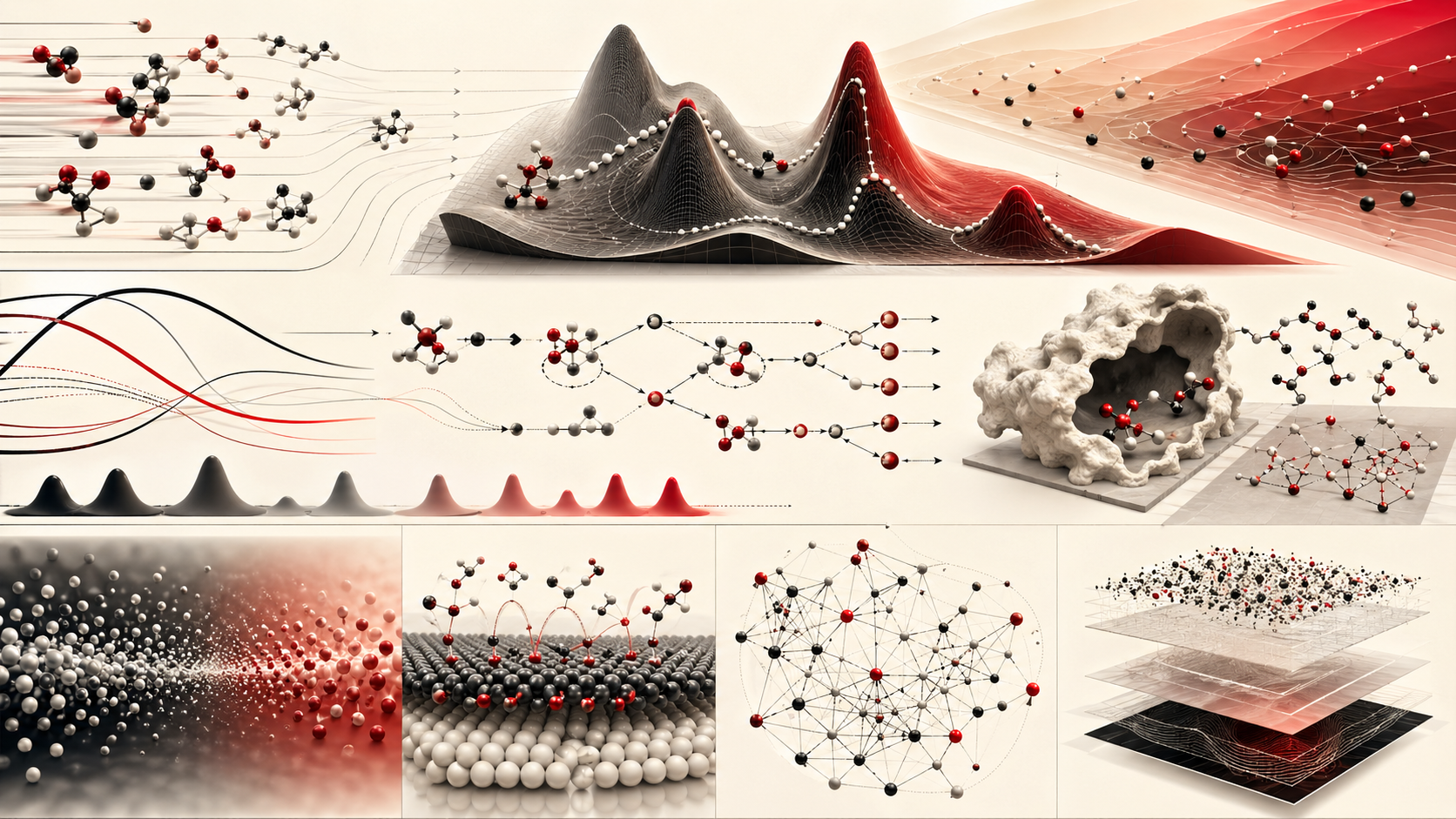
Chemical kinetics explains how fast reactions occur, how pathways unfold, and why thermodynamic possibility is not the same as chemical speed. Thermodynamics tells whether a transformation is energetically favored under specified conditions; kinetics explains whether that transformation happens in seconds, years, geological time, or not observably at all.
The central thesis of this article is that kinetics gives chemistry its time dimension. Stoichiometry constrains quantity. Thermodynamics constrains energetic possibility. Kinetics explains temporal behavior, pathway control, mechanistic evidence, and the conditions under which chemical change actually becomes observable.
A balanced equation describes net transformation, but it does not automatically reveal the molecular pathway. The equation \(2H_2 + O_2 \rightarrow 2H_2O\) summarizes reactants and products, but it does not describe every collision, radical, surface event, chain step, transition state, or energy barrier involved in actual combustion. Many organic, inorganic, biochemical, atmospheric, catalytic, and materials reactions proceed through sequences of elementary steps rather than one direct event.
Main Library
Publications
Article Map
Chemistry
Related Topic
Mathematical Modeling
Related Topic
Data Systems & Analytics
Related Topic
Environmental Monitoring Systems
Why Chemical Kinetics Matters
Chemical kinetics matters because chemical change happens through time. A thermodynamic calculation may say that products are favored, but it cannot say whether the reaction will occur in a flask during a laboratory period, inside an engine cylinder in milliseconds, in the atmosphere over hours, in a battery over years, in a cell over microseconds, or in a rock over geological time. Kinetics provides that temporal discipline.
Kinetics also explains control. Chemical systems can be manipulated by changing concentration, temperature, solvent, pressure, light exposure, catalysts, surface area, mixing, ionic strength, pH, enzyme concentration, or physical transport. A reaction that is too slow can be accelerated. A reaction that is too fast can be moderated. A pathway that produces unwanted products can sometimes be redirected.
Mechanisms matter because the net equation hides molecular detail. A rate law can reveal that a species not present in the overall stoichiometric equation affects the rate. Isotope substitution can reveal bond-breaking involvement. Product ratios can reveal competing pathways. Detection of intermediates can support or refute proposed mechanisms. A catalyst can change the path without changing the overall thermodynamic equilibrium.
Kinetics is also essential for safety, sustainability, and reliability. A material may be thermodynamically unstable but kinetically persistent. A drug may degrade slowly under storage but rapidly under heat, light, or moisture. A pollutant may persist because degradation pathways are kinetically blocked. A reactor may become dangerous if heat-producing kinetics outrun heat removal.
For researchers and scientists, kinetics turns reaction chemistry into evidence-based pathway analysis. It gives chemists a way to ask how matter changes, not only what it becomes.
Rate of Reaction and Chemical Time
The rate of reaction describes how quickly concentrations change during a chemical process. For a general reaction:
aA + bB \rightarrow pP + qQ
\]
Interpretation: Reactants \(A\) and \(B\) are consumed while products \(P\) and \(Q\) are formed according to the balanced stoichiometric coefficients.
a constant-volume reaction rate can be expressed as:
v = -\frac{1}{a}\frac{d[A]}{dt}
= -\frac{1}{b}\frac{d[B]}{dt}
= \frac{1}{p}\frac{d[P]}{dt}
= \frac{1}{q}\frac{d[Q]}{dt}
\]
Interpretation: Stoichiometric normalization allows the rate to describe the reaction as a whole rather than only one species’ disappearance or appearance.
The negative signs appear for reactants because their concentrations decrease as the reaction proceeds. Products have positive rates of appearance because their concentrations increase.
This definition connects kinetics to stoichiometry. Coefficients are needed so that the rate refers to the reaction as a whole. If \(A\) disappears twice as fast as \(B\) because the balanced equation consumes two units of \(A\) for each unit of \(B\), the normalized reaction rate accounts for that relationship.
Reaction rate is not always constant. It often changes as reactants are consumed, products accumulate, temperature shifts, catalysts deactivate, intermediates build up, or physical transport becomes limiting. Kinetics therefore studies rate as a function of time, composition, and conditions.
Chemical time can be extremely diverse. Explosive chain reactions may occur rapidly. Atmospheric radical reactions may shape pollution over hours. Polymer degradation may unfold over years. Mineral reactions may take centuries. Kinetics gives a common framework for comparing these timescales.
For researchers, rate is not merely “speed.” It is an experimentally measurable link between chemical composition and temporal behavior.
Rate Laws and Reaction Order
A rate law relates reaction rate to concentrations and a rate constant. A common empirical form is:
v = k[A]^m[B]^n
\]
Interpretation: \(v\) is rate, \(k\) is the rate constant, \([A]\) and \([B]\) are concentrations, and \(m\) and \(n\) are reaction orders with respect to \(A\) and \(B\).
The overall order is:
m+n
\]
Interpretation: The overall order is the sum of the concentration exponents in this empirical rate law.
Reaction order is not always equal to stoichiometric coefficients. For an elementary step, the rate law is often directly related to molecularity. For an overall reaction composed of multiple steps, the observed rate law must be determined experimentally or derived from a justified mechanism.
This distinction is essential. The balanced equation may suggest one set of coefficients, while the rate law reveals something different about the slow or rate-controlling molecular events. A reactant appearing in the overall equation may not appear in the rate law if it is not involved in the rate-controlling step or if it is present in large excess. Conversely, a catalyst, inhibitor, or intermediate may affect the rate even though it does not appear in the net equation.
Rate constants also carry units that depend on reaction order. A first-order rate constant has units of reciprocal time. A second-order rate constant has concentration inverse times reciprocal time. Unit checking is therefore part of kinetic discipline.
For researchers, rate laws are empirical and mechanistic clues. They do not merely report speed; they help infer pathway.
Integrated Rate Laws and Half-Life
Integrated rate laws describe concentration as a function of time. They are useful for analyzing experimental concentration-time data and identifying reaction order.
For a first-order reaction:
\frac{d[A]}{dt} = -k[A]
\]
Interpretation: The rate of disappearance of \(A\) is proportional to the concentration of \(A\).
The integrated form is:
[A]_t = [A]_0e^{-kt}
\]
Interpretation: Concentration decreases exponentially with time for ideal first-order behavior.
or:
\ln[A]_t = \ln[A]_0 – kt
\]
Interpretation: A plot of \(\ln[A]\) versus time is linear for ideal first-order kinetics, with slope \(-k\).
For a second-order reaction in one reactant:
\frac{d[A]}{dt} = -k[A]^2
\]
Interpretation: The rate depends on the square of the reactant concentration under this simplified second-order model.
The integrated form is:
\frac{1}{[A]_t} = \frac{1}{[A]_0} + kt
\]
Interpretation: A plot of \(1/[A]\) versus time is linear for ideal second-order behavior in one reactant.
For a zero-order reaction:
[A]_t = [A]_0 – kt
\]
Interpretation: Concentration decreases linearly with time when rate is independent of reactant concentration under the tested conditions.
Half-life, \(t_{1/2}\), is the time required for concentration to decrease to half its initial value. For first-order kinetics:
t_{1/2} = \frac{\ln 2}{k}
\]
Interpretation: First-order half-life is independent of initial concentration.
This first-order half-life property is central in radioactive decay, some decomposition reactions, pharmacokinetics, and many simplified kinetic models.
Integrated rate laws show how mathematical form becomes chemical evidence. Experimental data can be tested against models, but model fit must be interpreted chemically. Linear behavior alone does not prove a mechanism; it supports a kinetic description under specified conditions.
Temperature Dependence and the Arrhenius Equation
Reaction rates often increase with temperature because a larger fraction of molecular encounters can access the energy needed for reaction. The Arrhenius equation expresses a common relationship between rate constant and temperature:
k = Ae^{-E_a/(RT)}
\]
Interpretation: \(k\) is the rate constant, \(A\) is the pre-exponential factor, \(E_a\) is activation energy, \(R\) is the gas constant, and \(T\) is absolute temperature.
Taking the natural logarithm gives:
\ln k = \ln A – \frac{E_a}{RT}
\]
Interpretation: This linearized form allows activation energy to be estimated from temperature-dependent rate constants.
A plot of \(\ln k\) versus \(1/T\) can be used to estimate activation energy from the slope:
\mathrm{slope} = -\frac{E_a}{R}
\]
Interpretation: The slope of an Arrhenius plot gives activation energy when the model is valid across the temperature range.
The Arrhenius equation is powerful but not universal. Rate constants can deviate from simple Arrhenius behavior because mechanisms change, tunneling matters, diffusion becomes limiting, catalysts change state, enzymes denature, solvents reorganize, phase transitions occur, or multiple pathways contribute.
Temperature is therefore not just a knob that speeds chemistry. It can change pathways, selectivity, equilibrium, transport, catalyst behavior, enzyme structure, and material state.
For researchers, Arrhenius analysis is useful only when the temperature range, mechanism, units, and assumptions are documented. A straight line is evidence, not proof, of a single simple kinetic barrier.
Activation Energy and Energy Barriers
Activation energy is often introduced as an energy barrier that reactants must overcome to form products. This picture is useful, but it must be interpreted carefully. A reaction coordinate diagram simplifies a high-dimensional molecular process into a one-dimensional path. Real reactions involve molecular orientations, bond stretching, solvent reorganization, surfaces, electronic states, and transition-state structures.
A simplified reaction profile includes reactants, a transition state, and products:
\mathrm{Reactants} \rightarrow \mathrm{Transition\ State} \rightarrow \mathrm{Products}
\]
Interpretation: The reaction passes through a high-energy transition-state region before products form.
The activation energy for the forward reaction relates to the energy difference between reactants and the transition-state region. A catalyst lowers the effective barrier by providing an alternative pathway, but it does not change the overall thermodynamic free-energy difference between reactants and products.
Activation barriers help explain kinetic stability. A substance may be thermodynamically unstable but kinetically persistent because the barrier to transformation is high. Many materials, pharmaceuticals, polymers, biomolecules, and atmospheric species exist because kinetic barriers slow their transformation.
Activation energy also helps explain selectivity. When two pathways compete, the pathway with the lower effective barrier may dominate under kinetic control, even if another product is more thermodynamically stable. Temperature can alter this balance by changing how barrier differences affect rate.
For researchers, energetic favorability and kinetic accessibility must be distinguished. A downhill thermodynamic process can still require a high barrier crossing.
Elementary Reactions and Molecularity
An elementary reaction is a single molecular step in a mechanism. It is not decomposed into simpler hidden steps for the purposes of the mechanism under consideration. Elementary reactions can often be classified by molecularity:
- unimolecular: one reacting species undergoes change;
- bimolecular: two species collide or interact in the elementary event;
- termolecular: three-body elementary events, comparatively rare and often involving energy transfer or pressure-dependent behavior.
For an elementary step, the rate law is connected to the molecular event. A bimolecular elementary reaction between \(A\) and \(B\) often has a rate proportional to \([A][B]\):
A + B \rightarrow P
\]
v = k[A][B]
\]
Interpretation: For an elementary bimolecular step, the rate law follows directly from the molecular event under mass-action assumptions.
A unimolecular elementary step often has first-order form:
A \rightarrow P
\]
v = k[A]
\]
Interpretation: For an elementary unimolecular step, rate is proportional to the concentration of the reacting species.
This direct link does not generally hold for an overall reaction with multiple steps. A balanced net reaction may hide intermediates, catalysts, pre-equilibria, chain carriers, surface adsorption, or rate-controlling steps.
Elementary reactions are especially important in gas-phase kinetics, atmospheric chemistry, combustion, radical chemistry, photochemistry, mechanistic organic chemistry, organometallic chemistry, and heterogeneous catalysis. They allow a complex reaction to be represented as a sequence of molecular events.
For researchers, a mechanism is a proposed causal story, and elementary steps are the sentences of that story.
Reaction Mechanisms and Intermediates
A reaction mechanism is a proposed sequence of elementary steps that explains the overall chemical transformation and observed rate behavior. A plausible mechanism must satisfy several constraints:
- the elementary steps must add to the overall balanced equation;
- the derived rate law should be consistent with experimental data;
- intermediates should be chemically plausible;
- catalysts should be regenerated if they are not consumed overall;
- the mechanism should respect charge, spin, structure, and energetic constraints;
- available spectroscopic, isotopic, computational, and product evidence should support it.
Intermediates are species formed in one step and consumed in a later step. They do not appear in the net equation because they cancel when elementary steps are summed. Transition states are not intermediates; they are high-energy configurations along the reaction path and are not isolable species in the same way.
A simple mechanism may be represented as:
A + B \rightarrow I
\]
I \rightarrow P
\]
Interpretation: \(I\) is an intermediate because it is produced in one step and consumed in another.
Mechanisms can involve ions, radicals, excited states, organometallic complexes, enzyme-substrate complexes, adsorbed surface species, solvent-separated ion pairs, radical chains, or short-lived transition-state ensembles. Evidence for these species may be direct or indirect.
A mechanism is not proven merely because it can be written. It is strengthened when multiple independent lines of evidence converge: rate law, product distribution, isotope effects, stereochemistry, intermediate detection, inhibition studies, computation, and reproducibility.
For researchers, a mechanism is an evidence-bearing hypothesis about molecular pathway, not a decorative arrow-pushing diagram.
Rate-Determining Steps and Rate Control
Introductory chemistry often describes a “rate-determining step” as the slowest step in a mechanism. This idea is useful, but real mechanisms can be more subtle. Rate control may be distributed across multiple steps. A step’s influence on overall rate may depend on reversibility, intermediate concentration, catalyst state, substrate saturation, transport, thermodynamic driving force, or competing pathways.
A slow step early in a mechanism may limit product formation, but a later step can also control rate if intermediates build up. In catalytic cycles, no single step may always be rate-determining under all conditions. Changing pressure, solvent, ligand, pH, temperature, or reactant concentration can shift which step controls the observed rate.
Mechanistic interpretation therefore requires more than naming the slow step. It asks which molecular event controls the measured rate under the specific experimental conditions.
This is one reason kinetic studies often vary one condition at a time: concentration, temperature, catalyst loading, isotope substitution, solvent, pressure, pH, ionic strength, light intensity, or surface area. The goal is not only to measure a rate but to identify which part of the pathway governs that rate.
For researchers, rate control is central to catalyst design, enzyme engineering, industrial optimization, atmospheric modeling, reaction-network analysis, and materials degradation. It is a practical question: where should intervention occur if the rate or selectivity must change?
Steady-State and Pre-Equilibrium Approximations
Many mechanisms involve intermediates that are difficult to measure directly. Approximation methods help derive usable rate laws.
The steady-state approximation assumes that the concentration of a reactive intermediate remains approximately constant over a relevant time window:
\frac{d[I]}{dt} \approx 0
\]
Interpretation: \(I\) is an intermediate whose formation and consumption rates are approximately balanced. This does not mean \([I]\) is zero.
The pre-equilibrium approximation applies when an early reversible step reaches equilibrium quickly relative to a later product-forming step. For example:
A + B \rightleftharpoons I
\]
I \rightarrow P
\]
Interpretation: If the first step is fast and reversible while the second step is slow, the intermediate concentration may be expressed using the equilibrium relationship for the first step.
These approximations are powerful because they connect mechanisms to experimentally testable rate laws. They are also assumptions. They must be justified by timescale separation, concentration behavior, or agreement with evidence.
Approximation failure is scientifically informative. If a derived rate law does not match experiment, the mechanism may be incomplete, a step may not be in pre-equilibrium, an intermediate may not be steady, a side pathway may be important, or transport may be limiting.
For researchers, kinetic modeling often begins with approximations and then tests them against data. When simple approximations fail, numerical integration of differential equations may be needed.
Catalysis and Pathway Control
A catalyst increases reaction rate by providing an alternative pathway with a lower effective activation barrier. It participates in the mechanism but is regenerated overall. Catalysts do not change the thermodynamic equilibrium constant for a reaction, although they can help a system reach equilibrium faster or shift selectivity by changing competing pathways.
A simplified catalytic pathway can be written:
C + S \rightleftharpoons CS
\]
CS \rightarrow C + P
\]
Interpretation: Catalyst \(C\) binds substrate \(S\), forms an intermediate complex, produces product \(P\), and is regenerated.
Catalysis appears in many forms:
- acid-base catalysis, where proton transfer changes reactivity;
- metal catalysis, where coordination, redox, insertion, or activation steps enable reaction;
- heterogeneous catalysis, where surfaces adsorb, orient, and activate reactants;
- enzyme catalysis, where biological macromolecules stabilize transition states and organize substrates;
- photocatalysis, where light-generated excited states or charge carriers drive processes;
- organocatalysis, where small organic molecules mediate pathways.
Catalysis is kinetic control in practical form. It can lower energy barriers, change selectivity, stabilize intermediates, orient reactants, enable electron transfer, provide surfaces, or couple reactions to external energy sources.
Because catalysis changes pathways, it is inseparable from mechanism. A catalyst is not simply a speed additive; it is a chemical participant in an alternative route.
For researchers, catalytic kinetics must distinguish intrinsic catalytic activity from observed process rate, because transport, deactivation, inhibition, heat transfer, and active-site definition can all affect measurements.
Chain Reactions, Autocatalysis, and Complex Kinetics
Not all reactions follow simple first-order, second-order, or zero-order behavior. Complex kinetics can arise from chain reactions, autocatalysis, feedback, branching, inhibition, radical propagation, surface saturation, enzyme saturation, oscillation, transport limitation, or competing pathways.
Chain reactions involve initiation, propagation, branching, and termination steps. Combustion, atmospheric radical chemistry, halogenation, polymerization, and ozone chemistry can involve chain behavior. A small number of radicals can lead to many product-forming events through propagation cycles.
Autocatalysis occurs when a product or intermediate accelerates its own formation:
A + P \rightarrow 2P
\]
Interpretation: Product \(P\) helps produce more \(P\), creating positive feedback.
Autocatalysis can generate sigmoidal concentration-time curves, threshold behavior, or nonlinear dynamics. Reaction networks can exhibit bistability, oscillation, pattern formation, or runaway behavior under some conditions.
Complex kinetics shows why reaction chemistry can become systems chemistry. A mechanism is sometimes not a single pathway but a network of pathways with feedback, competition, and time-dependent behavior.
For researchers, complex kinetic behavior is not a nuisance to be ignored. It may contain the most important information about pathway control, system stability, safety, and emergent chemical behavior.
Diffusion Control, Surfaces, and Transport
Reaction rate is not always controlled by chemical barrier crossing. Sometimes species react as soon as they encounter each other, and the observed rate is limited by diffusion or transport. In solution, diffusion-controlled reactions can occur when reactive species must first find one another. In heterogeneous catalysis, rates can depend on adsorption, surface diffusion, desorption, pore transport, heat transfer, or mass transfer.
Surface reactions introduce additional kinetic layers. Reactants may adsorb onto a surface, migrate, react, and desorb:
A + * \rightleftharpoons A*
\]
A* + B* \rightarrow P*
\]
P* \rightarrow P + *
\]
Interpretation: The symbol \(*\) represents an open surface site. Adsorption, surface reaction, and desorption can all affect observed rate.
Surface coverage can change rate laws. Catalytic sites can saturate. Products can inhibit by occupying active sites. Temperature can change adsorption strength and surface mobility.
In industrial and environmental systems, mixing and transport are often as important as intrinsic chemical rate constants. A reaction may be fast in a well-mixed laboratory vial but slower in soil, aerosols, biofilms, porous catalysts, sediments, membranes, or reactors because diffusion is limiting.
For researchers, kinetics must distinguish intrinsic chemical rate from observed process rate. Without that distinction, a transport artifact can be mistaken for a mechanistic rate law.
Enzyme Kinetics and Biochemical Mechanisms
Enzyme kinetics is a major area where reaction mechanisms, saturation, catalysis, and biological function intersect. A simplified Michaelis-Menten scheme is:
E + S \rightleftharpoons ES \rightarrow E + P
\]
Interpretation: \(E\) is enzyme, \(S\) is substrate, \(ES\) is enzyme-substrate complex, and \(P\) is product.
Under common assumptions, the rate can be written:
v = \frac{V_{\max}[S]}{K_M + [S]}
\]
Interpretation: Rate increases with substrate concentration and approaches \(V_{\max}\) as enzyme active sites become saturated.
At low substrate concentration, rate increases approximately linearly with \([S]\). At high substrate concentration, the enzyme becomes saturated and rate approaches \(V_{\max}\).
This model is useful but simplified. Real enzymes can show inhibition, cooperativity, allostery, multiple substrates, conformational change, product inhibition, pH dependence, temperature dependence, isotope effects, compartment effects, and complex reaction pathways.
Enzyme kinetics also connects chemistry to medicine and biotechnology. Drug inhibition, metabolic flux, enzyme engineering, biomarker assays, fermentation, synthetic biology, and disease mechanisms all depend on kinetic interpretation.
For researchers, enzyme kinetics shows that mechanisms are not only chemical abstractions. They are central to metabolism, pharmacology, biotechnology, disease biology, and systems biology.
Experimental Evidence for Mechanisms
Mechanisms are inferred from evidence. Common evidence includes:
- rate law and reaction order;
- integrated concentration-time behavior;
- temperature dependence and activation parameters;
- isotope effects;
- intermediate detection;
- spectroscopic monitoring;
- product distribution;
- stereochemical outcome;
- solvent effects;
- pH-rate profiles;
- pressure dependence;
- catalyst concentration dependence;
- computational transition-state analysis;
- inhibition or trapping experiments.
No single observation usually proves a mechanism. A rate law may be consistent with more than one pathway. An intermediate may be observed but not lie on the productive pathway. A computational transition state may be plausible but depend on model assumptions. Isotope effects may support bond involvement but require careful interpretation.
Experimental design matters. Initial-rate methods may reduce product complications. Stopped-flow methods may capture fast processes. Spectroscopy can follow intermediates in real time. Isotopic labeling can reveal atom movement. Temperature-dependent data can estimate activation parameters. Perturbation experiments can identify rate control.
Mechanistic chemistry is therefore a convergence practice. Evidence accumulates until one mechanism explains the data better than alternatives.
For researchers, mechanism should be treated as a claim with evidence strength, uncertainty, and competing explanations—not as an answer that exists apart from measurement.
Kinetic Modeling and Computational Workflows
Kinetic modeling represents reactions as mathematical systems. A simple first-order reaction may be solved analytically, but reaction networks often require numerical integration of ordinary differential equations. For species concentrations \(\mathbf{c}\), a reaction network can be written in matrix form:
\frac{d\mathbf{c}}{dt} = S\mathbf{r}(\mathbf{c},T)
\]
Interpretation: \(S\) is the stoichiometric matrix and \(\mathbf{r}\) is a vector of reaction rates that depend on concentration, temperature, and parameters.
Computational kinetics can support combustion modeling, atmospheric chemistry, enzyme networks, catalytic cycles, polymerization, pharmacokinetics, battery degradation, corrosion, environmental fate, and industrial reactor simulation. A model may include hundreds or thousands of elementary reactions.
Reproducibility is essential. A kinetic model should document reactions, rate constants, temperature dependence, units, assumptions, initial conditions, solver settings, data sources, parameter uncertainty, validation datasets, and limitations. A model without provenance can produce precise-looking results that are difficult to trust.
Kinetic models also require numerical discipline. Stiff systems, fast radicals, slow degradation pathways, low-concentration intermediates, and coupled transport processes can challenge simple solvers. Solver tolerances, timestep control, conservation checks, and units are part of the scientific evidence chain.
For researchers, kinetics is a natural place for chemistry, mathematics, computation, and evidence to meet. The model should reveal the mechanism, not obscure it.
Mathematical Lens: Chemical Kinetics and Reaction Mechanisms
Chemical kinetics is built around differential equations, rate laws, exponential behavior, temperature dependence, and systems modeling. The reaction rate for a balanced reaction can be written:
v = -\frac{1}{a}\frac{d[A]}{dt}
= \frac{1}{p}\frac{d[P]}{dt}
\]
Interpretation: Rate can be defined through normalized reactant disappearance or product appearance.
An empirical rate law is:
v = k[A]^m[B]^n
\]
Interpretation: The rate depends on concentrations raised to experimentally determined orders.
The first-order integrated rate law is:
[A]_t = [A]_0e^{-kt}
\]
Interpretation: First-order concentration decay is exponential.
The first-order half-life is:
t_{1/2} = \frac{\ln 2}{k}
\]
Interpretation: First-order half-life depends only on the rate constant.
The second-order integrated rate law is:
\frac{1}{[A]_t} = \frac{1}{[A]_0} + kt
\]
Interpretation: A linear \(1/[A]\) versus time relationship supports ideal second-order behavior in one reactant.
The Arrhenius equation is:
k = Ae^{-E_a/(RT)}
\]
Interpretation: Rate constants often depend exponentially on activation energy and temperature.
The linearized Arrhenius form is:
\ln k = \ln A – \frac{E_a}{RT}
\]
Interpretation: This form supports activation-energy estimation from temperature-dependent kinetic data.
The steady-state approximation is:
\frac{d[I]}{dt} \approx 0
\]
Interpretation: Intermediate formation and consumption are approximately balanced over the relevant time window.
The Michaelis-Menten equation is:
v = \frac{V_{\max}[S]}{K_M + [S]}
\]
Interpretation: Enzyme rate approaches a maximum as substrate concentration saturates active sites.
The reaction-network form is:
\frac{d\mathbf{c}}{dt} = S\mathbf{r}(\mathbf{c},T)
\]
Interpretation: Concentration change is determined by stoichiometric structure and the vector of reaction rates.
A finite-difference sensitivity can be written:
S_{y,k_i} \approx \frac{y(k_i+\Delta k_i)-y(k_i-\Delta k_i)}{2\Delta k_i}
\]
Interpretation: Sensitivity analysis estimates how strongly a model output responds to a kinetic parameter.
These relationships show that kinetics is a quantitative science of change. It translates concentration, temperature, time, pathway, and mechanism into testable mathematical structure.
Computational Workflows for Chemical Kinetics
Computational workflows can make chemical kinetics more transparent. A workflow can track concentration-time data, rate-law assumptions, integrated-rate-law fits, residuals, temperature-dependent rate constants, Arrhenius parameters, elementary-step mechanisms, ODE simulations, enzyme kinetic models, reaction-network structure, parameter sensitivity, solver settings, validation evidence, and provenance.
Useful workflows include first-order and second-order fitting, half-life calculation, Arrhenius analysis, activation-energy estimation, enzyme kinetic fitting, consecutive-reaction simulation, reversible-reaction simulation, steady-state approximation checks, catalytic-cycle ODE models, chain-reaction scaffolds, diffusion-limited comparisons, and SQL evidence registers.
For researchers, kinetic workflows should preserve four distinctions:
- Thermodynamic favorability versus kinetic speed: a favorable reaction can be slow, and a fast reaction may be only one pathway among many.
- Rate law versus net equation: reaction order must be measured or derived from mechanism, not assumed from stoichiometry.
- Mechanism versus model fit: a mathematical fit can support a mechanism but does not prove it alone.
- Intrinsic kinetics versus observed process rate: transport, surfaces, mixing, and heat transfer can dominate measured behavior.
The examples below use synthetic educational data. They do not validate real mechanisms, certify catalyst performance, approve pharmaceutical stability, predict industrial reactors, establish environmental fate, or replace professional kinetic review. They demonstrate how kinetic reasoning can be organized, audited, and communicated responsibly.
Python Example: Rate-Law Fitting, Arrhenius Analysis, ODE Simulation, and Provenance
The following Python example uses synthetic educational data. It fits a first-order model, estimates Arrhenius activation energy, simulates a consecutive reaction network, performs a finite-difference sensitivity check, and writes provenance outputs. In real chemical kinetics, these workflows should preserve units, experimental methods, uncertainty, solver settings, and validation evidence.
from pathlib import Path
from typing import Dict, List
import json
import math
import platform
import sys

import numpy as np
import pandas as pd


# Synthetic chemical kinetics workflow.
# Educational example only; not for reactor design,
# pharmaceutical stability, environmental compliance,
# catalyst certification, or safety-critical decisions.


def require_columns(data: pd.DataFrame, required: List[str], table_name: str) -> None:
    """Raise an error if required columns are missing."""
    missing = [column for column in required if column not in data.columns]
    if missing:
        raise ValueError(f"{table_name} is missing required columns: {missing}")


def simulate_consecutive_network(
    k1: float,
    k2: float,
    dt: float = 0.25,
    total_time: float = 50.0,
) -> pd.DataFrame:
    """Simulate A -> B -> C using explicit Euler integration."""
    time = np.arange(0.0, total_time + dt, dt)
    A = 1.0
    B = 0.0
    C = 0.0
    rows = []

    for t in time:
        rows.append({
            "time": t,
            "A": A,
            "B": B,
            "C": C,
            "total": A + B + C,
        })

        rate1 = k1 * A
        rate2 = k2 * B

        A = max(A - rate1 * dt, 0.0)
        B = max(B + (rate1 - rate2) * dt, 0.0)
        C = max(C + rate2 * dt, 0.0)

    trajectory = pd.DataFrame(rows)
    trajectory["mass_balance_error"] = trajectory["total"] - trajectory["total"].iloc[0]
    return trajectory


R_J_mol_K = 8.314462618

first_order_data = pd.DataFrame({
    "time_min": [0, 5, 10, 15, 20, 25, 30],
    "concentration_mol_l": [1.000, 0.741, 0.549, 0.407, 0.301, 0.223, 0.165],
})

require_columns(
    first_order_data,
    ["time_min", "concentration_mol_l"],
    "first_order_data",
)

first_order_data["ln_concentration"] = np.log(
    first_order_data["concentration_mol_l"]
)

slope, intercept = np.polyfit(
    first_order_data["time_min"],
    first_order_data["ln_concentration"],
    deg=1,
)

rate_constant_per_min = -slope
initial_concentration_estimate = math.exp(intercept)
half_life_min = math.log(2.0) / rate_constant_per_min

first_order_summary = pd.DataFrame([{
    "model": "first_order",
    "rate_constant_per_min": rate_constant_per_min,
    "initial_concentration_estimate_mol_l": initial_concentration_estimate,
    "half_life_min": half_life_min,
}])

arrhenius_data = pd.DataFrame({
    "temperature_K": [290, 300, 310, 320, 330],
    "rate_constant_s_inv": [0.0012, 0.0021, 0.0037, 0.0063, 0.0104],
})

require_columns(
    arrhenius_data,
    ["temperature_K", "rate_constant_s_inv"],
    "arrhenius_data",
)

arrhenius_data["inverse_temperature_K_inv"] = 1.0 / arrhenius_data["temperature_K"]
arrhenius_data["ln_k"] = np.log(arrhenius_data["rate_constant_s_inv"])

arrhenius_slope, arrhenius_intercept = np.polyfit(
    arrhenius_data["inverse_temperature_K_inv"],
    arrhenius_data["ln_k"],
    deg=1,
)

activation_energy_j_mol = -arrhenius_slope * R_J_mol_K
pre_exponential_factor_s_inv = math.exp(arrhenius_intercept)

arrhenius_summary = pd.DataFrame([{
    "activation_energy_kj_mol": activation_energy_j_mol / 1000.0,
    "pre_exponential_factor_s_inv": pre_exponential_factor_s_inv,
}])

trajectory = simulate_consecutive_network(k1=0.16, k2=0.06)

def final_c_for_k1(k1_value: float) -> float:
    return float(simulate_consecutive_network(k1=k1_value, k2=0.06)["C"].iloc[-1])

base_k1 = 0.16
delta_k1 = 0.01

sensitivity_summary = pd.DataFrame([{
    "parameter": "k1",
    "base_value": base_k1,
    "delta": delta_k1,
    "final_C_low": final_c_for_k1(base_k1 - delta_k1),
    "final_C_high": final_c_for_k1(base_k1 + delta_k1),
}])

sensitivity_summary["central_difference_sensitivity"] = (
    sensitivity_summary["final_C_high"] - sensitivity_summary["final_C_low"]
) / (2.0 * sensitivity_summary["delta"])

output_dir = Path("outputs")
output_dir.mkdir(exist_ok=True)

first_order_data.to_csv(output_dir / "synthetic_first_order_data.csv", index=False)
first_order_summary.to_csv(output_dir / "synthetic_first_order_fit_summary.csv", index=False)
arrhenius_data.to_csv(output_dir / "synthetic_arrhenius_data.csv", index=False)
arrhenius_summary.to_csv(output_dir / "synthetic_arrhenius_summary.csv", index=False)
trajectory.to_csv(output_dir / "synthetic_consecutive_reaction_trajectory.csv", index=False)
sensitivity_summary.to_csv(output_dir / "synthetic_kinetic_sensitivity.csv", index=False)

manifest: Dict[str, object] = {
    "workflow": "synthetic_chemical_kinetics_workflow",
    "data_type": "synthetic educational kinetics records",
    "gas_constant_J_mol_K": R_J_mol_K,
    "first_order_model": "[A](t) = [A]0 exp(-k*t)",
    "arrhenius_model": "k = A exp(-Ea/(R*T))",
    "ode_model": "A -> B -> C with explicit Euler integration for transparency",
    "python_version": sys.version,
    "platform": platform.platform(),
    "numpy_version": np.__version__,
    "pandas_version": pd.__version__,
    "output_files": [
        "outputs/synthetic_first_order_data.csv",
        "outputs/synthetic_first_order_fit_summary.csv",
        "outputs/synthetic_arrhenius_data.csv",
        "outputs/synthetic_arrhenius_summary.csv",
        "outputs/synthetic_consecutive_reaction_trajectory.csv",
        "outputs/synthetic_kinetic_sensitivity.csv",
        "outputs/chemical_kinetics_manifest.json",
    ],
    "responsible_use": [
        "Synthetic educational data only.",
        "Real kinetic workflows require validated experimental methods, uncertainty estimates, mechanism review, unit checks, solver settings, and independent validation.",
    ],
}

with (output_dir / "chemical_kinetics_manifest.json").open(
    "w",
    encoding="utf-8"
) as file:
    json.dump(manifest, file, indent=2)

print("First-order kinetic fit")
print("-----------------------")
print(first_order_data.round(6).to_string(index=False))
print(first_order_summary.round(6).to_string(index=False))

print("\nArrhenius analysis")
print("------------------")
print(arrhenius_data.round(6).to_string(index=False))
print(arrhenius_summary.round(6).to_string(index=False))

print("\nConsecutive reaction trajectory, first rows")
print("-------------------------------------------")
print(trajectory.head(10).round(6).to_string(index=False))

print("\nConsecutive reaction trajectory, final rows")
print("-------------------------------------------")
print(trajectory.tail(6).round(6).to_string(index=False))

print("\nKinetic sensitivity")
print("-------------------")
print(sensitivity_summary.round(6).to_string(index=False))
This workflow demonstrates kinetic evidence discipline rather than real mechanism validation. It separates integrated rate-law fitting, Arrhenius analysis, ODE simulation, sensitivity, and provenance. A real workflow would add replicate data, uncertainty intervals, residual diagnostics, unit validation, solver verification, and independent experimental comparison.
R Example: Michaelis-Menten Fitting and Consecutive Reaction Dynamics
The following R example uses synthetic educational data to fit a Michaelis-Menten model and simulate a consecutive reaction. In real biochemical or chemical kinetic work, these calculations should be tied to validated assays, experimental uncertainty, appropriate model assumptions, and independent validation data.
# Synthetic chemical kinetics scaffold.
# Educational example only; not for clinical use,
# reactor design, environmental compliance,
# catalyst certification, or safety-critical decisions.

enzyme <- data.frame(
  substrate_mM = c(0.10, 0.25, 0.50, 1.00, 2.00, 5.00, 10.00),
  rate_umol_min = c(0.18, 0.39, 0.63, 0.91, 1.18, 1.47, 1.62)
)

model <- nls(
  rate_umol_min ~ (vmax * substrate_mM) / (km + substrate_mM),
  data = enzyme,
  start = list(vmax = 1.8, km = 0.8)
)

parameters <- coef(model)

enzyme_summary <- data.frame(
  vmax_umol_min = parameters[["vmax"]],
  km_mM = parameters[["km"]]
)

time <- seq(0, 50, by = 0.5)
dt <- time[2] - time[1]

k1 <- 0.16
k2 <- 0.06

A <- numeric(length(time))
B <- numeric(length(time))
C <- numeric(length(time))

A[1] <- 1.0
B[1] <- 0.0
C[1] <- 0.0

for (i in 2:length(time)) {
  rate1 <- k1 * A[i - 1]
  rate2 <- k2 * B[i - 1]

  A[i] <- max(A[i - 1] - rate1 * dt, 0)
  B[i] <- max(B[i - 1] + (rate1 - rate2) * dt, 0)
  C[i] <- max(C[i - 1] + rate2 * dt, 0)
}

trajectory <- data.frame(
  time = time,
  A = A,
  B = B,
  C = C,
  total = A + B + C
)

trajectory$mass_balance_error <- trajectory$total - trajectory$total[1]

arrhenius <- data.frame(
  temperature_K = c(290, 300, 310, 320, 330),
  rate_constant_s_inv = c(0.0012, 0.0021, 0.0037, 0.0063, 0.0104)
)

R_gas_constant <- 8.314462618

arrhenius$inverse_temperature <- 1 / arrhenius$temperature_K
arrhenius$ln_k <- log(arrhenius$rate_constant_s_inv)

arrhenius_model <- lm(ln_k ~ inverse_temperature, data = arrhenius)

activation_energy_j_mol <-
  -coef(arrhenius_model)[["inverse_temperature"]] * R_gas_constant

arrhenius_summary <- data.frame(
  activation_energy_kj_mol = activation_energy_j_mol / 1000,
  r_squared = summary(arrhenius_model)$r.squared
)

dir.create("outputs", showWarnings = FALSE)

write.csv(
  enzyme,
  file = "outputs/r_michaelis_menten_data.csv",
  row.names = FALSE
)

write.csv(
  enzyme_summary,
  file = "outputs/r_michaelis_menten_summary.csv",
  row.names = FALSE
)

write.csv(
  trajectory,
  file = "outputs/r_consecutive_reaction_trajectory.csv",
  row.names = FALSE
)

write.csv(
  arrhenius,
  file = "outputs/r_arrhenius_data.csv",
  row.names = FALSE
)

write.csv(
  arrhenius_summary,
  file = "outputs/r_arrhenius_summary.csv",
  row.names = FALSE
)

sink("outputs/r_chemical_kinetics_report.txt")
cat("Synthetic Chemical Kinetics Scaffold Report\n")
cat("===========================================\n\n")
cat("Michaelis-Menten data:\n")
print(enzyme)
cat("\nMichaelis-Menten parameter summary:\n")
print(enzyme_summary)
cat("\nConsecutive reaction trajectory, final rows:\n")
print(tail(trajectory, 6))
cat("\nArrhenius summary:\n")
print(arrhenius_summary)
cat("\nResponsible-use note:\n")
cat("Synthetic educational data only. Real kinetic workflows require validated experimental methods, uncertainty estimates, mechanism review, unit checks, solver settings, and independent validation.\n")
sink()

print(enzyme)
print(enzyme_summary)
print(tail(trajectory, 6))
print(arrhenius_summary)
This scaffold shows how R can support enzyme kinetic fitting, temperature-dependent rate analysis, and reaction-dynamics simulation. The central issue is not the language but the evidence chain. Kinetic parameters should remain connected to experimental design, units, model assumptions, uncertainty, and validation.
SQL Example: Chemical Kinetics Evidence Register
Chemical kinetics becomes more reliable when reactions, rate laws, concentration-time data, rate constants, mechanisms, intermediates, temperature dependence, model runs, validation records, and interpretation claims are traceable. A simple evidence register can preserve the context needed to audit kinetic results.
CREATE TABLE kinetic_system (
    system_id TEXT PRIMARY KEY,
    system_name TEXT NOT NULL,
    system_domain TEXT,
    solvent_or_medium TEXT,
    temperature_K REAL,
    pressure_bar REAL,
    ph REAL,
    ionic_strength_description TEXT,
    system_notes TEXT
);

CREATE TABLE kinetic_species (
    species_id TEXT PRIMARY KEY,
    system_id TEXT NOT NULL,
    species_name TEXT NOT NULL,
    formula TEXT,
    phase_or_location TEXT,
    charge INTEGER,
    species_role TEXT,
    species_review_status TEXT,
    FOREIGN KEY (system_id) REFERENCES kinetic_system(system_id)
);

CREATE TABLE kinetic_reaction (
    reaction_id TEXT PRIMARY KEY,
    system_id TEXT NOT NULL,
    reaction_label TEXT NOT NULL,
    reaction_equation TEXT,
    reaction_type TEXT,
    elementary_step INTEGER CHECK (elementary_step IN (0, 1)),
    reversible INTEGER CHECK (reversible IN (0, 1)),
    reaction_review_status TEXT,
    FOREIGN KEY (system_id) REFERENCES kinetic_system(system_id)
);

CREATE TABLE rate_law_record (
    rate_law_id TEXT PRIMARY KEY,
    reaction_id TEXT NOT NULL,
    rate_law_expression TEXT,
    rate_law_family TEXT,
    reaction_order_description TEXT,
    unit_description TEXT,
    assumption_notes TEXT,
    rate_law_review_status TEXT,
    FOREIGN KEY (reaction_id) REFERENCES kinetic_reaction(reaction_id)
);

CREATE TABLE kinetic_parameter (
    parameter_id TEXT PRIMARY KEY,
    rate_law_id TEXT NOT NULL,
    parameter_name TEXT,
    parameter_symbol TEXT,
    parameter_value REAL,
    parameter_unit TEXT,
    temperature_K REAL,
    source_uri TEXT,
    uncertainty_value REAL,
    uncertainty_unit TEXT,
    parameter_review_status TEXT,
    FOREIGN KEY (rate_law_id) REFERENCES rate_law_record(rate_law_id)
);

CREATE TABLE concentration_time_record (
    record_id TEXT PRIMARY KEY,
    system_id TEXT NOT NULL,
    species_id TEXT,
    time_value REAL,
    time_unit TEXT,
    concentration_value REAL,
    concentration_unit TEXT,
    measurement_method TEXT,
    replicate_id TEXT,
    measurement_review_status TEXT,
    FOREIGN KEY (system_id) REFERENCES kinetic_system(system_id),
    FOREIGN KEY (species_id) REFERENCES kinetic_species(species_id)
);

CREATE TABLE mechanism_step (
    mechanism_step_id TEXT PRIMARY KEY,
    reaction_id TEXT NOT NULL,
    step_order INTEGER,
    step_equation TEXT,
    intermediate_description TEXT,
    catalyst_role TEXT,
    evidence_uri TEXT,
    mechanism_review_status TEXT,
    FOREIGN KEY (reaction_id) REFERENCES kinetic_reaction(reaction_id)
);

CREATE TABLE arrhenius_record (
    arrhenius_id TEXT PRIMARY KEY,
    rate_law_id TEXT NOT NULL,
    activation_energy_kj_mol REAL,
    pre_exponential_factor REAL,
    temperature_range_K TEXT,
    fit_r_squared REAL,
    fit_output_uri TEXT,
    arrhenius_review_status TEXT,
    FOREIGN KEY (rate_law_id) REFERENCES rate_law_record(rate_law_id)
);

CREATE TABLE kinetic_model_run (
    model_run_id TEXT PRIMARY KEY,
    system_id TEXT NOT NULL,
    run_name TEXT,
    model_type TEXT,
    software_name TEXT,
    software_version TEXT,
    solver_name TEXT,
    timestep_description TEXT,
    tolerance_description TEXT,
    input_uri TEXT,
    output_uri TEXT,
    mass_balance_status TEXT,
    convergence_status TEXT,
    model_review_status TEXT,
    FOREIGN KEY (system_id) REFERENCES kinetic_system(system_id)
);

CREATE TABLE validation_record (
    validation_id TEXT PRIMARY KEY,
    model_run_id TEXT NOT NULL,
    validation_dataset_uri TEXT,
    validation_quantity TEXT,
    validation_metric TEXT,
    validation_metric_value REAL,
    validation_status TEXT,
    validation_notes TEXT,
    FOREIGN KEY (model_run_id) REFERENCES kinetic_model_run(model_run_id)
);

CREATE TABLE kinetic_interpretation_claim (
    claim_id TEXT PRIMARY KEY,
    system_id TEXT NOT NULL,
    reaction_id TEXT,
    model_run_id TEXT,
    claim_text TEXT,
    claim_type TEXT,
    confidence_level TEXT,
    limitation_notes TEXT,
    review_status TEXT,
    FOREIGN KEY (system_id) REFERENCES kinetic_system(system_id),
    FOREIGN KEY (reaction_id) REFERENCES kinetic_reaction(reaction_id),
    FOREIGN KEY (model_run_id) REFERENCES kinetic_model_run(model_run_id)
);

SELECT
    s.system_id,
    s.system_name,
    s.system_domain,
    s.temperature_K,
    r.reaction_label,
    r.reaction_type,
    r.elementary_step,
    rl.rate_law_family,
    rl.rate_law_expression,
    rl.reaction_order_description,
    p.parameter_symbol,
    p.parameter_value,
    p.parameter_unit,
    ct.time_value,
    ct.concentration_value,
    mech.step_equation,
    arr.activation_energy_kj_mol,
    run.model_type,
    run.solver_name,
    run.mass_balance_status,
    run.convergence_status,
    v.validation_status,
    claim.claim_type,
    claim.confidence_level,
    CASE
        WHEN s.temperature_K IS NULL
            THEN 'temperature review required'
        WHEN r.reaction_review_status IS NOT NULL
             AND r.reaction_review_status != 'pass'
            THEN 'reaction review required'
        WHEN rl.rate_law_review_status IS NOT NULL
             AND rl.rate_law_review_status != 'pass'
            THEN 'rate-law review required'
        WHEN p.parameter_review_status IS NOT NULL
             AND p.parameter_review_status != 'pass'
            THEN 'kinetic-parameter review required'
        WHEN ct.measurement_review_status IS NOT NULL
             AND ct.measurement_review_status != 'pass'
            THEN 'measurement review required'
        WHEN mech.mechanism_review_status IS NOT NULL
             AND mech.mechanism_review_status != 'pass'
            THEN 'mechanism review required'
        WHEN arr.arrhenius_review_status IS NOT NULL
             AND arr.arrhenius_review_status != 'pass'
            THEN 'Arrhenius review required'
        WHEN run.mass_balance_status IS NOT NULL
             AND run.mass_balance_status != 'pass'
            THEN 'mass-balance review required'
        WHEN run.convergence_status IS NOT NULL
             AND run.convergence_status != 'pass'
            THEN 'solver convergence review required'
        WHEN v.validation_status IS NOT NULL
             AND v.validation_status != 'pass'
            THEN 'validation review required'
        WHEN claim.review_status IS NOT NULL
             AND claim.review_status != 'reviewed'
            THEN 'interpretation review required'
        ELSE 'standard review'
    END AS kinetics_review_status
FROM kinetic_system s
LEFT JOIN kinetic_reaction r
    ON s.system_id = r.system_id
LEFT JOIN rate_law_record rl
    ON r.reaction_id = rl.reaction_id
LEFT JOIN kinetic_parameter p
    ON rl.rate_law_id = p.rate_law_id
LEFT JOIN concentration_time_record ct
    ON s.system_id = ct.system_id
LEFT JOIN mechanism_step mech
    ON r.reaction_id = mech.reaction_id
LEFT JOIN arrhenius_record arr
    ON rl.rate_law_id = arr.rate_law_id
LEFT JOIN kinetic_model_run run
    ON s.system_id = run.system_id
LEFT JOIN validation_record v
    ON run.model_run_id = v.model_run_id
LEFT JOIN kinetic_interpretation_claim claim
    ON s.system_id = claim.system_id
ORDER BY kinetics_review_status, s.system_id, r.reaction_id;
The purpose of this register is to keep kinetic interpretation attached to evidence. A kinetic result should preserve system conditions, reaction definitions, rate laws, parameter values, concentration-time records, mechanism steps, Arrhenius fits, model runs, validation data, and interpretation review. Chemical kinetics becomes stronger when its evidence trail is structured.
GitHub Repository
The companion repository for this article can support reproducible workflows for integrated rate-law fitting, Arrhenius analysis, activation-energy estimation, enzyme kinetic modeling, consecutive-reaction ODE simulation, reaction-network scaffolds, steady-state approximation checks, kinetic sensitivity analysis, SQL evidence registers, and responsible mechanistic interpretation.
Complete Code Repository
The full code distribution for this article, including selected chemical kinetics examples, expanded computational workflows, reproducible data structures, provenance documentation, integrated rate-law fitting, Arrhenius analysis, reaction-dynamics simulations, enzyme kinetic scaffolds, SQL evidence registers, and scientific-computing infrastructure, is available on GitHub.
Limits, Uncertainty, and Responsible Interpretation
Chemical kinetics is powerful, but it is not self-interpreting. A rate law does not automatically prove a mechanism. A linear integrated-rate-law plot does not exclude competing pathways. An Arrhenius fit does not prove one unchanged mechanism across all temperatures. A computational trajectory does not validate a reaction network without experimental comparison.
Uncertainty enters kinetics at many levels: concentration measurement, time resolution, temperature control, mixing, solvent composition, pH, ionic strength, catalyst loading, surface area, transport, light exposure, product inhibition, side reactions, instrument response, data processing, rate-law selection, and numerical solver settings.
Kinetic results are also context-dependent. A rate constant measured in one solvent may not apply in another. A reaction that is first order under excess-reagent conditions may not be first order generally. A catalyst that accelerates a model substrate may fail with real feedstock. A mechanism observed at low conversion may change at high conversion. A reaction that appears chemically slow may actually be transport-limited.
Computational kinetic workflows add additional risks. Parameter fitting can overfit sparse data. Stiff ODE systems can mislead if solver tolerances are inappropriate. Mechanisms can become too complex to identify uniquely. Missing pathways can produce false confidence. Synthetic or literature parameters may be used outside their valid domain.
The computational examples associated with this article are synthetic and educational. They do not validate real mechanisms, certify catalyst performance, approve pharmaceutical stability, predict industrial reactors, establish environmental fate, or replace professional kinetic review. They are designed to show how kinetic reasoning can be structured and audited.
Responsible kinetic interpretation should match claim strength to evidence. A strong kinetic claim should specify reaction conditions, rate law, units, measurement method, uncertainty, mechanism assumptions, validation status, and limits of applicability whenever possible.
Conclusion
Chemical kinetics and reaction mechanisms explain how reactions unfold through time. They connect rate laws, concentrations, temperature, activation energy, elementary steps, intermediates, catalysts, diffusion, surfaces, enzyme saturation, and reaction networks into a coherent account of chemical change.
Kinetics does not replace thermodynamics. It complements it. Thermodynamics defines energetic possibility and equilibrium constraints. Kinetics explains rate, pathway, and temporal behavior. Mechanistic chemistry requires both: what is favored and how it can happen.
Modern chemical science increasingly depends on controlling pathways, timescales, and reaction networks. Battery degradation, atmospheric pollution, polymer aging, pharmaceutical stability, enzyme engineering, carbon capture, combustion, catalysis, corrosion, hydrogen production, semiconductor processing, and green chemistry all require kinetic understanding.
A chemical reaction is therefore not only a balanced equation. It is a pathway through molecular events, energy barriers, changing concentrations, competing routes, and experimental evidence. Kinetics gives chemistry its time dimension, and mechanisms give that time dimension molecular meaning.
Related articles
- What Is Chemistry?
- Measurement, Quantification, and the Experimental Basis of Chemistry
- Mathematics for Chemistry and Molecular Systems
- Stoichiometry and the Quantitative Language of Reactions
- Chemical Thermodynamics and Energetics
- Equilibrium and the Dynamics of Reversible Systems
- Acids, Bases, and Proton Transfer
- Oxidation, Reduction, and Electron Transfer
- Catalysis and the Control of Chemical Pathways
- Reaction Networks and Chemical Systems Modeling
- Analytical Chemistry and the Identification of Matter
- Computational Chemistry and Molecular Modeling
Further reading
- Atkins, P., de Paula, J. and Keeler, J. (2018) Atkins’ Physical Chemistry. 11th edn. Oxford: Oxford University Press. Available at: https://global.oup.com/academic/product/atkins-physical-chemistry-9780198769866
- Espenson, J.H. (2002) Chemical Kinetics and Reaction Mechanisms. 2nd edn. New York: McGraw-Hill. Available at: https://www.mheducation.com/highered/product/chemical-kinetics-reaction-mechanisms-espenson/M9780072883627.html
- Laidler, K.J. (1987) Chemical Kinetics. 3rd edn. New York: Harper & Row. Available at: https://archive.org/details/chemicalkinetics0000laid
- Steinfeld, J.I., Francisco, J.S. and Hase, W.L. (1999) Chemical Kinetics and Dynamics. 2nd edn. Upper Saddle River: Prentice Hall. Available at: https://www.pearson.com/en-us/subject-catalog/p/chemical-kinetics-and-dynamics/P200000006829
- Segel, I.H. (1993) Enzyme Kinetics: Behavior and Analysis of Rapid Equilibrium and Steady-State Enzyme Systems. New York: Wiley. Available at: https://www.wiley.com/en-us/Enzyme+Kinetics%3A+Behavior+and+Analysis+of+Rapid+Equilibrium+and+Steady+State+Enzyme+Systems-p-9780471303091
- MIT OpenCourseWare (2014) Principles of Chemical Science: Chemical Kinetics. Available at: https://ocw.mit.edu/courses/5-111sc-principles-of-chemical-science-fall-2014/pages/unit-v-chemical-kinetics/
- MIT OpenCourseWare (2008) Thermodynamics & Kinetics. Available at: https://ocw.mit.edu/courses/5-60-thermodynamics-kinetics-spring-2008/
- National Institute of Standards and Technology (n.d.) NIST Chemical Kinetics Database. Available at: https://kinetics.nist.gov/
- Cantera Developers (n.d.) Cantera: Chemical kinetics, thermodynamics, and transport. Available at: https://cantera.org/
- Systems Biology Markup Language (n.d.) SBML. Available at: https://sbml.org/
References
- Atkins, P., de Paula, J. and Keeler, J. (2018) Atkins’ Physical Chemistry. 11th edn. Oxford: Oxford University Press. Available at: https://global.oup.com/academic/product/atkins-physical-chemistry-9780198769866
- Cantera Developers (n.d.) Chemical Kinetics: Cantera Documentation. Available at: https://cantera.org/dev/reference/kinetics/index.html
- Espenson, J.H. (2002) Chemical Kinetics and Reaction Mechanisms. 2nd edn. New York: McGraw-Hill. Available at: https://www.mheducation.com/highered/product/chemical-kinetics-reaction-mechanisms-espenson/M9780072883627.html
- International Union of Pure and Applied Chemistry (n.d.) Compendium of Chemical Terminology: Arrhenius Equation. Available at: https://goldbook.iupac.org/terms/view/A00446
- International Union of Pure and Applied Chemistry (n.d.) Compendium of Chemical Terminology: Elementary Reaction. Available at: https://goldbook.iupac.org/terms/view/E02035
- International Union of Pure and Applied Chemistry (n.d.) Compendium of Chemical Terminology: Order of Reaction. Available at: https://goldbook.iupac.org/terms/view/O04322
- International Union of Pure and Applied Chemistry (n.d.) Compendium of Chemical Terminology: Rate of Reaction. Available at: https://goldbook.iupac.org/terms/view/R05156
- International Union of Pure and Applied Chemistry (n.d.) Compendium of Chemical Terminology: Rate-Determining Step. Available at: https://goldbook.iupac.org/terms/view/R05140
- Laidler, K.J. (1987) Chemical Kinetics. 3rd edn. New York: Harper & Row. Available at: https://archive.org/details/chemicalkinetics0000laid
- MIT OpenCourseWare (2014) Principles of Chemical Science: Chemical Kinetics. Available at: https://ocw.mit.edu/courses/5-111sc-principles-of-chemical-science-fall-2014/pages/unit-v-chemical-kinetics/
- National Institute of Standards and Technology (n.d.) NIST Chemical Kinetics Database. Available at: https://kinetics.nist.gov/
- National Institute of Standards and Technology (n.d.) NIST Chemistry WebBook. Available at: https://webbook.nist.gov/chemistry/
- National Institute of Standards and Technology (2024) CODATA Recommended Values of the Fundamental Physical Constants: 2022. Available at: https://physics.nist.gov/cuu/Constants/
- Steinfeld, J.I., Francisco, J.S. and Hase, W.L. (1999) Chemical Kinetics and Dynamics. 2nd edn. Upper Saddle River: Prentice Hall. Available at: https://www.pearson.com/en-us/subject-catalog/p/chemical-kinetics-and-dynamics/P200000006829