Chemistry

Chemistry examines the composition, structure, properties, and transformation of matter at the atomic and molecular levels. It seeks to explain how substances are constituted, how they interact, and how chemical processes generate both stability and change across natural and synthetic systems.

This field brings together the study of elements, compounds, bonding, reactions, equilibrium, energetics, and molecular behavior. It provides the crucial bridge between the laws of physics and the complex material organization of organisms, environments, technologies, and the substances that make up the physical world.

Chemistry plays a central role in the natural sciences because it explains the material basis of interaction, transformation, and form. By clarifying how matter combines, reorganizes, and behaves under different conditions, it supports inquiry into biology, Earth systems, materials science, medicine, industry, and the physical processes that underlie life and environment.

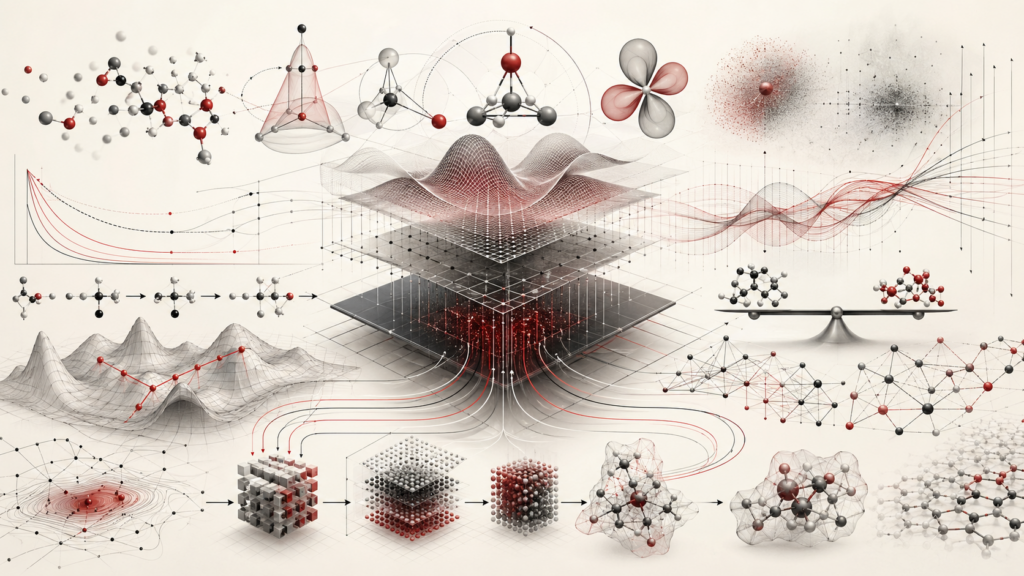
Abstract scientific illustration of mathematics for chemistry showing molecular geometry, reaction pathways, kinetic curves, thermodynamic surfaces, quantum orbital forms, probability clouds, coordinate grids, uncertainty ribbons, matrix-like layers, molecular networks, graph structures, and computational chemistry workflows without text or labels.

Mathematics for Chemistry and Molecular Systems

Mathematics gives chemistry a quantitative language for understanding matter, reactions, measurement, and molecular systems. Chemical formulas, reaction rates, equilibrium constants, thermodynamic relationships, quantum models, uncertainty, and simulations all depend on mathematical structure. From stoichiometry and logarithmic pH scales to kinetic equations, molecular geometry, graph theory, spectroscopy, and statistical mechanics, mathematics helps chemists move from observation to explanation and prediction. It reveals patterns not visible through experiment alone, connecting atomic interactions to macroscopic properties, laboratory data to models, and molecular structure to chemical function. In modern chemistry, mathematics also supports machine learning, molecular simulation, uncertainty analysis, and reproducible workflows. Understanding the mathematical foundations of chemistry strengthens experimental reasoning, improves interpretation, and connects molecular science to technology, environment, health, and sustainable innovation. It makes chemical evidence more precise, transferable, and durable.
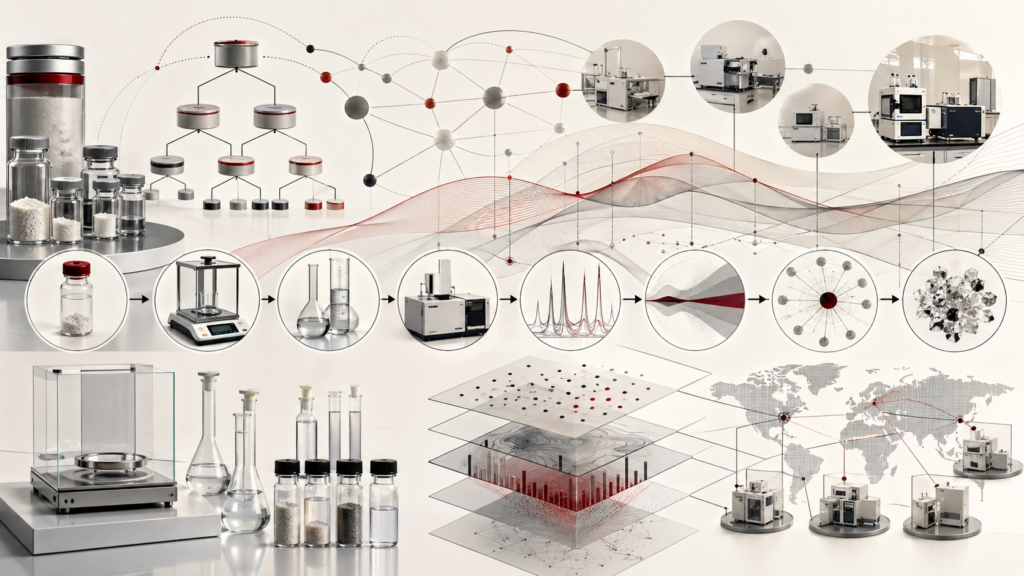
Abstract scientific illustration of chemical metrology showing certified reference-material vials, sealed standards, calibration hierarchy pathways, traceability-chain networks, precision balances, volumetric glassware, analytical instruments, spectroscopy-like signals, uncertainty layers, interlaboratory comparison nodes, provenance pathways, laboratory records, and global measurement infrastructure without text or labels.

Chemical Metrology, Standards, and Reference Materials

Chemical metrology gives chemistry its public standard of trust by establishing how measurements are defined, calibrated, compared, and verified. Standards and reference materials allow laboratories to connect local experiments to shared systems of accuracy, traceability, and accountability. Whether measuring concentration, purity, isotopic composition, pH, mass, temperature, spectra, or environmental contaminants, chemists depend on certified materials, calibration procedures, uncertainty estimates, and internationally recognized units to make results meaningful beyond a single instrument or laboratory. Metrology turns chemical measurement into a reproducible and comparable practice, supporting medicine, manufacturing, food safety, environmental regulation, forensic science, materials development, and global trade. It also reminds us that chemical facts are not merely observed; they are constructed through disciplined systems of evidence. Chemical metrology therefore links measurement, standards, governance, and responsibility at the foundation of modern science.

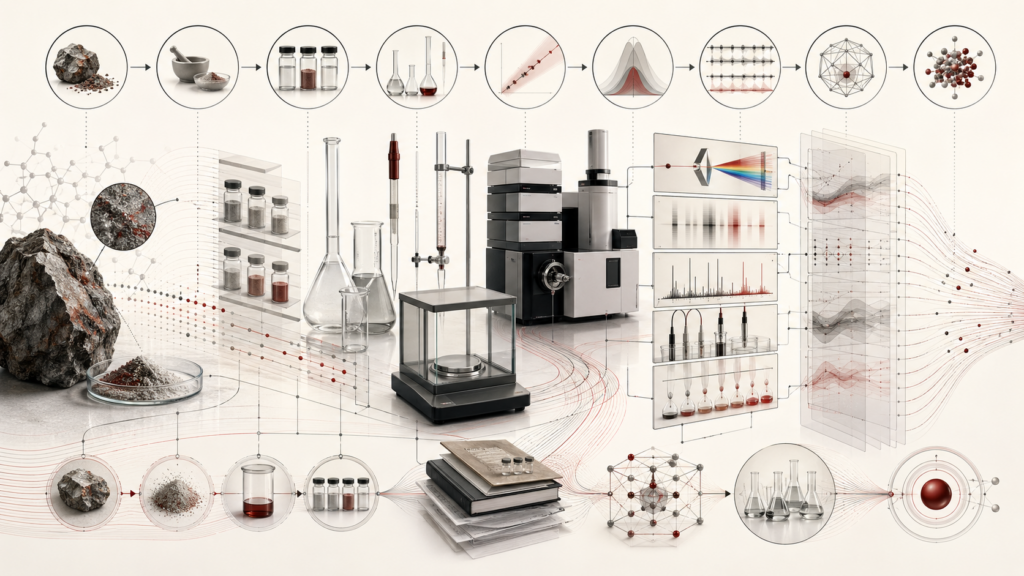
Abstract scientific illustration of chemical measurement showing raw samples, precision balance, volumetric glassware, pipettes, burettes, sealed containers, calibration geometry, uncertainty bands, analytical instruments, spectroscopy light paths, chromatography-like separation bands, sensor arrays, reproducible data workflows, laboratory records, molecular structures, and traceability pathways without text or labels.

Measurement, Quantification, and the Experimental Basis of Chemistry

Measurement is the experimental foundation of chemistry because chemical knowledge depends on turning observation into reliable quantitative evidence. Mass, volume, temperature, pressure, concentration, pH, spectra, reaction time, and uncertainty allow chemists to describe matter with precision rather than impression. Through balances, glassware, sensors, instruments, calibration standards, and statistical analysis, chemical experiments become repeatable, comparable, and accountable. Quantification makes it possible to test theories, identify substances, calculate stoichiometry, monitor reactions, determine purity, model kinetics, evaluate equilibrium, and connect laboratory results to industrial, medical, environmental, and materials applications. It also reveals the limits of knowledge by showing error, variability, detection limits, and confidence. Chemistry therefore depends not only on substances and reactions, but on disciplined measurement practices that transform material change into evidence, explanation, and responsible scientific judgment. Every measurement carries assumptions, instruments, units, and methods that shape chemical interpretation.

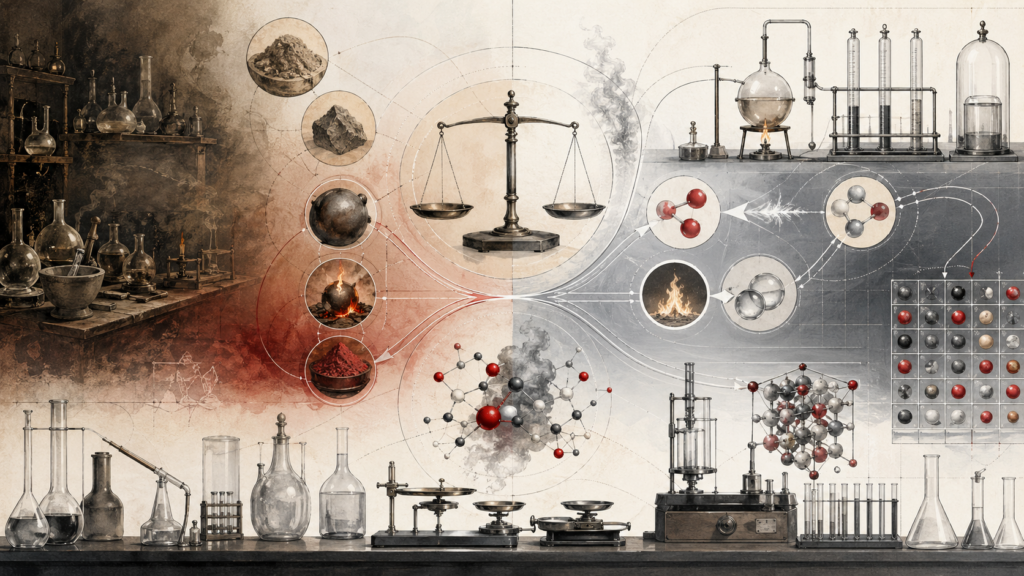
Abstract scientific illustration of the Chemical Revolution showing eighteenth-century laboratory glassware, precision balances, sealed reaction vessels, gas collection apparatus, combustion, oxygen-flow pathways, metal calcination, oxide formation, molecular structures, classification grids, and the rise of quantitative chemistry without text or labels.

The Chemical Revolution and the Rise of Modern Chemistry

The chemical revolution transformed the study of matter from a tradition shaped by alchemy, phlogiston theory, and qualitative observation into a modern science grounded in measurement, conservation, nomenclature, and experimental proof. Centered in the eighteenth century and associated above all with Antoine Lavoisier, this revolution redefined combustion, established oxygen’s role in chemical change, clarified the conservation of mass, and helped replace older explanatory systems with a disciplined quantitative framework. Its importance was not only theoretical. By creating a shared chemical language and insisting on careful balances, repeatable experiments, and material accountability, the chemical revolution made chemistry a cumulative science. It connected laboratory practice to industrial production, medicine, agriculture, environmental understanding, and modern technology. The rise of modern chemistry shows how scientific revolutions reorganize evidence, language, instruments, and imagination, changing how societies understand matter and transformation across the natural world.

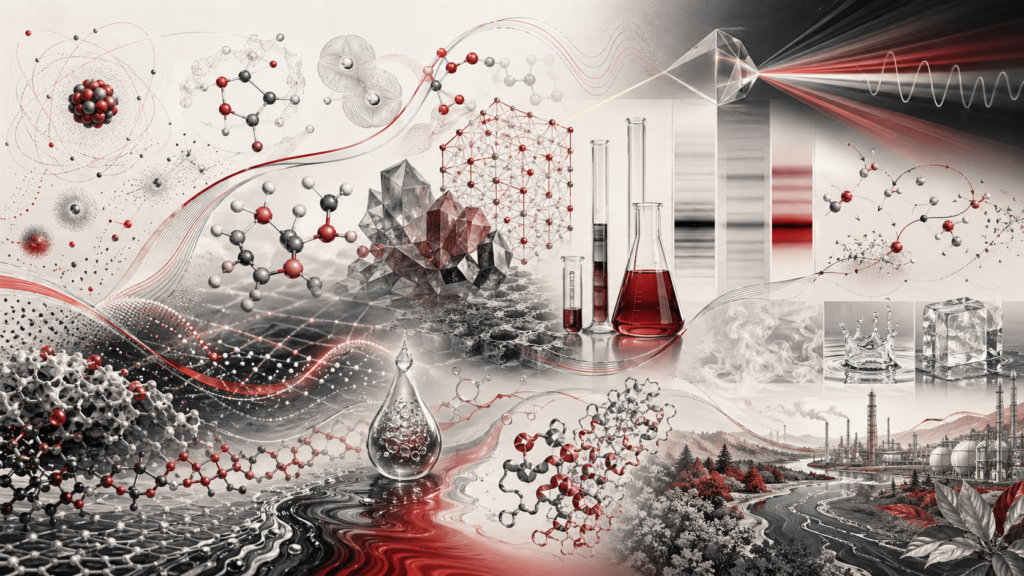
Abstract scientific illustration of chemistry showing atoms, molecules, electron clouds, bonding geometry, crystal lattices, laboratory glassware, spectroscopy light paths, chromatography-like bands, polymers, catalysts, environmental chemical flows, water chemistry, industrial systems, and chemical transformation without text or labels.

What Is Chemistry?

Chemistry is the science of matter, transformation, and molecular order. It studies atoms, bonds, reactions, energy, structure, and measurement, but its deeper importance lies in how it explains the material processes that shape life, technology, health, climate, agriculture, industry, and the environment. From the behavior of water and carbon compounds to the design of medicines, batteries, polymers, fertilizers, sensors, and clean-energy materials, chemistry connects microscopic structure to real-world function. It is both a laboratory science and a systems science, joining observation, mathematics, computation, experimentation, and theory. Understanding chemistry means understanding how substances interact, how reactions proceed, how materials acquire their properties, and how human societies can design safer, cleaner, and more sustainable technologies. Chemistry is therefore not only about substances; it is about change, evidence, responsibility, and the molecular foundations of civilization.

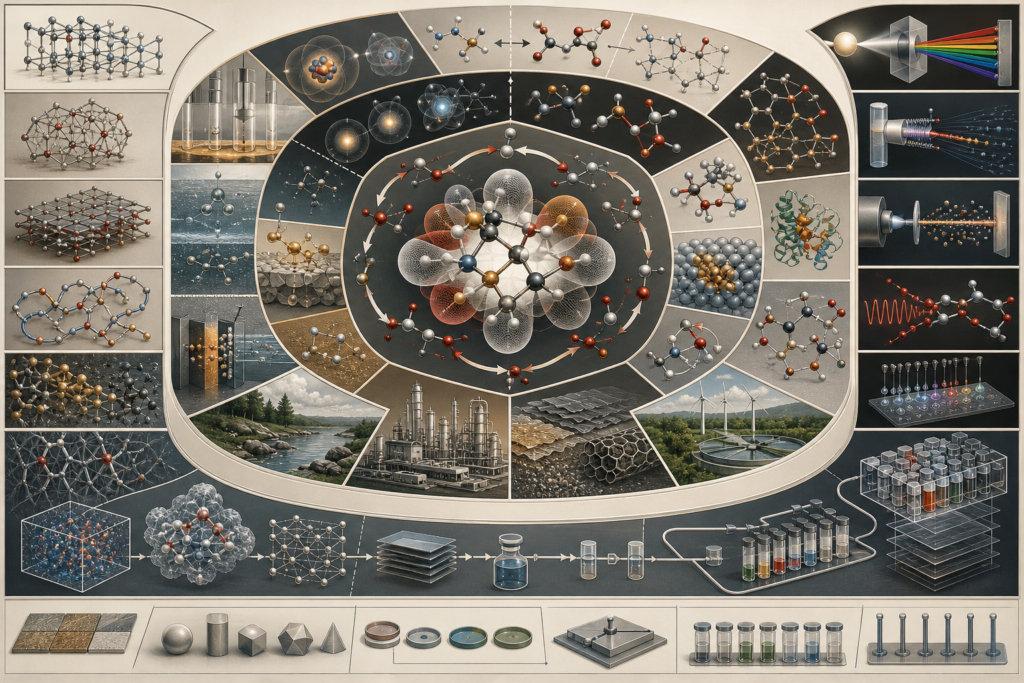
Editorial scientific illustration showing chemistry across scales, with atoms, molecules, electron-cloud forms, reaction pathways, crystalline materials, analytical instruments, environmental layers, industrial systems, and computational data workflows.

Chemistry: Matter, Reactions, Structure, Energy, and Transformation

Chemistry is the study of matter, energy, structure, and transformation, connecting the invisible world of atoms and molecules to the visible systems that sustain life, technology, health, industry, and the environment. This knowledge series introduces chemistry as both a foundational natural science and a practical language for understanding change. It explores atoms, bonding, reactions, thermodynamics, kinetics, equilibrium, acids and bases, electrochemistry, organic chemistry, biochemistry, materials, computation, laboratory measurement, and environmental systems. Across these topics, chemistry becomes more than a catalog of substances; it becomes a disciplined way of asking how matter behaves, how evidence is measured, how models explain reality, and how chemical knowledge can support safer materials, cleaner energy, better medicine, resilient food systems, and more responsible forms of innovation.

Scroll to Top