Biology

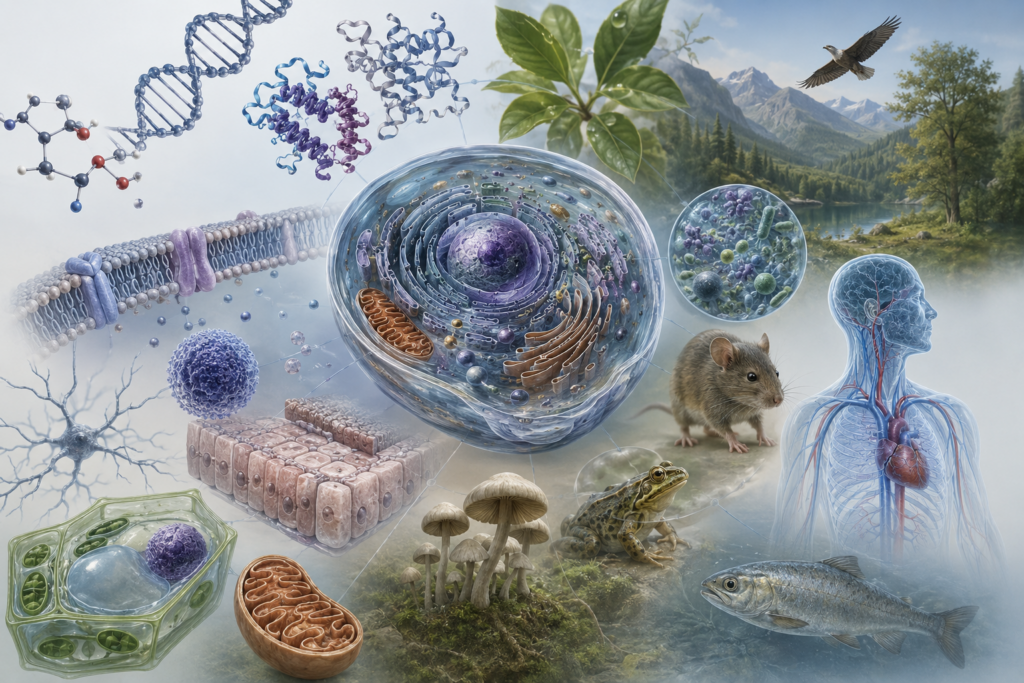
Biology examines life in all its forms, from cells and organisms to populations, ecosystems, and evolutionary processes. It seeks to explain how living systems are organized, how they function, how they reproduce and adapt, and how life changes across time in relation to heredity, environment, and ecological conditions.

This field brings together the study of structure, metabolism, development, genetics, evolution, behavior, and the interdependence of living systems across levels of organization. It includes molecular and cellular processes, organismal life, species diversity, ecological relationships, and the broader conditions through which life persists, transforms, and interacts with the natural world.

Biology plays a foundational role in understanding not only organisms themselves but also adaptation, vulnerability, resilience, and the continuity of life. By clarifying the processes that sustain living systems and the relationships that bind them to one another and to their environments, it shapes human understanding of health, nature, survival, and the conditions of flourishing on Earth.

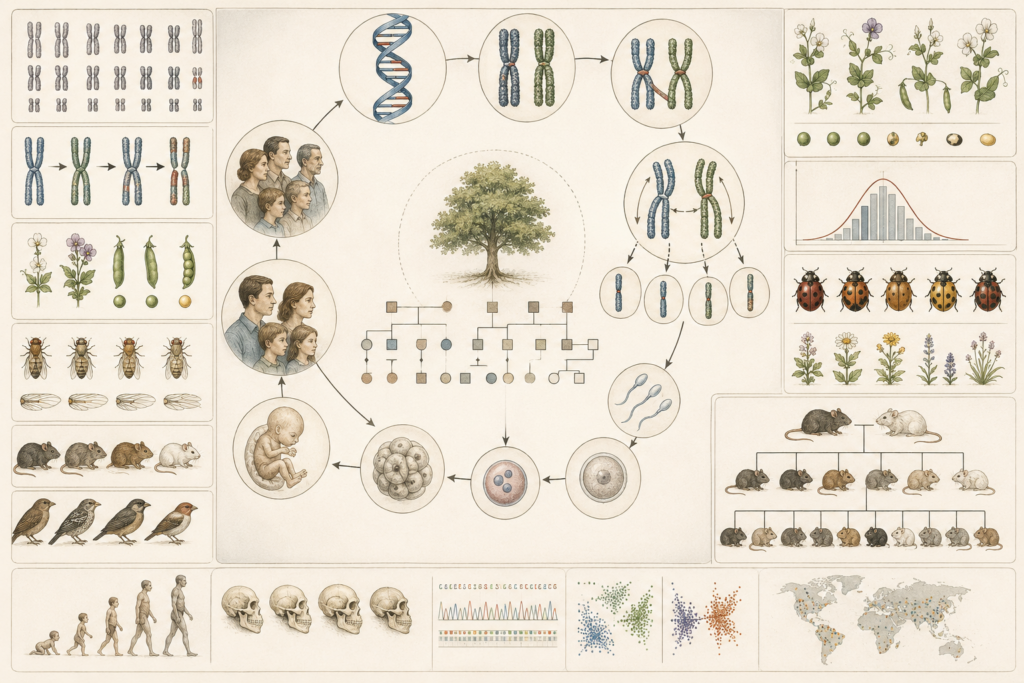
Research-grade genetics illustration showing DNA, chromosomes, family inheritance, pedigrees, embryos, trait variation in plants and animals, population patterns, sequencing data, and heredity across generations.

Genes, Inheritance, and the Principles of Heredity

Genes, inheritance, and the principles of heredity examine how biological traits are transmitted across generations, how hereditary information is organized in genomes and chromosomes, and how patterns of resemblance, variation, and difference emerge through the inheritance of genetic material. Heredity is one of the central principles of biology because living systems persist not only through metabolism and reproduction, but also through the regulated transmission of information that shapes development, physiology, adaptation, and evolutionary change. This article explores genes as units of heredity, the historical emergence of Mendelian principles, the chromosomal and molecular basis of inheritance, the limits of simple inheritance models, and the ways modern genetics integrates inheritance with molecular biology, development, population biology, and ecology. It also extends heredity into quantitative and computational biology through probability, allele-frequency models, inheritance ratios, and R- and Python-based workflows, while connecting the topic to sustainability-adjacent fields such as ecology, conservation biology, plant science, microbiology, marine biology, freshwater biology, soil biology, agroecology, disease ecology, and systems biology.
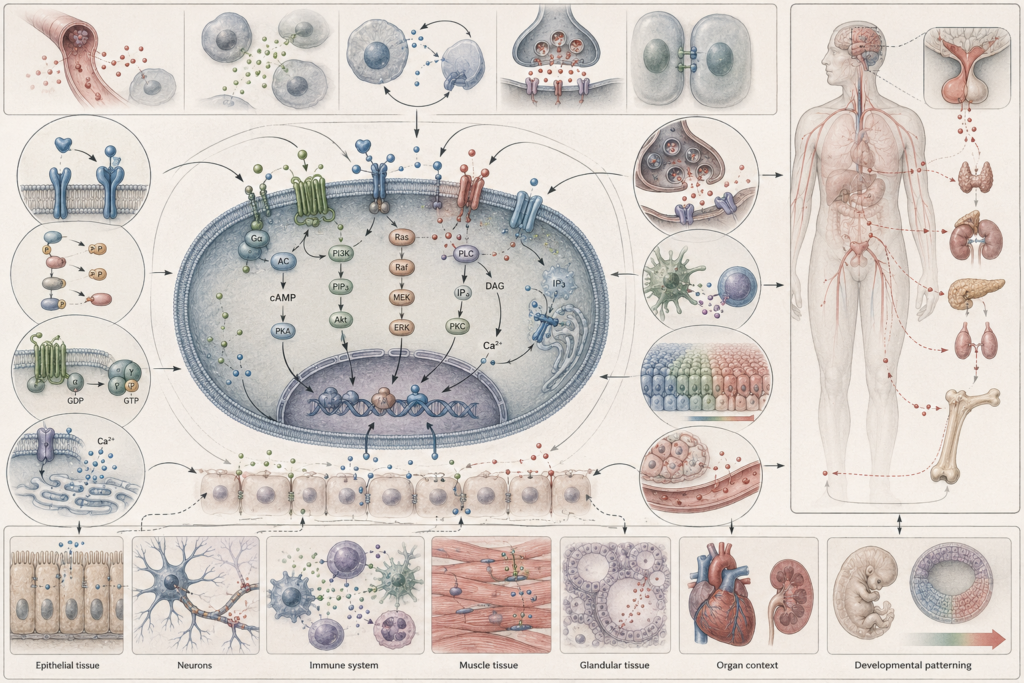
Research-grade cell biology illustration showing membrane receptors, signaling molecules, intracellular pathways, neurons, immune cells, epithelial tissue, muscle tissue, glandular tissue, organs, development, and whole-body biological coordination.

Cell Signaling, Communication, and Biological Coordination

Cell signaling, communication, and biological coordination examine how living systems detect information, transmit signals, interpret changing conditions, and coordinate activity across molecules, cells, tissues, organisms, populations, and environments. Signaling is one of the central principles of biology because no living system can remain organized without the ability to sense conditions, respond selectively, and coordinate internal and external processes across time. This article explores how signaling molecules act through receptors, how signals are transduced through intracellular pathways, how second messengers amplify and distribute information, and how signaling networks regulate metabolism, development, immunity, physiology, environmental response, and collective biological behavior. It also extends cell signaling into quantitative and computational biology through dynamic models, response curves, pathway analysis, and R- and Python-based workflows, while connecting the topic to sustainability-adjacent fields such as ecology, marine biology, freshwater biology, soil biology, plant science, microbiology, disease ecology, agroecology, conservation biology, and systems biology.

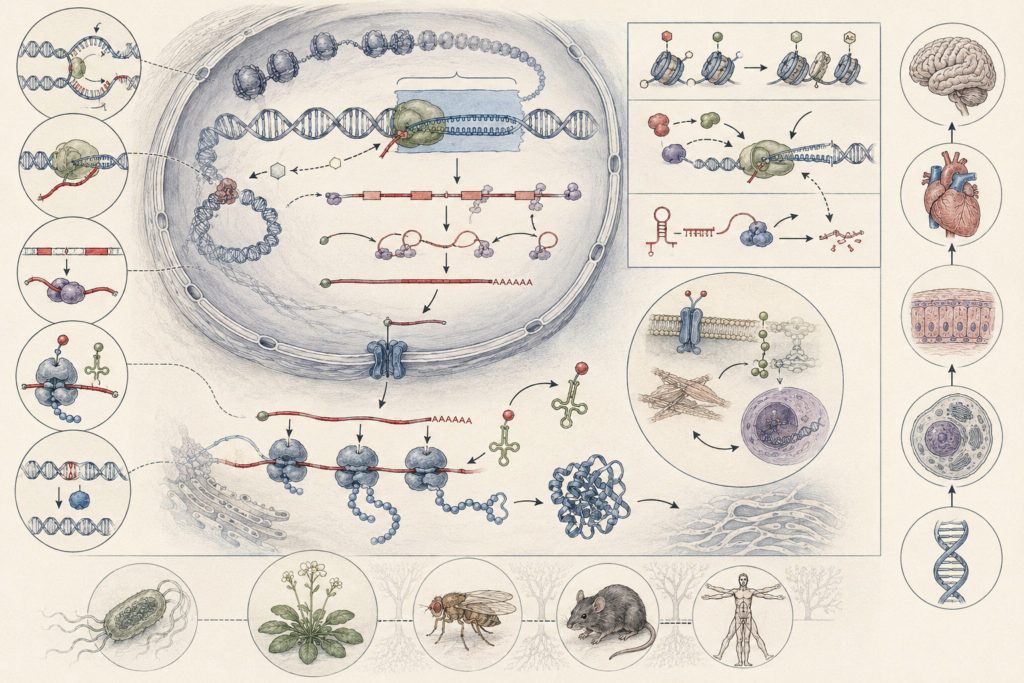
Research-grade molecular biology illustration showing DNA, chromatin, transcription, RNA processing, translation, ribosomes, transfer RNA, protein folding, cell signaling, tissues, organs, and organismal examples connected through the flow of genetic information.

Molecular Biology and the Flow of Genetic Information

Molecular biology and the flow of genetic information examine how living systems store, transmit, interpret, regulate, and sometimes alter hereditary information across generations and within the life of cells. This article explores one of the central frameworks of modern biology: the movement of information through DNA, RNA, and protein, and the larger molecular systems that make heredity, development, metabolism, repair, adaptation, and biological function possible. It considers how genetic information is organized, copied, transcribed, translated, regulated, and modified, while also showing why the flow of genetic information is not a rigid one-way script but a dynamic, conditional, and context-dependent process shaped by cells, organisms, environments, and evolutionary history. It also extends molecular biology into quantitative and computational biology through sequence analysis, transcriptional models, expression dynamics, and R- and Python-based workflows, while connecting the topic to sustainability-adjacent fields such as ecology, conservation biology, microbiology, plant science, marine biology, freshwater biology, soil biology, disease ecology, agroecology, and systems biology.

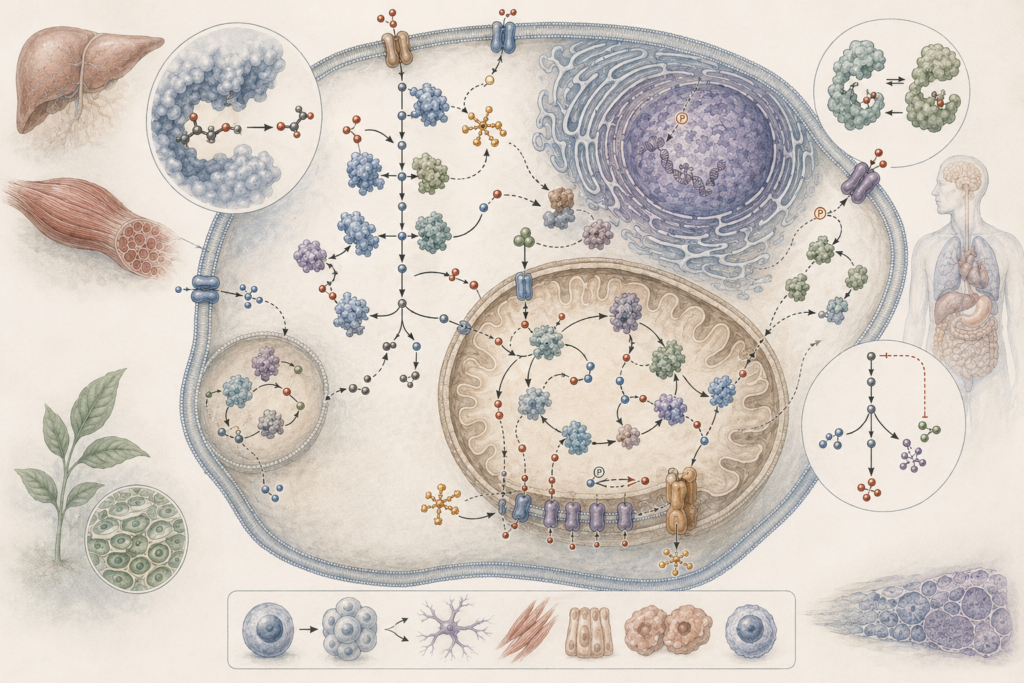
Research-grade systems biology illustration showing a eukaryotic cell with enzymes, metabolic pathways, mitochondria, membrane transport, signaling molecules, regulatory feedback, tissues, organs, plant cells, and biochemical coordination across living systems.

Enzymes, Regulation, and Biochemical Pathways

Enzymes, regulation, and biochemical pathways examine how living systems accelerate chemical reactions, coordinate metabolic activity, and organize thousands of interconnected transformations into functionally coherent biological systems. Enzymes are central to life because most biochemical reactions compatible with living temperature and pressure would proceed far too slowly without catalysis. This article explores how enzymes lower activation barriers, how catalytic activity is regulated, how pathways are coordinated across cells and organisms, and why biochemical control is essential to metabolism, physiology, development, ecological adaptation, and disease. It also extends the topic into quantitative and computational biology through enzyme kinetics, pathway flux, assay analysis, and R- and Python-based workflows, while connecting the subject to sustainability-adjacent fields such as ecology, marine biology, freshwater biology, soil biology, plant science, microbiology, agroecology, disease ecology, and systems biology.
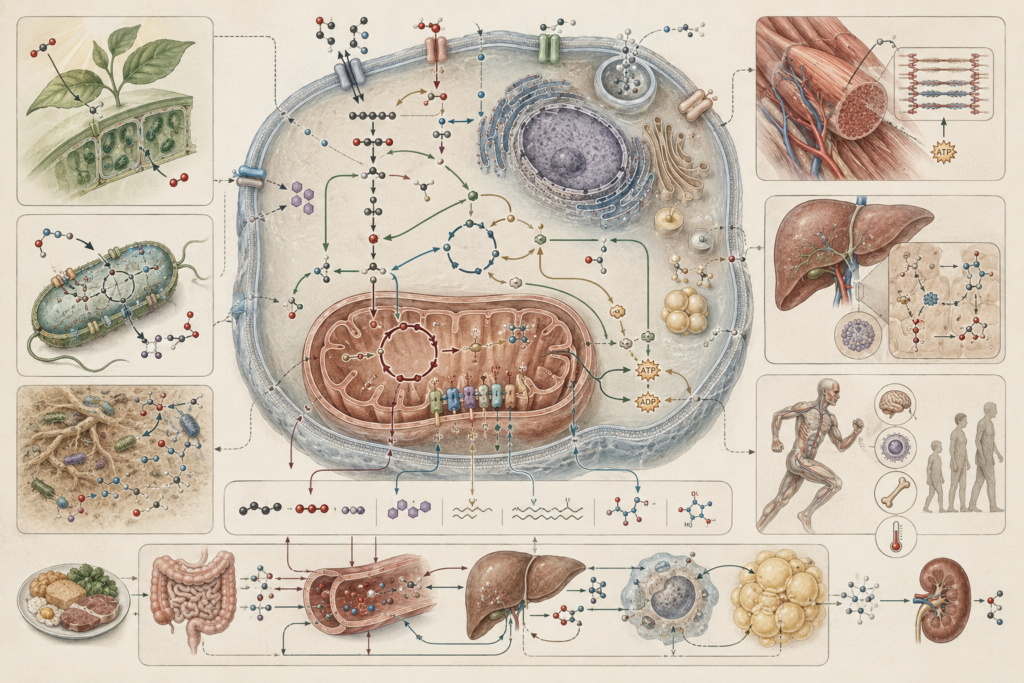
Research-grade systems biology illustration showing a cell with mitochondria, metabolic pathways, ATP production, nutrient flow, membrane transport, plant photosynthesis, microbial metabolism, digestion, liver function, muscle energy use, adipose tissue, kidney regulation, and whole-body energy balance.

Metabolism, Energy, and Biological Function

Metabolism, energy, and biological function examine how living systems acquire, transform, store, and use energy in order to maintain organization, grow, reproduce, respond to environments, and persist through time. This article explores metabolism as one of the most fundamental principles in biology, linking cells, organisms, ecosystems, and the biosphere through the movement of energy and matter. It considers how metabolic pathways sustain cellular work, how organisms differ in their strategies for obtaining and using energy, how metabolism connects to physiology, ecology, and evolution, and why energy transformation lies at the center of life’s capacity to maintain order under conditions of constraint. It also extends metabolism into quantitative and computational biology through rates, fluxes, energetic efficiency, growth models, and R- and Python-based workflows, while connecting the topic to sustainability-adjacent fields such as ecology, marine biology, freshwater biology, soil biology, plant science, microbiology, agroecology, forestry, disease ecology, and biogeochemical cycles.

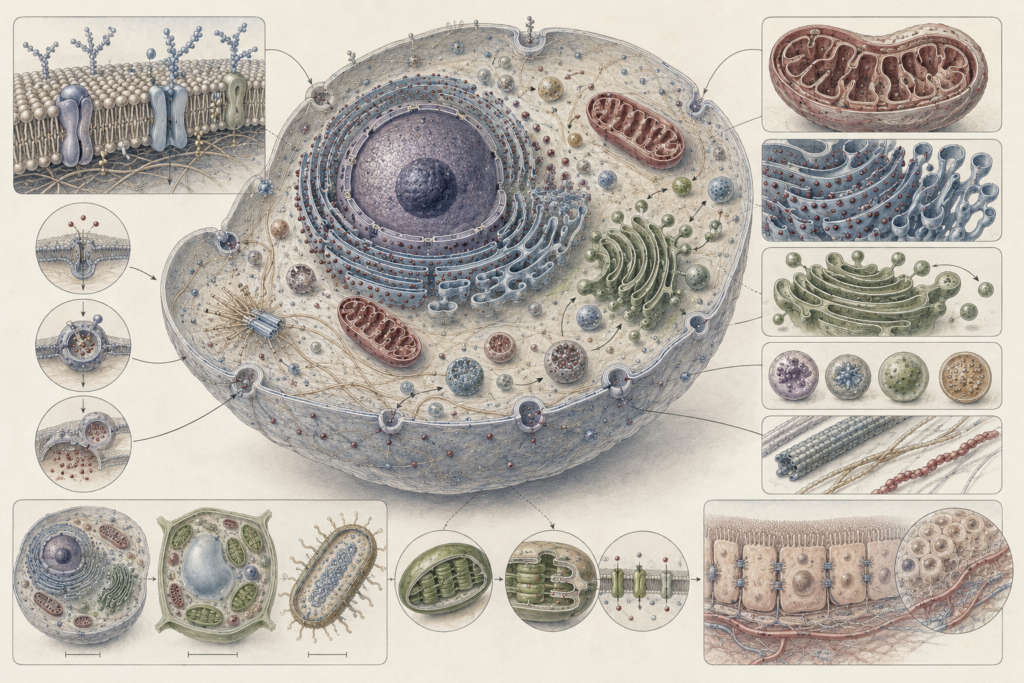
Research-grade cell biology illustration showing a eukaryotic cell with plasma membrane, nucleus, mitochondria, endoplasmic reticulum, Golgi apparatus, vesicles, lysosomes, cytoskeleton, membrane transport, plant cells, bacterial cells, and tissue context.

Cell Structure, Membranes, and Organelles

Cell structure, membranes, and organelles examine how cells are organized internally and how that organization makes living function possible. This article explores the structural logic of the cell, with particular attention to membranes as selective boundaries, organelles as specialized compartments, and the coordinated architecture through which cells regulate transport, metabolism, signaling, information flow, and energetic transformation. It shows why cellular structure is never merely anatomical description: the arrangement of membranes, cytoskeleton, nucleus, mitochondria, endoplasmic reticulum, Golgi apparatus, lysosomes, and other compartments is inseparable from the work cells perform. It also explains why this topic matters not only to cell biology, but also to ecology, marine biology, medicine, biotechnology, and quantitative life science, since environmental stress, disease, development, and engineered biological systems all depend on how cells are physically organized and functionally compartmentalized.

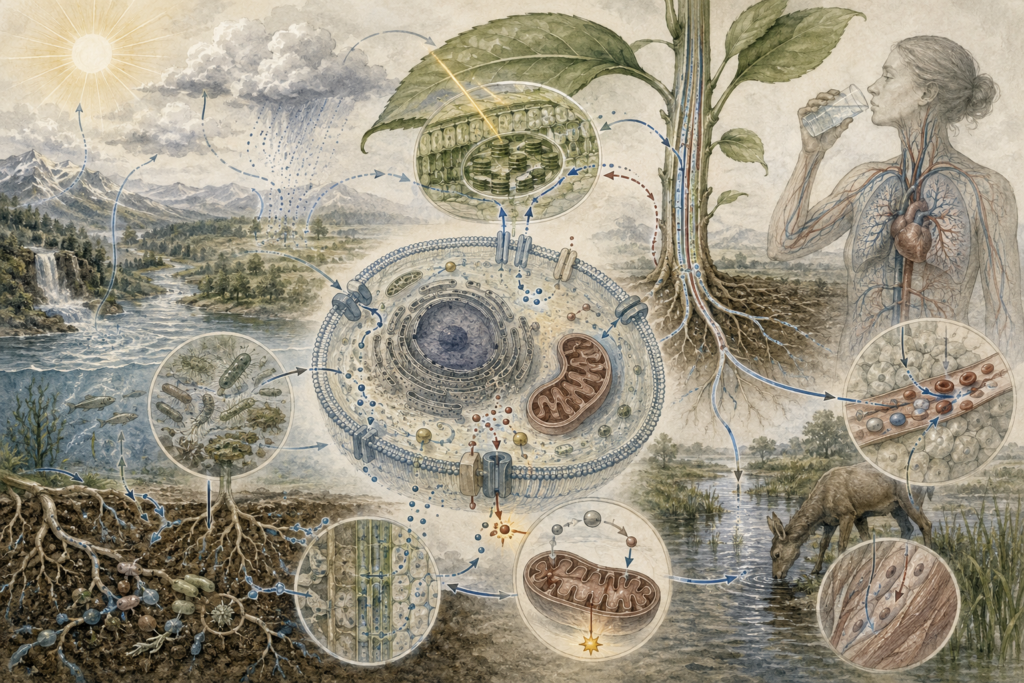
Research-grade systems biology illustration showing water cycles, sunlight, rivers, soil, plant roots, cells, membranes, mitochondria, chloroplasts, microbes, animals, and human physiology connected through water and energy flows.

Water, Energy, and the Material Conditions of Life

Water, energy, and the material conditions of life examine the physical and chemical conditions that make living systems possible, including the role of water as the medium of biological organization, the role of energy in sustaining ordered process, and the material constraints under which cells, organisms, and ecosystems persist. This article explores why life depends on water not only as a substance but as a solvent, transport medium, thermal buffer, and participant in chemical reaction; why living systems require continuous energy throughput rather than static stores alone; and how gradients, metabolism, and regulation connect the chemistry of life to physiology, ecology, marine systems, medicine, and biotechnology. It shows that life is not merely made of molecules, but maintained under material conditions that permit exchange, regulation, growth, and repair.

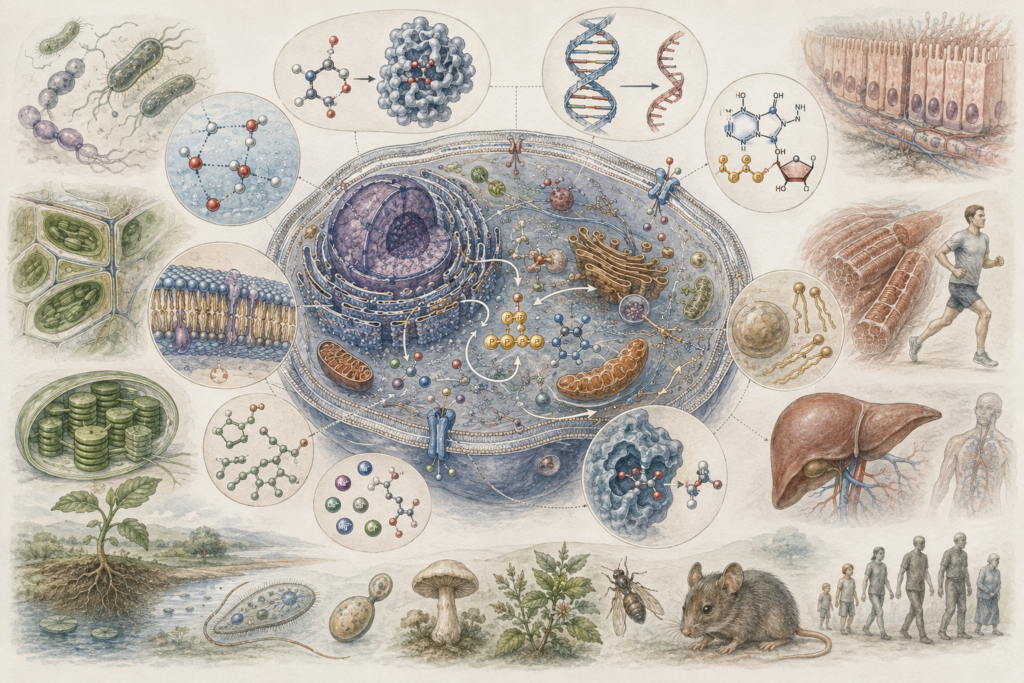
Research-grade systems biology illustration showing biomolecules, proteins, lipids, carbohydrates, nucleic acids, membranes, organelles, enzymes, ions, cells, tissues, plants, fungi, microbes, animals, and human physiology connected across biological scales.

Biomolecules and the Chemical Basis of Life

Biomolecules and the chemical basis of life examine how living systems are built from a distinctive chemical architecture of carbohydrates, lipids, proteins, nucleic acids, water, ions, and smaller metabolites whose interactions make cellular organization, metabolism, heredity, and regulation possible. This article explores how biology explains life at the chemical level without reducing it to chemistry alone. It considers the four major classes of biological macromolecules—carbohydrates, lipids, proteins, and nucleic acids—and shows how their structures support energy storage, membrane formation, catalysis, signaling, information transfer, and the maintenance of living order. It also shows why the chemical basis of life matters not only for core biology, but also for ecology, marine biology, medicine, biotechnology, and quantitative life science.

Research-grade biology illustration showing molecular structures, DNA, proteins, cell membranes, organelles, plant cells, tissues, microbes, fungi, animals, human physiology, and ecosystems connected across biological scales with no text.

Biology and the Scientific Understanding of Living Order

Biology and the scientific understanding of living order examine how the life sciences explain the organization, regulation, persistence, and transformation of living systems across scales. This article explores one of biology’s deepest concerns: how life maintains order in the midst of flux, how cells and organisms preserve internal stability while exchanging matter and energy with their surroundings, and how living systems generate structure, coordination, development, and adaptation without ceasing to change. It considers the scientific importance of organization, homeostasis, metabolism, self-regulation, heredity, and evolutionary continuity, and it shows how biology came to understand living order not as a static perfection but as a dynamic, process-based achievement sustained through interaction, feedback, and historically evolved structure.

Scroll to Top