
Last Updated May 28, 2026
Biology and the scientific understanding of living order examine how the life sciences explain the organization, regulation, persistence, development, adaptation, and transformation of living systems across scales. Living systems are not merely collections of matter. They are organized processes: cells maintain bounded interiors, organisms regulate internal conditions, ecosystems cycle matter and energy, and lineages persist through heredity and evolution. Biology therefore studies life not only as substance or structure, but as dynamic order sustained through metabolism, regulation, feedback, repair, reproduction, and historical continuity.
This article develops Biology and the Scientific Understanding of Living Order as a foundational conceptual article within the Biology knowledge series. It treats biological order not as static perfection, design metaphor, or simple complexity, but as a dynamic achievement produced by organized matter-energy exchange under constraint. Living systems remain coherent while constantly changing. They replace molecules, repair damage, regulate internal conditions, respond to environments, develop form, reproduce information, and evolve through time. The scientific challenge is to explain how this coherence is possible without denying that life is open, unstable, contingent, and historically shaped.
Main Library
Publications
Article Map
Biology
Related Topic
Chemistry
Related Topic
Earth Science
Related Topic
Environmental Science
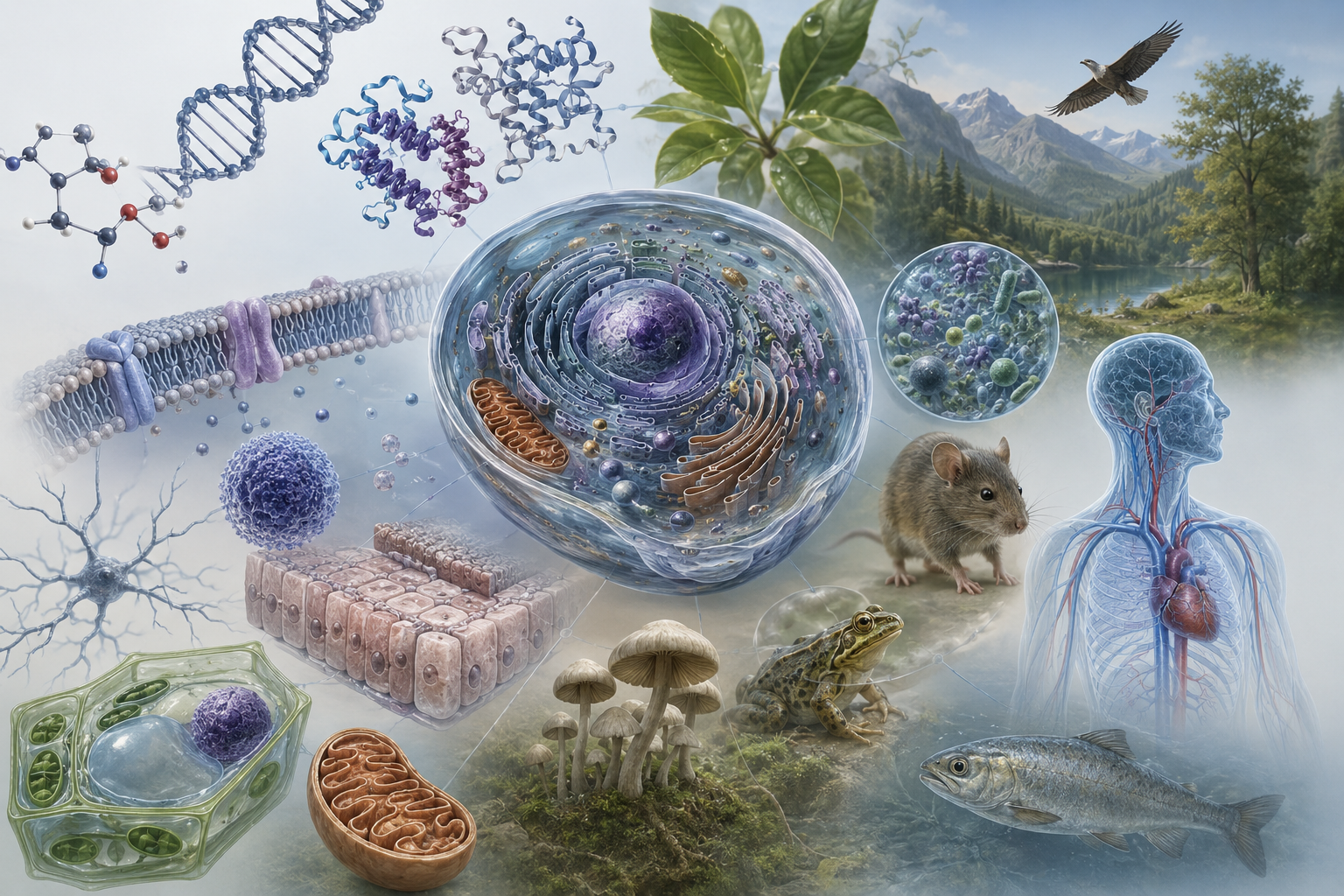
The article develops living order as a scale-spanning framework for understanding cells, organisms, tissues, physiology, homeostasis, metabolism, heredity, development, ecology, evolution, marine biology, disease, biotechnology, systems biology, and computational life science. It shows why biology cannot be reduced to isolated parts, but also why living systems can be studied rigorously through observation, experiment, modeling, measurement, and comparative analysis.
The article also extends living order into quantitative and computational biology through homeostatic setpoint models, exponential and logistic growth, feedback dynamics, stability analysis, ecological network summaries, resilience indices, regulatory recovery curves, biological organization scoring, R workflows, Python workflows, SQL provenance structures, and a linked full-stack GitHub repository containing Python, R, Julia, Fortran, Rust, Go, C, C++, SQL, notebooks, data files, validation notes, and reproducibility documentation.
What is living order?
One of biology’s most enduring insights is that life is not mere matter arranged accidentally, but matter organized in ways that sustain process, coordination, and continuity. Living order refers to the patterned organization through which cells, tissues, organisms, populations, communities, and ecosystems maintain themselves, regulate internal conditions, interact with environments, reproduce structure, and persist through time. This order is not rigid or static. It is dynamic because living systems remain alive only by continually exchanging matter and energy, repairing damage, responding to change, and renewing themselves.
To speak of living order is therefore to speak of organized complexity under conditions of flux. A living system is composed of parts, but it cannot be understood adequately by listing those parts alone. Molecules function within cells, cells within tissues, tissues within organisms, organisms within populations and ecosystems, and each level introduces patterns of coordination and constraint that exceed the properties of isolated components. Biology seeks to understand how these levels remain integrated, how they generate stable forms, and how they continue under changing conditions.
Living order also differs from many nonliving forms of order. A crystal may display structure, but it does not metabolize, repair itself, regulate internal conditions, reproduce hereditary information, or adapt through evolutionary lineages. A machine may exhibit design, but it does not grow, heal, evolve, or maintain itself through endogenous metabolism. Living order is therefore not simply order in the abstract. It is self-maintaining, historically evolved, environmentally open, and biologically regulated order.
This problem has been central to biology from the beginning. To ask what life is also requires asking how living order persists. The scientific understanding of life depends not only on recognizing that living beings exist, but on explaining how their organization becomes possible, how it is maintained, and how it changes without simply dissolving.
Biology and the problem of organization
Biology differs from many other natural sciences in part because it confronts organized systems whose parts work together in regulated and historically evolved ways. The problem is not simply that organisms have structure. Many nonliving objects have structure. The deeper issue is that living systems sustain and reproduce their organization through ongoing activity. They regulate internal conditions, transform energy, repair components, transmit hereditary information, and remain open to environmental exchange while preserving recognizable continuity.
This means that biology is concerned with a kind of order that is processual rather than inert. A living organism is never finished in the way a manufactured object might appear finished. Its organization is maintained through metabolism, feedback, responsiveness, developmental coordination, physiological regulation, immune surveillance, repair, and interaction with surroundings. Living order therefore depends not only on structural arrangement but on active maintenance.
The scientific understanding of living order therefore requires more than naming structures. It requires explanation of how organization is sustained, why it remains stable enough for life to continue, and how it changes without collapsing into disorder. Biology asks how living systems hold together, how they resist disintegration, and how they coordinate multiple processes without losing functional coherence.
This is also why biology uses multiple modes of explanation. Molecular biology explains mechanisms. Physiology explains regulation. Developmental biology explains the generation of form. Ecology explains relational organization. Evolutionary biology explains historical emergence and change. Systems biology explains networked interaction. None of these alone fully exhausts living order, but together they make it scientifically intelligible.
Homeostasis, regulation, and the maintenance of life
Homeostasis is one of the clearest scientific expressions of living order. It refers to the ability of a biological system to maintain relative internal stability while adjusting to external or internal change. This stability is not static equilibrium in the sense of stillness. It is dynamic equilibrium, in which continuous activity sustains viable ranges of temperature, pH, hydration, nutrient availability, oxygen delivery, ion concentration, glucose, pressure, and many other parameters required for life.
Homeostasis matters because life depends on organized range rather than absolute fixity. Bodies regulate temperature, glucose, salt-water balance, and acid-base conditions not because biological systems are unchanging, but because too much deviation threatens function and survival. Regulation therefore reveals that living order is inseparable from sensing, signaling, response, control, and coordinated adjustment.
Regulation occurs across scales. Cells regulate ion gradients, protein folding, redox state, gene expression, and metabolic flux. Organisms regulate circulation, respiration, digestion, immunity, temperature, and endocrine signaling. Ecosystems may exhibit forms of dynamic stability through feedback, nutrient cycling, species interaction, and resilience, though these should not be confused with organismal homeostasis. Across all these cases, order is maintained by coordinated response rather than passive stillness.
Modern biology also recognizes that regulation is often more complex than a single fixed setpoint. Many biological systems operate through multiple feedback loops, adaptive thresholds, oscillatory behavior, allostatic adjustment, anticipatory regulation, and context-sensitive stability. Still, the core insight remains: living systems must remain organized enough to persist while changing enough to respond.
Metabolism, exchange, and the openness of living systems
Living order exists only because living systems are open systems. Organisms do not survive by sealing themselves off from the world. They survive by taking in matter and energy, transforming them, eliminating waste, and maintaining internal organization through continuous exchange. Metabolism is therefore not one biological function among others. It is one of the foundational processes through which living order persists.
This openness distinguishes life from many nonliving forms of order. A living system must continually renew itself. Cells synthesize and degrade molecules, transport materials across membranes, regulate energy use, and maintain organized internal environments even as their components are constantly turned over. At larger scales, organisms depend on food webs, oxygen availability, nutrient circulation, water, and environmental resources. The order of life is sustained not against exchange but through exchange.
This metabolic openness helps explain why biology cannot understand living order purely as structure. Structure matters, but structure must be energized and maintained. A membrane must be repaired. A protein must be folded or degraded. A tissue must be supplied. An organism must eat, respire, excrete, and regulate. An ecosystem must cycle matter and receive energy. The scientific understanding of life therefore joins form to process, anatomy to physiology, and organization to flow.
Living order is not a frozen arrangement. It is the active persistence of organization under conditions of throughput and constraint.
Cells, organisms, and levels of coordination
The scientific understanding of living order also depends on recognizing that life is organized across levels. Cells are among the most basic units of living order because they establish bounded, regulated interiors capable of metabolism, signaling, replication, repair, and controlled exchange. A cell is not simply a bag of molecules. It is an organized system in which membranes, organelles, pathways, and genetic information are coordinated in time and space.
In multicellular organisms, living order becomes more layered. Cells differentiate into tissues, tissues into organs, and organs into systems that must coordinate with one another. Physiological regulation requires signaling across scale: hormones, nerves, circulatory transport, immune responses, extracellular matrices, and local cell-cell interaction all contribute to organismal integration. Living order at the organismal level therefore depends on cooperation among parts that remain specialized while still participating in a larger coordinated whole.
This layered organization is one reason biology resists simple reduction. Molecular explanation is indispensable, yet it does not eliminate the need to understand tissue patterning, organ coordination, behavior, development, or ecological function. Living order is not located at only one level. It is distributed across multiple levels of organization whose relations biology must explain together.
The same point applies beyond the organism. Populations, communities, microbiomes, reefs, forests, wetlands, and marine food webs all involve forms of biological organization that cannot be reduced to a single molecule, cell, or organism. Biology therefore studies living order as a nested and relational phenomenon.
Development, form, and the generation of structure
Biology must explain not only how living order is maintained, but how it is generated. Developmental biology studies how organisms arise from comparatively simple beginnings into highly organized forms with differentiated tissues, regulated growth, and patterned structure. This makes development one of the clearest demonstrations that living order is not merely inherited as a finished blueprint. It is produced through time by regulated processes of expression, differentiation, interaction, and morphogenesis.
The generation of form is especially important because it shows that biological order is constructive. Organisms do not simply possess structure; they build it. Embryogenesis, tissue renewal, wound healing, regeneration, and growth all reveal that living systems generate patterned organization under constraints imposed by genetics, signaling, mechanics, environment, and evolutionary history.
Development also helps biology overcome false oppositions between form and process. Form is not opposed to process in living systems; it emerges through process. The scientific understanding of living order must therefore include both the maintenance of stable organization and the generative pathways through which that organization comes into being.
This developmental perspective also matters for medicine, ecology, and evolution. Birth defects, cancer, tissue repair, metamorphosis, phenotypic plasticity, plant growth, and ecological life histories all involve developmental order. Biology’s understanding of living order is incomplete without understanding how order is built.
Heredity, information, and biological continuity
Living order persists across generations because biological systems transmit information. Heredity provides continuity between parent and offspring, cell and daughter cell, organism and lineage. DNA, RNA, chromosomes, gene regulation, epigenetic marks, developmental systems, cytoplasmic inheritance, and environmental interactions all contribute to biological continuity in different ways.
Information in biology is not abstractly separate from matter. It is chemically embodied in nucleic acids, organized in chromosomes, regulated by proteins and RNA, interpreted through cellular machinery, and expressed within developmental and environmental contexts. Heredity therefore connects chemical order to historical continuity. A lineage persists because information is copied, repaired, varied, expressed, and inherited.
This informational dimension helps explain why living order can change while remaining continuous. Mutation, recombination, gene regulation, epigenetic modification, developmental plasticity, and selection all allow variation to enter living systems without eliminating the fact of continuity. Biology therefore studies order as something both preserved and transformed.
This also means that biological order is not merely momentary organization. A living system is part of a lineage. Its present organization is connected to prior generations and to future biological possibility. Heredity gives living order duration.
Evolution and the history of living order
Living order is also historical. Biology does not treat organisms merely as presently functioning systems; it understands them as products of deep evolutionary time. Evolution explains why living systems have the structures they do, why certain regulatory mechanisms recur, why organisms show both unity and diversity, and why complex order can emerge through cumulative change rather than through static design.
This evolutionary perspective matters because the order of life is not perfect, timeless, or centrally planned. It is contingent, modified, and inherited. Biological systems carry traces of past selection, developmental constraint, and lineage history. Organs, behaviors, metabolic pathways, immune systems, reproductive strategies, and ecological relationships are shaped by this historical dimension. Living order is therefore intelligible not only through current function but through evolutionary explanation.
In this sense, biology’s scientific understanding of living order differs from purely engineering-style notions of design. Organisms are not assembled from scratch according to idealized plans. They are historically evolved systems whose order reflects adaptation, compromise, inheritance, constraint, and the continued reshaping of earlier structures. Biology studies not simply order, but order with a history.
Evolution also means that living order is plural. There is no single ideal form of life. Bacteria, archaea, fungi, plants, animals, protists, viruses, symbioses, microbiomes, forests, coral reefs, and microbial mats all reveal different ways biological organization can persist, reproduce, and change.
Ecology and living order beyond the organism
Living order extends beyond individual organisms. Ecology shows that biological organization also exists in relations among organisms and environments. Populations, communities, food webs, nutrient cycles, symbioses, microbiomes, and ecosystems all display patterned interdependence. These forms of order are not identical to the regulatory order of a cell or organism, but they are nonetheless biologically intelligible structures shaped by interaction, exchange, competition, cooperation, and environmental constraint.
This ecological dimension broadens the concept of living order in important ways. It shows that life is not organized solely inwardly. Organisms depend on pollinators, microbiomes, habitats, trophic networks, hydrology, soils, climate, and biogeochemical cycles. Stability at one scale may depend on relation at another. The order of a forest, reef, estuary, wetland, grassland, or microbial mat is not reducible to any one organism within it, even though it is composed of organisms and their interactions.
Ecology therefore helps biology understand living order as relational and distributed. It also reveals how fragile such order can be under conditions of habitat fragmentation, pollution, climate disruption, invasive species, overharvesting, species loss, and disturbance. To study living order scientifically is therefore also to study the conditions under which that order fails, reorganizes, or crosses thresholds.
Ecological order should not be romanticized as harmony. Ecosystems include competition, predation, parasitism, disease, disturbance, succession, mortality, and decomposition. Their order is not static peace, but structured interaction over time.
Marine, freshwater, soil, plant, and microbial relevance
Marine biology makes the scientific understanding of living order especially vivid because marine systems expose life to strong gradients of salinity, temperature, pressure, light, oxygen availability, pH, and nutrient distribution. In the oceans, living order is often maintained under narrow physiological margins and in highly coupled ecological systems. Cellular regulation, organismal adaptation, developmental timing, microbial turnover, plankton dynamics, and trophic exchange all depend on how order is maintained in fluid, variable environments.
Marine life also reveals that living order is often symbiotic and system-dependent. Coral reefs depend on coral-algal partnership. Marine microbial loops depend on the cycling of dissolved organic matter through microscopic life. Fisheries depend on population-level reproductive continuity. Hypoxia, warming, and acidification can destabilize living order at multiple levels simultaneously, from cell stress to ecosystem collapse.
Freshwater biology similarly reveals living order under hydrological constraint. Rivers, lakes, wetlands, aquifers, and floodplains are organized by flow, oxygen, nutrients, temperature, sediments, and seasonal cycles. Soil biology reveals living order through microbial decomposition, fungal networks, plant roots, organic matter, pore space, water films, and nutrient cycling. Plant science reveals living order through photosynthesis, water transport, growth, defense, reproduction, and interaction with fungi, microbes, herbivores, and climate.
Microbial life is especially important because microbial order underlies many larger systems. Microbes organize biofilms, cycle nutrients, shape host microbiomes, drive decomposition, influence disease ecology, and mediate biogeochemical transformations. Living order is therefore not only large, visible, and organismal. It is also microscopic, distributed, and chemically transformative.
Medical, biomedical, and disease relevance
The scientific understanding of living order is central to medicine and biomedicine because health depends on regulated organization and disease often begins with its disruption. Homeostasis, tissue integration, cellular signaling, developmental patterning, immune discrimination, metabolic coordination, and repair all matter directly for pathology. Disorders of glucose regulation, ion balance, immune control, growth signaling, mitochondrial function, tissue repair, and vascular stability are all disorders of biological order.
Biomedicine therefore studies not only disease agents or damaged organs, but the organization that permits life to continue. Cancer is disordered growth within regulated tissue systems. Sepsis is systemic dysregulation of host defense and physiology. Neurodegeneration involves the breakdown of organized cellular and tissue integrity. Autoimmune disease involves dysregulated distinction between self and non-self. Metabolic disease involves disrupted energy and substrate regulation. Developmental disorders involve altered processes of form generation.
For medical professionals, living order is therefore a clinically meaningful concept. It describes the regulated coordination that health requires and the layered failures through which disease emerges. Medicine is not only intervention against pathology; it is also the study of how living systems sustain viability and how that viability becomes fragile.
This framing also helps connect medicine to ecology and systems biology. Disease is rarely only a local malfunction. It often involves networks of cells, tissues, organs, microbes, environments, behavior, and social conditions. Living order is therefore a biological and clinical concept.
Biotechnology and computational relevance
Biotechnology extends the scientific understanding of living order into applied systems of intervention, production, monitoring, and design. Fermentation, assay development, microbial engineering, biosensing, tissue culture, gene delivery, high-throughput screening, synthetic biology, cell therapy, and bioprocess design all depend on knowing how living systems organize themselves, respond to perturbation, and maintain function under defined conditions.
Computational biology deepens this transition by making living order measurable in data-rich ways. High-content imaging, transcriptomics, metabolomics, proteomics, network analysis, simulation, ecological monitoring, and reproducible workflows allow scientists to estimate rates, compare perturbations, identify feedback, and detect patterns that are difficult to recognize intuitively. Living order becomes not only a conceptual framework but also a measurable and modelable target of analysis.
In this sense, biotechnology and computational biology do not replace classical biology. They operationalize it. The more sophisticated the biological workflow becomes, the more it depends on clear understanding of organization, regulation, dynamic stability, and scale.
This is also where reproducibility becomes part of biological reasoning. If living order is measured through data, then workflows must preserve provenance, assumptions, code, parameters, and validation checks. Biological order cannot be responsibly modeled if the evidentiary chain is opaque.
Mathematical lens
Modern biology is not only descriptive. It is also quantitative. Growth, regulation, physiological adjustment, ecological interaction, feedback, system response, and resilience can often be represented mathematically and analyzed statistically or computationally. This does not reduce biology to equations, but it does make biological patterns more explicit, testable, and reproducible.
A simple model of return toward a regulated setpoint \(x^*\) is:
Interpretation: A regulated variable moves back toward a target range when deviation produces corrective response.
where \(x\) is the variable of interest, \(x^*\) is the target range or reference level, and \(k\) is the rate constant of regulation. This model captures the idea that biological systems often restore variables toward viable ranges rather than remaining fixed in absolute stillness.
The continuous solution is:
Interpretation: The state approaches the setpoint exponentially over time under a simple recovery model.
where \(x_0\) is the initial state. This is useful for representing recovery from perturbation, pH adjustment, temperature regulation, osmotic return, glucose regulation, or other homeostatic processes.
A simple model for unconstrained growth is:
Interpretation: Exponential growth describes abundance increase when per-capita growth rate remains constant.
where \(N_0\) is the initial abundance, \(r\) is the per-capita growth rate, and \(t\) is time.
Under resource limitation, logistic growth is often more appropriate:
Interpretation: Logistic growth represents population increase under carrying-capacity limitation.
where \(K\) is the carrying capacity. These models are useful in physiology, ecology, marine biology, microbiology, biotechnology, and population biology because they formalize how living order persists under growth and constraint.
A simple negative feedback relation may be written as:
Interpretation: Corrective response increases with deviation from the target state under a simple negative-feedback model.
where \(u(t)\) is corrective response and \(g\) is feedback gain. This is useful because many living systems maintain order by sensing deviation and generating compensatory response.
If biological components are represented as nodes and interactions as edges, degree centrality for node \(i\) can be written as:
Interpretation: Degree centrality counts how many direct connections a biological component has in a network representation.
where \(a_{ij}\) indicates whether node \(i\) is connected to node \(j\). This is useful for studying ecological networks, gene regulation, metabolic pathways, organelle interaction, and systems biology.
A simple recovery index can be written as:
Interpretation: Recovery is stronger when the final state returns closer to the reference state after perturbation.
where \(x_0\) is the perturbed initial state, \(x_T\) is the state after recovery time \(T\), and \(x^*\) is the reference state. Values closer to 1 indicate stronger recovery under this simplified definition.
Variables, units, and biological interpretation
Quantitative models of living order depend on variables that connect regulation, growth, feedback, network structure, and resilience. The table below summarizes several central quantities.
| Symbol or Term | Meaning | Typical Unit or Scale | Biological Interpretation |
|---|---|---|---|
| \(x\) | Regulated biological variable | temperature, pH, glucose, ion concentration, abundance, or other measured state | Quantity whose deviation from a viable range triggers regulation or recovery |
| \(x^*\) | Setpoint or reference state | same as \(x\) | Target range or reference condition for regulation |
| \(x_0\) | Initial state | same as \(x\) | Starting condition after perturbation or at the beginning of observation |
| \(x_T\) | State after recovery time \(T\) | same as \(x\) | Measured state after the system has had time to recover |
| \(k\) | Regulatory correction rate | per unit time | Speed at which a system returns toward the reference state |
| \(N(t)\) | Population or abundance at time \(t\) | cells, organisms, colonies, biomass proxy, or read count | Abundance of a biological population or measurable biological unit |
| \(N_0\) | Initial abundance | same as \(N(t)\) | Starting abundance used in growth models |
| \(r\) | Per-capita growth rate | per unit time | Rate of biological increase under specified conditions |
| \(K\) | Carrying capacity | same as \(N(t)\) | Approximate upper abundance supported by limiting conditions |
| \(u(t)\) | Corrective response | system-specific response unit | Response generated to reduce deviation from a reference state |
| \(g\) | Feedback gain | response per unit deviation | Strength of response to deviation from target state |
| \(a_{ij}\) | Network adjacency entry | 0/1, weighted edge, or interaction strength | Indicates whether or how strongly biological components \(i\) and \(j\) interact |
| \(k_i\) | Degree centrality | count or weighted count | Number or strength of direct interactions involving node \(i\) |
| \(R\) | Recovery index | dimensionless index | Simplified measure of return toward reference state after perturbation |
The table shows why mathematical biology must remain biologically interpreted. The same formal structure may describe temperature regulation, glucose recovery, microbial growth, ecological return after disturbance, or network interaction, but the meaning depends on the level of organization and the measurement context.
Worked example: homeostatic recovery and growth rate
Suppose a regulated variable begins at \(x_0=10\), the target is \(x^*=2\), and \(k=0.4\). The recovery model is:
Interpretation: The state moves toward the target as the deviation decays over time.
Substituting the values:
Interpretation: The system starts eight units above the target and corrects at rate 0.4 per time unit.
At \(t=5\):
Interpretation: The system has moved substantially toward its regulated target, but has not reached it completely.
The model is simple, but it gives biological regulation a transparent quantitative form. It also shows why homeostasis is not perfect stillness. It is dynamic recovery toward a viable range.
Growth can be treated similarly. Suppose a microbial culture grows from \(N_0=100\) to \(N=735\) in 10 time units. Under exponential growth:
Interpretation: Observed abundance change can be used to estimate growth rate.
Dividing by 100:
Interpretation: The culture increased by a factor of 7.35 over the observation interval.
Solving for \(r\):
Interpretation: The estimated per-time-unit growth rate is approximately 0.1995.
The doubling time is:
Interpretation: At the estimated growth rate, the population doubles about every 3.47 time units.
This converts observed living change into interpretable biological parameters.
Computational modeling
Computational modeling helps make living order explicit because many forms of biological organization are dynamic, relational, and scale-dependent. Regulation can be modeled as recovery toward a reference state. Growth can be modeled as increase under constraint. Feedback can be represented as corrective response. Ecological order can be summarized through networks. Resilience can be estimated through recovery after perturbation.
The selected examples below focus on growth, recovery, and network structure because they are readable and useful across biological contexts. The GitHub repository extends the same logic into richer computational scaffolding: homeostatic setpoint dynamics, perturbation recovery, exponential growth fitting, logistic growth simulation, feedback-loop modeling, ecological network summaries, resilience indices, living-order condition scoring, SQL provenance structures, validation notes, reproducible data files, and multi-language scientific-computing implementations.
The point is not to reduce living order to formulas. The point is to make selected biological processes transparent, testable, reproducible, and open to comparison while preserving the biological meaning of scale, context, and organization.
R workflow: growth, recovery, and network order
R is useful for statistical modeling, tabular summaries, and ecological or systems-level analysis. The following workflow estimates exponential growth, calculates a recovery index, and summarizes a simple biological interaction network.
# Growth, Recovery, and Biological Network Order
#
# This workflow demonstrates three introductory computational tasks:
#
#   1. Fit exponential growth and estimate doubling time.
#   2. Calculate a simplified recovery index for homeostatic return.
#   3. Summarize a biological interaction network.
#
# These examples can be adapted for cell growth, microbial cultures,
# plankton abundance, ecological monitoring, biotechnology assays,
# homeostatic recovery experiments, or systems biology summaries.

library(tibble)
library(dplyr)

# ------------------------------------------------------------
# 1. Fit exponential growth and estimate doubling time
# ------------------------------------------------------------

growth_data <- tibble(
  time = c(0, 2, 4, 6, 8, 10),
  abundance = c(100, 149, 222, 331, 493, 735)
)

growth_model <- lm(log(abundance) ~ time, data = growth_data)

growth_summary <- tibble(
  growth_rate = coef(growth_model)[["time"]],
  estimated_initial_abundance = exp(coef(growth_model)[["(Intercept)"]]),
  doubling_time = log(2) / growth_rate,
  r_squared_log_space = summary(growth_model)$r.squared
)

growth_predictions <- growth_data %>%
  mutate(
    predicted_abundance = exp(predict(growth_model)),
    residual = abundance - predicted_abundance
  )

# ------------------------------------------------------------
# 2. Living-order recovery index
# ------------------------------------------------------------

initial_state <- 10
target_state <- 2
correction_rate <- 0.4
time_end <- 5

final_state <- target_state +
  (initial_state - target_state) * exp(-correction_rate * time_end)

recovery_index <- 1 -
  abs(final_state - target_state) / abs(initial_state - target_state)

recovery_summary <- tibble(
  initial_state = initial_state,
  target_state = target_state,
  final_state = final_state,
  recovery_index = recovery_index
)

# ------------------------------------------------------------
# 3. Ecological or systems-level interaction network summary
# ------------------------------------------------------------

edges <- tibble(
  source = c(
    "phytoplankton",
    "zooplankton",
    "small_fish",
    "detritus",
    "microbes",
    "plants"
  ),
  target = c(
    "zooplankton",
    "small_fish",
    "predator_fish",
    "microbes",
    "nutrients",
    "herbivores"
  ),
  interaction_weight = c(0.92, 0.80, 0.65, 0.75, 0.88, 0.70)
)

nodes <- sort(unique(c(edges$source, edges$target)))

centrality <- bind_rows(
  lapply(nodes, function(node) {
    mask <- edges$source == node | edges$target == node

    tibble(
      node = node,
      degree = sum(mask),
      weighted_degree = sum(edges$interaction_weight[mask])
    )
  })
) %>%
  arrange(desc(weighted_degree))

print(round(growth_summary, 4))
print(round(growth_predictions, 2))
print(round(recovery_summary, 4))
print(edges)
print(round(centrality, 3))
This workflow is useful because living order appears both in time-dependent change and in relations among parts. Growth, recovery, and network connection each represent different forms of biological organization.
Python workflow: setpoint recovery, logistic growth, and network summary
Python is useful for dynamic simulation, model comparison, data pipelines, and reproducible scientific workflows. The following workflow simulates return toward a setpoint, logistic growth under constraint, and a biological interaction network summary.
"""
Living Order Computational Workflow

This workflow demonstrates three computational ideas related to living order:

1. Return toward a setpoint after perturbation.
2. Logistic growth under different constraints.
3. Network degree summaries for biological interactions.

The examples are compact, but the same structure can be extended
for homeostatic regulation, microbial growth, biotechnology assays,
ecological networks, systems biology, and resilience analysis.
"""

from __future__ import annotations

import numpy as np
import pandas as pd

def simulate_setpoint_recovery(
    initial_state: float = 10.0,
    setpoint: float = 2.0,
    correction_rate: float = 0.4,
    t_max: float = 20.0,
    dt: float = 0.01,
) -> pd.DataFrame:
    """
    Simulate return toward a regulated setpoint.
    """
    time = np.arange(0, t_max + dt, dt)
    state = np.zeros_like(time)

    state[0] = initial_state

    for i in range(1, len(time)):
        dx = -correction_rate * (state[i - 1] - setpoint)
        state[i] = state[i - 1] + dx * dt

    return pd.DataFrame(
        {
            "time": time,
            "state": state,
            "setpoint": setpoint,
            "deviation": state - setpoint,
        }
    )

def logistic_growth(
    time: np.ndarray,
    initial_abundance: float,
    growth_rate: float,
    carrying_capacity: float,
) -> np.ndarray:
    """
    Calculate a logistic growth trajectory.
    """
    if initial_abundance <= 0:
        raise ValueError("Initial abundance must be positive.")
    if carrying_capacity <= 0:
        raise ValueError("Carrying capacity must be positive.")
    if initial_abundance > carrying_capacity:
        raise ValueError("Initial abundance should not exceed carrying capacity.")

    return carrying_capacity / (
        1.0
        + ((carrying_capacity - initial_abundance) / initial_abundance)
        * np.exp(-growth_rate * time)
    )

def compare_growth_scenarios() -> pd.DataFrame:
    """
    Compare logistic growth under different constraints.
    """
    time = np.linspace(0, 40, 200)

    return pd.DataFrame(
        {
            "time": time,
            "unconstrained_like": logistic_growth(time, 100, 0.35, 10000),
            "resource_limited": logistic_growth(time, 100, 0.35, 1200),
            "stress_limited": logistic_growth(time, 100, 0.20, 800),
        }
    )

def summarize_biological_network() -> tuple[pd.DataFrame, pd.DataFrame]:
    """
    Summarize a simple biological interaction network.
    """
    edges = pd.DataFrame(
        {
            "source": [
                "phytoplankton",
                "zooplankton",
                "small_fish",
                "detritus",
                "microbes",
                "plants",
                "soil_fungi",
            ],
            "target": [
                "zooplankton",
                "small_fish",
                "predator_fish",
                "microbes",
                "nutrients",
                "herbivores",
                "plants",
            ],
            "interaction_weight": [0.92, 0.80, 0.65, 0.75, 0.88, 0.70, 0.77],
        }
    )

    nodes = sorted(set(edges["source"]).union(edges["target"]))

    rows = []

    for node in nodes:
        mask = (edges["source"] == node) | (edges["target"] == node)

        rows.append(
            {
                "node": node,
                "degree": int(mask.sum()),
                "weighted_degree": float(edges.loc[mask, "interaction_weight"].sum()),
            }
        )

    network_df = pd.DataFrame(rows).sort_values(
        "weighted_degree",
        ascending=False,
    )

    return edges, network_df

def main() -> None:
    """
    Run compact living-order simulations and summaries.
    """
    homeostasis_df = simulate_setpoint_recovery()
    growth_df = compare_growth_scenarios()
    edges, network_df = summarize_biological_network()

    print("Setpoint recovery sample:")
    print(homeostasis_df.head(12).round(4).to_string(index=False))
    print(homeostasis_df.tail(12).round(4).to_string(index=False))

    print("\nLogistic growth scenarios:")
    print(growth_df.head(12).round(3).to_string(index=False))
    print(growth_df.tail(12).round(3).to_string(index=False))

    print("\nBiological interaction edges:")
    print(edges.to_string(index=False))

    print("\nNetwork summary:")
    print(network_df.round(3).to_string(index=False))

if __name__ == "__main__":
    main()
This workflow is useful because systems biology and ecology both require tools for describing relations among living components. It also shows why living order is dynamic rather than static: regulated variables recover, populations grow under constraint, and biological components interact within networks.
GitHub repository
The article body includes compact R and Python examples so the scientific argument remains readable. The full repository expands those examples into a more rigorous computational living-order workflow, including homeostatic setpoint dynamics, perturbation recovery, exponential growth fitting, logistic growth simulation, feedback-loop modeling, ecological network summaries, systems-level interaction metrics, resilience indices, living-order condition scoring, SQL provenance structures, validation notes, reproducible data files, and full-stack scientific-computing examples across Python, R, Julia, Fortran, Rust, Go, C, C++, SQL, and notebooks.
Systems biology and complex living order
Modern biology increasingly interprets living order through systems thinking. Rather than studying isolated parts alone, systems biology examines interactions, feedback loops, network structure, emergent properties, constraint, and multi-level coordination. This is especially useful where biological behavior depends less on single components than on relations among many components.
Systems approaches matter because cells, tissues, organisms, and ecosystems all display behaviors that cannot be fully understood by inventorying parts in isolation. Network regulation, collective behavior, ecological resilience, developmental coordination, immune response, and multi-omic integration all require attention to organization at the system level.
This does not replace classical biology. It deepens it. The scientific understanding of living order increasingly joins homeostasis, metabolism, development, ecology, and evolution with formal and computational tools capable of representing complexity more clearly.
Systems biology also reinforces a key methodological principle: living order is not always visible from isolated parts. It often appears through interaction, feedback, timing, constraint, and response. A molecule, cell, organism, or species may have one meaning in isolation and another within a network.
Limits, scaling, and modern biological thinking
Living order is a powerful concept, but it must be used carefully. Not every biological pattern is stable, not every ecosystem behaves like an organism, and not every feedback loop produces resilience. Living systems can fail, collapse, become diseased, cross thresholds, or reorganize in ways that are harmful or irreversible. Order in biology is therefore not a guarantee of harmony. It is an analytical problem.
Scaling also matters. A model that works for a physiological variable may not apply directly to an ecosystem. A gene regulatory network is not the same as a food web. A cell’s homeostasis is not the same as population persistence. A forest’s resilience is not the same as organismal health. Biology must therefore distinguish among levels while still studying the relations between them.
Models and workflows are useful because they clarify assumptions, expose constraints, and make comparison possible. But a setpoint equation is not a full organism, a growth curve is not a complete ecology, and a network score is not a complete theory of life. Quantitative biology is strongest when it supports biological interpretation rather than replacing it.
This caution is especially important for sustainability, medicine, and biotechnology. A system may appear stable until thresholds are crossed. A biological intervention may work in controlled conditions but fail in a larger context. A computational model may capture one layer of order while missing another. The scientific understanding of living order requires rigor and humility.
Why living order matters
The scientific understanding of living order matters because many of biology’s most important questions are really questions about coordinated persistence under change. Health depends on it. Development depends on it. Ecosystems depend on it. Marine systems reveal its fragility under environmental stress. Biotechnology depends on being able to measure, perturb, and reproduce it without misunderstanding what holds living systems together.
Living order also matters because it reframes how human beings understand themselves. Biology shows that human life is not exempt from the organizational principles that govern other living systems. Human beings, too, depend on metabolism, regulation, development, ecological relation, microbial partnership, and evolutionary history. This recognition can deepen scientific humility while clarifying the scale of human intervention into the living world.
Finally, living order matters because it reveals that life is neither random chaos nor rigid stasis. It is organized persistence under conditions of flux. Biology’s ability to explain that persistence is one of its greatest intellectual achievements.
That achievement has practical consequences. A society that misunderstands living order may misunderstand disease, ecological collapse, restoration, biotechnology, biodiversity, and environmental risk. A society that understands living order more deeply is better equipped to protect health, sustain ecosystems, and govern biological power responsibly.
Conclusion
Biology and the scientific understanding of living order show that the life sciences are concerned not only with the existence of organisms but with the organized processes through which life persists, regulates itself, develops, adapts, and changes. Living order is visible in cellular organization, physiological homeostasis, metabolic openness, developmental patterning, hereditary continuity, ecological relation, and evolutionary transformation. It is not static perfection, but dynamic coherence sustained under conditions of flux.
To understand living order scientifically is therefore to understand life as organized complexity. Biology does not reduce living beings to inert matter, nor does it treat them as inexplicable wholes beyond analysis. Instead, it studies how structure, regulation, exchange, information, history, and relation come together to produce the persistence of life across scales.
That is one of biology’s most important contributions to human knowledge. It reveals that life is scientifically intelligible not because it is simple, but because organized complexity can be studied with rigor, patience, and increasingly powerful methods of observation, inference, modeling, computation, and experiment across biology, ecology, marine science, medicine, and biotechnology.
Related articles
- Biology
- What Is Biology?
- The Rise of Modern Biological Thought
- Observation, Experiment, and the Methods of Biological Inquiry
- Classification, Taxonomy, and the Ordering of Life
- Life, Death, and the Problem of Biological Definition
- Cell Theory and the Basic Unit of Life
- Water, Energy, and the Material Conditions of Life
- Biomolecules and the Chemical Basis of Life
- Cell Structure, Membranes, and Organelles
- Metabolism, Energy, and Biological Function
- Ecology and the Interdependence of Life
- Systems Biology and the Logic of Biological Integration
Further reading
- Alberts, B. et al. (2002) Molecular Biology of the Cell. 4th edn. New York: Garland Science. Available at: https://www.ncbi.nlm.nih.gov/books/NBK21054/
- Cooper, G.M. (2000) The Cell: A Molecular Approach. 2nd edn. Sunderland, MA: Sinauer Associates. Available at: https://www.ncbi.nlm.nih.gov/books/NBK9839/
- Konieczny, L. (2023) The Structure and Function of Living Organisms. Available at: https://www.ncbi.nlm.nih.gov/books/NBK599595/
- Konieczny, L. (2023) Systems Biology. Available at: https://www.ncbi.nlm.nih.gov/books/NBK599593/
- National Research Council (1989) ‘Levels of organization in biology’, in Opportunities in Biology. Washington, DC: National Academies Press. Available at: https://www.ncbi.nlm.nih.gov/books/NBK217812/
- OpenStax (2018) ‘Themes and concepts of biology’, in Biology 2e. Available at: https://openstax.org/books/biology-2e/pages/1-introduction
- OpenStax (2018) ‘Homeostasis’, in Biology 2e. Available at: https://openstax.org/books/biology-2e/pages/1-3-homeostasis
- OpenStax (2018) ‘Ecology and the biosphere’, in Biology 2e. Available at: https://openstax.org/books/biology-2e/pages/44-introduction
References
- Alberts, B. et al. (2002) Molecular Biology of the Cell. 4th edn. New York: Garland Science. Available at: https://www.ncbi.nlm.nih.gov/books/NBK21054/
- Cooper, G.M. (2000) The Cell: A Molecular Approach. 2nd edn. Sunderland, MA: Sinauer Associates. Available at: https://www.ncbi.nlm.nih.gov/books/NBK9839/
- Konieczny, L. (2023) Systems Biology. Available at: https://www.ncbi.nlm.nih.gov/books/NBK599593/
- Konieczny, L. (2023) The Structure and Function of Living Organisms. Available at: https://www.ncbi.nlm.nih.gov/books/NBK599595/
- National Research Council (1989) ‘Levels of organization in biology’, in Opportunities in Biology. Washington, DC: National Academies Press. Available at: https://www.ncbi.nlm.nih.gov/books/NBK217812/
- OpenStax (2018) ‘Ecology and the biosphere’, in Biology 2e. Available at: https://openstax.org/books/biology-2e/pages/44-introduction
- OpenStax (2018) ‘Homeostasis’, in Biology 2e. Available at: https://openstax.org/books/biology-2e/pages/1-3-homeostasis
- OpenStax (2018) ‘Themes and concepts of biology’, in Biology 2e. Available at: https://openstax.org/books/biology-2e/pages/1-introduction