Biology

Biology examines life in all its forms, from cells and organisms to populations, ecosystems, and evolutionary processes. It seeks to explain how living systems are organized, how they function, how they reproduce and adapt, and how life changes across time in relation to heredity, environment, and ecological conditions.

This field brings together the study of structure, metabolism, development, genetics, evolution, behavior, and the interdependence of living systems across levels of organization. It includes molecular and cellular processes, organismal life, species diversity, ecological relationships, and the broader conditions through which life persists, transforms, and interacts with the natural world.

Biology plays a foundational role in understanding not only organisms themselves but also adaptation, vulnerability, resilience, and the continuity of life. By clarifying the processes that sustain living systems and the relationships that bind them to one another and to their environments, it shapes human understanding of health, nature, survival, and the conditions of flourishing on Earth.

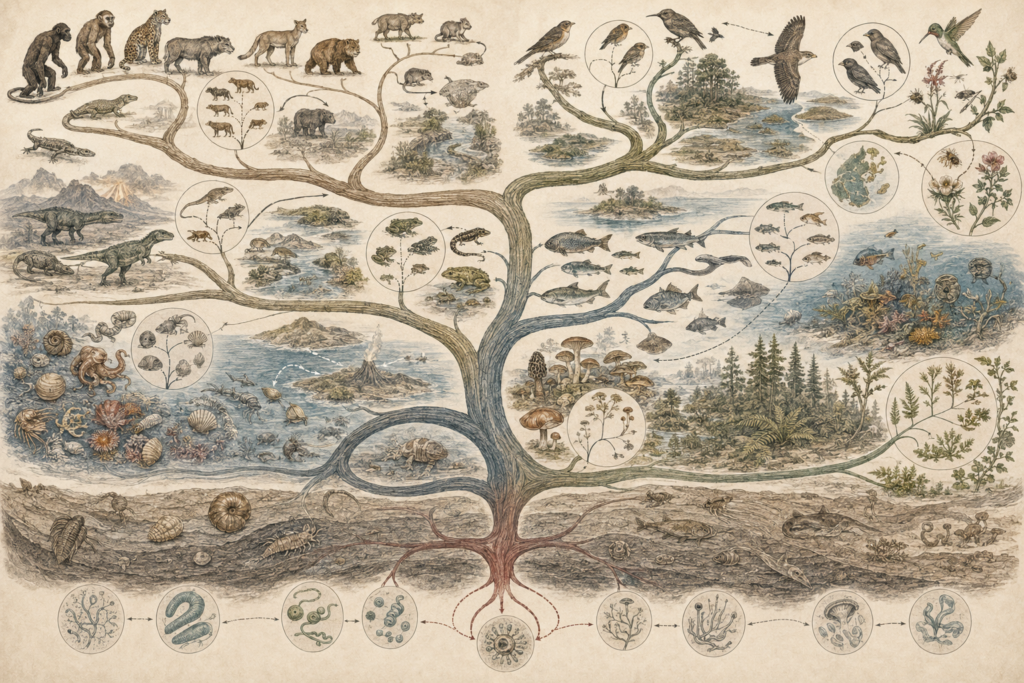
Research-grade evolutionary biology illustration showing a branching tree of life with mammals, birds, reptiles, amphibians, fish, invertebrates, plants, fungi, microbes, marine ecosystems, terrestrial habitats, fossils, and subtle speciation pathways.

Speciation, Diversity, and the Tree of Life

Speciation, diversity, and the tree of life examine how new species arise, how evolutionary branching generates the diversity of organisms on Earth, and how phylogenetic reasoning helps biology reconstruct the historical relationships among living and extinct lineages. Speciation is one of the central processes in biology because the richness of life does not emerge from variation within populations alone, but from the repeated splitting, divergence, and persistence of lineages across deep time. This article explores speciation as the origin of new species, diversity as the historical outcome of branching evolution under ecological, developmental, and geological conditions, and the tree of life as the framework through which common ancestry and evolutionary relatedness are represented. It also examines how reproductive isolation, divergence, extinction, phylogenetics, and comparative biology shape modern understanding of biodiversity, while extending the topic into quantitative and computational biology through branching models, frequency change, distance reasoning, and R- and Python-based workflows.
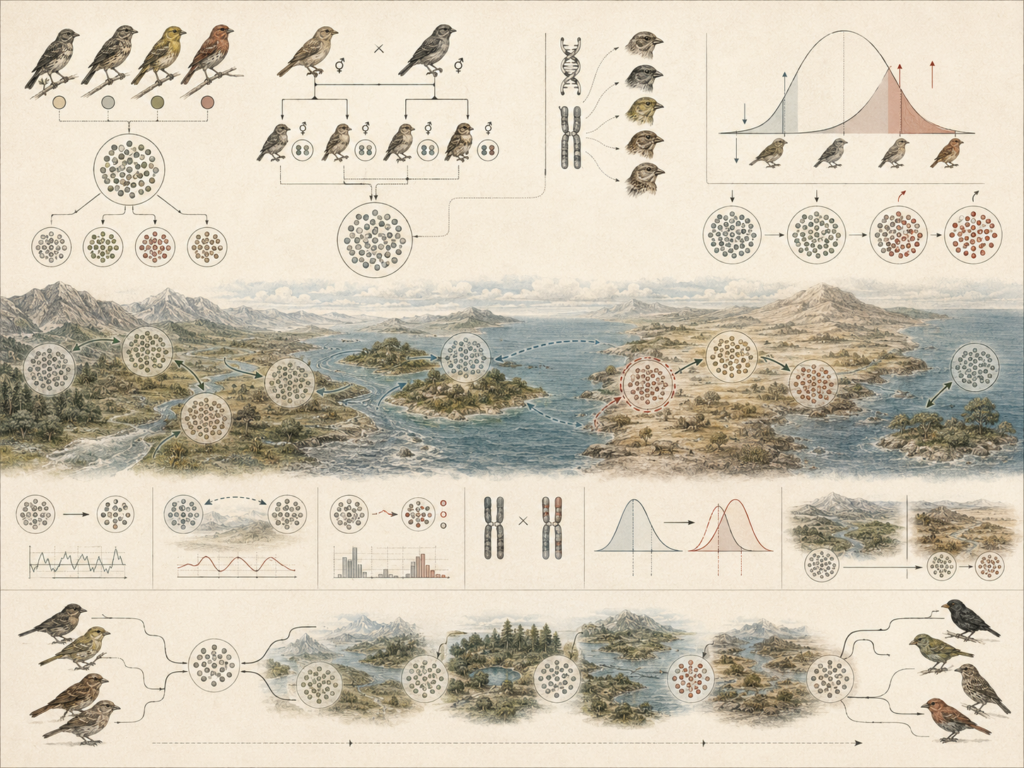
Research-grade population genetics illustration showing bird populations, inheritance patterns, chromosomes, allele-frequency changes, trait variation, geographic isolation, gene flow, selection, drift, and mathematical population models across connected landscapes.

Population Genetics and the Mathematics of Inheritance

Population genetics and the mathematics of inheritance examine how allele frequencies change through time, how heredity operates at the level of whole populations rather than isolated pedigrees alone, and how mathematical models help explain the evolutionary consequences of selection, drift, mutation, migration, and reproduction. Population genetics is one of the central bridges between classical genetics and evolutionary biology because it turns inheritance into a quantitative science of variation, frequency, and change across generations. This article explores allele and genotype frequencies, the Hardy–Weinberg principle, the mathematics of equilibrium and deviation, and the major forces that alter genetic composition in populations. It also shows why population genetics matters for ecology, conservation, medicine, microbiology, agriculture, and the long-term resilience of living systems. Finally, it extends the topic into quantitative and computational biology through probability models, frequency calculations, and selection dynamics.

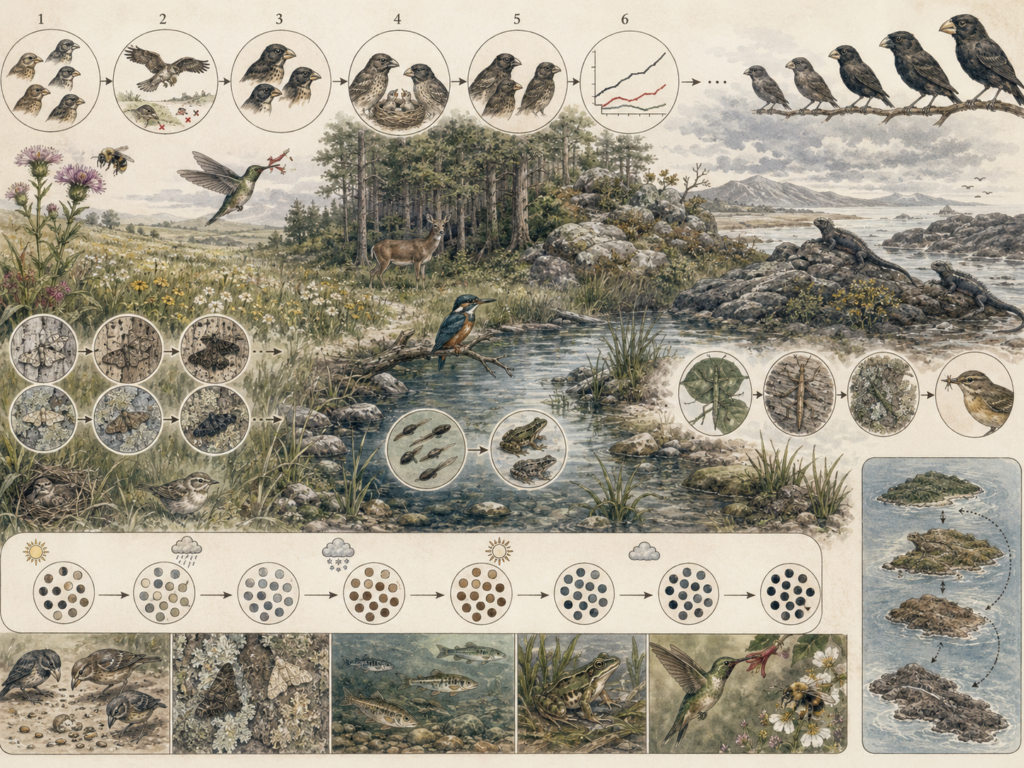
Research-grade evolutionary biology illustration showing birds, insects, amphibians, fish, reptiles, pollinators, island populations, trait variation, selection pressure, survival differences, adaptation sequences, and allele-frequency change across connected habitats.

Natural Selection, Adaptation, and Fitness

Natural selection, adaptation, and fitness examine how inherited variation affects survival and reproduction, how populations change through time under environmental pressures, and how biological traits become fitted, often imperfectly, to particular ecological conditions. Natural selection is one of the core mechanisms of evolution because it links variation to differential reproductive success, allowing some traits, combinations, and lineages to become more common across generations. This article explores how natural selection works, how fitness is defined in evolutionary biology, why adaptation must be understood historically rather than teleologically, and how selection interacts with mutation, drift, constraint, development, and ecological context. It also extends the topic into quantitative and computational biology through allele-frequency models, selection coefficients, fitness comparisons, and R- and Python-based workflows, while connecting the subject to sustainability-adjacent fields such as ecology, conservation biology, restoration ecology, evolutionary biology, marine biology, freshwater biology, plant science, soil biology, microbiology, agroecology, forestry, disease ecology, and systems biology.

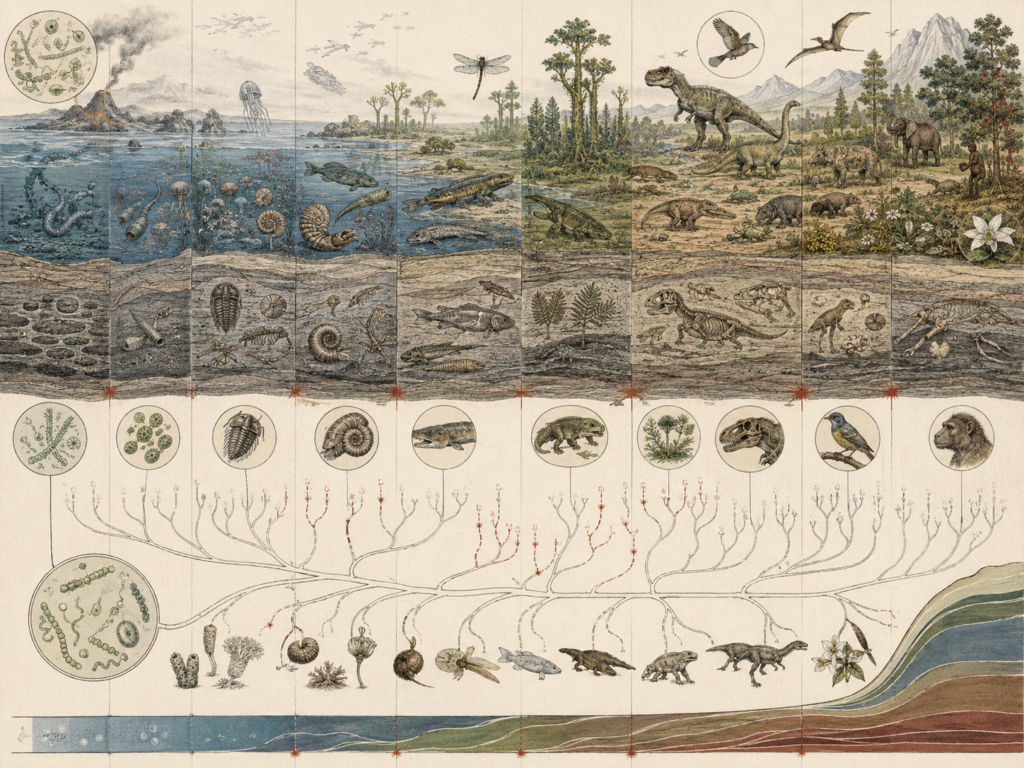
Research-grade evolutionary biology illustration showing the history of life across deep time, with microbial origins, ancient oceans, fossil strata, marine invertebrates, fish, amphibians, reptiles, dinosaurs, birds, mammals, flowering plants, geological layers, extinction markers, and phylogenetic branching.

Evolution and the History of Life

Evolution and the history of life examine how living systems change through time, how hereditary variation is sorted through selection and other evolutionary processes, and how the diversity of organisms on Earth emerged from shared ancestry across deep geological history. Evolution is one of the central principles of biology because it explains both the unity and the diversity of life: unity through common descent, and diversity through inherited modification, selection, drift, recombination, extinction, and ecological divergence. This article explores evolution as descent with modification, the major processes that generate evolutionary change, the fossil and comparative evidence through which the history of life is reconstructed, and the long unfolding of life from early microbial worlds to complex multicellular systems, ecological radiations, and the modern biosphere. It also extends evolutionary biology into quantitative and computational analysis through population models, allele-frequency change, phylogenetic reasoning, and R- and Python-based workflows, while connecting the subject to sustainability-adjacent fields such as ecology, conservation biology, restoration ecology, evolutionary biology, marine biology, freshwater biology, plant science, soil biology, microbiology, agroecology, forestry, disease ecology, and systems biology.

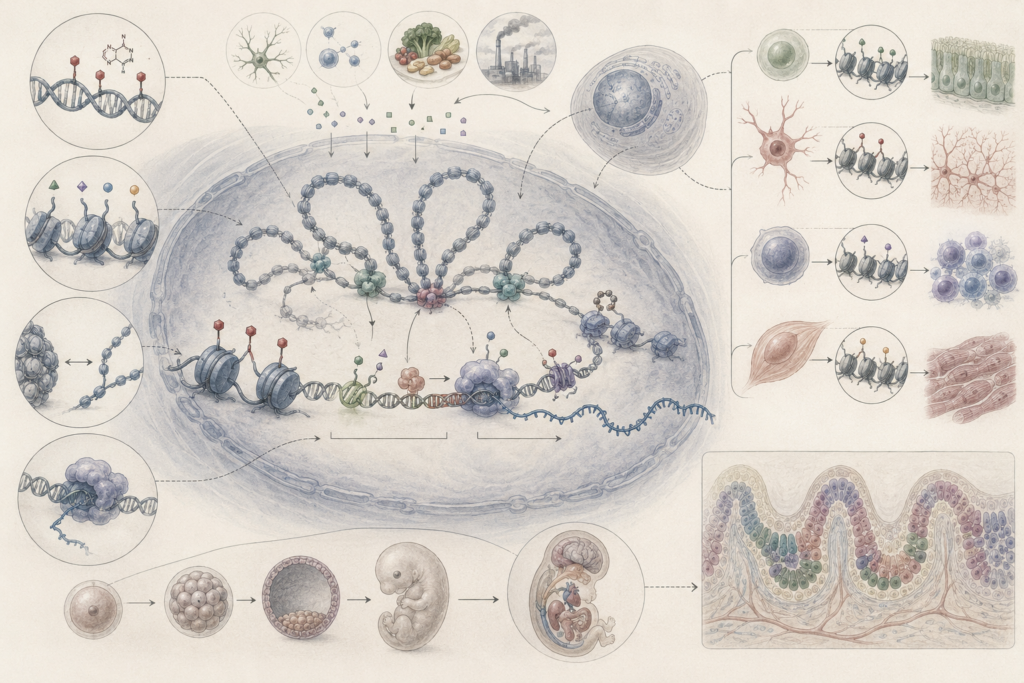
Research-grade molecular biology illustration showing DNA, chromatin loops, histones, epigenetic marks, transcription regulation, RNA production, cell differentiation, embryonic development, tissues, environmental signals, and gene-expression pathways.

Epigenetics, Regulation, and Gene Expression

Epigenetics, regulation, and gene expression examine how living systems control which genes are active, when they are active, where they are active, and to what extent they are expressed across cells, tissues, organisms, and environments. Epigenetics is central to modern biology because DNA sequence alone does not explain how genetically similar cells become different cell types, how organisms respond to environmental conditions, or how biological systems stabilize and modify patterns of activity across development and time. This article explores epigenetics as the study of heritable and persistent changes in gene activity that do not depend solely on changes in DNA sequence, including chromatin organization, DNA methylation, histone modification, regulatory RNA, and other mechanisms of gene control. It also examines how gene expression is regulated through transcriptional, post-transcriptional, and chromatin-level processes, and why epigenetic regulation matters for development, physiology, ecology, evolution, disease, and biotechnology.

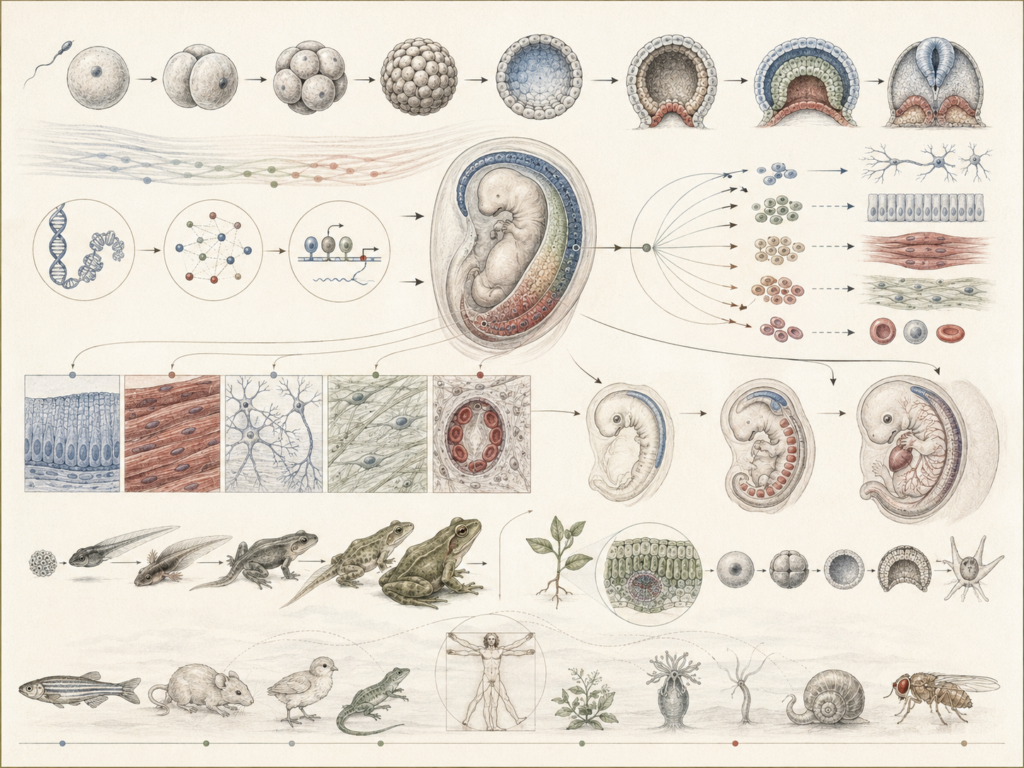
Research-grade developmental biology illustration showing fertilization, cell division, embryonic development, gastrulation, organ formation, tissue differentiation, gene regulation, cell lineages, metamorphosis, and comparative organismal development.

Development, Differentiation, and the Making of Organisms

Development, differentiation, and the making of organisms examine how living systems progress from relatively simple beginnings to complex, organized, multi-scale forms through regulated processes of cell division, pattern formation, specification, morphogenesis, and functional specialization. Development is one of the central problems of biology because organisms are not merely assembled from preexisting miniature parts. They are produced through dynamic, highly coordinated processes in which cells divide, acquire distinct identities, communicate with one another, move through tissues, respond to positional information, and collectively generate organs, body plans, and life-history stages. This article explores the principles of developmental biology, including cell fate specification, differentiation, morphogenesis, pattern formation, and developmental regulation, while also showing how development connects cell biology, molecular biology, physiology, ecology, and evolution. It further extends the topic into quantitative and computational biology through growth models, differentiation dynamics, patterning logic, and R- and Python-based workflows, while connecting the subject to sustainability-adjacent fields such as ecology, conservation biology, restoration ecology, evolutionary biology, marine biology, freshwater biology, plant science, soil biology, microbiology, agroecology, forestry, disease ecology, and systems biology.

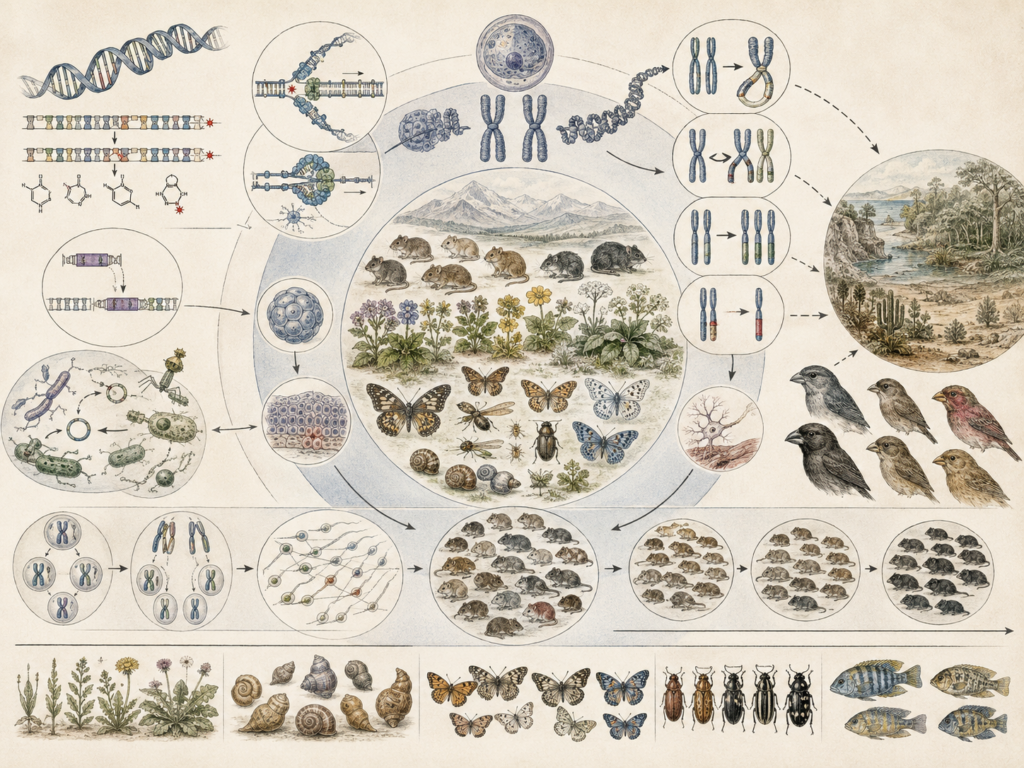
Research-grade evolutionary biology illustration showing DNA mutations, chromosomes, genetic recombination, microbial exchange, cell division, inherited variation, trait diversity in plants and animals, population change, and ecological novelty across generations.

Mutation, Variation, and the Sources of Novelty

Mutation, variation, and the sources of novelty examine how living systems generate difference, preserve or redistribute inherited diversity, and produce the raw material from which development, adaptation, innovation, and evolutionary change become possible. Novelty is one of biology’s most important problems because life persists not only through continuity, but also through the production of new forms, new combinations, and new possibilities under changing conditions. This article explores mutation as a source of sequence change, variation as a broader field of inherited and phenotypic difference, and novelty as an outcome that can emerge through mutation, recombination, genomic rearrangement, regulatory change, standing genetic variation, and ecological selection on biological systems. It also extends the topic into quantitative and computational biology through mutation-rate reasoning, allele-frequency models, sequence comparison, and R- and Python-based workflows, while connecting the subject to sustainability-adjacent fields such as ecology, conservation biology, microbiology, plant science, marine biology, freshwater biology, soil biology, agroecology, disease ecology, and systems biology.

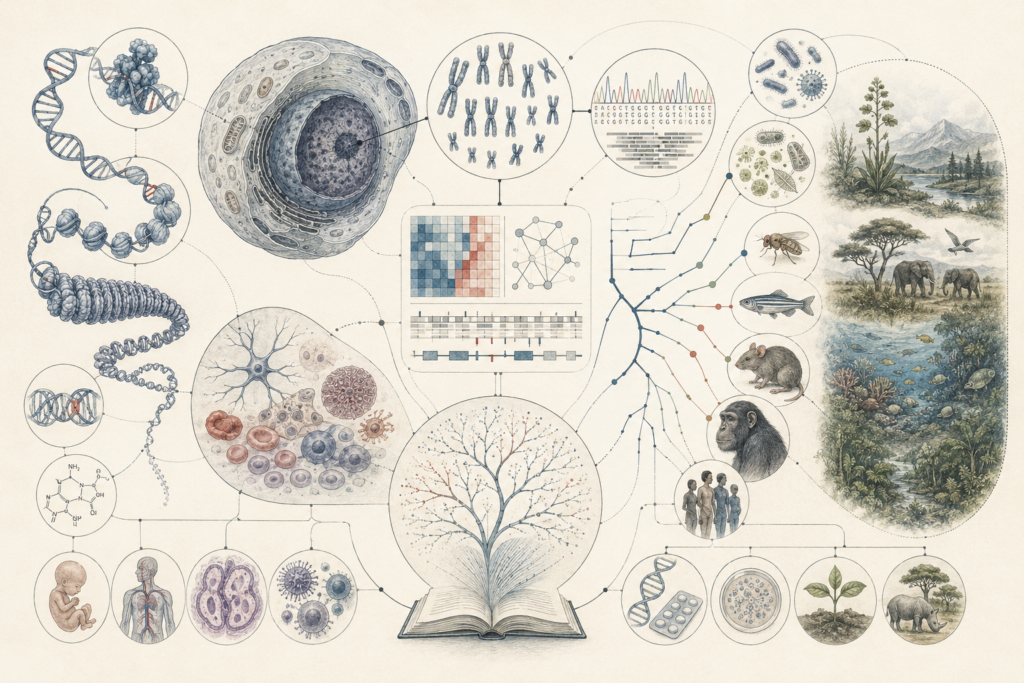
Research-grade genomics illustration showing DNA, chromatin, chromosomes, sequencing data, gene networks, cell biology, development, disease biology, biodiversity, model organisms, and ecosystem connections.

Genomics and the Expansion of Biological Knowledge

Genomics and the expansion of biological knowledge examine how the large-scale study of genomes has transformed biology from the analysis of individual genes into a broader science of whole genetic systems, regulatory architecture, variation, function, and evolutionary history. Genomics is one of the central developments of modern biology because it allows researchers to study not only isolated hereditary units but also the organization, interaction, and large-scale interpretation of genetic information across organisms, populations, ecosystems, and lineages. This article explores what genomics is, how it differs from classical genetics, how whole-genome sequencing and comparative genomics have changed biological reasoning, and why genomics matters for molecular biology, evolution, medicine, ecology, conservation, agriculture, microbiology, and biotechnology. It also extends genomics into quantitative and computational biology through sequence-scale analysis, variant interpretation, expression matrices, and R- and Python-based workflows, while connecting the subject to sustainability-adjacent fields such as ecology, conservation biology, microbiology, plant science, marine biology, freshwater biology, soil biology, agroecology, disease ecology, and systems biology.

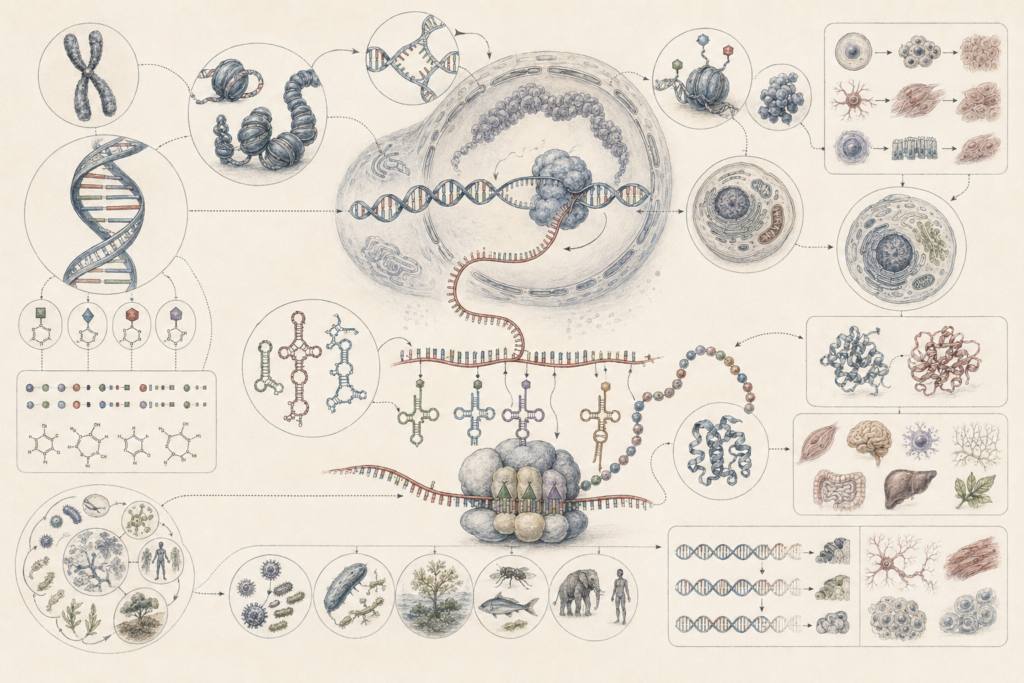
Research-grade molecular biology illustration showing DNA, RNA, chromosomes, chromatin, transcription, translation, ribosomes, transfer RNA, proteins, cells, tissues, organisms, and biological information flow across living systems.

DNA, RNA, and the Molecular Logic of Life

DNA, RNA, and the molecular logic of life examine how living systems store hereditary information, copy it across generations, interpret it within cells, and convert it into regulated biological function. This article explores one of the central frameworks of modern biology: the material and informational relationship among DNA, RNA, and protein, and the broader molecular logic through which living systems preserve continuity while remaining capable of change, adaptation, and response. It considers DNA as a relatively stable medium of hereditary storage, RNA as a diverse and dynamic set of informational and regulatory molecules, and protein synthesis as one of the major ways encoded information becomes embodied biological activity. It also shows why the molecular logic of life is not adequately described as a rigid one-way script, but is better understood as a regulated, context-dependent system shaped by replication, transcription, translation, repair, chromatin organization, RNA diversity, environmental response, and evolutionary history. It further extends the topic into quantitative and computational biology through sequence comparison, transcript dynamics, and expression models.

Scroll to Top