
Last Updated May 28, 2026
Genes, inheritance, and the principles of heredity examine how biological information is transmitted across generations, how traits and capacities persist through genomes and chromosomes, and how resemblance, variation, and difference emerge through the regulated inheritance of genetic material. Heredity is one of the central principles of biology because living systems persist not only through metabolism, development, and reproduction, but also through the transmission of information that shapes physiology, adaptation, disease, ecological response, and evolutionary change. Genes are among the principal units through which this continuity is organized, but heredity is broader than gene naming alone: it includes alleles, chromosomes, meiosis, recombination, mutation, gene regulation, developmental context, population structure, and environmental interaction.
This article develops Genes, Inheritance, and the Principles of Heredity as a foundational article within the Biology knowledge series. It treats inheritance not merely as a classroom set of Mendelian ratios, but as one of biology’s major explanatory infrastructures: the framework through which continuity and variation move across generations. Classical genetics explains why traits can follow predictable probabilistic patterns; molecular genetics explains how hereditary material is physically stored and copied; chromosomal genetics explains how segregation and recombination occur; population genetics explains how inherited variation is distributed through groups; and modern genomics expands heredity into whole-genome, multi-locus, and computational analysis.
Main Library
Publications
Article Map
Biology
Related Topic
Chemistry
Related Topic
Earth Science
Related Topic
Environmental Science
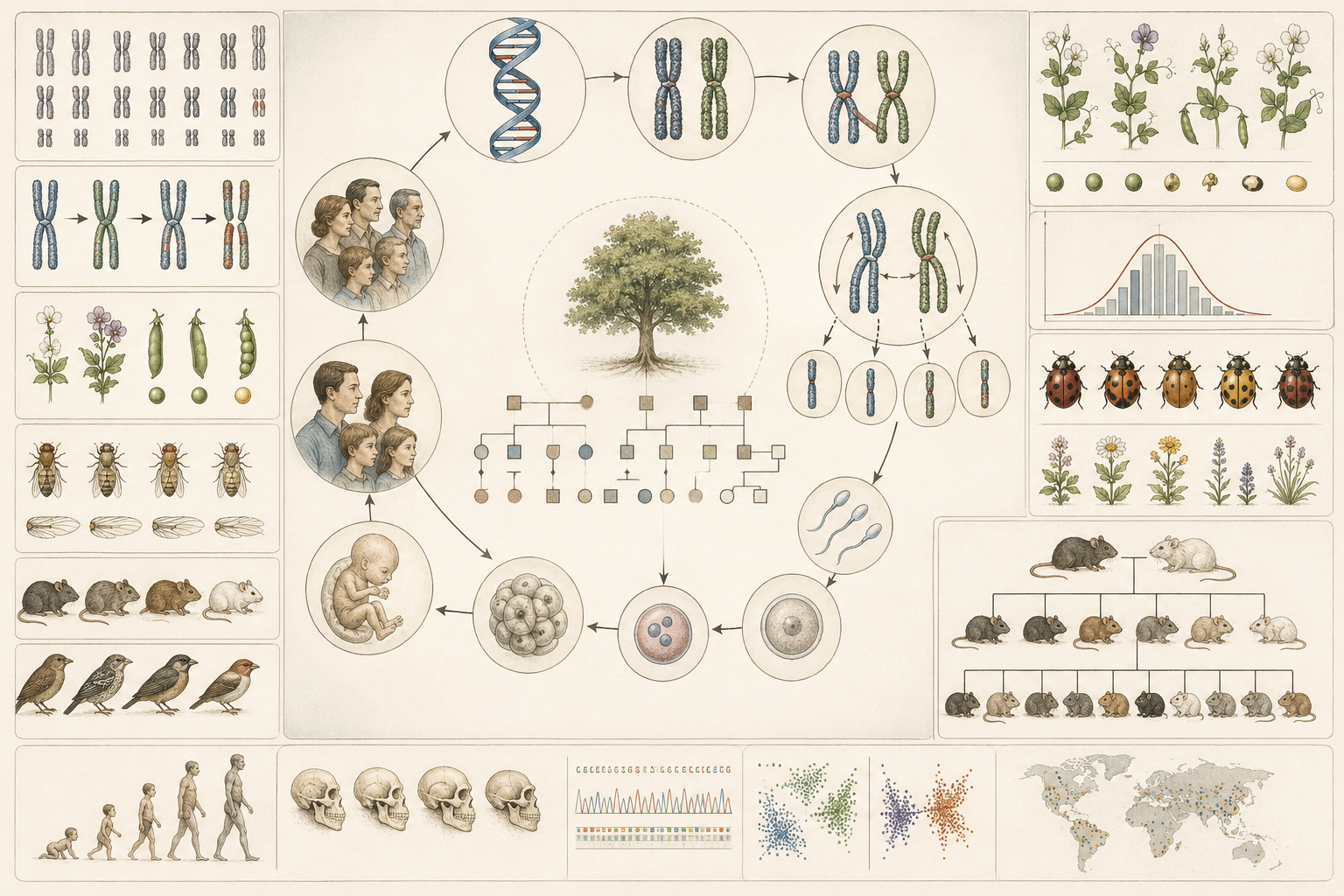
The article develops genes, inheritance, and heredity across genes as units of inheritance, Mendelian principles, segregation, independent assortment, meiosis, chromosomes, dominance, recessiveness, linkage, recombination, penetrance, expressivity, polygenic traits, genotype-by-environment interaction, quantitative genetics, conservation genetics, medical genetics, plant breeding, disease ecology, and computational inheritance analysis.
The article also extends heredity into quantitative and computational biology through Mendelian probability, genotype expectations, Punnett-style reasoning, chi-square goodness-of-fit, allele-frequency estimation, Hardy-Weinberg expectations, expected heterozygosity, recombination fractions, linkage logic, polygenic trait simulation, heritability scaffolds, breeder’s equation reasoning, conservation-genetic condition scoring, R workflows, Python workflows, SQL provenance structures, and a linked full-stack GitHub repository containing Python, R, Julia, Fortran, Rust, Go, C, C++, SQL, notebooks, data files, validation notes, and reproducibility documentation.
What genes and heredity are
Heredity is the transmission of biological traits and capacities from one generation to the next through genetic material. Genes are among the central units through which this transmission occurs. In modern biology, genes are understood as DNA sequences that contribute to functional products or regulated biological roles within cells and organisms. Genetics is the study of inheritance, including the interplay of genes, DNA variation, chromosomes, reproduction, development, and environment.
This makes heredity one of the deepest principles in biology. Organisms do not begin anew in every generation. They inherit structured biological possibilities through genomes, chromosomes, alleles, regulatory systems, cytoplasmic contexts, and developmental programs. Yet heredity does not simply reproduce sameness. It also transmits variation, reshuffles combinations, exposes hidden differences, and provides the substrate for evolutionary change. In that sense, heredity is about continuity and difference at once.
Genes and heredity therefore belong to the foundations of biological thinking. They help explain why offspring resemble parents, why siblings differ, how lineages persist, how populations change, why some diseases run in families, how breeders select traits, and why biological variation can be both predictable and open-ended. Heredity is not merely a record of the past. It is one of the mechanisms through which biological futures become possible.
Heredity also clarifies why biology must connect scales. A visible trait may appear in an organism, but its transmission may depend on alleles, chromosomes, meiosis, gamete formation, fertilization, gene regulation, developmental timing, and environmental context. Genetics is therefore not only a molecular science and not only a breeding science. It is a bridge between molecular continuity, organismal form, population variation, and evolutionary possibility.
Genes as units of inheritance
Genes are often described as units of heredity because they represent identifiable segments of genetic material that contribute to inherited biological effects. In classical genetics, this meant understanding genes as discrete factors transmitted across generations. In modern molecular biology, genes are embedded within chromosomes and genomes as DNA sequences whose products, regulatory roles, and expression contexts influence phenotype, development, and function.
This concept was scientifically powerful because it replaced vague notions of blended inheritance with the idea that hereditary factors retain distinguishable identity across generations. That conceptual shift made biological resemblance mathematically analyzable and experimentally testable. Instead of treating inheritance as an indistinct mixing of parental substance, genetics could treat it as the transmission of discrete, recombinable units.
Yet modern biology also understands that genes do not operate alone. They function within regulatory networks, chromosomal contexts, cellular systems, developmental pathways, environmental conditions, and population histories. A gene is a central unit of heredity, but heredity itself is not exhausted by gene naming alone. It includes interactions, expression, timing, dosage, recombination, chromosomal organization, and context.
This matters because gene-centered reasoning is most powerful when used carefully. Genes help explain inheritance, but they do not reduce living systems to simple one-gene, one-trait formulas. A gene can contribute to a trait, a pathway, a regulatory state, or a disease risk without determining every outcome by itself. Good genetic reasoning therefore treats genes as powerful units of inheritance within larger living systems.
Mendel and the foundations of classical genetics
Gregor Mendel’s work on pea plants remains foundational because it demonstrated that traits can be inherited according to regular patterns analyzable through discrete hereditary factors. Mendelian inheritance still provides the classic framework for understanding dominant and recessive single-gene transmission, even though modern genetics now recognizes many additional inheritance patterns beyond those first experiments.
Mendel’s importance lies not only in the traits he studied, but in the method he used. By counting offspring categories across controlled crosses, he showed that heredity could be studied quantitatively and inferentially. Biological inheritance became something that could be modeled probabilistically, not merely observed impressionistically.
This remains one of the great turning points in biology. Mendelian genetics demonstrated that heredity follows structured rules, and it helped establish genetics as a science of variation, transmission, and ratio rather than only lineage narrative or anatomical resemblance.
Mendel’s framework also remains important because it provided biology with a disciplined way to infer invisible hereditary structure from visible offspring outcomes. That logic still runs through modern genetics: observed patterns are used to infer hidden genotypes, inheritance modes, linkage relationships, allele frequencies, and molecular mechanisms. Genetics remains a science of inference from pattern to mechanism.
Segregation, independent assortment, and probabilistic inheritance
Two of Mendel’s most important principles are segregation and independent assortment. Segregation refers to the separation of paired hereditary factors into gametes, while independent assortment refers to the tendency of factors at different loci to assort independently under appropriate conditions. These principles matter because they reveal that heredity is inherently probabilistic. Parents do not transmit traits as fixed packages in deterministic miniature. They transmit alleles through gamete formation, and offspring outcomes depend on combinations that can be described statistically.
At the same time, modern genetics recognizes that independent assortment is not universal in the strongest possible sense. Genes on the same chromosome may show linkage and therefore be transmitted together more often than loci on different chromosomes. This is why classical Mendelian rules remain foundational but are refined through chromosomal reality, recombination, and meiotic mechanism.
This refinement is scientifically important because it shows how classical probability and cellular mechanism fit together. Heredity is not only a statistical pattern visible in offspring. It is a physical process operating through chromosomes, recombination, gamete production, and fertilization. Probabilistic inheritance is therefore not randomness without mechanism. It is structured uncertainty arising from the physical behavior of chromosomes and alleles.
This probabilistic structure is one of the reasons genetics became so mathematically powerful. Once heredity could be represented through ratios, frequencies, segregation patterns, and statistical tests, biological continuity became experimentally measurable. The result was a science in which invisible hereditary processes could be inferred from visible patterns of descent.
Chromosomes, meiosis, and the physical basis of heredity
Modern genetics gained deeper explanatory power when hereditary factors were linked to chromosomes and to the processes of meiosis and fertilization. Chromosomes provide the physical context in which genes are arranged, copied, paired, recombined, segregated, and transmitted. Meiosis reduces chromosome number by half, produces haploid cells, and includes homolog pairing and recombination, all of which help explain segregation, recombinant offspring, and variation among descendants.
This chromosomal basis of heredity matters because it connects classical ratios to cellular mechanism. Inheritance is not only a pattern visible in pedigrees. It is also a physical process involving homologous chromosomes, crossing over, gamete production, and fertilization. Genetics is therefore one of biology’s clearest multi-scale sciences.
It also explains why heredity cannot be understood only at one level. A family pattern may be visible at the organismal scale, but its basis lies in genes, chromosomes, cell division, DNA replication, recombination, and molecular continuity. Biological explanation becomes strongest when these levels are linked rather than separated.
Chromosomes also make clear why errors in inheritance can have major consequences. Nondisjunction, chromosomal rearrangement, deletion, duplication, translocation, and copy-number change can alter inherited outcomes in ways that simple single-locus models cannot capture. The physical organization of the genome is therefore part of heredity itself.
Dominance, recessiveness, and the limits of simple trait models
Dominant and recessive patterns remain useful introductory concepts because they explain why some alleles are expressed in heterozygous individuals while others are not. Mendelian inheritance still provides the standard language for many single-gene transmission patterns, including classic autosomal dominant, autosomal recessive, and sex-linked examples.
Yet dominance and recessiveness should not be mistaken for universal descriptions of how all traits work. Some traits show incomplete dominance, codominance, dosage effects, penetrance limits, variable expressivity, epistasis, imprinting, or context-sensitive expression. Even within Mendelian disease, phenotype may depend on background variation, developmental timing, modifier genes, environment, and chance.
This matters because heredity is more structured than folk ideas of blending, but often more complex than textbook monohybrid examples. Genetics gains power by starting with simple models and then expanding beyond them, not by confusing simplicity with completeness.
Dominance is also a relationship between alleles in a given biological context, not a moral hierarchy and not necessarily a statement about which allele is more common or more important. A dominant allele is not automatically beneficial, and a recessive allele is not automatically harmful. The biological effect depends on mechanism, molecular function, developmental context, and population history.
Beyond simple Mendelian inheritance
Modern heredity extends far beyond simple single-gene models. Polygenic traits, linkage, mitochondrial inheritance, sex-linked inheritance, incomplete penetrance, variable expressivity, chromosomal abnormalities, genotype-by-environment interactions, epigenetic regulation, and broader genomic effects all complicate the picture.
This complexity does not weaken genetics. It strengthens it by showing that heredity operates across multiple layers of organization. Some traits are governed strongly by single loci, while others emerge through the combined influence of many genes and environmental conditions. Some inheritance patterns are easy to track within pedigrees, while others require population-level analysis, genomic methods, experimental crosses, or quantitative genetics.
Modern heredity therefore combines classical genetics with genomics, developmental biology, molecular biology, ecology, and statistical analysis. Genes remain fundamental, but inheritance is best understood as a structured, layered, and context-sensitive biological phenomenon.
This is especially important for complex traits. Height, yield, disease susceptibility, stress tolerance, behavior, metabolic performance, and ecological fitness often arise from many loci of small effect interacting with environments. In these cases, heredity is still real, but it is distributed rather than simple. A trait can be heritable without being determined by one gene, and a genetic contribution can be meaningful without being absolute.
Genes in development, physiology, and biological function
Genes matter because they contribute to the development and functioning of living systems. Through regulated expression, they influence protein production, cellular differentiation, signaling pathways, metabolism, structure, repair, immunity, and response to environmental conditions. This means heredity is not merely about resemblance across generations. It is also about how biological systems become functionally organized within a lifetime.
Development is especially important in this regard. A fertilized embryo does not contain miniature organs waiting to enlarge. It contains hereditary material progressively interpreted through regulated expression, signaling, cellular differentiation, tissue interaction, and morphogenesis. Physiology likewise depends on inherited molecular capacities expressed in tissues and systems under particular conditions.
Heredity therefore connects lineage continuity to present function. What is inherited is not only a set of traits in static form, but the biological capacity to build, maintain, repair, and regulate living organization.
This developmental and physiological view also prevents genetic determinism. Genes are real and powerful, but their effects are expressed through biological systems. Inheritance provides structured possibilities; development and environment help determine how those possibilities become lived biological outcomes. Genes are therefore part of the causal architecture of life, but they operate through cells, tissues, organisms, and environments.
Ecology, evolution, and sustainability-adjacent biology
Genes and heredity are deeply relevant to ecology and sustainability-adjacent biology because populations respond to environmental pressures through inherited variation. Adaptation, resilience, stress tolerance, reproductive success, and extinction risk all depend partly on how genetic variation is distributed and transmitted through populations. Ecology provides selective and environmental context; heredity provides continuity and variation on which change can act.
Evolutionary biology makes this connection especially clear. Heredity is one of the conditions that makes natural selection meaningful, because without inherited variation there can be no cumulative adaptation across generations. Conservation biology also depends on heredity through concerns about genetic diversity, bottlenecks, inbreeding, adaptive capacity, and long-term population viability.
This matters for sustainability because environmental disruption is not only a matter of habitat and resource change. It is also a matter of whether populations retain enough hereditary diversity and reproductive continuity to persist under changing conditions. A population may remain numerically present while losing genetic diversity, adaptive capacity, or reproductive resilience.
In this sense, heredity is part of ecological infrastructure. It is one of the ways life carries adaptive possibility forward. Climate stress, habitat fragmentation, pollution, invasive species, disease emergence, and overharvesting all become more biologically consequential when they erode the hereditary diversity that allows populations to respond.
Marine, freshwater, soil, plant, and microbial relevance
Marine biology depends on heredity because adaptation to salinity, temperature, oxygen regimes, acidification, pathogens, and food-web shifts depends on transmitted variation across generations. Fisheries biology, coral resilience, plankton dynamics, microbial ocean ecology, and conservation of marine biodiversity all intersect with hereditary continuity and population-level genetic structure. The same broad hereditary logic applies in freshwater systems under pollution, eutrophication, thermal stress, invasive species pressure, and altered hydrology.
Soil biology and microbiology add another layer because microbial communities transmit genes vertically and, in some systems, horizontally, shaping nutrient cycling, decomposition, stress response, antibiotic resistance, and ecological function. Microbial heredity often operates on fast timescales, making inherited variation especially visible under strong environmental selection.
Plant science and agroecology are equally heredity-rich. Crop breeding, seed systems, disease resistance, flowering time, drought tolerance, nutrient-use efficiency, restoration planting, and forestry resilience all depend on inherited variation and controlled transmission. Forestry and restoration ecology likewise depend on genetics because long-lived plant populations must persist across environmental change on generational timescales.
Across marine, freshwater, soil, plant, and microbial contexts, heredity links biological continuity to ecological resilience. It helps explain which populations can persist, which traits can be selected, and which lineages remain open to adaptation. It also helps scientists avoid treating biodiversity as only a visible species count. Genetic diversity within populations is part of biological resilience.
Medical, biomedical, and disease ecology relevance
Genes and heredity are foundational to medicine and biomedicine because many conditions reflect inherited variants, spontaneous mutations, chromosomal abnormalities, or genotype-dependent susceptibilities. Medical professionals encounter heredity in family history, carrier status, pedigree interpretation, disease susceptibility, counseling, reproductive medicine, pharmacogenetics, and diagnostic genetics.
But biomedical heredity is not restricted to classic Mendelian disease. Complex disease, gene-environment interaction, polygenic risk, somatic mutation, molecular pathology, and population ancestry all extend heredity into wider biomedical systems. A disease may follow a recognizable inheritance pattern, but many clinical outcomes depend on multiple genetic and environmental contributions.
Disease ecology adds still another scale. Host populations differ in inherited susceptibility, pathogens evolve through inherited variation, and ecological conditions influence transmission, selection, and persistence. Heredity therefore links molecular difference to clinical outcome and population-level disease dynamics.
This is why heredity matters not only in families but also in public health, pathogen surveillance, vector biology, antimicrobial resistance, and ecological medicine. Inherited variation can shape vulnerability, resistance, transmission, and response. Heredity is therefore a medical, ecological, and evolutionary concern at the same time.
Biotechnology, bioinformatics, and computational relevance
Biotechnology extends heredity into applied systems of analysis, breeding, engineering, and intervention. Molecular diagnostics, genotyping, marker-assisted selection, synthetic biology, gene editing, microbial strain tracking, conservation genomics, seed-system design, and reproductive technologies all depend on understanding how genetic information is transmitted and altered. In these settings, heredity becomes not only a subject of explanation but also a target of design and decision-making.
Bioinformatics strengthens this transformation by enabling sequence comparison, pedigree-informed variant analysis, population-genetic inference, phylogenomics, linkage analysis, genotype matrix summaries, and large-scale study of inheritance patterns in data-rich contexts. Genes and heredity are therefore not only family-level phenomena. They are also patterns discoverable in datasets spanning genomes, populations, and environments.
This makes genetics one of the clearest bridges between classical biology and contemporary computational science. Heredity began as a problem of trait transmission in breeding experiments and now extends into large-scale sequence analysis, ecological population studies, biotechnology workflows, and reproducible data infrastructure.
Computational heredity also requires careful provenance. Genotype calls, pedigree records, population samples, allele frequencies, and trait measurements must be linked to sampling methods, metadata, filtering rules, reference panels, population structure, environmental context, and analytical assumptions. Without that context, genetic data can be misread as simpler, more deterministic, or more universal than it actually is.
Quantitative heredity: mathematics, R, and Python
Modern heredity is not only conceptual. It is also quantitative. Mendelian ratios, allele frequencies, genotype expectations, linkage patterns, recombination fractions, chi-square goodness-of-fit, heritability scaffolds, and population-level summaries all require probabilistic and statistical interpretation. This is one reason genetics became such a mathematically fertile branch of biology. Classical inheritance gives the entry point, but useful genetic analysis quickly expands into simulation, inference, and multi-locus reasoning.
For a simple monohybrid cross of two heterozygotes, \(Aa \times Aa\), genotype expectations are:
Interpretation: A heterozygote-by-heterozygote cross produces expected genotype probabilities of 1:2:1 under simple Mendelian assumptions.
This is useful because it makes heredity explicitly probabilistic rather than impressionistic.
If two loci assort independently in a cross \(AaBb \times AaBb\), the classic phenotypic expectation under full dominance at both loci is:
Interpretation: Independent assortment across two loci produces four expected phenotypic classes under the classical dihybrid model.
This matters because multi-locus inheritance is often the first point at which genetic reasoning expands beyond one-trait examples.
At a single locus with two alleles, the basic frequency relation is:
Interpretation: In a biallelic model, the two allele frequencies sum to one.
Under Hardy-Weinberg assumptions, genotype frequencies are expected to follow:
Interpretation: Hardy-Weinberg expectations describe genotype frequencies from allele frequencies under idealized population assumptions.
This is important because heredity at the population scale is often best understood statistically rather than through single pedigrees alone.
A standard biallelic diversity measure is:
Interpretation: Expected heterozygosity estimates the expected fraction of heterozygotes under a simple biallelic model.
This is useful because population heredity is often tracked through how much variation remains, not just which allele is most common.
For two linked loci, the recombination fraction can be written as:
Interpretation: Recombination fraction estimates the share of recombinant gametes among total gametes.
where \(R_g\) is the number of recombinant gametes and \(T_g\) is the total number of gametes. This is useful because linked inheritance departs from simple independent assortment and requires explicit estimation of recombinant versus parental classes.
A classic inheritance test compares observed and expected counts using:
Interpretation: Chi-square goodness-of-fit compares observed inheritance counts with expected counts under a hypothesized model.
where \(O_i\) is the observed count and \(E_i\) is the expected count for category \(i\). This is useful because genetics often involves deciding whether observed segregation patterns are plausibly consistent with a hypothesized inheritance model.
A simple quantitative-genetic expression for narrow-sense heritability is:
Interpretation: Narrow-sense heritability expresses the share of phenotypic variance attributable to additive genetic variance in a particular population and environment.
where \(V_A\) is additive genetic variance and \(V_P\) is total phenotypic variance. This is useful because many biologically important traits are polygenic rather than Mendelian.
A compact selection-response model is:
Interpretation: The breeder’s equation estimates response to selection from heritability and selection differential.
where \(R\) is response to selection, \(h^2\) is narrow-sense heritability, and \(S\) is the selection differential. This is useful because heredity matters directly for breeding, restoration, agriculture, conservation, and evolutionary response.
Variables, units, and heredity interpretation
Quantitative heredity depends on variables that connect genotype, allele frequency, segregation, recombination, variation, selection, and biological interpretation. The table below summarizes several central quantities.
| Symbol or Term | Meaning | Typical Unit or Scale | Heredity Interpretation |
|---|---|---|---|
| \(P(AA), P(Aa), P(aa)\) | Expected genotype probabilities | probability from 0 to 1 | Expected offspring genotype distribution under a specified cross |
| \(p\) | Frequency of allele \(A\) | fraction from 0 to 1 | Share of allele copies in a population represented by allele \(A\) |
| \(q\) | Frequency of allele \(a\) | fraction from 0 to 1 | Share of allele copies in a population represented by allele \(a\) |
| \(p^2, 2pq, q^2\) | Hardy-Weinberg genotype expectations | frequency or probability | Expected genotype frequencies under idealized assumptions |
| \(H_e\) | Expected heterozygosity | fraction from 0 to 1 | Expected heterozygote frequency and a compact diversity measure |
| \(r\) | Recombination fraction | fraction from 0 to 0.5 in typical linkage mapping | Estimated share of recombinant gametes between two loci |
| \(R_g\) | Recombinant gametes | count | Number of gametes carrying recombinant allele combinations |
| \(T_g\) | Total gametes | count | Total gametes observed or modeled for recombination analysis |
| \(O_i\) | Observed count in category \(i\) | count | Measured offspring, genotype, or phenotype count |
| \(E_i\) | Expected count in category \(i\) | count | Count predicted by an inheritance model |
| \(\chi^2\) | Chi-square statistic | dimensionless test statistic | Goodness-of-fit measure comparing observed and expected counts |
| \(V_A\) | Additive genetic variance | trait-unit squared | Trait variance attributable to additive genetic effects in a population |
| \(V_P\) | Total phenotypic variance | trait-unit squared | Total observed trait variance in a population |
| \(h^2\) | Narrow-sense heritability | fraction from 0 to 1 | Share of phenotypic variance attributable to additive genetic variance under specified conditions |
| \(S\) | Selection differential | trait unit | Difference between selected parents and population mean |
| \(R\) | Response to selection | trait unit | Predicted shift in offspring mean after selection |
The table shows why genetic quantities require careful interpretation. An allele frequency, chi-square statistic, recombination fraction, or heritability estimate becomes biologically meaningful only when linked to population, sampling design, inheritance model, trait definition, environment, and biological scale.
Worked example: allele frequency, chi-square, and selection response
Suppose allele \(A\) has frequency \(p=0.7\). Then allele \(a\) has frequency:
Interpretation: In a biallelic model, once one allele frequency is known, the other is determined by \(p+q=1\).
Expected genotype frequencies are:
Interpretation: The expected homozygous \(AA\) frequency is 0.49.
Interpretation: The expected heterozygous frequency is 0.42.
Interpretation: The expected homozygous \(aa\) frequency is 0.09.
This is useful because it converts hereditary variation into interpretable population expectations.
A chi-square goodness-of-fit test asks whether observed counts are plausibly consistent with a hypothesized inheritance model. Suppose a monohybrid cross yields 315 dominant and 105 recessive offspring, for a total of 420. Under a 3:1 expectation:
Interpretation: The expected dominant count under a 3:1 model is 315.
Interpretation: The expected recessive count under a 3:1 model is 105.
The test statistic is:
Interpretation: The observed counts perfectly match the hypothesized 3:1 expectation in this simplified example.
In real data, the same formula allows researchers to evaluate sampling deviation from expectation.
For quantitative traits, suppose \(V_A=4.0\), \(V_P=13.0\), and the selection differential is \(S=3.5\). Then:
Interpretation: About 30.8 percent of phenotypic variance is attributed to additive genetic variance in this simplified population.
The predicted response to selection is:
Interpretation: The predicted offspring mean shifts by approximately 1.08 trait units under the breeder’s equation assumptions.
This is useful because it shows how heredity becomes predictive for breeding, restoration, conservation, agriculture, and evolutionary response, while still depending on population and environmental context.
R and Python workflows
Computational modeling helps make heredity explicit because inheritance is probabilistic, countable, simulatable, and population-dependent. Monohybrid and dihybrid simulations show how expected ratios emerge from repeated gamete sampling. Allele-frequency calculations connect observed genotypes to population variation. Chi-square tests compare observed inheritance counts against model expectations. Recombination simulations clarify linkage. Quantitative trait models show how genetic and environmental variance combine. Selection-response scaffolds connect heritability to predicted change.
The selected examples below focus on compact, reusable workflows: expected genotype frequencies, heterozygosity, chi-square goodness-of-fit, Mendelian simulation, recombination simulation, allele-frequency estimation, quantitative trait simulation, and heritability scaffolding. The GitHub repository extends the same logic into richer workflows for pedigree-style inheritance, conservation-genetic condition scoring, genotype matrices, SQL provenance, notebooks, validation scripts, and multi-language scientific-computing examples.
The purpose is not to reduce heredity to equations or code. The purpose is to make inheritance evidence inspectable. A genetic claim becomes stronger when crosses, counts, genotypes, assumptions, sampling design, population context, and analytical code are documented together.
R workflow: genotype frequencies, segregation tests, recombination, and heritability
R is useful for heredity because it supports statistical tests, simulation, genotype summaries, quantitative trait modeling, and reproducible reporting. The following workflow calculates Hardy-Weinberg expectations, tests a Mendelian segregation ratio, simulates monohybrid and dihybrid inheritance, estimates recombination frequency from linked loci, and creates a simple quantitative-genetics scaffold.
# Genes, Inheritance, and the Principles of Heredity Workflow
#
# This workflow demonstrates five quantitative heredity tasks:
#
#   1. Calculate expected genotype frequencies and heterozygosity.
#   2. Test a Mendelian 3:1 segregation expectation.
#   3. Simulate monohybrid and dihybrid inheritance.
#   4. Simulate linked loci and estimate recombination fraction.
#   5. Build a simple quantitative trait and heritability scaffold.
#
# These examples can be adapted for teaching genetics, plant breeding,
# conservation genetics, disease genetics, population biology,
# agroecology, and computational inheritance analysis.

library(tibble)
library(dplyr)

# ------------------------------------------------------------
# 1. Expected genotype frequencies and heterozygosity
# ------------------------------------------------------------

p <- 0.7
q <- 1 - p

genotype_expectations <- tibble(
  genotype = c("AA", "Aa", "aa"),
  expected_frequency = c(p^2, 2 * p * q, q^2)
)

expected_heterozygosity <- 2 * p * q

diversity_summary <- tibble(
  p = p,
  q = q,
  expected_heterozygosity = expected_heterozygosity
)

# ------------------------------------------------------------
# 2. Chi-square goodness-of-fit test for a 3:1 ratio
# ------------------------------------------------------------

observed <- c(dominant = 315, recessive = 105)
total <- sum(observed)

expected <- c(
  dominant = total * 3 / 4,
  recessive = total * 1 / 4
)

chi_square <- sum((observed - expected)^2 / expected)
df <- length(observed) - 1
p_value <- pchisq(chi_square, df = df, lower.tail = FALSE)

segregation_test <- tibble(
  category = names(observed),
  observed = as.numeric(observed),
  expected = as.numeric(expected),
  contribution = (observed - expected)^2 / expected
)

test_summary <- tibble(
  chi_square = chi_square,
  degrees_of_freedom = df,
  p_value = p_value
)

# ------------------------------------------------------------
# 3. Monohybrid and dihybrid inheritance simulations
# ------------------------------------------------------------

set.seed(42)

sample_gamete_one_locus <- function(genotype) {
  sample(strsplit(genotype, "")[[1]], size = 1)
}

offspring_mono <- replicate(10000, {
  paste(sort(c(
    sample_gamete_one_locus("Aa"),
    sample_gamete_one_locus("Aa")
  )), collapse = "")
})

mono_result <- as.data.frame(prop.table(table(offspring_mono))) %>%
  as_tibble() %>%
  rename(genotype = offspring_mono, frequency = Freq)

gametes_dihybrid <- c("AB", "Ab", "aB", "ab")

offspring_di <- replicate(10000, {
  g1 <- sample(gametes_dihybrid, size = 1)
  g2 <- sample(gametes_dihybrid, size = 1)

  A_present <- grepl("A", g1) | grepl("A", g2)
  B_present <- grepl("B", g1) | grepl("B", g2)

  if (A_present & B_present) {
    "A_B_"
  } else if (A_present & !B_present) {
    "A_bb"
  } else if (!A_present & B_present) {
    "aaB_"
  } else {
    "aabb"
  }
})

di_result <- as.data.frame(prop.table(table(offspring_di))) %>%
  as_tibble() %>%
  rename(phenotype = offspring_di, frequency = Freq)

# ------------------------------------------------------------
# 4. Linked loci and recombination simulation
# ------------------------------------------------------------

recombination_fraction <- 0.18

linked_gametes <- sample(
  c("AB", "ab", "Ab", "aB"),
  size = 20000,
  replace = TRUE,
  prob = c(
    (1 - recombination_fraction) / 2,
    (1 - recombination_fraction) / 2,
    recombination_fraction / 2,
    recombination_fraction / 2
  )
)

linked_result <- as.data.frame(prop.table(table(linked_gametes))) %>%
  as_tibble() %>%
  rename(gamete = linked_gametes, frequency = Freq)

estimated_recombination_fraction <- linked_result %>%
  filter(gamete %in% c("Ab", "aB")) %>%
  summarise(estimated_r = sum(frequency))

# ------------------------------------------------------------
# 5. Quantitative trait and heritability scaffold
# ------------------------------------------------------------

set.seed(123)

n <- 500

additive_genetic_value <- rnorm(n, mean = 0, sd = 2.0)
environmental_effect <- rnorm(n, mean = 0, sd = 3.0)

phenotype <- 50 + additive_genetic_value + environmental_effect

VA <- var(additive_genetic_value)
VP <- var(phenotype)
h2 <- VA / VP

selection_threshold <- quantile(phenotype, 0.80)
selected <- phenotype >= selection_threshold

S <- mean(phenotype[selected]) - mean(phenotype)
R <- h2 * S

heritability_summary <- tibble(
  additive_variance = VA,
  phenotypic_variance = VP,
  h2 = h2,
  selection_differential = S,
  predicted_response = R
)

print(round(genotype_expectations, 4))
print(round(diversity_summary, 4))

print(round(segregation_test, 4))
print(round(test_summary, 4))

print(round(mono_result, 4))
print(round(di_result, 4))

print(round(linked_result, 4))
print(round(estimated_recombination_fraction, 4))

print(round(heritability_summary, 4))
This R workflow is useful because it moves from classical inheritance to population-level and quantitative heredity in one reproducible structure. It also shows why genetic analysis often requires both probability and biological interpretation.
Python workflow: Mendelian simulation, linkage, allele frequencies, and quantitative traits
Python is useful for heredity because it supports simulation, matrix operations, statistical scaffolds, pipeline design, and reproducible computational analysis. The following workflow calculates genotype expectations, simulates monohybrid inheritance, estimates allele frequencies from genotype counts, simulates linked loci and recombination, performs a simple chi-square calculation, and creates a quantitative trait heritability scaffold.
"""
Genes, Inheritance, and the Principles of Heredity Workflow

This workflow demonstrates six quantitative heredity tasks:

1. Calculate expected genotype frequencies and heterozygosity.
2. Simulate monohybrid inheritance.
3. Estimate allele frequencies from genotype calls.
4. Simulate linked loci and estimate recombination fraction.
5. Calculate chi-square goodness-of-fit for a 3:1 ratio.
6. Simulate a quantitative trait and heritability scaffold.

The examples are compact, but the same structures can be extended to
plant breeding, conservation genetics, disease genetics, population biology,
agroecology, restoration planning, and computational inheritance analysis.
"""

from __future__ import annotations

from collections import Counter

import numpy as np
import pandas as pd


def genotype_expectations(p: float = 0.7) -> tuple[pd.DataFrame, pd.DataFrame]:
    """
    Calculate Hardy-Weinberg genotype expectations and expected heterozygosity.
    """
    if not 0.0 <= p <= 1.0:
        raise ValueError("Allele frequency p must be between 0 and 1.")

    q = 1.0 - p

    genotype_df = pd.DataFrame(
        {
            "genotype": ["AA", "Aa", "aa"],
            "expected_frequency": [p**2, 2.0 * p * q, q**2],
        }
    )

    diversity_df = pd.DataFrame(
        {
            "p": [p],
            "q": [q],
            "expected_heterozygosity": [2.0 * p * q],
        }
    )

    return genotype_df, diversity_df


def simulate_monohybrid(n_offspring: int = 10000, seed: int = 42) -> pd.DataFrame:
    """
    Simulate offspring genotypes from Aa x Aa.
    """
    rng = np.random.default_rng(seed)

    def gamete(genotype: str) -> str:
        return rng.choice(list(genotype))

    offspring = []

    for _ in range(n_offspring):
        child = "".join(sorted(gamete("Aa") + gamete("Aa")))
        offspring.append(child)

    counts = Counter(offspring)
    total = sum(counts.values())

    return pd.DataFrame(
        {
            "genotype": list(counts.keys()),
            "count": list(counts.values()),
            "frequency": [count / total for count in counts.values()],
        }
    ).sort_values("genotype")


def allele_frequency_from_genotypes() -> pd.DataFrame:
    """
    Estimate allele frequency from genotype calls.

    Coding:
    2 = AA
    1 = Aa
    0 = aa
    """
    genotypes = [2, 2, 1, 1, 1, 0, 2, 1, 0, 2, 1, 1, 2, 0, 1, 2]

    n = len(genotypes)
    n_AA = genotypes.count(2)
    n_Aa = genotypes.count(1)
    n_aa = genotypes.count(0)

    p = (2.0 * n_AA + n_Aa) / (2.0 * n)
    q = 1.0 - p
    expected_heterozygosity = 2.0 * p * q

    return pd.DataFrame(
        {
            "n": [n],
            "n_AA": [n_AA],
            "n_Aa": [n_Aa],
            "n_aa": [n_aa],
            "p": [p],
            "q": [q],
            "expected_heterozygosity": [expected_heterozygosity],
        }
    )


def simulate_linked_loci(
    recombination_fraction: float = 0.18,
    n_gametes: int = 20000,
    seed: int = 42,
) -> tuple[pd.DataFrame, pd.DataFrame]:
    """
    Simulate gametes from a coupling-phase heterozygote AB/ab.
    """
    if not 0.0 <= recombination_fraction <= 0.5:
        raise ValueError("Recombination fraction should be between 0 and 0.5.")

    rng = np.random.default_rng(seed)

    gametes = np.array(["AB", "ab", "Ab", "aB"])
    probabilities = np.array(
        [
            (1.0 - recombination_fraction) / 2.0,
            (1.0 - recombination_fraction) / 2.0,
            recombination_fraction / 2.0,
            recombination_fraction / 2.0,
        ]
    )

    sampled = rng.choice(gametes, size=n_gametes, replace=True, p=probabilities)

    freq_df = (
        pd.Series(sampled)
        .value_counts(normalize=True)
        .rename_axis("gamete")
        .reset_index(name="frequency")
        .sort_values("gamete")
    )

    estimated_r = freq_df.loc[
        freq_df["gamete"].isin(["Ab", "aB"]),
        "frequency",
    ].sum()

    summary_df = pd.DataFrame(
        {
            "true_recombination_fraction": [recombination_fraction],
            "estimated_recombination_fraction": [estimated_r],
        }
    )

    return freq_df, summary_df


def chi_square_3_to_1() -> tuple[pd.DataFrame, pd.DataFrame]:
    """
    Calculate chi-square goodness-of-fit for a Mendelian 3:1 ratio.
    """
    observed = {"dominant": 315, "recessive": 105}
    total = sum(observed.values())

    expected = {
        "dominant": total * 3.0 / 4.0,
        "recessive": total * 1.0 / 4.0,
    }

    rows = []

    for category in observed:
        contribution = (observed[category] - expected[category]) ** 2 / expected[category]
        rows.append(
            {
                "category": category,
                "observed": observed[category],
                "expected": expected[category],
                "chi_square_contribution": contribution,
            }
        )

    result_df = pd.DataFrame(rows)

    summary_df = pd.DataFrame(
        {
            "chi_square": [result_df["chi_square_contribution"].sum()],
            "degrees_of_freedom": [len(observed) - 1],
        }
    )

    return result_df, summary_df


def quantitative_trait_heritability(seed: int = 123) -> pd.DataFrame:
    """
    Simulate additive genetic values, environmental effects, and selection response.
    """
    rng = np.random.default_rng(seed)

    n = 500

    additive_genetic_value = rng.normal(0.0, 2.0, size=n)
    environmental_effect = rng.normal(0.0, 3.0, size=n)

    phenotype = 50.0 + additive_genetic_value + environmental_effect

    VA = np.var(additive_genetic_value, ddof=1)
    VP = np.var(phenotype, ddof=1)
    h2 = VA / VP

    selection_threshold = np.quantile(phenotype, 0.80)
    selected = phenotype >= selection_threshold

    S = phenotype[selected].mean() - phenotype.mean()
    R = h2 * S

    return pd.DataFrame(
        {
            "additive_variance": [VA],
            "phenotypic_variance": [VP],
            "h2": [h2],
            "selection_differential": [S],
            "predicted_response": [R],
        }
    )


def main() -> None:
    """
    Run compact heredity workflows.
    """
    genotype_df, diversity_df = genotype_expectations()
    monohybrid_df = simulate_monohybrid()
    allele_freq_df = allele_frequency_from_genotypes()
    linked_freq_df, linked_summary_df = simulate_linked_loci()
    chi_df, chi_summary_df = chi_square_3_to_1()
    heritability_df = quantitative_trait_heritability()

    print("Expected genotype frequencies:")
    print(genotype_df.round(4).to_string(index=False))

    print("\nExpected heterozygosity:")
    print(diversity_df.round(4).to_string(index=False))

    print("\nMonohybrid simulation:")
    print(monohybrid_df.round(4).to_string(index=False))

    print("\nAllele frequency from genotype calls:")
    print(allele_freq_df.round(4).to_string(index=False))

    print("\nLinked loci simulation:")
    print(linked_freq_df.round(4).to_string(index=False))
    print(linked_summary_df.round(4).to_string(index=False))

    print("\nChi-square goodness-of-fit:")
    print(chi_df.round(4).to_string(index=False))
    print(chi_summary_df.round(4).to_string(index=False))

    print("\nQuantitative trait and heritability scaffold:")
    print(heritability_df.round(4).to_string(index=False))


if __name__ == "__main__":
    main()
This Python workflow is useful because heredity includes both discrete inheritance and continuous variation. It also shows why classical genetic reasoning now fits naturally into computational population biology, conservation genetics, breeding, and disease-risk analysis.
GitHub repository
The article body includes compact R and Python examples so the biological and scientific argument remains readable. The full repository expands those examples into a broader computational heredity workflow, including Mendelian genotype expectations, monohybrid and dihybrid simulations, chi-square goodness-of-fit testing, allele-frequency estimation, Hardy-Weinberg expectations, expected heterozygosity, linkage and recombination simulations, quantitative trait and heritability scaffolds, breeder’s equation examples, pedigree-style inheritance logic, conservation-genetic condition scoring, SQL provenance structures, validation notes, reproducible data files, and full-stack scientific-computing examples across Python, R, Julia, Fortran, Rust, Go, C, C++, SQL, and notebooks.
Complete Code Repository
The full code distribution for this article, including selected article examples, expanded computational workflows, reproducible data structures, provenance documentation, validation notes, and full-stack scientific-computing scaffolding, is available on GitHub.
Limits, complexity, and modern genetic thinking
Genes and heredity are foundational, but heredity is not adequately captured by simple textbook examples alone. Trait expression depends on environment, development, regulation, linkage, chromosomal structure, gene interaction, mutation, population history, and chance. A tidy Mendelian ratio can be biologically real and still insufficient as a description of a complex phenotype.
This is why modern genetic thinking increasingly emphasizes integration rather than reduction. Genetics is strongest when linked to molecular biology, developmental biology, ecology, evolution, physiology, genomics, and statistical reasoning. A gene may be a unit of heredity, but heredity itself is a multi-scale process.
Models and workflows are useful because they clarify assumptions, expose mechanisms, and make comparison possible. But a Punnett square is not a complete developmental model, a chi-square test is not a full inheritance theory, and a heritability estimate is not a fixed property outside population and environmental context. Quantitative heredity is strongest when it supports biological interpretation rather than replacing it.
In that sense, heredity is a model case of modern biology: structured, probabilistic, materially grounded, historically consequential, experimentally tractable, computationally analyzable, and yet never fully separable from broader biological context. The strongest genetic analysis connects molecular data, inheritance patterns, population structure, trait biology, environmental conditions, and evolutionary history.
Why this matters for scientific work
For working scientists, heredity matters because many biological problems are misread when transmission is treated as a black box. A conservation problem may hinge on whether enough variation remains after a bottleneck. A crop or restoration problem may depend on how traits are inherited across breeding generations. A disease problem may require distinguishing single-gene transmission from complex multifactor inheritance. A comparative biology problem may depend on linkage, chromosomal arrangement, or meiotic behavior rather than simple phenotype ratios alone.
This means heredity should often be treated as explanatory infrastructure rather than as a narrow introductory topic. Ecologists need it because adaptation depends on inherited variation. Plant scientists and breeders need it because selection programs depend on transmission rules. Biomedical scientists need it because disease risk and diagnosis often depend on inheritance patterns. Computational biologists need it because genotype and pedigree structures are core analyzable data forms in modern biology.
The scientific importance of heredity lies partly in this breadth. It is one of the principal ways biology explains how living systems remain continuous, variable, and historically alive.
Heredity is also practically actionable. Crosses can be designed. Genotypes can be measured. Ratios can be tested. Allele frequencies can be estimated. Genetic diversity can be monitored. Heritability can be modeled. Recombination can be mapped. These tools connect biological theory to agriculture, medicine, conservation, restoration ecology, disease surveillance, and evolutionary science.
Conclusion
Genes, inheritance, and the principles of heredity show that life persists across generations through the regulated transmission of genetic material, the probabilistic recombination of hereditary factors, and the structured continuity of lineages. Heredity explains resemblance, difference, variation, disease risk, population change, and the possibility of evolutionary adaptation.
To understand heredity is therefore to understand one of the deepest conditions of biological continuity. Genes are central not because they alone explain all of life, but because they provide one of the major ways biological systems conserve information while permitting variation, adaptation, and divergence. That is why genetics remains central not only to classical breeding and molecular biology, but also to ecology, conservation, plant science, microbiology, marine and freshwater biology, disease ecology, medicine, and biotechnology.
Genes and heredity are thus more than a subfield of biology. They are one of the principal ways biology explains how living systems remain continuous, variable, and historically alive. Modern quantitative and computational workflows deepen that understanding by making segregation, allele frequency, recombination, heritability, and selection response more transparent, reproducible, and scientifically interpretable.
Related articles
- Biology
- DNA, RNA, and the Molecular Logic of Life
- Molecular Biology and the Flow of Genetic Information
- Mutation, Variation, and the Sources of Novelty
- Genomics and the Expansion of Biological Knowledge
- Epigenetics, Regulation, and Gene Expression
- Population Genetics and the Mathematics of Inheritance
- Natural Selection, Adaptation, and Fitness
- Evolution and the History of Life
- Development, Differentiation, and the Making of Organisms
- Systems Biology and the Logic of Biological Integration
Further reading
- Alberts, B. et al. (2002) ‘Meiosis’, in Molecular Biology of the Cell. 4th edn. New York: Garland Science. Available at: https://www.ncbi.nlm.nih.gov/books/NBK26840/
- Cooper, G.M. (2000) ‘Meiosis and fertilization’, in The Cell: A Molecular Approach. 2nd edn. Sunderland, MA: Sinauer Associates. Available at: https://www.ncbi.nlm.nih.gov/books/NBK9901/
- Griffiths, A.J.F. et al. (2000) An Introduction to Genetic Analysis. 7th edn. New York: W.H. Freeman. Available at: https://www.ncbi.nlm.nih.gov/books/NBK21766/
- Hartl, D.L. and Clark, A.G. (2007) Principles of Population Genetics. 4th edn. Sunderland, MA: Sinauer Associates. Publisher information available at: https://global.oup.com/academic/product/principles-of-population-genetics-9780878933082
- National Center for Biotechnology Information (2012) GENETICS 101 – Understanding Genetics. NCBI Bookshelf. Available at: https://www.ncbi.nlm.nih.gov/books/NBK115568/
- National Center for Biotechnology Information (2012) Inheritance Patterns. NCBI Bookshelf. Available at: https://www.ncbi.nlm.nih.gov/books/NBK115561/
- National Human Genome Research Institute (n.d.) Gene. Available at: https://www.genome.gov/genetics-glossary/Gene
- National Human Genome Research Institute (n.d.) Genetics. Available at: https://www.genome.gov/genetics-glossary/Genetics
- National Human Genome Research Institute (n.d.) Genetics vs. Genomics. Available at: https://www.genome.gov/about-genomics/fact-sheets/Genetics-vs-Genomics
- National Human Genome Research Institute (n.d.) Gregor Johann Mendel. Available at: https://www.genome.gov/genetics-glossary/Gregor-Johann-Mendel
- National Human Genome Research Institute (n.d.) Mendelian Inheritance. Available at: https://www.genome.gov/genetics-glossary/Mendelian-Inheritance
- StatPearls (2023) Genetics, Meiosis. Treasure Island, FL: StatPearls Publishing. Available at: https://www.ncbi.nlm.nih.gov/books/NBK482462/
- StatPearls (2023) Genetics, Nondisjunction. Treasure Island, FL: StatPearls Publishing. Available at: https://www.ncbi.nlm.nih.gov/books/NBK482240/
References
- Alberts, B. et al. (2002) ‘Meiosis’, in Molecular Biology of the Cell. 4th edn. New York: Garland Science. Available at: https://www.ncbi.nlm.nih.gov/books/NBK26840/
- Cooper, G.M. (2000) ‘Meiosis and fertilization’, in The Cell: A Molecular Approach. 2nd edn. Sunderland, MA: Sinauer Associates. Available at: https://www.ncbi.nlm.nih.gov/books/NBK9901/
- Griffiths, A.J.F. et al. (2000) An Introduction to Genetic Analysis. 7th edn. New York: W.H. Freeman. Available at: https://www.ncbi.nlm.nih.gov/books/NBK21766/
- Hartl, D.L. and Clark, A.G. (2007) Principles of Population Genetics. 4th edn. Sunderland, MA: Sinauer Associates. Publisher information available at: https://global.oup.com/academic/product/principles-of-population-genetics-9780878933082
- National Center for Biotechnology Information (2012) GENETICS 101 – Understanding Genetics. NCBI Bookshelf. Available at: https://www.ncbi.nlm.nih.gov/books/NBK115568/
- National Center for Biotechnology Information (2012) Inheritance Patterns. NCBI Bookshelf. Available at: https://www.ncbi.nlm.nih.gov/books/NBK115561/
- National Human Genome Research Institute (n.d.) Gene. Available at: https://www.genome.gov/genetics-glossary/Gene
- National Human Genome Research Institute (n.d.) Genetics. Available at: https://www.genome.gov/genetics-glossary/Genetics
- National Human Genome Research Institute (n.d.) Genetics vs. Genomics. Available at: https://www.genome.gov/about-genomics/fact-sheets/Genetics-vs-Genomics
- National Human Genome Research Institute (n.d.) Gregor Johann Mendel. Available at: https://www.genome.gov/genetics-glossary/Gregor-Johann-Mendel
- National Human Genome Research Institute (n.d.) Mendelian Inheritance. Available at: https://www.genome.gov/genetics-glossary/Mendelian-Inheritance
- StatPearls (2023) Genetics, Meiosis. Treasure Island, FL: StatPearls Publishing. Available at: https://www.ncbi.nlm.nih.gov/books/NBK482462/
- StatPearls (2023) Genetics, Nondisjunction. Treasure Island, FL: StatPearls Publishing. Available at: https://www.ncbi.nlm.nih.gov/books/NBK482240/