Biology

Biology examines life in all its forms, from cells and organisms to populations, ecosystems, and evolutionary processes. It seeks to explain how living systems are organized, how they function, how they reproduce and adapt, and how life changes across time in relation to heredity, environment, and ecological conditions.

This field brings together the study of structure, metabolism, development, genetics, evolution, behavior, and the interdependence of living systems across levels of organization. It includes molecular and cellular processes, organismal life, species diversity, ecological relationships, and the broader conditions through which life persists, transforms, and interacts with the natural world.

Biology plays a foundational role in understanding not only organisms themselves but also adaptation, vulnerability, resilience, and the continuity of life. By clarifying the processes that sustain living systems and the relationships that bind them to one another and to their environments, it shapes human understanding of health, nature, survival, and the conditions of flourishing on Earth.

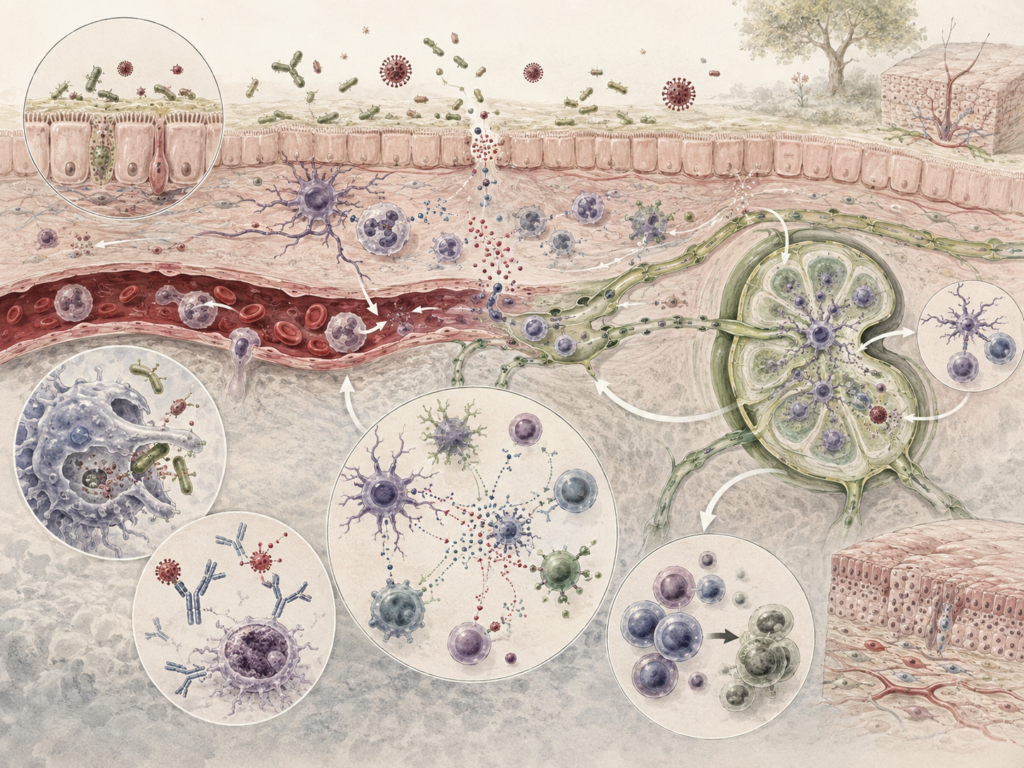
Research-grade immunology illustration showing tissue barriers, epithelial cells, microbes, immune cells, blood vessels, lymphatic pathways, antibodies, antigen recognition, inflammation, and immune defense across biological layers.

Immunology and Biological Defense

Immunology and biological defense examine how living systems detect danger, distinguish self from non-self or altered self, coordinate protective responses against infection and damage, and regulate the fine balance between defense, tolerance, inflammation, and injury. Immunology is central to biology because life persists not only through metabolism, development, and regulation, but also through the capacity to resist invasion, contain damage, remember prior exposure, and preserve internal integrity under continual microbial and environmental challenge. This article explores immunology through the lenses of innate defense, adaptive immunity, inflammation, immune memory, host-pathogen interaction, tolerance, immune dysregulation, and ecological context, while also situating biological defense within wider systems of physiology, microbiology, animal biology, plant biology, disease ecology, evolution, and sustainability-oriented science. It further extends the topic into quantitative and computational biology through feedback models, and population dynamics.
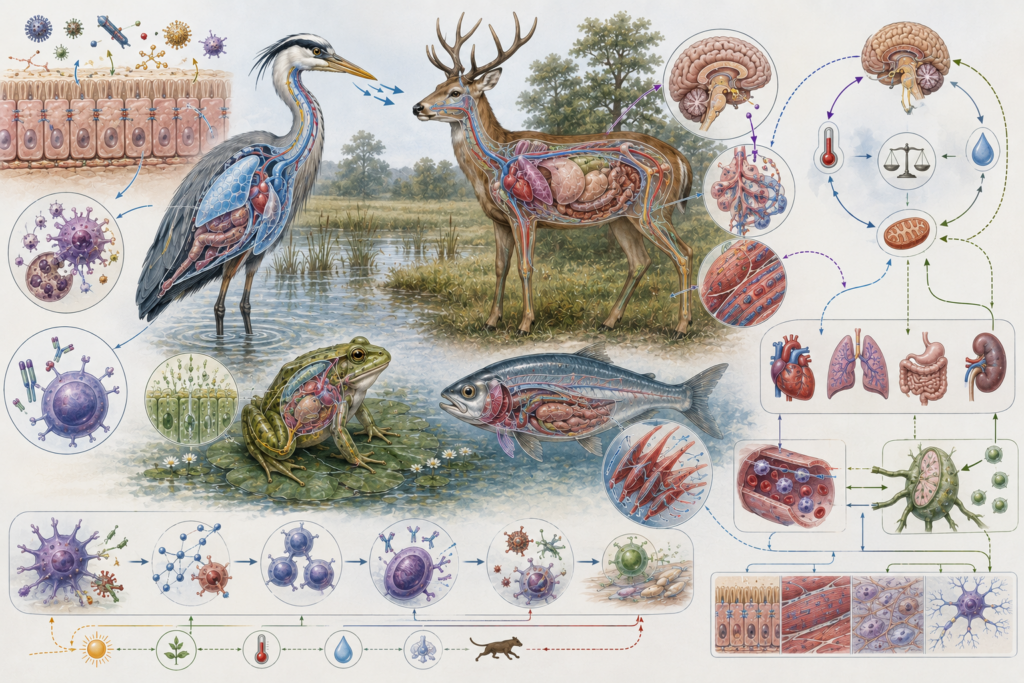
Research-grade systems biology illustration showing animals, tissue layers, organs, cellular pathways, immune signals, neural control, circulation, respiration, metabolism, and feedback loops with minimal text.

Physiology and the Regulation of Living Systems

Physiology and the regulation of living systems examine how organisms maintain functional order through the coordinated control of energy, matter, temperature, water, ions, gases, nutrients, signaling, and internal balance across cells, tissues, organs, and whole organisms. Physiology is central to biology because life does not persist through structure alone. Living systems must regulate themselves continuously in the face of environmental fluctuation, metabolic demand, developmental change, injury, stress, reproduction, and ecological challenge. This article explores physiology through the lenses of homeostasis, feedback, internal regulation, organ-system coordination, metabolic integration, environmental response, and adaptive constraint, while also situating physiology within wider systems of cell biology, development, animal biology, plant biology, microbiology, ecology, disease biology, and Earth-system change.

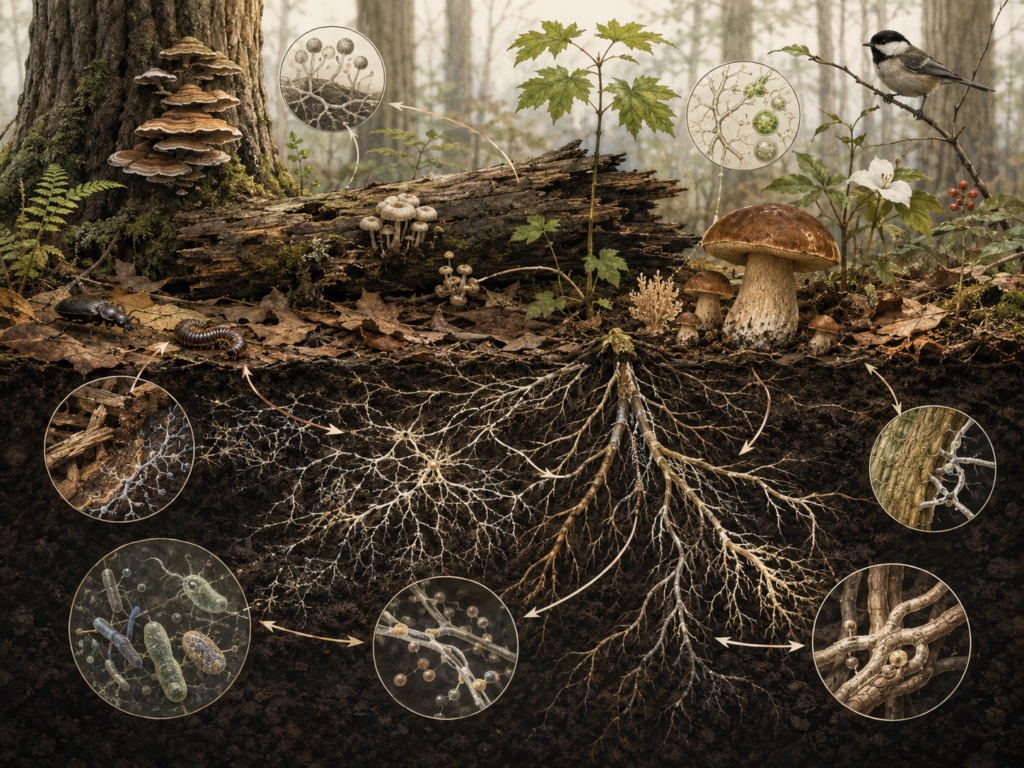
Research-grade systems biology illustration showing forest fungi, mushrooms, decomposing wood, leaf litter, soil organisms, plant roots, mycorrhizal networks, microbial communities, nutrient exchange, and decomposition pathways with minimal text.

Fungi and the Networks of Decomposition and Exchange

Fungi and the networks of decomposition and exchange examine how fungal life breaks down organic matter, redistributes nutrients, forms vast symbiotic networks, shapes soils and ecosystems, and connects living and dead matter through some of the most consequential biological processes on Earth. Fungi are central to biology because they do not merely occupy a narrow kingdom between plants and animals. They are among the principal agents through which organic material is decomposed, nutrients are recycled, soils are structured, symbioses are sustained, and ecological systems remain metabolically active across time. This article explores fungi through the lenses of cell structure, growth form, reproduction, decomposition, mycorrhizal exchange, ecological function, symbiosis, evolution, and environmental significance, while also situating fungal biology within wider systems of soil ecology, plant biology, microbiology, forest dynamics, disease ecology, and Earth-system change.

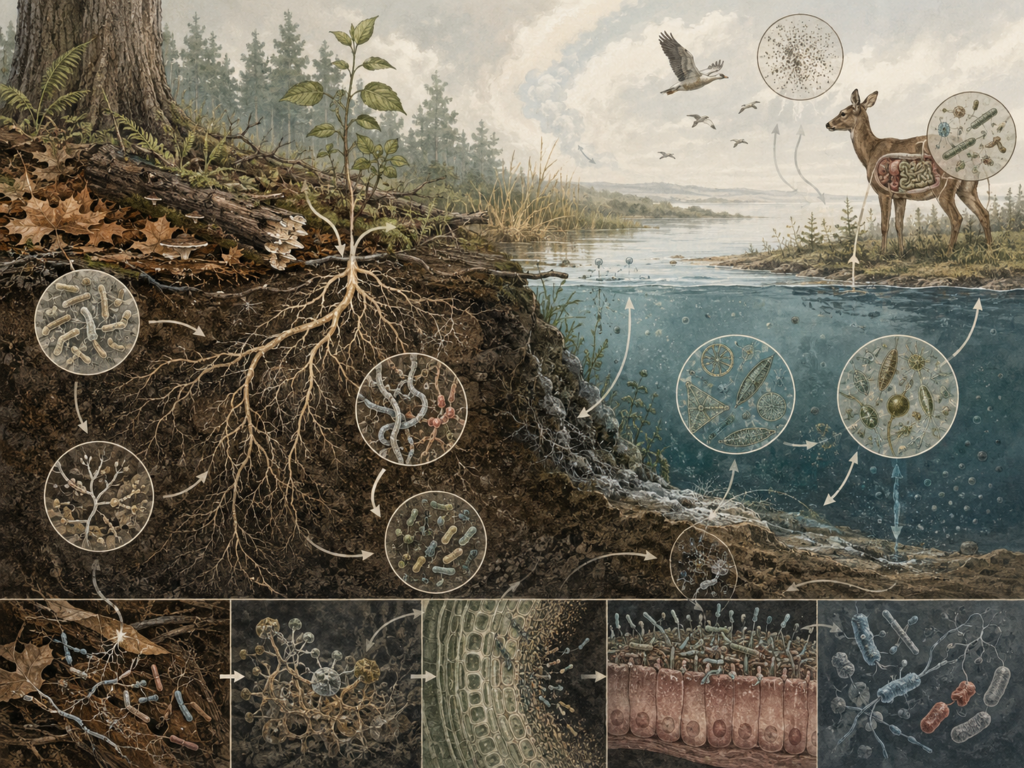
Research-grade systems biology illustration showing microbial life across soil, roots, leaf litter, freshwater, sediments, atmosphere, and animal microbiomes, with subtle microscope-style insets and fine-line ecological pathways.

Microbiology and the Hidden Majority of Life

Microbiology and the hidden majority of life examine the organisms, processes, and unseen systems through which microbes sustain biogeochemical cycles, shape ecosystems, regulate health and disease, drive evolution, and constitute much of the living activity of the biosphere. Microbes are central to biology because most of life’s metabolic diversity, much of its numerical abundance, and many of its deepest evolutionary innovations are microbial. Bacteria, archaea, microscopic eukaryotes, many fungi, and viruses interacting with cellular life all belong to the broader world through which organic matter is decomposed, nutrients are recycled, pathogens emerge, symbioses are sustained, soils are formed, oceans remain productive, and biochemical transformation continues across every major environment on Earth.

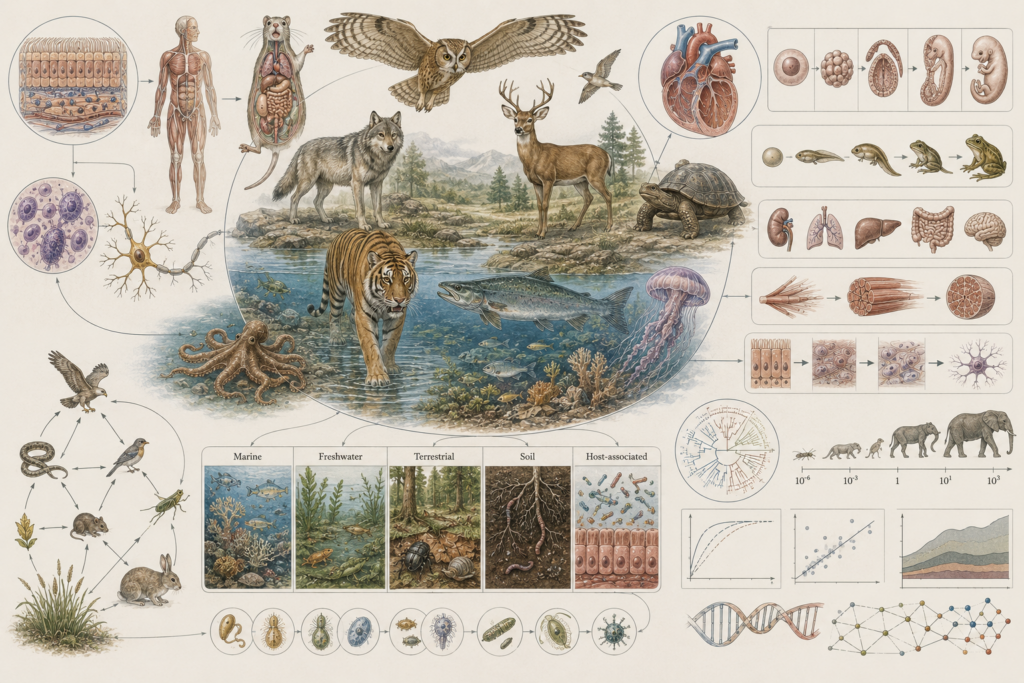
Research-grade systems biology illustration showing diverse animals across terrestrial, freshwater, marine, soil, and host-associated environments, with tissue structures, organ systems, development, food webs, phylogeny, microbiomes, and quantitative modeling elements.

Animal Biology and the Organization of Complex Life

Animal biology and the organization of complex life examine how multicellular heterotrophic organisms build tissues, organs, body plans, sensory systems, and coordinated behaviors through development, physiology, ecology, and evolutionary history. Animals are central to biology because they represent one of the most consequential expressions of multicellular organization: living systems in which specialized cells are integrated into tissues, tissues into organs, and organs into coordinated whole organisms capable of sensation, movement, predation, symbiosis, reproduction, and ecological transformation. This article explores what animals are, how metazoan complexity is organized, how animal form and function emerge through development and evolution, and why animal biology matters across ecology, marine and freshwater systems, disease ecology, conservation, and comparative life science.

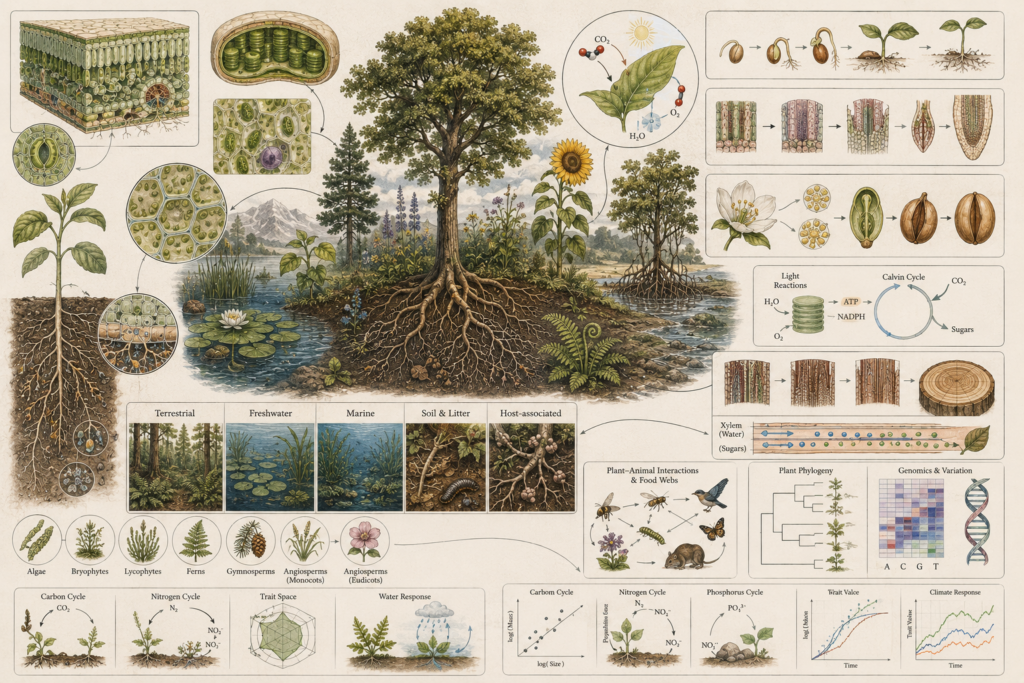
Research-grade botanical systems illustration showing plant life across terrestrial, freshwater, soil, and ecological contexts, with roots, leaves, flowers, seeds, vascular tissues, chloroplasts, photosynthesis, plant development, phylogeny, food webs, and environmental-response diagrams.

Plant Biology and the Life of Primary Producers

Plant biology and the life of primary producers examine how photosynthetic organisms capture energy, fix carbon, build biomass, structure ecosystems, and sustain the trophic, atmospheric, hydrological, and biogeochemical foundations of life on Earth. Plants are central to biology because primary producers do not merely occupy one ecological category among others. They form the energetic and material base upon which most ecosystems depend. Through photosynthesis, primary producers convert light energy, carbon dioxide, water, and mineral nutrients into organic matter that supports food webs, drives carbon cycling, influences climate, shapes soils, regulates water exchange, and creates the living architecture of terrestrial and many aquatic systems.

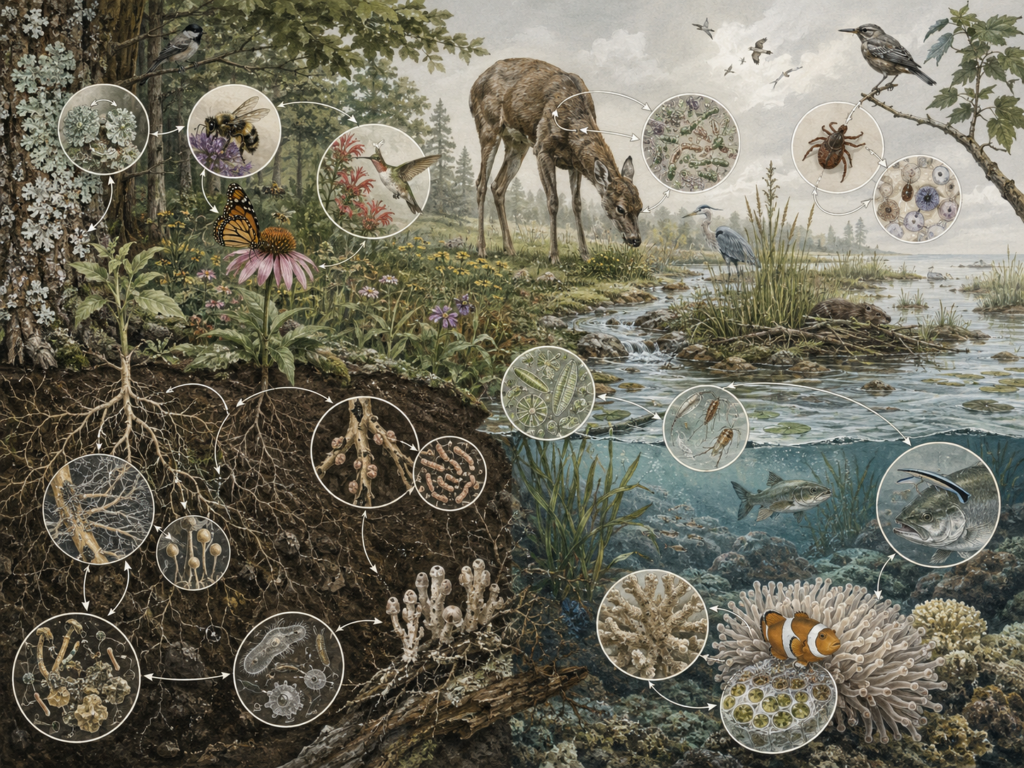
Research-grade ecological systems illustration showing plants, pollinators, lichens, mycorrhizal roots, microbes, parasites, host animals, aquatic organisms, coral, algae, fish, and subtle interaction pathways across terrestrial, freshwater, and marine habitats.

Coevolution, Symbiosis, and the Dynamics of Mutual Change

Coevolution, symbiosis, and the dynamics of mutual change examine how species reciprocally shape one another’s evolutionary trajectories, how long-term biological associations generate cooperation, conflict, dependence, and innovation, and how mutual change reorganizes organisms, ecosystems, and the history of life. Coevolution is central to biology because species do not evolve in isolation. Predators and prey, hosts and pathogens, plants and pollinators, corals and symbionts, roots and fungi, animals and microbes, and many other partners alter one another’s selective environments across time. Symbiosis matters because close biological association can range from mutual benefit to commensalism to parasitism, and because these relationships often become major drivers of development, physiology, ecology, and evolutionary transformation. This article explores coevolution as reciprocal evolutionary influence, symbiosis as intimate interspecies association, and mutual change as a dynamic process that can produce adaptation, escalation, stabilization, integration, and dependence. It also extends the topic into quantitative and computational biology through frequency change, interaction dynamics, and host-symbiont logic.

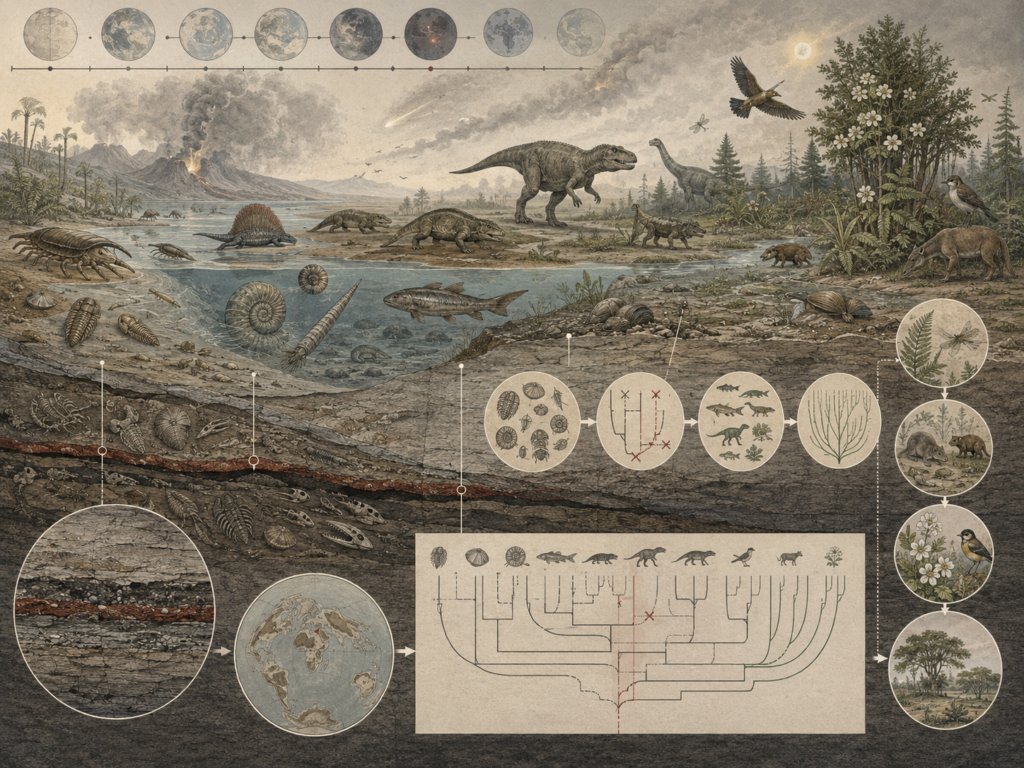
Research-grade evolutionary systems illustration showing deep time, fossil layers, ancient marine life, dinosaurs, extinction events, geological strata, phylogenetic branching, ecological recovery, and biological transformation across Earth history.

Extinction, Contingency, and Biological Transformation

Extinction, contingency, and biological transformation examine how the loss of lineages reshapes the history of life, how chance and historical sequence influence evolutionary outcomes, and how biological systems are repeatedly transformed through crises, survivals, radiations, and altered ecological possibility. Extinction is one of the central processes in biology because the history of life has been shaped not only by adaptation, diversification, and persistence, but also by disappearance, interruption, and irreversible loss. Contingency matters because evolutionary history is not fully predetermined: which lineages survive, which innovations spread, and which worlds become biologically possible often depend on prior accidents, timing, environmental shocks, and the uneven structure of inheritance across populations and clades. This article explores extinction as both background process and mass event, contingency as the historical dependence of outcomes on prior pathways and chance disruptions, and biological transformation as the reorganization of ecosystems, lineages, body plans, and evolutionary opportunities across deep time.

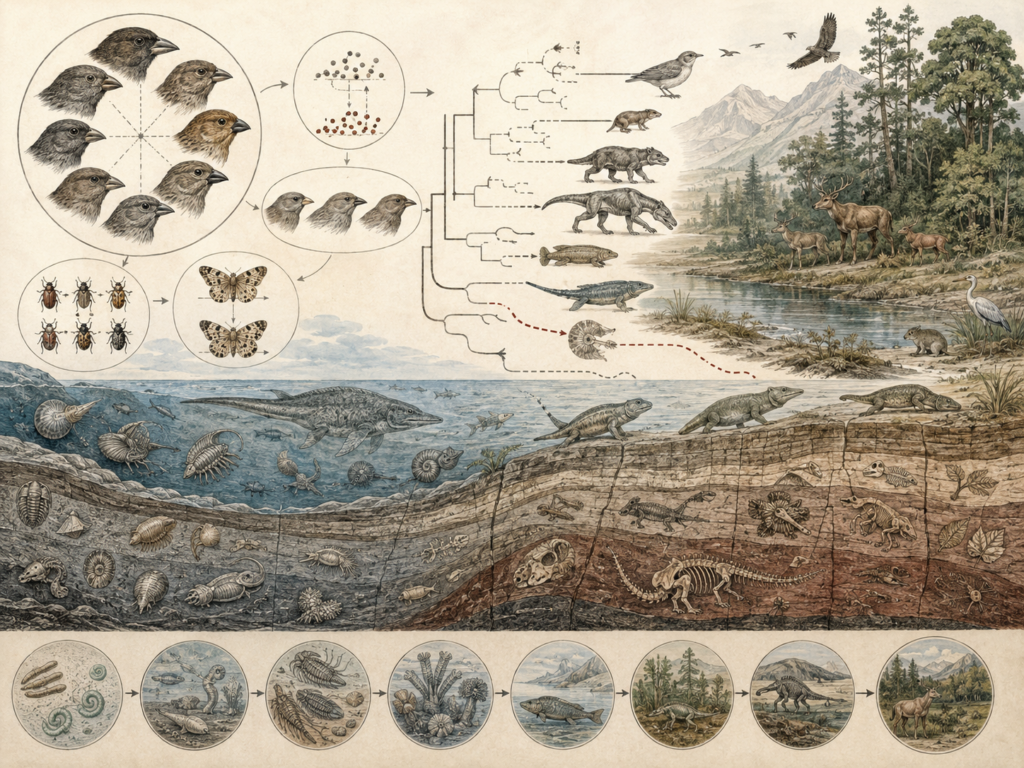
Research-grade evolutionary biology illustration showing variation within populations, inheritance, selection, phylogenetic branching, fossil strata, ancient marine life, extinct vertebrates, modern ecosystems, and biological change across deep time.

Microevolution, Macroevolution, and Deep Time

Microevolution, macroevolution, and deep time examine how small-scale genetic changes within populations connect to large-scale evolutionary patterns across species, lineages, and the vast history of life on Earth. Evolution is not divided into separate worlds of “small” and “large” change so much as expressed across different scales of time, evidence, and biological organization. This article explores microevolution as change in allele frequencies within populations, macroevolution as the large-scale pattern of diversification, extinction, stability, and innovation across the tree of life, and deep time as the geological and historical framework required to understand how these processes unfold. It also shows how fossils, comparative biology, genomics, and phylogenetic reasoning allow scientists to connect short-term population change with long-term evolutionary history. Finally, it extends the topic into quantitative and computational biology through allele-frequency models, branching logic, evolutionary rates, and R- and Python-based workflows, while connecting the subject to sustainability-adjacent fields such as ecology, conservation biology, restoration ecology, evolutionary biology, marine biology, freshwater biology, plant science, soil biology, microbiology, agroecology, forestry, disease ecology, and systems biology.

Scroll to Top