
Last Updated May 5, 2026
Fox spirits occupy a singular place in Chinese folklore because they concentrate several of the tradition’s deepest and most unstable themes into a single figure: transformation, seduction, intelligence, age, spiritual cultivation, deception, beauty, danger, sympathy, and ambiguity. Unlike creatures whose symbolic meaning remains comparatively stable, the fox spirit resists moral simplification. It may be malign or benevolent, predatory or affectionate, socially disruptive or ethically refined, grotesque or enchanting, comic or tragic. In Chinese tradition, the fox is not merely an animal that becomes supernatural. It is a being through which the boundaries between human and nonhuman, desire and danger, illusion and intimacy, are repeatedly tested.
The fox spirit matters because it does not remain safely outside the human world. It enters the household, the study, the bedchamber, the marketplace, the graveyard, the shrine, the dream, and the story. It may appear as a beautiful woman, a cultivated scholar, a neighboring family, a lover, a deity, a trickster, an illness-causing presence, or a morally complex companion. Its power lies in proximity. The fox does not simply terrify from the wilderness. It becomes close enough to be desired, trusted, suspected, loved, worshipped, or feared.
Series context: This article is part of the Chinese Myth, Folklore & Legend knowledge series. For the broader category structure, return to the Mythology category.
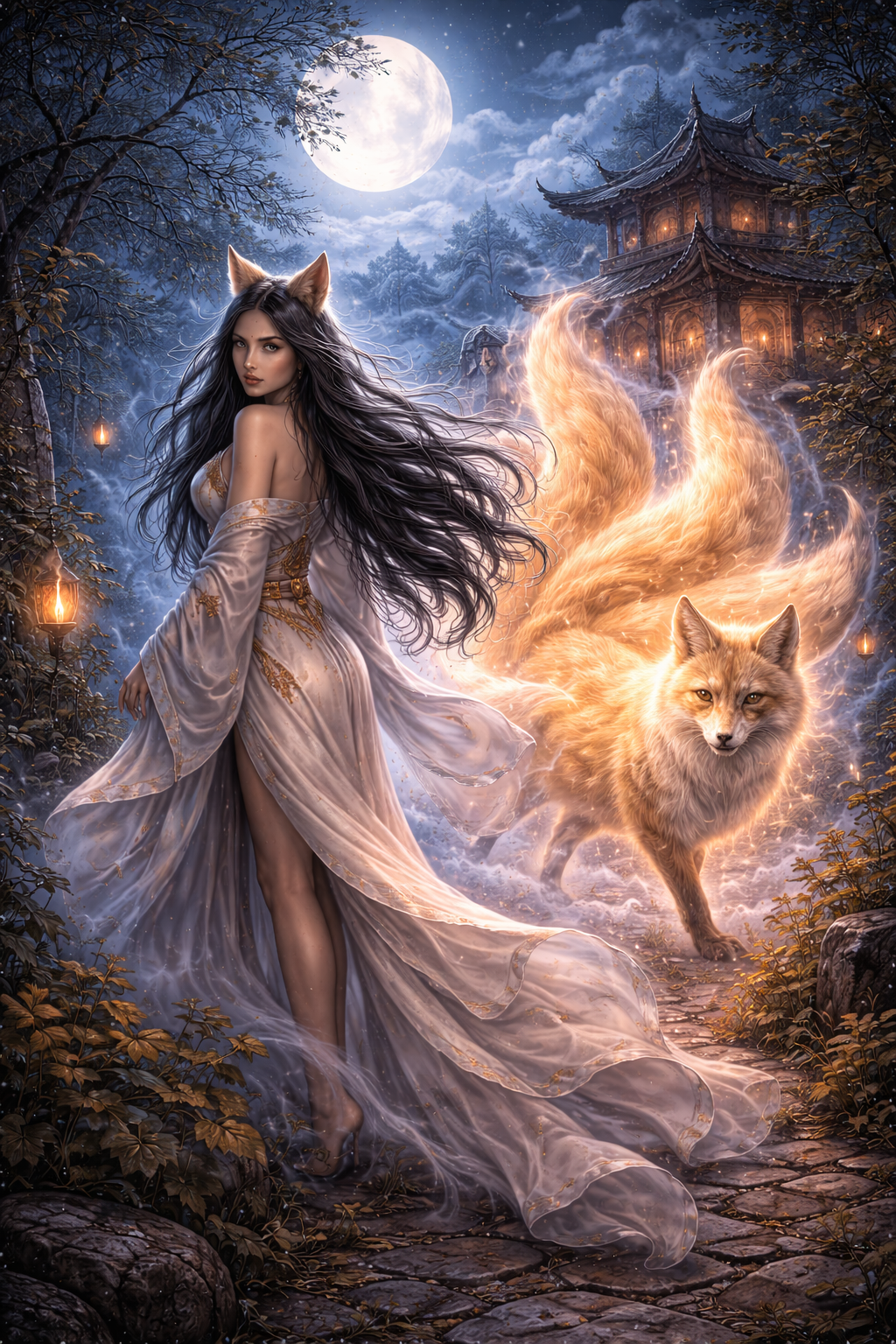
The transmitted archive does not preserve one single fox-spirit doctrine. It preserves a long history of transformation. Early texts associate aged foxes with metamorphosis and uncanny power. The Soushen ji preserves the striking claim that a fox a thousand years old may arise as a beautiful woman. Medieval and early modern anecdotal and strange-tale traditions develop this further, presenting foxes as scholars, lovers, courtesans, wives, tricksters, household presences, spirit-cult recipients, and morally complex supernatural companions. Later literary works such as Liaozhai zhiyi refine the figure still further, often giving fox spirits intelligence, emotional depth, wit, and even ethical superiority to the humans they encounter. Fox folklore in China is therefore not merely a story of demonization. It is a sustained meditation on ambiguity itself.
This article treats the fox spirit as a layered figure rather than a single creature type. The fox belongs to animal transformation, ghost literature, erotic tale, household religion, anomaly account, Daoist cultivation, spirit possession, gendered fantasy, moral critique, and popular belief. Its instability is not a flaw in the tradition. It is the reason the figure survived. The fox spirit is powerful because it cannot be fully reduced to monster, lover, demon, deity, animal, woman, scholar, trickster, or victim. It moves among all of them.
Why Fox Spirits Matter
Fox spirits matter because they embody uncertainty in one of its most culturally productive forms. They are not simply monsters to be defeated, nor merely sacred beings to be revered. They are interpretable presences whose meaning changes with context. The fox spirit may deceive the unwary, drain vitality, unsettle households, and blur the distinction between the lawful and the illicit. Yet it may also reward kindness, expose human vanity, cultivate learning, remain faithful in love, or reveal that the supposedly civilized world of human beings is morally cruder than the supernatural one that haunts it.
This instability is precisely what gives the fox spirit its enduring power. Many mythic beings symbolize one dominant value. The fox spirit symbolizes the difficulty of assigning value with certainty. It is a figure through which Chinese folklore explores the fact that beauty may conceal danger, but also that danger may conceal intelligence, longing, vulnerability, or virtue. The fox spirit is not reducible to a single lesson. It is a field of interpretive tension.
The fox also matters because it stands very near the human world. Dragons may belong to storm and imperial sovereignty; phoenixes and qilin may signify auspicious order; Xiwangmu may preside over a western paradise; underworld judges may sit in infernal courts. The fox, by contrast, may appear in the next room. It may knock on the door, share a bed, borrow a book, pour wine, play music, advise a scholar, deceive a household, or receive offerings at a local shrine. Its supernatural power is intimate.
That intimacy makes the fox one of the most psychologically complex beings in Chinese folklore. It does not only ask what lies beyond humanity. It asks how stable humanity itself is. If an animal can appear human, speak elegantly, desire intensely, cultivate spirit power, and behave with moral refinement, then “human” is no longer a simple category. The fox spirit forces recognition to become uncertain.
Age, Transformation, and the Power of the Fox
One of the most persistent ideas in Chinese fox lore is that age brings supernatural capacity. The fox does not become extraordinary merely by existing. It becomes extraordinary through duration, cultivation, and accumulated potency. Older foxes acquire greater powers of transformation, foresight, seduction, and deception. This association between longevity and metamorphic ability places the fox within a broader Chinese pattern in which age may confer not only wisdom, but ontological instability. A being that lives long enough may cross the limits assigned to its kind.
This concept is important because it links fox spirits to wider Chinese ideas of transformation already visible in early discussions of animals that change form over time. The fox becomes one of the most memorable expressions of this worldview. It is not simply magical in an arbitrary sense. Its powers are connected to duration, concentration, and the slow crossing of natural thresholds. Transformation is thus not only sudden enchantment. It is the result of accumulated existence.
In this respect, fox lore shares a conceptual field with Daoist immortality and animal-transformation traditions. Long life changes the being. A turtle may become wise; a snake may regenerate; a fox may become human-like; an adept may cultivate transcendence. The boundary between ordinary nature and supernatural nature is crossed not only by divine intervention, but by time itself. Duration becomes a force of metamorphosis.
The fox’s age also gives it authority and danger. A young animal is merely an animal; an old fox is no longer securely contained by animality. It has watched, learned, cultivated, absorbed, and endured. It has become strange through survival. Chinese fox lore therefore turns longevity into a source of both wonder and suspicion. The old fox knows too much.
Early Textual Foundations
The early textual archive preserves several foundational ideas about fox transformation. In the Soushen ji, one of the most frequently cited statements declares that a fox a thousand years old may arise as a beautiful woman. This formula is crucial because it establishes several enduring features of later fox lore at once: great age, metamorphosis, feminine embodiment, and erotic-social nearness to the human world. The fox does not become a dragon, a mountain, or a distant god. It becomes a woman. The locus of the uncanny is therefore intimate.
Primary Source
千歲之狐,起為美女。A fox a thousand years old rises and becomes a beautiful woman.Soushen ji 搜神記, Volume 12. Available at: https://ctext.org/wiki.pl?chapter=533261&if=en&remap=gb
This compact statement gives later fox-spirit tradition one of its central formulas: longevity produces transformation, and transformation brings the fox into intimate human form.
The surrounding passage in the Soushen ji places fox transformation within a wider theory of metamorphosis. It speaks of qi, animals changing form, seasonal transformation, and beings whose long duration carries them into extraordinary states. The fox is therefore not an isolated superstition. It belongs to a broader early medieval imagination in which the forms of beings are unstable under the pressure of time, qi, environment, and cosmic process.
Other transmitted materials expand the field of possibility. Some texts suggest that aged foxes gain predictive or uncanny powers; others preserve anecdotal accounts of foxes assuming scholarly or human form. Already by the medieval period, the fox was not simply a beast with strange capacities. It had become one of the most important boundary-crossing figures in the Chinese supernatural archive.
This early foundation matters because it prevents a narrow reading of the fox spirit as only a later erotic demon. Desire becomes important, but the older logic is transformation. The fox enters human form because Chinese supernatural thought already imagined beings as capable of crossing categories when their internal potency had ripened enough.
Foxes Becoming Human
The fox’s most famous power is metamorphosis into human form, and this power is central to its cultural meaning. A fox that can become human destabilizes confidence in appearances. It enters society not as an obvious invader, but as a participant. It may converse, flirt, marry, study, dine, dwell, write, teach, seduce, joke, negotiate, or pray. The threat or wonder of the fox spirit lies precisely here: it does not remain out in the wild. It enters the human social field and becomes difficult to distinguish from the people already there.
This metamorphic ability is also philosophically revealing. It suggests that form is not the ultimate guarantee of identity. Human appearance does not necessarily mean human nature, and nonhuman origin does not necessarily preclude refined feeling or cultivated intelligence. Fox stories repeatedly return to this problem. Who is truly human: the fox in female form, or the man whose desire, greed, cruelty, cowardice, or hypocrisy reveals moral coarseness? Transformation is therefore not only physical. It becomes an ethical test of recognition.
The fox’s human form also creates social risk. If the fox can enter ordinary society, then social categories become porous. A guest may not be what he seems. A lover may not be human. A scholar may be a fox. A neighbor may be a spirit household. An illness may have relational or supernatural causes. A woman’s beauty may be a mask, but a human man’s virtue may also be a mask. Fox transformation turns ordinary social reading into an uncertain art.
This is why fox stories are so often stories of discovery. The narrative turns on recognition: when will the human realize what kind of being has entered the room? But recognition does not always solve the moral problem. Some foxes deserve expulsion; others deserve gratitude. Some humans are victims; others are fools. Some transformations deceive; others reveal. The fox becomes human in order to show that humanity itself is not always morally secure.
Beauty, Seduction, and the Danger of Desire
Many fox spirit narratives emphasize beauty, seduction, and erotic danger. The fox often appears as a beautiful woman who entrances scholars, officials, or solitary men. In some traditions, such encounters are dangerous because the fox drains vitality, manipulates desire, disrupts study, breaks household order, or leads the man away from ordinary responsibilities. Here the fox spirit becomes a cautionary figure through which lust, fantasy, and loss of self-command are dramatized. The danger is not only the fox. It is the human susceptibility that makes fox enchantment possible.
Yet even within this familiar pattern, Chinese fox lore is rarely simple. Seduction does not always lead to ruin, and beauty does not always conceal malice. Some fox women in later literature are loyal, witty, emotionally serious, and capable of genuine attachment. The figure therefore exceeds the stereotype of the demonic temptress. Fox beauty may signify peril, but it may also mark the human world’s incapacity to distinguish desire from moral judgment.
The fox-woman is powerful because she reflects desire back to the desirer. The man who blames the fox for seduction may be exposed as vain, greedy, lonely, hypocritical, or emotionally shallow. In many stories, the fox does not create desire from nothing. It reveals what was already present. The supernatural encounter becomes a mirror of human weakness.
At the same time, the erotic fox can become a figure of sympathy. Some fox women love sincerely, protect lovers, challenge corrupt social expectations, or show more constancy than human spouses. The same motif that can express anxiety about female sexuality can also critique the narrowness of human moral judgment. The fox spirit remains dangerous because she is not easily contained by either condemnation or praise.
The Fox Spirit as Scholar, Stranger, and Social Being
Fox spirits are not always female, nor are they always eroticized. Some transmitted anecdotes describe foxes transforming into scholars or cultivated men who enter human society in refined guise. This variant is significant because it widens the fox’s symbolic range. The fox is not only an object of masculine desire. It is also a rival intelligence, a social actor, a conversational equal, and a stranger whose manner may be more polished than that of the humans around him.
This social refinement becomes especially important in later literary tradition. Fox spirits may appear as landlords, companions, literati, guests, neighbors, teachers, merchants, or household presences. They belong to the margins of ordinary society, but they are not outside culture. Their entry into scholarly and social roles allows folklore to test the very criteria by which civilized identity is judged. Learning, taste, eloquence, and emotional tact may belong to foxes as much as to men.
The scholar-fox is also a subtle challenge to literati self-confidence. If a fox can perform refinement, quote texts, drink wine, compose verse, debate morality, and judge human conduct, then culture is no longer the exclusive possession of human elites. The fox becomes an outsider who masters the signs of insider status. That mastery can be comic, unsettling, or critical.
The strangerliness of fox spirits is therefore social as well as ontological. They often know how to behave among humans, but they do not belong fully to human society. They can imitate its manners, expose its pretensions, and exploit its weaknesses. The fox as social being shows that civilization itself can be performed—and therefore unmasked.
Malevolent, Benign, and Morally Ambiguous Foxes
The moral range of fox spirits is unusually broad. Some are clearly harmful. They deceive, exhaust vitality, disturb households, possess bodies, manipulate desire, or act with deliberate malice. Others are benevolent or at least companionable. They may protect, repay kindness, show loyalty, teach hidden knowledge, cure illness, or reveal admirable character. Many of the most memorable fox spirits are neither wholly evil nor wholly good. They act from mixed motives, shifting loyalties, emotional complexity, and situational ethics.
This breadth is one reason fox lore remained so fertile in Chinese storytelling. The fox spirit is one of the rare supernatural figures capable of carrying serious moral ambiguity without collapsing into incoherence. It can function as demon, lover, trickster, cultivated companion, object of worship, household guardian, disease-causing presence, or nearly tragic outsider. Rather than stabilizing the moral world, fox stories often unsettle it, showing that the categories by which people sort others are themselves unreliable.
Fox ambiguity also allows stories to judge humans indirectly. A malevolent fox may expose the cost of uncontrolled desire. A benevolent fox may expose human ingratitude. A faithful fox may shame a faithless man. A deceptive fox may reveal that human society is already built on deception. A cultivated fox may show that refinement is not the same as virtue. The fox becomes a narrative instrument for distinguishing appearance from moral substance.
This moral instability makes fox stories unusually modern in feel. They resist the comfort of fixed categories. They ask readers to interpret carefully, to attend to context, and to recognize that danger and sympathy may inhabit the same figure. The fox spirit survives because it keeps judgment open.
Fox Cults, Household Presence, and Popular Religion
Fox spirits were not only literary figures. They were also objects of popular reverence, fear, and local cult. Historical evidence shows that fox worship could emerge in Chinese religious life, sometimes around specific legendary foxes or around broader beliefs in fox powers. Such cultic presence is significant because it confirms that foxes were not imagined only as abstract symbols. They were treated as active presences whose favor might be sought, whose anger might be feared, and whose powers might affect the domestic and social environment.
This popular religious dimension helps explain the persistence of the fox spirit across centuries. A being that can be narrated in stories, blamed for disturbances, suspected in uncanny events, and worshipped at shrines has a far wider cultural life than one confined to canonical myth. The fox becomes part of household imagination, local religion, and everyday unease. It is close enough to touch daily life, yet strange enough to remain fundamentally unstable.
Fox cults also reveal a different side of the figure. A being feared as a seducer or deceiver in one context may be approached as a patron or protector in another. This is not contradiction but relational logic. Spirits are dangerous when angered, neglected, or mismanaged; they may be helpful when honored, fed, or properly addressed. The fox’s moral ambiguity makes it especially suitable for such cultic negotiation.
Household fox belief also makes the supernatural domestic. The fox is not only in the mountains or graveyards. It may be in the walls, under the floor, near the stove, around ancestral spaces, or attached to family fortune. This domestic nearness gives fox lore its distinctive tension. The wild enters the house, but it does so in forms that can become almost familiar.
Foxes, Illness, and Spirit Affliction
Fox spirits are often associated with disturbance, affliction, and unexplained bodily or household disorder. A person may become ill, exhausted, obsessed, unlucky, or sexually depleted because of fox interference. A household may experience strange noises, dreams, apparitions, possessions, quarrels, or misfortune attributed to foxes. In such cases, the fox becomes not only a narrative character but an explanatory force for disruption that is felt before it is understood.
This affliction pattern is important because it connects fox lore to the wider Chinese religious management of spirits. If a problem is caused by a fox, it requires diagnosis and response. Offerings, expulsion, talismans, Daoist rites, Buddhist chanting, household purification, negotiation, or local ritual specialists may be called upon. The fox is therefore part of a practical supernatural ecology: it helps explain why something has gone wrong and what kind of ritual action may be needed.
Fox affliction also reveals anxiety about boundaries. The body’s boundary may be crossed through possession, sexual depletion, illness, dream invasion, or emotional obsession. The household boundary may be crossed through haunting or disturbance. The social boundary may be crossed when a fox appears as a person. Fox danger often lies in this capacity to enter where it should not.
At the same time, the afflicting fox may not be pure evil. It may be angry because of disrespect, displacement, neglected offerings, broken promises, or the destruction of its dwelling. In such cases, illness becomes relational. The cure is not only forceful expulsion, but restored balance. The fox disturbs because a relationship between human and spirit world has become misaligned.
Liaozhai and the Literary Deepening of the Fox Spirit
The fox spirit reaches one of its most sophisticated literary forms in Pu Songling’s Liaozhai zhiyi, commonly known as Strange Tales from a Chinese Studio. There the fox is often no longer a crude supernatural intruder. It becomes emotionally nuanced, verbally agile, and ethically complex. Fox women in particular may be affectionate, loyal, ironic, intelligent, or morally lucid. In many tales, the fox is more fully realized than the human protagonist and sometimes more admirable. The supernatural no longer merely threatens the social order; it exposes the limitations of the supposedly normal world.
This literary deepening matters enormously. It shows that fox lore was capable of becoming a vehicle for psychological subtlety and social criticism. Through the fox spirit, the strange tale could interrogate gender norms, scholarly pretension, bureaucratic hypocrisy, examination failure, emotional incapacity, erotic repression, and the boundaries of orthodoxy. The fox spirit thus becomes one of the great instruments of Chinese narrative ambiguity.
Liaozhai is especially important because it gathers ghosts, fox-fairies, flower spirits, demons, scholars, poor intellectuals, corrupt officials, and vulnerable women into one literary universe. The fox spirit participates in a broader world of the strange where moral reality is often clearer in supernatural form than in ordinary society. The fox is strange, but human society may be stranger still.
Pu Songling’s foxes often turn the expected hierarchy upside down. The human scholar may be foolish; the fox woman may be wise. The official may be corrupt; the spirit may be just. The supposedly proper household may be morally empty; the supernatural encounter may contain genuine feeling. In this literary world, the fox spirit is not only an object of fear. It is a critic of human failure.
Fox Women and the Politics of Voice
Fox women are among the most important female-coded figures in Chinese supernatural literature because they gather together desire, fear, agency, beauty, suspicion, and speech. They are often imagined through male anxieties about seduction and loss of control, but many stories also give them intelligence, wit, loyalty, judgment, and emotional depth. This makes the fox woman an ambivalent figure for reading gender. She may reinforce stereotypes of dangerous femininity, yet she may also expose the narrowness of those stereotypes.
The fox woman often speaks more freely than ordinary women could. Because she is not fully human, she can stand partly outside human social constraints. She can mock, advise, seduce, rebuke, negotiate, depart, or return. Her supernatural status gives her narrative room to act. This does not make her automatically emancipatory, but it does make her one of the richest figures through which Chinese literature explored female agency under constraint.
The politics of voice are especially important in later literary traditions. A fox woman may reveal truths that respectable society refuses. She may criticize male weakness, expose hypocrisy, or demonstrate a fidelity lacking among humans. In such stories, nonhuman identity becomes a vehicle for moral clarity. The figure marginalized as animal or spirit may become the clearest speaker in the narrative.
At the same time, the fox woman remains vulnerable to demonization. Her beauty may be used to blame her for male desire. Her intelligence may be treated as cunning. Her independence may be read as danger. This tension is central to her power. She reveals both the possibilities and the limits of female-coded supernatural agency in traditional narrative worlds.
Gender, Identity, and the Problem of Boundaries
Fox spirits are closely tied to questions of gender because their most famous transformations involve crossing into idealized or destabilizing human femininity. Yet fox lore is not simply a repository of male fantasy or anxiety. It also reveals how unstable gendered appearances can be. The fox spirit may perform femininity with extraordinary skill, but in doing so it exposes femininity itself as socially read, desired, feared, and constructed. The supernatural woman becomes the site at which human assumptions about women are rendered visible and contestable.
At the same time, fox stories involving male forms or socially fluid presentations remind us that fox transformation is not reducible to one gender script. The deeper issue is identity as performance and concealment. The fox spirit matters because it inhabits the instability of all fixed categories: animal and human, male and female, sincerity and disguise, nature and culture, desire and danger, social refinement and predation.
Fox transformation also shows that identity in these stories is relational. A fox becomes “woman,” “scholar,” “wife,” “lover,” “guest,” or “deity” through interaction with human recognition. The disguise works only because others read it. Human society becomes complicit in the transformation because it supplies the categories the fox performs. This makes the fox a powerful figure for thinking about identity as something socially produced as well as inwardly held.
The fox’s gender instability also links it to broader themes in Chinese supernatural narrative, including ghost women, snake women, transformed animals, immortals who cross social norms, and spirits who appear in seductive or ambiguous form. The fox is one of the most concentrated examples of a larger truth: the supernatural often enters literature where ordinary categories become unreliable.
Foxes, Ghosts, and the Overlapping World of the Strange
Fox spirits often appear alongside ghosts, revenants, demons, immortals, and other strange beings. In later literary worlds, especially Liaozhai, these categories may remain distinct but emotionally and narratively overlap. Ghosts return from death; foxes cross from animality into human form; demons deceive; immortals transform; spirits intervene. All belong to a wider field of anomaly in which the visible world cannot fully account for experience.
This overlap matters because fox spirits often perform functions similar to ghosts. Like ghosts, they may enter erotic relations with humans. Like revenants, they may expose moral failure. Like hungry spirits, they may be linked to desire and deprivation. Like household gods, they may be propitiated. Like demons, they may afflict. The fox is not identical with any of these beings, but it moves through their narrative space.
The shared world of the strange also explains why fox stories can shift tone so easily. A fox tale may begin as seduction, turn into moral comedy, become a possession case, reveal a karmic lesson, or end as tragic romance. The fox is adaptable because the category of the strange is itself broad. It allows beings to cross literary and religious functions.
This porousness is central to Chinese supernatural culture. The point is not always to classify a being once and for all. The point is to interpret what its appearance does. Does it expose desire? Demand ritual? Reveal injustice? Test recognition? Afflict a household? Offer love? Teach humility? The fox spirit is defined by function as much as origin.
Fox Spirits and Daoist Cultivation
Fox spirits are also tied to ideas of cultivation. Their powers often develop through age, concentration, and the accumulation of subtle potency. This resembles, in folkloric form, broader Daoist concerns with longevity, transformation, bodily refinement, and the crossing of ordinary limits. The fox becomes a nonhuman practitioner of sorts: not a Daoist adept in formal human lineage, but a being whose long cultivation allows it to transcend ordinary animal form.
This connection is important because it makes the fox more than a random shapeshifter. Its transformation is often imagined as achieved, not merely given. The fox cultivates power through time, hidden practice, breath, moonlight, skull rituals, or other motifs preserved in later lore. The details vary, but the pattern remains: the fox changes because it has gathered force.
Such cultivation also makes the fox morally ambiguous. Cultivation produces power, but power is not the same as virtue. A fox may become refined without becoming good. It may become beautiful without becoming trustworthy. It may acquire human form without human responsibility. This tension parallels broader Chinese concerns about technique without moral discipline. Transformation alone is not salvation.
Yet some fox spirits do become ethically refined. They repay kindness, honor promises, protect households, or behave with loyalty. In these cases, fox cultivation becomes more than technical skill. It approaches moral development. The best fox stories keep both possibilities alive: cultivation may produce danger, but it may also produce unexpected virtue.
Skepticism, Fear, and Cultural Familiarity
Fox spirits inspired fear, but also familiarity. In some periods they were imagined as common enough that households might treat fox disturbances as part of ordinary life. This familiarity is culturally revealing. The fox spirit is uncanny, yet not wholly alien. It belongs to the atmosphere of Chinese supernatural culture in a way that makes it both exceptional and domestically imaginable. One fears the fox, but one also expects it.
Skepticism, likewise, played an important role. Not everyone accepted every fox report at face value. The very frequency of fox explanation invited doubt, reinterpretation, and mockery. Some writers questioned excessive credulity, while others used fox stories precisely because audiences knew the conventions well enough to see them transformed. Skepticism did not erase the figure. It became part of the fox spirit’s history.
This tension between belief and doubt is essential. Fox spirits were culturally powerful not only because people believed in them, but because they provided a language for discussing ambiguity. A fox explanation might be literal, symbolic, comic, skeptical, or literary depending on context. The figure organized fear, desire, illness, household unease, sexual anxiety, and narrative invention all at once.
For modern readers, this means fox stories should not be reduced either to naive belief or to mere fiction. They were part of a shared cultural repertoire. Whether believed, doubted, ritualized, or artistically refined, the fox spirit remained useful because it made unstable experience narratable.
Source History and Interpretive Caution
A careful treatment of fox spirits must distinguish among several layers of tradition: early discussions of animal transformation; medieval anecdotal materials; fox cult practices; household spirit beliefs; Daoist-inflected cultivation motifs; strange-tale collections; and later literary refinements such as Liaozhai zhiyi. These layers do not always present the fox in the same way. The fox may be omen, demon, seductress, scholar, deity, household afflicter, cultivated companion, or morally complex outsider depending on genre and period.
These differences should not be flattened into one timeless “fox spirit” essence. They are the history of the figure. The fox spirit remained culturally powerful precisely because it could move across such different contexts without losing its core associations with transformation, intelligence, proximity to humanity, and moral uncertainty. The fox is not stable, and that instability is the point.
Translation also requires caution. English phrases such as “fox spirit,” “fox fairy,” “demon fox,” “vixen,” or “kitsune” carry different cultural associations. Japanese kitsune, Korean fox traditions, and Chinese huli jing or fox-spirit traditions belong to related East Asian families of fox lore, but they should not be collapsed into one identical figure. Chinese fox lore has its own textual history, cultic associations, and literary development.
Gender must also be read carefully. Many fox stories reflect male anxieties about desire and female sexuality, but others give fox women moral intelligence and narrative agency. Some tales demonize the fox; others use her to expose human cruelty. A serious interpretation should preserve both sides: the fox spirit is a vehicle of patriarchal fear, but also a medium through which suppressed voices, marginal figures, and nonhuman intelligence can unsettle human authority.
Finally, source genre matters. A brief anomaly note, a temple cult, a Daoist exorcistic context, a late-imperial short story, and a modern scholarly article do not all mean the same thing. The fox spirit changes as it moves from report to ritual, from household suspicion to literary art, from local cult to global mythology. The best reading follows the movement rather than forcing premature unity.
Why Fox Spirits Still Matter
Fox spirits still matter because they preserve one of the most sophisticated supernatural figures in Chinese folklore: a being who cannot be understood without confronting ambiguity itself. They reveal that folklore is not only a vehicle for simple moral binaries. It is also a medium for exploring unstable identities, compromised desires, mixed motives, social performances, hidden intelligence, and the uneasy intimacy between the human and the other-than-human.
They also matter because the fox spirit remains one of the clearest examples of how Chinese tradition transforms the strange into social drama. The fox does not merely haunt the margins. It enters the house, the bedchamber, the study, the conversation, the shrine, the illness, and the imagination. Under its sign, transformation becomes personal, and ambiguity becomes unforgettable.
Fox spirits matter, too, because they give voice to marginal and nonhuman perspectives. They show that the human world may not own intelligence, refinement, loyalty, desire, or moral judgment. A fox may deceive, but a human may be more corrupt. A fox may seduce, but a human may be more predatory. A fox may be nonhuman, yet more emotionally honest than those who condemn her. The figure turns hierarchy into a question.
Finally, the fox spirit matters because it remains culturally alive. It continues to appear in literature, opera, film, television, animation, games, and contemporary fantasy because its symbolic structure remains powerful: beauty that may be dangerous, danger that may be sympathetic, nonhuman intelligence in human form, desire that reveals the self, and transformation that makes identity uncertain. Few figures in Chinese folklore have carried ambiguity so well for so long.
Related Reading
- Chinese Myth, Folklore & Legend
- Animals, Omens, and Symbolic Creatures in Chinese Folk Imagination
- Ghosts, Revenants, and the Moral Logic of the Unsettled Dead
- Daoism, Immortality, and the Supernatural Imagination
- The Eight Immortals and the Popular Religious Imagination
- Buddhism, Daoism, and the Recasting of Chinese Mythic Worlds
- Underworlds, Judges, and the Bureaucracy of the Afterlife
Primary Sources
- Chinese Text Project (n.d.) Soushen ji: Volume 12 搜神記:第十二卷 / Record of Searching for the Divine. Available at: https://ctext.org/wiki.pl?chapter=533261&if=en&remap=gb
- Chinese Text Project (n.d.) dictionary entry citing Zhang Hua on fox transformation. Available at: https://ctext.org/dictionary.pl?chapter=232809&if=en&remap=gb&sid=890&trid=4684477
- Chinese Text Project (n.d.) Liaozhai zhiyi 聊齋志異 / Strange Tales from a Chinese Studio. Available at: https://ctext.org/liao-zhai-zhi-yi
- Project Gutenberg (2016; updated 2024) Pu Songling, Liaozhai zhiyi 聊齋志異. Chinese public-domain text. Available at: https://www.gutenberg.org/ebooks/51828
- Chinese Text Project (n.d.) Taiping guangji 太平廣記. Useful for broader strange-tale and spirit-anecdote contexts. Available at: https://ctext.org/taiping-guangji
- Chinese Text Project (n.d.) Lunheng: Ding gui 論衡:訂鬼 / Correcting Ghosts. Useful for skepticism and debates over spirits, ghosts, and extraordinary claims. Available at: https://ctext.org/lunheng/ding-gui/ens
- Chinese Text Project (n.d.) Lunheng: Ji yao 論衡:紀妖 / Record of Omens and Portents. Useful for the critical interpretation of portents and anomalies. Available at: https://ctext.org/lunheng/ji-yao
Further Reading
- Chinese Text Project (n.d.) Soushen ji: Volume 12. Available at: https://ctext.org/wiki.pl?chapter=533261&if=en&remap=gb
- Chinese Text Project (n.d.) dictionary entry citing Zhang Hua on fox transformation. Available at: https://ctext.org/dictionary.pl?chapter=232809&if=en&remap=gb&sid=890&trid=4684477
- Chinese Text Project (n.d.) Liaozhai zhiyi. Available at: https://ctext.org/liao-zhai-zhi-yi
- Project Gutenberg (2016; updated 2024) Pu Songling, Liaozhai zhiyi. Available at: https://www.gutenberg.org/ebooks/51828
- Library of Congress (2018) “The Strange Tales from Liaozhai.” Available at: https://blogs.loc.gov/international-collections/2018/10/the-strange-tales-from-liaozhai/
- Encyclopaedia Britannica (2026) “Kitsune.” Useful as a comparative East Asian fox-spirit reference, with caution that Japanese kitsune should not be collapsed into Chinese fox-spirit traditions. Available at: https://www.britannica.com/topic/kitsune
- Cruveillé, S. (n.d.) “The Fox in Chinese Culture.” French Network of Asian Studies. Available at: https://www.gis-reseau-asie.org/en/article/fox-chinese-culture
- Campany, R.F. (1996) Strange Writing: Anomaly Accounts in Early Medieval China. Albany: State University of New York Press.
- Kang, X. (2006) The Cult of the Fox: Power, Gender, and Popular Religion in Late Imperial and Modern China. New York: Columbia University Press.
- Huntington, R. (2003) Alien Kind: Foxes and Late Imperial Chinese Narrative. Cambridge, MA: Harvard University Asia Center.
- Pu, S. (2006) Strange Tales from a Chinese Studio. Translated by J. Minford. London: Penguin Classics.
- Pu, S. (2010) Strange Tales from Liaozhai. Translated by S. Sondergard. Fremont: Jain Publishing.
- Zeitlin, J.T. (1993) Historian of the Strange: Pu Songling and the Chinese Classical Tale. Stanford: Stanford University Press.
- Strassberg, R.E. (2002) A Chinese Bestiary: Strange Creatures from the Guideways Through Mountains and Seas. Berkeley: University of California Press. Available at: https://archive.org/details/chinesebestiarys0000unse
References
- Campany, R.F. (1996) Strange Writing: Anomaly Accounts in Early Medieval China. Albany: State University of New York Press.
- Chinese Text Project (n.d.) dictionary entry citing Zhang Hua on fox transformation. Available at: https://ctext.org/dictionary.pl?chapter=232809&if=en&remap=gb&sid=890&trid=4684477
- Chinese Text Project (n.d.) Liaozhai zhiyi. Available at: https://ctext.org/liao-zhai-zhi-yi
- Chinese Text Project (n.d.) Lunheng: Ding gui. Available at: https://ctext.org/lunheng/ding-gui/ens
- Chinese Text Project (n.d.) Lunheng: Ji yao. Available at: https://ctext.org/lunheng/ji-yao
- Chinese Text Project (n.d.) Soushen ji: Volume 12. Available at: https://ctext.org/wiki.pl?chapter=533261&if=en&remap=gb
- Chinese Text Project (n.d.) Taiping guangji. Available at: https://ctext.org/taiping-guangji
- Cruveillé, S. (n.d.) “The Fox in Chinese Culture.” French Network of Asian Studies. Available at: https://www.gis-reseau-asie.org/en/article/fox-chinese-culture
- Encyclopaedia Britannica (2026) “Kitsune.” Available at: https://www.britannica.com/topic/kitsune
- Huntington, R. (2003) Alien Kind: Foxes and Late Imperial Chinese Narrative. Cambridge, MA: Harvard University Asia Center.
- Kang, X. (2006) The Cult of the Fox: Power, Gender, and Popular Religion in Late Imperial and Modern China. New York: Columbia University Press.
- Library of Congress (2018) “The Strange Tales from Liaozhai.” Available at: https://blogs.loc.gov/international-collections/2018/10/the-strange-tales-from-liaozhai/
- Project Gutenberg (2016; updated 2024) Pu Songling, Liaozhai zhiyi. Available at: https://www.gutenberg.org/ebooks/51828
- Pu, S. (2006) Strange Tales from a Chinese Studio. Translated by J. Minford. London: Penguin Classics.
- Pu, S. (2010) Strange Tales from Liaozhai. Translated by S. Sondergard. Fremont: Jain Publishing.
- Strassberg, R.E. (2002) A Chinese Bestiary: Strange Creatures from the Guideways Through Mountains and Seas. Berkeley: University of California Press. Available at: https://archive.org/details/chinesebestiarys0000unse
- Zeitlin, J.T. (1993) Historian of the Strange: Pu Songling and the Chinese Classical Tale. Stanford: Stanford University Press.