
Last Updated May 5, 2026
Daoism has given Chinese civilization one of its richest supernatural imaginations because it does not treat transcendence as a merely distant abstraction. In Daoist traditions, immortality, spiritual transformation, bodily cultivation, visionary travel, celestial bureaucracy, sacred mountains, alchemical refinement, talismanic practice, ritual registers, inner gods, and the quest to align oneself with the Dao become interwoven parts of a single imaginal world. This supernatural field is not a secondary fringe around Daoist thought. It is one of the principal ways Daoism has imagined liberation, perfected life, and the possibility that the human being might exceed ordinary limits of illness, decay, social confinement, and death.
Daoist supernatural imagination is distinctive because it joins cosmology and practice. The Dao is not simply an object of belief. It is a generative order with which the adept seeks alignment. The body is not merely a prison or disposable shell. It may be cultivated as a microcosm of energies, spirits, breaths, organs, and inner landscapes. Mountains are not merely scenic backgrounds. They may become sites of withdrawal, revelation, immortal presence, and passage into hidden worlds. Alchemy is not merely proto-chemistry or superstition. It is a symbolic and practical attempt to refine matter, body, and destiny. Through these traditions, Daoism asks one of the most radical questions in religious history: can life itself be transformed into another mode?
Article Map
Chinese Myth, Folklore & Legend
Related Topic
Kunlun & Sacred Geography
Series context: This article is part of the Chinese Myth, Folklore & Legend knowledge series. It should be read alongside What Is Chinese Myth, Folklore & Legend?, The Problem of Sources in Chinese Mythology, Kunlun, Paradise Mountains, and the Sacred Geography of the West, The Queen Mother of the West and the Imagery of Immortality, Dragons in Chinese Myth, Water Cosmology, and Imperial Symbolism, and Animals, Omens, and Symbolic Creatures in Chinese Folk Imagination. Within that sequence, Daoism matters because it gives Chinese mythology and religious imagination one of their most enduring supernatural horizons: a world of immortals, adepts, sacred techniques, numinous bodies, hidden mountains, celestial offices, and transformative passage beyond ordinary mortality.
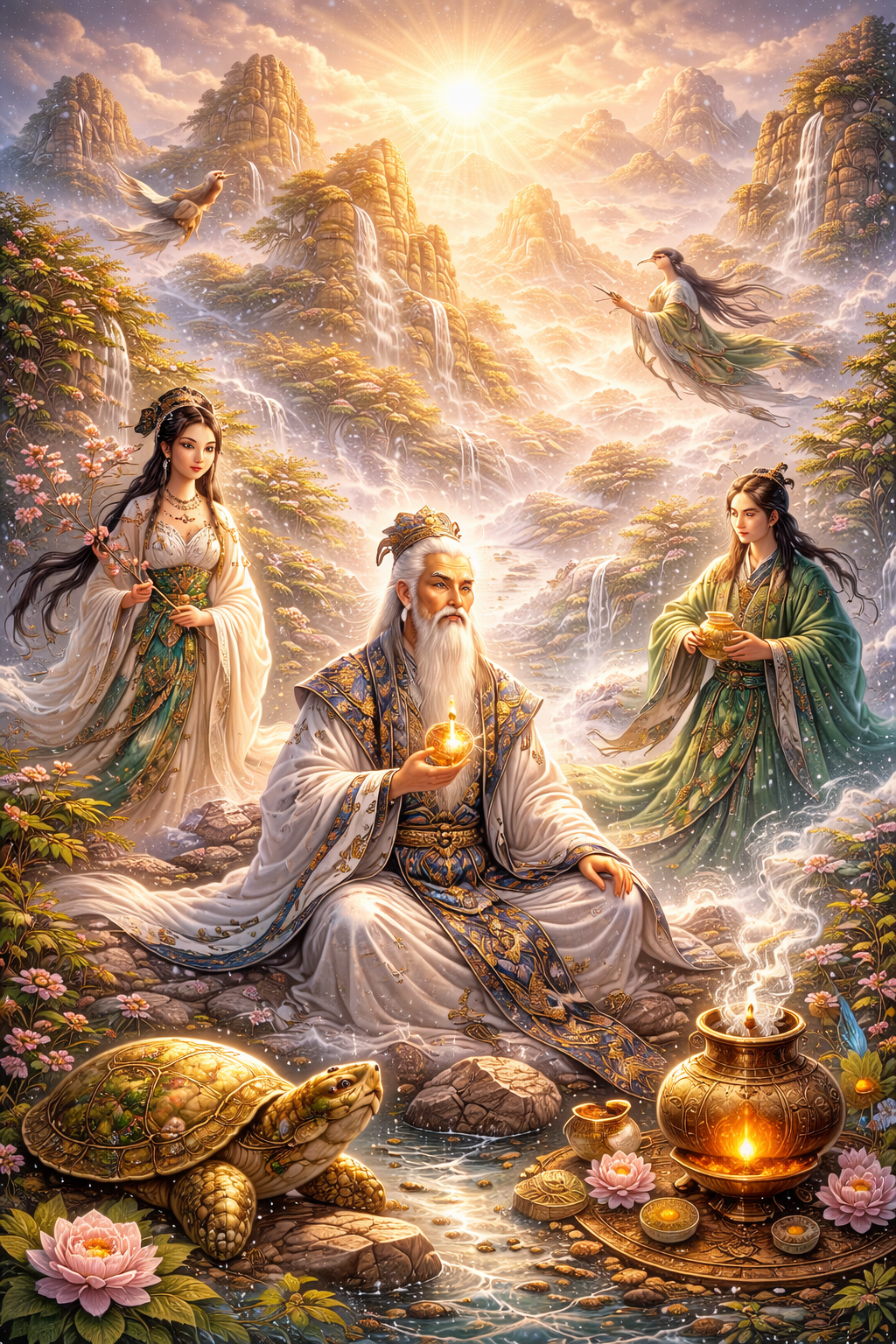
The transmitted archive preserves no single unchanging doctrine of immortality. Instead, it preserves a broad field of possibilities. In the Zhuangzi, one encounters spirit-like or perfected beings whose freedom lies in profound alignment with the movements of heaven, earth, and the changing seasons rather than in technical self-preservation alone. In Ge Hong’s Baopuzi, one encounters a far more explicit defense of immortals, medicinal regimens, alchemical substances, and practices designed to preserve the body and extend life. Later Daoist traditions develop multiple models of liberation, including union with the Dao, ascension to heaven, celestial immortality, and incorporation into a celestial bureaucracy. Daoism’s supernatural imagination is therefore neither singular nor static. It ranges from mystical wandering to alchemical transformation, from mountain hermits to courtly immortals, from subtle inner cultivation to ranked heavenly administration.
This plurality matters because it prevents Daoist immortality from being reduced to caricature. Daoism is not only “philosophy” purified of religion, nor only a technical search for endless bodily survival. It is a large, historically layered tradition in which cosmology, ritual, medicine, meditation, ethics, myth, landscape, and bodily practice repeatedly interact. The supernatural imagination of Daoism is powerful precisely because it can hold many registers at once: poetic freedom, disciplined technique, bodily transformation, celestial ascent, sacred geography, and the deep conviction that ordinary human life may not exhaust what life can become.
Why Daoism Generated a Supernatural Imagination
Daoism generated an unusually powerful supernatural imagination because it joined cosmology, physiology, ritual, nature, and liberation into one continuous field. The human body could be understood as a microcosm inhabited by spirits and energies; mountains and caves could be understood as privileged sites of access to the numinous; breathing, diet, meditation, sexual discipline, visualization, moral conduct, talismanic protection, and alchemical practice could be understood as means of changing one’s existential condition rather than merely improving one’s health. The result was a religious imagination in which transcendence remained materially, ritually, and bodily thinkable.
This matters because Daoism did not define liberation only through moral obedience, institutional membership, or metaphysical assent. It repeatedly imagined transformation as a process of attunement and refinement. One might seek longevity, invulnerability, spiritual wandering, celestial ascent, bodily lightness, union with the Dao, or admission into heavenly ranks, but in each case the human being was not treated as fixed. The ordinary body, ordinary perception, and ordinary social identity could be reworked. Daoism’s supernatural imagination rests on the conviction that life may be cultivated into another mode.
That conviction explains why Daoist supernatural imagery is so diverse. Immortals may dwell in mountains, travel through the sky, appear in hagiographies, guard scriptures, reveal practices, or enter popular storytelling. The body may be refined through breath, elixir, diet, inner visualization, or meditative stillness. The cosmos may be imagined as a network of heavens, registers, offices, spirits, stars, grottoes, paradises, and hidden realms. Daoist imagination is supernatural because it refuses to treat the visible world as the whole of reality, but it is also practical because it asks how one might actually live in relation to that unseen order.
In this sense, Daoist supernatural thought is not mere fantasy added to an otherwise rational tradition. It is one of the tradition’s principal languages for thinking transformation. The immortal, the adept, the alchemist, the mountain recluse, the celestial official, and the perfected person are all figures through which Daoism imagines the unfinished possibilities of human life.
Daoism, Myth, and Religious Imagination
Daoism is often introduced through philosophical texts such as the Daodejing and Zhuangzi, but its historical life cannot be understood through abstract philosophy alone. Daoism also developed liturgies, ritual communities, talismanic systems, celestial registers, revelations, sacred geographies, hagiographies, meditation practices, alchemical lineages, and pantheons. Its supernatural imagination is therefore not peripheral. It is one of the ways Daoism becomes a lived religious world.
This is especially important for mythology. Daoist traditions did not simply inherit older Chinese myths unchanged; they reorganized and expanded them. Mountains became grotto-heavens. Immortals became exemplary beings. Xiwangmu, the Queen Mother of the West, gained new importance within the paradise and immortality imagination. Dragons, spirits, celestial officials, stars, and underworld agencies were incorporated into broader ritual and cosmological systems. Mythic figures and sacred landscapes were reinterpreted as parts of a Daoist universe of cultivation, revelation, and transcendence.
Daoism also gives myth a technical dimension. A mythic paradise may become a place of visionary travel. A divine name may become part of a ritual invocation. A sacred mountain may become a site of pilgrimage or retreat. A celestial being may become an office-holder in a heavenly bureaucracy. A body may become a field of inner spirits. In this way, myth does not remain only narrative; it becomes practice, ritual, geography, and discipline.
For this article, Daoism is therefore treated as a mythic-religious system as well as a philosophical tradition. Its supernatural imagination includes stories, but also methods. It includes cosmic beings, but also bodily regimens. It includes poetic freedom, but also ritual order. Its power lies in the way these domains remain entangled.
Immortality in Daoist Thought
Immortality is among the most recurrent themes in Daoist literature, but it does not mean only one thing. Terms such as xian 仙 are often translated as “immortal” or “transcendent,” and both senses matter. Some Daoist traditions imagine the immortal as one who has achieved extraordinary longevity or bodily transformation. Others emphasize release from ordinary limitation, celestial ascent, or union with the Dao. Religious Daoist scholarship notes that liberation may be described as ascension to heaven, celestial immortality, or admission into celestial bureaucracy, but also that immortality was construed in multiple ways across texts and traditions.
This plurality is essential. It prevents Daoist immortality from being reduced to a single idea of “living forever.” Some traditions seek physical prolongation and bodily refinement. Others prize mystical alignment with the Dao so profound that ordinary distinctions of life and death lose their force. Still others imagine the adept entering higher offices, heavens, or registers within a ranked celestial order. The supernatural imagination of Daoism is powerful precisely because it can hold technical longevity and ontological transformation at once.
Immortality also functions as a critique of ordinary life. It refuses the assumption that aging, illness, bureaucratic status, household obligation, political authority, and death exhaust the meaning of existence. The immortal is not merely a long-lived person. The immortal is a sign that human life might be reoriented toward a different scale: cosmic, energetic, celestial, and transformative.
At the same time, Daoist immortality is not only an individual fantasy. It belongs to ritual communities, teacher-student lineages, texts, secret transmissions, mountains, scriptures, talismans, and celestial systems. The immortal is personal, but also institutional and cosmological. One becomes transformed within a world of practices and powers.
Zhuangzi and the Transcendence of the Perfect Person
The Zhuangzi provides one of the most influential early visions of transcendence in Chinese thought. Later summaries of the text often emphasize that Zhuang Zhou was skeptical of merely physiological pursuits of longevity and immortality. Yet the text does not therefore reject transcendence. It radicalizes it. The perfected person, spirit-like person, or sage in the Zhuangzi becomes so aligned with the movements of heaven and earth that ordinary fame, self-assertion, utility, fear, and rigid distinction lose their usual hold.
This is one of Daoism’s decisive contributions to the supernatural imagination. The marvelous is not always a matter of technique alone. It may arise from the spiritual reconfiguration of life itself. In the Zhuangzi, transcendence is often imagined as wandering, effortless attunement, and release from the narrow categories by which ordinary life imprisons itself. The supernatural here is not spectacle. It is freedom from constriction.
Primary Source
若夫乘天地之正,而御六氣之辯,以遊無窮者,彼且惡乎待哉!故曰:至人無己,神人無功,聖人無名。As for one who rides the proper course of heaven and earth and drives the changes of the six vital breaths, wandering in the inexhaustible—what would such a person need to depend upon? Therefore it is said: the perfected person has no self; the spirit-like person has no achievement; the sage has no name.Zhuangzi, “Enjoyment in Untroubled Ease” 逍遙遊.
This passage gives Daoist transcendence one of its most influential poetic forms. The perfected person does not merely survive longer; he or she moves beyond ordinary dependence, self-assertion, fame, and fixed identity.
The passage is important because it shifts the meaning of transcendence. The highest person does not simply acquire a miraculous body, although later Daoist traditions may pursue bodily transformation. In the Zhuangzi, transcendence is release from dependence: dependence on reputation, fixed identity, rigid distinction, social measure, and narrow usefulness. The spirit-like person is not defined by ordinary success.
This does not make the Zhuangzi anti-supernatural in any simple way. Its pages are filled with marvel, metamorphosis, enormous beings, strange sages, spirit-like persons, and cosmic transformations. But its supernatural language is philosophical and poetic rather than merely technical. It asks how life would appear if one no longer clung to the ordinary divisions that make death, failure, obscurity, and change so terrifying.
For later Daoism, this strand remained crucial. Even when alchemical, ritual, and hagiographic traditions developed more technical models of immortality, the Zhuangzi continued to provide a language of wandering freedom and deep attunement. Daoist immortality could mean transformed body, but also transformed relation to existence.
Ge Hong and the Defense of Immortals
If the Zhuangzi provides one major vision of transcendence, Ge Hong’s Baopuzi provides another. In the chapter “On Immortals,” Ge Hong argues explicitly for the existence of immortals and insists that limited ordinary knowledge cannot disprove what lies beyond common perception. The chapter is striking because it is polemical as well as doctrinal. Ge Hong is writing against disbelief, defending the reality of immortals and the possibility of practices that reach beyond ordinary lifespan.
Primary Source
或問曰:「神仙不死,信可得乎?」抱朴子答曰:「雖有至明,而有形者不可畢見焉……萬物云云,何所不有,況列仙之人,盈乎竹素矣。不死之道,曷為無之?」Someone asked, “Can it truly be that divine immortals do not die?” Master Baopu replied, “Even with the clearest sight, not all things with form can be fully seen… Among the countless beings, what could not exist? Moreover, the records are filled with accounts of ranked immortals. Why should there be no Way of deathlessness?”Ge Hong, Baopuzi, “On Immortals” 論仙.
Ge Hong does not treat immortality as mere metaphor. He argues that ordinary perception is too limited to dismiss the existence of immortals and the possibility of deathlessness.
This matters because it shows how seriously bodily immortality could be pursued in Daoist discourse. Ge Hong’s world is not satisfied with purely symbolic transformation. It seeks methods. His writings help anchor a major strand of Daoism in which the supernatural becomes operational: one searches for formulas, elixirs, regimens, transmissions, and techniques capable of producing extraordinary states.
Ge Hong’s argument also reveals an important epistemological strategy. He does not merely assert that immortals exist. He attacks the arrogance of ordinary perception. The fact that something has not been seen by a particular person does not mean it cannot exist. This defense allows Daoist supernatural discourse to claim a wider world than common sense permits. The hidden is not unreal simply because it is hidden.
The contrast with the Zhuangzi is illuminating. The Zhuangzi loosens the self from ordinary categories; the Baopuzi defends practices by which bodily life itself may be preserved and transformed. Both belong to Daoist imagination, but they represent different emphases: existential freedom and technical immortality, poetic wandering and disciplined regimen, philosophical release and alchemical pursuit.
Alchemy, Medicine, and the Remaking of the Body
One of the most powerful features of Daoist supernatural thought is its refusal to separate the body from salvation. Britannica’s overview of Daoist religious goals notes that bodily immortality and the state of xian, the immortal or transcendent, were pursued through dietary control, gymnastics, meditation, visualization, good deeds, and alchemical experimentation. Ge Hong’s works likewise connect preservation of life with medicinal substances, elixirs, and specialized techniques. The body in Daoism is therefore not merely the prison one escapes. It is the field one refines.
This makes Daoism especially important in the history of the supernatural imagination. Transformation is not imagined only after death or outside matter. It is cultivated through matter. Elixirs, herbs, minerals, breath, organs, inner energies, and ritual protections all belong to a continuum of practice through which the body may be rendered more subtle, more resilient, more luminous, or more fit for transcendence. The miraculous is pursued through regimen.
Alchemy also gives Daoist supernatural thought a distinctive material seriousness. The substances of the world are not inert. Minerals, metals, cinnabar, gold, herbs, and medicines are imagined as holding transformative potency. The adept does not merely contemplate the cosmos; he works upon substances in relation to cosmic pattern. Matter becomes spiritually charged because it participates in the same transformations that govern body and world.
At the same time, alchemical traditions must be treated historically and carefully. Some elixir practices were dangerous. Cinnabar and other substances could be toxic. Later internal alchemy reinterpreted many alchemical processes symbolically and physiologically rather than only as external compounding. A responsible interpretation must therefore neither romanticize nor ridicule. Daoist alchemy belongs to a world in which medicine, cosmology, ritual, and soteriology had not yet been separated into modern disciplinary categories.
External and Internal Alchemy
Daoist alchemical imagination developed in several forms. External alchemy, often associated with compounding elixirs from minerals and other substances, sought transformation through the ingestion or ritual handling of refined matter. Internal alchemy, which developed in later forms, increasingly read alchemical transformation through the body itself: essence, breath, spirit, internal circulation, meditative refinement, and the gestation of an inner immortal body.
The distinction is important because it shows how Daoist thought transformed its own methods. The alchemical furnace could become an image of the body. The elixir could become an inner process. Refinement could move from laboratory-like practice into meditation, visualization, and physiological symbolism. This did not simply abandon earlier alchemy; it reinterpreted the meaning of transformation.
Both external and internal alchemy rest on a common assumption: the ordinary state of the body is not final. It can be worked upon. It can be refined. It can be purified, stabilized, nourished, sealed, circulated, or reborn. Daoist alchemy, in this broad sense, is a theory of transformative process. The adept seeks not only to live longer, but to become differently constituted.
This alchemical imagination also links Daoism to broader Chinese concerns with correlation, timing, substances, and the patterned interaction of microcosm and macrocosm. The body is not isolated from the cosmos. Its transformations mirror, participate in, and respond to larger transformations. The alchemist works because the world itself is transformable.
Visualization, Qi, and Inner Cultivation
Daoist traditions also give extraordinary importance to inner cultivation. Scholarship on Daoist religion and Chinese medicine notes the prominence of techniques such as preserving unity, circulating qi, guiding and pulling, breathing practices, meditation, and visualization of the gods and spirits within the body. In this framework, the body becomes an interior cosmos. It contains energies, deities, palaces, fields, channels, and centers whose proper ordering is essential to transformation.
This interiorization is central to Daoism’s supernatural imagination. The extraordinary is not only elsewhere, on remote mountains or in celestial courts. It is also within. To cultivate the self is to move through an inner landscape no less charged than Kunlun or the western paradise. Daoist transcendence thus unfolds simultaneously through geography and physiology, pilgrimage and meditation, outer ascent and inner refinement.
The language of qi is especially important. Qi can be translated in many ways—breath, vapor, vital energy, pneuma—but no single English word captures its full range. In Daoist cultivation, breath and vitality are not merely mechanical functions. They are the medium through which the body participates in cosmic process. To cultivate qi is to cultivate relation between body and Dao.
Visualization practices deepen this relation by making the unseen body imaginally accessible. Inner gods, organs, palaces, colors, lights, breaths, and celestial correspondences may be contemplated as part of self-transformation. The body becomes a temple, court, mountain, and cosmos in miniature. The supernatural does not only descend from heaven; it is discovered in the hidden architecture of embodied life.
The Body as Inner Cosmos
One of Daoism’s most distinctive religious contributions is the imagination of the body as an inner cosmos. The body may contain gods, registers, palaces, fields, stars, channels, breaths, and symbolic correspondences to mountains, rivers, organs, directions, and celestial powers. This is not simply metaphor in the weak sense. It is a practice-world. The adept cultivates the body by treating it as a landscape of numinous relations.
This model transforms the meaning of embodiment. The body is not only flesh subject to decay. It is a field of hidden life. It is also a site of discipline and care. Diet, breathing, meditation, posture, moral conduct, sexual discipline, sleep, visualization, and ritual protection may all matter because the body’s inner order is connected to the larger order of the cosmos.
The body-as-cosmos model also helps explain why Daoist supernatural imagination can be both inward and outward at once. Sacred mountains and inner mountains mirror one another. Celestial offices and inner deities correspond. External elixirs and internal refinement belong to related logics. The adept travels outward toward sacred geography and inward through the hidden geography of the body.
This is one reason Daoist immortality is more than a desire not to die. It is a desire to reorder the very structure of life. The perfected body becomes aligned with the Dao, protected from dispersion, and opened toward a more subtle mode of existence. In such traditions, salvation is not escape from embodiment, but the transformation of embodiment into a vessel of the sacred.
Sacred Mountains, Caves, and the Geography of Transcendence
Daoism also depends upon sacred geography. Mountains, grotto-heavens, remote peaks, caves, paradisal islands, and hidden valleys function as places where ordinary and extraordinary worlds meet. The supernatural imagination of Daoism repeatedly places immortals in mountains, associates revelation with withdrawn landscapes, and treats distance from ordinary political and social life as a condition of receptivity. The mountain becomes both refuge and threshold.
This geographic orientation links Daoism to broader Chinese mythic traditions already visible in articles on Kunlun and the Queen Mother of the West. Paradise, remoteness, and sacred topography remain central. But Daoism extends these motifs by treating mountains not only as the dwellings of marvelous beings, but also as sites of cultivation, revelation, and passage into transformed states. Sacred geography becomes a map of practice.
Caves are especially important because they suggest hidden interiority within the mountain. A cave may be a place of retreat, revelation, initiation, or passage into a deeper realm. Grotto-heavens and blessed lands develop this imagery into a sacred spatial system in which the earth contains openings into other orders. The world is not flatly visible. It has hidden interiors.
This Daoist geography is not merely escapist. Withdrawal to the mountain can be a refusal of ordinary ambition, court politics, corruption, noise, and social entanglement. It can also be a search for purer air, rare substances, teachers, scriptures, and contact with numinous powers. The mountain is therefore both spiritual critique and supernatural possibility. It is the place where one leaves the dust of ordinary life in order to cultivate another relation to reality.
Immortals, Hagiography, and the Model of Human Perfectibility
Religious Daoist scholarship emphasizes that hagiographic collections present immortals as historical, semi-historical, or legendary persons who transcend ordinary human limits, usually by practice rather than by nature alone. These figures may transform themselves, heal, predict, master qi, disappear, ascend, live for extraordinary lengths of time, reveal scriptures, or guide disciples. Such hagiographies matter because they present transcendence as humanly exemplary. The immortal is not merely a god from elsewhere. He or she is a model of what a human life might become.
This is one of the strongest expressions of Daoist perfectibility. The supernatural does not simply descend from heaven. It may be cultivated upward from within human life. Stories of immortals thus perform a pedagogical function. They show the body and spirit as capable of more than the ordinary cycle suggests. Through them, the imagination of transcendence becomes narratively concrete.
Hagiography also gives Daoist supernatural thought social form. The immortal is not only an abstract type; he or she has a biography, teacher, mountain, practice, trial, encounter, disappearance, ascension, or posthumous presence. The narrative makes the path imaginable. Readers encounter not only doctrine, but example.
Such stories also preserve diversity. Some immortals are recluses; some are officials; some are women; some are eccentrics; some are healers; some are alchemists; some are moral exemplars; some are trickster-like figures who frustrate ordinary expectations. The immortal world is not one-dimensional. It is a vast human and more-than-human archive of alternative possibility.
Heavenly Ascension and Celestial Bureaucracy
Daoist supernatural thought does not end with earthly longevity. Religious Daoist scholarship notes that the highest form of liberation is often described as ascension to heaven or celestial immortality. Yet Daoist texts also imagine another form of liberation: incorporation into celestial bureaucracy, not necessarily as supreme divinity but as office within a heavenly order. This is a profoundly Chinese way of imagining transcendence. The afterlife or higher life may remain bureaucratically structured, morally ordered, and cosmologically administered.
This means that Daoist transcendence is not always a pure escape from order. It may instead be entry into a higher order. Heaven is populated, ranked, and governed. The immortal does not necessarily vanish into abstraction; he or she may take a place within a celestial administration. The supernatural imagination here joins ecstasy and institution, mystical ascent and ordered hierarchy.
The idea of celestial bureaucracy also links Daoism to broader Chinese religious and political imagination. Just as earthly government depends on registers, offices, ranks, petitions, seals, and written authority, heavenly administration can be imagined through analogous forms. The cosmos becomes bureaucratically legible. Ritual specialists may submit petitions, invoke officials, consult registers, or use talismans as authorized documents in a higher administrative order.
This administrative imagination does not reduce Daoism to bureaucracy. Rather, it shows how deeply the tradition integrated transcendence with Chinese models of order. Liberation could be imagined as wandering beyond all dependence, as in the Zhuangzi, but also as enrollment in celestial rank. Daoist supernatural thought holds both possibilities: freedom beyond name, and office beyond death.
Talismans, Registers, and Ritual Technologies
Daoist supernatural imagination is also practical in the ritual sense. Talismans, registers, seals, petitions, invocations, charts, scriptures, and ritual documents operate as technologies of relation between human communities and invisible powers. They do not merely symbolize the sacred; they are used to address, command, request, protect, exorcise, heal, register, and authorize within a cosmological order.
This ritual-documentary dimension is one of the most distinctive features of Daoist religion. A talisman may appear visually mysterious, but it belongs to a world of writing, authority, and transmission. A register may link the practitioner to celestial powers and ritual lineage. A petition may address divine officials in ways that mirror and transform earthly bureaucratic communication. Daoist ritual therefore makes the unseen world administratively approachable.
Such practices also connect Daoism to the everyday needs of communities. Protection from disease, demons, misfortune, drought, epidemic, ghosts, or social disorder could be sought through ritual action. Daoist supernatural imagination was not only about individual immortality. It was also about healing, protection, exorcism, communal order, and the maintenance of relations among the living, the dead, spirits, gods, and cosmic authorities.
This is why ritual technologies belong in an article on immortality and supernatural imagination. They show that Daoist transcendence is not only a private aspiration. It is embedded in a social world of vulnerability and repair. The same tradition that imagines immortals also writes talismans, performs rites, invokes gods, and seeks protection for ordinary human life.
Daoism and the Boundary Between Philosophy and Supernatural Religion
Modern discussions often try to separate “philosophical Daoism” from “religious Daoism” too sharply. The distinction can sometimes be useful for organizing materials, but it can also distort the tradition. The history of Daoism repeatedly shows how porous the boundary can be. The same broad tradition that produced the profound existential and cosmological reflections of the Zhuangzi also produced alchemy, hagiography, meditation systems, talismanic practice, ritual communities, and doctrines of immortality.
Even when some authors criticized certain pursuits, the supernatural imagination remained constitutive rather than peripheral. The Zhuangzi may mock narrow efforts to extend life, but it also imagines spirit-like persons, transformations, cosmic wandering, and release from ordinary identity. Ge Hong may pursue a more technical and bodily immortality, but he also participates in a long-standing Daoist concern with the limits of ordinary perception and the transformative potential of disciplined practice. These are differences within a wide tradition, not evidence that “real Daoism” must be stripped of religion.
This is important because it allows Daoism to be seen in its full breadth. Daoist thought is not impoverished by its supernatural elements. On the contrary, its reflections on body, spirit, nature, and transformation are often inseparable from them. The supernatural imagination is one of the places where Daoism thinks most boldly about the mutable limits of the human condition.
The better approach is not to divide Daoism into pure philosophy and impure religion, but to read across registers. Philosophical texts, ritual manuals, alchemical treatises, hagiographies, visual images, sacred geographies, and popular stories all preserve different aspects of Daoist imagination. Together they show a tradition concerned with one recurring problem: how to live in such a way that one becomes aligned with the deeper patterns of reality.
Daoism and the Broader Chinese Supernatural World
Daoism did not develop in isolation from the broader Chinese supernatural world. It interacted with ancestor reverence, local cults, popular deities, Buddhist cosmology, underworld imagery, mountain worship, healing traditions, omen culture, spirit possession, talismanic practice, and vernacular storytelling. This is why Daoist themes often appear in wider folklore: immortals enter popular tales; talismans appear in ghost stories; Daoist priests confront demons; mountains conceal adepts; alchemical substances promise transformation; celestial officials govern unseen realms.
This interaction is especially important for Chinese mythology because Daoism often provided organizational frameworks for older or more local materials. Spirits could be ranked. Mountains could be mapped. Deities could be placed within pantheons. Ritual specialists could mediate between households and invisible powers. Myths that might otherwise remain local or fragmented could be incorporated into broader cosmological and ritual systems.
At the same time, Daoism was also changed by popular religion and folklore. Local deities, healing needs, ghost fears, festival practices, and communal rituals shaped how Daoist specialists worked in lived contexts. The Daoist supernatural imagination was not only produced by elite texts. It was also shaped by households, villages, temples, patients, patrons, pilgrims, and ritual clients.
The result is a porous supernatural world. Immortals, ghosts, gods, demons, dragons, mountain spirits, celestial bureaucrats, fox spirits, ancestors, and local protectors may appear in overlapping symbolic fields. Daoism is one of the traditions that made this world ritually navigable.
Source History and Interpretive Caution
A careful reading of Daoism, immortality, and the supernatural imagination must distinguish among several registers: early philosophical texts such as the Zhuangzi; works such as the Baopuzi that explicitly defend immortals and technical longevity practices; later religious systems that elaborate ritual, inner cultivation, registers, talismans, and heavenly administration; hagiographic collections that narrate exemplary immortals; and visual or material sources that represent immortal worlds through painting, sculpture, prints, ritual implements, and decorative arts. These sources do not all say the same thing in the same way.
That diversity should not be flattened into either credulous unity or skeptical dismissal. The point is not that Daoism had one doctrine of immortality, but that it sustained an extraordinarily wide-ranging discourse on transformation, liberation, and the supernatural. The differences among its texts are part of the tradition’s richness.
It is also important to avoid treating Daoist immortality as only a failed scientific project. Some external alchemical practices are historically important and sometimes dangerous, but Daoist immortality is not reducible to chemical experiment. It also includes meditation, visualization, breath cultivation, ritual identity, moral discipline, sacred geography, hagiography, poetic freedom, celestial office, and philosophical release. The supernatural imagination is not one practice but a field.
Likewise, one should not reduce Daoist supernaturalism to fantasy detached from ordinary life. Daoist practices often addressed real human vulnerabilities: illness, aging, grief, fear of death, epidemic, demonic threat, political instability, social exhaustion, and the desire for protection. The supernatural world gave form to problems that were existentially real, even when its solutions belonged to religious imagination.
Read source-critically, Daoism becomes one of the great archives of human transformability. It asks how far cultivation can go, what a body can become, how hidden powers may be approached, how mortality can be reimagined, and whether the ordinary human condition is truly final.
Why This Supernatural Imagination Still Matters
Daoism’s supernatural imagination still matters because it preserves one of the most far-reaching visions of human transformability in world religious history. It asks whether body, breath, mind, spirit, place, practice, and cosmic relation may be cultivated into another mode of life. It refuses to treat the ordinary human condition as the final measure of possibility.
It also matters because it joins together domains that modern thought often separates: medicine and mysticism, geography and salvation, poetry and physiology, self-cultivation and celestial order, ritual document and cosmic administration, mountain withdrawal and inner transformation. Under the sign of Daoism, immortality becomes not only a hope but a vast symbolic and practical field.
Daoism matters, too, because it complicates modern assumptions about religion. Its supernatural imagination is not only belief in unseen beings. It is a disciplined effort to transform relation: relation to body, breath, time, landscape, spirits, death, and the Dao. Whether one reads these traditions as history, religion, philosophy, mythology, or cultural memory, they remain among the most sophisticated attempts to imagine life beyond ordinary limitation.
Finally, Daoism’s supernatural imagination matters because it helps explain the broader Chinese mythic world. Kunlun, Xiwangmu, immortals, dragons, sacred mountains, talismans, strange beings, and celestial officials all become more intelligible when read through Daoist frames of transformation, hierarchy, landscape, and practice. Daoism gave the Chinese supernatural imagination not only beings and stories, but pathways.
Related Reading
- Chinese Myth, Folklore & Legend
- What Is Chinese Myth, Folklore & Legend?
- The Problem of Sources in Chinese Mythology
- Kunlun, Paradise Mountains, and the Sacred Geography of the West
- The Queen Mother of the West and the Imagery of Immortality
- The Eight Immortals and the Popular Religious Imagination
- Animals, Omens, and Symbolic Creatures in Chinese Folk Imagination
- East Asian Traditions
Primary Sources
- Chinese Text Project (n.d.) Zhuangzi 莊子. Available at: https://ctext.org/zhuangzi
- Chinese Text Project (n.d.) Zhuangzi: Xiaoyao you 莊子:逍遙遊 / Enjoyment in Untroubled Ease. Available at: https://ctext.org/zhuangzi/enjoyment-in-untroubled-ease/ens
- Chinese Text Project (n.d.) Zhuangzi: Da zong shi 莊子:大宗師 / The Great and Most Honoured Master. Available at: https://ctext.org/zhuangzi/great-and-most-honoured-master/ens
- Chinese Text Project (n.d.) Baopuzi: Lun xian 抱朴子:論仙 / On Immortals. Available at: https://ctext.org/baopuzi/lun-xian/ens
- Chinese Text Project (n.d.) Baopuzi: Jin dan 抱朴子:金丹 / Golden Elixir. Available at: https://ctext.org/baopuzi/jin-dan/ens
- Chinese Text Project (n.d.) Baopuzi: Zhi li 抱朴子:至理 / Deepest Principle. Available at: https://ctext.org/baopuzi/zhi-li/ens
- Chinese Text Project (n.d.) Baopuzi: Di zhen 抱朴子:地真 / Earthly Reality. Available at: https://ctext.org/baopuzi/di-zhen/ens
- Chinese Text Project (n.d.) Soushen ji 搜神記 / Record of Searching for the Divine, early longevity and immortal traditions. Available at: https://ctext.org/wiki.pl?chapter=290130&if=en&remap=gb
- Chinese Text Project (n.d.) Liexian zhuan 列仙傳 / Traditions of Ranked Immortals. Available at: https://ctext.org/liexian-zhuan
Further Reading
- Chinese Text Project (n.d.) Zhuangzi. Available at: https://ctext.org/zhuangzi
- Chinese Text Project (n.d.) Zhuangzi: Xiaoyao you. Available at: https://ctext.org/zhuangzi/enjoyment-in-untroubled-ease/ens
- Chinese Text Project (n.d.) Baopuzi: Lun xian. Available at: https://ctext.org/baopuzi/lun-xian/ens
- Chinese Text Project (n.d.) Baopuzi: Jin dan. Available at: https://ctext.org/baopuzi/jin-dan/ens
- Chinese Text Project (n.d.) Baopuzi: Zhi li. Available at: https://ctext.org/baopuzi/zhi-li/ens
- Chinese Text Project (n.d.) Baopuzi: Di zhen. Available at: https://ctext.org/baopuzi/di-zhen/ens
- Chinese Text Project (n.d.) Liexian zhuan. Available at: https://ctext.org/liexian-zhuan
- Pregadio, F. (2016) “Religious Daoism.” Stanford Encyclopedia of Philosophy. Available at: https://plato.stanford.edu/entries/daoism-religion/
- Pregadio, F. (ed.) (2008) The Encyclopedia of Taoism. London: Routledge.
- Kohn, L. (2000) Daoism Handbook. Leiden: Brill.
- Robinet, I. (1997) Taoism: Growth of a Religion. Stanford: Stanford University Press.
- Campany, R.F. (2002) To Live as Long as Heaven and Earth: A Translation and Study of Ge Hong’s Traditions of Divine Transcendents. Berkeley: University of California Press.
- Campany, R.F. (2009) Making Transcendents: Ascetics and Social Memory in Early Medieval China. Honolulu: University of Hawai‘i Press.
- Encyclopaedia Britannica (2026) “Taoism: Religious goals of the individual.” Available at: https://www.britannica.com/topic/Taoism/Religious-goals-of-the-individual
- Encyclopaedia Britannica (2026) “Xian.” Available at: https://www.britannica.com/topic/xian-Daoism
- The Metropolitan Museum of Art (2011) “Daoism and Daoist Art.” Available at: https://www.metmuseum.org/essays/daoism-and-daoist-art
- The Metropolitan Museum of Art (2010) “Longevity in Chinese Art.” Available at: https://www.metmuseum.org/essays/longevity-in-chinese-art
References
- Campany, R.F. (2002) To Live as Long as Heaven and Earth: A Translation and Study of Ge Hong’s Traditions of Divine Transcendents. Berkeley: University of California Press.
- Campany, R.F. (2009) Making Transcendents: Ascetics and Social Memory in Early Medieval China. Honolulu: University of Hawai‘i Press.
- Chinese Text Project (n.d.) Baopuzi: Di zhen. Available at: https://ctext.org/baopuzi/di-zhen/ens
- Chinese Text Project (n.d.) Baopuzi: Jin dan. Available at: https://ctext.org/baopuzi/jin-dan/ens
- Chinese Text Project (n.d.) Baopuzi: Lun xian. Available at: https://ctext.org/baopuzi/lun-xian/ens
- Chinese Text Project (n.d.) Baopuzi: Zhi li. Available at: https://ctext.org/baopuzi/zhi-li/ens
- Chinese Text Project (n.d.) Liexian zhuan. Available at: https://ctext.org/liexian-zhuan
- Chinese Text Project (n.d.) Soushen ji, early longevity and immortal traditions. Available at: https://ctext.org/wiki.pl?chapter=290130&if=en&remap=gb
- Chinese Text Project (n.d.) Zhuangzi. Available at: https://ctext.org/zhuangzi
- Chinese Text Project (n.d.) Zhuangzi: Da zong shi. Available at: https://ctext.org/zhuangzi/great-and-most-honoured-master/ens
- Chinese Text Project (n.d.) Zhuangzi: Xiaoyao you. Available at: https://ctext.org/zhuangzi/enjoyment-in-untroubled-ease/ens
- Encyclopaedia Britannica (2026) “Taoism: Religious goals of the individual.” Available at: https://www.britannica.com/topic/Taoism/Religious-goals-of-the-individual
- Encyclopaedia Britannica (2026) “Xian.” Available at: https://www.britannica.com/topic/xian-Daoism
- Kohn, L. (2000) Daoism Handbook. Leiden: Brill.
- Pregadio, F. (2016) “Religious Daoism.” Stanford Encyclopedia of Philosophy. Available at: https://plato.stanford.edu/entries/daoism-religion/
- Pregadio, F. (ed.) (2008) The Encyclopedia of Taoism. London: Routledge.
- Robinet, I. (1997) Taoism: Growth of a Religion. Stanford: Stanford University Press.
- The Metropolitan Museum of Art (2010) “Longevity in Chinese Art.” Available at: https://www.metmuseum.org/essays/longevity-in-chinese-art
- The Metropolitan Museum of Art (2011) “Daoism and Daoist Art.” Available at: https://www.metmuseum.org/essays/daoism-and-daoist-art