
Last Updated May 5, 2026
Chinese folk imagination is crowded with animals, omens, and symbolic creatures because the natural world in Chinese tradition has rarely been understood as mute matter alone. Birds, beasts, reptiles, insects, fish, and hybrid beings repeatedly appear as signs, warnings, embodiments of power, carriers of blessing, or figures through which communities interpret change, danger, legitimacy, fertility, death, protection, and moral disorder. Some creatures are tied to dynastic symbolism, others to local custom, calendrical practice, popular religion, household art, or strange-tale literature; some remain close to the classical archive, while others move powerfully through folklore, ritual, storytelling, and visual culture. To study animals and symbolic creatures in Chinese folk imagination is therefore to study a world in which the boundary between natural observation and cultural meaning is constantly crossed.
This does not mean that every animal sign was understood in the same way, or that Chinese tradition lacked skepticism toward omen reading. On the contrary, the archive preserves both symbolic elaboration and critical reflection. The same civilization that moralized the fenghuang, honored the qilin, associated dragons with rain, and read animals as signs also produced texts such as the Lunheng, which challenged excessive credulity and asked whether portents, ghosts, and marvels had been interpreted too quickly. The result is not a simple world of superstition, but a long interpretive tradition in which animals became culturally readable while the meaning of that readability remained open to debate.
Article Map
Chinese Myth, Folklore & Legend
Related Topic
Dragons & Symbolic Power
Series context: This article is part of the Chinese Myth, Folklore & Legend knowledge series. It should be read alongside What Is Chinese Myth, Folklore & Legend?, The Problem of Sources in Chinese Mythology, Reading the Shanhaijing: Mythic Geography, Strange Beings, and Sacred Space, Dragons in Chinese Myth, Water Cosmology, and Imperial Symbolism, and Phoenix, Qilin, and the World of Auspicious Beings. Within that sequence, the present article turns from singular major creatures to the broader field of animal symbolism in popular and folkloric life. It asks how animals became readable signs, why certain creatures attracted omen traditions, and how symbolic animals mediated between everyday life and the larger moral, cosmological, and social imagination.
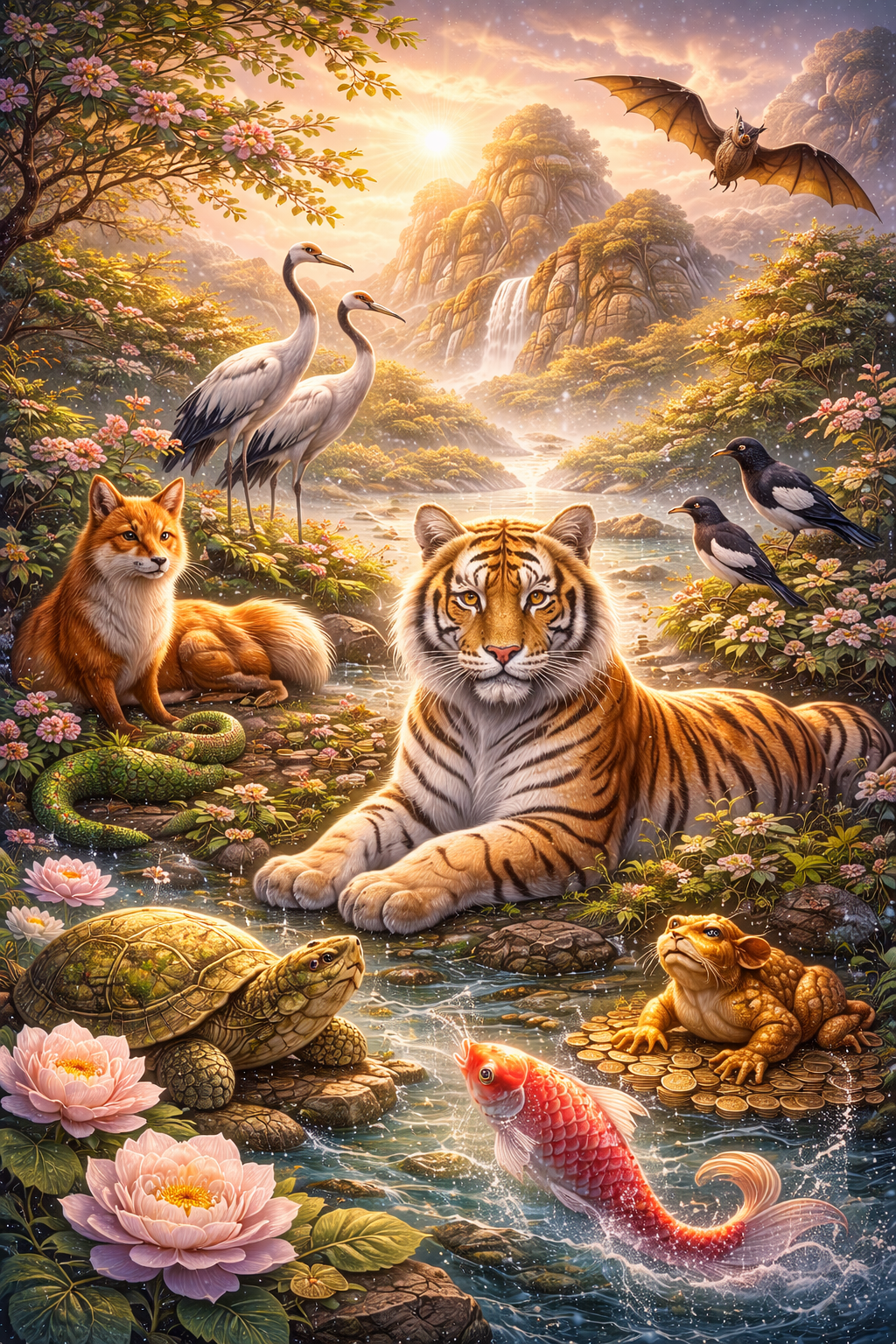
The primary archive preserves no single unified doctrine of animals and omens. Instead, it preserves a dispersed symbolic ecology. The Shanhaijing catalogues extraordinary beings and charged landscapes in which animals carry cosmological, medicinal, portentous, or boundary-marking significance. The Liji and related ritual texts connect certain creatures to ordered symbolic systems such as the Four Spirits. Works such as the Lunheng preserve both omen traditions and critical reflection on them. Collections such as the Soushen ji show how animals move through stories of spirits, transformations, warnings, and uncanny encounter. Folkloric and popular traditions later intensify these associations, so that foxes, snakes, crows, cranes, turtles, tigers, toads, magpies, bats, cicadas, fish, and insects all acquire symbolic lives that exceed ordinary zoology.
Chinese folk imagination is therefore not reducible to simple superstition. It is a cultural practice of reading significance in living forms. Animals become meaningful because they are encountered at thresholds: between seasons, between wildness and household life, between danger and protection, between visible body and hidden spirit, between ordinary pattern and exceptional sign. They may bless, warn, deceive, protect, transform, or reveal. Under their sign, the living world becomes morally suggestive and aesthetically charged.
Why Animals Become Symbolic
Animals become symbolic in Chinese folk imagination because they are encountered as living presences within a world already understood to be morally, cosmologically, ritually, and seasonally charged. A creature may be admired for strength, feared for unpredictability, noticed for seasonal recurrence, associated with death, fertility, concealment, transformation, long life, luck, illness, weather, or protection. Once such associations become culturally stabilized, the animal ceases to be only itself. It becomes a sign-bearing form.
This process is especially important in a civilization where natural pattern, omen, ritual timing, moral conduct, and political legitimacy were often understood in relation to one another. If the world is readable, then animals are among the media through which it may be read. Their movements, cries, appearances, colors, habitats, and legendary traits become available for interpretation. Chinese folk imagination thus treats animals not as isolated curiosities, but as participants in a larger field of meaning.
Animal symbolism may arise from several sources at once. It may arise from observation: cranes appear long-lived and elegant; cicadas emerge from the ground and sing after transformation; snakes disappear into holes and return with unnerving suddenness; tigers command fear; turtles endure. It may arise from sound: the bat becomes auspicious because fu, “bat,” sounds like fu, “fortune” or “blessing.” It may arise from ritual use: turtle shells and plastrons became central to divination. It may arise from political symbolism: dragons and phoenixes enter courtly iconography. It may arise from story: foxes become spirit-beings whose transformations reveal instability in human perception.
This layered origin is crucial. Chinese animal symbolism is not one thing. It includes observation, punning, ritual, omen, visual convention, political theology, popular religion, and literary imagination. The same creature can carry several of these meanings at once. That is why animal symbolism became so durable: it could move through text, temple, household, court, performance, and everyday speech without losing its capacity to gather meaning.
Omens, Portents, and the Readable World
The language of omen is fundamental to this symbolic world. Certain animals or animal appearances may signal disorder, blessing, dynastic transition, virtuous rule, death, unusual weather, impending danger, or altered relations between the human and more-than-human spheres. The cultural logic is not that every animal is mysterious in the same way, but that unusual appearances or especially charged creatures may disclose the state of the world.
This idea belongs to a broader Chinese habit of reading the world as relational. Events do not simply occur in isolation. A drought may be read politically. A flood may test rulership. A comet may be interpreted as warning. A strange animal may become an omen. A rare auspicious creature may confirm sage rule. A fox appearing near a household may unsettle boundaries between domestic order and spirit danger. The natural world becomes a field of possible signs because human life is imagined as embedded within larger patterns.
This does not mean that every transmitted omen was universally accepted without criticism. On the contrary, omen culture repeatedly generated argument. Some texts preserved auspicious claims; others questioned them. Yet even skeptical texts show how widespread the practice of reading signs had become. Animal symbolism mattered because it participated in the broader conviction that events in the natural world could reflect, disturb, or reveal the moral and political condition of human life.
Omen interpretation is therefore neither simply belief nor simply fantasy. It is a cultural technique of meaning-making. It asks what a creature’s appearance might disclose, who has the authority to interpret it, and how such interpretation may affect ritual, politics, household conduct, or public anxiety. The animal sign is rarely self-explanatory. It demands reading, and that reading can become powerful.
From Classical Archive to Folk Imagination
The symbolic life of animals in China cannot be understood through one genre alone. The classical archive preserves many foundational patterns, but popular storytelling, local cult, visual art, calendrical practice, vernacular custom, and ritual performance transform and redistribute them. The Shanhaijing offers a world in which creatures are tied to mountains, regions, disasters, medicines, omens, and sacred topography. Ritual and encyclopedic works classify symbolic beings into larger cosmological systems. Anecdotal and strange-tale collections bring animals into a more intimate imaginative world of village encounter, domestic warning, haunting, seduction, and blessing.
The result is that the same broad symbolic pattern may appear in different registers. A fox may be a mountain creature, an omen, a spirit-being, a seducer, a cultivator of power, or a figure of household fear. A crane may be an elegant bird, a sign of longevity, a Daoist conveyance, or a visual symbol of spiritual aspiration. A turtle may be a divinatory medium, a symbol of endurance, an architectural support, or a funerary emblem. Folk imagination does not discard the classical archive. It domesticates and extends it.
This movement from archive to folklore is one of the most important features of Chinese mythology. The Shanhaijing may describe strange beings in distant mountains; later literature may bring transformation into the scholar’s study or the family courtyard. A ritual text may classify cosmic beings; later visual culture may place them on robes, badges, ceramics, amulets, mirrors, birthday gifts, or New Year prints. The animal sign becomes socially durable because it can travel.
To study animal symbolism, then, is to follow circulation. Creatures move from wilderness to text, from text to image, from image to ritual, from ritual to household, from household to festival, and from festival to modern cultural memory. Their meanings are not static. They persist because they are repeatedly recontextualized.
The Shanhaijing and the Bestiary of Signs
The Shanhaijing is one of the most important primary archives for symbolic creatures because it does not present animals as merely zoological entries. Creatures are embedded in mountains, rivers, plants, minerals, medicines, dangers, omens, ritual effects, and regional landscapes. A being’s body, cry, diet, habitat, or appearance may carry consequences. Some creatures protect against disease; some foretell disaster; some mark strange borderlands; some collapse human, animal, and divine categories. The text offers not a modern natural history but a mythic geography of living signs.
This matters because it gives Chinese animal symbolism a spatial foundation. Creatures belong to places, and places belong to a charged world of mountains, waters, directions, and thresholds. The animal is rarely abstract. It appears somewhere: on a mountain, beside a river, in a distant region, near a sacred site, or at the edge of the known world. Meaning attaches to habitat as much as to form.
The nine-tailed fox of Qingqiu Mountain is a particularly important example because it shows how animal form can already carry danger, sound, transformation, and later symbolic expansion. In the early source, the fox is not yet simply the refined fox-spirit lover of later strange tales. It is strange, powerful, baby-voiced, dangerous, and associated with protection against poison or harmful influences when consumed. Later fox lore grows from a much wider field, but the Shanhaijing already shows fox-like beings as creatures of charged ambiguity.
Primary Source
又東三百里,曰青丘之山,其陽多玉,其陰多青雘。有獸焉,其狀如狐而九尾,其音如嬰兒,能食人,食者不蠱。Three hundred li further east is Qingqiu Mountain. Its sunny side has much jade, and its shaded side much blue-green pigment. There is a beast there whose form is like a fox and which has nine tails. Its cry is like that of an infant. It can eat people; one who eats it will not be afflicted by poison or harmful bewitchment.Shanhaijing, “Southern Mountain Classic” 南山經.
The passage shows how a creature may be dangerous, medicinally potent, uncanny in sound, and symbolically charged at once. Later fox-spirit traditions develop in different forms, but the fox-like creature is already a being of ambiguity.
The Shanhaijing therefore gives animal symbolism an early grammar of charged embodiment. A creature’s tail, voice, color, habitat, diet, and effects all matter. The body is not only biological. It is readable. The animal becomes a node where geography, danger, medicine, omen, and mythic imagination converge.
Foxes, Transformation, and Ambiguous Intelligence
Few creatures have been more important to Chinese folk imagination than the fox. The fox becomes powerful because it concentrates several anxieties and fascinations at once: intelligence, liminality, seduction, age, hidden power, deceptive appearance, and the possibility of transformation. In later strange-tale tradition especially, foxes can become human-like, deceive, enchant, cultivate power, enter intimate proximity with households and scholars, or reveal moral complexity that ordinary social categories cannot contain. They are rarely simple animals. They are boundary-crossers.
This symbolic role is important because the fox represents ambiguity itself. Unlike auspicious creatures such as the fenghuang or qilin, the fox is not a stable sign of harmonious order. It may be dangerous, alluring, clever, spiritually potent, generous, vengeful, comic, erotic, or morally undecidable. In this respect, fox lore reveals something essential about Chinese folk imagination: not all symbolic creatures confirm order. Some expose the instability of appearances and the vulnerability of the human world to cunning forms of otherness.
Foxes are especially powerful in stories because they disturb categories that human society relies upon. Animal becomes woman; stranger becomes lover; guest becomes spirit; household becomes haunted; scholarship becomes seduction; desire becomes danger; danger becomes insight. Such stories often turn on recognition: who or what has entered the human world? The fox makes visible the fear that appearance cannot be trusted.
At the same time, fox stories should not be reduced to misogynistic seduction tales or simple warnings against desire. They are more varied than that. Fox figures may expose hypocrisy, reward kindness, challenge rigid morality, dramatize social vulnerability, or give imaginative form to forms of female agency otherwise constrained in ordinary life. Their ambiguity is precisely what makes them compelling. The fox is a creature through which transformation becomes ethically unstable and narratively rich.
Snakes, Dragons, and Chthonic Power
Snakes and dragons belong to overlapping but not identical symbolic fields. The dragon, as seen elsewhere in this series, becomes one of the major figures of water, weather, imperial sovereignty, and cosmic vitality. The snake remains closer to the ground, to burrows, hidden movement, venom, shedding, transformation, and chthonic force. Yet the two are often imaginatively proximate because both are elongated, fluid, and associated with energies that move between seen and unseen domains.
This proximity matters because Chinese folk imagination often works through graded symbolic continuities rather than absolute taxonomic boundaries. A snake may be feared as a dangerous terrestrial presence, revered in local cultic settings, imagined as close to dragon power in attenuated form, or transformed into a human-like being in legend. A serpent-bodied deity or immortal figure may likewise blur distinctions between animality and divinity. The symbolic world is not rigidly zoological. It is relational and imaginative.
The White Snake tradition is one of the clearest examples of this complexity. The serpent-being may appear as lover, cultivator, wife, mother, transgressor, spirit, or victim of religious authority. The snake is not merely a monster, and its transformation into human form does not simply erase its otherness. The story-world preserves tension between intimacy and danger, spiritual cultivation and social boundary, love and prohibition, animal nature and moral personhood.
Snakes therefore occupy one of the most charged zones of symbolic animality. They are close to earth and water, close to danger and renewal, close to poison and healing, close to hiddenness and revelation. Their proximity to dragon symbolism gives them grandeur, while their nearness to the ground keeps them uncanny. They embody the unstable path between chthonic force and spiritual transformation.
Birds, Signs, and the Language of Appearance
Birds hold a privileged place in omen culture because they are creatures of visibility, movement, sound, and sudden appearance. Their cries, migrations, colors, flights, and seasonal patterns make them especially available for symbolic interpretation. In Chinese tradition, birds may signify happiness, announcement, mourning, transition, longing, distance, celestial proximity, or refined spiritual aspiration, depending on the species and context.
The fenghuang marks one high symbolic pole of this field: an auspicious bird whose appearance signifies peace and whose body is moralized as visible virtue. But more ordinary birds also become meaningful in everyday imagination. Magpies become associated with good news and auspicious arrival. Crows can carry darker or more ambiguous associations, while the three-legged crow in some traditions belongs to solar symbolism. Cranes become especially important as images of longevity, elegance, transcendence, and elevated spiritual status.
Birds are also powerful because they cross vertical space. They move between earth and sky. They perch near human settlements but disappear into distance. They cry before they are seen. They migrate with season. This makes them natural carriers of message, omen, separation, and return. The bird’s body becomes a visible line between the human world and the higher or farther realms beyond ordinary control.
In visual culture, birds often gather auspicious meanings through pairing and environment. A pair of cranes may suggest longevity and marital continuity; magpies and plum blossoms may suggest joy; phoenixes may suggest imperial harmony; mandarin ducks may suggest conjugal affection. Bird symbolism shows how animal meaning can be refined through composition, seasonal setting, punning, and social use.
Tigers, Turtles, and the Protection of Boundaries
The tiger and the turtle occupy very different symbolic positions, yet both help illuminate the relation between animal imagery and protection. The tiger is a creature of force, danger, mountain power, and martial awe. It may be feared as predator, but it can also function as a guardian image, a sign of courage, or a protective counterforce against lesser demons and malign influences. Its symbolic power derives partly from the fact that it is feared. What threatens ordinary life may also defend it when ritually reoriented.
This protective inversion is important. A terrifying animal can become a guardian precisely because its force is greater than the threats it repels. Tiger imagery on doors, charms, children’s clothing, military symbolism, or ritual objects can operate as a visual form of apotropaic power. The tiger does not become gentle; it becomes aligned with protection. Folk imagination often works this way: danger, when symbolically controlled, can defend the household or community against worse danger.
The turtle, by contrast, signifies endurance, longevity, and depth of time. In early Chinese civilization it is also bound to divination through turtle plastrons, making it one of the most consequential animals in the relation between omen, writing, and sacred inquiry. The turtle therefore joins durability with epistemic depth. It is slow, ancient, and readable. In later symbolic life, it continues to mark long life, persistence, and the heaviness of time itself.
Tiger and turtle together show the range of protective animal symbolism. One protects through awe, ferocity, and boundary defense; the other through endurance, divination, and temporal depth. Both show that animals become meaningful not only because of how they look, but because of what their bodies, behaviors, and cultural histories allow people to imagine about safety, time, danger, and knowledge.
Toads, Bats, Fish, and the Everyday Symbolic World
Not all symbolic animals in Chinese folk imagination are grand, terrifying, or cosmologically elevated. Some of the most durable symbolic creatures belong to the everyday world of visual punning, seasonal custom, popular blessing, household decoration, and ordinary wish. Bats become auspicious because the word for bat, fu 蝠, is homophonically linked with blessing or fortune, fu 福. Fish, yu 魚, carry associations of surplus and abundance because of the pun with yu 餘, “surplus.” Toads may be linked to the moon, alchemical imagery, or the stranger edges of immortality folklore.
This everyday symbolic field matters because it shows that Chinese folk imagination is not built only from rare marvels. Ordinary creatures become culturally powerful when sound, season, behavior, or appearance lend themselves to symbolic elaboration. Animal meaning may therefore arise from phonetic play, ritual habit, agricultural hope, decorative convention, or household aspiration as much as from dramatic mythic narrative.
The bat is especially revealing. In many cultures, bats may be uncanny or ominous, but in Chinese decorative art they become one of the most familiar signs of blessing. Five bats can symbolize the Five Blessings. Bats may appear with peaches, longevity characters, clouds, coins, or other auspicious motifs to create dense visual wishes for happiness, prosperity, rank, longevity, and good fortune. The animal’s symbolic meaning depends less on its zoological character than on language and visual convention.
Fish symbolism works similarly through abundance. Fish imagery appears in New Year contexts, household decorations, dishes, textiles, ceramics, and popular art because it turns ordinary food and aquatic life into an image of continuing surplus. The creature becomes a wish made visible. In this register, animal symbolism is not strange or elite. It is woven into everyday hope.
Cicadas, Cranes, and the Symbolics of Transformation
Cicadas and cranes show another side of animal symbolism: the use of creatures to think transformation, longevity, and transcendence. Cicadas emerge from the ground after a hidden phase of life, shed their old form, and fill the air with seasonal sound. This made them powerful symbols of rebirth, emergence, purity, and refined transformation. In funerary contexts, cicada imagery could suggest the hope that death itself might be followed by another mode of existence.
Cranes, by contrast, become one of the most elegant signs of longevity and Daoist ascent. They are associated with long life, white age, high flight, immortals, and refined distance from the ordinary dust of the world. Met materials on longevity in Chinese art note the crane’s association with long life and its role as a conveyance of immortals, while also showing how longevity motifs were widely used in paintings, garments, and decorative arts.
The contrast between cicada and crane is instructive. The cicada symbolizes transformation through emergence; the crane symbolizes elevation through longevity and spiritual flight. One rises from earth; the other moves through sky. Both make biological form culturally legible. The creature’s life cycle or appearance becomes a pattern through which human beings imagine their own hopes about death, old age, refinement, and transcendence.
These symbols also show how animal meaning can be deeply aesthetic. A crane in a painting is not a scientific specimen; it is a line of aspiration. A cicada carved in jade is not only an insect; it is a miniature theology of transformation. Animal form becomes a way of thinking visually about time, body, and spirit.
Animal Omens and Political Legibility
Animal symbolism in China often becomes politically legible when certain creatures are said to appear under virtuous or corrupt rule. Auspicious beings such as the fenghuang and qilin belong to the clearest version of this pattern, but the logic extends more broadly. If the natural world responds to government, then unusual creatures or animal events become evidence in debates about legitimacy. A well-governed realm may attract benevolent signs; a disordered one may produce troubling portents.
This political use of animal imagery is one reason omen traditions mattered so much. They offered a way of reading the natural and marvelous world as commentary on human authority. The state was not imagined as sealed off from the cosmos. It was exposed to symbolic judgment, and animals were among the forms through which that judgment might become visible.
The Four Spirits give one version of this political-symbolic order. Dragon, fenghuang, qilin, and turtle are not merely creatures but signs of a properly ordered world. Dragons connect water, vitality, and sovereign power; the fenghuang suggests peace and harmonious order; the qilin signifies benevolent sage presence; the turtle gives divinatory and temporal depth. When such beings appear in ritual, omen, or art, they do not merely decorate authority. They help interpret it.
Primary Source
何謂四靈?麟鳳龜龍,謂之四靈。What are called the Four Spirits? The qilin, the fenghuang, the turtle, and the dragon are called the Four Spirits.Liji, “Liyun” 禮記:禮運.
The passage places major symbolic creatures into an ordered constellation. Animal symbolism becomes a way of thinking cosmic, ritual, and political harmony together.
The political reading of animals can be ethically serious, but also dangerous. It may hold rulers accountable to signs of disorder, but it can also be manipulated as propaganda. A court may claim auspicious appearances to validate power; critics may read strange events as warnings of misrule. Animal omens therefore occupy a contested space between cosmology and political argument.
Skepticism, Interpretation, and the Problem of Belief
No serious treatment of animal omens should ignore skepticism. Texts such as the Lunheng are valuable precisely because they record omen culture while also subjecting it to rational challenge. Wang Chong’s work repeatedly asks whether unusual appearances have been misunderstood, whether human fear or expectation has produced false interpretation, and whether claims about spirits or portents are being accepted too easily. This is historically important. It shows that symbolic animals were never meaningful only because everyone accepted them naively. They were meaningful because they were debated, interpreted, and repeatedly recontextualized.
The problem is not whether ancient Chinese people “really believed” every symbolic association in a uniform way. The more important question is how these associations functioned culturally. Even when doubted, they shaped narrative expectation, visual language, ritual action, political rhetoric, and the reading of events. Skepticism did not erase the symbolic world. It became part of its history.
Primary Source
凡妖之發,或象人為鬼,或為人象鬼而使,其實一也。In general, when portents arise, some appear in the form of humans as ghosts, while others are humans imitating ghosts and acting as such; in substance, these are of one kind.Lunheng, “Record of Omens and Portents” 紀妖.
Wang Chong’s discussion shows that omen interpretation could be critically examined. The tradition contains skepticism as well as symbolic elaboration.
This critical dimension is essential for modern interpretation. It prevents animal symbolism from being treated either as literal zoological belief or as irrational fantasy. The tradition itself was more complex. Some texts gathered signs; some critiqued them; some used them for politics; some turned them into stories; some made them visual motifs. Animal omens mattered because they were culturally useful, aesthetically powerful, and intellectually contested.
Read this way, skepticism becomes part of the symbolic archive rather than an external correction imposed by modernity. Chinese thinkers themselves asked how signs should be interpreted and whether the world was being read too eagerly. That debate remains one of the most valuable parts of the tradition.
Folk Imagination, Visual Culture, and Ritual Practice
Animals and symbolic creatures remain powerful partly because they move easily between story, ritual, and image. A creature that appears in a strange tale may also appear on a rank badge, temple wall, roof ornament, New Year print, funerary object, birthday gift, porcelain vessel, textile, charm, or household decoration. The symbolic animal is therefore not only narrated but displayed. Visual repetition makes meaning socially durable.
Ritual practice intensifies this durability. Dragon dances, protective tiger imagery, bat and fish motifs on domestic goods, crane imagery in longevity symbolism, and zodiac animal cycles all show how creatures enter habitual cultural life. In such contexts, the symbolic animal becomes part of how communities greet time, imagine fortune, ward off harm, and decorate aspiration.
Metropolitan Museum materials on longevity in Chinese art are especially useful for this visual-cultural dimension. They show how motifs associated with long life—peaches, cranes, deer, pines, bats, butterflies, and other signs—were combined in paintings, garments, and decorative arts to create auspicious wishes. This is a crucial reminder that animal symbolism did not survive only in texts. It survived on objects people saw, wore, gifted, displayed, and handled.
Visual culture also allows meanings to combine. A bat with a peach may suggest blessing and longevity. A crane with pine may intensify long-life symbolism. Fish may combine with lotus or children to suggest surplus and fertility. Tigers may appear in protective contexts. Qilin may become rank insignia. The animal symbol becomes part of a visual grammar in which one motif modifies and strengthens another.
In this way, animal symbolism enters everyday life not as formal doctrine but as material atmosphere. It appears on cups, robes, tiles, screens, paintings, amulets, badges, prints, toys, and festival objects. The symbolic creature becomes one of the ways culture surrounds the household with wishes, protections, memories, and aspirations.
Zodiac Cycles and the Social Ordering of Animal Time
The Chinese zodiac shows how animals can organize time itself. The twelve animals—rat, ox, tiger, rabbit, dragon, snake, horse, goat or sheep, monkey, rooster, dog, and pig—do not function like isolated mythic creatures. They form a calendrical sequence through which years, personality associations, seasonal festivals, household expectations, and social memory are organized. Animal symbolism here becomes temporal structure.
This matters because it shows how deeply animal imagery can enter ordinary life. The zodiac animal is not only an artistic motif. It marks birth year, generational rhythm, festival decoration, family conversation, and popular interpretation of character. It gives people a way to place themselves within cyclical time. Under the zodiac, animals become markers of personal and social identity.
The zodiac also shows that animal symbolism does not need to be rare to be powerful. Unlike the qilin or fenghuang, zodiac animals are familiar. Some are domestic, some wild, some powerful, some ordinary. Their meaning comes from sequence, repetition, and social use. Each animal returns every twelve years, carrying inherited associations while also entering new circumstances.
The dragon’s presence within the zodiac is especially revealing because it places a mythic creature among ordinary animals. This mixture reflects the larger character of Chinese animal symbolism: the boundary between observed creatures and mythic beings is porous. The zodiac can hold rat and dragon, ox and snake, dog and monkey, ordinary life and sacred imagination. Time itself becomes a bestiary.
Source History and Interpretive Caution
A careful reading of animals, omens, and symbolic creatures must distinguish among several kinds of sources. The Shanhaijing preserves an early mythic-geographic bestiary of strange beings, medicines, dangers, and charged landscapes. The Liji and related ritual sources place certain creatures within symbolic systems such as the Four Spirits. The Lunheng preserves omen discourse while also critiquing it. The Soushen ji and later strange-tale traditions show animals as agents of transformation, haunting, warning, and uncanny encounter. Visual and material culture then gives symbolic animals a social life on textiles, ceramics, badges, paintings, mirrors, and household goods.
These layers should not be flattened into one timeless doctrine. A fox in the Shanhaijing, a fox in a medieval strange tale, and a fox in late-imperial fiction may be related, but they are not the same textual being. A dragon in a rain ritual, an imperial dragon on a robe, and a Dragon King in a vernacular novel share symbolic continuities, but their social functions differ. A bat in decorative art may depend more on phonetic punning than on narrative myth. The interpretive method must follow context.
It is also important not to mistake translation for equivalence. “Phoenix,” “unicorn,” “dragon,” “monster,” “demon,” and “spirit” are useful English approximations, but each can mislead. The fenghuang is not simply the Mediterranean phoenix; the qilin is not simply a unicorn; the dragon is not primarily a monster to be slain; the fox spirit is not reducible to a European fairy or demon. The Chinese symbolic field must be interpreted on its own terms.
Finally, animal symbolism should be read with social and political awareness. Auspicious signs could express hope, but they could also legitimate power. Protective imagery could defend households, but it could also reflect fear of boundary violation. Fox tales could encode misogyny, but also forms of agency and critique. Omen reading could hold rulers accountable, but also invite manipulation. The richness of the field lies in these tensions.
Why Symbolic Creatures Still Matter
Animals and symbolic creatures still matter because they preserve one of the most revealing features of Chinese folk imagination: the conviction that the world is expressive. Creatures are not always only biological entities. They may also be signs, analogies, warnings, guardians, blessings, omens, companions, deceivers, protectors, or embodiments of values that human communities seek to interpret and inhabit.
They also matter because they show how meaning can be distributed across everyday life. A crane, fox, bat, fish, turtle, tiger, snake, cicada, toad, magpie, or dragon may carry centuries of accumulated association without losing its local immediacy. The symbolic creature can appear in a classical text, strange tale, temple image, embroidered badge, birthday gift, children’s object, festival dance, or household decoration. It is ancient and ordinary at once.
Symbolic animals matter, too, because they complicate the boundary between myth and folklore. Some are part of grand mythic systems; others belong to household wishes or local anxieties. Some organize imperial authority; others protect children, mark birthdays, decorate New Year, or warn against deception. The field is broad because animal symbolism sits where cosmology meets daily life.
Finally, symbolic creatures matter because they make the living world culturally legible, morally suggestive, and aesthetically charged. They remind us that mythology is not only about distant gods or cosmic origins. It also lives in the way people interpret birds at the window, animals in dreams, insects in seasonal time, dragons in rain clouds, cranes in paintings, bats on porcelain, and foxes at the edge of the household. Under the sign of symbolic creatures, the world is never merely background. It speaks.
Related Reading
- Chinese Myth, Folklore & Legend
- What Is Chinese Myth, Folklore & Legend?
- The Problem of Sources in Chinese Mythology
- Reading the Shanhaijing: Mythic Geography, Strange Beings, and Sacred Space
- Dragons in Chinese Myth, Water Cosmology, and Imperial Symbolism
- Phoenix, Qilin, and the World of Auspicious Beings
- Fox Spirits, Transformation, and Ambiguity in Chinese Folklore
- Strange Tales and the Rise of Supernatural Literature
Primary Sources
- Chinese Text Project (n.d.) Shanhaijing 山海經 / Classic of Mountains and Seas. Available at: https://ctext.org/shan-hai-jing
- Chinese Text Project (n.d.) Shanhaijing: Nanshan jing 山海經:南山經 / Southern Mountain Classic. Available at: https://ctext.org/shan-hai-jing/nan-shan-jing
- Chinese Text Project (n.d.) Liji: Liyun 禮記:禮運 / Book of Rites: Conveyance of Rites. Available at: https://ctext.org/liji/li-yun/ens
- Chinese Text Project (n.d.) Lunheng 論衡. Available at: https://ctext.org/lunheng
- Chinese Text Project (n.d.) Lunheng: Ji yao 論衡:紀妖 / Record of Omens and Portents. Available at: https://ctext.org/lunheng/ji-yao
- Chinese Text Project (n.d.) Lunheng: Ding gui 論衡:訂鬼 / Correcting Ghosts. Available at: https://ctext.org/lunheng/ding-gui/ens
- Chinese Text Project (n.d.) Soushen ji 搜神記 / Record of Searching for the Divine. Available at: https://ctext.org/wiki.pl?if=en&res=839038
- Chinese Text Project (n.d.) Liaozhai zhiyi 聊齋志異 / Strange Tales from a Chinese Studio. Available at: https://ctext.org/liao-zhai-zhi-yi
- Chinese Text Project (n.d.) Taiping guangji 太平廣記. Available at: https://ctext.org/taiping-guangji
Further Reading
- Chinese Text Project (n.d.) Shanhaijing. Available at: https://ctext.org/shan-hai-jing
- Chinese Text Project (n.d.) Liji: Liyun. Available at: https://ctext.org/liji/li-yun/ens
- Chinese Text Project (n.d.) Lunheng. Available at: https://ctext.org/lunheng
- Chinese Text Project (n.d.) Lunheng: Ji yao. Available at: https://ctext.org/lunheng/ji-yao
- Chinese Text Project (n.d.) Soushen ji. Available at: https://ctext.org/wiki.pl?if=en&res=839038
- Chinese Text Project (n.d.) Liaozhai zhiyi. Available at: https://ctext.org/liao-zhai-zhi-yi
- The Metropolitan Museum of Art (2010) “Longevity in Chinese Art.” Available at: https://www.metmuseum.org/essays/longevity-in-chinese-art
- The Metropolitan Museum of Art (n.d.) “Rank Badge with Qilin.” Available at: https://www.metmuseum.org/art/collection/search/69079
- The Metropolitan Museum of Art (n.d.) “Blind with scrollwork, bat, and flowers.” Available at: https://www.metmuseum.org/art/collection/search/68454
- The Metropolitan Museum of Art (n.d.) “Dish with paired fish.” Available at: https://www.metmuseum.org/art/collection/search/39890
- Birrell, A. (1993) Chinese Mythology: An Introduction. Baltimore: Johns Hopkins University Press. Available at: https://archive.org/details/chinesemythology0000birr
- Strassberg, R.E. (2002) A Chinese Bestiary: Strange Creatures from the Guideways Through Mountains and Seas. Berkeley: University of California Press. Available at: https://archive.org/details/chinesebestiarys0000unse
- Campany, R.F. (1996) Strange Writing: Anomaly Accounts in Early Medieval China. Albany: State University of New York Press.
- Yang, L. and An, D. (2005) Handbook of Chinese Mythology. Santa Barbara: ABC-CLIO. Available at: https://archive.org/details/handbookofchines0000yang
- Bartholomew, T.T. (2006) Hidden Meanings in Chinese Art. San Francisco: Asian Art Museum.
References
- Bartholomew, T.T. (2006) Hidden Meanings in Chinese Art. San Francisco: Asian Art Museum.
- Birrell, A. (1993) Chinese Mythology: An Introduction. Baltimore: Johns Hopkins University Press. Available at: https://archive.org/details/chinesemythology0000birr
- Campany, R.F. (1996) Strange Writing: Anomaly Accounts in Early Medieval China. Albany: State University of New York Press.
- Chinese Text Project (n.d.) Liaozhai zhiyi. Available at: https://ctext.org/liao-zhai-zhi-yi
- Chinese Text Project (n.d.) Liji: Liyun. Available at: https://ctext.org/liji/li-yun/ens
- Chinese Text Project (n.d.) Lunheng. Available at: https://ctext.org/lunheng
- Chinese Text Project (n.d.) Lunheng: Ding gui. Available at: https://ctext.org/lunheng/ding-gui/ens
- Chinese Text Project (n.d.) Lunheng: Ji yao. Available at: https://ctext.org/lunheng/ji-yao
- Chinese Text Project (n.d.) Shanhaijing. Available at: https://ctext.org/shan-hai-jing
- Chinese Text Project (n.d.) Shanhaijing: Nanshan jing. Available at: https://ctext.org/shan-hai-jing/nan-shan-jing
- Chinese Text Project (n.d.) Soushen ji. Available at: https://ctext.org/wiki.pl?if=en&res=839038
- Chinese Text Project (n.d.) Taiping guangji. Available at: https://ctext.org/taiping-guangji
- Strassberg, R.E. (2002) A Chinese Bestiary: Strange Creatures from the Guideways Through Mountains and Seas. Berkeley: University of California Press. Available at: https://archive.org/details/chinesebestiarys0000unse
- The Metropolitan Museum of Art (2010) “Longevity in Chinese Art.” Available at: https://www.metmuseum.org/essays/longevity-in-chinese-art
- The Metropolitan Museum of Art (n.d.) “Blind with scrollwork, bat, and flowers.” Available at: https://www.metmuseum.org/art/collection/search/68454
- The Metropolitan Museum of Art (n.d.) “Dish with paired fish.” Available at: https://www.metmuseum.org/art/collection/search/39890
- The Metropolitan Museum of Art (n.d.) “Rank Badge with Qilin.” Available at: https://www.metmuseum.org/art/collection/search/69079
- Yang, L. and An, D. (2005) Handbook of Chinese Mythology. Santa Barbara: ABC-CLIO. Available at: https://archive.org/details/handbookofchines0000yang