
Last Updated May 5, 2026
The Eight Immortals occupy a singular place in Chinese religious and folkloric imagination because they translate the larger Daoist world of transcendence into a vividly social, popular, and narratively accessible form. If Daoism, immortality, and the supernatural imagination open a vast field of sacred mountains, alchemical techniques, perfected beings, talismanic practices, celestial ascent, and transformed bodies, the Eight Immortals bring that field into recognizable human types, portable attributes, festive stories, visual emblems, theatrical scenes, and widely shared acts of popular devotion. They are not simply eight interchangeable immortals grouped together for decorative convenience. They form one of the most durable ensembles in the Chinese mythic archive precisely because each figure represents a different social type, temperament, body, gender expression, moral problem, or path of transcendence.
Together, the Eight Immortals imagine immortality as plural, embodied, and close enough to popular life to be staged, painted, invoked, narrated, celebrated, joked about, and recognized at a glance. Their world is not the remote austerity of solitary metaphysics alone. It is convivial, theatrical, visual, portable, and socially expansive. In them, Daoist transcendence becomes a fellowship. The immortal is no longer only the mountain recluse, hidden alchemist, celestial bureaucrat, or perfected sage. The immortal may also be a beggar, woman, official, scholar, eccentric elder, youthful musician, gender-ambiguous wanderer, or broken-bodied healer whose unusual form becomes part of sacred power rather than an obstacle to it.
Article Map
Chinese Myth, Folklore & Legend
Related Topic
Daoism & Immortality
Series context: This article is part of the Chinese Myth, Folklore & Legend knowledge series. It should be read alongside What Is Chinese Myth, Folklore & Legend?, The Problem of Sources in Chinese Mythology, Daoism, Immortality, and the Supernatural Imagination, Kunlun, Paradise Mountains, and the Sacred Geography of the West, The Queen Mother of the West and the Imagery of Immortality, and Animals, Omens, and Symbolic Creatures in Chinese Folk Imagination. Within that sequence, the Eight Immortals matter because they show how the supernatural imagination of Daoism entered popular religion, theater, decorative art, seasonal celebration, domestic iconography, and everyday symbolic life. In them, transcendence becomes convivial, recognizable, and narratively distributed across multiple human forms.
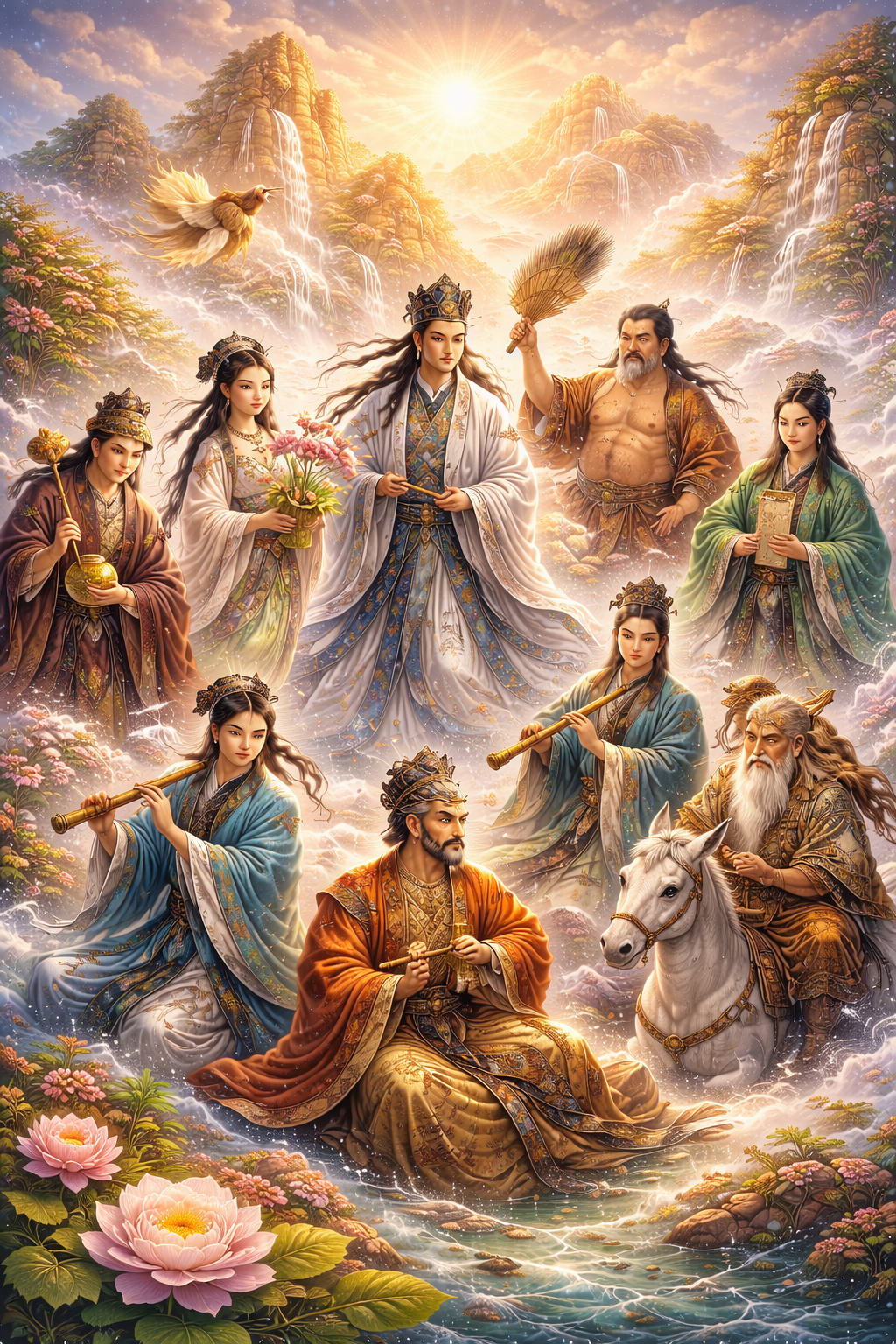
The transmitted and later religious archive does not present the Eight Immortals as a single fixed group from the earliest period. That is an important point of interpretation. The ensemble became one of the best-known groups in Daoist legend, but the list of members varied before becoming relatively stable in later tradition. What matters historically is not the illusion of an original frozen canon, but the process by which individual immortal figures such as Zhongli Quan, Lü Dongbin, Li Tieguai, Zhang Guolao, Han Xiangzi, Cao Guojiu, He Xiangu, and Lan Caihe came to be gathered into a single iconic set. That process is itself revealing. Chinese popular religion did not simply inherit one ready-made supernatural fellowship; it assembled one, and in doing so created one of the most enduring symbolic communities in the whole tradition.
This article therefore treats the Eight Immortals as a layered ensemble rather than as a single ancient doctrine. Their importance lies in formation, circulation, recognition, and use. They belong to Daoist immortality traditions, but also to theater, painting, porcelain, embroidery, domestic objects, festival imagery, vernacular storytelling, and the visual grammar of blessing. Their group identity is powerful because it allows transcendence to appear not as sameness, but as fellowship across difference.
Who Are the Eight Immortals?
The Eight Immortals, baxian 八仙, are among the most widely recognized figures in Chinese religious legend. In later standard form, the group usually includes Zhongli Quan, Lü Dongbin, Li Tieguai, Zhang Guolao, Han Xiangzi, Cao Guojiu, He Xiangu, and Lan Caihe. Yet the importance of the group lies in more than membership. They are imagined as a fellowship of transcendents whose lives, bodies, temperaments, and symbolic objects differ sharply from one another.
Some are associated with poverty or beggar-like wandering; some with official rank; some with youth; some with old age; some with disability or bodily rupture; some with ambiguous gender presentation; some with medicine, music, wine, poetry, moral conversion, swordsmanship, or ecstatic detachment. The group’s richness comes from this variety. Immortality is not represented by one perfected body repeated eight times. It is distributed across multiple forms of human difference.
This range is crucial. The Eight Immortals are not compelling because they erase difference within one celestial sameness. They are compelling because they preserve difference inside transcendence. Immortality here is not restricted to one noble body, one moral temperament, one gender, one social station, one age, or one form of beauty. It can appear through eccentricity, brokenness, poverty, office, learning, music, feminine discipline, comic wandering, and refusal of ordinary expectations.
The group therefore functions as a popular theology of plurality. It suggests that transcendence may be approached from many forms of life. The immortal world is not socially narrow. It is a fellowship in which different human types become signs of a larger Daoist possibility: the transformation of ordinary limitation into sacred difference.
Why This Group Became So Popular
The Eight Immortals became so popular because they unite several cultural advantages at once. As a group, they are visually memorable. As individuals, they are distinct. As supernatural figures, they are accessible enough for storytelling and theater. As Daoist immortals, they retain a connection to the larger religious imagination of transcendence, but they do so in a form that can circulate easily through vernacular culture. They can appear in temples, paintings, operas, porcelain, textiles, carved objects, festival images, birthday scenes, and household decoration without requiring long doctrinal explanation.
Popularity here should not be mistaken for superficiality. The Eight Immortals thrive because they offer a socialized supernatural world. Unlike a distant high metaphysics, they can be dramatized, recognized, and enjoyed. Their immortality is serious, but also theatrical; sacred, but also comic; religious, but also decorative; Daoist, but also deeply popular. Their appeal lies in the successful domestication of transcendence without eliminating its wonder.
The group’s popularity also comes from its balance of unity and difference. Each immortal has a recognizable identity, but the ensemble is stronger than the sum of its members. The eight form a portable community. They can be depicted together, separated into smaller combinations, reduced to their attributes, inserted into festive scenes, or expanded into narratives of travel, contest, and divine encounter. This adaptability allowed them to thrive across media.
Another reason for their popularity is emotional accessibility. The Eight Immortals are not all remote, perfect, solemn beings. Some are humorous, eccentric, flawed, excessive, marginal, or socially strange. Their stories often contain testing, conversion, disguise, trickery, moral awakening, or bodily transformation. They do not present transcendence as sterile perfection. They make immortality narratively human.
Plural Immortality and the Social Range of Transcendence
One of the most remarkable features of the Eight Immortals is the way they broaden the social imagination of immortality. In Daoist thought more broadly, immortality might be associated with elite adepts, alchemists, mountain recluses, perfected masters, ritual specialists, or celestial officials. The Eight Immortals retain something of that world, but they also redistribute it across a much wider range of types.
Li Tieguai appears as a crippled beggar-healer. Cao Guojiu brings courtly rank and moral reform into the immortal register. He Xiangu appears as the sole woman in the later standard group. Lan Caihe destabilizes ordinary gender coding and social decorum. Zhang Guolao embodies eccentric old age and paradoxical transport. Han Xiangzi is associated with youthful refinement, music, and cultivated marvel. Zhongli Quan appears as an older master of abundance, initiation, and transformation. Lü Dongbin becomes the most culturally expansive of all: scholar, swordsman, teacher, patriarch, exorcist, poet, and popular object of devotion.
This plurality matters because it implies that transcendence is not monopolized by one social form. The supernatural imagination here becomes socially generous. It allows the poor, the wandering, the deformed, the eccentric, the refined, the official, the ambiguous, the aged, and the youthful all to stand inside the horizon of immortality.
That generosity is not modern egalitarianism in a direct political sense, but it is still significant. The Eight Immortals resist the idea that sacred attainment belongs only to elite bodies or socially approved appearances. Their very composition expands the religious imagination. The path to transcendence may pass through court life, poverty, sickness, gender nonconformity, music, scholarship, wandering, moral failure, bodily loss, or ecstatic foolishness. The group says: the Dao may find many vessels.
The Eight Immortals as Popular Daoist Types
The Eight Immortals can be read as a set of popular Daoist types through which the supernatural becomes narratively legible. Li Tieguai represents the paradox of sanctity in broken embodiment. Cao Guojiu brings court rank, moral discipline, and the possibility of reform into the immortal register. Lan Caihe destabilizes ordinary categories of identity, wealth, gender, and decorum. He Xiangu brings feminine transcendence into a group otherwise dominated by men. Han Xiangzi offers the elegance of youthful magical accomplishment and musical cultivation. Zhang Guolao embodies eccentric longevity and paradoxical movement. Zhongli Quan represents archaic mastery, abundance, initiation, and genial power. Lü Dongbin often stands at the center as the literate and missionary immortal who moves between elite culture and mass devotion.
This typological richness is one reason the group works so effectively in popular religion. Each immortal can carry a distinct symbolic charge, and together they create a supernatural ensemble capable of speaking across social strata. They are not simply eight names. They are a map of recognizable possibilities within the religious imagination.
The type-system also makes the group easy to remember and transmit. Each immortal’s body, attribute, personality, or story functions almost like an iconographic shorthand. A crutch, fan, sword, flute, lotus, tablet, donkey, or basket can evoke a whole figure. This makes the group exceptionally suitable for visual culture. Their identities can be condensed into objects.
At the same time, the Eight Immortals are more than icons. Their stories move. They cross seas, attend banquets, test humans, perform miracles, confront demons, intervene in crisis, and reveal hidden wisdom through humor or disruption. They are types, but they are also dramatic agents. This combination of symbolic clarity and narrative mobility explains much of their longevity.
The Eight Figures and Their Symbolic Personalities
Zhongli Quan is often represented as an older, round-bellied immortal carrying a fan, associated with alchemical power, transformation, and the initiation of Lü Dongbin. His presence suggests old mastery, abundance, and the ability to transform the conditions of life. He is often genial, but not trivial: the fan can revive the dead or transform matter, making it a sign of life-renewing power.
Lü Dongbin is perhaps the most famous of the Eight. He is scholar, swordsman, exorcist, poet, teacher, and Daoist patriarch. His sword may cut through demons, illusions, or attachments. His prominence shows how the Eight Immortals connect popular religion with more formal Daoist lineages, internal alchemy, moral cultivation, and literati culture.
Li Tieguai, the iron-crutch immortal, is one of the group’s most powerful figures because his body is marked by disability, poverty, and marginality. He is often shown with a crutch and gourd, and he is associated with healing. His sanctity appears through a body the ordinary world might reject. He makes brokenness part of transcendence.
Zhang Guolao is an eccentric elder often associated with a magical donkey, which in some traditions can be folded like paper when not in use. His figure dramatizes paradox, old age, humor, and the strange logic of immortal travel. He is a reminder that immortality is not always solemn; it may be playful and absurd.
Han Xiangzi is associated with the flute, music, and cultivated refinement. He is often connected to the world of literary culture through traditions involving Han Yu. His immortality is musical, elegant, and transformative rather than physically imposing. Through him, art and transcendence meet.
Cao Guojiu brings court rank into the ensemble. Often shown with castanets or a jade tablet, he represents the possibility that official life, moral failure, and social privilege can be redirected toward Daoist transcendence. His presence prevents the group from being only marginal or anti-institutional; the court too can be drawn into the immortal imagination.
He Xiangu is the sole woman in the later standard group and is often associated with a lotus, ladle, or basket. Her presence is crucial because she gives female immortality a visible place inside the ensemble. She is not merely decorative; she represents the possibility of disciplined, luminous, feminine transcendence within a group otherwise dominated by male figures.
Lan Caihe is among the most intriguing members because of gender ambiguity, eccentric poverty, singing, and flower-basket imagery. Lan often appears as a wandering performer or holy fool, a figure whose identity resists ordinary classification. Through Lan Caihe, immortality becomes linked to social looseness, performative strangeness, and the refusal of stable worldly identity.
Together, these figures form a social map of transcendence. They show that the immortal is not one thing. The immortal may teach, heal, wander, play music, hold office, reject convention, bear disability, embody feminine power, or move between categories. The group’s power lies in its refusal of uniformity.
Attributes, Emblems, and the Visibility of the Sacred
Each of the Eight Immortals is identifiable through a distinctive attribute or set of attributes, and these emblems are central to their popularity. The crutch and gourd of Li Tieguai, the bamboo drum or magical donkey of Zhang Guolao, the sword of Lü Dongbin, the lotus or ladle associated with He Xiangu, the flower basket or musical implements of Lan Caihe, the tablet or castanets of Cao Guojiu, the fan of Zhongli Quan, and the flute associated with Han Xiangzi all make the supernatural immediately visible. One does not need a theological treatise to recognize them. Their objects make recognition fast, and recognition makes devotion mobile.
This visible emblematic structure matters because it turns transcendence into iconographic literacy. The popular religious imagination does not depend only on doctrine. It depends on forms that can be seen, repeated, embroidered, carved, painted, printed, performed, and staged. The attribute is what allows the immortal to travel through art and performance without losing identity.
The attributes also condense religious meaning. Li Tieguai’s gourd may suggest medicine, healing, and hidden potency. Lü Dongbin’s sword may suggest exorcism, discernment, and the cutting away of illusion. Zhongli Quan’s fan may suggest revival, transformation, or command over life force. Han Xiangzi’s flute turns sound into spiritual refinement. He Xiangu’s lotus evokes purity and feminine transcendence. Lan Caihe’s basket carries wandering, flowers, performance, and instability. Cao Guojiu’s tablet or courtly emblem recalls official rank and moral correction. Zhang Guolao’s donkey suggests impossible transport and comic paradox.
In many visual contexts, the attributes alone may stand for the immortals. This creates a second-order symbolic system: not only the Eight Immortals, but the “Eight Treasures” or attributes associated with them. The objects become portable sacred abbreviations. They allow a bowl, textile, carving, painting, or domestic object to invoke the entire immortal fellowship through signs rather than full figures.
Crossing the Sea and the Logic of Individual Powers
One of the most famous story patterns associated with the Eight Immortals is their crossing of the sea, often summarized in the proverb: “The Eight Immortals cross the sea; each reveals divine power.” The story matters because it gives narrative form to the group’s central logic. The immortals are a fellowship, but each member possesses a distinct power, method, emblem, or style. Unity does not erase difference. The group crosses together, but each crosses in a different way.
This is one reason the sea-crossing motif became so enduring. It dramatizes the visible function of the attributes. Each object becomes a vehicle, technique, or manifestation of spiritual potency. The fan, sword, gourd, lotus, basket, instrument, tablet, or mount is no longer merely identifying decoration. It becomes active power. Iconography becomes narrative.
The sea is also symbolically important. Water in Chinese mythic imagination often marks danger, passage, transformation, distance, and the boundary between ordinary and extraordinary worlds. To cross the sea is to cross into a space where ordinary human methods may fail. The immortals succeed because each carries a distinct relation to the supernatural. The crossing therefore becomes an image of plural pathways through danger.
The proverb’s popularity also shows how deeply the Eight Immortals entered everyday language. It can be used beyond religious contexts to mean that different people show their abilities in different ways. This is one of the group’s most important cultural achievements: Daoist supernatural imagery becomes a general social metaphor for plural competence.
The Queen Mother of the West and the Banquet of Immortals
One of the most important later settings for the Eight Immortals is the celestial celebration of the Queen Mother of the West. Museum records preserve visual traditions in which the Eight Immortals and the God of Longevity gather to celebrate the birthday of Xiwangmu. This association matters because it locates the group within the larger paradise world of the western Queen Mother, peaches of immortality, sacred festivity, celestial procession, and immortal courtly life.
The banquet setting transforms the group from an aggregate of individuals into a celestial society. They are no longer only separate immortals with separate stories; they are participants in an immortal courtly event. The supernatural imagination here becomes festive and relational. Immortality is not solitary abstraction. It is community, celebration, recognition, and shared presence before a higher western sovereign.
This connection also links the Eight Immortals to the broader symbolic geography of the west. Xiwangmu’s paradise is a realm of immortality, banquet, peaches, and divine authority. When the Eight Immortals appear in relation to her birthday or court, they are placed inside one of the most enduring sacred landscapes of Chinese mythology. Their popular accessibility is joined to the older prestige of western paradise.
The birthday setting is especially important because it connects immortality to celebration. Daoist transcendence can be technical, austere, secretive, and difficult, but the Eight Immortals also show immortality as festivity. Their presence at Xiwangmu’s celebration turns deathlessness into a social and visual joy: procession, salute, offering, gathering, and auspicious display.
Theater, Storytelling, and the Circulation of the Eight Immortals
The Eight Immortals achieved exceptional cultural reach because they circulate easily through theater and storytelling. Their distinct costumes, voices, props, personalities, and powers make them ideal dramatic figures. They can appear together or separately, in comic, didactic, miraculous, festive, romantic, or exorcistic modes. The group’s popularity in popular narrative stems partly from this performative adaptability. Each member is individually legible, but the ensemble produces even stronger recognition when assembled.
This dramatic quality helps explain why the Eight Immortals became so widely loved. They are not static icons. They are characters. They speak, intervene, deceive, bless, teach, travel, banter, expose hypocrisy, convert the misguided, confront demons, and reveal power through socially intelligible action. Popular religion is strengthened when the divine can be dramatized, and the Eight Immortals are among the finest examples of this principle.
Theater also allows the immortals to move across social boundaries. An elite viewer may recognize Daoist lineages and literary allusions; a popular audience may enjoy jokes, songs, costumes, and miraculous reversals; a child may recognize the attributes; a household may keep their image for blessing. The same figures can function at many levels of culture at once.
Storytelling further expands this reach by giving each immortal a biography. The ensemble is not only a list. Each figure may have a conversion story, test, failure, bodily crisis, encounter with a master, miracle, or moral lesson. These stories make transcendence narratively plausible. The immortal is not only a heavenly type; the immortal has a path.
Lü Dongbin and the Centrality of the Immortal Master
Among the Eight Immortals, Lü Dongbin occupies a special position. He became highly revered in Daoist tradition, especially from the Song period onward, and later traditions associated him with internal alchemy, Quanzhen religion, exorcistic power, moral teaching, and popular devotion. This gives him unusual importance because he links the more elite, textual, and internal-cultivation strands of Daoism with the more public, popular, and miraculous world in which the Eight Immortals flourish.
Lü Dongbin’s prominence helps clarify the religious depth of the group. The Eight Immortals are not simply folk mascots of good fortune. At least some of them, and above all Lü, remain anchored in real lineages of devotion, doctrine, moral teaching, and practice. Their popularity does not cancel their religious seriousness. It multiplies its forms.
Lü’s sword is especially important. It is not only a weapon in the ordinary sense. It can signify exorcism, spiritual discernment, the cutting away of illusion, and mastery over demonic or chaotic forces. As a scholar-immortal, Lü joins literate culture with supernatural authority. As a swordsman, he joins refinement with force. As a teacher, he joins individual transcendence with transmission.
He also helps bridge Daoist immortality and popular salvation. Stories of Lü often involve encounters with ordinary people, tests of character, dreamlike revelation, moral instruction, or intervention in human affairs. The immortal master is not sealed away from the world. He moves through it, sometimes disguised, sometimes stern, sometimes playful, sometimes salvific. Through Lü Dongbin, Daoist transcendence becomes pedagogical and public.
Gender, Deformity, Office, Poverty, and the Democratization of Transcendence
The Eight Immortals are important because they democratize transcendence. He Xiangu brings female immortality into a highly visible group. Lan Caihe’s identity remains unresolved enough in tradition that the figure has long challenged stable gender coding. Li Tieguai’s broken body refuses the assumption that beauty, symmetry, or bodily wholeness is a prerequisite for sanctity. Cao Guojiu introduces official rank, while other members bring poverty, eccentricity, musical refinement, age, or marginality. The group thereby distributes the supernatural across bodies and stations that ordinary hierarchy would separate.
This democratizing effect is one of the deepest reasons for the group’s popularity. The religious imagination becomes more generous when perfection is not uniform. The Eight Immortals suggest that transcendence may arrive through forms of life that the ordinary world undervalues, mistrusts, or misunderstands. In this way, they are not merely supernatural celebrities. They are a critique of narrow human ranking.
That critique is not always explicit, but it is structurally present. A court official and a beggar stand in the same immortal fellowship. A woman and a gender-ambiguous wanderer stand among male adepts. A broken body carries healing power. An eccentric elder becomes a holy figure. A musician and a scholar share sacred space. The ensemble imagines a celestial society more varied than ordinary respectability permits.
The group therefore matters for marginalized and non-normative forms of life within the mythic imagination. It does not dissolve hierarchy completely, and it remains shaped by older cultural assumptions, but it opens symbolic room. The path to sacred transformation is not reserved for the conventionally powerful, beautiful, male, able-bodied, or elite. That is one reason the Eight Immortals remain so emotionally durable.
He Xiangu and Female Immortality
He Xiangu’s presence in the group is essential because she gives female immortality an unmistakable place within one of Chinese religion’s most visible supernatural ensembles. She is often represented as graceful, luminous, and associated with a lotus, ladle, or basket. Yet her significance should not be reduced to decorative femininity. She represents the possibility that women too may enter the immortal horizon, cultivate transformation, and stand as sacred figures within a Daoist-popular world.
Her presence is especially important because many Daoist and popular religious traditions are transmitted through male figures, male teachers, male officials, and male ritual specialists. He Xiangu’s inclusion does not erase those broader gender structures, but it complicates them. The immortal fellowship cannot be narrated as wholly male. Female transcendence is visible, named, and iconographically stable.
The lotus associated with He Xiangu adds further meaning. As an image of purity rising from mud, the lotus belongs to a broader East Asian symbolic world of refinement, spiritual elevation, and unstained emergence. In her hands, the lotus becomes not only a floral emblem but an image of female spiritual attainment. It makes her visually recognizable and morally charged.
He Xiangu also helps connect the Eight Immortals with other powerful female figures in Chinese myth and religion, including Xiwangmu, Nüwa, Mazu, Chang’e, and White Snake. She is less cosmically sovereign than Xiwangmu and less mythically foundational than Nüwa, but her presence is no less important for popular religion. She brings feminine immortality into the everyday visual and devotional world.
Lan Caihe and the Instability of Social Categories
Lan Caihe is one of the most fascinating members of the Eight Immortals because the figure resists stable classification. Often represented as a wandering singer or eccentric performer carrying a flower basket, Lan appears in ways that can blur gender, age, wealth, sanity, and social propriety. This instability is not incidental. It is central to the figure’s religious and folkloric power.
Lan Caihe shows that transcendence may appear as social looseness. The holy person is not always disciplined into conventional respectability. Sometimes the immortal is a fool, performer, beggar, singer, or figure whose conduct makes ordinary people uncertain how to respond. Such figures are common in religious traditions because they expose the fragility of social categories. They ask whether sanity, status, gender, wealth, and decorum are reliable measures of spiritual truth.
The flower basket is a fitting emblem. Flowers are beautiful but temporary; they bloom and fade. In Lan’s hands, they become signs of impermanence, play, and fragile beauty. The basket is portable, modest, and performative. It belongs to the street rather than the palace. Lan Caihe’s immortality therefore does not look like courtly sovereignty. It looks like wandering excess and unpredictable song.
This makes Lan especially important for reading the Eight Immortals as a socially expansive ensemble. Lan’s ambiguity pushes the group beyond simple moral types. The immortal world includes figures who disturb ordinary social recognition. Transcendence may not only perfect identity; it may loosen identity altogether.
Li Tieguai and the Sacrality of the Broken Body
Li Tieguai, the iron-crutch immortal, is one of the most powerful figures in the group because his sanctity appears through bodily rupture. He is often represented as lame, disheveled, poor, or beggar-like, carrying a crutch and gourd. In some traditions, his broken body results from a soul-journey gone wrong: his spirit leaves his body, the body is destroyed or unavailable, and he must enter another form. However the details vary, the symbolic result is clear. Sacred power does not require a conventionally beautiful or whole body.
This is a profound religious image. The ordinary world often ranks bodies according to beauty, strength, symmetry, health, status, and usefulness. Li Tieguai overturns that ranking. His broken form becomes the vessel of healing and immortal power. The body that might be pitied, feared, mocked, or excluded becomes holy.
His gourd reinforces this meaning. The gourd is a container of medicine, hidden space, healing, and magical potency. It suggests that power may be carried in humble form. Like Li’s body, the gourd does not appear grand in an imperial sense, yet it contains extraordinary capacity. Beggar form and medicinal potency belong together.
Li Tieguai therefore gives the Eight Immortals one of their strongest ethical dimensions. The sacred may appear where ordinary respectability refuses to look. Disability, poverty, and marginality do not exclude transcendence. In the popular religious imagination, they may become its very signs.
The Eight Immortals in Visual Culture and Popular Devotion
The Eight Immortals have had an enormous presence in visual culture. Museum collections preserve works showing individual figures such as He Xiangu and Zhang Guolao, as well as group scenes connected to the Queen Mother of the West’s birthday celebration. Decorative objects, carved wrist rests, ceramics, embroideries, textiles, paintings, and household items confirm that the group was not confined to texts or temples. They entered domestic art, gift culture, luxury objects, festive imagery, and everyday auspicious display.
This diffusion into objects is crucial. Popular devotion often becomes durable when figures can be kept close: on vessels, in rooms, on textiles, at birthdays, in performances, in temple iconography. The Eight Immortals survive so powerfully because they are not merely remembered. They are continuously pictured.
Visual culture also allows the group to function without full narrative explanation. A viewer may not know every episode associated with each immortal, but the attributes and ensemble remain recognizable. The image itself becomes a carrier of blessing, memory, and cultural identity. The Eight Immortals can therefore circulate across literacy levels. They do not require access to classical texts in order to be meaningful.
Their visual life is especially important in the context of birthdays and longevity wishes. Immortals naturally belong to celebrations of long life. Their presence on gifts, panels, textiles, and decorative objects turns religious narrative into auspicious wish. The immortal fellowship becomes a blessing for the recipient: may life be long, protected, joyful, and touched by extraordinary fortune.
The Eight Immortals and the Everyday Religious Imagination
The Eight Immortals matter not only because they are famous, but because they show how religious imagination becomes everyday culture. Their images can appear in temples, but also on objects used in domestic, festive, or decorative contexts. Their stories can be religious, but also theatrical, comic, moral, or entertaining. Their names belong to Daoist legend, but their attributes become widely recognized visual signs. In this way, the group moves easily between devotion and culture.
This movement is central to popular religion. Sacred figures survive most powerfully when they can be invoked in many settings. The Eight Immortals can bless a birthday, decorate a vase, appear in opera, cross the sea in storytelling, attend Xiwangmu’s banquet in embroidery, or serve as symbols of plural talent in everyday speech. They become part of a shared symbolic language.
The group also makes transcendence socially near. High Daoist metaphysics may be difficult; internal alchemy may be esoteric; ritual registers may be specialized; mountain cultivation may be remote. The Eight Immortals translate those worlds into persons. They provide faces, objects, gestures, and stories through which ordinary people can imagine contact with immortal life.
This does not make them less religious. It makes them more culturally powerful. The Eight Immortals show how Daoist supernatural imagination becomes durable by becoming recognizable. The sacred enters the household through familiarity, and familiarity does not necessarily destroy wonder. It can preserve it.
Source History and Interpretive Caution
A careful reading of the Eight Immortals must distinguish between individual immortal traditions and the later consolidation of the group. It must also distinguish among hagiographic, devotional, theatrical, artistic, encyclopedic, and museum sources. The ensemble did not appear in a perfectly fixed form from the start. It stabilized through transmission, popular circulation, visual repetition, and devotional use. That development is not a defect. It is part of the history of the symbol.
One should therefore avoid searching for one pristine origin behind the entire group. The more illuminating question is how and why these specific figures came to be assembled into a single, enduring fellowship. The answer lies in the success of a form: diverse immortals, visually legible, theatrically adaptable, socially inclusive, and religiously resonant.
It is also important not to reduce the Eight Immortals to decorative folklore detached from Daoism. Their popularity and humor do not make them shallow. They belong to a larger religious field of immortality, transformation, sacred objects, paradise, inner cultivation, and Daoist transcendence. At the same time, they should not be treated only as elite religious doctrine. Their power lies precisely in their popular circulation.
Finally, the group should be read with sensitivity to gender, class, body, and marginality. He Xiangu, Lan Caihe, Li Tieguai, Cao Guojiu, and the other immortals do not merely fill slots in a list. They represent different ways that sacred power can inhabit human difference. The ensemble’s enduring appeal comes from the fact that it makes transcendence plural, social, and visually accessible.
Why the Eight Immortals Still Matter
The Eight Immortals still matter because they make transcendence socially imaginable. They show that immortality in Chinese tradition is not only a solitary mystical achievement, a hidden alchemical discipline, or a remote theological abstraction. It can also appear as fellowship, festival, icon, story, performance, and type. The supernatural becomes humanly varied without ceasing to be wondrous.
They also matter because they reveal one of the deepest strengths of Chinese popular religion: its ability to gather complex religious worlds into durable, widely recognized, symbolically rich ensembles. Under the sign of the Eight Immortals, Daoist transcendence becomes memorable, portable, and public. It can be sung, staged, gifted, painted, invoked, and recognized.
The Eight Immortals matter, too, because they preserve a generous religious anthropology. They do not imagine sacred transformation through one ideal body alone. The immortal may be female, gender-ambiguous, old, poor, broken-bodied, courtly, musical, scholarly, foolish, comic, or strange. This is one of the group’s greatest gifts: it gives transcendence many faces.
Finally, they matter because they connect several major themes of Chinese mythology: Daoism, immortality, Xiwangmu’s paradise, sacred attributes, popular devotion, theater, visual art, and the transformation of ordinary life into symbolic possibility. The Eight Immortals are indispensable because they show how the highest hopes of Daoist supernatural imagination entered the shared world of popular culture.
Related Reading
- Chinese Myth, Folklore & Legend
- What Is Chinese Myth, Folklore & Legend?
- The Problem of Sources in Chinese Mythology
- Daoism, Immortality, and the Supernatural Imagination
- Kunlun, Paradise Mountains, and the Sacred Geography of the West
- The Queen Mother of the West and the Imagery of Immortality
- Animals, Omens, and Symbolic Creatures in Chinese Folk Imagination
- East Asian Traditions
Primary Sources
- Chinese Text Project (n.d.) Taiping guangji: Baxiantu 太平廣記:八仙圖 / Eight Immortals Painting. Available at: https://ctext.org/taiping-guangji/215/baxiantu/ens
- Chinese Text Project (n.d.) Liexian zhuan 列仙傳 / Traditions of Ranked Immortals. Useful for the wider hagiographic background of Chinese immortals. Available at: https://ctext.org/liexian-zhuan
- Chinese Text Project (n.d.) Baopuzi: Lun xian 抱朴子:論仙 / On Immortals. Useful for Ge Hong’s explicit defense of immortals and the possibility of deathlessness. Available at: https://ctext.org/baopuzi/lun-xian/ens
- Chinese Text Project (n.d.) Baopuzi: Jin dan 抱朴子:金丹 / Golden Elixir. Useful for the alchemical background of Daoist immortality. Available at: https://ctext.org/baopuzi/jin-dan/ens
- Chinese Text Project (n.d.) Zhuangzi 莊子. Useful for early Daoist imagination of perfected persons, spirit-like persons, wandering, and release from ordinary limits. Available at: https://ctext.org/zhuangzi
- Chinese Text Project (n.d.) Soushen ji 搜神記 / Record of Searching for the Divine. Useful for the broader Chinese supernatural archive of spirits, marvels, and extraordinary persons. Available at: https://ctext.org/wiki.pl?if=en&res=839038
- Chinese Text Project (n.d.) entry on Lü Dongbin 呂洞賓. Useful for later religious and popular traditions surrounding Lü Dongbin. Available at: https://ctext.org/datawiki.pl?if=gb&res=186695
Further Reading
- Encyclopaedia Britannica (n.d.) “Baxian.” Available at: https://www.britannica.com/topic/Baxian
- Chinese Text Project (n.d.) Taiping guangji: Baxiantu. Available at: https://ctext.org/taiping-guangji/215/baxiantu/ens
- Chinese Text Project (n.d.) entry on Lü Dongbin. Available at: https://ctext.org/datawiki.pl?if=gb&res=186695
- The Metropolitan Museum of Art (n.d.) “Panel with immortals.” Available at: https://www.metmuseum.org/art/collection/search/68527
- The Metropolitan Museum of Art (n.d.) “Figure of He Xiangu, one of the Eight Immortals.” Available at: https://www.metmuseum.org/art/collection/search/45982
- The Metropolitan Museum of Art (n.d.) “Figure of Zhang Guolao (one of the Eight Immortals).” Available at: https://www.metmuseum.org/art/collection/search/47868
- The Metropolitan Museum of Art (n.d.) “Wrist rest with the Eight Immortals.” Available at: https://www.metmuseum.org/art/collection/search/42542
- Pregadio, F. (ed.) (2008) The Encyclopedia of Taoism. London: Routledge.
- Kohn, L. (2000) Daoism Handbook. Leiden: Brill.
- Campany, R.F. (2002) To Live as Long as Heaven and Earth: A Translation and Study of Ge Hong’s Traditions of Divine Transcendents. Berkeley: University of California Press.
- Campany, R.F. (2009) Making Transcendents: Ascetics and Social Memory in Early Medieval China. Honolulu: University of Hawai‘i Press.
- Werner, E.T.C. (1922) Myths and Legends of China. London: George G. Harrap & Co. Available at: https://archive.org/details/mythslegendsofch00wern
- Yang, L. and An, D. (2005) Handbook of Chinese Mythology. Santa Barbara: ABC-CLIO. Available at: https://archive.org/details/handbookofchines0000yang
References
- Campany, R.F. (2002) To Live as Long as Heaven and Earth: A Translation and Study of Ge Hong’s Traditions of Divine Transcendents. Berkeley: University of California Press.
- Campany, R.F. (2009) Making Transcendents: Ascetics and Social Memory in Early Medieval China. Honolulu: University of Hawai‘i Press.
- Chinese Text Project (n.d.) Baopuzi: Jin dan. Available at: https://ctext.org/baopuzi/jin-dan/ens
- Chinese Text Project (n.d.) Baopuzi: Lun xian. Available at: https://ctext.org/baopuzi/lun-xian/ens
- Chinese Text Project (n.d.) entry on Lü Dongbin. Available at: https://ctext.org/datawiki.pl?if=gb&res=186695
- Chinese Text Project (n.d.) Liexian zhuan. Available at: https://ctext.org/liexian-zhuan
- Chinese Text Project (n.d.) Soushen ji. Available at: https://ctext.org/wiki.pl?if=en&res=839038
- Chinese Text Project (n.d.) Taiping guangji: Baxiantu. Available at: https://ctext.org/taiping-guangji/215/baxiantu/ens
- Chinese Text Project (n.d.) Zhuangzi. Available at: https://ctext.org/zhuangzi
- Encyclopaedia Britannica (n.d.) “Baxian.” Available at: https://www.britannica.com/topic/Baxian
- Kohn, L. (2000) Daoism Handbook. Leiden: Brill.
- Pregadio, F. (ed.) (2008) The Encyclopedia of Taoism. London: Routledge.
- The Metropolitan Museum of Art (n.d.) “Figure of He Xiangu, one of the Eight Immortals.” Available at: https://www.metmuseum.org/art/collection/search/45982
- The Metropolitan Museum of Art (n.d.) “Figure of Zhang Guolao (one of the Eight Immortals).” Available at: https://www.metmuseum.org/art/collection/search/47868
- The Metropolitan Museum of Art (n.d.) “Panel with immortals.” Available at: https://www.metmuseum.org/art/collection/search/68527
- The Metropolitan Museum of Art (n.d.) “Wrist rest with the Eight Immortals.” Available at: https://www.metmuseum.org/art/collection/search/42542
- Werner, E.T.C. (1922) Myths and Legends of China. London: George G. Harrap & Co. Available at: https://archive.org/details/mythslegendsofch00wern
- Yang, L. and An, D. (2005) Handbook of Chinese Mythology. Santa Barbara: ABC-CLIO. Available at: https://archive.org/details/handbookofchines0000yang