
Last Updated May 5, 2026
Ghosts and revenants occupy a central place in Chinese religious and folkloric imagination because the dead are not always imagined as fully settled, pacified, or successfully integrated into the moral order. Some return because they were wronged. Some linger because they were neglected. Some suffer because ritual obligations were not fulfilled. Some become dangerous because desire, grievance, violence, debt, improper burial, or broken kinship binds them to the world of the living. Chinese traditions of ghosts and revenants therefore do not treat the dead merely as shadows from another realm. They treat them as moral presences whose unrest reveals fractures in family, ritual, justice, memory, and social order.
This is why Chinese ghost traditions are rarely only stories of fear. They are also stories of obligation. A ghost may frighten the living, but its return often makes sense within a social and ethical framework. The dead return when something has been left unresolved: a murder concealed, a body unburied, an ancestor unfed, a promise broken, a lover abandoned, a debt unpaid, a ritual neglected, or a family line unable to care for its dead. In this world, haunting is not random. It is the supernatural form of unfinished relation.
Article Map
Chinese Myth, Folklore & Legend
Related Topic
Underworlds & Judges
Series context: This article is part of the Chinese Myth, Folklore & Legend knowledge series. It should be read alongside Underworlds, Judges, and the Bureaucracy of the Afterlife, Buddhism, Daoism, and the Recasting of Chinese Mythic Worlds, Daoism, Immortality, and the Supernatural Imagination, Animals, Omens, and Symbolic Creatures in Chinese Folk Imagination, and The Eight Immortals and the Popular Religious Imagination. Within that sequence, ghosts and revenants matter because they reveal the moral logic of the unsettled dead: a world in which improper endings do not simply disappear into silence, but return as pressure upon the living.
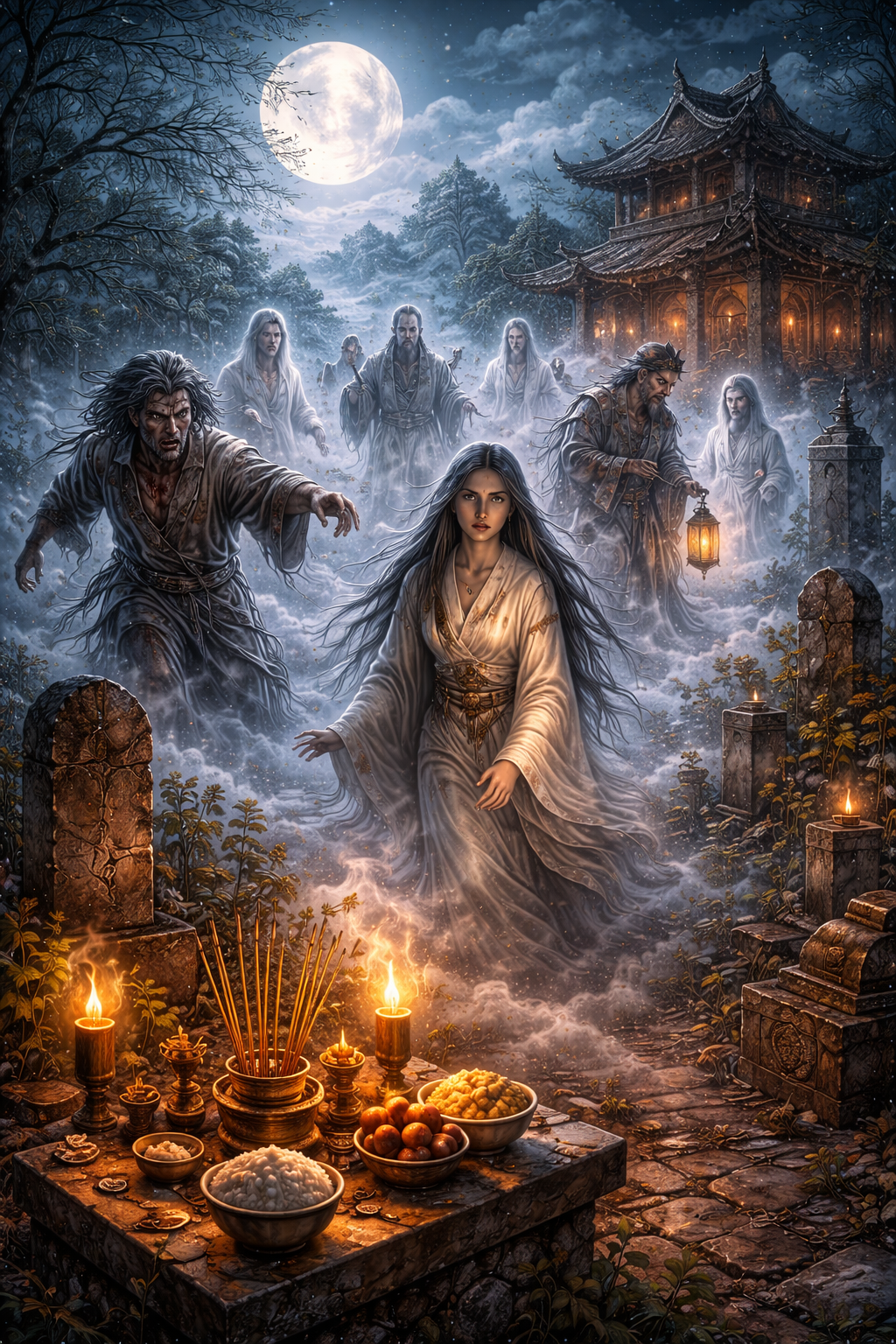
The Chinese archive preserves no single theory of ghosts. Instead, it preserves a broad spectrum of dead presences. Indigenous traditions distinguish between properly venerated ancestral spirits and troublesome ghosts. Buddhist and Daoist developments add further distinctions, including hungry ghosts, infernal judgment, karmic consequence, ritual rescue, registers of the dead, talismanic protection, and underworld administration. Strange-tale literature gives narrative body to these ideas by showing what happens when death is violent, burial is neglected, promises are broken, justice fails, or longing refuses to end. The result is one of the richest ghost traditions in world literature: a supernatural field structured not only by fear, but by ethics, memory, and unfinished obligation.
In these traditions, the dead are often most dangerous not when they are wholly alien, but when they remain socially intelligible. They return as parents, wives, scholars, monks, soldiers, lovers, creditors, victims, neglected ancestors, abandoned children, and the unjustly killed. Their familiarity intensifies their power. The ghost is frightening because it is not simply other. It is someone who should have been settled, remembered, judged, fed, buried, mourned, or avenged—but was not.
Why Ghosts Return
Ghosts return in Chinese tradition because something in the passage from life to death has failed to resolve. The dead may have suffered injustice, died violently, lacked descendants to care for them, been denied proper burial, or remained bound by grief, anger, desire, resentment, hunger, or unfinished obligation. Their return is therefore rarely arbitrary. It is intelligible within a moral and social framework. A ghost appears because a relationship has been broken, a duty neglected, or an injury left unredressed.
This intelligibility is one of the defining features of Chinese ghost lore. The ghost is not always a chaotic force erupting from outside the world of order. More often, it reveals where order was already damaged. The revenant exposes failure in kinship, ritual, law, governance, marriage, reciprocity, burial, memory, or social recognition. The supernatural becomes the form in which unresolved reality insists on being acknowledged.
Chinese ghost stories often begin where institutions fail. A magistrate fails to discover the truth. A family fails to perform proper rites. A community forgets a grave. A husband betrays a wife. A promise made to the dead is broken. A murdered person has no voice among the living. In such situations, the ghost becomes a second jurisdiction: a pressure from beyond the grave that forces the living world to revisit what it wanted to close.
That is why the return of ghosts is not only frightening but also meaningful. It suggests that death does not automatically settle moral accounts. A society may bury a body, but if the obligations surrounding that body remain unresolved, the dead may still be present. Haunting is the afterlife of failed responsibility.
Ancestors and Unsettled Dead
A crucial distinction in Chinese religious imagination is the difference between properly integrated ancestral spirits and wandering or troublesome ghosts. Ancestors belong within structures of remembrance, sacrifice, and lineage continuity. They are named, placed, honored, and ritually maintained. They have tablets, graves, descendants, offerings, anniversaries, and social location. They are dead, but not displaced.
Unsettled dead, by contrast, fall outside that stability. They roam, hunger, complain, afflict, intrude, or appear because they have not been properly situated within the moral and ritual order. They may lack descendants, burial, offerings, recognition, justice, or ritual closure. The problem is not death alone. It is bad settlement after death. To become an ancestor is to be socially incorporated. To become a ghost in the troubling sense is to remain displaced.
This distinction gives Chinese ghost traditions much of their force. The ghost is not simply a supernatural being. It is a failed ancestor, a dead person who has not been properly converted into a stable member of the remembered lineage or the wider moral cosmos. That failure may be caused by family neglect, social violence, poverty, war, travel, sudden death, suicide, injustice, or ritual breakdown. Whatever the cause, the ghost marks the point where death has not become peace.
This also explains why ritual care is so important. Offerings, burial, mourning, memorial rites, and seasonal observances are not merely gestures of affection. They are technologies of settlement. They help transform the dead from dangerous remainder into integrated presence. Without such care, the dead may remain hungry, angry, or socially homeless.
Gui, Shen, Hun, and Po
Chinese traditions use several terms for spirits, souls, and postmortem presences, and these terms do not always map neatly onto English words such as “ghost,” “soul,” or “demon.” Gui 鬼 can refer to a ghost or troublesome dead presence, while shen 神 often carries a more elevated sense of spirit, deity, or numinous agency. In some cosmological and religious traditions, the human person is also described through multiple soul-aspects, especially hun 魂 and po 魄, commonly associated with lighter, more yang spiritual aspects and heavier, more yin bodily aspects.
This vocabulary matters because Chinese ghost traditions are not built on a simple one-soul model. The dead may become ancestors, ghosts, hungry ghosts, infernal defendants, wandering spirits, local presences, or ritually transformed beings depending on context. A person’s postmortem fate may involve burial, ancestral integration, underworld judgment, karmic rebirth, ritual rescue, family offerings, or spirit management. The dead are not one thing.
The distinction between gui and shen also reveals a hierarchy of settlement and danger. A properly honored or elevated spirit may become protective, dignified, or ritually beneficial. A neglected or displaced ghost may become harmful, hungry, or resentful. The difference is not merely ontological. It is relational. The status of the dead depends on how they are remembered, placed, addressed, and integrated.
This is why Chinese ghost lore so often turns on ritual classification. Is this presence an ancestor, a demon, a hungry ghost, a wronged revenant, a local spirit, an illusion, or a deceitful anomaly? The answer determines the response. One does not treat every unseen being the same way. The religious problem is not only whether ghosts exist, but what kind of dead presence has appeared and what obligations it creates.
Revenants and the Demand for Justice
Many of the most powerful Chinese ghost stories are structured around wronged dead who return to demand justice. Murder victims, betrayed wives, slandered officials, monks killed unjustly, abandoned lovers, unpaid creditors, and others who suffered moral injury often reappear not merely to terrify, but to accuse. In such stories, the revenant acts as witness when human institutions fail. The dead return because the living have not adequately judged what happened.
This is one of the deepest moral functions of the revenant. The ghost becomes an instrument of delayed truth. Courts may fail, rulers may be corrupt, families may conceal wrongdoing, and communities may prefer silence. But the dead do not always accept erasure. Their return dramatizes the principle that injustice has consequences that outlive the event itself.
Revenant stories also expose a tension between official justice and supernatural justice. In a bureaucratic society, the court should discover truth, punish guilt, and restore order. Yet many stories begin from the failure of exactly that process. The revenant then becomes a witness from outside ordinary procedure, forcing the living court to reopen the case. The ghost is not anti-law. It appears because law has failed.
In this sense, Chinese revenants belong to the same moral world as underworld judges and infernal ledgers. They express the conviction that wrongdoing leaves traces. If human records are falsified, ghostly memory remains. If testimony is suppressed, the dead may speak. If the grave is closed too quickly, the revenant opens it again.
Hunger, Neglect, and Restless Spirits
Not all unsettled dead are revenants of grievance alone. Some are hungry, neglected, ritually abandoned, or socially unclaimed. In Buddhist and Daoist developments, hungry ghosts become emblematic of a condition in which desire remains intense but satisfaction is impossible. This image is religious, but it is also social. A dead person without offerings, descendants, ritual care, or proper remembrance may become a figure of deprivation and wandering. The ghost is hungry because relation has failed.
This theme gives Chinese ghost traditions an especially poignant structure. The dead may be fearsome, but they may also be pitiable. They suffer because they remain dependent on forms of care no longer adequately provided. Fear and compassion therefore coexist. The ghost is dangerous, but the danger often arises from neglect rather than pure malice.
Hunger also gives ghost stories a material intimacy. The dead need food, incense, paper money, clothing, ritual objects, lamps, prayers, merit, and remembrance. These needs make the boundary between living and dead socially active. A family meal, an offering table, a grave visit, or a festival altar becomes a point of contact with the unseen. The dead are not abstract. They are hungry.
This hunger may also extend beyond family. Ghost festivals often include care for the unclaimed dead, not only one’s own ancestors. This broadens ritual ethics. The neglected dead are not someone else’s problem. A society haunted by hungry ghosts is a society reminded that abandonment produces danger. Feeding the dead becomes a form of communal responsibility.
Ghosts in Early and Medieval Anecdotal Tradition
Early and medieval anecdotal collections give Chinese ghost lore much of its narrative shape. In these materials, ghosts appear on roads at night, enter houses, converse with travelers, seek redress, deceive the unwary, demand burial, reveal hidden crimes, or display truths inaccessible to ordinary human sight. Some stories portray the dead with surprising normality: they speak, reason, remember, negotiate, and maintain recognizable emotion. Others emphasize uncanny displacement, making the revenant both familiar and disturbingly altered.
What these traditions establish is the cultural normality of ghost encounter as a narrative form. The dead are not confined to theological abstraction. They enter anecdote, case history, moral tale, strange report, dream vision, courtroom revelation, romantic encounter, and warning story. The world of ghost stories thus becomes one of the major ways Chinese culture explored the unstable boundary between seen and unseen life.
These stories also often preserve a tone different from later horror fiction. The appearance of a ghost may be terrifying, but it may also be bureaucratic, domestic, legal, erotic, comic, or matter-of-fact. A ghost may appear not to shock the reader, but to explain why a burial must be corrected, why a murderer must be caught, why an offering is needed, or why a promise must be honored. The uncanny is practical.
This pragmatic quality is one of the strengths of Chinese ghost literature. The supernatural is not always distant from ordinary life. It interrupts roads, villages, bedrooms, archives, temples, graves, kitchens, courtrooms, and family spaces. Ghost stories show how the dead remain near the structures that once defined their lives.
The Soushen ji and the Search for the Divine
The Soushen ji, often translated as Record of Searching for the Divine or In Search of the Supernatural, is one of the most important early medieval collections for studying Chinese anomaly accounts, ghosts, spirits, marvels, and strange events. It does not present a systematic theology of ghosts. Instead, it preserves a world in which the extraordinary repeatedly breaks into ordinary life. The dead appear, spirits intervene, hidden causes are revealed, and the boundary between human and more-than-human remains porous.
The importance of the Soushen ji lies partly in its form. It gathers reports and anecdotes rather than constructing a single doctrinal argument. This gives the collection a documentary atmosphere, even when its contents are supernatural. Strange events are narrated as if they belong to the record of what happened. The result is a literary mode in which ghostly encounter becomes culturally reportable.
For ghost traditions, this matters because it shows how revenants entered moral memory. A ghost story could preserve a wrong, a warning, a ritual failure, or a sign of unseen order. The anecdote becomes a small archive of supernatural causality. It says: the world is stranger than ordinary perception admits, and the dead may still act within it.
The Soushen ji also helps show why Chinese ghost lore should not be separated too sharply from other supernatural traditions. Ghosts appear alongside deities, omens, transformations, anomalies, animals, immortals, and marvels. The category of ghost is part of a wider field of the strange. Death is one threshold among many.
The Taiping guangji and the Archive of Strange Encounter
The Taiping guangji, compiled in the Song period, is one of the great encyclopedic archives of Chinese strange tales. It preserves and organizes a vast range of earlier materials, including stories of ghosts, gods, demons, foxes, immortals, dreams, monks, Daoist adepts, animals, retribution, and uncanny events. For ghost studies, it matters because it shows how deeply revenant and ghost stories had entered the accumulated literary memory of imperial China.
The collection’s organization is itself revealing. Ghosts are not treated as isolated curiosities, but as part of a larger taxonomy of the strange. The archive gathers many kinds of abnormal or supernatural encounter and thereby makes the unseen world available for classification. In this sense, the Taiping guangji does for strange narrative what the bureaucratic underworld does for the dead: it orders the extraordinary.
Ghost tales in such collections preserve a wide emotional range. They may involve fear, justice, deception, longing, illness, ritual failure, sexual encounter, moral retribution, or comic reversal. The dead are not always solemn. Nor are they always evil. They are varied because the unresolved relations that produce haunting are varied.
The Taiping guangji also demonstrates the importance of transmission. Many ghost traditions survive because later compilers preserved earlier accounts, reclassified them, and inserted them into broader collections. The ghost story is therefore not only oral or local. It becomes archival. The unsettled dead enter literature’s own bureaucracy of memory.
The Liaozhai and the Literary Refinement of Ghosts
Pu Songling’s Liaozhai zhiyi, often known in English as Strange Tales from a Chinese Studio, represents one of the most refined later literary transformations of Chinese ghost and spirit traditions. In these stories, ghosts, fox spirits, revenants, demons, scholars, women, officials, monks, and ordinary households enter a world of moral ambiguity, erotic intensity, social critique, and narrative sophistication. Ghosts in the Liaozhai are rarely only frightful. They may be vulnerable, intelligent, loyal, wronged, seductive, morally superior to the living, or trapped within social structures that killed them.
This literary refinement matters because it shows how ghost traditions could become vehicles for psychological and social depth. A ghostly woman may reveal the injustice of gendered vulnerability. A revenant may expose the corruption of officials. A supernatural lover may critique hollow respectability. A dead presence may be more ethically alive than the living. The ghost becomes a literary instrument for testing the moral claims of ordinary society.
The Liaozhai also complicates the boundary between ghost and other spirit beings. Fox spirits, revenants, demons, and transformed beings often overlap in narrative function. The question is not always what category a being belongs to, but what its appearance reveals about desire, justice, hypocrisy, vulnerability, and recognition. The supernatural becomes a way of seeing social reality more sharply.
This is why later ghost literature remains so important. It carries older religious concerns into sophisticated narrative art. Ritual hunger, wrongful death, erotic attachment, family obligation, and moral witness all remain present, but they are transformed into stories of voice, agency, and critique. The ghost becomes a literary conscience.
The Dead as Moral Witnesses
Chinese ghost traditions repeatedly treat the dead as moral witnesses. A person may conceal a crime from neighbors, magistrates, or family, but not from the dead who suffered it. A ghost may reveal a murderer, expose betrayal, insist on proper burial, identify hidden documents, or draw attention to a grave. In this way, ghost lore supplements the moral imagination of courts and underworld judges. Not all justice waits for infernal bureaucracy. Sometimes the dead themselves intervene.
This witnessing function makes ghosts especially significant in a culture deeply concerned with record, accountability, and moral consequence. The ghost does not simply express irrational fear. It expresses the conviction that wrongdoing leaves traces and that the world is not as easily closed over as the guilty might wish.
The dead witness what the living refuse to see. This is one of the strongest ethical patterns in revenant stories. The murdered ghost knows the murderer. The abandoned ghost knows who failed in obligation. The unfed ghost knows who neglected rites. The betrayed ghost knows who broke faith. Ghostly knowledge is therefore not generalized omniscience. It is the knowledge of injury.
This is why ghost stories often carry the force of testimony. They give speech to those whose bodies were silenced. In this sense, the revenant is not only supernatural. It is juridical and moral. It returns because truth has not yet found a public form among the living.
Love, Desire, and the Return of the Dead
Not every ghost returns in rage. Chinese literature also preserves ghosts of longing, love, erotic attachment, unfinished marriage, and emotional fidelity beyond death. In some stories, the dead return to visit lovers, complete vows, continue bonds severed too soon, or experience a life denied to them before death. These narratives do not eliminate the uncanny, but they soften it through intimacy. The ghost becomes a figure of persistence in feeling as much as rupture in ontology.
This strand matters because it broadens the meaning of the unsettled dead. To be unsettled is not always to be criminally wronged or ritually abandoned. It may also mean that desire, devotion, grief, or emotional attachment has not been released. Ghostly return then becomes a language for the refusal of affection to end where the body ends.
Such stories can be tender, but they also remain ambivalent. A romance with a ghost may challenge social boundaries, threaten health, disrupt family order, or blur the difference between fidelity and dangerous attachment. Love across death is powerful because it is both beautiful and impossible. The ghost-lover embodies the hope that feeling survives, but also the danger that the dead may draw the living away from ordinary life.
In later literature, this tension becomes especially rich. A ghost may be more truthful than the living, more loyal than a spouse, more vulnerable than a demon, or more ethically alive than the respectable world that failed her. Desire becomes one of the ways the dead speak.
Women Ghosts and the Politics of Voice
Women ghosts occupy a particularly important place in Chinese ghost literature because many stories use the supernatural return of women to expose forms of vulnerability that ordinary social structures suppress. A woman may return after betrayal, wrongful death, forced marriage, sexual violence, abandonment, poverty, family coercion, or the denial of proper burial and remembrance. The ghostly body becomes a way for the silenced to speak after social power has failed them.
This does not mean every woman ghost story is liberating. Some reflect anxieties about female desire, sexuality, seduction, or disorder. But even those anxieties reveal how powerful the figure became. The woman ghost gathers fears around marriage, inheritance, erotic freedom, household stability, and male vulnerability. She can be demonized, romanticized, pitied, feared, or honored—but she is rarely insignificant.
In many stories, the woman ghost is not simply a threat to patriarchal order. She is evidence of its failures. She returns because she was not heard, protected, buried, remembered, or treated justly. Her haunting becomes a demand that the living acknowledge what was done to her. In that sense, the woman ghost functions as a witness to forms of suffering that official history might not preserve.
This is one reason Chinese ghost literature remains so important for reading marginalized voices. The dead speak where the living were denied speech. The revenant gives narrative form to suppressed memory. Even when the story is shaped by older gender assumptions, the ghost’s return can still reveal the moral cost of silencing.
Buddhism, Daoism, and the Religious Management of Ghosts
Buddhism and Daoism both reshaped Chinese ghost traditions by providing methods for understanding and managing the dead. Buddhism contributed karmic frameworks, hungry ghost doctrines, ritual rescue, merit transfer, monastic rites, underworld judgment, and festivals oriented toward feeding and relieving suffering spirits. Daoism contributed registers, talismans, exorcistic rites, spirit officials, ritual petitions, and complex unseen administrations that helped classify and control troubling presences. Together they transformed ghost lore from scattered fear into a more systematized religious field.
This development is crucial because ghosts in Chinese tradition are not only literary figures. They are ritual problems. Communities developed offerings, liturgies, exorcisms, petitions, memorial rites, seasonal observances, and protective practices precisely because the dead were imagined as active participants in the moral ecology of the world. Religion here does not abolish ghosts. It negotiates with them.
Buddhist and Daoist responses also show different but overlapping emphases. Buddhist rites often frame ghosts through karma, compassion, merit, rebirth, and the alleviation of suffering. Daoist rites often frame ghosts through registers, commands, talismans, celestial and terrestrial officials, and the restoration of cosmic order. In practice, communities could draw on both traditions. The ghost did not always respect doctrinal boundaries.
This shared management of ghosts is one of the clearest examples of Chinese religious pluralism. A troubling dead presence might require feeding, chanting, exorcism, petition, confession, burial correction, merit dedication, or local temple intervention. The response depends on the kind of ghost, the cause of unrest, and the ritual resources available. The unsettled dead created practical cooperation across religious systems.
Ghost Festivals, Offerings, and Ritual Appeasement
The Ghost Festival is one of the clearest examples of how Chinese culture ritualized relations with unsettled dead. Drawing on both Buddhist and Daoist traditions, the festival assumes that some dead suffer, wander, return, or require appeasement and that offerings of food, incense, ritual paper, lamps, chanting, and merit can alleviate their condition. The festival is not only about fear. It is about obligation toward the dead who might otherwise remain excluded from the care structures of kinship and religion.
This ritual dimension matters because it turns ghost belief into a public ethic of response. The dead are not ignored simply because they are troubling. They are fed, named, soothed, and acknowledged. The festival thus reveals a core feature of Chinese ghost logic: the proper answer to unrest is not always destruction. It may be care, propitiation, and ritual inclusion.
The Ghost Festival also broadens kinship ethics. It is not only one’s own ancestors who may need attention. Wandering, hungry, or abandoned ghosts may lack descendants or ritual support. Offerings to such beings extend care beyond the family line. In this way, ghost ritual becomes a form of social compassion toward the dead without households.
At the same time, appeasement is not sentimental. It recognizes danger. Hungry or neglected ghosts can afflict the living. Ritual feeding acknowledges that danger while redirecting it into a controlled and compassionate form. The festival therefore holds together fear and mercy, protection and generosity, household care and communal responsibility.
Exorcism, Talismans, and the Protection of the Living
Not every ghost can be settled through offerings alone. Some must be expelled, contained, exposed, commanded, or ritually transformed. Chinese traditions therefore developed a wide range of protective and exorcistic practices, including talismans, ritual documents, incantations, priestly rites, protective images, fire, noise, lamps, swords, mirrors, seals, and appeals to divine officials. These practices reveal a more forceful side of ghost management. The living must care for the dead, but they must also protect themselves from harmful presences.
Daoist ritual is especially important in this field because it often works through written authority. A talisman is not simply a magical drawing. It belongs to a world where writing, command, name, seal, office, and transmission carry sacred power. A ghost may be ordered, registered, released, or driven away through documents authorized by a ritual specialist. The unseen world is addressed through bureaucratic and scriptural forms.
Buddhist rites may likewise protect against ghosts through chanting, sutra recitation, merit transfer, invocation of bodhisattvas, and compassionate rescue. In Buddhist contexts, a ghost may be dangerous because it suffers. Relieving suffering can therefore also protect the living. The boundary between exorcism and compassion is not always sharp.
These practices show that ghost belief was socially practical. Ghosts were not only objects of storytelling. They were problems to be diagnosed and handled. The living needed ritual expertise because the dead could affect illness, dreams, family harmony, fortune, land, pregnancy, children, and social peace. The ghost was a religious reality because it entered lived vulnerability.
Fear, Skepticism, and the Problem of Belief
Chinese traditions also preserve skepticism about ghosts, omen claims, and supernatural reports. Some writers question excessive credulity, mock interpretive inflation, or seek more rational explanations for uncanny events. The Lunheng, for example, is important because it does not simply accept every ghost claim at face value. It preserves a critical strand within Chinese thought that asks whether fear, rumor, deception, misperception, or conventional belief has produced false conclusions.
Yet skepticism itself confirms the cultural prominence of ghost discourse. One does not argue extensively against what has no social force. Ghosts mattered enough to provoke doubt, critique, reinterpretation, and philosophical resistance. The debate over ghosts is therefore part of ghost culture, not external to it.
This tension is important. Chinese ghost culture is not a simple archive of unquestioned belief. It is a field of narration, interpretation, anxiety, ritual, doubt, and debate. The dead may be feared, pitied, doubted, explained away, or ritually addressed, but they remain central because they continue to gather unresolved moral and emotional questions around themselves.
The problem of belief also helps modern readers avoid two mistakes. One mistake is to treat ghost stories as literal evidence of uniform belief. Another is to dismiss them as superstition. The better approach is to ask what ghost stories do: how they preserve memory, negotiate fear, express grief, dramatize justice, manage death, protect the living, and give narrative form to social obligations that remain powerful after the body is gone.
Source History and Interpretive Caution
A careful reading of ghosts and revenants must distinguish among several source layers: early ritual distinctions between ancestors and ghosts; cosmological discussions of gui, shen, hun, and po; Buddhist hungry ghost and hell traditions; Daoist talismanic and exorcistic practices; anecdotal collections such as the Soushen ji; encyclopedic strange-tale collections such as the Taiping guangji; later literary works such as the Liaozhai zhiyi; and living festival traditions involving offerings to hungry or wandering ghosts. These layers are related, but they are not identical.
It is especially important not to flatten ghosts into a single category. A properly honored ancestor, a hungry ghost, a wronged revenant, a seductive ghost-lover, a deceitful apparition, a karmically suffering spirit, a demonized dead presence, and a ritually transformed spirit all occupy different places in the imagination. They require different interpretations and different responses. Chinese ghost culture is a taxonomy of unsettled relations.
Nor should ghost traditions be read only as fear literature. Fear is present, but so are grief, love, pity, justice, family duty, social critique, ritual care, and philosophical skepticism. Some ghosts demand punishment; others need food. Some reveal truth; others deceive. Some threaten households; others expose the sins of the living. Their variety is the point.
Finally, modern readers should handle gender, class, and marginality carefully. Many ghost stories preserve voices that ordinary society suppressed: women, the poor, the improperly buried, the murdered, the abandoned, the childless, the displaced, the ritually neglected, and the socially dishonored. Even when mediated through elite literary forms, these stories reveal a powerful cultural intuition: what is denied recognition does not always disappear. It may return.
Why the Unsettled Dead Still Matter
Ghosts and revenants still matter because they preserve one of the most revealing principles in Chinese religious imagination: the dead do not become harmless merely by dying. If relations are broken, if justice fails, if burial is improper, if memory is refused, if hunger goes unanswered, or if grief remains unresolved, the dead may remain active. The ghost is therefore a sign that moral life does not end neatly at the grave.
They also matter because they show how Chinese culture linked supernatural fear to social ethics. A ghost story is rarely only a thrill. It is also an argument about what the living owe the dead, what injustice does to the world, and what happens when obligation is denied. Under the sign of the unsettled dead, memory itself becomes a moral force.
Ghosts matter, too, because they connect several major areas of Chinese mythic and religious culture: underworld bureaucracy, family ritual, Buddhist compassion, Daoist exorcism, strange-tale literature, hungry ghost festivals, ancestral care, and the ethics of social recognition. They stand at the crossing point of fear, care, narrative, and ritual.
Finally, the unsettled dead matter because they give voice to what social order tries to bury too quickly. The ghost returns where the story is not finished. It asks to be fed, heard, buried, avenged, remembered, or released. In that demand lies the enduring power of Chinese ghost traditions: the dead do not merely haunt the living; they teach the living what remains unresolved.
Related Reading
- Chinese Myth, Folklore & Legend
- Underworlds, Judges, and the Bureaucracy of the Afterlife
- Buddhism, Daoism, and the Recasting of Chinese Mythic Worlds
- Daoism, Immortality, and the Supernatural Imagination
- Animals, Omens, and Symbolic Creatures in Chinese Folk Imagination
- The Eight Immortals and the Popular Religious Imagination
- Fox Spirits, Transformation, and Ambiguity in Chinese Folklore
- Strange Tales and the Rise of Supernatural Literature
Primary Sources
- Chinese Text Project (n.d.) Soushen ji 搜神記 / Record of Searching for the Divine. Available at: https://ctext.org/wiki.pl?if=en&res=839038
- Chinese Text Project (n.d.) Taiping guangji 太平廣記. Available at: https://ctext.org/taiping-guangji
- Chinese Text Project (n.d.) Taiping guangji: Ghosts and Gods Descend 太平廣記:鬼神下. Available at: https://ctext.org/taiping-guangji/281/guishenxia/ens
- Chinese Text Project (n.d.) Taiping guangji: New Ghost 太平廣記:新鬼. Available at: https://ctext.org/taiping-guangji/321/xingui
- Chinese Text Project (n.d.) Taiping guangji: Ghost 37 太平廣記:鬼三十七. Available at: https://ctext.org/taiping-guangji/352
- Chinese Text Project (n.d.) Liaozhai zhiyi 聊齋志異 / Strange Tales from a Chinese Studio. Available at: https://ctext.org/liao-zhai-zhi-yi
- Chinese Text Project (n.d.) Lunheng: Ding gui 論衡:訂鬼 / Correcting Ghosts. Available at: https://ctext.org/lunheng/ding-gui/ens
- Chinese Text Project (n.d.) Lunheng: Ji yao 論衡:紀妖 / Record of Omens and Portents. Available at: https://ctext.org/lunheng/ji-yao
- Chinese Text Project (n.d.) Shuoyuan: Bianwu 說苑:辨物. Useful for early discussions of spirits, ritual, and proper discernment. Available at: https://ctext.org/shuo-yuan/bian-wu
- NTI Reader (n.d.) Yulanpen jing 盂蘭盆經 / Ullambana Sutra. Useful for the Mulian / hungry ghost ritual background. Available at: https://ntireader.org/taisho/t0685.html
Further Reading
- Encyclopaedia Britannica (2026) “Guei.” Available at: https://www.britannica.com/topic/guei
- Encyclopaedia Britannica (2024) “Hungry Ghost Festival.” Available at: https://www.britannica.com/topic/Hungry-Ghost-Festival
- Encyclopaedia Britannica (n.d.) “Hun.” Available at: https://www.britannica.com/topic/hun-Daoism
- Chinese Text Project (n.d.) Soushen ji. Available at: https://ctext.org/wiki.pl?if=en&res=839038
- Chinese Text Project (n.d.) Taiping guangji. Available at: https://ctext.org/taiping-guangji
- Chinese Text Project (n.d.) Liaozhai zhiyi. Available at: https://ctext.org/liao-zhai-zhi-yi
- Chinese Text Project (n.d.) Lunheng: Ding gui. Available at: https://ctext.org/lunheng/ding-gui/ens
- Chinese Text Project (n.d.) Lunheng: Ji yao. Available at: https://ctext.org/lunheng/ji-yao
- UBC Library Open Collections (2022) Soushen ji 搜神記. Available at: https://open.library.ubc.ca/cIRcle/collections/ubccommunityandpartnerspublicati/52387/items/1.0422104
- Campany, R.F. (1996) Strange Writing: Anomaly Accounts in Early Medieval China. Albany: State University of New York Press.
- Pu, S. (2006) Strange Tales from a Chinese Studio. Translated by J. Minford. London: Penguin Classics.
- Pu, S. (2010) Strange Tales from Liaozhai. Translated by S. Sondergard. Fremont: Jain Publishing.
- Teiser, S.F. (1988) The Ghost Festival in Medieval China. Princeton: Princeton University Press.
- Teiser, S.F. (1994) The Scripture on the Ten Kings and the Making of Purgatory in Medieval Chinese Buddhism. Honolulu: University of Hawai‘i Press. Available at: https://archive.org/details/scriptureontenki0000teis
- Zeitlin, J.T. (1993) Historian of the Strange: Pu Songling and the Chinese Classical Tale. Stanford: Stanford University Press.
- Huntington, R. and Metcalf, P. (1979) Celebrations of Death: The Anthropology of Mortuary Ritual. Cambridge: Cambridge University Press.
References
- Campany, R.F. (1996) Strange Writing: Anomaly Accounts in Early Medieval China. Albany: State University of New York Press.
- Chinese Text Project (n.d.) Liaozhai zhiyi. Available at: https://ctext.org/liao-zhai-zhi-yi
- Chinese Text Project (n.d.) Lunheng: Ding gui. Available at: https://ctext.org/lunheng/ding-gui/ens
- Chinese Text Project (n.d.) Lunheng: Ji yao. Available at: https://ctext.org/lunheng/ji-yao
- Chinese Text Project (n.d.) Shuoyuan: Bianwu. Available at: https://ctext.org/shuo-yuan/bian-wu
- Chinese Text Project (n.d.) Soushen ji. Available at: https://ctext.org/wiki.pl?if=en&res=839038
- Chinese Text Project (n.d.) Taiping guangji. Available at: https://ctext.org/taiping-guangji
- Chinese Text Project (n.d.) Taiping guangji: Ghost 37. Available at: https://ctext.org/taiping-guangji/352
- Chinese Text Project (n.d.) Taiping guangji: Ghosts and Gods Descend. Available at: https://ctext.org/taiping-guangji/281/guishenxia/ens
- Chinese Text Project (n.d.) Taiping guangji: New Ghost. Available at: https://ctext.org/taiping-guangji/321/xingui
- Encyclopaedia Britannica (2024) “Hungry Ghost Festival.” Available at: https://www.britannica.com/topic/Hungry-Ghost-Festival
- Encyclopaedia Britannica (2026) “Guei.” Available at: https://www.britannica.com/topic/guei
- Encyclopaedia Britannica (n.d.) “Hun.” Available at: https://www.britannica.com/topic/hun-Daoism
- Huntington, R. and Metcalf, P. (1979) Celebrations of Death: The Anthropology of Mortuary Ritual. Cambridge: Cambridge University Press.
- NTI Reader (n.d.) Yulanpen jing. Available at: https://ntireader.org/taisho/t0685.html
- Pu, S. (2006) Strange Tales from a Chinese Studio. Translated by J. Minford. London: Penguin Classics.
- Pu, S. (2010) Strange Tales from Liaozhai. Translated by S. Sondergard. Fremont: Jain Publishing.
- Teiser, S.F. (1988) The Ghost Festival in Medieval China. Princeton: Princeton University Press.
- Teiser, S.F. (1994) The Scripture on the Ten Kings and the Making of Purgatory in Medieval Chinese Buddhism. Honolulu: University of Hawai‘i Press. Available at: https://archive.org/details/scriptureontenki0000teis
- UBC Library Open Collections (2022) Soushen ji 搜神記. Available at: https://open.library.ubc.ca/cIRcle/collections/ubccommunityandpartnerspublicati/52387/items/1.0422104
- Zeitlin, J.T. (1993) Historian of the Strange: Pu Songling and the Chinese Classical Tale. Stanford: Stanford University Press.