
Last Updated May 30, 2026
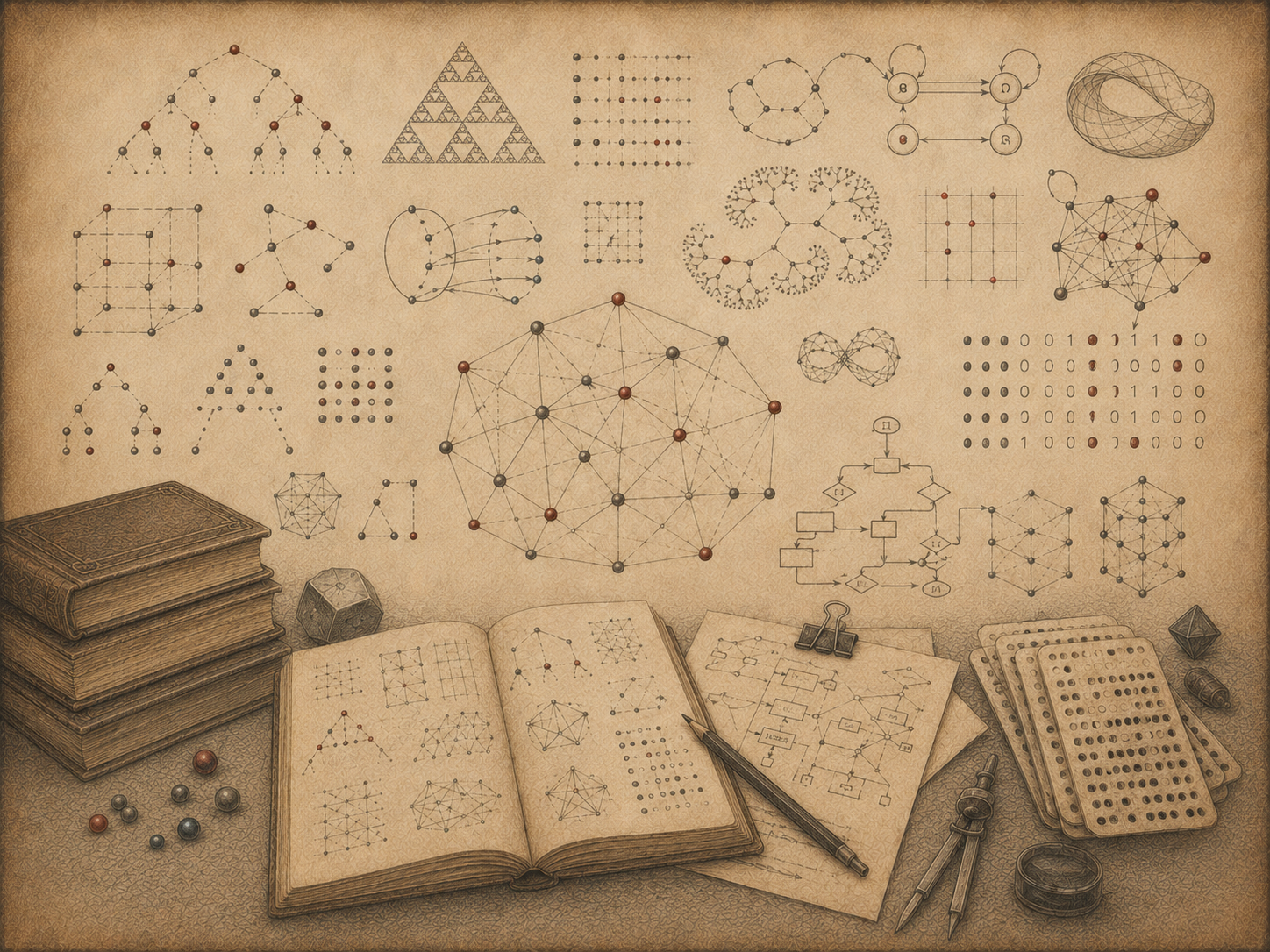
Computer science is not only the study of machines, software, or programming languages. At its deepest level, it is the study of structure, procedure, representation, information, proof, computation, and limits. Mathematical thinking gives computer science its conceptual foundation: the ability to define objects precisely, reason about algorithms, prove correctness, analyze complexity, model data structures, formalize logic, understand networks, and distinguish what can be computed from what cannot.
Programming is often where computer science becomes visible, but mathematics is what makes computation intelligible. A program is a symbolic object. An algorithm is a finite procedure. A data structure is an organized mathematical form. A type system is a discipline of classification and constraint. A graph models relation. A recurrence models recursive cost. A proof establishes correctness. A complexity bound explains scalability. A formal language defines syntax. A model of computation defines what it means to compute at all.
This article examines mathematical thinking for computer science as a way of connecting abstraction, proof, algorithms, data structures, logic, graphs, recursion, discrete mathematics, probability, linear algebra, automata, computability, complexity theory, type systems, and responsible software reasoning. It treats mathematics not as an external prerequisite, but as the intellectual architecture that makes computer science rigorous.
What Mathematical Thinking Means in Computer Science
Mathematical thinking in computer science means more than using formulas. It means reasoning precisely about symbolic systems, finite procedures, formal structures, and computational consequences. It is the habit of asking what is being represented, what rule transforms it, what can be proven, what resources are required, and what limits constrain the system.
Computer science depends on mathematical habits because computation is formal. A program does not execute intentions. It executes instructions. A data structure does not understand meaning. It stores representation. An algorithm does not know whether a real-world goal is just. It follows rules. Mathematical thinking clarifies the difference between formal correctness and broader interpretation.
\text{computer science}=\text{representation}+\text{procedure}+\text{proof}+\text{complexity}
\]
Interpretation: Computer science studies how information is represented, transformed by procedures, justified by proof, and constrained by computational resources.
Mathematical thinking helps computer scientists move from “this seems to work” to “this is correct under stated assumptions.” It distinguishes examples from proofs, implementation from specification, performance on small cases from scalability, and syntactic validity from semantic meaning.
| Mathematical Habit | Computer Science Role | Example |
|---|---|---|
| Definition | Specify objects precisely | Define graph, tree, type, state, language |
| Abstraction | Separate essential structure from implementation detail | Stack as abstract data type |
| Proof | Establish correctness | Loop invariant, induction, type safety |
| Counting | Analyze possibility and complexity | Search space size, combinatorial explosion |
| Modeling | Represent systems formally | Automaton, graph, probability model, recurrence |
Mathematical thinking for computer science is therefore a discipline of explicitness. It asks the programmer, theorist, engineer, analyst, or researcher to state the structure before trusting the system.
Computation as Formal Procedure
Computation is the execution of formal procedures on representations. A procedure takes input, follows rules, changes state, and produces output. This formal character is what allows computation to be studied mathematically. An algorithm can be described independently of any particular programming language. Its correctness and complexity can be analyzed as mathematical properties.
The central idea is that computation is rule-governed transformation. A sorting algorithm transforms an unordered list into an ordered one. A parser transforms a token sequence into a syntax tree. A compiler transforms source code into executable form. A database query transforms stored records into selected results. A model transforms inputs into predictions or classifications.
\text{input}\xrightarrow{\text{algorithm}}\text{output}
\]
Interpretation: An algorithm defines a finite procedure for transforming input into output under specified rules.
Mathematical thinking asks whether this transformation is well-defined. What is the input domain? What is the output specification? Does the procedure terminate? Does it produce the correct output for every valid input? What assumptions does it require? What happens at boundary cases?
| Computational Question | Mathematical Form | Example |
|---|---|---|
| What inputs are allowed? | Domain specification | List of comparable elements |
| What output is required? | Postcondition | Sorted permutation of input list |
| Does the procedure stop? | Termination argument | Problem size decreases each recursion |
| Is the output correct? | Proof of correctness | Invariant or induction proof |
| How much does it cost? | Complexity analysis | \(O(n\log n)\), \(O(n^2)\), \(O(2^n)\) |
This is why computer science cannot be reduced to syntax. Programming languages are important, but computation is deeper than any one language. Mathematical thinking reveals the structure beneath the code.
Discrete Mathematics and Digital Structure
Computer science is deeply discrete. Computers represent information using finite symbols, bits, bytes, addresses, records, tokens, states, edges, trees, instructions, and data structures. Even when software models continuous phenomena, the machine stores and processes discrete representations.
Discrete mathematics provides the language for this world. Sets define collections. Relations define connections. Functions define mappings. Logic defines conditions. Graphs define networks. Combinatorics defines possibility spaces. Recurrence defines recursive structure. Number theory supports modular arithmetic and cryptography. Formal languages define syntax. Automata define state-based computation.
\text{digital representation}=\text{finite symbols organized by rules}
\]
Interpretation: Digital systems rely on discrete representations: finite units structured by formal rules.
Discrete thinking matters because many computational errors are structural rather than numerical. A graph may be disconnected. A database relation may be poorly designed. A loop may miss a boundary case. A classifier may use categories that hide important variation. A search space may be exponentially large. A recursive function may lack a base case. These are discrete failures of structure.
| Discrete Concept | Computer Science Use | Typical Question |
|---|---|---|
| Set | Collection of values or objects | What belongs? |
| Relation | Database table, graph edge, equivalence | How are objects connected? |
| Function | Mapping input to output | Is the mapping well-defined? |
| Graph | Network, dependency, path structure | What can reach what? |
| Recurrence | Recursive cost or dynamic program | How does size \(n\) depend on smaller sizes? |
Discrete mathematics is therefore not a side topic for computer science. It is the structure of the field’s basic objects.
Logic, Boolean Structure, and Formal Inference
Logic is central to computer science because computation depends on conditions, truth values, inference, specification, verification, search, and symbolic reasoning. Boolean logic appears in circuits, control flow, database queries, type guards, SAT solvers, theorem provers, access rules, and program specifications.
(P\land Q)\Rightarrow P
\]
Interpretation: Logical inference captures what follows from stated propositions. If both \(P\) and \(Q\) are true, then \(P\) is true.
At the hardware level, logic gates implement Boolean operations. At the programming level, conditions decide control flow. At the database level, Boolean predicates filter records. At the formal verification level, logical formulas specify program behavior. At the AI level, symbolic logic supports rule systems, planning, constraint satisfaction, and theorem proving.
| Logical Structure | Computing Use | Example |
|---|---|---|
| Negation | Condition reversal | Not authorized |
| Conjunction | Multiple requirements | User is active and verified |
| Disjunction | Alternative conditions | Admin or owner |
| Implication | Rules and specifications | If precondition holds, postcondition follows |
| Quantification | Statements over collections | All records satisfy constraint |
Logic also teaches discipline about ambiguity. Natural language can be vague; programs cannot. A conditional statement must specify exactly what is true, false, included, excluded, required, or allowed. Logical thinking helps programmers avoid hidden assumptions and contradictory rules.
Sets, Relations, and Functions in Computing
Sets, relations, and functions are among the most important mathematical structures in computer science. A set describes a collection of distinct elements. A relation describes connections among elements. A function maps inputs to outputs. These three ideas appear everywhere: data types, databases, APIs, state machines, graphs, programming language semantics, type systems, and mathematical models of computation.
A relational database is built around relations. A graph is a set of vertices together with an edge relation. A program function maps arguments to return values, though real programs may also include side effects. A hash table maps keys to values. A compiler maps source programs to lower-level representations. A state transition system maps states and inputs to next states.
f:A\to B
\]
Interpretation: A function maps each input in domain \(A\) to an output in codomain \(B\). This idea underlies program functions, transformations, and mappings.
| Mathematical Structure | Computing Form | Example |
|---|---|---|
| Set | Collection or type | All valid user IDs |
| Relation | Table or edge relation | User enrolled in course |
| Function | Input-output mapping | Hash key to bucket |
| Equivalence relation | Partition into classes | Canonicalization, grouping, congruence |
| Partial order | Dependency ordering | Build order in a DAG |
These structures matter because they make software design more precise. Before writing code, one can ask: What is the domain? What are the valid values? What relation is being represented? Is the function total or partial? Can it fail? Are two objects equal, equivalent, or merely similar? What invariants must be preserved?
Proof, Correctness, and Program Reasoning
Computer science depends on proof because programs can appear correct on examples while failing on edge cases. Testing is essential, but testing alone cannot exhaust all possible inputs for most nontrivial programs. Mathematical proof provides a way to reason about all valid inputs under stated assumptions.
Program correctness often involves preconditions, postconditions, invariants, and termination arguments. A precondition states what must be true before execution. A postcondition states what must be true after execution. An invariant states what remains true during repeated steps. A termination argument explains why the program stops.
\{\text{precondition}\}\;\text{program}\;\{\text{postcondition}\}
\]
Interpretation: A correctness specification states that if the precondition holds before execution, the postcondition should hold afterward.
Correctness proofs are especially important for algorithms, compilers, operating systems, cryptographic protocols, safety-critical systems, distributed systems, and financial or institutional decision systems. In these contexts, a subtle logical error can have serious consequences.
| Proof Concept | Programming Use | Example |
|---|---|---|
| Invariant | Property preserved during loop or algorithm | Processed prefix is sorted |
| Induction | Proof over input size or recursive structure | Recursive tree traversal visits all nodes |
| Contradiction | Show impossible error state | No two assigned IDs are equal |
| Case analysis | Cover all branches | Empty, singleton, and nonempty list |
| Termination proof | Show computation stops | Input size decreases each recursive call |
Proof does not eliminate the need for testing. Instead, proof and testing answer different questions. Testing checks behavior on selected cases. Proof establishes why behavior follows from structure. The strongest software cultures use both.
Algorithms as Mathematical Objects
An algorithm is a finite procedure for solving a problem. Computer science studies algorithms mathematically: their inputs, outputs, correctness, cost, assumptions, invariants, limitations, and behavior under scale. An algorithm can be expressed in code, pseudocode, recurrence relations, state transitions, or formal models.
Thinking mathematically about algorithms means asking what problem is actually being solved. Sorting is not merely rearranging a list; it requires producing an ordered permutation of the input. Searching is not merely looking; it requires returning whether a target exists and perhaps where. Shortest-path algorithms require a graph, a source, weights, and assumptions about edge costs.
\text{algorithm}=(\text{input specification},\text{procedure},\text{output specification})
\]
Interpretation: An algorithm should be understood through the problem it solves, the steps it follows, and the output it guarantees.
| Algorithm | Mathematical Structure | Correctness Question |
|---|---|---|
| Binary search | Ordered sequence | Does it preserve the search interval invariant? |
| Merge sort | Recursive decomposition | Is output sorted and a permutation? |
| Breadth-first search | Graph traversal | Does it find all reachable vertices? |
| Dijkstra’s algorithm | Weighted graph | Are edge weights nonnegative? |
| Dynamic programming | Recurrence and subproblems | Is the state definition complete? |
Algorithmic thinking is mathematical because it asks for general guarantees. It does not stop at “this input worked.” It asks what must be true for all valid inputs.
Complexity, Growth, and Scalability
Complexity analysis studies how the resources required by an algorithm grow as input size increases. The most common resources are time and memory. Complexity is not about measuring one run on one machine; it is about understanding growth behavior.
Big-O notation describes an upper bound on growth. It abstracts away machine details and constant factors so that the shape of growth becomes visible. An \(O(n)\) algorithm grows roughly linearly. An \(O(n^2)\) algorithm grows quadratically. An \(O(2^n)\) algorithm grows exponentially and may become infeasible quickly.
f(n)=O(g(n))
\]
Interpretation: Big-O notation says that \(f(n)\) grows no faster than a constant multiple of \(g(n)\) beyond some sufficiently large input size.
Complexity analysis is one of the clearest examples of mathematical thinking in computer science. It uses functions, inequalities, recurrences, limits, counting, and asymptotic reasoning to explain why some algorithms scale and others do not.
| Complexity Class | Growth Pattern | Example |
|---|---|---|
| \(O(1)\) | Constant | Array index access |
| \(O(\log n)\) | Logarithmic | Binary search |
| \(O(n)\) | Linear | Single pass through list |
| \(O(n\log n)\) | Near-linear | Efficient comparison sorting |
| \(O(2^n)\) | Exponential | Naive subset search |
Complexity thinking matters ethically as well as technically. A system that works for small users but fails at scale may exclude people, waste resources, or create instability. Scalability is not only a performance concern; it is part of responsible system design.
Recursion, Induction, and Recursive Data
Recursion is central to computer science because many computational structures are self-similar. Lists can be defined as empty or as an element followed by a smaller list. Trees can be defined as leaves or nodes with subtrees. Expressions can contain subexpressions. File systems contain directories that contain directories. Programs parse syntax recursively. Algorithms divide problems into smaller problems.
\text{List}=\text{Empty}\;\;|\;\;\text{Cons}(\text{Element},\text{List})
\]
Interpretation: A list can be defined recursively as either empty or an element attached to a smaller list.
Recursion and induction are paired. Recursive definitions build structures. Inductive proofs establish properties of those structures. Recursive algorithms reduce problems to smaller cases. Induction proves that the reduction works for all cases.
| Recursive Structure | Computer Science Form | Proof Method |
|---|---|---|
| List | Empty or head plus tail | Structural induction |
| Tree | Node with subtrees | Structural induction |
| Expression | Operator with subexpressions | Induction on syntax |
| Algorithm cost | Recurrence relation | Induction or recurrence solving |
| Dynamic program | Subproblem table | Induction on subproblem order |
Recursive thinking is not only a programming pattern. It is a mathematical way of understanding nested structure, reduction, proof, and computation.
Graphs, Networks, and Computational Structure
Graphs are fundamental to computer science because many computational problems are relational. Networks, dependencies, links, paths, constraints, workflows, circuits, syntax trees, social relations, citation structures, knowledge graphs, and state spaces can all be represented using vertices and edges.
G=(V,E),\qquad E\subseteq V\times V
\]
Interpretation: A directed graph can be represented by vertices and ordered edge pairs.
Graph thinking supports search, routing, scheduling, dependency management, compiler design, operating systems, network analysis, AI planning, knowledge representation, and database systems. Many algorithmic problems become clearer when represented as graph problems.
| Graph Structure | Computer Science Use | Question |
|---|---|---|
| Tree | Syntax, search, hierarchy | How is structure nested? |
| DAG | Dependencies, build systems, workflows | What order respects prerequisites? |
| Weighted graph | Routing and optimization | What path has minimum cost? |
| Bipartite graph | Matching and recommendation | Which assignments are possible? |
| State graph | Automata and verification | Which states are reachable? |
Graphs also reveal the importance of interpretation. An edge in a graph is not automatically meaningful. It must be defined. A dependency edge, similarity edge, citation edge, communication edge, and causal edge all imply different things. Graph mathematics is precise only when graph modeling is precise.
Automata, Formal Languages, and Machines
Automata theory studies abstract machines and the languages they recognize. It provides a mathematical foundation for parsing, compilers, regular expressions, programming languages, state machines, protocol design, and models of computation.
A finite automaton consists of states, an input alphabet, a transition function, a start state, and accepting states. It processes input one symbol at a time and changes state according to transition rules. This simple model captures important forms of computation and language recognition.
M=(Q,\Sigma,\delta,q_0,F)
\]
Interpretation: A finite automaton is defined by states \(Q\), alphabet \(\Sigma\), transition function \(\delta\), start state \(q_0\), and accepting states \(F\).
Formal languages define sets of strings. Grammars define how strings can be generated. Automata define how strings can be recognized. Together, these ideas connect mathematics, language, computation, and programming language design.
| Formal Concept | Computer Science Use | Example |
|---|---|---|
| Alphabet | Allowed symbols | Characters, tokens, instructions |
| String | Sequence of symbols | Source code, input stream |
| Language | Set of valid strings | Valid identifiers or programs |
| Automaton | Recognizer | Regular expression engine |
| Grammar | Generator of syntax | Programming language syntax |
Automata theory teaches that machines can be studied abstractly. The physical device matters, but the mathematical structure of states and transitions reveals what the machine can recognize or compute.
Computability and the Limits of Algorithms
Computability theory asks what can be computed in principle. This is one of computer science’s deepest mathematical questions. Not every well-defined problem has an algorithmic solution. Some problems are undecidable: no algorithm can solve them for all possible inputs.
The halting problem is the classic example. It asks whether there is a general algorithm that can determine, for any program and input, whether that program eventually halts or runs forever. The answer is no. This result shows that computation has formal limits.
\text{not every precisely stated problem is algorithmically decidable}
\]
Interpretation: Computability theory shows that some formal problems cannot be solved by any general algorithm.
This matters because computer science is not only about building more powerful systems. It is also about understanding limits. Some limitations come from hardware. Some come from efficiency. Some come from data. But computability limitations are deeper: they are mathematical limits on algorithmic possibility.
| Limit Concept | Meaning | Computer Science Significance |
|---|---|---|
| Decidable problem | Algorithm always gives yes/no answer | Membership in many formal languages |
| Undecidable problem | No general algorithm exists | Halting problem |
| Semi-decidable problem | Algorithm may confirm yes but not always no | Program behavior questions |
| Reduction | Transform one problem into another | Show hardness or undecidability |
| Model of computation | Formal machine or computational system | Turing machines, lambda calculus, automata |
Computability theory gives humility to computer science. It shows that mathematical precision does not guarantee algorithmic solvability.
Types, Abstraction, and Structural Discipline
Type systems are mathematical disciplines for classifying values and constraining operations. A type describes what kind of value something is and what operations are valid for it. Type systems help prevent errors, document intent, support abstraction, guide program design, and sometimes prove safety properties.
Types are related to sets, logic, algebra, category theory, and formal semantics. In practical programming, types help programmers state assumptions. A function that accepts an integer is not the same as one that accepts a string. A nullable value is not the same as a guaranteed value. A list of users is not the same as a single user. A type system makes such distinctions explicit.
\text{type}=\text{classification}+\text{allowed operations}+\text{constraints}
\]
Interpretation: A type classifies values and restricts how they can be used.
| Type Concept | Programming Role | Mathematical Habit |
|---|---|---|
| Primitive type | Basic value classification | Domain restriction |
| Algebraic data type | Structured alternatives | Case analysis |
| Product type | Combine fields | Cartesian product |
| Sum type | Choose among variants | Disjoint union |
| Function type | Map input type to output type | Domain and codomain discipline |
Type thinking is mathematical because it makes structure explicit before execution. It asks not only what the program does, but what kinds of objects the program is allowed to manipulate.
Probability, Randomness, and Uncertainty
Probability is increasingly central to computer science. Randomized algorithms use probability to improve performance or simplicity. Cryptographic systems rely on randomness. Machine learning models reason under uncertainty. Networks experience probabilistic failure. Data systems sample, estimate, and infer. AI systems often produce probabilistic outputs.
P(E)=\frac{|E|}{|\Omega|}
\]
Interpretation: When all outcomes are equally likely, probability can be understood as favorable outcomes divided by total outcomes.
Probabilistic thinking requires careful attention to sample spaces, independence, conditional probability, expectation, variance, uncertainty, and evidence. It also requires humility: a probability is not a guarantee, a model score is not truth, and a statistical pattern is not automatically causal.
| Probability Concept | Computer Science Use | Risk |
|---|---|---|
| Randomness | Randomized algorithms, cryptography | Poor randomness can break guarantees |
| Expectation | Average-case analysis | Average case may hide worst-case harm |
| Conditional probability | Bayesian inference, classification | Confusing correlation with causation |
| Sampling | Data analysis and estimation | Biased samples distort conclusions |
| Uncertainty | Model confidence and prediction | Overconfident outputs mislead users |
Probability brings mathematical structure to uncertainty, but it does not eliminate judgment. The interpretation of uncertainty matters as much as its computation.
Linear Algebra, Data, and Machine Learning
Linear algebra is foundational for data science, computer graphics, machine learning, information retrieval, optimization, numerical computing, signal processing, and artificial intelligence. Vectors represent data points, features, embeddings, signals, or states. Matrices represent transformations, datasets, adjacency structures, images, systems of equations, and model parameters.
y=Ax
\]
Interpretation: A matrix \(A\) can represent a linear transformation that maps input vector \(x\) to output vector \(y\).
In machine learning, data is often represented as vectors in high-dimensional space. Similarity may be measured by distance or angle. Neural networks perform layers of matrix operations combined with nonlinear transformations. Search systems may compare embeddings. Graphs may be represented by adjacency matrices. Images are arrays of pixel values.
| Linear Algebra Object | Computer Science Use | Example |
|---|---|---|
| Vector | Feature representation | Document embedding |
| Matrix | Transformation or dataset | Image, linear layer, adjacency matrix |
| Dot product | Similarity or projection | Search relevance |
| Eigenvector | Structural importance | PageRank-style centrality |
| Norm | Magnitude or distance | Error measurement |
Linear algebra supports powerful computational systems, but representation matters. A vector embedding is not the object itself. A distance metric is not meaning itself. A matrix can encode structure, but the interpretation of that structure must be justified.
Number Theory, Modular Arithmetic, and Cryptography
Number theory and modular arithmetic are central to cryptography, hashing, error detection, pseudorandom generation, coding theory, digital signatures, and secure communication. Modular arithmetic studies remainders and cyclic structure. It is the mathematics of equivalence under division by a modulus.
a\equiv b\pmod n
\]
Interpretation: This means \(a\) and \(b\) leave the same remainder when divided by \(n\), or equivalently, \(n\) divides \(a-b\).
In computing, modular arithmetic appears in hash tables, checksums, cyclic buffers, memory addressing, random number generators, public-key cryptography, finite fields, and digital signatures. It allows finite symbolic systems to support secure and efficient computation.
| Number-Theoretic Concept | Computing Use | Example |
|---|---|---|
| Modulo operation | Cyclic indexing | Hash bucket selection |
| Prime numbers | Cryptographic structure | Public-key systems |
| Greatest common divisor | Number-theoretic algorithms | Euclidean algorithm |
| Finite fields | Coding theory and cryptography | Error correction |
| Congruence | Equivalence under modulus | Clock arithmetic, residues |
Cryptography is a reminder that abstract mathematics can become public infrastructure. The correctness, implementation, and governance of cryptographic systems are not merely technical details; they affect privacy, security, trust, and power.
Data Structures as Mathematical Design
Data structures are mathematical designs for organizing information. Arrays, linked lists, stacks, queues, trees, heaps, hash tables, graphs, tries, maps, sets, and union-find structures are not just programming conveniences. They embody assumptions about access, update, order, relation, search, memory, and cost.
Choosing a data structure is a mathematical decision. An array supports fast indexed access but may be costly to resize. A hash table supports average-case fast lookup but depends on hashing assumptions. A tree supports hierarchical structure and ordered operations. A graph supports relational structure. A heap supports priority-based access.
\text{data structure}=\text{representation}+\text{operations}+\text{invariants}+\text{costs}
\]
Interpretation: A data structure is defined by how it represents data, what operations it supports, what invariants it preserves, and what costs those operations require.
| Data Structure | Mathematical Structure | Key Invariant or Use |
|---|---|---|
| Array | Indexed sequence | Position maps to memory offset |
| Stack | Ordered collection | Last in, first out |
| Queue | Ordered collection | First in, first out |
| Binary search tree | Ordered recursive tree | Left values below node, right values above |
| Hash table | Function from keys to buckets | Hash distribution and collision handling |
Data structures connect abstraction to performance. A program can be correct but slow because the wrong structure was chosen. Mathematical thinking helps align structure with purpose.
Learning Mathematical Thinking for Computer Science
Learning mathematical thinking for computer science requires connecting theory to practice without reducing either one. Students often learn programming first and mathematics separately. The deeper goal is to see how mathematical structure explains programming practice: why loops need invariants, why recursion needs base cases, why sorting needs a specification, why graphs need definitions, why complexity matters, and why types prevent certain classes of error.
Mathematical maturity in computer science develops when learners stop asking only “what code do I write?” and begin asking “what structure am I manipulating?” This shift makes programming more reliable, debugging more systematic, and system design more principled.
| Learning Challenge | Underlying Issue | Instructional Response |
|---|---|---|
| Formula memorization | Mathematics separated from structure | Connect formulas to algorithms and data structures |
| Code without specification | Unclear input-output contract | Write preconditions and postconditions |
| Testing mistaken for proof | Examples confused with guarantees | Use invariants and induction |
| Complexity ignored | Small examples hide growth | Compare scaling curves and recurrence costs |
| Abstraction anxiety | Difficulty moving from concrete code to general structure | Use multiple representations: code, diagrams, tables, equations |
The strongest computer science learning integrates code, proof, visualization, examples, counterexamples, and formal reasoning. Students should see that mathematics is not an obstacle to computing; it is what makes computing understandable.
A Mathematical Lens: Representation, Rule, Proof, Cost
A useful lens for mathematical thinking in computer science is the sequence: representation, rule, proof, cost. First, identify how information is represented. Then define the rule or algorithm that transforms it. Then prove that the transformation is correct. Finally, analyze the resources required.
\text{Representation}\rightarrow \text{Rule}\rightarrow \text{Proof}\rightarrow \text{Cost}
\]
Interpretation: Mathematical computer science connects data representation, algorithmic procedure, correctness reasoning, and complexity analysis.
| Lens Element | Guiding Question | Computer Science Example |
|---|---|---|
| Representation | What structure stores the information? | Array, tree, graph, matrix, type |
| Rule | What procedure transforms it? | Sort, search, parse, update, traverse |
| Proof | Why is the result correct? | Invariant, induction, type safety |
| Cost | How does resource use grow? | Time, space, communication, energy |
| Interpretation | What does the output mean in context? | Prediction, classification, recommendation, decision |
This lens helps prevent a narrow view of computer science as code alone. Code is the implementation layer. Mathematical thinking asks what the code represents, what it guarantees, what it costs, and what its outputs should mean.
Computational Companion Examples
The companion repository for this article should extend the Mathematical Thinking codebase with examples focused on discrete structures, algorithm specification, invariants, recurrence costs, graph traversal, finite automata, type modeling, SQL schemas, probability audits, matrix/vector demonstrations, Haskell algebraic data types, and responsible interpretation of computational outputs. The examples below are compact article-level previews; the repository can expand them into richer professional workflows.
Python: Algorithm Specification, Invariant, and Complexity Audit
from dataclasses import dataclass
from typing import Callable, Sequence

@dataclass(frozen=True)
class AlgorithmSpec:
    name: str
    precondition: str
    postcondition: str
    invariant: str
    complexity: str
    responsible_use_note: str

def is_sorted(values: Sequence[int]) -> bool:
    return all(values[i] <= values[i + 1] for i in range(len(values) - 1))

def insertion_sort(values: list[int]) -> list[int]:
    result = values[:]

    for i in range(1, len(result)):
        key = result[i]
        j = i - 1

        while j >= 0 and result[j] > key:
            result[j + 1] = result[j]
            j -= 1

        result[j + 1] = key

    return result

spec = AlgorithmSpec(
    name="insertion_sort",
    precondition="input is a finite list of comparable integers",
    postcondition="output is sorted and is a permutation of the input",
    invariant="before each outer-loop step, the processed prefix is sorted",
    complexity="O(n^2) worst-case time; O(1) auxiliary space",
    responsible_use_note="correct sorting does not validate the meaning or fairness of downstream ranking"
)

values = [5, 2, 8, 1, 3]
sorted_values = insertion_sort(values)

print(spec)
print(sorted_values)
print("sorted:", is_sorted(sorted_values))
print("same multiset:", sorted(values) == sorted_values)
R: Complexity Growth and Search-Space Audit
n <- 1:20

complexity_audit <- data.frame(
  n = n,
  log_n = log2(n),
  linear = n,
  n_log_n = n * log2(n),
  quadratic = n^2,
  exponential = 2^n,
  interpretation = "asymptotic growth explains why some algorithms scale and others become infeasible"
)

print(complexity_audit)
Julia: Recurrence Cost and Matrix Transformation
function merge_sort_cost(n)
    n <= 1 && return 1
    return 2 * merge_sort_cost(n ÷ 2) + n
end

function linear_transform_demo()
    A = [2.0 0.0; 0.0 3.0]
    x = [4.0, 5.0]
    return A * x
end

println("Merge-sort recurrence costs:")
for n in [1, 2, 4, 8, 16, 32, 64]
    println((n=n, cost=merge_sort_cost(n)))
end

println("Matrix transformation y = Ax:")
println(linear_transform_demo())
Haskell: Types, Trees, and Structural Recursion
{-# OPTIONS_GHC -Wall #-}

data Tree a
  = Leaf a
  | Node a [Tree a]
  deriving (Eq, Show)

data AlgorithmClass
  = Constant
  | Logarithmic
  | Linear
  | NLogN
  | Quadratic
  | Exponential
  deriving (Eq, Show)

treeSize :: Tree a -> Int
treeSize tree =
  case tree of
    Leaf _ -> 1
    Node _ children -> 1 + sum (map treeSize children)

treeDepth :: Tree a -> Int
treeDepth tree =
  case tree of
    Leaf _ -> 1
    Node _ [] -> 1
    Node _ children -> 1 + maximum (map treeDepth children)

classifyGrowth :: String -> AlgorithmClass
classifyGrowth label =
  case label of
    "binary search" -> Logarithmic
    "merge sort" -> NLogN
    "linear scan" -> Linear
    "subset search" -> Exponential
    _ -> Quadratic

main :: IO ()
main = do
  let syntaxTree = Node "expression" [Leaf "x", Node "operator" [Leaf "+", Leaf "y"]]
  print (treeSize syntaxTree)
  print (treeDepth syntaxTree)
  print (classifyGrowth "merge sort")
SQL: Computational Structure Metadata Schema
CREATE TABLE computational_concept (
  concept_id TEXT PRIMARY KEY,
  name TEXT NOT NULL,
  concept_type TEXT NOT NULL,
  mathematical_structure TEXT NOT NULL,
  computer_science_use TEXT NOT NULL
);

CREATE TABLE algorithm_specification (
  algorithm_id TEXT PRIMARY KEY,
  name TEXT NOT NULL,
  input_domain TEXT NOT NULL,
  output_specification TEXT NOT NULL,
  invariant_note TEXT NOT NULL,
  complexity_note TEXT NOT NULL,
  correctness_note TEXT NOT NULL
);

CREATE TABLE representation_warning (
  warning_id TEXT PRIMARY KEY,
  concept_id TEXT NOT NULL,
  warning TEXT NOT NULL,
  mitigation TEXT NOT NULL,
  FOREIGN KEY (concept_id) REFERENCES computational_concept(concept_id)
);

CREATE TABLE complexity_audit (
  audit_id TEXT PRIMARY KEY,
  algorithm_id TEXT NOT NULL,
  input_size INTEGER NOT NULL,
  estimated_step_class TEXT NOT NULL,
  interpretation TEXT NOT NULL,
  FOREIGN KEY (algorithm_id) REFERENCES algorithm_specification(algorithm_id)
);
These examples treat mathematical computer science as executable structure. Algorithms can be specified, invariants can be recorded, complexity can be compared, data structures can be modeled, Haskell types can express recursive structure, and SQL schemas can document assumptions. The purpose is not to replace mathematical proof or software testing, but to make computational reasoning explicit, reproducible, and inspectable.
GitHub Repository
The companion repository for this article is designed as a reproducible mathematical-thinking workspace focused on discrete structures, logic, proof, algorithms, complexity, recursion, graphs, automata, computability, type systems, probability, linear algebra, modular arithmetic, data structures, Haskell algebraic data types, SQL schemas, and responsible interpretation of computational outputs.
Complete Code Repository
Companion article folder with Python, R, Julia, SQL, Haskell, Rust, Go, C++, Fortran, and C examples for professional mathematical exploration of computer science foundations, algorithms, complexity, proof, discrete structure, graph reasoning, type systems, automata, data structures, and responsible computational interpretation.
Mathematical Rigor and Responsible Computing
Mathematical rigor is essential for responsible computing, but it is not sufficient by itself. A system can be formally correct and still harmful. An algorithm can satisfy its specification while the specification encodes exclusion. A model can optimize a function while the function measures the wrong objective. A classifier can be accurate on average while failing vulnerable groups. A graph can be mathematically valid while its edges imply unsupported associations.
Responsible computing requires both formal reasoning and contextual reasoning. Mathematical thinking helps clarify definitions, assumptions, invariants, uncertainty, and limits. Ethical thinking asks who is affected, what is omitted, what harms may follow, and whether the formal objective is legitimate.
| Computing Practice | Mathematical Strength | Responsible Risk | Responsible Habit |
|---|---|---|---|
| Algorithm design | Correctness and efficiency | Optimizing the wrong objective | Audit objective functions and consequences |
| Classification | Formal category mapping | Harmful or reductive categories | Review labels, boundaries, and affected groups |
| Graph analysis | Relational structure | False association or guilt by connection | Track edge meaning and provenance |
| Complexity optimization | Scalable performance | Efficiency prioritized over fairness or safety | Balance cost with public consequences |
| Machine learning | Statistical and linear algebraic modeling | Overconfidence, bias, opacity | Validate, document uncertainty, and review harms |
Mathematical thinking helps reveal what a system is actually doing. Responsible interpretation asks whether it should be doing that, for whom, under what authority, with what safeguards, and with what accountability.
Why Mathematical Thinking Matters for Computer Science
Mathematical thinking matters for computer science because it gives the field its rigor. It allows computer scientists to define computation, specify algorithms, prove correctness, analyze complexity, model data, reason about uncertainty, design abstractions, understand limits, and build systems that can be inspected rather than merely used.
It also matters because software systems now shape public life. Algorithms classify, rank, recommend, route, allocate, filter, predict, schedule, secure, surveil, and decide. When such systems operate without mathematical clarity, they become harder to understand and harder to challenge. When they operate with mathematical clarity but without ethical interpretation, they may become efficient instruments of poorly defined goals.
The strongest computer science joins implementation with proof, abstraction with evidence, efficiency with accountability, and formal structure with human consequence. Mathematical thinking is what makes that integration possible.
Computer science is not just code. It is a mathematical discipline of representation, procedure, structure, proof, complexity, and limits. To think mathematically in computer science is to ask what is being represented, what rules govern transformation, what can be proven, what cannot be computed, what resources are required, and what the resulting system means in the world.
Related Articles
- What Is Mathematical Thinking? Pattern, Proof, Architecture, and Reason
- Recursion and Recursive Thinking
- Graphs, Networks, and Discrete Structure
- Discrete Mathematics and the Logic of Structure
- Combinatorics and the Mathematics of Possibility
- Sets, Relations, and Functions as Modes of Thought
- Logic and the Structure of Formal Inference
- Proof and the Logic of Mathematical Justification
- Algorithms, Proof, and Formal Reasoning
- Mathematical Thinking and Proof Assistants
Further Reading
- Abelson, H., Sussman, G.J. and Sussman, J. (1996) Structure and Interpretation of Computer Programs. 2nd edn. Cambridge, MA: MIT Press. Available at: https://mitpress.mit.edu/9780262510875/structure-and-interpretation-of-computer-programs/
- Aho, A.V., Lam, M.S., Sethi, R. and Ullman, J.D. (2006) Compilers: Principles, Techniques, and Tools. 2nd edn. Boston: Pearson.
- Cormen, T.H., Leiserson, C.E., Rivest, R.L. and Stein, C. (2022) Introduction to Algorithms. 4th edn. Cambridge, MA: MIT Press. Available at: https://mitpress.mit.edu/9780262046305/introduction-to-algorithms/
- Graham, R.L., Knuth, D.E. and Patashnik, O. (1994) Concrete Mathematics: A Foundation for Computer Science. 2nd edn. Reading, MA: Addison-Wesley.
- Harel, D. and Feldman, Y. (2004) Algorithmics: The Spirit of Computing. 3rd edn. Boston: Addison-Wesley.
- Pierce, B.C. (2002) Types and Programming Languages. Cambridge, MA: MIT Press. Available at: https://mitpress.mit.edu/9780262162098/types-and-programming-languages/
- Rosen, K.H. (2019) Discrete Mathematics and Its Applications. 8th edn. New York: McGraw-Hill.
- Sipser, M. (2013) Introduction to the Theory of Computation. 3rd edn. Boston: Cengage Learning.
References
- Abelson, H., Sussman, G.J. and Sussman, J. (1996) Structure and Interpretation of Computer Programs. 2nd edn. Cambridge, MA: MIT Press. Available at: https://mitpress.mit.edu/9780262510875/structure-and-interpretation-of-computer-programs/
- Aho, A.V., Lam, M.S., Sethi, R. and Ullman, J.D. (2006) Compilers: Principles, Techniques, and Tools. 2nd edn. Boston: Pearson.
- Cormen, T.H., Leiserson, C.E., Rivest, R.L. and Stein, C. (2022) Introduction to Algorithms. 4th edn. Cambridge, MA: MIT Press. Available at: https://mitpress.mit.edu/9780262046305/introduction-to-algorithms/
- Graham, R.L., Knuth, D.E. and Patashnik, O. (1994) Concrete Mathematics: A Foundation for Computer Science. 2nd edn. Reading, MA: Addison-Wesley.
- Harel, D. and Feldman, Y. (2004) Algorithmics: The Spirit of Computing. 3rd edn. Boston: Addison-Wesley.
- Knuth, D.E. (1997) The Art of Computer Programming, Volume 1: Fundamental Algorithms. 3rd edn. Boston: Addison-Wesley.
- Pierce, B.C. (2002) Types and Programming Languages. Cambridge, MA: MIT Press. Available at: https://mitpress.mit.edu/9780262162098/types-and-programming-languages/
- Rosen, K.H. (2019) Discrete Mathematics and Its Applications. 8th edn. New York: McGraw-Hill.
- Sipser, M. (2013) Introduction to the Theory of Computation. 3rd edn. Boston: Cengage Learning.