
Last Updated May 30, 2026
Proof is one of the defining practices of mathematics, but it did not appear fully formed. Across cultures, periods, and intellectual traditions, mathematical proof developed from practical calculation, diagrammatic demonstration, ritual measurement, administrative procedure, philosophical argument, geometric deduction, algebraic transformation, symbolic logic, set-theoretic foundations, formal systems, and machine-checked verification. The history of proof is therefore not a simple march from intuition to rigor. It is a long transformation in how human beings learned to justify mathematical claims.
To study the historical development of proof is to study the changing standards of mathematical authority. What counted as evidence? Who was allowed to make mathematical claims? Was a diagram enough? Was a numerical example enough? Did a rule require explanation? Did an algorithm require a proof of correctness? Did proof mean construction, deduction, contradiction, calculation, symbolic derivation, or formal verification?
This article examines proof as a historical achievement: from ancient computational traditions and Greek deductive geometry to Indian, Chinese, Islamic, medieval, early modern, modern, and computational forms of mathematical justification. It emphasizes that proof has always been shaped by notation, institutions, pedagogy, philosophy, technology, and culture. The history of proof is not only the history of mathematics; it is the history of how reason learned to make its claims accountable.
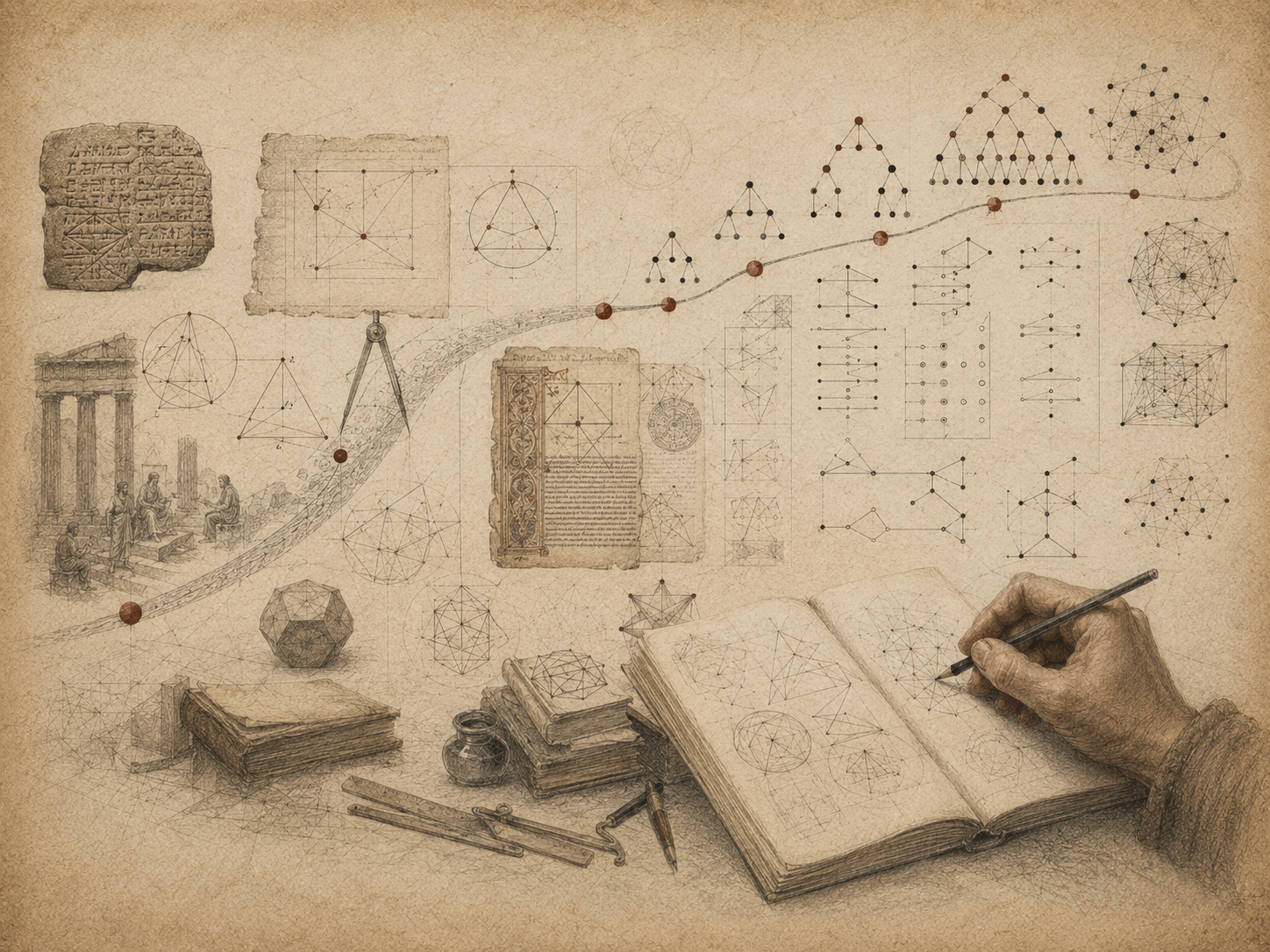
What Proof Means Historically
Proof is a method of justification. In mathematics, proof aims to show not merely that a claim appears true, but that it must be true under stated assumptions. Yet the meaning of proof has changed over time. Ancient mathematical cultures often justified results through procedures, diagrams, examples, and practical success. Greek mathematics developed a distinctive deductive style organized around definitions, postulates, propositions, and demonstrations. Later traditions expanded proof through algebra, symbolic notation, infinitesimal reasoning, rigorized limits, set theory, formal logic, computation, and proof assistants.
Historically, proof has always involved more than logic alone. It depends on what a mathematical community accepts as legitimate reasoning. A diagram, a verbal argument, an algebraic manipulation, a construction, a canonical example, a proof by contradiction, a formal derivation, or a machine-checked certificate may each function as proof in different settings. The standards shift with notation, pedagogy, institutions, philosophical commitments, and available technologies.
\text{proof}=\text{claim}+\text{accepted grounds}+\text{valid rule of inference}
\]
Interpretation: Proof connects a mathematical claim to accepted assumptions through reasoning steps recognized as legitimate by a mathematical community.
The history of proof is therefore a history of changing standards. It asks how humans moved from reliable procedures to deductive demonstrations, from diagrams to symbolic transformations, from local arguments to formal systems, and from human-written proofs to mechanically checked proofs.
| Historical Form of Justification | Typical Medium | What It Establishes |
|---|---|---|
| Procedure | Algorithm, recipe, worked example | How to obtain a result |
| Diagram | Geometric figure or configuration | Why a relation appears structurally true |
| Deduction | Definitions, axioms, propositions | Why a claim follows necessarily |
| Algebraic transformation | Symbols and equations | Why equivalent forms preserve truth |
| Formal proof | Logical system or proof assistant | Why a claim follows by explicit inference rules |
Proof is not simply a static mathematical object. It is a historical practice of disciplined justification.
Before Deductive Proof: Calculation, Measurement, and Procedure
Before the emergence of formal deductive proof, mathematical knowledge often appeared as rule-based practice. People measured land, tracked goods, calculated taxes, built structures, observed celestial cycles, divided inheritances, managed calendars, and solved practical problems. These activities required mathematical reliability, but not necessarily proof in the later axiomatic sense.
Procedural mathematics can be highly sophisticated. A rule for solving a quadratic problem, computing an area, dividing a quantity, or predicting an astronomical position may work reliably across many cases. But a procedure is not always accompanied by a general proof explaining why it works. The authority of the procedure may come from tradition, repeated success, scribal training, expert authority, or integration into administrative systems.
\text{procedure answers } “\text{how}”; \qquad \text{proof asks } “\text{why must this hold?}”
\]
Interpretation: Early mathematical practice often emphasized reliable methods before explicit general demonstrations became central.
This does not mean pre-deductive mathematics was primitive. It means that mathematical justification was organized differently. Practical reliability, pattern recognition, numerical examples, geometric intuition, and institutional training all played roles. The later distinction between computation and proof should not be projected backward too simplistically.
| Pre-Deductive Practice | Mathematical Content | Form of Authority |
|---|---|---|
| Land measurement | Area, length, proportion | Administrative need and repeated use |
| Commercial calculation | Ratios, division, accounting | Economic reliability |
| Astronomical prediction | Cycles, tables, interpolation | Observational success |
| Scribal education | Worked problems and procedures | Transmission through trained specialists |
| Construction and craft | Geometry, symmetry, proportion | Material success and skilled practice |
The development of proof did not replace procedure. It reorganized procedure under a new demand: not only how to compute, but why the computation is justified.
Mesopotamia and Egypt: Rule-Based Mathematical Practice
Mesopotamian and Egyptian mathematical traditions preserved sophisticated rule-based practices. Babylonian mathematical tablets show advanced numerical computation, reciprocal tables, quadratic problem solving, and geometric calculations. Egyptian sources such as the Rhind Mathematical Papyrus and Moscow Mathematical Papyrus show methods for arithmetic, fractions, geometry, volumes, and practical problem solving.
These traditions often present mathematics through worked examples. A problem is stated, a procedure is applied, and an answer is produced. The generality of the procedure is often implicit rather than presented as an abstract theorem with proof. The mathematical intelligence lies in the method, the choice of representation, and the reliable manipulation of quantities.
| Tradition | Typical Evidence | Mathematical Strength | Proof Style |
|---|---|---|---|
| Babylonian | Clay tablets, tables, worked examples | Numerical procedures, algebraic problem forms | Algorithmic and example-based |
| Egyptian | Papyrus texts, practical problems | Fractions, measurement, area, volume | Rule-based and procedural |
| Scribal schools | Training problems | Transmission of calculation methods | Pedagogical repetition |
It would be misleading to say these traditions lacked reasoning. They reasoned through examples, procedures, and problem types. The later Greek emphasis on explicit deductive proof represented a different standard of mathematical justification, not the beginning of mathematical thought itself.
The historical importance of these traditions is twofold. First, they show that advanced mathematics can exist in procedural form. Second, they remind us that proof developed out of practical, administrative, astronomical, and educational needs, not outside them.
Greek Mathematics and the Deductive Turn
Greek mathematics is often associated with the emergence of deductive proof. This shift did not happen all at once, and it should not be treated as a purely isolated Greek invention. Greek mathematics developed within a wider Mediterranean and Near Eastern world of mathematical exchange. Still, Greek authors produced a distinctive written style of mathematical demonstration in which propositions followed from definitions, postulates, common notions, and prior results.
The deductive turn changed mathematical authority. A claim was no longer justified primarily by successful computation or repeated example. It had to be shown to follow necessarily from accepted starting points. This created a new architecture of mathematical knowledge: definitions, axioms, lemmas, propositions, corollaries, and proofs.
\text{axioms}+\text{definitions}+\text{valid deductions}\Rightarrow \text{theorem}
\]
Interpretation: Deductive mathematics organizes claims as consequences of explicit starting points and permitted reasoning steps.
Greek geometry also gave diagrams a central role. The diagram was not merely decorative; it structured the reasoning. A proof might refer to lines, angles, circles, triangles, parallels, and constructions displayed in the figure. Yet the proof aimed at general necessity, not merely what appeared in one drawing.
| Feature of Greek Deductive Mathematics | Historical Significance |
|---|---|
| Definitions | Clarified the objects under discussion |
| Postulates | Stated accepted geometric operations or assumptions |
| Common notions | Provided general logical or equality principles |
| Propositions | Organized mathematical claims sequentially |
| Demonstrations | Showed why claims followed from prior results |
The deductive turn did not eliminate intuition, construction, or procedure. It placed them inside a new standard of public justification.
Euclid and the Axiomatic Architecture of Proof
Euclid’s Elements became one of the most influential works in the history of mathematics because it presented geometry as a structured deductive system. The work begins with definitions, postulates, and common notions, then builds propositions in an ordered sequence. Each proof depends on earlier results, creating a cumulative architecture of mathematical knowledge.
Euclid’s achievement was not that every proof met modern standards of formal rigor. Rather, the achievement was organizational and methodological. The Elements modeled mathematics as a system in which later claims are justified by earlier ones. It made proof pedagogically transmissible and intellectually durable.
P_1,\;P_2,\;P_3,\ldots,P_n
\]
Interpretation: Euclidean proof culture organizes propositions sequentially, so later results depend on definitions, postulates, and earlier propositions.
The Euclidean model deeply shaped mathematics, philosophy, education, and scientific reasoning. For centuries, “more geometrico” reasoning—reasoning in the geometric manner—served as an ideal of certainty. Even outside mathematics, thinkers admired the clarity of beginning from definitions and proceeding by demonstration.
| Euclidean Element | Function in Proof Architecture |
|---|---|
| Definition | Introduces mathematical objects |
| Postulate | States permitted geometric assumption or construction |
| Common notion | States general principle, often about equality |
| Proposition | States theorem or construction problem |
| Demonstration | Shows how the proposition follows |
Euclid’s influence also created later tensions. If mathematics rests on axioms, what justifies the axioms? Are they self-evident truths, definitions, conventions, or assumptions defining a structure? These questions would become central in the modern foundations of mathematics.
Aristotle, Logic, and Demonstration
Aristotle’s work on logic and demonstration shaped later understandings of proof. In the Posterior Analytics, demonstration is connected to knowledge of why something is the case. A scientific demonstration begins from true, primary, immediate, better-known premises and shows why a conclusion follows. This philosophical account influenced how proof was understood as more than persuasion: proof should reveal necessary connection.
Aristotle’s syllogistic logic also provided a systematic account of valid inference. Although mathematical proof is richer than syllogistic form, Aristotle’s logic helped establish the idea that reasoning can be studied formally. Proof became connected not only to geometry, but also to the structure of inference itself.
\text{premises}\Rightarrow \text{conclusion}
\]
Interpretation: Logical demonstration studies how conclusions follow from premises through valid inference.
This relationship between mathematics and logic would become increasingly important over time. In Greek mathematics, logic often remained embedded in geometric argument. In modern mathematics, logic would become a formal field capable of studying proof itself.
| Aristotelian Theme | Relevance to Proof |
|---|---|
| Demonstration | Proof as knowledge of why a conclusion follows |
| Syllogism | Formal structure of valid inference |
| Premises | Starting points of reasoning |
| Necessity | Proof as more than empirical regularity |
| Science | Demonstrative knowledge as organized explanation |
Aristotle’s influence reminds us that proof has always been both mathematical and philosophical. It is a practice of showing, but also a theory of what counts as knowledge.
Hellenistic Mathematics: Construction, Exhaustion, and Rigor
Hellenistic mathematics expanded the power of deductive proof. Archimedes, Apollonius, and other mathematicians developed sophisticated arguments involving geometry, conic sections, areas, volumes, centers of gravity, and methods approaching integral reasoning. Archimedes’ method of exhaustion became especially important because it addressed problems involving curved figures and limiting processes before the formal language of limits existed.
The method of exhaustion works by bounding a quantity increasingly closely using known geometric objects, often polygons. It does not rely on a modern epsilon-delta definition, but it shows a deep concern for rigorous approximation and limiting argument.
L_n \leq A \leq U_n,\qquad U_n-L_n\to 0
\]
Interpretation: Exhaustion-style reasoning bounds a quantity between lower and upper approximations whose difference becomes arbitrarily small.
Hellenistic mathematics shows that proof can be constructive, geometric, limiting, and physically motivated. Archimedes’ work on area and volume joined geometric rigor with mechanical intuition. This blend complicates any simple opposition between intuition and proof. Intuition often guides discovery; proof disciplines and communicates it.
| Hellenistic Contribution | Proof Significance |
|---|---|
| Method of exhaustion | Rigorous reasoning about areas and volumes |
| Conic sections | Systematic proof about complex geometric objects |
| Mechanical methods | Discovery aided by physical intuition |
| Geometric bounds | Early form of limiting reasoning |
| Advanced construction | Proof tied to geometric operation |
The history of proof is not simply the history of increasing abstraction. It is also the history of finding rigorous ways to reason about increasingly difficult objects.
Indian Mathematical Traditions: Algorithm, Astronomy, and Justification
Indian mathematical traditions developed sophisticated methods in arithmetic, algebra, combinatorics, trigonometry, infinite series, astronomy, and computation. Works associated with Āryabhaṭa, Brahmagupta, Bhāskara II, Mādhava, and the Kerala school show deep mathematical creativity, especially in algorithmic procedures and astronomical modeling.
Proof in Indian mathematics often appears differently from Greek deductive presentation. Some arguments are given as rules, examples, derivations, visual demonstrations, or explanatory verses. The Sanskrit term often translated as “demonstration” or “proof,” such as upapatti, has been the subject of significant historical scholarship because it reflects a tradition of justification that does not map neatly onto Euclidean format.
Indian mathematics is especially important for understanding that proof has multiple historical forms. Algorithmic reliability, derivation, astronomical adequacy, rule justification, and diagrammatic explanation may function together. The question is not whether a tradition “had proof” in a narrow Greek sense, but how it justified mathematical knowledge within its own intellectual and pedagogical framework.
| Indian Mathematical Theme | Proof-Historical Importance |
|---|---|
| Algorithmic rules | Mathematics expressed through procedures and examples |
| Astronomical computation | Mathematical validity tied to predictive models |
| Trigonometric series | Advanced reasoning about approximation and infinite processes |
| Combinatorics | Structured counting and recursive patterns |
| Upapatti traditions | Alternative forms of mathematical explanation and justification |
Including Indian traditions broadens the history of proof beyond a single canonical path. It shows that mathematical justification can be algorithmic, astronomical, computational, and explanatory without being reducible to a Euclidean proposition-proof style.
Chinese Mathematical Traditions: Procedure, Configuration, and Verification
Chinese mathematical traditions, especially those associated with The Nine Chapters on the Mathematical Arts and later commentaries, developed powerful methods in arithmetic, algebraic problem solving, geometry, systems of linear equations, extraction of roots, and practical mathematics. The tradition often emphasized procedures, configurations, and commentary rather than axiomatic deduction.
Chinese proof practices frequently appear through explanation of procedures, arrangement of counting rods, geometric dissection, and commentary that clarifies why a method works. Liu Hui’s commentary on The Nine Chapters is especially important because it provides reasoning about area, volume, dissection, approximation, and methods of calculation.
This tradition shows another major pathway in the history of proof: verification through procedure and configuration. A method is justified by showing how quantities are transformed, preserved, rearranged, or decomposed. The proof may be embedded in the method rather than separated as a formal demonstration.
\text{configuration}+\text{transformation}+\text{preservation}\Rightarrow \text{justified result}
\]
Interpretation: Procedural and configurational proof can justify a result by showing how mathematical structure is preserved through transformation.
| Chinese Mathematical Feature | Proof-Historical Significance |
|---|---|
| Counting rods | Concrete symbolic manipulation of numerical structure |
| Procedural algorithms | Rules justified through structured transformation |
| Geometric dissection | Visual reasoning about area and volume |
| Commentarial explanation | Proof embedded in interpretive exposition |
| Systems of equations | Early matrix-like computational reasoning |
Chinese mathematical traditions challenge the assumption that proof must always appear as axiomatic deduction. They show that algorithm, configuration, and commentary can carry mathematical justification in sophisticated ways.
Islamic Mathematics: Algebra, Geometry, and Transmission
Mathematics in the Islamic world played a central role in preserving, transforming, and extending Greek, Indian, Persian, and other mathematical traditions. Scholars working in Arabic and other languages developed algebra, geometry, number theory, trigonometry, astronomy, optics, and mathematical methods that shaped later European mathematics.
Al-Khwārizmī’s algebraic works helped establish systematic methods for solving equations. Later mathematicians such as Thābit ibn Qurra, al-Karajī, Omar Khayyam, al-Tūsī, and others developed sophisticated arguments across algebra, geometry, and astronomy. Islamic mathematical traditions often brought together geometric proof and algebraic procedure, especially in solving equations and justifying methods.
This period is crucial for the history of proof because it shows proof moving across languages, institutions, and cultures. Greek deductive geometry was translated, studied, criticized, and extended. Algebra became increasingly systematic. Trigonometry became a mathematical discipline with its own methods and tables. Astronomy demanded precise computational justification.
| Islamic Mathematical Contribution | Proof-Historical Importance |
|---|---|
| Translation movements | Preserved and transformed Greek mathematical proof traditions |
| Algebraic methods | Systematized equation solving and procedural reasoning |
| Geometric justification of algebra | Connected symbolic procedures to spatial demonstration |
| Trigonometry | Created proof-rich tools for astronomy and geometry |
| Astronomical modeling | Required mathematical precision and predictive adequacy |
The history of proof is therefore also a history of translation and transmission. Mathematical proof does not belong to one civilization; it travels, changes form, and gains new power through contact among intellectual worlds.
Medieval and Scholastic Proof Cultures
Medieval proof cultures developed within religious, philosophical, and educational institutions. In the Latin West, the recovery and translation of Greek and Arabic mathematical texts shaped university learning. Scholastic traditions emphasized logic, disputation, definition, distinction, and demonstration. Mathematics interacted with philosophy, theology, astronomy, music, optics, and natural philosophy.
Proof in this period was not limited to mathematics. Logical argument was central to scholastic education. The organization of argument into objections, responses, distinctions, and conclusions helped cultivate formal habits of reasoning. Mathematical proof occupied one part of a broader intellectual culture concerned with demonstration and certainty.
At the same time, mathematical practice continued in commerce, navigation, architecture, calendar computation, astronomy, and craft. Thus medieval proof culture had multiple layers: learned demonstration, practical arithmetic, astronomical tables, philosophical logic, and institutional pedagogy.
| Medieval Context | Relation to Proof |
|---|---|
| Universities | Institutionalized logic and demonstration |
| Translation | Moved Greek and Arabic mathematics into Latin education |
| Scholastic disputation | Developed disciplined argumentative structure |
| Astronomy | Linked calculation, observation, and model justification |
| Practical arithmetic | Maintained procedural mathematical traditions |
The medieval period helped preserve and reorganize proof traditions, preparing the ground for early modern transformations in algebra, geometry, mechanics, and symbolism.
Early Modern Mathematics: Algebra, Symbolism, and Analytic Method
Early modern mathematics transformed proof through algebraic symbolism, analytic geometry, mechanics, and new methods of calculation. Symbols made it possible to manipulate general relationships more efficiently. Algebra allowed mathematicians to reason with unknowns, parameters, equations, and transformations. Descartes and Fermat helped connect geometry and algebra through coordinate methods, creating analytic geometry.
This shift changed the style of proof. Geometric construction remained important, but symbolic manipulation increasingly became a legitimate mode of reasoning. A proof could proceed by transforming equations rather than by constructing a diagram. Algebra made generality more visible because a symbol could stand for a whole class of quantities.
\text{geometric relation}\longleftrightarrow \text{algebraic equation}
\]
Interpretation: Analytic geometry transformed proof by linking spatial objects to symbolic equations.
Symbolism also created new risks. Algebraic manipulation can hide assumptions about domains, signs, zero divisors, convergence, or existence. Early modern mathematics expanded proof power while also creating new demands for rigor.
| Early Modern Development | Effect on Proof |
|---|---|
| Algebraic notation | Enabled general symbolic reasoning |
| Analytic geometry | Connected equations and geometric objects |
| Mechanics | Linked mathematical proof to physical modeling |
| Infinite processes | Expanded mathematical power but raised rigor questions |
| New symbolic methods | Shifted proof from diagrammatic to algebraic forms |
The early modern period shows proof adapting to new symbolic technologies. Notation is never neutral; it changes what mathematicians can see, manipulate, and justify.
Calculus and the Crisis of Infinitesimals
The development of calculus by Newton, Leibniz, and their successors created one of the most powerful mathematical tools in history. It also produced a crisis of proof. Calculus used infinitesimals, fluxions, infinite series, limiting processes, and intuitive arguments about continuous change. These methods worked extraordinarily well in geometry, mechanics, astronomy, and physics, but their foundations were often unclear.
The basic tension was simple: calculus produced correct and useful results, but the reasoning behind infinitesimals and limits was not yet fully rigorous by later standards. Critics questioned whether infinitesimals were real quantities, useful fictions, or contradictory entities. Mathematicians continued to use calculus because it worked, but the demand for foundations grew.
\frac{dy}{dx}
\]
Interpretation: Differential notation became enormously powerful, but its historical interpretation required later clarification through limits and rigorous analysis.
The calculus crisis reveals an important historical pattern: mathematical practice often advances before proof standards catch up. Discovery, usefulness, and formal justification do not always move at the same speed. Later rigor does not erase earlier creativity; it clarifies and stabilizes it.
| Calculus Issue | Proof-Historical Significance |
|---|---|
| Infinitesimals | Powerful but philosophically contested |
| Infinite series | Useful but required convergence criteria |
| Limits | Needed formal clarification |
| Applications to physics | Practical success exceeded foundational clarity |
| Rigor movement | Responded to ambiguities in analysis |
Calculus shows that proof is not only about certainty. It is also about repairing, refining, and stabilizing powerful methods after they have already transformed knowledge.
The Nineteenth-Century Rigor Movement
The nineteenth century brought a major transformation in mathematical rigor. Mathematicians such as Cauchy, Weierstrass, Dedekind, Cantor, Dirichlet, Riemann, and others clarified limits, continuity, convergence, real numbers, functions, infinite sets, and analysis. Informal infinitesimal reasoning gave way, in many contexts, to epsilon-delta definitions and arithmetized foundations.
This was not simply a technical refinement. It changed what counted as proof. Arguments that had previously relied on geometric or physical intuition now required precise definitions. A function could be continuous but nowhere differentiable. Infinite series could behave unexpectedly. The real numbers required construction or axiomatization. Infinity demanded new forms of discipline.
\forall \varepsilon>0\;\exists \delta>0\;\text{such that}\;0<|x-a|<\delta\Rightarrow |f(x)-L|<\varepsilon
\]
Interpretation: Epsilon-delta reasoning made limiting processes precise by replacing intuitive nearness with quantified conditions.
The rigor movement also reflects the social organization of mathematics. As mathematics became more specialized, professionalized, and abstract, proof standards became more exacting. Definitions were no longer mere introductions; they became the foundation of entire theories.
| Nineteenth-Century Development | Proof Significance |
|---|---|
| Epsilon-delta analysis | Formalized limits and continuity |
| Rigorous convergence tests | Controlled infinite series |
| Construction of real numbers | Clarified the continuum |
| Set-theoretic infinity | Made infinite collections mathematical objects |
| Pathological examples | Exposed the limits of intuition |
The nineteenth-century rigor movement gave modern mathematics much of its present style: definitions first, proof through precise quantifiers, and suspicion toward unexamined intuition.
Non-Euclidean Geometry and the Shock to Axioms
The discovery and acceptance of non-Euclidean geometry transformed the meaning of axioms. For centuries, Euclidean geometry had appeared to describe necessary spatial truth. The parallel postulate was controversial because it seemed less self-evident than the others, but many mathematicians tried to prove it from the remaining axioms. Non-Euclidean geometry showed that alternative consistent geometries could exist when the parallel postulate was changed.
This was a profound shock. Axioms were no longer simply obvious truths about physical space. They could be understood as assumptions defining mathematical structures. Geometry became less about one necessary space and more about systems of relations governed by different axioms.
\text{different axiom systems}\Rightarrow \text{different geometries}
\]
Interpretation: Non-Euclidean geometry showed that changing axioms can generate coherent alternative mathematical worlds.
This transformation helped prepare modern formalism. If axioms define structures, then proof becomes the study of what follows from assumptions, not necessarily the discovery of self-evident truths. The question shifts from “Is this axiom obviously true?” to “What theory results if this axiom is adopted?”
| Geometric View | Older Interpretation | Modern Consequence |
|---|---|---|
| Euclidean geometry | Geometry of ordinary space | One structure among possible geometries |
| Parallel postulate | Questionable but expected to follow | Independent assumption |
| Non-Euclidean geometry | Initially counterintuitive | Coherent alternative axiom systems |
| Axiom | Self-evident truth | Structural assumption |
| Proof | Demonstration of necessary spatial fact | Derivation within a system |
Non-Euclidean geometry changed the philosophy of proof. It helped detach mathematical truth from a single intuitive model of space and strengthened the modern view of mathematics as structured reasoning from explicit assumptions.
Set Theory, Logic, and Foundations
Set theory and mathematical logic reshaped proof in the late nineteenth and early twentieth centuries. Cantor’s work on infinite sets opened new ways of comparing infinities. Frege, Peano, Russell, Whitehead, Zermelo, Fraenkel, Hilbert, and others sought foundations for arithmetic, logic, set theory, and mathematics as a whole.
This foundational period brought enormous ambition and deep crises. If mathematics could be grounded in logic or set theory, perhaps proof could become fully formal. But paradoxes such as Russell’s paradox showed that naive set formation could lead to contradiction. Foundational programs responded by formalizing axioms, restricting comprehension, and clarifying inference rules.
\text{formal system}=(\text{language},\text{axioms},\text{rules of inference})
\]
Interpretation: Modern logic studies proof by specifying formal languages, axioms, and rules that generate theorems.
Foundational mathematics transformed proof into an object of mathematical study. Proof was no longer only something mathematicians used; it became something logic could analyze. Questions about consistency, completeness, decidability, independence, and formal derivability became central.
| Foundational Concept | Proof-Historical Role |
|---|---|
| Formal language | Specifies the symbols and formulas of a theory |
| Axiom system | Defines starting assumptions |
| Rule of inference | Defines permitted proof steps |
| Consistency | Asks whether contradiction can be derived |
| Completeness | Asks whether all truths of a kind are provable |
The foundational turn made proof more explicit, but it also showed that proof itself has limits, assumptions, and unresolved philosophical questions.
Hilbert, Gödel, and the Limits of Formal Proof
Hilbert’s program sought to formalize mathematics and prove its consistency using finitary means. The aim was to secure mathematics by showing that formal systems could be trusted. This project reflected a powerful confidence in formal proof, axiomatization, and symbolic reasoning.
Gödel’s incompleteness theorems dramatically changed this landscape. For sufficiently strong formal systems capable of expressing arithmetic, if the system is consistent, there are true statements that cannot be proven within the system. Moreover, such a system cannot prove its own consistency using only its own resources, assuming it is consistent.
\text{consistency}\Rightarrow \text{incompleteness}
\]
Interpretation: Gödel showed that sufficiently expressive consistent formal systems cannot prove every arithmetical truth expressible in their language.
Gödel did not destroy mathematics. Mathematicians continued proving theorems. But he transformed the philosophical understanding of formal proof. Formal systems are powerful, but they are not all-encompassing. Mathematical truth, formal derivability, consistency, and completeness are distinct concepts.
| Foundational Aim or Result | Proof-Historical Meaning |
|---|---|
| Hilbert’s formalism | Mathematics as axiomatic symbolic system |
| Consistency proof | Desire to secure mathematics against contradiction |
| Gödel incompleteness | Limits of formal provability in strong systems |
| Truth vs. provability | Not every mathematical truth is derivable in a given system |
| Metamathematics | Mathematics studies formal proof itself |
The Hilbert-Gödel moment is one of the great turning points in the history of proof. It revealed both the power and the limits of formalization.
Twentieth-Century Proof: Structure, Abstraction, and Bourbaki
Twentieth-century mathematics increasingly emphasized structure and abstraction. Algebra, topology, functional analysis, category theory, model theory, probability, and other fields developed highly abstract proof styles. The Bourbaki group promoted a structural, axiomatic presentation of mathematics organized around set-theoretic foundations and abstract structures.
In this period, proof often became less tied to calculation or diagram and more tied to definitions, morphisms, universal properties, spaces, structures, and transformations. The rise of abstraction changed mathematical taste. A proof was valued not only for establishing a result, but for revealing the right conceptual framework.
\text{modern proof often asks not only “is it true?” but “what structure explains it?”}
\]
Interpretation: Twentieth-century proof increasingly emphasized structural explanation, abstraction, and conceptual organization.
This structural turn brought great power, but also challenges. Abstraction can unify, but it can also exclude learners and obscure concrete meaning. It can reveal deep relationships, but it can also create institutional barriers if presented without motivation, history, or examples.
| Twentieth-Century Feature | Effect on Proof |
|---|---|
| Abstract algebra | Proof organized around structures such as groups, rings, and fields |
| Topology | Proof about spaces through continuity, compactness, and invariance |
| Category theory | Proof through objects, morphisms, and universal properties |
| Functional analysis | Proof in infinite-dimensional spaces |
| Bourbaki style | Systematic axiomatic and structural presentation |
The twentieth century made proof increasingly structural. The right definition became as important as the right calculation.
Computer-Assisted and Machine-Checked Proof
Computers have changed proof in several ways. First, computer-assisted proofs use computation as part of the argument. The proof of the Four Color Theorem, for example, famously relied on extensive computer checking. Such proofs raised questions about trust: if no human can manually inspect every case, what makes the proof acceptable?
Second, proof assistants such as Coq, Lean, Isabelle/HOL, HOL Light, and Agda allow proofs to be formalized and checked by machine. A machine-checked proof encodes definitions, statements, and proof steps in a formal system. The computer verifies that each step follows from the rules.
\text{human proof}\longrightarrow \text{formal proof script}\longrightarrow \text{machine-checked certificate}
\]
Interpretation: Proof assistants transform proof into a formal artifact that can be checked mechanically.
Machine-checked proof does not eliminate human reasoning. Humans choose definitions, formulate theorems, guide proof strategies, interpret results, and decide what matters. But proof assistants change the reliability landscape by making many hidden steps explicit.
| Computational Proof Form | Strength | Challenge |
|---|---|---|
| Computer-assisted proof | Can check enormous finite cases | Trust depends on code, hardware, and verification |
| Proof assistant | Checks formal proof steps | Requires formalization effort and expertise |
| Automated theorem proving | Searches for proofs automatically | May be difficult to interpret |
| Formal verification | Applies proof to software and systems | Model may omit real-world assumptions |
| Certified computation | Links output to checkable certificate | Requires trusted checking infrastructure |
The computer age has not ended the history of proof. It has opened a new chapter in which proof becomes code, artifact, collaboration, and infrastructure.
A Global History of Proof and Its Silences
The history of proof is often told as a narrow story: Greek deduction, European rigor, modern formalism. That story captures important developments, but it can also erase other mathematical cultures, languages, institutions, and forms of justification. A more honest history recognizes multiple traditions of mathematical reasoning: Mesopotamian procedure, Egyptian computation, Greek deduction, Indian algorithmic and astronomical reasoning, Chinese configurational and procedural proof, Islamic algebraic and geometric synthesis, medieval logical culture, early modern symbolic transformation, modern formalization, and computational proof.
This broader history matters because proof is not only a logical object. It is also a cultural practice. Mathematical knowledge has been transmitted through tablets, papyri, manuscripts, oral teaching, diagrams, commentaries, universities, observatories, courts, workshops, printed books, journals, classrooms, code repositories, and proof assistants. Each medium shapes what proof looks like.
| Historical Medium | Effect on Proof Practice |
|---|---|
| Clay tablet | Preserved worked procedures and numerical methods |
| Papyrus manuscript | Recorded practical problems and rules |
| Diagram | Made spatial relations visible |
| Commentary | Explained, extended, and justified inherited methods |
| Printed textbook | Standardized proof pedagogy |
| Journal article | Professionalized proof communication |
| Proof assistant | Turned proof into machine-checkable formal artifact |
A global history of proof should not flatten differences. Greek deductive proof, Chinese procedural verification, Indian upapatti, Islamic geometric-algebraic reasoning, and modern formal systems are not identical. But they all belong to a wider human history of mathematical justification.
A Mathematical Lens: Claim, Ground, Rule, Community
A useful lens for the historical development of proof is the sequence: claim, ground, rule, community. A proof begins with a claim. It appeals to grounds: definitions, axioms, diagrams, procedures, prior results, computations, or formal rules. It moves by accepted rules of reasoning. And it is judged by a community that decides whether the reasoning is legitimate.
\text{Claim}\rightarrow \text{Ground}\rightarrow \text{Rule}\rightarrow \text{Community}
\]
Interpretation: Proof is both logical and social: it depends on claims, accepted grounds, valid reasoning steps, and communities of judgment.
This lens helps explain why proof changes historically. When the grounds change, proof changes. When notation changes, proof changes. When communities demand different standards, proof changes. When new technologies appear, proof changes. Euclid, Cauchy, Hilbert, Gödel, Bourbaki, and Lean all belong to the same long story of shifting proof standards.
| Lens Element | Guiding Question | Historical Example |
|---|---|---|
| Claim | What is being asserted? | A geometric theorem or algebraic identity |
| Ground | What is accepted as starting material? | Axiom, diagram, procedure, prior proposition |
| Rule | What steps are permitted? | Construction, deduction, transformation, inference |
| Community | Who judges the proof acceptable? | Scribal school, philosophical school, academy, journal, proof assistant community |
| Medium | How is the proof represented? | Diagram, manuscript, symbols, code, formal script |
This framework also guards against a narrow view of proof as only formal derivation. Formal derivation is one historically powerful form of proof, but mathematical justification has always lived in the interaction between logic, representation, and community standards.
Computational Companion Examples
The companion repository for this article should extend the Mathematical Thinking codebase with examples focused on proof history metadata, timelines, proof-style classification, proposition-dependency graphs, cross-cultural proof traditions, formalization milestones, citation schemas, Haskell typed proof-style models, SQL historical proof schemas, and responsible interpretation of mathematical canons. The examples below are compact article-level previews; the repository can expand them into richer professional workflows.
Python: Proof-History Timeline and Dependency Scaffold
from dataclasses import dataclass
from collections import defaultdict

@dataclass(frozen=True)
class ProofMilestone:
    period: str
    tradition: str
    figure_or_text: str
    proof_style: str
    significance: str

milestones = [
    ProofMilestone(
        period="ancient",
        tradition="Mesopotamian",
        figure_or_text="scribal tablets",
        proof_style="procedural worked examples",
        significance="rule-based mathematical practice"
    ),
    ProofMilestone(
        period="ancient",
        tradition="Greek",
        figure_or_text="Euclid, Elements",
        proof_style="axiomatic deduction",
        significance="systematic proposition-proof architecture"
    ),
    ProofMilestone(
        period="medieval",
        tradition="Islamic",
        figure_or_text="algebraic and geometric synthesis",
        proof_style="geometric justification and algebraic procedure",
        significance="transmission and transformation of proof practices"
    ),
    ProofMilestone(
        period="nineteenth century",
        tradition="European analysis",
        figure_or_text="Cauchy, Weierstrass, Dedekind",
        proof_style="epsilon-delta rigor and arithmetization",
        significance="precise foundations for limits and real analysis"
    ),
    ProofMilestone(
        period="twentieth century",
        tradition="mathematical logic",
        figure_or_text="Hilbert, Gödel",
        proof_style="formal systems and metamathematics",
        significance="proof itself becomes an object of mathematical study"
    ),
    ProofMilestone(
        period="contemporary",
        tradition="formal verification",
        figure_or_text="proof assistants",
        proof_style="machine-checked formal proof",
        significance="proof becomes executable formal artifact"
    ),
]

by_style = defaultdict(list)
for item in milestones:
    by_style[item.proof_style].append(item.figure_or_text)

for style, examples in by_style.items():
    print(style, "=>", examples)
R: Timeline Table for Proof Traditions
proof_timeline <- data.frame(
  period = c(
    "Ancient",
    "Ancient",
    "Classical Greek",
    "Medieval Islamic",
    "Early modern",
    "Nineteenth century",
    "Twentieth century",
    "Contemporary"
  ),
  tradition = c(
    "Mesopotamian",
    "Egyptian",
    "Greek",
    "Islamic",
    "European symbolic",
    "Analysis and foundations",
    "Logic and formalism",
    "Computer-assisted proof"
  ),
  proof_style = c(
    "procedural examples",
    "rule-based measurement",
    "deductive geometry",
    "algebraic-geometric justification",
    "symbolic transformation",
    "epsilon-delta rigor",
    "formal systems",
    "machine-checked verification"
  ),
  interpretation = "proof standards change with notation, institutions, and accepted reasoning practices"
)

print(proof_timeline)
Haskell: Typed Models of Proof Styles
{-# OPTIONS_GHC -Wall #-}

data ProofStyle
  = Procedural
  | Diagrammatic
  | Deductive
  | Algebraic
  | Analytic
  | FormalLogical
  | MachineChecked
  deriving (Eq, Show)

data Tradition = Tradition
  { name :: String
  , period :: String
  , style :: ProofStyle
  , significance :: String
  } deriving (Eq, Show)

traditions :: [Tradition]
traditions =
  [ Tradition "Mesopotamian scribal mathematics" "Ancient" Procedural
      "rule-based calculation and worked examples"
  , Tradition "Euclidean geometry" "Classical Greek" Deductive
      "axiomatic proposition-proof architecture"
  , Tradition "Chinese mathematical commentary" "Classical and medieval" Procedural
      "verification through procedure and configuration"
  , Tradition "Nineteenth-century analysis" "Modern" Analytic
      "rigorization of limits, continuity, and real numbers"
  , Tradition "Proof assistants" "Contemporary" MachineChecked
      "machine-checked formal proof artifacts"
  ]

main :: IO ()
main = mapM_ print traditions
SQL: Historical Proof Metadata Schema
CREATE TABLE proof_tradition (
  tradition_id TEXT PRIMARY KEY,
  name TEXT NOT NULL,
  period TEXT NOT NULL,
  region_or_language_context TEXT NOT NULL,
  dominant_proof_style TEXT NOT NULL,
  interpretation_note TEXT NOT NULL
);

CREATE TABLE proof_milestone (
  milestone_id TEXT PRIMARY KEY,
  tradition_id TEXT NOT NULL,
  figure_or_text TEXT NOT NULL,
  approximate_period TEXT NOT NULL,
  contribution TEXT NOT NULL,
  proof_historical_significance TEXT NOT NULL,
  FOREIGN KEY (tradition_id) REFERENCES proof_tradition(tradition_id)
);

CREATE TABLE proof_style (
  style_id TEXT PRIMARY KEY,
  name TEXT NOT NULL,
  typical_medium TEXT NOT NULL,
  accepted_ground TEXT NOT NULL,
  limitation_note TEXT NOT NULL
);

CREATE TABLE historiographic_warning (
  warning_id TEXT PRIMARY KEY,
  topic TEXT NOT NULL,
  warning TEXT NOT NULL,
  mitigation TEXT NOT NULL
);
These examples treat proof history as structured, inspectable knowledge. Traditions can be classified without flattening them. Milestones can be placed in relation. Proof styles can be compared. Warnings can document the risk of Eurocentric, overly linear, or culturally reductive histories of mathematical proof.
GitHub Repository
The companion repository for this article is designed as a reproducible mathematical-thinking workspace focused on proof-history timelines, historical proof-style classification, proposition-dependency graphs, cross-cultural mathematical traditions, formalization milestones, Haskell typed proof-style models, SQL historical proof schemas, and responsible interpretation of mathematical canons.
Complete Code Repository
Companion article folder with Python, R, Julia, SQL, Haskell, Rust, Go, C++, Fortran, and C examples for professional mathematical exploration of proof history, proof styles, deductive systems, procedural traditions, axiomatic structure, formalization, proof metadata, and responsible historiography of mathematical reasoning.
Proof, Authority, and Intellectual Justice
Proof is often associated with objectivity, but the history of proof is also a history of authority. Who is credited? Which traditions are canonized? Which languages are translated? Which manuscripts survive? Which institutions define rigor? Which forms of justification are dismissed because they do not match a dominant style?
A serious history of proof must avoid two errors. The first is triumphalism: treating modern formal proof as the inevitable destination of all mathematics and judging earlier traditions only by how closely they resemble it. The second is relativism: ignoring real differences between procedures, examples, demonstrations, formal derivations, and machine-checked proofs. The responsible approach recognizes difference without hierarchy becoming erasure.
| Historiographic Risk | Problem | Responsible Practice |
|---|---|---|
| Eurocentrism | Treats proof as a purely Greek-European story | Include Indian, Chinese, Islamic, Mesopotamian, Egyptian, and other traditions |
| Presentism | Judges past mathematics only by modern standards | Interpret proof practices within their historical contexts |
| Flattening difference | Treats all justification styles as identical | Compare styles carefully without erasing distinctions |
| Canon bias | Credits only famous texts and institutions | Attend to commentary, pedagogy, translation, and practice |
| Technological triumphalism | Treats machine proof as the end of human proof | Recognize human judgment in formalization and interpretation |
Proof is a discipline of accountability. A history of proof should be accountable too. It should show how standards of justification developed while also acknowledging the cultures, languages, and people often left at the margins of mathematical memory.
Why the History of Proof Matters
The history of proof matters because proof is central to mathematical identity. To understand mathematics as a human achievement, one must understand how its standards of justification developed. Proof did not begin as a fully formal system. It emerged through calculation, measurement, diagram, construction, procedure, philosophy, algebra, analysis, logic, abstraction, and computation.
This history also matters for education. Many students encounter proof as if it were a finished ritual: definitions, theorem, proof, QED. But proof becomes more intelligible when seen historically. It arose because examples were insufficient, diagrams could mislead, infinite processes created paradoxes, axioms became questionable, symbolic manipulation needed discipline, and computation required verification.
The history of proof also matters for contemporary technology. Algorithms, software, AI systems, cryptographic protocols, formal verification tools, and machine learning pipelines all depend on claims of correctness, reliability, and justification. Understanding proof historically helps us avoid confusing technical proof with full responsibility. A system can be formally correct while socially harmful. A model can be computationally valid while conceptually shallow. A proof can establish a theorem while leaving interpretation open.
Proof is not merely a mathematical technique. It is a culture of disciplined accountability. Its history shows how human beings learned to demand reasons, refine standards, expose assumptions, formalize inference, and recognize limits. The historical development of proof is therefore one of the central stories of mathematical thinking itself.
Related Articles
- Proof and the Logic of Mathematical Justification
- Logic and the Structure of Formal Inference
- Algorithms, Proof, and Formal Reasoning
- Mathematical Thinking for Computer Science
- What Is Mathematical Thinking? Pattern, Proof, Architecture, and Reason
- Abstraction and the Power of Generalization
- Symbols, Language, and Mathematical Representation
- Non-Algorithmic Reasoning and the Future of Mathematics Learning
- Mathematical Thinking and Proof Assistants
- Mathematical Thinking and AI-Assisted Discovery
Further Reading
- Aspray, W. and Kitcher, P. (eds.) (1988) History and Philosophy of Modern Mathematics. Minneapolis: University of Minnesota Press.
- Corry, L. (2004) Modern Algebra and the Rise of Mathematical Structures. 2nd edn. Basel: Birkhäuser. Available at: https://link.springer.com/book/10.1007/978-3-0348-7917-0
- Dauben, J.W. (1990) Georg Cantor: His Mathematics and Philosophy of the Infinite. Princeton: Princeton University Press. Available at: https://press.princeton.edu/books/paperback/9780691024479/georg-cantor
- Euclid (1956) The Thirteen Books of Euclid’s Elements, translated by T.L. Heath. 2nd edn. New York: Dover. Available at: https://archive.org/details/thirteenbookseuc00eucl
- Gray, J. (2007) Plato’s Ghost: The Modernist Transformation of Mathematics. Princeton: Princeton University Press. Available at: https://press.princeton.edu/books/paperback/9780691136103/platos-ghost
- Joseph, G.G. (2011) The Crest of the Peacock: Non-European Roots of Mathematics. 3rd edn. Princeton: Princeton University Press. Available at: https://press.princeton.edu/books/paperback/9780691135267/the-crest-of-the-peacock
- Katz, V.J. (2009) A History of Mathematics: An Introduction. 3rd edn. Boston: Addison-Wesley.
- Netz, R. (1999) The Shaping of Deduction in Greek Mathematics. Cambridge: Cambridge University Press. Available at: https://www.cambridge.org/core/books/shaping-of-deduction-in-greek-mathematics/8D6B25CECA5272DB3C7F7BB97B6B01E8
- Stillwell, J. (2010) Mathematics and Its History. 3rd edn. New York: Springer. Available at: https://link.springer.com/book/10.1007/978-1-4419-6053-5
References
- Aristotle (1994) Posterior Analytics, translated by J. Barnes. 2nd edn. Oxford: Clarendon Press.
- Aspray, W. and Kitcher, P. (eds.) (1988) History and Philosophy of Modern Mathematics. Minneapolis: University of Minnesota Press.
- Corry, L. (2004) Modern Algebra and the Rise of Mathematical Structures. 2nd edn. Basel: Birkhäuser. Available at: https://link.springer.com/book/10.1007/978-3-0348-7917-0
- Dauben, J.W. (1990) Georg Cantor: His Mathematics and Philosophy of the Infinite. Princeton: Princeton University Press. Available at: https://press.princeton.edu/books/paperback/9780691024479/georg-cantor
- Euclid (1956) The Thirteen Books of Euclid’s Elements, translated by T.L. Heath. 2nd edn. New York: Dover. Available at: https://archive.org/details/thirteenbookseuc00eucl
- Gray, J. (2007) Plato’s Ghost: The Modernist Transformation of Mathematics. Princeton: Princeton University Press. Available at: https://press.princeton.edu/books/paperback/9780691136103/platos-ghost
- Joseph, G.G. (2011) The Crest of the Peacock: Non-European Roots of Mathematics. 3rd edn. Princeton: Princeton University Press. Available at: https://press.princeton.edu/books/paperback/9780691135267/the-crest-of-the-peacock
- Katz, V.J. (2009) A History of Mathematics: An Introduction. 3rd edn. Boston: Addison-Wesley.
- Lloyd, G.E.R. (1990) Demystifying Mentalities. Cambridge: Cambridge University Press.
- Netz, R. (1999) The Shaping of Deduction in Greek Mathematics. Cambridge: Cambridge University Press. Available at: https://www.cambridge.org/core/books/shaping-of-deduction-in-greek-mathematics/8D6B25CECA5272DB3C7F7BB97B6B01E8
- Stillwell, J. (2010) Mathematics and Its History. 3rd edn. New York: Springer. Available at: https://link.springer.com/book/10.1007/978-1-4419-6053-5
- van der Waerden, B.L. (1983) Geometry and Algebra in Ancient Civilizations. Berlin: Springer.