
Last Updated May 30, 2026
Combinatorics is the mathematics of possibility. It asks how many arrangements, selections, paths, pairings, partitions, schedules, codes, graphs, outcomes, assignments, and structures are possible under stated rules. It is a field of mathematics built around one of the most basic questions human beings ask: what could happen?
At first, combinatorics can look like counting. But combinatorics is not merely counting objects one by one. It is structured counting. It asks what counts as distinct, whether order matters, whether repetition is allowed, whether cases overlap, whether constraints apply, whether objects are labeled or unlabeled, whether symmetries identify arrangements, and whether a finite procedure can enumerate all possibilities without omission or duplication.
This article examines combinatorics as a mode of mathematical thought. It explores counting principles, permutations, combinations, binomial coefficients, inclusion-exclusion, recurrence, generating functions, graph counting, partitions, pigeonhole reasoning, probabilistic applications, algorithmic search, Haskell-style typed modeling, and the responsible interpretation of possibility spaces in computation, artificial intelligence, policy, science, and public reasoning.
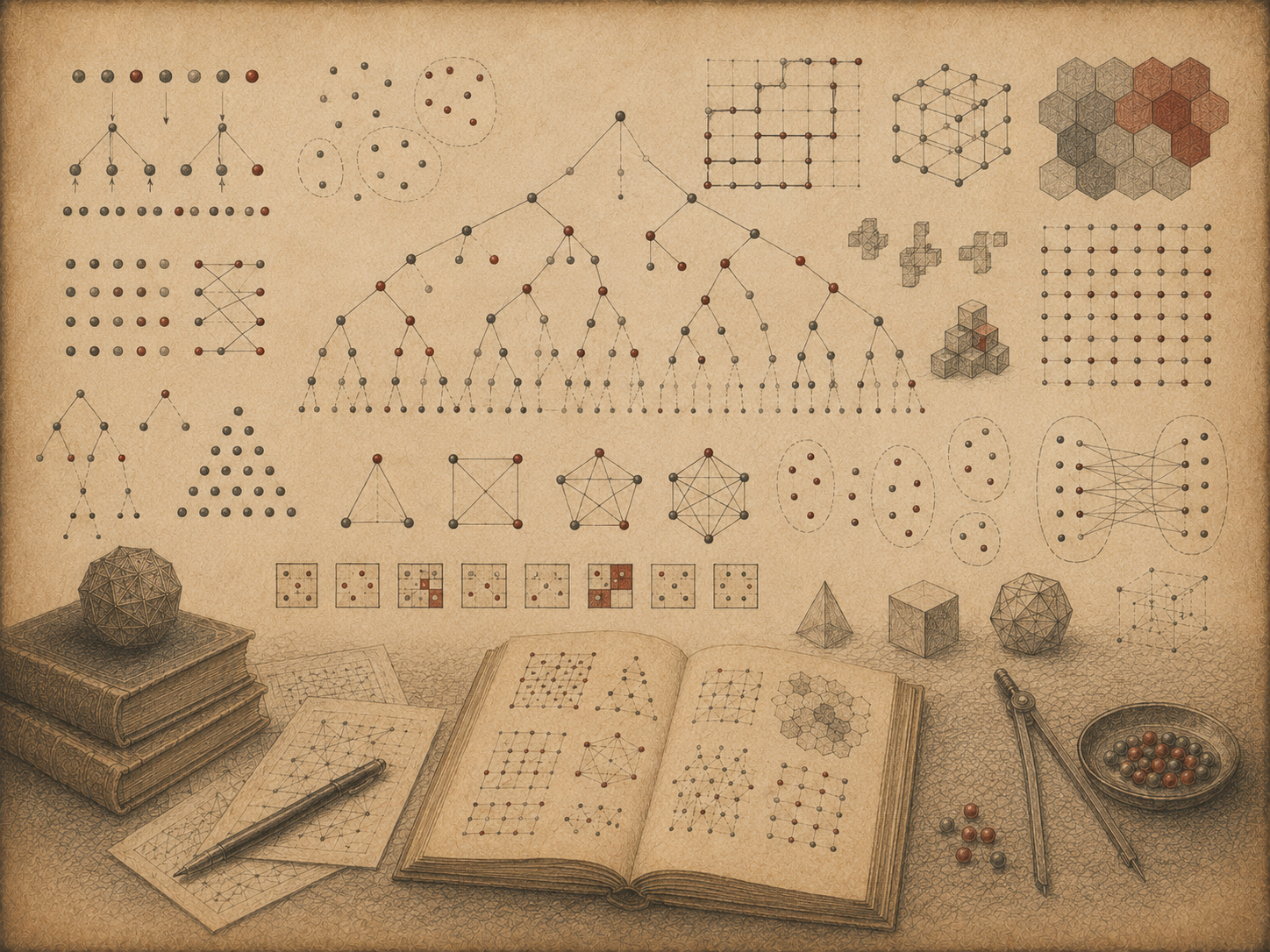
What Combinatorics Means
Combinatorics is the study of finite and discrete structures through counting, arrangement, selection, construction, and proof. It asks how objects can be chosen, ordered, grouped, paired, connected, colored, partitioned, encoded, or transformed under constraints. It is concerned with possibility, but not vague possibility. It studies possibility under rules.
A combinatorial problem begins by defining a universe of objects and the conditions that make an arrangement valid. A simple example might ask how many ways five books can be ordered on a shelf. A more complex example might ask how many graphs on \(n\) labeled vertices have a given property, how many schedules satisfy a set of constraints, or how many binary strings avoid a forbidden pattern.
\text{combinatorics}=\text{objects}+\text{choices}+\text{constraints}+\text{counting}
\]
Interpretation: Combinatorics studies how discrete objects can be selected, arranged, connected, or distributed under specified rules.
Combinatorics is foundational because many mathematical and computational systems are built from choices. A password is a sequence of symbols. A graph is a choice of edges among vertices. A schedule is an assignment of tasks to times. A dataset classification is an assignment of labels. A proof may require dividing cases. An algorithm may search a space of possible states. A model may explore possible scenarios. In each case, combinatorial structure determines what is possible.
| Combinatorial Object | Basic Question | Example |
|---|---|---|
| Selection | Which objects are chosen? | Choose \(k\) items from \(n\) |
| Arrangement | In what order are objects placed? | Permute a set of books |
| Distribution | How are objects assigned to containers? | Distribute tasks among workers |
| Connection | Which pairs are linked? | Build a graph from possible edges |
| Constraint | Which arrangements are allowed? | Count strings with no adjacent repeats |
Combinatorics therefore trains the mind to distinguish raw possibility from structured possibility. It asks not only “how many?” but “how many under exactly these rules?”
Possibility Spaces and Structured Counting
A possibility space is the set of all outcomes, arrangements, or configurations that could occur under a given system of rules. In combinatorics, defining the possibility space is often the most important step. The count depends entirely on what is included, what is excluded, and what counts as distinct.
Suppose a problem asks how many three-letter strings can be formed from the alphabet. The answer depends on whether letters may repeat, whether order matters, whether uppercase and lowercase are distinct, whether all letters are allowed, and whether strings with special patterns are excluded. The same surface question can produce different mathematical problems.
\Omega=\{\text{all valid configurations under the stated rules}\}
\]
Interpretation: A combinatorial possibility space \(\Omega\) contains the valid outcomes or configurations defined by the problem’s rules.
Structured counting begins when the rules are explicit. This includes the object type, the allowed operations, the constraints, and the equivalence conditions. Two arrangements might look different but count as the same under symmetry. Two schedules might use the same assignments but differ in order. Two graphs might be considered different if vertices are labeled, but the same if only structure matters.
| Question | Why It Matters | Example Consequence |
|---|---|---|
| Does order matter? | Changes combinations into permutations | Team selection versus finishing order |
| Is repetition allowed? | Changes the size of the possibility space | PIN codes versus committee selection |
| Are objects labeled? | Changes whether identities matter | Labeled graphs versus graph shapes |
| Are cases overlapping? | Creates double-counting risk | Counting numbers divisible by 2 or 3 |
| Are symmetries identified? | Groups arrangements into equivalence classes | Necklace colorings under rotation |
Combinatorial thinking is therefore a discipline of precision. Before counting, one must define the space. Before applying a formula, one must understand the structure. A formula used without structural analysis can produce an exact answer to the wrong problem.
Addition, Multiplication, and Basic Counting Principles
The basic counting principles are simple but powerful. The addition principle applies when cases are disjoint: if one can choose from group \(A\) or group \(B\), and the groups do not overlap, the total number of choices is the sum. The multiplication principle applies when a process has stages: if there are \(m\) choices for one stage and \(n\) choices for another independent or sequential stage, there are \(mn\) combined choices.
|A\cup B|=|A|+|B|\quad\text{when }A\cap B=\varnothing
\]
Interpretation: If two sets of possibilities do not overlap, their total count is the sum of their individual counts.
m\times n
\]
Interpretation: If one stage has \(m\) choices and another stage has \(n\) choices for each first choice, the total number of two-stage outcomes is \(mn\).
These principles are foundational because more complex counting often reduces to structured uses of addition and multiplication. A password count multiplies choices across positions. A case analysis adds disjoint case counts. A tree diagram represents staged choices visually. A recursive count may multiply or add subcase counts depending on the structure.
| Principle | Use When | Example |
|---|---|---|
| Addition principle | Cases are disjoint alternatives | Choose a red card or a black card from separate piles |
| Multiplication principle | Choices occur in stages | Choose shirt, pants, and shoes |
| Complement principle | It is easier to count what is excluded | Total strings minus strings with forbidden pattern |
| Division principle | Each valid object is counted multiple times | Correcting for repeated orderings |
| Casework | Problem naturally splits into types | Count by number of selected objects of each category |
The basic principles also teach a deeper habit: count by structure, not by guesswork. A good combinatorial solution explains why every valid object is counted, why no invalid object is counted, and why no valid object is counted more than intended.
Permutations: When Order Matters
A permutation is an arrangement of objects in order. If \(n\) distinct objects are arranged in a row, there are \(n!\) possible arrangements. The factorial appears because there are \(n\) choices for the first position, \(n-1\) choices for the second, and so on until one object remains.
n!=n(n-1)(n-2)\cdots 2\cdot 1
\]
Interpretation: The factorial counts the number of ways to order \(n\) distinct objects.
Permutations appear in ranking, scheduling, ordering tasks, arranging symbols, sorting data, assigning positions, forming sequences, and analyzing algorithmic complexity. They are also central to abstract algebra, where permutations are studied as functions that rearrange a set.
If only \(k\) objects are arranged from a set of \(n\), the number of ordered selections is:
P(n,k)=\frac{n!}{(n-k)!}
\]
Interpretation: \(P(n,k)\) counts ordered selections of \(k\) distinct objects from \(n\) distinct objects.
The most common error in permutation problems is failing to ask whether order matters. Choosing three people for a committee is not the same as choosing a first-place, second-place, and third-place finisher. The same individuals may form one committee but many ranked outcomes.
| Scenario | Order Matters? | Counting Tool |
|---|---|---|
| Arrange 5 books on a shelf | Yes | \(5!\) |
| Select 3 finalists and rank them | Yes | \(P(n,3)\) |
| Create a password from symbols | Yes | Multiplication principle |
| Choose a committee | No | Combination |
| Sort a list | Yes | Permutation structure |
Permutation thinking trains attention to sequence. It asks how order changes meaning, identity, and possibility.
Combinations: When Selection Matters
A combination is a selection where order does not matter. If \(k\) objects are chosen from \(n\) distinct objects, the number of possible selections is the binomial coefficient \(\binom{n}{k}\). The formula divides by \(k!\) because each unordered selection would otherwise be counted once for every possible order of its selected objects.
\binom{n}{k}=\frac{n!}{k!(n-k)!}
\]
Interpretation: The binomial coefficient counts the number of unordered selections of \(k\) objects from \(n\) distinct objects.
Combinations appear in committee selection, sampling, probability, experimental design, feature selection, card games, genetics, network edge choices, and combinatorial optimization. They are foundational because many problems involve choosing subsets rather than arranging sequences.
The distinction between permutation and combination is not merely formulaic. It is conceptual. A permutation treats position as meaningful. A combination treats membership as meaningful. If the selected people are assigned roles, order or position may matter. If they are simply members of a group, order does not matter.
| Question | Mathematical Structure | Reason |
|---|---|---|
| Which 3 people are on the committee? | Combination | Only membership matters |
| Who is chair, secretary, and treasurer? | Permutation or assignment | Roles make order/position matter |
| Which 5 cards form a poker hand? | Combination | Card order in the hand is irrelevant |
| What is the exact sequence of 5 cards drawn? | Permutation | Draw order matters |
| Which edges are present in a graph? | Combination over possible edges | Choose a subset of edge possibilities |
Combination thinking is the mathematics of selection. It asks what it means for a subset to be the same or different, and it shows why structure must be understood before a count can be trusted.
Binomial Coefficients and Pascal Structure
Binomial coefficients connect counting, algebra, geometry, probability, and recurrence. The coefficient \(\binom{n}{k}\) counts \(k\)-element subsets of an \(n\)-element set. It also appears as the coefficient of \(x^k y^{n-k}\) in the expansion of \((x+y)^n\).
(x+y)^n=\sum_{k=0}^{n}\binom{n}{k}x^k y^{n-k}
\]
Interpretation: The binomial theorem links algebraic expansion to combinatorial choice: each term records how many ways \(k\) factors contribute \(x\) and \(n-k\) factors contribute \(y\).
Pascal’s triangle organizes binomial coefficients through a recurrence:
\binom{n}{k}=\binom{n-1}{k-1}+\binom{n-1}{k}
\]
Interpretation: To choose \(k\) objects from \(n\), either include a particular object and choose \(k-1\) from the remaining \(n-1\), or exclude it and choose \(k\) from the remaining \(n-1\).
This recurrence illustrates the combinatorial power of casework. A counting formula is not merely a computational shortcut. It has a structural explanation. The recurrence splits the problem into two disjoint cases: selections that include a distinguished element and selections that do not.
| Binomial Structure | Meaning | Use |
|---|---|---|
| \(\binom{n}{k}\) | Choose \(k\) from \(n\) | Combinations, probability, subsets |
| Pascal recurrence | Include/exclude a distinguished element | Recursive counting and proof |
| Binomial theorem | Algebraic expansion by choices | Algebra, probability, analysis |
| Symmetry | \(\binom{n}{k}=\binom{n}{n-k}\) | Choose selected or unselected objects |
| Row sum | \(\sum_k \binom{n}{k}=2^n\) | Count all subsets of an \(n\)-element set |
Binomial coefficients are a reminder that combinatorics often reveals hidden unity. The same numbers count subsets, appear in algebraic expansions, describe probability distributions, and organize recursive structure.
Inclusion-Exclusion and the Problem of Overlap
One of the central dangers in combinatorics is double-counting. When categories overlap, simple addition counts shared objects more than once. The inclusion-exclusion principle corrects this by adding individual counts, subtracting overlaps, adding triple overlaps, and continuing according to the structure of intersections.
|A\cup B|=|A|+|B|-|A\cap B|
\]
Interpretation: Objects in both \(A\) and \(B\) are counted twice by \(|A|+|B|\), so the overlap must be subtracted once.
For three sets, the pattern extends:
|A\cup B\cup C|=|A|+|B|+|C|-|A\cap B|-|A\cap C|-|B\cap C|+|A\cap B\cap C|
\]
Interpretation: Inclusion-exclusion alternates addition and subtraction to correct overlapping counts across multiple sets.
Inclusion-exclusion is more than a formula. It is a way of thinking about overlap, classification, and correction. It asks where cases intersect, how often each object has been counted, and how to restore the intended count.
| Counting Problem | Overlap Risk | Correction |
|---|---|---|
| Numbers divisible by 2 or 3 | Numbers divisible by 6 counted twice | Subtract multiples of 6 |
| Students taking math or physics | Students taking both counted twice | Subtract intersection |
| Documents with tag A or tag B | Documents with both tags counted twice | Use union count |
| System failures by cause | Multi-cause failures overlap | Track intersections explicitly |
| Eligibility groups in policy | People may satisfy several criteria | Define whether groups are disjoint or overlapping |
Inclusion-exclusion teaches a general lesson: categories are often not disjoint. Counting requires attention to intersection. In mathematics, this prevents numerical error. In applied systems, it can prevent real-world misinterpretation.
The Pigeonhole Principle and Forced Structure
The pigeonhole principle is one of the simplest and most powerful ideas in combinatorics. If more objects are placed into fewer containers, at least one container must hold more than one object. This principle produces existence results without identifying the exact object involved.
n+1\text{ objects placed into }n\text{ boxes}\Rightarrow \text{some box contains at least two objects}
\]
Interpretation: The pigeonhole principle shows that certain outcomes are unavoidable when the number of objects exceeds the number of available categories.
The generalized version says that if \(N\) objects are placed into \(k\) boxes, then at least one box contains at least \(\lceil N/k\rceil\) objects. This supports arguments about duplication, collision, distribution, lower bounds, and unavoidable repetition.
\max_i |B_i|\geq \left\lceil\frac{N}{k}\right\rceil
\]
Interpretation: If \(N\) objects are distributed among \(k\) boxes, at least one box must contain at least the ceiling of \(N/k\) objects.
The pigeonhole principle is often surprising because it proves something must exist without constructing it. In a group of 13 people, at least two share a birth month. In any set of integers, enough elements force shared remainders modulo a smaller number. In computer science, finite hash spaces create collision possibilities. In social systems, limited categories can force different individuals into the same label even when their situations differ.
| Context | Objects | Boxes | Forced Conclusion |
|---|---|---|---|
| Birth months | 13 people | 12 months | At least two share a month |
| Remainders | Integers | Residue classes | Some share a remainder |
| Hashing | Keys | Hash buckets | Collisions occur when keys exceed buckets |
| Scheduling | Tasks | Time slots | Some slot must carry multiple tasks |
| Classification | People or cases | Limited labels | Different cases may be forced into same category |
The pigeonhole principle shows that structure can be forced by simple numerical constraints. It is a small theorem with wide reach.
Recurrence Relations and Recursive Counting
Many combinatorial objects are counted recursively. A recurrence relation defines a count for size \(n\) in terms of counts for smaller sizes. This is natural when structures are built step by step: strings by adding symbols, trees by adding subtrees, paths by extending previous paths, tilings by placing a tile at one end, or sequences by extending earlier terms.
a_n=a_{n-1}+a_{n-2}
\]
Interpretation: A recurrence relation defines each term from previous terms. This example has Fibonacci-like structure.
Recurrence is powerful because it turns construction into counting. Consider tiling a board of length \(n\) with tiles of length 1 and 2. If the first tile has length 1, the remaining board has length \(n-1\). If the first tile has length 2, the remaining board has length \(n-2\). Therefore the number of tilings satisfies a Fibonacci recurrence.
Recursive counting often comes with proof by induction. The recurrence gives a rule; induction proves that the rule counts the intended objects correctly. This is another reason combinatorics is closely tied to proof.
| Recursive Object | Counting Strategy | Typical Recurrence |
|---|---|---|
| Fibonacci tilings | First tile has size 1 or 2 | \(a_n=a_{n-1}+a_{n-2}\) |
| Binary strings | Append 0 or 1 | \(a_n=2a_{n-1}\) |
| Permutations | Insert new element into positions | \(a_n=na_{n-1}\) |
| Subsets | Include or exclude a new element | \(a_n=2a_{n-1}\) |
| Trees | Build from subtrees | Often nonlinear or generating-function based |
Recurrence relations teach that possibility can unfold through rules. They connect combinatorics to algorithms, dynamic programming, mathematical induction, and discrete dynamical systems.
Generating Functions and Encoded Possibility
A generating function encodes a sequence of numbers as coefficients of a formal power series. Instead of studying the sequence directly, one studies a function-like expression whose coefficients contain the combinatorial counts. This turns counting problems into algebraic problems.
G(x)=\sum_{n=0}^{\infty}a_nx^n
\]
Interpretation: The coefficient \(a_n\) records the count of objects of size \(n\). The generating function packages the entire sequence into one formal object.
Generating functions are powerful because algebraic operations on series correspond to combinatorial operations on structures. Addition can represent disjoint alternatives. Multiplication can represent combining independent choices. Recurrence relations can be transformed into equations involving generating functions. Coefficients can then be extracted to recover counts.
For example, the generating function for choosing any number of objects from a single available object is \(1+x\): choose none or choose one. For \(n\) distinct objects, the product \((1+x)^n\) encodes all subset choices, and the coefficient of \(x^k\) is \(\binom{n}{k}\).
(1+x)^n=\sum_{k=0}^{n}\binom{n}{k}x^k
\]
Interpretation: The coefficient of \(x^k\) counts the number of \(k\)-element subsets of an \(n\)-element set.
| Generating Function Idea | Combinatorial Meaning | Example |
|---|---|---|
| Coefficient | Count of objects of a given size | \([x^k](1+x)^n=\binom{n}{k}\) |
| Addition | Disjoint alternatives | Choose from class A or class B |
| Multiplication | Combine independent structures | Choose one object from each group |
| Power | Repeated choice structure | \((1+x)^n\) |
| Algebraic manipulation | Derive formulas or recurrences | Solve recurrence through series equation |
Generating functions show the depth of combinatorial thought. A counting problem can become an algebraic object. Possibility can be encoded, transformed, and decoded.
Graph Counting, Networks, and Discrete Structure
Graph theory is deeply combinatorial. A graph can be built by choosing vertices and edges. Counting graphs means asking how many possible connection structures exist under specified rules. Are vertices labeled? Are edges directed? Are loops allowed? Are multiple edges allowed? Must the graph be connected? Must it avoid cycles? These choices change the count.
For a simple undirected graph on \(n\) labeled vertices, each pair of vertices either has an edge or does not. There are \(\binom{n}{2}\) possible edges, and each can be independently included or excluded.
2^{\binom{n}{2}}
\]
Interpretation: This counts simple undirected labeled graphs on \(n\) vertices: each possible edge is either present or absent.
Graph counting becomes much more complex when constraints are added. Counting connected graphs, trees, matchings, colorings, paths, cycles, independent sets, or graph homomorphisms requires deeper combinatorial methods. These problems matter in network science, computer science, chemistry, biology, logistics, operations research, knowledge graphs, and AI systems.
| Graph Counting Problem | Question | Application |
|---|---|---|
| All simple graphs | Which edges are present? | Network possibility space |
| Trees | Which connected acyclic structures exist? | Hierarchies, spanning trees, syntax |
| Colorings | How can labels be assigned under adjacency constraints? | Scheduling, maps, frequency assignment |
| Matchings | Which disjoint pairings are possible? | Assignment, markets, resource allocation |
| Paths | Which routes connect nodes? | Transportation, dependency, reachability |
Graph combinatorics is especially powerful because it counts possible relationships. In a networked world, possibility is often relational: who can connect, what can flow, what can be reached, what can fail, and what structures can emerge from simple links.
Partitions, Distributions, and Arrangements of Quantity
Combinatorics also studies how quantities can be partitioned or distributed. A partition of an integer expresses it as a sum of positive integers, often without regard to order. A distribution problem asks how objects can be assigned to boxes, people, categories, or states under constraints.
For example, the integer \(5\) can be partitioned in several ways:
5=5=4+1=3+2=3+1+1=2+2+1=2+1+1+1=1+1+1+1+1
\]
Interpretation: Integer partitions count ways of decomposing a number into sums, usually ignoring order.
Distribution problems require careful attention to whether objects are identical or distinct, whether boxes are labeled or unlabeled, whether empty boxes are allowed, and whether capacity constraints apply. These choices create different mathematical structures.
| Distribution Question | Objects | Boxes | Important Constraint |
|---|---|---|---|
| Distribute identical candies to children | Identical | Labeled | Can a child receive zero? |
| Assign tasks to workers | Distinct | Labeled | Can a worker receive multiple tasks? |
| Partition an integer | Identical units | Unlabeled parts | Does order matter? |
| Allocate resources | Discrete or divisible units | Programs or recipients | Fairness and capacity constraints |
| Assign labels to records | Distinct records | Categories | Can records have multiple labels? |
Partition and distribution problems show why combinatorics is not merely abstract. Resource allocation, scheduling, workload balance, classification, and institutional design all involve constrained distribution. Counting the possible assignments is often the first step toward understanding feasibility, fairness, and risk.
Combinatorics and Probability
Probability often depends on combinatorics because probabilities are frequently ratios of counts. If all outcomes are equally likely, the probability of an event is the number of favorable outcomes divided by the number of possible outcomes.
P(E)=\frac{|E|}{|\Omega|}
\]
Interpretation: When all outcomes in the sample space \(\Omega\) are equally likely, the probability of event \(E\) is the count of favorable outcomes divided by the total count.
This makes accurate counting essential. Probability errors often arise from defining the sample space incorrectly, assuming outcomes are equally likely when they are not, confusing ordered and unordered outcomes, or double-counting favorable cases.
Card probabilities, dice problems, sampling without replacement, random committees, genetic combinations, randomized algorithms, statistical sampling, and risk models all rely on combinatorial reasoning. Even when probabilities are estimated empirically, combinatorial structure can clarify possible outcomes and constraints.
| Probability Context | Combinatorial Structure | Common Error |
|---|---|---|
| Cards | Combinations of hands | Confusing hand order with hand membership |
| Dice | Ordered outcome pairs | Treating sums as equally likely |
| Sampling | Selections with or without replacement | Ignoring dependence after selection |
| Genetics | Combinations of inherited traits | Assuming independence without justification |
| Risk modeling | Scenario space | Omitting rare but consequential combinations |
Combinatorics gives probability its structural foundation. Before assigning probability, one must understand the outcome space.
Combinatorics, Algorithms, and Search Spaces
Combinatorics is central to algorithms because many computational problems involve searching a space of possible solutions. A route-planning algorithm searches paths. A scheduler searches task assignments. A solver searches configurations satisfying constraints. A machine learning system searches model parameters or architectures. A theorem prover searches proof states. A game-playing program searches possible moves.
The challenge is that combinatorial spaces grow quickly. A small number of choices can produce an enormous number of possible configurations. This is sometimes called combinatorial explosion. It is one reason algorithms, heuristics, pruning methods, dynamic programming, approximation, and optimization are essential.
2^n,\quad n!,\quad \binom{n}{k}
\]
Interpretation: These common combinatorial quantities grow rapidly, making exhaustive search difficult or impossible for large \(n\).
Algorithmic combinatorics asks how to generate, count, search, optimize, or sample combinatorial objects efficiently. It is central to computer science because software often manipulates discrete possibilities under constraints.
| Algorithmic Problem | Combinatorial Space | Challenge |
|---|---|---|
| Traveling salesperson | Permutations of cities | Factorial growth |
| Feature selection | Subsets of variables | Exponential search space |
| Graph coloring | Color assignments to vertices | Constraint satisfaction |
| Scheduling | Assignments of tasks to times/resources | Conflicting constraints |
| Proof search | Sequences of inference steps | Branching and explosion |
Combinatorics helps identify the shape of the search space. Algorithms then ask how that space can be explored intelligently without treating every possibility equally or exhaustively.
Learning Combinatorial Thinking
Combinatorics can be difficult to learn because it often requires structural judgment before calculation. Students may know formulas but not know when to use them. They may confuse permutations and combinations, overlook overlapping cases, miss constraints, assume outcomes are equally likely, or count the same object multiple times.
Effective combinatorics learning should emphasize problem interpretation. What is being counted? Are objects distinct? Does order matter? Can repetition occur? Are cases disjoint? Are there hidden constraints? Is symmetry identifying arrangements? Is a formula appropriate, or does the problem require casework, recursion, or a bijection?
| Common Difficulty | Underlying Issue | Instructional Response |
|---|---|---|
| Formula matching | Memorizing without structure | Ask students to explain what counts as distinct |
| Permutation-combination confusion | Unclear role of order | Compare ranked outcomes and unranked selections |
| Double-counting | Overlapping cases | Use Venn diagrams or inclusion-exclusion tables |
| Omitted cases | Incomplete casework | Require disjoint exhaustive case partitions |
| Finite evidence mistaken for proof | Pattern recognition without justification | Use recurrence, induction, or bijective proof |
Combinatorial thinking develops through examples, nonexamples, small cases, diagrams, tables, recursive construction, counterexamples, and proof. It is not only a topic within discrete mathematics. It is a discipline of careful possibility analysis.
A Mathematical Lens: Choice, Constraint, Arrangement, Enumeration
A useful lens for combinatorics is the sequence: choice, constraint, arrangement, enumeration. First, identify the possible choices. Then identify the constraints. Then determine what counts as an arrangement or configuration. Finally, enumerate the valid structures.
\text{Choice}\rightarrow \text{Constraint}\rightarrow \text{Arrangement}\rightarrow \text{Enumeration}
\]
Interpretation: Combinatorial reasoning moves from possible choices to valid structures and then to reliable counts.
This lens applies broadly. In a password problem, choices are characters, constraints are length and allowed repetition, arrangements are strings, and enumeration gives the count. In a graph problem, choices are possible edges, constraints may require connectivity or acyclicity, arrangements are valid graphs, and enumeration gives the number of graphs. In a scheduling problem, choices are assignments, constraints include time and resource limits, arrangements are feasible schedules, and enumeration reveals possibility.
| Lens Element | Guiding Question | Combinatorial Use |
|---|---|---|
| Choice | What options are available? | Characters, objects, edges, labels, tasks |
| Constraint | What rules restrict the options? | No repeats, capacity, adjacency, eligibility |
| Arrangement | What counts as a distinct configuration? | Sequence, subset, graph, partition, assignment |
| Enumeration | How many valid configurations exist? | Formula, recurrence, bijection, algorithm |
| Interpretation | What does the count mean? | Probability, feasibility, risk, complexity, opportunity |
This framework makes combinatorics more than calculation. It becomes a way of thinking about structured possibility in mathematics, computation, and real-world systems.
Computational Companion Examples
The companion repository for this article should extend the Mathematical Thinking codebase with examples focused on permutations, combinations, binomial coefficients, inclusion-exclusion, recurrence, graph counting, integer partitions, generating-function coefficients, search-space growth, Haskell algebraic data types, SQL schemas, and responsible interpretation of combinatorial possibility. The examples below are compact article-level previews; the repository can expand them into richer professional workflows.
Python: Counting Principles and Inclusion-Exclusion
from math import comb, factorial
from itertools import permutations, combinations

def permutation_count(n: int, k: int) -> int:
    return factorial(n) // factorial(n - k)

def combination_count(n: int, k: int) -> int:
    return comb(n, k)

def inclusion_exclusion_two(a_count: int, b_count: int, overlap_count: int) -> int:
    return a_count + b_count - overlap_count

def multiples_of_2_or_3(limit: int) -> int:
    multiples_2 = limit // 2
    multiples_3 = limit // 3
    multiples_6 = limit // 6
    return inclusion_exclusion_two(multiples_2, multiples_3, multiples_6)

items = ["A", "B", "C", "D"]

print("permutations of 2:", list(permutations(items, 2)))
print("combinations of 2:", list(combinations(items, 2)))
print("P(4,2):", permutation_count(4, 2))
print("C(4,2):", combination_count(4, 2))
print("multiples of 2 or 3 through 100:", multiples_of_2_or_3(100))
R: Binomial Coefficients and Pascal Triangle Rows
pascal_row <- function(n) {
  sapply(0:n, function(k) choose(n, k))
}

rows <- lapply(0:8, pascal_row)

audit <- data.frame(
  n = 0:8,
  row_sum = sapply(rows, sum),
  expected_power_of_two = 2^(0:8),
  agrees = sapply(rows, sum) == 2^(0:8),
  interpretation = "row sums of Pascal's triangle count all subsets of an n-element set"
)

print(rows)
print(audit)
Julia: Recurrence and Search-Space Growth
function fibonacci_tilings(n)
    if n == 0
        return 1
    elseif n == 1
        return 1
    end

    previous = 1
    current = 1

    for _ in 2:n
        previous, current = current, previous + current
    end

    return current
end

function search_space_table(nmax)
    return [
        (n=n, subsets=2^n, permutations=factorial(big(n)))
        for n in 1:nmax
    ]
end

println("tiling counts: ", [fibonacci_tilings(n) for n in 0:10])
println("search-space growth: ", search_space_table(10))
println("Interpretation: combinatorial possibility spaces grow rapidly under simple rules.")
Haskell: Combinatorial Structures as Algebraic Data Types
{-# OPTIONS_GHC -Wall #-}

data ChoiceRule
  = OrderMatters
  | OrderDoesNotMatter
  deriving (Eq, Show)

data RepetitionRule
  = RepetitionAllowed
  | RepetitionNotAllowed
  deriving (Eq, Show)

data CountingProblem = CountingProblem
  { problemName :: String
  , numberOfObjects :: Integer
  , selectedObjects :: Integer
  , choiceRule :: ChoiceRule
  , repetitionRule :: RepetitionRule
  } deriving (Eq, Show)

factorial :: Integer -> Integer
factorial n = product [1..n]

permutation :: Integer -> Integer -> Integer
permutation n k = factorial n `div` factorial (n - k)

combination :: Integer -> Integer -> Integer
combination n k = factorial n `div` (factorial k * factorial (n - k))

countProblem :: CountingProblem -> Maybe Integer
countProblem problem =
  case (choiceRule problem, repetitionRule problem) of
    (OrderMatters, RepetitionNotAllowed) ->
      Just (permutation (numberOfObjects problem) (selectedObjects problem))
    (OrderDoesNotMatter, RepetitionNotAllowed) ->
      Just (combination (numberOfObjects problem) (selectedObjects problem))
    _ ->
      Nothing

main :: IO ()
main = do
  let ranked = CountingProblem "ranked finalists" 10 3 OrderMatters RepetitionNotAllowed
  let committee = CountingProblem "committee" 10 3 OrderDoesNotMatter RepetitionNotAllowed
  print (countProblem ranked)
  print (countProblem committee)
SQL: Combinatorial Possibility Metadata Schema
CREATE TABLE combinatorial_problem (
  problem_id TEXT PRIMARY KEY,
  name TEXT NOT NULL,
  object_count INTEGER NOT NULL,
  selected_count INTEGER,
  order_matters INTEGER NOT NULL,
  repetition_allowed INTEGER NOT NULL,
  constraint_note TEXT NOT NULL,
  interpretation TEXT NOT NULL
);

CREATE TABLE counting_method (
  method_id TEXT PRIMARY KEY,
  problem_id TEXT NOT NULL,
  method_name TEXT NOT NULL,
  formula TEXT NOT NULL,
  double_counting_risk TEXT NOT NULL,
  validation_note TEXT NOT NULL,
  FOREIGN KEY (problem_id) REFERENCES combinatorial_problem(problem_id)
);

CREATE TABLE possibility_warning (
  warning_id TEXT PRIMARY KEY,
  problem_id TEXT NOT NULL,
  warning TEXT NOT NULL,
  mitigation TEXT NOT NULL,
  FOREIGN KEY (problem_id) REFERENCES combinatorial_problem(problem_id)
);
These examples treat combinatorics as executable possibility analysis. Counts can be generated, assumptions can be labeled, recurrence can be audited, and Haskell data types can make the distinction between order, repetition, and constraint explicit. The purpose is not to replace proof, but to make the structure of counting reproducible and inspectable.
GitHub Repository
The companion repository for this article is designed as a reproducible mathematical-thinking workspace focused on permutations, combinations, binomial coefficients, inclusion-exclusion, recurrence, generating-function coefficients, graph counting, partitions, search-space growth, Haskell algebraic data types, SQL schemas, and responsible interpretation of combinatorial possibility.
Complete Code Repository
Companion article folder with Python, R, Julia, SQL, Haskell, Rust, Go, C++, Fortran, and C examples for professional mathematical exploration of combinatorics, structured counting, permutations, combinations, recurrence, graph counting, possibility spaces, search complexity, typed structures, and the mathematics of possibility.
Combinatorics, Possibility, and Responsible Interpretation
Combinatorics is powerful because it reveals the size and structure of possibility spaces. But possibility is not the same as likelihood, desirability, feasibility, justice, or responsibility. A configuration may be possible but harmful. A search space may be large but poorly defined. A model may enumerate scenarios while excluding the people most affected by them. A classification system may produce many combinations of labels while ignoring lived complexity.
Responsible combinatorial reasoning requires asking what possibilities are included, what possibilities are excluded, who defines the constraints, whether cases overlap, whether counts are being interpreted as probabilities, and whether the possibility space reflects the real system responsibly.
| Combinatorial Practice | Possible Benefit | Risk | Responsible Habit |
|---|---|---|---|
| Scenario enumeration | Reveals possible futures | May omit marginalized or low-probability high-impact cases | Audit scenario boundaries and stakeholder relevance |
| Classification combinations | Shows category intersections | May reify harmful categories | Review category design and consequences |
| Search-space analysis | Clarifies computational complexity | May hide value choices in constraints | Document objective function and exclusions |
| Probability counting | Supports risk estimation | May assume equal likelihood incorrectly | Distinguish count from probability |
| Optimization | Finds feasible or efficient arrangements | May optimize the wrong criterion | Include ethical and contextual constraints |
The ethics of combinatorics begins with the structure of possibility. What a system treats as possible determines what it can count, search, optimize, recommend, or ignore. A responsible mathematics of possibility must be clear about constraints, assumptions, exclusions, and consequences.
Why Combinatorics Matters
Combinatorics matters because it teaches mathematics how to reason about possibility with precision. It shows how choices combine, how constraints shape outcomes, how cases overlap, how structures can be counted, and how finite rules can generate enormous complexity.
It also matters because combinatorial thinking is everywhere in modern life. Algorithms search possibility spaces. AI systems generate sequences and classify outputs. Databases combine records. Networks connect nodes. Risk models enumerate scenarios. Schedules assign tasks. Cryptographic systems depend on large combinatorial spaces. Scientific models explore parameter combinations. Public institutions make decisions through categories, eligibility rules, and constrained resources.
Combinatorics trains habits that extend beyond formal mathematics: define the space, state the rules, check whether order matters, identify overlaps, avoid double-counting, look for recurrence, examine edge cases, and distinguish possible from probable or desirable.
In this sense, combinatorics is not merely a branch of discrete mathematics. It is a way of thinking about structured possibility. It reveals that possibility is not shapeless. It has architecture. It has rules. It has exclusions. It has consequences.
Combinatorics is the mathematics of possibility because it teaches us how to count what could happen—and how to ask whether we have defined that “could” responsibly.
Related Articles
- What Is Mathematical Thinking?
- Discrete Mathematics and the Logic of Structure
- Number, Pattern, and the Origins of Mathematical Thought
- Sets, Relations, and Functions as Modes of Thought
- Proof and the Logic of Mathematical Justification
- Logic and the Structure of Formal Inference
- Patterns, Structure, and the Mathematical Imagination
- Mathematics as the Science of Patterns
Further Reading
- Aigner, M. (2007) A Course in Enumeration. Berlin: Springer. Available at: https://link.springer.com/book/10.1007/978-3-540-39035-0
- Biggs, N.L. (1979) The Roots of Combinatorics. Historia Mathematica, 6(2), pp. 109–136. Available at: https://doi.org/10.1016/0315-0860(79)90074-0
- Bona, M. (2016) A Walk Through Combinatorics: An Introduction to Enumeration and Graph Theory. 4th edn. Singapore: World Scientific. Available at: https://www.worldscientific.com/worldscibooks/10.1142/9657
- Graham, R.L., Knuth, D.E. and Patashnik, O. (1994) Concrete Mathematics: A Foundation for Computer Science. 2nd edn. Reading, MA: Addison-Wesley.
- Grimaldi, R.P. (2004) Discrete and Combinatorial Mathematics: An Applied Introduction. 5th edn. Boston: Pearson.
- Lovász, L. (1993) Combinatorial Problems and Exercises. 2nd edn. Amsterdam: North-Holland.
- Stanley, R.P. (2012) Enumerative Combinatorics, Volume 1. 2nd edn. Cambridge: Cambridge University Press. Available at: https://www.cambridge.org/core/books/enumerative-combinatorics/1B8B4C8D3C58D9A1B6E31519B7E4D82A
- Tucker, A. (2012) Applied Combinatorics. 6th edn. Hoboken, NJ: Wiley.
References
- Aigner, M. (2007) A Course in Enumeration. Berlin: Springer. Available at: https://link.springer.com/book/10.1007/978-3-540-39035-0
- Biggs, N.L. (1979) The Roots of Combinatorics. Historia Mathematica, 6(2), pp. 109–136. Available at: https://doi.org/10.1016/0315-0860(79)90074-0
- Bona, M. (2016) A Walk Through Combinatorics: An Introduction to Enumeration and Graph Theory. 4th edn. Singapore: World Scientific. Available at: https://www.worldscientific.com/worldscibooks/10.1142/9657
- Graham, R.L., Knuth, D.E. and Patashnik, O. (1994) Concrete Mathematics: A Foundation for Computer Science. 2nd edn. Reading, MA: Addison-Wesley.
- Grimaldi, R.P. (2004) Discrete and Combinatorial Mathematics: An Applied Introduction. 5th edn. Boston: Pearson.
- Lovász, L. (1993) Combinatorial Problems and Exercises. 2nd edn. Amsterdam: North-Holland.
- Stanley, R.P. (2012) Enumerative Combinatorics, Volume 1. 2nd edn. Cambridge: Cambridge University Press. Available at: https://www.cambridge.org/core/books/enumerative-combinatorics/1B8B4C8D3C58D9A1B6E31519B7E4D82A
- Tucker, A. (2012) Applied Combinatorics. 6th edn. Hoboken, NJ: Wiley.