
Last Updated May 30, 2026
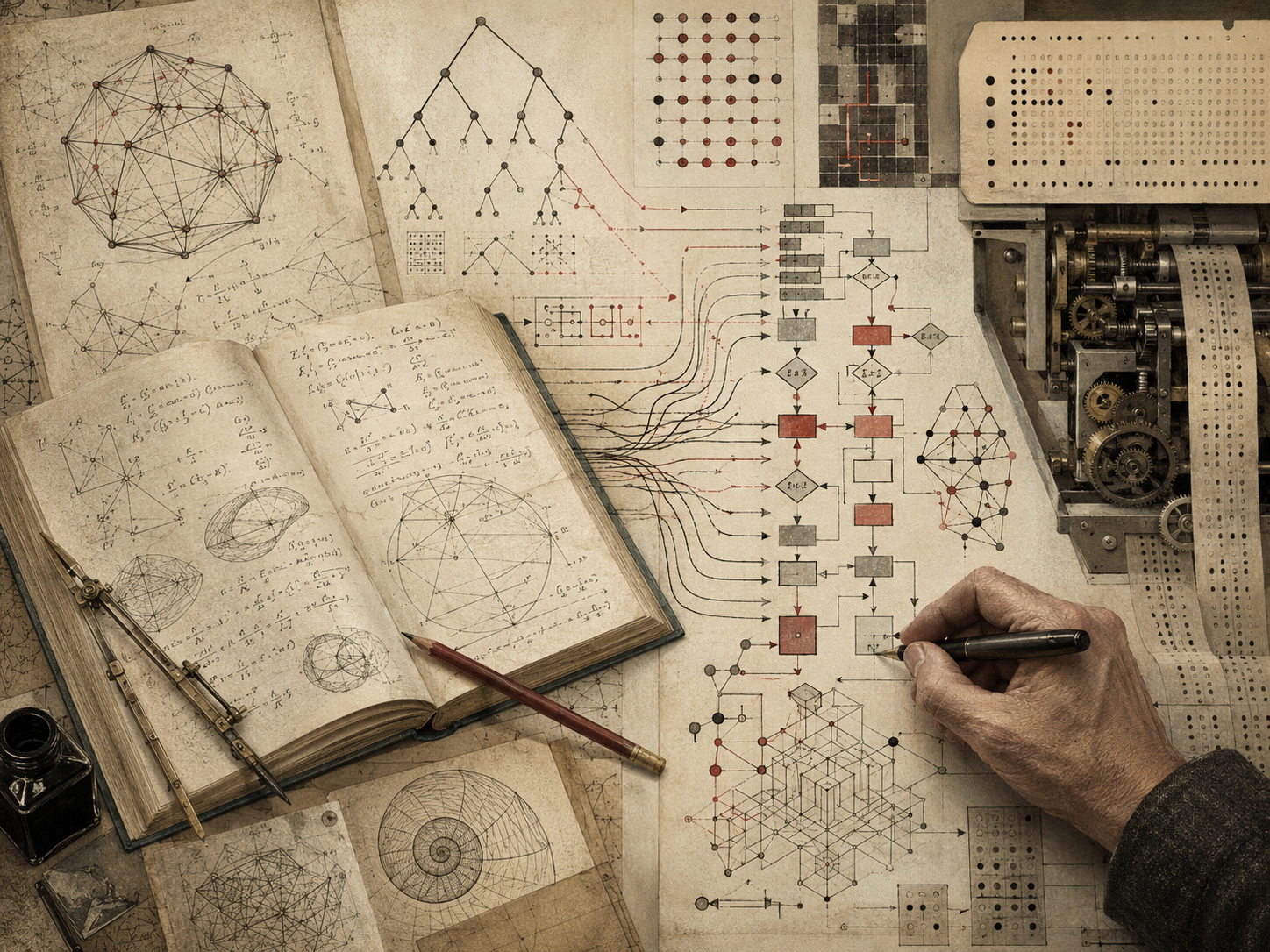
Mathematical thinking is entering a new historical phase. For centuries, mathematics has been shaped by tools: numerals, diagrams, tables, algebraic notation, logarithms, slide rules, calculators, computers, computer algebra systems, statistical software, programming languages, proof assistants, and now AI-assisted reasoning systems. Each tool changed what mathematicians could see, compute, prove, teach, and imagine. Automation is not the first transformation of mathematical practice, but it is one of the most consequential because it reaches into nearly every layer of mathematical work: calculation, symbolic manipulation, visualization, modeling, theorem proving, code generation, tutoring, search, explanation, and formal verification.
The central question is not whether automation will make mathematical thinking unnecessary. It will not. The deeper question is what kind of mathematical thinking becomes more important when machines can calculate, search, simplify, simulate, generate, and sometimes prove. Automation changes the human role from performing every step manually to specifying problems, choosing representations, checking assumptions, interpreting outputs, validating models, recognizing structure, asking better questions, and deciding when a result is meaningful.
This article examines mathematical thinking in an age of automation. It considers calculators, computer algebra, numerical simulation, algorithmic reasoning, proof assistants, AI-assisted theorem proving, automated tutoring, and machine-generated explanations. It argues that automation does not eliminate mathematics; it changes the boundary between procedure and judgment. In automated environments, mathematical maturity depends less on mechanical fluency alone and more on conceptual understanding, structural awareness, model literacy, proof literacy, verification habits, and ethical responsibility.
The Automation Question in Mathematics
The automation question in mathematics is often framed too narrowly: if a machine can calculate, simplify, plot, solve, prove, or explain, what remains for human mathematical thinking? This question assumes that mathematics consists mainly of performing procedures. But mathematical thinking has never been only procedure. It includes recognizing structure, forming conjectures, choosing representations, defining objects, building models, judging plausibility, constructing explanations, finding counterexamples, interpreting results, and deciding what matters.
Automation changes the distribution of labor. It can reduce the burden of routine calculation, but it increases the importance of specification. It can produce symbolic transformations, but it increases the need to know when transformations are valid. It can generate graphs, but it increases the need to interpret axes, domains, scales, and assumptions. It can produce proof scripts, but it increases the need to understand formal statements, libraries, dependencies, and trust boundaries. It can generate explanations, but it increases the need to distinguish fluency from correctness.
\text{automation}\neq \text{understanding}
\]
Interpretation: Automation can perform or assist mathematical operations, but understanding requires interpreting what the operation means, why it is valid, and where it applies.
In an age of automation, the mathematical learner, researcher, engineer, analyst, or policymaker must ask a different set of questions. What exactly did I ask the system to do? What assumptions did it use? What domain is the answer valid over? Is the result exact, approximate, symbolic, numerical, probabilistic, or heuristic? Does the output answer the original question? Can the result be checked independently? What would count as a counterexample? What would make the model fail?
| Automated Action | Human Mathematical Question | Risk Without Judgment |
|---|---|---|
| Calculate | What quantity is being computed? | Correct arithmetic applied to the wrong object |
| Simplify | Under what assumptions is the simplification valid? | Domain errors and lost conditions |
| Plot | What range, scale, and behavior are being shown? | Visual misinterpretation |
| Simulate | What model assumptions drive the simulation? | False confidence in modeled behavior |
| Prove | What formal statement was proved? | Verified statement that misses the intended claim |
The automation question is therefore not “Will machines do mathematics?” They already do many mathematical tasks. The real question is whether humans will develop stronger mathematical judgment in response.
Automation as Historical Continuity, Not Sudden Replacement
Automation feels new because contemporary systems are powerful, interactive, and increasingly language-based. But mathematics has always been shaped by technologies that automate or stabilize thought. Place-value notation automated aspects of arithmetic by making positional calculation systematic. Tables automated lookup and repeated computation. Algebraic notation automated symbolic manipulation by making form visible. Logarithms and slide rules transformed multiplication, division, and scaling. Calculators accelerated arithmetic. Computer algebra systems transformed symbolic work. Programming languages made procedures executable. Proof assistants made formal checking mechanical.
Each technological layer changed what counted as mathematical skill. Before place-value numeration, arithmetic looked different. Before symbolic algebra, equations were harder to generalize. Before graphing calculators and computer visualization, many functions were harder to explore. Before proof assistants, formal derivations were rarely written in machine-checkable detail. Automation is not outside mathematical history. It is part of the long history of mathematical representation.
\text{new tool}\rightarrow \text{new representation}\rightarrow \text{new mathematical practice}
\]
Interpretation: Mathematical tools do not merely speed up existing work. They often change what can be represented, explored, checked, and taught.
The history of mathematical technology shows that automation does not simply remove human thought. It relocates it. When arithmetic procedures become easier, more attention can move to algebraic structure. When symbolic manipulation becomes automated, more attention can move to modeling and interpretation. When proof checking becomes mechanized, more attention can move to definitions, formalization strategy, library design, and theorem architecture.
| Tool or Medium | What It Automates or Stabilizes | New Human Emphasis |
|---|---|---|
| Place-value notation | Arithmetic representation | Scalable calculation and abstraction |
| Tables | Repeated values and lookup | Prediction, comparison, and pattern recognition |
| Algebraic notation | General symbolic form | Equation structure and transformation |
| Computer algebra | Symbolic simplification and manipulation | Domain awareness and expression interpretation |
| Proof assistant | Formal checking | Definition design, formal statement, and proof architecture |
| AI assistant | Search, generation, explanation, pattern suggestion | Verification, critique, framing, and judgment |
The age of automation should therefore be understood as a continuation of mathematics’ representational history. The difference is that automation now reaches into symbolic, computational, explanatory, and formal reasoning at once.
What Automation Does Well: Procedure, Search, Computation, and Scale
Automation is strongest where tasks can be formalized as procedures. Arithmetic calculation, symbolic simplification, equation solving, matrix operations, numerical approximation, graph traversal, optimization routines, statistical estimation, theorem search, proof checking, and code execution all benefit from automation. These tasks may be difficult or tedious for humans, but they can often be specified as operations over representations.
Automation also excels at scale. A human may inspect a few cases; a program can inspect millions. A student may graph one function; software can plot a family of functions. A researcher may test a conjecture in small examples; computation can search large finite spaces. A proof assistant can check every formal step of a derivation. AI systems can retrieve possible lemmas, generate candidate explanations, suggest proof strategies, and translate between informal and formal language.
\text{formal representation}+\text{procedure}\Rightarrow \text{automatable task}
\]
Interpretation: A mathematical task becomes automatable when it can be represented formally enough for a procedure to operate on it.
But automation’s strength is also its boundary. A machine can operate on a representation. It does not automatically know whether the representation is appropriate. A system can optimize an objective. It does not know whether the objective should be optimized. A theorem prover can check a formal statement. It does not know whether the statement captures the informal mathematical intention. A model can simulate trajectories. It does not know whether the model should guide a public decision.
| Automation Strength | Why It Works | Human Check Required |
|---|---|---|
| Calculation | Rules are explicit and repeatable | Is the quantity meaningful? |
| Symbolic manipulation | Expressions can be transformed formally | Are domain assumptions preserved? |
| Numerical simulation | Equations can be approximated stepwise | Are the model and numerical method valid? |
| Search | Large spaces can be explored computationally | Is the search space relevant? |
| Formal checking | Inference rules can be verified mechanically | Does the formal statement mean what was intended? |
Automation extends mathematical reach. It does not remove the need to know what is being reached for.
What Automation Does Not Replace: Judgment, Meaning, and Assumptions
Mathematical judgment is the ability to know what a result means, when a method applies, which assumptions matter, how a representation shapes the problem, and what kind of evidence is required. Automation can support judgment, but it cannot replace it because judgment operates at the level of meaning, context, and purpose.
A symbolic system may simplify \(\sqrt{x^2}\) to \(|x|\), or under certain assumptions to \(x\). Which expression is appropriate depends on the domain. A numerical solver may produce an approximate root, but the user must ask whether the method converged, whether there are other roots, and whether the root matters. A model may fit data well while failing causally. A proof assistant may verify a formal theorem that is weaker, stronger, or different from the claim the human intended.
\text{correct output}\not\Rightarrow \text{correct interpretation}
\]
Interpretation: A mathematical output can be formally or computationally correct while still being misinterpreted, misapplied, or insufficient for the problem at hand.
Automation makes assumptions more important, not less. Every automated result depends on inputs, definitions, domains, data, algorithms, libraries, precision settings, search strategies, model forms, or training distributions. The more powerful the automated system, the more important it becomes to ask what assumptions are hidden beneath the output.
| Human Judgment Task | Why Automation Cannot Fully Replace It | Example Question |
|---|---|---|
| Problem framing | Purpose is not contained in the computation | What is the real question? |
| Representation choice | Different representations reveal different structure | Should this be modeled as an equation, graph, matrix, or simulation? |
| Assumption review | Automated systems operate within assumptions | What domain, data, and constraints are being assumed? |
| Evidence evaluation | Not all outputs have the same status | Is this a proof, heuristic, approximation, or empirical fit? |
| Interpretation | Meaning depends on context and consequence | What does this result imply, and for whom? |
In automated mathematics, the human role becomes less mechanical and more epistemic. Humans must know what kind of knowledge has been produced.
Symbolic Computation and the Reorganization of Algebraic Work
Symbolic computation changed mathematical work by allowing computers to manipulate algebraic expressions. Computer algebra systems can expand, factor, simplify, differentiate, integrate, solve equations, manipulate matrices, compute Gröbner bases, transform expressions, and generate exact symbolic results. This can make mathematical exploration faster and more powerful.
But symbolic computation also exposes a central truth: algebraic manipulation is not meaning-neutral. A transformation that is valid in one domain may be invalid in another. Simplification may hide restrictions. Solving an equation may introduce extraneous roots or omit exceptional cases. Symbolic equality may depend on assumptions about variables, branches, fields, rings, or analytic domains.
\text{symbolic transformation}=\text{rule}+\text{domain}+\text{assumptions}
\]
Interpretation: Symbolic automation requires rules, but the validity of those rules depends on domains and assumptions.
The educational implication is important. Students should not learn algebra only as hand manipulation, but they also should not surrender algebra to software without understanding. They need to know what transformations preserve, when expressions are equivalent, and why symbolic form matters.
| Symbolic Task | Automated Benefit | Mathematical Judgment |
|---|---|---|
| Expansion | Quickly rewrites products as sums | Is expanded form more useful than factored form? |
| Factoring | Reveals product structure | Over which number system or ring? |
| Simplification | Reduces expression complexity | What assumptions are required? |
| Equation solving | Finds candidate solutions | Are there extraneous or missing solutions? |
| Integration | Finds antiderivatives when possible | What branch, constant, or domain issue matters? |
Symbolic computation does not make algebra obsolete. It makes algebraic understanding more conceptual: students and practitioners must understand form, equivalence, domain, and representation.
Numerical Simulation and the Mathematics of Approximation
Automation has greatly expanded the role of numerical simulation. Many systems cannot be solved exactly in closed form, but they can be approximated through computation. Differential equations, climate models, epidemic models, fluid dynamics, optimization landscapes, financial systems, neural networks, and infrastructure simulations often depend on numerical methods.
Simulation changes mathematical thinking because it makes behavior visible. Instead of solving a system once symbolically, one can explore trajectories, parameter regimes, sensitivity, stability, bifurcations, uncertainty, and failure modes. But simulation is not proof. It is structured exploration under assumptions.
\text{simulation}=\text{model}+\text{numerical method}+\text{parameters}+\text{initial conditions}
\]
Interpretation: A simulation is not merely a computed picture. It is a model executed under numerical, parametric, and representational choices.
Automated simulation requires numerical literacy. Users must understand step size, convergence, stability, discretization error, parameter sensitivity, stochastic variation, and validation. A beautiful visualization can hide a fragile model. A precise-looking output can depend on uncertain inputs. A simulation that reproduces past behavior may still fail under new conditions.
| Simulation Issue | Mathematical Meaning | Review Question |
|---|---|---|
| Step size | Discrete approximation of continuous change | Does the result change when the step size changes? |
| Stability | Behavior of numerical errors | Is the method stable for this system? |
| Sensitivity | Dependence on parameters or initial conditions | Which assumptions drive the output? |
| Validation | Comparison to evidence or known behavior | What would count as model failure? |
| Visualization | Representation of computed behavior | Does the visual scale mislead interpretation? |
Simulation expands mathematical imagination, but it also demands disciplined skepticism. In an automated environment, approximation must be understood as a method, not mistaken for certainty.
Proof Assistants and the Automation of Formal Checking
Proof assistants represent one of the most important developments in modern mathematical automation. Systems such as Lean, Rocq/Coq, Isabelle/HOL, HOL Light, Agda, and related formal systems allow mathematical definitions, theorems, and proofs to be encoded in formal languages and checked by machine. This does not mean the machine automatically creates all the mathematics. It means that the machine can verify whether a formal derivation follows from the chosen rules, definitions, libraries, and assumptions.
The transformation is profound. Traditional mathematical proof is written for human readers. It relies on shared background, compression, judgment, and accepted conventions. Formal proof requires much more explicit structure. Definitions must be precise. Theorems must be stated in a formal language. Proof steps must be accepted by the system. Libraries become part of the mathematical environment.
\text{informal proof}\rightarrow \text{formal statement}\rightarrow \text{machine-checked derivation}
\]
Interpretation: Proof assistants change the medium of proof by turning mathematical reasoning into formal artifacts that can be checked mechanically.
This changes mathematical thinking in several ways. It encourages precision about definitions. It exposes hidden assumptions. It makes dependency structures visible. It requires modular proof design. It creates reusable formal libraries. It also introduces new skills: reading formal statements, navigating libraries, choosing definitions that work well, managing proof states, and understanding the trust boundary of the system.
| Proof Assistant Layer | Human Role | Machine Role |
|---|---|---|
| Concept | Decide what mathematical idea matters | No independent mathematical purpose |
| Definition | Choose formal objects and assumptions | Check syntax and type correctness |
| Theorem statement | Translate informal claim into formal language | Represent the proposition precisely |
| Proof construction | Guide strategy, structure, and decomposition | Verify each accepted inference |
| Interpretation | Explain why the result matters | No social or philosophical judgment |
Proof assistants do not end proof. They deepen the question of what a proof is. They make proof more explicit, more reusable, more checkable, and more infrastructural. But the human still has to ask whether the formalization expresses the intended mathematics.
AI-Assisted Mathematical Reasoning
AI-assisted mathematical reasoning adds another layer to automation. Unlike a calculator or a proof kernel, an AI system may generate plausible explanations, suggest strategies, produce code, search for patterns, translate informal language into formal expressions, propose examples, identify likely lemmas, or help debug a proof attempt. These capabilities can make mathematical exploration more conversational and accessible.
But AI-generated mathematical content has a distinctive risk: it may sound coherent without being correct. Fluency is not proof. A generated explanation can skip a condition, invent a lemma, misuse a theorem, confuse a definition, or produce a correct-looking but invalid argument. This makes verification central.
\text{AI suggestion}\rightarrow \text{human review}\rightarrow \text{independent verification}
\]
Interpretation: AI-assisted mathematics should be treated as proposal generation, not as final authority.
AI is especially useful when treated as a collaborator in exploration rather than a substitute for understanding. It can help generate examples, explain definitions in multiple ways, compare approaches, draft code, suggest proof outlines, and identify possible errors. But mathematical authority still comes from proof, computation, validation, or formal checking—not from the confidence or style of the generated text.
| AI-Assisted Task | Potential Value | Required Check |
|---|---|---|
| Explaining a concept | Multiple intuitive framings | Definitions and examples must be correct |
| Generating examples | Fast exploration of cases | Examples must satisfy the stated conditions |
| Suggesting proof strategy | Possible route through a problem | Each inference must be justified |
| Writing code | Rapid prototype for computation | Tests, edge cases, and assumptions must be reviewed |
| Formalization support | Help with syntax, tactics, or library search | Proof assistant must check the formal derivation |
The right posture toward AI-assisted mathematical reasoning is neither rejection nor blind trust. It is disciplined use: ask, test, verify, revise, and interpret.
Verification, Trust, and the Boundary of Mathematical Authority
Automation forces a sharper distinction among different kinds of mathematical authority. A calculator output, a symbolic simplification, a numerical simulation, an AI explanation, a proof assistant verification, and a peer-reviewed proof do not have the same epistemic status. They answer different questions and require different trust models.
Formal verification is powerful because it can reduce trust in informal reasoning by checking derivations mechanically. But formal verification has its own boundary. One must trust the proof kernel, the formal statement, the imported libraries, the foundations, the definitions, and the correspondence between the formal result and the intended claim. Verification is not magic. It moves trust into more explicit places.
\text{trust}=\text{system}+\text{specification}+\text{derivation}+\text{interpretation}
\]
Interpretation: Automated verification changes where trust is placed. It does not remove the need to understand specifications, assumptions, and interpretation.
Different automated systems require different forms of review. A numerical model needs sensitivity analysis. A statistical model needs diagnostic checks and validation. A symbolic result needs domain assumptions. A proof assistant result needs formal statement review. An AI explanation needs independent verification. A software implementation needs tests and specification review.
| Output Type | Evidence Standard | Trust Boundary |
|---|---|---|
| Arithmetic output | Correct computation | Input, operation, precision |
| Symbolic output | Valid transformation | Domain, assumptions, simplification rules |
| Simulation output | Model-based numerical exploration | Model, parameters, method, stability |
| AI explanation | Heuristic or instructional proposal | Independent mathematical checking |
| Formal proof | Machine-checked derivation | Formal statement, libraries, kernel, foundations |
Mathematical authority in an age of automation depends on knowing what kind of output one has and what kind of verification it requires.
Mathematics Education After Automation
Automation changes mathematics education because many traditional exercises can now be completed by tools. This does not mean that students no longer need skills. It means educators must distinguish mechanical practice from mathematical understanding. Some procedural fluency remains essential because it builds intuition and error detection. But procedural fluency alone is no longer enough.
Students need to learn how to use automated tools as mathematical instruments. They should learn to ask what a system did, why the result makes sense, what assumptions were used, how to check the answer, and how the automated output connects to the underlying concept. A graphing tool should not replace understanding functions; it should deepen visual reasoning. A computer algebra system should not replace algebra; it should help reveal structure and domain issues. A proof assistant should not replace proof; it should clarify what proof requires.
\text{education after automation}=\text{fluency}+\text{concept}+\text{tool literacy}+\text{verification}
\]
Interpretation: Mathematical education after automation should combine procedural fluency with conceptual understanding, tool literacy, and verification habits.
The educational goal should shift from “Can the student perform this procedure by hand?” to a richer set of questions: does the student understand the structure? Can the student estimate the answer? Can the student detect nonsense? Can the student explain why a method applies? Can the student use a tool responsibly? Can the student verify or challenge an automated result?
| Old Emphasis | Still Valuable? | New Emphasis |
|---|---|---|
| Manual calculation | Yes, for intuition and checking | Estimation, sense-making, and error detection |
| Symbol manipulation | Yes, for structure | Domain assumptions and representation choice |
| Graphing by hand | Yes, for basic shape understanding | Visual interpretation and scale awareness |
| Proof writing | Yes, for reasoning | Proof strategy, formalization, and dependency awareness |
| Answer production | Limited by itself | Explanation, verification, and interpretation |
The student of the future should not be trained to compete with a calculator, computer algebra system, or AI assistant at mechanical speed. They should be trained to understand, direct, critique, and verify mathematical work in a tool-rich world.
The Human Skills That Become More Important
As automation expands, certain human mathematical skills become more important. The most valuable skills are not merely procedural but architectural: seeing structure, choosing representations, specifying problems, designing definitions, finding examples, checking edge cases, interpreting models, and communicating meaning.
One especially important skill is problem specification. Automated systems do what they are asked to do, but the mathematical difficulty often lies in asking the right thing. A poorly specified problem can produce a precise but useless answer. A badly defined formal theorem can be proved but irrelevant. An optimization model can solve the wrong objective. A statistical model can estimate a quantity that is not the real concern.
\text{better question}\rightarrow \text{better mathematics}
\]
Interpretation: Automation increases the value of asking precise, meaningful, and well-structured mathematical questions.
Another important skill is counterexample thinking. Automated outputs can be challenged by asking: what case would break this? What assumption is necessary? What happens at zero, infinity, boundary values, singularities, discontinuities, degenerate cases, or changes of domain? Counterexample thinking protects against overgeneralization.
| Human Skill | Why It Matters More | Automation Context |
|---|---|---|
| Specification | Automated systems need precise tasks | Modeling, proof assistants, programming, AI prompts |
| Representation choice | Different forms reveal different structures | Graphs, matrices, equations, algorithms, diagrams |
| Assumption tracking | Automated results depend on hidden conditions | Symbolic computation, modeling, proof |
| Counterexample thinking | Protects against overgeneralization | AI explanations, conjectures, symbolic rules |
| Interpretation | Outputs need meaning | Simulation, statistics, optimization, verification |
| Communication | Mathematics must be understood by humans | Education, research, policy, engineering |
The automated age does not lower the ceiling of mathematical thinking. It raises the importance of higher-order mathematical judgment.
Risks of Automated Mathematical Work
Automation introduces serious risks when mathematical outputs are treated as self-validating. The most obvious risk is error: the system may produce an incorrect result. But the deeper risks are subtler. The result may be correct under assumptions the user does not understand. The representation may be inappropriate. The model may be invalid. The explanation may be persuasive but false. The proof may verify the wrong statement. The output may be used in a decision context where mathematical correctness is not enough.
Automation can also weaken mathematical agency if users become passive. A student who only accepts generated answers may lose the ability to estimate, question, or explain. A researcher who relies on automated search may miss conceptual structure. An analyst who accepts model outputs without interrogation may produce harmful decisions. A developer who trusts generated mathematical code without testing may deploy fragile systems.
\text{automation without verification}\rightarrow \text{fragile authority}
\]
Interpretation: Automated mathematical work becomes dangerous when outputs are given authority without independent checking, assumption review, or interpretation.
| Risk | Mathematical Problem | Responsible Response |
|---|---|---|
| Fluent falsehood | Convincing explanation with invalid reasoning | Check definitions, steps, and examples |
| Hidden assumptions | Output valid only under unstated conditions | Document domain, constraints, and parameters |
| Model overreach | Formal model treated as reality | Validate and state limitations |
| Optimization harm | Wrong objective optimized efficiently | Review objectives before solving |
| Formal mismatch | Verified theorem differs from intended claim | Review formal statement and informal meaning |
| Skill erosion | Users lose estimation and verification habits | Teach tools alongside reasoning |
Automation should be treated as mathematical power that requires governance. The stronger the tool, the more disciplined the verification culture must be.
Automation, Power, and Mathematical Responsibility
Automated mathematics is not ethically neutral. Mathematical systems increasingly shape real decisions: credit scoring, hiring, logistics, public health, climate modeling, policing, infrastructure, finance, education, insurance, content ranking, resource allocation, and artificial intelligence. In these contexts, mathematical correctness is necessary but insufficient.
A model can be mathematically coherent and socially harmful. An optimization system can be efficient and unjust. A statistical model can be accurate on average while failing vulnerable populations. A proof can verify software against a specification while the specification itself encodes narrow or harmful assumptions. A risk score can appear objective while reflecting historical inequity in data.
\text{formal correctness}\neq \text{responsible use}
\]
Interpretation: Automated mathematical systems require ethical review because correctness within a formal system does not guarantee responsible consequences.
Responsibility in automated mathematics requires asking who benefits, who is harmed, what assumptions are embedded, what data are used, what objectives are optimized, what uncertainty remains, what appeals are possible, and whether the system should be used at all. Mathematical thinking must therefore include institutional and ethical reasoning when mathematics enters public life.
| Ethical Question | Mathematical Connection | Responsible Practice |
|---|---|---|
| What is being optimized? | Objective function | Review values before solving |
| Who is represented? | Data and sample design | Audit bias, missingness, and exclusions |
| What uncertainty remains? | Probability, error, confidence, sensitivity | Communicate uncertainty honestly |
| What assumptions govern the model? | Formal structure and parameters | Document assumptions and limitations |
| What happens if the system is wrong? | Decision threshold and consequence | Design accountability and recourse |
Automation makes mathematics more powerful in institutions. That makes mathematical responsibility more urgent.
A Mathematical Lens: Specify, Compute, Verify, Interpret
A useful lens for mathematical thinking in an age of automation is: specify, compute, verify, interpret. Specification defines the problem. Computation executes procedures. Verification checks correctness or adequacy. Interpretation connects results to meaning, context, and consequence.
\text{Specify}\rightarrow \text{Compute}\rightarrow \text{Verify}\rightarrow \text{Interpret}
\]
Interpretation: Automated mathematical work should move through explicit problem specification, computational execution, verification, and human interpretation.
This sequence applies across mathematical contexts. In algebra, specify the domain, compute symbolic transformations, verify equivalence, and interpret the form. In simulation, specify the model, compute trajectories, verify stability and sensitivity, and interpret behavior. In proof assistants, specify definitions and theorem statements, compute or construct proof steps, verify derivations, and interpret the theorem. In AI-assisted reasoning, specify the prompt, generate candidate reasoning, verify independently, and interpret cautiously.
| Stage | Question | Failure Mode |
|---|---|---|
| Specify | What exactly is the problem? | Wrong question answered precisely |
| Compute | What procedure or system produced the output? | Opaque automation |
| Verify | How do we know the result is correct or adequate? | Unchallenged output |
| Interpret | What does the result mean in context? | Formal correctness without meaning |
This lens turns automation into disciplined mathematical practice. The goal is not to avoid automation, but to surround it with better reasoning.
Computational Companion Examples
The companion repository for this article should extend the Mathematical Thinking codebase with examples focused on automation audit workflows, symbolic-assumption checks, numerical simulation validation, proof-assistant metadata, AI-generated reasoning review, Haskell typed automation models, SQL schemas for verification records, and responsible mathematical automation checklists.
Python: Automation Output Audit
from dataclasses import dataclass
from typing import Literal

OutputType = Literal[
    "calculation",
    "symbolic_transformation",
    "simulation",
    "ai_explanation",
    "formal_proof"
]

@dataclass(frozen=True)
class AutomationAudit:
    task: str
    output_type: OutputType
    assumptions: str
    verification_method: str
    interpretation_question: str
    risk: str

audits = [
    AutomationAudit(
        task="simplify sqrt(x^2)",
        output_type="symbolic_transformation",
        assumptions="domain of x must be specified",
        verification_method="check equivalence under domain assumptions",
        interpretation_question="Is x real, nonnegative, complex, or symbolic?",
        risk="incorrect simplification if domain is hidden"
    ),
    AutomationAudit(
        task="simulate epidemic curve",
        output_type="simulation",
        assumptions="model structure, parameters, initial conditions",
        verification_method="sensitivity analysis and validation against data",
        interpretation_question="Which assumptions drive the trajectory?",
        risk="model overconfidence"
    ),
    AutomationAudit(
        task="generate proof outline",
        output_type="ai_explanation",
        assumptions="definitions and theorems must be independently checked",
        verification_method="step-by-step proof review or formalization",
        interpretation_question="Does every inference follow?",
        risk="fluent falsehood"
    ),
    AutomationAudit(
        task="check theorem in proof assistant",
        output_type="formal_proof",
        assumptions="formal statement, libraries, kernel, foundations",
        verification_method="machine check plus statement review",
        interpretation_question="Does the formal theorem match the intended claim?",
        risk="formal mismatch"
    ),
]

for item in audits:
    print(f"{item.task}: {item.verification_method}")
R: Tool Literacy Review Table
tool_literacy <- data.frame(
  tool = c(
    "calculator",
    "computer algebra system",
    "numerical simulator",
    "AI assistant",
    "proof assistant"
  ),
  strength = c(
    "arithmetic speed",
    "symbolic manipulation",
    "model exploration",
    "explanation and proposal generation",
    "formal derivation checking"
  ),
  human_review = c(
    "quantity and units",
    "domain assumptions",
    "stability and validation",
    "independent verification",
    "formal statement and trust boundary"
  ),
  failure_mode = c(
    "right number for wrong problem",
    "invalid simplification",
    "simulation mistaken for proof",
    "fluent falsehood",
    "verified theorem with wrong intended meaning"
  )
)

print(tool_literacy)
Haskell: Typed Automation Model
{-# OPTIONS_GHC -Wall #-}

data AutomationType
  = Calculator
  | ComputerAlgebra
  | NumericalSimulation
  | AIAssistant
  | ProofAssistant
  deriving (Eq, Show)

data EvidenceStandard
  = ArithmeticCheck
  | SymbolicEquivalence
  | NumericalValidation
  | IndependentReview
  | MachineCheckedDerivation
  deriving (Eq, Show)

data AutomationRecord = AutomationRecord
  { tool :: AutomationType
  , automates :: String
  , evidence :: EvidenceStandard
  , humanResponsibility :: String
  } deriving (Eq, Show)

records :: [AutomationRecord]
records =
  [ AutomationRecord Calculator
      "routine arithmetic"
      ArithmeticCheck
      "check quantity, units, and problem framing"
  , AutomationRecord ComputerAlgebra
      "symbolic transformation"
      SymbolicEquivalence
      "check domains and assumptions"
  , AutomationRecord NumericalSimulation
      "model execution"
      NumericalValidation
      "check stability, sensitivity, and validation"
  , AutomationRecord AIAssistant
      "proposal and explanation generation"
      IndependentReview
      "verify every mathematical claim"
  , AutomationRecord ProofAssistant
      "formal derivation checking"
      MachineCheckedDerivation
      "review formal statement and trust boundary"
  ]

main :: IO ()
main = mapM_ print records
SQL: Automation Verification Schema
CREATE TABLE automation_task (
  task_id TEXT PRIMARY KEY,
  task_name TEXT NOT NULL,
  tool_type TEXT NOT NULL,
  mathematical_object TEXT NOT NULL,
  output_type TEXT NOT NULL,
  assumptions TEXT NOT NULL
);

CREATE TABLE verification_record (
  verification_id TEXT PRIMARY KEY,
  task_id TEXT NOT NULL,
  verification_method TEXT NOT NULL,
  evidence_standard TEXT NOT NULL,
  trust_boundary TEXT NOT NULL,
  interpretation_note TEXT NOT NULL
);

CREATE TABLE automation_risk (
  risk_id TEXT PRIMARY KEY,
  risk_name TEXT NOT NULL,
  mathematical_problem TEXT NOT NULL,
  mitigation TEXT NOT NULL
);

CREATE TABLE human_judgment_skill (
  skill_id TEXT PRIMARY KEY,
  skill_name TEXT NOT NULL,
  automation_context TEXT NOT NULL,
  why_it_matters TEXT NOT NULL
);
These examples treat automation as an auditable mathematical workflow. Automated outputs are classified by type, assumption, verification method, evidence standard, trust boundary, and interpretation note. The goal is not to reject automation, but to make mathematical responsibility explicit.
GitHub Repository
The companion repository for this article is designed as a reproducible mathematical-thinking workspace focused on automation audit workflows, symbolic-assumption checks, numerical simulation validation, proof-assistant metadata, AI-generated reasoning review, Haskell typed automation models, SQL schemas for verification records, and responsible mathematical automation checklists.
Complete Code Repository
Companion article folder with Python, R, Julia, SQL, Haskell, Rust, Go, C++, Fortran, and C examples for professional mathematical exploration of automation, symbolic computation, numerical simulation, proof assistants, AI-assisted reasoning, verification, trust boundaries, human judgment, and responsible mathematical tool use.
The Future of Mathematical Thinking
The future of mathematical thinking will not be a simple replacement of humans by machines. It will be a changing partnership between human meaning-making and automated formal, symbolic, numerical, and generative systems. Machines will compute more. They will search more. They will formalize more. They will assist more. But mathematics will still require humans to ask why a question matters, what assumptions should be made, what counts as evidence, what a result means, and how mathematical power should be used.
In this future, mathematical literacy will include tool literacy. Proof literacy will include formalization awareness. Modeling literacy will include assumption and validation review. Statistical literacy will include uncertainty and data ethics. AI literacy will include verification and hallucination awareness. Computational literacy will include algorithmic limits, numerical error, and reproducibility.
The age of automation should not make mathematics thinner. It should make mathematical thinking more reflective. If routine procedures can be automated, then human attention can move toward structure, interpretation, creativity, responsibility, and proof. But this will not happen automatically. It requires education, norms, institutions, and habits that treat automation as a tool for deeper reasoning rather than a shortcut around it.
Mathematical thinking in an age of automation is therefore not the end of mathematical understanding. It is a test of whether mathematical culture can preserve judgment while expanding power. The central human task is to remain responsible for meaning.
Related Articles
- Mathematical Thinking for Computer Science
- Algorithms, Proof, and Formal Reasoning
- Logic and the Structure of Formal Inference
- Proof and the Logic of Mathematical Justification
- Foundations, Structure, and the Reimagining of Mathematics
- The Historical Understanding of Mathematics
- Non-Algorithmic Reasoning and the Future of Mathematics Learning
- Conjecture, Creativity, and Mathematical Discovery
- Mathematical Thinking and Proof Assistants
- Mathematical Thinking and AI-Assisted Discovery
Further Reading
- Avigad, J. (2018) ‘The Mechanization of Mathematics’, Notices of the American Mathematical Society. Available at: https://community.ams.org/journals/notices/201806/rnoti-p681.pdf
- Avigad, J. (2024) The Mechanization of Mathematics. Cambridge: Cambridge University Press. Available at: https://www.cambridge.org/core/books/mechanization-of-mathematics/0D421D0044B551A17E8C01D0163FF061
- Lean FRO (n.d.) Lean Programming Language. Available at: https://lean-lang.org/
- Lean Community (n.d.) Lean Community and Mathlib. Available at: https://leanprover-community.github.io/
- The Mathlib Community (2020) ‘The Lean Mathematical Library’, CPP 2020. Available at: https://arxiv.org/abs/1910.09336
- Rocq Prover (n.d.) The Rocq Prover. Available at: https://rocq-prover.org/
- Isabelle (n.d.) Isabelle Proof Assistant. Available at: https://isabelle.in.tum.de/
- Harrison, J., Urban, J. and Wiedijk, F. (2014) ‘History of Interactive Theorem Proving’, in Computational Logic. Available at: https://www.cl.cam.ac.uk/~jrh13/papers/itp-history.pdf
- Wiedijk, F. (2008) ‘Formal Proof — Getting Started’, Notices of the American Mathematical Society. Available at: https://www.ams.org/notices/200811/tx081101408p.pdf
- Higham, N.J. (2002) Accuracy and Stability of Numerical Algorithms. 2nd edn. Philadelphia: SIAM. Available at: https://epubs.siam.org/doi/book/10.1137/1.9780898718027
References
- Avigad, J. (2018) ‘The Mechanization of Mathematics’, Notices of the American Mathematical Society. Available at: https://community.ams.org/journals/notices/201806/rnoti-p681.pdf
- Avigad, J. (2024) The Mechanization of Mathematics. Cambridge: Cambridge University Press. Available at: https://www.cambridge.org/core/books/mechanization-of-mathematics/0D421D0044B551A17E8C01D0163FF061
- Barendregt, H. and Geuvers, H. (2001) ‘Proof-Assistants Using Dependent Type Systems’, in Robinson, A. and Voronkov, A. (eds.) Handbook of Automated Reasoning. Amsterdam: Elsevier.
- Harrison, J. (2009) Handbook of Practical Logic and Automated Reasoning. Cambridge: Cambridge University Press. Available at: https://www.cambridge.org/core/books/handbook-of-practical-logic-and-automated-reasoning/FB81E4B514A4E42EBB923D92F86ED308
- Harrison, J., Urban, J. and Wiedijk, F. (2014) ‘History of Interactive Theorem Proving’, in Computational Logic. Available at: https://www.cl.cam.ac.uk/~jrh13/papers/itp-history.pdf
- Higham, N.J. (2002) Accuracy and Stability of Numerical Algorithms. 2nd edn. Philadelphia: SIAM. Available at: https://epubs.siam.org/doi/book/10.1137/1.9780898718027
- Isabelle (n.d.) Isabelle Proof Assistant. Available at: https://isabelle.in.tum.de/
- Lean Community (n.d.) Lean Community and Mathlib. Available at: https://leanprover-community.github.io/
- Lean FRO (n.d.) Lean Programming Language. Available at: https://lean-lang.org/
- Rocq Prover (n.d.) The Rocq Prover. Available at: https://rocq-prover.org/
- The Mathlib Community (2020) ‘The Lean Mathematical Library’, CPP 2020. Available at: https://arxiv.org/abs/1910.09336
- Wiedijk, F. (2008) ‘Formal Proof — Getting Started’, Notices of the American Mathematical Society. Available at: https://www.ams.org/notices/200811/tx081101408p.pdf