
Last Updated May 30, 2026
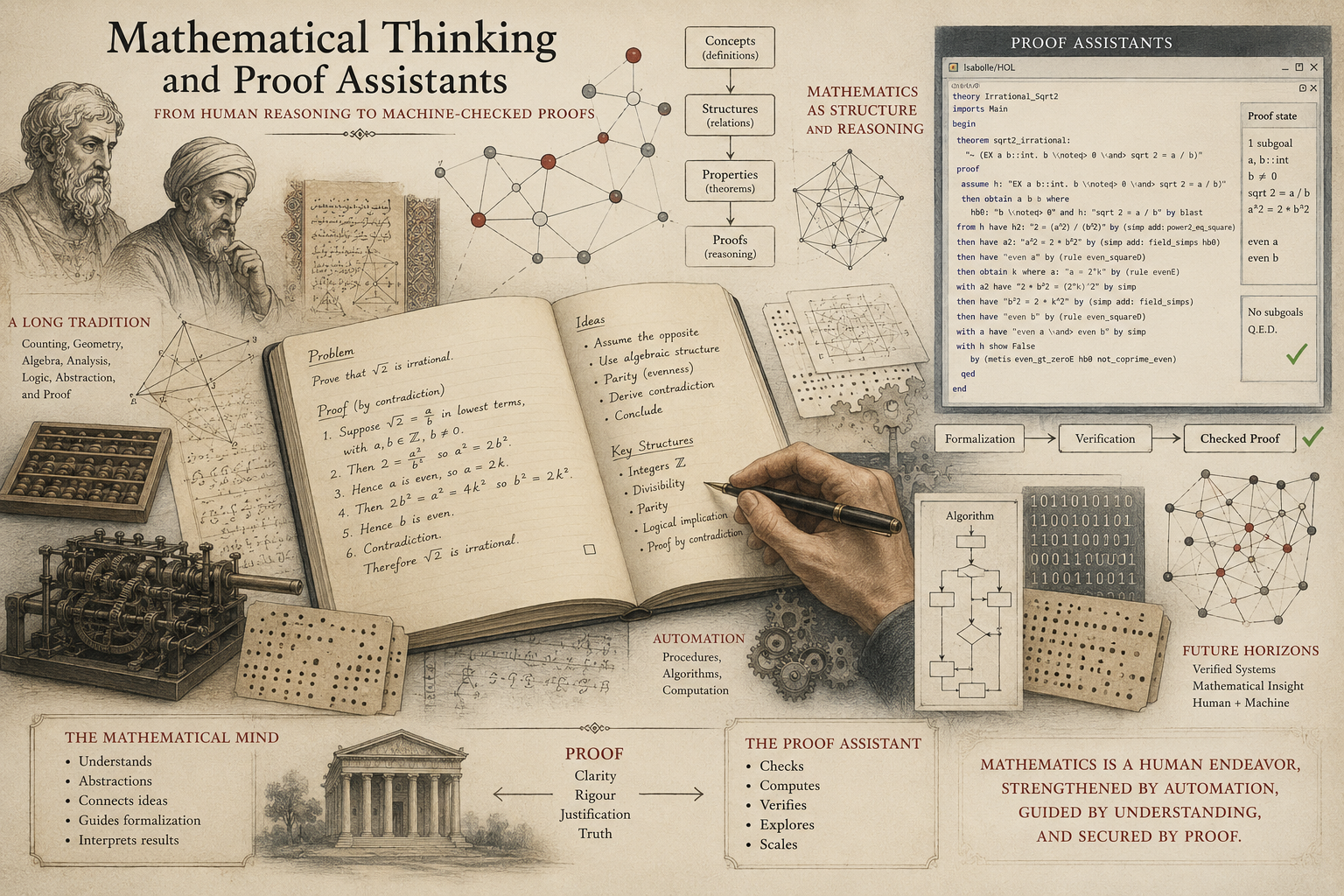
Proof assistants are changing the medium of mathematical thought. For most of mathematical history, proofs have been written for human readers: compressed, elegant, contextual, and dependent on shared background knowledge. A proof assistant changes that relationship. It asks mathematics to be expressed in a formal language precise enough for a machine to check. Definitions, theorem statements, assumptions, inference rules, library dependencies, and proof steps must become explicit.
This does not mean that proof assistants replace mathematicians. They do not decide what questions matter, what definitions are fruitful, what examples are illuminating, or what a theorem means within a broader intellectual project. They do something narrower and powerful: they check whether a formal derivation follows from specified rules, definitions, axioms, and libraries. That shift transforms proof from a persuasive human text into a machine-checkable mathematical artifact.
Mathematical thinking with proof assistants therefore requires a new balance of intuition and formal precision. The human must still conjecture, define, structure, search, interpret, and explain. The machine checks formal correctness. The result is a new kind of mathematical practice: part proof, part programming, part library design, part formal language work, and part philosophical reflection on what it means for mathematics to be verified.
What Proof Assistants Are
A proof assistant is a software system that helps users state definitions, formulate theorems, construct proofs, and check whether those proofs are valid within a formal system. Unlike an ordinary calculator, a proof assistant is not primarily concerned with numerical output. Unlike a computer algebra system, it is not only manipulating expressions. Unlike a text editor, it does not merely record mathematical prose. It checks formal reasoning.
At the center of a proof assistant is a formal language. Mathematical objects must be written in that language. Theorems must be stated precisely. Proofs must be accepted by the system according to its rules. In many systems, proofs are written interactively: the user enters steps, tactics, definitions, or terms, and the system reports the remaining goals or errors. The proof assistant becomes a partner in the construction of a formal derivation.
\text{proof assistant}=\text{formal language}+\text{proof checker}+\text{library}+\text{interaction}
\]
Interpretation: A proof assistant combines a precise formal language, a trusted checking mechanism, mathematical libraries, and an interactive workflow for constructing verified proofs.
The phrase “assistant” is important. These systems do not remove the need for mathematical insight. They assist with formal checking, proof-state management, automation, library search, and dependency tracking. But the human still decides what to define, what to prove, how to decompose a problem, which theorem matters, and how the formal result should be interpreted.
| Component | Function | Human Responsibility |
|---|---|---|
| Formal language | Expresses definitions, statements, and proofs | Translate informal ideas into precise form |
| Kernel or checker | Verifies accepted proof terms or derivations | Understand the trust boundary |
| Library | Provides reusable definitions and theorems | Choose appropriate existing infrastructure |
| Tactics or automation | Help construct proof steps | Ensure automation proves the intended goal |
| Interactive environment | Shows goals, errors, and proof state | Guide proof strategy and interpretation |
A proof assistant is therefore not just a tool for checking finished mathematics. It is a new working environment for mathematical thought.
Why Proof Assistants Matter for Mathematical Thinking
Proof assistants matter because they change what mathematical rigor can mean in practice. Traditional mathematical rigor depends on trained human readers. A published proof is checked by experts, referees, seminar audiences, and later users. This system is powerful but imperfect. It depends on trust, reputation, shared conventions, and the ability of humans to fill gaps.
Proof assistants make a different kind of rigor possible. They require proof steps to be accepted by a formal system. Hidden assumptions become harder to ignore. Definitions must be explicit. Dependencies can be tracked. Large proof developments can be reused. Mathematical knowledge can become a versioned, searchable, computationally checkable library.
\text{human-readable proof}\neq \text{machine-checkable proof}
\]
Interpretation: Human-readable proofs aim to persuade mathematically trained readers; machine-checkable proofs must satisfy precise formal rules.
This does not make informal proof obsolete. Informal proof is still essential for insight, communication, pedagogy, strategy, and meaning. A formal proof can verify that a statement follows from assumptions, but it may not explain why the theorem matters. The most powerful mathematical practice will combine both: informal understanding for meaning and formal verification for exactness.
| Mathematical Need | Informal Proof Strength | Formal Proof Strength |
|---|---|---|
| Insight | Explains the idea and strategy | May expose hidden structure through formalization |
| Rigor | Depends on expert judgment | Checked against explicit rules |
| Communication | Readable and pedagogical | Precise but often less accessible |
| Reuse | Requires interpretation and adaptation | Can become part of a formal library |
| Trust | Distributed through community review | Relocated to kernel, foundations, libraries, and formal statement |
Proof assistants matter because they make mathematical rigor infrastructural. Proof is no longer only an argument on a page. It can also be a checked artifact in a formal knowledge system.
From Informal Proof to Formal Proof
The movement from informal proof to formal proof is not mechanical translation. It is interpretation. An informal proof often uses compression: “clearly,” “without loss of generality,” “by standard arguments,” “choose sufficiently small,” “it follows,” or “the remaining case is similar.” These phrases are efficient for trained humans, but a proof assistant cannot accept them unless the relevant steps are formalized.
Formalization requires specifying objects, hypotheses, domains, types, definitions, lemmas, and dependencies. A theorem about continuity must specify what kind of space is involved. A statement about groups must specify the group structure. A result about finite sets may require a particular formal representation of finiteness. A proof that seems obvious informally may require several supporting lemmas in a formal library.
\text{informal claim}\rightarrow \text{formal statement}\rightarrow \text{checked derivation}
\]
Interpretation: Formalization turns mathematical meaning into a precise statement and then into a derivation accepted by the proof assistant.
This process often improves mathematical understanding. It forces the user to ask what the theorem really says. Are all hypotheses necessary? Is the statement too weak or too strong? Which definitions make the proof natural? Does the theorem depend on classical logic? Does it require choice? Does it assume decidable equality? Does it require a topology, metric, order, algebraic structure, or type-class instance?
| Informal Feature | Formalization Demand | Mathematical Benefit |
|---|---|---|
| Implicit assumptions | State hypotheses explicitly | Clarifies theorem scope |
| Compressed reasoning | Fill proof steps or cite lemmas | Reveals dependency structure |
| Ambiguous objects | Specify types and structures | Prevents category errors |
| Standard arguments | Formalize reusable lemmas | Builds library infrastructure |
| Intuitive equivalence | Prove or invoke formal equivalence | Checks hidden transformations |
Formalization is therefore not merely clerical. It is a form of mathematical analysis: it exposes what the informal proof relies on.
Foundations: Logic, Type Theory, Sets, and Constructive Reasoning
Every proof assistant rests on foundational choices. These choices determine how mathematical objects are represented, how propositions are stated, how proofs are checked, and what counts as a valid derivation. Some systems are based on dependent type theory. Some use higher-order logic. Some emphasize set-theoretic foundations. Some support constructive mathematics more naturally than classical mathematics, while others are designed around classical reasoning.
These differences matter. In a set-theoretic classroom style, many objects can be treated as sets with additional structure. In type theory, mathematical objects often live in types, and propositions may correspond to types whose inhabitants are proofs. In higher-order logic, functions, predicates, and sets can be expressed within a carefully controlled logical system. Each foundation provides a different way to organize mathematical meaning.
\text{foundation}\Rightarrow \text{language of objects, propositions, and proofs}
\]
Interpretation: A proof assistant’s foundation shapes how mathematics is represented and how proof checking works.
Foundational differences are not merely philosophical. They affect practice. They influence how easy it is to state a theorem, how much automation is available, what libraries exist, how structures are organized, how equality behaves, how computation interacts with proof, and how users reason about existence.
| Foundational Style | Typical Emphasis | Mathematical Consequence |
|---|---|---|
| Dependent type theory | Types can depend on terms; propositions can be types | Strong connection between proof, construction, and computation |
| Higher-order logic | Functions and predicates within a simple logical framework | Clear, stable foundation with strong automation traditions |
| Set-theoretic formalization | Objects built from sets and membership | Close to common foundations of modern mathematics |
| Constructive logic | Proof as construction | Existence often requires explicit witness or method |
| Classical logic | Law of excluded middle and nonconstructive arguments allowed | Closer to much ordinary mathematical practice |
Proof assistants make foundations visible. They force mathematics to be written not only as a result, but as a result inside a chosen logical architecture.
Definitions as Design Decisions
In ordinary mathematical writing, definitions can feel natural once they are established. In proof assistants, definitions become design decisions with practical consequences. A definition that is elegant on paper may be difficult to use formally. A definition that works well computationally may obscure the mathematical intuition. A definition that is too general may require many hypotheses; a definition that is too specific may limit reuse.
Formal mathematics is sensitive to definitional architecture. How should a group be represented? How should a topological space be encoded? Should a function be bundled with proof of continuity, or should continuity be a separate predicate? Should a subtype carry its own structure? Should coercions be used? Should equality be definitional, propositional, or established by an isomorphism? These are not merely coding questions. They shape proof strategy.
\text{good formal definition}=\text{mathematical meaning}+\text{usable structure}+\text{proof economy}
\]
Interpretation: A good definition in a proof assistant should preserve mathematical meaning while supporting useful, reusable, and manageable proofs.
Formal definitions also reveal how much ordinary mathematics depends on tacit conventions. Mathematicians often move fluidly among equivalent structures: a subset and its inclusion map, an isomorphic copy, a quotient, a coordinate representation, or a bundled structure. A proof assistant asks which one is meant at each step.
| Definition Choice | Formal Consequence | Mathematical Question |
|---|---|---|
| Bundled vs. unbundled structure | Affects how objects carry operations and laws | Should the structure travel with the object? |
| Predicate vs. subtype | Affects coercions and proof obligations | Is this a property or a new object? |
| Classical vs. constructive definition | Affects existence proofs and computation | Does the proof need an explicit witness? |
| Equality vs. isomorphism | Affects rewriting and transport | What kind of sameness is mathematically appropriate? |
| Concrete vs. abstract representation | Affects automation and reuse | Should the proof expose implementation details? |
Proof assistants teach a demanding lesson: definitions are not passive labels. They are infrastructure for thought.
Proof as Program, Proof as Object
Many proof assistants bring proof close to programming. In type-theoretic systems, propositions may be treated as types and proofs as terms inhabiting those types. In tactic-based environments, a user builds a proof by transforming proof states. In formal libraries, proofs become reusable objects with dependencies and names. This changes how proof is experienced.
Proof becomes something one constructs, checks, refactors, imports, searches, and maintains. Like software, formal proof can have architecture. Lemmas can be modular. Names matter. Dependencies matter. Reuse matters. A proof may be short but fragile, or longer but maintainable. A theorem may become part of a larger library, enabling future results.
\text{proof}:\text{proposition}
\]
Interpretation: In type-theoretic settings, a proof can be understood as an object whose type is the proposition being proved.
This perspective can feel strange to mathematicians trained only on prose proof. But it reveals something profound: proof can be treated as structured data. It can be checked, transformed, stored, composed, and reused. The proof is no longer only an explanation. It is also an artifact.
| Traditional Proof | Formal Proof | Shift in Thinking |
|---|---|---|
| Written in mathematical prose | Written in a formal language | From persuasion to checkability |
| Gaps filled by expert readers | Gaps must be resolved formally | From convention to explicit derivation |
| Referenced by citation | Imported as a library dependency | From text to infrastructure |
| Evaluated by human judgment | Checked by a proof kernel or system | From social trust to formal trust boundary |
| Explains why a theorem is true | Verifies that a statement follows | From meaning to derivation, requiring both |
Proof assistants do not make proof less human. They make proof more explicit, and that explicitness changes the nature of mathematical labor.
Mathematical Libraries and the Architecture of Formal Knowledge
Formal proof becomes powerful when it is organized into libraries. A proof assistant without a library is like a programming language without an ecosystem. Users would have to rebuild basic definitions, lemmas, algebraic structures, number systems, order theory, topology, analysis, measure theory, combinatorics, and category theory from scratch. Libraries turn formalized mathematics into cumulative infrastructure.
Mathlib in Lean is one of the most visible examples of this library-centered model. Mizar’s mathematical library has a long history of formalized mathematics. Isabelle, Rocq, HOL Light, Metamath, and other systems also organize proof developments through formal libraries and theories. These libraries do not merely store results. They encode mathematical style, naming conventions, dependency structures, and community norms.
\text{formal library}=\text{definitions}+\text{theorems}+\text{dependencies}+\text{conventions}
\]
Interpretation: A formal mathematical library is not just a collection of theorems. It is an architecture for reusable formal knowledge.
Library design affects mathematical work. If a theorem already exists, the user must find it. If the theorem is stated in an unexpected way, the user must adapt. If definitions are organized well, many proofs become shorter. If naming is inconsistent, formalization becomes harder. If abstractions are too rigid, reuse suffers. If they are too general, beginners may struggle.
| Library Feature | Mathematical Function | Practical Challenge |
|---|---|---|
| Definitions | Establish objects and structures | Choosing usable formal representations |
| Lemmas | Support reusable proof steps | Finding the right lemma |
| Type classes or structure hierarchy | Organize algebraic and order structures | Managing inference and abstraction |
| Naming conventions | Make knowledge searchable | Balancing consistency and readability |
| Dependency graph | Shows what relies on what | Maintaining large proof developments |
Proof assistants therefore turn mathematics into a kind of knowledge architecture. The theorem is important, but so is the library that makes the theorem reusable.
Automation Inside Proof Assistants
Proof assistants are interactive, but they also contain automation. Tactics, simplifiers, decision procedures, rewrite systems, type-class search, automated theorem provers, SMT integrations, and library search tools can reduce the burden of routine proof steps. This automation is essential. Without it, formal proofs would often be unbearably verbose.
Automation inside a proof assistant differs from unchecked AI-generated reasoning. A tactic may search for a proof, simplify a goal, solve arithmetic, discharge routine logical obligations, or apply known lemmas. But if the tactic produces a proof accepted by the kernel, the result is checked. The tactic itself may be complex, but the proof object or derivation it produces must satisfy the system’s rules, depending on the architecture of the system.
\text{automation proposes}\rightarrow \text{kernel checks}
\]
Interpretation: In trusted proof-assistant workflows, automation can help construct proof steps, but those steps must still be checked by the trusted core or accepted proof mechanism.
Automation also shapes mathematical style. If simplification is powerful, users may structure definitions to work well with simplifier rules. If type-class inference is central, users may organize structures accordingly. If search tools are strong, users may rely on library reuse. If automation is weak, formalization becomes more manual and proof scripts become longer.
| Automation Type | What It Does | Human Review |
|---|---|---|
| Simplifier | Rewrites goals using known rules | Are rewrite rules appropriate and terminating? |
| Tactic search | Finds possible proof steps | Does it prove the intended goal? |
| Decision procedure | Solves a decidable fragment automatically | What fragment is covered? |
| Type-class inference | Finds structure instances automatically | Which instance was selected? |
| Library search | Finds relevant existing theorems | Is the theorem exactly applicable? |
Automation in proof assistants is powerful because it is embedded in a culture of checking. It helps humans build proofs without asking them to trust unverified mathematical prose.
Trust, Kernels, Axioms, and the Boundary of Verification
Proof assistants are often described as providing machine-checked certainty. That is broadly true, but it must be understood carefully. A proof assistant verifies a formal derivation within a system. Trust is not eliminated; it is relocated. One must trust the proof kernel or checker, the formal foundation, the axioms admitted, the imported libraries, the parser and elaborator to the extent they affect what is checked, and the correspondence between the formal statement and the intended mathematical claim.
The trusted kernel is especially important. Many proof assistants aim to keep the core checker small or well-specified so that the trusted base is manageable. Tactics and automation may be complicated, but if the system architecture requires their output to be checked by the kernel, then bugs in tactics should not create false theorems unless they compromise the trusted core or use unsafe mechanisms.
\text{verification}=\text{formal statement}+\text{trusted checker}+\text{axioms}+\text{libraries}
\]
Interpretation: Machine-checked proof depends on the formal statement, the trusted checking mechanism, the accepted axioms, and the library environment.
The formal statement is a common source of risk. A theorem can be checked correctly while failing to capture the intended informal claim. It may have a missing hypothesis, an unintended definition, a too-weak conclusion, or a representation mismatch. Machine checking verifies derivability; it does not guarantee that the formalized theorem is the theorem the human meant.
| Trust Boundary | Question to Ask | Risk |
|---|---|---|
| Kernel or checker | What part of the system must be trusted? | Implementation or soundness error |
| Axioms | Which assumptions are admitted? | Unintended foundational strength |
| Formal statement | Does it express the intended theorem? | Correct proof of wrong statement |
| Library dependencies | What prior results are imported? | Hidden assumptions or incompatible conventions |
| Extraction or application | How is the theorem used outside the assistant? | Misapplication beyond formal scope |
Proof assistants strengthen trust by making it more explicit. They do not make trust disappear.
The Human Role in Machine-Checked Mathematics
The human role becomes more important, not less, when mathematics is machine-checked. Humans choose the problem, design the definitions, decide what level of generality is appropriate, select the proof strategy, search for useful lemmas, interpret error messages, refactor formalizations, communicate the result, and explain why the theorem matters.
Proof assistants are unforgiving about formal correctness, but they are not sources of mathematical purpose. They can check whether a proof works. They cannot decide whether a definition is illuminating, whether a formalization is pedagogically useful, whether a theorem is worth proving, or whether a verified system should be deployed.
\text{machine checks derivation; human preserves meaning}
\]
Interpretation: The machine can verify formal correctness, but humans remain responsible for purpose, interpretation, explanation, and use.
Formalization also requires creativity. Many formal proof problems are not solved by writing down the obvious proof. They require finding the right intermediate lemmas, rewriting a statement, choosing a better induction principle, generalizing a theorem, changing definitions, or reorganizing a proof into reusable pieces. This is mathematical design work.
| Human Skill | Role in Proof Assistant Work | Why It Matters |
|---|---|---|
| Conceptual framing | Decide what theorem matters | Formal proof without purpose is inert |
| Definition design | Choose usable formal objects | Definitions shape proof difficulty |
| Statement precision | Translate informal meaning into formal language | Machine checks only the formal statement |
| Proof strategy | Guide decomposition and lemma selection | Automation rarely replaces global strategy |
| Interpretation | Explain significance and scope | Formal derivation is not mathematical communication by itself |
Proof assistants make some kinds of mathematical labor more visible: the labor of definition, dependency, structure, and exact statement.
Proof Assistants in Mathematical Education
Proof assistants can reshape mathematical education, especially around logic, proof, definitions, and rigor. Students often struggle because they do not know what a proof must establish, what assumptions are available, or why a step is invalid. A proof assistant makes these issues concrete. It shows remaining goals. It refuses invalid steps. It forces hypotheses, objects, and conclusions to be explicit.
This can be powerful, but it must be used carefully. If introduced too early or too mechanically, proof assistants can make mathematics feel like syntax debugging rather than reasoning. The goal should not be to replace human proof writing with formal scripts. The goal should be to use formalization to sharpen understanding: what is being assumed, what is being proved, and why each step is justified.
\text{proof education}=\text{meaning}+\text{structure}+\text{formal discipline}
\]
Interpretation: Proof assistants can support proof education when they connect formal discipline to mathematical meaning and structure.
Interactive theorem-proving games, such as natural-number proof games, can help learners experience proof as construction. Formal environments can make induction, rewriting, implication, quantifiers, contradiction, and equality more concrete. But students still need informal explanation, diagrams, examples, counterexamples, and mathematical conversation.
| Educational Use | Benefit | Risk |
|---|---|---|
| Learning logic | Quantifiers and implications become explicit | Syntax may overwhelm meaning |
| Learning induction | Base case and step are enforced | Students may follow tactics without understanding |
| Learning definitions | Definitions must be used precisely | Formal definitions may seem detached from examples |
| Learning proof structure | Goals and hypotheses are visible | Proof becomes goal manipulation only |
| Learning verification | Students see what checking requires | Formal correctness mistaken for explanation |
Proof assistants can make proof more teachable if they are framed as tools for understanding, not as replacements for mathematical thought.
Proof Assistants and AI-Assisted Mathematics
Proof assistants and AI systems are increasingly connected. AI can help search libraries, suggest tactics, generate proof sketches, translate informal statements into formal language, retrieve premises, and assist with formalization. Proof assistants can provide the checking discipline that AI-generated mathematical text lacks. This combination is important: AI can propose; proof assistants can verify.
The distinction matters. AI-generated mathematical reasoning may be fluent but wrong. A proof assistant can reject invalid formal derivations. If an AI system generates a formal proof that the assistant accepts, the proof has a different status from an unchecked prose explanation. The authority comes not from the AI’s fluency, but from the proof assistant’s checking of the formal derivation.
\text{AI proposes}\rightarrow \text{proof assistant checks}\rightarrow \text{human interprets}
\]
Interpretation: A responsible AI-proof-assistant workflow treats AI output as a proposal, machine checking as formal verification, and human judgment as interpretation and meaning review.
AI may also make formal mathematics more accessible by helping users find lemmas, explain error messages, translate between informal and formal statements, and generate candidate proof structures. But it can also create new risks: overreliance, shallow understanding, hidden formal mismatches, or false confidence in generated code.
| AI Role | Potential Value | Required Check |
|---|---|---|
| Premise retrieval | Find relevant library theorems | Confirm applicability and hypotheses |
| Formalization suggestion | Draft theorem statements or definitions | Review intended meaning and scope |
| Tactic suggestion | Help construct proof steps | Proof assistant must accept the result |
| Error explanation | Make formal feedback more understandable | Check against actual proof state |
| Proof sketch generation | Suggest strategy | Verify every inference formally or mathematically |
The future of AI in mathematics may depend on this partnership: generative systems for search and suggestion, proof assistants for verification, and humans for mathematical purpose.
Comparing Major Proof-Assistant Traditions
Proof assistants differ in foundations, proof style, libraries, automation, community, and use cases. Lean has become especially prominent in formalizing modern mathematics and building a large community library. Rocq, formerly Coq, is rooted in dependent type theory and has a long history in constructive mathematics, programming-language theory, and formal verification. Isabelle is a generic proof assistant with strong Isabelle/HOL usage and mature automation. HOL Light emphasizes a small kernel and higher-order logic. Mizar has a long tradition of declarative formalized mathematics. Agda connects dependent types, constructive proof, and programming. Metamath emphasizes minimal foundations and detailed proof checking.
No single system is best for every purpose. A mathematician formalizing algebraic geometry may prioritize library coverage. A programming-language researcher may care about dependent types and extraction. A verification engineer may prioritize automation and integration. A teacher may prioritize readability and learning materials. A foundations researcher may care about the exact logical framework.
| System or Tradition | Typical Strength | Common Use or Emphasis |
|---|---|---|
| Lean | Large modern mathematics library and active community | Formal mathematics, education, AI-assisted theorem proving |
| Rocq / Coq | Dependent type theory and constructive foundations | Mathematics, programming languages, certified software |
| Isabelle/HOL | Mature automation and higher-order logic environment | Formal mathematics, verification, logic, computer science |
| HOL Light | Small trusted core and higher-order logic | Formalized analysis, verification, landmark theorem formalizations |
| Mizar | Declarative mathematical style and long-standing library | Formalized mathematics and library development |
| Agda | Dependent types and constructive programming/proving | Type theory, constructive mathematics, programming-language research |
| Metamath | Minimal proof language and explicit proof databases | Foundational transparency and detailed proof verification |
The diversity of proof assistants is healthy. It reflects the diversity of mathematical foundations, proof styles, and practical needs.
Limitations and Practical Barriers
Proof assistants are powerful, but they are not easy. Formalization often takes more time than writing an informal proof. Users must learn a formal language, a proof environment, library conventions, tactics, error messages, and foundational assumptions. Mathematical ideas that are simple on paper can become complicated when every implicit step must be made explicit.
There are also social and institutional barriers. Formal proof is not yet standard in most mathematics departments. Many journals do not require or support formal verification. Library coverage is uneven across fields. Formalization work may be undervalued compared with theorem discovery. The labor of maintaining libraries, documenting definitions, and making formal mathematics accessible is substantial.
\text{formal certainty has a cost}
\]
Interpretation: Proof assistants increase confidence in formal derivations, but they require time, expertise, infrastructure, and community maintenance.
Proof assistants can also obscure meaning if used poorly. A proof script may be accepted but unreadable. A theorem may be technically correct but pedagogically opaque. A formalization may depend on library machinery that beginners cannot understand. Formal success should not be confused with good mathematical explanation.
| Barrier | Problem | Possible Response |
|---|---|---|
| Learning curve | Users must learn formal language and tools | Better tutorials, games, examples, and curricula |
| Library gap | Needed mathematics may not be formalized | Community library development and documentation |
| Proof verbosity | Formal proofs can be much longer than informal proofs | Improved automation and abstraction |
| Opaque scripts | Accepted proofs may be hard to read | Readable proof style and explanatory comments |
| Institutional recognition | Formalization labor may be undervalued | Treat formal libraries as scholarly infrastructure |
Proof assistants are not a magic solution to mathematical rigor. They are demanding tools that require culture, infrastructure, and interpretation.
Proof Assistants, Power, and Mathematical Responsibility
Machine-checked proof carries authority. That authority must be used responsibly. A formal proof may verify a theorem, a software property, a cryptographic protocol, a compiler transformation, a hardware design, or a safety-critical system. But formal verification is only as responsible as the specification being verified and the context in which it is used.
A verified system can still be harmful if the specification encodes the wrong goal. A formally correct optimization routine can optimize an unjust objective. A verified cryptographic component can be embedded in an abusive surveillance system. A theorem can be correct but misrepresented in public discourse. Formal correctness is powerful, but it is not ethical adequacy.
\text{machine-checked proof}\neq \text{responsible use}
\]
Interpretation: Proof assistants can verify formal claims, but humans remain responsible for specifications, applications, consequences, and values.
Responsible use requires careful specification review, assumption documentation, limitation statements, reproducibility, accessibility, and human accountability. It also requires attention to who can participate in formal mathematics. If proof assistants become part of future mathematical infrastructure, access to learning materials, tooling, community support, and institutional recognition will matter.
| Responsibility Issue | Formal Question | Human Question |
|---|---|---|
| Specification | Was the stated property verified? | Was the right property specified? |
| Assumptions | Which axioms or libraries were used? | Are those assumptions appropriate? |
| Application | What theorem was proved? | How is it being used in the world? |
| Access | Can the proof be checked? | Who can understand, reproduce, or challenge it? |
| Authority | What exactly is machine-checked? | What should not be inferred from verification? |
Proof assistants make mathematical authority stronger in some ways. That makes responsible interpretation more important.
A Mathematical Lens: Define, State, Prove, Check, Interpret
A useful lens for proof-assistant mathematics is: define, state, prove, check, interpret. Definitions establish the objects. Statements identify the claim. Proof construction produces a derivation. Checking verifies formal correctness. Interpretation explains meaning, scope, and significance.
\text{Define}\rightarrow \text{State}\rightarrow \text{Prove}\rightarrow \text{Check}\rightarrow \text{Interpret}
\]
Interpretation: Proof-assistant work requires both formal construction and human interpretation. Checking is central, but it is not the whole of mathematics.
This lens applies across levels of difficulty. In a beginner proof, defining natural numbers and proving a simple identity teaches structure and induction. In formalized algebra, defining rings, modules, and morphisms shapes the proof architecture. In verification, specifying a program property determines what the proof can establish. In AI-assisted theorem proving, generated steps must be checked and interpreted within the intended mathematics.
| Stage | Question | Failure Mode |
|---|---|---|
| Define | What objects and structures are being used? | Bad definitions make proofs awkward or misleading |
| State | What exactly is the theorem? | Formal statement misses informal meaning |
| Prove | How is the derivation constructed? | Proof script becomes fragile or opaque |
| Check | What does the system verify? | Trust boundary is misunderstood |
| Interpret | What does the theorem mean and why does it matter? | Formal correctness replaces explanation |
This lens keeps machine-checked proof connected to mathematical understanding. It treats formal verification as part of reasoning, not a substitute for meaning.
Computational Companion Examples
The companion repository for this article should extend the Mathematical Thinking codebase with proof-assistant literacy workflows, formalization metadata, theorem-statement audits, proof-layer schemas, trust-boundary reviews, AI-to-proof-assistant verification pipelines, Haskell typed proof models, SQL formalization records, and responsible verification checklists.
Python: Proof Assistant Formalization Audit
from dataclasses import dataclass
from typing import Literal

Layer = Literal[
    "concept",
    "definition",
    "theorem_statement",
    "proof_construction",
    "machine_check",
    "interpretation"
]

@dataclass(frozen=True)
class FormalizationAudit:
    layer: Layer
    human_question: str
    machine_role: str
    risk: str
    review_action: str

audit = [
    FormalizationAudit(
        layer="concept",
        human_question="What mathematical idea matters?",
        machine_role="No independent mathematical purpose.",
        risk="Formalizing a trivial or poorly framed question.",
        review_action="Explain why the theorem matters before formalizing."
    ),
    FormalizationAudit(
        layer="definition",
        human_question="Which objects and assumptions should be encoded?",
        machine_role="Check syntax and type correctness.",
        risk="Definition works formally but obscures meaning.",
        review_action="Compare the formal definition with examples."
    ),
    FormalizationAudit(
        layer="theorem_statement",
        human_question="Does the formal statement match the intended claim?",
        machine_role="Represent the proposition precisely.",
        risk="Machine checks the wrong theorem.",
        review_action="Translate the formal statement back into prose."
    ),
    FormalizationAudit(
        layer="proof_construction",
        human_question="What strategy connects the hypotheses to the goal?",
        machine_role="Track proof state and accept valid steps.",
        risk="Proof script becomes opaque or fragile.",
        review_action="Name reusable lemmas and document strategy."
    ),
    FormalizationAudit(
        layer="machine_check",
        human_question="What exactly has been verified?",
        machine_role="Check derivation under formal rules.",
        risk="Trust boundary misunderstood.",
        review_action="Document axioms, libraries, kernel, and dependencies."
    ),
    FormalizationAudit(
        layer="interpretation",
        human_question="What does the result mean?",
        machine_role="No social, philosophical, or pedagogical judgment.",
        risk="Formal correctness replaces explanation.",
        review_action="Explain scope, significance, and limitations."
    ),
]

for item in audit:
    print(f"{item.layer}: {item.review_action}")
R: Proof-Assistant Literacy Table
proof_assistant_literacy <- data.frame(
  skill = c(
    "reading formal statements",
    "tracking assumptions",
    "choosing definitions",
    "using libraries",
    "understanding tactics",
    "interpreting verification"
  ),
  why_it_matters = c(
    "the machine checks the formal statement, not the informal intention",
    "hidden assumptions determine theorem scope",
    "definitions shape proof difficulty and reuse",
    "formal mathematics is cumulative infrastructure",
    "automation helps construct proof steps but must be understood",
    "machine checking verifies derivation, not broader meaning"
  ),
  review_question = c(
    "Can I translate the statement back into ordinary mathematical prose?",
    "Which hypotheses, axioms, and instances are used?",
    "Does this definition preserve the intended concept?",
    "Which existing theorem or structure should be reused?",
    "What did the tactic actually solve?",
    "What exactly has been verified?"
  )
)

print(proof_assistant_literacy)
Haskell: Typed Proof-Assistant Model
{-# OPTIONS_GHC -Wall #-}

data ProofLayer
  = Concept
  | Definition
  | TheoremStatement
  | ProofConstruction
  | MachineCheck
  | Interpretation
  deriving (Eq, Show)

data TrustBoundary
  = FormalStatement
  | Kernel
  | Axioms
  | Libraries
  | HumanMeaning
  deriving (Eq, Show)

data ProofAssistantRecord = ProofAssistantRecord
  { layer :: ProofLayer
  , humanRole :: String
  , machineRole :: String
  , trustBoundary :: TrustBoundary
  } deriving (Eq, Show)

records :: [ProofAssistantRecord]
records =
  [ ProofAssistantRecord Concept
      "choose the mathematical problem"
      "no independent purpose"
      HumanMeaning
  , ProofAssistantRecord Definition
      "encode objects and assumptions"
      "check syntax and types"
      FormalStatement
  , ProofAssistantRecord TheoremStatement
      "state the intended theorem precisely"
      "represent the proposition"
      FormalStatement
  , ProofAssistantRecord ProofConstruction
      "guide proof strategy"
      "verify accepted steps"
      Kernel
  , ProofAssistantRecord MachineCheck
      "understand what is trusted"
      "check derivation"
      Kernel
  , ProofAssistantRecord Interpretation
      "explain significance and scope"
      "no contextual judgment"
      HumanMeaning
  ]

main :: IO ()
main = mapM_ print records
SQL: Formalization Record Schema
CREATE TABLE formalization_project (
  project_id TEXT PRIMARY KEY,
  project_name TEXT NOT NULL,
  proof_assistant TEXT NOT NULL,
  foundation TEXT NOT NULL,
  mathematical_domain TEXT NOT NULL,
  purpose TEXT NOT NULL
);

CREATE TABLE theorem_statement_audit (
  theorem_id TEXT PRIMARY KEY,
  project_id TEXT NOT NULL,
  informal_statement TEXT NOT NULL,
  formal_statement_summary TEXT NOT NULL,
  hypotheses TEXT NOT NULL,
  intended_meaning_review TEXT NOT NULL
);

CREATE TABLE proof_trust_boundary (
  boundary_id TEXT PRIMARY KEY,
  theorem_id TEXT NOT NULL,
  trusted_component TEXT NOT NULL,
  trust_question TEXT NOT NULL,
  review_note TEXT NOT NULL
);

CREATE TABLE proof_assistant_skill (
  skill_id TEXT PRIMARY KEY,
  skill_name TEXT NOT NULL,
  why_it_matters TEXT NOT NULL,
  review_question TEXT NOT NULL
);
These examples treat proof-assistant work as auditable mathematical practice. The goal is to document definitions, statements, trust boundaries, proof layers, and human interpretation rather than treating machine checking as a black box.
GitHub Repository
The companion repository for this article is designed as a reproducible mathematical-thinking workspace focused on proof-assistant literacy workflows, formalization metadata, theorem-statement audits, proof-layer schemas, trust-boundary reviews, AI-to-proof-assistant verification pipelines, Haskell typed proof models, SQL formalization records, and responsible verification checklists.
Complete Code Repository
Companion article folder with Python, R, Julia, SQL, Haskell, Rust, Go, C++, Fortran, and C examples for professional mathematical exploration of proof assistants, formalization, theorem statements, proof kernels, trust boundaries, formal libraries, AI-assisted proof workflows, and responsible machine-checked mathematics.
The Future of Mathematical Proof
Proof assistants are likely to become increasingly important in mathematical research, education, software verification, artificial intelligence, and scientific computing. They will not replace all informal proof, but they will change the expectations surrounding formal rigor, reproducibility, and mathematical infrastructure. Some theorems may be published with formal companions. Some mathematical libraries may become standard research infrastructure. Some AI systems may become useful formalization assistants. Some areas of mathematics may become easier to verify, search, and reuse.
The future will probably not be one in which every mathematician writes every proof in a proof assistant. More likely, proof assistants will become part of a layered ecosystem. Informal mathematics will continue to guide discovery and communication. Formal libraries will verify key results and reusable foundations. AI tools will assist with search and translation. Human mathematicians will remain responsible for concepts, definitions, strategy, interpretation, and meaning.
The most important shift may be cultural. Proof assistants encourage mathematics to become more explicit about assumptions, dependencies, definitions, and trust. They make proof more checkable, but they also make the architecture of mathematical knowledge more visible. That visibility can strengthen mathematics if it is paired with good explanation, open infrastructure, careful pedagogy, and responsible use.
Mathematical thinking and proof assistants therefore belong together. Proof assistants do not end mathematical thought. They ask mathematical thought to become more precise about what it means, what it assumes, and what it can prove.
Related Articles
- Mathematical Thinking in an Age of Automation
- Logic and the Structure of Formal Inference
- Algorithms, Proof, and Formal Reasoning
- The Historical Development of Proof
- Foundations, Structure, and the Reimagining of Mathematics
- Mathematical Thinking for Computer Science
- Proof and the Logic of Mathematical Justification
- Non-Algorithmic Reasoning and the Future of Mathematics Learning
- Conjecture, Creativity, and Mathematical Discovery
- Mathematical Thinking and AI-Assisted Discovery
Further Reading
- Avigad, J. (2018) ‘The Mechanization of Mathematics’, Notices of the American Mathematical Society. Available at: https://community.ams.org/journals/notices/201806/rnoti-p681.pdf
- Avigad, J. (2024) ‘Mathematics and the Formal Turn’, Bulletin of the American Mathematical Society. Available at: https://www.ams.org/journals/bull/2024-61-02/S0273-0979-2024-01832-1/
- Avigad, J., Commelin, J., Macbeth, H. and Topaz, A. (2024) ‘Anatomy of a Formal Proof’. Available at: https://arxiv.org/abs/2411.11885
- Lean FRO (n.d.) Lean Programming Language. Available at: https://lean-lang.org/
- Lean Community (n.d.) Lean Community and Mathlib. Available at: https://leanprover-community.github.io/
- The Mathlib Community (2020) ‘The Lean Mathematical Library’, CPP 2020. Available at: https://arxiv.org/abs/1910.09336
- Rocq Prover (n.d.) The Rocq Prover. Available at: https://rocq-prover.org/
- Isabelle (n.d.) Isabelle Proof Assistant. Available at: https://isabelle.in.tum.de/
- HOL Light (n.d.) The HOL Light Theorem Prover. Available at: https://hol-light.github.io/
- Agda (n.d.) What is Agda? Available at: https://agda.readthedocs.io/en/latest/getting-started/what-is-agda.html
- Metamath (n.d.) Metamath Home Page. Available at: https://us.metamath.org/
References
- Agda (n.d.) What is Agda? Available at: https://agda.readthedocs.io/en/latest/getting-started/what-is-agda.html
- Avigad, J. (2018) ‘The Mechanization of Mathematics’, Notices of the American Mathematical Society. Available at: https://community.ams.org/journals/notices/201806/rnoti-p681.pdf
- Avigad, J. (2024) ‘Mathematics and the Formal Turn’, Bulletin of the American Mathematical Society. Available at: https://www.ams.org/journals/bull/2024-61-02/S0273-0979-2024-01832-1/
- Avigad, J., Commelin, J., Macbeth, H. and Topaz, A. (2024) ‘Anatomy of a Formal Proof’. Available at: https://arxiv.org/abs/2411.11885
- Bancerek, G. et al. (2018) ‘The Role of the Mizar Mathematical Library for Interactive Proof Development in Mizar’, Journal of Automated Reasoning, 61, pp. 9–32. Available at: https://pmc.ncbi.nlm.nih.gov/articles/PMC6044251/
- Barendregt, H. and Geuvers, H. (2001) ‘Proof-Assistants Using Dependent Type Systems’, in Robinson, A. and Voronkov, A. (eds.) Handbook of Automated Reasoning. Amsterdam: Elsevier.
- Harrison, J. (2009) Handbook of Practical Logic and Automated Reasoning. Cambridge: Cambridge University Press. Available at: https://www.cambridge.org/core/books/handbook-of-practical-logic-and-automated-reasoning/FB81E4B514A4E42EBB923D92F86ED308
- Harrison, J., Urban, J. and Wiedijk, F. (2014) ‘History of Interactive Theorem Proving’, in Computational Logic. Available at: https://www.cl.cam.ac.uk/~jrh13/papers/itp-history.pdf
- HOL Light (n.d.) The HOL Light Theorem Prover. Available at: https://hol-light.github.io/
- Isabelle (n.d.) Isabelle Proof Assistant. Available at: https://isabelle.in.tum.de/
- Lean Community (n.d.) Lean Community and Mathlib. Available at: https://leanprover-community.github.io/
- Lean FRO (n.d.) Lean Programming Language. Available at: https://lean-lang.org/
- Metamath (n.d.) Metamath Home Page. Available at: https://us.metamath.org/
- Rocq Prover (n.d.) About The Rocq Prover. Available at: https://rocq-prover.org/about
- The Mathlib Community (2020) ‘The Lean Mathematical Library’, CPP 2020. Available at: https://arxiv.org/abs/1910.09336
- Wiedijk, F. (2008) ‘Formal Proof — Getting Started’, Notices of the American Mathematical Society. Available at: https://www.ams.org/notices/200811/tx081101408p.pdf