
Last Updated May 30, 2026
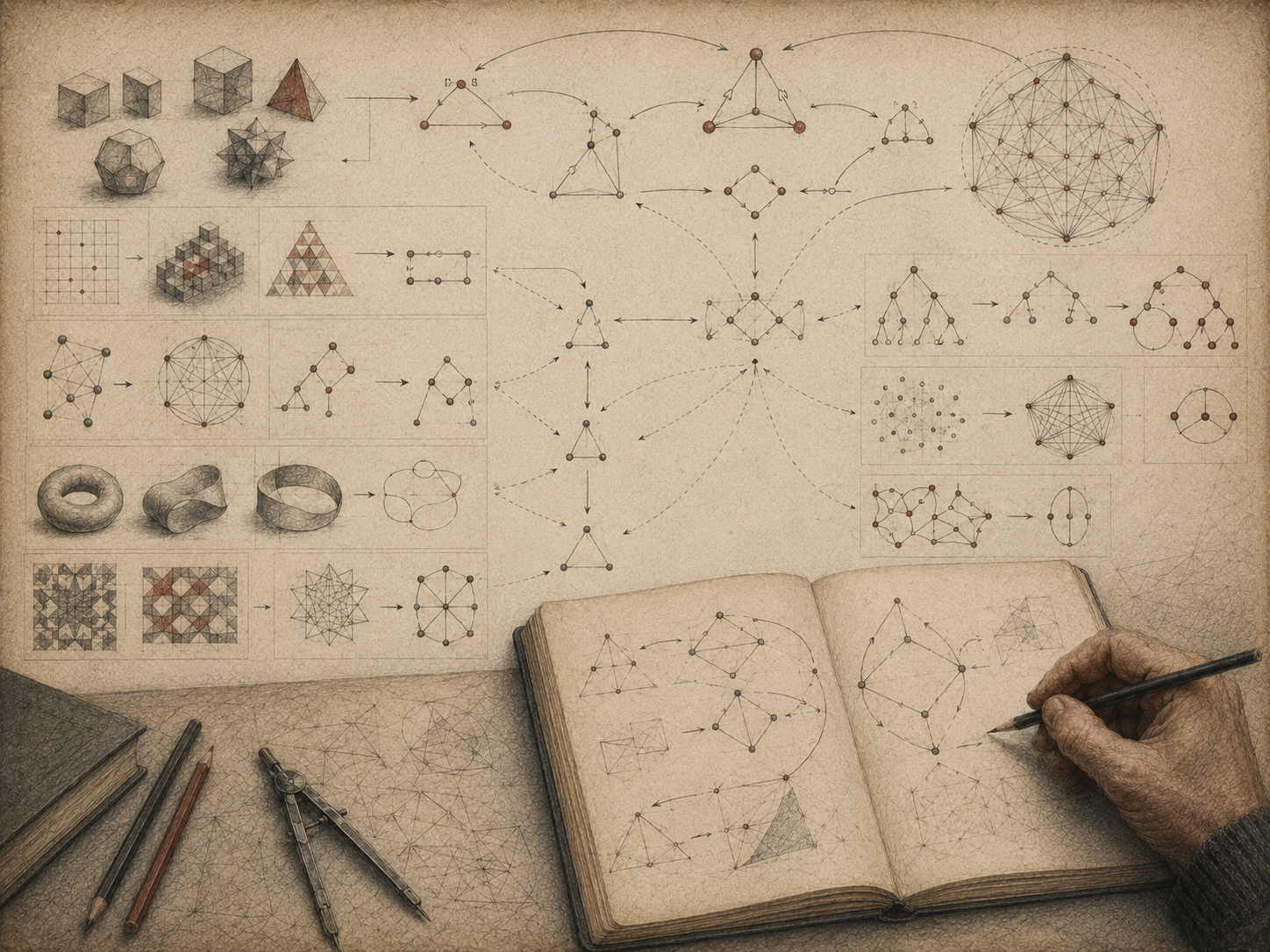
Category-level abstraction is one of the most powerful forms of mathematical thinking because it asks mathematics to look past the internal details of objects and attend instead to relationships, transformations, structure, and composition. Rather than asking only what a mathematical object is made of, category-level thinking asks how objects relate, how maps preserve structure, how constructions are characterized by their roles, and how different domains of mathematics can be connected through common patterns.
This shift is subtle but profound. In elementary mathematics, one often studies numbers, shapes, functions, equations, and sets as objects with internal features. In category theory, the emphasis moves toward objects together with the arrows between them. The arrows matter because they reveal what can be transformed, preserved, composed, represented, compared, and generalized. Category-level abstraction therefore changes the center of mathematical attention from isolated things to structured systems of relations.
This article examines category-level abstraction as a mode of mathematical thinking. It introduces categories, objects, morphisms, composition, functors, natural transformations, universal properties, diagrams, duality, adjunctions, limits, colimits, and the Yoneda perspective. It also explores why category-level thinking matters beyond pure mathematics: in computer science, logic, databases, systems modeling, knowledge representation, physics, data integration, and artificial intelligence. The central claim is that category-level abstraction is not abstraction for its own sake. At its best, it is a disciplined way to see unity across different mathematical worlds.
The Abstraction Question
Mathematics depends on abstraction, but not all abstraction works the same way. One kind of abstraction removes irrelevant detail in order to isolate a common property. Another generalizes from examples to a broader class. Another represents a system symbolically. Category-level abstraction does something more structural: it identifies patterns of relationship, transformation, and composition that recur across many mathematical settings.
The abstraction question is therefore not simply “How general can we make this?” It is “What structure is being preserved, and by what maps?” Category-level abstraction asks how mathematical worlds communicate. It asks which constructions have the same formal role even when their underlying objects are different. It asks how algebra, topology, logic, computation, geometry, and data can be compared without reducing them to one domain’s vocabulary.
\text{category-level abstraction}=\text{objects}+\text{morphisms}+\text{composition}+\text{structure}
\]
Interpretation: Category-level thinking treats mathematical objects together with the structure-preserving arrows between them and the rules by which those arrows compose.
This kind of abstraction is powerful because it focuses on behavior. A product is not defined merely by a set of elements. It is defined by how other objects map into it. A quotient is not only a collapsed object. It is characterized by how maps out of the original object factor through it. A free construction is not just a newly built object. It is the most general object satisfying a certain relationship. Category theory makes these role-based definitions precise.
| Ordinary Question | Category-Level Question | Shift in Thinking |
|---|---|---|
| What elements does this object contain? | How do other objects map to or from it? | From internal contents to external relationships |
| What is this construction made of? | What universal role does this construction satisfy? | From recipe to characterization |
| How do I solve this case? | What pattern of maps explains the case? | From problem solution to structural pattern |
| Are these objects equal? | Are they isomorphic, equivalent, or naturally related? | From sameness to structure-preserving comparison |
| What happens in this field of mathematics? | What common categorical pattern appears across fields? | From domain-specific method to cross-domain abstraction |
Category-level abstraction is therefore not a flight away from mathematical content. It is a way to understand what remains stable when mathematical content is transported across contexts.
From Objects to Relationships
Many learners first encounter mathematics through objects: numbers, triangles, functions, matrices, sets, groups, graphs, spaces, equations. Category-level thinking does not deny the importance of objects. It changes the emphasis. Objects become meaningful through the arrows between them: functions between sets, homomorphisms between groups, continuous maps between spaces, linear maps between vector spaces, order-preserving maps between ordered sets, transformations between structures, and proofs between propositions.
This shift is similar to moving from nouns to verbs. A category is not merely a collection of things. It is a world in which things can be transformed in disciplined ways. The arrows reveal which transformations are allowed, which structure is preserved, and how one transformation can follow another.
A \xrightarrow{f} B \xrightarrow{g} C
\]
Interpretation: Category-level reasoning focuses on arrows and their composition. If \(f\) maps \(A\) to \(B\) and \(g\) maps \(B\) to \(C\), then their composite \(g\circ f\) maps \(A\) to \(C\).
Relationships matter because mathematics is rarely about isolated objects. A group matters because of its homomorphisms. A topological space matters because of continuous maps. A data schema matters because of structure-preserving translations. A logical proposition matters because of proofs and implications. A system matters because of its interfaces and transformations.
| Domain | Objects | Morphisms | Structure Preserved |
|---|---|---|---|
| Set theory | Sets | Functions | Element assignment |
| Group theory | Groups | Group homomorphisms | Group operation |
| Topology | Topological spaces | Continuous maps | Open-set or continuity structure |
| Linear algebra | Vector spaces | Linear maps | Addition and scalar multiplication |
| Logic | Propositions or types | Proofs or functions | Implication or construction |
| Computer science | Types, programs, states, systems | Functions, transformations, processes | Computation, typing, interface, or behavior |
Category-level abstraction teaches that structure is often best understood by asking what transformations preserve it.
Categories: Objects, Morphisms, Identity, and Composition
A category consists of objects and morphisms, together with identity morphisms and a rule for composing morphisms. The definition is simple, but its consequences are enormous. Objects can be sets, spaces, groups, graphs, types, propositions, databases, systems, or more abstract entities. Morphisms are the structure-preserving arrows between objects. Composition tells us how arrows chain together. Identity morphisms tell us that every object has a neutral arrow from itself to itself.
\mathcal{C}=(\mathrm{Ob}(\mathcal{C}),\mathrm{Hom}_{\mathcal{C}},\circ,\mathrm{id})
\]
Interpretation: A category \(\mathcal{C}\) contains objects, morphisms between objects, a composition operation for compatible morphisms, and identity morphisms for each object.
The axioms are minimal. Composition must be associative, and identity morphisms must behave as identities. If \(f:A\to B\), \(g:B\to C\), and \(h:C\to D\), then \(h\circ(g\circ f)=(h\circ g)\circ f\). If \(f:A\to B\), then \(f\circ \mathrm{id}_A=f\) and \(\mathrm{id}_B\circ f=f\).
h\circ(g\circ f)=(h\circ g)\circ f
\]
Interpretation: Associativity means that when arrows compose in sequence, the result does not depend on how the composition is grouped.
f\circ \mathrm{id}_A=f=\mathrm{id}_B\circ f
\]
Interpretation: Identity arrows act neutrally under composition, preserving each morphism exactly.
The power of this definition lies in its generality. Many mathematical settings become categories once one identifies their objects, morphisms, identities, and compositions. This makes category theory a language for comparing structures that may look very different on the surface.
| Category Component | Meaning | Mathematical Role |
|---|---|---|
| Object | A structured entity | Thing being related or transformed |
| Morphism | Arrow between objects | Structure-preserving transformation |
| Identity | Arrow from object to itself | Neutral transformation |
| Composition | Combining compatible arrows | Sequential transformation |
| Associativity | Composition grouping does not matter | Coherent chains of transformations |
A category is therefore a minimal grammar of structured transformation.
Why Morphisms Matter
Morphisms are central because they reveal what kind of structure matters in a mathematical context. A function between sets preserves only the ability to assign elements. A group homomorphism preserves multiplication. A continuous map preserves topological structure. A linear map preserves vector-space structure. A monotone map preserves order. The choice of morphisms determines the mathematics.
This is a crucial lesson: the same collection of objects can become different categories depending on which arrows are allowed. If the objects are topological spaces and the morphisms are continuous maps, one studies topology. If the morphisms are homeomorphisms only, one studies a more restricted world of reversible topological equivalences. If the objects are vector spaces and the morphisms are all functions, the linear structure is ignored. If the morphisms are linear maps, the structure is preserved.
\text{chosen morphisms determine the visible structure}
\]
Interpretation: Category-level abstraction depends on selecting arrows that preserve the features one wants to study.
In this sense, morphisms are not secondary to objects. They define the discipline of attention. To choose morphisms is to decide what counts as a legitimate transformation, comparison, or process.
| Object Type | Possible Morphism Choice | What Becomes Visible |
|---|---|---|
| Sets | All functions | Assignment and cardinal structure |
| Groups | Group homomorphisms | Algebraic operation preservation |
| Spaces | Continuous maps | Topological structure |
| Vector spaces | Linear maps | Linear structure and dimension-sensitive relations |
| Ordered sets | Monotone maps | Order preservation |
| Types | Typed functions | Computational transformation |
Category-level thinking therefore asks not only “What are the objects?” but “What are the right arrows?”
Composition as a Mathematical Primitive
Composition is one of the deepest ideas in category theory. Mathematics often studies processes that can be chained: functions after functions, transformations after transformations, proofs after implications, programs after programs, maps after maps. Category theory treats composition not as an afterthought but as a basic feature of structure.
Composition matters because it gives mathematics a notion of workflow, dependency, and process. If one transformation takes \(A\) to \(B\), and another takes \(B\) to \(C\), their composite takes \(A\) to \(C\). This simple pattern appears in algebra, topology, programming, logic, data pipelines, systems modeling, and scientific workflows.
A \xrightarrow{f} B \xrightarrow{g} C \quad \Rightarrow \quad A \xrightarrow{g\circ f} C
\]
Interpretation: Composition creates a new transformation from compatible transformations, allowing mathematical processes to be chained coherently.
Associativity is what makes long chains of composition manageable. It ensures that a sequence of transformations has a coherent result independent of parenthesization. This is not only a technical axiom. It is what allows complex mathematical and computational systems to be built from smaller pieces.
| Context | Composition Means | Why It Matters |
|---|---|---|
| Functions | Apply one function after another | Build complex transformations |
| Proofs | Chain implications or constructions | Derive conclusions from intermediate results |
| Programs | Connect outputs to inputs | Create pipelines and modular systems |
| Data workflows | Transform datasets through stages | Support reproducibility and dependency tracking |
| Systems modeling | Connect interfaces or processes | Represent composite behavior |
Composition is the grammar of category-level abstraction. It tells us how pieces of structure combine.
Functors: Structure-Preserving Translation
A functor is a map between categories. It sends objects to objects and morphisms to morphisms while preserving identities and composition. If a category is a mathematical world, a functor is a disciplined translation between worlds.
F:\mathcal{C}\to\mathcal{D}
\]
Interpretation: A functor \(F\) maps a category \(\mathcal{C}\) into a category \(\mathcal{D}\), translating objects and morphisms while preserving categorical structure.
Functors are powerful because they allow one kind of mathematics to illuminate another. A functor may send a topological space to an algebraic invariant. It may send a group to its underlying set. It may send a database schema to an instance. It may send a type to a data structure. It may send a mathematical object to the set of ways it is probed by another object.
F(g\circ f)=F(g)\circ F(f), \qquad F(\mathrm{id}_A)=\mathrm{id}_{F(A)}
\]
Interpretation: A functor preserves composition and identity, which means it respects the transformation structure of the source category.
Functors make abstraction mobile. They allow structure to move between domains without being flattened into sameness. A functor does not claim that two categories are identical. It provides a coherent way to translate from one to another.
| Functor Type | Example Role | What It Reveals |
|---|---|---|
| Forgetful functor | Group to underlying set | What remains after structure is ignored |
| Free functor | Set to free group or free vector space | Most general structured object generated from data |
| Homology functor | Topological space to algebraic invariant | Shape information translated into algebra |
| Power set functor | Set to set of subsets | Construction acting uniformly across sets |
| Data migration functor | Schema translation | Structure-preserving movement of data |
Functors are one of the main reasons category theory can connect different areas of mathematics. They turn analogy into structure-preserving translation.
Natural Transformations: Comparing Translations
If functors translate between categories, natural transformations compare functors. They show how one structure-preserving translation can be transformed into another in a way that respects the morphisms of the source category. This may sound abstract, but it captures a familiar mathematical phenomenon: sometimes two constructions are not merely related object by object; they are related coherently across an entire category.
A natural transformation \(\eta:F\Rightarrow G\) assigns to each object \(A\) in \(\mathcal{C}\) a morphism \(\eta_A:F(A)\to G(A)\) in \(\mathcal{D}\), subject to a compatibility condition for every morphism \(f:A\to B\). This compatibility is usually expressed by a commutative square.
\eta_B\circ F(f)=G(f)\circ \eta_A
\]
Interpretation: Naturality says that applying the transformation after translating by \(F\) gives the same result as translating by \(G\) after applying the transformation at the source object.
Natural transformations are important because they express coherent comparison. They prevent arbitrary object-by-object choices from masquerading as structure. A natural transformation must behave uniformly with respect to the arrows in the category.
| Level | Entity | Role |
|---|---|---|
| First level | Objects | Structured things |
| Second level | Morphisms | Structure-preserving arrows between objects |
| Third level | Functors | Structure-preserving translations between categories |
| Fourth level | Natural transformations | Coherent comparisons between functors |
Natural transformations are a major reason category theory can reason about sameness without collapsing everything into equality. They express structured coherence.
Diagrams and Commutativity
Category theory is highly diagrammatic. Diagrams show objects as nodes and morphisms as arrows. A diagram commutes when all paths with the same start and end produce the same composite morphism. This makes diagrams more than pictures. They are compact statements about equality of composed transformations.
For example, a commutative square says that there are two ways to travel from one object to another and that the two resulting morphisms are equal. This is a visual way of stating an equation of morphisms.
g\circ f = k\circ h
\]
Interpretation: A commutative square can express that two different paths through a diagram yield the same composite morphism.
Diagrams support category-level abstraction because they make relationships visible without requiring attention to internal elements. Instead of tracking elements moving through functions, one tracks arrows composing with arrows. This is especially useful in contexts where elements may not be the right level of analysis, such as topology, logic, algebraic geometry, type theory, and systems modeling.
| Diagrammatic Feature | Mathematical Meaning | Why It Matters |
|---|---|---|
| Node | Object | Structured entity in a category |
| Arrow | Morphism | Structure-preserving transformation |
| Path | Composite morphism | Sequential transformation |
| Commutativity | Equality of paths | Coherence of transformations |
| Universal diagram | Unique factorization property | Role-based characterization |
Category diagrams are visual proof tools. They help mathematicians see when constructions are coherent, when transformations agree, and when a universal object has the right role.
Universal Properties and Role-Based Definition
Universal properties are among the most important ideas in category-level abstraction. A universal property defines an object not by listing its internal contents but by specifying its relationship to all other relevant objects. It asks what role the object plays in a network of maps.
This is a major conceptual shift. A product, for example, can be defined not merely as a set of ordered pairs but as an object equipped with projection maps that receives a unique map from any object that maps to both factors. This definition works in many categories, not only in sets. Products exist in groups, vector spaces, topological spaces, posets, and many other settings, though their concrete form may differ.
\forall X,\quad (X\to A,\;X\to B)\;\text{factors uniquely through}\;A\times B
\]
Interpretation: A product is characterized by the universal way it receives compatible maps into its factors, not merely by an elementwise construction.
Universal properties make mathematics portable. Once a construction is defined by a universal property, it can be recognized wherever that role exists. This is why category theory can unify products, coproducts, pullbacks, pushouts, free objects, limits, colimits, adjoints, and many other constructions.
| Construction | Ordinary View | Universal View |
|---|---|---|
| Product | Ordered pairs or combined object | Universal receiver of maps to two objects |
| Coproduct | Disjoint union or free sum | Universal source of maps from two objects |
| Pullback | Compatible pairs over a shared target | Universal object enforcing agreement |
| Pushout | Gluing along shared source | Universal object combining along common structure |
| Free object | Generated structured object | Most general structured object extending a map |
Universal properties are category-level abstraction at its most elegant: objects are understood by their place in a field of possible mappings.
Limits, Colimits, Products, Pullbacks, and Pushouts
Limits and colimits generalize many familiar constructions. A limit is a universal way of assembling compatible information from a diagram. A colimit is a universal way of combining or gluing information according to a diagram. Products, equalizers, pullbacks, inverse limits, coproducts, coequalizers, pushouts, and direct limits can all be understood through this framework.
This is category-level abstraction because the same formal idea applies to many different mathematical contexts. In sets, a product may look like ordered pairs. In vector spaces, it may look like a direct product. In topology, it comes with a topology. In logic, it may correspond to conjunction. The categorical pattern remains the same even when the concrete realization changes.
\text{limit}=\text{universal compatible cone}
\]
Interpretation: A limit is characterized by a universal cone that maps compatibly into a diagram.
\text{colimit}=\text{universal compatible cocone}
\]
Interpretation: A colimit is characterized by a universal cocone that receives compatible maps out of a diagram.
Pullbacks and pushouts are especially useful because they express two basic structural operations: enforcing compatibility and gluing along shared structure. A pullback constructs the object of things that map consistently to a common target. A pushout constructs the object formed by combining two things along a shared source.
| Construction | Informal Meaning | Category-Level Role |
|---|---|---|
| Product | Put two things side by side | Universal object mapping to both |
| Equalizer | Find where two maps agree | Universal subobject enforcing equality |
| Pullback | Match compatible data over a shared target | Universal compatibility object |
| Coproduct | Choose from or combine alternatives | Universal object receiving maps from both |
| Coequalizer | Identify according to a relation | Universal quotient enforcing equality |
| Pushout | Glue along common structure | Universal amalgamation object |
Limits and colimits show how category theory turns many separate constructions into one pattern of universal organization.
Duality and Reversible Patterns of Thought
Duality is one of category theory’s most elegant habits of thought. Given a category, one can form its opposite category by reversing all arrows. Many definitions and theorems have dual versions obtained by reversing arrows. Products become coproducts. Monomorphisms become epimorphisms. Limits become colimits. Initial objects become terminal objects. Pullbacks become pushouts.
\mathcal{C}^{op}
\]
Interpretation: The opposite category \(\mathcal{C}^{op}\) has the same objects as \(\mathcal{C}\), but all arrows are reversed.
Duality is powerful because it reveals hidden symmetry in mathematical concepts. If a theorem is true in category theory, its dual theorem is often true automatically. This is not merely a shortcut. It teaches a flexible habit of thought: whenever a construction is understood by arrows in one direction, ask what happens when the arrows are reversed.
| Concept | Dual Concept | Arrow-Level Shift |
|---|---|---|
| Product | Coproduct | Maps into factors become maps out of summands |
| Terminal object | Initial object | Unique maps into object become unique maps out |
| Monomorphism | Epimorphism | Left-cancellability becomes right-cancellability |
| Pullback | Pushout | Compatibility over target becomes gluing from source |
| Limit | Colimit | Universal cone becomes universal cocone |
Duality makes category-level abstraction economical. It allows one structure of thought to generate another by reversing perspective.
Adjunctions and Conceptual Pairing
Adjunctions are among the most important and subtle ideas in category theory. An adjunction relates two functors moving in opposite directions between categories. One functor is left adjoint, the other right adjoint. Together, they express a deep kind of correspondence between ways of mapping in two categories.
F:\mathcal{C}\rightleftarrows \mathcal{D}:G
\]
Interpretation: An adjunction pairs two functors \(F\) and \(G\), typically moving in opposite directions between categories.
One common formulation says that there is a natural correspondence between morphisms \(F(A)\to B\) in \(\mathcal{D}\) and morphisms \(A\to G(B)\) in \(\mathcal{C}\). This means that mapping out of a free or constructed object can correspond to mapping from the original data into an underlying or structured object.
\mathrm{Hom}_{\mathcal{D}}(F(A),B)\cong \mathrm{Hom}_{\mathcal{C}}(A,G(B))
\]
Interpretation: An adjunction often expresses a natural equivalence between two ways of giving a morphism, one after applying \(F\), the other before applying \(G\).
Adjunctions appear throughout mathematics and computer science: free-forgetful relationships, syntax-semantics relationships, discrete-continuous relationships, product-exponential relationships, geometric-logical relationships, and optimization-like relationships between construction and observation.
| Adjunction Pattern | Informal Meaning | Example Intuition |
|---|---|---|
| Free / forgetful | Add structure freely, then forget it | Free group generated by a set |
| Product / exponential | Pairing inputs corresponds to function space | Currying in functional programming |
| Syntax / semantics | Expressions correspond to interpretations | Logic and models |
| Discrete / continuous | Embed simple structure into richer structure | Discrete topology or free constructions |
| Abstraction / concretization | Relate abstract descriptions to concrete states | Program analysis and Galois connections |
Adjunctions show that category-level abstraction is not only about similarities. It is also about structured complementarity.
The Yoneda Perspective
The Yoneda lemma is one of the most profound results in category theory because it expresses how an object can be understood through its relationships to all other objects. Informally, the Yoneda perspective says that an object is characterized by how it is probed by morphisms.
This is category-level abstraction at its deepest. Instead of studying an object directly, one studies the functor of maps into or out of that object. The object is understood through its role in the entire category. What matters is not only what the object contains, but how it participates in the network of morphisms.
\mathrm{Nat}(\mathrm{Hom}(-,A),F)\cong F(A)
\]
Interpretation: One form of the Yoneda lemma says that natural transformations from the representable functor \(\mathrm{Hom}(-,A)\) to a functor \(F\) correspond naturally to elements of \(F(A)\).
The philosophical lesson is often summarized as: to understand an object, understand how it relates to everything else. This resonates far beyond category theory. In systems thinking, an entity is understood by its interactions. In data modeling, an object is understood by its queries and interfaces. In software design, a component is understood by how it composes. In science, a system is understood by its observable behavior.
| Perspective | Object-Centered View | Yoneda-Style View |
|---|---|---|
| Mathematics | What is the object internally? | How does it relate to all other objects? |
| Systems | What components does the system contain? | How does the system interact through interfaces? |
| Data | What fields does the record contain? | What queries and transformations characterize it? |
| Software | What code is inside the module? | What behavior does its interface expose? |
| Knowledge organization | What is the concept? | How does the concept connect across contexts? |
The Yoneda perspective makes category-level abstraction more than a technical language. It becomes a way of understanding identity through relational behavior.
Levels of Abstraction: Objects, Categories, Functors, and Beyond
Category theory is unusual because it naturally rises through levels of abstraction. Objects are related by morphisms. Categories are related by functors. Functors are related by natural transformations. Natural transformations can themselves be related in higher categorical settings. This creates a layered architecture of mathematical thought.
\text{objects}\to \text{morphisms}\to \text{functors}\to \text{natural transformations}
\]
Interpretation: Category-level abstraction organizes mathematical structure into multiple levels of relationships and relationships between relationships.
This layered view is useful because many modern mathematical and computational problems are not flat. They involve systems of systems, transformations of transformations, models of models, and abstractions of abstractions. Category theory provides a disciplined vocabulary for these levels.
| Level | Mathematical Entity | Question Asked |
|---|---|---|
| Object level | Objects in a category | What structured things are being studied? |
| Morphism level | Arrows between objects | What transformations preserve structure? |
| Category level | Whole mathematical worlds | What pattern of objects and arrows is present? |
| Functor level | Translations between categories | How does one world map into another? |
| Natural transformation level | Coherent maps between functors | How can translations be compared? |
| Higher category level | Morphisms between morphisms between morphisms | How do structures of comparison themselves compose? |
This hierarchy of abstraction is one reason category theory can feel difficult. It asks the mind to move not only from concrete to abstract, but from relation to relation-between-relations. That difficulty is also its power.
Category-Level Thinking Across Mathematics
Category theory began within pure mathematics, but its influence spread because its patterns recur widely. Algebra uses categories to compare structures and homomorphisms. Topology uses functors to translate spaces into algebraic invariants. Algebraic geometry uses categorical language to understand sheaves, schemes, stacks, and derived structures. Logic and type theory use categorical semantics. Homological algebra is deeply categorical. Category theory is not a separate island; it is an organizing language across mathematical fields.
One reason category-level thinking is so useful is that it separates construction from presentation. The same construction may appear in different disguises. A categorical viewpoint asks whether those disguises satisfy the same universal property, functorial behavior, or diagrammatic condition.
| Mathematical Area | Category-Level Contribution | Example Pattern |
|---|---|---|
| Algebra | Structures and homomorphisms become categories | Groups, rings, modules, algebras |
| Topology | Spaces are studied through continuous maps and invariants | Homology and homotopy functors |
| Logic | Proofs, propositions, and models receive categorical semantics | Topoi, Cartesian closed categories, type theory |
| Geometry | Spaces and sheaves are organized through maps and gluing | Schemes, stacks, fibered categories |
| Analysis | Functional spaces and operators can be organized categorically | Dualities, adjunctions, operator categories |
| Combinatorics | Structures and transformations become functorial | Species, operads, graph categories |
Category-level abstraction helps mathematics recognize when different fields are solving structurally related problems.
Category-Level Abstraction in Computer Science
Computer science is one of the richest applied settings for category-level abstraction. Types, programs, functions, processes, state machines, data transformations, database schemas, programming languages, and logical systems can all be studied categorically. Functional programming, in particular, has made categorical ideas such as functors, monads, products, coproducts, and adjunctions more visible outside pure mathematics.
In programming, a type can be treated as an object and a function as a morphism. Composition of functions becomes program composition. Products correspond to paired data. Coproducts correspond to alternatives or sum types. Function types correspond to exponentials in suitable categories. Monads can model structured computation such as state, exceptions, nondeterminism, input/output, parsing, or effects.
\text{program composition} \approx \text{morphism composition}
\]
Interpretation: Category theory provides a way to treat programs as composable transformations between types or computational states.
Category-level abstraction in computer science is useful because it supports modularity. It asks how components compose, how interfaces preserve structure, how data migrates, how effects are controlled, how semantics relates to syntax, and how systems can be reasoned about compositionally.
| Computer Science Concept | Category-Level View | Why It Helps |
|---|---|---|
| Type | Object | Supports structural reasoning about programs |
| Function | Morphism | Makes composition central |
| Product type | Categorical product | Pairs values with projection structure |
| Sum type | Categorical coproduct | Represents alternatives or variants |
| Monad | Structured endofunctor with unit and multiplication | Models computational effects compositionally |
| Database schema | Category or sketch | Supports data migration and integration |
Category theory matters in computing because computation itself is compositional. Programs, data, types, and systems become more understandable when their transformations are explicit.
Applied Category Theory and Systems Modeling
Applied category theory uses category-level abstraction to model systems outside traditional pure mathematics. Its central promise is compositional modeling: build complex systems from smaller pieces while preserving information about interfaces, relationships, constraints, and transformations. This is relevant to databases, networks, dynamical systems, open systems, control, knowledge representation, scientific modeling, and institutional systems.
Many real systems are not best understood as isolated objects. They are networks of interacting components. Category theory provides languages for wiring diagrams, lenses, operads, decorated cospans, sheaves, databases, functorial data migration, and compositional semantics. These tools ask how parts connect and how local structure produces global behavior.
\text{complex system}=\text{components}+\text{interfaces}+\text{composition rules}
\]
Interpretation: Applied category theory often models systems by making interfaces and composition rules explicit.
This matters for sustainability, infrastructure, science, policy, and data systems because many failures occur at interfaces: data systems that cannot interoperate, models that cannot compose, institutions that cannot coordinate, workflows that cannot be traced, or technical systems that cannot explain how local assumptions affect global outputs.
| Applied Context | Category-Level Tool or Idea | Modeling Benefit |
|---|---|---|
| Databases | Schemas as categories, functorial data migration | Structure-preserving data translation |
| Open systems | Cospans, decorated cospans, wiring diagrams | Interface-aware composition |
| Dynamical systems | Functorial and compositional models | Reusable model structure |
| Knowledge representation | Ontologies, sketches, diagrams | Explicit conceptual relations |
| Scientific workflows | Compositional pipelines | Traceable transformations and assumptions |
Applied category theory is not about forcing everything into abstract notation. It is about using abstraction to preserve structure when systems become too interconnected for informal reasoning alone.
Learning to Think Categorically
Category-level abstraction can be difficult to learn because it often arrives after students have already built habits around elements, equations, and concrete representations. A learner may ask, “What are the elements?” while category theory asks, “What are the morphisms?” A learner may ask, “How do I construct it?” while category theory asks, “What universal role does it satisfy?”
Learning to think categorically therefore requires a gradual shift. Students need examples before abstraction, diagrams before formalism, and familiar constructions before universal properties. Products in sets, groups, vector spaces, and topological spaces can be compared. Free constructions can be introduced through examples. Functors can be understood as structure-preserving translations. Natural transformations can be introduced as coherent families of maps.
\text{examples}\rightarrow \text{pattern}\rightarrow \text{diagram}\rightarrow \text{universal property}
\]
Interpretation: Category-level learning is strongest when abstraction emerges from repeated examples and visible structural patterns.
Good category education should also avoid mystification. Category theory is sometimes presented as a grand unifying language before learners have enough examples to need it. The better approach is to let abstraction solve a felt problem: too many similar constructions, too many parallel proofs, too many incompatible notations, too many systems that need to be composed.
| Learning Challenge | Why It Happens | Helpful Approach |
|---|---|---|
| Too abstract too soon | Learner lacks examples | Compare concrete categories first |
| Confusion about morphisms | Arrows differ by domain | Ask what structure each arrow preserves |
| Universal properties feel indirect | Objects are defined by mapping roles | Start with products and coproducts |
| Diagrams feel decorative | Commutativity is not yet understood | Translate diagrams into equations of morphisms |
| Natural transformations feel too high-level | They compare functors, not objects | Use examples of coherent construction across objects |
To learn category theory is to learn a new scale of mathematical vision. The goal is not to abandon concrete reasoning, but to recognize when concrete reasoning is an instance of a larger pattern.
Risks of Category-Level Abstraction
Category-level abstraction is powerful, but it can mislead when used carelessly. The most common risk is abstraction without grounding: using categorical language before understanding the concrete examples. Another risk is overgeneralization: assuming that because two situations share a categorical pattern, they are equivalent in all relevant ways. A third risk is aesthetic abstraction: valuing elegance over explanatory usefulness.
Category theory can also hide important details. A functor may preserve some structure while forgetting other structure. A universal property may characterize an object up to unique isomorphism, but the concrete construction may still matter computationally. A categorical equivalence may preserve categorical structure while leaving out practical, numerical, algorithmic, or interpretive differences.
\text{abstraction without grounding}\rightarrow \text{empty formalism}
\]
Interpretation: Category-level abstraction becomes weak when it is detached from examples, applications, and the structures it is meant to clarify.
| Risk | Problem | Responsible Response |
|---|---|---|
| Premature abstraction | Formal language appears before examples motivate it | Build from concrete categories and recurring patterns |
| Overgeneralization | Shared categorical form hides important differences | Ask what the functor preserves and what it forgets |
| Decorative diagrams | Diagrams appear without proof-bearing content | State commutativity and universal properties explicitly |
| Jargon inflation | Terms replace understanding | Translate categorical language back into examples |
| Computational neglect | Universal characterization hides algorithmic cost | Pair categorical structure with implementation analysis |
The solution is not to avoid abstraction. It is to keep abstraction accountable to structure, examples, computation, interpretation, and use.
Abstraction, Power, and Responsibility
Category-level abstraction may seem far from ethics, but abstraction always has consequences when it is used to model real systems. A categorical model of data, institutions, infrastructure, ecological systems, or decision pipelines can clarify relationships, but it can also hide lived experience, uncertainty, asymmetry, power, and historical context. Any formal abstraction selects what counts as structure and what is ignored.
This matters especially when category-level tools are used in data integration, AI systems, policy modeling, governance, risk assessment, or institutional design. A structure-preserving map may preserve the formal relation that the modeler selected, while ignoring harms, exclusions, missing data, or unequal consequences. Mathematical elegance does not guarantee responsible modeling.
\text{formal structure}\neq \text{complete reality}
\]
Interpretation: Category-level models can preserve selected structure, but they do not capture every ethically or socially relevant feature of the system being modeled.
Responsible abstraction requires documentation. What are the objects? What are the morphisms? What structure is preserved? What is forgotten? Who chose the model? What assumptions shape the diagram? What consequences follow if the model is used in practice? What cannot be represented in the chosen formal language?
| Responsibility Question | Category-Level Version | Why It Matters |
|---|---|---|
| What is being represented? | What are the objects? | Defines the modeled entities |
| What relationships count? | What are the morphisms? | Defines legitimate transformations |
| What is preserved? | What does the functor preserve? | Clarifies model fidelity |
| What is ignored? | What does the abstraction forget? | Reveals possible harm or blind spots |
| Who can challenge the model? | Who can inspect the diagram and assumptions? | Supports accountability and revision |
Responsible category-level abstraction should make structure visible without pretending that structure exhausts reality.
A Mathematical Lens: Objects, Arrows, Structure, Universality
A useful lens for category-level abstraction is: objects, arrows, structure, universality. Objects identify what is being studied. Arrows identify the transformations that matter. Structure identifies what the arrows preserve. Universality identifies constructions by their role among all relevant arrows.
\text{Objects}\rightarrow \text{Arrows}\rightarrow \text{Structure}\rightarrow \text{Universality}
\]
Interpretation: Category-level thinking moves from things to transformations, from transformations to preserved structure, and from preserved structure to universal roles.
This lens can be used in pure mathematics, programming, data systems, modeling, and institutional analysis. It forces the modeler to ask not only what exists, but what maps, what composes, what preserves, and what universal role a construction satisfies.
| Stage | Question | Failure Mode |
|---|---|---|
| Objects | What entities or structures are being studied? | Unclear domain of discourse |
| Arrows | What transformations are allowed? | Wrong or vague notion of relationship |
| Structure | What do the arrows preserve? | Important features are forgotten |
| Universality | What role does the construction satisfy among all maps? | Construction understood only by recipe, not by role |
This framework makes category-level abstraction practical. It turns a high-level theory into a disciplined sequence of questions.
Computational Companion Examples
The companion repository for this article should extend the Mathematical Thinking codebase with category-level abstraction audits, category object/morphism metadata, functor preservation checks, natural-transformation records, universal-property schemas, diagram commutativity tests, Haskell typed category models, SQL categorical schema records, and responsible abstraction checklists.
Python: Category-Level Abstraction Audit
from dataclasses import dataclass
from typing import Literal

PreservationType = Literal[
    "set_assignment",
    "algebraic_operation",
    "topological_structure",
    "linear_structure",
    "order_structure",
    "computational_behavior"
]

@dataclass(frozen=True)
class CategoryAudit:
    category_name: str
    objects: str
    morphisms: str
    preserved_structure: PreservationType
    composition_meaning: str
    abstraction_risk: str

audits = [
    CategoryAudit(
        category_name="Set",
        objects="sets",
        morphisms="functions",
        preserved_structure="set_assignment",
        composition_meaning="function composition",
        abstraction_risk="ignoring additional structure such as topology or algebra"
    ),
    CategoryAudit(
        category_name="Grp",
        objects="groups",
        morphisms="group homomorphisms",
        preserved_structure="algebraic_operation",
        composition_meaning="composition of operation-preserving maps",
        abstraction_risk="forgetting that not every function between groups is a homomorphism"
    ),
    CategoryAudit(
        category_name="Top",
        objects="topological spaces",
        morphisms="continuous maps",
        preserved_structure="topological_structure",
        composition_meaning="composition of continuous maps",
        abstraction_risk="confusing set-theoretic maps with continuous maps"
    ),
    CategoryAudit(
        category_name="Vect",
        objects="vector spaces",
        morphisms="linear maps",
        preserved_structure="linear_structure",
        composition_meaning="composition of linear transformations",
        abstraction_risk="hiding basis-dependent computational details"
    ),
]

for item in audits:
    print(f"{item.category_name}: {item.objects} / {item.morphisms} / {item.preserved_structure}")
R: Abstraction Risk Review Table
category_abstraction_risks <- data.frame(
  risk = c(
    "premature abstraction",
    "overgeneralization",
    "decorative diagrams",
    "jargon inflation",
    "computational neglect",
    "forgotten structure"
  ),
  problem = c(
    "categorical language appears before examples motivate it",
    "shared categorical form hides important domain differences",
    "diagrams appear without proof-bearing content",
    "terms replace understanding",
    "universal characterization hides algorithmic cost",
    "a functor preserves one structure while forgetting another"
  ),
  mitigation = c(
    "build from concrete categories and recurring patterns",
    "ask what the functor preserves and what it forgets",
    "state commutativity and universal properties explicitly",
    "translate categorical language back into examples",
    "pair categorical structure with implementation analysis",
    "document preserved and forgotten features"
  )
)

print(category_abstraction_risks)
Haskell: Typed Category-Level Model
{-# OPTIONS_GHC -Wall #-}

data CategoryDomain
  = Set
  | Group
  | Topology
  | VectorSpace
  | Poset
  | TypeSystem
  deriving (Eq, Show)

data MorphismKind
  = Function
  | Homomorphism
  | ContinuousMap
  | LinearMap
  | MonotoneMap
  | TypedFunction
  deriving (Eq, Show)

data CategoricalConcept
  = Object
  | Morphism
  | Functor
  | NaturalTransformation
  | UniversalProperty
  | Adjunction
  deriving (Eq, Show)

data CategoryRecord = CategoryRecord
  { domain :: CategoryDomain
  , morphismKind :: MorphismKind
  , preservedStructure :: String
  , reviewQuestion :: String
  } deriving (Eq, Show)

records :: [CategoryRecord]
records =
  [ CategoryRecord Set Function
      "element assignment"
      "Are we ignoring additional structure?"
  , CategoryRecord Group Homomorphism
      "group operation"
      "Does the arrow preserve multiplication and identity?"
  , CategoryRecord Topology ContinuousMap
      "topological continuity"
      "Is the map continuous, not merely set-theoretic?"
  , CategoryRecord VectorSpace LinearMap
      "addition and scalar multiplication"
      "Does the transformation preserve linear combinations?"
  , CategoryRecord Poset MonotoneMap
      "order relation"
      "Does the map preserve order?"
  , CategoryRecord TypeSystem TypedFunction
      "computational behavior"
      "Does composition preserve types?"
  ]

main :: IO ()
main = mapM_ print records
SQL: Category-Level Abstraction Schema
CREATE TABLE category_record (
  category_id TEXT PRIMARY KEY,
  category_name TEXT NOT NULL,
  objects TEXT NOT NULL,
  morphisms TEXT NOT NULL,
  preserved_structure TEXT NOT NULL,
  composition_rule TEXT NOT NULL
);

CREATE TABLE functor_record (
  functor_id TEXT PRIMARY KEY,
  source_category TEXT NOT NULL,
  target_category TEXT NOT NULL,
  object_mapping TEXT NOT NULL,
  morphism_mapping TEXT NOT NULL,
  preserved_property TEXT NOT NULL
);

CREATE TABLE universal_property_record (
  property_id TEXT PRIMARY KEY,
  construction_name TEXT NOT NULL,
  diagram_shape TEXT NOT NULL,
  universal_role TEXT NOT NULL,
  uniqueness_condition TEXT NOT NULL
);

CREATE TABLE abstraction_risk (
  risk_id TEXT PRIMARY KEY,
  risk_name TEXT NOT NULL,
  problem TEXT NOT NULL,
  mitigation TEXT NOT NULL
);
These examples treat category-level abstraction as an auditable mathematical workflow. The goal is to document objects, morphisms, preserved structure, functorial translation, universal roles, and abstraction risks rather than using categorical language as decoration.
GitHub Repository
The companion repository for this article is designed as a reproducible mathematical-thinking workspace focused on category-level abstraction audits, category object/morphism metadata, functor preservation checks, natural-transformation records, universal-property schemas, diagram commutativity tests, Haskell typed category models, SQL categorical schema records, and responsible abstraction checklists.
Complete Code Repository
Companion article folder with Python, R, Julia, SQL, Haskell, Rust, Go, C++, Fortran, and C examples for professional mathematical exploration of category-level abstraction, objects, morphisms, composition, functors, natural transformations, universal properties, diagrams, duality, adjunctions, Yoneda-style reasoning, applied category theory, and responsible abstraction.
The Future of Category-Level Abstraction
The future of category-level abstraction will likely be both theoretical and applied. In pure mathematics, category theory will continue to shape algebra, topology, geometry, logic, homotopy theory, type theory, and higher mathematics. In computer science, categorical ideas will continue to influence programming languages, semantics, databases, verification, and compositional systems. In applied fields, category theory may help organize models, workflows, knowledge systems, and data integration problems that require structure-preserving translation.
Category-level abstraction is especially relevant in an age of automation and AI because modern systems are increasingly compositional. Models connect to models. Data schemas connect to pipelines. Proof assistants connect formal libraries. AI systems connect representations, embeddings, code, text, and external tools. The question is no longer only whether a system works locally. It is whether transformations preserve meaning across layers.
The central challenge will be keeping abstraction grounded. Category-level thinking can clarify structure, but it can also become opaque if detached from examples, computation, and interpretation. The strongest future use of category theory will combine formal precision with educational clarity, applied relevance, responsible modeling, and accessible explanation.
Mathematical thinking and category-level abstraction therefore belong together because category theory teaches mathematics to see patterns of structure across worlds. It asks not only what things are, but how they transform, compose, compare, and play universal roles. It is a mathematics of relationships at the highest level of discipline.
Related Articles
- Mathematical Thinking and Visual Proof
- Mathematical Thinking and AI-Assisted Discovery
- Mathematical Thinking and Proof Assistants
- Mathematical Thinking in an Age of Automation
- Foundations, Structure, and the Reimagining of Mathematics
- Sets, Relations, and Functions as Modes of Thought
- Graphs, Networks, and Discrete Structure
- Mathematical Thinking for Computer Science
- Mathematical Thinking and Scientific Modeling
- Mathematical Thinking and the Ethics of Quantification
Further Reading
- Awodey, S. (2010) Category Theory. 2nd edn. Oxford: Oxford University Press. Available at: https://global.oup.com/academic/product/category-theory-9780199237180
- Fong, B. and Spivak, D.I. (2019) An Invitation to Applied Category Theory: Seven Sketches in Compositionality. Cambridge: Cambridge University Press. Available at: https://www.cambridge.org/core/books/an-invitation-to-applied-category-theory/828C7A0AE13D6B0C5B6BDB7D300B3C5A
- Leinster, T. (2014) Basic Category Theory. Cambridge: Cambridge University Press. Available at: https://www.cambridge.org/core/books/basic-category-theory/643525B7C68F502D63E6BB4A3590C2C9
- Mac Lane, S. (1998) Categories for the Working Mathematician. 2nd edn. New York: Springer. Available at: https://link.springer.com/book/10.1007/978-1-4757-4721-8
- Marquis, J.-P. (2021) ‘Category Theory’, Stanford Encyclopedia of Philosophy. Available at: https://plato.stanford.edu/entries/category-theory/
- nLab (n.d.) ‘Category Theory’. Available at: https://ncatlab.org/nlab/show/category+theory
- nLab (n.d.) ‘Universal Construction’. Available at: https://ncatlab.org/nlab/show/universal+construction
- nLab (n.d.) ‘Yoneda Lemma’. Available at: https://ncatlab.org/nlab/show/Yoneda+lemma
- Riehl, E. (2016) Category Theory in Context. Mineola, NY: Dover Publications. Available at: https://math.jhu.edu/~eriehl/context/
- Spivak, D.I. (2014) Category Theory for the Sciences. Cambridge, MA: MIT Press. Available at: https://mitpress.mit.edu/9780262028134/category-theory-for-the-sciences/
References
- Awodey, S. (2010) Category Theory. 2nd edn. Oxford: Oxford University Press. Available at: https://global.oup.com/academic/product/category-theory-9780199237180
- Baez, J.C. and Stay, M. (2011) ‘Physics, Topology, Logic and Computation: A Rosetta Stone’, in Coecke, B. (ed.) New Structures for Physics. Berlin: Springer. Available at: https://arxiv.org/abs/0903.0340
- Fong, B. and Spivak, D.I. (2019) An Invitation to Applied Category Theory: Seven Sketches in Compositionality. Cambridge: Cambridge University Press. Available at: https://www.cambridge.org/core/books/an-invitation-to-applied-category-theory/828C7A0AE13D6B0C5B6BDB7D300B3C5A
- Lawvere, F.W. and Schanuel, S.H. (2009) Conceptual Mathematics: A First Introduction to Categories. 2nd edn. Cambridge: Cambridge University Press. Available at: https://www.cambridge.org/core/books/conceptual-mathematics/007F4B775F07EC4E115E0B191D4890F3
- Leinster, T. (2014) Basic Category Theory. Cambridge: Cambridge University Press. Available at: https://www.cambridge.org/core/books/basic-category-theory/643525B7C68F502D63E6BB4A3590C2C9
- Mac Lane, S. (1998) Categories for the Working Mathematician. 2nd edn. New York: Springer. Available at: https://link.springer.com/book/10.1007/978-1-4757-4721-8
- Marquis, J.-P. (2021) ‘Category Theory’, Stanford Encyclopedia of Philosophy. Available at: https://plato.stanford.edu/entries/category-theory/
- nLab (n.d.) ‘Category Theory’. Available at: https://ncatlab.org/nlab/show/category+theory
- nLab (n.d.) ‘Universal Construction’. Available at: https://ncatlab.org/nlab/show/universal+construction
- nLab (n.d.) ‘Yoneda Lemma’. Available at: https://ncatlab.org/nlab/show/Yoneda+lemma
- Riehl, E. (2016) Category Theory in Context. Mineola, NY: Dover Publications. Available at: https://math.jhu.edu/~eriehl/context/
- Spivak, D.I. (2014) Category Theory for the Sciences. Cambridge, MA: MIT Press. Available at: https://mitpress.mit.edu/9780262028134/category-theory-for-the-sciences/