
Last Updated May 30, 2026
Mathematics often appears fragmented when it is first encountered: arithmetic, geometry, algebra, calculus, statistics, logic, discrete mathematics, topology, computation, modeling, and proof may seem like separate territories. Yet the history of mathematical thought shows a deeper unity. Ideas that begin in counting reappear in algebra. Geometric problems become equations. Algebraic structures become symmetries. Functions become spaces. Graphs become networks, algorithms, models, and data structures. Proof becomes formal language. Computation becomes both a mathematical object and a mathematical method.
The unity of mathematical ideas is not the result of reducing all mathematics to one topic. It is the result of recurring patterns: quantity, relation, transformation, invariance, structure, representation, proof, approximation, symmetry, recursion, continuity, discreteness, uncertainty, and computation. These ideas move across history, across cultures, and across mathematical fields. They are translated into different notations, media, methods, and institutions, but they remain connected by shared forms of reasoning.
This article traces the historical development of mathematical ideas from ancient counting, measurement, geometry, and astronomy through Greek proof, Indian and Chinese algorithmic traditions, Islamic algebraic synthesis, Renaissance symbolism, early modern analytic geometry and calculus, nineteenth-century rigor, modern structural mathematics, computation, formal logic, proof assistants, and contemporary systems thinking. It argues that mathematics is unified not by sameness of subject matter, but by the movement of ideas across representations: number becomes structure, space becomes relation, proof becomes formal system, computation becomes reasoning, and abstraction becomes a way of seeing unity beneath difference.
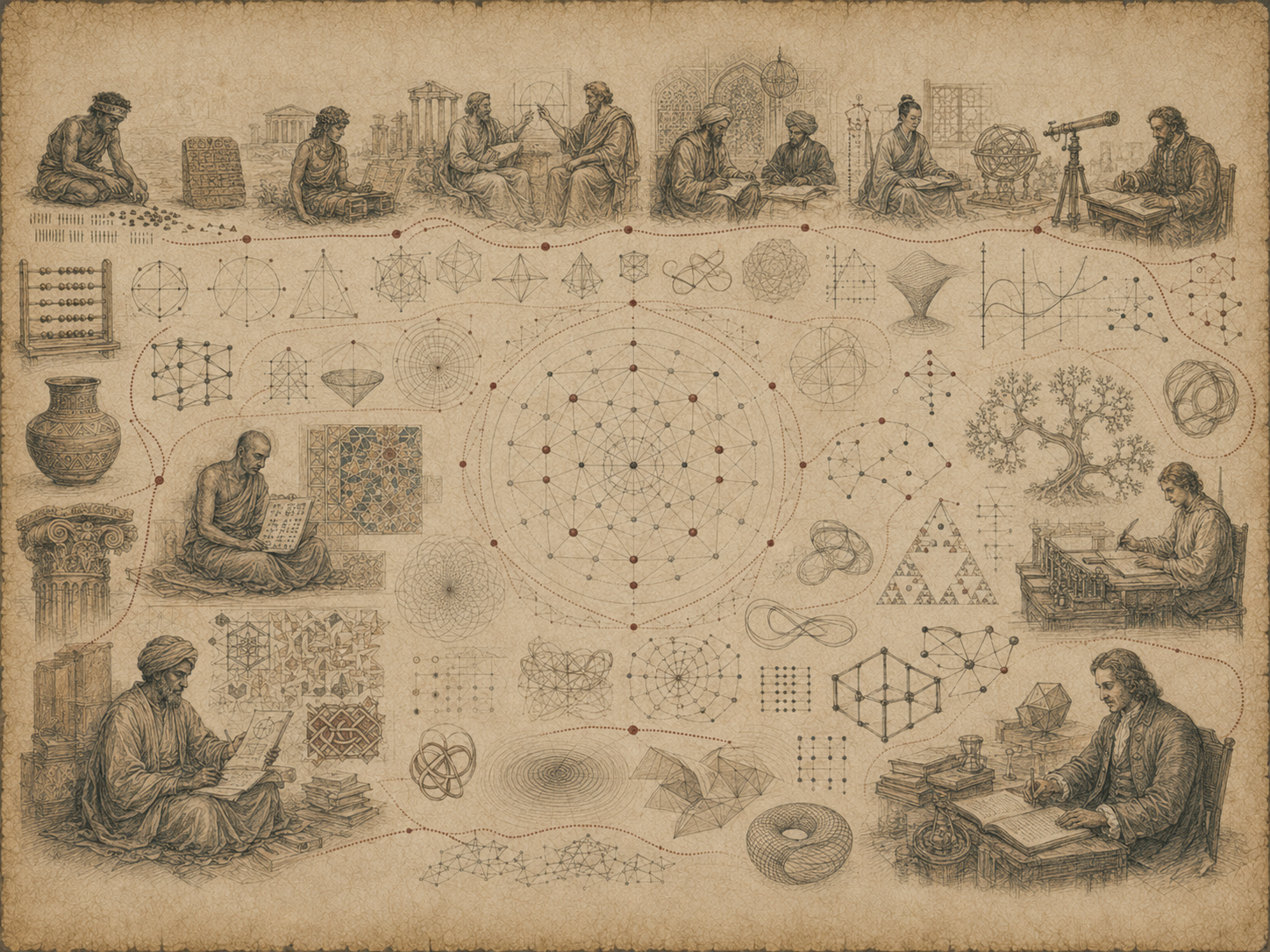
The Question of Mathematical Unity
The unity of mathematics is not obvious from the outside. Arithmetic studies numbers. Geometry studies space. Algebra studies symbols and equations. Calculus studies change. Probability studies uncertainty. Logic studies inference. Discrete mathematics studies finite structures. Topology studies continuity and deformation. Computer science studies algorithms. Mathematical modeling studies systems in the world. These fields differ in language, methods, objects, and applications.
Yet the history of mathematics repeatedly reveals connections among them. The same idea may appear in different forms: ratio in geometry, proportion in music, slope in calculus, rate in physics, derivative in analysis, gradient in optimization, sensitivity in modeling, and backpropagation in machine learning. A graph may be a discrete object, a network model, a data structure, a dependency system, or a category-theoretic diagram. A function may be a formula, a mapping, a transformation, a computational procedure, a random variable, or an element of a function space.
\text{unity}\neq \text{uniformity}
\]
Interpretation: Mathematical unity does not mean that all mathematics is the same. It means that different fields are connected by recurring ideas, structures, transformations, and forms of reasoning.
The unity of mathematical ideas is historical. It grows as concepts migrate across fields, as notation evolves, as proof standards change, as structures are abstracted, and as mathematical objects are reinterpreted. A problem about land measurement can become geometry. A geometric problem can become algebra. An algebraic identity can become a structural law. A structural law can become a computational specification. A computational specification can become a machine-checked theorem.
| Unifying Idea | Appears In | Historical Effect |
|---|---|---|
| Quantity | Arithmetic, algebra, analysis, probability | Connects counting, measurement, magnitude, and modeling |
| Relation | Geometry, algebra, logic, graph theory, category theory | Turns isolated objects into structured systems |
| Transformation | Algebra, geometry, calculus, topology, computation | Studies how objects change while structure is preserved |
| Invariance | Symmetry, topology, physics, statistics, algorithms | Identifies what remains stable across change |
| Proof | Geometry, logic, algebra, analysis, formal verification | Makes reasoning accountable under assumptions |
The unity of mathematics is therefore a unity of movement. Ideas travel, transform, and reappear in new forms.
Ancient Beginnings: Counting, Measuring, and Pattern Recognition
Mathematical unity begins in the earliest human practices of pattern recognition. Counting animals, measuring land, dividing food, tracking seasons, building structures, exchanging goods, and observing the sky all required stable forms of comparison. These practices appear different, but they share a mathematical core: the identification of regularity across changing situations.
Counting abstracts from the thing counted. Three sheep, three stones, three days, and three marks share a numerical form. Measurement abstracts from physical objects into units and magnitudes. Calendars abstract from celestial cycles into repeatable periods. Geometry abstracts from construction and land into shape, proportion, and spatial relation. Commerce abstracts from goods into equivalence, ratio, and value.
\text{different objects}\longrightarrow \text{same pattern}
\]
Interpretation: Mathematical abstraction begins when different concrete situations are recognized as sharing the same form.
Ancient mathematics was often procedural rather than symbolic in the modern sense. Mesopotamian tablets, Egyptian papyri, counting devices, calendars, construction methods, and astronomical tables did not always present general theorems. Yet they expressed durable mathematical ideas: number, ratio, area, volume, periodicity, approximation, and algorithmic procedure.
| Ancient Practice | Mathematical Idea | Later Unifying Role |
|---|---|---|
| Counting goods | Discrete quantity | Arithmetic, number theory, combinatorics, computation |
| Measuring land | Length, area, proportion | Geometry, calculus, surveying, modeling |
| Calendar design | Periodicity | Modular arithmetic, astronomy, dynamical systems |
| Astronomical observation | Prediction and cyclic pattern | Trigonometry, analysis, mathematical physics |
| Trade and accounting | Equivalence, ratio, debt, exchange | Algebra, finance, optimization, economics |
The earliest unity of mathematics was practical: different problems required common forms of quantitative order. Later mathematics would make those forms explicit, symbolic, and structural.
Number and Space as Early Unifying Ideas
Number and space were among the earliest great unifying ideas in mathematics. Number allowed quantities to be compared across contexts. Space allowed shapes, distances, angles, areas, and configurations to be reasoned about. At first, number and space often appeared as separate domains: arithmetic for quantity, geometry for form. Yet their connection became one of the central engines of mathematical history.
Ratio is an early bridge between number and geometry. A ratio compares magnitudes. It can describe lengths, areas, speeds, musical intervals, mixtures, or astronomical relations. Proportion allows the same relation to appear in different physical contexts. Similar triangles, scale drawings, maps, musical harmony, and rates of change all depend on proportional reasoning.
\frac{a}{b}=\frac{c}{d}
\]
Interpretation: Proportion unifies number and geometry by expressing sameness of relation across different magnitudes.
Geometry also gave number a visual language. Lengths could represent magnitudes. Areas could represent products. Diagrams could show identities. Later, algebraic expressions would be interpreted geometrically, and geometric objects would be represented algebraically. The unity of number and space prepared the way for analytic geometry, calculus, linear algebra, topology, and modern modeling.
| Idea | Numerical Form | Spatial Form |
|---|---|---|
| Equality | Same value | Congruent length, area, or shape |
| Ratio | Comparison of quantities | Similarity and scale |
| Product | Multiplication | Area or volume |
| Square | \(n^2\) | Square area |
| Root | Inverse of power | Side length from area |
Number and space became two languages for form. Their interaction shaped much of later mathematical development.
Proof and the Search for Necessity
Proof introduced a new kind of unity into mathematics: the unity of justification. Procedures can work. Patterns can be observed. Measurements can be repeated. But proof asks why a claim must hold under stated assumptions. The development of proof transformed mathematics from a collection of successful methods into an architecture of accountable reasoning.
Greek deductive geometry, especially the Euclidean tradition, became one of the most influential models of proof. Definitions, postulates, common notions, propositions, diagrams, and demonstrations organized mathematical knowledge into a cumulative structure. A theorem was no longer an isolated fact. It belonged to a network of dependencies.
\text{assumptions}+\text{valid inference}\Rightarrow \text{theorem}
\]
Interpretation: Proof unifies mathematical claims by showing how they depend on assumptions and inference rules.
Proof also creates unity across fields. A proof in number theory, geometry, algebra, analysis, logic, or combinatorics may use different objects, but it shares the demand for justified inference. The standards and styles differ, yet the underlying aim remains: to make reasoning accountable.
| Proof Style | Typical Field or Context | Unifying Function |
|---|---|---|
| Geometric demonstration | Classical geometry | Shows necessity through construction and relation |
| Algebraic manipulation | Algebra and equations | Transforms expressions while preserving equality |
| Induction | Arithmetic, combinatorics, computer science | Connects base case and recursive step |
| Limit proof | Analysis | Controls approximation and infinity |
| Formal derivation | Logic and proof assistants | Makes inference machine-checkable |
Proof is one of the deepest sources of mathematical unity because it links truth to reasoning rather than to mere observation, habit, or authority.
Algorithmic Traditions and Procedural Unity
Another source of mathematical unity is algorithmic procedure. Long before modern computers, mathematical traditions developed repeatable methods for calculation, equation solving, root extraction, astronomical prediction, land measurement, tax computation, and systems of constraints. Algorithms unify mathematics by turning problems into sequences of operations.
Mesopotamian tables, Egyptian fraction methods, Indian arithmetic and astronomical procedures, Chinese rod calculation, Islamic algebraic solution methods, medieval commercial arithmetic, and modern computer algorithms all share a procedural logic: input is transformed through a reliable sequence of steps into output.
\text{input}\rightarrow \text{procedure}\rightarrow \text{output}
\]
Interpretation: Algorithmic thinking unifies mathematics by treating reasoning as a repeatable transformation process.
Procedural mathematics should not be treated as inferior to proof-based mathematics. It is a different mode of mathematical thought. A procedure can reveal structure, support generalization, and guide proof. In computer science, algorithms become mathematical objects studied for correctness, efficiency, termination, complexity, and implementation.
| Procedural Tradition | Mathematical Method | Later Connection |
|---|---|---|
| Mesopotamian tables | Lookup and transformation | Computational mathematics and numerical methods |
| Indian algorithms | Arithmetic, astronomy, algebraic procedures | Algorithmic mathematics and computation |
| Chinese rod calculation | Tabular manipulation and systems | Linear algebra and matrix-like reasoning |
| Islamic algebra | Equation classification and solution rules | Symbolic algebra and general methods |
| Modern algorithms | Formal procedures over data structures | Computer science, verification, optimization |
Algorithmic unity reminds us that mathematics is not only proof of truth. It is also disciplined action on form.
Algebra and the Generalization of Form
Algebra unified mathematical ideas by making form explicit. Instead of solving one numerical problem at a time, algebra allowed whole classes of problems to be represented symbolically. Unknowns, variables, coefficients, powers, operations, and equations made patterns portable.
The historical movement from rhetorical algebra to syncopated algebra to symbolic algebra changed the scale of mathematical thought. A problem described in words could become an equation. A repeated operation could become a rule. A numerical case could become a general form. A form could become an object of study in its own right.
ax^2+bx+c=0
\]
Interpretation: Symbolic algebra represents an entire family of quadratic equations, not merely one numerical case.
Algebra also unified arithmetic and geometry. Products could be areas. Squares could be geometric squares or powers. Equations could encode curves. Later, algebra would move beyond number and geometry altogether, becoming the study of abstract operations and structures.
| Algebraic Idea | Unifying Role | Later Development |
|---|---|---|
| Unknown | Makes missing quantity manipulable | Variables, parameters, coordinates, states |
| Equation | Represents relation of equality | Models, constraints, curves, systems |
| Polynomial | Organizes powers and coefficients | Algebraic geometry, approximation, computation |
| Operation | Defines allowable transformations | Groups, rings, fields, algebras |
| Symbolic manipulation | Preserves relation through transformation | Computer algebra and formal verification |
Algebra’s historical power lies in its ability to reveal sameness of form beneath different numerical, geometric, and applied problems.
The Union of Geometry and Algebra
Analytic geometry created one of the great unifications in mathematical history. Geometry, once centered on diagrams and constructions, could be represented algebraically through coordinates and equations. Algebra, once focused on symbolic equations, gained geometric interpretation through curves and spaces.
The equation \(y=x^2\) is both an algebraic statement and a geometric object. It defines a relation between variables, and it describes a parabola. A system of equations can describe an intersection of curves. A matrix can describe a linear transformation of space. A polynomial can define an algebraic variety. Geometry and algebra became two languages for the same structures.
\text{curve}\longleftrightarrow \text{equation}
\]
Interpretation: Analytic geometry unifies spatial form and symbolic relation by allowing curves to be represented as equations.
This union reshaped mathematics, physics, engineering, computer graphics, optimization, and data analysis. Coordinate systems made motion, force, fields, trajectories, surfaces, constraints, and transformations mathematically writable.
| Geometric Object | Algebraic Representation | Unified Insight |
|---|---|---|
| Line | \(y=mx+b\) | Slope becomes relation of change |
| Circle | \((x-a)^2+(y-b)^2=r^2\) | Distance relation becomes equation |
| Parabola | \(y=x^2\) | Quadratic relation becomes shape |
| Linear transformation | \(Ax\) | Matrix becomes action on space |
| Constraint system | \(Ax=b\) | Equations define feasible structure |
The union of geometry and algebra shows how mathematical unity often arises when two forms of representation become translatable into one another.
Calculus and the Mathematics of Change
Calculus unified problems of motion, accumulation, area, slope, growth, approximation, and continuous change. Before calculus, many of these problems appeared separate: tangent lines in geometry, velocity in mechanics, area under curves, infinite series, planetary motion, and optimization. Calculus revealed their common structure.
The derivative expresses local change. The integral expresses accumulation. The fundamental theorem of calculus connects the two. This connection is one of the most powerful unifications in mathematics: slope and area, change and accumulation, local and global behavior become mathematically linked.
\frac{d}{dx}\int_a^x f(t)\,dt=f(x)
\]
Interpretation: The fundamental theorem of calculus unifies differentiation and integration, showing that change and accumulation are inverse aspects of the same structure.
Calculus also unified mathematics with the natural sciences. Motion, force, heat, waves, fluids, electromagnetism, population growth, chemical reactions, and economic dynamics could be described using differential equations and continuous models. Mathematics became a language of change in the world.
| Problem Type | Calculus Concept | Unifying Idea |
|---|---|---|
| Tangent line | Derivative | Local rate of change |
| Area under curve | Integral | Accumulation over interval |
| Motion | Differential equation | State changes over time |
| Optimization | Critical point | Change vanishes or changes sign |
| Approximation | Series expansion | Complex behavior represented by simpler terms |
Calculus demonstrates that mathematical unity often appears when one concept explains many different phenomena at once.
Rigor, Infinity, and the Rebuilding of Analysis
The nineteenth century deepened the unity of mathematics by clarifying concepts that had been powerful but unstable: limit, function, continuity, convergence, real number, infinite series, and infinity itself. Calculus worked, but its foundations required refinement. Analysis was rebuilt through definitions, quantifiers, inequalities, and careful proof.
The epsilon-delta definition of limit turned intuitive nearness into formal control. It unified many concepts in analysis: continuity, derivative, convergence, approximation, and error bounds. The same logical structure appears repeatedly: for every tolerance, there is a condition that guarantees control.
\forall \varepsilon>0\;\exists \delta>0\;\bigl(0<|x-a|<\delta\Rightarrow |f(x)-L|<\varepsilon\bigr)
\]
Interpretation: Rigor unifies analysis by replacing visual intuition with explicit quantified control.
Set theory and the construction of real numbers also changed the meaning of mathematical unity. Numbers, functions, sequences, spaces, and infinite collections could be organized within broader foundational systems. Infinity became structured rather than merely indefinite.
| Concept Clarified | Problem Addressed | Unifying Effect |
|---|---|---|
| Limit | Intuitive nearness | Controls convergence, continuity, derivative, integral |
| Real number | Continuum foundation | Supports rigorous analysis |
| Function | Dependence and mapping | Unifies formulas, curves, transformations, processes |
| Infinite set | Actual infinity | Connects analysis, logic, topology, foundations |
| Counterexample | Misleading intuition | Forces precise definitions |
Rigor did not fragment mathematics. It created deeper unity by making assumptions, definitions, and limits of reasoning visible.
The Structural Turn: Unity Through Relations
Modern mathematics increasingly understands unity through structure. A structure is not defined only by its elements, but by the relations, operations, and laws that organize those elements. Groups, rings, fields, vector spaces, topological spaces, graphs, categories, probability spaces, and formal systems all express this structural imagination.
The structural turn allows mathematics to identify sameness beneath different appearances. The integers under addition, rotations of a polygon, permutations of a set, and symmetries of an object may all be studied through group structure. A vector space may consist of arrows, coordinate lists, functions, signals, or data. What matters is not the surface form, but the operations and laws.
\text{structure}=(\text{objects},\text{relations},\text{operations},\text{laws})
\]
Interpretation: Structural mathematics unifies different fields by studying systems according to their relations, operations, and laws.
This shift changed the meaning of abstraction. Abstraction became a way to preserve what matters across different contexts. A theorem about groups may apply to number systems, symmetries, transformations, and algebraic objects. A theorem about vector spaces may apply to geometry, differential equations, quantum mechanics, statistics, or machine learning.
| Structure | Unifies | Preserving Map |
|---|---|---|
| Group | Numbers, symmetries, permutations, transformations | Homomorphism |
| Vector space | Geometry, functions, signals, states, data | Linear map |
| Topological space | Continuity, nearness, deformation | Continuous map |
| Graph | Networks, dependencies, relations, paths | Graph morphism |
| Category | Structures and structure-preserving maps | Functor |
The structural turn is one of the clearest expressions of mathematical unity: different objects become intelligible through common forms of relation.
Logic, Foundations, and the Formal Unity of Reasoning
Logic and foundations introduced another kind of unity: the unity of formal reasoning. If mathematics depends on proof, then proof itself can be studied mathematically. Formal logic turns statements, inference rules, quantifiers, axioms, models, and derivations into explicit objects.
Set theory offered a common language for much of mathematics. Logicism, formalism, intuitionism, structuralism, and type-theoretic approaches each proposed different ways to understand the grounding of mathematics. These views differ, but all attempt to clarify how mathematical reasoning works.
\text{formal system}=(\text{language},\text{axioms},\text{rules of inference})
\]
Interpretation: Foundations unify mathematics by making the components of reasoning explicit: the language used, the assumptions accepted, and the rules by which conclusions follow.
Gödel’s incompleteness theorems complicated any simple dream of complete formal unity. Formal systems are powerful, but their power has limits. Truth, provability, consistency, interpretation, and computation cannot be collapsed into a single simple notion. The unity of foundations is therefore not final closure, but disciplined clarification.
| Foundational Idea | Unifying Contribution | Limit or Caution |
|---|---|---|
| Set theory | Provides a common language of collections | Foundational coding is not the whole of practice |
| Formal logic | Makes inference explicit | Formal derivability is not identical to meaning |
| Model theory | Connects formal language to interpretations | Different models may satisfy the same theory |
| Proof theory | Studies proof as an object | Proof systems have limits |
| Type theory | Connects computation, construction, and proof | Formalization choices matter |
Foundations show that mathematical unity is not only about common objects. It is also about common standards for reasoning, representation, and interpretation.
Discrete and Continuous Mathematics as Complementary Modes
Another major theme in mathematical unity is the relation between the discrete and the continuous. Discrete mathematics studies separated objects: integers, graphs, finite sets, combinations, algorithms, logical formulas, symbols, and data structures. Continuous mathematics studies change, limits, curves, spaces, fields, flows, and smooth variation.
These modes often appear opposed, but history shows that they are deeply connected. Calculus approximates continuous change through discrete partitions. Numerical methods approximate continuous problems through finite computation. Digital computers represent continuous phenomena through discrete data. Graphs approximate spaces. Combinatorics appears inside topology, algebra, probability, and computation.
\text{continuous problem}\longrightarrow \text{discrete approximation}\longrightarrow \text{computed insight}
\]
Interpretation: Modern mathematics often connects continuous phenomena with discrete representations that can be counted, computed, simulated, or analyzed.
The discrete-continuous relationship is one of the most productive tensions in mathematics. It appears in calculus, numerical analysis, topology, graph theory, probability, information theory, computer graphics, finite element methods, machine learning, and scientific computing.
| Continuous Idea | Discrete Partner | Unified Field or Method |
|---|---|---|
| Curve | Sample points | Numerical approximation |
| Integral | Finite sum | Riemann sums and quadrature |
| Space | Mesh or graph | Finite element methods and computational geometry |
| Differential equation | Time-step update | Simulation |
| Signal | Digital samples | Signal processing and information theory |
Discrete and continuous mathematics are not rival kingdoms. They are complementary ways of representing structure, change, and computation.
Symmetry, Invariance, and the Deep Unity of Form
Symmetry and invariance are among the deepest unifying ideas in mathematics. A symmetry is a transformation that preserves some structure. An invariant is something that remains unchanged under transformation. Together, they reveal what matters most in a mathematical object or system.
A square can be rotated or reflected while preserving its shape. An equation can be transformed while preserving equality. A topological space can be deformed while preserving connectedness. A physical law can remain invariant under coordinate transformation. A statistical model may be invariant under relabeling. A graph may preserve connectivity under isomorphism.
\text{transformation}+\text{preservation}\Rightarrow \text{symmetry or invariant}
\]
Interpretation: Symmetry and invariance unify mathematics by asking what remains the same when something changes.
Invariance connects geometry, algebra, topology, physics, statistics, computer science, and category theory. It also changes how mathematicians think. Instead of studying objects only directly, one studies transformations of objects and the properties those transformations preserve.
| Field | Transformation | Invariant |
|---|---|---|
| Geometry | Rotation or reflection | Distance, angle, shape |
| Algebra | Isomorphism | Operation structure |
| Topology | Continuous deformation | Connectedness, holes, compactness |
| Physics | Coordinate transformation | Physical law or conserved quantity |
| Computer science | Program transformation | Semantics or output behavior |
Invariance is a language of unity because it identifies stability within change. It tells mathematics what a structure really preserves.
Probability, Statistics, and the Mathematics of Uncertainty
Probability and statistics expanded mathematical unity into the domain of uncertainty. Earlier mathematics often pursued exactness: exact number, exact proof, exact geometry, exact equation. Probability introduced a disciplined way to reason when outcomes are uncertain, information is incomplete, or variation is unavoidable.
Probability connects counting, measure, logic, inference, decision-making, physics, biology, economics, machine learning, and risk analysis. It can be interpreted through frequency, belief, symmetry, propensity, or measure-theoretic structure depending on context. Statistics then connects probability to data, estimation, uncertainty, evidence, and inference.
P(A\mid B)=\frac{P(A\cap B)}{P(B)}
\]
Interpretation: Conditional probability unifies uncertainty with information: the probability of an event changes when new conditions are known.
Probability also links discrete and continuous mathematics. A probability distribution may describe finite outcomes, countably infinite outcomes, or continuous variables. Measure theory provides a rigorous foundation for probability, unifying area, integration, and chance.
| Probability Concept | Connects To | Unifying Role |
|---|---|---|
| Counting outcomes | Combinatorics | Discrete probability |
| Distribution | Functions and measures | Models variation |
| Expectation | Integration | Summarizes random quantities |
| Conditional probability | Logic and evidence | Updates uncertainty under information |
| Statistical inference | Data and models | Connects theory to empirical evidence |
The mathematics of uncertainty reminds us that unity does not require certainty. It can also arise from disciplined reasoning about variability, evidence, and risk.
Computation and the Algorithmic Unity of Mathematics
Computation has given modern mathematics a new form of unity. Algorithms, data structures, formal languages, symbolic computation, numerical methods, simulation, complexity theory, cryptography, machine learning, and proof assistants all connect mathematical ideas to executable procedures.
Computation does not merely automate calculation. It turns mathematical objects into representations that can be stored, transformed, searched, checked, simulated, and verified. A polynomial can become an expression tree. A proof can become a formal script. A graph can become an adjacency list. A function can become code. A differential equation can become a numerical simulation.
\text{mathematical object}\rightarrow \text{representation}\rightarrow \text{algorithm}
\]
Interpretation: Computation unifies mathematics by translating mathematical objects into executable representations.
The rise of computation also connects pure and applied mathematics. Number theory becomes cryptography. Linear algebra becomes machine learning infrastructure. Graph theory becomes network science. Logic becomes programming language theory and formal verification. Probability becomes statistical computation. Geometry becomes computer graphics and robotics.
| Mathematical Field | Computational Form | Modern Unity |
|---|---|---|
| Number theory | Modular arithmetic algorithms | Cryptography |
| Linear algebra | Matrix computation | Data science and machine learning |
| Logic | Formal languages and type systems | Programming languages and proof assistants |
| Graph theory | Network algorithms | Infrastructure, search, dependency analysis |
| Analysis | Numerical solvers | Simulation and scientific computing |
Computation extends the unity of mathematics by making mathematical forms operational. It turns thought into procedure.
Models, Systems, and the Applied Unity of Mathematical Ideas
Mathematical modeling unifies ideas by connecting formal structures to real or imagined systems. A model may use equations, graphs, probability distributions, simulations, optimization problems, differential equations, matrices, or logical rules. What makes it a model is not the mathematics alone, but the interpretation of that mathematics in relation to a target system.
\text{formal structure}+\text{interpretation}+\text{assumptions}\Rightarrow \text{model}
\]
Interpretation: A mathematical model unifies formal reasoning and real-world interpretation, but only through assumptions that must be made explicit.
Models reveal unity across domains. The same differential equation form may describe population growth, chemical reaction, heat flow, infection spread, or financial dynamics. The same graph structure may describe roads, social ties, power grids, neural networks, supply chains, or citation systems. The same optimization framework may apply to logistics, energy, economics, machine learning, and policy design.
| Mathematical Form | Possible Systems Modeled | Interpretive Caution |
|---|---|---|
| Differential equation | Motion, population, disease, climate, reaction | Variables and parameters simplify reality |
| Graph | Networks, dependencies, flows, relations | Edges have different meanings in different systems |
| Matrix | Data, transformation, adjacency, covariance | Rows and columns require interpretation |
| Probability distribution | Risk, uncertainty, variation, noise | Probability interpretation matters |
| Optimization problem | Allocation, logistics, design, policy, learning | The objective function may encode values |
Applied mathematical unity is powerful because it allows one formal structure to illuminate many systems. But it also requires humility: a model is not the world, and formal unity does not erase real-world difference.
Category-Level Abstraction and Unity Through Transformation
Category theory offers one of the most explicit modern languages of mathematical unity. It studies objects and morphisms: structures and the structure-preserving maps between them. Rather than focusing only on what objects are made of, category theory asks how objects relate, transform, compose, and preserve structure.
This perspective reveals common patterns across algebra, topology, logic, computer science, geometry, and type theory. Groups and homomorphisms, spaces and continuous maps, sets and functions, types and programs, propositions and proofs—all can be studied through the language of objects and morphisms.
A\xrightarrow{f}B\xrightarrow{g}C,\qquad g\circ f:A\to C
\]
Interpretation: Category-level thinking unifies mathematics by studying transformations and their composition.
Category theory does not mean that all mathematics becomes identical. It provides a language for comparing structures at a high level. Its unity is relational: objects matter through the maps between them, and maps matter through what they preserve.
| Category-Level Idea | Plain Meaning | Unifying Role |
|---|---|---|
| Object | A mathematical structure | Allows structures to be compared abstractly |
| Morphism | Structure-preserving map | Centers transformation |
| Composition | Chaining transformations | Creates coherent systems of maps |
| Functor | Map between categories | Transfers structure between mathematical worlds |
| Natural transformation | Structured comparison between functors | Studies transformations between transformations |
Category-level abstraction is a mature expression of mathematical unity because it does not require reducing everything to one kind of object. It unifies through relation, preservation, and transformation.
Formal Verification and the New Unity of Proof and Computation
Proof assistants and formal verification systems are creating a new unity between proof, logic, computation, and software. Systems such as Lean, Coq, Isabelle/HOL, HOL Light, and Agda allow mathematical statements and proofs to be encoded in formal languages and checked by machine.
This development connects several historical streams. Euclidean proof organized reasoning into propositions and demonstrations. Modern logic formalized inference. Type theory connected propositions and constructions. Computer science formalized algorithms and computation. Proof assistants bring these together: proof becomes a computational artifact that can be checked by a formal kernel.
\text{proof}+\text{formal language}+\text{computation}\Rightarrow \text{machine-checked mathematics}
\]
Interpretation: Formal verification unifies proof and computation by making mathematical reasoning checkable within a formal system.
This does not eliminate human mathematical judgment. Humans choose definitions, state theorems, build libraries, guide proofs, interpret results, and decide what matters. But formal verification changes the medium of proof. It makes hidden assumptions more visible, proof dependencies more explicit, and large formal developments more reusable.
| Historical Stream | Modern Formalization Role | Unifying Effect |
|---|---|---|
| Proof | Theorem and derivation | Reasoning becomes checkable |
| Logic | Formal language and inference rules | Meaning is constrained by syntax and rules |
| Type theory | Types, terms, propositions, constructions | Connects proof and computation |
| Software | Libraries, tactics, proof scripts | Mathematics becomes reusable infrastructure |
| Computation | Checking, automation, search | Formal reasoning becomes executable |
Formal verification is not the final form of mathematics. It is a new historical layer in the unity of mathematical ideas: proof, structure, computation, and language become inseparable.
Global Traditions and the Plural Sources of Mathematical Unity
The unity of mathematical ideas must not be confused with a single linear story centered only on Greece and modern Europe. Mathematical unity emerged from many traditions: Mesopotamian computation, Egyptian measurement, Greek deductive proof, Indian place-value numeration and astronomy, Chinese procedural and configurational reasoning, Islamic algebra and trigonometry, medieval scholastic logic, Renaissance symbolism, early modern calculus, modern structural abstraction, and contemporary computation.
Different traditions developed different forms of mathematical unity. Some unified through proof. Others through procedure, tables, astronomical prediction, geometric configuration, algebraic classification, commentary, instruments, notation, or pedagogy. The global history of mathematics is not a ladder with one culture at the top. It is a network of traditions, translations, transformations, and reinterpretations.
\text{mathematical unity}=\text{shared forms}+\text{plural histories}
\]
Interpretation: Mathematics can have deep unity while still arising from many cultures, media, institutions, and modes of reasoning.
A responsible history must also account for what is missing or minimized: oral traditions, craft mathematics, Indigenous knowledge systems, women’s mathematical labor, colonized knowledge traditions, translation networks, pedagogical communities, and practical mathematics embedded in architecture, navigation, textiles, commerce, and engineering.
| Tradition or Context | Mathematical Unity Emphasized | Historiographic Caution |
|---|---|---|
| Mesopotamian | Tabular and procedural calculation | Do not judge only by later proof standards |
| Greek | Deductive geometry and proof architecture | Do not make proof the only legitimate form of reasoning |
| Indian | Number, algorithm, astronomy, series, trigonometry | Respect genre, commentary, and computational context |
| Chinese | Procedure, configuration, systems, dissection | Do not dismiss procedural verification |
| Islamic | Algebra, trigonometry, translation, synthesis | Transmission was creative transformation |
The unity of mathematics is strongest when its history is told honestly: not as the property of one civilization, but as a shared human achievement built through many forms of thought.
A Mathematical Lens: Pattern, Relation, Transformation, Invariance
A useful lens for understanding the unity of mathematical ideas is the sequence: pattern, relation, transformation, invariance. Pattern begins the process. Relation organizes the pattern. Transformation tests how the pattern changes. Invariance reveals what remains stable.
\text{Pattern}\rightarrow \text{Relation}\rightarrow \text{Transformation}\rightarrow \text{Invariance}
\]
Interpretation: Mathematical unity often emerges when patterns are organized as relations, studied through transformations, and understood by what remains invariant.
This lens works across fields. In arithmetic, patterns of numbers lead to relations such as divisibility and congruence. In geometry, spatial patterns lead to transformations and invariants such as distance, angle, or topology. In algebra, operation laws define structure. In calculus, functions transform under differentiation and integration. In probability, distributions transform under conditioning, aggregation, and limit theorems. In computation, programs transform inputs while preserving specifications.
| Field | Pattern | Transformation | Invariant |
|---|---|---|---|
| Number theory | Divisibility and congruence | Modular transformation | Remainder structure |
| Geometry | Shape and space | Rotation, reflection, projection | Distance, angle, incidence, symmetry |
| Algebra | Operation laws | Homomorphism | Structure |
| Topology | Continuity and nearness | Continuous deformation | Connectedness, holes, compactness |
| Computation | Input-output behavior | Program execution | Specification or semantics |
This lens captures why mathematics feels unified even when its subjects differ. Mathematics studies what changes, what remains, and what structure makes that distinction intelligible.
Computational Companion Examples
The companion repository for this article should extend the Mathematical Thinking codebase with examples focused on historical idea networks, cross-field concept mapping, transformation and invariance catalogs, proof/algorithm/model connections, Haskell typed unity models, SQL schemas for mathematical ideas, graph-based dependency maps, and responsible generalization audits. The examples below are compact article-level previews; the repository can expand them into richer professional workflows.
Python: Mapping Ideas Across Mathematical Fields
from dataclasses import dataclass
from collections import defaultdict

@dataclass(frozen=True)
class MathematicalIdea:
    idea: str
    field: str
    representation: str
    transformation: str
    invariant: str
    interpretation: str

ideas = [
    MathematicalIdea(
        idea="proportion",
        field="geometry",
        representation="ratio of magnitudes",
        transformation="scaling",
        invariant="same relative relation",
        interpretation="proportion connects number, shape, and similarity"
    ),
    MathematicalIdea(
        idea="slope",
        field="calculus",
        representation="derivative",
        transformation="local change",
        invariant="rate relation at a point",
        interpretation="slope unifies geometry and change"
    ),
    MathematicalIdea(
        idea="group",
        field="algebra",
        representation="set with operation",
        transformation="homomorphism",
        invariant="operation structure",
        interpretation="group theory studies sameness under structural maps"
    ),
    MathematicalIdea(
        idea="graph",
        field="discrete mathematics",
        representation="nodes and edges",
        transformation="graph morphism",
        invariant="relation pattern",
        interpretation="graphs unify networks, dependencies, and finite structure"
    ),
    MathematicalIdea(
        idea="proof",
        field="logic",
        representation="formal derivation",
        transformation="translation between systems",
        invariant="derivability under rules",
        interpretation="formal proof unifies reasoning through explicit inference"
    ),
]

by_invariant = defaultdict(list)
for item in ideas:
    by_invariant[item.invariant].append((item.idea, item.field))

for invariant, examples in by_invariant.items():
    print(invariant, "=>", examples)
R: Historical Unity Matrix
unity_matrix <- data.frame(
  historical_layer = c(
    "Ancient calculation",
    "Greek proof",
    "Algebraic symbolism",
    "Analytic geometry",
    "Calculus",
    "Structural mathematics",
    "Formal logic",
    "Computation"
  ),
  unifying_idea = c(
    "procedure",
    "deductive necessity",
    "general symbolic form",
    "equation as shape",
    "change and accumulation",
    "objects through relations",
    "reasoning as formal derivation",
    "mathematics as executable procedure"
  ),
  later_connection = c(
    "algorithms and computation",
    "proof theory and verification",
    "abstract algebra and computer algebra",
    "modeling and data geometry",
    "differential equations and simulation",
    "category theory and systems thinking",
    "proof assistants and formal methods",
    "AI, simulation, and machine-checked mathematics"
  )
)

print(unity_matrix)
Haskell: Typed Model of Mathematical Unity
{-# OPTIONS_GHC -Wall #-}

data MathematicalMode
  = Arithmetic
  | Geometric
  | Algebraic
  | Analytic
  | Structural
  | Logical
  | Computational
  deriving (Eq, Show)

data UnifyingIdea
  = Pattern
  | Relation
  | Transformation
  | Invariance
  | Proof
  | Algorithm
  | Model
  deriving (Eq, Show)

data Concept = Concept
  { name :: String
  , mode :: MathematicalMode
  , idea :: UnifyingIdea
  , preserved :: String
  } deriving (Eq, Show)

concepts :: [Concept]
concepts =
  [ Concept "proportion" Geometric Relation "relative magnitude"
  , Concept "derivative" Analytic Transformation "local rate relation"
  , Concept "group" Algebraic Invariance "operation structure"
  , Concept "graph" Structural Relation "adjacency pattern"
  , Concept "formal proof" Logical Proof "derivability"
  , Concept "algorithm" Computational Algorithm "specified input-output behavior"
  ]

main :: IO ()
main = mapM_ print concepts
SQL: Schema for Mathematical Unity
CREATE TABLE mathematical_idea (
  idea_id TEXT PRIMARY KEY,
  name TEXT NOT NULL,
  historical_layer TEXT NOT NULL,
  primary_field TEXT NOT NULL,
  unifying_role TEXT NOT NULL,
  interpretation_note TEXT NOT NULL
);

CREATE TABLE cross_field_connection (
  connection_id TEXT PRIMARY KEY,
  source_idea TEXT NOT NULL,
  target_idea TEXT NOT NULL,
  connection_type TEXT NOT NULL,
  preserved_structure TEXT NOT NULL,
  caution_note TEXT NOT NULL
);

CREATE TABLE transformation_invariant (
  invariant_id TEXT PRIMARY KEY,
  field TEXT NOT NULL,
  transformation TEXT NOT NULL,
  invariant TEXT NOT NULL,
  meaning TEXT NOT NULL
);

CREATE TABLE responsible_generalization_warning (
  warning_id TEXT PRIMARY KEY,
  topic TEXT NOT NULL,
  warning TEXT NOT NULL,
  mitigation TEXT NOT NULL
);
These examples treat mathematical unity as a structured network of ideas. Concepts can be linked across fields, transformations can be paired with invariants, and historical layers can be connected without flattening their differences.
GitHub Repository
The companion repository for this article is designed as a reproducible mathematical-thinking workspace focused on historical idea networks, cross-field concept mapping, transformation and invariance catalogs, proof/algorithm/model connections, Haskell typed unity models, SQL schemas for mathematical ideas, graph-based dependency maps, and responsible generalization audits.
Complete Code Repository
Companion article folder with Python, R, Julia, SQL, Haskell, Rust, Go, C++, Fortran, and C examples for professional mathematical exploration of the historical development and unity of mathematical ideas, including pattern, relation, transformation, invariance, proof, algorithms, models, structures, computation, and responsible mathematical generalization.
Unity, Power, and Responsible Generalization
The unity of mathematical ideas is powerful because it allows knowledge to travel. A structure discovered in one field can illuminate another. A model built for one system can inspire methods for another. A proof technique can migrate across domains. An algorithm can solve problems far beyond its original context.
But generalization also carries risk. A mathematical structure may unify different cases while erasing important differences. A model may transfer across domains without preserving meaning. A metric may compress social reality into a number. An optimization method may impose a narrow objective on a complex human system. A statistical model may treat populations as interchangeable when history, power, and context matter.
\text{formal similarity}\neq \text{contextual sameness}
\]
Interpretation: Mathematical unity can reveal shared structure, but shared structure does not mean that contexts, meanings, or consequences are identical.
| Generalization Risk | Problem | Responsible Practice |
|---|---|---|
| False equivalence | Different systems are treated as the same because their formal models resemble one another | Ask what the structure preserves and what it omits |
| Metric reduction | Complex realities are compressed into narrow indicators | Audit what cannot be measured or is excluded |
| Optimization harm | A system optimizes a formal objective that conflicts with human values | Interrogate objectives before solving |
| Model migration | A model is transferred to a new domain without validating assumptions | Revalidate assumptions, data, and interpretation |
| Historical flattening | Different mathematical traditions are forced into one modern framework | Preserve historical specificity while recognizing shared ideas |
Responsible mathematical unity does not deny difference. It asks precisely what is shared, what is preserved, what changes, and who is affected when a formal idea travels.
Why the Unity of Mathematical Ideas Matters
The unity of mathematical ideas matters because it explains why mathematics is so powerful. Mathematics can move from number to space, from space to algebra, from algebra to structure, from structure to computation, from computation to models, and from models back to the world. Ideas invented for one purpose often become indispensable elsewhere.
This unity also helps make mathematics more teachable. Students often experience mathematics as a sequence of disconnected techniques. A historical and structural view shows that the same ideas recur: relation, transformation, invariance, approximation, proof, algorithm, model, and structure. Algebra is not separate from geometry. Calculus is not separate from approximation. Logic is not separate from computation. Graphs are not separate from systems. Probability is not separate from evidence and decision-making.
The unity of mathematics also matters for modern society. Data systems, artificial intelligence, infrastructure, finance, epidemiology, climate modeling, cryptography, optimization, and formal verification all depend on mathematical ideas moving across fields. That movement can produce insight, but it can also produce authority without accountability if assumptions are hidden.
The historical development of mathematics shows a discipline that grows by connection. Its unity is not a closed system, but an expanding architecture: pattern becomes relation, relation becomes structure, structure becomes transformation, transformation reveals invariance, and invariance makes new forms of reasoning possible. Mathematics is unified because it continually discovers how different worlds can share form without becoming identical.
Related Articles
- What Is Mathematical Thinking? Pattern, Proof, Architecture, and Reason
- The History of Mathematical Thinking from Antiquity to Modernity
- Foundations, Structure, and the Reimagining of Mathematics
- Mathematics as the Science of Patterns
- Abstraction and the Power of Generalization
- The Evolution of Algebraic Notation
- The Historical Development of Proof
- Mathematical Thinking and Category-Level Abstraction
- Mathematical Thinking for Computer Science
- The Historical Understanding of Mathematics
Further Reading
- Boyer, C.B. and Merzbach, U.C. (2011) A History of Mathematics. 3rd edn. Hoboken, NJ: Wiley.
- Corry, L. (2004) Modern Algebra and the Rise of Mathematical Structures. 2nd edn. Basel: Birkhäuser. Available at: https://link.springer.com/book/10.1007/978-3-0348-7917-0
- Gray, J. (2007) Plato’s Ghost: The Modernist Transformation of Mathematics. Princeton: Princeton University Press. Available at: https://press.princeton.edu/books/paperback/9780691136103/platos-ghost
- Joseph, G.G. (2011) The Crest of the Peacock: Non-European Roots of Mathematics. 3rd edn. Princeton: Princeton University Press. Available at: https://press.princeton.edu/books/paperback/9780691135267/the-crest-of-the-peacock
- Katz, V.J. (2009) A History of Mathematics: An Introduction. 3rd edn. Boston: Addison-Wesley.
- Kline, M. (1972) Mathematical Thought from Ancient to Modern Times. New York: Oxford University Press.
- Mac Lane, S. (1998) Categories for the Working Mathematician. 2nd edn. New York: Springer. Available at: https://link.springer.com/book/10.1007/978-1-4757-4721-8
- MacTutor History of Mathematics (n.d.) An overview of the history of mathematics. University of St Andrews. Available at: https://mathshistory.st-andrews.ac.uk/HistTopics/History_overview/
- Reck, E. (2019) ‘Structuralism in the Philosophy of Mathematics’, Stanford Encyclopedia of Philosophy. Available at: https://plato.stanford.edu/entries/structuralism-mathematics/
- Stillwell, J. (2010) Mathematics and Its History. 3rd edn. New York: Springer. Available at: https://link.springer.com/book/10.1007/978-1-4419-6053-5
References
- Boyer, C.B. and Merzbach, U.C. (2011) A History of Mathematics. 3rd edn. Hoboken, NJ: Wiley.
- Cajori, F. (1928) A History of Mathematical Notations, Volume I: Notations in Elementary Mathematics. Chicago: Open Court. Available at: https://archive.org/details/historyofmathema031756mbp
- Corry, L. (2004) Modern Algebra and the Rise of Mathematical Structures. 2nd edn. Basel: Birkhäuser. Available at: https://link.springer.com/book/10.1007/978-3-0348-7917-0
- Dauben, J.W. (1990) Georg Cantor: His Mathematics and Philosophy of the Infinite. Princeton: Princeton University Press. Available at: https://press.princeton.edu/books/paperback/9780691024479/georg-cantor
- Euclid (1956) The Thirteen Books of Euclid’s Elements, translated by T.L. Heath. 2nd edn. New York: Dover. Available at: https://archive.org/details/EuclidsElementsBooksIIIVolume1Heath
- Ferreirós, J. (2007) Labyrinth of Thought: A History of Set Theory and Its Role in Modern Mathematics. 2nd edn. Basel: Birkhäuser. Available at: https://link.springer.com/book/10.1007/978-3-7643-8350-3
- Gray, J. (2007) Plato’s Ghost: The Modernist Transformation of Mathematics. Princeton: Princeton University Press. Available at: https://press.princeton.edu/books/paperback/9780691136103/platos-ghost
- Horsten, L. (2019) ‘Philosophy of Mathematics’, Stanford Encyclopedia of Philosophy. Available at: https://plato.stanford.edu/entries/philosophy-mathematics/
- Joseph, G.G. (2011) The Crest of the Peacock: Non-European Roots of Mathematics. 3rd edn. Princeton: Princeton University Press. Available at: https://press.princeton.edu/books/paperback/9780691135267/the-crest-of-the-peacock
- Katz, V.J. (2009) A History of Mathematics: An Introduction. 3rd edn. Boston: Addison-Wesley.
- Kline, M. (1972) Mathematical Thought from Ancient to Modern Times. New York: Oxford University Press.
- Mac Lane, S. (1998) Categories for the Working Mathematician. 2nd edn. New York: Springer. Available at: https://link.springer.com/book/10.1007/978-1-4757-4721-8
- MacTutor History of Mathematics (n.d.) An overview of the history of mathematics. University of St Andrews. Available at: https://mathshistory.st-andrews.ac.uk/HistTopics/History_overview/
- Reck, E. (2019) ‘Structuralism in the Philosophy of Mathematics’, Stanford Encyclopedia of Philosophy. Available at: https://plato.stanford.edu/entries/structuralism-mathematics/
- Stillwell, J. (2010) Mathematics and Its History. 3rd edn. New York: Springer. Available at: https://link.springer.com/book/10.1007/978-1-4419-6053-5
- Weir, A. (2022) ‘Formalism in the Philosophy of Mathematics’, Stanford Encyclopedia of Philosophy. Available at: https://plato.stanford.edu/entries/formalism-mathematics/