
Last Updated June 3, 2026
The future of work and automation is not simply a story about machines replacing human labor. It is a deeper transformation in how work is divided, measured, managed, valued, intensified, protected, and redistributed across economies, institutions, households, platforms, and public systems. Artificial intelligence, robotics, algorithmic management, digital platforms, workflow automation, sensing systems, and data infrastructures are changing not only which tasks can be automated, but how occupations are redesigned, how workers are supervised, how skills are formed, how productivity gains are captured, and how economic security is distributed.
Automation has always been more complex than the simple disappearance of jobs. Technologies usually affect tasks before they affect whole occupations. Some tasks are substituted by machines. Others are augmented, accelerated, standardized, monitored, or reorganized. Some jobs disappear, but others change internally. Some workers gain productivity and autonomy, while others experience deskilling, surveillance, precarity, displacement, wage pressure, or intensified performance management. The future of work is therefore not determined by technology alone. It is shaped by labor institutions, public policy, education systems, bargaining power, organizational design, social protection, industrial strategy, worker participation, and the political choices that determine who benefits from technological change.
The core question is not whether automation will transform work. It already is. The deeper question is whether that transformation will expand human capability, dignity, security, creativity, and democratic voice—or whether it will deepen inequality, concentrate control, weaken worker power, and treat people as adjustable components inside automated systems.
This article examines the future of work and automation as a futures-thinking problem. It connects labor markets, task exposure, AI, robotics, workplace redesign, platform work, algorithmic management, skill systems, productivity, inequality, care work, social protection, worker voice, and long-term institutional adaptation. It treats automation not as an inevitable technological destiny, but as a contested social, economic, and political pathway.
Main Library
Publications
Article Map
Futures Thinking
Related Topic
Artificial Intelligence Systems
Related Topic
Economic Systems
Related Topic
Organizational Psychology
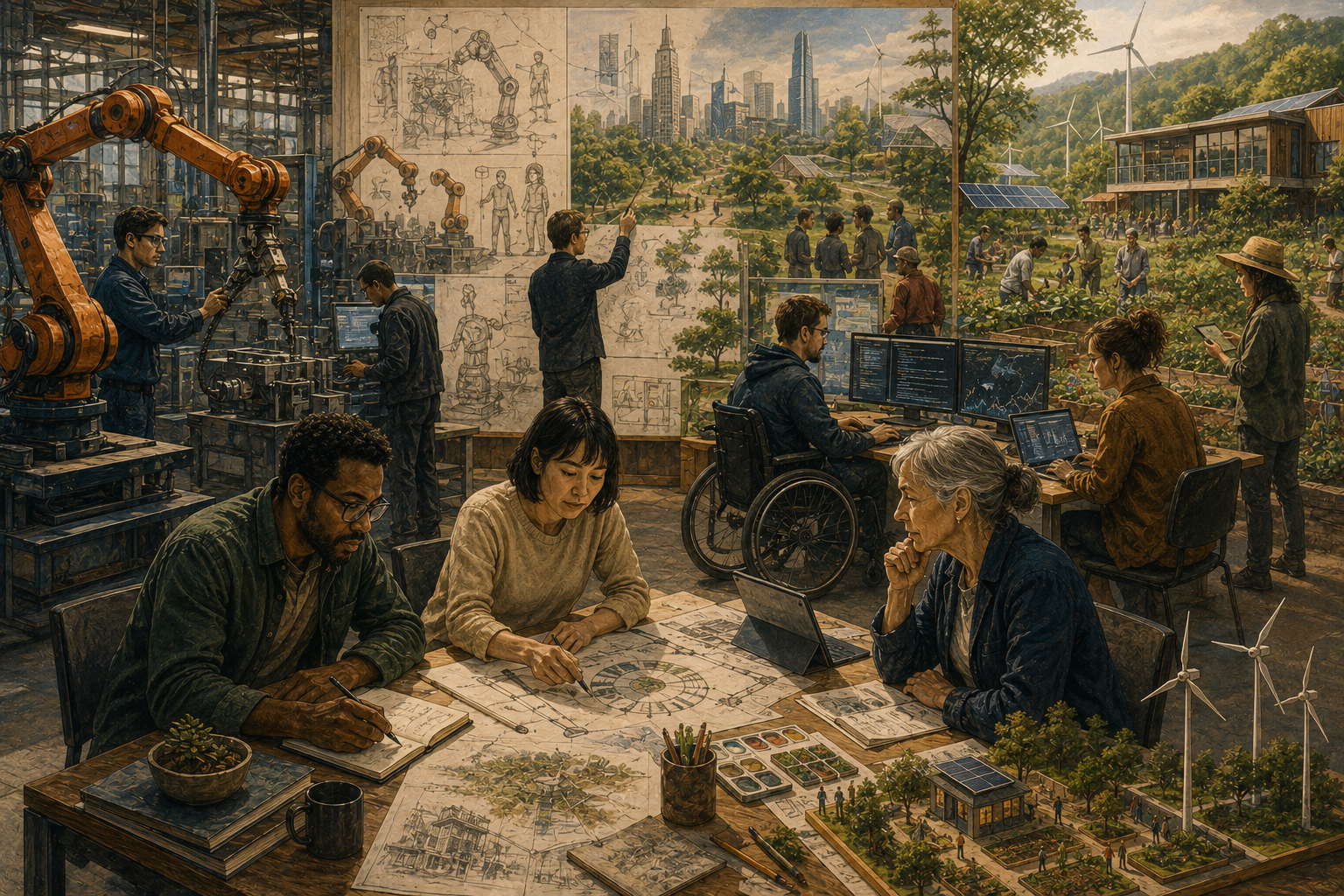
What Is the Future of Work and Automation?
The future of work and automation concerns how technological systems reshape labor, occupations, skills, organizations, power, income, security, and the meaning of work over time. It includes automation by software, artificial intelligence, robotics, sensors, digital platforms, workflow systems, decision engines, scheduling algorithms, autonomous machines, and data-driven management tools. But it also includes the social institutions that determine whether those tools produce shared prosperity or intensified inequality.
Work is not only a source of income. It is also a source of identity, dignity, social participation, learning, autonomy, care, public contribution, and political power. Automation therefore changes more than employment statistics. It can change how people experience time, authority, recognition, bargaining power, skill development, and economic security.
Futures thinking matters because the effects of automation are uncertain, uneven, and shaped by choices. The same technology can be used to reduce dangerous work or intensify surveillance; to support workers or deskill them; to raise wages or concentrate profits; to expand accessibility or exclude people; to shorten work time or increase productivity demands. The future of work is therefore not a fixed forecast. It is a field of competing pathways.
| Dimension | Key Question | Why It Matters |
|---|---|---|
| Task exposure | Which tasks can be automated, augmented, monitored, or redesigned? | Jobs change internally before they disappear or expand. |
| Occupational change | Which jobs are transformed, displaced, created, or reclassified? | Labor-market transitions unfold unevenly across sectors and regions. |
| Skill formation | Which skills gain value, which erode, and who gets access to training? | Skill transitions determine opportunity and inequality. |
| Job quality | Does automation improve wages, autonomy, safety, dignity, and security? | Employment quantity alone does not measure the quality of work. |
| Worker power | Do workers have voice over technology deployment? | Automation outcomes depend on bargaining power and participation. |
| Social protection | How are displaced, precarious, unpaid, or transitioning workers protected? | Automation without protection can create insecurity and social harm. |
| Distribution | Who captures productivity gains? | Technology can increase output while wages and security stagnate. |
The future of work is not the future of technology alone. It is the future of institutions governing technology, labor, care, income, training, and power.
Automation Is About Tasks, Not Only Jobs
Many public debates ask whether AI or robotics will eliminate jobs. That question is too crude. Most occupations are bundles of tasks. Some tasks are routine, rule-based, repetitive, and easier to automate. Others require physical dexterity, interpersonal judgment, moral responsibility, contextual interpretation, creative synthesis, trust, negotiation, care, embodied presence, or adaptation to ambiguous environments.
A job may be highly exposed to automation in some tasks while remaining deeply dependent on human judgment in others. A nurse may use automated documentation, scheduling, triage support, and monitoring systems while still providing embodied care, emotional support, ethical judgment, and clinical interpretation. A software developer may use AI coding tools while still designing architecture, debugging complex systems, coordinating requirements, and evaluating tradeoffs. A teacher may use AI for lesson drafting or feedback support while still holding responsibility for learning relationships, classroom culture, developmental context, and moral formation.
This is why task analysis is central. It avoids both panic and complacency. It shows where automation may substitute labor, where it may augment skill, where it may create new work, and where it may shift power without eliminating employment.
| Task Type | Automation Exposure | Human-Centered Consideration |
|---|---|---|
| Routine cognitive tasks | High exposure to AI, software automation, and workflow systems. | Requires job redesign, reskilling, and protection against deskilling. |
| Routine physical tasks | High exposure where robotics are economically and physically feasible. | Depends on capital costs, safety, environment, maintenance, and human oversight. |
| Nonroutine analytical tasks | Increasing exposure to AI augmentation and partial automation. | Requires critical review, domain expertise, and accountability. |
| Creative and generative tasks | Increasing exposure to generative AI tools. | Raises questions of authorship, quality, originality, and labor value. |
| Interpersonal care tasks | Lower substitution potential but high exposure to support tools and monitoring. | Care quality depends on relationships, dignity, trust, and time. |
| Managerial coordination tasks | High exposure to scheduling, metrics, dashboards, and algorithmic management. | Risk of surveillance, performance pressure, and loss of discretion. |
| Strategic judgment tasks | Augmented by AI but difficult to automate responsibly. | Requires values, uncertainty reasoning, institutional accountability, and public legitimacy. |
Automation rarely replaces work in one clean stroke. It disassembles work into tasks, changes the value of those tasks, and then recomposes jobs around new technical and institutional arrangements.
AI, Robotics, and Workplace Transformation
Artificial intelligence and robotics affect work in different but increasingly connected ways. AI transforms information work, decision support, communication, prediction, design, coding, writing, analysis, customer service, logistics, planning, monitoring, and administration. Robotics transforms physical work: manufacturing, warehouses, agriculture, healthcare support, construction, inspection, cleaning, transport, and hazardous environments. When AI, sensors, robotics, and workflow systems are combined, automation can move from isolated machines to integrated labor systems.
The key transformation is not only that machines perform tasks. It is that work becomes more measurable, programmable, monitorable, and reorganizable. A warehouse worker may not be replaced by a robot, but their movement may be timed by software. A call-center worker may not be replaced by an AI system, but every interaction may be scored, prompted, summarized, and evaluated algorithmically. A knowledge worker may not lose their job, but their output expectations may rise because AI tools accelerate drafting, analysis, or documentation.
| Technology | Workplace Effect | Governance Question |
|---|---|---|
| Generative AI | Drafts text, code, images, reports, summaries, and decisions support artifacts. | Who reviews outputs, owns authorship, and bears responsibility for errors? |
| Predictive AI | Forecasts demand, risk, performance, churn, fraud, need, or productivity. | Are predictions valid, fair, explainable, and contestable? |
| Robotics | Automates physical tasks in structured or semi-structured environments. | How are safety, displacement, maintenance, and worker retraining handled? |
| Algorithmic management | Schedules, scores, monitors, ranks, routes, disciplines, or rewards workers. | Do workers have transparency, appeal rights, and bargaining power? |
| Workflow automation | Moves tasks across software systems with less manual intervention. | Does automation remove friction responsibly or eliminate necessary judgment? |
| Digital platforms | Coordinate labor through apps, ratings, dynamic pricing, and task allocation. | Are workers employees, contractors, dependent contractors, or something else? |
The future workplace is not simply automated. It is increasingly instrumented, scored, optimized, integrated, and governed through data systems.
Automation, Augmentation, and Job Redesign
Automation and augmentation are often treated as opposites, but they are better understood as different ways technology changes the relationship between tasks and human capability. Automation substitutes machine action for human action. Augmentation expands what humans can do by improving information access, speed, coordination, analysis, safety, or creative possibility. Job redesign determines whether a technology produces empowerment or control.
The same tool can automate some tasks and augment others. An AI writing assistant may automate first drafts while augmenting research synthesis. A medical AI tool may automate image triage while augmenting physician review. A logistics system may automate routing while reducing dispatcher discretion. A customer-service chatbot may automate routine questions while leaving human workers with more complex, emotionally demanding cases.
| Pathway | Description | Worker Impact |
|---|---|---|
| Substitution | Machine systems replace human task performance. | May reduce employment, shift tasks, or displace workers. |
| Augmentation | Tools increase human capability, speed, quality, or reach. | Can improve work if workers retain voice, skill, and autonomy. |
| Task intensification | Technology raises output expectations without improving job quality. | Can increase stress, pace, burnout, and surveillance. |
| Deskilling | Systems remove learning tasks, judgment, or craft from work. | Can weaken expertise and career mobility. |
| Upskilling | Workers gain new capabilities through technology and training. | Requires access, time, support, and recognized career pathways. |
| Polarization | High-skill and low-wage work grow while middle-skill pathways weaken. | Can deepen inequality and reduce mobility. |
| Democratic redesign | Workers participate in technology decisions and workflow design. | Can align productivity with dignity, safety, and shared gains. |
The decisive issue is not whether a tool is labeled automation or augmentation. The decisive issue is how the job is redesigned around the tool.
Skills, Reskilling, and Deskilling
Automation changes the value of skills. Some skills become less valuable when machines perform them cheaply. Others become more valuable because they complement automation. Some new skills emerge around AI oversight, prompt design, workflow integration, data quality, model evaluation, human-machine coordination, cybersecurity, robotics maintenance, domain-specific interpretation, and ethical governance. But the future of skills is not simply a matter of individual adaptation. It is an institutional problem.
Workers cannot reskill themselves into opportunity if training is inaccessible, unaffordable, poorly aligned with real jobs, detached from wages, or unavailable during working hours. Reskilling rhetoric can become a way of shifting responsibility from institutions to individuals. A just transition requires employers, governments, unions, educational institutions, and communities to build pathways that connect training to real mobility, stable employment, recognized credentials, and economic security.
Deskilling is equally important. When AI tools perform the entry-level tasks through which workers once learned, career ladders may weaken. If junior analysts no longer perform basic research, if junior lawyers no longer draft routine memos, if junior developers rely heavily on code generation, or if apprentices bypass foundational practice, institutions must redesign learning deliberately. Automation can remove drudgery, but it can also remove the practice ground for expertise.
| Skill Issue | Automation Dynamic | Institutional Response |
|---|---|---|
| Skill substitution | AI or robotics performs tasks that previously required human skill. | Create transition pathways, wage insurance, and redeployment support. |
| Skill complementarity | Workers become more productive when using AI tools well. | Provide training, time, peer learning, and recognized advancement. |
| Deskilling | Systems remove judgment, craft, or learning from roles. | Protect professional development and human practice. |
| New hybrid skills | Workers need to coordinate human judgment with machine outputs. | Teach critical AI literacy, model limits, domain validation, and escalation. |
| Credential mismatch | Training programs do not translate into real opportunity. | Connect credentials to hiring, promotion, wages, and sector strategy. |
| Unequal access | Higher-income workers receive better tools and training. | Invest in public training, community colleges, apprenticeships, and employer accountability. |
The future of skills is not only about learning new tools. It is about whether societies build institutions that let workers move through technological change with dignity, security, and power.
Algorithmic Management and Workplace Surveillance
Automation affects not only production, but management. Algorithmic systems can assign tasks, schedule shifts, track productivity, evaluate performance, predict turnover, monitor movement, analyze communication, route work, rank workers, trigger discipline, and allocate pay or opportunities. This is one of the most important and underappreciated dimensions of the future of work.
Algorithmic management can improve coordination when used responsibly. It can reduce scheduling chaos, detect safety hazards, match tasks to capacity, improve logistics, and support managers with better information. But it can also create intensive surveillance, opaque discipline, unstable schedules, constant ranking, automated wage pressure, and loss of worker discretion. Workers may experience the system not as assistance, but as an invisible supervisor.
| Management Function | Algorithmic Form | Worker Risk |
|---|---|---|
| Scheduling | Dynamic shift allocation and labor forecasting. | Unstable hours, unpredictable income, and care burden conflicts. |
| Performance scoring | Productivity dashboards, rankings, and behavioral metrics. | Stress, gaming, unfair comparison, and metric fixation. |
| Task allocation | Automated routing of work to workers or teams. | Loss of autonomy and hidden discrimination. |
| Surveillance | Monitoring movement, keystrokes, calls, location, or communication. | Privacy loss, anxiety, and erosion of trust. |
| Discipline | Automated warnings, deactivation, or escalation. | Opaque punishment without due process. |
| Pay and incentives | Dynamic pricing, bonuses, penalties, and performance-linked compensation. | Income instability and behavioral manipulation. |
Algorithmic management changes the workplace because it automates authority, not just tasks. Any serious future-of-work strategy must therefore include transparency, appeal rights, worker participation, privacy limits, human review, and collective bargaining over algorithmic systems.
Platform Work and Precarity
Digital labor platforms show how automation and work reorganization can occur without conventional job replacement. Platform systems use apps, ratings, matching algorithms, dynamic pricing, route optimization, customer feedback, and automated discipline to coordinate labor at scale. Workers may technically remain independent contractors while being managed through software in ways that resemble employment control.
Platform work can offer flexibility and access to income, but it can also produce precarity: unstable earnings, weak benefits, limited recourse, opaque deactivation, data asymmetry, algorithmic control, and individualization of risk. The platform model also reveals a broader trend: work can become more fragmented, measurable, and externally coordinated even when workers are not formally employees.
The future of platform work will depend on law, labor classification, collective bargaining rights, data transparency, portable benefits, wage floors, algorithmic accountability, and public recognition that economic dependency can exist even where legal employment status is ambiguous.
| Platform Feature | Worker Opportunity | Worker Risk |
|---|---|---|
| Flexible access | Workers can enter work quickly and choose hours. | Flexibility may mask income instability and lack of protection. |
| Algorithmic matching | Platforms coordinate demand and supply efficiently. | Workers may not understand why tasks, pay, or opportunities change. |
| Ratings systems | Customer feedback can support quality control. | Ratings can reproduce bias and create anxiety or unfair penalties. |
| Dynamic pricing | Pay may rise during high-demand periods. | Income becomes volatile and difficult to plan around. |
| Automated discipline | Platforms can remove unsafe or poor-quality providers. | Deactivation can occur without meaningful due process. |
| Data asymmetry | Platforms optimize across large datasets. | Workers lack visibility into rules shaping their livelihoods. |
Platform work makes visible a broader automation problem: when software coordinates labor, power can shift away from workers even without full technological substitution.
Care Work, Social Reproduction, and Hidden Labor
The future of work cannot be understood only through paid employment, productivity, and formal labor markets. Care work and social reproduction are foundational to every economy. Childcare, elder care, disability care, household labor, emotional support, community care, education, health maintenance, and unpaid coordination make paid work possible. Yet these forms of labor are often undervalued, underpaid, feminized, racialized, informal, or invisible in conventional economic metrics.
Automation interacts with care work in complicated ways. Technologies can support care through scheduling, monitoring, mobility assistance, documentation, telehealth, assistive devices, and administrative relief. But they can also intensify care labor, replace human contact with inadequate systems, increase surveillance, or shift responsibility onto families and low-paid workers. Care cannot be reduced to task completion because it involves trust, presence, dignity, responsiveness, interpretation, and relationship.
As societies age and care demands rise, the future of work will depend heavily on whether care is treated as a public infrastructure rather than private burden. A society that automates office work while neglecting care labor will misunderstand the future economy. The deepest labor shortages may not be where technology is most advanced, but where human presence remains indispensable and institutionally undervalued.
| Care Dimension | Automation Possibility | Human-Centered Limit |
|---|---|---|
| Documentation | AI can reduce administrative burden. | Must not increase surveillance or paperwork expectations. |
| Monitoring | Sensors can detect health or safety changes. | Privacy, consent, and dignity must be protected. |
| Mobility assistance | Robotics and devices can support independence. | Technology cannot replace relational care. |
| Scheduling | Platforms can coordinate care workers and families. | Care workers need stable wages, hours, and rights. |
| Emotional support | Digital tools may supplement connection. | Human presence remains ethically and socially central. |
| Household labor | Automation can reduce some domestic tasks. | Unequal gendered and class burdens may persist unless institutions change. |
A just future of work must count the labor that sustains life, not only the labor that appears in productivity dashboards.
Productivity, Wages, and the Distribution of Gains
Automation can raise productivity by reducing task time, improving coordination, increasing output quality, reducing errors, extending operating hours, supporting prediction, and enabling new products or services. But productivity gains do not automatically become wage gains. The distribution of gains depends on labor bargaining power, ownership, market concentration, public policy, union strength, minimum labor standards, tax systems, corporate governance, and social norms about work.
A society can become more productive while workers become less secure. A firm can automate tasks while raising workload expectations. AI can increase output while profits accrue to platform owners, cloud providers, software vendors, shareholders, or executives. Productivity therefore must be analyzed alongside wages, hours, autonomy, safety, inequality, and voice.
| Productivity Pathway | Possible Benefit | Distributional Risk |
|---|---|---|
| Labor-saving automation | Reduces time required for routine work. | May displace workers or reduce hours without income protection. |
| Labor-augmenting tools | Increases worker output and capability. | May raise performance expectations without wage growth. |
| Process optimization | Improves logistics, scheduling, and coordination. | May intensify pace and reduce discretion. |
| New product creation | Expands markets and creates new roles. | Benefits may concentrate among firms with data, compute, and capital. |
| Quality improvement | Reduces errors and improves service. | Metrics may overvalue measurable quality and undervalue human care. |
| Reduced work time | Could allow shorter workweeks or more flexible lives. | Requires political choice; otherwise gains may become profit only. |
Productivity is not destiny. The central distributional question is who has the power to claim the gains of automation.
Worker Voice, Labor Rights, and Collective Bargaining
Workers often understand workplace technologies differently from executives, vendors, or consultants because they encounter the practical consequences directly. They see when a tool makes work safer or more stressful, when it removes unnecessary drudgery or intensifies pace, when it improves judgment or replaces it with crude metrics, when it supports learning or erodes expertise. Worker knowledge is therefore not a secondary input. It is essential foresight evidence.
Worker voice matters before technology is deployed, not only after harm appears. Participatory design, collective bargaining, works councils, labor-management technology committees, algorithmic transparency, training rights, appeal procedures, and data access can shape automation pathways toward shared benefit. Without worker voice, automation is more likely to be designed around cost reduction, control, and speed rather than dignity, safety, skill, and shared prosperity.
| Worker Voice Mechanism | Purpose | Automation Relevance |
|---|---|---|
| Collective bargaining | Negotiates wages, conditions, technology use, training, and protections. | Can shape how automation affects pay, workload, and job security. |
| Technology committees | Include workers in evaluation and implementation. | Surfaces practical risks before deployment. |
| Algorithmic transparency rights | Give workers visibility into scoring and management systems. | Supports contestability and due process. |
| Training rights | Guarantee access to reskilling and paid learning time. | Prevents reskilling from becoming an individual burden. |
| Appeal procedures | Allow workers to challenge automated decisions. | Protects against opaque discipline, deactivation, or unfair scoring. |
| Data access | Allows workers and representatives to inspect workplace metrics. | Reduces asymmetry between labor and management. |
Automation becomes more democratic when workers have power over the systems that reorganize their labor.
Social Protection and Public Policy
Automation creates public-policy responsibilities because labor-market transitions do not happen fairly on their own. Workers may need income support, retraining, job placement, wage insurance, portable benefits, childcare, healthcare, housing stability, unemployment protection, disability accommodation, and regional development investment. Communities may need public infrastructure, industrial strategy, and transition planning when automation or restructuring affects local economies.
Social protection should not be treated as a residual safety net after disruption. It is part of the infrastructure that allows societies to adapt. If workers fear ruin from technological change, they may resist even beneficial innovation. If firms can automate while externalizing transition costs to workers and communities, technology deployment may become socially destructive. If education systems lag behind workplace change, inequality widens.
| Policy Area | Future-of-Work Function | Example |
|---|---|---|
| Training and lifelong learning | Builds pathways into new skills and occupations. | Public apprenticeships, community college programs, paid training leave. |
| Unemployment and transition support | Protects workers during displacement or job search. | Wage insurance, extended benefits, rapid response services. |
| Portable benefits | Protects workers across jobs, contracts, and platforms. | Health, retirement, leave, and injury protections tied to workers. |
| Labor standards | Sets minimum protections regardless of technology. | Wage floors, scheduling protections, privacy rights, safety rules. |
| Algorithmic accountability | Governs AI and automated management systems. | Disclosure, audits, appeal rights, worker data protections. |
| Industrial policy | Guides technology investment toward public value. | Regional development, green jobs, domestic capacity, public procurement. |
| Care infrastructure | Supports labor participation and social reproduction. | Childcare, elder care, disability support, paid leave. |
The future of work will be shaped as much by social policy as by automation technology.
Future Scenarios for Work and Automation
Because the effects of automation are uncertain and politically shaped, scenario thinking is essential. The future may not follow a single pathway. Different societies, sectors, and institutions may experience different automation futures depending on regulation, labor power, education systems, investment, public trust, industrial structure, and ecological constraint.
| Scenario | Description | Key Risk | Strategic Opportunity |
|---|---|---|---|
| Automation for Control | AI and robotics are used primarily to reduce labor costs, intensify work, and expand surveillance. | Precarity, deskilling, inequality, burnout, and weakened worker power. | Regulate algorithmic management and strengthen labor rights. |
| Augmented Professional Work | AI supports knowledge workers, technicians, clinicians, educators, and public servants. | Unequal access, overreliance, deskilling, and hidden accountability gaps. | Build high-quality training, oversight, and professional judgment systems. |
| Platformized Labor Markets | More work becomes mediated through platforms, ratings, dynamic pricing, and task allocation. | Income volatility, weak benefits, opaque control, and misclassification. | Create portable benefits, platform accountability, and worker data rights. |
| Public-Interest Automation | Automation reduces dangerous, repetitive, or administrative work while strengthening social protection. | Requires sustained public capacity and governance. | Align productivity with shorter hours, better care, safety, and shared gains. |
| Fragmented Skill Divide | High-skill workers gain AI leverage while lower-wage workers face monitoring or displacement. | Widening inequality and reduced mobility. | Invest in universal training, public education, and labor-market inclusion. |
| Democratic Work Transformation | Workers participate in redesigning technology, workflows, and productivity distribution. | Requires institutional reform and bargaining power. | Use automation to expand dignity, voice, capability, and economic security. |
Automation futures are not merely predicted. They are governed, negotiated, resisted, designed, and institutionalized.
Strategic Questions for Institutions
Organizations and governments need better questions than “How many jobs will AI replace?” A serious future-of-work strategy must ask how technology changes task architecture, worker power, skill formation, organizational learning, public legitimacy, and social protection.
| Strategic Question | What It Reveals | Why It Matters |
|---|---|---|
| Which tasks are exposed to automation, augmentation, surveillance, or redesign? | Task-level transformation inside occupations. | Prevents crude job-loss forecasting. |
| Who participates in technology decisions? | Power over workplace redesign. | Worker voice changes outcomes. |
| How are productivity gains distributed? | Whether automation improves wages, hours, quality, or profits only. | Technology can widen or reduce inequality. |
| What skills are being created or destroyed? | Learning pathways and deskilling risks. | Career mobility depends on deliberate skill architecture. |
| What new risks are created by algorithmic management? | Surveillance, opacity, and due-process gaps. | Authority is being automated. |
| Which workers and communities are most exposed? | Distributional risk and transition vulnerability. | Policy must protect those with least power. |
| What social protections are needed before disruption accelerates? | Institutional readiness. | Adaptation requires security, not only flexibility. |
The central institutional challenge is to move from automation adoption to automation governance.
Limits and Failure Modes
Future-of-work analysis can fail in predictable ways. It can exaggerate job loss, underestimate displacement, ignore unpaid labor, treat reskilling as magic, confuse productivity with social progress, or assume that technology automatically improves work. It can also focus on employment quantity while ignoring job quality, autonomy, surveillance, dignity, and bargaining power.
Another failure mode is technological determinism. This treats automation as inevitable and institutions as passive. In reality, deployment depends on choices: whether to automate, which tasks to automate, how workers are consulted, how gains are distributed, what safeguards exist, what training is provided, and what public policies shape the transition.
| Failure Mode | Problem | Corrective Practice |
|---|---|---|
| Job-count fixation | Focuses only on jobs lost or gained. | Analyze tasks, wages, autonomy, hours, safety, and voice. |
| Reskilling optimism | Assumes training alone solves labor transition. | Link training to jobs, wages, time, credentials, and public investment. |
| Productivity determinism | Assumes productivity gains automatically benefit workers. | Study bargaining power, ownership, policy, and distribution. |
| Care blindness | Ignores unpaid and low-paid care work. | Treat care as economic infrastructure. |
| Surveillance normalization | Treats monitoring as neutral efficiency. | Require privacy limits, transparency, appeal, and worker voice. |
| Technological fatalism | Presents automation pathways as unavoidable. | Use foresight, democratic governance, and scenario-based strategy. |
The future of work should not be evaluated only by whether people remain employed. It should be evaluated by whether work remains dignified, secure, meaningful, fairly rewarded, and democratically governable.
Mathematical Lens: Task Exposure, Job Quality, and Automation Risk
A task-exposure score for occupation \(j\) can be represented as:
E_j = \sum_{t=1}^{n} w_{jt} a_t
\]
Interpretation: \(E_j\) is exposure for occupation \(j\), \(w_{jt}\) is the share or importance of task \(t\) within occupation \(j\), and \(a_t\) is the automation or AI exposure of that task. This shows why occupations should be analyzed as task bundles.
An automation-augmentation balance can be represented as:
B_j = A^{aug}_j – A^{auto}_j
\]
Interpretation: \(B_j\) is the balance between augmentation and automation for job \(j\). \(A^{aug}_j\) represents capability-expanding uses of technology, while \(A^{auto}_j\) represents labor-substituting uses. A positive balance suggests augmentation; a negative balance suggests substitution pressure.
A job-quality profile can be written as:
Q_j = W_j + S_j + V_j + L_j – M_j – P_j
\]
Interpretation: \(Q_j\) is job quality, \(W_j\) is wages, \(S_j\) is security, \(V_j\) is worker voice, \(L_j\) is learning opportunity, \(M_j\) is monitoring intensity, and \(P_j\) is pace pressure. Automation improves work only if it improves the overall quality profile, not merely output.
Transition vulnerability can be represented as:
R_i = E_i \times V_i \times (1 – M_i)
\]
Interpretation: \(R_i\) is transition risk for worker or group \(i\), \(E_i\) is automation exposure, \(V_i\) is vulnerability, and \(M_i\) is mobility or transition capacity. Workers with high exposure and low mobility face the greatest risk.
The distribution of productivity gains can be represented conceptually as:
\Delta Y = \Delta W + \Delta \Pi + \Delta I + \Delta C
\]
Interpretation: A productivity gain \(\Delta Y\) may be distributed into wage gains \(\Delta W\), profits \(\Delta \Pi\), investment \(\Delta I\), or consumer/social benefit \(\Delta C\). The allocation is not technologically automatic; it is shaped by institutions, bargaining, ownership, markets, and policy.
These equations are not predictions. They are structured ways of making automation futures inspectable: exposure, augmentation, job quality, transition risk, and distribution must be analyzed together.
Computational Modeling for Work and Automation Futures
Computational modeling can help compare work-automation futures by organizing occupations, tasks, exposure, augmentation, job quality, transition risk, governance readiness, and social protection. The goal is not to predict labor markets with false precision. The goal is to make assumptions visible and support better institutional decisions.
A professional future-of-work workflow may include:
- Occupation register: sectors, occupations, task categories, employment scale, wage levels, and regional concentration.
- Task-exposure matrix: task importance, AI exposure, robotics exposure, monitoring exposure, and augmentation potential.
- Job-quality indicators: wages, autonomy, security, schedule stability, safety, learning, voice, and surveillance intensity.
- Transition-risk indicators: displacement exposure, vulnerability, mobility, training access, credential barriers, and social protection.
- Governance indicators: worker participation, bargaining coverage, transparency, appeal rights, privacy limits, and training commitments.
- Scenario profiles: automation for control, public-interest automation, platformized labor, augmented professional work, and democratic work redesign.
Computational models are useful when they support judgment, transparency, and worker-centered strategy—not when they reduce labor futures to abstract efficiency scores.
Advanced R Workflow: Comparing Work-Automation Futures
The R workflow below compares stylized work-automation futures across automation intensity, augmentation capacity, worker voice, job quality, surveillance, transition support, skill mobility, and social protection.
# ------------------------------------------------------------
# R Workflow: Comparing Work-Automation Futures
# Purpose:
#   Compare stylized futures of work across automation,
#   augmentation, worker voice, job quality, surveillance,
#   social protection, and transition capacity.
#
# Optional dependency:
#   install.packages(c("tidyverse"))
# ------------------------------------------------------------

library(tidyverse)

work_futures <- tibble(
  future_type = c(
    "Automation for Control",
    "Augmented Professional Work",
    "Platformized Labor Markets",
    "Public-Interest Automation",
    "Democratic Work Redesign"
  ),
  automation_intensity = c(0.86, 0.52, 0.74, 0.58, 0.50),
  augmentation_capacity = c(0.34, 0.78, 0.42, 0.72, 0.76),
  worker_voice = c(0.22, 0.48, 0.26, 0.70, 0.86),
  job_quality = c(0.30, 0.62, 0.34, 0.74, 0.82),
  surveillance_intensity = c(0.88, 0.54, 0.82, 0.38, 0.28),
  transition_support = c(0.28, 0.56, 0.34, 0.78, 0.84),
  skill_mobility = c(0.32, 0.68, 0.40, 0.76, 0.82),
  social_protection = c(0.26, 0.52, 0.30, 0.82, 0.86)
)

work_futures <- work_futures %>%
  mutate(
    worker_centered_capacity =
      0.18 * augmentation_capacity +
      0.18 * worker_voice +
      0.18 * job_quality +
      0.14 * transition_support +
      0.14 * skill_mobility +
      0.12 * social_protection +
      0.06 * (1 - surveillance_intensity),

    displacement_pressure =
      0.30 * automation_intensity +
      0.22 * surveillance_intensity +
      0.18 * (1 - transition_support) +
      0.16 * (1 - skill_mobility) +
      0.14 * (1 - social_protection),

    scenario_class = case_when(
      worker_centered_capacity >= 0.75 ~ "High worker-centered capacity",
      displacement_pressure >= 0.65 ~ "High displacement and control risk",
      TRUE ~ "Contested transition pathway"
    )
  ) %>%
  arrange(desc(worker_centered_capacity))

print(work_futures)

work_futures_long <- work_futures %>%
  select(
    future_type,
    automation_intensity,
    augmentation_capacity,
    worker_voice,
    job_quality,
    surveillance_intensity,
    transition_support,
    skill_mobility,
    social_protection
  ) %>%
  pivot_longer(
    cols = -future_type,
    names_to = "dimension",
    values_to = "value"
  )

ggplot(work_futures_long, aes(x = dimension, y = value, fill = future_type)) +
  geom_col(position = "dodge") +
  coord_flip() +
  labs(
    title = "Work and Automation Futures: Scenario Dimensions",
    x = "Dimension",
    y = "Value",
    fill = "Future Type"
  ) +
  theme_minimal(base_size = 12)

ggplot(work_futures, aes(x = reorder(future_type, worker_centered_capacity), y = worker_centered_capacity)) +
  geom_col() +
  coord_flip() +
  labs(
    title = "Worker-Centered Capacity by Automation Future",
    x = "Future Type",
    y = "Worker-Centered Capacity"
  ) +
  theme_minimal(base_size = 12)

dir.create("outputs", showWarnings = FALSE)
write_csv(work_futures, "outputs/work_automation_future_profiles.csv")
This workflow shows why automation futures should be evaluated across worker voice, job quality, transition support, and social protection—not only technology adoption.
Advanced Python Workflow: Simulating Task Exposure and Job Quality
The Python workflow below simulates how different occupations may evolve under automation pressure, augmentation capacity, worker voice, training access, and surveillance intensity.
# ------------------------------------------------------------
# Python Workflow: Simulating Task Exposure and Job Quality
# Purpose:
#   Compare stylized occupations under automation pressure,
#   augmentation capacity, worker voice, training access,
#   social protection, and surveillance intensity.
#
# Optional dependencies:
#   pip install pandas numpy matplotlib
# ------------------------------------------------------------

from pathlib import Path

import numpy as np
import pandas as pd
import matplotlib.pyplot as plt

OUTPUT_DIR = Path("outputs")
OUTPUT_DIR.mkdir(exist_ok=True)

time_steps = np.arange(1, 41)

occupations = [
    {
        "occupation": "Administrative Support",
        "task_exposure": 0.78,
        "augmentation_capacity": 0.54,
        "worker_voice": 0.38,
        "training_access": 0.42,
        "social_protection": 0.46,
        "surveillance_intensity": 0.68,
        "initial_job_quality": 0.62
    },
    {
        "occupation": "Skilled Trades and Maintenance",
        "task_exposure": 0.42,
        "augmentation_capacity": 0.66,
        "worker_voice": 0.58,
        "training_access": 0.60,
        "social_protection": 0.56,
        "surveillance_intensity": 0.38,
        "initial_job_quality": 0.68
    },
    {
        "occupation": "Care Work",
        "task_exposure": 0.34,
        "augmentation_capacity": 0.52,
        "worker_voice": 0.36,
        "training_access": 0.44,
        "social_protection": 0.40,
        "surveillance_intensity": 0.54,
        "initial_job_quality": 0.55
    },
    {
        "occupation": "Knowledge Work",
        "task_exposure": 0.66,
        "augmentation_capacity": 0.82,
        "worker_voice": 0.54,
        "training_access": 0.72,
        "social_protection": 0.60,
        "surveillance_intensity": 0.46,
        "initial_job_quality": 0.70
    },
    {
        "occupation": "Platform-Based Service Work",
        "task_exposure": 0.58,
        "augmentation_capacity": 0.40,
        "worker_voice": 0.22,
        "training_access": 0.30,
        "social_protection": 0.24,
        "surveillance_intensity": 0.86,
        "initial_job_quality": 0.46
    }
]

def simulate_occupation(
    task_exposure,
    augmentation_capacity,
    worker_voice,
    training_access,
    social_protection,
    surveillance_intensity,
    initial_job_quality
):
    job_quality = np.zeros(len(time_steps))
    transition_risk = np.zeros(len(time_steps))
    skill_mobility = np.zeros(len(time_steps))

    job_quality[0] = initial_job_quality
    transition_risk[0] = task_exposure * (1 - training_access)
    skill_mobility[0] = training_access

    for t in range(1, len(time_steps)):
        automation_pressure = 0.05 + 0.10 * task_exposure
        augmentation_gain = 0.08 * augmentation_capacity
        voice_buffer = 0.06 * worker_voice
        protection_buffer = 0.05 * social_protection
        surveillance_penalty = 0.07 * surveillance_intensity

        shock = 0.08 if (t + 1) % 10 == 0 else 0.02

        transition_risk[t] = np.clip(
            transition_risk[t - 1] * 0.90
            + automation_pressure
            + shock
            - 0.06 * training_access
            - 0.05 * social_protection,
            0,
            1.5
        )

        skill_mobility[t] = np.clip(
            skill_mobility[t - 1]
            + 0.04 * training_access
            + 0.03 * augmentation_capacity
            - 0.02 * surveillance_intensity,
            0,
            1.2
        )

        job_quality[t] = np.clip(
            job_quality[t - 1]
            + augmentation_gain
            + voice_buffer
            + protection_buffer
            - automation_pressure / 2
            - surveillance_penalty
            - shock / 2,
            0,
            1.5
        )

    return job_quality, transition_risk, skill_mobility

rows = []

for occ in occupations:
    quality, risk, mobility = simulate_occupation(
        task_exposure=occ["task_exposure"],
        augmentation_capacity=occ["augmentation_capacity"],
        worker_voice=occ["worker_voice"],
        training_access=occ["training_access"],
        social_protection=occ["social_protection"],
        surveillance_intensity=occ["surveillance_intensity"],
        initial_job_quality=occ["initial_job_quality"]
    )

    for t, q, r, m in zip(time_steps, quality, risk, mobility):
        rows.append({
            "occupation": occ["occupation"],
            "time": t,
            "job_quality": q,
            "transition_risk": r,
            "skill_mobility": m
        })

df = pd.DataFrame(rows)

summary = (
    df.groupby("occupation")
    .agg(
        final_job_quality=("job_quality", "last"),
        mean_transition_risk=("transition_risk", "mean"),
        final_skill_mobility=("skill_mobility", "last")
    )
    .reset_index()
    .sort_values("final_job_quality", ascending=False)
)

print(summary)

plt.figure(figsize=(10, 6))
for occupation in df["occupation"].unique():
    subset = df[df["occupation"] == occupation]
    plt.plot(subset["time"], subset["job_quality"], label=occupation)

plt.xlabel("Time Step")
plt.ylabel("Job Quality")
plt.title("Job Quality Under Automation Futures")
plt.legend()
plt.tight_layout()
plt.savefig(OUTPUT_DIR / "job_quality_paths.png", dpi=150)
plt.close()

plt.figure(figsize=(10, 6))
for occupation in df["occupation"].unique():
    subset = df[df["occupation"] == occupation]
    plt.plot(subset["time"], subset["transition_risk"], label=occupation)

plt.xlabel("Time Step")
plt.ylabel("Transition Risk")
plt.title("Transition Risk Under Automation Pressure")
plt.legend()
plt.tight_layout()
plt.savefig(OUTPUT_DIR / "transition_risk_paths.png", dpi=150)
plt.close()

df.to_csv(OUTPUT_DIR / "work_automation_paths.csv", index=False)
summary.to_csv(OUTPUT_DIR / "work_automation_summary.csv", index=False)
This workflow illustrates a central point: exposure alone does not determine the future of work. Training access, worker voice, social protection, augmentation capacity, and surveillance intensity shape whether automation becomes a pathway toward dignity or insecurity.
GitHub Repository
The companion repository for this article contains computational examples for task exposure, automation versus augmentation, job-quality pathways, transition risk, skill mobility, worker voice, algorithmic management, social protection, and reproducible future-of-work workflows.
Complete Code Repository
The companion code includes Python, R, Julia, SQL, Rust, Go, C++, Fortran, C, documentation, synthetic datasets, outputs, and notebook placeholders for applied future-of-work and automation workflows.
Why This Matters
The future of work and automation matters because it determines how technological change enters everyday life. AI and robotics do not affect society only through spectacular breakthroughs. They affect society through schedules, tasks, wages, promotions, surveillance systems, training pathways, workplace rules, hiring filters, care burdens, platform ratings, algorithmic decisions, and the distribution of time and security.
Automation can reduce drudgery, improve safety, expand accessibility, support creativity, and help societies respond to demographic, ecological, and economic pressure. But it can also intensify work, weaken bargaining power, degrade job quality, concentrate ownership, deepen inequality, and normalize surveillance. The difference is institutional, not merely technical.
Futures thinking is essential because the future of work is not one future. It is a set of plausible pathways shaped by public policy, labor rights, education, ownership, organizational design, industrial strategy, worker participation, and social imagination. The question is not whether automation will arrive. The question is what kind of work society will build around it.
A just future of work uses technology to expand human capability, reduce unnecessary hardship, protect dignity, strengthen worker voice, and distribute productivity gains widely. Anything less is not technological progress. It is merely automated inequality.
Related Articles
- Futures Thinking
- AI and the Future of Decision-Making
- Technology Foresight
- Societal Transformation and Long-Term Change
- Biotechnology Futures
- AI, Labor, Automation, and the Future of Work
- Artificial Intelligence Systems
- Economic Futures and Global Development
- Futures Thinking in Business Strategy
- Strategic Robustness Across Futures
- Foresight Data Systems and Reproducible Workflows
- Organizational Psychology
Further Reading
- Acemoglu, D. and Restrepo, P. (2019) ‘Automation and new tasks: How technology displaces and reinstates labor’, Journal of Economic Perspectives, 33(2), pp. 3–30.
- Autor, D.H. (2015) ‘Why are there still so many jobs? The history and future of workplace automation’, Journal of Economic Perspectives, 29(3), pp. 3–30.
- Brynjolfsson, E. and McAfee, A. (2014) The Second Machine Age: Work, Progress, and Prosperity in a Time of Brilliant Technologies. New York: W.W. Norton.
- International Labour Organization (ILO) (2025) Generative AI and Jobs: A Refined Global Index of Occupational Exposure. Geneva: ILO. Available at: https://www.ilo.org/publications/generative-ai-and-jobs-refined-global-index-occupational-exposure.
- International Labour Organization (ILO) (2025) Generative AI and Jobs: A 2025 Update. Geneva: ILO. Available at: https://www.ilo.org/publications/generative-ai-and-jobs-2025-update.
- Kellogg, K.C., Valentine, M.A. and Christin, A. (2020) ‘Algorithms at work: The new contested terrain of control’, Academy of Management Annals, 14(1), pp. 366–410.
- National Institute of Standards and Technology (NIST) (2023) Artificial Intelligence Risk Management Framework (AI RMF 1.0). Gaithersburg, MD: NIST. Available at: https://www.nist.gov/itl/ai-risk-management-framework.
- Organisation for Economic Co-operation and Development (OECD) (2024) AI and Work. Paris: OECD. Available at: https://www.oecd.org/en/topics/sub-issues/ai-and-work.html.
- Organisation for Economic Co-operation and Development (OECD) (2024) AI and the Future of Social Protection in OECD Countries. Paris: OECD. Available at: https://www.oecd.org/en/publications/ai-and-the-future-of-social-protection-in-oecd-countries_7b245f7e-en.html.
- World Economic Forum (2025) The Future of Jobs Report 2025. Geneva: World Economic Forum. Available at: https://www.weforum.org/publications/the-future-of-jobs-report-2025/.
References
- Acemoglu, D. and Restrepo, P. (2019) ‘Automation and new tasks: How technology displaces and reinstates labor’, Journal of Economic Perspectives, 33(2), pp. 3–30.
- Autor, D.H. (2015) ‘Why are there still so many jobs? The history and future of workplace automation’, Journal of Economic Perspectives, 29(3), pp. 3–30.
- Autor, D.H., Levy, F. and Murnane, R.J. (2003) ‘The skill content of recent technological change: An empirical exploration’, The Quarterly Journal of Economics, 118(4), pp. 1279–1333.
- Brynjolfsson, E. and McAfee, A. (2014) The Second Machine Age: Work, Progress, and Prosperity in a Time of Brilliant Technologies. New York: W.W. Norton.
- International Labour Organization (ILO) (2025) Generative AI and Jobs: A Refined Global Index of Occupational Exposure. Geneva: ILO. Available at: https://www.ilo.org/publications/generative-ai-and-jobs-refined-global-index-occupational-exposure.
- International Labour Organization (ILO) (2025) Generative AI and Jobs: A 2025 Update. Geneva: ILO. Available at: https://www.ilo.org/publications/generative-ai-and-jobs-2025-update.
- Kellogg, K.C., Valentine, M.A. and Christin, A. (2020) ‘Algorithms at work: The new contested terrain of control’, Academy of Management Annals, 14(1), pp. 366–410.
- National Institute of Standards and Technology (NIST) (2023) Artificial Intelligence Risk Management Framework (AI RMF 1.0). Gaithersburg, MD: NIST. Available at: https://www.nist.gov/itl/ai-risk-management-framework.
- Organisation for Economic Co-operation and Development (OECD) (2024) AI and Work. Paris: OECD. Available at: https://www.oecd.org/en/topics/sub-issues/ai-and-work.html.
- Organisation for Economic Co-operation and Development (OECD) (2024) AI and the Future of Social Protection in OECD Countries. Paris: OECD. Available at: https://www.oecd.org/en/publications/ai-and-the-future-of-social-protection-in-oecd-countries_7b245f7e-en.html.
- Rosenblat, A. (2018) Uberland: How Algorithms Are Rewriting the Rules of Work. Oakland: University of California Press.
- World Economic Forum (2025) The Future of Jobs Report 2025. Geneva: World Economic Forum. Available at: https://www.weforum.org/publications/the-future-of-jobs-report-2025/.
- Zuboff, S. (2019) The Age of Surveillance Capitalism: The Fight for a Human Future at the New Frontier of Power. New York: PublicAffairs.