Futures Thinking

Futures thinking explores structured methods for analyzing long-term uncertainty and anticipating potential transformations in technological, economic, and social systems. Rather than attempting to predict a single future, futures thinking investigates multiple plausible futures to help organizations prepare for emerging risks and opportunities.

The field includes a range of foresight methodologies, including scenario planning, horizon scanning, trend analysis, and strategic foresight modeling. These tools help decision-makers identify early signals of change and explore how current decisions may shape long-term outcomes.

Futures thinking plays an important role in strategic planning, innovation management, public policy development, and sustainability research. Many global challenges—including climate change, demographic transitions, and technological disruption—unfold over decades and require institutions to plan beyond short-term horizons.

By expanding the temporal scope of decision-making, futures thinking enables organizations to develop strategies that remain robust across a range of possible futures.

Financial analysts examine systemic risk across global markets, supply chains, infrastructure, banks, trade routes, and economic networks.

Financial Futures and Systemic Risk: Debt, Climate, and Crisis Resilience

Financial Futures and Systemic Risk examines how money, credit, debt, banking, digital finance, insurance, public finance, climate exposure, and institutional trust may evolve under uncertainty. The article argues that finance is not only a technical sector of interest rates, asset prices, lending, and regulation, but a complex social system that allocates capital, distributes risk, shapes household security, and can transmit crisis across society. It explores banking fragility, liquidity stress, leverage, household debt, shadow banking, asset bubbles, financialization, fintech, digital-speed runs, climate financial risk, insurance retreat, sovereign debt, inequality, central banks, macroprudential policy, stress testing, and early warning systems. The article also shows why financial futures must be evaluated through resilience, public investment, consumer protection, climate preparedness, productive finance, democratic accountability, and stronger safeguards for households, workers, communities, and public institutions under systemic financial stress rather than market performance alone.


Researchers map global supply chain futures across ports, shipping routes, rail systems, agriculture, manufacturing, energy infrastructure, and climate risk.

Supply Chain Futures: Resilience, Risk, and Global Logistics

Supply Chain Futures examines how production, sourcing, logistics, labor, data systems, climate risk, and global interdependence may evolve under uncertainty. The article argues that supply chains are not merely operational pipelines for moving goods cheaply, but complex socio-technical systems that shape resilience, affordability, public health, energy transition, infrastructure, labor conditions, ecological impact, and strategic dependency. It explores globalization, regionalization, chokepoints, cascading disruption, inventory buffers, supplier diversification, digital traceability, automation, critical minerals, climate adaptation, public procurement, circular material flows, and accountability across supplier tiers. The article also shows why future-ready supply chain strategy must move beyond lowest-cost optimization toward risk-adjusted resilience, ethical sourcing, worker protection, transparent data, and public-interest governance. Supply chain futures matter because hidden dependencies determine whether essential goods remain available when crises, conflict, climate shocks, or market volatility intensify and expose vulnerable workers and communities to harm.

Researchers study future consumer behavior and market change across cities, digital systems, retail spaces, mobility, energy transition, and global trends.

Future Consumer Behavior and Market Change: Trust, Demand, and Digital Markets

Future Consumer Behavior and Market Change examines how demand, trust, affordability, identity, technology, sustainability, and regulation may reshape markets over time. The article argues that consumer behavior is not only a matter of preference or marketing psychology, but a systems problem shaped by household budgets, digital platforms, cultural meaning, access, privacy, behavioral design, ecological pressure, and unequal market power. It explores cost-of-living pressure, demographic change, algorithmic consumption, personalization, data governance, ethical consumption, greenwashing, accessibility, consumer vulnerability, platform concentration, subscription friction, and public-interest regulation. The article also shows why future-ready market strategy must move beyond trend chasing toward deeper analysis of changing constraints, trust relationships, and social conditions. Consumer futures matter because markets shape everyday life, public trust, ecological impact, labor conditions, access, dignity, and the kinds of choices people can realistically make.

Legal scholars, policy researchers, and civic planners examine emerging futures across law, regulation, technology, climate, infrastructure, and public institutions.

Law, Regulation, and Emerging Futures: Governing Risk Before Crisis

Law, Regulation, and Emerging Futures examines how legal systems can govern uncertainty before social, technological, ecological, and economic consequences become fully visible. The article argues that future-ready regulation is not about predicting tomorrow, but building lawful institutions that can scan, monitor, adapt, enforce, and learn without abandoning rights or democratic legitimacy. It explores regulatory lag, anticipatory lawmaking, adaptive rules, precaution, proportionality, regulatory sandboxes, public participation, technology governance, climate regulation, standards, international coordination, and capture resistance. The article also foregrounds accountability: who controls evidence, who defines acceptable risk, who receives notice and explanation, who can appeal, and who has access to remedy when future assumptions fail. Law matters because emerging futures become real through enforceable choices about rights, duties, permissions, prohibitions, liability, oversight, public power, and long-term responsibility across communities, markets, ecosystems, institutions, technologies, and future generations facing unequal exposure.

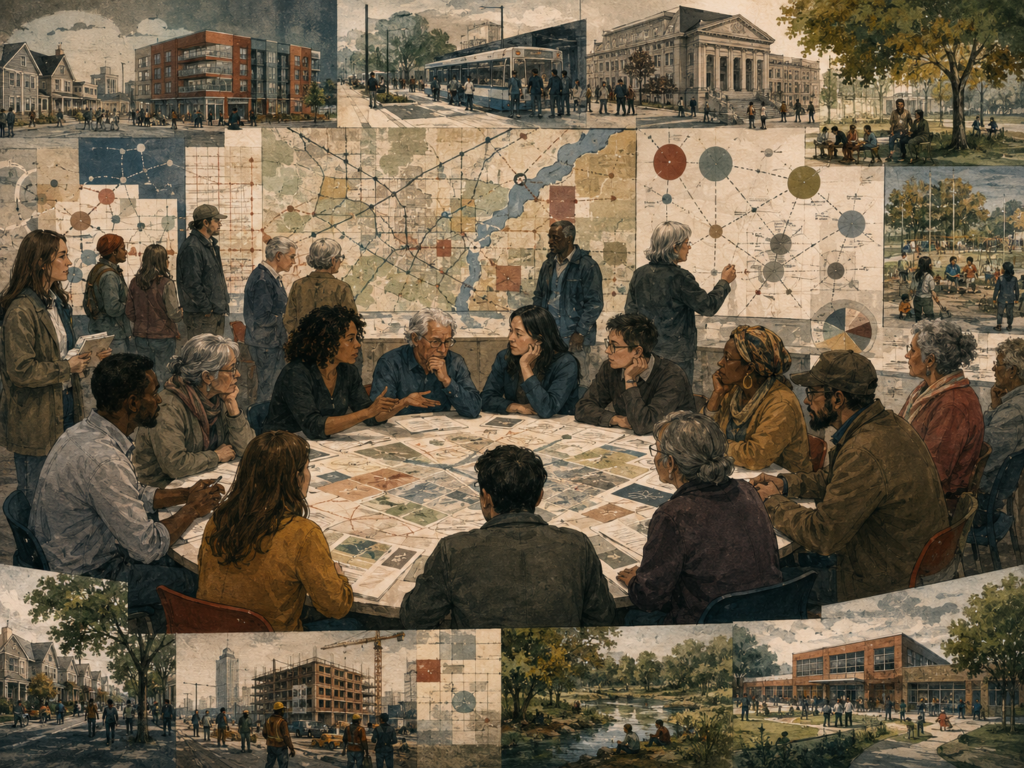
A diverse community group participates in democratic futures planning through neighborhood maps, public institutions, civic dialogue, infrastructure, and shared decision-making.

Democratic Futures and Public Participation: Who Gets to Shape Tomorrow?

Democratic Futures and Public Participation examines how societies imagine, debate, contest, and govern futures through civic voice, deliberative democracy, community knowledge, and institutional accountability. This article argues that the future is not a neutral technical object reserved for experts, planners, governments, or markets. It is a political field shaped by power, exclusion, aspiration, memory, and public choice. The article explores citizen assemblies, participatory foresight, community-led planning, youth councils, digital participation, co-governance, public technology assessment, and future generations mechanisms. It also confronts tokenism, consultation fatigue, elite capture, digital exclusion, and extractive participation. Democratic futures matters because climate transition, AI governance, infrastructure, public health, migration, work, housing, and ecological risk will shape lives unequally. Public participation gives affected people power to name risks, imagine alternatives, contest assumptions, and influence decisions before futures are locked in by institutions, markets, platforms, and states.

Public-sector researchers and civic planners build foresight capacity through scenario maps, governance diagrams, policy analysis, and long-term planning.

Public-Sector Foresight Capacity: Building Future-Ready Government Under Uncertainty

Public-sector foresight capacity examines how governments and public institutions can move beyond occasional futures workshops toward durable systems for scanning, scenario planning, policy learning, public participation, and long-term decision-making. This article explains why foresight capacity requires more than a strategy office or report. It depends on mandates, horizon scanning systems, scenario cycles, policy labs, decision pathways, budget links, knowledge infrastructure, evaluation routines, implementation authority, and democratic legitimacy. It shows how foresight can inform climate adaptation, infrastructure planning, AI governance, public health preparedness, fiscal risk, demographic change, procurement, and institutional reform. The article also foregrounds justice: whose signals are recognized, whose futures are imagined, who participates, and who benefits from preparedness. Public-sector foresight capacity matters because future-ready institutions must learn before crisis, connect insight to action, and govern uncertainty with accountability, equity, and public purpose.

A diverse policy and foresight group studies long-term governance scenarios across climate risk, infrastructure, public institutions, communities, and ecological systems.

Anticipatory Governance: Foresight, Early Warning, and Public Capacity Under Uncertainty

Anticipatory governance examines how institutions can detect emerging change, interpret uncertainty, prepare for plausible futures, and act before risks become crises. This article treats anticipation not as prediction, but as a public capacity built through horizon scanning, weak-signal interpretation, scenario planning, early warning systems, adaptive regulation, policy experimentation, institutional learning, and democratic accountability. It explains why climate risk, artificial intelligence, biotechnology, public health, infrastructure failure, digital platforms, financial instability, and geopolitical volatility require governance systems that can learn before harm becomes irreversible. The article also foregrounds justice: whose risks are noticed, whose futures are imagined, who benefits from delay, and who can contest decisions made in the name of preparedness. Anticipatory governance matters because responsible institutions must prepare under uncertainty while protecting rights, public legitimacy, equity, and long-term democratic responsibility across generations, communities, systems, and rapidly changing public conditions.

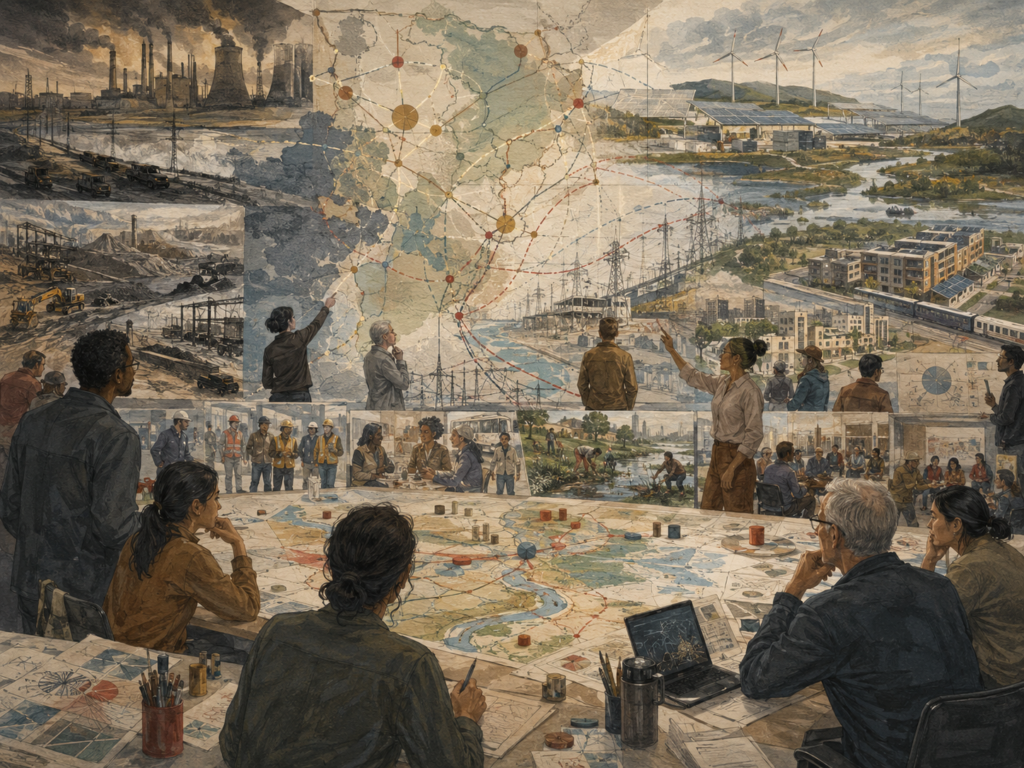
A planning group maps energy transition pathways across fossil fuel decline, renewable infrastructure, power grids, communities, labor, and ecological restoration.

Energy Transition Futures: Clean Power, Grids, Justice, and Climate Resilience

Energy transition futures examine how societies may transform power systems, fuels, grids, buildings, transportation, industry, labor, finance, and energy governance under climate risk and ecological constraint. This article treats the energy transition not as a simple technology swap from fossil fuels to renewables, but as a structural transformation of infrastructure, public investment, regional economies, land use, critical minerals, energy security, and social justice. It explores clean power expansion, grid modernization, storage, electrification, fossil-fuel phase-down, industrial decarbonization, material responsibility, climate resilience, and just transition planning. The central question is whether energy transition will become reliable, affordable, democratic, worker-protecting, and ecologically grounded, or whether it will reproduce green extraction, regional abandonment, affordability backlash, and new geopolitical dependencies. A responsible transition requires public legitimacy, community benefit, labor security, resilient infrastructure, and justice across generations. It frames energy as public infrastructure and responsibility.

A diverse civic research group maps digital platform systems through networks, governance flows, public institutions, archives, infrastructure, and community relationships.

Digital Platform Futures: Platform Power, Data, Labor, and Digital Public Infrastructure

Digital platform futures examine how platform-based systems may reshape markets, labor, public discourse, infrastructure, data rights, competition, and democratic governance. This article treats platforms not as neutral apps or websites, but as institutional systems that coordinate access, visibility, ranking, payment, identity, reputation, work, commerce, and attention. It explores network effects, data advantage, gatekeeping, lock-in, algorithmic recommendation, platform labor, digital public infrastructure, interoperability, digital sovereignty, and ecological cost. The central question is whether platforms will deepen dependency, surveillance, private rulemaking, and market enclosure, or whether societies can build accountable, rights-protecting, worker-centered, interoperable, and public-interest digital systems. A just platform future requires contestability, transparency, auditability, user rights, labor protections, competition policy, public infrastructure capacity, ecological responsibility, and democratic governance over the infrastructures that increasingly organize everyday life. It frames platform design as a public question, not merely a technical business model.

Scroll to Top