
Last Updated May 7, 2026
Resilience thinking matters for sustainable development because development does not unfold under conditions of stability, predictability, or linear progress. It unfolds through disturbance, uncertainty, feedback, adaptation, and the possibility of systemic change. Sustainable development therefore depends not only on building more assets, expanding services, or improving current performance, but on whether social, ecological, infrastructural, and institutional systems can absorb shocks, adapt to changing conditions, and transform when existing trajectories become untenable.
The deeper reason resilience thinking matters is that development systems are never static. Food systems, water systems, cities, public institutions, energy infrastructures, health systems, supply chains, and ecosystems all operate under conditions of fluctuation and stress. Attempts to govern them as if they were stable, fully controllable, and fully predictable often produce fragility rather than security.
Main Library
Publications
Article Map
Sustainable Development
Related Topic
Risk & Resilience
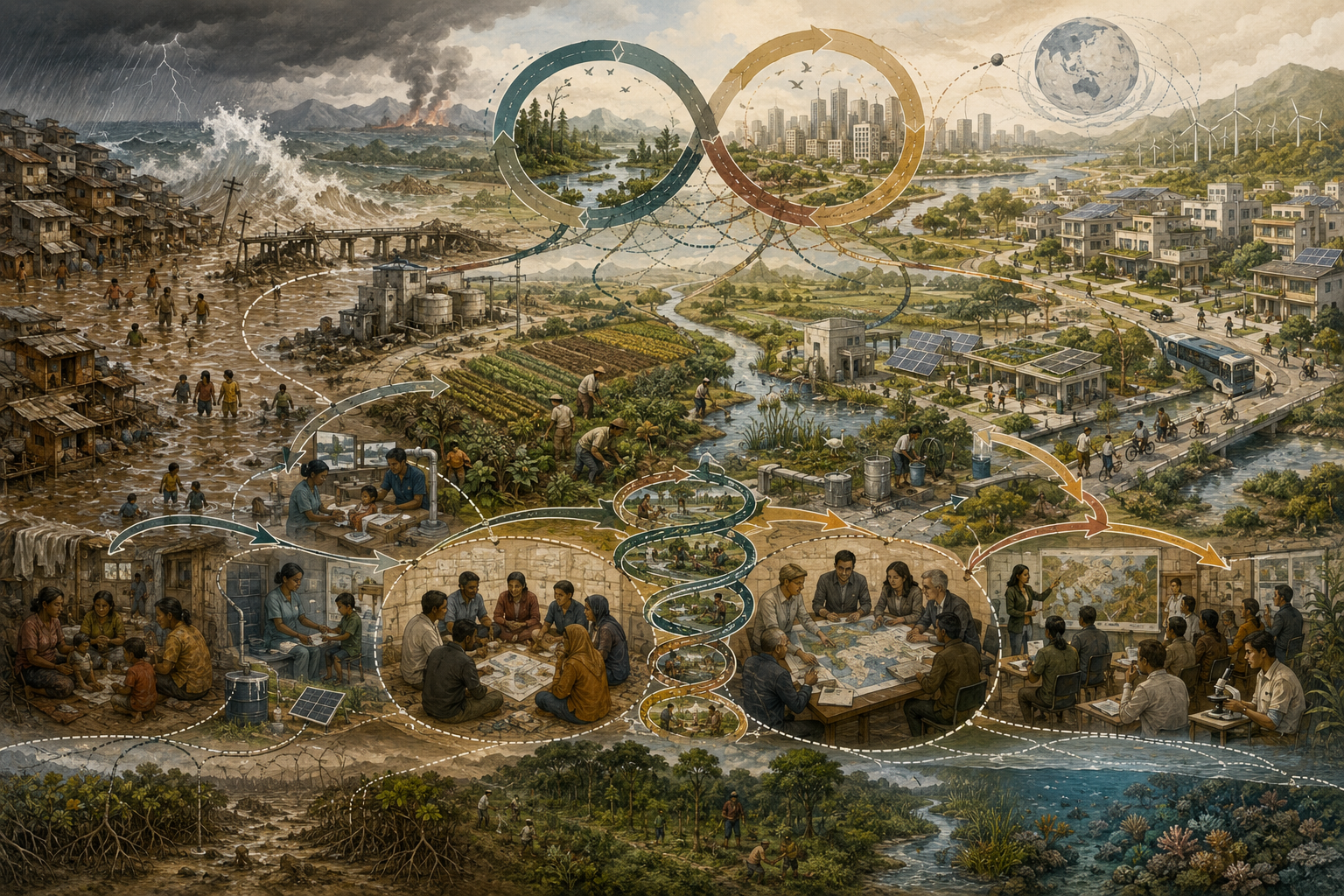
Resilience thinking offers a different orientation from development models built around linear progress, optimization, and restoration of a prior baseline. It asks how systems persist, reorganize, learn, and change under disturbance, and how they can do so without losing the capacities on which life and wellbeing depend. It also asks when persistence is no longer enough because the system being preserved is itself unjust, brittle, or ecologically destructive.
This article argues that resilience thinking belongs near the center of sustainable development because it clarifies a broader shift in development thought: from optimizing for stability to governing under uncertainty. Sustainable development depends not only on expanding present wellbeing, but on preserving future possibility in systems that are always vulnerable to stress, surprise, and reorganization.
What Resilience Thinking Means
Resilience thinking is a systems-oriented way of understanding how interacting social and ecological systems respond to disturbance, uncertainty, and change. Rather than assuming that the goal of governance is to keep systems near one ideal equilibrium, resilience thinking asks how systems absorb shocks, reorganize after disruption, and continue to function without collapsing into qualitatively worse conditions.
This is a significant departure from static policy models. Ecosystems fluctuate, institutions evolve, economies reorganize, technologies diffuse unevenly, and communities face recurring disturbances ranging from drought and disease to conflict, market shifts, infrastructure failure, and climate extremes. Resilience thinking begins from the premise that disturbance is not an exception to development. It is part of the condition under which development must proceed.
In development terms, resilience is not simply the ability to “bounce back.” That phrase can be misleading because returning to a prior condition is not always possible or desirable. A community may not want to bounce back to insecure housing, exclusionary institutions, fragile livelihoods, degraded ecosystems, or unjust systems of risk. Resilience thinking is more demanding: it asks whether systems can preserve what is life-supporting while changing what is brittle, harmful, or unsustainable.
To ask what resilience means is therefore to ask what capacities allow systems to persist, adapt, or transform under pressure. Sustainable development depends on these capacities because progress achieved under fragile conditions can be reversed quickly when shock arrives. This places resilience thinking naturally beside work on Risk, Shock, and Fragility in Development Systems, where the central question is not whether disturbance can be eliminated, but whether development gains remain durable once disturbance arrives.
Resilience thinking is therefore both analytical and normative. Analytically, it studies how systems behave under stress. Normatively, it asks which systems should be sustained, which should be adapted, and which should be transformed because their persistence reproduces vulnerability or injustice.
Why Resilience Matters for Sustainable Development
Resilience matters because sustainable development is not only about improving present outcomes. It is also about ensuring that gains in health, education, food security, infrastructure, livelihoods, public services, and institutional capability remain durable under uncertainty. A system that performs well in stable conditions but fails under disturbance may look successful in the short term while remaining developmentally weak.
Many development models have privileged optimization, efficiency, and short-run expansion without paying enough attention to redundancy, adaptability, diversity, and learning. Such systems can appear highly successful until they face shocks they were not designed to absorb. Resilience thinking broadens the developmental lens by asking whether systems can continue to support human wellbeing when conditions change.
This matters because the conditions surrounding development are changing rapidly. Climate instability, biodiversity loss, water stress, pandemic risk, food-system volatility, geopolitical disruption, fiscal pressure, digital dependency, and infrastructure aging all place stress on systems that were often designed around more stable assumptions. Resilience thinking helps development policy ask whether present gains can withstand future disturbance rather than only whether indicators are improving now.
Resilience also matters because development failure is often cumulative. A shock rarely strikes a perfectly neutral system. It meets households with unequal assets, institutions with uneven capacity, infrastructures with maintenance backlogs, ecosystems already under stress, and public budgets already constrained. Whether a disturbance becomes crisis depends on these preexisting conditions. Resilience thinking therefore directs attention to buffers, relationships, feedbacks, and latent vulnerabilities that conventional performance metrics can miss.
Sustainable development therefore depends not only on more growth or more services, but on whether the systems delivering those gains can endure disturbance without becoming brittle, exclusionary, or ecologically destructive. This is one reason resilience thinking complements Climate Change as a Development Constraint and Boundary Transgression and Development Fragility: both show that development becomes more precarious when environmental pressures intensify faster than systems can adjust.
From Stability to Adaptation
One of the most important contributions of resilience thinking is its shift from a model of stability toward a model of adaptation. Conventional policy frameworks often assume that the aim of governance is to restore systems to a previous condition as quickly as possible. Resilience thinking instead asks whether the previous condition was itself viable, just, or sustainable, and whether returning to it is either possible or desirable.
This shift matters because change is often not temporary noise around a stable baseline. In many contexts, ecological shifts, social transformation, technological change, demographic pressure, and climate risk are altering the baseline itself. Sustainable development therefore cannot be built only on restoration of the familiar. It must also involve adaptation to new realities.
A stability-centered approach may treat disturbance as an abnormal interruption. An adaptive approach treats disturbance as information. It asks what the disturbance reveals about system weakness, hidden dependence, brittle institutions, ecological stress, or unequal exposure. A flood may reveal not only unusual rainfall, but also land-use failure, poor drainage, weak housing standards, underfunded local government, exclusionary planning, and social inequality. A food shock may reveal not only price volatility, but also import dependence, soil degradation, weak social protection, and fragile supply chains.
Adaptation also means accepting that some systems should not be preserved exactly as they are. A development pathway that depends on ecological depletion, fossil-intensive infrastructure, exploitative labor, or exclusionary institutions may be stable in a narrow sense but unsustainable in a deeper one. Resilience thinking therefore shifts the question from “How do we preserve the current system?” to “What capacities should endure, what relationships must change, and what futures should become possible?”
The developmentally important question becomes not how to freeze systems in place, but how to help them remain functional, just, and ecologically grounded as conditions evolve. This brings resilience thinking into productive conversation with Development Under Deep Uncertainty, where the challenge is not merely predicting change more accurately, but building institutions and strategies that can remain effective even when baseline assumptions keep shifting.
Coping, Adapting, and Transforming
Resilience thinking is especially useful because it distinguishes among different capacities for dealing with disturbance. Coping refers to short-term responses that allow systems, households, communities, or institutions to withstand immediate shock. Adaptation refers to adjustment that helps systems continue functioning under changed conditions. Transformation refers to more fundamental reorganization when existing systems become untenable or trap people in undesirable trajectories.
Development strategies often blur these capacities. Emergency response may be mistaken for long-run resilience. Incremental adaptation may be over-relied on even where deeper transformation is required. Conversely, calls for transformation may overlook the immediate coping capacities people need simply to survive. Resilience thinking clarifies that these capacities are related but not identical.
Coping is necessary in crisis. It includes emergency shelters, cash transfers, food assistance, medical response, temporary repairs, evacuation, and immediate livelihood support. But coping alone can become a trap if households and institutions are forced to survive repeated shocks without the resources to change the conditions that make them vulnerable.
Adaptation is more durable. It may involve redesigning infrastructure, diversifying crops, strengthening public-health surveillance, improving water governance, revising land-use planning, building climate-aware social protection, or changing institutional routines. Adaptation helps systems operate under new conditions rather than merely endure immediate disruption.
Transformation is required when existing pathways reproduce risk. A flood-prone settlement may need relocation with rights and compensation. A fossil-dependent region may need a just transition. A degraded agricultural system may need new land, water, and livelihood models. An exclusionary institution may need democratic reform rather than technical adjustment. Transformation is politically difficult because it changes power, assets, identities, and expectations.
Sustainable development depends on balancing these capacities rather than privileging only one. Systems need ways to cope with present shocks, adapt to medium-term pressures, and transform when current arrangements become sources of persistent fragility or injustice. That is why resilience thinking links naturally to Scenario Planning for Sustainable Futures and Future Directions in Sustainable Development Thought, both of which ask how societies prepare not only for continuity, but for discontinuity and strategic reorientation.
Social-Ecological Systems and Development
Resilience thinking is closely tied to the concept of social-ecological systems: systems formed by the interaction of human societies and ecosystems. This perspective rejects the idea that nature is merely an external backdrop to development. Instead, it treats social and ecological processes as intertwined.
This is analytically important because development outcomes depend on these interactions. Food systems depend on ecosystems, water systems depend on watersheds and institutions, and livelihoods depend on both ecological conditions and social rules. If policy treats ecological and social systems as separate, it may miss the feedbacks that make development either more robust or more fragile.
Social-ecological systems thinking changes how development problems are framed. A water crisis is not only a hydrological event. It may also involve land use, governance, infrastructure maintenance, agricultural demand, household inequality, climate change, public finance, and institutional trust. A food crisis is not only a production problem. It may involve soils, water, biodiversity, trade, energy, labor, storage, price systems, and social protection. Resilience thinking makes these couplings visible.
This approach also shows why purely technical fixes often disappoint. Technologies can help, but their effectiveness depends on institutions, maintenance, local knowledge, finance, and ecological context. A drought-resistant crop, water treatment system, flood barrier, or digital warning tool is only as resilient as the social-ecological system into which it is introduced.
Sustainable development therefore requires seeing human wellbeing, institutions, and ecosystems as linked rather than as separate policy domains. Readers moving through the series will see the same logic in articles on Water, Sanitation, and Public Infrastructure Systems, Freshwater Change and Development Risk, and Food Systems and Agricultural Transformation, where development outcomes depend precisely on the coupling of ecological and institutional systems.
Adaptive Cycles and System Dynamics
A central concept in resilience thinking is the adaptive cycle. This model draws attention to recurring phases of growth, conservation, release, and reorganization. Systems may expand and accumulate resources, become more connected and rigid over time, then experience disturbance that releases accumulated structures, opening space for renewal or reconfiguration.
This matters because development is often narrated only in terms of growth and accumulation. The adaptive-cycle perspective reminds us that breakdown and reorganization are also part of system dynamics. Periods of disruption are not always signs of simple failure; they may also create openings for renewal, innovation, and different developmental trajectories.
The growth phase can expand capability, connection, and productivity. The conservation phase can stabilize institutions and accumulate assets. But conservation can also become rigidity. A system that becomes highly connected and optimized may lose flexibility. It may become efficient under ordinary conditions but brittle under disturbance. When disruption arrives, release can be destructive, but it can also expose hidden weaknesses and create space for reorganization.
This is especially relevant to infrastructure, food systems, public administration, and economic development. Systems that have accumulated complexity may become difficult to reform. Supply chains may become efficient but fragile. Cities may grow around risky settlement patterns. Institutions may preserve routines that no longer fit changing conditions. Resilience thinking helps interpret these patterns as system dynamics rather than isolated failures.
Sustainable development is therefore better understood when release and reorganization are included within the analysis of change rather than treated as anomalies outside it. This makes the adaptive cycle especially useful for reading moments when systems that once appeared efficient begin to show brittleness, a pattern that also appears in discussions of Policy Coordination Across Complex Systems and Infrastructure as the Material Basis of Development, where accumulated complexity can create both capability and rigidity.
Panarchy and Cross-Scale Interaction
Resilience thinking also introduces the concept of panarchy: the idea that adaptive cycles occur at multiple nested scales and interact with one another. Smaller, faster systems can trigger change in larger systems, while larger, slower systems can either stabilize or constrain what smaller ones are able to do.
This matters because development never occurs at only one scale. Households, communities, cities, regions, national institutions, ecosystems, financial systems, and global governance structures all interact. A shock at one level can reverberate through others; a rigid national policy can suppress local experimentation; local innovation can sometimes reshape larger systems. Panarchy helps show that resilience is not just a property of isolated units but of relationships across scales.
Cross-scale interaction is visible in climate adaptation. A household may adapt through livelihood diversification, but its options are shaped by local infrastructure, national policy, credit access, land rights, and global climate trends. A city may improve drainage, but it remains dependent on watershed governance, national finance, construction standards, and regional climate patterns. A nation may pursue resilience, but global debt conditions, trade systems, and international climate finance shape its room for action.
Panarchy also helps explain why interventions can fail when they target the wrong scale. A community project may be strong locally but undermined by national policy. A national strategy may be well designed but fail because local institutions lack capacity. A global framework may set goals that cannot be implemented without territorial knowledge. Resilience requires alignment across scales, not only action at one level.
Sustainable development therefore requires attention to how local adaptation, institutional memory, and broader structural conditions interact. Systems become more governable when cross-scale dynamics are recognized rather than ignored. This is why resilience thinking pairs well with Local Governance, Cities, and Territorial Development and International Organizations and Global Development Governance: both show that development is shaped by nested scales of action rather than by any one level in isolation.
Resilience, Fragility, and the Management of Disturbance
Resilience thinking clarifies fragility by showing that fragility is not simply exposure to shock. It is the condition in which systems lose the capacity to absorb, adapt, or reorganize without severe decline in function or wellbeing. A development system may look efficient in ordinary times while being profoundly fragile under disturbance.
Many systems become brittle through over-optimization. Supply chains, infrastructures, institutions, and ecological systems designed for maximum efficiency may lack redundancy, diversity, or flexibility. Disturbance then exposes how little capacity exists for adjustment. Fragility is often the hidden partner of apparent efficiency.
This is especially important for development policy because many gains are delivered through systems that require maintenance, coordination, and buffers. A health system may perform well until a pandemic or heat wave overwhelms it. A water system may function until drought, contamination, or infrastructure failure exposes weak reserves. A food system may deliver low prices until climate shocks or trade disruptions expose dependence. A public budget may appear stable until repeated disasters redirect spending from investment to repair.
Resilience thinking does not suggest that every system should maximize redundancy without limit. Resources are finite, and some efficiency is necessary. The point is that efficiency should not be mistaken for resilience. A sustainable development system needs enough reserve capacity, diversity, institutional learning, and ecological buffering to absorb disturbance without cascading loss.
Sustainable development therefore depends on managing disturbance rather than imagining it away. Resilience thinking helps shift the focus from controlling all shocks to building capacities that allow systems to live with uncertainty without breaking down into deeper crisis. This section is especially continuous with Risk, Shock, and Fragility in Development Systems and Boundary Transgression and Development Fragility, where fragility appears not as a dramatic endpoint but as a condition of narrowed margins and rising systemic sensitivity.
Resilience Thinking and Climate-Resilient Development
Resilience thinking is especially important in the context of climate change. Climate change intensifies variability, increases the frequency and severity of extremes, and alters baseline conditions across water, food, health, settlement, infrastructure, and ecosystem systems. Under these conditions, sustainable development cannot be separated from resilience.
Climate-resilient development therefore requires more than isolated adaptation projects. It demands systemic transitions in infrastructure, energy, governance, land use, livelihoods, public finance, social protection, and ecological stewardship. Systems must cope with immediate hazards, adapt to shifting baselines, and in many cases transform away from carbon-intensive or ecologically fragile pathways.
This matters because climate risk is not a single-sector problem. Heat affects health, labor productivity, electricity demand, housing, and food systems. Flooding affects transport, schools, hospitals, sanitation, housing, and public budgets. Drought affects agriculture, water supply, energy, migration, and social stability. Climate resilience therefore requires coordination across institutions that often operate separately.
Climate-resilient development also requires attention to justice. Adaptation can reproduce inequality when protection follows wealth, property value, or political influence. A resilience strategy that protects central business districts while leaving informal settlements exposed is not sustainable development in a meaningful sense. A climate transition that reduces emissions while abandoning workers and regions dependent on legacy industries is incomplete. Resilience must be linked to fairness and transformation.
Sustainable development under climate change cannot rely on preserving the status quo. It depends on building systems that can move toward more livable, lower-risk trajectories under conditions of unavoidable disturbance. This is why resilience thinking naturally extends the discussion in Climate Change as a Development Constraint and prepares the ground for pieces such as Scenario Planning for Sustainable Futures and Development Under Deep Uncertainty.
Institutions, Learning, and Adaptive Governance
Resilience thinking has important implications for governance. If systems are dynamic and uncertain, institutions cannot rely only on fixed rules and static plans. They also need learning capacity, feedback mechanisms, cross-sector coordination, participatory legitimacy, and the ability to revise strategy as conditions change.
This matters because governance failure often occurs not only through lack of resources, but through lack of adaptability. Institutions may become locked into outdated assumptions, narrow mandates, or rigid administrative routines that make it difficult to respond to changing risks. Adaptive governance matters because resilience depends partly on whether institutions can learn from disturbance rather than merely endure it.
Adaptive governance does not mean abandoning structure. Institutions still need rules, authority, accountability, public finance, and implementation capacity. But those structures must be capable of learning. Monitoring systems, scenario planning, local feedback, transparent evaluation, and iterative policy design all help institutions adjust without losing direction.
Public participation is also central. Communities often know where systems are failing before formal indicators register crisis. Farmers, health workers, engineers, teachers, local officials, indigenous communities, and neighborhood organizations hold practical knowledge about risk, adaptation, and system performance. Adaptive governance is stronger when this knowledge is not treated as anecdotal noise but as part of the evidence base for resilience.
Sustainable development therefore requires institutions that are not only strong in the conventional sense, but also reflective, flexible, publicly accountable, and able to govern under uncertainty without losing legitimacy or direction. This section sits comfortably alongside Why Institutions Matter for Sustainable Development, State Capacity, Public Administration, and Delivery Systems, and Policy Coordination Across Complex Systems.
Resilience, Justice, and the Politics of Transformation
Resilience is not always desirable in itself. Undesirable systems can also be resilient. Inequality, ecological degradation, authoritarian rule, racial hierarchy, extractive labor systems, land dispossession, and exploitative production systems may persist precisely because they are organized in ways that reproduce themselves effectively. This means resilience must always be asked in relation to what is being sustained, for whom, and at whose expense.
This matters because sustainable development cannot be reduced to preserving existing arrangements. Some systems require transformation rather than stabilization. Communities may need protection from shock, but they may also need release from trajectories that lock them into exclusion or environmental harm.
Resilience language can become politically dangerous when it asks vulnerable people to endure more rather than asking why they are exposed in the first place. A household may be praised for resilience while lacking secure housing, fair wages, clean water, or political voice. A community may be asked to adapt to repeated flooding rather than receiving land rights, infrastructure, relocation support, or climate justice. A worker may be told to retrain without a credible transition plan. Resilience without justice can become a language of burden-shifting.
Transformation raises harder questions because it challenges power. Who benefits from the current system? Who bears risk? Who decides what should be protected? Who pays for transition? Which histories of dispossession, extraction, or exclusion shaped present vulnerability? Resilience thinking becomes more ethically serious when it confronts these questions rather than treating systems as neutral technical objects.
Resilience thinking is developmentally strongest when it remains tied to justice. The aim is not resilience of any system whatsoever, but resilience of systems that support human dignity, ecological viability, and fairer forms of collective life. In the broader series, this sits naturally with Inequality and Inclusive Development, Gender, Exclusion, and Development Justice, and Law, Rights, and Sustainable Development, all of which remind us that what endures is not automatically what ought to endure.
Resilience, Diversity, and Redundancy
Another key contribution of resilience thinking is its emphasis on diversity and redundancy. Systems that rely on one crop, one supplier, one source of authority, one energy pathway, one logistics corridor, or one brittle infrastructure network often appear efficient until disturbance reveals their lack of backup capacity. Diversity and redundancy can look inefficient in narrow short-term terms, yet they often make systems more resilient over time.
This matters because sustainable development has often been pursued through logics of streamlining and optimization that reward immediate output while discounting reserve capacity. But reserve capacity matters when shocks arrive. Diverse livelihoods, multiple water sources, redundant infrastructure, institutional plurality, local food systems, and ecological variety can all increase the ability of systems to continue functioning under stress.
Diversity matters ecologically because diverse ecosystems often provide stronger buffering, recovery, and adaptive potential than simplified systems. It matters economically because diversified livelihoods and production systems can reduce dependence on a single fragile income source. It matters institutionally because plural sources of knowledge, authority, and participation can help systems learn and respond when one channel fails.
Redundancy matters because some spare capacity is not waste. A hospital bed, backup power source, emergency fund, seed bank, alternative transport route, community organization, or secondary water source may seem inefficient during normal times, but it becomes essential under disturbance. Resilience thinking helps development policy value these capacities before crisis exposes their absence.
Sustainable development therefore requires asking not only whether systems are efficient today, but whether they retain enough diversity and redundancy to remain viable tomorrow. Resilience is often built through capacities that are easy to undervalue until they are needed. Readers moving between articles will see the same theme in Food Systems and Agricultural Transformation, Water, Sanitation, and Public Infrastructure Systems, and Infrastructure as the Material Basis of Development, where redundancy is often what separates robust provision from brittle provision.
Why Resilience Alone Is Not Enough
Resilience is essential, but it is not sufficient on its own. A narrow resilience agenda can sometimes become a language of coping without change, placing the burden of adaptation on households and communities while leaving the drivers of fragility intact. Systems may be made more shock-tolerant without becoming more just or sustainable.
This matters because sustainable development requires more than endurance. It requires reducing the sources of disturbance where possible, transforming harmful systems where necessary, and widening the conditions for equitable wellbeing. Resilience without mitigation, redistribution, or institutional reform can become an expensive way of preserving vulnerability.
Resilience can also be used to protect systems that should be changed. A fossil-intensive economy can become more resilient to market shocks while continuing to destabilize the climate. An unequal city can strengthen emergency response while leaving poor residents in heat-exposed or flood-prone neighborhoods. A food system can become more logistically efficient while degrading soils, water, biodiversity, and labor conditions. Resilience must therefore be judged by the quality of the system being made resilient.
Resilience also cannot substitute for boundary reduction. If ecological pressures keep rising, adaptation becomes more expensive and less reliable. Societies can buffer some stress, but no amount of local resilience can fully compensate for unchecked climate disruption, freshwater depletion, biodiversity loss, or land-system degradation. Resilience and transformation must therefore work together.
The deeper goal is not simply to help systems survive stress, but to enable them to evolve toward more just, flexible, and ecologically grounded trajectories. Resilience matters most when it is linked to transformation rather than substituted for it. This is precisely where the article touches Future Directions in Sustainable Development Thought, because resilience becomes transformative only when it is joined to deeper change in institutions, infrastructures, and development priorities.
Why This Matters for Sustainable Development
Resilience thinking and sustainable development belong together because development unfolds under conditions of uncertainty, disturbance, and systemic interaction rather than stable equilibrium. Progress depends not only on expanding assets and services, but on whether the systems that support them can absorb shocks, adapt to change, and transform when existing trajectories become untenable.
This is why resilience thinking matters so much. It reveals a central truth that simpler development narratives often miss: systems can be productive yet brittle, efficient yet fragile, and stable yet unjust. Sustainable development requires not only improvement in ordinary times, but the capacity to navigate disruption without sacrificing future possibility.
The issue is also one of justice. Resilience cannot mean asking vulnerable communities to endure repeated harm while the drivers of exposure remain intact. It must mean building systems that reduce unequal vulnerability, protect life-supporting ecological foundations, strengthen public capacity, and transform institutions or infrastructures that reproduce risk. The question is not only whether a system can persist, but whether it deserves to persist in its current form.
To take resilience thinking seriously is therefore to take uncertainty, learning, and transformation seriously. Long-run development depends not only on building more, but on building systems able to live with change while remaining capable of renewal, justice, and ecological balance.
Development becomes credible when resilience is more than a language of coping, when adaptive governance learns from disturbance, when redundancy and diversity are valued before crisis arrives, and when transformation is pursued where existing systems are too brittle, unequal, or ecologically destructive to sustain.
Mathematical Lens
Resilience can be clarified by thinking in terms of system capacity under disturbance. Let \(S_t\) represent a system state at time \(t\), and let \(D_t\) represent disturbance:
S_{t+1} = f(S_t, D_t, A_t, T_t)
\]
Interpretation: Future system states are shaped not only by disturbance, but by adaptive capacity and transformative capacity available at the time of response.
Here, \(A_t\) represents adaptive capacity and \(T_t\) represents transformative capacity. The important point is that disturbance does not determine the future alone. System response depends on capacities for coping, learning, adaptation, and reorganization.
A threshold view is also useful. Suppose a system has a functional threshold \(\theta\). If disturbance exceeds the system’s coping capacity \(C_t\), then the system may cross into a qualitatively worse regime:
\text{If } D_t > C_t,\ \text{then } S_t \rightarrow S_t’
\]
Interpretation: When disturbance exceeds coping capacity, a system may shift into a degraded state rather than returning smoothly to prior function.
Resilience, in this sense, concerns how much disturbance can be absorbed without regime shift, how adaptation changes the coping threshold over time, and when transformation becomes necessary because preserving the old regime is no longer desirable.
Adaptive cycles can also be represented schematically as a recurring sequence:
r \rightarrow K \rightarrow \Omega \rightarrow \alpha
\]
Interpretation: Adaptive systems often move through phases of growth, conservation, release, and reorganization rather than linear progress alone.
A resilience-capacity score can be represented conceptually as:
R = w_1 C + w_2 A + w_3 T + w_4 L + w_5 E + w_6 J
\]
Interpretation: Resilience rises when coping capacity, adaptive capacity, transformative capacity, institutional learning, ecological buffering, and equity protection reinforce one another.
| Term | Meaning | Interpretive role |
|---|---|---|
| \(S_t\) | System state at time \(t\) | Represents the current condition of a development system, ecosystem, institution, or infrastructure network. |
| \(D_t\) | Disturbance | Represents shock or stress such as drought, flood, price volatility, conflict, pandemic, or infrastructure failure. |
| \(A_t\) | Adaptive capacity | Represents the ability to adjust to changing conditions while preserving core functions. |
| \(T_t\) | Transformative capacity | Represents the ability to reorganize a system when existing pathways become untenable. |
| \(C_t\) | Coping capacity | Represents immediate capacity to absorb disturbance without severe loss of function. |
| \(S_t’\) | Degraded state | Represents a qualitatively worse regime after disturbance overwhelms coping capacity. |
| \(r, K, \Omega, \alpha\) | Adaptive-cycle phases | Represent growth, conservation, release, and reorganization. |
| \(R\) | Resilience capacity | Represents combined social, ecological, institutional, and justice-oriented capacity to endure and adapt under stress. |
The equations are conceptual rather than predictive. Their value is to make visible the structure of the problem: resilience is not a single trait, but a relationship among disturbance, coping capacity, adaptive learning, transformation, ecological buffering, and justice.
Advanced Python Workflow: Adaptive Capacity, Disturbance Response, and Resilience Scoring
This Python workflow translates resilience thinking into a structured analytical model. Instead of treating resilience as a vague metaphor, it evaluates how systems perform under disturbance by combining exposure, coping capacity, adaptive capacity, transformative capacity, institutional learning, ecological buffering, and equity protection into a transparent scoring framework. That makes it possible to compare places or systems not only by present performance, but by how well they can respond when conditions deteriorate or shift.
from __future__ import annotations

import pandas as pd
import numpy as np

INPUT_FILE = "resilience_system_data.csv"
OUTPUT_FILE = "resilience_system_scores.csv"


def load_data(path: str) -> pd.DataFrame:
    """Load resilience-related system data from CSV."""
    df = pd.read_csv(path)

    required_columns = [
        "system_name",
        "region",
        "disturbance_exposure_index",
        "coping_capacity_index",
        "adaptive_capacity_index",
        "transformative_capacity_index",
        "institutional_learning_index",
        "ecological_buffer_index",
        "equity_protection_index",
    ]

    missing = [col for col in required_columns if col not in df.columns]

    if missing:
        raise ValueError(f"Missing required columns: {missing}")

    return df


def validate_indices(df: pd.DataFrame) -> pd.DataFrame:
    """Ensure all normalized index fields are complete and bounded between 0 and 1."""
    index_columns = [
        "disturbance_exposure_index",
        "coping_capacity_index",
        "adaptive_capacity_index",
        "transformative_capacity_index",
        "institutional_learning_index",
        "ecological_buffer_index",
        "equity_protection_index",
    ]

    for col in index_columns:
        if df[col].isna().any():
            raise ValueError(f"Column '{col}' contains missing values.")

        if ((df[col] < 0) | (df[col] > 1)).any():
            raise ValueError(f"Column '{col}' contains values outside [0, 1].")

    return df


def compute_resilience_score(df: pd.DataFrame) -> pd.DataFrame:
    """Compute composite resilience capacity, brittleness, and transformation need."""
    df = df.copy()

    df["resilience_capacity_score"] = (
        0.18 * df["coping_capacity_index"] +
        0.20 * df["adaptive_capacity_index"] +
        0.20 * df["transformative_capacity_index"] +
        0.16 * df["institutional_learning_index"] +
        0.14 * df["ecological_buffer_index"] +
        0.12 * df["equity_protection_index"]
    ).clip(lower=0, upper=1)

    df["brittleness_score"] = (
        0.65 * df["disturbance_exposure_index"] -
        0.35 * df["resilience_capacity_score"]
    ).clip(lower=0, upper=1)

    df["governance_ecology_balance"] = (
        df["institutional_learning_index"] -
        df["ecological_buffer_index"]
    )

    df["transformation_need_score"] = (
        0.45 * df["disturbance_exposure_index"] +
        0.25 * (1 - df["ecological_buffer_index"]) +
        0.20 * (1 - df["equity_protection_index"]) +
        0.10 * (1 - df["transformative_capacity_index"])
    ).clip(lower=0, upper=1)

    df["resilience_band"] = np.select(
        [
            df["resilience_capacity_score"] >= 0.75,
            df["resilience_capacity_score"] >= 0.55,
            df["resilience_capacity_score"] >= 0.35,
        ],
        [
            "High resilience",
            "Moderate resilience",
            "Stressed resilience",
        ],
        default="Low resilience",
    )

    df["resilience_warning"] = np.select(
        [
            df["brittleness_score"] >= 0.65,
            df["transformation_need_score"] >= 0.65,
            df["equity_protection_index"] <= 0.30,
            df["institutional_learning_index"] <= 0.30,
        ],
        [
            "High brittleness under disturbance",
            "High transformation need",
            "Weak equity protection",
            "Weak institutional learning",
        ],
        default="Lower resilience warning",
    )

    return df


def build_summary(df: pd.DataFrame) -> pd.DataFrame:
    """Build a summary table sorted by resilience capacity."""
    summary_columns = [
        "system_name",
        "region",
        "disturbance_exposure_index",
        "resilience_capacity_score",
        "brittleness_score",
        "transformation_need_score",
        "governance_ecology_balance",
        "resilience_band",
        "resilience_warning",
    ]

    summary = df[summary_columns].copy()

    return summary.sort_values(
        by=[
            "resilience_capacity_score",
            "brittleness_score",
            "transformation_need_score",
        ],
        ascending=[False, True, True],
    )


def main() -> None:
    df = load_data(INPUT_FILE)
    df = validate_indices(df)
    df = compute_resilience_score(df)

    summary = build_summary(df)
    summary.to_csv(OUTPUT_FILE, index=False)

    print("Resilience scoring complete.")
    print(summary.to_string(index=False))


if __name__ == "__main__":
    main()
This workflow is intentionally transparent. It does not claim that resilience can be fully reduced to a single number. It creates a reproducible way of comparing relative resilience across development systems and identifying where brittleness is likely to emerge. In practice, it can support analysis of food systems, water systems, infrastructure networks, health systems, or institutional contexts where stress is recurring and the key question is whether the system can absorb, adapt, and reorganize without severe loss of function.
Advanced R Workflow: Social-Ecological Resilience and Adaptive Governance Analysis
This R workflow is designed for comparative analysis across systems, regions, or countries where resilience has to be tracked as a multidimensional condition rather than a single static attribute. It summarizes social-ecological resilience across several core domains and highlights the relationship between institutional learning and ecological buffering, which is often central to whether systems remain adaptable under stress.
library(readr)
library(dplyr)

input_file <- "social_ecological_resilience_panel.csv"
system_output_file <- "social_ecological_resilience_system_summary.csv"
region_output_file <- "social_ecological_resilience_region_summary.csv"

resilience_df <- read_csv(input_file, show_col_types = FALSE)

required_cols <- c(
  "system_name",
  "region",
  "year",
  "coping_capacity_index",
  "adaptive_capacity_index",
  "transformative_capacity_index",
  "institutional_learning_index",
  "ecological_buffer_index",
  "equity_protection_index"
)

missing_cols <- setdiff(required_cols, names(resilience_df))

if (length(missing_cols) > 0) {
  stop(paste("Missing required columns:", paste(missing_cols, collapse = ", ")))
}

index_cols <- names(resilience_df)[grepl("_index$", names(resilience_df))]

invalid_index_cols <- index_cols[
  vapply(
    resilience_df[index_cols],
    function(x) any(is.na(x) | x < 0 | x > 1),
    logical(1)
  )
]

if (length(invalid_index_cols) > 0) {
  stop(
    paste(
      "Index columns must be complete and normalized to [0, 1]:",
      paste(invalid_index_cols, collapse = ", ")
    )
  )
}

resilience_df <- resilience_df %>%
  mutate(
    multidimensional_resilience_proxy = (
      coping_capacity_index +
        adaptive_capacity_index +
        transformative_capacity_index +
        institutional_learning_index +
        ecological_buffer_index +
        equity_protection_index
    ) / 6,
    governance_ecology_gap = institutional_learning_index - ecological_buffer_index,
    brittleness_proxy = (
      (1 - coping_capacity_index) +
        (1 - adaptive_capacity_index) +
        (1 - institutional_learning_index) +
        (1 - ecological_buffer_index)
    ) / 4,
    transformation_need_proxy = (
      (1 - transformative_capacity_index) +
        (1 - equity_protection_index) +
        (1 - ecological_buffer_index)
    ) / 3
  )

system_summary <- resilience_df %>%
  group_by(system_name) %>%
  summarise(
    avg_resilience_proxy = mean(multidimensional_resilience_proxy, na.rm = TRUE),
    min_resilience_proxy = min(multidimensional_resilience_proxy, na.rm = TRUE),
    max_resilience_proxy = max(multidimensional_resilience_proxy, na.rm = TRUE),
    avg_brittleness_proxy = mean(brittleness_proxy, na.rm = TRUE),
    avg_transformation_need = mean(transformation_need_proxy, na.rm = TRUE),
    avg_governance_ecology_gap = mean(governance_ecology_gap, na.rm = TRUE),
    observations = n(),
    .groups = "drop"
  ) %>%
  mutate(
    resilience_band = case_when(
      avg_resilience_proxy >= 0.75 ~ "High resilience",
      avg_resilience_proxy >= 0.55 ~ "Moderate resilience",
      avg_resilience_proxy >= 0.35 ~ "Stressed resilience",
      TRUE ~ "Low resilience"
    )
  ) %>%
  arrange(desc(avg_resilience_proxy))

region_summary <- resilience_df %>%
  group_by(region) %>%
  summarise(
    avg_resilience_proxy = mean(multidimensional_resilience_proxy, na.rm = TRUE),
    avg_coping_capacity = mean(coping_capacity_index, na.rm = TRUE),
    avg_adaptive_capacity = mean(adaptive_capacity_index, na.rm = TRUE),
    avg_transformative_capacity = mean(transformative_capacity_index, na.rm = TRUE),
    avg_institutional_learning = mean(institutional_learning_index, na.rm = TRUE),
    avg_ecological_buffer = mean(ecological_buffer_index, na.rm = TRUE),
    avg_equity_protection = mean(equity_protection_index, na.rm = TRUE),
    avg_brittleness_proxy = mean(brittleness_proxy, na.rm = TRUE),
    observations = n(),
    .groups = "drop"
  ) %>%
  arrange(desc(avg_resilience_proxy))

write_csv(system_summary, system_output_file)
write_csv(region_summary, region_output_file)

cat("System resilience summary exported to:", system_output_file, "\n")
print(system_summary)

cat("\nRegion resilience summary exported to:", region_output_file, "\n")
print(region_summary)
R is particularly useful here because resilience analysis often involves structured comparison across time and space, with an interest in averages, gaps, and relative profiles rather than single-case descriptions alone. The workflow calculates a multidimensional resilience proxy, estimates a governance-ecology gap, and produces both system-level and regional summaries that can support resilience-oriented monitoring and policy review.
Advanced Go Workflow: Lightweight Resilience Scoring Service
This Go workflow is useful when the article’s resilience logic needs to move from analysis into a lightweight operational service. Python and R are strong for diagnostics and comparative summaries, but Go is a good fit for a compact utility that can ingest system-level records and return resilience capacity, brittleness, and transformation-need scores quickly. In practical terms, this kind of service could sit behind a monitoring dashboard, internal planning tool, or early-warning workflow.
package main

import (
	"encoding/csv"
	"fmt"
	"os"
	"strconv"
)

type ResilienceRecord struct {
	SystemName              string
	Region                  string
	DisturbanceExposure     float64
	CopingCapacity          float64
	AdaptiveCapacity        float64
	TransformativeCapacity  float64
	InstitutionalLearning   float64
	EcologicalBuffer        float64
	EquityProtection        float64
}

func parseIndex(value string) (float64, error) {
	parsed, err := strconv.ParseFloat(value, 64)
	if err != nil {
		return 0, err
	}

	if parsed < 0 || parsed > 1 {
		return 0, fmt.Errorf("index value outside [0, 1]: %f", parsed)
	}

	return parsed, nil
}

func parseRecord(row []string) (ResilienceRecord, error) {
	if len(row) != 9 {
		return ResilienceRecord{}, fmt.Errorf("invalid record length: expected 9 columns")
	}

	values := make([]float64, 7)

	for i, col := range row[2:] {
		value, err := parseIndex(col)
		if err != nil {
			return ResilienceRecord{}, err
		}

		values[i] = value
	}

	return ResilienceRecord{
		SystemName:             row[0],
		Region:                 row[1],
		DisturbanceExposure:    values[0],
		CopingCapacity:         values[1],
		AdaptiveCapacity:       values[2],
		TransformativeCapacity: values[3],
		InstitutionalLearning:  values[4],
		EcologicalBuffer:       values[5],
		EquityProtection:       values[6],
	}, nil
}

func clamp01(x float64) float64 {
	if x < 0 {
		return 0
	}

	if x > 1 {
		return 1
	}

	return x
}

func resilienceCapacity(record ResilienceRecord) float64 {
	return clamp01(
		0.18*record.CopingCapacity +
			0.20*record.AdaptiveCapacity +
			0.20*record.TransformativeCapacity +
			0.16*record.InstitutionalLearning +
			0.14*record.EcologicalBuffer +
			0.12*record.EquityProtection,
	)
}

func brittleness(record ResilienceRecord) float64 {
	resilience := resilienceCapacity(record)

	return clamp01(
		0.65*record.DisturbanceExposure -
			0.35*resilience,
	)
}

func transformationNeed(record ResilienceRecord) float64 {
	return clamp01(
		0.45*record.DisturbanceExposure +
			0.25*(1-record.EcologicalBuffer) +
			0.20*(1-record.EquityProtection) +
			0.10*(1-record.TransformativeCapacity),
	)
}

func resilienceBand(score float64) string {
	switch {
	case score >= 0.75:
		return "High resilience"
	case score >= 0.55:
		return "Moderate resilience"
	case score >= 0.35:
		return "Stressed resilience"
	default:
		return "Low resilience"
	}
}

func main() {
	file, err := os.Open("resilience_system_data_service.csv")
	if err != nil {
		fmt.Println("Error opening CSV:", err)
		return
	}
	defer file.Close()

	reader := csv.NewReader(file)

	rows, err := reader.ReadAll()
	if err != nil {
		fmt.Println("Error reading CSV:", err)
		return
	}

	for i, row := range rows {
		if i == 0 {
			continue
		}

		record, err := parseRecord(row)
		if err != nil {
			fmt.Println("Parse error:", err)
			continue
		}

		resilience := resilienceCapacity(record)
		brittle := brittleness(record)
		transform := transformationNeed(record)

		fmt.Printf(
			"system=%s region=%s resilience=%.3f brittleness=%.3f transformation_need=%.3f band=%s\n",
			record.SystemName,
			record.Region,
			resilience,
			brittle,
			transform,
			resilienceBand(resilience),
		)
	}
}
The point is not to build a full resilience platform inside the article. The point is to show how the logic of disturbance exposure, coping capacity, adaptive capacity, transformative capacity, institutional learning, ecological buffering, and equity protection can be operationalized cleanly: validate normalized inputs, compute resilience and brittleness scores, estimate transformation need, and return a readable band. That gives the article’s systems argument a practical service layer while keeping the code compact and auditable.
GitHub Repository
Complete Code Repository
The full code distribution for this article, including resilience scoring workflows, adaptive-capacity diagnostics, social-ecological resilience summaries, optional scoring-service tooling, SQL materials, supporting documentation, and repository structure, is available on GitHub.
Related Articles
- Sustainable Development
- Risk, Shock, and Fragility in Development Systems
- Climate Change as a Development Constraint
- Boundary Transgression and Development Fragility
- Development Under Deep Uncertainty
- Scenario Planning for Sustainable Futures
- Why Institutions Matter for Sustainable Development
- State Capacity, Public Administration, and Delivery Systems
- Food Systems and Agricultural Transformation
- Water, Sanitation, and Public Infrastructure Systems
Further Reading
- Resilience Alliance (n.d.) Adaptive Cycle. Available at: https://www.resalliance.org/adaptive-cycle
- Resilience Alliance (n.d.) Panarchy. Available at: https://www.resalliance.org/panarchy
- Resilience Alliance (n.d.) Transformation. Available at: https://www.resalliance.org/transformations
- Stockholm Resilience Centre (2025) Resilience requires balancing the capacities to cope, adapt and transform. Available at: https://www.stockholmresilience.org/research/research-projects/resilience-science-must-knows/the-must-knows/2.-resilience-requires-balancing-the-capacities-to-cope-adapt-and-transform.html
- Intergovernmental Panel on Climate Change (2022) Chapter 18: Climate Resilient Development Pathways. In: Climate Change 2022: Impacts, Adaptation and Vulnerability. Available at: https://www.ipcc.ch/report/ar6/wg2/chapter/chapter-18/
References
- Intergovernmental Panel on Climate Change (2022) Chapter 18: Climate Resilient Development Pathways. In: Climate Change 2022: Impacts, Adaptation and Vulnerability. Available at: https://www.ipcc.ch/report/ar6/wg2/chapter/chapter-18/
- Intergovernmental Panel on Climate Change (n.d.) FAQ 6: What is Climate Resilient Development and how do we pursue it? Available at: https://www.ipcc.ch/report/ar6/wg2/about/frequently-asked-questions/keyfaq6/
- Resilience Alliance (n.d.) Adaptive Cycle. Available at: https://www.resalliance.org/adaptive-cycle
- Resilience Alliance (n.d.) Panarchy. Available at: https://www.resalliance.org/panarchy
- Resilience Alliance (n.d.) Transformation. Available at: https://www.resalliance.org/transformations
- Stockholm Resilience Centre (2015) Applying resilience thinking. Available at: https://www.stockholmresilience.org/research/research-news/2015-02-19-applying-resilience-thinking.html
- Stockholm Resilience Centre (2025) Resilience requires balancing the capacities to cope, adapt and transform. Available at: https://www.stockholmresilience.org/research/research-projects/resilience-science-must-knows/the-must-knows/2.-resilience-requires-balancing-the-capacities-to-cope-adapt-and-transform.html