Sustainable Development

Sustainable development is a framework for improving human well-being while preserving the ecological systems on which life depends. It gained global prominence through the 1987 World Commission on Environment and Development report Our Common Future, which defined it as development that meets present needs without compromising the ability of future generations to meet their own.

The concept brings together three interdependent aims: economic vitality, social equity, and environmental stewardship. Rather than treating them as separate or competing goals, sustainable development emphasizes their mutual dependence and now underpins global agendas such as the United Nations Sustainable Development Goals. As a result, it has become a central framework for addressing climate change, biodiversity loss, inequality, and long-term institutional resilience.

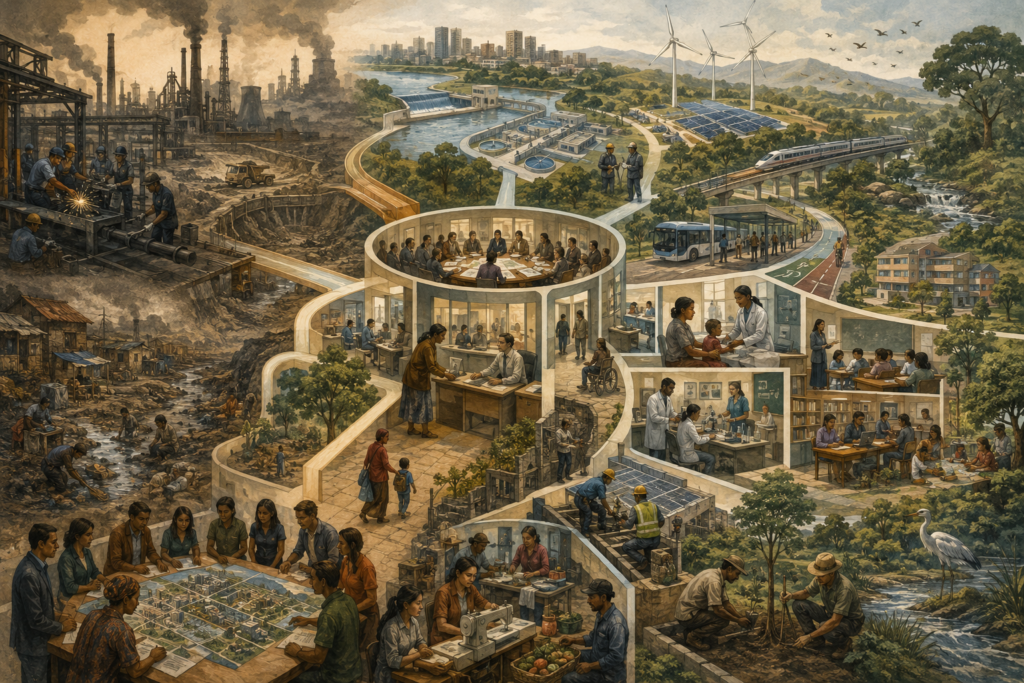
Editorial sustainability illustration showing economic growth being translated through institutions, public services, infrastructure, education, healthcare, decent work, and ecological resilience into human progress.

Economic Growth & Human Progress

Economic Growth and Human Progress examines the historical relationship between rising output and expanding human wellbeing, arguing that growth has been one of the great engines of modern progress without ever being an adequate measure of progress by itself. The article explores productivity, industrialization, technological change, life expectancy, education, inequality, ecological cost, and public-goods provision, showing that economic growth enlarges the material possibilities of development but does not automatically translate into healthier, freer, or more inclusive societies. Its central claim is that growth matters most when it is understood not as the final definition of development, but as a historically powerful means whose value depends on distribution, institutional quality, human-capability expansion, and long-run social and ecological viability.
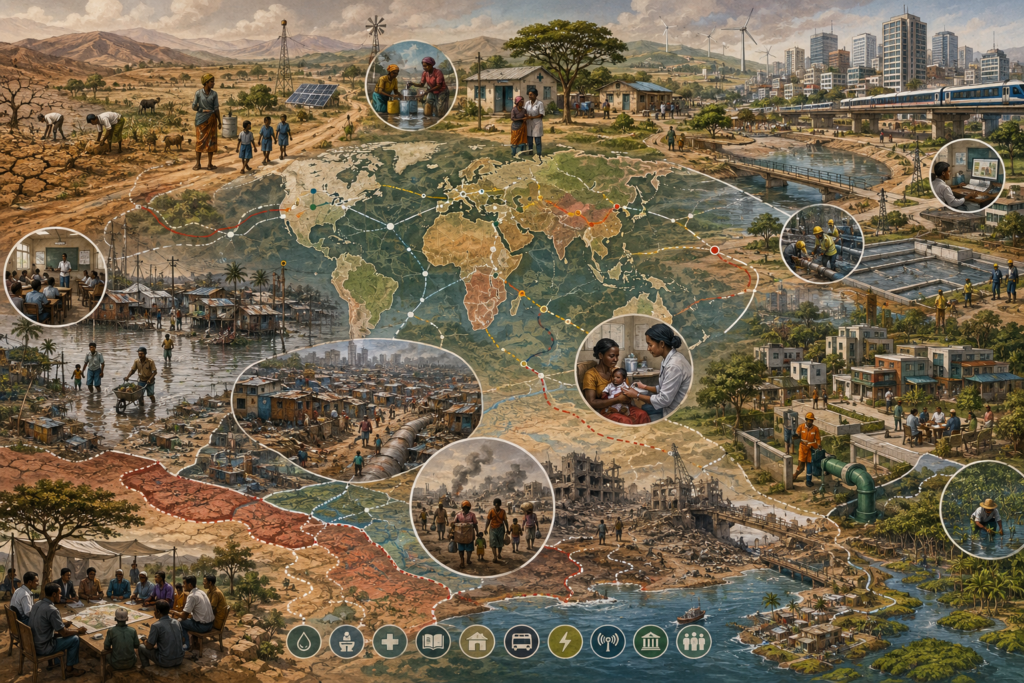
Editorial sustainability illustration showing global poverty as a spatial condition shaped by rural vulnerability, informal settlements, infrastructure gaps, disease burden, climate exposure, conflict displacement, and unequal public-service reach.

Geography of Global Poverty

Geography of Global Poverty examines how deprivation is distributed unevenly across rural regions, informal urban settlements, ecologically vulnerable zones, and territorially marginalized communities rather than appearing as a uniform global condition. The article argues that poverty is not only a question of low income, but a spatial condition shaped by infrastructure gaps, disease burdens, regional isolation, weak public systems, conflict exposure, and unequal access to health, education, sanitation, housing, and mobility. It explores rural precarity, urban informality, regional concentration, multidimensional poverty, and territorial exclusion, showing that the persistence of global poverty cannot be understood through national averages alone. Its central claim is that ending extreme poverty requires geographically literate development strategies capable of extending public goods, resilience, and human capability into the landscapes of exclusion that markets and aggregate growth too often leave behind.

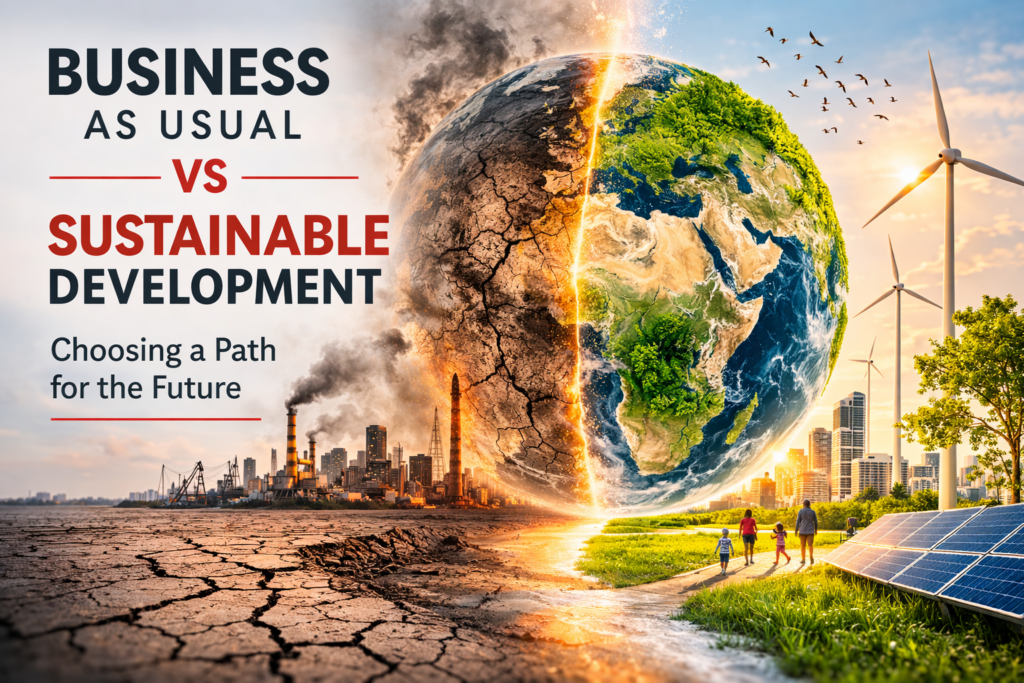
Business as usual vs sustainable development comparison showing unsustainable growth, carbon emissions, and inequality contrasted with renewable energy, environmental protection, and inclusive prosperity.

Business as Usual vs Sustainable Development

Business as Usual vs Sustainable Development examines the conflict between two models of growth: one that extends familiar patterns of fossil dependence, resource throughput, unequal distribution, and ecological strain, and another that seeks to redesign development around inclusion, resilience, and long-run viability. The article argues that business as usual remains politically attractive because it is associated with the real achievements of modern growth, yet it becomes increasingly self-undermining when the same systems that raise output also intensify climate risk, biodiversity loss, social fracture, and institutional stress. Its central claim is that sustainable development is not a softer moral gloss on the status quo, but a more demanding framework for restructuring energy, cities, infrastructure, governance, and distribution so that prosperity can endure under ecological and social constraint.

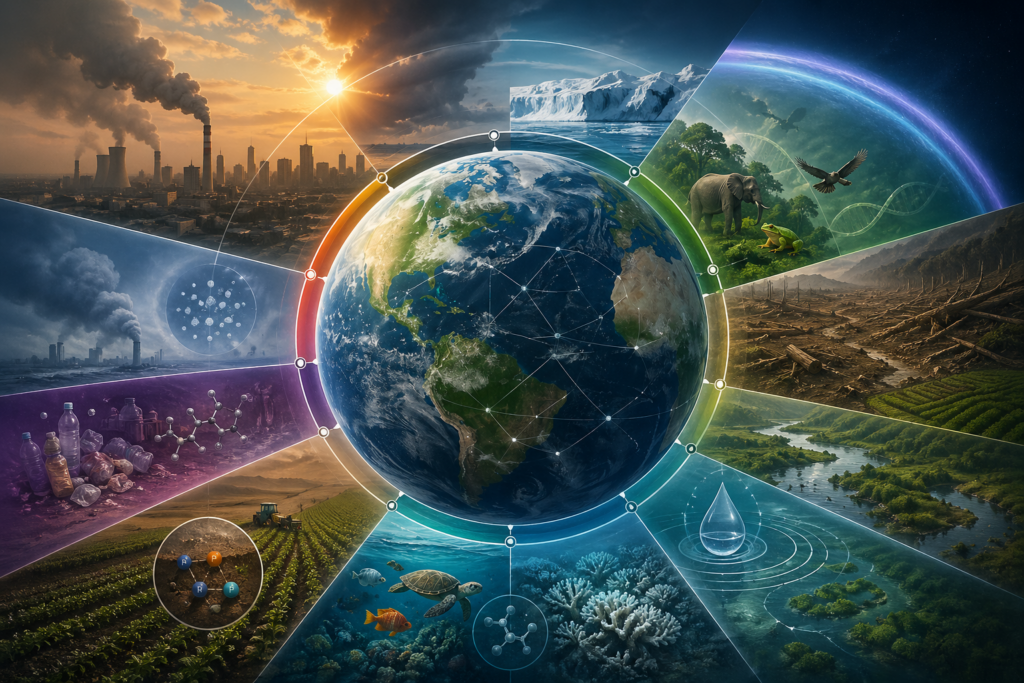
Editorial illustration of Earth surrounded by threshold rings and connected planetary systems, showing climate change, biodiversity, land-system change, freshwater stress, ocean acidification, nutrient cycles, novel entities, atmospheric pollution, and ozone recovery.

Anthropocene and Planetary Boundaries

Anthropocene and Planetary Boundaries examines how human activity has become powerful enough to alter the regulating systems of the Earth itself, transforming sustainable development from a question of local environmental management into a question of planetary stability. The article argues that the Anthropocene names a new historical condition in which climate, biodiversity, freshwater, land systems, nutrient cycles, ocean chemistry, and pollution are being reshaped by human economic activity, while the planetary boundaries framework provides a scientific way of judging how far those pressures can extend before the risk of destabilization rises sharply. Its central claim is that development can no longer be assessed only by output, welfare, or poverty reduction in isolation, but must also be judged by whether it preserves a safe operating space for humanity within the Earth system.

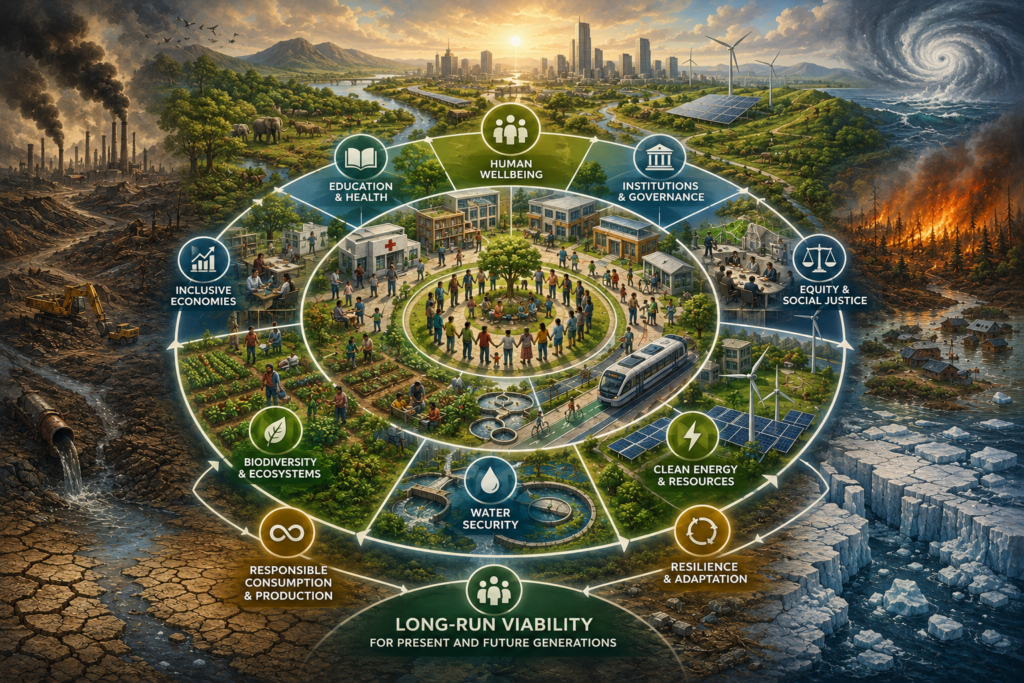
Conceptual illustration of sustainable development as an interconnected systems framework linking human wellbeing, inclusive economies, education and health, institutions and governance, ecosystems, water security, clean energy, resilience, and long-run viability.

The Four Dimensions of Sustainable Development

The Four Dimensions of Sustainable Development explains sustainable development as a systems framework built around four interacting conditions: economic prosperity, social inclusion, environmental sustainability, and good governance. The article argues that sustainable development is best understood not as a vague balance among competing goals, but as a structured way of thinking about how societies endure over time, since prosperity without inclusion can produce instability, inclusion without material capacity can remain fragile, environmental protection without institutions can remain rhetorical, and governance without justice or ecological viability can preserve unsustainable systems. Its central claim is that these four dimensions provide one of the clearest conceptual maps for understanding the wider field of sustainable development and for organizing the deeper articles across the knowledge series.

Technical embedded systems workspace featuring a PYNQ-Z2 FPGA board, STM32 microcontroller board, breadboarded sensors, logic analyzer traces, Linux terminal windows, TinyML inference visualizations, and PYNQ Python code displayed across multiple monitors.

Energy-Efficient Embedded Systems for Sustainable Digital Infrastructure

Energy-Efficient Embedded Systems for Sustainable Digital Infrastructure examines how sustainable digital infrastructure depends on mapping workloads across ultra-low-power MCU endpoints, Linux-capable edge nodes, and adaptive acceleration platforms rather than treating all embedded compute as the same design problem. The article argues that embedded efficiency is best understood as a systems-engineering question about duty-cycling, memory discipline, local inference, power-state control, and lifecycle servicing, since billions of deployed devices turn small per-device inefficiencies into infrastructure-scale energy, maintenance, and material burdens. It explores Cortex-M event-driven design, TinyML on constrained endpoints, Linux CPUFreq and scheduler-aware edge tuning, and PYNQ-based adaptive acceleration, showing that durable digital infrastructure depends on choosing the lightest adequate compute tier and minimizing both active-time energy and long-run maintenance overhead.

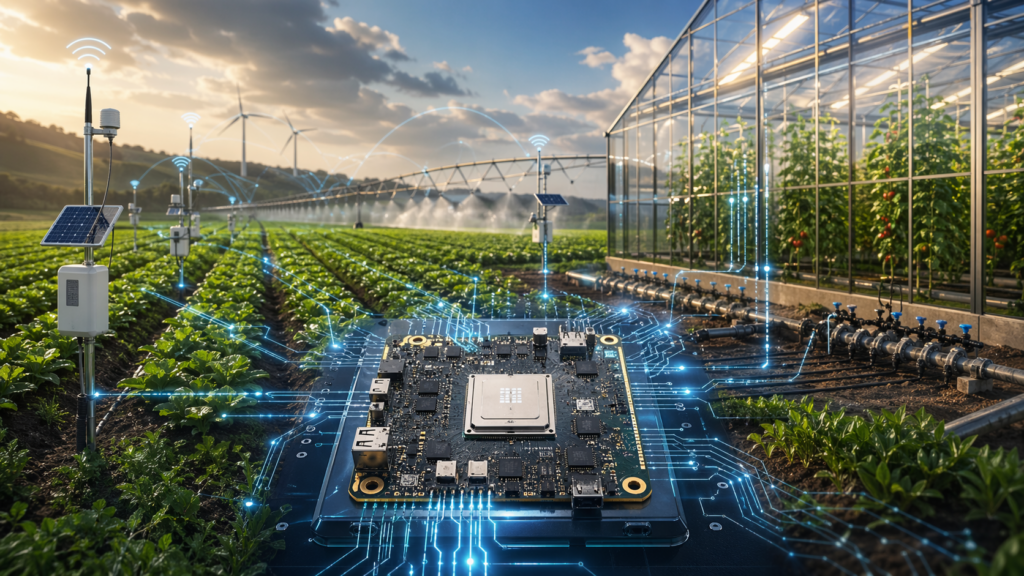
Smart agriculture scene with an FPGA board in the foreground connected visually to field sensors, irrigation infrastructure, solar-powered monitoring stations, and a greenhouse, representing reconfigurable edge hardware for environmental monitoring.

FPGA Environmental Monitoring: Reconfigurable Edge Hardware for Smart Agriculture

FPGA Environmental Monitoring: Reconfigurable Edge Hardware for Smart Agriculture examines how agricultural monitoring becomes more responsive when sensing, filtering, feature extraction, and control logic move into reconfigurable edge hardware rather than remaining entirely dependent on sequential software and cloud backhaul. The article argues that FPGA-based monitoring is most valuable where multiple noisy sensor streams, strict latency requirements, constrained communications, and local actuation needs converge, such as in irrigation control, greenhouse climate systems, pump and pipeline monitoring, and water infrastructure management. It develops the topic through workload structure, platform comparison, sensor front ends, streaming hardware pipelines, fixed-point and timing-closure considerations, Linux and PYNQ gateway integration, lightweight inference, and field verification strategy. Its central claim is that reconfigurable edge hardware can make smart agriculture more deterministic, resilient, and operationally useful under real deployment conditions.

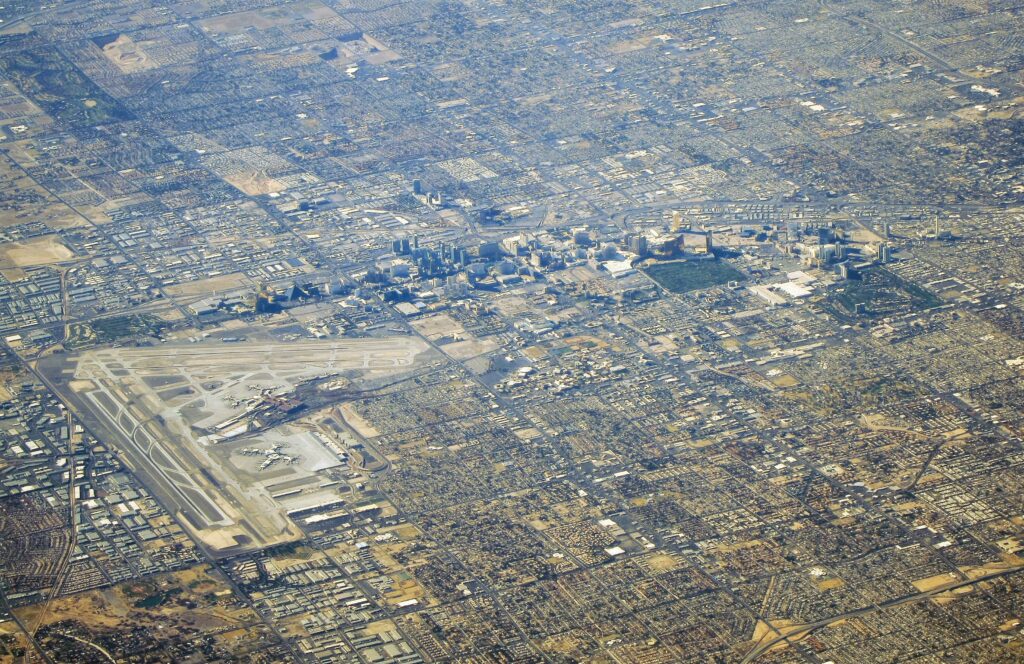
Beyond GDP and economic growth vs development — city skyline representing economic output without measuring social wellbeing

Beyond GDP Development: Measuring Prosperity as a Systems Outcome

Beyond GDP Development: Measuring Prosperity as a Systems Outcome argues that economic output is too narrow to serve as a full measure of development because societies do not prosper through production alone, but through the interaction of human capability, institutional quality, distribution, and ecological stability. The article reframes the beyond GDP debate by showing that GDP remains useful as an indicator of economic activity, yet becomes misleading when it is treated as a proxy for overall wellbeing or long-run progress. It explores the limits of GDP, the capabilities approach and human-development tradition, the role of institutions and inequality, and the need for a broader measurement architecture that captures whether growth is actually strengthening the systems that make prosperity durable. Its central claim is that development should be measured not as output alone, but as a systems outcome.

Scroll to Top