Sustainable Systems

Sustainable systems examine how social, economic, and environmental processes can be organized to support long-term stability and human well-being. Rather than treating environmental protection, economic development, and social equity as separate challenges, sustainable systems research emphasizes their deep interdependence.

The field integrates insights from sustainability science, systems theory, ecological economics, and public policy. Researchers analyze how resource use, technological development, governance structures, and social behavior interact within complex systems.

Designing sustainable systems requires understanding feedback loops, institutional incentives, and long-term environmental constraints. Effective systems must balance efficiency with resilience, innovation with stewardship, and economic opportunity with ecological limits.

By integrating interdisciplinary knowledge, sustainable systems approaches aim to create development pathways that maintain ecological integrity while supporting inclusive and resilient societies.

Editorial sustainability illustration showing a civic forum centered on an ethical compass, with community members, public officials, engineers, scientists, caregivers, young people, polluted landscapes, renewable energy, public institutions, infrastructure, and ecological restoration representing stewardship, justice, care, trust, precaution, and responsibility to future generations.

What Is Stewardship & Ethics? Responsibility, Justice, and Sustainable Systems

Stewardship and ethics give sustainable systems their moral architecture. Stewardship asks how power should be held when institutions shape land, infrastructure, finance, technology, ecosystems, public trust, and future possibilities. Ethics asks by what standards that power should be judged: justice, dignity, care, accountability, truthfulness, precaution, and responsibility across generations. This article explains why sustainability cannot be reduced to technical management, efficiency, resilience, or greener growth. Systems may function well while still distributing burdens unjustly, degrading ecological foundations, concealing risk, or shifting harm onto vulnerable communities and future generations. Stewardship and ethics make those hidden judgments visible, asking not only whether systems work, but what they protect, what they sacrifice, who they serve, and whether they are worthy of continuation.


Editorial illustration of stewardship and ethics shown as a layered moral and ecological systems architecture, with a central stewardship core surrounded by institutional chambers, environmental landscapes, knowledge spaces, industrial pressure zones, and interconnected pathways of responsibility, justice, care, and long-term obligation.

Stewardship & Ethics: Responsibility, Justice, and the Moral Architecture of Sustainable Systems

Stewardship & Ethics examines the moral principles, civic obligations, institutional responsibilities, and long-horizon judgments that shape how human beings inhabit, govern, and transform the world. As a pillar within sustainable systems thinking, it explores environmental ethics, justice, intergenerational obligation, precaution, public trust, and the ethical limits of extraction, optimization, and technological power. This series considers how responsibility moves from philosophy into governance, asking what societies, institutions, and leaders owe to vulnerable populations, future generations, and the living systems on which human flourishing depends.

Editorial systems illustration showing diverse leaders, scientists, emergency managers, community representatives, and residents around a resilience strategy table linking systemic risk, ecological repair, technology, justice, and planetary limits.

The Future of Resilience Thinking

The future of resilience thinking lies in moving beyond narrow ideas of recovery, protection, and continuity toward a broader framework capable of engaging systemic risk, justice, transformation, local governance, infrastructure interdependence, technological dependency, regenerative capacity, and planetary limits. Earlier resilience frameworks emphasized shock absorption, adaptation, and recovery, but today’s risks are increasingly compound, cascading, and systemic. Climate change, biodiversity loss, AI governance, cyber dependency, infrastructure coupling, inequality, financial fragility, and public distrust all require a deeper resilience framework. This article examines how resilience thinking is evolving from “bounce back” recovery toward whole-system governance, ethical transformation, local capability, technological accountability, ecological repair, resilience investment, and evidence-based public accountability. It argues that future resilience must preserve essential functions while transforming the systems that produce vulnerability.

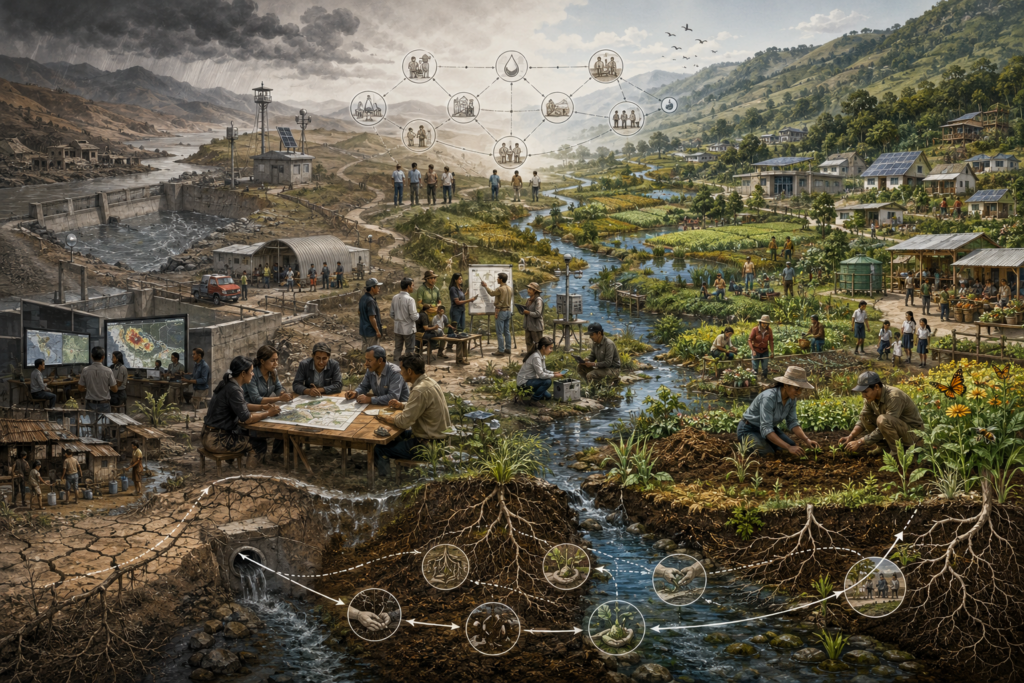
Editorial illustration showing a transition from defensive risk management and degraded landscapes to regenerative resilience through ecological restoration, community planning, and renewed social and institutional systems.

From Risk Management to Regenerative Capacity

From risk management to regenerative capacity marks a shift from simply protecting systems against shocks toward renewing the ecological, social, institutional, and material foundations that make long-term resilience possible. Traditional risk management remains essential: it identifies hazards, reduces exposure, prepares institutions, and limits losses. But systems can survive disruption while still emerging depleted, unjust, brittle, or locked into future crisis. This article examines regenerative capacity as a deeper resilience framework, connecting ecological restoration, soil health, biodiversity, water systems, food and land systems, livelihoods, social trust, institutional learning, justice, and long-term investment. It argues that resilience should not only ask how systems can withstand harm, but whether they can restore the conditions for future adaptation, public legitimacy, ecological renewal, and more durable forms of collective wellbeing.

Editorial illustration of AI-enabled public systems, infrastructure, finance, and human oversight centers showing both resilience benefits and systemic risks in automated systems.

Resilience in the Age of AI and Automated Systems

Resilience in the age of AI and automated systems depends on whether societies can use artificial intelligence to improve monitoring, prediction, coordination, and decision support without creating new forms of opacity, dependency, concentration, bias, and systemic fragility. AI can strengthen resilience through anomaly detection, forecasting, early warning, predictive maintenance, fraud detection, service targeting, and scenario analysis. Yet automation can also scale errors, weaken human oversight, obscure accountability, deepen vendor dependence, reproduce inequality, and create brittle systems that are difficult to challenge when conditions change. This article examines AI as a socio-technical resilience problem, connecting model reliability, drift, explainability, contestability, public-sector governance, financial stability, cyber-physical systems, equity, and institutional trust. AI becomes a resilience technology only when it remains monitorable, auditable, correctable, accountable, and supported by meaningful fallback capacity.

Editorial illustration of critical infrastructure linked to a digital twin system with sensors, data flows, monitoring screens, and planning teams supporting infrastructure resilience.

Digital Twins, Sensing, and Infrastructure Resilience

Digital twins and sensing systems strengthen infrastructure resilience when they connect physical assets, real-time data, validated models, and decision-making under stress. This article explains digital twins not as visual replicas, but as sensing-linked decision systems that help infrastructure operators detect deterioration, identify anomalies, test scenarios, prioritize maintenance, map interdependence, and support climate adaptation. It also warns that digital twins can create new risks when data quality is weak, models are poorly validated, cyber trust is fragile, or public institutions lack the capacity to act on what systems reveal. True resilience depends on more than digitization. It requires secure data, accountable governance, equity-aware sensing, model transparency, public trust, and operational workflows that turn infrastructure signals into timely, responsible decisions before local stress becomes cascading failure.

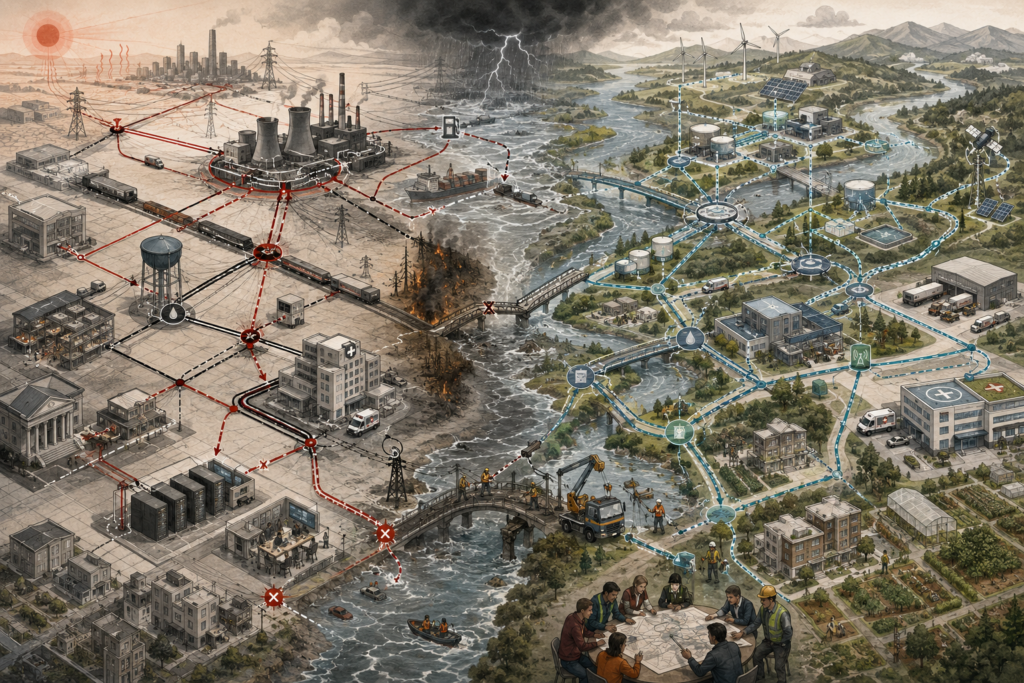
Editorial illustration contrasting a brittle, highly optimized infrastructure system with a more resilient network designed with redundancy, flexibility, modularity, and recovery capacity.

Designing for Resilience Rather Than Optimization Alone

Designing for resilience rather than optimization alone means building systems that can preserve critical function when conditions become unstable, uncertain, hostile, or disrupted. Systems optimized narrowly for efficiency, cost reduction, lean operation, high utilization, or smooth performance under normal conditions can become brittle when shocks expose hidden dependencies, thin margins, tight coupling, and single points of failure. This article examines why resilience requires more than ordinary efficiency: redundancy, slack, flexibility, modularity, graceful degradation, service continuity, dependency visibility, adaptive governance, and equity protection. It connects infrastructure resilience, cyber systems, supply chains, climate risk, public institutions, and social vulnerability to show why durable systems must be designed for disturbance as well as performance. Optimization remains valuable, but only when embedded within a broader framework that accounts for disruption, recovery, adaptation, and the public cost of failure.

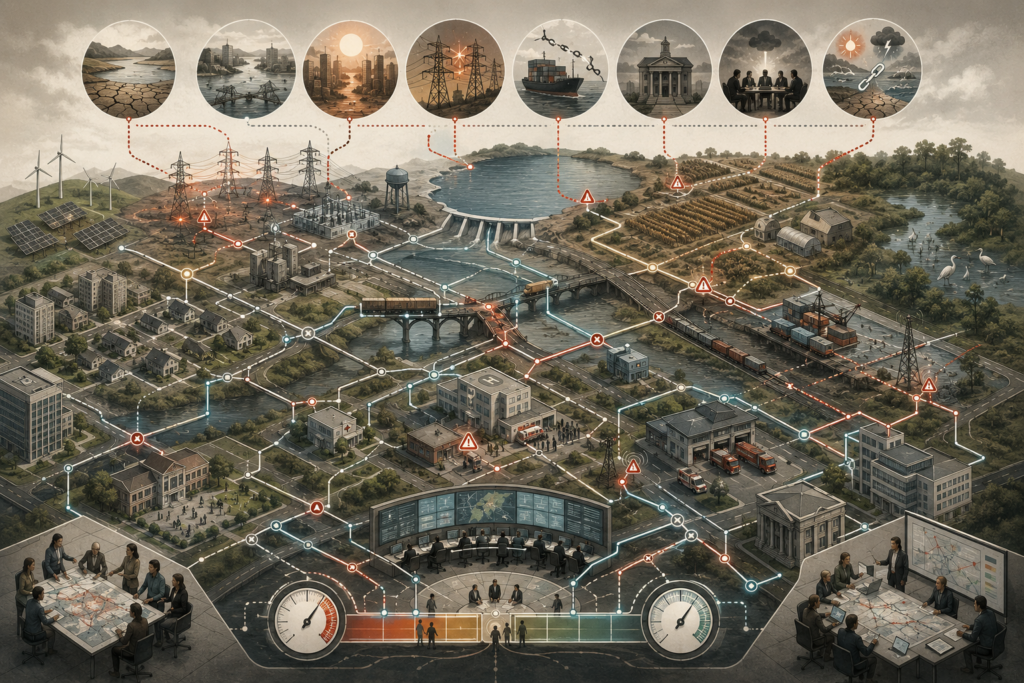
Editorial illustration of interconnected energy, water, food, transport, health, finance, governance, and emergency systems being stress tested under drought, flood, heat, and cascading disruption scenarios.

Stress Testing Sustainable Systems

Stress testing sustainable systems matters because systems that appear stable in ordinary periods may fail quickly when exposed to pressure. A water system that works in average rainfall years may fail under prolonged drought. A hospital network that seems adequate in normal demand may become overwhelmed by heat, disease, staffing shortages, or supply disruption. This article explains how stress testing uses adverse scenarios to reveal hidden fragility, thresholds, interdependencies, cascading effects, weak buffers, and service-continuity gaps before crisis arrives. It examines climate and disaster risk, infrastructure, public systems, social vulnerability, governance capacity, and compound stress. Durable sustainability requires more than baseline performance; it requires systems that can withstand pressure, adapt under uncertainty, preserve essential functions, protect vulnerable communities, and learn before failure becomes irreversible or far more costly.

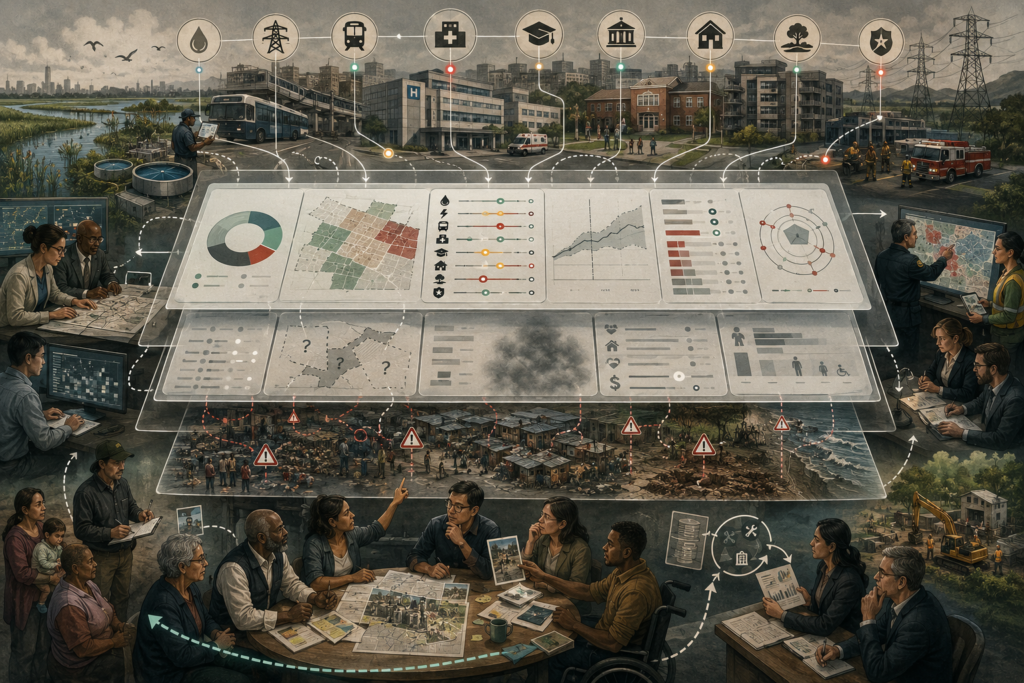
Editorial illustration showing a layered resilience dashboard over a city and infrastructure landscape, with planners, analysts, officials, and community members examining indicators, uncertainty, hidden vulnerability, and blind spots in resilience measurement.

Resilience Indicator Dashboards and Their Blind Spots

Resilience indicator dashboards can make complex systems more visible, but they can also make partial visibility feel complete. This article examines dashboards as governance instruments that shape what institutions notice, fund, ignore, and claim to have improved. It explains how resilience dashboards use indicators, scorecards, maps, recovery curves, capacity measures, project ratings, and composite scores to track preparedness, vulnerability, infrastructure, ecosystems, public health, finance, and adaptation. It also warns that dashboards can create false precision, hide unequal resilience through aggregation, privilege available data, confuse proxies with real outcomes, and produce dashboard theater when reporting replaces action. Better dashboards must be transparent, disaggregated, uncertainty-aware, equity-sensitive, community-validated, and connected to decisions, budgets, accountability, and corrective action.

Scroll to Top