
Last Updated May 8, 2026
Designing for resilience rather than optimization alone means building systems that can preserve critical function when conditions become abnormal, volatile, hostile, or uncertain. Systems optimized narrowly for efficiency, throughput, cost minimization, lean inventories, high utilization, or smooth performance under normal conditions can appear successful while quietly losing the margins that allow them to absorb disturbance. A serious risk-and-resilience framework must therefore ask not only whether a system performs well when everything works, but whether it can continue, degrade safely, adapt, recover, and reorganize when parts of the system fail.
Optimization is not the enemy of resilience. Narrow optimization is. Efficient systems can be valuable, affordable, and socially necessary, but efficiency becomes dangerous when it removes slack, hides dependencies, concentrates control, erodes maintenance capacity, suppresses redundancy, or treats interruption costs as external to the design problem. Resilient design does not romanticize waste. It asks which forms of redundancy, flexibility, modularity, visibility, backup capacity, and adaptive governance are necessary to protect essential services, public wellbeing, ecological function, and institutional continuity under stress.
Main Library
Publications
Article Map
Risk & Resilience
Related Topic
Sustainable Development
Related Topic
Institutions & Governance
Related Topic
Technology & Systems Intelligence
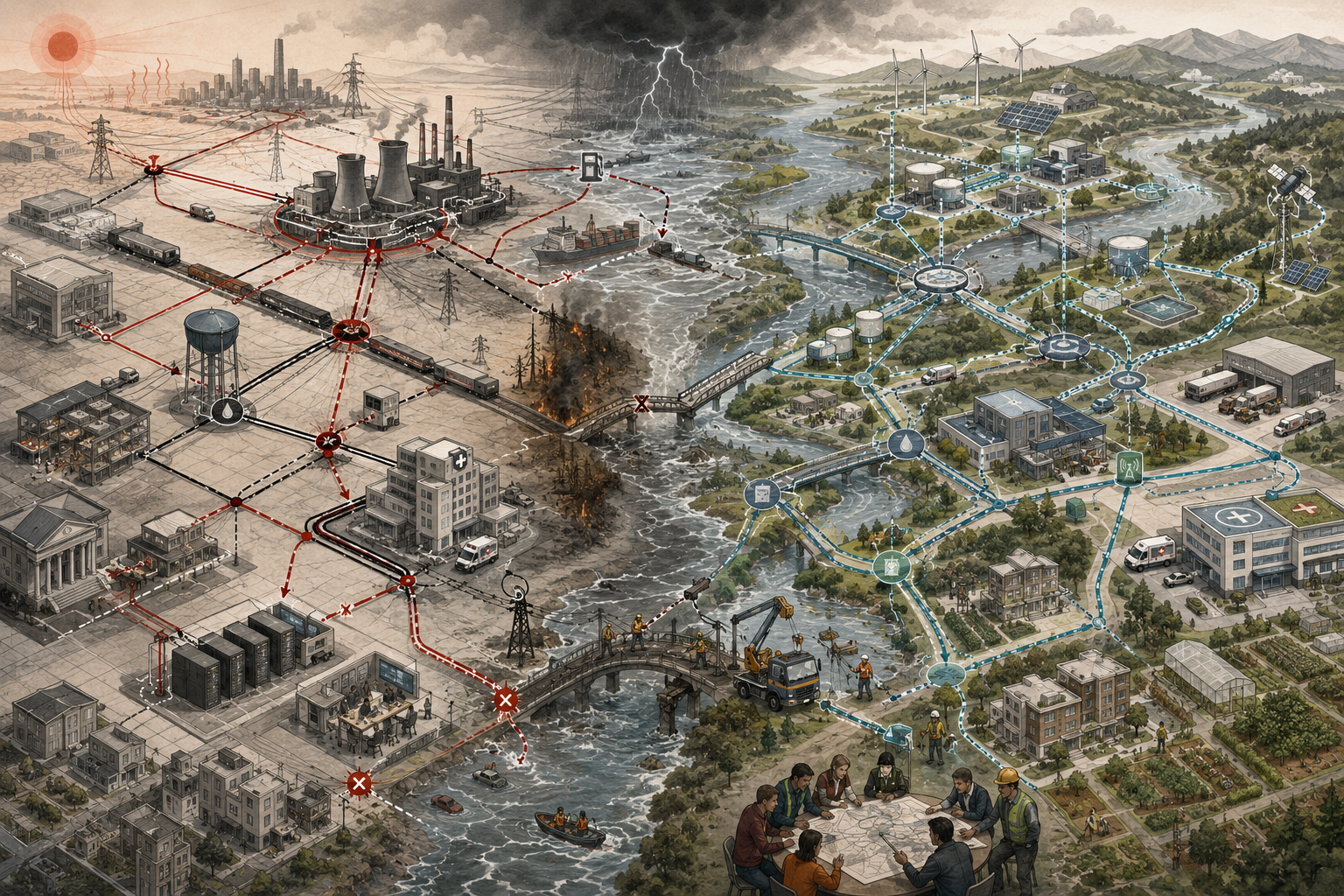
Modern systems are increasingly interdependent. Supply chains depend on ports, logistics platforms, energy systems, digital networks, finance, labor availability, climate stability, and political order. Hospitals depend on electricity, water, software, pharmaceuticals, communications, staffing, and transportation. Cities depend on drainage, housing, food distribution, public health, emergency response, waste systems, and public trust. Digital systems increasingly mediate physical infrastructure, public administration, commerce, health systems, and social life. Under these conditions, optimization must be judged not only by normal-period performance, but by behavior under stress.
Why Resilience Must Be Designed, Not Assumed
Resilience must be designed because systems do not automatically become capable of withstanding disturbance simply because they function well under ordinary conditions. A system can be fast, cheap, productive, highly utilized, and operationally elegant while remaining brittle. It may depend on precise timing, a single supplier, a central software platform, a narrow transport corridor, a small number of skilled personnel, a fragile ecological buffer, or infrastructure that has not been maintained. The system may look efficient because the disturbance has not yet arrived.
Risk and resilience analysis begins by rejecting the illusion that normal performance is proof of durable function. Many failures are preceded by long periods of apparent success. Lean inventories work until a supply shock arrives. Centralized systems reduce duplication until the central node fails. High utilization raises output until demand surges or maintenance is deferred. Just-in-time delivery reduces storage costs until transport networks are disrupted. Digital automation improves coordination until a cyber incident, software dependency, or data outage compromises control.
Designing for resilience means treating disturbance as part of the design environment rather than as an exceptional afterthought. Systems should be evaluated across multiple conditions: normal operation, stress, partial failure, compound disruption, recovery, adaptation, and transformation. This does not require every system to be maximally redundant or permanently overbuilt. It requires clarity about which functions are critical, which failures would cascade, which communities would be harmed, which dependencies are hidden, and what level of fallback capacity is socially necessary.
Resilience also must be designed because many risks are not independent. Energy disruptions can affect water systems, hospitals, refrigeration, telecommunications, payment networks, and public safety. Flooding can disrupt roads, ports, housing, electrical substations, wastewater systems, and emergency response. Cyber incidents can move through software supply chains, operational technology, logistics platforms, and public services. Climate hazards can interact with debt, inequality, weak institutions, brittle infrastructure, and ecological degradation. Resilience is therefore not only a property of components. It is a property of relationships.
A resilient design approach asks: What must continue when the system is under stress? What can fail safely? What can be isolated? What can be rerouted? What capacity can be mobilized? What information must remain visible? What communities are most exposed? What institutions are responsible for adaptation and repair? Those questions move the design problem beyond narrow optimization toward durable public value.
What Optimization Means in System Design
Optimization usually means selecting a system arrangement that maximizes or minimizes a chosen objective under specified constraints. In engineering, logistics, finance, management, infrastructure, computing, and public administration, optimization may seek to minimize cost, delivery time, energy use, inventory, idle capacity, labor expense, downtime, waste, or transaction friction. It may seek to maximize throughput, utilization, speed, profitability, coordination, coverage, or output per unit of input.
These goals are not inherently wrong. Cost matters. Waste matters. Speed matters. Public systems cannot ignore affordability, and private systems cannot ignore resource discipline. Optimization can improve access, reduce unnecessary burdens, increase productivity, and make services more reliable when it is framed carefully. The problem is not optimization itself. The problem is a narrow design objective that assumes a stable environment, treats disturbance as rare, ignores externalized harm, and defines unused capacity as waste even when that capacity protects critical function.
The meaning of optimization depends on what the objective function includes. If the objective function includes only average-period cost, a system may become cheaper by eliminating buffers. If it includes service continuity under stress, the same buffers may be understood as protective capacity. If it includes only throughput, high utilization may look desirable. If it includes maintenance, recovery, and surge capacity, permanent maximum utilization may look risky. If it includes only the cost of one organization, risk may be shifted to workers, households, suppliers, communities, ecosystems, or public institutions.
This is why resilience requires rethinking the optimization problem itself. A system optimized for stable conditions may be underdesigned for volatility. A system optimized for one actor may impose fragility on others. A system optimized for short-run accounting may accumulate long-run risk. A system optimized for single-point efficiency may become vulnerable to cascading failure. Resilience design therefore asks whether the objective being optimized is too narrow for the world in which the system must operate.
The most responsible approach is not to abandon optimization, but to broaden it. Resilience-aware optimization includes disturbance, recovery, adaptation, maintenance, dependency visibility, equity, environmental risk, and the social cost of service failure. It asks not merely “What is cheapest?” or “What is fastest?” but “What design preserves essential function across a wider range of futures?”
Efficient Performance and Durable Function Are Not the Same
Efficient performance and durable function are related, but they are not the same. Efficient performance describes how well a system converts inputs into outputs under a defined set of conditions. Durable function describes whether the system can continue providing essential value when those conditions change. A system may perform efficiently on an ordinary day and fail badly during a shock. Another system may appear less efficient in routine periods because it maintains backup capacity, distributed options, spare parts, trained personnel, diverse suppliers, or ecological buffers, yet preserve public value when stress arrives.
This distinction is especially important for essential services. A hospital is not successful simply because it minimizes unused capacity during normal periods. It must also handle surges, outages, epidemics, disasters, supply shortages, cyber disruptions, and staffing stress. A water system is not successful merely because it operates cheaply during average weather. It must also withstand drought, flooding, contamination, power loss, infrastructure decay, and population pressure. A digital identity system is not successful only because it speeds transactions. It must also preserve security, continuity, recoverability, and public trust.
Durable function usually requires margin. Margin may take the form of redundant pathways, spare capacity, alternative suppliers, modular architecture, local repair capability, manual fallback procedures, emergency reserves, backup power, robust governance, or institutional trust. These margins can be difficult to justify when accounting systems measure cost more easily than avoided disruption. Yet resilience often consists precisely in capacities that are invisible until they are needed.
The tension between efficiency and durable function becomes sharper when systems are treated as isolated units. A firm may optimize inventory costs while increasing vulnerability across the supply chain. A utility may defer maintenance while keeping prices low in the short term. A government may consolidate services to reduce duplication while reducing local capacity. A platform may centralize coordination while creating systemic dependence. Each decision may appear rational within a narrow frame while increasing fragility across the wider system.
Resilience design therefore requires a broader definition of performance. The question is not only whether a system is efficient before disturbance, but whether it preserves essential function during disturbance and learns after disturbance. Durable function should be treated as a performance criterion, not as a secondary concern.
How Optimization Alone Can Create Fragility
Optimization alone can create fragility by removing the very features that allow systems to absorb uncertainty. When inventories, spare capacity, backup suppliers, repair crews, local knowledge, public reserves, staffing buffers, maintenance budgets, or emergency procedures are treated only as inefficiencies, the system may become leaner but less resilient. It becomes dependent on conditions remaining close to expectation.
Fragility often grows through several mechanisms. The first is margin erosion. Systems that operate permanently near maximum capacity have little room for demand surges, component failure, or unexpected delays. The second is dependency concentration. Systems that rely on a single supplier, platform, route, facility, energy source, software library, or decision center become vulnerable to disruption at that node. The third is tight coupling. Systems that require precise timing and continuous coordination can transmit failure quickly because one disruption leaves little time for adjustment.
The fourth mechanism is opacity. Highly optimized systems can become difficult to understand because dependencies are distributed across contracts, software, logistics providers, infrastructure networks, financial arrangements, and regulatory regimes. When failure occurs, no single actor may fully understand the system’s vulnerability. The fifth is deferred maintenance. Cost optimization can reward postponing repairs, staff training, infrastructure renewal, and institutional capacity until breakdown reveals the accumulated risk. The sixth is externalization. A system may appear optimized because it shifts risk onto workers, households, ecosystems, local governments, or future generations.
Optimization also creates fragility when it assumes stationarity. Many systems are designed around historical averages: average demand, average weather, average delivery times, average loads, average labor availability, average failure rates, average cyber threat conditions. But climate change, geopolitical tension, digital interdependence, pandemics, inequality, ecological stress, and infrastructure aging mean that the past may be a poor guide to future operating conditions. A system optimized for yesterday’s distribution of events may be poorly designed for tomorrow’s extremes.
This does not mean every efficiency gain weakens resilience. Some efficiency gains improve resilience by reducing waste, improving information, lowering energy demand, or making services more accessible. The danger lies in optimization that ignores disturbance, interdependence, and social consequences. Optimization becomes fragile when it narrows the design imagination.
Redundancy, Slack, Diversity, and Optionality
Redundancy is one of the most familiar resilience resources. It means that more than one component, pathway, supplier, team, or institution can perform a necessary function. In infrastructure, redundancy may include backup power, alternative routes, duplicated communication channels, emergency water supplies, or spare parts. In supply chains, it may include multiple suppliers, regional inventories, alternate logistics routes, and distributed production capacity. In public systems, it may include overlapping service networks, local emergency capacity, cross-trained staff, and community-based support.
Redundancy has costs. Maintaining backup systems requires money, space, maintenance, training, governance, and coordination. But the cost of redundancy should be compared with the cost of failure, not only with the cost of ordinary operation. The relevant question is not whether redundancy is “efficient” in a narrow sense, but which functions require redundancy because their failure would produce unacceptable harm.
Slack is related but broader. Slack is unused or underused capacity that gives a system room to maneuver. A public health system with staffing slack can respond to surges. A transport system with route slack can absorb disruptions. A household with financial slack can withstand a shock. A community with social slack can mobilize mutual aid. A landscape with ecological slack can absorb floodwater or heat stress. Slack is often invisible in normal times because its value lies in what it prevents.
Diversity also supports resilience. Diverse suppliers, energy sources, crops, institutions, technical architectures, local economies, and forms of knowledge reduce the chance that one failure mode disables the entire system. Diversity can slow failure propagation because different components respond differently to stress. It can also expand adaptation options by preserving more ways to respond.
Optionality is the capacity to choose among alternatives when conditions change. Optionality may come from modular design, interoperable systems, local production capacity, public reserves, mutual aid networks, open standards, flexible regulation, or adaptive financing. A system with optionality is not locked into one pathway. It has room to reconfigure.
The challenge is to design redundancy, slack, diversity, and optionality intelligently. Too little creates fragility. Too much, poorly governed, can create cost, confusion, or waste. Resilience design asks where backup capacity is essential, where flexibility is more valuable than duplication, where diversity reduces systemic risk, and where optionality protects long-run public value.
Flexibility, Modularity, and Reconfiguration
Flexibility is the ability to adjust when conditions change. A flexible supply chain can shift suppliers, reroute shipments, alter production schedules, or substitute inputs. A flexible energy system can balance multiple sources, storage options, demand response, and distributed generation. A flexible public institution can reallocate staff, adapt rules, coordinate across agencies, and respond to local conditions. Flexibility is often more dynamic than redundancy because it does not merely duplicate capacity; it enables reconfiguration.
Modularity supports flexibility by dividing systems into parts that can function, fail, or be repaired without collapsing the whole. A modular system has boundaries that limit failure propagation. In digital systems, modularity can prevent one software failure from disabling an entire platform. In infrastructure, modularity can allow local sections to be isolated and repaired. In governance, modularity can preserve local response capacity while still allowing central coordination. In ecological and social systems, modularity can prevent shocks from spreading too quickly across all connected units.
Reconfiguration is the practical test of flexibility and modularity. It asks whether a system can change its structure under stress. Can power be rerouted? Can hospitals share capacity? Can food distribution shift when one corridor fails? Can digital systems operate in degraded mode? Can public agencies coordinate outside routine procedures? Can communities activate local knowledge and mutual aid? Can financial support reach vulnerable households quickly? A system that cannot reconfigure is dependent on its original design remaining valid.
Flexibility is especially important where uncertainty is high. In climate adaptation, systems must be prepared for a range of future conditions rather than one predicted future. In cyber resilience, systems must respond to adversaries who adapt. In public health, institutions must handle novel disease patterns and uncertain transmission. In geopolitics and supply chains, shocks can emerge from conflict, sanctions, trade disruption, or resource scarcity. Flexible systems can preserve function without requiring perfect prediction.
But flexibility is not free. It requires information, governance, training, interoperability, trust, authority, and sometimes excess capacity. Without those supports, flexibility can become a slogan rather than an operational capability. Resilience design therefore asks not only whether flexibility exists in principle, but whether the system has the institutions, data, skills, resources, and legitimacy required to reconfigure under pressure.
Robustness, Graceful Degradation, and Service Continuity
Robustness is the ability to withstand disturbance without losing core function. A robust bridge can tolerate stress beyond ordinary loads. A robust cyber system can resist intrusion, isolate compromise, and continue essential operations. A robust institution can continue serving the public despite leadership turnover, fiscal stress, political conflict, or emergency conditions. Robustness is not the same as invulnerability. It means the system has been designed with enough strength, protection, and tolerance to avoid disproportionate failure.
Graceful degradation is another crucial resilience concept. A system designed for graceful degradation does not fail all at once. It loses some performance while preserving essential function. A power system may shed noncritical loads to protect hospitals and water systems. A digital service may reduce advanced features while keeping basic access available. A transport network may slow rather than stop. A public institution may shift to emergency procedures rather than suspend service entirely. Graceful degradation is often more realistic than uninterrupted perfection.
Service continuity is the public-value expression of robustness and graceful degradation. In risk and resilience work, the goal is rarely to protect every asset equally. The goal is to preserve essential functions: water, energy, food, shelter, healthcare, communication, mobility, public safety, sanitation, social protection, and institutional coordination. Some assets may fail, but critical services should continue or recover quickly. This shifts design from asset-centered thinking to function-centered thinking.
Function-centered resilience is especially important for infrastructure. A city does not need every road open during a flood, but it needs emergency access, evacuation routes, supply corridors, and continuity for hospitals and shelters. A health system does not need every administrative process to operate normally during a crisis, but it needs triage, treatment, supplies, staffing, and communication. A digital public service may not need full functionality during an outage, but it must preserve identity, security, access, and recovery pathways.
Designing for service continuity requires prioritization. Which functions are mission-critical? Which populations are most vulnerable if service fails? Which dependencies must be protected first? Which failures can be tolerated temporarily? Which backup systems require regular testing? Which recovery timelines are acceptable? These questions make resilience a governance problem as much as an engineering problem.
Robustness, graceful degradation, and continuity help move systems away from brittle perfection. They accept that failure can occur and design so that failure does not become catastrophe.
Tight Coupling, Cascading Failure, and Hidden Dependencies
Tight coupling occurs when components depend on one another in ways that leave little time, space, or flexibility for adjustment. In tightly coupled systems, one failure can quickly produce additional failures because processes are synchronized, buffers are thin, dependencies are concentrated, and delays are difficult to absorb. Tight coupling can improve speed and coordination in normal periods, but it can also increase systemic vulnerability.
Cascading failure is the spread of disruption across connected systems. A power outage may disrupt water pumps, telecommunications, hospitals, payment systems, fuel distribution, and traffic control. A cyberattack may interrupt logistics, public administration, manufacturing, financial transactions, and critical infrastructure operations. A port closure may affect food supply, medical equipment, retail inventories, industrial production, and employment. A drought may affect agriculture, energy generation, water quality, migration, public health, and political stability.
Hidden dependencies make cascading failure harder to anticipate. Organizations often understand their direct suppliers, assets, or platforms better than their indirect dependencies. A hospital may know its medical suppliers but not the upstream dependencies of those suppliers. A city may know its water infrastructure but not all of its electrical, software, staffing, chemical, transportation, and maintenance dependencies. A company may know its cloud provider but not the broader software supply chain that supports its operations. Resilience requires mapping these dependencies before failure exposes them.
Optimization can intensify hidden dependency risk by creating long, specialized, geographically dispersed, digitally coordinated systems whose vulnerabilities are difficult to see. A system may appear diversified at the surface while sharing the same upstream supplier, software dependency, logistics corridor, financing structure, or energy source. Apparent diversity can conceal common-mode failure.
A resilience approach therefore requires dependency visibility. Systems need to know what they depend on, which dependencies are critical, where single points of failure exist, how failures might cascade, and which actors are responsible for mitigation. This requires data, transparency, cross-sector coordination, scenario analysis, stress testing, and governance authority. It also requires humility: complex systems often surprise their designers.
The practical design lesson is clear. The more tightly coupled and interdependent a system becomes, the more important it is to build buffers, modularity, monitoring, fallback capacity, and cross-system coordination. Efficiency without dependency awareness is not design maturity. It is unmanaged exposure.
Infrastructure, Cyber Systems, and Supply Chains
Infrastructure, cyber systems, and supply chains reveal why resilience cannot be separated from systems design. Critical infrastructure provides the material foundation for daily life: electricity, water, sanitation, transport, communications, healthcare, food distribution, emergency services, and public administration. These systems are often old, expensive, interdependent, and exposed to climate hazards, cyber threats, maintenance gaps, fiscal constraints, and governance fragmentation. Optimizing them only for cost or average demand can leave essential services vulnerable.
Cyber systems add another layer of dependency. Digital platforms now coordinate logistics, finance, communications, health systems, public services, industrial control systems, and energy networks. Cyber resilience is not only about preventing attacks. It is about ensuring that systems can anticipate, withstand, recover from, and adapt to cyber incidents while preserving mission-critical function. That requires architecture, governance, backups, segmentation, monitoring, incident response, supply-chain security, and tested recovery procedures.
Supply chains show how optimization can produce both impressive efficiency and serious fragility. Lean inventories, global specialization, just-in-time coordination, low-cost sourcing, and consolidated suppliers can reduce cost under stable conditions. But shocks can expose dependence on single regions, ports, materials, firms, transport routes, or regulatory regimes. Resilience may require strategic reserves, supplier diversification, regional production capacity, visibility across tiers, substitution planning, and better labor and environmental standards.
These domains also show that resilience is not only technical. It is institutional. Infrastructure resilience depends on regulation, financing, maintenance, public accountability, emergency management, land-use planning, and community trust. Cyber resilience depends on governance, standards, procurement, workforce development, disclosure, and accountability. Supply-chain resilience depends on market structure, trade policy, labor rights, corporate governance, logistics infrastructure, and geopolitical risk management.
The shared lesson is that resilience emerges from the relationship between design and governance. Systems must be engineered to withstand disruption, but they must also be governed so that maintenance is funded, dependencies are visible, accountability is clear, and public value is protected. A technically sophisticated system can still be fragile if institutions reward short-term savings while ignoring long-term risk.
Climate Risk and Nonstationary Design Conditions
Climate change strengthens the case for designing for resilience rather than optimization alone because it undermines the assumption that future operating conditions will resemble historical baselines. Infrastructure, agriculture, housing, insurance, disaster planning, water systems, coastal development, public health, and energy demand have often been designed around past climate patterns. But rising temperatures, shifting precipitation, sea-level rise, more intense extremes, wildfire risk, heat stress, drought, flooding, and compound hazards challenge historical assumptions.
This creates a nonstationary design problem. A stationary design world assumes that statistical patterns remain broadly stable. A nonstationary world requires systems to operate under changing distributions of risk. What used to be rare may become more common. What used to be extreme may become plausible. What used to be local may interact with global supply chains, migration, food prices, insurance markets, fiscal stress, and political legitimacy.
Optimization based on historical averages can therefore produce climate fragility. A drainage system optimized for past rainfall may fail under new precipitation extremes. A power grid optimized for historical demand may struggle under heat-driven cooling loads. A city optimized around past flood maps may expose households to future inundation. An agricultural system optimized for current climate zones may face yield instability. A public health system optimized for ordinary seasonal patterns may be strained by heat, smoke, vector-borne disease, or disaster displacement.
Climate-resilient design requires adaptive pathways rather than one-time optimization. Systems must be able to monitor changing conditions, update risk assumptions, phase investments, protect vulnerable populations, and avoid locking in infrastructure that will become unsafe or maladaptive. In some cases, resilience requires hard protection. In others, it requires nature-based buffers, managed retreat, distributed systems, building codes, social protection, early warning, insurance reform, or land-use change.
The climate lesson is broader than climate. It shows why resilience is an epistemic discipline: it designs for uncertainty, not only for known probabilities. A system that can only function under yesterday’s assumptions is not resilient enough for a changing world.
Equity, Public Value, and the Distribution of Failure
Resilience is not only about keeping systems running. It is also about who is protected when systems fail. A system may preserve aggregate performance while abandoning vulnerable communities. It may recover quickly for wealthy users while leaving poor households, disabled people, rural communities, informal workers, migrants, elderly residents, or marginalized neighborhoods exposed to prolonged harm. Resilience that ignores distribution can become a technical language for protecting assets rather than people.
Optimization often hides distributional consequences. Cost minimization can reduce service coverage in low-income areas. Infrastructure consolidation can remove local access. Lean staffing can burden workers. Platform efficiency can shift risk onto contractors. Insurance optimization can make coverage unaffordable. Disaster recovery can prioritize high-value property over social need. Public austerity can erode the institutional capacity that marginalized communities rely on during stress.
A public-value approach asks whether resilience protects essential capabilities: safety, health, mobility, shelter, water, food, communication, care, income security, and democratic participation. It asks whether backup systems are accessible to the people most at risk. It asks whether planning includes local knowledge, community organizations, Indigenous and place-based expertise, disability access, language access, and social trust. It asks whether recovery restores dignity or simply reopens markets.
Equity also affects system performance. Communities with stronger trust, social infrastructure, public health, local capacity, and institutional legitimacy are often better able to respond to disturbance. Marginalization can create vulnerability long before a hazard arrives. Housing insecurity, environmental injustice, weak public services, labor precarity, debt, health inequality, and political exclusion all reduce resilience. Designing for resilience therefore requires confronting underlying vulnerability, not only strengthening technical assets.
This is where resilience connects to justice. A resilient society is not merely one with hardened infrastructure. It is one that reduces unequal exposure, protects essential services, supports communities under stress, and prevents disruption from becoming abandonment. Efficiency without justice can become organized fragility for those with the least power.
Trade-Offs, Governance, and Resilience Investment
There are real trade-offs between efficiency and resilience, but they should not be framed simplistically. Some resilience investments add cost. Backup systems, spare capacity, maintenance, training, monitoring, diversified suppliers, emergency reserves, and local institutions require resources. But disruption also has costs: service failure, recovery expense, economic loss, public health harm, ecological damage, political instability, and loss of trust. Resilience investment should be evaluated against the full cost of failure, not only against the cost of routine operation.
Some trade-offs are genuine. It is not always possible to maximize efficiency, redundancy, flexibility, affordability, speed, and equity simultaneously. Design requires judgment. Which functions are critical? What level of interruption is acceptable? Which risks are plausible? Which failures would cascade? Which populations would be harmed? Which investments generate multiple benefits? Which forms of redundancy are excessive? Which forms of flexibility are more cost-effective? Which systems need transformation rather than reinforcement?
Other trade-offs are produced by narrow accounting. Maintenance may look expensive until deferred maintenance causes catastrophic failure. Local capacity may look duplicative until centralized systems are overwhelmed. Public stockpiles may look inefficient until supply chains break. Staff training may look optional until emergency response fails. Ecological buffers may look like undeveloped land until they absorb floodwater, reduce heat, protect biodiversity, and lower disaster losses.
Governance determines whether resilience investments happen. Markets may underinvest in resilience when benefits are diffuse, long-term, public, or difficult to monetize. Firms may optimize for shareholder value while shifting risk to workers, suppliers, or governments. Public agencies may be constrained by short budget cycles, fragmented authority, political pressure, or austerity. Communities may know vulnerabilities that formal systems ignore. Resilience therefore requires institutions capable of long-term planning, cross-sector coordination, public accountability, and adaptive learning.
The strongest resilience investments often produce co-benefits. Distributed renewable energy can reduce emissions and improve backup power. Urban trees and wetlands can reduce heat, flooding, and biodiversity loss. Public health systems can improve everyday wellbeing and emergency response. Local food networks can support livelihoods and supply continuity. Open standards can improve interoperability and reduce dependency lock-in. Resilience design becomes more powerful when it looks for these co-benefits rather than treating resilience as a standalone cost.
Design Principles for Resilient Systems
A resilience-oriented design framework begins with critical function. Before deciding how much redundancy or flexibility is needed, designers must ask what the system exists to protect. Is the critical function electricity delivery, safe water, healthcare access, food availability, data integrity, mobility, public safety, ecological stability, or institutional continuity? Clear function definition prevents resilience from becoming vague.
The second principle is dependency visibility. Systems should map direct and indirect dependencies, common-mode risks, single points of failure, cyber-physical connections, supply-chain tiers, maintenance needs, and institutional responsibilities. What cannot be seen cannot be governed well.
The third principle is proportional redundancy. Not every component needs duplication, but critical functions need fallback capacity. Redundancy should be designed where failure would produce unacceptable harm, where repair times are long, where dependencies are concentrated, or where recovery is uncertain.
The fourth principle is modularity. Systems should be structured so that failure can be isolated, repair can occur locally, and components can be replaced or reconfigured without collapsing the whole. Modularity supports containment, experimentation, and adaptation.
The fifth principle is graceful degradation. Systems should be able to reduce noncritical performance while preserving essential services. This requires prioritization rules, load-shedding plans, emergency procedures, manual fallback options, and communication systems.
The sixth principle is adaptive capacity. Resilience is not only bouncing back. It includes learning, updating assumptions, redesigning institutions, and transforming systems when old patterns become unsafe. Adaptive capacity requires monitoring, feedback, experimentation, authority, funding, and public trust.
The seventh principle is equity. A system is not meaningfully resilient if it preserves service for the powerful while exposing marginalized communities to preventable harm. Resilience design must include vulnerability reduction, community participation, accessible services, and fair recovery.
The final principle is life-cycle governance. Resilience is not installed once. It must be maintained, tested, audited, funded, revised, and governed over time. A backup system that is never tested is not reliable. A plan that no one owns is not operational. A risk register that never changes is not adaptive. Resilience is a practice, not a static feature.
Mathematical Lens
A simple way to represent resilience-aware design is to treat system value as a function of normal performance, service continuity under stress, adaptive capacity, and cascading-failure exposure. Let \(V_s\) represent resilience-adjusted system value, \(P_n\) normal-period performance, \(C_s\) continuity under stress, \(A_s\) adaptive capacity, and \(K_f\) cascading-failure exposure:
V_s = \alpha P_n + \beta C_s + \gamma A_s – \delta K_f
\]
Interpretation: A system’s value should not be measured only by normal performance. Resilience-adjusted value rises when the system preserves service under stress and adapts, and falls when cascading-failure exposure is high.
This equation captures the article’s central claim: systems optimized only for ordinary conditions can be undervalued or overvalued if continuity, adaptation, and cascading risk are excluded.
We can also define a conceptual fragility score. Let \(F_o\) denote optimization-induced fragility, \(U\) high utilization, \(L\) low slack, \(D_c\) dependency concentration, \(T_c\) tight coupling, and \(M_v\) maintenance vulnerability:
F_o = \lambda U + \mu L + \nu D_c + \xi T_c + \rho M_v
\]
Interpretation: Fragility rises when systems operate near capacity, lack slack, concentrate dependencies, become tightly coupled, and defer maintenance or institutional renewal.
Finally, resilient design capacity can be represented as:
R_c = \theta B + \kappa M + \psi G + \omega I + \zeta E
\]
Interpretation: Resilience capacity increases through backup capacity, modularity, governance quality, dependency information, and equitable protection of vulnerable users or communities.
Here, \(B\) is backup capacity, \(M\) is modularity, \(G\) is governance quality, \(I\) is dependency information, and \(E\) is equity in protection and recovery.
| Term | Meaning | Interpretive role |
|---|---|---|
| \(V_s\) | Resilience-adjusted system value | Represents value across ordinary performance, disturbance, recovery, and adaptation. |
| \(P_n\) | Normal-period performance | Represents efficiency, throughput, cost performance, reliability, or output under ordinary conditions. |
| \(C_s\) | Continuity under stress | Represents the ability to preserve essential service when parts of the system fail. |
| \(A_s\) | Adaptive capacity | Represents the ability to learn, reconfigure, and adjust to changing conditions. |
| \(K_f\) | Cascading-failure exposure | Represents the likelihood that one failure propagates across connected systems. |
| \(F_o\) | Optimization-induced fragility | Represents fragility created by narrow efficiency, high utilization, low slack, and concentrated dependencies. |
| \(R_c\) | Resilience capacity | Represents the design and governance capacity that allows a system to withstand and recover from disturbance. |
The equations are conceptual rather than predictive. Their value is to make the design logic visible. A system should not be judged only by efficiency under normal conditions. It should also be judged by service continuity, dependency exposure, governance quality, adaptive capacity, and the social distribution of failure.
Advanced Python Workflow: Resilience Design and Optimization-Fragility Scoring
This Python workflow models resilience design risk by combining normal performance, utilization pressure, slack, redundancy, modularity, dependency concentration, tight coupling, maintenance vulnerability, climate exposure, cyber exposure, service criticality, governance capacity, and equity risk. It is designed to make the article’s central argument operational: optimization must be evaluated alongside resilience capacity and fragility exposure.
from __future__ import annotations

import pandas as pd
import numpy as np

INPUT_FILE = "resilience_design_system_panel.csv"
OUTPUT_FILE = "resilience_design_scores.csv"


def load_data(path: str) -> pd.DataFrame:
    """
    Load a system-level resilience-design dataset.

    All *_index columns should be normalized to [0, 1].
    Higher values should mean more of the named property.

    Examples:
      - normal_performance_index: higher = stronger routine performance
      - utilization_pressure_index: higher = more pressure from high utilization
      - slack_capacity_index: higher = more available slack or surge capacity
      - dependency_concentration_index: higher = more concentrated dependency risk
      - governance_capacity_index: higher = stronger governance and coordination
    """
    df = pd.read_csv(path)

    required_columns = [
        "system_name",
        "sector",
        "system_type",
        "normal_performance_index",
        "cost_efficiency_index",
        "utilization_pressure_index",
        "slack_capacity_index",
        "redundancy_capacity_index",
        "flexibility_capacity_index",
        "modularity_index",
        "dependency_visibility_index",
        "dependency_concentration_index",
        "tight_coupling_index",
        "maintenance_vulnerability_index",
        "cyber_exposure_index",
        "climate_hazard_exposure_index",
        "service_criticality_index",
        "governance_capacity_index",
        "recovery_capacity_index",
        "equity_vulnerability_index",
    ]

    missing = [col for col in required_columns if col not in df.columns]

    if missing:
        raise ValueError(f"Missing required columns: {missing}")

    return df


def validate_indices(df: pd.DataFrame) -> pd.DataFrame:
    """Validate that all *_index fields are complete and normalized to [0, 1]."""
    index_columns = [col for col in df.columns if col.endswith("_index")]

    for col in index_columns:
        if df[col].isna().any():
            raise ValueError(f"Column '{col}' contains missing values.")

        if ((df[col] < 0) | (df[col] > 1)).any():
            raise ValueError(f"Column '{col}' contains values outside [0, 1].")

    return df


def compute_scores(df: pd.DataFrame) -> pd.DataFrame:
    """
    Compute optimization-fragility, resilience capacity,
    and resilience-adjusted design risk.

    Optimization-fragility rises when systems are highly utilized,
    tightly coupled, dependency-concentrated, low-slack,
    maintenance-vulnerable, and exposed to cyber/climate stress.

    Resilience capacity rises with redundancy, slack, flexibility,
    modularity, dependency visibility, governance, and recovery capacity.

    Resilience-adjusted design risk rises when fragility and criticality are high
    and resilience capacity is low.
    """
    df = df.copy()

    df["optimization_fragility_score"] = (
        0.14 * df["utilization_pressure_index"] +
        0.12 * (1 - df["slack_capacity_index"]) +
        0.12 * (1 - df["redundancy_capacity_index"]) +
        0.13 * df["dependency_concentration_index"] +
        0.12 * df["tight_coupling_index"] +
        0.11 * df["maintenance_vulnerability_index"] +
        0.10 * df["cyber_exposure_index"] +
        0.10 * df["climate_hazard_exposure_index"] +
        0.06 * (1 - df["dependency_visibility_index"])
    ).clip(lower=0, upper=1)

    df["resilience_capacity_score"] = (
        0.15 * df["slack_capacity_index"] +
        0.15 * df["redundancy_capacity_index"] +
        0.14 * df["flexibility_capacity_index"] +
        0.13 * df["modularity_index"] +
        0.13 * df["dependency_visibility_index"] +
        0.14 * df["governance_capacity_index"] +
        0.10 * df["recovery_capacity_index"] +
        0.06 * (1 - df["equity_vulnerability_index"])
    ).clip(lower=0, upper=1)

    df["resilience_adjusted_design_risk"] = (
        0.38 * df["optimization_fragility_score"] +
        0.24 * (1 - df["resilience_capacity_score"]) +
        0.14 * df["service_criticality_index"] +
        0.10 * df["equity_vulnerability_index"] +
        0.08 * df["cyber_exposure_index"] +
        0.06 * df["climate_hazard_exposure_index"]
    ).clip(lower=0, upper=1)

    df["resilience_gap"] = (
        df["optimization_fragility_score"] -
        df["resilience_capacity_score"]
    )

    df["risk_band"] = np.select(
        [
            df["resilience_adjusted_design_risk"] >= 0.80,
            df["resilience_adjusted_design_risk"] >= 0.60,
            df["resilience_adjusted_design_risk"] >= 0.40,
        ],
        [
            "Extreme resilience-design risk",
            "High resilience-design risk",
            "Moderate resilience-design risk",
        ],
        default="Lower resilience-design risk",
    )

    df["design_warning"] = np.select(
        [
            df["resilience_gap"] >= 0.35,
            df["resilience_gap"] >= 0.20,
            df["resilience_gap"] >= 0.05,
        ],
        [
            "Severe optimization-fragility gap",
            "High optimization-fragility gap",
            "Moderate optimization-fragility gap",
        ],
        default="Lower fragility gap or stronger resilience capacity",
    )

    return df


def build_summary(df: pd.DataFrame) -> pd.DataFrame:
    """Return a ranked summary table for resilience review."""
    columns = [
        "system_name",
        "sector",
        "system_type",
        "normal_performance_index",
        "cost_efficiency_index",
        "optimization_fragility_score",
        "resilience_capacity_score",
        "resilience_adjusted_design_risk",
        "resilience_gap",
        "risk_band",
        "design_warning",
    ]

    summary = df[columns].copy()

    summary = summary.sort_values(
        by=[
            "resilience_adjusted_design_risk",
            "optimization_fragility_score",
            "resilience_capacity_score",
        ],
        ascending=[False, False, True],
    ).reset_index(drop=True)

    return summary


def main() -> None:
    df = load_data(INPUT_FILE)
    df = validate_indices(df)
    scored = compute_scores(df)
    summary = build_summary(scored)

    summary.to_csv(OUTPUT_FILE, index=False)

    print("Resilience-design scoring complete.")
    print(summary.to_string(index=False))


if __name__ == "__main__":
    main()
This workflow is intentionally transparent. It does not claim that resilience can be reduced to one objective score. Instead, it makes assumptions visible: high utilization, low slack, dependency concentration, tight coupling, maintenance vulnerability, cyber exposure, climate exposure, service criticality, governance capacity, recovery capacity, and equity vulnerability are treated as distinct design factors. The value of the model is diagnostic. It helps identify systems that may look efficient during ordinary periods while carrying hidden fragility under disturbance.
Advanced R Workflow: Cross-System Resilience Design Diagnostics
This R workflow compares resilience-design exposure across sectors and system types. It is useful for identifying where optimization pressure is strongest, where resilience capacity is weakest, and where service-critical systems face the greatest combination of fragility, dependency concentration, cyber exposure, climate exposure, and equity vulnerability.
library(readr)
library(dplyr)

input_file <- "resilience_design_system_panel.csv"
sector_output_file <- "sector_resilience_design_summary.csv"
system_type_output_file <- "system_type_resilience_design_summary.csv"

resilience_df <- read_csv(input_file, show_col_types = FALSE)

required_cols <- c(
  "system_name",
  "sector",
  "system_type",
  "normal_performance_index",
  "cost_efficiency_index",
  "utilization_pressure_index",
  "slack_capacity_index",
  "redundancy_capacity_index",
  "flexibility_capacity_index",
  "modularity_index",
  "dependency_visibility_index",
  "dependency_concentration_index",
  "tight_coupling_index",
  "maintenance_vulnerability_index",
  "cyber_exposure_index",
  "climate_hazard_exposure_index",
  "service_criticality_index",
  "governance_capacity_index",
  "recovery_capacity_index",
  "equity_vulnerability_index"
)

missing_cols <- setdiff(required_cols, names(resilience_df))

if (length(missing_cols) > 0) {
  stop(paste("Missing required columns:", paste(missing_cols, collapse = ", ")))
}

index_cols <- names(resilience_df)[grepl("_index$", names(resilience_df))]

invalid_index_cols <- index_cols[
  vapply(
    resilience_df[index_cols],
    function(x) any(is.na(x) | x < 0 | x > 1),
    logical(1)
  )
]

if (length(invalid_index_cols) > 0) {
  stop(
    paste(
      "Index columns must be complete and normalized to [0, 1]:",
      paste(invalid_index_cols, collapse = ", ")
    )
  )
}

resilience_df <- resilience_df %>%
  mutate(
    optimization_fragility_proxy = (
      utilization_pressure_index +
      (1 - slack_capacity_index) +
      (1 - redundancy_capacity_index) +
      dependency_concentration_index +
      tight_coupling_index +
      maintenance_vulnerability_index +
      cyber_exposure_index +
      climate_hazard_exposure_index +
      (1 - dependency_visibility_index)
    ) / 9,
    resilience_capacity_proxy = (
      slack_capacity_index +
      redundancy_capacity_index +
      flexibility_capacity_index +
      modularity_index +
      dependency_visibility_index +
      governance_capacity_index +
      recovery_capacity_index +
      (1 - equity_vulnerability_index)
    ) / 8,
    resilience_adjusted_design_proxy = (
      optimization_fragility_proxy +
      (1 - resilience_capacity_proxy) +
      service_criticality_index +
      equity_vulnerability_index +
      cyber_exposure_index +
      climate_hazard_exposure_index
    ) / 6,
    resilience_gap = optimization_fragility_proxy - resilience_capacity_proxy,
    risk_band = case_when(
      resilience_adjusted_design_proxy >= 0.75 ~ "Extreme resilience-design risk",
      resilience_adjusted_design_proxy >= 0.55 ~ "High resilience-design risk",
      resilience_adjusted_design_proxy >= 0.35 ~ "Moderate resilience-design risk",
      TRUE ~ "Lower resilience-design risk"
    )
  )

sector_summary <- resilience_df %>%
  group_by(sector) %>%
  summarise(
    avg_resilience_adjusted_design_proxy = mean(resilience_adjusted_design_proxy, na.rm = TRUE),
    avg_optimization_fragility_proxy = mean(optimization_fragility_proxy, na.rm = TRUE),
    avg_resilience_capacity_proxy = mean(resilience_capacity_proxy, na.rm = TRUE),
    avg_utilization_pressure = mean(utilization_pressure_index, na.rm = TRUE),
    avg_slack_capacity = mean(slack_capacity_index, na.rm = TRUE),
    avg_redundancy_capacity = mean(redundancy_capacity_index, na.rm = TRUE),
    avg_flexibility_capacity = mean(flexibility_capacity_index, na.rm = TRUE),
    avg_modularity = mean(modularity_index, na.rm = TRUE),
    avg_dependency_concentration = mean(dependency_concentration_index, na.rm = TRUE),
    avg_tight_coupling = mean(tight_coupling_index, na.rm = TRUE),
    avg_service_criticality = mean(service_criticality_index, na.rm = TRUE),
    avg_equity_vulnerability = mean(equity_vulnerability_index, na.rm = TRUE),
    avg_resilience_gap = mean(resilience_gap, na.rm = TRUE),
    observations = n(),
    .groups = "drop"
  ) %>%
  mutate(
    sector_risk_band = case_when(
      avg_resilience_adjusted_design_proxy >= 0.75 ~ "Extreme resilience-design risk",
      avg_resilience_adjusted_design_proxy >= 0.55 ~ "High resilience-design risk",
      avg_resilience_adjusted_design_proxy >= 0.35 ~ "Moderate resilience-design risk",
      TRUE ~ "Lower resilience-design risk"
    )
  ) %>%
  arrange(desc(avg_resilience_adjusted_design_proxy))

system_type_summary <- resilience_df %>%
  group_by(system_type) %>%
  summarise(
    avg_resilience_adjusted_design_proxy = mean(resilience_adjusted_design_proxy, na.rm = TRUE),
    avg_optimization_fragility_proxy = mean(optimization_fragility_proxy, na.rm = TRUE),
    avg_resilience_capacity_proxy = mean(resilience_capacity_proxy, na.rm = TRUE),
    avg_utilization_pressure = mean(utilization_pressure_index, na.rm = TRUE),
    avg_slack_capacity = mean(slack_capacity_index, na.rm = TRUE),
    avg_redundancy_capacity = mean(redundancy_capacity_index, na.rm = TRUE),
    avg_flexibility_capacity = mean(flexibility_capacity_index, na.rm = TRUE),
    avg_modularity = mean(modularity_index, na.rm = TRUE),
    avg_dependency_concentration = mean(dependency_concentration_index, na.rm = TRUE),
    avg_tight_coupling = mean(tight_coupling_index, na.rm = TRUE),
    avg_service_criticality = mean(service_criticality_index, na.rm = TRUE),
    avg_equity_vulnerability = mean(equity_vulnerability_index, na.rm = TRUE),
    avg_resilience_gap = mean(resilience_gap, na.rm = TRUE),
    observations = n(),
    .groups = "drop"
  ) %>%
  arrange(desc(avg_resilience_adjusted_design_proxy))

write_csv(sector_summary, sector_output_file)
write_csv(system_type_summary, system_type_output_file)

cat("Sector resilience-design summary exported to:", sector_output_file, "\n")
print(sector_summary)

cat("\nSystem-type resilience-design summary exported to:", system_type_output_file, "\n")
print(system_type_summary)
This workflow helps distinguish efficient performance from resilient design capacity. A sector may show strong normal performance and cost efficiency while also showing high utilization pressure, weak slack, concentrated dependencies, tight coupling, cyber exposure, climate exposure, and equity vulnerability. Conversely, systems with stronger modularity, redundancy, governance, recovery capacity, and dependency visibility may appear less lean but prove more durable under stress. The workflow therefore treats resilience as a systems-governance problem rather than a simple engineering feature.
GitHub Repository
Complete Code Repository
The full code distribution for this article, including resilience-design scoring workflows, optimization-fragility diagnostics, sector comparison tools, R summaries, SQL-ready data structures, optional monitoring support materials, and supporting documentation, is available on GitHub.
Related Articles
- The Difference Between Efficiency and Resilience
- Redundancy, Modularity, and System Resilience
- Tight Coupling and the Logic of Catastrophic Failure
- Infrastructure Governance and Critical System Protection
- Stress Testing Sustainable Systems
- Risk Governance in Complex Societies
- Critical Infrastructure Resilience and Interdependent Systems
- Cyber Risk, Digital Dependency, and System Resilience
Further Reading
- Holling, C.S. (1973) ‘Resilience and stability of ecological systems’, Annual Review of Ecology and Systematics, 4, pp. 1–23. Available at: https://www.annualreviews.org/content/journals/10.1146/annurev.es.04.110173.000245
- Perrow, C. (1984) Normal Accidents: Living with High-Risk Technologies. New York: Basic Books.
- Woods, D.D. (2015) ‘Four concepts for resilience and the implications for the future of resilience engineering’, Reliability Engineering & System Safety, 141, pp. 5–9. Available at: https://doi.org/10.1016/j.ress.2015.03.018
- Linkov, I., Eisenberg, D.A., Bates, M.E., Chang, D., Convertino, M., Allen, J.H., Flynn, S.E. and Seager, T.P. (2013) ‘Measurable resilience for actionable policy’, Environmental Science & Technology, 47(18), pp. 10108–10110. Available at: https://doi.org/10.1021/es403443n
- Bruneau, M., Chang, S.E., Eguchi, R.T., Lee, G.C., O’Rourke, T.D., Reinhorn, A.M., Shinozuka, M., Tierney, K., Wallace, W.A. and von Winterfeldt, D. (2003) ‘A framework to quantitatively assess and enhance the seismic resilience of communities’, Earthquake Spectra, 19(4), pp. 733–752. Available at: https://doi.org/10.1193/1.1623497
- National Academies of Sciences, Engineering, and Medicine (2012) Disaster Resilience: A National Imperative. Washington, DC: The National Academies Press. Available at: https://nap.nationalacademies.org/catalog/13457/disaster-resilience-a-national-imperative
- Leveson, N.G. (2011) Engineering a Safer World: Systems Thinking Applied to Safety. Cambridge, MA: MIT Press. Available at: https://mitpress.mit.edu/9780262533690/engineering-a-safer-world/
References
- Intergovernmental Panel on Climate Change (IPCC) (2022) Chapter 18: Climate Resilient Development Pathways. In: Climate Change 2022: Impacts, Adaptation and Vulnerability. Available at: https://www.ipcc.ch/report/ar6/wg2/chapter/chapter-18/
- Intergovernmental Panel on Climate Change (IPCC) (2022) Chapter 6: Cities, Settlements and Key Infrastructure. In: Climate Change 2022: Impacts, Adaptation and Vulnerability. Available at: https://www.ipcc.ch/report/ar6/wg2/chapter/chapter-6/
- National Institute of Standards and Technology (NIST) (2021) Developing Cyber-Resilient Systems: A Systems Security Engineering Approach. NIST Special Publication 800-160, Volume 2, Revision 1. Available at: https://nvlpubs.nist.gov/nistpubs/SpecialPublications/NIST.SP.800-160v2r1.pdf
- National Institute of Standards and Technology (NIST) (2022) Engineering Trustworthy Secure Systems. NIST Special Publication 800-160, Volume 1, Revision 1. Available at: https://nvlpubs.nist.gov/nistpubs/SpecialPublications/NIST.SP.800-160v1r1.pdf
- National Institute of Standards and Technology (NIST) (n.d.) Measures of Building Resilience and Structural Robustness Project. Available at: https://www.nist.gov/programs-projects/measures-building-resilience-and-structural-robustness-project
- Organisation for Economic Co-operation and Development (OECD) (2025) OECD Supply Chain Resilience Review: Navigating Risks. Paris: OECD. Available at: https://www.oecd.org/content/dam/oecd/en/publications/reports/2025/06/oecd-supply-chain-resilience-review_9930d256/94e3a8ea-en.pdf
- Organisation for Economic Co-operation and Development (OECD) (2025) ‘Ensuring the resilience of critical infrastructure’, in Government at a Glance 2025. Paris: OECD. Available at: https://www.oecd.org/en/publications/government-at-a-glance-2025_0efd0bcd-en/full-report/ensuring-the-resilience-of-critical-infrastructure_896f59cf.html
- United Nations Office for Disaster Risk Reduction (UNDRR) (2022) Principles for Resilient Infrastructure. Geneva: UNDRR. Available at: https://globalplatform.undrr.org/2022/sites/default/files/2022-05/UNDRR%202022%20Principles%20for%20Resilient%20Infrastructure.pdf