Sustainable Systems

Sustainable systems examine how social, economic, and environmental processes can be organized to support long-term stability and human well-being. Rather than treating environmental protection, economic development, and social equity as separate challenges, sustainable systems research emphasizes their deep interdependence.

The field integrates insights from sustainability science, systems theory, ecological economics, and public policy. Researchers analyze how resource use, technological development, governance structures, and social behavior interact within complex systems.

Designing sustainable systems requires understanding feedback loops, institutional incentives, and long-term environmental constraints. Effective systems must balance efficiency with resilience, innovation with stewardship, and economic opportunity with ecological limits.

By integrating interdisciplinary knowledge, sustainable systems approaches aim to create development pathways that maintain ecological integrity while supporting inclusive and resilient societies.

Editorial illustration showing planners, public officials, emergency managers, analysts, and community representatives using layered indicators, maps, scorecards, and recovery pathways to measure resilience across infrastructure, ecosystems, institutions, and vulnerable communities.

Resilience Indicators and Measurement

Resilience is difficult to measure because it is not a single observable variable. It must be inferred through indicators, proxies, capacities, assets, processes, outcomes, and system performance before, during, and after shocks. This article explains how resilience measurement works across cities, projects, infrastructure systems, adaptation planning, and public governance. It shows why scorecards, ratings, composite frameworks, recovery trajectories, and indicator families can make resilience more operational, while also warning against false precision. A single resilience score may hide unequal vulnerability, weak institutions, incomplete data, or communities that remain exposed despite strong aggregate performance. Good resilience measurement is plural, contextual, and decision-oriented: it helps institutions assess preparedness, service continuity, recovery capacity, adaptive learning, ecological buffers, social protection, and whether resilience is shared fairly across the whole system.


Editorial systems illustration showing public officials, emergency managers, utility operators, health workers, community representatives, and local leaders coordinating water, energy, transport, housing, health, digital networks, and social protection.

Cross-Sector Coordination and Integrated Resilience Governance

Cross-sector coordination and integrated resilience governance matter because systemic risks do not remain inside one agency, sector, or jurisdiction. Floods become housing, transport, water, health, energy, insurance, emergency-response, and social-protection problems. Heat waves become public-health, labor, housing, food, energy, and urban-design problems. Cyber incidents become infrastructure, finance, health-care, logistics, public-administration, and trust problems. This article explains why resilience depends on the capacity to coordinate across agencies, infrastructures, private operators, communities, and scales before disruption becomes cascading failure. It examines institutional silos, policy coherence, lifeline services, dependency mapping, data sharing, public-private coordination, justice, accountability, and adaptive learning. It argues that coordination is not bureaucratic tidiness but a core resilience capacity: the ability to govern interdependence when risks move faster than fragmented institutions can respond.

Editorial illustration showing climate hazards, vulnerable and protected communities, public finance officials, insurance and risk-pooling systems, and resilience investments connected through layered financial-protection pathways.

Risk Finance, Insurance, and Resilience Investment

Risk finance, insurance, and resilience investment belong together because modern societies cannot manage systemic risk through emergency spending or post-disaster reconstruction alone. This article examines how financial protection, insurance coverage, public risk pools, catastrophe bonds, contingent credit, social protection, disclosure, and resilience investment shape the ability of households, governments, firms, and communities to recover from shocks. It shows why protection gaps are not merely insurance-market failures, but resilience failures that shift loss onto vulnerable people, public budgets, lenders, and local economies. The article connects climate risk, insurability, fiscal resilience, debt stress, public-private risk sharing, and adaptation finance to a broader question: how can finance reduce vulnerability before crisis arrives? Resilience finance should not only price or transfer risk; it should mobilize investment toward safer, fairer, and more durable systems.

Editorial illustration showing resilient critical infrastructure across energy, water, transport, hospitals, communications, wetlands, emergency response, and public planning, with disruption contained on one side and coordinated systems functioning on the other.

Critical Infrastructure Resilience and Interdependent Systems

Critical infrastructure resilience and interdependent systems belong together because modern societies do not depend on isolated assets. They depend on lifeline systems whose failures can cascade across energy, water, transport, communications, health care, finance, food logistics, public administration, emergency response, and digital services. This article explains how infrastructure resilience depends on service continuity, interdependence mapping, cyber-physical protection, maintenance, redundancy, climate adaptation, public-private coordination, accountable governance, and equitable access. It examines how a power outage, cyberattack, flood, transport disruption, water failure, or communications breakdown can move across systems and become a wider social crisis. Durable resilience requires protecting essential functions, not merely hardening individual assets, while prioritizing vulnerable communities and preventing cascading failure before recovery becomes far more difficult.

Editorial systems illustration showing public officials, emergency managers, budget analysts, procurement officers, health leaders, community advocates, and frontline workers coordinating essential public services under stress.

Public Institutional Resilience Strategy

Public institutional resilience strategy concerns how governments and public bodies build the capacity to anticipate disruption, preserve essential services, coordinate under pressure, finance resilience before failure, procure for continuity, learn from stress, and adapt without losing legitimacy. This article explains why resilient societies depend on resilient public institutions: emergency systems, health agencies, local governments, social-protection offices, finance ministries, procurement bodies, regulators, and digital public-service systems all shape whether shocks become manageable disruptions or cascading governance failures. It examines strategic foresight, continuity planning, administrative capacity, multilevel coordination, risk-informed budgeting, resilient procurement, digital fallback systems, public communication, justice, service equity, and institutional learning. It argues that public institutional resilience is not emergency improvisation, but a core design principle for governing uncertainty in the public interest.

Editorial illustration showing a central scenario-planning matrix connected to shock libraries, public systems, infrastructure networks, community actors, and decision-makers involved in resilience planning.

Scenario Matrices, Shock Libraries, and Resilience Planning

Resilience indicator dashboards can make complex systems more visible, but they can also make partial visibility feel complete. This article examines dashboards as governance instruments that shape what institutions notice, fund, ignore, and claim to have improved. It explains how resilience dashboards use indicators, scorecards, maps, recovery curves, capacity measures, project ratings, and composite scores to track preparedness, vulnerability, infrastructure, ecosystems, public health, finance, and adaptation. It also warns that dashboards can create false precision, hide unequal resilience through aggregation, privilege available data, confuse proxies with real outcomes, and produce dashboard theater when reporting replaces action. Better dashboards must be transparent, disaggregated, uncertainty-aware, equity-sensitive, community-validated, and connected to decisions, budgets, accountability, and corrective action.

Editorial illustration showing an early warning system linking hazard monitoring, forecasting, communication, emergency operations, community response, and protective decision-making under stress.

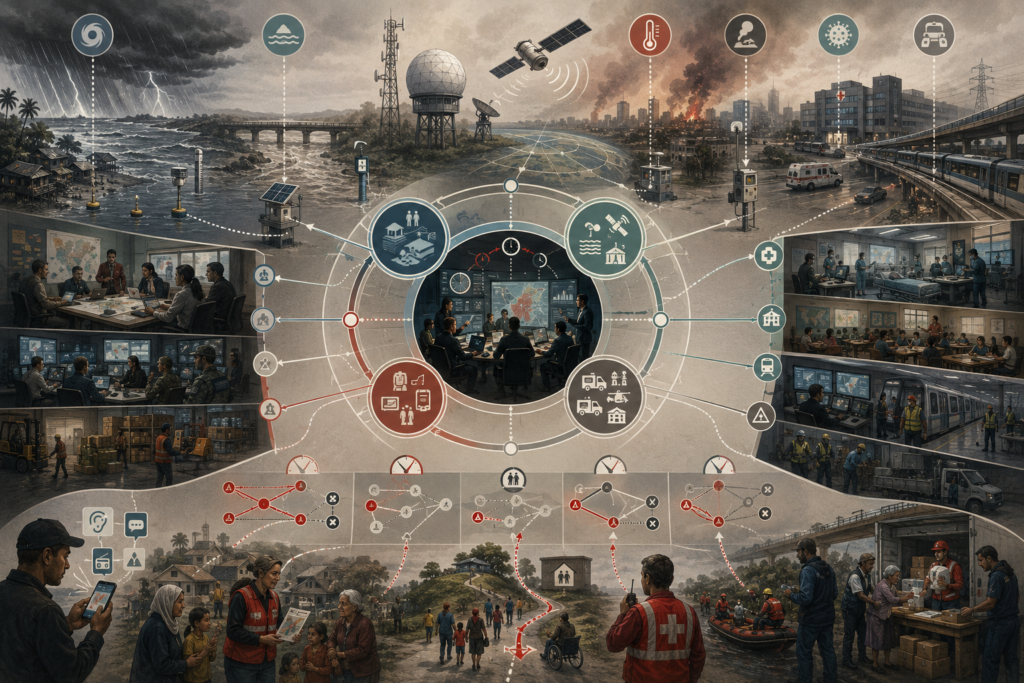
Early Warning Systems and Preparedness

Early warning systems and preparedness belong together because warnings reduce harm only when they are connected to trusted communication, practical readiness, institutional protocols, and timely action. A forecast may be accurate and still fail if people do not receive it, understand it, trust it, or have the resources to act. This article examines early warning as both decision infrastructure and preparedness infrastructure, linking risk knowledge, monitoring, forecasting, communication, response capacity, household readiness, community trust, and institutional coordination. It shows why preparedness is the missing link between warning and protection, especially under climate risk, compound hazards, uncertainty, false alarms, missed alarms, cognitive stress, and unequal access. Effective warning systems do not merely detect danger earlier; they preserve decision time, reduce confusion, support vulnerable communities, and make early protective action possible before crisis becomes irreversible harm.

Editorial illustration of resilience governance showing adaptive institutions, accountability, public oversight, community participation, infrastructure systems, and vulnerable communities connected through feedback loops and civic decision-making.

Resilience Governance, Accountability, and Public Legitimacy

Resilience governance, accountability, and public legitimacy belong together because institutions cannot build resilience through technical capacity alone. In complex societies, resilience depends on whether public institutions can anticipate disruption, coordinate across sectors, learn from feedback, protect vulnerable communities, explain decisions, accept responsibility, and maintain trust under uncertainty. This article reframes adaptive governance around a broader public question: how can societies adapt to risk without drifting into technocracy, emergency exceptionalism, or unaccountable discretion? It examines accountability, public legitimacy, institutional learning, transparency, participation, justice, climate adaptation, polycentric coordination, and trust as core resilience capacities. Resilient governance is not only flexible; it must be answerable, reviewable, fair, corrective, and publicly legitimate enough to sustain collective action before, during, and after disruption.

Editorial illustration of risk governance showing adaptive institutions, public participation, cross-sector coordination, hazard monitoring, and feedback loops linking vulnerable communities, infrastructure, and decision-making systems.

Risk Governance and Adaptive Institutions

Risk governance and adaptive institutions concern how societies organize knowledge, authority, participation, coordination, and learning under uncertainty. In complex societies, risk is rarely a narrow technical problem; it moves through infrastructure, finance, climate systems, public health, technology, law, social vulnerability, and institutional trust. This article examines why resilience depends not only on expert assessment, but on institutions capable of framing risks well, engaging affected communities, coordinating across sectors, communicating uncertainty, learning from failure, and revising policy as conditions change. It connects systemic risk, stakeholder participation, legitimacy, justice, climate resilience, institutional memory, and adaptive governance to show why societies need more than static risk-management plans. Strong risk governance does not eliminate uncertainty; it builds the public capacity to act responsibly within it while protecting vulnerable communities and preserving trust.

Scroll to Top