
Last Updated May 8, 2026
Digital twins, sensing, and infrastructure resilience belong together because resilient infrastructure increasingly depends on the ability to observe, interpret, simulate, and govern complex systems under stress. Physical robustness still matters: bridges, grids, water systems, hospitals, roads, ports, communications networks, and public facilities must be designed and maintained well. But infrastructure resilience now also depends on information quality, model validity, cyber trust, institutional coordination, and the ability to translate signals into timely decisions. A resilient system is not only one that is strong. It is one that can detect deterioration, anticipate disruption, understand interdependence, and support action before local stress becomes cascading failure.
Digital twins are therefore not simply impressive visual models or technological branding. At their best, they are sensing-linked, model-based decision systems that connect physical assets, operational data, simulation, risk analysis, maintenance planning, climate adaptation, and emergency response. Their resilience value lies in the relationship between observation and action. A digital twin that merely displays infrastructure is limited. A digital twin that helps identify anomalies, test scenarios, prioritize maintenance, map dependencies, evaluate recovery options, and support accountable decisions becomes part of the infrastructure resilience architecture itself.
Main Library
Publications
Article Map
Risk & Resilience
Related Topic
Intelligent Infrastructure
Related Topic
Monitoring Systems
Related Topic
Technology & Systems
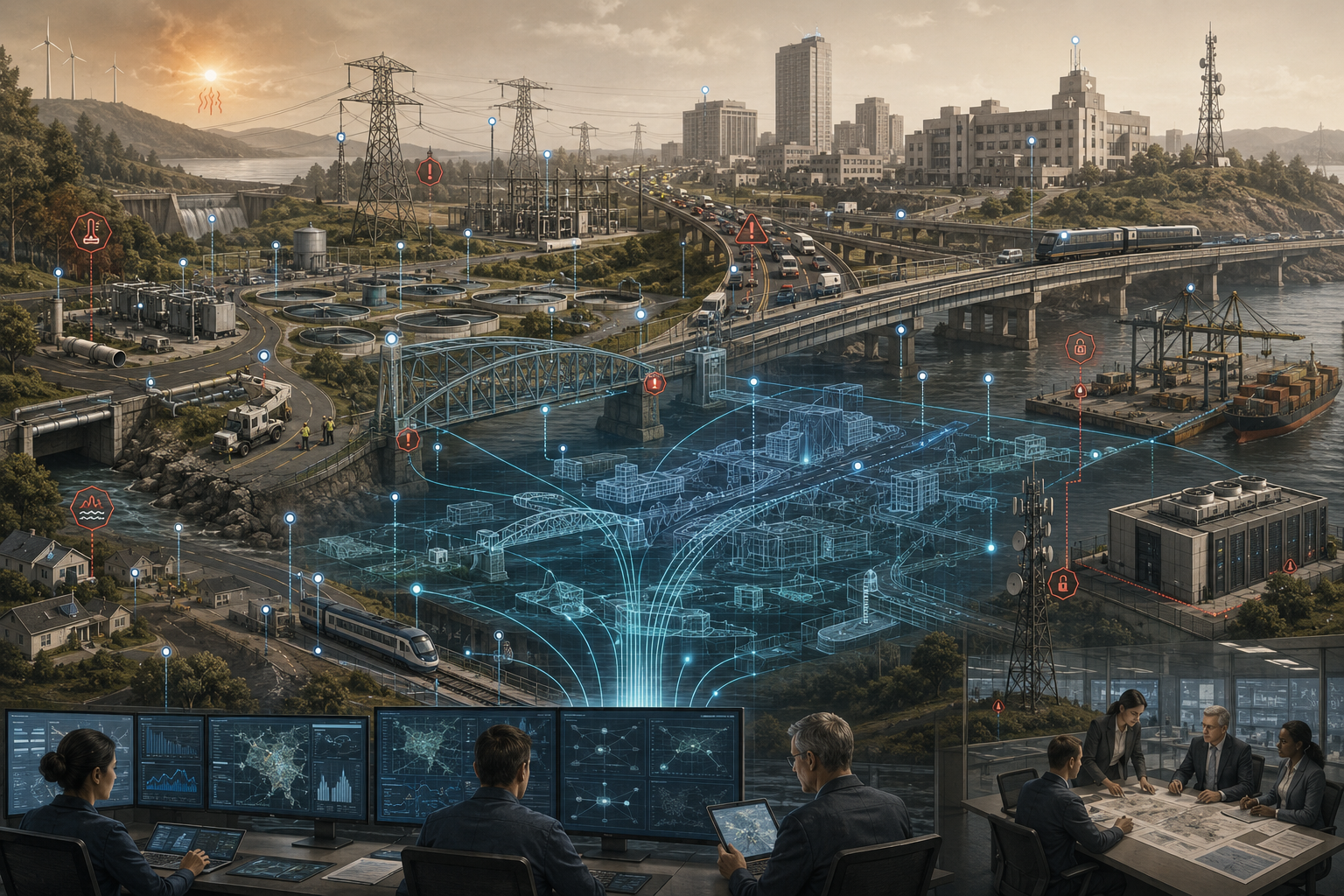
Critical infrastructure now operates under pressure from aging assets, climate extremes, cyber risk, fiscal constraint, urban growth, supply-chain dependency, and public expectations for uninterrupted service. Infrastructure failure is rarely only physical. It can be informational, institutional, digital, financial, social, or ecological. Operators may not see deterioration early enough. Agencies may not understand dependencies across sectors. Public institutions may lack the data, models, authority, or trust needed to act before thresholds are crossed. Digital twins and sensing systems matter because they can help close that gap between system condition and system knowledge.
Why This Topic Matters
This topic matters because infrastructure resilience increasingly depends on information quality as much as physical strength. Systems fail not only because concrete cracks, pipes rupture, grids overload, roads flood, or software is attacked. They also fail because operators lack visibility into emerging conditions, planners underestimate interdependence, agencies rely on outdated assumptions, data systems are fragmented, or warning signals do not translate into timely decisions.
Infrastructure systems are also becoming more complex. Energy systems depend on digital controls, weather forecasts, fuel markets, transmission networks, storage, demand response, and cyber-secure coordination. Water systems depend on pumps, sensors, treatment chemicals, watersheds, electricity, pipe networks, public finance, and land-use decisions. Transport systems depend on roads, bridges, ports, rail, traffic systems, logistics platforms, fuel, labor, and weather conditions. Hospitals depend on electricity, water, communications, supply chains, staffing, pharmaceuticals, data systems, and emergency access. Resilience therefore requires more than strengthening individual assets. It requires understanding relationships.
Digital twins and sensing systems can help make those relationships visible. Sensors provide streams of information about physical conditions. Digital twins organize that information into models, simulations, operational representations, and decision-support systems. Together, they can help operators detect anomalies, monitor degradation, test scenarios, identify failure pathways, plan maintenance, and anticipate service disruption.
But the topic matters for another reason: digital twins can also create new vulnerabilities. Sensing-rich systems expand data dependencies. Cyber-physical integration can create attack surfaces. Poorly validated models can produce false confidence. Proprietary platforms can create lock-in. Data gaps can reproduce inequality. Automated recommendations can obscure accountability. A digital twin that is inaccurate, insecure, or disconnected from governance may weaken resilience rather than strengthen it.
The real question, then, is not whether digital twins are innovative. The question is whether they improve the capacity of infrastructure systems to preserve function under disturbance. Their value depends on whether they are trustworthy, validated, secure, governable, equitable, and connected to real decisions.
What Digital Twins Are
A digital twin is a digitally represented counterpart of a physical asset, process, environment, organization, or system that is linked to relevant data and used for monitoring, analysis, simulation, prediction, or decision support. In infrastructure contexts, a digital twin may represent a bridge, building, water network, energy grid, rail system, port, airport, hospital, industrial facility, urban district, watershed, or entire city-scale system of systems.
The simplest misunderstanding is to treat a digital twin as a three-dimensional model. A visual representation may be part of a digital twin, but visualization alone is not the core. The core is the relationship between the represented system, the data streams that update the representation, the models that interpret behavior, and the decisions that the twin supports. A static model is not enough. A dashboard is not enough. A digital replica is not enough. The resilience value emerges when the twin helps users understand system state, evaluate possible futures, and choose better interventions.
Digital twins vary widely in sophistication. Some are descriptive: they show current or recent system conditions. Some are diagnostic: they help explain why performance has changed. Some are predictive: they estimate what may happen under future operating conditions. Some are prescriptive: they evaluate possible actions and recommend interventions. Infrastructure resilience usually requires movement from description toward diagnosis, prediction, and action, while preserving humility about model uncertainty.
Digital twins also depend on model validation. If the twin does not represent the real system accurately enough for its intended purpose, it may produce misleading conclusions. A model used for visualization has different requirements from a model used for emergency operations, structural assessment, maintenance planning, flood response, or cyber-physical risk management. Good digital twin practice therefore begins with the question: what decision is this twin meant to improve?
For resilience, that decision-centered framing is essential. A twin should not exist merely because infrastructure can be digitized. It should exist because a particular system needs better monitoring, earlier warning, maintenance prioritization, scenario testing, dependency mapping, climate adaptation, emergency response, public accountability, or lifecycle governance.
Sensing as Resilience Infrastructure
Sensing is the foundation that allows infrastructure systems to become more observable. Sensors can measure temperature, vibration, strain, flow, pressure, water quality, air quality, traffic, load, occupancy, energy demand, structural movement, soil moisture, rainfall, corrosion, equipment performance, or other operational conditions. In digital twin systems, sensor data can update the model so that the represented system reflects changing conditions rather than remaining a static design file.
This is resilience-relevant because many infrastructure failures develop gradually before they become visible as crises. Pipes degrade, bridges fatigue, pumps vibrate abnormally, substations overheat, slopes become unstable, drainage capacity is exceeded, building systems drift from expected performance, and cyber-physical anomalies appear in operational data. Without sensing, these signals may remain hidden until service interruption occurs. With better sensing, some failures can be detected earlier, maintained sooner, or managed before they cascade.
Sensing also changes the timescale of infrastructure governance. Traditional infrastructure management often relies on periodic inspection, historical records, design assumptions, and scheduled maintenance. Those practices remain important, but sensing can provide more continuous information. It can help reveal how infrastructure behaves under real operating conditions, not only how it was expected to behave when designed. That distinction matters in a world of climate stress, aging assets, changing demand, and complex interdependence.
However, sensing is not the same as understanding. Sensors can produce overwhelming quantities of data without improving decisions. Data may be noisy, incomplete, biased, poorly calibrated, inaccessible, or disconnected from institutional workflows. A sensor network can create visibility for some neighborhoods and leave others unmonitored. It can measure what is easy rather than what is important. It can detect anomalies without clarifying responsibility. It can also create privacy and surveillance concerns if deployed without public governance.
Sensing becomes resilience infrastructure only when it is purposeful, maintained, validated, secure, and connected to decisions. The question is not simply whether a system has sensors. The question is whether sensing improves the ability to preserve critical function, protect people, reduce vulnerability, and act before disturbance becomes failure.
The Infrastructure Resilience Problem
Infrastructure resilience is the capacity of infrastructure systems to prevent, absorb, withstand, recover from, adapt to, and sometimes transform after disruption while preserving essential services. This includes physical assets, digital systems, institutions, workers, financing, supply chains, users, and communities. Infrastructure is not resilient simply because individual components are strong. It is resilient when critical functions continue under stress or recover quickly and fairly after interruption.
The infrastructure resilience problem is difficult because infrastructure systems are long-lived, capital-intensive, interdependent, and exposed to changing risk. Roads, bridges, tunnels, pipes, power plants, transmission lines, treatment facilities, public buildings, ports, and housing systems may remain in service for decades. They are often designed under assumptions that later become outdated. Climate conditions shift. Urban populations grow. Cyber threats evolve. Materials age. Maintenance is deferred. Land-use patterns change. Public budgets tighten. Social vulnerability deepens.
Digital twins can help address this problem by connecting asset condition, system performance, risk exposure, and decision-making. A water utility may use sensing and modeling to identify pressure anomalies, leakage patterns, pump stress, treatment performance, and service vulnerability. A transport agency may use a twin to monitor congestion, bridge conditions, flood exposure, and emergency access. An energy operator may use one to simulate demand, distributed generation, weather hazards, and grid stress. A city may use digital twin methods to understand how heat, mobility, energy, housing, and emergency response interact.
But infrastructure resilience is not solved by better modeling alone. A digital twin cannot replace maintenance budgets, skilled workers, public accountability, emergency planning, democratic oversight, ecological restoration, or social protection. It can support those functions only when institutions are capable of acting on what the twin reveals.
The resilience problem therefore sits at the intersection of technology and governance. Digital twins can make infrastructure more legible, but legibility must be translated into responsibility. If no one has the authority, resources, trust, or mandate to intervene, better information may simply document decline more precisely.
Monitoring, Anomaly Detection, and Situational Awareness
One of the clearest resilience uses for digital twins is improved situational awareness. Situational awareness means understanding what is happening, where it is happening, why it may be happening, and what may happen next. In infrastructure systems, that can involve monitoring asset condition, system load, environmental stress, operational performance, service disruptions, and emerging anomalies.
Anomaly detection is especially important. A pump vibrating outside its normal pattern, a bridge sensor recording unusual movement, a pressure drop in a water network, a sudden change in power demand, an unexpected traffic pattern, or unusual communication between control systems may indicate a developing problem. A digital twin can help compare real-time data against expected behavior and identify deviations that require attention.
This does not mean every anomaly is a crisis. Infrastructure systems are noisy. Data streams contain errors. Sensors fail. Environmental conditions vary. Human judgment remains necessary. But anomaly detection can help operators move from reactive maintenance to earlier intervention. It can also help distinguish normal variation from meaningful warning signals.
Situational awareness matters most during compound events. A storm may affect roads, power, telecommunications, drainage, hospitals, emergency response, and vulnerable households at the same time. A digital twin that integrates multiple data layers may help decision-makers identify where service continuity is at risk, which routes remain available, which assets are overloaded, which neighborhoods are exposed, and which interventions should be prioritized.
The key resilience benefit is time. Earlier detection creates more time for repair, rerouting, communication, evacuation, backup activation, load reduction, or service prioritization. Time is one of the most important resources in risk governance. Digital twins and sensing systems are valuable when they create usable decision time.
Digital Twins as Decision Support, Not Just Visualization
Digital twins should be understood as decision-support systems rather than visual showcases. A visually impressive twin may attract attention, but its public value depends on whether it improves decisions. Can it help prioritize maintenance? Can it test a climate scenario? Can it identify dependencies? Can it support emergency operations? Can it reveal inequitable service exposure? Can it help compare investments? Can it improve recovery planning? Can it make trade-offs visible?
Decision support requires more than data display. It requires models, assumptions, uncertainty ranges, validation, user workflows, governance processes, and clear links to action. A digital twin should help answer questions such as: What assets are most vulnerable? Which failures would cascade? Which interventions reduce risk most effectively? Which communities would lose service first? Which maintenance backlog creates the greatest service risk? Which adaptation pathway is robust across multiple climate futures? What happens if power, transport, and communications fail together?
This is where simulation becomes important. Infrastructure resilience depends on possible futures, not only current states. A digital twin may allow planners to explore scenarios: heat waves, floods, cyber incidents, traffic disruptions, power outages, asset failures, population growth, demand spikes, or emergency response constraints. Scenario analysis does not eliminate uncertainty, but it can make assumptions explicit and reveal vulnerabilities before real-world stress exposes them.
Decision support also requires organizational trust. Operators must understand how the model works well enough to use it responsibly. Public officials must know what confidence to place in its outputs. Communities must know how data about them is being used. Engineers must be able to challenge assumptions. Emergency managers must know when digital recommendations should be overridden. A digital twin that no one trusts will not guide action. A digital twin that people trust too much can create automation bias.
The best use of digital twins is therefore disciplined and humble. They should strengthen human and institutional judgment, not replace it. Their role is to make complex systems more understandable, possible futures more testable, and decisions more accountable.
Predictive Maintenance and Lifecycle Asset Management
Predictive maintenance is one of the most practical applications of digital twins and sensing systems. Instead of relying only on fixed maintenance schedules or visible breakdowns, predictive maintenance uses data to estimate when components are likely to degrade, fail, or require intervention. In infrastructure systems, this can help target limited resources toward assets where failure risk is rising and service consequences are serious.
This matters because deferred maintenance is a major source of hidden fragility. Infrastructure often fails not because risk was completely unknown, but because deterioration accumulated gradually without adequate investment, visibility, or institutional urgency. Cracks, corrosion, fatigue, leakage, sedimentation, outdated software, spare-parts shortages, and workforce gaps can all accumulate in ways that remain politically invisible until disruption occurs. A sensing-linked twin can help bring some of that hidden deterioration into view.
Lifecycle asset management connects maintenance to long-term resilience. Infrastructure systems should not be evaluated only at the moment of construction. They must be monitored, repaired, upgraded, adapted, and eventually replaced. Digital twins can support lifecycle thinking by preserving asset histories, tracking condition changes, comparing performance across time, and connecting maintenance decisions to service risk.
Predictive maintenance also supports financial prioritization. Public agencies and utilities often face large maintenance backlogs and limited budgets. A digital twin can help distinguish assets that are merely old from assets whose failure would create serious service disruption, safety risk, environmental harm, or inequitable impacts. That distinction matters because resilience investment should be targeted by function and consequence, not only by asset age.
However, predictive maintenance can be misused. Models may underpredict failure in poorly sensed areas. Data may be better for high-value assets than marginalized communities. Algorithms may prioritize easily measured assets over socially critical ones. Cost-optimization tools may recommend maintenance deferral if social harm is not included in the objective function. Predictive maintenance therefore needs public-value criteria, not only technical efficiency.
A resilience-centered maintenance system asks not simply “What asset is likely to fail?” but “What function would fail, who would be harmed, how quickly could service be restored, and what intervention best protects public value?”
Interdependence and System-of-Systems Resilience
Infrastructure systems are interconnected. Energy systems support water treatment, hospitals, communications, traffic signals, data centers, fuel distribution, and emergency response. Transport systems support food delivery, medical access, workforce mobility, supply chains, evacuation, and repair crews. Digital systems support logistics, finance, public administration, industrial control, identity systems, and communications. Ecological systems support flood absorption, water quality, heat reduction, soil stability, and coastal protection.
Digital twins can be especially useful when they help represent these interdependencies. A twin of one asset may be valuable, but a system-of-systems twin can reveal how failure propagates across sectors. For example, a flood model connected to transport, energy, hospitals, and emergency services may show that a physically undamaged hospital is still at risk if access roads flood or power backup fails. A power-system twin connected to water infrastructure may show which pumping stations depend on vulnerable substations. A city twin connected to heat, housing, health, and energy demand may show where heat waves create compound risk.
Interdependence is where resilience becomes more than asset management. It becomes systems governance. Failures cascade when the output of one system becomes the input of another. Digital twins can help map these relationships, but doing so requires data sharing, common standards, institutional cooperation, and trust among agencies, utilities, firms, and communities.
The system-of-systems perspective also prevents false confidence. A bridge may be structurally sound, but if surrounding roads flood, it cannot provide mobility. A data center may have backup power, but if fuel supply fails, backup duration is limited. A water facility may operate well, but if upstream land-use change increases sediment or contamination, treatment stress rises. A port may remain open, but if inland logistics fail, supply-chain function is disrupted.
Infrastructure resilience therefore depends on functional continuity across connected systems. Digital twins can help reveal those functional relationships, but only if the twin is designed around interdependence rather than isolated assets.
Climate Risk, Nonstationarity, and Adaptive Infrastructure
Climate change makes digital twins more important because infrastructure must operate under changing environmental conditions. Many infrastructure systems were designed using historical climate data: rainfall patterns, flood zones, temperature ranges, storm intensity, sea levels, soil moisture, river flows, wind loads, wildfire regimes, and demand patterns. But those historical baselines are becoming less reliable. Climate risk is increasingly nonstationary, meaning the probability structure itself is changing.
Digital twins can support climate resilience by connecting infrastructure condition to environmental monitoring, hazard models, exposure maps, and adaptation scenarios. A drainage-system twin may test how rainfall extremes affect flood risk. A grid twin may simulate heat-driven demand spikes and wildfire exposure. A transport twin may assess road vulnerability to flooding, heat deformation, or slope failure. A coastal infrastructure twin may evaluate sea-level rise, storm surge, erosion, and retreat options.
This is not simply a technical exercise. Climate adaptation involves uncertainty, trade-offs, public finance, land-use decisions, equity, and intergenerational responsibility. A digital twin can make some choices clearer, but it cannot decide what level of risk is acceptable, whose homes should be protected, which assets should be relocated, or how costs should be shared. Those are governance questions.
Still, digital twins can improve adaptation by supporting adaptive pathways. Instead of designing once for a single predicted future, planners can monitor conditions, update assumptions, phase investments, and revise decisions as evidence changes. This is especially useful where uncertainty is high and infrastructure decisions are difficult to reverse.
Climate resilience also requires attention to ecological infrastructure. Wetlands, forests, watersheds, soils, reefs, floodplains, and urban tree systems can reduce risk. Digital twin approaches should not be limited to built assets. They can also help model ecosystem services, land-use interactions, flood storage, heat reduction, water quality, and biodiversity-related resilience. The strongest infrastructure resilience strategies often combine engineered systems, digital sensing, ecological buffers, and public governance.
The climate lesson is clear: infrastructure can no longer be designed only for yesterday’s averages. Digital twins can help institutions learn, adapt, and update risk assumptions as the operating environment changes.
Security, Trust, and Cyber-Physical Risk
Digital twins introduce cyber-physical risk because they connect data, models, sensors, operational systems, and decisions. A twin that supports infrastructure operations may become part of the system’s risk surface. If its data are corrupted, its models manipulated, its access controls weak, or its recommendations trusted without verification, the twin can become a source of vulnerability.
Cybersecurity is therefore not an add-on. It is part of resilience design. Digital twins require secure data transmission, identity and access management, audit trails, model integrity checks, segmentation, backup procedures, incident response planning, and governance over third-party vendors. They also require clarity about which systems are connected to operational control and which are used only for planning or analysis.
Trustworthiness includes more than cybersecurity. It includes data quality, model validation, transparency, documentation, uncertainty communication, and accountability. Users should know what the twin can and cannot do. They should understand the limits of the data. They should know whether outputs are estimates, predictions, simulations, or recommendations. They should be able to challenge the model when local knowledge or engineering judgment indicates a problem.
Digital twins can also create dependency risk. If an agency becomes dependent on a proprietary platform, specialized vendor, closed data format, or poorly documented model, it may lose institutional capacity. Vendor lock-in can become resilience risk when public systems cannot maintain, audit, migrate, or independently verify their digital infrastructure. Open standards, interoperability, public procurement safeguards, and internal technical capacity are therefore part of resilience governance.
Cyber-physical risk becomes especially serious when digital twins interact with critical infrastructure operations. A compromised model may mislead operators. A false signal may trigger unnecessary intervention. A hidden data gap may conceal deterioration. A cyber incident may disrupt monitoring during an emergency. A digital twin meant to improve resilience can undermine it if the twin itself lacks resilience.
The practical conclusion is simple: digital twins must be designed as critical knowledge infrastructure. Their security, integrity, maintainability, and governance deserve the same seriousness as the physical systems they represent.
Data Governance, Public Accountability, and Institutional Capacity
Digital twins depend on data governance. Infrastructure data may involve public assets, private utilities, contractors, sensors, satellite imagery, operational technology, geospatial systems, environmental monitoring, user behavior, emergency services, and community-level exposure. Without clear governance, digital twin systems can become fragmented, opaque, inequitable, or unaccountable.
Data governance must answer practical questions. Who owns the data? Who can access it? Who validates it? Who maintains it? How are errors corrected? What privacy protections apply? How long are data retained? What standards support interoperability? How are communities informed? How are public-interest uses distinguished from surveillance or commercial extraction? What happens when vendors change? What happens when model outputs influence public decisions?
Public accountability matters because infrastructure decisions affect people’s lives. A digital twin may influence where maintenance occurs, which neighborhoods receive flood protection, how emergency response is prioritized, or which assets are deemed expendable. These decisions cannot be left entirely to technical systems. They require public reasoning, transparent criteria, democratic oversight, and attention to unequal vulnerability.
Institutional capacity is equally important. A city or utility may acquire sophisticated digital tools but lack staff, training, budget, procurement expertise, cybersecurity capacity, or interagency coordination to use them well. Digital twins can widen the gap between wealthy, technologically advanced institutions and under-resourced communities if implementation capacity is uneven. That creates a risk of digital resilience inequality: some places become more observable and adaptive, while others remain invisible.
A resilient digital twin program should therefore build local and institutional capability. It should train public staff, support cross-agency coordination, use interoperable standards, document models, preserve public access where appropriate, protect sensitive information, and include community knowledge. Infrastructure resilience is strengthened when digital systems expand institutional learning rather than replace it with black-box dependency.
The deeper principle is that data systems are governance systems. Digital twins do not merely represent infrastructure. They shape what institutions see, value, prioritize, and act upon.
Limits, Risks, and Cautions
Digital twins are not magic representations of reality. Their usefulness depends on data quality, model validity, operational relevance, governance clarity, maintenance, cybersecurity, and decision fit. A twin built from poor data can mislead. A model validated for one purpose may be inappropriate for another. A beautiful visualization may conceal weak assumptions. A real-time dashboard may create urgency without understanding. A predictive model may understate uncertainty.
One risk is false precision. Digital systems can make estimates appear more certain than they are. Maps, dashboards, simulations, and risk scores may look authoritative even when underlying data are incomplete or uncertain. Infrastructure governance must therefore communicate uncertainty clearly. Decision-makers should understand confidence intervals, model limitations, missing data, and conditions under which outputs should not be trusted.
Another risk is surveillance. Sensing systems deployed in cities, transport networks, buildings, and public spaces may collect data about people as well as infrastructure. Resilience cannot become a justification for unaccountable monitoring. Privacy, civil liberties, community consent, and proportionality matter, especially in marginalized communities that may already experience unequal surveillance.
A third risk is inequitable coverage. High-value districts, major assets, and wealthy jurisdictions may receive better sensing and modeling than poorer areas. If digital twins are used to allocate maintenance or protection, data-rich places may receive more attention while data-poor places remain neglected. This can reproduce infrastructural inequality.
A fourth risk is technological distraction. Institutions may invest in digital twins while underfunding basic maintenance, workforce capacity, emergency planning, or community resilience. Digital twins should not become a substitute for fixing pipes, strengthening bridges, upgrading drainage, protecting workers, restoring ecosystems, or building public trust.
A fifth risk is cyber dependence. As infrastructure knowledge becomes more digital, the systems that hold that knowledge become critical. They must be secured, backed up, audited, and recoverable.
The strongest digital twin programs treat these cautions as design requirements. They do not ask, “How can we digitize everything?” They ask, “What information, models, and governance arrangements are necessary to protect essential services fairly under stress?”
Design Principles for Resilient Digital Twin Systems
A resilient digital twin system should begin with purpose. The first question should be: what resilience decision is the twin meant to improve? Maintenance prioritization, flood response, cyber-physical monitoring, grid planning, emergency routing, asset lifecycle management, climate adaptation, and public accountability are different purposes. Each requires different data, models, validation, workflows, and governance.
The second principle is data quality. Sensors must be calibrated, maintained, documented, and checked. Missing data must be visible. Data lineage should be preserved. Users should know where data came from, when it was updated, and how reliable it is.
The third principle is model validation. Digital twins should be tested against observed conditions, expert judgment, historical events, stress scenarios, and known failure modes. Validation should be appropriate to the twin’s decision role. A planning model and an operational emergency model require different levels of confidence.
The fourth principle is interoperability. Infrastructure systems cross institutional and technical boundaries. Digital twins should use standards, open formats where possible, and architectures that allow data exchange across agencies, utilities, researchers, and emergency managers without creating unnecessary lock-in.
The fifth principle is cybersecurity and trust. Digital twin systems should be designed with security, access controls, auditability, backup, and incident response from the beginning. Trustworthiness should include data integrity, model transparency, uncertainty communication, and accountability.
The sixth principle is equity. Sensing and modeling should not only protect high-value assets. They should identify vulnerable communities, service gaps, accessibility barriers, and unequal exposure. Public value should be built into the objective function.
The seventh principle is connection to action. A twin that produces insight without authority, funding, or operational workflow will not improve resilience. Digital twin outputs should connect to maintenance schedules, emergency protocols, adaptation planning, capital investment, public communication, and institutional learning.
The final principle is lifecycle governance. Digital twins must be maintained just like infrastructure assets. Sensors degrade, models become outdated, software changes, climate conditions shift, and institutional needs evolve. A digital twin that is not updated can become a misleading historical artifact. Resilient digital twin systems are living governance tools, not one-time digital products.
Mathematical Lens
Digital twin resilience value can be represented as a function of sensing coverage, data quality, model validity, decision integration, and governance capacity, reduced by cyber risk and model uncertainty. Let \(R_t\) represent digital-twin resilience contribution, \(S_c\) sensing coverage, \(D_q\) data quality, \(M_v\) model validity, \(I_d\) decision integration, \(G_c\) governance capacity, \(C_r\) cyber risk, and \(U_m\) model uncertainty:
R_t = \alpha S_c + \beta D_q + \gamma M_v + \delta I_d + \epsilon G_c – \lambda C_r – \mu U_m
\]
Interpretation: A digital twin contributes to resilience when it improves sensing, data quality, model validity, decision integration, and governance capacity, but its value is reduced when cyber risk and model uncertainty are high.
This equation captures the article’s central claim: the resilience value of a digital twin does not come from digitization alone. It comes from trustworthy observation, validated interpretation, and connection to action.
We can also define infrastructure situational awareness:
A_i = \theta S_c + \kappa T_r + \rho D_v + \omega E_w
\]
Interpretation: Infrastructure awareness increases when sensing coverage is strong, data are timely, dependencies are visible, and warning signals are connected to operational response.
Here, \(T_r\) is timeliness of reporting, \(D_v\) is dependency visibility, and \(E_w\) is early-warning usefulness.
Finally, digital-twin implementation risk can be expressed as:
Q_r = \eta P_d + \zeta B_m + \chi L_v + \tau O_g
\]
Interpretation: Implementation risk rises when platform dependency, model bias, low validation, and weak operational governance are present.
| Term | Meaning | Interpretive role |
|---|---|---|
| \(R_t\) | Digital-twin resilience contribution | Represents the extent to which a digital twin improves infrastructure resilience. |
| \(S_c\) | Sensing coverage | Represents how well critical assets, hazards, and service conditions are observed. |
| \(D_q\) | Data quality | Represents accuracy, completeness, calibration, timeliness, and reliability of data. |
| \(M_v\) | Model validity | Represents whether the twin is fit for the decision it is meant to support. |
| \(I_d\) | Decision integration | Represents whether twin outputs are connected to operational decisions. |
| \(G_c\) | Governance capacity | Represents institutional ability to maintain, audit, secure, and act on the twin. |
| \(C_r\) | Cyber risk | Represents exposure to compromise, manipulation, outage, or trust failure. |
| \(U_m\) | Model uncertainty | Represents uncertainty, error, incompleteness, or inappropriate model use. |
| \(A_i\) | Infrastructure situational awareness | Represents the ability to understand system state and emerging risk. |
| \(Q_r\) | Digital-twin implementation risk | Represents risk created by weak validation, bias, platform dependency, or poor governance. |
The equations are conceptual rather than predictive. Their value is to make visible the structure of digital twin resilience: sensing, data, models, governance, security, and decision integration must be interpreted together.
Advanced Python Workflow: Digital Twin Resilience Scoring
This Python workflow models the resilience contribution and implementation risk of digital twin systems by combining sensing coverage, data quality, model validation, decision integration, dependency visibility, maintenance usefulness, climate adaptation usefulness, cyber risk, platform dependency, equity coverage, and governance capacity.
from __future__ import annotations

import pandas as pd
import numpy as np

INPUT_FILE = "digital_twin_infrastructure_panel.csv"
OUTPUT_FILE = "digital_twin_resilience_scores.csv"


def load_data(path: str) -> pd.DataFrame:
    """
    Load an infrastructure digital twin assessment dataset.

    All *_index columns should be normalized to [0, 1].
    Higher values should mean more of the named property.

    Examples:
      - sensing_coverage_index: higher = better sensing coverage
      - data_quality_index: higher = stronger data quality
      - cyber_risk_index: higher = greater cyber risk
      - governance_capacity_index: higher = stronger institutional governance
    """
    df = pd.read_csv(path)

    required_columns = [
        "system_name",
        "sector",
        "infrastructure_type",
        "sensing_coverage_index",
        "data_quality_index",
        "data_timeliness_index",
        "model_validation_index",
        "decision_integration_index",
        "dependency_visibility_index",
        "predictive_maintenance_usefulness_index",
        "climate_adaptation_usefulness_index",
        "service_continuity_relevance_index",
        "cyber_risk_index",
        "platform_dependency_index",
        "model_uncertainty_index",
        "equity_coverage_index",
        "governance_capacity_index",
        "public_accountability_index",
    ]

    missing = [col for col in required_columns if col not in df.columns]

    if missing:
        raise ValueError(f"Missing required columns: {missing}")

    return df


def validate_indices(df: pd.DataFrame) -> pd.DataFrame:
    """Validate that all *_index fields are complete and normalized to [0, 1]."""
    index_columns = [col for col in df.columns if col.endswith("_index")]

    for col in index_columns:
        if df[col].isna().any():
            raise ValueError(f"Column '{col}' contains missing values.")

        if ((df[col] < 0) | (df[col] > 1)).any():
            raise ValueError(f"Column '{col}' contains values outside [0, 1].")

    return df


def compute_scores(df: pd.DataFrame) -> pd.DataFrame:
    """
    Compute digital twin resilience contribution, implementation risk,
    and a resilience-readiness score.
    """
    df = df.copy()

    df["digital_twin_resilience_contribution"] = (
        0.13 * df["sensing_coverage_index"] +
        0.12 * df["data_quality_index"] +
        0.09 * df["data_timeliness_index"] +
        0.13 * df["model_validation_index"] +
        0.13 * df["decision_integration_index"] +
        0.10 * df["dependency_visibility_index"] +
        0.10 * df["predictive_maintenance_usefulness_index"] +
        0.08 * df["climate_adaptation_usefulness_index"] +
        0.06 * df["equity_coverage_index"] +
        0.06 * df["governance_capacity_index"]
    ).clip(lower=0, upper=1)

    df["digital_twin_implementation_risk"] = (
        0.18 * df["cyber_risk_index"] +
        0.15 * df["platform_dependency_index"] +
        0.15 * df["model_uncertainty_index"] +
        0.12 * (1 - df["model_validation_index"]) +
        0.12 * (1 - df["data_quality_index"]) +
        0.10 * (1 - df["governance_capacity_index"]) +
        0.09 * (1 - df["public_accountability_index"]) +
        0.09 * (1 - df["equity_coverage_index"])
    ).clip(lower=0, upper=1)

    df["resilience_readiness_score"] = (
        0.42 * df["digital_twin_resilience_contribution"] +
        0.22 * (1 - df["digital_twin_implementation_risk"]) +
        0.14 * df["service_continuity_relevance_index"] +
        0.12 * df["governance_capacity_index"] +
        0.10 * df["public_accountability_index"]
    ).clip(lower=0, upper=1)

    df["resilience_gap"] = (
        df["digital_twin_resilience_contribution"] -
        df["digital_twin_implementation_risk"]
    )

    df["readiness_band"] = np.select(
        [
            df["resilience_readiness_score"] >= 0.80,
            df["resilience_readiness_score"] >= 0.60,
            df["resilience_readiness_score"] >= 0.40,
        ],
        [
            "Strong digital twin resilience readiness",
            "Moderate digital twin resilience readiness",
            "Limited digital twin resilience readiness",
        ],
        default="Weak digital twin resilience readiness",
    )

    df["implementation_warning"] = np.select(
        [
            df["digital_twin_implementation_risk"] >= 0.75,
            df["digital_twin_implementation_risk"] >= 0.55,
            df["digital_twin_implementation_risk"] >= 0.35,
        ],
        [
            "Severe implementation and trust risk",
            "High implementation and trust risk",
            "Moderate implementation and trust risk",
        ],
        default="Lower implementation and trust risk",
    )

    return df


def build_summary(df: pd.DataFrame) -> pd.DataFrame:
    """Return a ranked summary table for digital twin resilience review."""
    columns = [
        "system_name",
        "sector",
        "infrastructure_type",
        "digital_twin_resilience_contribution",
        "digital_twin_implementation_risk",
        "resilience_readiness_score",
        "resilience_gap",
        "readiness_band",
        "implementation_warning",
    ]

    summary = df[columns].copy()

    summary = summary.sort_values(
        by=[
            "resilience_readiness_score",
            "digital_twin_resilience_contribution",
            "digital_twin_implementation_risk",
        ],
        ascending=[False, False, True],
    ).reset_index(drop=True)

    return summary


def main() -> None:
    df = load_data(INPUT_FILE)
    df = validate_indices(df)
    scored = compute_scores(df)
    summary = build_summary(scored)

    summary.to_csv(OUTPUT_FILE, index=False)

    print("Digital twin resilience scoring complete.")
    print(summary.to_string(index=False))


if __name__ == "__main__":
    main()
This workflow is intentionally transparent. It does not claim that digital twin resilience can be reduced to a single objective number. Instead, it makes assumptions visible: sensing coverage, data quality, model validation, decision integration, dependency visibility, predictive maintenance usefulness, climate adaptation usefulness, cyber risk, model uncertainty, platform dependency, equity coverage, governance capacity, and public accountability are treated as distinct components. The value of the model is diagnostic. It helps identify whether a digital twin system is strengthening infrastructure resilience or introducing new trust and implementation risks.
Advanced R Workflow: Sensing Coverage, Maintenance Risk, and Infrastructure Resilience
This R workflow compares digital twin resilience readiness across sectors and infrastructure types. It is useful for identifying where sensing coverage is strong, where data and model quality remain weak, where implementation risk is high, and where digital twins are most closely tied to service continuity, predictive maintenance, and climate adaptation.
library(readr)
library(dplyr)

input_file <- "digital_twin_infrastructure_panel.csv"
sector_output_file <- "digital_twin_sector_summary.csv"
infrastructure_output_file <- "digital_twin_infrastructure_type_summary.csv"

twin_df <- read_csv(input_file, show_col_types = FALSE)

required_cols <- c(
  "system_name",
  "sector",
  "infrastructure_type",
  "sensing_coverage_index",
  "data_quality_index",
  "data_timeliness_index",
  "model_validation_index",
  "decision_integration_index",
  "dependency_visibility_index",
  "predictive_maintenance_usefulness_index",
  "climate_adaptation_usefulness_index",
  "service_continuity_relevance_index",
  "cyber_risk_index",
  "platform_dependency_index",
  "model_uncertainty_index",
  "equity_coverage_index",
  "governance_capacity_index",
  "public_accountability_index"
)

missing_cols <- setdiff(required_cols, names(twin_df))

if (length(missing_cols) > 0) {
  stop(paste("Missing required columns:", paste(missing_cols, collapse = ", ")))
}

index_cols <- names(twin_df)[grepl("_index$", names(twin_df))]

invalid_index_cols <- index_cols[
  vapply(
    twin_df[index_cols],
    function(x) any(is.na(x) | x < 0 | x > 1),
    logical(1)
  )
]

if (length(invalid_index_cols) > 0) {
  stop(
    paste(
      "Index columns must be complete and normalized to [0, 1]:",
      paste(invalid_index_cols, collapse = ", ")
    )
  )
}

twin_df <- twin_df %>%
  mutate(
    resilience_contribution_proxy = (
      sensing_coverage_index +
        data_quality_index +
        data_timeliness_index +
        model_validation_index +
        decision_integration_index +
        dependency_visibility_index +
        predictive_maintenance_usefulness_index +
        climate_adaptation_usefulness_index +
        equity_coverage_index +
        governance_capacity_index
    ) / 10,
    implementation_risk_proxy = (
      cyber_risk_index +
        platform_dependency_index +
        model_uncertainty_index +
        (1 - model_validation_index) +
        (1 - data_quality_index) +
        (1 - governance_capacity_index) +
        (1 - public_accountability_index) +
        (1 - equity_coverage_index)
    ) / 8,
    resilience_readiness_proxy = (
      resilience_contribution_proxy +
        (1 - implementation_risk_proxy) +
        service_continuity_relevance_index +
        governance_capacity_index +
        public_accountability_index
    ) / 5,
    resilience_gap = resilience_contribution_proxy - implementation_risk_proxy,
    readiness_band = case_when(
      resilience_readiness_proxy >= 0.75 ~ "Strong digital twin resilience readiness",
      resilience_readiness_proxy >= 0.55 ~ "Moderate digital twin resilience readiness",
      resilience_readiness_proxy >= 0.35 ~ "Limited digital twin resilience readiness",
      TRUE ~ "Weak digital twin resilience readiness"
    )
  )

sector_summary <- twin_df %>%
  group_by(sector) %>%
  summarise(
    avg_resilience_readiness_proxy = mean(resilience_readiness_proxy, na.rm = TRUE),
    avg_resilience_contribution_proxy = mean(resilience_contribution_proxy, na.rm = TRUE),
    avg_implementation_risk_proxy = mean(implementation_risk_proxy, na.rm = TRUE),
    avg_sensing_coverage = mean(sensing_coverage_index, na.rm = TRUE),
    avg_data_quality = mean(data_quality_index, na.rm = TRUE),
    avg_model_validation = mean(model_validation_index, na.rm = TRUE),
    avg_decision_integration = mean(decision_integration_index, na.rm = TRUE),
    avg_dependency_visibility = mean(dependency_visibility_index, na.rm = TRUE),
    avg_predictive_maintenance_usefulness = mean(predictive_maintenance_usefulness_index, na.rm = TRUE),
    avg_climate_adaptation_usefulness = mean(climate_adaptation_usefulness_index, na.rm = TRUE),
    avg_cyber_risk = mean(cyber_risk_index, na.rm = TRUE),
    avg_equity_coverage = mean(equity_coverage_index, na.rm = TRUE),
    avg_public_accountability = mean(public_accountability_index, na.rm = TRUE),
    observations = n(),
    .groups = "drop"
  ) %>%
  mutate(
    sector_readiness_band = case_when(
      avg_resilience_readiness_proxy >= 0.75 ~ "Strong digital twin resilience readiness",
      avg_resilience_readiness_proxy >= 0.55 ~ "Moderate digital twin resilience readiness",
      avg_resilience_readiness_proxy >= 0.35 ~ "Limited digital twin resilience readiness",
      TRUE ~ "Weak digital twin resilience readiness"
    )
  ) %>%
  arrange(desc(avg_resilience_readiness_proxy))

infrastructure_type_summary <- twin_df %>%
  group_by(infrastructure_type) %>%
  summarise(
    avg_resilience_readiness_proxy = mean(resilience_readiness_proxy, na.rm = TRUE),
    avg_resilience_contribution_proxy = mean(resilience_contribution_proxy, na.rm = TRUE),
    avg_implementation_risk_proxy = mean(implementation_risk_proxy, na.rm = TRUE),
    avg_sensing_coverage = mean(sensing_coverage_index, na.rm = TRUE),
    avg_data_quality = mean(data_quality_index, na.rm = TRUE),
    avg_model_validation = mean(model_validation_index, na.rm = TRUE),
    avg_decision_integration = mean(decision_integration_index, na.rm = TRUE),
    avg_dependency_visibility = mean(dependency_visibility_index, na.rm = TRUE),
    avg_predictive_maintenance_usefulness = mean(predictive_maintenance_usefulness_index, na.rm = TRUE),
    avg_climate_adaptation_usefulness = mean(climate_adaptation_usefulness_index, na.rm = TRUE),
    avg_cyber_risk = mean(cyber_risk_index, na.rm = TRUE),
    avg_equity_coverage = mean(equity_coverage_index, na.rm = TRUE),
    avg_public_accountability = mean(public_accountability_index, na.rm = TRUE),
    observations = n(),
    .groups = "drop"
  ) %>%
  arrange(desc(avg_resilience_readiness_proxy))

write_csv(sector_summary, sector_output_file)
write_csv(infrastructure_type_summary, infrastructure_output_file)

cat("Digital twin sector summary exported to:", sector_output_file, "\n")
print(sector_summary)

cat("\nDigital twin infrastructure-type summary exported to:", infrastructure_output_file, "\n")
print(infrastructure_type_summary)
This workflow helps distinguish digital sophistication from resilience readiness. A system may have advanced sensing and visualization but weak model validation, poor governance, high platform dependency, high cyber risk, and limited public accountability. Conversely, a more modest twin may contribute strongly to resilience if it has reliable data, validated models, clear operational use, strong governance, and direct relevance to service continuity. The workflow therefore treats digital twins as socio-technical resilience systems rather than merely technical assets.
GitHub Repository
Complete Code Repository
The full code distribution for this article, including digital twin resilience scoring workflows, sensing coverage diagnostics, maintenance-risk summaries, SQL materials, optional infrastructure monitoring support tools, and supporting documentation, is available on GitHub.
Related Articles
- Environmental Monitoring as a Foundation of Resilience
- Infrastructure Governance and Critical System Protection
- Early Warning Systems and Decision Making Under Stress
- Adaptive Governance and Institutional Learning
- Stress Testing Sustainable Systems
- Why Resilience Requires Coordination Across Sectors
- Critical Infrastructure Resilience and Interdependent Systems
- Cyber Risk, Digital Dependency, and System Resilience
Further Reading
- National Institute of Standards and Technology (NIST) (2025) Security and Trust Considerations for Digital Twin Technology. Available at: https://nvlpubs.nist.gov/nistpubs/ir/2025/NIST.IR.8356.pdf
- National Institute of Standards and Technology (NIST) (2025) Digital Twins. Available at: https://www.nist.gov/digital-twins
- National Institute of Standards and Technology (NIST) (2026) Case Studies and Economics. Available at: https://www.nist.gov/digital-twins/case-studies-and-economics
- Organisation for Economic Co-operation and Development (OECD) (2025) Quantifying Digital Innovation for the Twin Transition. Paris: OECD. Available at: https://www.oecd.org/en/publications/quantifying-digital-innovation-for-the-twin-transition_8cc4cff0-en.html
- Organisation for Economic Co-operation and Development (OECD) (2025) Harnessing the Power of Geospatial Data, AI and Digital Twins. OECD Laboratory for Geospatial Analysis seminar materials. Available at: https://www.oecd.org/content/dam/oecd/en/about/programmes/the-oecd-laboratory-for-geospatial-analysis/Geospatial_Lab_seminar_2025_06_18_agenda_V00.pdf
- Boje, C., Guerriero, A., Kubicki, S. and Rezgui, Y. (2020) ‘Towards a semantic Construction Digital Twin: Directions for future research’, Automation in Construction, 114, 103179. Available at: https://doi.org/10.1016/j.autcon.2020.103179
- Tao, F., Zhang, H., Liu, A. and Nee, A.Y.C. (2019) ‘Digital twin in industry: State-of-the-art’, IEEE Transactions on Industrial Informatics, 15(4), pp. 2405–2415. Available at: https://doi.org/10.1109/TII.2018.2873186
- Fuller, A., Fan, Z., Day, C. and Barlow, C. (2020) ‘Digital twin: Enabling technologies, challenges and open research’, IEEE Access, 8, pp. 108952–108971. Available at: https://doi.org/10.1109/ACCESS.2020.2998358
References
- Boje, C., Guerriero, A., Kubicki, S. and Rezgui, Y. (2020) ‘Towards a semantic Construction Digital Twin: Directions for future research’, Automation in Construction, 114, 103179. Available at: https://doi.org/10.1016/j.autcon.2020.103179
- Fuller, A., Fan, Z., Day, C. and Barlow, C. (2020) ‘Digital twin: Enabling technologies, challenges and open research’, IEEE Access, 8, pp. 108952–108971. Available at: https://doi.org/10.1109/ACCESS.2020.2998358
- National Institute of Standards and Technology (NIST) (2025) Security and Trust Considerations for Digital Twin Technology. Available at: https://nvlpubs.nist.gov/nistpubs/ir/2025/NIST.IR.8356.pdf
- National Institute of Standards and Technology (NIST) (2025) Digital Twins. Available at: https://www.nist.gov/digital-twins
- National Institute of Standards and Technology (NIST) (2026) Case Studies and Economics. Available at: https://www.nist.gov/digital-twins/case-studies-and-economics
- Organisation for Economic Co-operation and Development (OECD) (2025) Quantifying Digital Innovation for the Twin Transition. Paris: OECD. Available at: https://www.oecd.org/en/publications/quantifying-digital-innovation-for-the-twin-transition_8cc4cff0-en.html
- Organisation for Economic Co-operation and Development (OECD) (2025) Harnessing the Power of Geospatial Data, AI and Digital Twins. OECD Laboratory for Geospatial Analysis seminar materials. Available at: https://www.oecd.org/content/dam/oecd/en/about/programmes/the-oecd-laboratory-for-geospatial-analysis/Geospatial_Lab_seminar_2025_06_18_agenda_V00.pdf
- Tao, F., Zhang, H., Liu, A. and Nee, A.Y.C. (2019) ‘Digital twin in industry: State-of-the-art’, IEEE Transactions on Industrial Informatics, 15(4), pp. 2405–2415. Available at: https://doi.org/10.1109/TII.2018.2873186