Sustainable Systems

Sustainable systems examine how social, economic, and environmental processes can be organized to support long-term stability and human well-being. Rather than treating environmental protection, economic development, and social equity as separate challenges, sustainable systems research emphasizes their deep interdependence.

The field integrates insights from sustainability science, systems theory, ecological economics, and public policy. Researchers analyze how resource use, technological development, governance structures, and social behavior interact within complex systems.

Designing sustainable systems requires understanding feedback loops, institutional incentives, and long-term environmental constraints. Effective systems must balance efficiency with resilience, innovation with stewardship, and economic opportunity with ecological limits.

By integrating interdisciplinary knowledge, sustainable systems approaches aim to create development pathways that maintain ecological integrity while supporting inclusive and resilient societies.

Editorial climate ethics illustration showing a central stewardship forum gathered around a planetary compass, with one side depicting wildfire, fossil industry, flooding, drought, displacement, and damaged infrastructure, and the other showing renewable energy, resilient cities, restoration, public transit, healthcare, community planning, and protection of future generations.

Stewardship and the Ethics of Climate Change

Stewardship matters for climate ethics because climate change is not only a scientific or policy problem. It is a moral question about how power should be exercised over conditions of life that are shared, vulnerable, and not fully replaceable. This article examines stewardship in relation to responsibility, restraint, unequal contribution, vulnerable populations, future generations, mitigation, adaptation, and institutional obligation under planetary risk. It argues that climate ethics requires more than technical management of emissions and impacts. It requires a deeper ethic of care, justice, and long-horizon responsibility for the atmospheric and ecological conditions on which collective life depends.
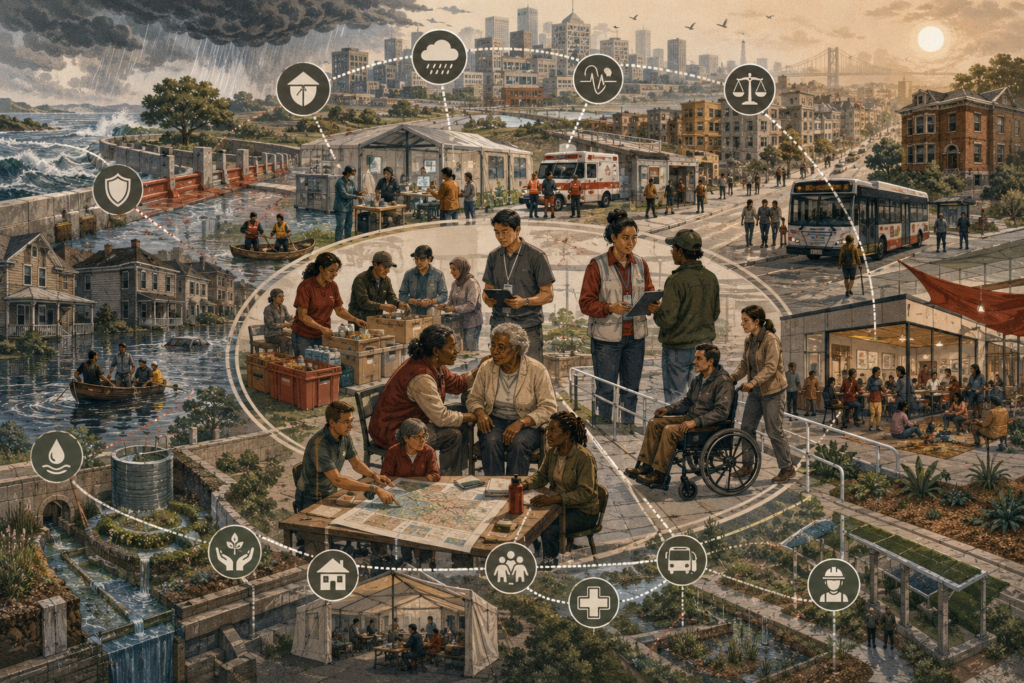

Editorial illustration showing a community responding together to flood, heat, and infrastructure stress through mutual aid, public health support, accessible care, and protective public systems.

Solidarity, Vulnerability, and the Ethics of Protection

Solidarity matters for sustainable systems because vulnerability is never only an individual condition. This article examines how exposure to harm is shaped by inequality, institutional design, public responsibility, and uneven protection, and argues that solidarity is a practical ethic of standing with and protecting those most at risk. It shows that sustainable systems require more than abstract resilience. They require organized forms of care, reciprocity, justice, and protection for people and communities facing patterned and foreseeable harm.

Editorial illustration for justice, equity, and the distribution of environmental burdens showing polluted industrial and healthy green communities separated by a central scale of justice, with families facing unequal environmental conditions.

Justice, Equity, and the Distribution of Environmental Burdens

Justice and equity matter for sustainable systems because environmental harm is rarely distributed evenly. This article examines how pollution, climate risk, ecological degradation, extraction, and infrastructural neglect are patterned through inequality, exclusion, cumulative impacts, and unequal political power. It argues that sustainable systems require more than aggregate environmental improvement. They require fairer distributions of protection, voice, risk, and repair for communities disproportionately burdened by environmental harm.

Editorial illustration for precaution, prudence, and irreversible harm showing an hourglass between a burning industrial landscape and a damaged river system, with observers, warning signs, and symbols of delayed environmental risk.

Precaution, Prudence, and Irreversible Harm

Precaution matters for sustainable systems because it asks how responsible judgment should proceed when the stakes are high, the harms may be severe or irreversible, and full scientific certainty is unavailable. This article examines precaution as an ethical and governance principle shaped by prudence, uncertainty, thresholds, delayed harm, and the moral weight of irreversible loss. It argues that sustainable systems require more than waiting for perfect evidence. They require institutions capable of acting responsibly before avoidable damage becomes entrenched, unjustly distributed, or impossible to reverse.

Editorial illustration contrasting environmental degradation and ecological renewal through a central hourglass, with a child and elder on a barren industrial side and a family on a green renewable-energy side, symbolizing intergenerational justice and long-term obligation.

Intergenerational Justice and Long-Term Obligation

Intergenerational justice matters for sustainable systems because it asks what the present owes to those who do not yet exist but who will nonetheless inherit the consequences of present action. This article examines fairness across time through the moral standing of future persons, the nonidentity problem, savings and depletion, discounting and short-termism, climate burden, irreversible harm, and the institutional challenge of representing absent generations. It argues that sustainable systems require more than present stability or short-run gain. They require forms of governance capable of acting justly toward those who cannot yet speak, vote, or bargain, but whose lives will be shaped by the decisions made today.

Editorial illustration for responsibility in the Anthropocene showing factories, mining, farmland, governance buildings, a child and elder observer, and a balance scale weighing industrial wealth against a family, wildlife, and ecological life across a damaged landscape.

Responsibility in the Anthropocene: Ethics, Justice, and Planetary Obligation

Responsibility in the Anthropocene matters for sustainable systems because it asks what obligations arise when human activity becomes a force capable of altering climate, biodiversity, landscapes, and the long-term conditions of life at planetary scale. This article examines Anthropocene responsibility as a problem of cumulative causation, unequal agency, historical emissions, benefit, capacity, future generations, more-than-human worlds, and institutional power. It argues that sustainable systems require a deeper ethic of responsibility in which planetary consequence does not dissolve obligation, but enlarges it.

Editorial landscape illustration for The Land Ethic and the Expansion of Moral Community showing mountains, river, waterfall, wildlife, books, a balance scale contrasting conqueror and member, and symbolic elements of ecological membership, integrity, stability, and beauty.

The Land Ethic and the Expansion of Moral Community

The land ethic matters for sustainable systems because it redefines the scope of moral concern by asking whether human beings stand above the natural world as managers and owners, or within it as members of a wider biotic community. This article examines Aldo Leopold’s expansion of ethics beyond the human, the shift from conqueror to member, the significance of integrity, stability, and beauty, and the lasting relevance of the land ethic for conservation, stewardship, and sustainable systems. It argues that sustainability depends not only on better management of land, but on a deeper ethical transformation in how human beings understand their place within the community of life.

Editorial illustration for environmental ethics and the moral status of nature showing a mountain landscape, river and waterfall, wildlife, books, a balance scale with Earth and forest, a hand holding a young plant, and symbolic objects of ethical judgment and ecological care.

Environmental Ethics and the Moral Status of Nature

Environmental ethics matters for sustainable systems because it asks whether nature matters only as a means to human ends or whether the more-than-human world possesses moral significance that should constrain what human beings are permitted to do. This article examines the moral status of nature through the distinction between instrumental and intrinsic value, the debate between anthropocentric, sentientist, biocentric, and ecocentric ethics, the significance of Aldo Leopold’s land ethic, and the problem of plural values in environmental judgment. It argues that sustainable systems depend not only on better management of natural resources, but on a deeper ethical understanding of what in nature has value, what moral limits follow from that value, and how human societies should position themselves within a more-than-human world.

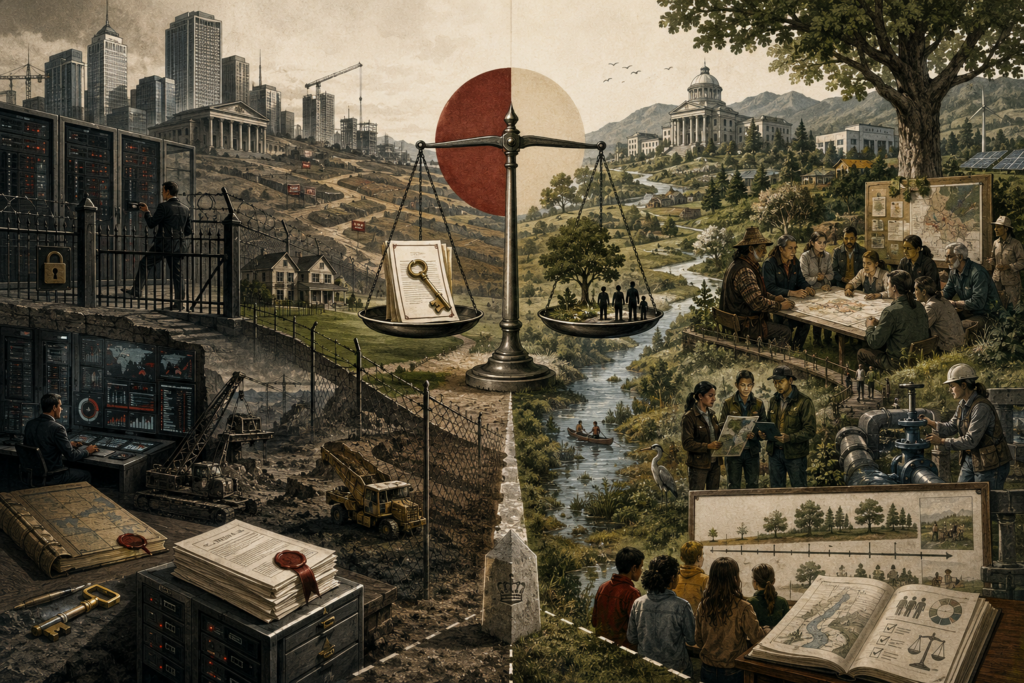
Editorial sustainability illustration showing a balance scale between ownership and stewardship, with fences, contracts, data systems, extraction equipment, public institutions, restored landscapes, community deliberation, water systems, and future generations symbolizing the moral limits of authority.

Stewardship Versus Ownership, Use, and Control

Stewardship is not the same as ownership, use, or control. Ownership grants claims, use enables benefit, and control directs systems, but stewardship asks whether those forms of authority are exercised with responsibility, restraint, and accountability. This article examines why legal entitlement does not automatically create moral legitimacy, especially when land, infrastructure, finance, data, ecosystems, and public institutions affect others beyond the immediate owner or manager. It contrasts dominion with trusteeship, explores commons governance and fiduciary responsibility, and argues that sustainable systems require authority to be judged by what it preserves, what it endangers, and whose future it shapes. Stewardship becomes the higher ethical standard for power in a shared world: not merely whether someone has the right to act, but whether that action protects ecological integrity, public trust, vulnerable communities, and future generations.

Scroll to Top