
Last Updated May 6, 2026
Atmospheric aerosols matter for development because air quality is not simply an environmental amenity. It is one of the background conditions through which health, labour capacity, learning, urban livability, and public-system resilience are sustained. Aerosols include fine solid and liquid particles suspended in the air, and some of the most important for human health are particulate matter such as PM2.5 and PM10. While aerosol loading has complex climatic and regional effects, the public-health burden of polluted air is direct and immense.
Air pollution is therefore not only an atmospheric science issue. It is a structural development issue that shapes who can live well, work safely, learn effectively, age with dignity, and remain healthy over time. Sustainable development must ask not only whether societies can expand energy, mobility, housing, and industry, but whether the air through which those gains are lived remains breathable enough to support human capability and public health.
Main Library
Publications
Article Map
Sustainable Development
Related Topic
Planetary Boundaries
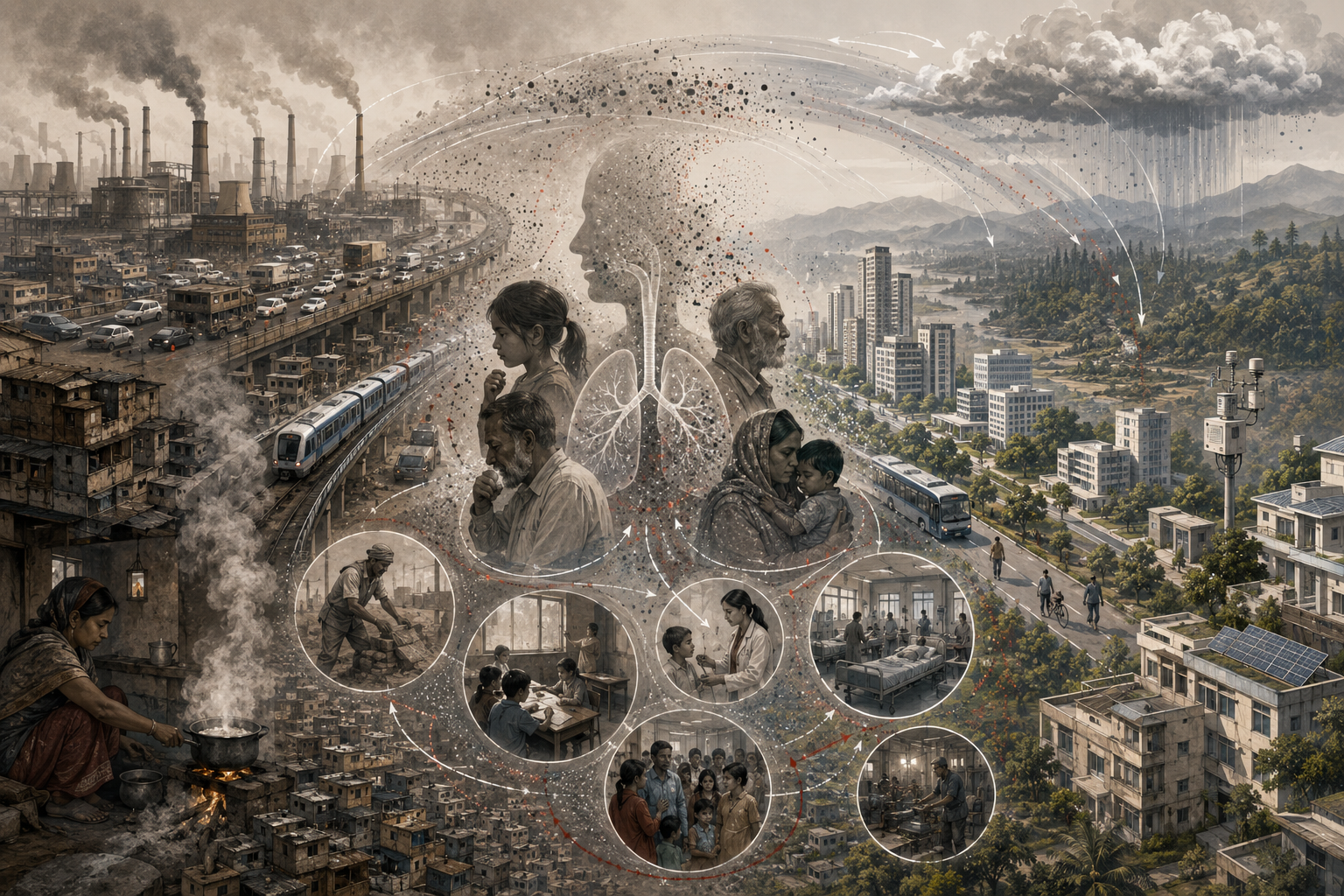
The development significance of air quality is explicit in current global reporting. WHO continues to describe air pollution as one of the greatest environmental risks to health, and its SDG policy materials connect air pollution directly to mortality and illness under target 3.9.1, clean household energy under target 7.1.2, and urban air quality under target 11.6.2. This matters because air quality is not merely a technical atmospheric issue. It is part of the wider structure through which preventable illness, premature mortality, and unequal vulnerability are reproduced across societies.
The planetary-boundaries framework adds another layer of meaning. Stockholm Resilience Centre’s current boundary framing classifies atmospheric aerosol loading as just within the global safe operating space, while also stressing that aerosol pressures already influence major regional systems such as monsoons, forest biomes, and marine ecosystems. This is analytically important because “not globally transgressed” does not mean developmentally harmless. Aerosols remain a major regional public-health and systems risk.
IPCC materials reinforce this broader framing. AR6 describes short-lived climate forcers as including aerosols and notes that many are also air pollutants and particulate matter relevant to air-pollution problems. Aerosols therefore sit at the intersection of climate, public health, energy systems, air quality, urban planning, and regional instability. This article argues that atmospheric aerosols, air quality, and public health should be understood together as a development issue because they affect habitability, productivity, health-system burdens, environmental justice, and long-run urban and regional viability.
What Atmospheric Aerosols Are
Atmospheric aerosols are fine solid or liquid particles suspended in air. Some are natural in origin, such as sea salt, mineral dust, wildfire smoke, or volcanic particles. Others arise from human activity, including combustion, industrial processes, transport, agriculture, waste burning, construction, and household fuel use. In air-pollution and public-health terms, the most important are often particulate matter classified by size, especially PM10 and PM2.5, because smaller particles can penetrate deeper into the respiratory system and contribute to broader systemic health effects.
This matters because aerosols are not only atmospheric objects. They are particles that move from energy systems, industrial corridors, roads, households, fields, fires, and waste systems into human bodies and public institutions. They therefore sit at the intersection of environmental process and social consequence. Air quality becomes a development issue precisely because the atmosphere is not external to human life. It is one of the media through which development is physically lived.
Aerosols also vary in origin, composition, size, toxicity, lifetime, and climatic effect. Some scatter sunlight. Some absorb heat. Some contribute to cloud formation. Some travel long distances, while others remain concentrated near emission sources. This complexity is scientifically important, but the development point is simpler: fine particles and polluted air shape the ordinary conditions of health, movement, labour, schooling, and urban life.
Particulate matter is particularly important because it translates atmospheric chemistry and combustion into embodied risk. PM2.5 is small enough to reach deep into the lungs, and exposure is associated with major respiratory and cardiovascular burdens. PM10 also matters because it can irritate and damage the respiratory system, especially where dust, transport, construction, industrial activity, and combustion are significant.
Atmospheric aerosols therefore reveal a basic fact about development: growth is always material. Energy systems, transport systems, housing systems, industrial systems, and agricultural systems do not only produce goods and services. They also produce atmospheric conditions, and those conditions become part of the lived structure of human wellbeing.
Why Air Quality Is a Development Condition
Air quality is a development condition because human wellbeing depends on breathable environments. Public health, labour productivity, child development, educational continuity, transport systems, and urban livability all depend on whether air is safe enough to inhabit daily without cumulative harm. Unsafe air is therefore not a marginal issue. It is one of the basic conditions through which human capability is widened or narrowed.
This matters because development theory often foregrounds income, infrastructure, and services while undercounting the atmospheric conditions through which those gains are experienced. A city may expand transport, housing, and industrial capacity while simultaneously deepening the background disease burden through chronic particulate exposure. In such cases, visible development gains coexist with less visible but structurally important reductions in health, resilience, and bodily security.
Air quality also affects public systems. Health systems absorb respiratory and cardiovascular disease burdens. Schools face attendance and learning disruptions. Households absorb caregiving burdens. Workers lose time and bodily capacity. Cities face reduced livability. Governments face monitoring, mitigation, and healthcare costs. Air pollution therefore produces development burdens across institutions, not only across individual bodies.
Clean air is also connected to dignity. A society in which people must breathe unsafe air in their homes, schools, workplaces, buses, streets, and neighbourhoods cannot be understood as fully habitable, even if income or infrastructure indicators improve. Development that normalizes hazardous air shifts hidden costs into lungs, hearts, brains, families, and public budgets.
Air quality belongs inside sustainable development because it is a background condition of capability. People cannot fully benefit from education, employment, housing, transport, and public services if the air through which they access those systems damages their health. This section connects naturally to Health, Education, and Human Capability Expansion.
From Air Pollution to Development Risk
One of the most important conceptual shifts is the movement from viewing air pollution as an environmental nuisance to understanding it as development risk. A nuisance can be managed at the margins. A development risk alters the terms under which societies can secure healthy lives, maintain productive workforces, govern urban and industrial change, and protect vulnerable populations. Polluted air affects mortality, morbidity, healthcare burdens, school attendance, labour capacity, and the ordinary physiological conditions of social participation.
This is developmentally significant because risk accumulates. Polluted air increases health-system burdens, narrows effective labour capacity, raises household vulnerability, and compounds existing inequalities. Development that expands material throughput while normalizing hazardous air may still register output gains, but it becomes more medically expensive, socially unequal, and physically harder to sustain.
Air-pollution risk is also often chronic rather than dramatic. It does not always appear as a sudden disaster. It may appear as asthma, heart disease, stroke, respiratory infection, lost workdays, reduced cognitive performance, premature mortality, and long-term public-health pressure. These are development outcomes, even when they are not counted in infrastructure or growth statistics.
The development-risk framing also reveals why air pollution cannot be solved only by individual behaviour. People breathe the air available to them. Exposure is shaped by power plants, traffic systems, industrial zoning, fuel access, housing quality, household energy, public transport, regulation, monitoring, and political choices. Air quality is therefore not merely a personal health issue. It is a structural condition produced by development pathways.
To treat air pollution as development risk is to ask whether the systems that produce energy, mobility, housing, food, and industry are also producing preventable disease. That question belongs at the center of sustainable development.
Particulate Matter and Human Exposure
Particulate matter is central because it provides one of the clearest pathways through which aerosols become human harm. PM10 and especially PM2.5 are among the pollutants of greatest concern. Fine particles can penetrate deep into the lungs and, in the case of PM2.5, affect systemic bodily processes more broadly. Exposure is often chronic rather than event-based, which makes it especially dangerous from a public-health and development perspective.
This matters because particulate exposure transforms atmospheric conditions into embodied developmental cost. The issue is not only that polluted air exists, but that repeated exposure narrows the physical basis of human capability. A society may grow economically while gradually weakening the biological conditions that support learning, working, caregiving, and aging with dignity.
Particulate exposure also varies sharply by place. A major road, industrial facility, power plant, port, construction corridor, informal waste-burning site, or household fuel source can produce localized exposure burdens. Air pollution therefore has geography. It is not evenly spread across society, even when it is described through national averages. People live in particular neighbourhoods, work in particular occupations, and move through particular transport systems.
PM2.5 is especially developmentally important because it often reflects combustion-heavy systems: fossil-fuel use, biomass burning, vehicle emissions, industrial sources, household fuels, and regional smoke. Reducing exposure therefore often requires structural changes in energy, transport, household fuel, industrial regulation, land management, and urban planning. It cannot be fully solved by advising individuals to avoid exposure when exposure is built into the physical organization of society.
Particulate matter makes visible the intimate connection between infrastructure and bodies. What is emitted from engines, stacks, fires, and fuels becomes part of the air people breathe. Development pathways are therefore not only economic arrangements. They are atmospheric arrangements.
Habitability, Health, and Human Development
Air pollution constrains development because it constrains habitability. Human development depends on environments that are sufficiently safe to support healthy childhoods, productive adulthood, manageable disease burdens, and social participation. When air becomes chronically polluted, the ordinary spaces of life—homes, streets, schools, markets, buses, factories, clinics, offices, and neighbourhoods—become harder to inhabit well.
This matters because many of the resulting harms are cumulative rather than spectacular. Polluted air often does not interrupt social life dramatically each day; instead, it steadily increases illness, reduces resilience, and intensifies background health burdens. That pattern makes air pollution developmentally dangerous. It can degrade long-run wellbeing while remaining normalized within everyday urban and industrial life.
Habitability is also more than survival. A city can remain physically occupied while becoming less livable. People can continue working while breathing unsafe air. Children can attend school while carrying respiratory burdens. Families can remain in polluted neighbourhoods because they lack the resources to move. Development that tolerates such conditions treats habitability as optional, when in fact it is foundational.
Air pollution also alters the relationship between place and possibility. Poor air can make outdoor play less safe, walking and cycling less attractive, outdoor work more hazardous, and public space less healthy. It can weaken trust in institutions when communities repeatedly experience pollution without effective response. It can create a sense that some neighbourhoods are sacrifice zones for the convenience or profit of others.
Human development requires environments in which people can breathe, learn, work, move, and age without preventable atmospheric harm. Clean air is therefore not an aesthetic improvement. It is part of the material foundation of human capability.
Children, Labour, Learning, and Urban Life
Aerosol pollution affects development not only through mortality, but through the wider organization of social life. Children are especially vulnerable because polluted air can shape health across the life course. Exposure during childhood can affect respiratory health, school attendance, physical activity, cognitive development, and long-term wellbeing. This makes air quality an intergenerational development issue rather than only a current public-health metric.
Workers are also vulnerable because respiratory and cardiovascular burdens reduce the ability to work safely and productively. Outdoor workers, transport workers, industrial workers, construction workers, agricultural workers, waste workers, and informal-sector workers may face repeated exposure with limited protection. Development that depends on work under polluted conditions transfers atmospheric risk into the bodies of workers.
Learning is affected because health affects attention, attendance, concentration, and energy. A child who repeatedly suffers respiratory illness, fatigue, or exposure-related stress does not experience school in the same way as a child in a cleaner environment. Educational development therefore cannot be separated from environmental conditions. Clean schools and safe routes to school are part of human-capability infrastructure.
Urban life is especially shaped by air quality. Cities concentrate transport, construction, industry, households, services, and public space. They can also concentrate exposure. But cities can reduce exposure through public transit, clean energy, walkable planning, green infrastructure, industrial regulation, cleaner freight, building standards, and monitoring. Air quality therefore becomes a test of whether urban development is physically livable or merely economically dense.
The broader development point is direct: air pollution narrows participation. It makes learning, labour, mobility, caregiving, and ordinary urban life more physiologically costly. Sustainable development must therefore treat clean air as part of social capability, not as an afterthought to economic growth.
Energy Systems, Aerosols, and Structural Sources
Air pollution is strongly linked to the structure of energy systems. Power generation, industry, households, transport, agriculture, and waste systems can all contribute to harmful aerosol burdens. This is crucial because it shows that aerosol exposure is not random. It is built into the infrastructures and fuel systems through which development is organized. Clean air cannot be secured only through downstream health advice or episodic pollution alerts. It requires structural change in how energy is produced, distributed, and used.
Household energy is especially important. In many contexts, households still depend on polluting fuels for cooking, heating, or lighting. This creates indoor and near-household exposure burdens that can be especially severe for women, children, older people, and those who spend more time at home. Clean household energy is therefore not only an energy-access issue. It is a public-health and gender-equity issue.
Transport systems also shape aerosol exposure. Car-dependent urban growth, diesel freight corridors, congested roads, poorly regulated vehicle fleets, and port-related emissions can all intensify particulate burdens. Transport policy therefore becomes air-quality policy. Public transit, cleaner vehicles, walkable urban design, freight regulation, and low-emission zones are not merely mobility reforms. They are development-health interventions.
Industrial sources matter because industrial development can create concentrated exposure if zoning, monitoring, enforcement, and emissions controls are weak. Communities near industrial corridors may face cumulative burdens from multiple facilities, traffic routes, waste sites, and housing vulnerability. The result is often not a single pollutant from a single source, but a layered exposure landscape.
Development pathways organized around heavy combustion tend to generate aerosol burdens as a built-in consequence. Cleaner development pathways, by contrast, can reduce immediate health harms while also supporting climate and resilience goals. Air quality therefore sits at the intersection of energy transition, urban planning, industrial regulation, public health, and environmental justice.
Inequality and Uneven Exposure
Air pollution is also an inequality issue because exposure is unevenly distributed. Poorer communities, workers in high-exposure occupations, households dependent on polluting fuels, and populations living near industrial, traffic-dense, port-adjacent, or waste-burdened zones often face heavier burdens. Exposure is shaped by income, housing, fuel access, occupational structure, urban planning, land use, and regulatory protection.
This matters because development gains can be socially unequal not only in who benefits, but in who bears the bodily costs of how growth occurs. Some groups benefit from polluting energy and industrial systems, while others inhale the residues. Development can therefore appear successful in aggregate while becoming more unequal in embodied health terms.
Uneven exposure is also linked to political visibility. Communities with less power may have less access to monitoring, legal remedy, media attention, public-health protection, or relocation options. Their exposure may be normalized as the price of growth, industrial employment, cheaper housing, or infrastructure expansion. A sustainable-development framework must reject that logic. No community should be treated as an atmospheric dumping ground for the convenience of others.
Air pollution also intersects with age, health status, disability, occupation, and gender. Children, pregnant people, older adults, people with existing respiratory or cardiovascular conditions, outdoor workers, and those responsible for household energy tasks may face particular burdens. Averages can obscure these differences. Air-quality governance must therefore look at distribution, not only aggregate concentration.
Clean air is a justice issue because breathing is universal but exposure is unequal. Sustainable development cannot be credible if it improves mobility, energy, or industrial output while allowing certain populations to carry the atmospheric costs of those systems in their bodies.
Aerosols, Climate, and Regional Instability
Atmospheric aerosols are unusual because they matter not only for health, but also for climate and regional environmental stability. Aerosols can influence radiation, cloud properties, precipitation patterns, temperature patterns, and regional climate dynamics. Their effects vary by composition, altitude, geography, and interaction with other atmospheric processes. This means aerosol loading can generate both direct public-health burdens and wider regional-system effects.
This is developmentally significant because regional climatic disruption feeds back into agriculture, water security, settlement viability, disaster risk, and public planning. Aerosols therefore cannot be treated only as urban air contaminants. In some contexts, they are part of a wider atmospheric instability that affects human systems through multiple channels at once.
Aerosols also complicate climate policy because some aerosol pollution has historically masked a portion of greenhouse-gas warming through cooling effects, even while damaging health. This does not make aerosol pollution beneficial from a development perspective. It means that air-quality improvements and climate mitigation must be planned coherently. Reducing harmful aerosols improves health, but climate strategies must also reduce greenhouse gases so that public-health gains do not occur within worsening climate instability.
The regional character of aerosols is especially important. Air-pollution burdens may be intense in particular cities, basins, industrial zones, wildfire regions, or household-energy contexts. Atmospheric effects may influence monsoons, precipitation, ecosystems, and regional weather patterns. Development planning therefore needs both local exposure analysis and regional systems analysis.
The planetary-boundaries framing is useful here because it shows why a process can remain globally within the safe operating space and still matter intensely at regional scale. Development risk is not always global before it is severe. It may first appear as local illness, regional atmospheric disruption, and unequal exposure.
Aerosol Loading in the Planetary Boundaries Framework
The planetary-boundaries framework gives aerosol loading a distinctive role. Unlike several other Earth-system processes, aerosol loading remains just within the global safe operating space in the current Stockholm Resilience Centre framing, while strong regional pressures and clear health implications are already evident. This is analytically important because it shows that a boundary can remain globally unbreached while still producing severe regional development harm.
In this sense, aerosol loading highlights an important lesson for sustainable development: global thresholds do not erase regional vulnerability. A development framework must still confront aerosol burdens as lived health risk, institutional strain, and regional atmospheric disruption even when the planetary-boundary status appears less extreme than in other domains. The global boundary status should not be misread as reassurance for exposed populations.
Aerosols also reveal the difference between Earth-system thresholds and human-development burdens. A process may not have crossed a global planetary threshold, yet still cause millions of people to live under hazardous air. It may not destabilize the Earth system globally, yet still destabilize health systems, household wellbeing, labour capacity, and urban livability regionally. Sustainable development must be able to hold both scales at once.
The aerosol boundary is also difficult because aerosols vary widely by type, source, and effect. Black carbon, sulfate aerosols, dust, sea salt, smoke, and other particles have different health and climate implications. This complexity makes monitoring and governance demanding. It also means that policy cannot be reduced to a single number. Air-quality governance must connect atmospheric science, health evidence, local exposure data, and source-specific mitigation.
Aerosol loading is therefore especially instructive for sustainability analysis. It shows that development risk can be severe before a global boundary is crossed, and that regional justice matters even when planetary indicators appear less alarming.
Toward Clean-Air Development Pathways
If aerosols and air quality are structural development issues, then governance must do more than issue health warnings. It must organize urban planning, energy transition, transport systems, industrial standards, waste systems, household energy access, monitoring, and public-health protection in ways that reduce harmful exposure. Clean-air development pathways are therefore not cosmetic improvements. They are part of building societies that are physically more inhabitable, healthier, and institutionally more sustainable.
This implies a different model of development: one that asks not only whether energy, mobility, and industrial expansion are increasing, but whether the atmospheric conditions through which those gains are delivered remain compatible with health and long-run resilience. A transport system that moves people while exposing them to harmful air is incomplete development. An energy system that expands access while deepening household pollution is incomplete development. An industrial system that creates employment while burdening workers and nearby communities with preventable exposure is incomplete development.
Clean-air pathways require multiple forms of action. Household energy transitions can reduce indoor and neighbourhood exposure. Cleaner power systems can reduce combustion-related particles. Public transport and active mobility can reduce traffic burdens. Industrial emissions controls can reduce concentrated exposure. Land-use planning can reduce the clustering of vulnerable housing near major sources. Air-quality monitoring can make exposure visible. Public-health systems can target protection where burdens are highest.
Governance is central because clean air is a collective condition. Individuals cannot purchase their way out of all exposure, especially when pollution is built into the urban, industrial, and energy systems around them. Clean air therefore requires public capacity: standards, enforcement, infrastructure, monitoring, transparent data, accountability, and planning that treats health as a core development objective.
Clean-air development is also a justice agenda. It must prioritize communities with the highest exposure, weakest protection, and least political power. Sustainable development becomes more credible when the air improves first where the burdens have been greatest.
Why This Matters for Sustainable Development
Atmospheric aerosols, air quality, and public health belong together because development changes not only economies and infrastructures, but also the air through which social life is continuously lived. A serious development framework must therefore ask not only what growth delivers, but what atmospheric burdens it imposes on bodies, households, cities, workers, children, ecosystems, and public systems.
This is why aerosols matter so much for sustainable development. They reveal a central truth that development theory can overlook: development can become self-undermining when it organizes energy, transport, industry, household fuel, and urban space in ways that normalize chronic exposure to harmful air. Even where atmospheric aerosol loading remains globally within the safe operating space, the regional health and development burden can be severe.
The issue is also one of justice. Air pollution burdens are not distributed evenly. Those with fewer resources, less political power, more hazardous work, poorer housing, or greater dependence on polluting fuels often carry heavier exposure. Sustainable development cannot be credible if it improves aggregate economic indicators while leaving some populations to breathe the hidden costs of growth.
To take air quality seriously is therefore to take sustainable development seriously. It is to recognize that long-run human development depends not only on building productive societies, but on keeping the ordinary atmosphere of life breathable enough for those societies to remain healthy, livable, and just.
Development becomes credible when people can work, learn, move, care, and age in air that does not quietly undermine the health and capability that development is supposed to protect.
Mathematical Lens
Aerosol-related development burden can be clarified by thinking in terms of exposure, health sensitivity, source intensity, and mitigation capacity rather than pollutant concentration alone. Let \(B_a\) represent aerosol-related public-health burden, \(E\) exposure intensity, \(H\) health sensitivity, \(S\) structural source pressure, and \(M\) mitigation capacity:
B_a = \alpha E + \beta H + \gamma S – \delta M
\]
Interpretation: Aerosol-related public-health burden rises when exposure, health sensitivity, and structural source pressure intensify, and falls when mitigation capacity improves.
This captures the article’s core point: the developmental cost of aerosols depends not only on pollutant presence, but on exposure patterns, vulnerability, and whether systems reduce or reproduce hazardous air.
We can also express particulate-risk sensitivity as a weighted function of PM2.5 concentration, household energy exposure, and urban transport intensity:
P_a = w_1 A + w_2 U + w_3 T
\]
Interpretation: Particulate-risk sensitivity rises when ambient fine-particulate exposure, household energy exposure, and transport-linked emissions reinforce one another.
Here, \(A\) is ambient fine-particulate exposure, \(U\) is household or indoor fuel-related exposure, and \(T\) is transport-linked emissions intensity. Higher \(P_a\) means a population faces more persistent and cumulative aerosol-related health burden.
Finally, atmospheric-development fragility can be represented as a function of inequality, monitoring weakness, and regulatory under-capacity:
F_a = \lambda I + \mu R + \nu G
\]
Interpretation: Atmospheric-development fragility rises when unequal exposure, weak monitoring, and weak governance capacity reinforce one another.
Here, \(I\) is inequality of exposure, \(R\) is weak monitoring and reporting, and \(G\) is weak governance or mitigation capacity. This helps show why hazardous air often persists even where the health burden is already well known.
| Term | Meaning | Interpretive role |
|---|---|---|
| \(B_a\) | Aerosol-related public-health burden | Represents development burden created by particulate exposure, health sensitivity, source pressure, and weak mitigation capacity. |
| \(E\) | Exposure intensity | Represents the level and duration of exposure to harmful aerosols and particulate matter. |
| \(H\) | Health sensitivity | Represents vulnerability linked to age, illness, occupation, housing, poverty, and baseline public-health conditions. |
| \(S\) | Structural source pressure | Represents emissions pressure from energy, transport, industry, household fuels, agriculture, fires, and waste systems. |
| \(M\) | Mitigation capacity | Represents the ability of institutions and infrastructure to reduce exposure through clean energy, regulation, monitoring, transport planning, and enforcement. |
| \(P_a\) | Particulate-risk sensitivity | Represents combined risk from ambient PM exposure, household energy exposure, and transport-linked emissions. |
| \(F_a\) | Atmospheric-development fragility | Represents fragility from unequal exposure, weak monitoring, and weak governance capacity. |
The equations are conceptual rather than predictive. Their value is to make visible the structure of the problem: aerosol-related development burden depends on exposure, source pressure, health vulnerability, household energy, transport, monitoring, inequality, and mitigation capacity working together.
Advanced Python Workflow: Aerosol Exposure and Public-Health Burden Scoring
This Python workflow translates the article’s core argument into a structured air-quality burden model. Rather than treating aerosols as an isolated pollution variable, it scores cities, regions, or countries across ambient particulate exposure, household energy exposure, transport and industrial source pressure, health sensitivity, mitigation capacity, exposure inequality, monitoring readiness, clean-energy transition readiness, and regulatory enforcement. That makes it possible to compare not only where aerosol burdens are high, but where they are most developmentally costly.
from __future__ import annotations

import pandas as pd
import numpy as np

INPUT_FILE = "aerosols_air_quality_panel.csv"
OUTPUT_FILE = "aerosols_air_quality_public_health_scores.csv"


def load_data(path: str) -> pd.DataFrame:
    """
    Load a territory-level aerosol, air-quality, and public-health dataset.

    All *_index columns should be normalized to [0, 1].
    Higher values should mean more of the named property.

    Examples:
      - ambient_pm25_index: higher = greater PM2.5 exposure
      - household_energy_exposure_index: higher = greater household fuel-related exposure
      - mitigation_capacity_index: higher = stronger mitigation capacity
      - monitoring_readiness_index: higher = stronger air-quality monitoring readiness
    """
    df = pd.read_csv(path)

    required_columns = [
        "territory_name",
        "country_or_region",
        "territory_type",
        "ambient_pm25_index",
        "ambient_pm10_index",
        "household_energy_exposure_index",
        "transport_emissions_pressure_index",
        "industrial_source_pressure_index",
        "health_sensitivity_index",
        "mitigation_capacity_index",
        "exposure_inequality_index",
        "monitoring_readiness_index",
        "clean_energy_transition_readiness_index",
        "regulatory_enforcement_index",
    ]

    missing = [col for col in required_columns if col not in df.columns]

    if missing:
        raise ValueError(f"Missing required columns: {missing}")

    return df


def validate_indices(df: pd.DataFrame) -> pd.DataFrame:
    """Validate that all *_index fields are complete and normalized to [0, 1]."""
    index_columns = [col for col in df.columns if col.endswith("_index")]

    for col in index_columns:
        if df[col].isna().any():
            raise ValueError(f"Column '{col}' contains missing values.")

        if ((df[col] < 0) | (df[col] > 1)).any():
            raise ValueError(f"Column '{col}' contains values outside [0, 1].")

    return df


def compute_scores(df: pd.DataFrame) -> pd.DataFrame:
    """
    Compute exposure burden, public-health vulnerability,
    governance readiness, and constrained aerosol burden.

    Exposure burden rises with ambient PM2.5, ambient PM10,
    household energy exposure, transport emissions, and industrial source pressure.

    Governance readiness rises with mitigation capacity, monitoring readiness,
    clean-energy transition readiness, and regulatory enforcement.
    """
    df = df.copy()

    df["exposure_burden_score"] = (
        0.28 * df["ambient_pm25_index"] +
        0.17 * df["ambient_pm10_index"] +
        0.19 * df["household_energy_exposure_index"] +
        0.18 * df["transport_emissions_pressure_index"] +
        0.18 * df["industrial_source_pressure_index"]
    ).clip(lower=0, upper=1)

    df["public_health_vulnerability_score"] = (
        0.42 * df["health_sensitivity_index"] +
        0.34 * df["exposure_inequality_index"] +
        0.14 * (1 - df["mitigation_capacity_index"]) +
        0.10 * (1 - df["clean_energy_transition_readiness_index"])
    ).clip(lower=0, upper=1)

    df["governance_readiness_score"] = (
        0.30 * df["mitigation_capacity_index"] +
        0.25 * df["monitoring_readiness_index"] +
        0.23 * df["clean_energy_transition_readiness_index"] +
        0.22 * df["regulatory_enforcement_index"]
    ).clip(lower=0, upper=1)

    df["constrained_aerosol_burden_score"] = (
        0.44 * df["exposure_burden_score"] +
        0.28 * df["public_health_vulnerability_score"] +
        0.14 * df["exposure_inequality_index"] +
        0.08 * (1 - df["governance_readiness_score"]) +
        0.06 * (1 - df["monitoring_readiness_index"])
    ).clip(lower=0, upper=1)

    df["air_governance_gap"] = (
        df["exposure_burden_score"] -
        df["governance_readiness_score"]
    )

    df["air_quality_band"] = np.select(
        [
            df["constrained_aerosol_burden_score"] >= 0.80,
            df["constrained_aerosol_burden_score"] >= 0.60,
            df["constrained_aerosol_burden_score"] >= 0.40,
        ],
        [
            "Extreme aerosol-health burden",
            "High aerosol-health burden",
            "Moderate aerosol-health burden",
        ],
        default="Lower aerosol-health burden",
    )

    df["air_quality_warning"] = np.select(
        [
            df["air_governance_gap"] >= 0.35,
            df["air_governance_gap"] >= 0.20,
            df["air_governance_gap"] >= 0.05,
        ],
        [
            "Severe air-quality governance gap",
            "High air-quality governance gap",
            "Moderate air-quality governance gap",
        ],
        default="Lower governance gap or stronger clean-air readiness",
    )

    return df


def build_summary(df: pd.DataFrame) -> pd.DataFrame:
    """Return a ranked summary table for review or reporting."""
    columns = [
        "territory_name",
        "country_or_region",
        "territory_type",
        "exposure_burden_score",
        "public_health_vulnerability_score",
        "governance_readiness_score",
        "constrained_aerosol_burden_score",
        "air_governance_gap",
        "air_quality_band",
        "air_quality_warning",
    ]

    summary = df[columns].copy()

    summary = summary.sort_values(
        by=[
            "constrained_aerosol_burden_score",
            "exposure_burden_score",
            "public_health_vulnerability_score",
        ],
        ascending=[False, False, False],
    ).reset_index(drop=True)

    return summary


def main() -> None:
    df = load_data(INPUT_FILE)
    df = validate_indices(df)
    scored = compute_scores(df)
    summary = build_summary(scored)

    summary.to_csv(OUTPUT_FILE, index=False)

    print("Aerosol exposure and public-health burden scoring complete.")
    print(summary.to_string(index=False))


if __name__ == "__main__":
    main()
This workflow is intentionally transparent. It does not claim that aerosol-health burden can be reduced to one objective score. Instead, it makes assumptions visible: PM2.5, PM10, household energy exposure, transport emissions, industrial source pressure, health sensitivity, mitigation capacity, exposure inequality, monitoring readiness, clean-energy transition readiness, and regulatory enforcement are treated as distinct components. The value of the model is diagnostic. It helps identify where air pollution is most likely to become a long-run development constraint.
Advanced R Workflow: Air-Quality Inequality, Urban Exposure, and Systemic Burden Analysis
This R workflow is designed for the part of the article that emphasizes variation across territories, groups, and urban systems. It compares settings across ambient particulate exposure, household energy exposure, industrial and transport pressure, exposure inequality, health sensitivity, monitoring readiness, mitigation capacity, clean-energy transition readiness, and regulatory enforcement. It then builds grouped summaries that help show where aerosol burdens are strongest and where unequal exposure remains developmentally costly.
library(readr)
library(dplyr)

input_file <- "aerosols_air_quality_country_panel.csv"
region_output_file <- "cross_region_air_quality_summary.csv"
territory_output_file <- "cross_territory_air_quality_summary.csv"

air_df <- read_csv(input_file, show_col_types = FALSE)

required_cols <- c(
  "territory_name",
  "country_or_region",
  "territory_type",
  "ambient_pm25_index",
  "ambient_pm10_index",
  "household_energy_exposure_index",
  "transport_emissions_pressure_index",
  "industrial_source_pressure_index",
  "health_sensitivity_index",
  "mitigation_capacity_index",
  "exposure_inequality_index",
  "monitoring_readiness_index",
  "clean_energy_transition_readiness_index",
  "regulatory_enforcement_index"
)

missing_cols <- setdiff(required_cols, names(air_df))

if (length(missing_cols) > 0) {
  stop(paste("Missing required columns:", paste(missing_cols, collapse = ", ")))
}

index_cols <- names(air_df)[grepl("_index$", names(air_df))]

invalid_index_cols <- index_cols[
  vapply(
    air_df[index_cols],
    function(x) any(is.na(x) | x < 0 | x > 1),
    logical(1)
  )
]

if (length(invalid_index_cols) > 0) {
  stop(
    paste(
      "Index columns must be complete and normalized to [0, 1]:",
      paste(invalid_index_cols, collapse = ", ")
    )
  )
}

air_df <- air_df %>%
  mutate(
    exposure_burden_proxy = (
      ambient_pm25_index +
      ambient_pm10_index +
      household_energy_exposure_index +
      transport_emissions_pressure_index +
      industrial_source_pressure_index
    ) / 5,
    public_health_vulnerability_proxy = (
      health_sensitivity_index +
      exposure_inequality_index +
      (1 - mitigation_capacity_index) +
      (1 - clean_energy_transition_readiness_index)
    ) / 4,
    governance_readiness_proxy = (
      mitigation_capacity_index +
      monitoring_readiness_index +
      clean_energy_transition_readiness_index +
      regulatory_enforcement_index
    ) / 4,
    aerosol_development_burden_proxy = (
      exposure_burden_proxy +
      public_health_vulnerability_proxy +
      exposure_inequality_index +
      health_sensitivity_index +
      (1 - governance_readiness_proxy)
    ) / 5,
    air_governance_gap = exposure_burden_proxy - governance_readiness_proxy,
    burden_band = case_when(
      aerosol_development_burden_proxy >= 0.75 ~ "Extreme aerosol-health burden",
      aerosol_development_burden_proxy >= 0.55 ~ "High aerosol-health burden",
      aerosol_development_burden_proxy >= 0.35 ~ "Moderate aerosol-health burden",
      TRUE ~ "Lower aerosol-health burden"
    )
  )

region_summary <- air_df %>%
  group_by(country_or_region) %>%
  summarise(
    avg_aerosol_development_burden_proxy = mean(aerosol_development_burden_proxy, na.rm = TRUE),
    avg_exposure_burden_proxy = mean(exposure_burden_proxy, na.rm = TRUE),
    avg_public_health_vulnerability_proxy = mean(public_health_vulnerability_proxy, na.rm = TRUE),
    avg_governance_readiness_proxy = mean(governance_readiness_proxy, na.rm = TRUE),
    avg_ambient_pm25 = mean(ambient_pm25_index, na.rm = TRUE),
    avg_ambient_pm10 = mean(ambient_pm10_index, na.rm = TRUE),
    avg_household_energy_exposure = mean(household_energy_exposure_index, na.rm = TRUE),
    avg_transport_emissions_pressure = mean(transport_emissions_pressure_index, na.rm = TRUE),
    avg_industrial_source_pressure = mean(industrial_source_pressure_index, na.rm = TRUE),
    avg_health_sensitivity = mean(health_sensitivity_index, na.rm = TRUE),
    avg_exposure_inequality = mean(exposure_inequality_index, na.rm = TRUE),
    avg_mitigation_capacity = mean(mitigation_capacity_index, na.rm = TRUE),
    avg_monitoring_readiness = mean(monitoring_readiness_index, na.rm = TRUE),
    avg_clean_energy_transition_readiness = mean(clean_energy_transition_readiness_index, na.rm = TRUE),
    avg_regulatory_enforcement = mean(regulatory_enforcement_index, na.rm = TRUE),
    avg_air_governance_gap = mean(air_governance_gap, na.rm = TRUE),
    observations = n(),
    .groups = "drop"
  ) %>%
  mutate(
    regional_burden_band = case_when(
      avg_aerosol_development_burden_proxy >= 0.75 ~ "Extreme aerosol-health burden",
      avg_aerosol_development_burden_proxy >= 0.55 ~ "High aerosol-health burden",
      avg_aerosol_development_burden_proxy >= 0.35 ~ "Moderate aerosol-health burden",
      TRUE ~ "Lower aerosol-health burden"
    )
  ) %>%
  arrange(desc(avg_aerosol_development_burden_proxy))

territory_summary <- air_df %>%
  group_by(territory_type) %>%
  summarise(
    avg_aerosol_development_burden_proxy = mean(aerosol_development_burden_proxy, na.rm = TRUE),
    avg_exposure_burden_proxy = mean(exposure_burden_proxy, na.rm = TRUE),
    avg_public_health_vulnerability_proxy = mean(public_health_vulnerability_proxy, na.rm = TRUE),
    avg_governance_readiness_proxy = mean(governance_readiness_proxy, na.rm = TRUE),
    avg_ambient_pm25 = mean(ambient_pm25_index, na.rm = TRUE),
    avg_ambient_pm10 = mean(ambient_pm10_index, na.rm = TRUE),
    avg_household_energy_exposure = mean(household_energy_exposure_index, na.rm = TRUE),
    avg_transport_emissions_pressure = mean(transport_emissions_pressure_index, na.rm = TRUE),
    avg_industrial_source_pressure = mean(industrial_source_pressure_index, na.rm = TRUE),
    avg_health_sensitivity = mean(health_sensitivity_index, na.rm = TRUE),
    avg_exposure_inequality = mean(exposure_inequality_index, na.rm = TRUE),
    avg_mitigation_capacity = mean(mitigation_capacity_index, na.rm = TRUE),
    avg_monitoring_readiness = mean(monitoring_readiness_index, na.rm = TRUE),
    avg_clean_energy_transition_readiness = mean(clean_energy_transition_readiness_index, na.rm = TRUE),
    avg_regulatory_enforcement = mean(regulatory_enforcement_index, na.rm = TRUE),
    avg_air_governance_gap = mean(air_governance_gap, na.rm = TRUE),
    observations = n(),
    .groups = "drop"
  ) %>%
  arrange(desc(avg_aerosol_development_burden_proxy))

write_csv(region_summary, region_output_file)
write_csv(territory_summary, territory_output_file)

cat("Cross-region air-quality summary exported to:", region_output_file, "\n")
print(region_summary)

cat("\nCross-territory air-quality summary exported to:", territory_output_file, "\n")
print(territory_summary)
This workflow helps distinguish air pollution presence from developmentally consequential aerosol burden. A territory may have high particulate exposure but stronger monitoring, clean-energy transition readiness, enforcement, and mitigation capacity. Another may face moderate exposure but severe inequality, weak monitoring, and high health sensitivity. The workflow therefore treats air quality as a development condition, not as an isolated atmospheric variable.
GitHub Repository
Complete Code Repository
The full code distribution for this article, including aerosol-burden scoring workflows, exposure-inequality diagnostics, SQL materials, optional air-quality support tooling, supporting documentation, and repository structure, is available on GitHub.
Related Articles
- Climate Change as a Development Constraint
- From Economic Growth to Human Development
- Health, Education, and Human Capability Expansion
- Inequality and Inclusive Development
- Freshwater Change and Development Risk
- Trade-Offs, Synergies, and Policy Coherence
- Ecological Thresholds, Nonlinearity, and Systemic Risk
- Local Governance, Cities, and Territorial Development
- Planetary Boundaries and Sustainable Development
- Pollution, Novel Entities, and Long-Run Development
Further Reading
- World Health Organization (2024) Ambient (outdoor) air pollution. Geneva: World Health Organization. Available at: https://www.who.int/news-room/fact-sheets/detail/ambient-%28outdoor%29-air-quality-and-health
- World Health Organization (2021) WHO global air quality guidelines: particulate matter (PM2.5 and PM10), ozone, nitrogen dioxide, sulfur dioxide and carbon monoxide. Geneva: World Health Organization. Available at: https://www.who.int/publications/i/item/9789240034228
- World Health Organization (n.d.) Sustainable development goals & air pollution. Geneva: World Health Organization. Available at: https://www.who.int/teams/environment-climate-change-and-health/air-quality-energy-and-health/policy-progress/sustainable-development-goals-air-pollution
- United Nations Statistics Division (2023) Metadata for SDG indicator 3.9.1. New York: United Nations Statistics Division. Available at: https://unstats.un.org/sdgs/metadata/files/Metadata-03-09-01.pdf
- Intergovernmental Panel on Climate Change (2021) AR6 WGI Chapter 6: Short-lived Climate Forcers. Geneva: Intergovernmental Panel on Climate Change. Available at: https://www.ipcc.ch/report/ar6/wg1/chapter/chapter-6/
- Stockholm Resilience Centre (n.d.) Planetary boundaries. Stockholm: Stockholm Resilience Centre. Available at: https://www.stockholmresilience.org/research/planetary-boundaries.html
- United Nations Department of Economic and Social Affairs (n.d.) Goal 11: Make cities and human settlements inclusive, safe, resilient and sustainable. New York: United Nations. Available at: https://sdgs.un.org/goals/goal11
- UNEP (2025) SDG Indicator 3.9.1. Nairobi: United Nations Environment Programme. Available at: https://sdgs.unep.org/article/sdg-indicator-391
References
- World Health Organization (2024) Ambient (outdoor) air pollution. Geneva: World Health Organization. Available at: https://www.who.int/news-room/fact-sheets/detail/ambient-%28outdoor%29-air-quality-and-health
- World Health Organization (2021) WHO global air quality guidelines: particulate matter (PM2.5 and PM10), ozone, nitrogen dioxide, sulfur dioxide and carbon monoxide. Geneva: World Health Organization. Available at: https://www.who.int/publications/i/item/9789240034228
- World Health Organization (n.d.) Sustainable development goals & air pollution. Geneva: World Health Organization. Available at: https://www.who.int/teams/environment-climate-change-and-health/air-quality-energy-and-health/policy-progress/sustainable-development-goals-air-pollution
- United Nations Statistics Division (2023) Metadata for SDG indicator 3.9.1. New York: United Nations Statistics Division. Available at: https://unstats.un.org/sdgs/metadata/files/Metadata-03-09-01.pdf
- Intergovernmental Panel on Climate Change (2021) AR6 WGI Chapter 6: Short-lived Climate Forcers. Geneva: Intergovernmental Panel on Climate Change. Available at: https://www.ipcc.ch/report/ar6/wg1/chapter/chapter-6/
- Intergovernmental Panel on Climate Change (2021) Climate Change 2021: The Physical Science Basis — Chapter 6 PDF. Geneva: Intergovernmental Panel on Climate Change. Available at: https://www.ipcc.ch/report/ar6/wg1/downloads/report/IPCC_AR6_WGI_Chapter06.pdf
- Stockholm Resilience Centre (n.d.) Planetary boundaries. Stockholm: Stockholm Resilience Centre. Available at: https://www.stockholmresilience.org/research/planetary-boundaries.html
- Stockholm Resilience Centre (2025) Seven of nine planetary boundaries now breached. Stockholm: Stockholm Resilience Centre. Available at: https://www.stockholmresilience.org/news–events/general-news/2025-09-24-seven-of-nine-planetary-boundaries-now-breached.html
- United Nations Department of Economic and Social Affairs (n.d.) Goal 11: Make cities and human settlements inclusive, safe, resilient and sustainable. New York: United Nations. Available at: https://sdgs.un.org/goals/goal11
- UNEP (2025) SDG Indicator 3.9.1. Nairobi: United Nations Environment Programme. Available at: https://sdgs.unep.org/article/sdg-indicator-391