
Last Updated May 9, 2026
Not all valuable resources fit neatly into the categories of private property, market exchange, or centralized state provision. Many of the most important material, ecological, informational, and civic conditions of life are shared, interdependent, and vulnerable to overuse, undermaintenance, enclosure, exclusion, or institutional neglect. Fisheries, forests, grazing lands, irrigation systems, groundwater basins, watersheds, urban public space, scientific knowledge, digital infrastructures, open standards, public archives, and atmospheric sinks all raise a related question: how can societies govern resources that many actors depend upon, but that no single actor can safely manage alone?
This is the domain of commons, shared resources, and institutional governance. The commons should not be reduced to a romantic image of unmanaged sharing, nor to a simplistic story of inevitable overuse. Commons are governed social arrangements. They involve rules, norms, boundaries, obligations, monitoring, sanctions, maintenance, conflict resolution, local knowledge, and institutional design. Shared resources are not valuable merely because they are collectively used. They are valuable because they support livelihoods, ecological stability, social reproduction, public capability, knowledge systems, and long-term productive capacity across populations and generations.
The governance of commons therefore raises questions not only of efficiency, but of legitimacy, stewardship, resilience, justice, access, power, and institutional reproduction. The central issue is not whether shared resources exist. They do. The deeper question is whether societies can build institutions capable of sustaining shared use without exhausting the underlying resource, enclosing it unjustly, or allowing it to decay through neglect.
Main Library
Publications
Article Map
Economic Systems
Related Topic
Sustainable Development
Related Topic
Institutions & Governance
Related Topic
Risk & Resilience
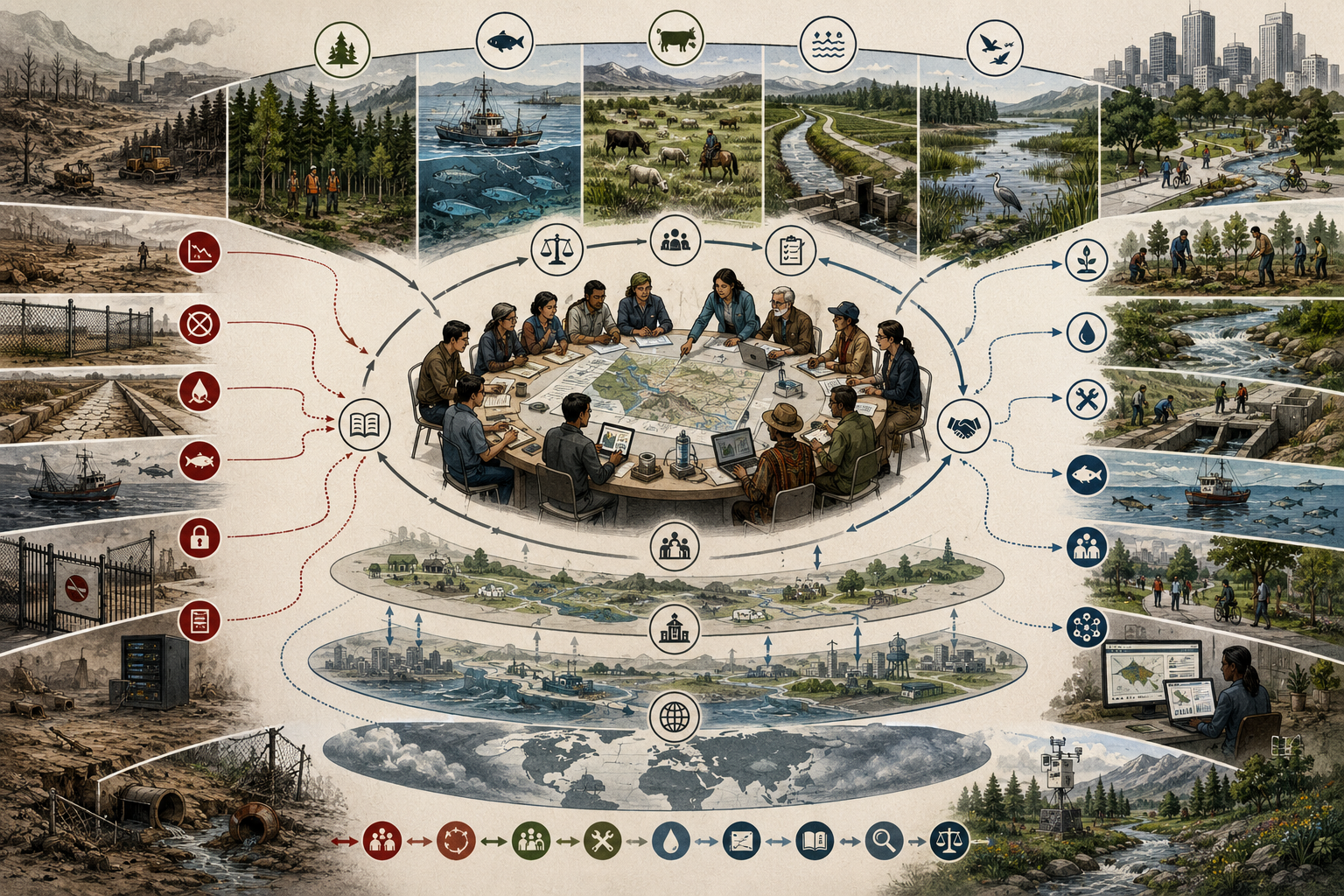
Within a sustainable systems framework, commons governance becomes central rather than peripheral. Climate stability, biodiversity, water systems, local ecosystems, public knowledge, digital coordination layers, urban public goods, scientific infrastructure, and many forms of shared infrastructure all contain commons-like characteristics. They require rules, monitoring, legitimacy, maintenance, access rights, and institutional capacity. A society that cannot govern shared resources cannot sustain the material and ecological foundations on which private and public life both depend.
Why This Topic Matters
Commons, shared resources, and institutional governance matter because many essential conditions of economic and social life are neither purely private nor easily reducible to top-down administration. Water systems, forests, fisheries, atmospheric sinks, urban public spaces, scientific knowledge, and digital infrastructures all involve multiple users, interdependent benefits, and risks of depletion, enclosure, degradation, or exclusion. These resources often support livelihoods and public welfare in ways that are not fully captured by ordinary market pricing.
This matters analytically because shared resources challenge simplistic assumptions about coordination. A resource can be widely valuable and jointly used without being well governed through isolated exchange alone. It can also fail under more than one institutional condition. Unmanaged open access may produce depletion, but enclosure or rigid centralization may also destroy local knowledge, adaptive capacity, legitimate access, and community stewardship. The problem is therefore not sharing as such. The problem is whether institutions can make shared use durable, accountable, and regenerative.
These issues also matter politically and ecologically. They raise questions about who has rights to use a resource, who bears the burden of restraint, who monitors conduct, who decides rules, how conflicts are resolved, and whether long-term stewardship can survive short-term pressure. Commons governance is therefore one of the clearest places where economics, institutional design, ecology, law, public authority, local knowledge, and justice meet.
They also matter historically. Many societies have long depended on governed commons for survival, from irrigation systems and common grazing to forests, fisheries, canals, wetlands, and local maintenance regimes. Modern economies have not escaped this dependence. They have expanded it into new domains, including data standards, scientific archives, open-source software, public knowledge systems, ecological sinks, and digital coordination layers whose governance now shapes the conditions of global life.
A society’s approach to the commons reveals whether it can preserve shared value without exhausting it, enclosing it for narrow gain, or allowing it to deteriorate through neglect. That is why commons governance belongs at the center of economic systems analysis.
What the Commons Are
The commons are not simply resources that happen to be shared. They are resources embedded in social arrangements of shared access, mutual dependence, and governance. A commons exists where a resource is valuable to multiple users and where stable use depends on rules, norms, institutions, and forms of restraint that structure access over time.
This definition matters because it avoids two common errors. The first is treating the commons as a naturally ungoverned open-access space. The second is treating the commons as inherently harmonious or self-sustaining. In reality, commons persist only where institutions, whether formal or informal, help define entitlements, obligations, monitoring, sanctions, maintenance responsibilities, and dispute resolution.
Commons may take many forms. Some are local and ecological, such as fisheries, forests, irrigation systems, pastures, wetlands, and groundwater basins. Others are infrastructural or civic, such as public spaces, neighborhood systems, water networks, public paths, shared maintenance regimes, and urban amenities. Still others are informational, such as open knowledge systems, standards, scientific archives, open-source software, and certain digital coordination environments. What unites them is not a single legal form, but the problem of governing shared use across time.
A research-grade treatment of the commons must distinguish carefully among common-pool resources, public goods, open-access systems, publicly owned systems, and collectively governed resources. These categories overlap at times, but they are not identical. Public goods are often non-rival and non-excludable. Common-pool resources are often rival but difficult to exclude. Open access means weak or absent governance. Public ownership does not automatically mean commons governance. The commons are best understood as institutionally governed shared resources rather than as resources that are merely available to many.
That distinction is crucial. The question is not only who owns the resource, but who may use it, under what conditions, with what obligations, with what monitoring, and with what capacity for renewal.
Shared Resources and Rivalry
Many shared resources are characterized by rivalry in use. One actor’s extraction, consumption, congestion, pollution, or degradation can reduce what remains available to others. Fisheries, groundwater, forests, grazing areas, road space, irrigation channels, and environmental sinks all have this feature to some degree. This makes governance essential, because the resource cannot be treated as infinitely abundant simply because it is collectively accessible.
At the same time, some commons-like systems combine rival and non-rival elements. Knowledge can be widely shared without being depleted by use, yet the institutions that produce, curate, preserve, validate, and transmit it require collective support. Digital infrastructures may appear infinitely reproducible at the margin while still depending on material systems, energy, labor, maintenance, standards, cybersecurity, and governance. Urban public space can be shared widely, but congestion, disrepair, exclusion, policing, or privatization can alter its effective accessibility.
Commons analysis therefore benefits from precision. Not all shared systems are exhausted in the same way, but all raise questions of access, maintenance, and institutional design. A fishery may collapse through overharvest. A public park may deteriorate through undermaintenance or exclusion. A knowledge commons may weaken through enclosure, fragmentation, paywalls, data loss, or lack of curation. A digital commons may be captured through platform control or dependency on privately governed infrastructures.
Rivalry is important because it shows why governance cannot be optional. Where use today affects availability tomorrow, the resource becomes a problem of temporal coordination as much as present access. Commons institutions are mechanisms for converting interdependence into durable order. They define how much can be taken, who has rights, who must contribute, how the resource is monitored, and how users respond when conditions change.
This is one reason shared resources are so analytically significant within sustainable systems. They make visible the fact that production, consumption, and access are often nested within stocks and flows that require ongoing renewal. A commons is not just something people use together. It is something whose future depends on the present pattern of that use.
Beyond the Tragedy Narrative
One of the most influential modern accounts of shared resources is the “tragedy of the commons” narrative, in which individually rational users overexploit a shared resource because each has an incentive to capture private benefit while the costs of depletion are spread across all users. That framework captures an important risk, especially under open access with weak governance. But it becomes misleading when treated as a universal law of commons failure.
The problem is that many historical commons did not fail because people shared resources. They failed when governance arrangements were absent, undermined, captured, or overwhelmed. In many cases communities developed rules about who could use a resource, when use was allowed, how extraction was limited, how violations were handled, how maintenance was organized, and how disputes were resolved. The tragedy, in other words, is not sharing as such. It is unmanaged or mismanaged sharing under insufficient institutional conditions.
This distinction matters because it changes the question from “should shared resources exist?” to “what governance arrangements allow shared resources to endure?” It shifts analysis away from fatalism and toward institutional design, empirical variation, and the conditions under which cooperation becomes stable.
It also allows a more serious comparison among different governance failures. Commons may break down through open access, through enclosure, through predatory extraction by powerful actors, through state incapacity, through corruption, through bad measurement, through loss of legitimacy among users, or through external market pressure that overwhelms local restraint. A mature theory of the commons must account for this broader range of failure modes.
The tragedy narrative remains useful as a warning against unmanaged open access, but it is inadequate as a theory of shared life. The deeper lesson is that shared resources require governance, and governance itself must be studied, maintained, and judged.
Institutional Governance
Institutional governance refers to the structured rules, norms, organizations, and decision procedures through which shared resources are maintained across time. It includes formal law, administrative oversight, customary rules, local associations, monitoring systems, cooperative arrangements, public agencies, scientific institutions, user councils, and hybrid forms that combine community knowledge with larger-scale regulation.
This broader view matters because governance is not reducible to a single mechanism. Some shared resources are governed effectively through local rule-making and peer monitoring. Others require state support, technical expertise, legal enforcement, or broader regulatory coordination. Some are nested within larger systems, where local governance manages immediate use while higher-level institutions provide funding, science, dispute resolution, or cross-boundary coordination.
A research-grade treatment of the commons must therefore ask not whether governance exists, but what kind exists, at what scale, with what legitimacy, with what evidence base, and with what capacity for monitoring, adaptation, and conflict resolution.
Institutional governance also has a temporal aspect. Good rules today do not guarantee good governance tomorrow if institutions lose capacity, if monitoring erodes, if ecological conditions shift, if user composition changes, or if market pressures intensify. The governance of the commons is therefore never a one-time design problem. It is an ongoing problem of institutional reproduction.
Governance also has to balance restraint and access. A rule system that preserves a resource while excluding the people whose lives depend on it may remain ecologically stable but politically illegitimate. A rule system that maximizes access while neglecting regeneration may appear inclusive until the resource collapses. Durable governance must hold preservation, access, justice, and maintenance together.
Rules, Boundaries, and Monitoring
Durable commons governance usually depends on rules that define use and boundaries that define membership, jurisdiction, or entitlement. Who is allowed to draw from a groundwater basin? Who may graze animals on a shared pasture? What counts as acceptable extraction from a fishery? Who may use a public space, and under what conditions? What contributions are required for maintenance? Without such boundaries and rules, shared resources are more likely to drift toward open access, opportunism, conflict, or capture.
Monitoring is equally important. Rules without observability are difficult to sustain. Effective systems often include peer monitoring, public oversight, measurable quotas, ecological observation, maintenance logs, community reporting, satellite data, administrative records, or reputational accountability. Monitoring does not need to be coercive in every case, but it does need to make conduct legible enough for rules to matter.
Sanctions and dispute resolution also matter. Governance is rarely stable if rule violations carry no consequence or if conflicts cannot be settled in ways users regard as legitimate. Sanctions need not be severe to be effective; in many durable systems, graduated sanctions, warnings, mediation, and local dispute mechanisms matter as much as formal punishment. The point is that users must believe the rules are real, consistently applied, and contestable when necessary.
These elements are analytically important because they connect ecology to institution-building. A resource may be physically renewable, yet socially unsustainable if governance cannot define access, monitor use, and respond to breach in ways that remain credible over time. Conversely, strong monitoring and clear rules can make shared use possible even where the resource is vulnerable.
Commons governance is therefore best understood not as spontaneous harmony, but as structured social order built around recognizable expectations and enforceable obligations.
Local Knowledge and Adaptation
Shared resources are often governed more effectively when institutions draw on local ecological knowledge, practical experience, and situated observation. Fishers may understand seasonal dynamics that generalized rules miss. Farmers managing irrigation may recognize timing patterns invisible to distant administrators. Communities may know which areas flood first, which paths are essential, which forests are under pressure, which wells are declining, and which rules people regard as legitimate.
This does not mean local governance is always superior. Local systems can be unequal, exclusionary, captured, or overwhelmed by larger pressures. But it does mean that commons governance often works best when it remains adaptive and informationally grounded rather than rigidly abstract.
Adaptation matters because shared resources are dynamic. Ecological conditions shift, populations change, technologies alter extraction possibilities, climate stress intensifies, and broader market forces increase pressure. Governance systems that cannot learn or adjust may fail even if their original rules were well designed. A commons is therefore not merely a resource stock. It is an evolving institutional relationship between use, knowledge, restraint, and renewal.
In this sense, good governance is epistemic as well as legal. It depends on whether institutions can observe change, incorporate distributed knowledge, revise rules, and maintain legitimacy under new conditions. Commons governance is one of the clearest examples of learning as an institutional capacity.
Local knowledge also matters for justice. Communities closest to a resource often bear the consequences of misgovernance first. Their observations should not be treated as anecdotal noise beneath expert knowledge. A serious governance system must be capable of combining scientific measurement, administrative capacity, and situated knowledge rather than allowing any one form of knowledge to dominate the others uncritically.
Commons, Enclosure, and Power
Commons are shaped by power. Shared resources may be enclosed, privatized, monopolized, or appropriated by stronger actors who convert common use into exclusive control. Historical enclosure of land is one familiar case, but similar processes occur in water access, fisheries, forests, digital infrastructures, knowledge systems, genetic resources, urban public space, and data ecosystems. Enclosure can sometimes improve management under certain conditions, but it can also dispossess communities, narrow access, destroy mutual obligations, and shift shared value into private rent streams.
This is why commons governance cannot be analyzed apart from political economy. The question is not only whether a resource is shared, but who has the power to redefine its status, rewrite its rules, capture its value, or exclude others from access. Governance is always partly a problem of institutional authority and asymmetry.
Power also operates within commons regimes themselves. Access may be unequally distributed by class, caste, gender, race, citizenship, landownership, administrative influence, or proximity to public authority. A serious account must therefore distinguish between the existence of shared institutions and the fairness of the rules through which sharing is organized.
Commons analysis has to resist two simplifications at once: the romantic assumption that local or shared systems are automatically fair, and the market assumption that privatization automatically solves the problem of overuse. In reality, both commons governance and enclosure must be judged by their consequences for sustainability, access, legitimacy, democratic contestation, maintenance, and long-run collective capacity.
Enclosure can reduce visible overuse while producing hidden forms of exclusion. Open access can preserve nominal inclusion while producing depletion. State control can protect a resource or alienate users. Community governance can sustain a commons or reproduce local hierarchy. The institutional question is always concrete: what arrangement preserves the resource, maintains access, distributes obligations fairly, and remains legitimate over time?
Scale, Nested Systems, and Polycentric Governance
Many commons problems cannot be governed at a single scale. A local fishery may be shaped by regional ecosystems, national regulation, and global trade demand. A watershed may cross jurisdictions. A forest may be locally used but globally relevant for biodiversity and climate regulation. Climate stability is a planetary commons problem that no local community can govern alone, yet many relevant actions still occur locally, regionally, and nationally.
This means that governance often needs to be nested: different institutions acting at different levels with overlapping responsibilities. Local institutions may monitor use closely. Regional institutions may provide ecological modeling, enforcement, or dispute coordination. National institutions may set legal frameworks, financing, and rights protections. International institutions may coordinate cross-border problems, scientific standards, or global public commitments.
Polycentric governance refers to systems in which multiple centers of authority coordinate, overlap, or coexist rather than being organized through one fully centralized command structure. This can be useful where problems span scales and where no single institution possesses all necessary information, legitimacy, resources, or enforcement capacity.
Polycentric systems are not valuable merely because they are decentralized. Their value lies in whether they distribute authority in ways that match the problem structure, create opportunities for learning, reduce single-point failure, and preserve channels through which users can contest, revise, and improve rules over time. Poorly designed polycentric systems can become fragmented, duplicative, or conflict-ridden. Well-designed ones can combine local intelligence with broader coordination.
Sustainable governance often requires both local knowledge and larger-scale capacity. Too little scale leaves major spillovers unmanaged. Too much scale can destroy adaptive fit, local legitimacy, and contextual knowledge. The institutional question is how to create layered governance that remains coherent without becoming rigid, captured, or disconnected.
Commons in Ecology, Infrastructure, and Knowledge
Commons analysis is often associated with natural resources, but it applies more broadly. Ecological commons include forests, watersheds, fisheries, soils, biodiversity, wetlands, pollination systems, groundwater, and atmospheric sinks. Infrastructural commons include roads, public spaces, shared transit systems, maintenance networks, some digital coordination layers, and parts of urban life that depend on sustained collective care. Knowledge commons include scientific research, open standards, educational resources, open-source code, archives, and public data systems whose value grows through shared use and stewardship.
This broader application matters because many modern systems combine ecological, infrastructural, and informational dimensions. Environmental monitoring systems depend on shared data. Public health depends on knowledge-sharing and trust. Digital infrastructures rely on protocols and standards that function most effectively as widely available coordination layers. Climate adaptation depends on data, local observation, infrastructure, planning, and public trust at once.
In these domains, the commons problem is not only overuse. It may also be undermaintenance, enclosure, fragmentation, strategic withholding, loss of interoperability, platform dependency, erosion of trust, or failure to preserve records. A knowledge commons may be weakened not because too many people use knowledge, but because institutions fail to curate it, because access is restricted, or because private control fragments shared standards.
The study of commons therefore belongs not only to environmental economics, but to the wider analysis of how societies sustain shared foundations for production, coordination, and collective life. It highlights an important shift in contemporary political economy: some of the most decisive commons today are hybrid systems, where material infrastructures, ecological conditions, data flows, institutional trust, and public authority interact.
Governing these systems well requires conceptual tools that can move beyond older separations between “nature,” “infrastructure,” “information,” and “public goods.” Commons thinking provides one such bridge.
Distribution, Justice, and Access
Commons governance is never only about efficiency. It also concerns access, fairness, and the distribution of burden. Who gets to use a shared resource, under what terms, and with what protections? Who is excluded in the name of preservation? Who is asked to restrain use, and who is historically responsible for depletion? Who has voice in rule-making, and who is monitored most heavily? These are distributional questions as much as governance questions.
This is especially important where shared resources support basic life conditions. Water access, public space, ecological protection, digital access, scientific knowledge, and local infrastructure all affect capability, participation, and dignity. A commons regime that sustains a resource biologically while entrenching unequal access may still fail in normative and political terms.
Justice enters commons analysis in several ways: distribution of use rights, distribution of maintenance obligations, distribution of sacrifice under scarcity, distribution of benefits from preservation, and distribution of voice in governance. Without attention to these dimensions, governance may remain formally stable while becoming substantively illegitimate.
This is particularly relevant under conditions of ecological transition. When shared resources are under stress, societies must decide who adapts first, who sacrifices most, who receives compensation, and whose livelihoods are protected. Commons governance under scarcity is therefore also a problem of political morality and institutional trust.
Access must also be understood historically. Communities excluded from past ownership, harmed by extractive regimes, or exposed to pollution may have different claims than actors who benefited from prior depletion. A just commons regime cannot pretend that all users arrive at the resource from equal positions. Governance must account for unequal power, unequal dependence, and unequal responsibility.
Time, Maintenance, and Reproduction
Shared resources are sustained not only by rules about use, but by maintenance across time. Irrigation systems require repair. Public spaces require care. Knowledge systems require updating, curation, preservation, and documentation. Ecosystems require restraint and regeneration. Digital commons require security patches, governance, standards, moderation, and technical upkeep. Commons governance is therefore not just about limiting extraction. It is about reproducing the conditions of continued shared use.
This temporal dimension is crucial because breakdown often begins not with dramatic collapse, but with quiet undermaintenance. Monitoring fades, rules lose legitimacy, data quality decays, infrastructure ages, local institutions weaken, ecological change goes unobserved, and the social labor required to preserve a commons is neglected. By the time failure becomes obvious, restoration may be costly or impossible.
Commons governance is therefore a problem of institutional reproduction as well as resource management. A society must sustain not only the shared resource, but the rules, knowledge, trust, maintenance capacity, and public commitment that make continued governance possible.
This is one reason maintenance deserves greater attention in economic thought. Production and extraction are often more visible than upkeep, yet the long-run condition of the commons depends heavily on whether societies can value and organize the labor of preservation before crisis forces belated intervention.
Maintenance also has a justice dimension. The labor of sustaining shared resources is often underpaid, feminized, informal, racialized, or treated as background care rather than productive work. A serious commons framework must recognize maintenance as part of the economic foundation of shared life.
Measurement and Governance Capacity
Shared resources are difficult to govern when the relevant conditions cannot be observed, measured, or trusted. Fisheries require stock assessment. Groundwater governance requires monitoring extraction and recharge. Forest governance requires ecological observation, land-use data, and enforcement capacity. Knowledge commons require curation, version control, metadata, citation systems, and preservation infrastructure. Infrastructure commons require maintenance data and performance indicators. Governance capacity is therefore partly informational capacity.
This does not mean governance should be reduced to technocratic measurement. Measurement can be captured, selective, misleading, or disconnected from lived experience. But rules work better when institutions can observe conditions, detect change, and make use of credible information. Without this, both overuse and undermaintenance become harder to address before deterioration becomes severe.
Measurement also supports legitimacy when it is transparent and contestable. Users are more likely to accept restraint, maintenance obligations, or contribution rules when the state of the resource and the rationale for governance are visible. In this sense, information is not separate from institutional governance. It is one of its enabling conditions.
A research-grade account must therefore treat measurement as part of institutional design rather than as an afterthought. What gets measured, who controls the data, how indicators are interpreted, whether users trust the resulting picture, and how uncertainty is communicated are all part of the governance problem itself.
The best governance systems are not those that simply collect more data. They are those that connect credible measurement with legitimate decision-making, adaptive rules, public accountability, and meaningful participation by those affected.
Institutional Failure and Commons Breakdown
Commons rarely collapse for a single reason. Breakdown often reflects a combination of ecological pressure, weak monitoring, declining legitimacy, political capture, undermaintenance, blurred boundaries, conflict, external market shocks, and unequal power. A fishery may be biologically stressed while governance institutions simultaneously lose authority. A public space may be underfunded while adjacent inequality increases conflict over access. A knowledge commons may be fragmented by enclosure, legal restriction, declining trust, and failing maintenance at once.
This matters because institutional failure is often cumulative. Rules are ignored more frequently, monitoring becomes selective, sanctions lose credibility, trusted norms erode, and extraction or neglect rises. At some point, actors stop believing others will comply, and the system shifts from governed reciprocity toward defensive appropriation, opportunism, enclosure, or exit.
Breakdown is therefore not just an ecological event. It is also an institutional and social one. A commons may be in danger before the resource stock visibly collapses if trust, monitoring, conflict resolution, and rule legitimacy have already eroded. Conversely, a damaged resource may recover if governance institutions remain strong enough to organize restraint, restoration, and shared sacrifice.
Understanding commons failure requires attention to how ecological systems, political authority, local trust, measurement, and external economic pressure interact. That is why commons analysis belongs naturally within broader systems thinking. It reveals how fragile shared orders can become when their material and institutional supports drift apart.
A sustainable commons must therefore protect two stocks at once: the resource stock and the institutional stock. If either is depleted, the commons is at risk.
Commons, Shared Resources, and Institutional Governance Within Sustainable Systems
Within sustainable systems, commons governance becomes a central problem because many of the most important conditions of long-run welfare are shared and vulnerable to cumulative damage. Climate stability, biodiversity, watershed integrity, public knowledge, digital coordination layers, urban public goods, and ecological sinks all have commons-like dimensions. These cannot be governed adequately through isolated exchange alone.
This perspective changes the meaning of sustainability. It is not merely a matter of greener private choice or more efficient production. It is also a matter of whether institutions can preserve shared systems, align use with regeneration, distribute obligations fairly, and maintain legitimacy across time. A system that consumes shared ecological and infrastructural foundations faster than it can renew them is not sustainable, whatever its short-term growth profile may be.
Sustainable systems require governance forms capable of handling interdependence, scale, uncertainty, maintenance, and justice together. Commons analysis helps make that challenge visible because it forces attention to the institutional preconditions of durable shared life.
It also helps bridge the gap between local stewardship and planetary governance. The same conceptual concerns recur at very different scales: boundaries, monitoring, legitimacy, maintenance, burden sharing, access, rule adaptation, and long-term renewal. Commons thinking is therefore one of the most useful institutional lenses for understanding sustainability as a lived and governed system rather than as an abstract aspiration.
A sustainable economy must therefore ask not only how private goods are produced and exchanged, but how shared foundations are preserved. The commons are where the illusion of isolated economic life breaks down most clearly. They show that material life is interdependent, that governance is unavoidable, and that freedom itself depends on maintained shared conditions.
How Commons Governance Should Be Judged
Commons governance should not be judged only by whether a resource survives in biological or technical terms. A broader economic systems framework asks whether the resource is preserved, access is legitimate, rules are trusted, maintenance is organized, knowledge is incorporated, and institutions remain capable of adapting over time.
| Dimension | Narrow Question | Systems Question |
|---|---|---|
| Resource Stock | How much of the resource remains? | Is extraction, use, or degradation compatible with regeneration and long-term renewal? |
| Access | Who can use the resource? | Are access rights fair, legitimate, historically aware, and compatible with preservation? |
| Rules | Are there formal restrictions? | Are rules clear, known, trusted, enforceable, and adaptable to changing conditions? |
| Monitoring | Can use be observed? | Are ecological, social, and institutional conditions measured credibly and transparently? |
| Compliance | Do users obey rules? | Do monitoring, legitimacy, sanctions, and shared norms make cooperation stable? |
| Power | Who controls the resource? | Are commons protected from capture, enclosure, exclusion, and unequal rule-making? |
| Maintenance | Is the resource repaired when damaged? | Are upkeep, curation, restoration, and institutional reproduction organized before crisis? |
| Scale | Who has jurisdiction? | Does governance match the ecological, infrastructural, informational, and political scale of the problem? |
| Justice | Is the resource efficiently managed? | Are benefits, burdens, restraint, and voice distributed fairly across users and generations? |
This framework prevents a common mistake: assuming that commons governance is only about avoiding overuse. Overuse is one danger, but not the only one. Enclosure, exclusion, undermaintenance, capture, fragmentation, and loss of legitimacy can also destroy the shared value of a resource.
The central question is therefore not whether a commons is public, private, local, or state-managed in a simple sense. The question is whether the institutional arrangement sustains the resource, protects fair access, maintains trust, and preserves shared capability across time.
Mathematical Lens
Mathematics can clarify commons governance by making stock-flow relationships, extraction pressure, compliance, access, and institutional integrity explicit. These equations do not determine the right governance arrangement by themselves, but they help reveal why shared resources require rules, monitoring, legitimacy, and maintenance.
1. Resource Stock Dynamics
S_{t+1} = S_t + G(S_t) – H_t
\]
Interpretation: The resource stock \(S\) at time \(t+1\) equals the current stock plus regeneration \(G(S_t)\) minus total harvest or extraction \(H_t\). A commons persists only when the pattern of use remains compatible with renewal.
2. Shared Extraction
H_t = \sum_i h_{i,t}
\]
Interpretation: Total extraction \(H_t\) is the sum of extraction by individual users or groups. The commons problem arises because many separate decisions accumulate into one system-level pressure on the resource stock.
3. Sustainability Condition
H_t \leq G(S_t)
\]
Interpretation: A basic sustainability condition requires harvest or use to remain within the regenerative capacity of the resource. If extraction persistently exceeds regeneration, depletion follows.
4. Monitoring and Compliance
C = f(M,R,L,S)
\]
Interpretation: Compliance \(C\) depends on monitoring capacity \(M\), rule clarity \(R\), legitimacy \(L\), and sanction capacity \(S\). Rules alone are insufficient if they cannot be observed, understood, trusted, or enforced.
5. Preservation, Access, and Justice
W = f(P,A,J)
\]
Interpretation: Welfare from a commons regime \(W\) depends on preservation \(P\), access \(A\), and justice \(J\). A regime that preserves a resource by unjust exclusion may fail normatively even if it succeeds biologically.
6. Institutional Integrity
I_{t+1} = I_t + U_t – E_t
\]
Interpretation: Institutional integrity \(I\) changes through upkeep \(U_t\) and erosion \(E_t\). Monitoring, legitimacy, conflict resolution, and maintenance must be reproduced over time or governance capacity declines.
7. Practical Interpretation
The mathematical lens clarifies several things. Shared-resource governance is fundamentally a stock-flow problem. Individual extraction decisions accumulate into system-level pressure. Sustainability depends on keeping use within regenerative limits. Compliance depends on monitoring, rules, legitimacy, and enforcement together. Good commons governance balances preservation, access, and justice. Institutional erosion can undermine a commons even before ecological collapse is visible.
Formalization helps reveal structure, but it does not determine the appropriate institutional form in every case. Real governance still depends on history, power, scale, local knowledge, administrative capacity, ecological uncertainty, and political legitimacy.
Python Workflow: Commons Stock and Governance Analysis
Python is useful for turning commons-governance concepts into reproducible stock-flow and institutional scenarios. The following compact workflow models a renewable shared resource, multiple users, a governance intervention, and institutional integrity over time.
# Commons, Shared Resources, and Institutional Governance
# Simple Python workflow

import numpy as np
import pandas as pd

time = np.arange(1, 31)

def regen(stock, r=0.12, K=150):
    return r * stock * (1 - stock / K)

# Resource stock without stronger governance
stock = np.zeros(len(time))
stock[0] = 100

# Three users drawing from the resource
user1 = np.full(len(time), 4)
user2 = np.full(len(time), 3)
user3 = np.full(len(time), 5)

harvest = user1 + user2 + user3

for t in range(len(time) - 1):
    stock[t + 1] = stock[t] + regen(stock[t]) - harvest[t]

# Governance scenario: reduced extraction after period 10
harvest_gov = harvest.copy()
harvest_gov[10:] = 7

stock_gov = np.zeros(len(time))
stock_gov[0] = 100

for t in range(len(time) - 1):
    stock_gov[t + 1] = stock_gov[t] + regen(stock_gov[t]) - harvest_gov[t]

# Institutional integrity
integrity = np.zeros(len(time))
integrity[0] = 80

upkeep = np.full(len(time), 2.5)
erosion = np.full(len(time), 3.0)
erosion[10:] = 1.5

for t in range(len(time) - 1):
    integrity[t + 1] = integrity[t] + upkeep[t] - erosion[t]

df = pd.DataFrame({
    "Period": time,
    "Stock_No_Governance": np.round(stock, 2),
    "Stock_With_Governance": np.round(stock_gov, 2),
    "Harvest_No_Governance": harvest,
    "Harvest_With_Governance": harvest_gov,
    "Institutional_Integrity": np.round(integrity, 2)
})

print(df.head())
This workflow shows how modest collective restraint can alter the long-run trajectory of a shared resource. It also makes visible that governance quality itself changes over time. A commons can fail not only because the resource is overused, but because institutional integrity erodes through neglect, conflict, capture, or loss of legitimacy.
The full GitHub repository expands this example into multiple resource types, user classes, governance regimes, compliance scores, access-justice metrics, enclosure-risk indicators, SQL queries, R and Stata replication workflows, Julia stock-flow simulations, and article-ready figures.
R Workflow: Shared Resource Governance
R is useful for summarizing commons trajectories, comparing governance regimes, and creating publication-ready graphics. The following compact workflow performs the same shared-resource stock and institutional-integrity analysis in R.
# Commons, Shared Resources, and Institutional Governance
# Simple R workflow

time <- 1:30

regen <- function(S, r = 0.12, K = 150) {
  r * S * (1 - S / K)
}

# Resource stock without stronger governance
stock <- numeric(length(time))
stock[1] <- 100

# Three users drawing from the resource
user1 <- rep(4, length(time))
user2 <- rep(3, length(time))
user3 <- rep(5, length(time))

harvest <- user1 + user2 + user3

for (t in 1:(length(time) - 1)) {
  stock[t + 1] <- stock[t] + regen(stock[t]) - harvest[t]
}

# Governance scenario: reduced extraction after period 10
harvest_gov <- harvest
harvest_gov[11:length(time)] <- 7

stock_gov <- numeric(length(time))
stock_gov[1] <- 100

for (t in 1:(length(time) - 1)) {
  stock_gov[t + 1] <- stock_gov[t] + regen(stock_gov[t]) - harvest_gov[t]
}

# Institutional integrity
integrity <- numeric(length(time))
integrity[1] <- 80

upkeep <- rep(2.5, length(time))
erosion <- rep(3.0, length(time))
erosion[11:length(time)] <- 1.5

for (t in 1:(length(time) - 1)) {
  integrity[t + 1] <- integrity[t] + upkeep[t] - erosion[t]
}

summary_df <- data.frame(
  Period = time,
  Stock_No_Governance = round(stock, 2),
  Stock_With_Governance = round(stock_gov, 2),
  Harvest_No_Governance = harvest,
  Harvest_With_Governance = harvest_gov,
  Institutional_Integrity = round(integrity, 2)
)

head(summary_df)
This R workflow is deliberately compact for article readability. In the full repository, R reads structured resource, user, governance, and access-justice scenarios; compares stock trajectories across governance forms; summarizes compliance and institutional-integrity indicators; and visualizes how open access, community governance, state regulation, polycentric governance, enclosure, and capture differ over time.
Future Economic Systems articles can extend this foundation with fisheries data, groundwater records, forest inventories, land-tenure systems, public-space maintenance data, open-science repositories, digital commons governance, remote-sensing indicators, or participatory monitoring datasets.
GitHub Repository
The article body includes selected computational examples so the conceptual, institutional, and mathematical argument remains readable. The full repository contains the expanded research infrastructure: Python stock-flow commons simulations, R governance summaries, Stata applied-economics replication workflows, SQL resource and governance tables, Julia dynamic simulations, extraction scenarios, compliance metrics, access-justice indicators, enclosure-risk measures, institutional-integrity models, documentation, reproducible sample data, and article-ready figures and tables.
Complete Code Repository
The full code distribution for this article, including selected article examples and advanced research-style computational scaffolding for commons governance, shared resource stocks, extraction and regeneration, monitoring, compliance, rule clarity, legitimacy, access justice, enclosure risk, polycentric governance, institutional integrity, reproducibility documentation, and cross-language economic analysis, is available on GitHub.
Conclusion
Commons, shared resources, and institutional governance are central to economic analysis because they show how societies manage interdependence where isolated exchange is not enough. Commons are not simply unowned spaces. They are governed arrangements in which access, restraint, maintenance, monitoring, legitimacy, and renewal must be organized across time.
Shared resources endure not because users are automatically cooperative, but because institutions make cooperation possible. Rules define expectations. Monitoring makes conduct visible. Sanctions and dispute resolution make rules credible. Local knowledge improves adaptation. Polycentric governance connects scales. Maintenance reproduces the resource and the institution. Justice sustains legitimacy.
To understand an economic system seriously, one must therefore ask how it governs what many depend upon together: ecological systems, shared infrastructures, knowledge bases, public spaces, water systems, atmospheric sinks, and the wider conditions of collective life. These questions reveal whether a society is capable of preserving shared value without exhausting it, enclosing it unjustly, or allowing it to deteriorate through institutional neglect.
In a sustainable economic system, commons governance is not a niche concern. It is one of the foundations of long-run welfare. The future depends not only on what societies produce and exchange, but on whether they can maintain the shared systems that make production, exchange, health, dignity, knowledge, and ecological continuity possible.
Related Reading
- Economic Systems
- Externalities, Public Goods, and Collective Provision
- Scarcity, Allocation, and the Organization of Material Life
- Households, Firms, Markets, and States
- Ecological Economics and the Embedded Economy
- Public Finance, State Capacity, and Collective Goods
- Risk & Resilience
- Sustainable Development
Further Reading
- Food and Agriculture Organization of the United Nations (FAO) (n.d.). Governance of Tenure. Available at: https://www.fao.org/tenure/en/
- Food and Agriculture Organization of the United Nations (FAO) (2024). The State of World Fisheries and Aquaculture 2024. Available at: https://www.fao.org/publications/home/fao-flagship-publications/the-state-of-world-fisheries-and-aquaculture/en
- Ostrom, E. (1990). Governing the Commons: The Evolution of Institutions for Collective Action. Cambridge: Cambridge University Press.
- Organisation for Economic Co-operation and Development (OECD) (n.d.). Water Governance. Available at: https://www.oecd.org/en/topics/water-governance.html
- Organisation for Economic Co-operation and Development (OECD) (2015). OECD Principles on Water Governance. Available at: https://www.oecd.org/cfe/regionaldevelopment/OECD-Principles-on-Water-Governance.pdf
- UNESCO (n.d.). Open Science. Available at: https://www.unesco.org/en/open-science
- United Nations Environment Programme (UNEP) (2024). Global Resources Outlook 2024. Available at: https://www.unep.org/resources/global-resource-outlook-2024
- World Bank (n.d.). Natural Resources Management. Available at: https://www.worldbank.org/en/topic/naturalresourcesmanagement
- World Bank (2021). Green, Resilient, and Inclusive Development. Available at: https://documents.worldbank.org/en/publication/documents-reports/documentdetail/285171633074966748/green-resilient-and-inclusive-development
References
- Food and Agriculture Organization of the United Nations (FAO) (n.d.). Governance of Tenure. Available at: https://www.fao.org/tenure/en/
- Food and Agriculture Organization of the United Nations (FAO) (2024). The State of World Fisheries and Aquaculture 2024. Rome: FAO. Available at: https://www.fao.org/publications/home/fao-flagship-publications/the-state-of-world-fisheries-and-aquaculture/en
- Organisation for Economic Co-operation and Development (OECD) (n.d.). Water Governance. Available at: https://www.oecd.org/en/topics/water-governance.html
- Organisation for Economic Co-operation and Development (OECD) (2015). OECD Principles on Water Governance. Paris: OECD. Available at: https://www.oecd.org/cfe/regionaldevelopment/OECD-Principles-on-Water-Governance.pdf
- UNESCO (n.d.). Open Science. Available at: https://www.unesco.org/en/open-science
- United Nations Environment Programme (UNEP) (2024). Global Resources Outlook 2024. Nairobi: UNEP. Available at: https://www.unep.org/resources/global-resource-outlook-2024
- World Bank (n.d.). Natural Resources Management. Available at: https://www.worldbank.org/en/topic/naturalresourcesmanagement
- World Bank (2021). Green, Resilient, and Inclusive Development. Washington, DC: World Bank. Available at: https://documents.worldbank.org/en/publication/documents-reports/documentdetail/285171633074966748/green-resilient-and-inclusive-development