
Last Updated May 9, 2026
Firms are among the central institutions of modern economic life because they organize production, employment, investment, innovation, pricing, logistics, technology, and the practical transformation of inputs into goods and services. They are not merely abstract profit-maximizing units on a diagram. They are strategic organizations embedded in labor markets, financial systems, supply chains, legal regimes, public infrastructure, technological systems, competitive environments, and ecological constraints.
To study firms seriously is therefore to study more than business decision-making. It is to study how costs are structured, how competition is governed, how market power is built or restrained, how firms distribute income and risk, and how market structure shapes the wider organization of economic life. Firms decide whether to hire or automate, invest or distribute profits, compete through price or differentiation, source locally or globally, absorb costs or shift them outward, innovate productively or defend incumbency, and internalize or externalize ecological and social burdens.
Costs matter because they shape how firms survive, expand, contract, price, outsource, automate, consolidate, and distribute income. Competition matters because it affects how firms respond to rivals, how much pricing power they possess, how much innovation pressure they face, and whether households, workers, suppliers, and communities encounter open rivalry, concentrated control, or dependence on a few dominant actors. Market structure matters because the arrangement of firms within a sector conditions the whole field of economic behavior.
Main Library
Publications
Article Map
Economic Systems
Related Topic
Sustainable Development
Related Topic
Institutions & Governance
Related Topic
Risk & Resilience
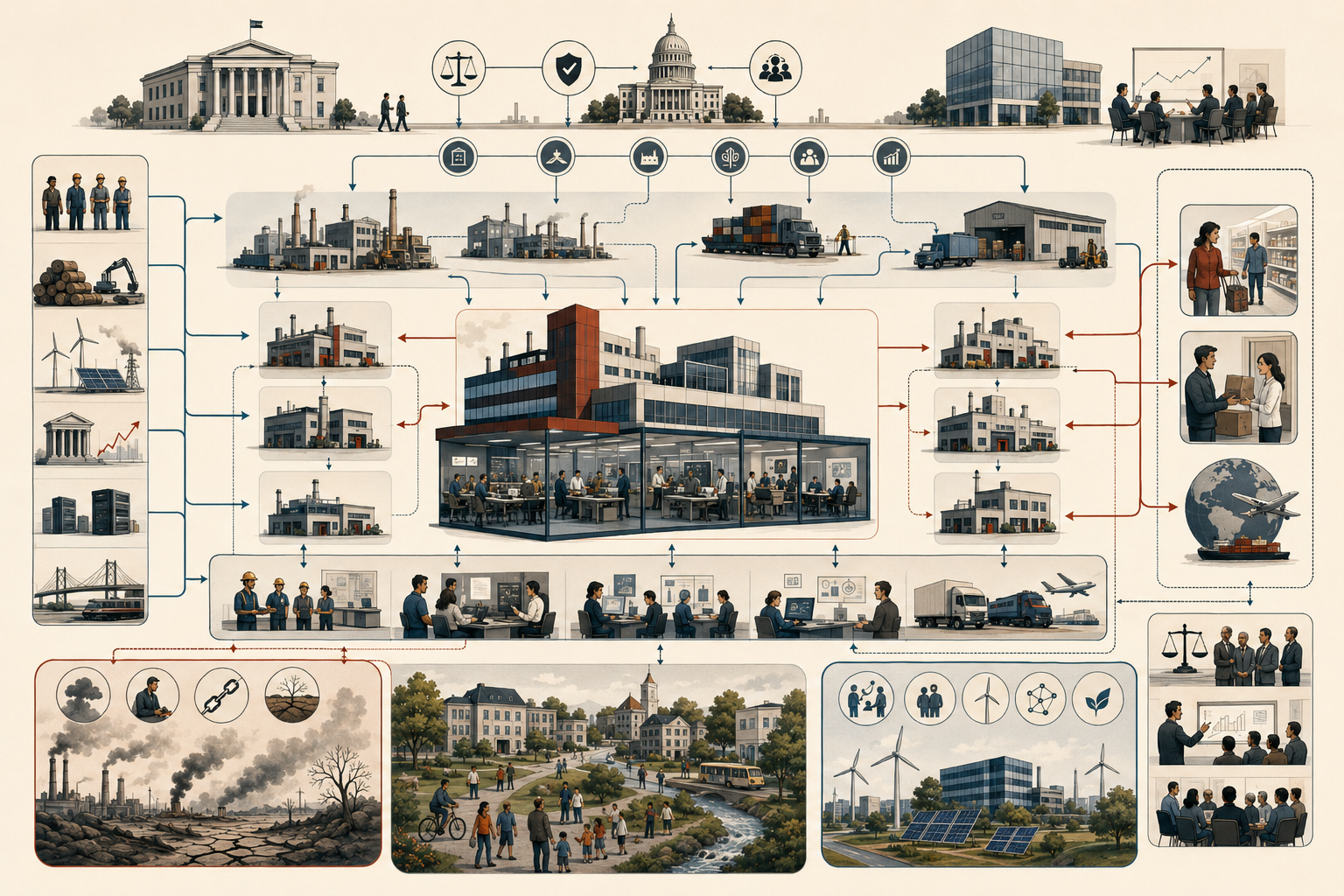
Within a sustainable systems framework, firms, costs, competition, and market structure must be analyzed beyond narrow claims about efficiency or profitability. A sector may be profitable yet fragile, competitive yet socially destructive, concentrated yet innovative, or low-cost in the short run while shifting costs onto workers, suppliers, public budgets, households, or ecosystems. The deeper question is whether market organization supports productive investment, fair access, wage growth, resilience, accountable innovation, public legitimacy, and ecological compatibility.
Why This Topic Matters
Firms matter because much of modern economic life is organized through them. They hire workers, purchase inputs, manage technologies, raise capital, coordinate logistics, set prices, maintain supplier relationships, and decide what is produced. They translate labor, materials, energy, knowledge, infrastructure, and finance into goods and services. They are therefore among the most important mediating institutions between households, markets, finance, and states.
Costs matter because firms do not operate under conditions of pure abstraction. They face wages, energy prices, material costs, logistics costs, rents, debt obligations, compliance costs, taxes, insurance, technology costs, and transition costs. These costs structure what appears profitable, what appears risky, what forms of organization are viable, and what pressures firms place on workers, suppliers, communities, and ecosystems.
Competition and market structure matter because firm behavior depends on who else is in the market, how many rivals exist, how easy entry is, how much information buyers possess, how much spare capacity exists, and how much control incumbents exercise over infrastructure, data, distribution channels, finance, standards, or intellectual property. A small firm in a fragmented local service market behaves differently from a dominant platform, a regulated utility, an oligopolistic manufacturer, or a multinational corporation controlling a global supply chain.
These questions matter at a deeper level because the firm is one of the places where the wider political economy becomes operational. Cost pressure becomes wage discipline, automation, outsourcing, price increases, or investment strategy. Competitive pressure becomes innovation, consolidation, exclusion, or quality improvement. Market structure becomes a lived distribution of bargaining power among owners, workers, suppliers, consumers, communities, and public institutions.
What appears at first as industrial organization is therefore also a problem of power, legitimacy, public policy, and social design.
What a Firm Is
A firm is an organization that coordinates labor, capital, technology, knowledge, materials, finance, and other inputs in order to produce goods or services. At a minimal level, the firm is a site of productive coordination. It exists because some economic activities are organized more effectively through internal direction, contracts, planning, hierarchy, routines, and long-term investment than through a series of isolated spot-market exchanges.
But firms are more than production units. They are also institutions of power and strategy. They decide whether to hire or automate, whether to invest or distribute profits, whether to raise wages or cut labor costs, whether to source locally or globally, whether to compete through price, quality, convenience, data, ecosystem control, intellectual property, branding, or regulatory influence. Firms therefore shape not only output, but the wider organization of work, consumption, infrastructure, innovation, and development.
Firms are also historically and institutionally variable. Family businesses, cooperatives, public enterprises, partnerships, multinationals, financialized corporations, platform firms, regulated utilities, and state-owned enterprises all coordinate production differently. Their objectives, governance structures, financing models, labor relations, and accountability systems vary. The generic word firm is useful, but serious analysis requires attention to ownership, legal form, capital structure, governance, market position, and relation to the state.
Firms are never merely private actors in a narrow sense. They rely on legal systems, transport networks, education systems, energy systems, communications infrastructure, monetary stability, enforceable contracts, and public order. They depend on public investments and shared institutions that no single firm creates alone. The firm is therefore always partly a public-institutional achievement, even when its ownership and objectives are privately defined.
This means that the question is not simply whether firms are productive or profitable. It is what kind of production they organize, how their costs and gains are distributed, what risks they absorb or shift, and whether their strategies strengthen or weaken the long-term conditions of collective life.
The Structure of Costs
The cost structure of a firm is one of the most important determinants of its behavior. Costs shape pricing, output decisions, employment, investment, vulnerability to shocks, technological choice, and the strategic benefits of scale. They influence which firms survive, which sectors consolidate, and which forms of competition become dominant.
Costs are not merely internal accounting categories. They reflect the wider system. Energy grids, transport quality, interest rates, labor protections, environmental regulation, zoning, resource availability, insurance markets, technological standards, taxation, and public infrastructure all affect firm cost structures. A sector’s cost profile is therefore partly a matter of technology and partly a matter of institutional design.
This broader view matters because firms often try not simply to manage costs, but to shift them. They may externalize environmental harm, push insecurity onto workers through unstable scheduling, offload risk to suppliers, rely on unpaid social reproduction, use public infrastructure without fully contributing to its upkeep, or depend on weak regulation to keep private costs low. Cost analysis is therefore inseparable from power and social burden.
A research-grade treatment of costs must distinguish between private cost minimization and system-level rationality. A cost saving for a firm may become a cost increase for households, ecosystems, suppliers, workers, or the public budget. What matters analytically is not only whether costs fall somewhere in the system, but where they are moved, who bears them, and whether the resulting arrangement remains socially and ecologically tenable.
That is why low private cost cannot automatically be treated as economic success. A firm may appear efficient because pollution is not priced, workers lack bargaining power, suppliers absorb volatility, public systems subsidize infrastructure, or future maintenance is deferred. Real efficiency must be judged across the system, not only inside the firm’s accounts.
Fixed, Variable, and Marginal Costs
One of the most basic distinctions in firm analysis is between fixed and variable costs. Fixed costs do not change immediately with output. These may include rent, debt obligations, salaried staff, machinery, software systems, permits, insurance, data infrastructure, or long-term contracts. Variable costs rise or fall more directly with production. These may include raw materials, hourly labor, energy tied to output, packaging, shipping, maintenance, or transaction costs.
Marginal cost is the cost of producing one additional unit of output. This concept matters because it helps explain pricing behavior, expansion decisions, and the conditions under which additional production is economically worthwhile. A firm with high fixed costs and low marginal costs may seek scale aggressively, because each additional unit spreads fixed costs over a larger base. A firm with high marginal costs may be more cautious in expanding output, especially when input prices are volatile.
Average cost matters as well, especially in relation to scale. If average costs fall as output rises, firms may gain strong incentives to expand, merge, acquire rivals, or dominate markets. In some industries this can create tendencies toward concentration even without explicit anticompetitive intent. Cost structure therefore shapes market structure over time.
These distinctions also affect resilience. High fixed-cost sectors may appear efficient under stable demand but become vulnerable when revenue falls sharply. High variable-cost sectors may be more flexible but more exposed to input shocks. Capital-intensive sectors may require long planning horizons and stable financing. Labor-intensive sectors may be more sensitive to wages, scheduling, skill formation, and labor bargaining power.
The structure of costs therefore has implications not only for profitability, but also for employment stability, investment patterns, fragility, and systemic adaptability.
Costs, Pricing, and Output Decisions
Firms do not simply inherit costs; they respond to them strategically. Pricing decisions depend on demand conditions, rivalry, expectations, market power, regulation, brand position, consumer switching costs, and the need to recover both fixed and variable costs. In highly competitive markets, firms may have little room to price above cost for long. In concentrated markets, firms may sustain wider markups. In periods of volatility, pricing may also be shaped by uncertainty, precaution, inventory strategy, or expectations about future constraints.
Output decisions are similarly structured. A firm may produce more when price exceeds marginal cost, but actual decisions are shaped by capacity, inventories, labor availability, financing conditions, supplier reliability, transport, regulation, and expected demand. The textbook firm that smoothly adjusts output is a useful abstraction, but real firms operate under delay, uncertainty, and strategic interaction.
Costs also affect technological choice. Rising wages may encourage automation. Unstable logistics may encourage local sourcing or redundancy. High energy costs may shift investment toward efficiency. Higher borrowing costs may discourage expansion. Strong environmental rules may redirect technological change toward cleaner production. Weak rules may encourage firms to compete by externalizing harm.
Pricing is therefore never just a mechanical response to cost. It is also a strategic interpretation of the market environment. Firms ask not only what production costs are, but what demand will bear, what rivals are likely to do, how much scarcity exists, how much regulatory scrutiny they face, and whether short-term pricing today affects long-run market position tomorrow.
When firms possess market power, pricing becomes even more strategic. Prices may reflect not only cost and demand, but the preservation of dominance, control of entry, bundling, loyalty systems, platform dependence, or strategic underpricing aimed at weakening rivals. Cost analysis must therefore be joined to market-structure analysis.
Competition as a Structural Condition
Competition is often described as rivalry among firms, but it is better understood as a structural condition governing the intensity and form of that rivalry. Competition depends on how many firms exist, how differentiated their products are, how easily buyers can switch, how much spare capacity exists, how easy entry is, how informed buyers are, how much control incumbents have over infrastructure, and whether firms can use data, contracts, standards, or platforms to limit contestability.
This matters because competition is not a simple binary condition. Some sectors are intensely competitive on price. Others compete on quality, design, convenience, reputation, location, speed, network access, vertical integration, data ecosystems, or control of standards. In some cases firms compete fiercely while remaining highly concentrated. In others, a market may appear fragmented at the retail level while still being controlled by upstream suppliers, payment systems, logistics platforms, or data intermediaries.
Competition therefore cannot be inferred solely from the number of firms. It requires analysis of conduct, power, barriers, strategy, information, buyer dependence, supplier dependence, and the institutional rules that shape entry and exit.
Competition can discipline firms in socially useful ways. It can restrain markups, improve quality, encourage innovation, widen access, and reduce complacency. But competition can also be destructive when it produces wage suppression, unsafe work, underinvestment in resilience, degraded quality, environmental externalization, or short-term cost cutting that damages the wider system. The value of competition depends on the kind of competition being produced.
A sustainable economic system should therefore ask not only whether firms compete, but whether competition is directed toward socially valuable outcomes: better products, fairer access, decent work, responsible innovation, lower unnecessary cost, ecological improvement, and resilient capacity.
Major Forms of Market Structure
Market structure refers to the broader arrangement of firms within a sector. The standard forms include perfect competition, monopolistic competition, oligopoly, and monopoly. These categories are ideal types, but they remain useful because they help clarify how pricing power, entry barriers, rivalry, innovation, and bargaining power vary across sectors.
Perfect competition is a limiting case in which many firms sell similar products, no single firm has market power, and prices are taken as given. It is analytically useful but rare in pure form. Monopolistic competition describes markets with many firms but product differentiation, so firms possess some pricing power. Oligopoly involves a small number of dominant firms whose strategies are interdependent. Monopoly involves a single dominant supplier, often sustained by scale, legal privilege, infrastructure control, intellectual property, network effects, or regulatory design.
These categories matter because they shape pricing, innovation, wages, quality, and the distribution of power. An oligopolistic market may remain innovative while sustaining high markups. A monopoly may support investment under some conditions while restricting access, disciplining suppliers, weakening workers, or reducing quality under others. A fragmented market may appear competitive but still produce poor outcomes if wages are compressed, public standards are weak, or firms compete through cost externalization.
Real sectors often sit between ideal types. A market may appear competitive at one layer and concentrated at another. Retailers may be numerous while payment systems, cloud infrastructure, app stores, logistics platforms, search gateways, agricultural processors, or key upstream inputs are tightly controlled. Market structure must therefore be studied across the chain, not only at the final point of sale.
This is especially important in platform and network industries, where control over access, data, standards, and defaults may matter more than traditional output share. Market structure is increasingly infrastructural: the power to shape the conditions under which others participate.
Market Power, Concentration, and Strategy
Market power refers to the ability of a firm to influence price, output, quality, standards, access, contract terms, wages, supplier margins, or the rules of participation rather than merely accepting them as given. Market power can derive from scale, ownership of essential infrastructure, intellectual property, data control, network effects, brand dominance, vertical integration, privileged access to capital, regulatory protection, or strategic control over distribution.
Concentration matters because it can affect far more than consumer prices. Highly concentrated sectors may influence wage-setting, suppress supplier bargaining power, shape standards, raise barriers to entry, redirect innovation toward defensible rents, and increase systemic fragility if too much capacity is controlled by too few actors. A concentrated sector may be efficient in a narrow sense while still producing strategic dependence, weakened resilience, or public vulnerability.
Firms operating with market power often compete differently from firms in fragmented markets. They may compete through acquisition, ecosystem control, exclusionary design, loyalty architecture, bundling, self-preferencing, contract restrictions, or control of distribution channels. Their strategy often concerns preserving position as much as producing value.
This is why market power should not be reduced to the question of whether prices are immediately high. Firms may exercise power through standards, default settings, data extraction, platform dependency, contract asymmetry, predatory expansion, labor-market control, or control over future access. Market power is often infrastructural before it is visible in price.
Concentration metrics such as CR4 and HHI are useful starting points, but they are not complete. A market may look unconcentrated while critical bottlenecks remain concentrated elsewhere. Conversely, a concentrated sector may be socially acceptable under strong regulation, public accountability, and universal access obligations. The central analytical task is to connect concentration to conduct, institutional design, and social consequence.
Innovation, Scale, and Barriers to Entry
One of the persistent tensions in firm analysis is the relationship between scale and innovation. Large firms may have resources for research, development, infrastructure, data systems, capital-intensive investment, and long-term projects that smaller firms cannot easily support. But they may also protect incumbency, suppress entrants, acquire rivals, steer standards, or use ecosystem control to reduce contestability.
Barriers to entry are therefore central. These may include high fixed costs, regulatory complexity, access to finance, control over data, distribution networks, intellectual property, brand loyalty, switching costs, procurement rules, network effects, and capital requirements. Some barriers are socially useful, as when safety regulation prevents reckless entry. Others entrench incumbents without corresponding public benefit.
Innovation must therefore be analyzed institutionally. The question is not merely whether firms innovate, but under what market structures, with what incentives, and with what consequences for access, resilience, labor, and productive capacity.
It is also important to distinguish innovation aimed at genuine capability from innovation aimed at enclosure. Some innovations expand productive possibility, reduce waste, improve quality, widen access, or lower ecological burden. Others chiefly reinforce dependence, capture rents, lock users into ecosystems, intensify surveillance, or narrow future competition.
A serious account of market structure must distinguish between innovation that builds shared capability and innovation that merely strengthens private control over access. The two can look similar in short-term growth metrics while producing very different long-term economic systems.
Labor, Supply Chains, and Cost Shifting
Firm behavior is often discussed through prices and output, but labor and supply chains are equally important. Wages, staffing models, scheduling systems, contracting practices, training, benefits, workplace safety, and worker bargaining power all affect both cost structures and social outcomes. Firms may reduce costs by improving productivity, but also by weakening labor protections, increasing precarity, relying on misclassification, suppressing wages, or shifting risk outward.
Supply chains operate similarly. Firms may reduce cost through outsourcing, offshoring, just-in-time systems, supplier concentration, inventory minimization, or aggressive contracting. These strategies can improve margins under stable conditions while increasing vulnerability to disruption. The costs saved internally may reappear as fragility, dependency, weakened supplier resilience, labor exploitation, or public burden elsewhere.
This is why firm-level efficiency cannot be treated as synonymous with system-level efficiency. A firm may optimize its own cost structure while making the wider system more unstable, unequal, or ecologically destructive.
Supply chains also redistribute visibility. The final firm may appear efficient and innovative while environmental burdens, low margins, labor discipline, and volatility are pushed upstream onto subcontractors, peripheral regions, informal labor systems, or ecological frontiers. The study of firms and competition therefore requires looking across the full organization of production, not merely at the lead firm’s own accounts.
Labor and supply-chain analysis also reveals how costs are often shifted onto households. Low wages, irregular schedules, unsafe work, unstable benefits, and weak training systems become household stress, public assistance burdens, health costs, debt dependence, and reduced social reproduction capacity. Cost shifting is not only an accounting issue. It is a social-systems issue.
Firms, Public Authority, and Regulation
Firms operate within legal and regulatory orders that shape competition, labor relations, environmental burden, pricing conduct, financial exposure, innovation incentives, and access to public infrastructure. Regulation is not merely a correction layered on after markets exist. It helps define the conditions under which firms compete, survive, consolidate, and invest.
Competition policy, financial oversight, labor law, safety standards, environmental rules, industrial policy, procurement systems, intellectual-property law, tax design, public investment, and trade regimes all affect firm behavior. Public authority therefore shapes not only what firms are allowed to do, but what kinds of market structures tend to emerge.
This means that market structure is partly a public outcome. Monopolies, oligopolies, fragmented sectors, platform ecosystems, regulated utilities, and strategic industries do not arise in a purely natural way. They are co-produced by technology, cost conditions, law, finance, infrastructure, and policy choices.
Public authority also determines whether firms are pushed toward short-term extraction or longer-term productive contribution. Procurement rules, antitrust standards, infrastructure strategy, industrial policy, tax incentives, labor standards, public research, and environmental rules can all change the strategic horizon within which firms operate. Regulation is therefore not just about restraint. It is also about institutional direction.
Weak regulation can allow private cost minimization to become public cost creation. Excessively rigid or poorly designed regulation can also create barriers, inefficiencies, or capture. The central question is not regulation versus markets, but what kind of rule structure produces productive, fair, resilient, and ecologically responsible firm behavior.
Time, Uncertainty, and Strategic Conduct
Firms make decisions under uncertainty, not under perfect information. They face unknown future demand, uncertain input costs, interest-rate changes, geopolitical volatility, technological disruption, policy shifts, climate hazards, labor turnover, and financial instability. Competition is therefore always partly anticipatory. Firms do not simply respond to present conditions; they act on expectations about future risks and opportunities.
Time matters as much as price. A firm may defer investment because financing costs are unstable. It may raise inventories because supply chains seem fragile. It may consolidate because scale appears to be the best defense against uncertainty. It may hold back wage growth to preserve margins against expected shocks. It may vertically integrate to reduce dependence on suppliers. It may invest in automation to reduce labor uncertainty. Strategic conduct is shaped by the future as much as by the present.
This temporal dimension is crucial for sustainable systems analysis. Markets and firms that appear efficient over a short horizon may be underinvesting in resilience, redundancy, workforce stability, ecological repair, maintenance, and long-run productive capacity. The structure of the market affects not only what firms do today, but what they are institutionally prepared to sustain tomorrow.
Short-term financial pressure can be especially important. If firms are rewarded mainly for quarterly returns, buybacks, cost cutting, or asset appreciation, they may underinvest in workers, technology, safety, resilience, and ecological transition. If institutions reward patient capital, public-purpose investment, and durable capability, firms may behave differently.
Firm strategy is therefore not only managerial. It reflects the time horizon built into finance, ownership, regulation, competition, and public policy.
Firms, Costs, Competition, and Market Structure Within Sustainable Systems
Within sustainable systems, the analysis of firms and markets must go beyond narrow price efficiency. The relevant questions include whether firms invest productively or extractively, whether competition supports innovation without destroying resilience, whether concentration increases strategic dependence, whether wages and working conditions are compatible with household stability, and whether cost structures reflect or conceal ecological damage.
This perspective changes how firm success is evaluated. A profitable firm is not automatically a socially successful one. A low-cost production system is not automatically a resilient or just one. A competitive market is not automatically well designed if it rewards environmental externalization, labor precarity, brittle supply chains, or underinvestment in public goods. A concentrated market is not automatically harmful in every case, but it requires careful governance because concentrated power can affect access, wages, suppliers, innovation, and public accountability.
Sustainable systems require market structures in which productive efficiency, resilience, public legitimacy, and ecological compatibility are not systematically pulled apart. A firm should not be able to appear efficient only because it offloads risk onto workers, pollution onto communities, infrastructure costs onto the public, fragility onto suppliers, or damage onto future generations.
The central question is therefore not whether firms compete, but what kind of competitive order society is building through its institutions, infrastructures, rules, and public priorities.
From this perspective, the best market structure is not necessarily the one that minimizes price at a single point in time. It is the one that supports durable capability, fair access, accountable innovation, decent work, adaptive capacity, and compatibility with long-run social and ecological reproduction. That standard is more demanding, but it is also closer to the realities firms actually inhabit.
How Market Structure Should Be Judged
Firms, costs, competition, and market structure should not be judged by price, profit, or output alone. A broader economic systems framework asks whether firm behavior strengthens or weakens the social, productive, institutional, and ecological foundations on which the economy depends.
| Dimension | Narrow Question | Systems Question |
|---|---|---|
| Firms | Are firms profitable? | Do firms build productive capacity, fair work, innovation, resilience, and public value? |
| Costs | Are private costs low? | Are costs genuinely reduced, or shifted onto workers, suppliers, households, public budgets, or ecosystems? |
| Competition | Are firms competing? | What kind of competition exists: innovation, quality, access, labor discipline, exclusion, or cost externalization? |
| Market Structure | How many firms exist? | How are power, entry, data, infrastructure, supply chains, and bargaining positions organized across the sector? |
| Market Power | Are prices above cost? | Can firms control access, standards, suppliers, wages, defaults, platforms, or future competition? |
| Innovation | Are firms introducing new products? | Does innovation expand capability and access, or mainly enclose users and protect rents? |
| Ecology | What are private production costs? | What are the full social and ecological costs once external harms and public burdens are included? |
| Resilience | Is the sector efficient today? | Can the sector withstand shocks without cascading disruption, exploitation, or public rescue? |
This wider framework prevents a common error: treating low prices or high profits as sufficient evidence of a healthy market. A sector may deliver low prices by suppressing wages, underinvesting in resilience, depleting ecosystems, exploiting suppliers, depending on public subsidies, or tolerating systemic fragility. Conversely, some higher-cost arrangements may build redundancy, safety, public accountability, domestic capability, or ecological repair.
The central issue is whether firm behavior and market structure support a durable economic order rather than merely rewarding narrow strategic advantage.
Mathematical Lens
Mathematics can clarify firm behavior because it makes cost structure, profit, markup, concentration, and external costs explicit. These equations do not decide whether a market structure is socially desirable, but they help reveal what firms are responding to and where private incentives may diverge from public welfare.
1. Total Cost and Profit
TC(Q) = FC + VC(Q)
\]
Interpretation: Total cost \(TC\) depends on fixed cost \(FC\) and variable cost \(VC(Q)\), which changes with output \(Q\).
\Pi(Q) = TR(Q) – TC(Q)
\]
Interpretation: Profit \(\Pi\) equals total revenue \(TR\) minus total cost. Profit depends not only on selling more, but on how costs and prices change across output levels.
2. Average and Marginal Cost
AC(Q) = \frac{TC(Q)}{Q}
\]
Interpretation: Average cost shows cost per unit of output. Falling average cost can create incentives for scale and concentration.
MC(Q) = \frac{dTC(Q)}{dQ}
\]
Interpretation: Marginal cost shows the cost of producing one additional unit. Pricing and output decisions often turn on the relationship between marginal cost and marginal revenue.
3. Revenue and Output Choice
MR(Q) = MC(Q)
\]
Interpretation: A profit-maximizing firm with market power chooses output where marginal revenue equals marginal cost, subject to demand, capacity, regulation, and strategy.
4. Markup and Market Power
\mu = \frac{P – MC}{P}
\]
Interpretation: The markup ratio \(\mu\) measures the gap between price \(P\) and marginal cost \(MC\) relative to price. Higher markups may indicate pricing power, product differentiation, entry barriers, or weak competition.
5. Concentration
CR_n = s_1 + s_2 + \cdots + s_n
\]
Interpretation: A concentration ratio \(CR_n\) measures the combined market share of the largest \(n\) firms. It is a simple indicator of how much control is clustered at the top of a sector.
HHI = \sum_i s_i^2
\]
Interpretation: The Herfindahl-Hirschman Index squares and sums market shares, giving greater weight to large firms. It is a useful but incomplete measure of market concentration.
6. Private and Social Cost
MSC = MPC + MEC
\]
Interpretation: Marginal social cost \(MSC\) equals marginal private cost \(MPC\) plus marginal external cost \(MEC\). A firm may appear efficient when judged by private cost while remaining socially costly once pollution, depletion, public burden, or risk shifting are included.
7. Practical Interpretation
The mathematical lens clarifies several structural points. Cost structure shapes pricing, output, scale, and survival. High fixed costs can create pressures toward scale and concentration. Marginal conditions help explain output choice, but not justice or resilience. Markups and concentration measures reveal how competition may be weakened or transformed by market power. Private efficiency may diverge sharply from social efficiency when external costs are large.
Formalization helps reveal structure, but it does not decide whether a market order is socially desirable. A low-cost equilibrium may still rely on labor insecurity, ecological depletion, or brittle supply chains. Those wider questions remain institutional, political, and ethical.
Python Workflow: Costs, Profit, and Market Power
Python is useful for turning firm-level cost and market-structure concepts into reproducible analysis. The following compact workflow models a simple firm cost structure, profit schedule, concentration indicator, markup, and external-cost adjustment.
# Firms, Costs, Competition, and Market Structure
# Simple Python workflow

import numpy as np
import pandas as pd

# Output grid
Q = np.arange(1, 101)

# Cost structure
FC = 200
VC = 8 * Q + 0.05 * Q**2
TC = FC + VC
AC = TC / Q
MC = np.append(np.nan, np.diff(TC))

# Simple inverse demand / price schedule
P = 30 - 0.1 * Q
TR = P * Q
profit = TR - TC

# Profit-maximizing output
best_index = np.argmax(profit)
Q_star = Q[best_index]
profit_star = profit[best_index]

# Markup at the profit-maximizing output
markup_star = (P[best_index] - MC[best_index]) / P[best_index]

# Market concentration example
market_shares = np.array([0.32, 0.24, 0.16, 0.10, 0.08, 0.10])
CR4 = np.sort(market_shares)[::-1][:4].sum()
HHI = np.sum(market_shares**2)

# External cost adjustment
external_cost_per_unit = 2.5
social_cost = TC + external_cost_per_unit * Q
social_profit = TR - social_cost

df = pd.DataFrame({
    "Output": Q,
    "Price": np.round(P, 2),
    "Total Cost": np.round(TC, 2),
    "Average Cost": np.round(AC, 2),
    "Marginal Cost": np.round(MC, 2),
    "Profit": np.round(profit, 2),
    "Social Profit": np.round(social_profit, 2)
})

print("Profit-maximizing output:", Q_star)
print("Maximum private profit:", round(profit_star, 2))
print("Markup at optimum:", round(markup_star, 3))
print("CR4:", round(CR4, 2))
print("HHI:", round(HHI, 3))
print(df.head())
This workflow links cost structure, profit maximization, markup, concentration, and the difference between private and social profitability in a single inspectable framework. It shows how a firm’s private optimum may differ from a socially preferable outcome when external costs are included.
The full GitHub repository expands this example into multiple firm cost structures, concentration scenarios, cost-shock models, labor-cost metrics, entry-barrier indicators, external-cost adjustments, SQL queries, R and Stata replication workflows, Julia comparative statics, and article-ready figures.
R Workflow: Costs, Concentration, and Social Profit
R is useful for cost-curve summaries, market-share metrics, and publication-ready graphics. The following compact workflow performs the same cost, profit, concentration, and social-cost analysis in R.
# Firms, Costs, Competition, and Market Structure
# Simple R workflow

# Output grid
Q <- 1:100

# Cost structure
FC <- 200
VC <- 8 * Q + 0.05 * Q^2
TC <- FC + VC
AC <- TC / Q
MC <- c(NA, diff(TC))

# Simple inverse demand / price schedule
P <- 30 - 0.1 * Q
TR <- P * Q
profit <- TR - TC

# Profit-maximizing output
best_index <- which.max(profit)
Q_star <- Q[best_index]
profit_star <- profit[best_index]

# Markup at the profit-maximizing output
markup_star <- (P[best_index] - MC[best_index]) / P[best_index]

# Market concentration example
market_shares <- c(0.32, 0.24, 0.16, 0.10, 0.08, 0.10)
CR4 <- sum(sort(market_shares, decreasing = TRUE)[1:4])
HHI <- sum(market_shares^2)

# External cost adjustment
external_cost_per_unit <- 2.5
social_cost <- TC + external_cost_per_unit * Q
social_profit <- TR - social_cost

summary_df <- data.frame(
  Output = Q,
  Price = round(P, 2),
  Total_Cost = round(TC, 2),
  Average_Cost = round(AC, 2),
  Marginal_Cost = round(MC, 2),
  Profit = round(profit, 2),
  Social_Profit = round(social_profit, 2)
)

cat("Profit-maximizing output:", Q_star, "\n")
cat("Maximum private profit:", round(profit_star, 2), "\n")
cat("Markup at optimum:", round(markup_star, 3), "\n")
cat("CR4:", round(CR4, 2), "\n")
cat("HHI:", round(HHI, 3), "\n")

head(summary_df)
This R workflow is deliberately compact for article readability. In the full repository, R reads multiple firm and market-structure scenarios, estimates optimal output, compares private and social profit, calculates CR4 and HHI, and visualizes how cost structure and concentration differ across stylized sectors.
Future Economic Systems articles can extend this foundation with firm-level microdata, industry cost data, price-cost margins, merger analysis, supply-chain stress testing, labor-cost pass-through, energy-price shocks, entry-barrier indicators, and sectoral externality estimates.
GitHub Repository
The article body includes selected computational examples so the conceptual, institutional, and mathematical argument remains readable. The full repository contains the expanded research infrastructure: Python cost-curve and profit-maximization analysis, R market-structure summaries, Stata applied-economics replication workflows, SQL firm and concentration tables, Julia comparative statics, cost-shock scenarios, markup metrics, concentration indicators, private-versus-social cost analysis, documentation, reproducible sample data, and article-ready figures and tables.
Complete Code Repository
The full code distribution for this article, including selected article examples and advanced research-style computational scaffolding for firm cost structures, profit maximization, average and marginal cost, markups, market concentration, CR4 and HHI metrics, cost shocks, entry barriers, labor-cost exposure, external-cost adjustment, social profitability, reproducibility documentation, and cross-language economic analysis, is available on GitHub.
Conclusion
Firms, costs, competition, and market structure are central to economic analysis because they show how production is organized, how prices are shaped, how power is distributed, and how sectors evolve over time. Firms are not merely technical units of production. They are strategic institutions embedded in labor systems, financial structures, public rules, supply chains, technological systems, and industrial environments.
Costs are not just accounting categories. They shape scale, survival, conduct, employment, pricing, and concentration. Competition is not a slogan. It is a structured condition. Market structure is not a background detail. It is one of the principal ways economic power is organized.
To understand an economy seriously, one must therefore ask not only whether firms are productive, but how their costs are structured, how their markets are organized, how competition is governed, and whether the resulting system supports resilience, innovation, fair access, decent work, and ecological viability. Those questions reveal whether economic order is serving collective life or merely rewarding narrow strategic advantage.
In a sustainable economic system, the goal is not to eliminate firms or competition, but to organize them within institutions that make productive enterprise compatible with public purpose. Firms should be able to innovate, invest, and coordinate production, but not by shifting hidden costs onto workers, suppliers, communities, ecosystems, or future generations. Market structure matters because it helps determine whether private strategy strengthens or weakens the conditions of shared prosperity.
Related Reading
- Economic Systems
- What Is an Economic System?
- Production, Distribution, and Exchange in Human Societies
- Households, Firms, Markets, and States
- Supply, Demand, Prices, and Economic Coordination
- Consumer Choice, Household Welfare, and Everyday Economic Life
- Labor, Wages, Productivity, and the Social Organization of Work
- Externalities, Public Goods, and Collective Provision
- Ecological Economics and the Embedded Economy
Further Reading
- Bain, J. S. (1956). Barriers to New Competition: Their Character and Consequences in Manufacturing Industries. Cambridge, MA: Harvard University Press.
- Coase, R. H. (1937). The Nature of the Firm. Economica, 4(16), pp. 386–405.
- International Labour Organization (ILO) (n.d.). Statistics on Wages. Available at: https://ilostat.ilo.org/topics/wages/
- Organisation for Economic Co-operation and Development (OECD) (n.d.). Competition. Available at: https://www.oecd.org/en/topics/competition.html
- Organisation for Economic Co-operation and Development (OECD) (n.d.). Industrial Policy. Available at: https://www.oecd.org/en/topics/industrial-policy.html
- Polanyi, K. (2001 [1944]). The Great Transformation: The Political and Economic Origins of Our Time. Boston: Beacon Press.
- Tirole, J. (1988). The Theory of Industrial Organization. Cambridge, MA: MIT Press.
- UN Trade and Development (UNCTAD) (2024). Trade and Development Report 2024. Available at: https://unctad.org/publication/trade-and-development-report-2024
- World Bank (2024). Industrial Policy for Development. Available at: https://www.worldbank.org/en/publication/industrial-policy-for-development
References
- International Labour Organization (ILO) (n.d.). Statistics on Wages. Available at: https://ilostat.ilo.org/topics/wages/
- Organisation for Economic Co-operation and Development (OECD) (n.d.). Competition. Available at: https://www.oecd.org/en/topics/competition.html
- Organisation for Economic Co-operation and Development (OECD) (n.d.). Industrial Policy. Available at: https://www.oecd.org/en/topics/industrial-policy.html
- UN Trade and Development (UNCTAD) (2024). Trade and Development Report 2024. Geneva: UNCTAD. Available at: https://unctad.org/publication/trade-and-development-report-2024
- World Bank (2024). Industrial Policy for Development. Washington, DC: World Bank. Available at: https://www.worldbank.org/en/publication/industrial-policy-for-development