
Last Updated May 9, 2026
Some of the most important economic realities are not well organized by ordinary market exchange alone. Pollution imposes costs on people who are not party to the transaction that creates it. Basic research benefits many firms, households, and institutions that never pay directly for its creation. Clean air, public health preparedness, flood control, epidemiological surveillance, transport infrastructure, legal order, ecological stability, and social trust all shape the conditions of life and production, yet they do not fit neatly into a world where every good is efficiently allocated through price and private purchase.
This is the domain of externalities, public goods, and collective provision. Externalities arise when the actions of households, firms, or institutions create costs or benefits for others that are not fully reflected in market prices. Public goods are goods whose benefits are difficult to confine to paying users and whose use by one person does not necessarily reduce availability to others. Collective provision refers to the wider institutional arrangements through which societies organize goods, services, protections, and capacities that private markets alone tend to underprovide, misprice, neglect, or distribute unequally.
Together, these concepts reveal the limits of narrow market coordination and the continuing necessity of public institutions, shared rules, long-range governance, and legitimate burden sharing. They show why a society cannot be understood only through private transactions. It must also be understood through the shared conditions that make production, health, safety, knowledge, resilience, and future welfare possible.
Main Library
Publications
Article Map
Economic Systems
Related Topic
Sustainable Development
Related Topic
Institutions & Governance
Related Topic
Risk & Resilience
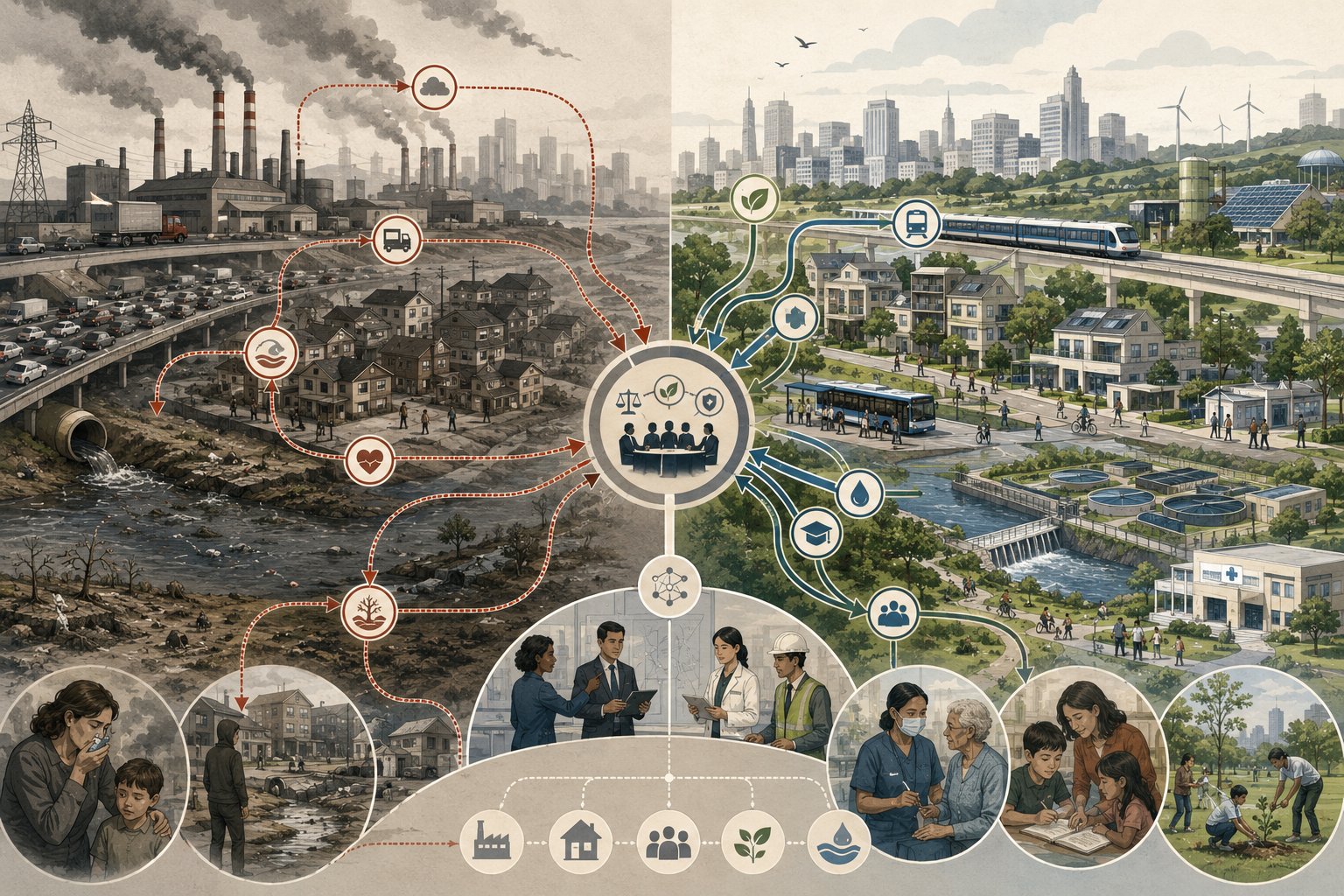
Within a sustainable systems framework, externalities, public goods, and collective provision are not marginal exceptions to an otherwise self-sufficient market order. They are central categories. Ecological damage, climate risk, biodiversity loss, public health vulnerability, infrastructure resilience, scientific capacity, disaster preparedness, and social trust all involve interdependence across time, territory, class, generation, and institution. The relevant question is not only whether markets coordinate private exchange, but whether societies can protect shared conditions of life, distribute burdens fairly, and preserve the foundations of future welfare.
Why This Topic Matters
Externalities, public goods, and collective provision matter because many of the most important conditions of economic life are shared, cumulative, and institutionally mediated. Clean air supports health and productivity. Reliable transit reduces private cost and expands labor-market access. Public health systems reduce vulnerability long before any single illness becomes visible. Basic research makes future innovation possible in ways no immediate purchaser can fully capture. Flood defenses, water systems, sanitation, ecological monitoring, legal order, and trustworthy information systems all shape the background conditions of social and economic life.
These are not peripheral concerns. They are among the enabling conditions of a functioning society. A narrow focus on isolated transactions can hide how much production and welfare depend on goods that markets do not price well, do not generate adequately, or do not distribute fairly on their own.
A factory may appear profitable because it does not pay for all the damage it causes downstream. A firm may seem efficient because it relies on public infrastructure, education systems, legal order, and basic research without accounting for the collective cost of maintaining them. Households may appear to make private consumption choices freely while compensating for absent public goods through money, time, debt, unpaid labor, and exposure to preventable risk.
These concepts also matter politically. They force societies to confront questions of responsibility, legitimacy, and long-term obligation. When harms spill across communities, when benefits are widely shared, or when the conditions of life depend on coordinated action, isolated choice is not enough. The issue becomes how institutions define obligations, allocate burdens, finance shared systems, and create mechanisms through which collective goods can be protected and reproduced across time.
They also matter historically. Many of the greatest improvements in human welfare have depended less on isolated private consumption than on collectively organized systems: sanitation, vaccination, water provision, electrification, transport, mass education, public health, environmental regulation, social insurance, and foundational research. Economic life becomes more intelligible once these are seen not as peripheral corrections, but as constitutive elements of development itself.
What Externalities Are
An externality exists when the action of one actor affects the welfare, opportunities, costs, or risks of others without that effect being fully incorporated into the relevant price or contract. In simpler terms, externalities occur when private decision-makers impose costs or create benefits beyond the boundaries of the transaction itself.
This is important because market prices often coordinate only those costs and benefits directly borne by the parties to exchange. If a producer emits pollutants into air or water, causes congestion, increases health burdens, contributes to antimicrobial resistance, or adds to long-term climate instability without paying for those effects, then the private cost of production understates the social cost. Conversely, if an activity such as vaccination, education, ecological restoration, or basic research creates benefits for many others beyond the individual buyer, then the private return may understate the social benefit.
Externalities therefore reveal a structural gap between private incentive and collective consequence. They do not show that markets are useless. They show that markets operating alone may coordinate activity around signals that are incomplete, distorted, or systematically biased against long-term social welfare.
This structural gap is one of the reasons economics cannot stop at exchange. It must also study institutions that govern spillovers, define liability, shape incentives, pool costs, monitor harms, and coordinate shared obligations. Externalities are therefore not merely technical anomalies. They are windows into the deeper institutional architecture of an economy.
They also show why the boundary of a transaction is never the same thing as the boundary of consequence. A sale may occur between two parties, but the effects may extend to neighbors, workers, watersheds, public budgets, future generations, and ecological systems. The economy is not only a network of contracts. It is a network of consequences.
Negative and Positive Externalities
Negative externalities arise when an activity imposes costs on others. Pollution is the standard example, but the category is much broader. Noise, congestion, overuse of common resources, systemic financial risk, occupational exposure, antibiotic resistance, habitat destruction, and climate change all involve harms that spill beyond the immediate decision-maker. These harms may be local or global, immediate or delayed, visible or diffuse.
Negative externalities are especially important because they can make private decisions appear rational while producing collective damage. A firm may minimize private cost by emitting pollutants. A commuter may add only a small amount of congestion. A lender may take risks that appear profitable until those risks become systemic. A household or firm may make energy choices that seem individually affordable while contributing to wider climate instability. The private act and the collective consequence are separated by institutional design.
Positive externalities arise when an activity creates benefits for others that the decision-maker cannot fully capture through market return. Education can improve civic participation, social trust, productivity, and public health beyond the individual learner. Vaccination reduces transmission risk for others. Basic research often generates knowledge spillovers that later firms and institutions build upon. Public parks, street lighting, sanitation, and accessible transit often create broad indirect benefits that exceed the immediate private payment associated with them.
The distinction matters because it affects institutional design. Negative externalities often call for constraints, taxation, standards, liability rules, reporting systems, or redesigned incentives. Positive externalities often call for subsidy, direct provision, public investment, public procurement, or long-range support. In both cases, the core problem is the same: private decision-making alone does not align neatly with wider social consequence.
Many real phenomena combine both kinds. Urban transit may generate positive spillovers in access, productivity, and environmental performance while reducing negative spillovers from congestion and emissions. Ecological restoration may create public benefit while also avoiding future damage. Public health systems reduce harm while expanding shared capability. The analytic categories are distinct, but in practice they often interact.
What Public Goods Are
A public good is classically defined by two properties: non-rivalry and non-excludability. Non-rivalry means that one person’s use does not substantially reduce availability to others. Non-excludability means that it is difficult or costly to prevent non-payers from benefiting once the good is provided. National defense is the textbook example, but the broader category includes many other goods, capacities, and infrastructures that are shared in effect even when they are not perfectly pure in form.
In practice, most real public goods are not perfectly pure. They exist along a spectrum. Basic scientific knowledge, public health preparedness, weather information, epidemiological surveillance, legal order, flood protection, civic trust, resilient ecosystems, disaster-warning systems, and some kinds of infrastructure all contain public-good characteristics even if they are mixed with excludable or rival components at the margin.
This spectrum matters because the analytic point is not whether a good fits a perfect definition, but whether private incentives alone are likely to underprovide it relative to social need. Where benefits are diffuse, long-term, hard to exclude, or difficult to monetize privately, markets often struggle to generate adequate provision at the scale, quality, equity, or time horizon required.
It is also important to distinguish public goods from goods that are simply publicly provided. Some goods are publicly financed for reasons of equity, citizenship, development, health, legitimacy, or nation-building even if they do not fit the strict technical definition. Education, health care, transit, housing, and digital access may contain public-good components but are also often collectively supported because societies decide that access should not depend solely on purchasing power.
A serious treatment of collective provision must therefore combine formal economic categories with institutional judgment about what a society has decided should not be left to private ability to pay alone.
Collective Provision
Collective provision refers to the institutional arrangements through which societies organize goods and services whose value exceeds what decentralized private exchange will reliably deliver. This may involve direct public provision, taxation and spending, regulated monopoly, cooperative organization, common-pool governance, mandated contribution, social insurance, pooled risk, procurement systems, or hybrid institutional forms.
The concept is broader than government expenditure alone. Collective provision can include municipal systems, public utilities, professional associations, commons regimes, multilateral institutions, nonprofit infrastructures, legal mandates, and pooled institutional funds. What unites these arrangements is not ownership alone, but the recognition that some goods must be organized beyond isolated willingness to pay.
This broader view matters because debates about “market versus state” often obscure the wide range of institutional possibilities through which societies actually solve collective problems. The deeper issue is not whether coordination is public or private in the abstract, but how institutions are designed so that shared conditions of life are adequately maintained, fairly financed, transparently governed, and resilient across time.
Collective provision also involves decisions about scale. Some goods are most effectively organized locally, others regionally, nationally, or internationally. Public health, climate stability, watershed protection, scientific knowledge, financial stability, biodiversity protection, and disaster preparedness all illustrate different scales of interdependence. Good institutional design requires matching the scope of governance to the scope of the problem.
Collective provision is therefore not only a financing mechanism. It is a way of organizing responsibility. It asks who contributes, who benefits, who decides, who monitors, who enforces, who is protected, and how long-term obligations are sustained when short-term incentives are weak.
Why Markets Tend to Underprovide
Markets tend to underprovide public goods and mishandle externalities because private actors respond to private returns. If the benefits of an investment spill widely to others, the actor paying for it may not capture enough of the gain to justify the cost under ordinary market criteria. If the harms of an activity spill widely to others, the actor causing them may continue the activity because those harms do not appear fully in the private decision calculus.
This is not simply a matter of moral failure. It is a structural feature of decentralized coordination under incomplete pricing. Even rational, informed, self-interested actors may underinvest in collective goods or overproduce harmful activities if the institutional framework does not translate social consequence into effective incentive.
That is why externalities and public goods are central to economic analysis rather than exceptional anomalies. They show that some of the most important economic problems concern the design of the rules under which markets operate, not merely the transactions that occur within them.
Underprovision can also be quiet and cumulative. A society may not notice the absence of epidemiological preparedness, bridge maintenance, public research capacity, ecological monitoring, water-system resilience, or social trust until a crisis exposes what has long been underfunded. In this sense, market underprovision often appears historically as delayed fragility rather than immediate failure.
There is also a visibility problem. Private consumption is often easy to count. Shared capacities are often invisible until they fail. A household purchase appears in a transaction. The avoided disease outbreak, the bridge that does not collapse, the flood that does not destroy a neighborhood, or the climate damage prevented by earlier action is harder to observe. This creates a bias toward underinvestment in prevention and shared resilience.
The Free-Rider Problem
The free-rider problem arises when individuals or firms can benefit from a good without contributing to its provision. If enough actors behave this way, the good may be undersupplied or not provided at all. Public goods are especially vulnerable to this problem because exclusion is difficult once the good exists.
The free-rider problem explains why many socially valuable goods are hard to sustain through voluntary payment alone. Why pay for flood barriers, disease surveillance, basic research, clean air, cybersecurity standards, or climate mitigation if others will benefit whether one contributes or not? The rational private incentive may be to wait for others to bear the cost, even though the collective result is inadequate provision.
This does not mean all collective problems must be solved by centralized command. But it does mean that durable solutions often require institutions that define contribution, enforce rules, pool costs, create trusted mechanisms, and sustain shared provision over time.
The problem is especially difficult where benefits are long-term and contributors are politically fragmented. Climate mitigation is the clearest contemporary example: the benefits are widely shared, the costs are immediate, the time horizon is long, and the relevant actors range from households and firms to states and international institutions. The free-rider problem is therefore one of the central governance challenges of complex interdependence.
It is also a legitimacy challenge. People are more willing to contribute when they believe others are contributing fairly, institutions are trustworthy, benefits are real, and burdens are not being shifted onto those with the least power. Free riding is not only an incentive problem; it is also a trust problem.
Public Goods, Infrastructure, and Capability
Many public goods are infrastructural in character. They create the background conditions under which households, firms, and other institutions can function. Education systems produce skills. Courts secure contracts. Public health systems reduce collective vulnerability. Water systems, sanitation, transport, grids, and communications networks enable ordinary economic activity. Basic research expands future technological possibility.
These goods are especially important because they build capability. They do not simply correct marginal failures around the edges of the market. They help constitute the productive system itself. Without them, private actors face higher cost, greater uncertainty, weaker coordination, and reduced capacity for long-range investment.
This is why underinvestment in public goods can be so destructive. The effects may not appear immediately in prices or output, but over time they erode productivity, resilience, trust, and social cohesion. Collective provision is therefore not a residual supplement to private activity. It is often one of the preconditions of a capable economy.
Capability also matters because collective provision shapes what kinds of futures remain open. Public education broadens skill formation. Research systems widen technological possibilities. Transit and digital infrastructure expand participation. Ecological protection preserves future productive conditions. Public health systems reduce systemic vulnerability. Collective provision therefore organizes not only present welfare, but the range of future development paths available to a society.
When collective provision is weak, households and firms are forced to compensate privately. This raises private costs, deepens inequality, and often produces inefficient duplication. A household buys private substitutes for failing public systems. A firm builds redundant safeguards because shared infrastructure is unreliable. A community absorbs risk that should have been prevented collectively. Underprovision becomes privatized burden.
Distribution, Justice, and Burden Sharing
Externalities and public goods are not only technical problems of inefficiency. They are also distributional problems. Polluting activities often impose burdens unevenly across class, region, race, occupation, and generation. Public goods are often accessed unevenly even when formally shared. The financing of collective provision also raises distributive questions: who pays, who benefits, who is protected, who remains exposed, and who has voice in deciding priorities.
This matters because a society can address externalities in ways that deepen inequality or in ways that reduce it. Carbon pricing may improve allocative signals while still burdening lower-income households unless redistribution, public alternatives, or compensating transfers are included. Infrastructure investment may strengthen collective welfare broadly or be captured by already advantaged regions and actors. Environmental cleanup may protect some communities while leaving others exposed.
A serious account of collective provision must therefore treat burden sharing as intrinsic to institutional design. Efficiency without legitimacy is unstable. Collective goods must not only be financed and organized; they must also be governed in ways that sustain public trust.
This also means that externality policy cannot be judged only by aggregate outcome. Who is asked to adapt, who receives compensation, whose neighborhoods are protected, whose labor transitions are supported, whose exposure remains normalized, and whose knowledge is taken seriously are all part of the economics of collective provision. Distribution is not secondary to governance. It is one of the conditions of governability itself.
Future generations are also part of the distributional problem. They cannot vote in present policy debates, bargain in current markets, or demand compensation for irreversible damage. Yet many externalities transfer risk forward in time. Collective provision is therefore partly a moral and institutional response to the political weakness of those who will inherit present decisions.
Ecological Externalities and Planetary Systems
Ecological externalities are among the most important forms of economic spillover because they can accumulate across time, scales, and systems. Greenhouse gas emissions, biodiversity loss, deforestation, water contamination, soil degradation, nitrogen overload, toxic exposure, ocean acidification, and habitat fragmentation are rarely confined to a single transaction or locality. They spread, compound, and often become visible only after delay.
This changes the meaning of externality analysis. The issue is no longer a minor side effect around an otherwise efficient system. It is the possibility that private optimization can destabilize the ecological conditions on which all future production depends. What appears efficient at the level of the firm or household may be collectively irrational at the level of the Earth system.
This is one reason externalities occupy such a central place in sustainable systems thinking. They reveal how market signals can systematically understate long-term damage, misallocate resources, and encourage forms of development that consume the foundations of future welfare.
Ecological externalities also differ from many local spillovers because they may involve thresholds, nonlinearity, irreversibility, and cascading effects. Once environmental systems are pushed beyond critical points, restoration becomes uncertain, delayed, or impossible. In such cases, the language of marginal adjustment can be too thin. The deeper problem is the institutional governance of potentially irreversible system change.
The economy is not outside nature. It is one organized pattern of material transformation within the Earth system. Externality analysis makes this visible by showing how private decisions can accumulate into planetary instability when institutions fail to govern shared ecological foundations.
Time, Risk, and Irreversibility
Externalities and public goods are deeply temporal. Some harms unfold slowly and become difficult to reverse once thresholds are crossed. Some benefits require long lead times and continuous maintenance before they become visible. Public health preparedness may seem expensive until a crisis emerges. Ecological protection may appear to constrain present opportunity until degradation becomes irreversible. Basic research may look uncertain in the short run yet prove foundational over decades.
This temporal dimension is crucial because markets often privilege short-run returns more strongly than institutions concerned with long-run stability can afford to do. Where benefits are delayed and harms are deferred, private signals may be systematically biased toward underprovision and overextraction.
Irreversibility intensifies this problem. Once aquifers are degraded, species lost, climate systems destabilized, trust broken, or infrastructure neglected past critical thresholds, restoration becomes far more costly or impossible. A responsible system of collective provision must therefore govern not only current allocation, but also the preservation of future possibility.
Risk compounds the problem because many externalities are uncertain in timing but not negligible in consequence. Pandemic risk, infrastructure failure, ecological tipping points, systemic financial fragility, and cumulative toxic exposure may all remain partly probabilistic while still demanding provision in advance. The absence of certainty is therefore not a reason for institutional passivity. It is often the reason precaution and preparedness are necessary.
Collective provision is therefore partly a way of governing time. It allows societies to act before private incentives fully register the danger, before damage becomes visible, and before repair becomes impossible.
Governance, Policy, and Institutional Design
Because externalities and public goods are structural rather than accidental, governance matters decisively. Policy tools may include taxation, subsidy, liability rules, standards, quotas, public ownership, regulated access, commons governance, procurement systems, social insurance, public investment, disclosure rules, and direct service provision. No single instrument is universally adequate. Different goods and harms require different institutional forms.
Institutional design matters because the aim is not merely to “fix” a price. It is to create durable arrangements for financing shared goods, constraining destructive conduct, coordinating contribution, distributing burdens, monitoring outcomes, and maintaining legitimacy. Sometimes this requires public provision. Sometimes it requires regulated markets. Sometimes it requires international coordination, especially where harms and benefits cross borders.
What matters is whether institutions are capable of acting at the appropriate scale and horizon. A local nuisance requires a different governance form from climate risk, pandemic preparedness, watershed protection, or basic scientific capability. The deeper lesson is that collective problems require institutions commensurate with the interdependence they express.
Institutional design also requires administrative capacity. Rules that exist only formally but cannot be monitored, enforced, financed, or trusted will not sustain collective goods well for long. The economics of collective provision is therefore inseparable from the political economy of capable institutions.
Governance is also about accountability. Institutions that provide public goods or regulate externalities must be able to justify decisions, disclose evidence, contest capture, include affected communities, and distribute burdens transparently. Collective provision without accountability can become technocratic, exclusionary, or captured. Markets alone are insufficient, but institutions themselves must be designed to remain legitimate.
Measurement and the Limits of Market Signals
One reason externalities and public goods are so often neglected is that they are difficult to measure through ordinary market indicators alone. A firm’s revenue can be counted. A household purchase can be priced. But the social value of clean air, resilient ecosystems, preventive care, legal trust, scientific spillovers, social cohesion, or avoided disaster is often diffuse, indirect, and only partly visible in transactions. This creates a persistent bias in systems that privilege what is readily monetized over what is structurally indispensable.
Measurement therefore becomes an institutional question. Societies need indicators, accounts, monitoring systems, and evaluative frameworks that make collective conditions more visible. Environmental accounts, infrastructure quality measures, public health indicators, resilience metrics, distribution-sensitive assessments of burden, social vulnerability measures, and long-term risk registers are all ways of compensating for the incompleteness of ordinary market signals.
The absence of good measurement does not mean the underlying reality is unimportant. It often means the opposite. Some of the most vital goods are precisely those whose value is revealed most clearly only when they have been allowed to decay. A research-grade treatment of externalities and collective provision must therefore take visibility itself as a problem of governance.
This also means that public accounting must be broadened. A society that counts private output while ignoring ecological depletion, public-health fragility, infrastructure decay, unpaid care, or community exposure will misunderstand its own economic condition. What is not measured is often not maintained. What is not maintained eventually becomes crisis.
Markets are powerful signal systems, but they do not signal everything that matters. Collective provision begins by recognizing what market signals leave out.
Externalities, Public Goods, and Collective Provision Within Sustainable Systems
Within sustainable systems, externalities, public goods, and collective provision move from being “special cases” to becoming central analytic categories. Sustainability depends on shared goods that private actors cannot be relied upon to maintain at the necessary scale or horizon: stable climates, resilient infrastructures, functioning ecosystems, public health capacity, research systems, trustworthy governance, and forms of social provision that reduce chronic vulnerability.
This perspective changes the meaning of efficiency. A system that prices private goods well while allowing ecological damage, institutional decay, and public underprovision is not efficient in any serious long-run sense. It is consuming its own background conditions. Likewise, a system that shifts public burden onto households through privatized care, transport, health, or risk management may appear fiscally restrained while actually making everyday life more costly and fragile.
Sustainable systems therefore require institutions that can align private conduct with collective survival, widen access to foundational goods, and preserve long-run capacities that cannot be regenerated through spontaneous exchange alone. The issue is not whether collective provision is necessary. It is how intelligently, fairly, and effectively it is designed.
This also means that sustainable development cannot be treated as a matter of greener private choice alone. It depends on whether collective institutions can finance transitions, constrain spillover harms, maintain shared infrastructure, support adaptation, and distribute burdens in ways that remain politically and socially legitimate over time.
The health of a sustainable system is therefore revealed not only by markets, but by its capacity for durable collective provision. An economy that cannot maintain shared conditions of life cannot be considered successful merely because private transactions continue.
How Collective Provision Should Be Judged
Externalities, public goods, and collective provision should not be judged only by whether private markets continue to operate. A broader economic systems framework asks whether shared goods are maintained, spillover harms are governed, burdens are distributed fairly, and institutions are capable of preserving long-term collective welfare.
| Dimension | Narrow Question | Systems Question |
|---|---|---|
| Externalities | Are private costs and benefits accounted for? | What costs or benefits spill beyond the transaction, and who bears or receives them? |
| Public Goods | Can users be charged directly? | Is the good socially necessary, widely beneficial, difficult to exclude, or likely to be underprovided privately? |
| Collective Provision | How much does government spend? | Are shared goods financed, governed, maintained, and distributed fairly across time and population? |
| Free Riding | Are actors contributing voluntarily? | Do institutions prevent systematic benefit without contribution where shared goods depend on collective effort? |
| Burden Sharing | Who pays the visible cost? | Who benefits, who is exposed, who is protected, and whose voice shapes the allocation of responsibility? |
| Ecological Stability | What is the private cost of activity? | Does the activity preserve or degrade the ecological foundations of future welfare? |
| Resilience | Does the system function in normal times? | Can it withstand shocks because public health, infrastructure, knowledge, and social trust have been maintained? |
This framework prevents a common mistake: treating collective provision as an optional supplement to private exchange. In reality, private exchange depends on shared background conditions. When those conditions decay, households, firms, and public institutions all become more vulnerable.
The central question is therefore not whether markets or collective provision should dominate everywhere. The question is which goods, risks, harms, and benefits require collective governance because private transactions alone cannot sustain them responsibly.
Mathematical Lens
Mathematics can clarify externalities, public goods, and collective provision by making the gap between private incentives and social consequences explicit. These equations do not determine the best institutional response by themselves, but they help show why private coordination may diverge from collective welfare.
1. Marginal Social Cost and Marginal Social Benefit
MSC = MPC + MEC
\]
Interpretation: Marginal social cost \(MSC\) equals marginal private cost \(MPC\) plus marginal external cost \(MEC\). If pollution, congestion, health burdens, or ecological damage are not reflected in private prices, private decision-making understates the true social cost.
MSB = MPB + MEB
\]
Interpretation: Marginal social benefit \(MSB\) equals marginal private benefit \(MPB\) plus marginal external benefit \(MEB\). If education, vaccination, research, public health, or ecological restoration create benefits beyond the immediate user, private returns understate social value.
2. Underprovision of Public Goods
MSB = \sum_i MB_i
\]
Interpretation: For a public good shared by many people, the socially relevant benefit is the sum of marginal benefits across affected individuals. No single buyer captures the full benefit, which helps explain underprovision through ordinary private markets.
3. A Simple Free-Rider Condition
G = \sum_i c_i
\]
Interpretation: The level of a public good \(G\) depends on the sum of contributions \(c_i\). Each actor may benefit from the total public good while preferring that others contribute more, creating a free-rider problem.
4. Externality-Correcting Tax
t^* = MEC
\]
Interpretation: In the simplest case of a negative externality, a corrective tax \(t^*\) can be set equal to marginal external cost. The purpose is to force more of the social cost into the private decision process.
5. Collective Provision Capacity
CP = T + B + O
\]
Interpretation: Collective provision capacity \(CP\) can be represented as tax revenue \(T\), borrowing or intertemporal finance \(B\), and other organized contribution \(O\), such as mandated fees, social insurance funds, or pooled institutional resources.
6. Threshold Condition
D_t < T_c
\]
Interpretation: Accumulated damage \(D_t\) must remain below a critical threshold \(T_c\) where recovery becomes difficult, costly, nonlinear, or impossible. This is especially important for ecological and infrastructure systems where delay can become irreversible.
7. Practical Interpretation
The mathematical lens clarifies several structural points. Private and social cost can diverge systematically. Public goods create benefits larger than any single payer will capture. Free riding is a structural incentive problem, not merely a moral failing. Collective provision requires stable financing and institutional coordination. Threshold effects make delay especially dangerous where damage can become irreversible.
Formalization helps reveal why markets alone may underprovide shared goods or overproduce harmful activities, but it does not decide which institutional response is best in every case. Scale, justice, legitimacy, administrative capacity, and ecological irreversibility remain matters of political judgment and design.
Python Workflow: Social Costs, Public Goods, and Thresholds
Python is useful for turning externality and public-good concepts into reproducible scenarios. The following compact workflow compares private and social optima, illustrates voluntary contribution under a public-good problem, and models accumulated damage relative to a critical threshold.
# Externalities, Public Goods, and Collective Provision
# Simple Python workflow

import numpy as np
import pandas as pd

# Output grid
Q = np.arange(1, 101)

# Private cost and external cost
MPC = 10 + 0.2 * Q
MEC = 2 + 0.05 * Q
MSC = MPC + MEC

# Marginal private benefit
MPB = 40 - 0.25 * Q

# Private and social optima
private_index = np.argmin(np.abs(MPB - MPC))
social_index = np.argmin(np.abs(MPB - MSC))

Q_private = Q[private_index]
Q_social = Q[social_index]

print("Private-output level:", Q_private)
print("Socially efficient output:", Q_social)

# Public-good contribution example
contributors = np.array([10, 8, 0, 4, 0, 6])
benefit_shares = np.array([0.24, 0.18, 0.14, 0.16, 0.12, 0.16])

G_total = contributors.sum()
free_rider_count = np.sum((contributors == 0) & (benefit_shares > 0))

print("Total public-good contribution:", G_total)
print("Free-rider groups:", free_rider_count)

# Threshold-style damage accumulation
damage = np.cumsum(MEC) / 10
critical_threshold = 35

threshold_cross = (
    np.argmax(damage > critical_threshold) + 1
    if np.any(damage > critical_threshold)
    else None
)

print("First period crossing threshold:", threshold_cross)

df = pd.DataFrame({
    "Output": Q,
    "MPB": np.round(MPB, 2),
    "MPC": np.round(MPC, 2),
    "MSC": np.round(MSC, 2),
    "Damage": np.round(damage, 2)
})

print(df.head())
This workflow makes visible the difference between private and social optima, shows how voluntary contribution can fall short when some groups benefit without contributing, and adds a simple way of thinking about accumulated damage relative to a critical threshold.
The full GitHub repository expands this example into public-good underprovision tables, burden-distribution metrics, collective-finance scenarios, free-rider contribution models, threshold simulations, SQL queries, R and Stata replication workflows, Julia comparative analysis, and article-ready figures.
R Workflow: Externalities, Public Goods, and Contributions
R is useful for summarizing social-cost scenarios, public-good gaps, free-rider contribution patterns, and publication-ready figures. The following compact workflow performs the same externality and public-good analysis in R.
# Externalities, Public Goods, and Collective Provision
# Simple R workflow

# Output grid
Q <- 1:100

# Private cost and external cost
MPC <- 10 + 0.2 * Q
MEC <- 2 + 0.05 * Q
MSC <- MPC + MEC

# Marginal private benefit
MPB <- 40 - 0.25 * Q

# Private and social optima
private_index <- which.min(abs(MPB - MPC))
social_index <- which.min(abs(MPB - MSC))

Q_private <- Q[private_index]
Q_social <- Q[social_index]

cat("Private-output level:", Q_private, "\n")
cat("Socially efficient output:", Q_social, "\n")

# Public-good contribution example
contributors <- c(10, 8, 0, 4, 0, 6)
benefit_shares <- c(0.24, 0.18, 0.14, 0.16, 0.12, 0.16)

G_total <- sum(contributors)
free_rider_count <- sum(contributors == 0 & benefit_shares > 0)

cat("Total public-good contribution:", G_total, "\n")
cat("Free-rider groups:", free_rider_count, "\n")

# Threshold-style damage accumulation
damage <- cumsum(MEC) / 10
critical_threshold <- 35
threshold_cross <- which(damage > critical_threshold)[1]

cat("First period crossing threshold:", threshold_cross, "\n")

summary_df <- data.frame(
  Output = Q,
  MPB = round(MPB, 2),
  MPC = round(MPC, 2),
  MSC = round(MSC, 2),
  Damage = round(damage, 2)
)

head(summary_df)
This R workflow is deliberately compact for article readability. In the full repository, R reads structured externality, public-good, contribution, and collective-finance scenarios; calculates social-cost gaps and underprovision gaps; summarizes free-rider patterns; and visualizes public-good need relative to voluntary provision.
Future Economic Systems articles can extend this foundation with carbon pricing, fiscal incidence analysis, environmental justice data, public-health preparedness indicators, benefit-cost analysis, public investment appraisal, resilience thresholds, and distribution-sensitive infrastructure planning.
GitHub Repository
The article body includes selected computational examples so the conceptual, institutional, and mathematical argument remains readable. The full repository contains the expanded research infrastructure: Python social-cost analysis, R public-good summaries, Stata applied-economics replication workflows, SQL externality and contribution tables, Julia social-optimum solving, free-rider contribution scenarios, collective-finance capacity models, burden-distribution metrics, ecological-threshold simulations, documentation, reproducible sample data, and article-ready figures and tables.
Complete Code Repository
The full code distribution for this article, including selected article examples and advanced research-style computational scaffolding for externalities, marginal private and social costs, public-good underprovision, free-rider incentives, collective financing, burden sharing, ecological thresholds, social-cost pricing, institutional capacity, reproducibility documentation, and cross-language economic analysis, is available on GitHub.
Conclusion
Externalities, public goods, and collective provision are central to economic analysis because they reveal where private coordination diverges from collective welfare. Externalities show how costs and benefits spill beyond transactions. Public goods show why some of the most important conditions of economic life are hard to sustain through isolated willingness to pay. Collective provision shows why institutions matter: shared goods require organized financing, governance, legitimacy, and burden sharing.
To understand an economic system seriously, one must therefore ask not only how markets allocate private goods, but how societies govern shared conditions of life, how they respond to spillover harms, and whether they can sustain the infrastructures, capabilities, public health systems, knowledge systems, and ecological foundations on which future welfare depends.
These questions reveal whether economic order is merely organizing transactions or actually preserving the conditions of collective life. A society that allows pollution to accumulate, infrastructure to decay, public health capacity to weaken, scientific systems to erode, and ecological thresholds to be crossed may still record private activity, but it is consuming the foundations of its own prosperity.
In a sustainable economic system, externalities must be governed, public goods must be maintained, and collective provision must be treated as part of the architecture of freedom, resilience, and justice. The goal is not to replace all private choice with public direction. The goal is to recognize that private choice becomes meaningful only when shared conditions of life are protected.
Related Reading
- Economic Systems
- What Is an Economic System?
- Scarcity, Allocation, and the Organization of Material Life
- Households, Firms, Markets, and States
- Supply, Demand, Prices, and Economic Coordination
- Firms, Costs, Competition, and Market Structure
- Public Finance, State Capacity, and Collective Goods
- Ecological Economics and the Embedded Economy
- Risk & Resilience
Further Reading
- International Monetary Fund (IMF) (n.d.). Externalities: Prices Do Not Capture All Costs. Available at: https://www.imf.org/en/publications/fandd/issues/series/back-to-basics/externalities
- International Monetary Fund (IMF) (2021). What Are Global Public Goods? Finance & Development. Available at: https://www.imf.org/en/Publications/fandd/issues/2021/12/global-public-goods-chin-basics
- Organisation for Economic Co-operation and Development (OECD) (n.d.). Public Governance. Available at: https://www.oecd.org/en/topics/public-governance.html
- Organisation for Economic Co-operation and Development (OECD) (n.d.). Environment. Available at: https://www.oecd.org/en/topics/environment.html
- Organisation for Economic Co-operation and Development (OECD) (2023). Climate Tipping Points: Insights for Effective Policy Action. Available at: https://www.oecd.org/en/publications/climate-tipping-points_abc5a69e-en.html
- Ostrom, E. (1990). Governing the Commons: The Evolution of Institutions for Collective Action. Cambridge: Cambridge University Press.
- Samuelson, P. A. (1954). The Pure Theory of Public Expenditure. The Review of Economics and Statistics, 36(4), pp. 387–389.
- United Nations Environment Programme (UNEP) (2024). Global Resources Outlook 2024. Available at: https://www.unep.org/resources/global-resource-outlook-2024
- World Bank (2021). Green, Resilient, and Inclusive Development. Available at: https://documents.worldbank.org/en/publication/documents-reports/documentdetail/285171633074966748/green-resilient-and-inclusive-development
References
- International Monetary Fund (IMF) (n.d.). Externalities: Prices Do Not Capture All Costs. Available at: https://www.imf.org/en/publications/fandd/issues/series/back-to-basics/externalities
- International Monetary Fund (IMF) (2021). What Are Global Public Goods? Finance & Development. Available at: https://www.imf.org/en/Publications/fandd/issues/2021/12/global-public-goods-chin-basics
- Organisation for Economic Co-operation and Development (OECD) (n.d.). Environment. Available at: https://www.oecd.org/en/topics/environment.html
- Organisation for Economic Co-operation and Development (OECD) (n.d.). Public Governance. Available at: https://www.oecd.org/en/topics/public-governance.html
- United Nations Environment Programme (UNEP) (2024). Global Resources Outlook 2024. Nairobi: UNEP. Available at: https://www.unep.org/resources/global-resource-outlook-2024
- World Bank (2021). Green, Resilient, and Inclusive Development. Washington, DC: World Bank. Available at: https://documents.worldbank.org/en/publication/documents-reports/documentdetail/285171633074966748/green-resilient-and-inclusive-development