
Last Updated May 26, 2026
Trade, globalization, and uneven development are central to economic analysis because they reveal how national economies are shaped by relationships that extend beyond their borders. Goods, capital, technologies, labor flows, currencies, logistical systems, standards, platforms, and regulatory orders connect places across great distance, but they do not do so on equal terms. Globalization is therefore not simply the expansion of exchange. It is the reorganization of economic life through cross-border integration structured by hierarchy, asymmetry, and differential power.
Trade can widen opportunity, reduce costs, expand markets, and support learning. It can also deepen dependency, expose vulnerable sectors to destabilizing competition, concentrate gains in already advantaged regions and classes, and displace ecological burden across borders. The developmental meaning of trade therefore depends not only on how much an economy imports or exports, but on what it trades, where value is captured, who controls technology, which regions gain, which workers are exposed, and whether openness strengthens or weakens domestic capability over time.
These distinctions matter because integration into the world economy does not produce uniform outcomes. Some countries use trade to build industry, acquire technology, diversify exports, and strengthen public capacity. Others remain locked into low-value production, commodity dependence, debt vulnerability, or externally controlled value chains. Even within the same country, globalization can enrich major cities, financial sectors, and internationally connected firms while hollowing out manufacturing regions, weakening labor bargaining power, or intensifying regional inequality.
Main Library
Publications
Article Map
Economic Systems
Related Topic
Sustainable Development
Related Topic
Institutions & Governance
Related Topic
Risk & Resilience
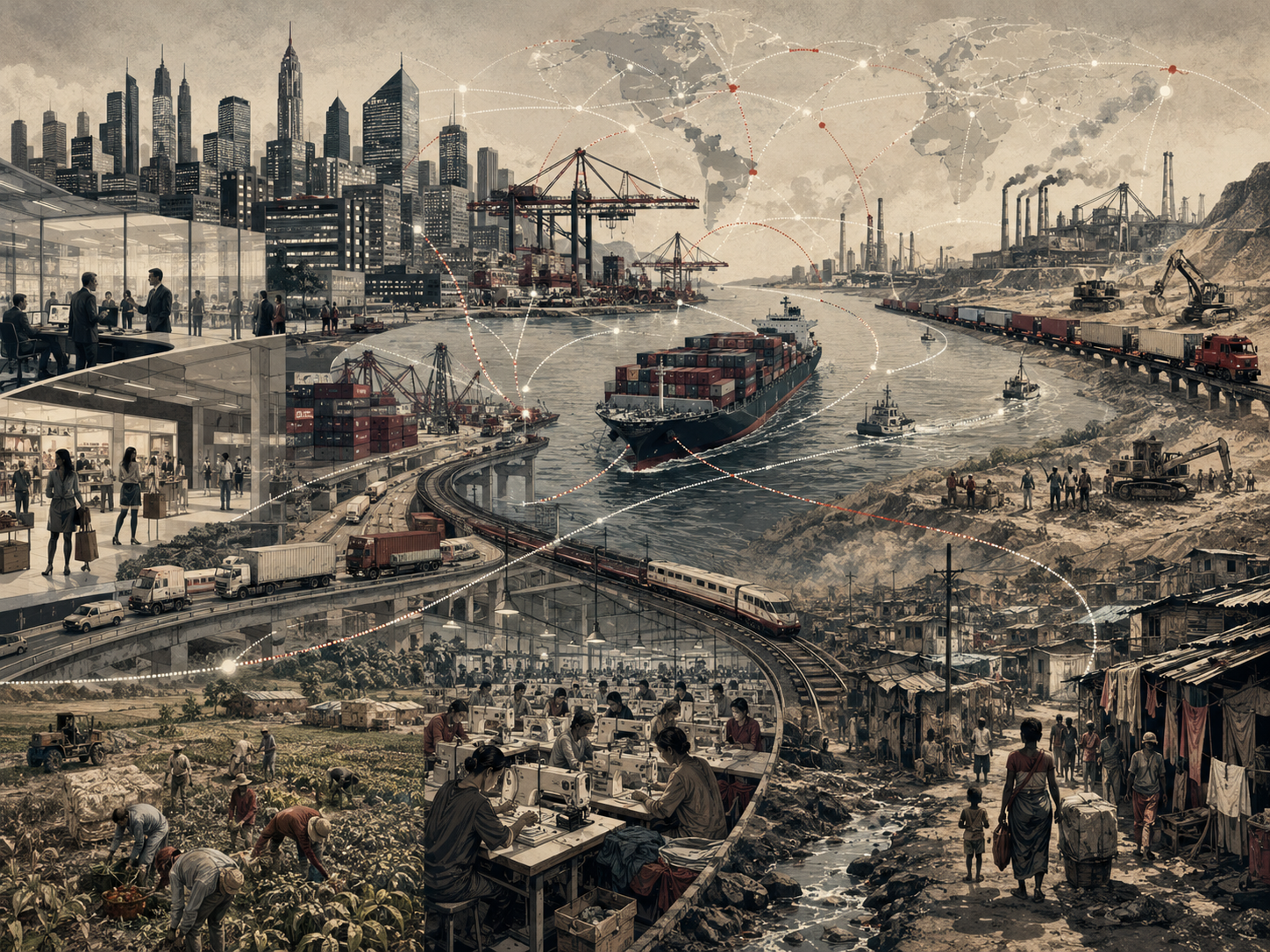
Within a sustainable systems framework, trade, globalization, and uneven development must be judged not only by the volume of cross-border exchange, but by whether global integration strengthens resilience, productive capability, territorial balance, labor dignity, and ecological viability. A society may increase exports while deepening import dependence in strategic sectors, externalizing environmental harm, weakening domestic productive depth, or concentrating gains in narrow metropolitan and financial networks. The serious study of globalization therefore asks not only whether economies are open, but what kinds of structures that openness is building, whose development it supports, and what forms of fragility it leaves behind.
Why This Topic Matters
Trade, globalization, and uneven development matter because few economies now reproduce themselves within strictly national boundaries. Food systems depend on cross-border inputs. Manufacturing depends on imported components and distant logistics. Finance moves through global markets. Energy systems are shaped by international prices and geopolitical risk. Technologies are embedded in standards, platforms, patents, supply chains, and data infrastructures that exceed national control. Economic life is therefore already internationalized, whether or not a society benefits from that condition equally.
This matters analytically because aggregate trade figures can conceal profound structural differences. A country may export high-value technology-intensive goods or depend mainly on raw materials. It may host command functions such as design, finance, intellectual property, and platform control while offshoring lower-value activities elsewhere. Another may appear highly integrated into global trade while capturing only a narrow fraction of total value. The developmental meaning of globalization depends not only on participation, but on position.
These issues also matter politically. Trade and globalization reorganize bargaining power among firms, workers, regions, and states. Sectors exposed to import competition may decline. Export-oriented sectors may gain influence. Urban cores linked to global capital and high-skill services may prosper while peripheral industrial regions stagnate. These redistributions of opportunity and insecurity often shape electoral conflict, state legitimacy, and the social interpretation of globalization itself.
For this reason, the study of trade belongs not only to exchange theory, but to political economy, geography, development, and systems analysis. It asks how cross-border integration changes the structure of production and power, and why some societies convert openness into capability while others experience it as dependency or dislocation.
It also asks a deeper question about scale: whether globalization enlarges the field of human cooperation or merely extends the reach of uneven power across greater distances. That question cannot be answered by trade volume alone.
Trade therefore matters not only because it changes what can be bought and sold, but because it changes which places become central, which become peripheral, and which social groups gain the authority to define what development should mean.
Within sustainable economic analysis, this makes trade a question of resilience as well as efficiency. A trade system can appear efficient in calm conditions and become dangerously brittle when war, pandemic, climate disruption, shipping stress, export controls, or capital-flow reversal reveals how concentrated and fragile its dependencies have become.
What Trade Is
Trade is the exchange of goods and services across individuals, firms, regions, or nations. In international economics, trade typically refers to cross-border exchange organized through prices, contracts, shipping systems, legal rules, payment arrangements, customs systems, and financial settlement. At its simplest, trade allows places to obtain what they do not produce cheaply or efficiently themselves. At a deeper level, it connects production systems, consumption patterns, and comparative specialization across space.
This matters because trade is often presented as a neutral extension of exchange, but its economic meaning depends on structure. Trading grain for machinery, software for minerals, or design services for assembly labor are not equivalent developmental relationships. The pattern of trade matters because it reveals how an economy is inserted into wider systems of production and value capture.
Trade also matters because it changes domestic possibilities. Imports can lower costs, widen consumer choice, and provide access to technologies and intermediate goods. Exports can support scale, foreign-exchange earnings, learning, and industrial deepening. Yet both can also generate dislocation if domestic sectors are unable to adjust, if capabilities remain weak, or if exposure is too abrupt.
A serious account therefore treats trade as relational rather than abstract. The question is not only whether exchange occurs, but what kinds of sectors, dependencies, and institutional pressures that exchange creates across time.
Trade is thus not merely a border phenomenon. It is one of the principal ways economic structures are linked, tested, and transformed through interaction with wider systems of production and demand.
It is also one of the clearest ways societies discover their own productive limits. What a country must import, what it can export, and what it cannot yet competitively produce are all signals of its present structural position.
Those signals are not destiny. They can be changed through industrial policy, skills formation, infrastructure, technology acquisition, development finance, and strategic integration. But without such capacity, trade can simply reproduce the structure an economy already has.
What Globalization Is
Globalization refers to the intensification and widening of cross-border integration in trade, finance, production, technology, information, migration, governance, and culture. Economically, it involves the increasing organization of production and exchange across national boundaries through global supply chains, multinational firms, cross-border finance, digital networks, logistics corridors, standards systems, and trade agreements.
This matters because globalization is more than higher trade volume. It involves changes in the scale and organization of economic life itself. Production may be fragmented across countries; ownership may be separated from location; financing may come from distant markets; standards may be set internationally; and value capture may depend on intellectual property, platform control, branding, data, or logistical advantage rather than on local manufacturing alone.
Globalization also has institutional content. It is shaped by trade law, investment treaties, reserve-currency hierarchies, shipping systems, technological standards, intellectual property regimes, and geopolitical security arrangements. It is therefore not a spontaneous natural process. It is built and governed through rules, infrastructures, and concentrations of power.
A research-grade treatment must therefore distinguish globalization from simple openness. Globalization is not merely an economy having trade. It is the embedding of that economy within a wider architecture of cross-border interdependence whose benefits and constraints are unevenly distributed.
This architecture also changes over time. Periods of deep globalization may be followed by fragmentation, regionalization, friend-shoring, strategic decoupling, or security-driven trade restrictions. Globalization is therefore historical and political, not an irreversible condition of nature.
Globalization is best understood as a governing pattern of interdependence. It determines not only that economies interact, but how they are linked, who writes the rules, who sets the standards, and who retains the greatest freedom to exit, discipline, or redirect the terms of exchange.
That freedom is unevenly distributed. Some states, firms, and regions can reorganize value chains, set standards, relocate production, or absorb shocks. Others must adjust to decisions made elsewhere. Globalization therefore contains both cooperation and hierarchy.
What Uneven Development Means
Uneven development refers to the tendency for economic growth, capability, infrastructure, and institutional power to be distributed asymmetrically across places, sectors, and populations. Some regions accumulate investment, technology, public capacity, high-productivity activity, and strategic control, while others remain dependent, marginalized, extractive, or subordinated within wider systems of accumulation.
This matters because unevenness is not an anomaly added onto globalization later. It is one of its constitutive features. Global systems tend to concentrate command functions, high-value activities, and financial power in some places while externalizing lower-value production, ecological burden, and labor-intensive tasks to others.
Uneven development also exists within nations. Trade and globalization can enrich globally connected metropolitan regions while weakening smaller industrial cities, rural territories, or labor-intensive manufacturing zones. The relevant spatial divide is therefore not just between countries, but between positions inside national and global hierarchies.
A serious account of globalization must therefore ask not only whether trade raises aggregate welfare, but how the gains, losses, and structural positions created by integration are distributed across territory and social groups.
Uneven development is therefore not simply about inequality in amount. It is about inequality in function. Some places are positioned to govern, finance, design, and coordinate, while others are positioned mainly to extract, assemble, transport, or absorb risk.
This functional unevenness tends to reproduce itself. Places that already host infrastructure, technical standards, capital markets, research systems, and corporate control often attract more of the same, while places assigned lower-value roles face steeper barriers to upgrading.
The result is a global and national geography of unequal capability. Some places are integrated as decision-making centers. Others are integrated as sites of labor, raw materials, ecological sacrifice, or logistical passage. The form of integration matters as much as integration itself.
Comparative Advantage and Its Limits
One of the foundational ideas in trade theory is comparative advantage: the proposition that countries can gain from trade by specializing in activities they perform relatively more efficiently, even if one country is more productive in all activities absolutely. This insight explains why trade can expand total output and consumption possibilities under certain conditions.
This matters because comparative advantage remains analytically important. It clarifies how specialization and exchange can create gains beyond autarky. It helps explain why access to imports and export markets can improve welfare and efficiency.
But it also has limits. Comparative advantage says little on its own about how countries acquire capabilities, how specialization changes over time, or whether specializing in low-learning sectors traps economies in fragile positions. A country may have a comparative advantage in raw materials or low-wage assembly, yet remain developmentally vulnerable if those sectors do not support deeper transformation.
A research-grade treatment therefore respects comparative advantage as a useful insight while rejecting its use as a complete developmental doctrine. The question is not only what an economy is relatively better at now, but whether present specialization supports future capability or locks in structural dependence.
This distinction is crucial because comparative advantage can be historically shaped rather than naturally given. Colonial legacies, infrastructure patterns, land systems, financial constraints, technology control, educational inequality, and state capacity all influence what appears efficient in the present.
Comparative advantage is therefore better understood as a snapshot than a destiny. Developmental analysis must ask how the conditions producing that snapshot were formed, and whether they should be accepted or transformed.
In sustainable systems, this matters even more. An economy may have a current advantage in carbon-intensive extraction, low-wage assembly, or resource depletion. A narrow reading of comparative advantage may validate that position, while a developmental reading asks whether that specialization is viable, just, and resilient across time.
Trade Gains, Distribution, and the Politics of Winners and Losers
Trade may increase aggregate welfare while distributing gains and losses very unevenly. Consumers may benefit from cheaper imports. Export sectors may expand. Firms with access to global value chains may gain scale and profit. At the same time, import-competing sectors may contract, workers may lose bargaining power, regions may deindustrialize, and public institutions in affected areas may weaken.
This matters because aggregate gain does not automatically translate into broad legitimacy. If the benefits of globalization are concentrated in asset holders, globally mobile firms, high-skill professionals, or major metropolitan areas, while the costs are borne by manufacturing workers, peripheral regions, or small producers, political backlash is predictable rather than irrational.
Distribution also matters over time. Theoretically, winners could compensate losers. In practice, such compensation is often partial, delayed, or absent. Communities can lose industrial identity, tax base, infrastructure investment, and institutional depth in ways that simple transfer payments do not fully repair. Trade therefore becomes politically contested not because gains are imaginary, but because gains are structured unequally.
A serious framework must therefore place distribution inside trade analysis rather than outside it. The relevant question is not whether trade generates benefits in the abstract, but who receives them, who bears adjustment, and whether institutions exist to prevent trade openness from becoming territorial and social fracture.
This is one reason the politics of trade often exceed the economics of price effects. People experience trade not only through cheaper goods, but through work, place, security, and the perceived dignity or abandonment of entire communities.
Trade’s distributive politics therefore arise from the fact that openness is lived through institutions and territories, not through averages. A region losing skilled employment and civic confidence does not experience national efficiency gains in the same way as a financial district or an import-dependent consumer market.
Distributional trade analysis must therefore include wages, bargaining power, regional tax capacity, sectoral employment, public services, retraining systems, housing markets, and local institutional resilience. Trade effects are not only prices. They are social structures.
Global Value Chains and Hierarchies of Production
Global value chains fragment production across borders so that design, components, assembly, branding, logistics, finance, data, and after-sales functions may occur in different countries under the control of multinational firms or tightly coordinated supplier networks. This organization has become one of the defining features of modern globalization.
This matters because participation in a global value chain is not the same as capturing significant value. High returns may accrue to intellectual property, design, finance, branding, and platform control, while lower returns go to assembly or commodity supply. Countries can therefore become deeply integrated into global production while remaining structurally subordinate within it.
Value-chain governance also matters because lead firms often control standards, technology access, pricing pressure, supplier qualification, and upgrading possibilities. This can discipline quality and facilitate market entry, but it can also limit development if domestic firms remain trapped in low-margin segments without building deeper capabilities.
A research-grade perspective therefore asks where value is captured, who controls upgrading, and whether participation in global chains is creating domestic learning or merely intensifying dependence on externally governed production architectures.
Global value chains thus make visible one of globalization’s central asymmetries: countries may appear linked through shared production while occupying very different positions in terms of power, knowledge, and strategic control.
This is why gross exports can be misleading. A country may ship large volumes of manufactured goods while capturing only a modest share of the income, design authority, or technological autonomy associated with those goods.
Developmental trade strategy must therefore distinguish integration from upgrading. The goal is not simply to enter global value chains, but to climb within them, build domestic linkages, deepen technical capability, and gain more control over the knowledge and income streams that determine long-run development.
Commodity Dependence and the Problem of Extractive Integration
Many economies participate in global trade primarily through the export of raw materials, agricultural commodities, or energy products. These exports can generate foreign exchange and fiscal revenue, but commodity dependence often leaves development vulnerable to price swings, limited domestic linkages, ecological damage, and weak industrial deepening.
This matters because extractive integration can produce growth without transformation. Commodity booms may raise output and public revenue while leaving manufacturing shallow, supplier ecosystems weak, employment generation narrow, and public capacity dependent on volatile rents. When global prices fall, fragility becomes visible quickly.
Commodity dependence also matters because extraction can distort political economy. Resource rents may strengthen central power while weakening incentives for broader tax capacity, diversified industry, or accountable institutions. Environmental and territorial conflict may intensify as extraction expands into vulnerable regions.
A serious account therefore asks whether trade in raw materials is being used as a platform for wider developmental upgrading or whether it is reinforcing a narrow pattern of integration in which value leaves, volatility remains, and local capability deepens only weakly.
This does not mean commodity exports are inherently undesirable. It means that their developmental significance depends on how rents are governed, whether linkages are built, and whether extraction finances broader structural transformation rather than substituting for it.
Extractive integration is therefore best understood as a developmental risk when it becomes a substitute for structural learning. The issue is not export presence alone, but whether the economy remains locked into roles defined mainly by what can be removed rather than what can be cumulatively built.
Within a sustainable systems framework, commodity dependence also raises ecological questions. Extraction may provide foreign exchange while degrading land, water, biodiversity, and community health. A trade model that monetizes depletion while leaving damage locally concentrated cannot be treated as developmentally neutral.
Industrial Upgrading, Learning, and Strategic Integration
Trade can support development when economies use external markets, imported inputs, and technological exposure to deepen domestic capability. Industrial upgrading involves moving into more sophisticated production, stronger supplier networks, higher-productivity sectors, more complex services, and more valuable positions within global trade and production systems.
This matters because openness alone does not guarantee upgrading. Firms may remain dependent on imported technology, foreign designs, or low-value assembly unless institutions support learning, finance, infrastructure, and strategic movement into more complex activities. Development requires not only participation in trade, but progression through it.
Strategic integration is therefore crucial. Economies that integrate selectively and developmentally may use trade to expand exports, strengthen domestic suppliers, and climb technological ladders. Economies that integrate passively may become open without becoming strong.
A research-grade framework therefore treats trade policy, industrial policy, education, infrastructure, and finance as interconnected. The question is whether globalization is being used to build capability or merely to optimize dependence.
Upgrading also requires institutional patience. Learning curves are long, supplier ecosystems take time, and movement into higher-value activities often demands public coordination that markets alone do not reliably sustain.
Strategic integration is thus the opposite of naive openness. It treats trade not as an end-state, but as a terrain on which domestic capability must be deliberately built, protected where necessary, and progressively tested.
This does not require isolation. It requires a theory of openness that distinguishes beneficial exposure from destructive vulnerability. Strategic integration asks where openness accelerates learning and where it prematurely exposes fragile capabilities before they can mature.
Labor Markets, Wages, and Cross-Border Competition
Globalization changes labor markets by exposing workers and firms to cross-border competition, supply-chain restructuring, migration flows, platform-mediated work, and the threat or reality of offshoring. This can lower production costs and widen consumer access, but it can also weaken wage bargaining power, increase labor insecurity, and place pressure on social protections.
This matters because labor is not merely another factor of production. The organization of work shapes household security, regional stability, skill formation, and political legitimacy. A globalization model that relies heavily on labor arbitrage may raise profit and trade volumes while undermining broader social cohesion.
Wage effects also vary sharply by sector and skill. High-skill workers in globally connected industries may benefit from larger markets and rising demand, while workers in import-competing sectors or weaker regions face downward pressure, displacement, or prolonged insecurity. Cross-border integration therefore often widens internal inequality even where national income rises overall.
A serious treatment of trade must therefore include labor institutions, wage formation, and the social consequences of competitive restructuring. The relevant question is not only whether trade increases efficiency, but whether it supports a labor order compatible with durable development.
This also means that labor protections, training systems, and adjustment institutions are not external correctives to trade. They are part of the institutional architecture that determines whether openness becomes developmentally sustainable or socially corrosive.
Globalization therefore tests the quality of domestic labor institutions. Where workers are treated as disposable adjustment variables, trade may deepen insecurity. Where training, bargaining, and social protection are stronger, integration is more likely to produce upgrading rather than simple wage suppression.
In sustainable systems, trade must therefore be judged partly by whether it builds human capability. A trade system that generates low prices by undermining labor dignity, weakening bargaining power, or externalizing insecurity is not simply efficient. It is institutionally incomplete.
Finance, Capital Flows, and External Vulnerability
Globalization involves not only trade in goods and services, but also cross-border finance. Capital inflows can support investment, government borrowing, and external balance, yet they can also create dependency, volatility, currency mismatch, and crisis vulnerability when flows reverse abruptly.
This matters because financial openness does not have the same structure as trade openness. Capital can move far faster than industrial capability can adjust. Short-term portfolio flows, external debt, and foreign-currency liabilities can expose economies to destabilizing shocks even when export sectors are performing reasonably well.
External vulnerability is especially significant where trade deficits, imported energy dependence, or shallow domestic finance require continuous access to foreign funding. Under such conditions, changes in global interest rates, investor sentiment, exchange rates, or reserve-currency policy can reshape domestic possibilities quickly and painfully.
A research-grade framework therefore connects trade with financial structure. The developmental meaning of globalization depends partly on whether external integration is financed on stable terms, in manageable currencies, and in ways compatible with domestic resilience rather than repeated crisis.
Finance therefore complicates any simple story of openness. A country may seem globally integrated and prosperous during easy external funding conditions, only to discover during tightening cycles that its developmental trajectory had been resting on fragile monetary foundations.
The result is that some economies experience openness less as voluntary integration than as disciplined exposure. Their trade structures cannot be understood apart from the financial conditions that permit or constrain them.
Development finance, reserve buffers, capital-flow management, domestic credit depth, and public investment capacity therefore matter to trade strategy. Openness is not developmentally governable if the financial architecture leaves a society unable to withstand external shocks.
Trade Imbalances, Currency Power, and Global Adjustment
Global trade rarely balances neatly across countries. Some run persistent surpluses, accumulating foreign assets, industrial scale, or reserve strength. Others run deficits, often financed through borrowing, asset sales, foreign investment, or reserve depletion. These imbalances are tied not only to productivity and saving patterns, but also to currency hierarchy, financial architecture, and global demand structures.
This matters because not all countries adjust to imbalance under the same conditions. Economies issuing reserve currencies or borrowing in their own currency often possess greater room to sustain deficits. Others face harsher external discipline through exchange-rate pressure, imported inflation, debt-service stress, or funding constraints. Global adjustment is therefore unequal.
Currency power also matters because trade competitiveness interacts with monetary hierarchy. A country whose currency is widely used in trade, reserves, and finance occupies a structurally different position from one whose trade depends on foreign-currency invoicing and external borrowing. The world economy is not neutral on this point.
A serious treatment of trade and globalization must therefore include the monetary order. Trade flows, capital flows, and currency power are intertwined, and uneven development is often reproduced through that intertwining.
Trade imbalances are therefore not just bookkeeping facts. They often reflect deeper asymmetries in productive structure, reserve status, and financial power that shape who can sustain openness comfortably and who must endure it under greater external constraint.
Adjustment itself is therefore political. The question is often not simply who should change, but who has the power to delay change, externalize its cost, or force others to absorb it first.
This is why trade policy cannot be separated from monetary policy, central banking, debt management, and development finance. Globalization operates through money as well as goods.
Regional Inequality, Cities, and the Spatial Pattern of Globalization
Globalization is spatially selective. Major port cities, financial hubs, logistics corridors, technology clusters, and metropolitan service centers often benefit disproportionately from global integration. Meanwhile, regions dependent on vulnerable manufacturing, low-value agriculture, older industrial systems, or extraction may experience stagnation or decline.
This matters because national growth can conceal internal territorial fracture. Globally connected urban cores may accumulate capital, infrastructure, talent, and political voice, while peripheral regions lose employment, tax base, and institutional depth. Uneven development is therefore often reproduced through the geography of globalization itself.
Cities matter especially because globalization tends to reward concentration: airports, ports, finance, universities, professional services, digital infrastructure, and high-value networks cluster spatially. Yet concentration can also produce housing stress, congestion, exclusion, displacement, and stark intra-urban inequality.
A research-grade account must therefore treat place as central to trade and development. The relevant question is not only how much a country trades, but which regions are integrated, which are bypassed, and whether territorial policy exists to prevent globalization from becoming a map of internal abandonment.
This is one reason regional policy, infrastructure investment, and industrial strategy remain essential in open economies. Without them, globalization often amplifies preexisting spatial advantage rather than broadening development across national territory.
The geography of trade thus becomes part of the social geography of citizenship. Some places are incorporated into the future; others are left to experience openness mainly as displacement, extraction, or logistical passage.
A sustainable trade strategy must therefore be territorial as well as sectoral. It must ask whether integration builds regional capability, secondary-city strength, infrastructure networks, and public services beyond the already advantaged centers of the global economy.
Technology, Standards, and Digital Globalization
Globalization now operates increasingly through digital systems, technological standards, intellectual property regimes, platforms, data infrastructures, cloud systems, chips, protocols, and software-dependent forms of production and exchange. Digital globalization does not eliminate geography, but it changes how power and value are organized across it.
This matters because countries and firms can participate in digital systems while remaining dependent on external standards, platforms, cloud infrastructures, chips, or proprietary software. Control over technical architecture increasingly shapes who captures value and who remains subordinate within global networks.
Standards matter especially because they govern interoperability, safety, market entry, technological lock-in, and regulatory compliance. Countries with influence over standards-setting, platform governance, or core technologies often exercise structural power beyond their physical production share alone.
A serious development framework must therefore include digital capability, public technical infrastructure, standards literacy, and technological sovereignty. Trade today is not only about shipping goods. It is also about the governance of code, data, platforms, and protocols through which economic life increasingly moves.
Digital globalization therefore intensifies an older developmental question in new form: whether participation builds domestic capability or merely updates dependency through more intangible but no less powerful forms of external control.
This is why technological sovereignty, interoperability, and public digital infrastructure increasingly matter to trade analysis. The location of servers, patents, chips, and standards bodies can be as developmentally significant as the location of ports or factories.
The digital economy also changes value capture. A country may supply users, labor, data, or content while platform owners elsewhere capture rents. Digital trade therefore requires analysis of ownership, governance, and control, not only access.
Ecology, Supply Chains, and the Environmental Geography of Trade
Trade reorganizes not only production and income, but also ecological burden. Resource extraction, emissions-intensive manufacturing, waste handling, shipping pollution, deforestation, water stress, and land degradation are often displaced across borders along with production itself. Global supply chains can therefore obscure the environmental geography of consumption.
This matters because countries may appear cleaner domestically while importing the ecological cost of what they consume from elsewhere. Trade thus makes environmental accounting more complex and can externalize damage toward weaker regulatory environments, poorer regions, or politically marginalized populations.
Supply chains also matter because ecological fragility is increasingly a trade risk. Drought, heat, floods, biodiversity loss, wildfire, resource depletion, and water stress can disrupt production, transport, insurance, and commodity availability across borders. Environmental stress is therefore no longer a side issue for global trade. It is part of its operating condition.
A research-grade treatment must therefore link trade with material throughput and ecological limits. The developmental question is not only whether trade increases welfare, but whether the structure of cross-border production is environmentally governable and resilient across time.
This means that ecological sustainability cannot be treated as an external correction to trade. It is part of the logic of trade itself once supply chains, resource systems, and planetary constraints are understood as interconnected.
The environmental geography of trade thus reveals one of globalization’s most persistent moral tensions: consumption, profit, and apparent cleanliness in some places may depend on degradation, dispossession, or toxic exposure elsewhere.
A sustainable trade system must therefore account for embodied emissions, extraction, waste displacement, labor exposure, and community burden. Trade that hides ecological damage is not clean; it is merely geographically displaced.
Geopolitics, Fragmentation, and the End of Frictionless Globalism
Contemporary globalization is increasingly shaped by geopolitical rivalry, sanctions, export controls, energy insecurity, supply-chain reshoring, industrial strategy, and security-driven restrictions on trade and technology. The older image of frictionless global integration has weakened as states reassert strategic concern over semiconductors, energy systems, logistics, minerals, data, and defense-related technologies.
This matters because trade is no longer governed solely by efficiency criteria. Security, resilience, strategic autonomy, and alliance structures increasingly shape what kinds of openness are considered acceptable. This changes both the theory and practice of globalization.
Fragmentation also matters developmentally. Some countries may gain opportunities from supply-chain relocation or regional industrial diversification. Others may be squeezed between rival blocs, locked out of technologies, or forced into more vulnerable dependency patterns. The developmental effects of fragmentation are therefore likely to be uneven.
A serious framework must therefore move beyond the assumption that globalization always deepens in one direction. The real question is how economic integration is being reorganized under geopolitical stress, and what that means for countries seeking resilient and sovereign developmental pathways.
This new phase of globalization may be less universal, more regional, and more strategic. The developmental challenge is to navigate that shift without confusing resilience-building with isolation or strategic alignment with genuine productive upgrading.
Fragmentation therefore does not end uneven development. It may simply redraw its lines, producing new centers and peripheries under a different geopolitical vocabulary.
The central policy challenge is to build resilience without collapsing into self-defeating isolation. A resilient trade strategy needs diversified suppliers, domestic capability, regional cooperation, strategic redundancy, and continued exchange where cooperation remains developmentally and ecologically useful.
Development Finance, Sovereignty, and the Governance of Openness
Trade strategy cannot be separated from the question of how development is financed. Economies integrated into global markets often need foreign exchange, external borrowing, investment inflows, and technological imports to sustain industrialization, infrastructure, energy transition, and public capacity. Yet the financial terms of that integration can either widen developmental autonomy or sharply constrain it.
This matters because openness funded through fragile debt structures or short-term external confidence may leave states with little room to govern trade developmentally. Exchange-rate pressure, debt-service obligations, reserve stress, and lender conditionality can all narrow the policy space available for industrial strategy, social protection, or public investment.
Sovereignty in this context does not mean autarky. It means sufficient control over financing terms, external exposure, and strategic priorities that integration can be managed rather than simply endured. Development finance becomes central because it determines whether openness is accompanied by real capability-building or by repeated adjustment crises.
A research-grade treatment therefore places trade inside a wider framework of monetary and fiscal capacity. The question is not only whether countries participate in globalization, but whether they possess the institutional and financial means to shape the terms of that participation over time.
Openness is therefore governable only where sovereignty is sufficiently material. Without domestic financial depth, public capacity, and strategic control, trade may expand while the space to direct development quietly contracts.
This is especially important for countries seeking sustainable development under climate pressure. Energy transition, adaptation infrastructure, food security, and industrial upgrading require finance on terms compatible with long-horizon public purpose. If the terms of external finance repeatedly force austerity, currency stress, or extractive growth, openness becomes a constraint rather than a pathway.
Developmental sovereignty therefore requires both connection and capacity: access to markets, ideas, and technologies, but also enough institutional strength to avoid being trapped by the financial and productive terms of that access.
Historical Lessons from Trade Orders and Developmental Divergence
Historically, trade has never been separated cleanly from power. Colonial trade systems, imperial preference, unequal treaties, export enclaves, postwar trade regimes, and contemporary value chains have all distributed opportunity and constraint unevenly. The world economy has repeatedly generated divergence as well as convergence.
This matters because theories of trade become shallow when they treat exchange as if it always occurs between symmetrical actors entering markets under equal historical conditions. In practice, trade orders have often been built upon military force, institutional asymmetry, technological monopoly, reserve-currency power, or inherited patterns of dependency.
History also shows, however, that strategic engagement with trade can support development under certain conditions. Economies that used trade to acquire technology, expand industry, support exports, and build public capability often did so with strong institutions, developmental states, and strategic selectivity rather than with passive openness alone.
A research-grade perspective therefore uses history diagnostically. The point is not to romanticize autarky or openness, but to understand how trade orders have historically produced developmental divergence, and what institutional capacities have allowed some countries to convert external integration into deeper capability.
Historical perspective also warns against innocence. Trade regimes that appear universal and neutral often contain embedded advantages for those already holding financial, technological, or military leadership. Uneven development is therefore not a deviation from history’s trade orders. It is frequently one of their results.
History also demonstrates that trade orders are always political settlements. They stabilize only temporarily, and when their distributive effects become too sharp or their strategic assumptions too brittle, they are revised, contested, or replaced.
The lesson is not that trade is inherently emancipatory or inherently exploitative. It is that trade must be governed, interpreted, and evaluated through the institutions, histories, and power relations that shape who gains, who adjusts, and who is permitted to transform.
Trade, Globalization, and Sustainable Systems
Within sustainable systems, trade and globalization must be judged by whether they support resilient productive capacity, fairer territorial development, manageable external exposure, labor dignity, and ecologically viable forms of exchange. A country that opens rapidly while weakening domestic industry, deepening energy dependence, and externalizing environmental cost may appear globally integrated while becoming more fragile systemically.
This changes the meaning of successful globalization. The goal is not simply to maximize trade volume or attract mobile capital, but to build forms of cross-border integration compatible with learning, public capacity, infrastructural depth, and long-term resilience. Strategic trade policy, industrial policy, energy policy, development finance, labor policy, and territorial policy therefore remain central in open economies.
Sustainable systems require a broader conception of openness. Economies need access to technologies, markets, and ideas, but they also need domestic capability, diversified supply, ecological governance, and institutions strong enough to absorb global shocks without collapsing into dependency. Trade is developmentally valuable when it widens capability rather than hollowing it out.
In this sense, globalization becomes a systems question. It asks whether cross-border integration is helping societies build stronger and more resilient foundations for collective life, or whether it is reorganizing production in ways that intensify fragility, hierarchy, and distributed ecological harm.
This also means that sustainability should not be understood as retreat from the world economy. It is better understood as the effort to participate in global exchange without sacrificing productive depth, territorial balance, social legitimacy, and ecological viability in the process.
A sustainable trade order would therefore be one that supports capability-building, limits extractive dependence, reduces ecological displacement, and allows a wider range of societies to move from subordinate integration toward more balanced and resilient forms of development.
The deepest question is whether globalization can be governed as a system of mutual capability rather than as a system of uneven exposure. That requires new forms of public strategy, international cooperation, ecological accounting, labor protection, development finance, and institutional capacity strong enough to make openness serve life rather than merely circulation.
How Trade and Globalization Systems Should Be Judged
Trade and globalization systems should not be judged only by trade volume, export growth, import prices, or aggregate welfare estimates. A broader economic systems framework asks whether integration builds domestic capability, improves value capture, reduces vulnerability, supports labor dignity, strengthens regions, and accounts for ecological burden.
| Dimension | Narrow Question | Systems Question |
|---|---|---|
| Trade Openness | How much does the economy trade? | Does trade strengthen capability, resilience, and public capacity, or does it deepen dependency? |
| Trade Balance | Is there a surplus or deficit? | What sectors drive the balance, how is it financed, and what external vulnerabilities does it create? |
| Export Structure | Are exports growing? | Are exports diversified, high-learning, domestically linked, and resilient to price and geopolitical shocks? |
| Value Chains | Is the economy integrated into global production? | Where is value captured, who controls technology and standards, and can domestic firms upgrade? |
| Labor | Are consumers benefiting from cheaper goods? | How are wages, bargaining power, employment security, and regional labor markets affected? |
| Finance | Is external capital available? | Does financial integration expand development space or create currency, debt, and capital-flow vulnerability? |
| Territory | Are globally connected regions prospering? | Does globalization widen regional inequality or support balanced territorial development? |
| Ecology | Are goods produced efficiently? | Where are emissions, extraction, waste, and ecological risks located across the supply chain? |
| Resilience | Are supply chains cost-efficient? | Are they diversified, transparent, strategically redundant, and resilient under disruption? |
This framework prevents a common mistake: treating globalization as either automatically beneficial or automatically harmful. The deeper issue is structure. Openness can build capability under some institutional conditions and deepen fragility under others. Trade can support development when it enables learning, value capture, and resilience. It can undermine development when it locks societies into low-value roles, volatile dependence, or unequal adjustment.
The central question is therefore not simply whether an economy is open or closed. The deeper question is whether cross-border integration is governed in ways that build a more capable, just, resilient, and ecologically viable economic system.
Mathematical Lens
Mathematics can clarify trade, globalization, and uneven development by making trade openness, trade balance, export concentration, domestic value capture, terms of trade, external vulnerability, regional divergence, and sustainable trade resilience explicit. These equations do not determine what level of openness is desirable, but they help reveal why trade volume alone is an insufficient measure of development.
1. Trade Openness Ratio
TO = \frac{X + M}{Y}
\]
Interpretation: Trade openness \(TO\) compares exports \(X\) plus imports \(M\) with total output \(Y\). It indicates the scale of trade relative to the economy, but not whether trade is developmentally beneficial.
2. Trade Balance
TB = X – M
\]
Interpretation: The trade balance \(TB\) equals exports minus imports. A surplus implies exports exceed imports; a deficit implies the reverse. The developmental meaning depends on structure, financing, sectoral composition, and currency position.
3. Export Concentration
EC = \sum_{i=1}^{n} x_i^2
\]
Interpretation: Export concentration \(EC\) can be represented as the sum of squared export shares \(x_i\). Higher concentration suggests greater dependence on a narrow range of exports and therefore higher vulnerability to sector-specific shocks.
4. Domestic Value Capture
DVC = \frac{Domestic\ Value\ Added}{Gross\ Exports}
\]
Interpretation: Domestic value capture \(DVC\) distinguishes participation in trade from actual domestic income capture within global value chains. A country may export a great deal while retaining only a limited share of value.
5. Terms of Trade
TT = \frac{P_x}{P_m}
\]
Interpretation: The terms of trade \(TT\) compare export prices \(P_x\) with import prices \(P_m\). Adverse movement can weaken purchasing power, fiscal space, and external resilience.
6. External Vulnerability
EV = f(Import\ Dependence, Foreign\ Currency\ Debt, Capital\ Flow\ Volatility, Reserve\ Buffer)
\]
Interpretation: External vulnerability \(EV\) can be modeled as a function of import dependence, foreign-currency debt, capital-flow volatility, and reserve buffers. This shows why trade openness must be interpreted alongside financial and monetary exposure.
7. Uneven Development
UD = f(Productivity, Infrastructure, Capital\ Access, Market\ Access, Institutional\ Capacity)
\]
Interpretation: Uneven development \(UD\) reflects cumulative differences in productivity, infrastructure, capital access, market access, and institutional capacity. Globalization often amplifies these differences rather than distributing gains evenly.
8. Sustainable Trade Resilience
STR = f(Diversification, Value\ Capture, Domestic\ Capability, Ecological\ Burden, Strategic\ Redundancy)
\]
Interpretation: Sustainable trade resilience \(STR\) represents whether trade integration supports diversification, value capture, domestic capability, ecological accountability, and strategic redundancy. It shifts evaluation from trade volume to long-run system quality.
9. Practical Interpretation
The mathematical lens clarifies several structural points. Trade volume alone does not indicate developmental quality. Trade deficits or surpluses must be interpreted structurally rather than morally. Export concentration can increase vulnerability. Domestic value capture matters more than gross participation alone. Terms-of-trade shocks can weaken external resilience. Regional divergence and uneven development are linked to cumulative differences in capability and position. Sustainable trade requires diversification, value capture, ecological accountability, and enough domestic capability to avoid dependency.
Formalization helps clarify mechanism, but it does not determine what level of openness is desirable, how tradeoffs between resilience and efficiency should be resolved, or what forms of global integration are just or sustainable. Those remain institutional, historical, and political questions.
Python Workflow: Trade, Globalization, and Uneven Development
Python is useful for turning trade and globalization concepts into reproducible calculations. The following compact workflow models trade openness, trade balance, export concentration, domestic value capture, terms of trade, external vulnerability, and sustainable trade resilience.
# Trade, Globalization, and Uneven Development
# Simple Python workflow

import pandas as pd

# Trade openness and trade balance
exports = 320
imports = 410
output = 1500

trade_openness = (exports + imports) / output
trade_balance = exports - imports

print("Trade openness:", round(trade_openness, 3))
print("Trade balance:", trade_balance)

# Export concentration
export_values = {
    "energy": 140,
    "minerals": 90,
    "agriculture": 60,
    "manufacturing": 45,
    "knowledge_services": 25
}

total_exports = sum(export_values.values())
export_shares = {
    sector: value / total_exports
    for sector, value in export_values.items()
}

export_concentration = sum(share ** 2 for share in export_shares.values())
diversification_score = 1 - export_concentration

print("Export concentration:", round(export_concentration, 3))
print("Diversification score:", round(diversification_score, 3))

# Domestic value capture
domestic_value_added = 145
gross_exports = 320
domestic_value_capture = domestic_value_added / gross_exports

print("Domestic value capture:", round(domestic_value_capture, 3))

# Terms of trade
export_price_index = 102
import_price_index = 118
terms_of_trade = export_price_index / import_price_index

print("Terms of trade:", round(terms_of_trade, 3))

# External vulnerability
import_dependence = 0.55
foreign_currency_debt = 0.42
capital_flow_volatility = 0.48
reserve_buffer = 0.38

external_vulnerability = (
    0.30 * import_dependence
    + 0.25 * foreign_currency_debt
    + 0.25 * capital_flow_volatility
    + 0.20 * (1 - reserve_buffer)
)

print("External vulnerability:", round(external_vulnerability, 3))

# Sustainable trade resilience
supplier_diversification = 0.62
domestic_capability = 0.58
strategic_redundancy = 0.52
ecological_traceability = 0.46
cooperative_trade_access = 0.70

sustainable_trade_resilience = (
    0.22 * supplier_diversification
    + 0.24 * domestic_capability
    + 0.18 * strategic_redundancy
    + 0.16 * ecological_traceability
    + 0.20 * cooperative_trade_access
)

print("Sustainable trade resilience:", round(sustainable_trade_resilience, 3))

df = pd.DataFrame({
    "Metric": [
        "Trade Openness",
        "Trade Balance",
        "Export Concentration",
        "Diversification Score",
        "Domestic Value Capture",
        "Terms of Trade",
        "External Vulnerability",
        "Sustainable Trade Resilience"
    ],
    "Value": [
        trade_openness,
        trade_balance,
        export_concentration,
        diversification_score,
        domestic_value_capture,
        terms_of_trade,
        external_vulnerability,
        sustainable_trade_resilience
    ]
})

print(df)
This workflow is useful because it separates trade scale from trade structure, export dependence, domestic value capture, price vulnerability, external financial exposure, and strategic resilience. It helps show why an economy can be highly globalized yet still developmentally fragile if it captures little value, depends on narrow exports, imports strategic essentials, or lacks domestic capability.
The full GitHub repository expands this example into trade-position scenarios, export-basket analysis, domestic value-capture models, global value-chain position, commodity dependence, terms-of-trade vulnerability, currency and capital-flow exposure, regional inequality, labor-market exposure, ecological burden, strategic resilience, SQL queries, R and Stata replication workflows, Julia simulations, and article-ready figures.
R Workflow: Trade, Globalization, and Uneven Development
R is useful for trade summaries, export-concentration tables, value-capture comparisons, and publication-ready graphics. The following compact workflow performs the same trade-openness, trade-balance, export-concentration, value-capture, terms-of-trade, external-vulnerability, and resilience calculations in R.
# Trade, Globalization, and Uneven Development
# Simple R workflow

# Trade openness and trade balance
exports <- 320
imports <- 410
output <- 1500

trade_openness <- (exports + imports) / output
trade_balance <- exports - imports

cat("Trade openness:", round(trade_openness, 3), "\n")
cat("Trade balance:", trade_balance, "\n")

# Export concentration
export_values <- c(
  energy = 140,
  minerals = 90,
  agriculture = 60,
  manufacturing = 45,
  knowledge_services = 25
)

total_exports <- sum(export_values)
export_shares <- export_values / total_exports

export_concentration <- sum(export_shares ^ 2)
diversification_score <- 1 - export_concentration

cat("Export concentration:", round(export_concentration, 3), "\n")
cat("Diversification score:", round(diversification_score, 3), "\n")

# Domestic value capture
domestic_value_added <- 145
gross_exports <- 320
domestic_value_capture <- domestic_value_added / gross_exports

cat("Domestic value capture:", round(domestic_value_capture, 3), "\n")

# Terms of trade
export_price_index <- 102
import_price_index <- 118
terms_of_trade <- export_price_index / import_price_index

cat("Terms of trade:", round(terms_of_trade, 3), "\n")

# External vulnerability
import_dependence <- 0.55
foreign_currency_debt <- 0.42
capital_flow_volatility <- 0.48
reserve_buffer <- 0.38

external_vulnerability <- (
  0.30 * import_dependence +
  0.25 * foreign_currency_debt +
  0.25 * capital_flow_volatility +
  0.20 * (1 - reserve_buffer)
)

cat("External vulnerability:", round(external_vulnerability, 3), "\n")

# Sustainable trade resilience
supplier_diversification <- 0.62
domestic_capability <- 0.58
strategic_redundancy <- 0.52
ecological_traceability <- 0.46
cooperative_trade_access <- 0.70

sustainable_trade_resilience <- (
  0.22 * supplier_diversification +
  0.24 * domestic_capability +
  0.18 * strategic_redundancy +
  0.16 * ecological_traceability +
  0.20 * cooperative_trade_access
)

cat("Sustainable trade resilience:", round(sustainable_trade_resilience, 3), "\n")

summary_df <- data.frame(
  Metric = c(
    "Trade Openness",
    "Trade Balance",
    "Export Concentration",
    "Diversification Score",
    "Domestic Value Capture",
    "Terms of Trade",
    "External Vulnerability",
    "Sustainable Trade Resilience"
  ),
  Value = c(
    trade_openness,
    trade_balance,
    export_concentration,
    diversification_score,
    domestic_value_capture,
    terms_of_trade,
    external_vulnerability,
    sustainable_trade_resilience
  )
)

print(summary_df)
This R workflow is deliberately compact for article readability. In the full repository, R reads structured trade-position, export-basket, value-chain, terms-of-trade, finance-currency, regional-inequality, labor-exposure, ecological-trade, and strategic-resilience scenarios; calculates trade openness, trade balances, export concentration, domestic value capture, value-chain position, external vulnerability, regional advantage, labor exposure, ecological burden, and sustainable trade resilience; and visualizes how globalization differs across structural positions.
Future Economic Systems articles can extend this foundation with customs data, input-output tables, trade-in-value-added data, export concentration metrics, commodity price series, exchange rates, capital-flow data, regional employment data, shipping and logistics data, embodied emissions estimates, and supply-chain risk indicators.
GitHub Repository
The article body includes selected computational examples so the conceptual, institutional, and mathematical argument remains readable. The full repository contains the expanded research infrastructure: Python trade and value-chain analysis, R globalization summaries, Stata applied trade-and-development replication workflows, SQL trade scenario tables, Julia trade vulnerability simulations, trade openness, trade balances, export concentration, domestic value capture, global value-chain position, commodity dependence, terms-of-trade pressure, capital-flow vulnerability, regional inequality, labor exposure, ecological burden, sustainable trade resilience, documentation, reproducible sample data, and article-ready figures and tables.
Complete Code Repository
The full code distribution for this article, including selected article examples and advanced research-style computational scaffolding for trade openness, trade balances, export concentration, domestic value capture, global value chains, commodity dependence, terms-of-trade shocks, currency hierarchy, capital-flow vulnerability, regional inequality, labor-market exposure, ecological burden, supply-chain resilience, sustainable globalization pathways, reproducibility documentation, and cross-language economic analysis, is available on GitHub.
Conclusion
Trade, globalization, and uneven development are central to economic analysis because they show how cross-border integration changes not only exchange, but productive structure, bargaining power, territorial balance, ecological burden, and long-term capability. Trade can widen opportunity, but its effects depend on position, institutions, value capture, and the capacity of societies to convert openness into deeper development rather than more fragile dependency.
To understand an economic system seriously, one must therefore ask not only how much an economy trades, but what it trades, where value is captured, how labor and regions are affected, how finance and currency power shape adjustment, and whether global integration is building stronger domestic capability or subordinating it. These questions reveal whether globalization is widening human possibility through cooperation and learning or reproducing hierarchy through more complex and far-reaching forms of uneven development.
The serious study of trade also requires moving beyond simple binaries. Openness is not automatically development. Protection is not automatically sovereignty. Trade can support industrial upgrading, technological learning, and public welfare when governed strategically. It can also deepen dependency, ecological displacement, labor insecurity, and regional abandonment when treated as an end in itself.
In a sustainable economic system, globalization must be judged by whether it strengthens the conditions of collective life: resilient supply chains, diversified production, fairer labor systems, ecological accountability, regional inclusion, development finance, and enough domestic capability to participate in the world economy without being subordinated by it. The task is not to withdraw from the world, but to build forms of connection that do not require permanent hierarchy, hidden damage, or disposable communities.
Related Reading
- Economic Systems
- Growth, Development, and Structural Transformation
- Industrial Policy and the Developmental State
- Fiscal Policy, Taxation, and Public Investment
- Inflation, Energy Shocks, and Supply Constraints
- Monetary Policy, Central Banking, and Financial Conditions
- Labor, Wages, Productivity, and the Social Organization of Work
- Sustainable Development
- Institutions & Governance
- Risk & Resilience
Further Reading
- International Labour Organization (ILO) (n.d.). Trade, labor markets, and globalization. Available at: https://www.ilo.org/
- Organisation for Economic Co-operation and Development (OECD) (n.d.). Global value chains and trade. Available at: https://www.oecd.org/en/topics/global-value-chains.html
- United Nations Conference on Trade and Development (UNCTAD) (n.d.). Trade and development. Available at: https://unctad.org/
- United Nations Industrial Development Organization (UNIDO) (n.d.). Industrial development and global value chains. Available at: https://www.unido.org/
- World Bank (n.d.). Trade. Available at: https://www.worldbank.org/en/topic/trade
- World Trade Organization (WTO) (n.d.). Trade and development. Available at: https://www.wto.org/
- World Bank (n.d.). World Integrated Trade Solution. Available at: https://wits.worldbank.org/
References
- International Labour Organization (ILO) (n.d.). Trade, labor markets, and globalization. Available at: https://www.ilo.org/
- Organisation for Economic Co-operation and Development (OECD) (n.d.). Global value chains and trade. Available at: https://www.oecd.org/en/topics/global-value-chains.html
- United Nations Conference on Trade and Development (UNCTAD) (n.d.). Trade and development. Available at: https://unctad.org/
- United Nations Industrial Development Organization (UNIDO) (n.d.). Industrial development and global value chains. Available at: https://www.unido.org/
- World Bank (n.d.). Trade. Available at: https://www.worldbank.org/en/topic/trade
- World Bank (n.d.). World Integrated Trade Solution. Available at: https://wits.worldbank.org/
- World Trade Organization (WTO) (n.d.). Trade and development. Available at: https://www.wto.org/