
Last Updated May 26, 2026
The welfare state and social protection belong at the center of political economy because modern societies do not leave livelihoods, health, old age, disability, unemployment, care, childhood, and family survival entirely to market income or private charity. The welfare state refers to the institutional arrangements through which public authority helps secure social protection, redistribute risk, and support a minimum level of material security across the life course. Social protection refers more specifically to the policies and systems through which societies reduce vulnerability and protect people against predictable and unpredictable shocks: unemployment, sickness, disability, old age, childrearing costs, poverty, displacement, and crisis.
These institutions shape far more than household income. They affect bargaining power in labor markets, the capacity to take risks, the distribution of insecurity, the terms of citizenship, and the degree to which people can participate in economic life without living permanently at the edge of collapse. In that sense, the welfare state is not simply a residual corrective applied after the market has done its work. It is part of the basic architecture through which a society decides how far social membership should protect people from destitution, volatility, and avoidable dependence.
Social protection is especially important because insecurity is cumulative. Income loss can become housing instability; poor health can become labor-market exclusion; weak childcare can become reduced lifetime earnings; disability can become poverty; old-age insecurity can become dependence and isolation. Where protection is thin, ordinary life-course risks are more likely to become structural disadvantage. Where protection is stronger, the same risks are more likely to remain manageable interruptions rather than permanent downward turns.
Main Library
Publications
Article Map
Economic Systems
Related Topic
Sustainable Development
Related Topic
Institutions & Governance
Related Topic
Risk & Resilience
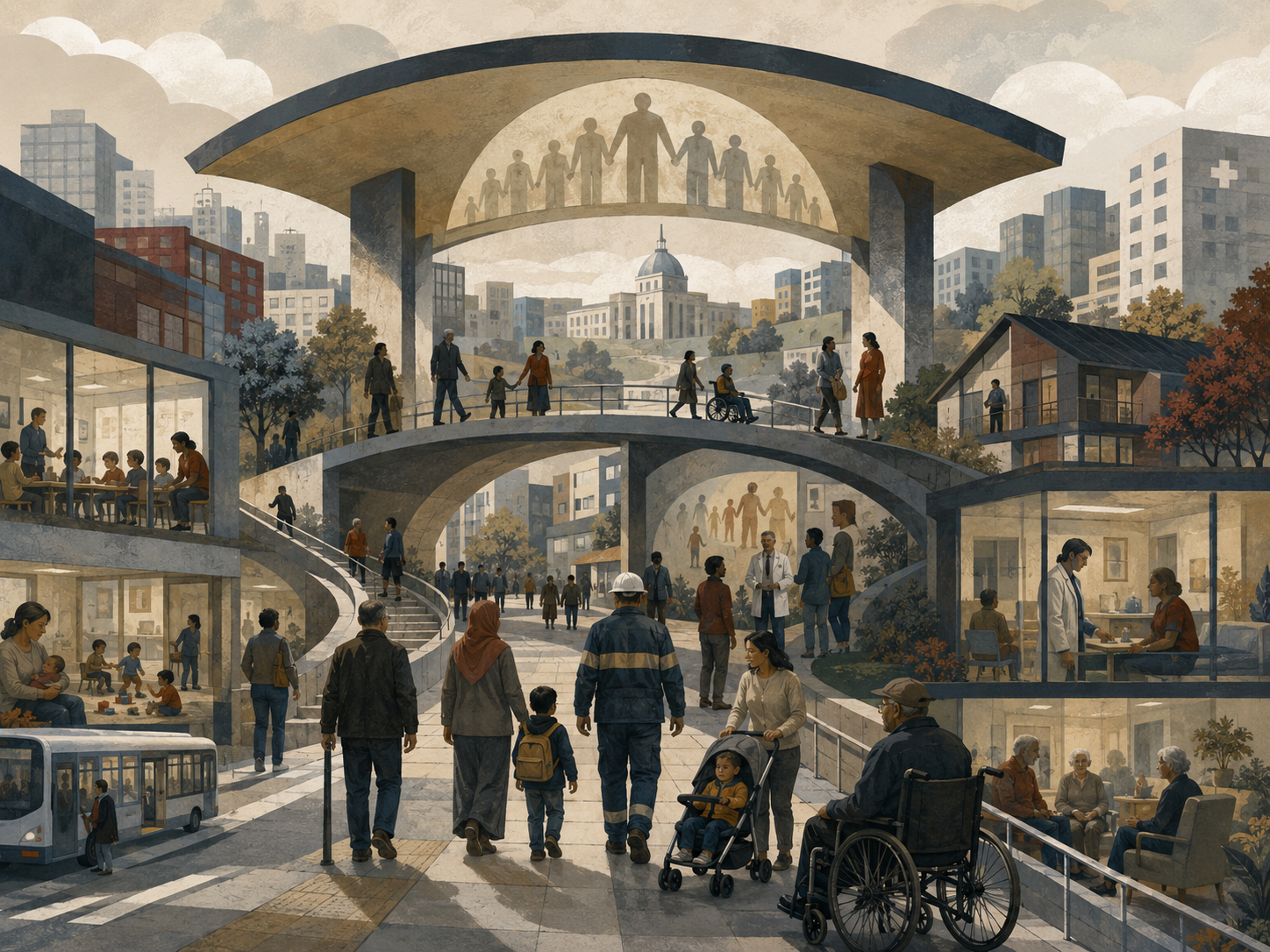
Within a sustainable systems framework, the welfare state and social protection should be understood not only as instruments of redistribution, but as systems for stabilizing capability, participation, and long-horizon resilience. A society may generate growth while leaving large portions of the population exposed to ill health, unstable work, unaffordable care, disability, housing insecurity, or old-age poverty. The deeper question is whether public institutions convert economic capacity into durable social security, or whether market success coexists with chronic vulnerability beneath the surface.
Why This Topic Matters
The welfare state matters because market societies distribute risk unevenly. Illness, unemployment, caregiving, disability, old age, wage instability, and housing insecurity do not arrive under conditions of equal household wealth or equal access to support. Without public protection, ordinary life risks can translate quickly into long-term exclusion.
Social protection also changes how people relate to markets. Workers are in a different position when unemployment does not immediately mean destitution. Families are in a different position when illness does not automatically become financial ruin. Older people are in a different position when retirement is not reducible to prior private wealth alone. Protection therefore changes not only outcomes, but bargaining conditions and social time horizons.
These systems also shape legitimacy. A political order appears more credible when people believe that citizenship carries some protection against predictable forms of hardship. Where institutions offer little security, insecurity can become privatized, and social membership itself begins to feel conditional on continued earning power.
For that reason, the welfare state is not only about public spending. It is about how a society organizes security, reciprocity, and continuity under conditions of interdependence.
It also asks whether freedom is understood narrowly as non-interference or more substantively as the ability to live without being constantly exposed to preventable collapse.
Social protection matters for economic dynamism as well. People are often more able to retrain, move, change jobs, care for family, start enterprises, and search for suitable work when a single failure does not destroy the household’s foundation.
Within sustainable systems, welfare institutions are therefore resilience infrastructure. They reduce the chance that personal hardship, recession, climate shock, illness, care burden, or displacement becomes a cascading social crisis.
What the Welfare State Is
The welfare state refers to the ensemble of public institutions through which societies provide income security, healthcare, education, pensions, family support, labor-market protection, housing assistance, disability support, and other forms of social provision. It is not a single program, nor does it look identical across countries. Some welfare states rely more heavily on cash transfers, others on services; some emphasize universal provision, others means-tested assistance; some are highly centralized, others fragmented across levels of government and employment status.
What makes these arrangements part of a welfare state is not simply that they spend money. It is that they treat the protection of social wellbeing as a public responsibility rather than as a matter left entirely to private markets, family resources, employer discretion, or charitable relief.
The welfare state also includes institutions people do not always recognize as welfare institutions: public education, subsidized childcare, wage regulation, housing support, disability services, active labor-market policy, public health systems, and social insurance all shape the lived security of households across the life course.
A serious account therefore treats the welfare state as an institutional settlement about the relationship among markets, families, communities, employers, and public authority.
It is, in effect, a society’s answer to the question of how much insecurity should be socialized and how much should remain privately borne.
The welfare state also defines the practical content of citizenship. It reveals whether membership in a political community includes claims to care, income security, health, education, and protection against ordinary risks, or whether social membership remains thin when earnings disappear.
For economic systems analysis, this matters because the welfare state is one of the major ways societies convert production into security. Without that conversion, growth may coexist with permanent household fragility.
What Social Protection Is
Social protection refers to the policies and systems designed to reduce and prevent poverty, vulnerability, and exclusion across the life cycle. It typically includes social insurance, social assistance, labor protections, and access to essential services. In some contexts, it also includes public works, food support, child benefits, disability protection, emergency relief, and climate- or disaster-responsive assistance.
The concept is useful because it is slightly broader and more operational than the welfare state. It focuses directly on the mechanisms through which societies pool risk, stabilize households, and protect capability under conditions of uncertainty.
Social protection also covers both contributory and non-contributory arrangements. Some benefits are financed through payroll contributions and linked to employment histories; others are tax-financed and designed to reach people regardless of formal labor-market attachment.
A strong framework therefore understands social protection as the practical machinery through which social membership is defended against predictable and unpredictable shocks.
Its central concern is not charity, but the organized reduction of avoidable vulnerability across time.
This distinction matters because protection can exist formally while failing in practice. A program may appear in law but reach too few people, pay too little, impose excessive administrative burden, or exclude informal workers and marginalized communities.
Social protection should therefore be evaluated by real protection: coverage, adequacy, accessibility, dignity, timeliness, and whether support actually prevents shocks from becoming long-term deprivation.
From Poor Relief to Social Citizenship
Historically, systems of protection often began as poor relief: narrowly targeted, morally conditional, and frequently stigmatized support for those deemed unable to support themselves. Over time, many societies moved toward broader conceptions of social insurance and social citizenship, in which protection became less discretionary and more closely tied to membership in the political community.
This shift changed the meaning of support. Relief framed insecurity as deviance or failure requiring control. Social citizenship framed protection as part of a legitimate social claim arising from participation in an interdependent economy and polity.
The move was never complete or uncontested. Many welfare systems still mix universal rights, employment-linked entitlements, and means-tested residual support, often with tensions among them.
A serious account therefore sees welfare-state development as a historical struggle over whether protection should be treated as benevolence, earned status, or citizenship right.
That distinction still shapes contemporary debates about deservingness, stigma, and the moral basis of public provision.
The older poor-relief logic has not disappeared. It often returns through surveillance-heavy benefit systems, punitive eligibility rules, work tests, sanctions, and public narratives that divide people into worthy and unworthy recipients.
Social citizenship, by contrast, begins from a different assumption: that vulnerability is a normal feature of human life, and that a decent society builds institutions to protect people without requiring humiliation as the price of support.
Insurance, Assistance, and Universal Provision
Most systems of social protection combine three broad logics: social insurance, social assistance, and universal provision. Social insurance pools risk across contributors, often through payroll-based systems linked to employment. Social assistance targets households judged to be in need, usually through means-tested support. Universal provision offers benefits or services to broad populations as a matter of common entitlement.
Each logic addresses a different problem. Insurance links protection to participation in labor markets and can generate political legitimacy through contributory reciprocity. Assistance directs resources toward severe need but may carry stigma or administrative burden. Universal provision reduces exclusion and often builds stronger common systems, though it requires broader fiscal commitment.
No welfare state is purely one type. The real question is how these logics are combined, and what consequences follow for coverage, dignity, administrative simplicity, political durability, and social cohesion.
A serious framework therefore treats welfare architecture as a design problem rather than an abstract ideological choice between state and market.
The structure of provision affects not only who receives support, but how support is experienced: as a right, a contingency, an earned claim, or a degrading last resort.
These design choices matter especially for people outside stable formal employment. Systems built mainly around payroll contributions can leave informal workers, unpaid caregivers, disabled people, migrants, and precarious workers insufficiently protected.
An inclusive welfare architecture therefore needs both insurance and solidarity: systems that reward contribution without abandoning people whose work, care, or exclusion does not fit neat formal categories.
Life-Course Risk and the Logic of Protection
Social protection is easiest to understand when viewed through life-course risk. Human beings predictably move through stages of dependency, learning, employment, caregiving, illness, aging, and death. In addition, they face contingencies such as job loss, disability, family breakdown, displacement, and crisis. The welfare state exists in large part because private households cannot reliably insure all of these risks on their own.
Many of these risks are not individual failures. They are ordinary features of embodied and social life. Childhood requires support. Illness interrupts work. Old age changes earnings capacity. Caregiving takes time. Labor markets fluctuate. Any serious social order must decide how these realities are to be governed.
The logic of protection is therefore not exceptional. It is built into the ordinary reproduction of society. Public systems spread costs across populations and across time so that predictable dependence does not automatically become destitution.
A strong account of the welfare state therefore begins with interdependence rather than with isolated individuals confronting risk alone.
Social protection exists because life is structured by vulnerability before it is structured by autonomy.
This insight changes how welfare is interpreted. Protection is not a reward for failure. It is a recognition that households, workers, children, disabled people, caregivers, and older people move through conditions that markets alone do not protect fairly or reliably.
A life-course approach also shows why fragmented systems fail. If childhood, education, work, illness, caregiving, unemployment, disability, and old age are treated as disconnected policy problems, households experience gaps precisely at the transitions where protection is most needed.
Healthcare, Pensions, and Income Security
Healthcare and pensions are among the most visible pillars of the welfare state because they address two of the largest risks households face: illness and old age. Without collective arrangements, both can produce extreme insecurity even in otherwise prosperous societies.
Healthcare systems matter not only because they improve health outcomes, but because they determine whether sickness becomes impoverishment. Pensions matter not only because they support older adults, but because they reduce dependency, stabilize consumption, and lessen the degree to which old-age security depends entirely on family wealth or continuous high earnings during working life.
Income security also extends beyond these areas. Disability protection, survivor benefits, sick pay, child benefits, minimum-income supports, and housing assistance help keep temporary or permanent shocks from becoming irreversible social exclusion.
A serious framework therefore treats income security as one of the main ways societies convert economic capacity into social continuity.
Where such systems are weak, vulnerability accumulates quietly; where they are strong, ordinary risks are less likely to become permanent rupture.
These systems also shape household planning. People can invest, learn, care, move, retire, and participate differently when illness, age, or disability do not immediately threaten destitution.
For sustainable systems, this matters because public health, old-age security, and disability protection are not only expenditures. They are part of the institutional foundation that allows a society to remain stable, humane, and adaptive across demographic and economic change.
Unemployment Protection, Labor Markets, and Stabilization
Unemployment protection sits at the intersection of social justice and macroeconomic stabilization. It supports households during job loss, preserves purchasing power during downturns, and reduces the pressure to accept immediately any work under any terms simply to avoid collapse.
This changes labor-market dynamics. Workers with no fallback are in a weaker bargaining position than workers protected against immediate destitution. Unemployment benefits and reemployment systems therefore affect wage-setting, job quality, search behavior, and the distribution of power between labor and employers.
These protections also stabilize economies. When downturns reduce income broadly, unemployment support helps prevent deeper contractions in consumption and demand. Social protection therefore operates not only at the household level, but as part of macroeconomic resilience.
A serious account thus treats unemployment protection as more than a transfer. It is part of how societies govern labor-market risk and cyclical instability.
It also reveals whether a society treats job loss as a private disaster or as a collective condition that calls for shared adjustment.
Unemployment protection also affects matching quality. When people have time to search, train, and transition, they are less likely to be forced into the first available low-quality job that may trap them in lower productivity and insecurity.
In a resilient economy, unemployment systems should therefore connect income support, training, placement, childcare, transport, and regional development rather than operating as isolated temporary relief.
Family Policy, Care Systems, and Social Reproduction
Family policy and care systems are central to the welfare state because economies depend on work that markets do not fully price or organize well: raising children, caring for older adults, supporting disability, maintaining households, and reproducing the labor force across generations.
Child benefits, parental leave, childcare, elder care, disability services, and care-related supports shape whether households can combine earning, caregiving, and social participation without extreme strain. Where care systems are weak, the burden is pushed back onto families, often unevenly onto women, and inequality deepens through time and labor-market penalties.
Care policy therefore affects not only private family life, but workforce participation, fertility decisions, gender equality, child development, disability inclusion, elder wellbeing, and long-run social sustainability.
A serious framework treats care as economic infrastructure rather than as a private afterthought.
Without care systems, the welfare state remains incomplete because it leaves one of the central tasks of social reproduction under-supported and unevenly distributed.
This matters for economic systems because unpaid care is not outside the economy. It is one of the foundations on which the visible economy depends.
A welfare state that supports care directly is therefore not merely compensating families. It is strengthening the social infrastructure through which labor, health, learning, and intergenerational capability are reproduced.
Redistribution, Risk Pooling, and Social Cohesion
The welfare state redistributes not only income, but risk. Taxation, transfers, and services move resources across classes, generations, household types, health states, employment states, and points in the life cycle. That redistribution is often contested, but it is also part of what makes complex societies governable.
Risk pooling matters because few people remain permanently healthy, fully employed, free of care obligations, and financially secure across the whole of life. People move through different dependency states. Social protection makes that movement less punitive by sharing costs that would otherwise be borne privately and unevenly.
Redistribution also supports cohesion. A society in which households face radically different exposure to illness, unemployment, childrearing costs, disability, or old-age poverty is likely to generate deeper insecurity and weaker common identification.
A strong account therefore sees redistribution not only as a moral transfer, but as a practical means of sustaining a shared social order under conditions of unequal exposure to hardship.
Social cohesion, in this sense, is built partly through institutions that prevent ordinary risks from sorting people into radically unequal degrees of security.
Risk pooling also changes the meaning of reciprocity. People contribute when able and draw support when vulnerable, not because everyone faces the same risks at the same time, but because everyone is embedded in life-course vulnerability.
The welfare state therefore creates a temporal community: people at different life stages and risk states are linked through institutions that recognize dependence as a normal feature of social life.
Targeting Versus Universalism
One of the classic design questions in social policy is whether benefits should be targeted narrowly to the poorest or provided more universally. Targeting can conserve fiscal resources and direct aid toward severe need. Universalism can reduce stigma, improve take-up, simplify administration, and build broader political support for public systems.
The tradeoff is not merely technical. Highly targeted systems may appear efficient while missing eligible people, imposing high administrative burdens, or politically isolating the poor. Universal systems may be more expensive, but they can create stronger common institutions and reduce the gap between formal entitlement and practical access.
In practice, most welfare states combine elements of both. The more important question is how targeting and universalism are balanced, and whether that balance widens dignity and coverage or produces residual systems of last resort.
A serious framework therefore avoids simplistic contrasts. It asks which forms of provision best reduce deprivation while maintaining political legitimacy, administrative practicality, fiscal sustainability, and social inclusion.
The design choice is ultimately about what kind of social membership a society wants its protective institutions to express.
Targeting can be useful where needs are sharply concentrated, but the administrative machinery of targeting must not become a barrier that consumes the benefit it is meant to deliver.
Universalism, meanwhile, should not be confused with lack of redistribution. Universal services financed progressively can be deeply redistributive because they reduce dependence on private purchasing power for essential goods.
Welfare States, Work Incentives, and the Politics of Deservingness
Debates over the welfare state often revolve around work incentives, dependency, and deservingness. Critics worry that income support reduces labor supply or weakens personal responsibility. Defenders respond that insecurity itself undermines labor-market participation, health, caregiving, training, and long-term capability, and that badly designed labor markets can be more corrosive than income protection.
These debates reveal the moral language through which protection is judged. Some systems distinguish sharply between the deserving and undeserving poor, the contributor and the non-contributor, the worker and the dependent. Others begin from the assumption that social life necessarily includes periods of dependence, care, and vulnerability that no moralized distinction can eliminate.
Work incentives do matter, but they depend on system design. Supports paired with childcare, health access, training, transport, and realistic labor-market opportunity function differently from supports delivered into systems of weak services and unstable work.
A serious account therefore treats the politics of deservingness as part of welfare-state design rather than as external rhetoric alone.
How a society talks about support often shapes who can access it without shame, friction, or exclusion.
The politics of deservingness also affects administrative design. A system built around suspicion will tend to require more monitoring, sanctions, verification, and burden. A system built around citizenship will tend to emphasize access, dignity, and continuity.
The deeper question is whether a society treats protection as an exception to normal economic life or as part of the institutional foundation that makes participation possible.
Fiscal Capacity, Taxation, and the Financing of Protection
The welfare state depends on fiscal capacity. Social protection cannot be sustained without reliable revenue, administrative competence, and political willingness to finance common provision across time. Taxation is therefore not an external issue to welfare policy; it is one of its foundations.
How systems are financed matters greatly. Payroll contributions, general taxation, earmarked funds, consumption taxes, and wealth or income taxes distribute burdens differently across groups and economic activities. Some financing structures reinforce solidarity more effectively than others; some are more regressive; some are more vulnerable to labor-market fragmentation or demographic change.
Fiscal capacity also affects quality. Thinly financed systems may formally exist while delivering weak benefits, inconsistent services, long delays, or regional disparities that undermine trust and actual protection.
A serious framework therefore treats taxation, administration, and benefit design as one institutional problem rather than as separate technical domains.
Protection is only as durable as the political and fiscal structures willing to support it in ordinary times as well as in crisis.
Fiscal capacity also includes administrative capacity. A government may legally promise protection but fail to deliver it if registration systems, payment infrastructure, staffing, appeals, data systems, and local institutions are weak.
A sustainable welfare state therefore requires more than generosity in principle. It requires durable financing, reliable administration, public legitimacy, and a tax system capable of supporting shared protection without undermining the social basis of consent.
Welfare Regimes, Varieties, and Institutional Design
Welfare states vary widely in how they organize protection. Some systems rely heavily on earnings-related insurance linked to employment status. Others emphasize universal services and flatter benefit structures. Others rely more on means-tested assistance and market provision, with public intervention concentrated on those who fall below specific thresholds.
These differences shape lived experience. Two countries with similar aggregate spending can produce very different levels of dignity, simplicity, equality, and security depending on how access is structured and how strongly services are integrated.
Institutional design also matters because welfare states interact with labor markets, housing systems, family structures, health systems, taxation, and political cultures. A program that works well in one setting may function differently in another if surrounding institutions are weaker or more unequal.
A strong account therefore compares welfare arrangements not only by size, but by structure, accessibility, adequacy, and the forms of social life they support.
The real question is less whether a state is large or small than what kind of security and dependence its institutional mix produces.
Regime design also affects political durability. Universal systems may create broader constituencies; narrowly targeted systems may face weaker support; employment-linked systems may exclude those outside formal work; market-heavy systems may reproduce inequality through private purchasing power.
For economic systems analysis, the key is to examine how the full institutional mix distributes risk, time, dignity, and capability across the life course.
Social Protection in Lower-Income and Fragile Contexts
In lower-income and fragile contexts, social protection often operates under sharper fiscal constraints, larger informal sectors, weaker administrative infrastructure, and greater exposure to shocks. Yet these conditions can make protection more, not less, essential.
Where formal employment is limited, contributory insurance alone cannot reach enough people. Tax-financed transfers, school feeding, public works, basic pensions, health protection, child benefits, and emergency support often become central. In fragile or conflict-affected settings, social protection may also help preserve basic institutional continuity.
The challenge is not simply scarcity, but system design under constraint. Identification systems, payment mechanisms, local administrative capacity, political trust, and coordination with health, education, and humanitarian services all shape whether protection reaches people reliably.
A serious framework therefore avoids treating strong welfare institutions as a luxury of already rich states.
Protection can be developmental in lower-income settings precisely because it reduces the volatility and exclusion that otherwise block longer-term capability-building.
This also means that social protection should be connected to development strategy. Transfers can stabilize households, but durable inclusion also requires health systems, schools, infrastructure, labor-market pathways, food systems, and local administrative capacity.
In fragile contexts, the ability to deliver protection fairly and reliably may itself become a source of institutional trust, especially where the state’s presence has otherwise been experienced through neglect, violence, or extraction.
Digital Administration, Automation, and Access
Social protection is increasingly administered through digital systems: online applications, platform-based benefits management, automated eligibility checks, direct digital payments, identity databases, and data-sharing across agencies. These changes can improve speed, reduce leakage, and widen reach, but they can also create new barriers.
Digital administration works differently for households with reliable broadband, devices, literacy, stable addresses, documentation, and formal identity than for those without them. Automated systems can reduce discretion, but they can also harden errors, obscure appeal processes, and shift the burden of proof onto claimants navigating opaque interfaces.
The issue is therefore not simply modernization. It is whether digitization widens access and dignity or makes support more conditional on technical competence, data visibility, and bureaucratic legibility.
A serious account treats administrative design as part of the substance of social protection, not merely its delivery mechanism.
If people cannot access benefits without overcoming major technological hurdles, formal entitlement and practical protection begin to diverge sharply.
Automation must therefore be evaluated by error, appeal, transparency, accessibility, language access, human support, privacy, and the treatment of edge cases. Efficiency is not enough if vulnerable people are excluded more quietly.
A rights-based digital welfare system should make access easier, not make poverty harder to prove.
Climate Shocks, Crisis, and Adaptive Social Protection
Climate shocks, pandemics, inflation surges, conflict, and supply disruptions have made visible how central social protection is to resilience. Systems built only for normal times struggle when crises arrive at scale. Adaptive social protection aims to respond more flexibly to systemic shocks while preserving continuity in ordinary provision.
This means protection must be able to scale, coordinate across agencies, and reach households whose vulnerability rises suddenly under crisis conditions. It also means that climate adaptation cannot be treated only as infrastructure or energy policy; it has a social-protection dimension as well.
Households facing heat stress, crop failure, displacement, disaster loss, or food-price shocks need institutions capable of reducing the long-term scarring effects of crisis. Without this, shocks compound into deeper poverty and territorial abandonment.
A serious framework therefore places social protection inside broader resilience strategy.
A welfare state that cannot adapt to systemic disturbance may remain adequate in ordinary times yet fail precisely when social protection is most needed.
Adaptive protection requires pre-positioned registries, flexible financing, trusted local institutions, inclusive payment systems, rapid eligibility expansion, and safeguards against excluding people whose vulnerability is newly created by crisis.
In a climate-constrained world, social protection is therefore part of adaptation infrastructure. It helps prevent environmental shocks from becoming permanent social and developmental losses.
Historical Lessons from Welfare State Development
Historically, welfare states were not built all at once. They emerged through gradual layering: social insurance, labor law, pensions, health systems, family benefits, unemployment protection, public education, and later expansions or retrenchments shaped by conflict, crisis, ideology, and institutional experimentation.
No single path has been universal. Some welfare states developed through labor movements and social-democratic compromise; others through conservative state-building, wartime mobilization, developmental strategies, religious and civic institutions, or hybrid settlements. What recurs is that strong systems usually depended on political coalitions able to treat security as a public good rather than as a private residual.
History also shows that welfare institutions can erode. Fiscal crises, austerity, privatization, demographic change, labor-market fragmentation, and political shifts can narrow coverage, increase conditionality, or hollow out quality while leaving formal structures in place.
A historical perspective therefore treats the welfare state as something built, contested, and revised rather than as a fixed destination.
Its durability depends not only on economic resources, but on whether societies continue to treat shared protection as part of what political community is for.
Historical analysis also shows that welfare states are not simply costs of prosperity. In many cases, they helped create the conditions for broader prosperity by stabilizing households, widening education, improving health, supporting demand, and making labor-market participation less fragile.
The lesson is not that one model should be copied everywhere. It is that social protection must be institutionally built, politically defended, and continually adapted to new forms of work, care, risk, technology, demography, and ecological disruption.
The Welfare State and Sustainable Systems
Within sustainable systems, the welfare state should be understood as a core institution of resilience. A society is not socially sustainable if large portions of its population remain one illness, one layoff, one caregiving burden, one disability, one rent increase, or one climate shock away from instability. Protection is part of how a society preserves continuity under ordinary strain and extraordinary shock.
This changes the meaning of social policy. Welfare institutions are not only redistributive add-ons to growth. They are part of the broader system that allows people to participate in work, education, care, and civic life without constant fear of collapse.
Sustainable systems therefore require more than growth and more than narrow anti-poverty relief. They require institutions that widen security, reduce preventable vulnerability, and allow households to navigate the life course with workable levels of stability and dignity.
In this sense, the welfare state becomes a systems question. It asks whether economic capacity is being translated into public security and durable social membership, or whether prosperity coexists with structurally unmanaged risk.
This also means that sustainability should not be framed only in environmental or fiscal terms. A society may keep deficits low and still become less sustainable if insecurity, exclusion, and unmanaged care burdens quietly intensify beneath the surface.
Social protection is therefore part of the moral and institutional foundation of sustainable development. It helps societies absorb shocks without sacrificing human capability, democratic trust, and social continuity.
The deepest question is whether an economic system treats security as a private commodity or as a shared foundation for freedom. The welfare state answers that question through institutions.
How Welfare-State and Social-Protection Systems Should Be Judged
Welfare states and social-protection systems should not be judged only by public spending totals. A broader economic systems framework asks whether protection is adequate, accessible, dignified, fiscally durable, administratively reliable, and capable of reducing vulnerability across the life course and under crisis conditions.
| Dimension | Narrow Question | Systems Question |
|---|---|---|
| Social Spending | How much does the state spend? | Does spending translate into real protection, service quality, accessibility, and reduced vulnerability? |
| Coverage | Who is formally eligible? | Who is actually reached, who is excluded, and what barriers prevent access? |
| Adequacy | Are benefits provided? | Do benefits protect living standards enough to prevent hardship, poverty, or irreversible loss? |
| Replacement Rates | How much income is replaced? | Does protection preserve continuity during unemployment, sickness, disability, caregiving, or old age? |
| Access | Can people apply? | Are systems simple, dignified, timely, appealable, multilingual, digitally accessible, and supported by human help? |
| Care | Are families responsible? | Do public systems support childcare, elder care, disability care, paid leave, and care workers? |
| Labor Markets | Do benefits affect work incentives? | Do protections improve bargaining power, job matching, training, and freedom from desperate work? |
| Fiscal Capacity | Can programs be funded? | Are taxation, administration, compliance, and political support strong enough to sustain protection? |
| Digital Administration | Are systems modernized? | Do digital systems widen access and dignity, or automate exclusion, errors, surveillance, and appeal barriers? |
| Resilience | Can programs operate normally? | Can protection scale during climate shocks, pandemics, displacement, inflation, and systemic crises? |
This framework prevents a common mistake: treating welfare-state quality as a simple function of spending level. Spending matters, but structure matters as well. A system may spend heavily while excluding informal workers, underpaying benefits, fragmenting services, or imposing high administrative burden. Another may spend less but deliver certain protections efficiently and with dignity. The serious question is how spending, design, access, and social outcomes fit together.
The central question is therefore not simply whether a welfare state is large or small. The deeper question is whether social protection converts collective economic capacity into real security, capability, and social membership across the life course.
Mathematical Lens
Mathematics can clarify the welfare state and social protection by making social spending, disposable income, coverage, replacement rates, protection strength, vulnerability, and vulnerability reduction explicit. These equations do not determine what level of protection is just, but they help show why spending totals alone are insufficient.
1. Social Spending Ratio
SSR = \frac{S}{Y}
\]
Interpretation: The social spending ratio \(SSR\) compares total social spending \(S\) with total output or income \(Y\). It helps show the scale of public social provision relative to the economy, though it does not capture institutional quality by itself.
2. Disposable Income
DI = Market\ Income – Taxes + Transfers
\]
Interpretation: Disposable income \(DI\) captures the idea that welfare states alter final living standards rather than merely record market outcomes.
3. Coverage Rate
CR = \frac{Covered\ Population}{Target\ Population}
\]
Interpretation: The coverage rate \(CR\) shows how many people are actually reached relative to those the system is meant to protect. Coverage gaps are central to social-protection analysis.
4. Replacement Rate
RR = \frac{Benefit}{Previous\ Earnings}
\]
Interpretation: The replacement rate \(RR\) shows how far benefits protect prior living standards during unemployment, sickness, disability, or retirement.
5. Protection Strength
PS = f(Contributions, Tax\ Financing, Universal\ Access, Administrative\ Reach)
\]
Interpretation: Protection strength \(PS\) depends on financing, institutional design, universality, and administrative reach. A system can be formally generous but weak if it fails to reach people reliably.
6. Vulnerability
V = f(Income\ Insecurity, Health\ Risk, Care\ Burden, Housing\ Cost, Service\ Access)
\]
Interpretation: Vulnerability \(V\) reflects the combined risks households face. Stronger welfare institutions reduce vulnerability by changing several of these factors at once.
7. Vulnerability Reduction
VR = V_{before} – V_{after}
\]
Interpretation: Vulnerability reduction \(VR\) measures how much social protection reduces exposure to hardship after taxes, transfers, services, and insurance are taken into account.
8. Adaptive Protection Capacity
APC = f(Scale\text{-}Up\ Capacity, Payment\ Speed, Registry\ Quality, Local\ Delivery, Benefit\ Adequacy)
\]
Interpretation: Adaptive protection capacity \(APC\) measures whether social-protection systems can respond quickly and fairly during climate shocks, pandemics, displacement, inflation, or other systemic crises.
9. Practical Interpretation
The mathematical lens clarifies several structural points. Welfare states change final outcomes, not only market incomes. Coverage matters as much as formal program existence. Replacement rates shape how well systems protect continuity. Risk pooling depends on financing, reach, and access. Social protection can reduce multiple forms of vulnerability at once. Adaptive capacity matters because systems must function during crisis, not only during normal administrative conditions.
Formalization helps clarify mechanism, but it does not determine what level of protection is just, which risks should be socialized, or how the burden of financing should be shared. Those remain institutional, historical, ethical, and political questions.
Python Workflow: The Welfare State and Social Protection
Python is useful for turning welfare-state and social-protection concepts into reproducible calculations. The following compact workflow models social spending, disposable income, coverage, replacement, protection strength, and vulnerability reduction.
# The Welfare State and Social Protection
# Simple Python workflow

import pandas as pd

# Social spending ratio
social_spending = 320
output = 1500
social_spending_ratio = social_spending / output
print("Social spending ratio:", round(social_spending_ratio, 3))

# Disposable income
market_income = 52
taxes = 9
transfers = 11
disposable_income = market_income - taxes + transfers
print("Disposable income:", disposable_income)

# Coverage rate
covered_population = 780
target_population = 1000
coverage_rate = covered_population / target_population
print("Coverage rate:", round(coverage_rate, 3))

# Replacement rate
benefit = 24
previous_earnings = 40
replacement_rate = benefit / previous_earnings
print("Replacement rate:", round(replacement_rate, 3))

# Effective protection score
take_up_rate = 0.78
administrative_burden = 0.30
stigma_cost = 0.18
benefit_adequacy = 0.62

effective_protection_score = (
    0.24 * coverage_rate
    + 0.22 * replacement_rate
    + 0.20 * take_up_rate
    + 0.16 * (1 - administrative_burden)
    + 0.10 * (1 - stigma_cost)
    + 0.08 * benefit_adequacy
)

print("Effective protection score:", round(effective_protection_score, 3))

# Stylized vulnerability score
income_insecurity = 0.60
health_risk = 0.55
care_burden = 0.58
housing_cost_pressure = 0.70
service_access = 0.45

vulnerability_before = (
    0.24 * income_insecurity
    + 0.22 * health_risk
    + 0.20 * care_burden
    + 0.18 * housing_cost_pressure
    + 0.16 * (1 - service_access)
)

# Protection reduces vulnerability through income support, services, and insurance
service_improvement = 0.30
income_support_effect = 0.24
insurance_effect = 0.18

vulnerability_after = vulnerability_before * (
    1 - service_improvement - income_support_effect - insurance_effect
)

vulnerability_reduction = vulnerability_before - vulnerability_after

print("Vulnerability before:", round(vulnerability_before, 3))
print("Vulnerability after:", round(vulnerability_after, 3))
print("Vulnerability reduction:", round(vulnerability_reduction, 3))

df = pd.DataFrame({
    "Metric": [
        "Social Spending Ratio",
        "Disposable Income",
        "Coverage Rate",
        "Replacement Rate",
        "Effective Protection Score",
        "Vulnerability Before Protection",
        "Vulnerability After Protection",
        "Vulnerability Reduction"
    ],
    "Value": [
        social_spending_ratio,
        disposable_income,
        coverage_rate,
        replacement_rate,
        effective_protection_score,
        vulnerability_before,
        vulnerability_after,
        vulnerability_reduction
    ]
})

print(df)
This workflow is useful because it connects welfare-state scale with coverage, adequacy, administrative access, stigma, and vulnerability reduction. It helps show why formal program existence is not enough: a system must actually reach people, replace enough income, reduce essential costs, and protect households against shocks.
The full GitHub repository expands this example into social spending scenarios, tax-transfer analysis, coverage gaps, replacement rates, welfare-regime comparisons, life-course risk, care-system support, fiscal capacity, targeting and universalism, digital administration, climate-shock response, adaptive social protection, SQL queries, R and Stata replication workflows, Julia simulations, and article-ready figures.
R Workflow: The Welfare State and Social Protection
R is useful for welfare-state summaries, social-protection tables, vulnerability comparisons, and publication-ready graphics. The following compact workflow performs the same social-spending, disposable-income, coverage, replacement, effective-protection, and vulnerability-reduction calculations in R.
# The Welfare State and Social Protection
# Simple R workflow

# Social spending ratio
social_spending <- 320
output <- 1500
social_spending_ratio <- social_spending / output
cat("Social spending ratio:", round(social_spending_ratio, 3), "\n")

# Disposable income
market_income <- 52
taxes <- 9
transfers <- 11
disposable_income <- market_income - taxes + transfers
cat("Disposable income:", disposable_income, "\n")

# Coverage rate
covered_population <- 780
target_population <- 1000
coverage_rate <- covered_population / target_population
cat("Coverage rate:", round(coverage_rate, 3), "\n")

# Replacement rate
benefit <- 24
previous_earnings <- 40
replacement_rate <- benefit / previous_earnings
cat("Replacement rate:", round(replacement_rate, 3), "\n")

# Effective protection score
take_up_rate <- 0.78
administrative_burden <- 0.30
stigma_cost <- 0.18
benefit_adequacy <- 0.62

effective_protection_score <- (
  0.24 * coverage_rate +
  0.22 * replacement_rate +
  0.20 * take_up_rate +
  0.16 * (1 - administrative_burden) +
  0.10 * (1 - stigma_cost) +
  0.08 * benefit_adequacy
)

cat("Effective protection score:", round(effective_protection_score, 3), "\n")

# Stylized vulnerability score
income_insecurity <- 0.60
health_risk <- 0.55
care_burden <- 0.58
housing_cost_pressure <- 0.70
service_access <- 0.45

vulnerability_before <- (
  0.24 * income_insecurity +
  0.22 * health_risk +
  0.20 * care_burden +
  0.18 * housing_cost_pressure +
  0.16 * (1 - service_access)
)

# Protection reduces vulnerability through income support, services, and insurance
service_improvement <- 0.30
income_support_effect <- 0.24
insurance_effect <- 0.18

vulnerability_after <- vulnerability_before * (
  1 - service_improvement - income_support_effect - insurance_effect
)

vulnerability_reduction <- vulnerability_before - vulnerability_after

cat("Vulnerability before:", round(vulnerability_before, 3), "\n")
cat("Vulnerability after:", round(vulnerability_after, 3), "\n")
cat("Vulnerability reduction:", round(vulnerability_reduction, 3), "\n")

summary_df <- data.frame(
  Metric = c(
    "Social Spending Ratio",
    "Disposable Income",
    "Coverage Rate",
    "Replacement Rate",
    "Effective Protection Score",
    "Vulnerability Before Protection",
    "Vulnerability After Protection",
    "Vulnerability Reduction"
  ),
  Value = c(
    social_spending_ratio,
    disposable_income,
    coverage_rate,
    replacement_rate,
    effective_protection_score,
    vulnerability_before,
    vulnerability_after,
    vulnerability_reduction
  )
)

print(summary_df)
This R workflow is deliberately compact for article readability. In the full repository, R reads structured household tax-transfer, social spending, program coverage, welfare-regime, life-course risk, care-system, fiscal-capacity, digital-administration, and adaptive-protection scenarios; calculates disposable income, service-adjusted income, social spending ratios, coverage rates, replacement rates, effective protection, care-system strength, digital access quality, fiscal capacity, and adaptive social-protection capacity; and visualizes how welfare-state design changes vulnerability.
Future Economic Systems articles can extend this foundation with social spending data, tax-benefit microdata, household surveys, pension adequacy indicators, unemployment insurance records, healthcare access metrics, childcare data, administrative burden measures, digital-access data, climate-shock exposure, and social-protection payment records.
GitHub Repository
The article body includes selected computational examples so the conceptual, institutional, and mathematical argument remains readable. The full repository contains the expanded research infrastructure: Python welfare-state and social-protection analysis, R program summaries, Stata applied social-policy replication workflows, SQL welfare scenario tables, Julia life-course and adaptive-protection simulations, social spending ratios, disposable income, coverage rates, replacement rates, welfare-regime strength, life-course risk, unemployment protection, pensions, healthcare, care systems, fiscal capacity, targeting, universalism, digital administration, climate shocks, adaptive social protection, documentation, reproducible sample data, and article-ready figures and tables.
Complete Code Repository
The full code distribution for this article, including selected article examples and advanced research-style computational scaffolding for social spending, tax-transfer analysis, disposable income, public-service adjustment, coverage gaps, replacement rates, social insurance, social assistance, universal provision, welfare regimes, life-course risk, care systems, fiscal capacity, digital administration, climate shocks, adaptive social protection, vulnerability reduction, reproducibility documentation, and cross-language economic analysis, is available on GitHub.
Conclusion
The welfare state and social protection are central to economic analysis because they show whether a society turns collective wealth into durable security across the life course. The key issue is not only whether people earn income in markets, but whether they can face illness, old age, unemployment, disability, care burdens, housing pressure, and crisis without losing the foundations of a stable life.
To understand an economic system seriously, one must therefore ask not only how much a state spends, but how protection is structured, who is covered, how easy systems are to access, how adequately they replace lost income or reduce private costs, and whether they widen dignity and participation rather than only managing visible distress. These questions reveal whether a society has built institutions capable of translating prosperity into resilience, or whether insecurity remains privatized beneath the surface of growth.
The serious study of welfare also requires moving beyond the idea that social protection is merely a cost. Welfare institutions are part of how societies stabilize labor markets, support care, protect health, maintain demand, reduce poverty, build human capability, and preserve social trust across risk and crisis.
In a sustainable economic system, the welfare state is not an afterthought. It is one of the institutions through which a society decides that life-course vulnerability should not become permanent exclusion. Its purpose is not only to relieve distress, but to make shared security, social membership, and practical freedom durable across time.
Related Reading
- Economic Systems
- Poverty, Capability, and Economic Inclusion
- Inequality, Redistribution, and Social Mobility
- Fiscal Policy, Taxation, and Public Investment
- Labor, Wages, Productivity, and the Social Organization of Work
- Growth, Development, and Structural Transformation
- Debt, Dependency, and Global Financial Order
- Externalities, Public Goods, and Collective Provision
- Sustainable Development
- Institutions & Governance
- Risk & Resilience
Further Reading
- International Labour Organization (ILO) (2024). World Social Protection Report 2024–26: Universal social protection for climate action and a just transition. Available at: https://www.ilo.org/publications/flagship-reports/world-social-protection-report-2024-26-universal-social-protection-climate
- International Labour Organization (ILO) (n.d.). Social protection. Available at: https://www.ilo.org/topics-and-sectors/social-protection
- Organisation for Economic Co-operation and Development (OECD) (n.d.). Social spending. Available at: https://www.oecd.org/en/topics/social-spending.html
- Organisation for Economic Co-operation and Development (OECD) (n.d.). Social spending indicator. Available at: https://www.oecd.org/en/data/indicators/social-spending.html
- World Bank (n.d.). Social Protection & Jobs. Available at: https://www.worldbank.org/en/topic/socialprotectionandjobs
- World Bank (n.d.). The State of Social Protection Report. Available at: https://www.worldbank.org/en/topic/socialprotection/publication/the-state-of-social-protection-report
- United Nations Research Institute for Social Development (UNRISD) (2018). Global Approaches to Social Policy. Available at: https://cdn.unrisd.org/assets/library/papers/pdf-files/yeates2018.pdf
References
- International Labour Organization (ILO) (2024). World Social Protection Report 2024–26: Universal social protection for climate action and a just transition. Available at: https://www.ilo.org/publications/flagship-reports/world-social-protection-report-2024-26-universal-social-protection-climate
- International Labour Organization (ILO) (n.d.). Social protection. Available at: https://www.ilo.org/topics-and-sectors/social-protection
- Organisation for Economic Co-operation and Development (OECD) (n.d.). Social spending. Available at: https://www.oecd.org/en/topics/social-spending.html
- Organisation for Economic Co-operation and Development (OECD) (n.d.). Social spending indicator. Available at: https://www.oecd.org/en/data/indicators/social-spending.html
- World Bank (n.d.). Social Protection & Jobs. Available at: https://www.worldbank.org/en/topic/socialprotectionandjobs
- World Bank (n.d.). The State of Social Protection Report. Available at: https://www.worldbank.org/en/topic/socialprotection/publication/the-state-of-social-protection-report
- United Nations Research Institute for Social Development (UNRISD) (2018). Global Approaches to Social Policy. Available at: https://cdn.unrisd.org/assets/library/papers/pdf-files/yeates2018.pdf